
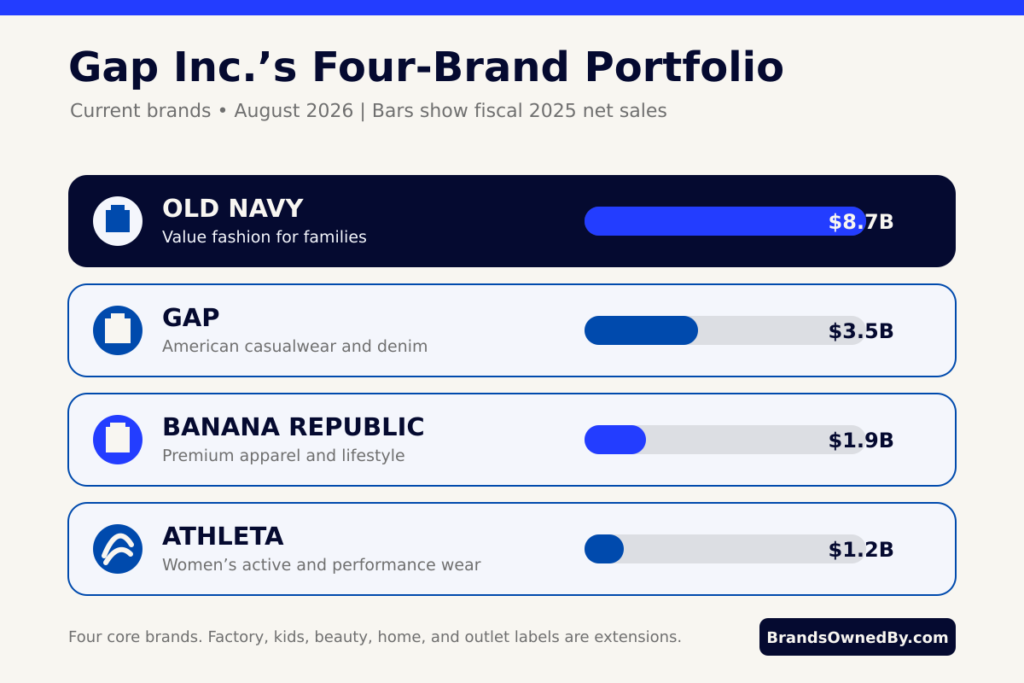
- Gap Inc. owns four core brands: Old Navy, Gap, Banana Republic, and Athleta.
- Old Navy is the largest brand, generating $8.7 billion in fiscal 2025 net sales, or roughly 57% of company revenue.
- Gap Factory, Banana Republic Factory, GapKids, babyGap, GapBody, and Athleta Girl are extensions of the four core brands. They are not separate companies.
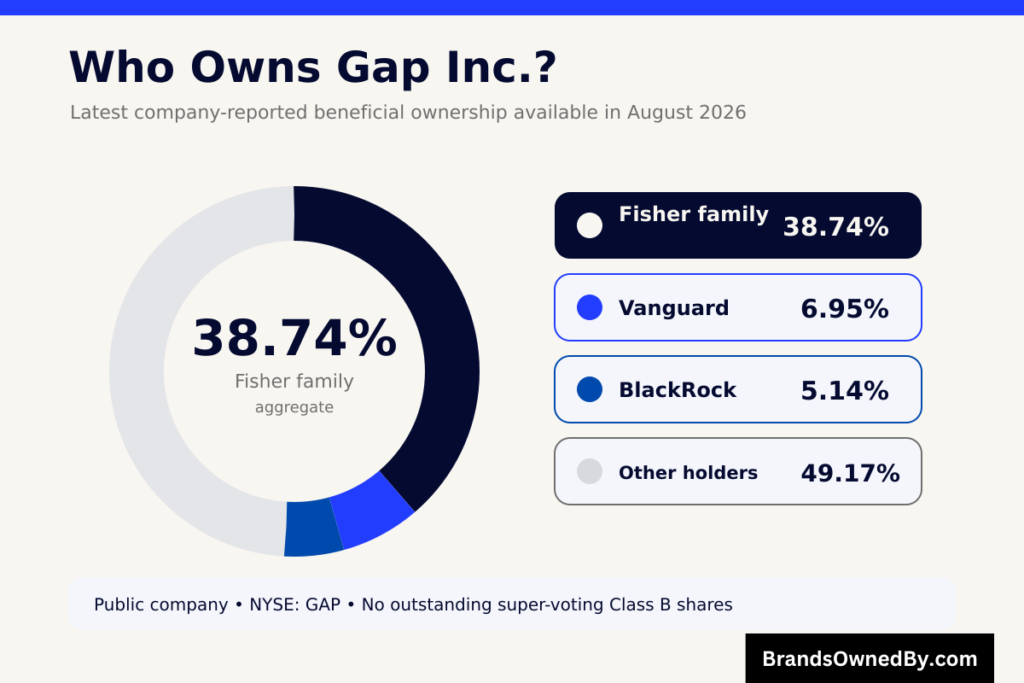
- The Fisher family beneficially owns an aggregate 38.74% of Gap’s outstanding shares, making it the company’s strongest shareholder bloc without holding an outright majority.
What companies does Gap own?
Well, Gap Inc. owns four core consumer brands as of August 2026: Old Navy, Gap, Banana Republic, and Athleta. Old Navy is the largest by sales. The namesake Gap brand is currently growing the fastest. Banana Republic serves the premium lifestyle market. Athleta focuses on women’s activewear. All four sit under the publicly traded Gap Inc., while the Fisher family remains its most influential shareholder group.
![What Companies Does Gap Own [Infographic]](https://brandsownedby.com/wp-content/uploads/2023/08/What-Companies-Does-Gap-Own-Infographic-683x1024.png)
Gap Founder(s)
Gap was not created as a broad fashion conglomerate. It began with a narrow retail problem. Donald and Doris Fisher wanted to make well-fitting jeans easier to find. That simple proposition became the foundation for a multibrand apparel group.
Donald Fisher
Donald “Don” Fisher was a real estate developer before entering retail. His difficulty finding Levi’s jeans in the right size helped reveal a gap in the market. Stores carried jeans, but the size selection was inconsistent.
Don turned that frustration into a retail concept built around depth of inventory. A customer could visit one store and compare more sizes and fits. That was a practical advantage at a time when denim distribution was fragmented.
He remained closely involved as the company expanded. His strengths were site selection, merchandising discipline, and scaling a repeatable store model. Those capabilities helped Gap move from one San Francisco location to a national chain.
Doris Fisher
Doris Fisher was an equal co-founder and equal early investor. Her role is sometimes understated when the company’s history is summarized around Don’s search for jeans. Gap’s own account describes the couple as equal partners.
Doris contributed to product selection, operations, and the development of the company’s accessible American style. She also served on Gap’s board for decades. The long-term family shareholding that still shapes Gap’s governance traces back to the ownership built by both founders.
The First Gap Store and Early Growth
Don and Doris opened the first Gap store at 1950 Ocean Avenue in San Francisco in 1969. It sold men’s Levi’s jeans alongside records and tapes. The music helped attract younger shoppers, while the denim selection addressed the practical fit problem.
The name referred to the “generation gap.” A second store opened in San Jose in 1970. Gap had 25 locations by its third anniversary. The first Gap-label merchandise appeared in 1974. The Gap Stores, Inc. then completed an initial public offering in 1976, selling 1.2 million shares at $18 each.
The move into private-label apparel was strategically important. It reduced dependence on Levi Strauss & Co. It also gave Gap more control over design, pricing, inventory, and brand identity.
List of Companies and Brands Owned by Gap
Gap Inc. describes itself as a house of four iconic American brands. Each brand is operated within the same public corporate group. Gap Inc. owns the intellectual property and consolidates the financial results. Some international locations are run by franchise partners, but those partners do not own the underlying brands.
Old Navy
Old Navy is Gap Inc.’s largest brand. Gap developed it internally and opened the first Old Navy store in Colma, California, in 1994. The concept was designed around family fashion at lower prices than the main Gap brand.
Old Navy reached $1 billion in annual sales within four years of opening. Its operating model emphasizes broad size coverage, high-volume categories, family shopping, and frequent seasonal promotions. Key departments include women’s, men’s, kids, baby, denim, activewear, and accessories.
The brand generated $8.7 billion in net sales during fiscal 2025. That represented about 56.6% of Gap Inc.’s consolidated revenue. First-quarter fiscal 2026 sales reached $2.0 billion and increased 1% from the prior year.
Gap Inc. considered separating Old Navy into an independent public company in 2019. It canceled that plan in January 2020. Old Navy therefore remains wholly controlled within Gap Inc.’s consolidated group.
Old Navy’s scale gives Gap Inc. purchasing volume and broad exposure to value-conscious households. For example, a slowdown in premium discretionary purchases may hurt Banana Republic while Old Navy continues to attract customers seeking lower price points.
Gap
Gap is both the original retail brand and the name used by the parent company. The brand sells casual apparel, denim, fleece, accessories, and lifestyle products for adults, children, and babies.
The Gap brand produced $3.5 billion in fiscal 2025 net sales. Sales increased 5%, while comparable sales rose 6%. Momentum continued into the first quarter of fiscal 2026. Net sales rose 10% to $796 million, making Gap the fastest-growing major brand in the portfolio during that quarter.
Gap Factory is the outlet and value channel for the Gap brand. GapKids, babyGap, GapBody, GapFit, Gap Home, and the newly expanded Gap Beauty offering are categories, extensions, or licensed programs. They should not be counted as separately owned companies.
This distinction matters in an ownership article. A shopper may see a dedicated Gap Factory website or a babyGap department. Legally and financially, those operations remain part of the Gap brand and Gap Inc. group.
Banana Republic
Banana Republic began as a safari-inspired retailer and catalog business. Mel and Patricia Ziegler founded it in 1978. Gap acquired the business in 1983 and later repositioned it as an upscale apparel and lifestyle brand.
Today, Banana Republic sells women’s and men’s clothing, accessories, footwear, and home products. Its assortment sits above Gap and Old Navy in price and presentation. The brand competes for customers who want polished workwear, occasion clothing, tailoring, and premium casual pieces.
Banana Republic generated $1.9 billion in fiscal 2025 net sales. That was down 1%, although comparable sales increased 3%. The difference reflects factors such as store changes and channel mix. First-quarter fiscal 2026 sales increased 1% to $431 million, with comparable sales up 2%.
Banana Republic Factory is the brand’s lower-priced outlet channel. It is not an independent company. Gap Inc. owns the core Banana Republic brand and uses company-operated stores, digital commerce, outlets, and franchise arrangements to reach different markets.
Athleta
Athleta was founded in 1998 as a women-focused performance and active-lifestyle business. Gap Inc. acquired it in 2008 for approximately $150 million. The first Athleta physical store opened in 2011, helping the catalog and digital brand become an omnichannel retailer.
Athleta sells activewear, swimwear, outerwear, travel clothing, and everyday performance products. It is the most specialized brand in Gap’s portfolio. Athleta Girl serves younger customers but remains a line within Athleta rather than a separate company.
The brand generated $1.2 billion in fiscal 2025 net sales. Sales fell 10%, and comparable sales fell 9%. The decline continued in the first quarter of fiscal 2026. Sales dropped 12% to $270 million, while comparable sales declined 11%.
Athleta is therefore both an opportunity and a risk for Gap Inc. The activewear category can support attractive long-term growth. However, product inconsistency and intense competition have weakened recent performance. Management is rebuilding the assortment and positioning rather than divesting the brand.
Former Gap-Owned Brands and Businesses
Gap’s current four-brand portfolio should not be confused with its historical holdings. Several names that appear in older articles are no longer owned or operated by Gap Inc.
Intermix was acquired in 2012 and sold to Altamont Capital Partners in 2021. Janie and Jack was acquired from Gymboree in 2019 and sold to Go Global Retail in 2021. Piperlime closed in 2015. The Hill City men’s performance brand was closed in 2020. Weddington Way was also shut down.
These exits show how the company narrowed its strategy. Gap Inc. is no longer trying to maintain a wide collection of smaller specialty concepts. Capital, creative leadership, supply-chain resources, and marketing are concentrated on four brands with established consumer awareness.
Who Owns Gap: Major Shareholders
Gap Inc. is a publicly traded company. Its common stock trades on the New York Stock Exchange under the ticker GAP. The company changed its ticker from GPS to GAP in August 2024. No parent corporation owns Gap Inc.
The ownership percentages below reflect Gap’s latest company-reported beneficial ownership table available in August 2026. That table measured ownership as of March 13, 2026. Fisher family percentages include overlapping trust and shared-control positions, so the three individual figures should not be added together. Gap calculated the family group’s non-duplicated aggregate position separately.
The Fisher Family
Robert J. Fisher, William S. Fisher, John J. Fisher, and Fisher-linked charitable entities beneficially owned 38.74% of Gap’s outstanding shares after duplicate holdings were removed. This is the cleanest measure of the family’s combined economic position.
The latest proxy separately reported William S. Fisher at 16.09%, Robert J. Fisher at 15.39%, and John J. Fisher at 14.73%. Those figures overlap because multiple family members share voting or dispositive authority over certain trusts, partnerships, and charitable holdings.
The family is not a single legal shareholder with one consolidated account. However, its aggregate position makes it Gap’s most influential ownership bloc. Robert and William Fisher also serve on the board, connecting the founding family’s investment with direct governance participation.
The Vanguard Group
Vanguard was listed as the largest outside institutional beneficial owner, with 25.39 million shares or 6.95% of the outstanding stock. Most of these shares are held through index funds, retirement funds, and other investment products for Vanguard clients.
Vanguard’s percentage does not mean it operates Gap’s stores or selects products. Its influence is primarily exercised through proxy voting on directors, compensation, governance proposals, and other shareholder matters.
BlackRock
BlackRock was listed with 18.78 million shares, equal to 5.14% of the outstanding stock. Like Vanguard, BlackRock generally holds shares through funds and client portfolios rather than as a strategic retail owner.
BlackRock can influence annual meeting outcomes through voting. It does not control day-to-day strategy. Its stake is also far smaller than the Fisher family’s combined position.
Other Institutions, Insiders, and Public Investors
The remaining shares are distributed among other investment managers, pension funds, company insiders, and individual investors. Those holdings change as funds rebalance and investors trade the stock.
No additional shareholder was listed above 5% in Gap’s 2026 beneficial ownership table. That leaves the Fisher family as the only ownership group with a position large enough to exert persistent, company-specific influence.
Competitor Ownership Comparison
Gap competes with retailers that use very different ownership models. Some rivals have a majority founder or family controller. Others have dispersed institutional ownership. These differences affect strategic patience, board accountability, succession, and exposure to activist investors.
Inditex
Inditex owns Zara, Pull&Bear, Massimo Dutti, Bershka, Stradivarius, Oysho, and Zara Home. Amancio Ortega controls 59.294% of Inditex through two holding companies.
That is a true majority position. Ortega can exercise formal control without relying on support from unrelated shareholders. Gap’s Fisher family has strong influence at 38.74%, but it cannot pass ordinary shareholder votes alone.
Inditex also has a broader brand portfolio and a highly integrated fast-fashion supply chain. Gap’s portfolio is smaller and more concentrated in American casualwear.
H&M Group
H&M Group owns brands such as H&M, COS, Weekday, & Other Stories, and ARKET. The Stefan Persson family and related companies held 67.8% of shares and 84.69% of voting rights at June 30, 2026.
H&M’s dual-class structure gives the founding family decisive voting control. Gap does not have outstanding super-voting Class B shares. The two companies therefore have very different governance structures despite both retaining influential founding families.
Abercrombie & Fitch Co.
Abercrombie & Fitch Co. owns the Abercrombie and Hollister brand families, including abercrombie kids and Gilly Hicks. It is a public company with widely distributed institutional ownership and no comparable founder-family controlling bloc.
This makes Abercrombie more exposed to conventional public-market pressure. Gap also faces that pressure, but its 38.74% Fisher family position can provide more resistance to an unsolicited control campaign or a strategy the family strongly opposes.
American Eagle Outfitters
American Eagle Outfitters owns American Eagle and Aerie, along with related concepts such as OFFLINE by Aerie. It is publicly traded and does not have a shareholder with majority voting control.
Aerie competes directly with Athleta in parts of the activewear, intimates, and lifestyle market. American Eagle also overlaps with Old Navy and Gap in denim and casual apparel. Both companies depend on boards elected by a dispersed public shareholder base, although Gap’s founding family position is much larger.
Levi Strauss & Co.
Levi Strauss & Co. is a public company with longstanding influence from descendants and relatives of the Haas family. Its dual-class structure gives Class B shares more voting power than publicly traded Class A shares.
That structure offers the family stronger formal voting protection than Gap’s current one-share, one-vote framework. The comparison is historically notable because Gap began as a Levi’s retailer before building its own private-label products and becoming a major denim competitor.
Who Controls Gap?
Gap Inc. does not have a single controlling shareholder. Control is divided among the company’s shareholders, its 11-member board, and President and CEO Richard Dickson. The Fisher family has the greatest shareholder influence, but it does not own a majority of Gap’s shares. The board retains formal authority over major corporate decisions, while Dickson controls everyday operations.
The Fisher Family Has the Strongest Shareholder Influence
The latest proxy statement calculates the Fisher family’s non-duplicated beneficial ownership at 38.74% of Gap’s outstanding common stock. This figure covers shares associated with Robert J. Fisher, William S. Fisher, John J. Fisher, and certain charitable entities for which one or more family members serve as trustees.
That 38.74% position does not give the family automatic voting control. The Fishers cannot approve a matter requiring majority shareholder support without votes from other investors. The proxy also explains that individual family members disclaim ownership of shares held by other relatives except where shared voting or investment authority is specifically reported. It would therefore be inaccurate to describe the family as one legally consolidated shareholder.
Even so, the family has considerable practical influence. The remaining stock is spread among institutions, funds, insiders, and individual investors. A family-related position approaching two-fifths of the company can materially affect director elections, takeover proposals, shareholder resolutions, and other matters submitted for a vote.
Gap Does Not Currently Have Super-Voting Shares
Gap’s corporate documents authorize up to 60 million Class B shares. Each Class B share would carry six votes on most matters. However, no Class B shares had been issued as of January 31, 2026. The company also had no preferred shares outstanding.
This distinction is important. Historical descriptions sometimes present Gap as an actively dual-class company controlled through super-voting stock. That is not its current structure. Gap’s approximately 372 million outstanding shares were ordinary common shares, so the Fisher family’s influence comes from the size of its economic ownership rather than an active class of enhanced-voting shares.
The board could potentially issue preferred stock with terms established at the time of issuance, including voting provisions. That authority is part of Gap’s capital structure, but it does not mean such securities presently affect control.
The Board Controls Major Corporate Decisions
Gap’s board has the legal authority to oversee the company. It appoints or removes the chief executive, approves major acquisitions and divestitures, oversees capital allocation, reviews executive compensation, and monitors financial, operational, cybersecurity, and regulatory risks.
Mayo A. Shattuck III has served as independent board chair since 2024. His responsibilities include setting board agendas, leading meetings, building consensus among directors, evaluating board effectiveness, and acting as the principal link between independent directors and management.
Ten of the 11 director nominees named in Gap’s 2026 proxy were classified as independent under SEC and NYSE standards. Richard Dickson was the only non-independent nominee because he is the company’s CEO. Gap also separates the chair and CEO positions. This prevents Dickson from simultaneously directing management and leading the body responsible for overseeing his performance.
The Fisher Family Retains a Direct Boardroom Role
Robert J. Fisher and William S. Fisher both serve as Gap directors. Robert Fisher has been a director since 1990. He also chairs the Governance and Sustainability Committee, which helps identify director nominees, reviews Gap’s governance policies, and conducts board and committee assessments.
William Fisher has held senior positions in investment and private-equity businesses after previously working at Gap. The presence of both brothers gives the founding family direct access to board deliberations in addition to its substantial shareholding.
However, the Fishers occupy only two seats on an 11-member board. Robert’s committee chairmanship gives him influence over governance matters, but it does not allow the family to approve corporate actions independently. Major board decisions still require support from other directors.
Richard Dickson Controls Day-to-Day Operations
Richard Dickson has served as Gap’s president and CEO since August 2023. He is the company’s highest-ranking executive and has authority over daily strategy and execution within the limits set by the board.
Dickson oversees the portfolio strategy for Old Navy, Gap, Banana Republic, and Athleta. His responsibilities include allocating operating resources, selecting senior executives, approving brand priorities, directing the company’s transformation program, and managing shared functions such as sourcing, technology, real estate, logistics, and marketing.
Brand leaders manage their respective businesses, but they ultimately report through Gap’s executive structure. They cannot independently sell a brand, issue Gap shares, authorize a major acquisition, or change the company’s overall capital policy. Decisions of that scale require approval from Dickson, the board, or shareholders, depending on their nature.
Shareholders Can Challenge the Board
Gap’s directors are elected annually. The company does not use a classified or staggered board that protects groups of directors through multiyear terms. In uncontested elections, an incumbent director who fails to receive the required majority vote must submit a resignation for the board to consider.
Shareholders holding at least 10% of Gap’s common stock may call a special meeting. Shareholders can also act through written consent, and Gap does not currently maintain a shareholder-rights plan commonly called a poison pill.
These provisions make the board more accountable to investors. They also mean that Gap is not insulated from shareholder pressure. The Fisher family would be an important participant in any serious control contest, but it could not dictate the result alone.
The most accurate conclusion is that Gap has influential family ownership without outright family control. The Fisher family is its strongest shareholder constituency. Mayo Shattuck leads the board’s oversight. Richard Dickson controls business execution. Major authority remains divided among these three layers rather than concentrated in one person or organization.
Gap Annual Revenue and Net Worth
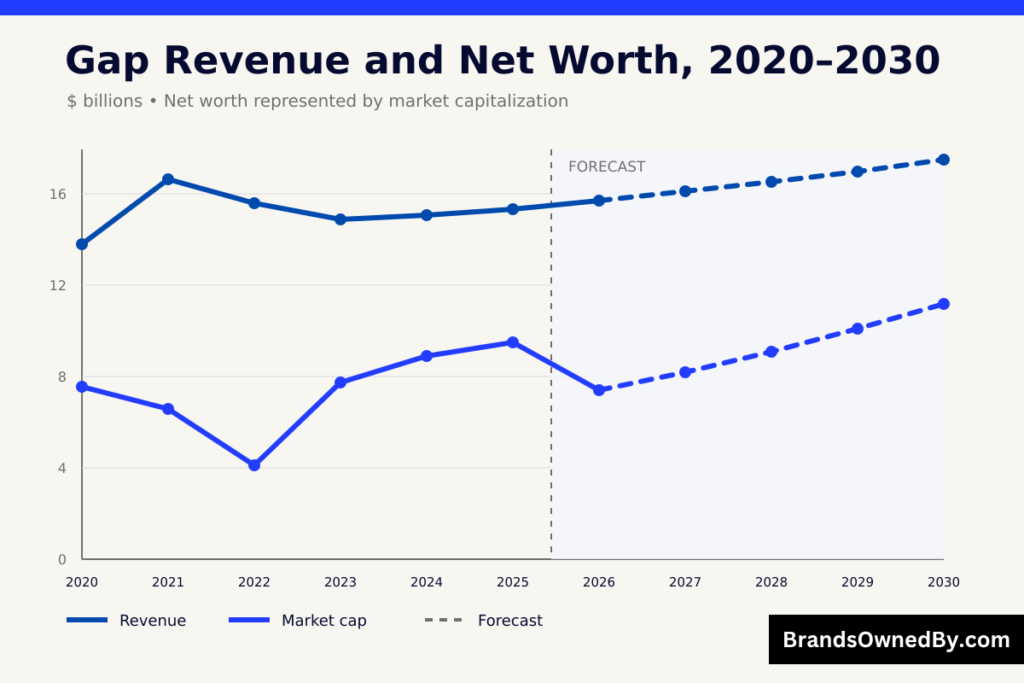
Gap Inc. reports revenue on a fiscal-year basis. Its fiscal year normally ends in late January or early February. This means fiscal 2025 ended on January 31, 2026, rather than December 31, 2025.
“Net worth” requires a clearer definition. Gap does not publish an official corporate net-worth figure. For a publicly traded company, market capitalization is the most useful measure of current equity value. Shareholders’ equity provides a separate accounting measure based on the company’s balance sheet.
Gap’s Historical Revenue Performance
Gap’s revenue has recovered from the disruption caused by store closures and weak consumer traffic in 2020, but its long-term growth has been uneven.
Annual revenue fell to $13.80 billion in fiscal 2020. It rebounded sharply to $16.67 billion in fiscal 2021 as stores reopened and consumer spending recovered. Revenue then declined to $15.62 billion in fiscal 2022 and $14.89 billion in fiscal 2023.
The business returned to growth in fiscal 2024. Revenue increased to $15.09 billion and then reached $15.37 billion in fiscal 2025. Gap has therefore restored part of the revenue lost after 2021, but it has not yet returned to that year’s $16.67 billion level.
This pattern matters because Gap’s recent improvement has come from better comparable sales and stronger execution rather than rapid expansion of its store base. The company ended fiscal 2025 with 2,474 company-operated stores, compared with a much larger North American Gap and Banana Republic footprint several years earlier.
Gap’s Fiscal 2025 Revenue
Gap Inc. generated $15.366 billion in net sales during fiscal 2025, an increase of 2% from $15.086 billion in fiscal 2024. Comparable sales grew 3%. Store sales increased 1%, while online sales rose 4% and represented 39% of total revenue.
The company converted that modest sales increase into $1.1 billion of operating income. Its operating margin was 7.3%, compared with 7.4% in fiscal 2024. Net income was $816 million, or $2.13 per diluted share.
Operating cash flow reached $1.3 billion. After $470 million of capital expenditure, free cash flow was $823 million. Gap ended the fiscal year with approximately $3.0 billion in cash, cash equivalents, and short-term investments.
The results show that Gap does not need high revenue growth to produce meaningful cash flow. Merchandise margins, inventory control, promotional activity, sourcing costs, and store expenses can have a larger effect on profit than a small change in sales.
Revenue Generated by Each Gap Brand
Old Navy remains the main revenue engine. It generated $8.7 billion in fiscal 2025 net sales, up 3%. That represented approximately 57% of Gap Inc.’s consolidated revenue.
The Gap brand generated $3.5 billion, an increase of 5%. It accounted for approximately 23% of consolidated revenue. Comparable sales grew 6%, making Gap the strongest contributor to the company’s recent brand-level momentum.
Banana Republic produced $1.9 billion in annual sales. Revenue declined 1%, although comparable sales increased 3%. The difference indicates that performance at stores open for the comparable period improved even as factors such as store changes and channel mix limited total revenue.
Athleta generated $1.2 billion. Revenue declined 10%, while comparable sales fell 9%. Athleta contributed less than 8% of company revenue and remained the weakest-performing business in the portfolio.
Old Navy and Gap together produced close to 80% of Gap Inc.’s sales. This concentration means the performance of those two brands has a much larger effect on consolidated revenue than changes at Banana Republic or Athleta.
Gap’s Fiscal 2026 Revenue Performance
Gap generated $7.148 billion in net sales during the first 26 weeks of fiscal 2026, compared with $7.188 billion in the corresponding period of fiscal 2025. The $40 million decrease represented a decline of approximately 1%.
Second-quarter revenue was $3.651 billion, down 2% year over year. Comparable sales decreased 1%. Store sales fell 3%, while online sales declined 1% and represented 35% of quarterly revenue.
The portfolio produced sharply different results. Gap brand revenue increased 9% to $844 million, with comparable sales up 10%. Banana Republic revenue increased 1% to $478 million. Old Navy revenue fell 4% to approximately $2.1 billion. Athleta revenue declined 12% to $264 million.
Gap reported second-quarter operating income of $676 million and net income of $501 million. Those reported figures included a $417 million benefit from the expected recovery of tariffs imposed under the International Emergency Economic Powers Act. Excluding that unusual benefit, adjusted operating income was $259 million, adjusted net income was $190 million, and adjusted diluted earnings were $0.52 per share.
The adjusted figures provide a more representative view of recurring operations. The tariff recovery increased reported profit for the quarter, but it did not come from additional apparel sales or a permanent improvement in operating efficiency.
Expected Fiscal 2026 Revenue
Management expects fiscal 2026 net sales to increase between 1% and 1.5% from the $15.366 billion reported in fiscal 2025. That guidance implies annual revenue of approximately $15.52 billion to $15.60 billion.
The forecast assumes that continued growth at Gap and gradual improvement at Banana Republic will outweigh weaker performance at Athleta and softer sales at Old Navy. Management expects Gap brand comparable sales to rise in the high-single-digit to low-double-digit range. Old Navy comparable sales are expected to range from flat to down 1%.
Adjusted operating margin is expected to reach approximately 7.4% to 7.6%, compared with 7.3% in fiscal 2025. Adjusted diluted earnings are projected at $2.35 to $2.45 per share.
The guidance does not support an aggressive revenue-growth assumption. Gap is forecasting low-single-digit expansion. Its near-term financial improvement depends more heavily on protecting margins, reducing promotions, managing tariffs, rebuilding Athleta, and maintaining Gap brand momentum.
Gap’s Current Net Worth Based on Market Capitalization
Gap’s market capitalization was approximately $8.15 billion on September 8, 2026, with its shares trading near $22.50. Market capitalization represents the value investors place on Gap’s outstanding equity. It changes whenever the share price or share count changes.
Gap reported 351.27 million common shares outstanding as of August 21, 2026. That was down from approximately 372 million shares at the end of fiscal 2025. The reduction followed substantial share repurchases.
During the first half of fiscal 2026, Gap spent $601 million repurchasing approximately 26 million shares. It also paid $125 million in dividends. Total cash returned to shareholders reached $726 million during the six-month period.
Using the current market capitalization and the midpoint of management’s fiscal 2026 revenue guidance, investors value Gap’s equity at approximately 0.52 times annual sales. This relatively modest sales multiple reflects the economics of apparel retail, where revenue is large but margins remain sensitive to markdowns, inventory errors, tariffs, freight costs, and changing consumer demand.
Gap’s Net Worth Based on Shareholders’ Equity
Gap reported total shareholders’ equity of $3.951 billion as of August 1, 2026. That was higher than $3.801 billion at January 31, 2026 and $3.433 billion one year earlier.
Shareholders’ equity is calculated from the balance sheet after subtracting total liabilities from total assets. It includes retained earnings and other accumulated equity accounts. It is different from market capitalization because it is based on accounting values rather than the stock market’s expectations.
Gap’s market capitalization of approximately $8.15 billion was more than twice its reported book equity. The difference reflects the value investors assign to assets that are not fully captured at current market value on the balance sheet. These include the earning power of Old Navy, Gap, Banana Republic, and Athleta, as well as Gap’s customer relationships, operating platform, and future cash flows.
Gap also held approximately $2.48 billion in cash, cash equivalents, and short-term investments at the end of the second quarter. That liquidity supports inventory purchases, capital expenditure, dividends, and repurchases. It also gives the company financial capacity to manage periods of weaker consumer demand.
Gap’s current equity value is therefore best presented using two figures: approximately $8.15 billion in stock-market value as of September 8, 2026 and $3.951 billion in accounting shareholders’ equity as of August 1, 2026. These measures answer different questions and should not be treated as interchangeable.
Final Words
Gap Inc. owns Old Navy, Gap, Banana Republic, and Athleta. The group is more focused than it once was. Old Navy provides scale. Gap is driving current momentum. Banana Republic adds a premium lifestyle position. Athleta gives the company exposure to activewear but remains its clearest turnaround challenge.
Gap is publicly owned and has no corporate parent. The Fisher family’s 38.74% aggregate stake makes it the strongest shareholder bloc, but not a majority owner. Formal authority is shared across shareholders, an independently chaired board, and CEO Richard Dickson.
For readers asking what brands Gap owns, the simplest accurate answer is four. Factory stores, children’s labels, beauty, home, and activewear sub-lines expand those brands. They do not increase the company count.
FAQs
Does Gap Own Old Navy?
Yes. Gap Inc. created Old Navy and still owns it. The company proposed separating Old Navy in 2019 but canceled the plan in January 2020. Old Navy remains Gap Inc.’s largest brand by revenue.
Does Gap Own Banana Republic?
Yes. Gap acquired Banana Republic in 1983. It transformed the original safari-themed retailer into a premium apparel and lifestyle brand. Banana Republic Factory is an outlet channel within the same brand.
Does Gap Own Athleta?
Yes. Gap Inc. acquired Athleta in 2008 for approximately $150 million. Athleta remains part of Gap’s four-brand portfolio despite its recent sales decline.
Is Gap Still Family-Owned?
Gap is a public company, not a privately held family business. However, the Fisher family beneficially owns an aggregate 38.74% of outstanding shares. That position gives the family substantial influence without majority ownership.
Who is the Largest Owner of Gap?
The Fisher family is the largest ownership group, with a non-duplicated aggregate beneficial position of 38.74%. Among outside institutions listed in Gap’s 2026 proxy, Vanguard was the largest at 6.95%.
Does Gap Own Zara?
No. Zara is owned by Spain-based Inditex. Inditex and Gap Inc. are separate public retail groups and direct competitors in parts of the global apparel market.
Does Gap Own Levi’s?
No. Levi’s is owned by Levi Strauss & Co. Gap’s first store sold Levi’s jeans, but Gap later developed its own apparel and denim. The two companies are now independent competitors.
Is Gap Factory a Separate Company?
No. Gap Factory is the outlet and value channel of the Gap brand. It may have separate stores and a separate shopping website, but it is not a fifth core company in Gap Inc.’s portfolio.
What Brands Did Gap Previously Own?
Gap previously owned or operated Intermix, Janie and Jack, Piperlime, Hill City, and Weddington Way. Intermix and Janie and Jack were sold. The other concepts were closed.
What is the Difference Between Gap and Gap Inc.?
Gap is the consumer clothing brand. Gap Inc. is the public parent company that owns Gap, Old Navy, Banana Republic, and Athleta. The distinction is similar to a product brand operating inside a broader corporate group.