

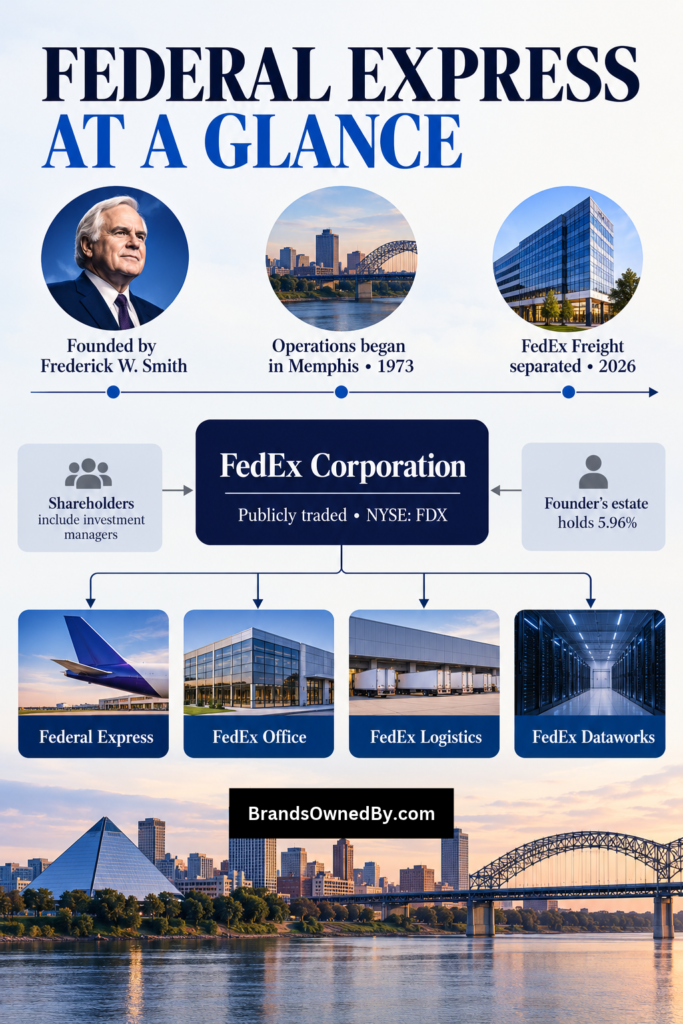
- Federal Express Corporation is a wholly owned operating company of FedEx Corporation. FedEx Corporation is publicly traded as FDX, so its shareholders indirectly own Federal Express.
- The largest holders reported in FedEx’s 2026 proxy were Vanguard Capital Management at 6.81%, BlackRock at 6.55%, the Estate of Frederick W. Smith at 5.96%, and PRIMECAP Management at 5.04%. These are disclosed positions, not a controlling block.
- FedEx Freight separated into an independent public company on June 1, 2026. FedEx distributed 80.1% of it to FedEx shareholders and retained 19.9% temporarily, with a stated plan to dispose of that interest within 24 months.
- FedEx’s current portfolio includes Federal Express, FedEx Logistics, FedEx Office, and FedEx Dataworks. FedEx Supply Chain was sold to CMA CGM in October 2026.
Federal Express Corporation is owned by FedEx Corporation, the publicly traded parent company listed on the New York Stock Exchange as FDX. FedEx Corporation itself belongs to its shareholders. The distinction is especially important in 2026: FedEx Freight became a separate public company on June 1, while FedEx sold FedEx Supply Chain to CMA CGM in October. Federal Express remains the central parcel delivery operation within FedEx Corporation.
Federal Express Overview and Who Founded It
Federal Express is the operating company behind the FedEx parcel network. It handles time-definite air shipments and small-package ground delivery. It is a subsidiary of FedEx Corporation, rather than a standalone public company with its own independent shareholders.
Who Founded Federal Express?
Frederick W. Smith founded Federal Express in 1971. He developed the idea of a dedicated air network that could move urgent packages through a central hub, instead of relying on passenger-airline capacity and conventional postal routes. The model linked pickup, sorting, air transport, and delivery under one coordinated system.
Smith’s plan was ambitious for its time. A shipment might travel across the country overnight, but that depended on the company controlling both the aircraft schedule and the sorting process. Federal Express built its early operating model around that reliability problem.
How Did Federal Express Begin?
The company began service in Memphis on April 17, 1973. Its first operation used 14 small aircraft and served 25 U.S. cities. Memphis offered a central location and an airport that could support the company’s overnight hub system. That hub-and-spoke design became a defining feature of the business.
Federal Express grew from an overnight air carrier into a broader transportation network. The company expanded its ground services, added international routes, and acquired businesses that extended its reach. In 1994, it adopted the FedEx name as its public brand. In 1998, the parent company reorganized as FDX Corporation after acquiring Caliber System. It changed its name to FedEx Corporation in 2000.
What Does “Federal Express” Mean Today?
The name now has two related uses. Federal Express Corporation is a legal operating company within FedEx Corporation. “FedEx” is also the customer-facing brand family used across shipping, logistics, office services, and digital products.
The distinction became more important after a 2024 internal consolidation. FedEx Ground Package System and FedEx Corporate Services merged into Federal Express Corporation on June 1, 2024. The unified company now operates an integrated air-ground parcel network. People may still use “FedEx Express” or “FedEx Ground” to describe service types, but those names do not mean the former companies remain separate corporations.
Ownership History
Federal Express began as a founder-led company. Its ownership changed as the network grew, outside investors entered, and the company moved into the public markets. FedEx’s present structure is the result of several reorganizations, not a single recent acquisition.
From Founder-Led Startup to Public Company
Smith founded Federal Express in 1971 and led the business through its early expansion. The company went public in 1978. Its shares then became available to institutional and individual investors. Smith remained a major figure in its leadership for decades, serving as chief executive until 2022 and later as executive chairman. He died in June 2025.
His death did not transfer ownership of the company to one person. FedEx was already a public corporation. The founder’s estate retained a significant stake, but it held less than 6% of the outstanding common stock according to FedEx’s 2026 proxy statement.
The Creation of FedEx Corporation
In 1998, Federal Express acquired Caliber System, a transportation group that included ground delivery and freight operations. The transaction created FDX Corporation as a parent for businesses with different service models. The parent later took the FedEx Corporation name.
This structure helped FedEx own multiple operating companies under one corporate umbrella. Over time, the portfolio included air express, ground parcel delivery, less-than-truckload freight, office services, logistics, and data capabilities. FedEx used acquisitions and internal combinations to expand the network and add services.
One FedEx Consolidation and the 2026 Separation
FedEx has also moved in the opposite direction by combining operations. The June 2024 merger of FedEx Ground into Federal Express Corporation was part of its “One FedEx” strategy. It brought the U.S. air and ground parcel networks under one operating company, a move intended to reduce duplicated routes and management structures.
The Freight business followed a different path. On June 1, 2026, FedEx spun off FedEx Freight Holding Company, Inc. and began trading it separately as FDXF. Existing FedEx shareholders received one FedEx Freight share for every two FedEx shares they held on the record date. FedEx distributed 80.1% of the new company and retained 19.9% temporarily. FedEx said it intended to dispose of the retained interest within 24 months through exchanges with creditors and/or distributions to FedEx shareholders.
This matters when a reader sees FedEx Freight on a list of FedEx businesses. The carrier remains closely linked through brand and transition agreements, but it is no longer a consolidated FedEx subsidiary after the spin-off.
FedEx Supply Chain Sale
FedEx announced in July 2026 that it would sell FedEx Supply Chain to CMA CGM Group for an enterprise value of $1.4 billion. FedEx completed the sale in October 2026. The business now sits within CMA CGM’s logistics portfolio, alongside CEVA Logistics.
Who Owns Federal Express?
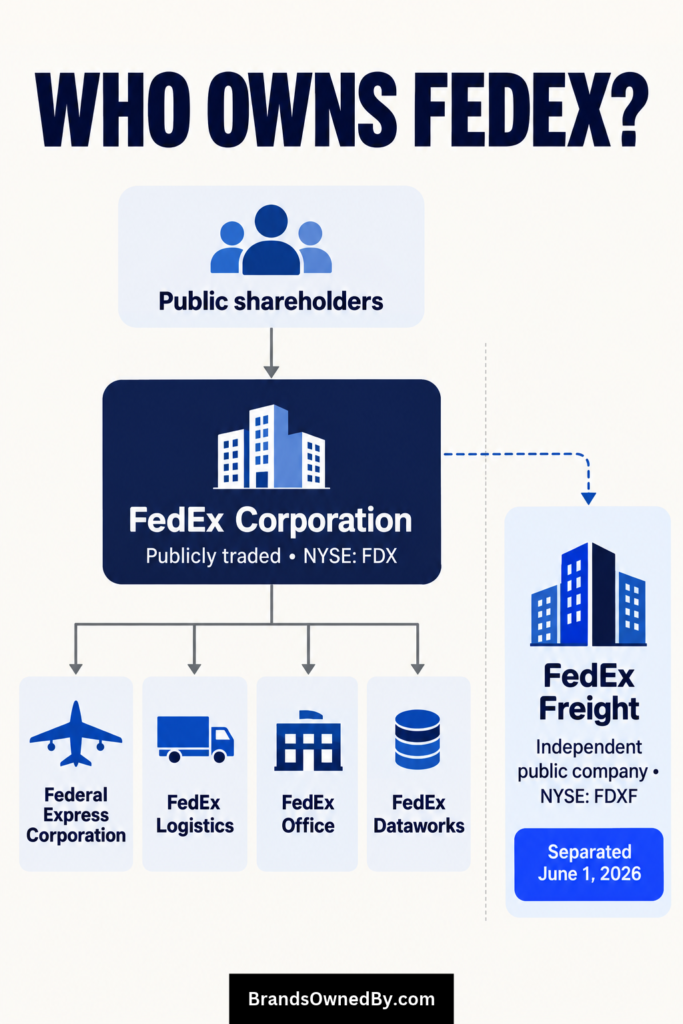
Federal Express Corporation is owned by FedEx Corporation, its publicly traded parent. FedEx Corporation is the entity whose common stock trades on the New York Stock Exchange under ticker FDX. Investors who buy FDX shares own a stake in the parent company. They do not hold shares directly in Federal Express Corporation or in individual FedEx aircraft, hubs, trucks, or delivery stations.
This distinction answers two related questions. FedEx Corporation owns the operating subsidiary called Federal Express Corporation. The shareholders of FedEx Corporation collectively own the parent’s equity. No single investor owns all of Federal Express, and the company is not privately held by its founder or by one investment firm.
How The Ownership Chain Works?
The structure is parent-to-subsidiary. FedEx Corporation sits at the top of the publicly traded group. It owns Federal Express Corporation, which carries out core express transportation and delivery activities alongside other operating companies within the group. The parent holds the subsidiary’s shares and oversees it through the corporate governance and management structure.
A person who purchases one FDX share therefore has an indirect economic interest in the parent’s overall business. That investor may vote on matters submitted to FedEx Corporation shareholders and may benefit if the parent’s value rises or it pays dividends. The share does not give the investor a direct right to select a particular package route, claim a particular aircraft, or instruct a Federal Express employee. Those decisions are made by the company’s officers and operating leadership under authority delegated through the corporate structure.
The distinction also matters when reading financial and ownership disclosures. FedEx Corporation’s annual report, proxy statement, and stockholder list refer to the parent company. Federal Express Corporation is a subsidiary in that corporate group. So when a filing says Vanguard or an individual owns a percentage of FedEx common stock, it means that party has a reportable position in FedEx Corporation, not a direct percentage holding in Federal Express Corporation.
FedEx Corporation is Publicly Held
FedEx Corporation has a broad public shareholder base. Its shares are held through investment managers, mutual funds, pension funds, other institutions, employee plans, and individual brokerage accounts. A large share may be registered in the name of a custodian or nominee, even though the underlying economic interest belongs to clients or fund investors.
The latest FedEx proxy’s significant-ownership disclosure identifies holders reporting more than 5% of FedEx common stock. The four positions listed there add up to about 24.36% using the figures and reporting dates shown in that proxy. They are not a synchronized, real-time ownership count: the filings span different dates, and the proxy’s snapshot for the Smith estate differs from the reporting dates for investment managers. Treat the percentages as the company’s latest disclosed large-holder data, not as a live share register for October 2026.
“Beneficial ownership” also does not always mean that the named institution supplied the money or receives all the investment gains. A manager may have authority to vote or dispose of shares held in client accounts or funds. The clients and fund shareholders generally have the economic exposure, while the manager exercises the authority described in its regulatory filing. A position can therefore be significant for voting and engagement without making the manager the company’s controlling owner.
Vanguard Capital Management
Vanguard was the largest holder listed in the proxy, with 16,106,255 shares, or 6.81% of the relevant class, based on its Schedule 13G filing dated April 29, 2026. It reported sole voting power over about 2.2 million shares and dispositive power over all of the reported shares. Its filing said the position was held in the ordinary course and was not held to change or influence control of FedEx.
Vanguard’s position gives it a meaningful voice in shareholder votes. It can also engage with the board on issues such as governance, executive pay, and business risk. But 6.81% is a minority interest. It does not allow Vanguard to appoint a board majority or direct day-to-day operations on its own. Its voting authority is also distinct from the economic interests of the many clients whose assets its funds and accounts manage.
BlackRock
BlackRock was listed with 15,498,779 shares, or 6.55%. The proxy cited a Schedule 13G/A reporting beneficial ownership as of December 31, 2023. The position covered holdings reported across certain investment-management entities within BlackRock’s corporate group.
Because that filing date is earlier than the 2026 proxy date, the 6.55% is a disclosed historical position rather than confirmation of BlackRock’s exact current stake. BlackRock’s filing described the shares as held in the ordinary course and did not state an intention to change or influence control. Like Vanguard, BlackRock is an asset manager whose reporting authority over shares should not be confused with a single owner personally holding the entire economic interest.
The Estate Of Frederick W. Smith
The estate of FedEx founder Frederick W. Smith was reported with 14,096,876 shares, or 5.96%, based on the August 3, 2026 ownership snapshot. The total included 13,617,663 shares owned directly by the estate and 479,183 shares held through a grantor retained annuity trust. Stacey D. Smith, the founder’s widow, had shared voting and dispositive power over estate shares as co-executor.
This is a substantial founder-linked position and gives the estate a meaningful stake in shareholder decisions. It does not mean that the Smith family owns or controls FedEx outright. At 5.96%, the estate is far below a majority, and the proxy does not identify it as holding unilateral control of the board or the operating company. The estate’s voting rights are exercised through the authority disclosed for its co-executors and trusts.
PRIMECAP Management Company
PRIMECAP Management was listed with 11,931,800 shares, or 5.04%. The figure came from a May 2025 Schedule 13G/A reporting ownership as of March 31, 2025. The filing reported sole voting power over approximately 11.7 million shares and sole dispositive power over the full position. It described the investment as ordinary-course holdings, not a position intended to influence company control.
That filing is older than the 2026 proxy, so 5.04% should be presented as the reported position available in the proxy, not a real-time estimate. PRIMECAP’s stake is large enough to matter in shareholder voting, but it remains a minority holding and does not confer operational control.
What The Large-Holder Figures Do And Do Not Show
The four disclosed positions total about one quarter of the company’s shares on the reported figures. That concentration deserves attention because large investors can influence votes, signal concerns to the board, and affect the outcome of close shareholder proposals. Yet the positions belong to separate holders with their own clients, investment mandates, and voting policies. They should not be added together and described as a coordinated ownership bloc.
The other roughly three quarters were not represented by those four entries. They were spread across other institutions, funds, employee-related holdings, and individual investors. Those holders collectively supply the majority of FedEx’s equity ownership, even though their positions may be individually smaller and may be registered through brokers or custodians.
The proxy’s 5% threshold also explains why the list is incomplete. It is a list of significant disclosed holders, not a complete directory of every shareholder. An investor below the threshold may still own shares and vote them. Likewise, a manager may file updates when its stake changes or when disclosure rules require a new filing. Ownership percentages can move as shares are bought, sold, issued, or repurchased.
What The FedEx Freight Spin-Off Changed
The June 2026 spin-off of FedEx Freight changed the wider corporate group, but it did not change who owns Federal Express Corporation. FedEx Corporation distributed 80.1% of FedEx Freight to its shareholders and retained up to 19.9% temporarily, with plans to dispose of that retained interest within 24 months. Because the distribution went to FedEx shareholders, those investors also received a direct stake in the newly independent FedEx Freight according to the distribution terms.
After the separation, FedEx Freight is a separate public company. It is no longer simply another wholly owned operating subsidiary in the same way as Federal Express Corporation. FedEx’s temporary retained interest in Freight is an asset of FedEx Corporation; it does not give FedEx shareholders direct ownership of Federal Express. This is why current corporate structure should be distinguished from legacy references that group all FedEx-branded businesses together.
Do Shareholders Own Federal Express Directly?
No. Shareholders own FedEx Corporation common stock. FedEx Corporation owns Federal Express Corporation. This indirect ownership gives shareholders economic exposure to the parent and voting rights at the parent level, subject to the company’s charter and applicable law. It does not make each shareholder a direct legal co-owner of the subsidiary’s property or a manager of its operations.
For example, if an investor holds 100 FDX shares through a retirement account, the investor has an interest in FedEx Corporation through that account. The investor does not personally own 100 shares of Federal Express Corporation. Nor does the investor receive 100 specific packages’ worth of profit. The value of the investment depends on the parent’s overall financial performance, capital allocation, risks, and market valuation.
Competitor Ownership Comparison
FedEx competes with companies that use very different ownership models. Some are public corporations, some are government postal services, and some are businesses inside much larger technology or logistics groups.
United Parcel Service
United Parcel Service, Inc. (UPS) is publicly traded on the New York Stock Exchange. Its shareholders own the parent company, which operates the UPS parcel and logistics network. Like FedEx, it is a public company with ownership distributed among institutions and individuals. Unlike FedEx, UPS has a separate share class structure, including publicly traded Class B shares and non-traded Class A shares.
For a U.S. online retailer, this means UPS and FedEx can both be evaluated as public carriers. Their different network designs, labor models, pricing, and service mixes shape the competition more than a single controlling family owner.
DHL Group
DHL’s global parcel and logistics businesses are part of Deutsche Post DHL Group, a publicly traded German company. The German state-owned development bank KfW remains a major shareholder, while other shares trade publicly. DHL is therefore not owned by FedEx or by a single private logistics operator. It competes internationally through a broader group that includes express delivery, freight forwarding, and supply chain services.
United States Postal Service
The U.S. Postal Service is not a shareholder-owned corporation. It is an independent establishment of the executive branch of the U.S. federal government, with a public service mandate and a statutory governance structure. USPS competes with private carriers in parcel delivery while also carrying universal service responsibilities that FedEx and UPS do not have.
This difference affects how the organizations set priorities. A private carrier must answer to investors and pursue profitable returns. USPS has to balance financial sustainability with nationwide service obligations established by law.
Amazon Logistics
Amazon Logistics is part of Amazon.com, Inc., a publicly traded company. It supports Amazon’s retail and marketplace operations and also delivers packages for third-party sellers and other customers. Amazon’s delivery network is therefore integrated with a much larger e-commerce and cloud business.
FedEx’s model is different. It is a carrier and logistics provider that serves a wide range of shippers, including retailers that compete with Amazon. The two companies may compete for parcel volume while also interacting commercially in the broader delivery market.
OnTrac
OnTrac is a privately held parcel delivery company backed by private investment. It focuses primarily on regional and last-mile parcel delivery in the United States. Its ownership is not dispersed through public stock-market trading like FedEx, UPS, or DHL Group.
A merchant choosing between carriers may see OnTrac in regional delivery options, particularly for lower-cost residential shipments. FedEx has a broader global network and international express capability, while OnTrac is positioned as a regional parcel competitor.
Who Controls FedEx?
FedEx Corporation is governed by its board and managed by its executive team. FedEx’s 2026 proxy described a 12-member board at the time of filing, with nine directors identified as independent. It presented 11 director nominees for the September 28, 2026 annual meeting. The current board roster reflects the post-meeting composition. Directors are elected by shareholders at annual meetings. The board appoints and oversees the CEO, approves major strategic actions, and monitors risks, capital allocation, and executive performance.
No single shareholder has a majority stake. Control is therefore exercised through the board’s authority and the voting rights attached to the widely held shares. Large investors can influence director elections and governance proposals, but the proxy’s four disclosed holders above 5% did not individually control the company.
Board and Executive Leadership
As of October 2026, Rajesh Subramaniam is FedEx Corporation’s president and CEO. He leads the parent company’s strategy and day-to-day corporate management. FedEx’s leadership roster also identifies him as president and CEO of Federal Express Corporation, the principal parcel operating company within the group.
Federal Express has operating leaders for its different parts of the network. Richard W. Smith serves as chief operating officer for International and chief executive officer of Airline. Scott Ray serves as chief operating officer for the U.S. and Canada. These roles manage execution across major parts of the parcel network, while Subramaniam remains the group CEO and the board oversees the corporation as a whole.
R. Brad Martin is executive chairman and chair of the board. The role gives him responsibility for leading board work and oversight of strategic growth initiatives, while Subramaniam leads the management team and company operations. The distinction matters: an executive chairman can shape board priorities, but the board as a whole retains formal oversight authority.
Susan Patricia Griffith serves as lead independent director. She is also president and CEO of Progressive Corporation. The lead independent director presides over independent directors’ executive sessions, helps review board agendas, and serves as a liaison between independent directors and the chair. FedEx’s proxy says independent directors meet without management present and evaluate the CEO.
The board’s structure became a visible governance issue after founder Frederick W. Smith’s death and the transition to Martin as executive chairman. FedEx maintains separate CEO, executive chairman, and lead independent director roles. This provides a defined channel for independent board oversight while keeping the chair involved in strategy and integration.
What Influence Do Large Shareholders Have?
Large shareholders can vote on directors, executive compensation, and proposals submitted to stockholders. They can also meet with the board and management, ask questions, and press for changes to governance or capital allocation. These rights give institutions influence, especially when several large funds vote in the same direction.
The 2026 proxy states that Vanguard’s 6.81% position was held in the ordinary course and not to influence control. BlackRock’s and PRIMECAP’s cited filings also described their holdings as ordinary-course investments. Those disclosures do not remove their voting rights, but they show that the reported stakes were not presented as a takeover or control campaign.
A practical way to understand the balance is to separate three roles. Shareholders elect directors and vote on matters reserved for them. Directors set oversight and approve major corporate decisions. Management, led by the CEO, runs the business and executes the strategy. The Smith estate and large institutional holders participate at the shareholder level; none directly manages package routes, aircraft schedules, or subsidiary operations by virtue of owning shares.
FedEx Annual Revenue and Net Worth
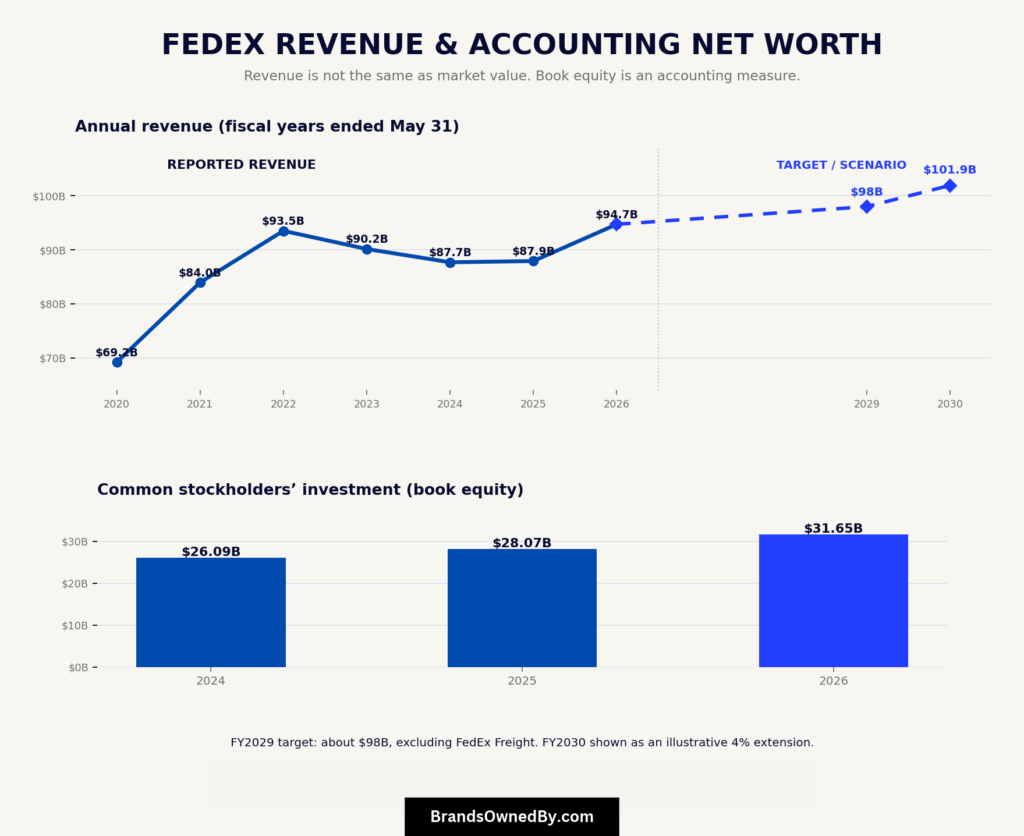
FedEx’s audited fiscal 2026 statements reported revenue of $94.72 billion and net income of $4.43 billion for the year ended May 31, 2026. That consolidated figure includes FedEx Freight because the spin-off became effective on June 1, the day after the fiscal year ended. FedEx’s current company overview separately gives $85.9 billion as FY26 annual revenue for the ongoing parent business after the Freight separation. The two figures use different corporate scopes and should not be treated as interchangeable.
Revenue and Operating Performance
FedEx revenue increased 7.7% from $87.93 billion in fiscal 2025. The largest business line was Federal Express, which produced $82.1 billion in revenue for the fiscal year. FedEx Freight generated approximately $8.9 billion. Other revenue, which included corporate activities and smaller operating businesses, was about $3.7 billion.
The reported net income was $4.43 billion, up from $4.09 billion in fiscal 2025. Operating income was $5.46 billion, producing a 5.8% operating margin. Results included $738 million in spin-off costs and $366 million in business optimization costs. That makes adjusted operating measures useful for understanding underlying operations, but GAAP figures remain the audited baseline.
The June 2026 spin-off changes comparability. FedEx’s 2026 financial statements consolidate Freight for the full year through May 31, 2026, but future reporting periods no longer include it. A reader comparing future FedEx revenue with $94.72 billion should account for this change in corporate perimeter.
What Does “FedEx Net Worth” Mean?
“Net worth” is not a standard valuation figure for a public company. Searchers may mean market capitalization, which is the share price multiplied by shares outstanding. That value changes every trading day. They may instead mean book equity, the accounting value of assets minus liabilities attributable to shareholders.
FedEx reported $31.65 billion in common stockholders’ investment on May 31, 2026. Total assets were $98.94 billion. These balance-sheet numbers are more stable than market capitalization but are not the same as what investors would pay to acquire the company.
Market capitalization is calculated by multiplying the share price by the shares outstanding on a chosen date. It changes as the stock trades, so any quoted market value needs a date. No single permanent “net worth” number describes the company across market dates.
Revenue Outlook Through 2029 and 2030
FedEx’s 2026 investor-day framework set a 2029 revenue target of about $98 billion, with operating income of about $8 billion and an operating margin near 8%. This framework excludes FedEx Freight and compares with the midpoint of a prior fiscal 2026 outlook. It is a management target, not a guarantee.
A simple extension of the $98 billion target at approximately 4% annual growth would imply roughly $102 billion in revenue for 2030. That is an analytical scenario, not a company-issued forecast. It assumes FedEx maintains volume, pricing, and operational efficiency after Freight leaves the group. It could be undermined by weaker global trade, fuel and labor cost inflation, lower package volumes, or delays in integrating the Network 2.0 operating model.
A precise 2030 net worth cannot be derived from the revenue target alone. Market capitalization will depend on future share prices, which reflect earnings expectations, interest rates, investor risk appetite, and the capital FedEx returns to shareholders. Book equity will also change with profits, dividends, share repurchases, pension accounting, and other balance-sheet movements. A numerical long-range net-worth estimate would therefore be speculative.
Brands Owned by FedEx
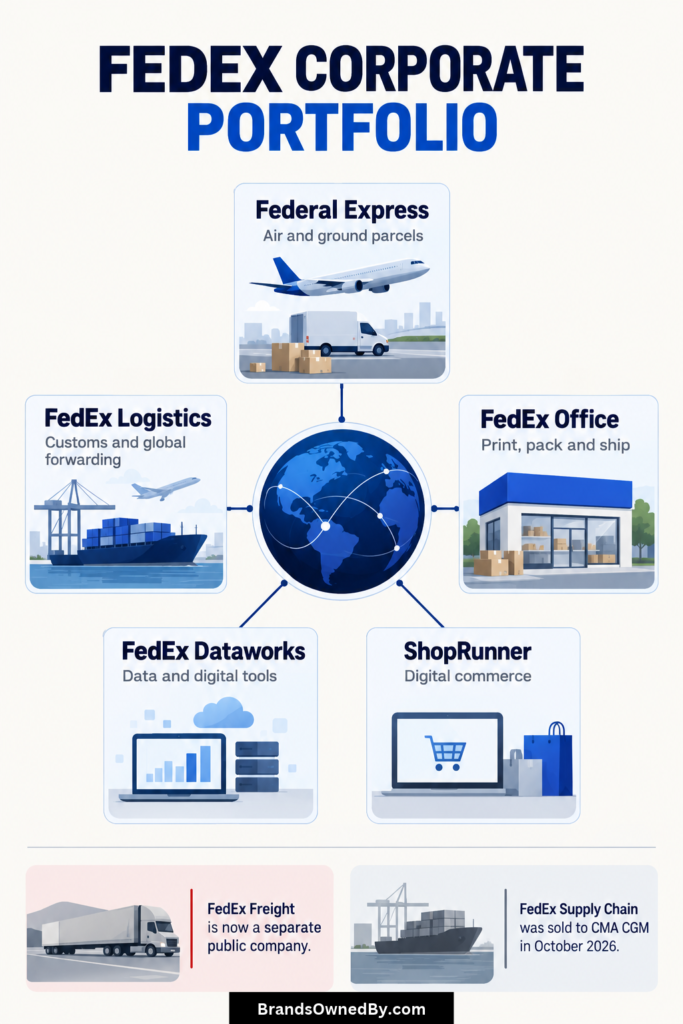
FedEx Corporation’s 2026 corporate structure includes several operating subsidiaries and service brands. The core is Federal Express Corporation, which combines air and ground parcel operations. FedEx also owns office, logistics, and data businesses. FedEx Freight is now a separate public company, while FedEx Supply Chain was sold to CMA CGM.
Federal Express Corporation
Federal Express Corporation is the group’s main parcel transportation company. It operates the integrated U.S. air and ground network under the FedEx brand, as well as international express services. The company’s work includes pickup, sorting, linehaul, customs coordination, and last-mile delivery.
A practical example is a business shipping a product from Memphis to a customer in New York. The parcel may travel by ground or air depending on the service selected, but the air and ground network are now managed within the integrated Federal Express operating company. The historical standalone FedEx Ground entity was merged into it in 2024.
FedEx Logistics
FedEx Logistics provides customs brokerage, air and ocean freight forwarding, and specialty transportation. It helps customers coordinate cross-border movement and navigate import requirements. Its value is different from parcel delivery: a company moving a container of components or arranging a large international shipment may need brokerage and freight forwarding rather than an overnight small-package service.
Following the June 2026 spin-off, FedEx moved FedEx Logistics into its Express International reporting structure. It remains within the FedEx Corporation group and supports international transportation and trade services.
FedEx Office
FedEx Office combines retail access to shipping with printing and business services. Its locations offer parcel drop-off and pickup, packing, document printing, signs, graphics, and other services. FedEx reported about 2,000 customer-facing stores and approximately 12,000 employees as of May 31, 2026.
For an individual, a FedEx Office store can print and bind a presentation, package a fragile item, and ship it at one counter. For a company, FedEx Office can support managed print programs and centralized shipping access. The business therefore complements the parcel network while also selling print services.
FedEx Dataworks
FedEx Dataworks develops data products and digital tools that use information from the company’s physical network. Its aim is to connect supply chain data, help customers see disruptions, and improve planning and execution. FedEx described the unit as a data and intelligence capability rather than a traditional carrier.
The practical use is shipment visibility at a broader scale. A shipper may use delivery data and network information to identify recurring delays, improve inventory planning, or respond to disruptions. FedEx Dataworks had approximately 200 employees as of May 31, 2026.
FedEx Freight: A Separate Public Company
FedEx Freight is no longer a wholly owned operating subsidiary of FedEx Corporation. It became an independent company, trading as FDXF, on June 1, 2026. It operates less-than-truckload freight services, including the business previously conducted through FedEx Freight and related operations such as FedEx Custom Critical.
FedEx distributed 80.1% of its shares to existing FDX shareholders and retained 19.9% temporarily. FedEx plans to dispose of its retained shares within 24 months. The new company also has a license to continue using the FedEx Freight name and certain marks. Continued brand use does not make it a FedEx subsidiary.
FedEx Supply Chain: Sold to CMA CGM
FedEx Supply Chain provided warehousing, fulfillment, returns management, packaging, and other contract logistics services. FedEx completed its sale to CMA CGM Group in October 2026 for an enterprise value of $1.4 billion. CMA CGM intends to integrate the business with CEVA Logistics.
This is a completed sale, not a planned divestiture. FedEx Supply Chain should therefore be described as a former FedEx business. For a retailer outsourcing inventory storage or order fulfillment, its service offering continues under the new owner’s logistics portfolio.
Former FedEx Brands and Reorganized Companies
FedEx Ground and FedEx Express remain familiar service labels, but the U.S. air and ground parcel operations have been combined within Federal Express Corporation. Likewise, FedEx Trade Networks was rebranded as FedEx Logistics. These brand and legal-entity changes can make older ownership articles misleading if they list every historical operating company as a separate current subsidiary.
The same caution applies to FedEx Freight and FedEx Supply Chain. The first is separately traded; the second was sold. A current ownership list should distinguish wholly owned subsidiaries, independent spin-offs, and divested businesses.
Final Thoughts
Federal Express is owned by FedEx Corporation, while FedEx Corporation is owned by its public shareholders. The 2026 proxy showed large stakes held by Vanguard, BlackRock, the Estate of Frederick W. Smith, and PRIMECAP, but none of those holders controlled the company alone.
The corporate map changed substantially in 2026. FedEx Freight became an independent public company, and FedEx Supply Chain moved to CMA CGM. Federal Express, FedEx Logistics, FedEx Office, and FedEx Dataworks remain part of the FedEx group. That is the clearest answer to who owns Federal Express and which businesses currently sit under the wider FedEx umbrella.
FAQs
Is Federal Express Owned by FedEx?
Yes. Federal Express Corporation is an operating subsidiary of FedEx Corporation. “FedEx” is also the name used for the parent company’s broader family of transportation, logistics, office, and technology services.
Is Federal Express a Public Company?
Federal Express Corporation is not separately listed on a stock exchange. Its parent, FedEx Corporation, is publicly traded on the New York Stock Exchange under ticker FDX.
Who Owns the Most Shares of FedEx?
FedEx’s 2026 proxy listed Vanguard Capital Management with 6.81% as the largest disclosed holder. The figure was based on Vanguard’s April 29, 2026 filing. It is a reported beneficial ownership position and may not equal a live position today.
Does Fred Smith’s Family Still Own FedEx?
The Estate of Frederick W. Smith held 5.96% of FedEx common stock in the company’s August 3, 2026 ownership snapshot. That is a significant minority stake, not a controlling majority. Smith’s family does not own all of FedEx.
Does FedEx Still Own FedEx Freight?
FedEx no longer owns all of FedEx Freight. The company became independent on June 1, 2026, after FedEx distributed 80.1% of its shares to FedEx shareholders. FedEx retained 19.9% temporarily and said it plans to dispose of the interest within 24 months.
Does FedEx Own FedEx Supply Chain?
No. FedEx completed the sale of FedEx Supply Chain to CMA CGM Group in October 2026. The deal was announced at an enterprise value of $1.4 billion.
Is FedEx Ground a Separate Company?
No longer as a separate operating subsidiary. FedEx Ground Package System merged into Federal Express Corporation on June 1, 2024. “FedEx Ground” can still refer to a service, but the former legal entity is now integrated into Federal Express Corporation.
Who Founded Federal Express?
Frederick W. Smith founded Federal Express in 1971. The company began operations in Memphis in 1973 with an overnight air network connecting 25 U.S. cities.
What Is FedEx’s Net Worth?
There is no single fixed net-worth figure for FedEx. Its market capitalization changes with the stock price. FedEx reported $31.65 billion in common stockholders’ investment on May 31, 2026, which is its accounting book equity and not the same as market value.
Who Controls FedEx Corporation?
FedEx is governed by its board and managed by its executive team. Rajesh Subramaniam is CEO, and Brad Martin is executive chairman as of October 2026. No shareholder disclosed in the 2026 proxy held a majority stake.