

- GTCR is the controlling owner of Consumer Cellular following its approximately $2.3 billion acquisition in October 2020.
- Consumer Cellular is a private mobile virtual network operator. It sells service under its own brand but relies mainly on AT&T’s network infrastructure for current activations.
- The company has no publicly disclosed portfolio of major subsidiaries. Its principal assets are the Consumer Cellular service brand, its IRIS device family, and related customer programs.
- Ed Evans leads daily operations as chairman and CEO, but GTCR controls major ownership, capital-allocation, financing, and exit decisions.
Consumer Cellular is owned and controlled by GTCR, a Chicago-based private equity firm. GTCR acquired the wireless provider in October 2020 in a transaction reported at approximately $2.3 billion. Consumer Cellular remains a private company. Its shares do not trade on a public stock exchange. Ed Evans serves as chairman and chief executive officer, while GTCR exercises ultimate ownership control through its investment structure.
![Who Owns Consumer Cellular [Infographic]](https://brandsownedby.com/wp-content/uploads/2026/09/Who-Owns-Consumer-Cellular-Infographic-683x1024.png)
Consumer Cellular Overview
Consumer Cellular is a U.S. wireless provider built around simple plans, domestic customer support, and a strong focus on adults aged 50 and older. It operates as a mobile virtual network operator, or MVNO. That means it sells wireless service without owning a nationwide tower network.
The company buys access to a larger carrier’s infrastructure and manages the customer relationship itself. Consumer Cellular sets its plans, sells devices, handles billing, provides support, and controls its brand. AT&T supplies the underlying network for new activations. Some older accounts may still reflect earlier network arrangements.
Who Founded Consumer Cellular?
John Marick and Greg Pryor founded Consumer Cellular in Portland, Oregon, in October 1995. They reportedly started the business with a $25,000 small-business loan.
Their idea was straightforward. Major carriers were designing plans for people who used more minutes and accepted long contracts. Marick and Pryor targeted lighter users who wanted predictable bills and fewer complications.
That positioning became more valuable as the U.S. population aged. Consumer Cellular later built a close commercial relationship with AARP. It also expanded into large national retailers. Those channels helped the company reach customers who were less likely to buy wireless service from a digital-only startup.
Where Did Consumer Cellular Originate?
Consumer Cellular originated in the Portland, Oregon, area. Its early identity was tied to the Pacific Northwest. The company later expanded its operational footprint and moved its headquarters to Scottsdale, Arizona.
Its growth did not depend on constructing towers or buying spectrum. Instead, it focused on customer acquisition, call-center service, billing, device sales, and wholesale network agreements. This asset-light structure allowed Consumer Cellular to scale nationally without the capital burden carried by AT&T, Verizon, or T-Mobile.
How Does Consumer Cellular Make Money?
Recurring monthly service payments are the core source of revenue. The company also earns money from device sales, accessories, financing arrangements, protection-related services, and selected connected products.
The most useful operating formula is customer count multiplied by average monthly revenue per customer. Consumer Cellular had almost 4.4 million subscribers in early 2026. Management also indicated that average monthly revenue per customer had risen from roughly $20 historically to more than $30.
For example, 4.4 million customers at approximately $30 per month would represent about $1.58 billion in annualized service revenue. The actual result may differ because subscriber counts change during the year. Device revenue, discounts, taxes, fees, and customer mix also affect the final figure.
Consumer Cellular Ownership History
Consumer Cellular passed through two distinct ownership eras. Its founders controlled the company for its first 25 years. GTCR then acquired control and introduced a private equity ownership model.
Founder Ownership From 1995 to 2020
John Marick and Greg Pryor built Consumer Cellular as a privately owned founder-led business. It did not complete an initial public offering. It also did not become a subsidiary of AT&T, despite using AT&T network capacity.
The founders retained strategic control while the company expanded. Consumer Cellular reached one million customers in 2013, two million in 2015, three million in 2018, and approximately four million near the time of its sale.
The founders’ decision to sell reflected both scale and succession. The company had become a national wireless business. Marick and Pryor were also preparing to retire from their operating roles.
The 2020 Sale to GTCR
GTCR announced its acquisition of Consumer Cellular on October 28, 2020. The purchase price was not formally disclosed in the transaction announcement. Multiple transaction reports placed the value at approximately $2.3 billion.
The deal transferred control from the founders to a financial sponsor. John Marick retired as CEO and remained involved through a minority position and board role at the time of the transaction. Ed Evans became chief executive officer.
GTCR did not combine Consumer Cellular with a major network operator. It kept the company independent and preserved its customer-facing identity. That mattered because the value of the acquisition was tied to Consumer Cellular’s brand, older-customer expertise, distribution, and service model.
GTCR’s Original Fund Ownership
The acquisition was associated with GTCR Fund XII investment vehicles. Private equity funds typically pool money from pension systems, endowments, insurers, sovereign investors, family offices, and other institutions.
Those limited partners have economic exposure to the fund. They do not manage Consumer Cellular directly. GTCR, as the sponsor and general partner, controls the investment and appoints the governance structure around the portfolio company.
The 2025 Continuation Transaction
Consumer Cellular remained under GTCR control after a 2025 continuation transaction. The investment was transferred from GTCR Fund XII/A and GTCR Fund XII/C into a new GTCR-affiliated vehicle formed to acquire and hold the business.
This was not a sale to a new strategic owner. It was a sponsor-led restructuring. A continuation vehicle gives existing investors a path to receive liquidity while allowing new or continuing investors to hold the asset for longer.
The distinction is important. A database may show a transaction or a change in the legal investment vehicle. That does not mean Consumer Cellular stopped being controlled by GTCR.
Debt Recapitalizations Under Private Equity Ownership
GTCR has also used Consumer Cellular’s balance sheet to return capital to investors. In 2022, the company planned a debt-funded dividend of approximately $1.1 billion to its private equity sponsor. A second dividend recapitalization followed in February 2024.
In 2025, Consumer Cellular arranged approximately $3.4 billion of private credit financing. Most of the proceeds refinanced existing debt, while part of the transaction supported another distribution.
These transactions do not change the brand’s owner. They do change the financial profile. More debt can increase the equity return for the sponsor, but it also raises fixed interest obligations and makes stable subscriber cash flow more important.
Who Owns Consumer Cellular?
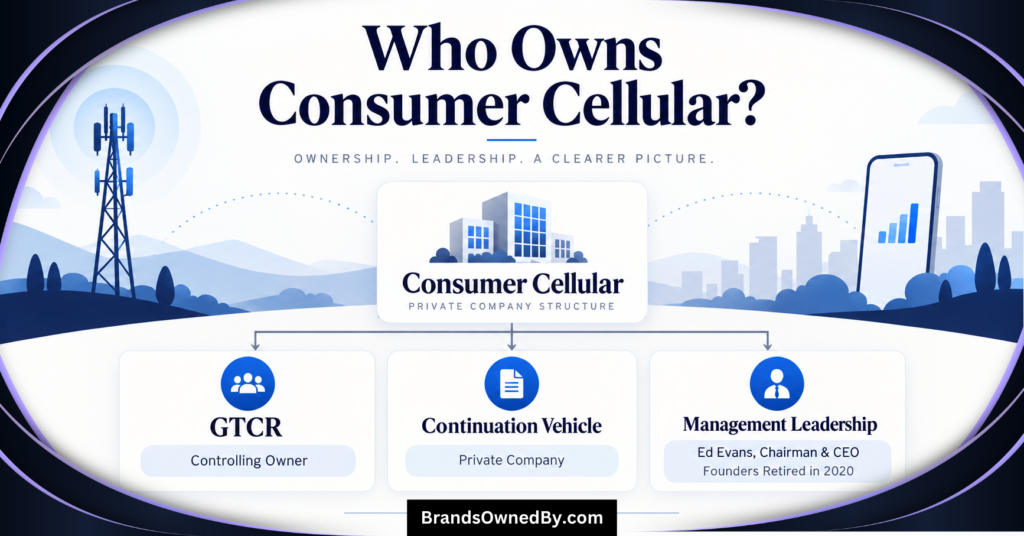
GTCR controls Consumer Cellular as of September 2026. The company does not publish a public shareholder register, ownership percentages, or a listed-company proxy statement. Any claim that assigns a precise percentage to GTCR, management, or the founders should therefore be treated cautiously unless it is supported by a current legal filing.
The ownership can be understood in layers. GTCR is the controlling sponsor. A GTCR-managed continuation vehicle holds the investment. Institutional limited partners supply much of the capital behind that vehicle. Management may have equity incentives, but the current percentage is not public.
GTCR
GTCR is the controlling owner. The private equity firm was founded in 1980 and is headquartered in Chicago. Its investment model often combines an experienced executive with a platform company and additional capital for expansion.
For Consumer Cellular, GTCR partnered with Ed Evans. The firm controls the investment through board governance and the ownership vehicle. It has authority over major financing, recapitalization, acquisition, budget, and eventual exit decisions.
GTCR should not be confused with Consumer Cellular’s network supplier. GTCR owns the company. AT&T provides network access under a commercial arrangement. Network dependency is operational, not an ownership relationship.
GTCR’s Continuation Vehicle Investors
The direct investment is held through a GTCR-managed continuation structure rather than public shares. The underlying investors are institutions and other eligible private-market investors that commit capital to the vehicle.
Those investors share in the financial return. They generally do not select Consumer Cellular plans, manage call centers, or negotiate day-to-day customer policies. Their influence flows through fund agreements and GTCR’s governance role.
The continuation structure also extends GTCR’s holding period. Consumer Cellular was already held for roughly five years when the vehicle was formed. Moving it into a new structure allowed GTCR to retain control instead of pursuing an immediate strategic sale or public listing.
John Marick and Other Pre-2020 Shareholders
The acquisition announcement said John Marick would retain a minority position. He also remained on the board after retiring as CEO. Public disclosures do not provide an updated September 2026 percentage for Marick or identify every other pre-2020 holder.
The 2025 continuation transaction may have changed who elected to remain invested. Without a current capitalization table, it is not responsible to present the founders’ original rollover position as an unchanged percentage.
What is clear is that any founder or legacy holding is non-controlling. GTCR remains the party with decisive ownership power.
Ed Evans and Management
Ed Evans is chairman and CEO. GTCR described its acquisition as a partnership with Evans, which is consistent with the firm’s executive-led investment model.
Private equity portfolio companies often give senior managers equity, options, or performance units. Consumer Cellular has not publicly disclosed the current size or terms of management’s stake. Management should therefore be described as operational leadership and a possible minority economic participant, not as the controlling owner.
Is Consumer Cellular Publicly Traded?
Consumer Cellular is not publicly traded. It has no stock ticker. Retail investors cannot buy Consumer Cellular shares through the New York Stock Exchange or Nasdaq.
Exposure is indirect. Some pension funds or institutions may invest in GTCR funds. That does not create a publicly available Consumer Cellular share.
Consumer Cellular Competitor Ownership Comparison
Ownership matters in the value-wireless market because it determines access to network capacity, capital, and distribution. Consumer Cellular is unusual among large value brands because it remains independent of the three nationwide network owners.
Consumer Cellular vs. Mint Mobile
GTCR owns and controls Consumer Cellular. Mint Mobile is owned by T-Mobile US after T-Mobile completed its acquisition of Ka’ena Corporation in May 2024. The transaction included Mint Mobile, Ultra Mobile, and Plum.
Mint therefore sits inside the same corporate group that owns its underlying network. Consumer Cellular does not. It negotiates wholesale network access while remaining under a financial sponsor.
The tradeoff is strategic. Mint can benefit from T-Mobile’s network economics and purchasing scale. Consumer Cellular retains more independence in pricing, customer service, and positioning, but it depends on a separate network supplier.
Consumer Cellular vs. Cricket Wireless
Cricket Wireless is owned by AT&T. AT&T acquired Cricket’s former parent, Leap Wireless, in 2014. Cricket now operates as AT&T’s value and prepaid brand.
Consumer Cellular also uses AT&T network capacity for new activations, but AT&T does not own Consumer Cellular. This is one of the most common points of confusion around the company.
Cricket is vertically integrated into its network owner. Consumer Cellular is a wholesale customer and an independent retail operator controlled by GTCR.
Consumer Cellular vs. Visible
Visible is owned by Verizon. It was created as a digital-first wireless brand within the Verizon corporate structure.
Visible’s ownership allows it to package Verizon network access inside a low-overhead digital model. Consumer Cellular follows a different strategy. It invests more heavily in phone-based support, retail access, and services designed for older customers.
The ownership difference explains part of the positioning. Visible is an internal brand extension. Consumer Cellular is a stand-alone operating company that buys network capacity.
Consumer Cellular vs. Lively
Lively is owned by Best Buy. Best Buy acquired the business, then known as GreatCall, for $800 million in 2018. Lively combines wireless service with health and safety products aimed at older adults.
This makes Lively one of Consumer Cellular’s closest demographic competitors. Its owner is a public electronics retailer with a broader health strategy. Consumer Cellular’s owner is a private equity firm focused on investment returns from the wireless platform.
Lively can draw on Best Buy’s retail footprint and health-services ecosystem. Consumer Cellular brings a larger dedicated wireless subscriber base and a long-established AARP relationship.
Consumer Cellular vs. Boost Mobile
Boost Mobile has operated under EchoStar following the combination of EchoStar and DISH Network. Its ownership path has been more complex because it was assembled as part of the remedies tied to the T-Mobile-Sprint merger and later affected by major spectrum and network transactions.
Boost has tried to operate with a mix of owned and partner network capacity. Consumer Cellular follows the simpler MVNO model. It does not own nationwide spectrum and is not trying to build a fourth national network.
From an ownership-risk perspective, Consumer Cellular is more focused. Boost sits within a capital-intensive telecom group. Consumer Cellular sits inside a leveraged private equity structure but concentrates on service, distribution, and customer retention.
Who Controls Consumer Cellular?
GTCR has ultimate corporate control as of September 2026. Ed Evans controls daily execution within the authority delegated to management. AT&T controls much of the physical network experience, but it does not control the company.
Understanding those three layers prevents an overly simple answer. Ownership control, operating control, and infrastructure control belong to different parties.
GTCR Controls Governance and Capital Allocation
GTCR’s influence is exercised through ownership rights and board governance. It can approve major debt transactions, distributions, strategic plans, acquisitions, executive appointments, and a future sale.
The dividend recapitalizations illustrate that authority. Consumer Cellular did not merely retain cash for operating growth. It borrowed against the strength of its recurring revenue and distributed capital to its sponsor.
This does not mean GTCR sets every plan price. It means GTCR controls the financial and strategic framework within which management operates.
Ed Evans Controls Day-to-Day Operations
Ed Evans has served as CEO since the 2020 acquisition and also holds the chairman title. His responsibilities include customer strategy, operations, distribution, network relationships, staffing, product development, and financial performance.
Evans brought extensive wireless experience to the role. His appointment also created a clean succession after John Marick’s retirement.
In practice, management must balance growth with cash generation. Consumer Cellular needs enough investment in service and customer acquisition to remain competitive. It must also service a substantial debt load and meet the return objectives of its owner.
AT&T Influences Service Quality but Does Not Own the Company
Consumer Cellular’s network arrangement gives AT&T substantial operational importance. Coverage, network prioritization, capacity, and wholesale economics can affect the customer experience and profit margins.
However, a network contract is not an equity stake. AT&T does not control Consumer Cellular’s board merely because Consumer Cellular uses its towers.
The practical example is billing. A Consumer Cellular customer may use an AT&T radio network, but the plan, invoice, support interaction, and account relationship remain with Consumer Cellular.
Lenders Have Protective Rights, Not Ordinary Ownership
Consumer Cellular’s private credit lenders have contractual protections. These may include covenants, reporting requirements, restrictions, collateral rights, and remedies if the company fails to meet its obligations.
Those rights can become influential when leverage is high. They do not make lenders the normal owner while the company remains compliant. GTCR retains equity control unless a restructuring or enforcement event changes the position.
Consumer Cellular Annual Revenue and Net Worth
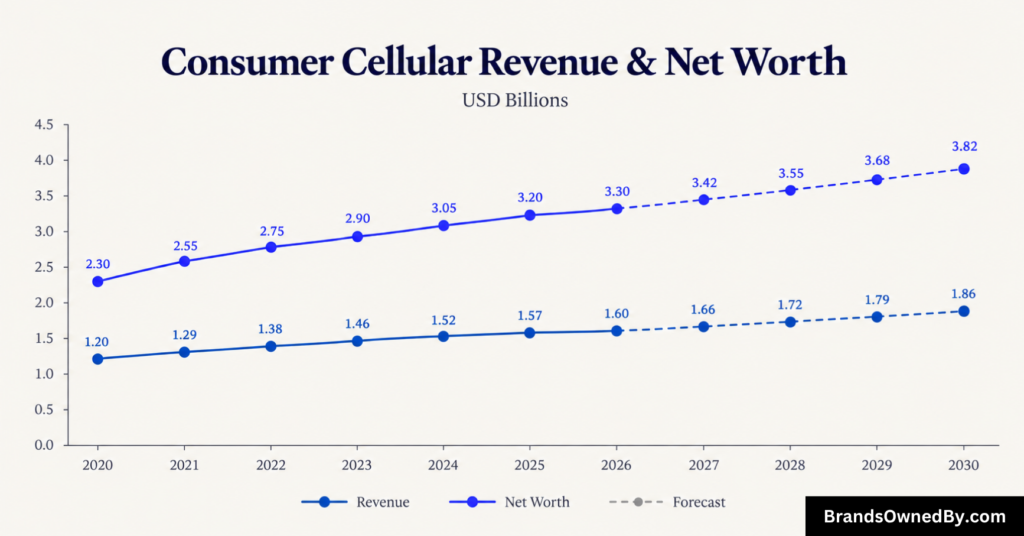
Consumer Cellular does not publish audited annual accounts. Revenue and net worth figures must therefore be treated as analytical estimates, not reported financial statements.
Revenue in 2026
Our 2026 revenue estimate is $1.60 billion. The strongest operating anchors are almost 4.4 million subscribers and average monthly revenue per customer above $30.
Multiplying 4.4 million by $30 and then by 12 produces $1.584 billion. Rounding that result to $1.60 billion allows for device and accessory revenue while recognizing that not every subscriber remains active for the full year.
This estimate is materially higher than some third-party company directories. Those directories often recycle older figures or use employee-based models. A customer-and-ARPU calculation is more appropriate for a subscription wireless business.
Net Worth in 2026
We estimate Consumer Cellular’s 2026 enterprise value at $3.30 billion. The starting anchor is the reported $2.3 billion acquisition value in 2020.
The company has since increased average revenue per customer and expanded its subscriber base from roughly four million to almost 4.4 million. Those gains support a higher operating value. The 2025 continuation structure and large refinancing also indicate that institutional capital providers still view the company as a durable cash-generating asset.
Enterprise value should not be confused with GTCR’s equity value. Consumer Cellular carried more than $3 billion of debt around its 2025 refinancing. The equity value may therefore be much lower than the enterprise value after net debt is deducted.
Revenue Bifurcation
Wireless service should account for the great majority of revenue. Using the current operating model, recurring plan payments likely contribute more than 90% of the total.
Devices and accessories add a smaller amount. Hardware revenue can be meaningful in dollars, but gross margins are usually lower than service margins. Financing programs may support device conversion and customer retention rather than becoming a major stand-alone profit center.
Medical-alert products and connected devices broaden the customer relationship. They also fit Consumer Cellular’s older demographic. Their financial contribution is likely modest compared with monthly wireless plans.
Revenue Forecast Through 2030
The model forecasts revenue rising from $1.60 billion in 2026 to $1.86 billion in 2030. That is a compound annual growth rate of approximately 3.8%.
The forecast does not require aggressive subscriber expansion. Growth can come from three sources. The first is modest net additions. The second is higher average revenue per customer as users consume more data or move to larger plans. The third is additional revenue from devices and safety products.
There are limits to the upside. The 50-plus segment is attractive but heavily contested. Cable companies, carrier-owned prepaid brands, and low-cost digital MVNOs can pressure pricing. Consumer Cellular must also protect its service reputation as it grows.
Net-Worth Forecast Through 2030
The estimated enterprise value reaches $3.82 billion in 2030. This assumes that revenue growth remains steady and valuation multiples stay broadly stable.
The forecast is deliberately more conservative than applying a technology-company multiple. Consumer Cellular is a subscription business, but it does not own the network. Wholesale costs, customer-acquisition spending, churn, and leverage reduce the multiple investors should pay.
The largest valuation risk is debt. A highly leveraged business can have a healthy enterprise value while generating a much smaller equity value. Higher interest costs or weaker retention would reduce the amount available to equity holders.
The upside case would require stronger subscriber growth, continued ARPU expansion, and stable wholesale terms. A strategic buyer could also pay a premium for the company’s customer base and older-adult positioning.
Brands Owned by Consumer Cellular
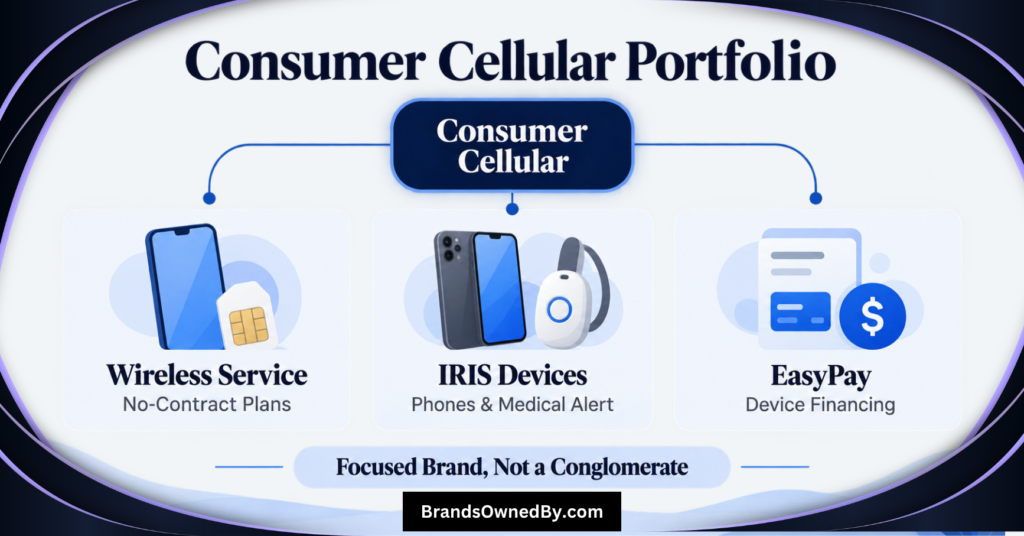
Consumer Cellular is not a diversified holding company. It has no publicly disclosed list of acquired operating subsidiaries. The portfolio is concentrated in one wireless brand and several product or service labels.
That focused structure is important for readers searching for companies owned by Consumer Cellular. GTCR owns Consumer Cellular. Consumer Cellular, in turn, primarily owns and operates its own service platform rather than a group of separate businesses.
Consumer Cellular
Consumer Cellular is the principal operating company and customer-facing brand. It offers no-contract wireless plans, phones, accessories, account management, and customer support.
The brand’s key asset is its relationship with an older customer base. Its value comes from recurring subscribers, trusted support, retail distribution, and a straightforward service proposition.
Consumer Cellular does not own the AT&T network. It buys access to that infrastructure and packages it into its own service.
IRIS Devices
IRIS is Consumer Cellular’s house device family. Products have included senior-friendly phones and medical-alert devices such as IRIS Ally and IRIS Ally Go.
The IRIS label allows Consumer Cellular to design a product experience around its target market. Features can prioritize simpler navigation, readable interfaces, emergency assistance, and accessible support.
IRIS is a product brand, not a separately disclosed operating company. It should not be counted as an independent subsidiary when describing Consumer Cellular’s corporate portfolio.
EasyPay
EasyPay is Consumer Cellular’s device-financing program. It allows eligible customers to spread the cost of a phone across monthly payments rather than paying the full purchase price upfront.
The program supports device upgrades and lowers the initial cost of more expensive smartphones. It also strengthens retention because the customer maintains an ongoing device-payment relationship.
EasyPay is a service program. It is not a separate finance company or publicly disclosed subsidiary.
GrandPad Relationship
Consumer Cellular invested in GrandPad and became a U.S. distributor of its simplified tablet in 2018. The product was designed to make communication and digital services easier for older adults.
GrandPad should not be listed as a wholly owned Consumer Cellular company. The relationship involved an investment and distribution partnership. Public company databases do not show Consumer Cellular completing an acquisition of GrandPad.
This distinction separates an equity investment from corporate ownership. A company can invest in or distribute a product without owning the entire business.
Third-Party Phone Brands
Consumer Cellular sells devices made by companies such as Apple, Samsung, Motorola, and others. It does not own those manufacturers or brands.
The same rule applies to retail partners. Target, Walmart, and other sellers may distribute Consumer Cellular products, but Consumer Cellular does not own those retailers. AARP provides a membership relationship and discount channel, but AARP does not own Consumer Cellular and Consumer Cellular does not own AARP.
Final Thoughts
The direct answer to who owns Consumer Cellular is GTCR. The private equity firm acquired control in October 2020 in a deal reported at approximately $2.3 billion. A 2025 continuation transaction changed the investment vehicle, not the controlling sponsor.
Ed Evans runs the business. GTCR controls governance and major financial decisions. AT&T supplies the network used for new activations but has no disclosed ownership stake.
Consumer Cellular’s portfolio is also narrower than many readers expect. It is a focused wireless operator, not a conglomerate. Its main assets are the Consumer Cellular brand, recurring subscriber base, IRIS product family, distribution relationships, and customer-service operation.
The most important issue going forward is the balance between operating growth and financial leverage. Consumer Cellular has a resilient customer base and rising revenue per account. It also carries substantial debt after several sponsor-driven recapitalizations. That combination will shape the company’s value and GTCR’s eventual exit options.
FAQs
Who owns Consumer Cellular in September 2026?
GTCR controls Consumer Cellular through a GTCR-managed private investment structure. The company is privately held and does not publish current ownership percentages for every minority investor.
Is Consumer Cellular owned by AT&T?
No. Consumer Cellular uses AT&T’s network for new activations, but AT&T does not own the company. GTCR is the controlling owner.
Is Consumer Cellular owned by Verizon?
No. Verizon does not own Consumer Cellular. Verizon owns Visible, a competing value-wireless brand.
Is Consumer Cellular owned by AARP?
No. Consumer Cellular is an approved provider for AARP members and offers member discounts. That is a commercial relationship, not an ownership arrangement.
Does John Marick still own Consumer Cellular?
John Marick sold control to GTCR in 2020 and retired as CEO. The transaction announcement stated that he would retain a minority position and board role. His current percentage has not been publicly disclosed.
Who is the CEO of Consumer Cellular?
Ed Evans is chairman and CEO. He took over when GTCR completed the acquisition in October 2020.
What network does Consumer Cellular use?
Consumer Cellular uses wholesale network capacity rather than owning a nationwide tower network. New activations use AT&T’s network. Some older accounts may have originated under earlier network arrangements.
Is Consumer Cellular a public company?
No. Consumer Cellular is private. It has no publicly traded ticker symbol and does not release the same financial disclosures required from listed companies.
How much did GTCR pay for Consumer Cellular?
The transaction price was not disclosed in the official acquisition announcement. Contemporary deal reports valued the purchase at approximately $2.3 billion.
How many customers does Consumer Cellular have?
Consumer Cellular had almost 4.4 million subscribers in early 2026, compared with about 3.9 million several years earlier.
How much revenue does Consumer Cellular make?
Consumer Cellular does not publish audited revenue. Based on almost 4.4 million subscribers and average monthly revenue above $30 per customer, we estimate 2026 revenue at approximately $1.60 billion.
What is Consumer Cellular’s net worth?
Consumer Cellular has no official public net-worth figure. We estimate its 2026 enterprise value at $3.30 billion. This is an operating-business valuation and should not be confused with book equity or GTCR’s net equity after debt.
Does Consumer Cellular own GrandPad?
Consumer Cellular invested in GrandPad and distributed its tablet, but public records do not show that Consumer Cellular acquired the company outright.
Does Consumer Cellular own its wireless network?
No. It operates as an MVNO. It owns the customer relationship, billing platform, service operation, and brand, while purchasing network access from a larger carrier.
Will GTCR sell Consumer Cellular?
Private equity firms normally seek an eventual exit. Possible routes include a strategic sale, another sponsor transaction, or a public offering. The 2025 continuation structure extended GTCR’s ownership period, so it should not be read as evidence of an immediate sale.