
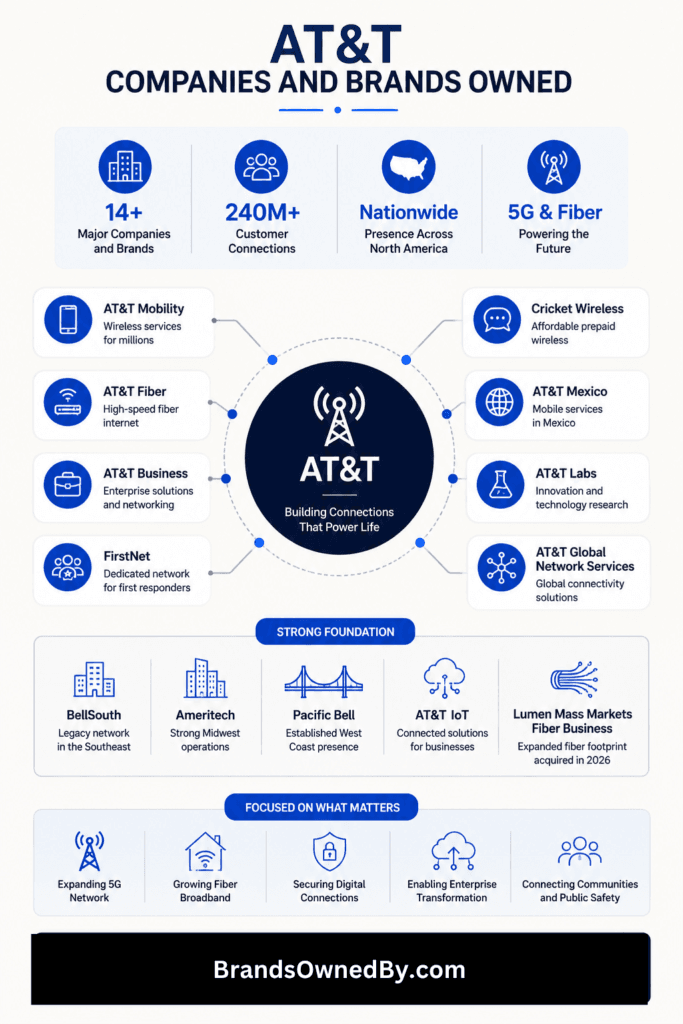
- AT&T owns a diversified portfolio of telecommunications businesses, including AT&T Communications, AT&T Mobility, AT&T Business, AT&T Fiber, FirstNet, Cricket Wireless, AT&T Mexico, AT&T Labs, AT&T Global Network Services, AT&T IoT, BellSouth, Ameritech, Pacific Bell, and the Lumen Mass Markets Fiber Business acquired in 2026.
- The company’s core business is communications infrastructure, with its subsidiaries collectively providing wireless services, fiber broadband, enterprise networking, cloud connectivity, cybersecurity, Internet of Things (IoT) solutions, and public safety communications across North America.
- Several companies became part of AT&T through major acquisitions, including BellSouth, Ameritech, Pacific Telesis (Pacific Bell), Leap Wireless (Cricket Wireless), Iusacell and Nextel Mexico (AT&T Mexico), and Lumen’s Mass Markets Fiber Business, all of which continue supporting AT&T’s long-term growth strategy.
- AT&T no longer operates as a diversified media company and now focuses on expanding its 5G network, fiber broadband infrastructure, enterprise communications, and digital connectivity services through its wholly owned subsidiaries and business units.
What companies does AT&T own? The answer is different today than it was just a few years ago. AT&T has streamlined its business by focusing almost entirely on telecommunications. Instead of expanding into media and entertainment, the company now concentrates on wireless connectivity, fiber broadband, enterprise networking, and digital communication services.
Its portfolio includes well-known consumer brands, regional telecommunications companies, specialized business units, and infrastructure businesses that support millions of customers across North America. Understanding these companies provides a clearer picture of how AT&T generates revenue and maintains its position as one of the largest telecommunications providers in the world.
AT&T Company Profile
AT&T Inc. is one of the oldest and most recognized telecommunications companies in the United States. Its history dates back to 1885 when the American Telephone and Telegraph Company was established to expand long-distance telephone services across the country. Over more than a century, the business evolved through mergers, acquisitions, regulatory changes, and technological innovation.
The modern AT&T is the successor to SBC Communications, which acquired the original AT&T Corp. in 2005 and adopted the globally recognized AT&T name. Since then, the company has expanded its wireless network, invested heavily in fiber broadband, strengthened its enterprise communications business, and built one of the nation’s largest 5G networks.
Today, AT&T primarily operates through its communications businesses. It serves more than 100 million wireless subscribers and millions of broadband customers while providing networking, cybersecurity, cloud connectivity, and Internet of Things (IoT) solutions to businesses across the globe.
The company is headquartered in Dallas, Texas, and its shares trade on the New York Stock Exchange under the ticker symbol T. John T. Stankey serves as Chairman and Chief Executive Officer, leading AT&T’s strategy of expanding fiber infrastructure, enhancing wireless coverage, and improving customer experience through long-term investments in network technology.
List of Major Companies Owned by AT&T
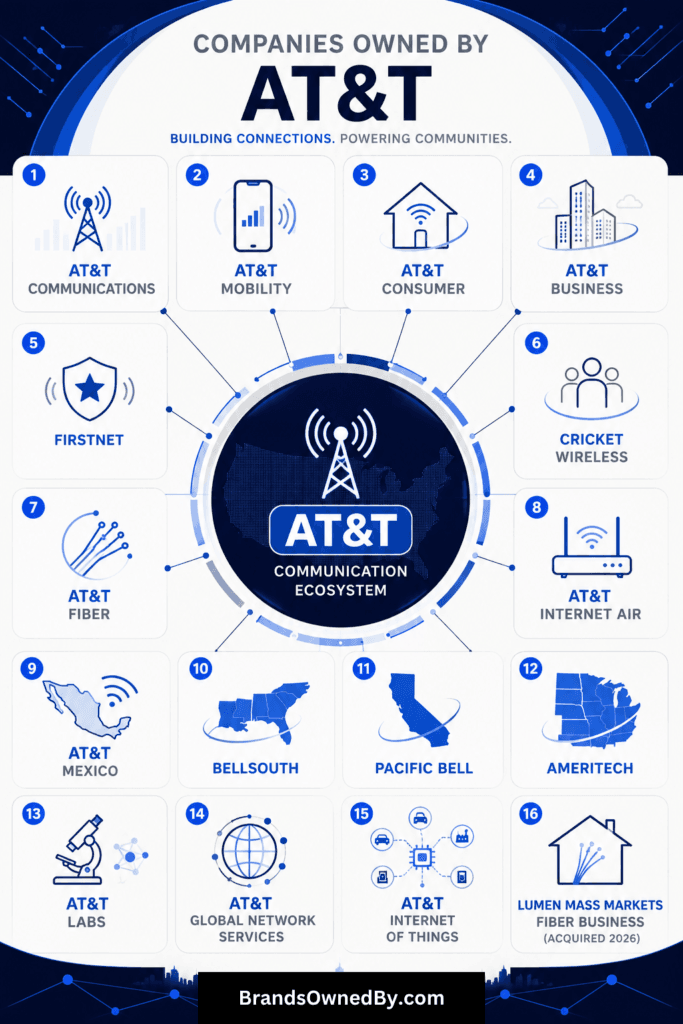
AT&T owns several subsidiaries, operating companies, and consumer brands that together form one of the largest telecommunications ecosystems in North America. Some businesses operate under the AT&T brand, while others continue to exist as separate subsidiaries because of historical acquisitions or regulatory requirements.
Together, these companies allow AT&T to provide wireless communication, broadband internet, enterprise networking, public safety communications, research, and international telecommunications services.
AT&T Communications
AT&T Communications is the largest operating company within AT&T and serves as the foundation of its business. Nearly every consumer and enterprise communication service offered by AT&T is managed through this division. Rather than operating as a separate consumer-facing brand, it functions as the company’s primary communications business responsible for delivering wireless, broadband, voice, and networking services across the United States.
The division manages AT&T’s nationwide wireless network, fiber broadband infrastructure, business communications, internet services, and traditional voice offerings. It also oversees much of the company’s network operations, ensuring reliable connectivity for residential customers, small businesses, large enterprises, and government organizations.
One of AT&T Communications’ biggest responsibilities is maintaining and expanding the company’s 5G wireless network and fiber infrastructure. Every year, AT&T invests billions of dollars to improve network capacity, expand coverage, and deploy faster internet services in new communities. These investments allow the company to compete with Verizon and T-Mobile while meeting growing demand for cloud applications, video streaming, artificial intelligence workloads, and connected devices.
For consumers, AT&T Communications powers familiar services such as unlimited wireless plans, AT&T Fiber internet, home broadband, and mobile hotspot services. For businesses, it delivers networking, managed connectivity, cloud integration, and communication platforms that support organizations ranging from small local companies to multinational corporations.
Because of its size and broad responsibilities, AT&T Communications generates the majority of AT&T’s revenue and remains the company’s most valuable operating business.
AT&T Mobility
AT&T Mobility is AT&T’s wireless subsidiary and one of the largest mobile network operators in the United States. Although consumers simply recognize the AT&T wireless brand, the mobile business is operated through AT&T Mobility, which manages nationwide cellular infrastructure, mobile subscriber services, spectrum assets, and wireless technologies.
The business became significantly larger after AT&T acquired BellSouth in 2006. That transaction gave AT&T complete ownership of Cingular Wireless, which was later integrated and rebranded as AT&T Mobility. The acquisition transformed AT&T into one of the country’s dominant wireless carriers and strengthened its position in both consumer and enterprise mobility.
Today, AT&T Mobility offers prepaid and postpaid mobile plans, smartphones, tablets, smartwatches, connected vehicles, mobile hotspots, and fixed wireless services. The company also supports businesses through mobile device management, private wireless networks, fleet connectivity, and secure mobility solutions designed for industries such as healthcare, manufacturing, transportation, and government.
The subsidiary continues investing in 5G technology to increase network speed, reduce latency, and support emerging applications such as autonomous vehicles, industrial automation, augmented reality, and smart cities. Its wireless infrastructure also serves as the foundation for several other AT&T businesses, including FirstNet, Internet Air, and numerous Internet of Things services.
For most consumers, every call made, message sent, or video streamed through AT&T’s mobile network is supported by the infrastructure managed by AT&T Mobility.
AT&T Business
AT&T Business is the company’s enterprise communications division, serving organizations ranging from small businesses to multinational corporations. While many consumers associate AT&T primarily with mobile phones and home internet, the enterprise segment represents a significant portion of the company’s overall operations and revenue.
The division provides networking, cloud connectivity, managed security, Internet of Things connectivity, software-defined wide area networking (SD-WAN), dedicated internet access, voice solutions, and collaboration services. These products enable businesses to securely connect offices, remote employees, manufacturing facilities, data centers, and cloud platforms through highly reliable communication networks.
One of AT&T Business’s strengths is its ability to deliver integrated solutions rather than individual products. For example, a healthcare provider can combine secure fiber connectivity, managed cybersecurity, cloud networking, mobile communications, and IoT-enabled medical devices through a single provider. Likewise, a multinational retailer can connect hundreds of stores across different countries while maintaining secure communications between employees, payment systems, and inventory management platforms.
The division also supports industries with specialized requirements, including finance, healthcare, education, manufacturing, energy, logistics, and government agencies. Many Fortune 500 companies rely on AT&T Business to maintain secure global communications and mission-critical connectivity.
As businesses continue adopting cloud computing, artificial intelligence, edge computing, and hybrid work environments, AT&T Business remains one of the company’s key growth drivers by helping organizations modernize their communication infrastructure.
FirstNet
FirstNet is one of the most strategically important businesses owned by AT&T. Unlike traditional wireless networks designed for the general public, FirstNet is dedicated exclusively to first responders and public safety organizations throughout the United States.
The nationwide broadband network was developed through a long-term partnership with the U.S. government to improve emergency communications. Police departments, fire services, emergency medical teams, search and rescue organizations, emergency management agencies, and other public safety professionals use the network during daily operations as well as large-scale emergencies.
A defining feature of FirstNet is its priority and preemption capability. During natural disasters, major sporting events, terrorist incidents, or other situations that overload commercial cellular networks, FirstNet users receive priority access to network resources. This allows emergency personnel to continue communicating even when millions of consumer devices are competing for bandwidth.
AT&T continues expanding FirstNet through additional spectrum deployment, network infrastructure upgrades, and advanced communication technologies. The network now supports mission-critical voice services, mobile broadband, connected emergency vehicles, drones, wearable technology, and Internet of Things devices used by public safety agencies.
Beyond its public service role, FirstNet also strengthens AT&T’s competitive position. The long-term government partnership provides a stable source of revenue while reinforcing AT&T’s reputation as a trusted communications provider for mission-critical operations.
Cricket Wireless
Cricket Wireless is one of AT&T’s most successful consumer brands and plays a major role in the company’s prepaid wireless business. Although it operates under its own name, Cricket is a wholly owned subsidiary of AT&T and uses the company’s nationwide 5G and LTE network to provide mobile services across the United States.
AT&T entered the prepaid market by acquiring Leap Wireless, the parent company of Cricket Wireless, in 2014. At the time, the prepaid wireless segment was growing rapidly as consumers looked for affordable mobile plans without long-term contracts. Instead of replacing the Cricket brand with AT&T, the company chose to keep it as a separate business because of its strong customer recognition and established retail network.
Today, Cricket Wireless offers unlimited and fixed-data mobile plans, smartphones, tablets, mobile hotspots, and family plans. Customers receive access to AT&T’s wireless network while benefiting from straightforward pricing, no annual contracts, and flexible payment options. The brand primarily targets students, budget-conscious families, seniors, and customers who prefer prepaid services over traditional postpaid contracts.
Cricket also serves as an important competitive tool for AT&T. It allows the company to compete directly with prepaid brands such as Metro by T-Mobile, Boost Mobile, and Verizon’s Visible without affecting the pricing strategy of its premium AT&T wireless offerings. By operating two distinct wireless brands, AT&T is able to reach different customer segments while maximizing its overall market share.
AT&T Fiber
AT&T Fiber is one of the company’s fastest-growing businesses and a central part of its long-term growth strategy. Rather than relying on traditional copper telephone lines, AT&T Fiber delivers internet services through fiber-optic cables capable of transmitting data at extremely high speeds with very low latency.
The company has invested tens of billions of dollars into expanding its fiber network across the United States. These investments are intended to replace aging infrastructure, improve network reliability, and meet increasing demand for bandwidth-intensive applications such as video streaming, cloud computing, online gaming, artificial intelligence, and remote work.
Unlike many cable internet providers, AT&T Fiber offers symmetrical upload and download speeds on many plans. This is particularly valuable for households that regularly upload large files, participate in video conferences, create online content, or operate home-based businesses. A family streaming multiple 4K videos while attending virtual meetings and backing up data to the cloud can use the network simultaneously without experiencing significant performance issues.
The expansion of AT&T Fiber also strengthens the company’s competitive position against cable operators including Comcast and Charter Communications. Fiber customers generally produce higher long-term value, lower maintenance costs, and stronger customer retention compared with legacy broadband services. For this reason, AT&T continues expanding fiber coverage into new cities and neighborhoods each year.
AT&T Internet Air
AT&T Internet Air is the company’s fixed wireless broadband service designed for households where fiber internet has not yet been deployed. Instead of connecting homes through underground cables or fiber-optic infrastructure, the service uses AT&T’s nationwide wireless network to deliver high-speed internet.
The introduction of Internet Air reflects a broader industry shift toward fixed wireless access as a practical solution for expanding broadband coverage. Building fiber infrastructure in rural communities or sparsely populated areas can require substantial investment and lengthy construction timelines. Internet Air allows AT&T to reach many of these customers much more quickly by using existing wireless towers and spectrum assets.
Customers install a wireless gateway that communicates directly with nearby AT&T cellular towers. Once activated, the gateway provides Wi-Fi connectivity throughout the home for streaming, video conferencing, online education, gaming, and everyday internet use. The installation process is typically much simpler than traditional wired broadband because no technician is required to lay new cables.
Internet Air also complements AT&T Fiber rather than replacing it. In areas where fiber is available, AT&T generally promotes fiber as its premium broadband product because of its higher capacity and symmetrical speeds. Internet Air fills the coverage gap by providing reliable broadband to customers who would otherwise have limited high-speed internet options.
As AT&T continues expanding both fiber and wireless infrastructure, Internet Air has become an important part of the company’s strategy to extend broadband availability to millions of additional households.
AT&T Mexico
AT&T Mexico represents the company’s largest telecommunications operation outside the United States. The business was established after AT&T acquired Mexican wireless carriers Iusacell in 2014 and Nextel Mexico in 2015. Rather than operating the two businesses separately, AT&T integrated them into a single nationwide wireless network under the AT&T Mexico brand.
The expansion into Mexico was driven by AT&T’s vision of creating a more connected North American communications network. Millions of people travel, work, and conduct business between the United States and Mexico each year. By owning wireless operations in both countries, AT&T can offer seamless roaming services, cross-border business connectivity, and integrated communication solutions for multinational organizations.
Today, AT&T Mexico provides prepaid and postpaid mobile plans, smartphones, enterprise mobility services, Internet of Things connectivity, and nationwide 4G LTE and 5G coverage. The company continues investing in network modernization to improve service quality and expand coverage throughout the country.
Although competition in Mexico is intense, particularly from América Móvil and Telefónica, AT&T Mexico remains an important strategic asset. It strengthens AT&T’s international presence while supporting businesses that operate across North America. Manufacturing companies, logistics providers, retailers, and multinational corporations benefit from integrated communication services that span both countries.
BellSouth
BellSouth remains one of the most significant companies owned by AT&T, even though consumers rarely encounter the brand today. AT&T acquired BellSouth in 2006 through an $86 billion transaction that became one of the largest telecommunications mergers in U.S. history.
The acquisition fundamentally changed AT&T’s business. Most importantly, it gave the company complete ownership of Cingular Wireless, which was later fully integrated into AT&T Mobility. This allowed AT&T to simplify its wireless operations, accelerate network investments, and compete more effectively in the rapidly growing mobile communications market.
BellSouth also brought extensive wireline infrastructure, broadband assets, enterprise customers, and local telecommunications operations across the southeastern United States. Its regional operating companies continue supporting millions of residential and business customers in states including Alabama, Florida, Georgia, Kentucky, Louisiana, Mississippi, North Carolina, South Carolina, and Tennessee.
Although the BellSouth name has largely disappeared from consumer marketing, the company’s infrastructure remains deeply integrated into AT&T’s communications network. Its fiber routes, central offices, switching facilities, and local access networks continue supporting wireless backhaul, broadband services, enterprise networking, and traditional voice communications.
More than two decades after the acquisition, BellSouth continues to play an essential role in AT&T’s nationwide telecommunications operations, demonstrating how major acquisitions can remain strategically valuable long after their consumer branding has been retired.
Ameritech
Ameritech is another important legacy telecommunications company that continues operating within AT&T’s corporate structure. Originally created after the breakup of the Bell System in 1984, Ameritech served customers across several Midwestern states and quickly became one of the largest regional telephone companies in the United States.
The company became part of AT&T through a series of corporate transactions that began when SBC Communications acquired Ameritech in 1999. After SBC later acquired the original AT&T Corp. and adopted the AT&T name, Ameritech’s operations became part of today’s AT&T organization.
Although the Ameritech brand is no longer marketed to consumers, many of its operating companies continue functioning as regulated telecommunications subsidiaries. These businesses manage local telephone infrastructure, fiber networks, broadband facilities, and enterprise communications throughout Illinois, Indiana, Michigan, Ohio, and Wisconsin.
The acquisition significantly expanded AT&T’s geographic footprint and customer base while providing valuable telecommunications infrastructure across the Midwest. Much of today’s fiber expansion and enterprise connectivity in these states builds upon network assets originally developed under Ameritech.
For AT&T, Ameritech represents more than a historical acquisition. It remains a foundational part of the company’s regional communications infrastructure and continues supporting millions of residential, commercial, and government customers through modern broadband and telecommunications services.
Pacific Bell
Pacific Bell is one of AT&T’s longest-standing regional telecommunications companies and continues to play an important role in the company’s wireline operations. Originally established as part of the Bell System, Pacific Bell became one of the Regional Bell Operating Companies following the breakup of AT&T in 1984. It later became part of SBC Communications through the acquisition of Pacific Telesis in 1997. When SBC adopted the AT&T name in 2005, Pacific Bell became part of the modern AT&T organization.
Although customers throughout California now primarily see the AT&T brand, Pacific Bell continues to exist as a regulated operating company responsible for maintaining significant portions of AT&T’s local telecommunications infrastructure. The company supports residential telephone services, fiber deployment, broadband connectivity, enterprise networking, and the physical infrastructure required to deliver communications across one of the country’s largest markets.
California represents one of AT&T’s most valuable service areas because of its large population, technology industry, and concentration of enterprise customers. Pacific Bell’s extensive network of central offices, fiber routes, switching facilities, and local access infrastructure enables AT&T to serve millions of households and businesses throughout the state.
The subsidiary also plays an important role in AT&T’s ongoing fiber expansion strategy. Much of the company’s investment in high-speed broadband across California builds upon the infrastructure originally developed by Pacific Bell. Rather than constructing entirely new networks, AT&T continues modernizing and expanding these assets to deliver faster internet speeds, improved reliability, and greater network capacity.
While Pacific Bell no longer operates as a separate consumer-facing brand, it remains one of the most valuable telecommunications companies within AT&T’s corporate structure.
AT&T Labs
AT&T Labs is the company’s primary research and development organization and one of the most technologically significant businesses owned by AT&T. Its engineers, scientists, and researchers develop many of the technologies that improve network performance, strengthen cybersecurity, optimize wireless communications, and support future telecommunications innovations.
The organization traces its heritage to Bell Labs, one of the world’s most influential research institutions. While Bell Labs eventually became part of Nokia through separate corporate transactions, AT&T retained its own advanced research organization to continue developing technologies for its communications business.
Today, AT&T Labs focuses on areas such as artificial intelligence, machine learning, cloud networking, software-defined networking, edge computing, cybersecurity, network automation, quantum networking research, and next-generation wireless technologies. Many improvements to AT&T’s fiber and 5G networks are first tested and refined within the research division before being deployed across commercial operations.
The team’s work extends beyond consumer services. Researchers also develop technologies for enterprise networking, public safety communications, Internet of Things platforms, and large-scale network management. For example, AT&T Labs uses artificial intelligence to detect network anomalies, predict equipment failures, optimize traffic routing, and improve customer service operations.
As telecommunications networks become increasingly software-driven, AT&T Labs has become even more important to the company’s long-term strategy. Its innovations help AT&T reduce operating costs, improve network reliability, accelerate service deployment, and remain competitive in an industry where technology evolves rapidly.
AT&T Global Network Services
AT&T Global Network Services manages the company’s international enterprise networking business. While AT&T is widely recognized as a U.S. telecommunications provider, many of its largest customers operate globally and require secure communications that extend well beyond North America.
The division provides multinational corporations with managed networking, cloud connectivity, virtual private networks (VPNs), dedicated internet access, voice communications, cybersecurity services, and international data transport. These services allow organizations to connect offices, factories, warehouses, data centers, and remote employees through highly secure communication infrastructure.
For example, a global manufacturer may operate production facilities in Asia, research centers in Europe, distribution hubs in North America, and customer support offices in Latin America. AT&T Global Network Services enables all of these locations to communicate securely through a single managed network while maintaining consistent performance and centralized security policies.
The business also works closely with major cloud providers, allowing enterprise customers to establish secure, high-performance connections to cloud platforms without relying solely on the public internet. This is particularly valuable for financial institutions, healthcare providers, and government organizations that require enhanced security and regulatory compliance.
Although it receives less public attention than AT&T’s consumer businesses, Global Network Services remains an important contributor to the company’s enterprise strategy by serving thousands of multinational organizations across numerous industries.
AT&T Internet of Things (IoT)
AT&T operates one of the largest Internet of Things (IoT) connectivity platforms in North America. Rather than serving individual consumers, this business focuses on connecting millions of machines, sensors, vehicles, and industrial devices through AT&T’s wireless and broadband networks.
The company’s IoT platform enables organizations to collect real-time data, automate business processes, monitor equipment remotely, and improve operational efficiency. Connected devices communicate continuously through AT&T’s network, allowing businesses to make faster decisions based on accurate, real-time information.
AT&T’s IoT services are used across numerous industries. Automotive manufacturers rely on the platform for connected vehicle services, navigation, diagnostics, and emergency assistance. Logistics companies use IoT technology to monitor vehicle fleets, track shipments, optimize fuel consumption, and improve delivery schedules. Utility providers deploy connected smart meters to measure electricity and water usage remotely, while healthcare organizations use connected medical devices to monitor patients and transmit health information securely.
Industrial companies also benefit from IoT connectivity by monitoring manufacturing equipment, predicting maintenance requirements, and reducing unexpected downtime. Instead of waiting for machinery to fail, sensors continuously report equipment performance, allowing maintenance teams to address potential problems before they interrupt production.
As businesses continue embracing automation, artificial intelligence, and smart infrastructure, AT&T’s IoT business has become an increasingly important growth area. The company’s nationwide wireless network, combined with its enterprise expertise, positions it as a leading provider of large-scale connected device solutions.
Lumen Mass Markets Fiber Business
One of AT&T’s newest additions is the Mass Markets Fiber Business acquired from Lumen Technologies. The transaction officially closed in early 2026 and represents one of AT&T’s most significant broadband acquisitions in recent years.
The acquisition aligns directly with AT&T’s long-term strategy of expanding its fiber network rather than relying solely on traditional copper infrastructure. By acquiring Lumen’s fiber assets, AT&T immediately expanded its presence in several metropolitan markets, added approximately one million fiber customers, and gained access to millions of additional fiber-enabled locations that can be connected to its growing broadband network.
Integrating these assets into AT&T’s existing fiber business also creates operational efficiencies. Instead of building entirely new infrastructure in every market, the company can upgrade and expand existing fiber networks while introducing AT&T’s broadband services, customer support systems, and technology platforms.
The acquisition strengthens AT&T’s competitive position against cable providers and other fiber operators. High-speed fiber broadband continues generating strong demand as households consume more streaming content, businesses migrate to cloud computing, and artificial intelligence applications require increasingly reliable internet connections.
Beyond adding customers, the transaction demonstrates AT&T’s continued commitment to investing in fiber infrastructure as one of its primary long-term growth engines. Combined with ongoing network expansion projects, the acquisition further reinforces AT&T’s goal of becoming one of the largest fiber broadband providers in the United States.
Who Owns AT&T: Top Shareholders
AT&T is a publicly traded company listed on the New York Stock Exchange (NYSE) under the ticker symbol T. Unlike privately owned businesses, AT&T is not controlled by a single individual or family. Ownership is divided among millions of shareholders worldwide, with institutional investors collectively holding the majority of the company’s outstanding shares.
Most of AT&T’s shares are owned by large asset management firms, pension funds, mutual funds, and exchange-traded funds (ETFs). These institutions invest on behalf of millions of individual investors and retirement accounts rather than for their own ownership. While they do not manage the company’s daily operations, they exercise influence by voting on director elections, executive compensation, shareholder proposals, and other corporate governance matters.
Individual investors also own a significant portion of AT&T’s stock. Many of these shareholders are long-term investors who value the company’s dividend income and its continued investment in wireless communications and fiber broadband infrastructure.
As of the latest reported institutional holdings available in July 2026, the largest shareholders of AT&T are as follows.
BlackRock
BlackRock is AT&T’s largest shareholder, owning approximately 8.07% of the company’s outstanding shares. The investment is held through numerous mutual funds, pension portfolios, and iShares exchange-traded funds managed on behalf of institutional and retail clients worldwide.
Because AT&T is included in many major U.S. stock market indices, BlackRock’s ownership reflects its position as one of the world’s largest index fund managers. Although the firm holds substantial voting rights, it primarily focuses on long-term corporate governance and shareholder value rather than participating in day-to-day business operations.
Vanguard Capital Management
Vanguard Capital Management is the second-largest shareholder, holding approximately 6.54% of AT&T’s outstanding shares. The firm’s ownership is spread across a wide range of index funds and retirement investment products that collectively represent millions of individual investors.
Vanguard’s investment philosophy emphasizes long-term ownership. As a result, it remains one of AT&T’s most influential institutional shareholders through its proxy voting rights and engagement with the company’s board of directors.
State Street Global Advisors
State Street Global Advisors owns approximately 4.55% of AT&T. The firm manages investments for pension funds, governments, corporations, and institutional clients around the world.
Most of State Street’s holdings are contained within passive investment funds that track major equity indices. While it does not take an active management role in AT&T, its voting power makes it an important participant in shareholder decisions.
Newport Trust
Newport Trust is another major institutional investor, owning approximately 2.58% of AT&T’s outstanding shares.
The firm provides investment management and fiduciary services for institutional clients and employee benefit plans. Its investment in AT&T reflects confidence in the company’s long-term strategy and stable cash flow generated by its wireless and fiber broadband businesses.
Geode Capital Management
Geode Capital Management owns approximately 2.52% of AT&T’s outstanding shares. The company manages billions of dollars in assets through index-based investment strategies and institutional portfolios.
Like other passive investment managers, Geode typically maintains long-term positions in companies included in major market indices. Its ownership gives it voting rights on important governance matters while supporting diversified investment portfolios.
Individual Shareholders
Beyond institutional investors, millions of individual shareholders collectively own the remaining AT&T shares. These investors include retail shareholders, retirement account holders, dividend-focused investors, and individuals investing through mutual funds and exchange-traded funds.
Although no single retail investor owns a meaningful percentage of the company, individual shareholders collectively represent an important part of AT&T’s ownership base. Together with institutional investors, they elect the Board of Directors and vote on significant corporate matters during annual shareholder meetings.
Competitor Ownership Comparison
AT&T operates in one of the most competitive telecommunications markets in the world. While the company competes primarily with Verizon, T-Mobile US, Comcast, Charter Communications, and Lumen Technologies, each competitor has a different ownership structure. Some are widely held public companies, while others have a controlling shareholder or founder influence that shapes corporate decision-making.
AT&T vs. Verizon
AT&T and Verizon have remarkably similar ownership structures. Both companies are publicly traded and have highly diversified shareholder bases dominated by institutional investors. Neither company has a controlling shareholder, meaning strategic decisions are made by executive management under the oversight of their respective boards of directors.
At AT&T, BlackRock is the largest shareholder with approximately 8.07% of the company’s outstanding shares, followed by Vanguard Capital Management (6.54%) and State Street Global Advisors (4.55%).
Verizon follows a similar pattern. The Vanguard Group and BlackRock are its two largest shareholders, with State Street Global Advisors also holding a significant stake. Together, institutional investors own the majority of Verizon’s outstanding shares, resulting in a governance structure that closely resembles AT&T’s.
AT&T vs. T-Mobile US
T-Mobile US has a fundamentally different ownership structure.
Although the company is publicly traded on Nasdaq, Deutsche Telekom AG remains its controlling shareholder. Through its majority voting power, Deutsche Telekom has substantial influence over T-Mobile’s board appointments, strategic direction, mergers and acquisitions, and capital allocation decisions.
AT&T does not have a comparable controlling shareholder. Instead, its ownership is distributed among institutional investors, which means corporate decisions are influenced through shareholder voting rather than by a single dominant owner. This creates a more decentralized governance model than T-Mobile’s.
AT&T vs. Comcast
Comcast differs from AT&T because of its dual-class share structure.
While institutional investors such as Vanguard and BlackRock own significant economic interests in Comcast, the Roberts family retains effective voting control through Class B shares. This gives Comcast a founder-controlled governance model despite being a publicly traded company.
AT&T operates under a traditional one-share, one-vote ownership structure. No founder, executive, or family controls the company, making shareholder influence considerably more distributed than at Comcast. Comcast also announced plans in June 2026 to separate its media businesses into a standalone public company, further reshaping its corporate structure.
AT&T vs. Charter Communications
Charter Communications, which operates under the Spectrum brand and is expanding through its acquisition of Cox Communications, is another major broadband competitor. Unlike AT&T, Charter has historically had several influential strategic shareholders, including Liberty Broadband, although its ownership structure has continued evolving through corporate transactions.
Charter remains a publicly traded company with significant institutional ownership, but its governance has traditionally been influenced by strategic investors to a greater extent than AT&T. In 2026, Charter received regulatory approval for its acquisition of Cox Communications, a transaction expected to create the largest broadband provider in the United States after closing.
AT&T vs. Lumen Technologies
Lumen Technologies competes with AT&T primarily in enterprise networking, fiber infrastructure, and business communications.
Like AT&T, Lumen is a publicly traded company without a controlling shareholder. Its largest shareholders are institutional investment firms, and corporate decisions are overseen by its Board of Directors and executive leadership team.
The relationship between the two companies has also become more strategic. In early 2026, AT&T completed the acquisition of Lumen’s Mass Markets Fiber Business, expanding its residential fiber footprint while Lumen continued focusing on enterprise networking, cloud connectivity, and digital infrastructure. This transaction strengthened AT&T’s consumer broadband business while allowing Lumen to concentrate on higher-margin enterprise services.
Key Ownership Differences
Among the largest telecommunications companies in North America, AT&T has one of the most diversified ownership structures. No shareholder owns a controlling interest, and the company’s direction is determined collectively by institutional investors, retail shareholders, the Board of Directors, and executive management.
This contrasts with T-Mobile US, where Deutsche Telekom exercises effective control, and Comcast, where the Roberts family retains long-term voting control. Verizon and Lumen follow governance models that are more comparable to AT&T, relying on dispersed institutional ownership rather than a dominant controlling shareholder, while Charter Communications occupies a middle ground with significant institutional ownership alongside historically influential strategic investors.
Who Controls AT&T?
Although millions of shareholders own AT&T, control of the company rests with its Board of Directors and executive leadership team. Public companies operate under a governance structure where shareholders elect directors, and the board appoints senior executives responsible for managing the business.
John T. Stankey
John T. Stankey serves as Chairman and Chief Executive Officer of AT&T. He oversees the company’s overall strategy, capital allocation, network investments, acquisitions, financial performance, and long-term business direction.
Under his leadership, AT&T has concentrated on expanding its fiber footprint, strengthening its wireless network, improving free cash flow, and simplifying the company’s business portfolio around telecommunications.
Major strategic decisions, including multibillion-dollar infrastructure investments and significant acquisitions, ultimately require approval from the Board of Directors, but Stankey is responsible for executing those decisions.
AT&T Board of Directors
The Board of Directors represents shareholders and provides oversight of the company’s management. Directors approve major corporate actions, review financial performance, oversee executive compensation, monitor risk management, and ensure the company operates in the best interests of shareholders.
The board also evaluates long-term strategic initiatives, including acquisitions, large capital expenditures, financing decisions, and corporate governance policies.
Institutional Investors
Large institutional shareholders influence AT&T through their voting rights rather than direct management. They vote on director elections, shareholder proposals, executive compensation, and other governance matters during annual shareholder meetings.
Because no single shareholder owns a controlling stake, major institutional investors collectively have significant influence over corporate governance, even though they do not manage the company’s day-to-day operations.
AT&T Annual Revenue and Net Worth
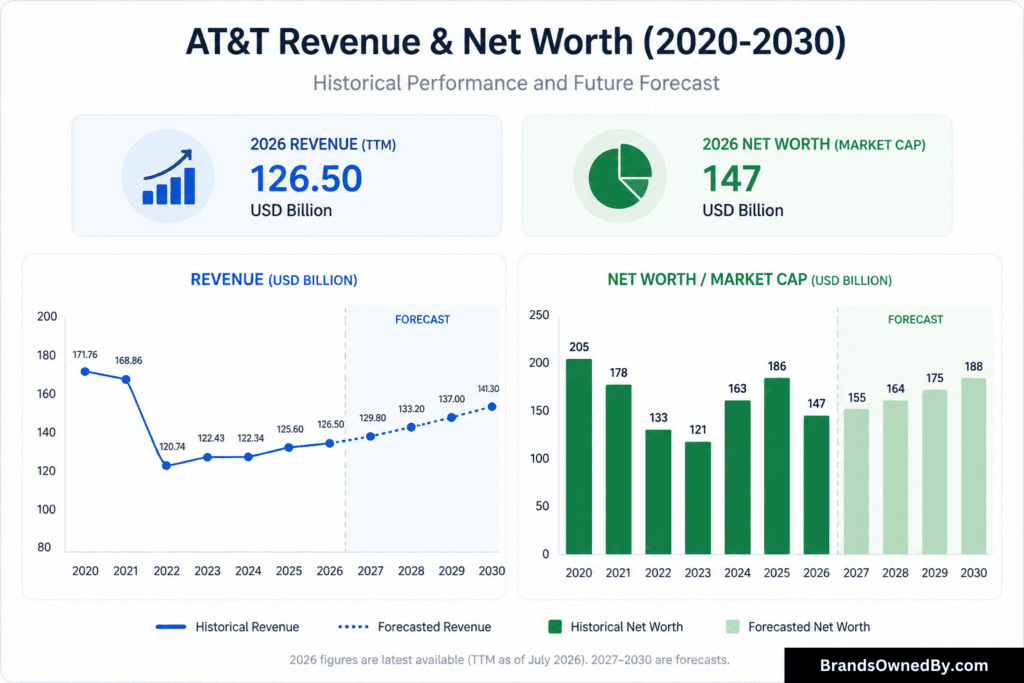
AT&T remains one of the largest telecommunications companies in the world, generating approximately $126.5 billion in trailing twelve-month revenue as of 2026. The company has an estimated market capitalization of approximately $147 billion, while its enterprise value exceeds $290 billion, reflecting the scale of its network infrastructure and long-term debt.
Following the divestiture of its media business, AT&T has become a pure-play communications company, with nearly all revenue now coming from wireless services, fiber broadband, enterprise networking, and business communications.
The company’s financial performance is supported by recurring subscription revenue from more than 240 million customer connections worldwide, including over 109 million wireless subscribers in the United States.
AT&T Revenue in 2026
For the latest trailing twelve-month period available in 2026, AT&T generated approximately $126.5 billion in consolidated revenue. During the first quarter of 2026 alone, the company reported $31.5 billion in revenue, representing a 2.9% year-over-year increase despite continued declines in legacy copper-based services. Revenue growth was primarily driven by wireless service revenue, fiber broadband expansion, and increased equipment sales.
One of the most significant contributors to growth has been AT&T’s Advanced Connectivity business. During the first quarter of 2026, Advanced Connectivity generated $22.9 billion in service revenue and $6.9 billion in operating income. Adjusted EBITDA for the segment reached $11.6 billion, highlighting the profitability of AT&T’s core communications operations.
Revenue Breakdown by Business
AT&T’s revenue is concentrated in three primary operating businesses.
The Mobility segment remains the company’s largest revenue generator. During the first quarter of 2026, Mobility produced approximately $16.9 billion in wireless service revenue, accounting for well over half of total communications revenue. Growth was supported by continued additions of postpaid phone subscribers, increasing adoption of premium unlimited plans, and higher equipment sales driven by smartphone upgrades.
The Consumer Wireline business has become one of AT&T’s fastest-growing segments. Home Internet service revenue increased by more than 27% year over year, reaching approximately $2.8 billion during the first quarter. The growth reflects strong demand for AT&T Fiber and fixed wireless broadband as customers continue migrating away from traditional DSL and cable connections.
The Business Wireline segment continues generating billions of dollars annually by serving enterprise customers with dedicated internet access, cybersecurity, software-defined networking (SD-WAN), cloud connectivity, Internet of Things (IoT) solutions, and managed communications. Although legacy voice services continue to decline, demand for digital infrastructure and enterprise networking remains resilient.
Financial Performance and Key Operating Metrics
AT&T’s financial strength is supported by a recurring subscription-based business model that produces predictable cash flow.
During the first quarter of 2026, the company reported:
- Revenue of $31.5 billion.
- Adjusted EBITDA of approximately $11.8 billion.
- Adjusted earnings per share (EPS) of $0.57.
- Operating cash flow of more than $7 billion.
- Free cash flow of $2.5 billion, despite elevated capital spending on fiber deployment.
AT&T reaffirmed its full-year guidance of more than $18 billion in free cash flow and plans annual capital investments of approximately $23–24 billion, with most spending directed toward fiber expansion, 5G infrastructure, and network modernization.
Subscriber and Network Growth
AT&T’s revenue growth is supported by continued customer additions across its wireless and broadband businesses.
During the first quarter of 2026, the company added approximately 294,000 postpaid wireless phone subscribers, while broadband services recorded approximately 584,000 net internet additions, including both fiber and fixed wireless customers. Nearly 45% of new advanced internet customers also subscribed to AT&T wireless services, demonstrating the success of the company’s bundled connectivity strategy.
Following the completion of the Lumen Mass Markets Fiber acquisition, AT&T’s fiber network now reaches more than 37 million customer locations, with management targeting over 40 million locations by the end of 2026 and more than 60 million locations by 2030.
AT&T Net Worth in 2026
Based on its public market valuation, AT&T’s estimated net worth, measured by market capitalization, is approximately $147 billion in 2026. This places the company among the world’s most valuable telecommunications providers.
However, market capitalization represents only the value of the company’s equity. When long-term debt and other financial obligations are included, AT&T’s enterprise value exceeds $290 billion, reflecting the enormous scale of its wireless spectrum portfolio, nationwide fiber infrastructure, data centers, enterprise networking assets, and international operations.
The company also owns one of the largest communications infrastructures in North America, serving over 109 million wireless subscribers, millions of fiber broadband customers, thousands of enterprise clients, and one of the largest dedicated public safety networks through FirstNet. These long-lived infrastructure assets provide recurring revenue and create significant barriers to entry for competitors.
Revenue Forecast Through 2030
AT&T’s long-term growth is expected to be driven by fiber broadband expansion, continued 5G adoption, enterprise networking services, fixed wireless access, and the integration of the Lumen Mass Markets Fiber Business. Based on the company’s current guidance, industry trends, and analyst expectations, annual revenue could develop as follows:
- 2026: $126.5 billion.
- 2027: $129–131 billion.
- 2028: $132–135 billion.
- 2029: $136–139 billion.
- 2030: $140–144 billion.
These projections assume continued expansion of fiber infrastructure, stable wireless subscriber growth, annual capital investments of approximately $23–24 billion, free cash flow exceeding $18 billion annually, and no major divestitures or transformational acquisitions.
Final Words
AT&T owns a diverse portfolio of telecommunications businesses that support consumers, enterprises, governments, and public safety organizations. While many people still associate the company with its former media businesses, today’s AT&T is firmly focused on communications infrastructure.
Its major companies include AT&T Communications, AT&T Mobility, AT&T Business, AT&T Fiber, Cricket Wireless, FirstNet, AT&T Mexico, AT&T Labs, BellSouth, Ameritech, Pacific Bell, Global Network Services, AT&T IoT, and the recently acquired Lumen Mass Markets Fiber Business. Together, these businesses enable AT&T to provide wireless connectivity, fiber broadband, cloud networking, cybersecurity, enterprise communications, and next-generation digital infrastructure across North America.
With continued investment in fiber expansion and 5G technology, AT&T is well positioned to remain one of the leading telecommunications providers in the United States for years to come.
FAQs
What is the list of companies AT&T owns?
AT&T owns several major telecommunications companies, subsidiaries, and business units, including AT&T Communications, AT&T Mobility, AT&T Business, AT&T Fiber, AT&T Internet Air, FirstNet, Cricket Wireless, AT&T Mexico, AT&T Labs, AT&T Global Network Services, AT&T Internet of Things (IoT), BellSouth, Ameritech, Pacific Bell, and the Lumen Mass Markets Fiber Business acquired in 2026. Together, these businesses provide wireless services, fiber broadband, enterprise networking, cloud connectivity, cybersecurity, and public safety communications across North America.
What companies has AT&T bought?
AT&T has completed numerous acquisitions throughout its history to expand its telecommunications business. Some of its most significant acquisitions include AT&T Corp. (2005), BellSouth (2006), Ameritech (through SBC Communications), Pacific Telesis, Leap Wireless (Cricket Wireless), Iusacell, Nextel Mexico, and the Lumen Mass Markets Fiber Business in 2026. These acquisitions helped strengthen AT&T’s wireless, broadband, enterprise networking, and international operations.
Who is a bigger company, Verizon or AT&T?
Both AT&T and Verizon rank among the largest telecommunications companies in the United States, but their size depends on the metric being compared. Based on annual revenue, AT&T is generally larger, generating approximately $126.5 billion in annual revenue in 2026 compared with Verizon’s annual revenue of around $135 billion on a trailing basis, making the two companies very close in scale. Verizon has historically maintained a slightly larger wireless subscriber base in some categories, while AT&T has expanded rapidly through fiber broadband and enterprise communications. Both companies have market capitalizations exceeding $100 billion and operate nationwide 5G networks.
Who owns most of AT&T?
No single person or company owns AT&T because it is a publicly traded corporation listed on the New York Stock Exchange. As of the latest reported institutional holdings available in 2026, BlackRock is AT&T’s largest shareholder with approximately 8.07% of the outstanding shares. Other major shareholders include Vanguard Capital Management (6.54%), State Street Global Advisors (4.55%), Newport Trust (2.58%), and Geode Capital Management (2.52%). Together, institutional investors own roughly two-thirds of the company.
Who is AT&T’s sister company?
AT&T does not have a sister company in the traditional corporate sense because it is an independent publicly traded company rather than a subsidiary of another business. However, several AT&T subsidiaries, including Cricket Wireless, FirstNet, AT&T Mobility, and AT&T Fiber, are considered sister companies because they operate under the same parent company, AT&T Inc.
Does Warren Buffett own AT&T stock?
No. As of the latest publicly available portfolio disclosures in 2026, Berkshire Hathaway, the investment company led by Warren Buffett, does not own a significant position in AT&T. While Berkshire Hathaway has invested in several telecommunications and technology companies over the years, AT&T is not currently one of its major publicly disclosed equity holdings.
How many companies does AT&T own?
AT&T owns more than a dozen major operating companies, subsidiaries, and business units, in addition to numerous regional telecommunications entities and legal subsidiaries. Its most important businesses include AT&T Communications, AT&T Mobility, AT&T Business, AT&T Fiber, Cricket Wireless, FirstNet, AT&T Mexico, BellSouth, Ameritech, Pacific Bell, AT&T Labs, Global Network Services, AT&T IoT, and the Lumen Mass Markets Fiber Business. Beyond these well-known businesses, AT&T also maintains hundreds of legal entities that support its operations across different states and business functions.
What does AT&T stand for?
AT&T stands for American Telephone and Telegraph Company. The company was founded in 1885 to build and operate long-distance telephone networks in the United States. Although the business has evolved into a global telecommunications provider offering wireless services, fiber broadband, cloud networking, and enterprise communications, the initials AT&T continue to represent its original corporate name.
What companies does AT&T own?
AT&T owns several major businesses, including AT&T Communications, AT&T Mobility, AT&T Business, AT&T Fiber, Cricket Wireless, FirstNet, AT&T Mexico, AT&T Labs, BellSouth, Ameritech, Pacific Bell, Global Network Services, AT&T Internet of Things (IoT), and the Lumen Mass Markets Fiber Business acquired in 2026.
Does AT&T own Cricket Wireless?
Yes. Cricket Wireless is a wholly owned subsidiary of AT&T. The prepaid wireless carrier operates on AT&T’s nationwide network while maintaining its own brand identity, retail stores, and pricing structure.
Does AT&T own FirstNet?
Yes. AT&T operates FirstNet under a long-term public-private partnership with the U.S. government. The network provides dedicated broadband services for first responders and public safety agencies across the United States.
Does AT&T own AT&T Fiber?
Yes. AT&T Fiber is one of the company’s core broadband businesses. It delivers high-speed fiber-optic internet to residential and business customers and is a key part of AT&T’s long-term growth strategy.
Does AT&T own BellSouth?
Yes. BellSouth became part of AT&T after an $86 billion acquisition completed in 2006. Its network infrastructure continues to support AT&T’s wireline and broadband operations across the southeastern United States.
Does AT&T own AT&T Mexico?
Yes. AT&T Mexico is a wholly owned subsidiary that provides wireless services throughout Mexico. The business was established through the acquisitions of Iusacell and Nextel Mexico.
Does AT&T own Warner Bros. or HBO?
No. AT&T no longer owns Warner Bros., HBO, or other former WarnerMedia assets. Those businesses became part of Warner Bros. Discovery following the separation of WarnerMedia.
Who is the largest shareholder of AT&T?
Based on the latest publicly reported institutional holdings available in 2026, BlackRock is AT&T’s largest shareholder with an ownership stake of approximately 8.07%.
Is AT&T privately owned?
No. AT&T is a publicly traded company listed on the New York Stock Exchange under the ticker symbol T. Its shares are owned by institutional investors, retail investors, pension funds, and mutual funds.
What is AT&T’s main business today?
AT&T’s primary business is telecommunications. The company generates most of its revenue from wireless communications, fiber broadband, enterprise networking, business communications, and digital connectivity services.
Which company controls AT&T?
No individual, family, or corporation controls AT&T. The company is governed by its Board of Directors and executive leadership, while ownership is distributed among millions of shareholders.
Why did AT&T focus on telecommunications again?
AT&T streamlined its business to concentrate on its core strengths in wireless communications and broadband infrastructure. This strategy allows the company to invest more heavily in fiber expansion, 5G deployment, enterprise networking, and long-term cash flow generation.