
Fans often ask who owns Southampton FC as the club enters another chapter of rebuilding and ambition. The Saints have shifted through several ownership eras, each shaping the team’s identity and direction. Understanding today’s ownership helps explain where the club is heading next.
Key Takeaways
- Southampton FC is owned by Sport Republic, which holds an 80% controlling stake, backed financially by billionaire Dragan Šolak, who also serves as chairman.
- Katharina Liebherr retains the remaining 20% minority stake, maintaining her family’s legacy connection to the club.
- Sport Republic’s leadership includes Henrik Kraft and Rasmus Ankersen, who influence governance and football strategy through the group’s multi-club model.
Southampton FC Profile
Southampton FC is a professional football club based in the city of Southampton on the south coast of England. Founded in 1885, the club has grown from a small church-youth team into one of the most respected development-focused football institutions in the country.
As of 2025, Southampton is known for its strong academy, modern stadium infrastructure, data-driven operations, and a distinct identity built around discipline, youth promotion, and attacking football.
Southampton’s reputation centers on producing elite players who often rise to the top European leagues. The club has also benefited financially from its development pipeline, which became a core part of its operational model across the 2000s and 2010s.
The organization today consists of the first team, the academy, extensive scouting operations, global partnerships, and a carefully structured business division responsible for commercial progress.
Founders and Formation
Southampton FC traces its origins to the St. Mary’s Church of England Young Men’s Association (YMA). The club was founded in November 1885 by young church members who wanted to organize competitive football beyond informal matches. This group included church leaders, local businessmen, and young working-class players.
The founding environment was shaped by:
- Growing popularity of organized sport in England
- Local church involvement in youth community programs
- Rising interest in competitive football among port-city workers
- A desire to formalize games into structured leagues.
The team was initially known as St. Mary’s YMA FC, which reflects the church-based foundation. The club competed in local competitions before joining organized leagues. As football professionalized in England, Southampton transitioned from a volunteer-driven, community project into a structured organization.
A key part of the club’s identity — even today — is tied to its roots in the St. Mary’s community. The nickname “The Saints” comes directly from these origins.
The transition from a church-side to a professional team was gradual:
- They reorganized governance structures
- Introduced formal training and competitive fixtures
- Sought financial stability to attract better players
- Entered official leagues and competitions.
By the early 20th century, Southampton had developed into a competitive club with professional ambitions, aided by its location in a growing port city and a passionate local fanbase.
Major Milestones
- 1885 – Formation of St. Mary’s Y.M.A. FC by members of St. Mary’s Church in Southampton, marking the birth of what would become Southampton FC.
- 1890 – The club begins playing competitive matches in organized local competitions, increasing structure and visibility in the region.
- 1894 – Southampton St. Mary’s joins the Southern League, stepping into official, organized football and competing at a higher regional level.
- 1896 – Southampton wins its first Southern League championship, signaling its arrival as a strong competitive side.
- 1897 – The club becomes a professional outfit, offering wages to players and formalizing football operations.
- 1898 – Southampton moves into The Dell, a new purpose-built stadium that would become its iconic home for over a century.
- 1900 – Southampton reaches the FA Cup Final for the first time, gaining national attention despite not being a Football League club.
- 1902 – The club reaches another FA Cup Final, reinforcing its reputation as one of the strongest non-league teams in the country.
- 1920 – Southampton is elected into the Football League Third Division, marking its entry into the national football pyramid.
- 1922 – The club wins the Third Division South title and secures promotion to the Second Division, beginning a long stay in the second tier.
- 1940 – The Dell suffers bomb damage during World War II, forcing the club to undertake repairs and use temporary facilities.
- 1950 – Southampton modernizes its stadium facilities at The Dell, improving accessibility and increasing match-day capacity.
- 1959 – Promotion under manager Ted Bates marks the beginning of a more competitive era for the club.
- 1966 – Southampton earns its first-ever promotion to the First Division, entering the top tier of English football for the first time.
- 1976 – Southampton wins the FA Cup after beating Manchester United 1–0, the most iconic victory in the club’s history.
- 1980 – Southampton signs Kevin Keegan, the reigning Ballon d’Or winner, boosting global visibility and fan interest.
- 1984 – The Saints finish second in the First Division, the highest league finish in their history.
- 1992 – Southampton becomes a founding member of the Premier League as English football undergoes major restructuring.
- 2001 – The club moves from The Dell to the new St Mary’s Stadium, modernizing its infrastructure and increasing commercial potential.
- 2005 – Southampton is relegated from the Premier League after 27 consecutive years in the top flight.
- 2009 – The club enters administration, faces financial collapse, and is penalized with a points deduction that drops it to League One.
- 2009 – Swiss businessman Markus Liebherr purchases the club, saving it from crisis and beginning a major rebuilding project.
- 2010 – Investment in the academy and sporting structure accelerates, laying the foundation for future success.
- 2011 – Southampton earns promotion from League One to the Championship, continuing its recovery under Liebherr ownership.
- 2012 – The club secures promotion to the Premier League, achieving back-to-back promotions and returning to the top flight.
- 2014 – Southampton finishes 8th in the Premier League and qualifies for the Europa League, signaling the start of a strong modern era.
- 2016 – The Saints finish 6th and qualify for Europe again, while also reaching the EFL Cup Final in the following season.
- 2017 – Chinese businessman Gao Jisheng acquires an 80% stake in the club, shifting ownership direction.
- 2020 – Southampton stabilizes in the Premier League under new leadership structures and a stronger recruitment model.
- 2022 – Sport Republic acquires controlling ownership, beginning a new era focused on data-driven scouting and multi-club strategy.
- 2023 – The club invests heavily in analytical tools, global partnerships, and academy expansion under Sport Republic.
- 2024 – Southampton wins the Championship play-off final and earns promotion back to the Premier League.
- 2025 – The Saints record the earliest relegation in Premier League history, exiting the league with seven games remaining and triggering structural reassessment.
Who Owns Southampton FC: Top Shareholders
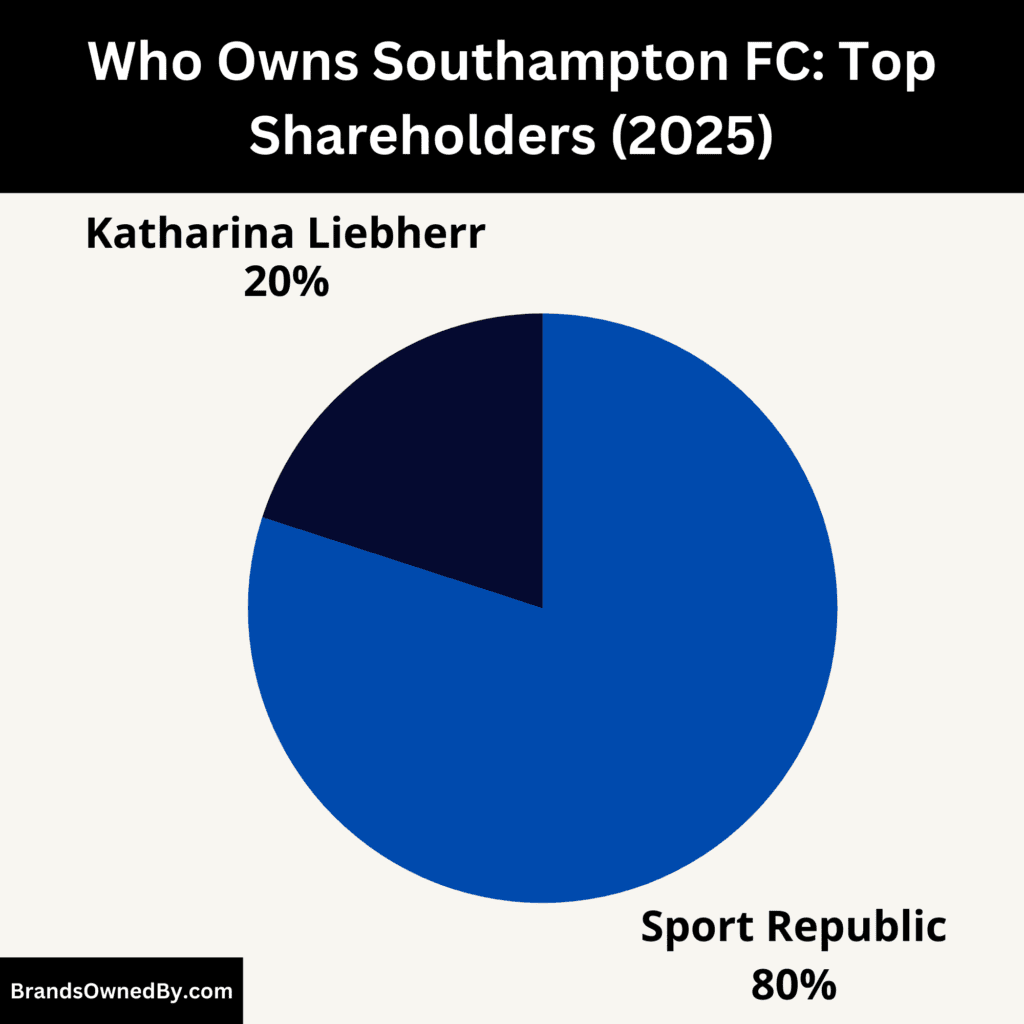
Southampton FC is owned by Sport Republic, which holds an 80% controlling stake in the club. The remaining 20% is held by minority shareholder Katharina Liebherr. The ownership is backed financially by Dragan Šolak, while co-founders Henrik Kraft and Rasmus Ankersen have influence through Sport Republic’s leadership structure.
As of 2025, the group operates Southampton under a multi-club, analytics-driven model with Šolak now directly chairing the board.
Here’s a quick summary of Southampton FC’s largest shareholders as of November 2025:
- Sport Republic – 80% controlling owner
- Dragan Šolak – Principal investor and chairman
- Henrik Kraft – Co-founder, governance influence
- Rasmus Ankersen – Football strategy and recruitment leader.
- Katharina Liebherr – 20% minority shareholder.
Sport Republic (80%)
Sport Republic is a sports investment company focused on football club ownership and data-driven decision-making. It bought an 80% stake in Southampton in January 2022.
The group’s approach emphasizes analytics, recruitment efficiency, and shared resources across its multi-club network. Southampton is the flagship asset, with the group also investing in clubs in France and Turkey as part of a broader ecosystem.
Sport Republic controls:
- Board appointments
- CEO selection
- Sporting director hiring
- Budget approval
- Infrastructure investment
- Multi-club recruitment pathways.
As of November 2025, the group continues to invest in the club despite recent relegation, seeing it as a long-term project rather than a short-term cycle.
Dragan Šolak (Lead Investor & Chairman)
Dragan Šolak is the financial backbone of Sport Republic.
He is a Serbian billionaire who made his fortune through telecommunications and media.
Though exact internal percentages are not publicly disclosed, Šolak provides the majority of the capital behind the 80% ownership stake, making him the dominant financial and strategic figure within the group.
- Šolak became chairman of Southampton FC in January 2025.
- He replaced Henrik Kraft after a disappointing Premier League campaign.
- He now oversees high-level investment, restructuring, and long-term planning.
- His authority extends across all club departments, including executive, commercial, and sporting operations.
Here’s an overview of his financial role:
- He has injected tens of millions into Sport Republic to stabilize the Southampton project.
- Provides guarantees for recruitment budgets and operational costs.
- Approves any major expenditure, including managerial appointments and structural changes.
Šolak’s position makes him, effectively, the true controlling figure at Southampton FC.
Henrik Kraft (Sport Republic Co-Founder)
Henrik Kraft is a co-founder of Sport Republic and played a major role in the early phase of the ownership project. Although his exact equity percentage inside Sport Republic is undisclosed, he is recognized as a meaningful shareholder.
- Kraft served as chairman of Southampton FC from 2022 until January 2025.
- He stepped down to allow Šolak to take a more hands-on position.
- He remains involved at the Sport Republic board level, contributing to governance, financial oversight, and investment strategy.
Here’s how he influences the club:
- Early-stage restructuring after the takeover
- Club governance models
- Executive recruitment
- Operational policy under the Sport Republic vision.
Even after stepping down, Kraft remains part of the ownership ecosystem behind the club.
Rasmus Ankersen (Sport Republic Co-Founder)
Rasmus Ankersen is one of the architects of Sport Republic’s football philosophy.
He holds an influential role in shaping Southampton’s sporting direction.
- Oversees scouting frameworks
- Designs data-driven recruitment processes
- Integrates academy pathways into the first team
- Coordinates sporting synergy with other Sport Republic clubs.
Although his exact internal shareholding is not publicly stated, he is a founding stakeholder with strategic influence.
He is one of the most important operational leaders within the ownership group, especially on football matters.
Katharina Liebherr (20%)
Katharina Liebherr inherited Southampton FC from her late father Markus Liebherr, who saved the club from administration in 2009.
When Sport Republic purchased an 80% stake in 2022, she retained approximately 20%.
- Liebherr is not involved in daily operations.
- She does not sit on the football decision-making committees.
- Her role is passive but historically significant, as the Liebherr family oversaw one of the club’s strongest modern eras.
Here’s what her stake means:
- She remains the only other shareholder outside Sport Republic.
- Her presence ensures continuity between the club’s past and present ownership structures.
- Her remaining equity maintains long-standing ties between the club and its pre-Sport Republic identity.
Southampton FC Ownership History
Southampton FC’s ownership story reflects the club’s growth from a small church team into a modern, multi-club football organization. The evolution of control over the club shaped its stability, financial health, success, and long-term direction.
| Ownership Era | Owner / Group | Years in Control | Stake Held | Key Actions, Impact & Notable Events |
|---|---|---|---|---|
| Early Community Era | St. Mary’s Church Leaders & Local Committee | 1885–1970s | N/A | Founded the club; ran operations through volunteers; established identity, early competitions, and move into structured leagues. |
| Board & Local Business Era | Local Businessmen & Club Board | 1970s–1996 | N/A | Guided the club through The Dell years; stabilized finances; supported youth development; maintained competitive presence. |
| Rupert Lowe Era | Rupert Lowe & Club Board | 1996–2006 | Majority control | Led construction of St Mary’s Stadium; reshaped board structure; oversaw major managerial changes; mixed sporting success. |
| Post-Lowe Decline | Fragmented Ownership (Southampton Leisure Holdings PLC) | 2006–2009 | Split among investors | Financial instability; debt accumulation; structural collapse; club entered administration in 2009 and was relegated. |
| Markus Liebherr Era | Markus Liebherr | 2009–2010 | 100% | Saved club from liquidation; invested in squad, facilities, and structure; laid foundation for future promotions and stability. |
| Katharina Liebherr Era | Katharina Liebherr | 2010–2017 | 100% → 20% | Oversaw back-to-back promotions; redefined the “Southampton Way”; built strong academy reputation; sold 80% stake in 2017. |
| Gao Jisheng Era | Gao Jisheng (Lander Sports) | 2017–2022 | 80% | Implemented sell-to-buy model; inconsistent results; squad weakened; club battled relegation repeatedly; prepared exit by 2022. |
| Sport Republic Era | Sport Republic (Backed by Dragan Šolak) | 2022–Present | 80% | Introduced data-driven model; multi-club structure; expanded scouting and analytics; invested in restructuring; oversaw promotions and relegations; Šolak became chairman in 2025. |
| Minority Stake Holder | Katharina Liebherr | 2017–Present | 20% | Passive stakeholder; no operational control; retains legacy family connection; provides continuity across ownership transitions. |
Early Community and Local Leadership Era (1885–1970s)
Southampton FC began in 1885 under the St. Mary’s Church of England Young Men’s Association. The club was managed by church leaders, community figures, and volunteers. Decisions were simple and based on local priorities, not commercial interests.
As football became more organized, the club evolved into a more formalized committee-run organization. Local businessmen gradually joined the board and helped the club transition from an amateur structure to a professional team.
The identity of the club during this time was rooted in community values, modest finances, and gradual competitive development.
Board-Led Ownership and The Dell Era (1970s–1990s)
During this period, Southampton was run by local businessmen and administrators who held board positions and made collective decisions. The club operated within tight budgets and relied heavily on match-day revenue from The Dell. Ted Bates, a legendary club figure, played a major role in shaping strategic decisions.
His influence brought stability and continuity as football entered a more commercial phase. Despite financial limitations, Southampton maintained competitive standards and strengthened its youth system. Ownership remained locally driven, with conservative but steady governance.
Rupert Lowe Era (1996–2006)
Rupert Lowe became chairman in 1996 and introduced a more corporate style of leadership. His era brought bold decisions, including the construction of St Mary’s Stadium, which opened in 2001.
This was the club’s most important infrastructure project and transformed its commercial potential. Lowe’s leadership, however, was marked by instability in management and frequent changes in direction. He clashed with supporters at times, and results on the pitch varied.
Despite the challenges, the stadium move positioned the club for long-term revenue growth.
Financial Crisis and Administration (2006–2009)
After Lowe’s exit and attempts at restructuring, the club entered one of the most turbulent periods in its history. Financial mismanagement and ownership fragmentation led to Southampton Leisure Holdings PLC collapsing under debt.
In 2009, the club entered administration and suffered a points deduction that contributed to relegation to League One. The club’s survival was at risk, and only external investment could prevent liquidation.
Ownership during this phase was unstable, fractured, and unable to support the club’s operational needs.
Markus Liebherr Era (2009–2010)
In 2009, Swiss businessman Markus Liebherr purchased Southampton and saved it from collapse. His investment stabilized the club and restored professional structure across all departments. Liebherr funded infrastructure upgrades, strengthened the academy, and revitalized recruitment.
Although his ownership was brief, he laid the foundation for Southampton’s remarkable rise in the 2010s.
His commitment returned hope to supporters and re-established long-term planning. His passing in 2010 marked a transition to his family’s stewardship.
Katharina Liebherr Era (2010–2017)
After Markus’s death, Katharina Liebherr assumed ownership. She continued the long-term investment approach and appointed experienced executives to manage operations. Under her ownership, Southampton experienced its most successful modern era.
The club achieved back-to-back promotions from League One to the Premier League, solidifying its return to top-flight football. The “Southampton Way,” a philosophy built around youth development, dynamic football, and smart recruitment, became widely recognized.
Strong financial planning and tactical vision allowed the club to qualify for European competitions and establish a respected academy pipeline.
Gao Jisheng Era (2017–2022)
In 2017, Katharina sold 80% of the club to Chinese businessman Gao Jisheng while retaining a 20% minority stake. Gao’s ownership focused on financial sustainability and player trading.
The club sold several high-value academy and first-team players to support operations. Although this provided revenue, it weakened on-field competitiveness. Managerial instability increased, and the club entered recurring relegation battles.
Strategic direction lacked consistency, and the club’s Premier League position became fragile.
By 2022, Gao was ready to sell, creating an opening for a new investment group.
Sport Republic Era (2022–Present)
Sport Republic acquired the 80% stake in January 2022, marking the beginning of a modern investment-led ownership structure. The group introduced a data-driven, multi-club strategy designed to improve recruitment efficiency and long-term sustainability.
Co-founders Dragan Šolak, Henrik Kraft, and Rasmus Ankersen reshaped the governance model and integrated Southampton into a broader football portfolio. Šolak later assumed the chairman role in January 2025 as the club faced significant sporting challenges.
Sport Republic invested heavily in football operations, scouting systems, academy development, and multi-club resource sharing.
The era also included a Premier League relegation in 2023, promotion in 2024, and an early relegation again in 2025. Despite setbacks, the ownership group committed to restructuring and rebuilding the club’s football identity and financial stability.
Southampton FC Owner’s Net Worth
Dragan Šolak is the lead investor behind Sport Republic and the principal financial figure at Southampton FC. His net worth and business portfolio underpin the club’s investment strategy and long-term viability.
As of November 2025, Šolak’s net worth is estimated at over $1.5 billion. His wealth was previously reported to be around €1.22 billion, and despite market fluctuations, he continues to maintain billionaire status due to the scale and diversity of his investments. His assets span telecommunications, media, real estate, sports investments, and private equity partnerships. This diversified portfolio enables him to remain financially resilient regardless of economic cycles.
His net worth valuation also reflects his long-term involvement in United Group, Southeast Europe’s largest telecom and media conglomerate, as well as his transition into new investment vehicles under Sport Republic. Even as some corporate shifts have reduced direct operational control in certain holdings, Šolak’s financial footprint remains substantial.
Primary Sources of Wealth
Šolak built his wealth through a combination of telecom expansion, media assets, and large-scale mergers across Southeast Europe. His primary business empire was formed through United Group, a major telecommunications and media company operating in multiple countries.
Here are some of the flagship businesses and assets that contributed to his wealth:
- Telemach – A major cable and broadband operator in Slovenia, Bosnia & Herzegovina, Montenegro, and Croatia.
- SBB – One of Serbia’s largest cable TV and internet providers, acquired and built up under United Group.
- Vivacom – A leading telecom operator in Bulgaria, providing mobile, broadband, and digital services.
- Nova Broadcasting Group – A major television and media network operating across Serbia and the Balkans.
- United Media – A large regional content producer and broadcaster with sports channels, entertainment networks, and digital platforms.
These businesses helped United Group generate multi-billion-dollar revenues across Southeast Europe. Even though private equity investors later acquired majority control, Šolak still retains ownership stakes in several subsidiaries and remains financially tied to the conglomerate he built.
Business Influence and Investment Power
Beyond telecom and media, Šolak has expanded into a broader portfolio of investments through Sport Republic. He acts as the lead investor for the group’s acquisitions, including Southampton FC and European clubs in Turkey and France. His role includes providing funding for transfers, analytics infrastructure, academy upgrades, and operational expenses.
Šolak’s investment power is rooted in the cash flow strength of the telecom sector, which historically provides stable returns. These revenues and shareholdings allow him to allocate significant capital toward long-term projects, including football club redevelopment and multi-club systems.
His ability to finance multiple clubs at once gives Sport Republic a competitive advantage in scouting, player development, and global recruitment.
Financial Stability and Strategic Value
Šolak’s wealth also brings stability to Southampton FC during periods of relegation or restructuring. His portfolio includes real estate assets, long-term investment vehicles, and digital infrastructure holdings that protect him from volatility in any single industry.
This diversified foundation ensures that even after corporate challenges—such as changes in control over United Group—his personal financial base remains strong enough to sustain football operations.
For Southampton, this stability matters. The club has endured multiple promotions and relegations since 2022, and Šolak’s willingness to fund rebuilding phases has prevented budget crises and maintained strategic continuity.
His capital injections into Sport Republic also allow the group to acquire complementary assets, expand analytics departments, and modernize sporting structures.
Role in Southampton FC’s Financial Future
As chairman and lead investor, Šolak’s net worth directly influences Southampton’s ability to compete and recover from setbacks. His financial capacity supports the multi-club model that Sport Republic relies on, enabling data sharing, loan movements, and coordinated recruitment across affiliated clubs.
He has publicly committed to strengthening the club’s sporting operations, improving executive leadership, and rebuilding the squad after difficult seasons. His ability to take a long-term, resource-backed approach gives Southampton a more secure financial foundation than many clubs of similar size.
Šolak’s net worth, therefore, plays a central role in shaping the club’s ambitions. His resources provide not only financial backing but also strategic flexibility, allowing Southampton to pursue structural improvements and sustainable growth under Sport Republic.
Southampton FC Net Worth
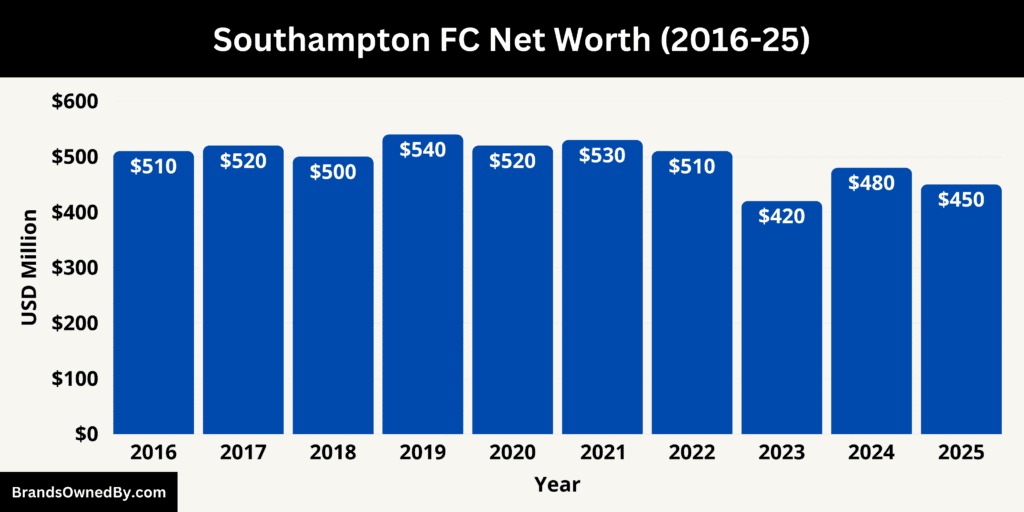
As of November 2025, Southampton FC is valued at $450 million. This valuation reflects the club’s commercial strength, long-term development model, multi-club ownership benefits, and the financial backing provided by Sport Republic.
Southampton’s consistent presence in English football’s top tiers, even with occasional relegation, gives the club a financial profile stronger than many Championship clubs.
The club’s $450 million valuation is a result of the following major components:
- Stadium and infrastructure value
- Broadcast and media revenue
- Commercial partnerships and sponsorships
- Player asset value and academy output
- Parachute payments and guaranteed revenue streams
- Brand equity and historical Premier League presence.
Stadium and Infrastructure Value
St Mary’s Stadium is one of the largest assets contributing to the club’s valuation. With a 32,000+ seating capacity, modern hospitality areas, and strong community integration, the stadium adds significant long-term value. Its location in a major port city supports high match-day turnout and commercial activity.
The Staplewood Campus is another core part of Southampton’s net worth. The training center includes elite coaching facilities, data analysis suites, sports science labs, and a Category One academy.
These assets provide a competitive advantage and enhance the club’s long-term financial resilience.
Broadcasting and Media Revenue Value
Broadcasting is historically the club’s largest income source.
When in the Premier League, Southampton received over $130 million per season in broadcasting and merit payments.
After relegation, the club now benefits from multi-year parachute payments, which stabilize income during Championship years.
Parachute payments average between $45 million and $55 million annually, depending on the year of relegation.
This guaranteed revenue keeps Southampton’s valuation high even outside the Premier League.
International media rights also contribute to the club’s valuation, as the Southampton brand still appears in global football content, replays, and digital licensing.
Commercial Partnerships and Brand Strength
Southampton maintains multiple long-term commercial contracts, including shirt sponsorship, kit suppliers, global partners, and regional sponsors.
Commercial income contributes a consistent annual revenue stream—typically between $20 million and $30 million depending on league status.
The club’s strong brand identity built on academy success and attacking football makes it appealing for corporate partnerships.
Even in down seasons, Southampton retains strong commercial demand due to its history of competing in the Premier League for over a decade.
Player Asset Value
The market value of Southampton’s first-team squad forms another major component of the club’s net worth.
During Championship seasons, the squad is valued between $150 million and $200 million, depending on age profiles, contract lengths, and market trends.
Southampton’s academy—one of the most respected in England—adds long-term economic value.
The club benefits from:
- High resale value of academy-developed players
- Sell-on clauses from past transfers (very common in Saints deals)
- Development fees when academy players move between clubs.
These mechanisms create ongoing revenue streams and contribute significantly to overall valuation.
Multi-Club Ownership Impact
Sport Republic’s multi-club model enhances Southampton’s valuation by reducing operational costs and improving recruitment efficiency.
Shared scouting resources, data systems, sports science departments, and player development pathways strengthen the club’s structure.
This reduces risk and allows Southampton to adopt a more sustainable financial model than typical Championship clubs.
The synergy between clubs under Sport Republic also makes Southampton more valuable in the long term, especially in global scouting and player trading cycles.
Financial Stability and Ownership Support
Sport Republic’s financial backing plays a major role in supporting Southampton’s valuation. The group’s majority ownership ensures stable investment, even during relegation seasons.
This stability protects the club from cost-cutting cycles that weaken many Championship teams. Instead, Southampton can maintain competitive budgets, retain staff, and continue long-term projects.
The remaining 20% share maintained by the Liebherr family adds continuity and heritage value, linking modern investment with historical identity.
Southampton’s projected valuation trajectory remains positive due to its infrastructure, academy, commercial stability, and ownership model. If the club returns to the Premier League, its valuation could exceed $550 million, with additional uplift from broadcasting revenue and market exposure.
Even in the Championship, the club holds strong financial fundamentals, making it one of the highest-valued clubs outside the Premier League.
The combination of modern facilities, a respected academy, a strong brand, and stable ownership ensures Southampton FC remains a financially significant franchise with strong long-term potential.
Southampton FC CEO
The CEO of Southampton FC is Phil Parsons, appointed in July 2023. He is responsible for running the club’s business operations, commercial growth, infrastructure planning, regulatory compliance, and long-term strategy. Parsons works directly with Sport Republic to align the club’s off-pitch direction with its footballing ambitions.
Phil Parsons was appointed as CEO of Southampton FC in July 2023.
Before joining the club, he spent 15 years in senior leadership roles at global technology company Dyson. His technology-business experience made him a strong fit for the club’s ownership under Sport Republic, which emphasizes data-driven operations, multi-club strategy, and modern infrastructure.
Key Responsibilities
As CEO, Phil Parsons is responsible for:
- Regulatory and governance compliance of the club’s corporate structure and ownership framework.
- Commercial strategy including global sponsorships, partnerships, and brand expansion.
- Maximizing stadium, hospitality and match-day revenue from St Mary’s Stadium and associated infrastructure.
- Overseeing non-football operations such as staffing, facilities, academy development, corporate functions, and digital initiatives.
- Acting as a bridge between Sport Republic’s strategic objectives and Southampton’s internal operational teams, ensuring alignment on investment, data capabilities, and club growth.
Strategic Initiatives Under His Tenure
Since his appointment, the CEO has led multiple strategic initiatives:
- A major redevelopment plan for the St Mary’s Stadium and surrounding waterfront area in partnership with the local council, aimed at expanding stadium capacity and diversifying revenue streams beyond football matches.
- Strengthening the club’s data, analytics, and recruitment functions, aligning with Sport Republic’s multi-club model to share scouting and performance resources across clubs.
- Enhancing commercial and hospitality offerings, optimizing non-match-day usage of facilities to increase revenue resilience during off-seasons or lower-league periods.
- Implementing cost-control and operational efficiency frameworks to prepare the club for fluctuating performance and league status.
Challenges and Focus Areas
The CEO’s role is particularly challenging given Southampton’s recent sporting fluctuations. The club’s early relegation in 2025 and the need to rebuild the squad and restore performance place significant pressure on financial and operational leadership. Parsons must manage:
- Ensuring the club remains financially stable under fluctuating broadcast and league status income.
- Balancing immediate cost pressures (player wages, transfers) with long-term investment (academy, infrastructure).
- Maintaining and growing commercial partnerships in a season where performance may dampen appeal.
- Delivering on the stadium redevelopment plans while ensuring short-term operational continuity.
Outlook and Importance to Southampton’s Future
Phil Parsons’s role is crucial to Southampton’s long-term viability. With the club’s valuation at $450 million as of November 2025, operational leadership will determine how quickly the club can return to competitive stability and elevate its commercial and infrastructure value.
The CEO’s ability to execute the ownership group’s vision, manage business risks, and create growth beyond the pitch will directly impact the club’s success on and off the field.
Conclusion
Southampton FC continues to evolve under modern investment and strategic planning. Sport Republic, backed by Dragan Šolak, now controls the club and guides its long-term future. Understanding who owns Southampton FC offers insight into its plans, ambitions, and direction as the club works to strengthen its identity.
FAQs
Who is the current owner of Southampton FC?
Southampton FC is currently owned by Sport Republic, which holds an 80% controlling stake in the club, led and financially backed by Dragan Šolak.
When was Southampton FC founded?
Southampton FC was founded in 1885 as St. Mary’s Young Men’s Association (YMA).
What is Southampton’s majority owner’s net worth?
The majority owner, through Sport Republic, is backed by Dragan Šolak, whose investment leadership gives the ownership group an estimated financial capacity of over $1.5 billion as of November 2025.
How much is Dragan Šolak worth?
Dragan Šolak has an estimated net worth of more than $1.5 billion as of 2025.