

Who owns Wolverhampton Wanderers is a question many fans still ask. Wolves have changed owners several times, and the current structure shapes their financial strength and football strategy. This article explains the ownership, net worth, history, and leadership of the club.
Key Takeaways
- Wolverhampton Wanderers are 100% owned by Fosun International, which has full control of the club through its parent company.
- Guo Guangchang is the ultimate controlling owner, holding approximately 85.29% of Fosun International Holdings.
- Wang Qunbin is the secondary major shareholder, owning around 14.71% of the holding structure that controls Fosun and therefore Wolves.
Wolverhampton Wanderers Overview
Wolverhampton Wanderers Football Club, commonly known as Wolves, is one of the most historically significant football institutions in England. Founded in 1877, the club has grown from a school-based amateur team into a major professional organization competing in the Premier League.
The club is based in the city of Wolverhampton in the West Midlands, a region known for its industrial heritage and strong football culture. Wolves’ identity is closely tied to this community, with a fanbase that has remained intensely loyal through periods of triumph and hardship.
Molineux Stadium, the club’s iconic home, has hosted football for well over a century and has been continuously upgraded to meet modern standards. The stadium’s redevelopment in the 1990s transformed it into one of the earliest all-seater grounds in English football.
Wolves’ profile also includes a sophisticated youth academy that has produced top players for decades. The club is recognized for its emphasis on player development, tactical innovation, and long-standing commitment to attractive football.
Founders
The origins of Wolverhampton Wanderers trace back to St. Luke’s Church School in Blakenhall. In 1877, two key individuals—John Baynton and John Brodie—formed a small football team with their fellow pupils. Their initiative laid the foundation for what would become one of England’s most enduring football clubs.
Baynton and Brodie were not businessmen or professional athletes. They were schoolboys influenced by the rising popularity of football across Britain. Their desire to represent their school and community helped shape the early spirit of the club.
The transformation from a school team to an organized club began with the 1879 merger with The Wanderers, a local cricket and football group. This merger expanded the membership and provided structure, resources and a more formal identity. It also introduced the name Wolverhampton Wanderers, which the club has carried proudly ever since.
During its early years, leadership came primarily from local figures—teachers, church members, and workers—who volunteered time and effort to keep the club functioning. This grassroots leadership allowed Wolves to establish early roots in the city and develop a reputation for unity, resilience and community pride.
The founders’ legacy remains central to Wolves’ identity. Even as the club transitioned to professional status and later to international ownership, the community-driven origins remain an essential part of its story.
Major Milestones
- 1877: St. Luke’s F.C. is founded by John Baynton and John Brodie, marking the birth of the club.
- 1879: The team merges with The Wanderers, adopting the name Wolverhampton Wanderers.
- 1881: Wolves begin playing regularly at the early Molineux Grounds, establishing long-term ties to the stadium area.
- 1888: Becomes one of the 12 founding members of the English Football League, helping shape organized football in England.
- 1893: Wins the FA Cup for the first time, defeating Everton in a historic final.
- 1908: Wins the FA Cup again while playing in the Second Division, reflecting the club’s competitive spirit.
- 1923: Molineux Stadium undergoes major redevelopment, creating a more permanent football venue.
- 1939: Reaches the FA Cup final, demonstrating continued relevance in English football despite pre-war challenges.
- 1953–54: Wins the First Division title under Stan Cullis, beginning the club’s most successful era.
- 1954: Hosts high-profile international friendlies under floodlights, contributing to the creation of European club competitions.
- 1957–58: Wins its second league title during the golden era of Wolves dominance.
- 1958–59: Wins a third league title, confirming the club’s position as one of England’s elite teams.
- 1960: Wins the FA Cup once more, defeating Blackburn Rovers in a strong cup run.
- 1972: Reaches the UEFA Cup Final, finishing as runners-up in their first major European competition final.
- 1979–80: Wins the League Cup, adding another significant domestic trophy.
- 1982–86: Endures severe financial crisis and repeated relegations, nearly leading to the club’s closure.
- 1986: New local owners step in to save the club from extinction, ensuring survival.
- 1990: Sir Jack Hayward purchases Wolves and invests millions to rebuild facilities and restore competitiveness.
- 1993: Molineux Stadium becomes one of the first major all-seater stadiums in England after full redevelopment.
- 2003: Wolves win the Championship Play-Off Final, earning their first-ever Premier League promotion.
- 2010: Returns to the Premier League under Mick McCarthy, beginning another top-flight spell.
- 2012: Relegated from the Premier League and enters a period of instability.
- 2013: Suffers a second consecutive relegation, dropping to League One for the first time in club history.
- 2014: Secures promotion back to the Championship, beginning a steady rebuild.
- 2016: Fosun International acquires the club, ushering in a new era of investment, global strategy, and modernization.
- 2018: Wins the Championship, returns to the Premier League and finishes 7th—qualifying for European football.
- 2020: Reaches the Europa League quarter-finals, one of the club’s strongest modern achievements.
- 2021–2025: Establishes sustained Premier League presence, enhances academy operations, upgrades infrastructure and expands global brand visibility.
Who Owns Wolverhampton Wanderers (Wolves): Major Shareholders
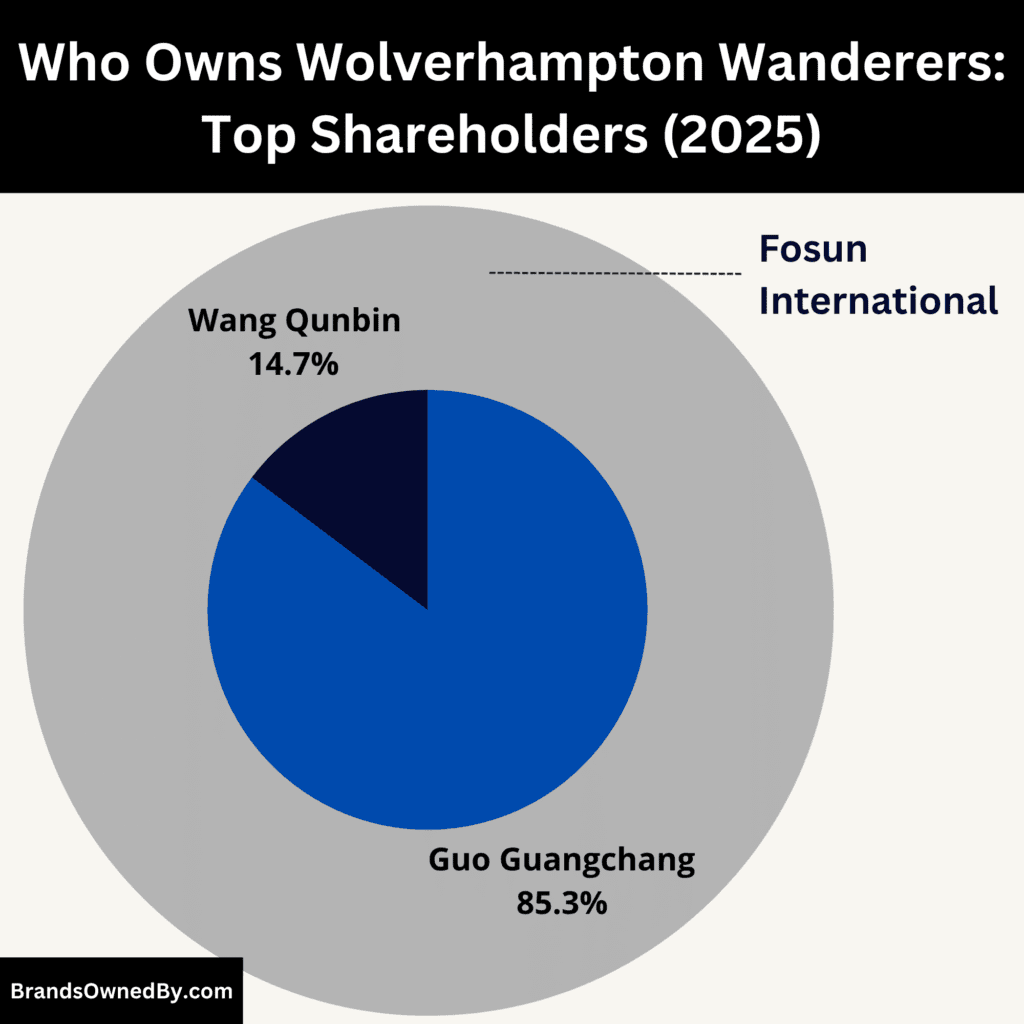
Wolverhampton Wanderers is fully controlled by Fosun International, a global Chinese investment group that purchased the club’s parent company in 2016. Fosun owns the club through its holding subsidiaries and retains complete strategic authority. Day-to-day operations are handled by club executives, but financial, structural and long-term decisions originate from Fosun’s leadership.
Fosun’s control flows from its internal ownership structure, where the major beneficial shareholders are Guo Guangchang and Wang Qunbin. Their stakes at the holding-company level determine the balance of influence and ultimately shape Wolves’ direction.
Fosun International (Ultimate Owner)
Fosun International is the controlling owner of Wolverhampton Wanderers through its acquisition of W.W. (1990) Ltd. The group holds 100% effective ownership of the parent company, giving it full decision-making authority over the club.
Fosun uses a multi-layered ownership model:
- Fosun International Holdings →
- Fosun Holdings →
- Fosun-controlled subsidiaries →
- W.W. (1990) Ltd →
- Wolverhampton Wanderers.
This structure centralizes power at the top of the organization but allows operational responsibilities to be delegated to Wolves’ executive team.
Fosun’s investment approach emphasizes long-term competitiveness, commercial expansion and multi-market branding. The club’s financial capacity, recruitment investment and global partnerships reflect Fosun’s broader international strategy.
Guo Guangchang (Primary Ultimate Controller)
Guo Guangchang is the chairman and main beneficial shareholder of Fosun International.
He holds roughly 85.29% of Fosun International Holdings, making him the dominant decision-maker. This gives Guo the strongest voting power in every major strategic decision affecting Fosun’s assets, including Wolves.
Guo influences large-scale decisions such as:
• Club-wide investment strategy
• Multi-year financial planning
• Infrastructure investment
• Top-level football and business policy
• Key executive appointments at Wolves.
His majority stake makes him the most powerful individual in the club’s ownership hierarchy.
Wang Qunbin (Secondary Ultimate Shareholder)
Wang Qunbin is the Co-Chairman and CEO of Fosun. He holds the second-largest ownership stake at the holding level with approximately 14.71% of Fosun International Holdings.
While smaller than Guo’s share, Wang’s influence remains significant. He contributes to governance, global strategy, financial oversight and international expansion decisions that indirectly shape Wolves’ growth and investment priorities.
Wang functions as the stabilizing strategic partner to Guo within the ownership structure.
Wolves Ownership History
The ownership journey of Wolverhampton Wanderers spans nearly 150 years and reflects how the club grew from a small community team into a modern Premier League side. Each ownership era brought different challenges, financial realities and identities, leading to the fully corporate ownership structure in place today.
| Era / Owner | Ownership Type | Years | Key Actions & Contributions |
|---|---|---|---|
| Founders (St. Luke’s School & The Wanderers merger) | Community / Committee-led | 1877–1920s | Formed the club, merged with The Wanderers, joined Football League, established early identity |
| Local Directors & Business Leaders | Board-led local ownership | 1920s–1980s | Guided club through pre-war and post-war periods; oversaw golden era under Stan Cullis |
| Bhatti Brothers | Private owners | Early 1980s–1986 | Minimal investment, severe financial decline, stadium deterioration, multiple relegations |
| Wolverhampton Council, Gallagher Group, Allied Breweries (Rescue Consortium) | Emergency rescue partnership | 1986–1990 | Saved Wolves from collapse, secured Molineux land, stabilized finances temporarily |
| Sir Jack Hayward | Single private owner | 1990–2007 | Rebuilt Molineux, invested large personal funds, modernized club, maintained stability |
| Steve Morgan | Private owner (symbolic £10 purchase with investment pledge) | 2007–2016 | Invested £30m, secured Premier League promotion, strengthened facilities, improved operations |
| Fosun International | Full corporate owner | 2016–Present | Purchased 100% of parent company, invested heavily, returned Wolves to Premier League, delivered European football, globalized the brand |
| Guo Guangchang (Ultimate Shareholder at Fosun) | Majority beneficial owner | 2016–Present | Controls Fosun’s ownership decisions, approves major investments, leads long-term direction |
| Wang Qunbin (Secondary Ultimate Shareholder at Fosun) | Secondary beneficial owner | 2016–Present | Handles governance, global strategy and financial oversight within Fosun |
| Liang Xinjun (Founding Fosun Shareholder) | Minority influence | 2016–Present | Historical founder influence within Fosun; limited role in Wolves’ direct decisions |
Early Community and Founding Era (1877–1920s)
Wolverhampton Wanderers began as a community-run football team. Founded in 1877 by pupils from St. Luke’s School, the club later merged with The Wanderers in 1879, officially becoming Wolverhampton Wanderers.
During this period, the club had no private owner. It was operated by schoolmasters, church members and local leaders, who made decisions through committees. This early community-driven structure shaped Wolves’ identity and helped the club become a founding member of the Football League in 1888.
Pre-War and Post-War Local Leadership (1930s–1980s)
From the 1930s through the 1980s, Wolves were led by local businessmen and directors. Ownership was shared among board members who funded and ran the club collectively.
This era included the famous Stan Cullis golden period of the 1950s, when Wolves won league titles and became one of England’s strongest teams. However, by the late 1970s financial problems emerged, leading to instability and decline.
The Bhatti Brothers Crisis (1980s)
The takeover by the Bhatti brothers brought one of the darkest periods in Wolves’ history.
Investment dried up, Molineux deteriorated, and the club suffered multiple relegations. Financial mismanagement pushed Wolves towards complete collapse. By 1986, liquidation was a real threat.
This era is remembered as the worst ownership phase the club ever endured.
Local Authority Rescue and Corporate Support (1986–1990)
A rescue package involving Wolverhampton Council, Gallagher Group and Allied Breweries saved Wolves from extinction.
This consortium provided emergency funding, secured stadium land and stabilized club operations. Without this intervention, Wolverhampton Wanderers may not exist today.
Sir Jack Hayward Era (1990–2007)
In 1990, lifelong Wolves supporter Sir Jack Hayward purchased the club, beginning a period of emotional and financial rebuilding.
Sir Jack invested heavily in Wolves, funding the complete redevelopment of Molineux, supporting the squad and improving club structures. He restored pride and stability after years of decline.
Although Wolves did not win major trophies during his tenure, his commitment transformed the club and laid the foundations for future progress.
Steve Morgan Era (2007–2016)
Steve Morgan acquired the club in 2007 for £10 with a pledge to invest £30 million.
His ownership modernized operational systems and brought Wolves back to the Premier League in 2009. Morgan upgraded training facilities, improved commercial operations and aimed for long-term sustainability.
However, inconsistent results and relegation led Morgan to put the club up for sale in 2015.
Fosun International Era (2016–Present)
In 2016, Fosun International purchased Wolverhampton Wanderers in a full takeover.
Fosun’s arrival marked a major shift, moving Wolves from traditional private ownership to a global, investment-backed model. Their financial strength transformed the club’s recruitment strategy, infrastructure, analytics and international branding.
Under Fosun, Wolves have returned to the Premier League, finished seventh, qualified for Europe and strengthened their academy and global footprint. Fosun’s senior shareholders — particularly Guo Guangchang and Wang Qunbin — serve as the ultimate controlling figures, while Jeff Shi manages day-to-day club operations at Molineux.
Today, Fosun owns 100% of the club’s parent company, making it one of the most centralized and financially powerful ownership structures in the Premier League.
Guo Guangchang Net Worth
Guo Guangchang, the ultimate controlling owner of Wolverhampton Wanderers through Fosun International, has an estimated net worth of $2.8 billion as of November 2025. His personal wealth and corporate influence shape the financial stability and long-term investment strategy of the club.
Primary Wealth Drivers
Guo’s wealth is built on three main pillars:
- His majority control of Fosun International via its holding structure. Fosun’s total assets were reported at RMB 821.9 billion as of 30 June 2024.
- Fosun’s interim first‐half 2025 financials: total revenue of RMB 87.28 billion, industrial operation profit of RMB 3.15 billion, and profit attributable to owners of the parent of RMB 661.2 million.
- His ownership of unlisted and private assets — including real estate, international investments and insurance/finance businesses — that are less transparent but add substantial value to his wealth.
Corporate Strength and Implications
Fosun International’s scale gives Guo indirect but substantial financial power. For example:
- The group’s overseas revenue for the first half of 2025 was RMB 46.67 billion, representing 53% of total revenue.
- Because Guo controls the holding companies that own Fosun, his personal net worth and ability to fund investments (including football club acquisitions) are strongly tied to Fosun’s performance.
- The debt profile is notable: one report indicates Fosun had a secured debt ratio of about 20% at the holding company level as of end-June 2025.
What This Means for Wolverhampton Wanderers FC
Because Guo Guangchang is the ultimate controlling owner of Wolves via Fosun, his net worth and the financial health of his business interests have direct relevance to the club. The $2.8 billion figure indicates a solid, though not unlimited, resource base. It supports:
Some potential risk: any significant downturn in Fosun’s core businesses or asset valuations could affect the club’s budget or investment ambitions
A capacity for major investments in infrastructure, player recruitment and global commercial strategy
A centralized ownership structure, which provides stability compared to fragmented ownership models
Wolverhampton Wanderers Net Worth
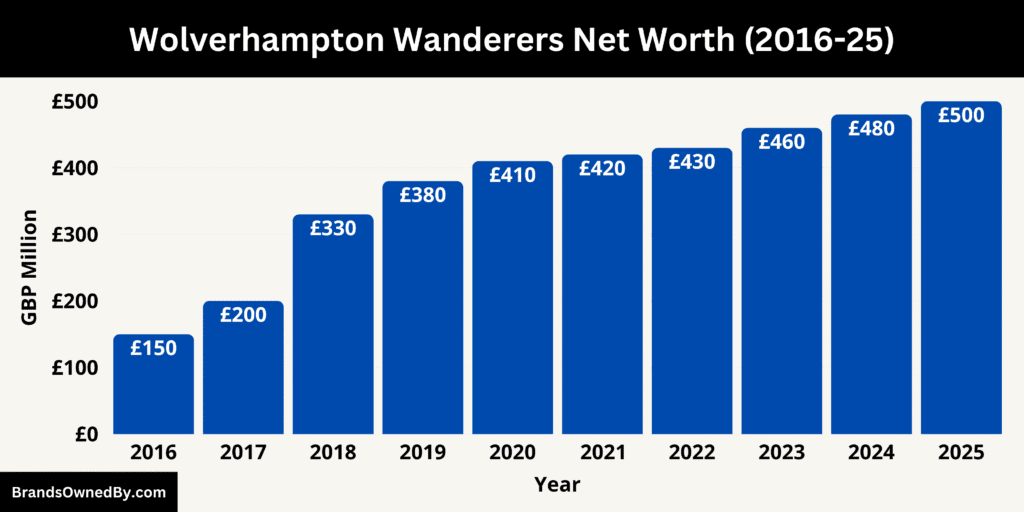
The net worth of Wolves, as of November 2025, is estimated to be around £500 million ($630 million). This valuation reflects the club’s on-field performance, commercial growth, asset value, broadcasting income, and long-term investments made under Fosun International.
Wolves’ estimated valuation of £500 million places the club in the mid-tier of Premier League franchise values. This figure represents a significant increase from the club’s valuation before the Fosun takeover in 2016, when the club was valued much lower due to Championship status and limited commercial reach.
The current valuation incorporates factors such as Premier League financial stability, stadium infrastructure, squad valuation, global branding strength and long-term commercial potential.
Revenue Performance and Income Streams
Wolves’ financial output has grown steadily in recent years.
For the 2023–24 financial year, the club generated £177.7 million in revenue, an increase from the previous year’s £168.6 million. This income is driven by broadcasting rights, matchday earnings, Premier League prize money, commercial partnerships and international merchandising.
A large portion of club revenue comes from Premier League broadcasting contracts, which remain among the most lucrative in global sports. Wolves also benefit from sponsorship deals, digital media expansion, shirt sales, hospitality services and global fan engagement.
Although revenue is strong, the club reported a net loss of £14.3 million, reflecting operating costs, player wages, amortization and infrastructure expenses. Despite this, revenue stability ensures Wolves retain financially competitive status within the league.
Playing Squad Market Value
Wolves’ squad is a major component of the franchise’s overall worth.
As of November 2025, the squad’s combined market valuation is estimated to be around £280 million. This reflects the club’s recruitment strategy, player development and the market value of emerging and established talents.
High-value players significantly boost franchise valuation, as they represent both competitive and financial assets. The squad value also influences long-term financial planning, transfer market leverage and stability in case of potential sales.
Impact of Infrastructure and Assets
Molineux Stadium remains a core asset contributing to Wolves’ net worth. The club’s ongoing stadium upgrades, commercial facilities and training ground investments add tangible value to the franchise. Stadium modernization and expansion potential also contribute to long-term commercial revenue.
Wolves’ training complex and academy systems further strengthen the club’s asset base. A high-performing academy increases both squad depth and potential player sale profits, enhancing financial sustainability.
Commercial Growth and Global Market Expansion
Under Fosun ownership, Wolves have increased their global commercial footprint. The club has expanded its presence in international markets including Asia, North America and parts of Europe. Digital engagement, global merchandising and strategic partnerships contribute additional revenue streams that support long-term valuation.
The club’s brand has grown significantly through international tours, content distribution, global fan membership programs and new commercial sponsorships. These elements collectively raise Wolves’ intangible value and contribute meaningfully to the overall net worth.
Investment by Ownership and Financial Stability
Since acquiring the club in 2016, Fosun International has invested over £250–£300 million into Wolves through player transfers, wages, infrastructure and operational upgrades. This financial backing has strengthened the club’s competitive position and elevated its commercial potential.
The combination of long-term ownership investment and Premier League revenue has stabilized the club financially. While Wolves occasionally report operational losses, these are offset by player sales, owner support and strong commercial income.
Despite financial fluctuations, Wolves maintain a strong long-term valuation outlook. Premier League status ensures predictable income, while commercial and sporting development provide growth potential.
If the club achieves consistent top-half finishes, European qualification or further international expansion, Wolves’ valuation could rise significantly in future financial cycles.
Wolverhampton Wanderers Leadership
The leadership of Wolverhampton Wanderers in 2025 operates under a centralized model directed by Fosun International. The club’s executives oversee daily management, football operations, commercial expansion, academy development and long-term strategy.
Executive Chairman – Jeff Shi
Jeff Shi has been the Executive Chairman of Wolverhampton Wanderers since 2017 and is the highest-ranking club official.
He sets the club’s strategic direction, approves the annual budgets, oversees recruitment planning, and manages the link between Wolves and Fosun’s senior ownership. Shi signs off on major capital spending, multi-year business plans, senior appointments, and the long-term footballing philosophy.
He directly supervises the club’s leadership departments, including football operations, commercial strategy, academy planning and performance. Shi also ensures compliance with Premier League financial rules and guides the club’s transition cycles between managerial appointments, squad rebuilds and multi-season planning.
Board of Directors – John Bowater & John Gough
The board is responsible for governance, oversight and risk management. Wolves have two named board members as of 2025:
John Bowater – Non-Executive Director
Bowater provides oversight on commercial operations, risk assessments and operational compliance.
He reviews quarterly financial performance, assesses commercial partnership proposals, and evaluates long-term investment decisions such as stadium upgrades and infrastructure projects. Bowater also helps ensure the club’s governance framework aligns with Premier League regulations.
John Gough – Non-Executive Director
Gough is responsible for financial oversight, audit supervision and legal compliance.
He examines Wolves’ annual accounts, supervises PSR (Profitability & Sustainability Rules) compliance, and evaluates operational cost structures. Gough also monitors debt levels, liquidity planning and contract commitments to ensure financial stability.
Together, Bowater and Gough serve as the internal audit and oversight mechanism that balances executive power and protects long-term financial health.
Director of Player Recruitment & Development – Matt Jackson
Matt Jackson oversees global recruitment strategy and the integration of youth players into senior football.
He manages Wolves’ global scouting network, oversees analytical evaluation of transfer targets, leads contract and valuation modelling, and coordinates with the head coach on positional needs. Jackson is also responsible for succession planning — identifying which academy talents are ready for progression into the senior squad.
His department evaluates players using data metrics such as age curves, expected contribution, market inflation, and resale potential. Jackson’s role also includes managing development plans for academy graduates and overseeing outgoing loan strategies.
Director of Professional Football – Domenico Teti
Domenico Teti leads the professional football structure, including squad planning, football strategy and multi-year performance alignment.
He supervises the technical direction of the club, coordinates between the head coach, recruitment, medical teams and performance staff, and ensures that Wolves’ football identity and tactical principles remain consistent across seasons.
Teti’s responsibilities include evaluating first-team performance trends, preparing long-term competitiveness mapping, overseeing contract strategy alongside Jackson, and monitoring physical performance outputs in partnership with sports science. He plays a crucial role in aligning football philosophy with recruitment decisions.
Director of Football Operations & Administration – Matt Wild
Matt Wild manages operational, regulatory and administrative aspects of the football department.
His primary responsibilities include managing player contracts, handling Premier League registrations, ensuring regulatory compliance, overseeing fixture logistics, and coordinating travel, scheduling, and matchday operations.
Wild also manages internal football governance — ensuring that operational procedures, budget controls, and regulatory documentations remain compliant with league and federation standards. His work ensures the football department operates smoothly around the head coach and performance staff.
Director of Performance – Phil Hayward
Phil Hayward leads Wolves’ performance department, which includes sports science, medical care, rehabilitation, strength and conditioning, and performance analysis.
He is responsible for designing physical development plans, reducing injury risk, overseeing return-to-play protocols, and monitoring player workload through GPS and physiological data.
Hayward ensures first-team and academy players meet Premier League physical standards, coordinating with the head coach to optimize matchday readiness. His team directly influences player availability and long-term athletic performance.
Head Coach – Rob Edwards
Rob Edwards was appointed head coach in 2025 and is responsible for Wolves’ on-field performance, tactical strategy, training methodology and player development.
He designs Wolves’ playing style, matchday systems, tactical adjustments, and training cycles. Edwards works closely with Jackson, Teti and Hayward to ensure football identity, player conditioning and recruitment align.
His performance is evaluated through league results, tactical progression, player improvement, and integration of academy talent. Edwards represents the most influential figure in the club’s matchday success.
Final Words
Wolverhampton Wanderers continue to build a stable future under a clear ownership and leadership structure, which has strengthened the club both on and off the pitch. With Fosun providing long-term investment and strategic direction, and a professional executive team driving daily operations, the club remains on a solid path of growth. This stability is crucial in understanding who owns Wolverhampton Wanderers today and how the current ownership model supports sustained competitiveness, stronger commercial performance and a clear football identity for the years ahead.
FAQs
Who owns Wolves football club?
Wolves are fully owned by Fosun International, a global investment group that purchased the club in 2016.
Who is Wolverhampton Wanderers’ owner?
The ultimate controlling owner of Wolverhampton Wanderers is Guo Guangchang, who holds the majority stake in Fosun’s main holding company.
What clubs does Fosun own?
Fosun previously owned a majority stake in Grasshopper Club Zürich in Switzerland and has held various strategic sports investments, but Wolverhampton Wanderers remain their primary football asset.
Did Steve Morgan own Wolves?
Yes, Steve Morgan owned Wolves from 2007 to 2016 before selling the club to Fosun International.
Is Fosun a Chinese company?
Yes, Fosun International is a Chinese multinational conglomerate headquartered in Shanghai.
Why did Fosun buy Wolves?
Fosun bought Wolves to expand its global sports portfolio, build international brand visibility, and capitalize on the commercial growth of the Premier League. The club’s long-term potential and strategic fit made it an attractive investment.
Which English clubs have Chinese owners?
In recent years, clubs with Chinese ownership interests have included West Bromwich Albion, Southampton, Reading, and Birmingham City at different points. Wolves remain one of the most prominent clubs under Chinese ownership.
How rich are Wolves’ owners?
Wolves’ owners control a large global conglomerate with extensive assets, giving the club access to strong financial backing and long-term investment stability.
What is the Wolves’ owner’s net worth?
The ultimate controlling owner, Guo Guangchang, has an estimated net worth of $2.8 billion as of November 2025.