

- Charter Communications, Inc. is a publicly traded telecommunications company primarily owned by institutional investors, with Liberty Broadband Corporation holding the largest stake at 31.9% as of 2026.
- Other major shareholders include Dodge & Cox with 11.5%, The Vanguard Group with 8.1%, Capital Research and Management Company with 5.9%, BlackRock with 5.5%, and State Street Corporation with 5.1%, giving institutional investors substantial influence over Charter Communications’ governance and long-term strategy.
- CEO Chris Winfrey leads operational control of Charter Communications, while long-term strategic influence is strongly connected to John Malone through Liberty Broadband’s ownership and board-level influence.
- Charter Communications became one of the largest broadband providers in the United States after acquiring Time Warner Cable and Bright House Networks in 2016, with further expansion expected through the approved acquisition of Cox Communications in 2026.
Charter Communications, Inc. is one of the largest broadband and telecommunications companies in the United States. The company provides high-speed internet, cable television, mobile, voice, and enterprise communication services through its primary consumer brand, Spectrum.
The company operates a large communications infrastructure network that serves residential customers, businesses, schools, healthcare organizations, and government institutions across multiple states. Charter Communications expanded from a regional cable operator into a national telecommunications company through aggressive acquisitions and network consolidation.
A major turning point came after the acquisition of Time Warner Cable and Bright House Networks. These deals significantly increased the company’s market reach and subscriber base. The acquisitions also helped Charter strengthen its position in highly competitive metropolitan broadband markets.
Today, the company focuses heavily on broadband internet services because internet connectivity has become the core driver of customer demand. Charter also continues expanding mobile services and enterprise communication solutions to reduce dependence on traditional cable television subscriptions.
Its services include:
- high-speed residential broadband internet.
- cable television and streaming-related services.
- wireless communication services through Spectrum Mobile.
- business networking and enterprise communication solutions.
- cloud, cybersecurity, and managed connectivity services for organizations.
For example, a residential customer may combine Spectrum Internet, mobile services, and streaming television packages into a single bundled subscription. A business customer may use Charter’s enterprise-grade networking solutions for secure communications between offices and remote employees.
The company’s long-term strategy focuses on expanding broadband coverage, upgrading network infrastructure, increasing customer retention through bundled services, and growing its enterprise communication business.
![who owns Charter Communications [infographic]](https://brandsownedby.com/wp-content/uploads/2026/04/who-owns-Charter-Communications-infographic-683x1024.png)
Charter Communications Founders
Charter Communications, Inc. was founded in 1993 by Barry Babcock, Jerald Kent, and Howard Wood. The founders created the company with the goal of building a large cable and telecommunications network through acquisitions of smaller regional cable operators across the United States.
Barry Babcock
Barry Babcock played a major role in Charter’s early acquisition strategy. He helped identify regional cable operators that could be integrated into a larger communications network. His work contributed to the company’s rapid expansion during its early years.
Jerald Kent
Jerald Kent became one of the most influential early leaders of Charter Communications. He helped shape the company’s long-term expansion strategy and operational growth model. Kent focused heavily on scaling the business through acquisitions and infrastructure development.
Howard Wood
Howard Wood contributed to the company’s operational and strategic development during its early formation period. He helped support the company’s efforts to consolidate fragmented cable systems into a larger telecommunications operation.
The founders built Charter Communications around a consolidation-focused growth model. During the 1990s, many local cable operators controlled small regional markets. Charter acquired and integrated these systems to expand its infrastructure footprint and customer base. This strategy eventually helped the company evolve into one of the largest broadband providers in the United States.
Ownership History
The ownership history of Charter Communications, Inc. has been shaped by aggressive acquisitions, financial restructuring, institutional investment activity, and large-scale media industry consolidation. Over the past three decades, the company evolved from a regional cable operator into one of the largest broadband providers in the United States.
Founding Ownership Structure in 1993
Charter Communications, Inc. was founded in 1993 by Barry Babcock, Jerald Kent, and Howard Wood.
In its early years, ownership was concentrated among the founders, private investors, and early financing partners. The company focused on acquiring small and mid-sized cable systems across regional American markets.
The founders built Charter around a consolidation strategy. At the time, many local cable operators controlled isolated regional markets. Charter acquired these fragmented systems and integrated them into a larger communications network.
This acquisition-focused growth model attracted outside investors that wanted exposure to the expanding cable television industry.
Paul Allen’s Investment and Expansion Era
A major ownership shift happened in the late 1990s when Paul Allen, co-founder of Microsoft Corporation, became heavily involved in Charter Communications through his investment company Vulcan Ventures.
Allen invested billions of dollars into Charter and became one of the company’s most influential shareholders during its rapid expansion phase.
His backing allowed Charter to aggressively acquire cable systems across the United States. During this period, the company completed multiple acquisitions that significantly expanded its subscriber base and infrastructure footprint.
The company also went public during this era, which introduced institutional investors and public shareholders into the ownership structure.
Debt Expansion and Financial Pressure
During the early 2000s, Charter continued expanding through acquisitions financed largely with debt.
While the strategy increased the company’s scale, it also created major financial pressure. The company accumulated billions of dollars in liabilities tied to acquisition financing and infrastructure investments.
As debt levels increased, banks, institutional lenders, and financial stakeholders gained stronger influence over the company’s financial direction.
The pressure intensified as competition increased in the cable and telecommunications sectors.
Chapter 11 Bankruptcy Restructuring in 2009
In 2009, Charter Communications, Inc. filed for Chapter 11 bankruptcy protection to restructure approximately $22 billion in debt.
The restructuring dramatically changed the ownership structure of the company.
Many previous shareholders experienced dilution after the restructuring process. Creditors and institutional financial entities gained stronger ownership positions in exchange for debt restructuring agreements.
The bankruptcy allowed Charter to reduce debt obligations and stabilize operations.
After emerging from bankruptcy, the company became more heavily influenced by institutional ownership rather than founder-led ownership control.
Liberty Broadband and John Malone Influence
One of the most significant ownership developments came through the involvement of Liberty Broadband Corporation, a company closely associated with media billionaire John Malone.
Liberty Broadband became a major shareholder in Charter Communications and gradually emerged as its most influential shareholder.
As of April 2026, Liberty Broadband owns roughly 31% to 32% of Charter Communications shares, making it the company’s largest shareholder.
John Malone has long been considered one of the most influential figures in the American cable industry. Through Liberty Broadband, Malone gained major influence over Charter’s strategic direction, governance decisions, and large-scale acquisition planning.
Liberty Broadband also secured governance influence through board representation and shareholder agreements connected to Charter’s corporate structure.
Transformational Acquisition of Time Warner Cable and Bright House Networks
In 2016, Charter Communications, Inc. completed the acquisitions of Time Warner Cable and Bright House Networks.
These acquisitions transformed Charter into one of the largest broadband and cable operators in the United States.
The deals significantly expanded Charter’s customer base, infrastructure network, and geographic reach.
The acquisitions also strengthened the influence of large institutional shareholders because Charter became a much larger publicly traded telecommunications company after the merger transactions.
Rise of Institutional Ownership
Over time, institutional investors became dominant owners of Charter Communications shares.
As of April 2026, the company’s ownership structure is heavily concentrated among institutional asset managers and investment firms.
Major shareholders include:
- Liberty Broadband Corporation with approximately 31% to 32% ownership.
- Dodge & Cox with more than 11% ownership.
- The Vanguard Group with more than 8% ownership.
- BlackRock with more than 5% ownership.
- State Street Corporation with more than 5% ownership.
This ownership structure means Charter Communications is largely controlled by institutional capital rather than founder-family ownership.
Pending Ownership Changes Through Liberty Broadband Combination
Another major ownership development emerged after Charter announced plans to acquire Liberty Broadband Corporation through an all-stock transaction.
If completed, the transaction would restructure Liberty Broadband’s ownership relationship with Charter and change governance arrangements tied to shareholder rights. Charter filings also indicate that governance rights connected to Liberty Broadband would be modified after the transaction.
This proposed transaction reflects ongoing consolidation trends in the telecommunications and broadband industry.
Ownership Structure as of April 2026
As of April 2026, Charter Communications, Inc. remains a publicly traded company with ownership dominated by institutional investors.
Liberty Broadband Corporation remains the company’s largest shareholder and most influential strategic investor. Large institutional asset managers also maintain substantial positions in the company.
This ownership structure gives Charter access to strong institutional capital support while also concentrating influence among major financial and media investment entities.
Who Owns Charter Communications: Largest Shareholders
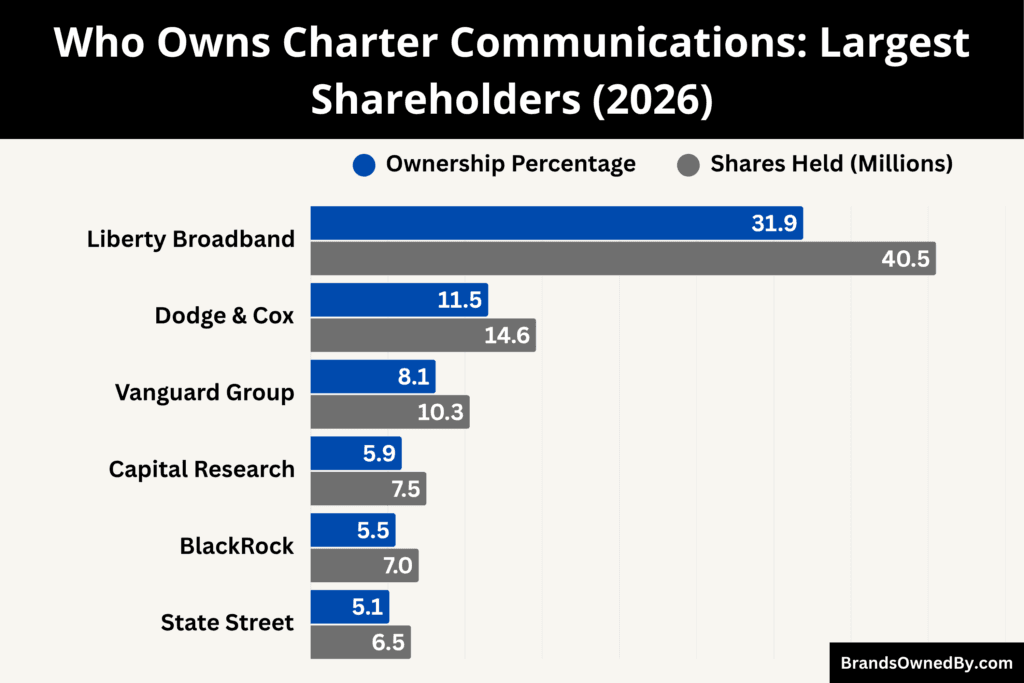
Charter Communications, Inc. is a publicly traded telecommunications company listed on the NASDAQ under the ticker symbol CHTR. The company does not operate under founder-family ownership like some other media and telecom businesses. Instead, ownership is heavily concentrated among institutional investors, asset management firms, and strategic telecommunications investors.
As of April 2026, institutional investors control the majority of Charter Communications shares. The largest shareholder is Liberty Broadband Corporation, which holds a highly influential ownership stake connected to media industry billionaire John Malone.
Other major shareholders include large investment management firms such as The Vanguard Group, BlackRock, and investment management company Dodge & Cox. These institutions hold shares through mutual funds, retirement portfolios, pension investments, and large-cap index funds.
The ownership structure gives Charter Communications strong institutional financial backing while concentrating significant influence among a relatively small group of major shareholders.
Liberty Broadband Corporation
Liberty Broadband Corporation is the largest shareholder of Charter Communications.
As of April 2026, Liberty Broadband owns approximately 31.8% to 32% of Charter Communications shares, representing more than 40 million shares. This makes it the most influential shareholder in the company.
Liberty Broadband’s influence extends beyond passive investment ownership. The company has historically maintained strong governance influence through board representation and strategic involvement in major corporate decisions.
The company is closely associated with John Malone, one of the most influential figures in the American cable and telecommunications industry. Malone has played a major role in cable industry consolidation for decades.
Liberty Broadband’s investment became especially important during Charter’s expansion phase following the acquisition of Time Warner Cable and Bright House Networks.
The relationship between Liberty Broadband and Charter Communications may change further because Charter announced plans to acquire Liberty Broadband through an all-stock transaction. If finalized, the deal would restructure ownership arrangements tied to Liberty Broadband’s stake in Charter Communications.
Dodge & Cox
Dodge & Cox is one of the largest institutional investors in Charter Communications.
As of 2026, Dodge & Cox owns more than 11.5% of Charter Communications shares, representing over 14.6 million shares.
Dodge & Cox is known for long-term value investing strategies. Its investment approach often focuses on companies with strong market positions and long-term cash generation potential.
Its large ownership position in Charter Communications reflects confidence in the company’s broadband infrastructure business and recurring subscription revenue model.
Because of the size of its ownership stake, Dodge & Cox remains an influential institutional shareholder in investor-related matters and corporate governance discussions.
The Vanguard Group
The Vanguard Group is another major shareholder in Charter Communications.
As of April 2026, Vanguard controls slightly more than 8% of Charter Communications shares, representing over 10 million shares.
Vanguard holds these shares through various index funds, exchange-traded funds, retirement portfolios, and institutional investment products.
Since Vanguard manages investments for millions of investors worldwide, its ownership stake reflects broad institutional exposure to the telecommunications sector rather than direct operational involvement.
However, due to the scale of Vanguard’s holdings, the company still maintains significant influence in shareholder voting matters.
Capital Research and Management Company
Capital Research and Management Company is also one of the largest institutional shareholders of Charter Communications.
As of 2026, the firm owns nearly 6% of Charter Communications shares, representing more than 7.4 million shares.
Capital Research and Management Company operates major investment funds and actively invests in large public corporations across multiple industries.
Its investment in Charter Communications reflects institutional confidence in broadband demand growth and telecommunications infrastructure expansion.
BlackRock
BlackRock holds a major ownership position in Charter Communications.
As of 2026, BlackRock owns approximately 5.5% of the company’s shares, representing nearly 7 million shares.
BlackRock is one of the world’s largest asset management companies. Its ownership stake comes primarily through institutional investment portfolios and index-based investment products.
Although BlackRock is generally considered a passive institutional investor, its size gives it meaningful influence in shareholder voting and governance matters.
State Street Corporation
State Street Corporation remains another major institutional shareholder in Charter Communications.
As of 2026, State Street controls slightly more than 5% of Charter Communications shares.
Like Vanguard and BlackRock, State Street primarily owns shares through institutional investment funds and index-based financial products.
The company’s ownership position contributes to the broader institutional control structure surrounding Charter Communications.
Public and Institutional Shareholders
Beyond the major shareholders, a large percentage of Charter Communications shares are owned by pension funds, hedge funds, mutual funds, insurance investment portfolios, and public investors.
Institutional ownership in Charter Communications exceeds 75% as of 2026. This means the company is heavily controlled by financial institutions rather than retail investors or founder ownership groups.
This ownership structure affects how the company approaches decision-making. Institutional shareholders often prioritize long-term subscriber growth, broadband infrastructure expansion, operational efficiency, and shareholder returns.
Large investors also influence executive compensation structures, governance standards, merger approvals, and long-term strategic planning.
Competitor Ownership Comparison
The ownership structure of Charter Communications, Inc. is very different from several of its largest competitors in the broadband and telecommunications industry. Some competing companies operate under founder-family control, while others are dominated almost entirely by institutional investors. These ownership differences directly affect corporate strategy, acquisition decisions, infrastructure investment priorities, executive control, and long-term risk tolerance.
Charter Communications operates under a highly institutionalized ownership model with strong influence from a strategic shareholder. This structure places heavy emphasis on shareholder returns, broadband expansion, operational efficiency, and long-term network growth.
In comparison, competitors such as Comcast Corporation and Cox Communications maintain stronger family control structures that allow leadership to make long-term strategic decisions with less pressure from outside shareholders.
| Company | Ownership Structure | Major Shareholders or Controlling Parties | Level of Control | How Ownership Impacts the Business |
|---|---|---|---|---|
| Charter Communications, Inc. | Publicly traded company with strong institutional ownership and strategic investor influence. | Liberty Broadband Corporation, The Vanguard Group, BlackRock, and Dodge & Cox. | Strategic influence is heavily concentrated through Liberty Broadband, while institutional investors collectively shape governance decisions. | The company focuses heavily on broadband expansion, operational efficiency, recurring subscription revenue growth, and shareholder returns due to institutional investor expectations. |
| Comcast Corporation | Public company with a dual-class voting structure. | The Roberts family led by Brian L. Roberts. | Strong founder-family voting control through super-voting shares. | Family control allows Comcast to pursue long-term acquisitions, infrastructure investments, and media expansion strategies with reduced short-term shareholder pressure. |
| AT&T Inc. | Public company with widely distributed institutional ownership. | Major institutional investors including The Vanguard Group, BlackRock, and State Street Corporation. | No single shareholder has dominant control. Governance influence is distributed across institutional investors and the board of directors. | Institutional investors strongly influence decisions involving debt management, operational restructuring, wireless expansion, and shareholder return policies. |
| Verizon Communications Inc. | Public company with institutional ownership dominance. | Large institutional investment firms and asset managers. | Distributed ownership structure with board-led governance oversight. | The company operates under strong institutional pressure tied to network performance, infrastructure investment returns, and dividend stability. |
| Cox Communications | Privately owned telecommunications company. | The Cox family. | Direct family ownership and operational control. | Private ownership gives the company flexibility to make long-term investments without pressure from public shareholders or quarterly earnings expectations. |
| Altice USA | Public company with founder-linked ownership influence. | Ownership influence connected to Patrick Drahi and the broader Altice structure. | Strong founder-linked strategic influence over governance and operational direction. | Centralized influence allows faster strategic decision-making during restructuring efforts, acquisitions, and operational efficiency programs. |
Charter Communications Ownership Model
Charter Communications, Inc. is primarily controlled through institutional ownership and strategic investment influence.
The company’s largest shareholder is Liberty Broadband Corporation, which owns approximately 31.9% of Charter Communications as of 2026. This gives Liberty Broadband substantial influence over governance decisions, strategic planning, and board-level discussions.
Large institutional investors such as The Vanguard Group, BlackRock, and Dodge & Cox also control major ownership stakes.
This structure means Charter must continuously satisfy institutional investors that expect strong broadband subscriber growth, disciplined capital allocation, network expansion, and stable long-term returns.
For example, Charter’s aggressive investment in broadband infrastructure expansion and mobile service bundling reflects the priorities of institutional shareholders that favor recurring subscription revenue and scalable telecommunications assets.
Unlike family-controlled competitors, Charter’s leadership operates under stronger pressure from institutional shareholders that closely monitor financial performance and operational execution.
Comcast Corporation Ownership Structure
Comcast Corporation operates under one of the most powerful family-influenced ownership structures in the American telecommunications and media industry.
Although Comcast is publicly traded, the Roberts family maintains effective control through a special class of super-voting shares. Brian L. Roberts holds significant voting power that allows the family to maintain long-term strategic control over the company.
This structure gives Comcast a major advantage in strategic consistency. Leadership can pursue large acquisitions and long-term investments without facing the same level of short-term shareholder pressure experienced by institutionally dominated companies.
For example, Comcast was able to aggressively expand through acquisitions involving media assets, broadband infrastructure, and streaming investments while maintaining centralized family-backed control.
This ownership structure also reduces the risk of activist investor interference because voting power remains concentrated within the Roberts family structure.
In contrast, Charter Communications does not have concentrated founder-family voting control. Institutional shareholders collectively hold far more influence over corporate governance outcomes.
AT&T Ownership Structure
AT&T Inc. operates under a widely distributed institutional ownership structure similar in some ways to Charter Communications.
Large investment firms including The Vanguard Group, BlackRock, and State Street Corporation hold substantial ownership positions in the company.
However, AT&T differs from Charter because it does not have a dominant strategic shareholder comparable to Liberty Broadband.
Ownership in AT&T is more fragmented across institutional investors, pension funds, mutual funds, and public shareholders. This creates a governance structure where influence is spread across multiple financial institutions rather than concentrated in one strategic investor.
As a result, AT&T leadership faces strong pressure from institutional investors regarding debt management, dividend policies, wireless network expansion, and operational restructuring.
For example, after several large acquisitions and divestitures over the years, institutional investors increased pressure on AT&T leadership to simplify operations and focus on core telecommunications services.
Verizon Communications Ownership Structure
Verizon Communications Inc. also operates under a highly institutionalized ownership structure.
Major asset management firms dominate Verizon’s shareholder base, including many of the same institutional investors that hold stakes in Charter Communications and AT&T.
Unlike Charter, Verizon does not have a shareholder with concentrated strategic influence comparable to Liberty Broadband’s role in Charter Communications.
This creates a more decentralized ownership environment where governance decisions depend heavily on board oversight and institutional shareholder expectations.
Verizon’s ownership structure also creates strong accountability tied to wireless network performance, infrastructure investments, and dividend stability.
Because ownership is widely distributed, the company must maintain investor confidence across a broad institutional shareholder base rather than aligning closely with one dominant strategic investor.
Cox Communications Ownership Structure
Cox Communications operates under a completely different ownership model compared to Charter Communications.
The company remains privately owned and controlled by the Cox family.
This private ownership structure gives Cox Communications substantial operational flexibility because it does not face quarterly earnings pressure from public market investors.
The company can make long-term infrastructure investments and strategic decisions without immediate pressure tied to public shareholder expectations.
For example, Cox can invest in broadband infrastructure upgrades over extended time periods without needing to satisfy short-term public market performance targets.
This ownership structure also allows the company to maintain greater privacy regarding operational performance and strategic planning.
Charter Communications, by comparison, must operate with far greater transparency because of public market reporting obligations and institutional investor oversight.
Altice USA Ownership Structure
Altice USA combines public ownership with strong founder-linked influence.
The company has historically remained closely associated with telecommunications billionaire Patrick Drahi through the broader Altice corporate structure.
Although Altice USA trades publicly, founder-linked control continues influencing strategic direction and governance decisions.
This gives Altice USA more centralized strategic influence compared to companies with widely distributed institutional ownership.
Founder-linked influence can create faster decision-making during restructuring efforts, acquisitions, or operational cost-cutting initiatives.
Charter Communications operates differently because governance influence is more distributed between institutional shareholders and Liberty Broadband rather than concentrated around a founder figure.
How Charter Communications Differs From Competitors
One of the biggest differences between Charter Communications and its competitors is the balance between institutional ownership and strategic investor influence.
Companies such as Comcast and Cox Communications benefit from concentrated family control that supports long-term strategic consistency.
Companies such as AT&T and Verizon operate with highly distributed institutional ownership structures.
Charter Communications sits between these models. The company has strong institutional ownership but also maintains concentrated strategic influence through Liberty Broadband.
This hybrid structure gives Charter access to institutional capital support while still allowing a major strategic shareholder to influence long-term direction.
It also means Charter leadership must balance multiple priorities simultaneously, including shareholder returns, broadband growth, infrastructure expansion, debt management, and competitive positioning against other telecommunications giants.
Who Controls Charter Communications?
Control of Charter Communications, Inc. is shared between executive leadership, the board of directors, and major shareholders. Unlike companies that operate under direct founder-family control, Charter Communications uses a governance structure where power is distributed between senior executives, influential board members, and institutional investors.
As of 2026, the company’s operational leadership is controlled by CEO Chris Winfrey, while long-term strategic influence remains strongly connected to Liberty Broadband Corporation and cable industry billionaire John Malone.
This leadership structure affects how Charter Communications approaches broadband expansion, pricing strategies, acquisitions, infrastructure investment, and shareholder return policies.
Chris Winfrey: President and CEO
Chris Winfrey is the President and Chief Executive Officer of Charter Communications.
He officially became CEO in December 2022 after succeeding Tom Rutledge.
Winfrey is considered one of the most important operational leaders inside Charter because he has spent years managing the company’s financial and strategic operations before becoming CEO.
Before taking over the top leadership position, Winfrey served as:
- Chief Financial Officer.
- Chief Operating Officer.
- Executive Vice President.
During his time as CFO, he played a major role in financing and structuring Charter’s transformational acquisitions of Time Warner Cable and Bright House Networks.
These deals reshaped Charter Communications into one of the largest broadband companies in the United States.
As CEO, Winfrey oversees nearly every major operational area of the company, including:
- broadband network expansion.
- Spectrum Mobile growth strategy.
- customer retention programs.
- enterprise communication services.
- infrastructure investment planning.
- investor relations strategy.
His leadership style is heavily focused on operational efficiency and broadband growth.
For example, under Winfrey’s leadership, Charter has continued expanding rural broadband infrastructure and bundling internet services with Spectrum Mobile to increase customer retention and long-term subscriber value.
John Malone: Strategic Influence Through Liberty Broadband
Although Chris Winfrey controls daily operations, one of the most influential figures connected to Charter Communications is John Malone.
Malone is closely associated with Liberty Broadband Corporation, the largest shareholder in Charter Communications.
As of 2026, Liberty Broadband owns approximately 31.9% of Charter Communications shares. This gives the company enormous influence over governance decisions and long-term strategic direction.
John Malone is widely known as one of the architects of the modern cable television industry in the United States.
Over several decades, he built influence across telecommunications and media businesses through complex investment and acquisition strategies.
His influence on Charter Communications is important because Liberty Broadband maintains strong voting power and board-level influence inside the company.
Malone’s strategic philosophy has historically emphasized:
- aggressive infrastructure investment.
- industry consolidation.
- long-term subscription revenue growth.
- operational efficiency.
- shareholder value creation.
Many analysts believe this philosophy continues influencing Charter’s long-term broadband expansion strategy.
Tom Rutledge: Architect of Modern Charter Communications
Tom Rutledge remains one of the most influential executives in Charter Communications history.
He served as CEO before Chris Winfrey and is widely credited with transforming Charter into a national telecommunications giant.
Before joining Charter, Rutledge worked at Cablevision Systems Corporation and later became known for his operational expertise in cable and broadband services.
Under Rutledge’s leadership, Charter completed the acquisitions of Time Warner Cable and Bright House Networks in 2016.
These acquisitions dramatically expanded the company’s customer base and broadband infrastructure footprint.
Rutledge also pushed the company toward a broadband-first business strategy at a time when traditional cable television subscriptions were declining across the industry.
Many operational systems and customer service strategies used by Charter today were developed during Rutledge’s leadership period.
Even after stepping down as CEO, his influence continued through advisory and leadership transition roles.
Liberty Broadband Board Influence
Liberty Broadband Corporation influences Charter Communications not only through ownership but also through governance relationships tied to board representation.
Because Liberty Broadband is the company’s largest shareholder, its interests carry substantial weight during strategic decision-making discussions.
Board influence becomes especially important during decisions involving:
- mergers and acquisitions.
- broadband expansion investments.
- debt financing strategies.
- executive compensation decisions.
- long-term capital allocation planning.
This gives Liberty Broadband influence that extends beyond ordinary passive investment ownership.
Institutional Investor Influence
Large institutional investors also play an important role in controlling Charter Communications indirectly.
Major shareholders such as The Vanguard Group, BlackRock, and Dodge & Cox collectively own a major percentage of the company’s shares.
These firms influence the company through shareholder voting and governance expectations.
For example, institutional investors can pressure leadership regarding:
- broadband subscriber growth targets.
- debt reduction strategies.
- stock repurchase programs.
- executive compensation policies.
- operational efficiency improvements.
Because institutional ownership in Charter Communications is extremely high, management decisions are often closely tied to investor expectations surrounding long-term profitability and shareholder returns.
Board Leadership and Governance Oversight
The board of directors provides another layer of control inside Charter Communications.
Board members oversee executive leadership and help approve major strategic decisions.
This includes decisions involving:
- large acquisitions.
- broadband infrastructure investments.
- regulatory strategy.
- executive leadership appointments.
- long-term financial planning.
Because Charter operates in a highly regulated and capital-intensive industry, board oversight is critical for balancing infrastructure spending with shareholder expectations.
The board also acts as a governance checkpoint between executive management and major shareholders.
How Control Works Inside Charter Communications
Control inside Charter Communications operates through multiple power centers rather than a single controlling executive or family.
Chris Winfrey manages day-to-day operations and corporate execution.
John Malone influences long-term strategic direction through Liberty Broadband Corporation.
Institutional investors shape governance expectations and shareholder priorities.
The board of directors oversees executive leadership and major strategic decisions.
This layered governance structure allows Charter Communications to combine operational management, institutional investor oversight, and strategic shareholder influence while competing in the highly competitive broadband and telecommunications industry.
Charter Communications Annual Revenue and Net Worth
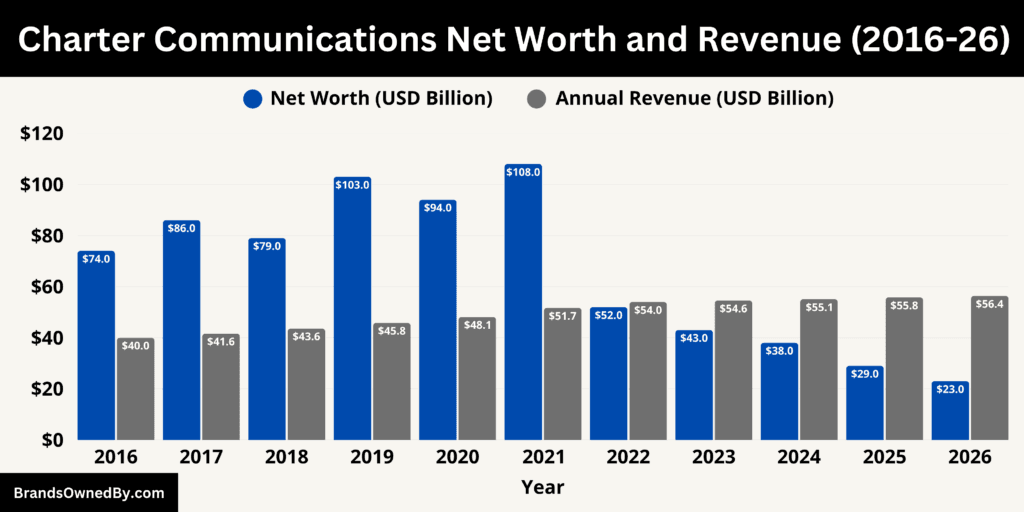
As of April 2026, Charter Communications, Inc. generates approximately $54.8 billion in annual revenue and has an estimated market value of roughly $23 billion. The company remains one of the largest broadband operators in the United States despite facing growing pressure from fiber-optic competitors, fixed wireless providers, and declining cable television subscriptions.
2026 Revenue Breakdown
Broadband internet remains the financial foundation of Charter Communications, Inc..
As of 2026, residential and business broadband services generate an estimated $31 billion to $32 billion annually. Internet subscriptions account for the largest portion of recurring customer revenue because broadband connectivity has become essential for streaming, cloud computing, remote work, gaming, and digital communication.
Video services contribute approximately $12 billion annually. However, this segment continues shrinking because of cord-cutting trends and the shift toward streaming platforms.
Mobile services under Spectrum Mobile generate approximately $3.7 billion to $4 billion annually. This segment is growing rapidly and partially offsets declines in legacy cable television revenue. As of March 2026, Charter served approximately 12.1 million mobile lines after adding 1.8 million lines over the previous twelve months.
Commercial and enterprise services generate roughly $6 billion annually through networking infrastructure, cloud communications, cybersecurity, and enterprise connectivity solutions.
Advertising and other operational activities generate the remaining revenue contribution.
Broadband and Mobile Growth Strategy
Charter Communications increasingly operates as a broadband and mobile connectivity company rather than a traditional cable television provider.
The company continues bundling broadband internet with Spectrum Mobile services to improve customer retention and increase average customer revenue.
For example, customers using bundled internet and mobile plans are typically less likely to cancel services compared to standalone cable television subscribers.
The company also continues expanding rural broadband infrastructure and upgrading network capabilities to support faster internet speeds and multi-gig connectivity services.
Management stated that roughly 50% of Charter’s network footprint is expected to support multi-gig symmetrical speeds by the end of 2026.
Capital Investment and Infrastructure Spending
One of the biggest financial priorities for Charter Communications is infrastructure investment.
For full-year 2025, the company spent approximately $11.7 billion on capital expenditures, including nearly $3.9 billion tied to network expansion and line extensions.
For 2026, Charter expects capital expenditures to remain extremely high at approximately $11.4 billion as the company continues upgrading broadband infrastructure and expanding network capacity.
These investments are designed to strengthen long-term broadband competitiveness against fiber providers and wireless broadband companies.
Charter Communications Net Worth in 2026
As of April 2026, Charter Communications, Inc. has an estimated market value of approximately $23 billion. The company’s valuation is significantly lower than its peak years between 2019 and 2021, when its market capitalization exceeded $100 billion.
One major reason for this decline is slowing broadband subscriber growth across the cable industry. Competition from fiber-optic internet providers and fixed wireless broadband services increased pressure on traditional cable operators like Charter.
The company also carries more than $90 billion in long-term debt, much of it linked to the acquisitions of Time Warner Cable and Bright House Networks, along with continued broadband infrastructure investments. Higher interest rates increased investor concerns about heavily leveraged telecommunications companies.
Another challenge is the decline in traditional cable television subscriptions as more consumers shift toward streaming platforms.
Despite these pressures, Charter Communications continues generating strong recurring revenue through broadband services and Spectrum Mobile. As of 2026, Spectrum Mobile serves more than 12 million mobile lines, making it one of the fastest-growing business segments inside the company.
The company also continues investing heavily in broadband infrastructure. Charter expects capital expenditures to remain above $11 billion in 2026 as it upgrades network capacity and expands multi-gig internet services.
Investors are also monitoring Charter’s planned acquisition of Cox Communications, which could significantly increase the company’s broadband scale and long-term revenue potential if successfully integrated.
Impact of the Cox Communications Deal
Another major financial development involves Charter’s planned acquisition of Cox Communications.
As of 2026, regulators approved Charter’s $34.5 billion acquisition deal involving Cox Communications. The transaction is expected to create one of the largest broadband providers in the United States with approximately 38 million subscribers.
The acquisition could significantly increase Charter’s long-term revenue scale, broadband infrastructure reach, and enterprise communication footprint once fully integrated.
Management also expects the combined operation to generate approximately $500 million in cost savings within three years after integration.
Future Revenue Forecast for Charter Communications (2027–2030)
Industry analysts expect Charter Communications to experience modest long-term revenue growth driven primarily by broadband infrastructure expansion, mobile subscriber growth, and enterprise communication services.
However, future growth will likely remain slower than earlier expansion periods because of increasing broadband competition and market saturation in mature cable markets.
Projected revenue forecasts include:
- 2027: projected revenue of approximately $55.5 billion supported by Spectrum Mobile subscriber growth and Cox integration synergies.
- 2028: projected revenue of approximately $57.2 billion as broadband infrastructure upgrades improve premium internet adoption rates.
- 2029: projected revenue of approximately $59.0 billion driven by enterprise communication expansion and operational synergies from network consolidation.
- 2030: projected revenue of approximately $61.5 billion assuming continued mobile growth, broadband retention improvements, and expanded multi-gig internet adoption.
Analysts also expect Charter’s long-term profitability to improve after major infrastructure spending declines. Current projections indicate annual capital expenditures could eventually decline toward the $7.5 billion to $8 billion range after major network evolution projects are completed.
Companies Owned by Charter Communications
As of 2026, Charter controls consumer broadband brands, enterprise communication divisions, advertising technology businesses, local media networks, infrastructure operations, and acquired cable systems integrated into its nationwide Spectrum platform.
| Company / Brand / Entity | Type | Year Acquired or Launched | Role Inside Charter Communications | Key Details as of 2026 |
|---|---|---|---|---|
| Spectrum | Consumer telecommunications brand. | Introduced in 2014 and expanded nationally after 2016 acquisitions. | Primary consumer-facing brand of Charter Communications. | Provides broadband internet, cable television, voice, and bundled communication services across 41 states to more than 58 million homes and businesses. |
| Spectrum Mobile | Wireless communication service. | Launched in 2018. | Mobile service division operated under the Spectrum ecosystem. | Serves more than 12 million mobile lines as of 2026 and supports bundled broadband-mobile customer retention strategies. |
| Spectrum Business | Business telecommunications division. | Expanded after 2016 integration. | Provides communication services for small and medium-sized businesses. | Offers internet connectivity, cybersecurity, managed Wi-Fi, business voice systems, and cloud communication services. |
| Spectrum Enterprise | Enterprise communication division. | Expanded after Time Warner Cable integration. | Provides large-scale enterprise and institutional communication infrastructure. | Serves healthcare organizations, government agencies, educational institutions, and large enterprises with fiber connectivity and managed network services. |
| Spectrum Reach | Advertising and media sales division. | Expanded under Spectrum branding after 2016. | Handles advertising sales and audience-targeting operations. | Operates targeted advertising platforms across cable television, connected TV, streaming, and digital media channels. |
| ShowSeeker | Advertising technology company. | Acquired in 2025. | Supports advertising automation and campaign workflow systems for Spectrum Reach. | Provides cloud-based advertising order management and campaign automation technology. |
| Spectrum News | Regional news media network. | Expanded under Spectrum branding after acquisitions. | Operates local news broadcasting channels across Spectrum markets. | Provides local news coverage, politics reporting, weather updates, and regional programming. |
| New England Cable News | Regional cable news network. | Acquired in 2026. | Integrated into Spectrum News regional media operations. | Expanded Charter’s regional media footprint across New England markets. |
| Time Warner Cable | Telecommunications and cable operator acquisition. | Acquired in 2016. | Major acquisition integrated into Charter’s broadband infrastructure network. | Added millions of broadband customers and expanded Charter’s metropolitan infrastructure footprint nationwide. |
| Bright House Networks | Cable and broadband operator acquisition. | Acquired in 2016. | Integrated into Charter’s Spectrum operations. | Strengthened Charter’s broadband presence in southeastern regional markets including Florida. |
| Xumo | Streaming platform and entertainment technology partnership. | Joint venture involvement expanded in the 2020s. | Supports Charter’s streaming television and digital entertainment ecosystem. | Powers Xumo Stream Box platform used for streaming integration and connected TV services. |
| Charter Communications Operating, LLC | Operational subsidiary. | Internal operating entity. | Manages telecommunications infrastructure and operational systems. | Supports broadband infrastructure operations, customer systems, and nationwide service delivery operations. |
| Charter Communications Holdings, LLC | Holding and financing subsidiary. | Internal holding structure. | Supports financing and telecommunications asset management operations. | Helps manage debt structures, infrastructure investments, and operational asset ownership. |
| Cox Communications | Pending telecommunications acquisition. | Acquisition approved in 2026. | Planned integration into Charter Communications operations. | Expected to expand Charter’s broadband footprint to approximately 38 million subscribers after full integration. |
Spectrum
Spectrum is the primary brand operated by Charter Communications and represents the company’s largest business operation.
The Spectrum brand was introduced after Charter acquired Time Warner Cable and Bright House Networks in 2016. Charter unified multiple cable and broadband operations under the Spectrum identity to create a national telecommunications brand.
As of 2026, Spectrum provides services to more than 58 million homes and businesses across 41 states. The brand includes broadband internet, cable television, mobile connectivity, voice services, Wi-Fi infrastructure, and enterprise communication solutions.
Spectrum remains the company’s core revenue generator and customer acquisition platform.
Spectrum Mobile
Spectrum Mobile is one of Charter Communications’ fastest-growing business segments.
The wireless service was launched to reduce customer churn and increase long-term subscriber retention through bundled broadband and mobile plans.
As of April 2026, Spectrum Mobile supports more than 12 million mobile lines. The business operates using a hybrid wireless model that combines carrier network agreements with Charter’s Wi-Fi infrastructure network.
The company continues expanding mobile services aggressively because bundled internet and mobile customers typically remain subscribers longer than standalone broadband users.
Spectrum Business
Spectrum Business focuses on small and medium-sized business customers.
The division provides internet connectivity, business phone systems, wireless solutions, cybersecurity services, managed Wi-Fi infrastructure, and cloud communication systems.
This division became increasingly important as businesses expanded remote work operations and cloud-based infrastructure requirements.
Spectrum Business also allows Charter Communications to diversify revenue beyond residential broadband customers.
Spectrum Enterprise
Spectrum Enterprise serves large corporations, healthcare systems, educational institutions, financial organizations, and government agencies.
The division provides:
- dedicated fiber connectivity.
- enterprise networking solutions.
- cloud infrastructure services.
- managed security solutions.
- unified communications systems.
- advanced enterprise voice platforms.
Enterprise communication services became a strategic growth area for Charter because enterprise clients generate large recurring contracts and long-term infrastructure revenue.
Spectrum Reach
Spectrum Reach is the advertising and media sales division owned by Charter Communications.
The business provides targeted advertising solutions across cable television, streaming platforms, connected TV environments, and digital advertising channels.
Spectrum Reach operates in dozens of U.S. media markets and uses audience-targeting technologies for advertisers ranging from local businesses to national brands.
The division became more technologically advanced after acquiring advertising technology company ShowSeeker in 2025.
ShowSeeker
ShowSeeker was acquired by Spectrum Reach in 2025.
The company specialized in cloud-based advertising order management and campaign workflow systems for media buyers and broadcasters.
The acquisition strengthened Charter’s advertising technology capabilities and improved automated media campaign management across linear television and connected TV advertising platforms.
The deal also helped Spectrum Reach expand its operational automation systems for advertisers.
Spectrum News
Spectrum News is Charter Communications’ local news media division.
The network operates regional local news channels across multiple U.S. markets served by Spectrum services.
Spectrum News focuses on local reporting, weather coverage, politics, and regional community news programming.
The division helps Charter strengthen local audience engagement while supporting advertising operations tied to regional broadcasting markets.
New England Cable News (NECN)
New England Cable News was acquired by Charter Communications through its Spectrum News division in 2026.
The acquisition expanded Charter’s regional media presence across New England.
Following the acquisition, the operation began transitioning into the Spectrum News NECN platform combining existing Spectrum News operations in Massachusetts and Maine with NECN’s regional news infrastructure.
This acquisition strengthened Charter’s local media operations and expanded regional news distribution capabilities.
Time Warner Cable
Time Warner Cable became part of Charter Communications after the massive 2016 acquisition deal valued at approximately $78.7 billion.
This acquisition transformed Charter into one of the largest broadband providers in the United States.
The deal gave Charter access to major metropolitan broadband markets and millions of additional residential and business customers.
Time Warner Cable’s infrastructure assets, broadband systems, and operations were fully integrated into the Spectrum ecosystem.
The acquisition dramatically expanded Charter’s national broadband footprint.
Bright House Networks
Bright House Networks was acquired alongside the Time Warner Cable transaction in 2016.
The deal strengthened Charter’s presence in important regional markets, especially in Florida and other southeastern regions.
Bright House Networks operations were eventually integrated into the Spectrum brand platform.
The acquisition increased Charter’s residential broadband customer base and strengthened its infrastructure scale.
Xumo Joint Venture Operations
Xumo operates as a streaming platform partnership connected to Charter Communications and Comcast Corporation.
The Xumo Stream Box became an important part of Charter’s streaming and digital entertainment strategy as traditional cable television subscriptions declined.
The platform integrates live television, streaming applications, and digital entertainment services into a unified streaming device ecosystem.
Charter increasingly uses Xumo technology to retain video customers transitioning away from traditional cable television packages.
Charter Communications Operating, LLC
Charter Communications Operating, LLC functions as one of the company’s primary operational subsidiaries.
The entity manages large portions of broadband infrastructure operations, telecommunications systems management, customer service operations, and network delivery systems.
It plays a critical role in supporting Charter’s nationwide connectivity infrastructure.
Charter Communications Holdings, LLC
Charter Communications Holdings, LLC operates as a major holding and financing entity inside Charter’s corporate structure.
The subsidiary supports debt financing structures, infrastructure investment operations, and telecommunications asset management connected to Charter’s nationwide operations.
Pending Cox Communications Integration
As of April 2026, Charter Communications, Inc. is preparing for the integration of Cox Communications following regulatory approval of the $34.5 billion transaction.
Once fully integrated, the transaction is expected to create one of the largest broadband and cable operators in the United States with approximately 38 million subscribers.
Under the agreement, Spectrum will remain the consumer-facing brand across Cox markets after integration. The transaction also includes Cox’s residential cable operations, commercial fiber infrastructure businesses, and managed IT operations.
Conclusion
Charter Communications is primarily owned by institutional investors, with Liberty Broadband holding the most influential stake. Major firms like Vanguard, BlackRock, and State Street also control substantial ownership positions.
The company itself has become one of the most important broadband providers in the United States through aggressive acquisitions and network expansion. Under the leadership of Chris Winfrey, Charter continues focusing on broadband growth, mobile expansion, and enterprise communication services.
Its Spectrum brand remains central to its business strategy and long-term market positioning in the telecommunications industry.
FAQs
Is Spectrum owned by Charter?
Yes. Spectrum is fully owned and operated by Charter Communications, Inc.. Charter uses Spectrum as its primary consumer-facing brand for broadband internet, mobile, television, and phone services across the United States.
Who is Charter Communications owned by?
Charter Communications, Inc. is publicly owned by institutional investors and shareholders. As of 2026, the largest shareholder is Liberty Broadband Corporation with a 31.9% stake. Other major shareholders include Dodge & Cox, The Vanguard Group, BlackRock, and State Street Corporation.
Where is Charter Communications located?
Charter Communications, Inc. is headquartered in Stamford, Connecticut, United States.
Who acquired Charter Communications?
No company has fully acquired Charter Communications, Inc.. However, Charter itself acquired major telecommunications companies including Time Warner Cable and Bright House Networks in 2016.
Who is the largest shareholder of Charter Communications?
The largest shareholder of Charter Communications, Inc. is Liberty Broadband Corporation, which owns approximately 31.9% of the company as of 2026.
Did Paul Allen own Charter Communications?
Yes. Paul Allen, co-founder of Microsoft Corporation, previously owned a major stake in Charter Communications through his investment company Vulcan Ventures during the company’s expansion period in the late 1990s and early 2000s.
Who is bigger, Cox or Charter?
Charter Communications, Inc. is significantly larger than Cox Communications in terms of subscribers, broadband footprint, and annual revenue. Charter serves tens of millions of customers across 41 states, while Cox operates on a smaller regional scale.
Does Warren Buffett own Charter stock?
Warren Buffett does not personally control Charter Communications stock. However, Berkshire Hathaway previously held investments in Charter Communications shares through its investment portfolio.
What does Charter Communications own?
Charter Communications, Inc. owns and operates several telecommunications and media businesses including Spectrum, Spectrum Mobile, Spectrum Business, Spectrum Enterprise, Spectrum Reach, Spectrum News, and infrastructure assets acquired through Time Warner Cable and Bright House Networks.
Is Charter Communications the same as Spectrum?
Not exactly. Charter Communications, Inc. is the parent telecommunications company, while Spectrum is the consumer brand used by Charter for its internet, mobile, television, and communication services.