

- Pinterest is a publicly traded company listed on the New York Stock Exchange under the ticker symbol PINS. The company is owned by a mix of institutional investors, insider shareholders, and public investors rather than a single owner or parent company.
- The largest Pinterest shareholders as of April 2026 include The Vanguard Group with 62.1 million shares (10.4% stake), BlackRock with 65.5 million shares (10.2% stake), and Elliott Investment Management with 28 million shares (4.5% stake), giving institutional investors major influence over company governance and strategic decisions.
- Pinterest co-founders Ben Silbermann and Paul Sciarra remain significant insider shareholders with 7.6% and 5.1% ownership stakes, respectively, although the company no longer operates under strong founder-controlled voting dominance like some competing social media companies.
- As of 2026, Pinterest controls a growing portfolio of acquired companies and technologies including The Yes, Vochi, Instapaper, and tvScientific, which support its expansion into AI-powered shopping, creator tools, visual search, and advertising technology.
Pinterest is a visual discovery and bookmarking platform that helps users find ideas, save inspiration, and organize content into collections called boards. The platform is widely used for home design ideas, recipes, fashion inspiration, travel planning, DIY projects, beauty trends, and shopping research.
Unlike traditional social media platforms that focus on conversations and personal updates, Pinterest is built around discovery and intent. Many users visit the platform when they are planning purchases or looking for solutions to specific problems.
Pinterest combines search engine features with visual content recommendations. Users can search for ideas using keywords or images. The platform then recommends related content based on user behavior and interests.
The company has become especially important for advertisers and e-commerce brands because users often arrive with purchase intent. Businesses use Pinterest to promote products, drive website traffic, and increase online sales.
How Pinterest Works
Pinterest allows users to save images, videos, and product links as “Pins.” These Pins can then be organized into themed boards.
For example:
- A user planning a kitchen renovation may create boards for cabinets, lighting, and flooring ideas.
- A fashion retailer may publish Pins that link directly to product pages.
- A travel blogger may create destination guides with visual recommendations.
Pinterest also uses machine learning and visual search technology to personalize recommendations for users.
Pinterest’s Business Model
Pinterest primarily operates as an advertising-driven platform. Brands pay to promote products and sponsored Pins to targeted audiences.
The company has increasingly focused on social commerce. Users can now discover products, compare ideas, and purchase items directly through shopping integrations.
This strategy positions Pinterest closer to a shopping discovery engine rather than a traditional social networking platform.
Global Presence
Pinterest operates globally and serves users across multiple countries. The platform is available in different languages and continues to expand its international advertising business.
Its user base includes:
- Consumers searching for inspiration
- Small businesses promoting products
- Influencers and creators
- E-commerce brands
- Advertisers targeting niche audiences.
Technology and Innovation
Pinterest invests heavily in artificial intelligence and visual search tools.
One example is its image-recognition technology. A user can upload a photo of a product or object, and Pinterest will suggest visually similar content or products.
The company also uses recommendation algorithms to improve user engagement and content discovery.
![who owns pinterest [infographic]](https://brandsownedby.com/wp-content/uploads/2026/04/who-owns-pinterest-infographic-1024x683.png)
Pinterest Founders
Pinterest was founded in 2010 by Ben Silbermann, Paul Sciarra, and Evan Sharp.
Each founder contributed different skills that helped shape the platform’s identity and growth strategy.
Ben Silbermann
Ben Silbermann is considered the primary visionary behind Pinterest.
Before launching Pinterest, Silbermann worked at Google in advertising operations. He became interested in product design, collecting behavior, and how people organize interests visually.
He helped build Pinterest around the idea of digital collections and visual inspiration.
Silbermann also focused heavily on community development during Pinterest’s early years. He personally interacted with early users and gathered feedback to improve the platform.
He later served as CEO of Pinterest for many years before transitioning leadership to Bill Ready.
Paul Sciarra
Paul Sciarra was one of Pinterest’s co-founders and early business strategists.
He played a major role in helping the company secure early funding and develop its operational structure.
Sciarra later left Pinterest but remained influential in the technology investment ecosystem through venture capital and startup advisory roles.
Evan Sharp
Evan Sharp helped shape Pinterest’s visual design and product experience.
With a background in architecture and design, Sharp contributed to the platform’s clean and image-focused interface.
His design influence became one of Pinterest’s biggest competitive advantages. The platform’s grid-style visual layout later influenced design trends across other digital platforms.
Sharp also helped develop Pinterest’s product vision around discovery and creativity.
Ownership History
The ownership history of Pinterest reflects its transition from a small startup founded by a few entrepreneurs into a publicly traded technology company controlled largely by institutional investors.
Over the years, ownership shifted through multiple funding rounds, venture capital investments, employee stock allocations, and the company’s public listing.
Founding Stage Ownership
Pinterest was founded in 2010 by Ben Silbermann, Paul Sciarra, and Evan Sharp.
During the earliest stage of the company, ownership was concentrated among the founders. Like most startups, the founders initially controlled nearly all equity in the business.
At this stage, ownership was simple. The founders held shares based on their roles and contributions to the company’s development.
Ben Silbermann became the central figure in the business and maintained significant influence over strategic decisions during Pinterest’s early growth period.
Early Venture Capital Investment
As Pinterest started gaining traction, the company needed outside funding to scale operations, hire engineers, and expand infrastructure.
This led to the first major ownership dilution for the founders.
Several venture capital firms invested in Pinterest during its early years, including:
- Bessemer Venture Partners
- Andreessen Horowitz
- FirstMark Capital.
In exchange for funding, these firms received equity stakes in Pinterest.
This is a standard process in startup financing. Investors provide capital while founders give up partial ownership in return.
For example, if a startup founder owns 100% of a company and raises investment in exchange for 20% equity, the founder’s ownership percentage decreases even though the company gains additional capital.
Growth Phase and Ownership Dilution
As Pinterest expanded rapidly, the company raised additional funding rounds from institutional investors.
Each funding round increased the company’s valuation but also diluted existing ownership percentages.
New investors entered the company while earlier shareholders sometimes reduced their proportional stakes.
During this period, Pinterest also began issuing stock options to employees and executives.
Employee stock compensation became an important part of the company’s hiring strategy. This created additional ownership distribution across staff members and executives.
The ownership structure became increasingly complex as more stakeholders entered the business.
Private Company Era
Before becoming publicly traded, Pinterest was considered one of Silicon Valley’s most valuable private startups.
Large institutional investors and venture capital firms accumulated substantial stakes during this phase.
The founders still maintained significant influence because of their early ownership positions and leadership roles.
However, institutional investors became increasingly important in governance discussions and long-term strategic planning.
Private ownership during this period included:
- Founders
- Venture capital firms
- Early employees
- Private equity investors
- Executive leadership.
Initial Public Offering (IPO)
Pinterest officially became a public company in 2019 through its initial public offering.
The IPO marked one of the biggest turning points in Pinterest ownership history.
When a company goes public, shares become available to public investors through stock exchanges. This significantly broadens ownership distribution.
After the IPO:
- Institutional investors increased their ownership stakes
- Retail investors gained access to Pinterest shares
- Some early investors sold portions of their holdings
- Founder ownership percentages declined further.
Pinterest began trading on the New York Stock Exchange under the ticker symbol PINS.
Shift Toward Institutional Ownership
After becoming public, ownership gradually shifted toward large institutional asset managers.
Firms such as The Vanguard Group and BlackRock became major shareholders through index funds and exchange-traded funds.
This shift is common among major publicly traded technology companies.
Institutional investors often hold shares on behalf of:
- Retirement funds
- Pension plans
- ETF investors
- Mutual fund investors
- Individual clients.
Although these institutions hold large stakes, the underlying ownership is spread across millions of investors.
Decline in Founder Ownership Influence
Over time, founder ownership percentages typically decline in public companies.
This happens because of:
- Share sales
- Stock-based compensation
- Additional stock issuance
- Investor dilution over multiple funding rounds.
At Pinterest, founder influence gradually became less dominant compared to companies where founders maintain special voting structures.
For example, some technology companies give founders super-voting shares that allow them to retain control even with smaller ownership percentages.
Pinterest operates with a more traditional shareholder structure.
Modern Ownership Structure
As of 2026, Pinterest ownership is widely distributed across:
- Institutional investors
- Mutual funds
- Retail shareholders
- Company insiders
- Executives and board members.
No single shareholder fully controls the company.
Instead, influence is shared across major investors, executive leadership, and the board of directors.
This structure gives Pinterest a governance model that is more aligned with traditional public corporations than founder-controlled technology companies.
Who Owns Pinterest: Top Shareholders
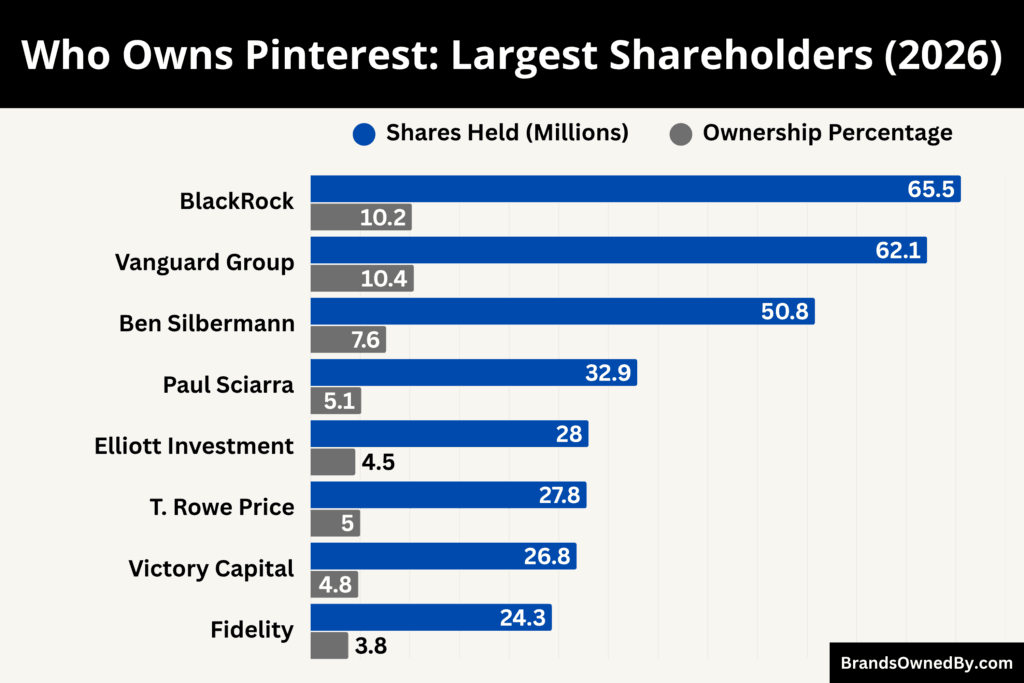
Pinterest is a publicly traded company listed on the New York Stock Exchange under the ticker symbol PINS. The company is not owned by a single person or parent corporation. Instead, ownership is divided among institutional investors, insider shareholders, and public investors who hold shares through the stock market.
As of April 2026, the largest shareholders of Pinterest are major institutional investment firms including The Vanguard Group and BlackRock, both of which own tens of millions of shares through index funds, ETFs, and institutional portfolios. Other major shareholders include Elliott Investment Management, T. Rowe Price, and Victory Capital Management.
Pinterest’s co-founders, including Ben Silbermann and Paul Sciarra, still retain significant ownership stakes, although institutional investors now control most of the company’s voting power. This ownership structure gives large investment firms strong influence over corporate governance, leadership decisions, and long-term strategy.
The Vanguard Group
The Vanguard Group is one of the largest shareholders of Pinterest as of April 2026.
Recent institutional filings show Vanguard holds approximately 62.1 million Pinterest shares, representing roughly 9.7% to 10.4% ownership of the company depending on filing methodology and affiliated fund calculations.
Vanguard owns these shares through multiple investment products, including:
- Index funds
- Exchange-traded funds (ETFs)
- Retirement investment portfolios
- Technology-focused mutual funds.
Because Pinterest is included in major stock indexes, Vanguard automatically accumulates shares through passive investment strategies.
This means millions of investors indirectly own Pinterest stock through Vanguard-managed funds.
Vanguard’s large ownership stake gives the company significant voting influence during shareholder decisions involving:
- Board elections
- Executive compensation approvals
- Corporate governance proposals
- Strategic shareholder resolutions.
BlackRock
BlackRock is another dominant shareholder in Pinterest.
As of early 2026, BlackRock controlled approximately 59.6 million to 65.5 million shares, equal to roughly 9.8% to 10.2% ownership of Pinterest.
BlackRock’s holdings are spread across:
- iShares ETFs
- Institutional investment portfolios
- Pension-related investment funds
- Growth-oriented investment products.
Its ownership position increased significantly over recent years as Pinterest remained part of major growth and technology investment baskets.
BlackRock’s influence is particularly important because the company is one of the world’s largest asset managers. Its shareholder voting decisions can affect major governance outcomes inside Pinterest.
Fidelity Investments
Fidelity Investments remains one of the major institutional investors in Pinterest.
Although Fidelity’s exact ownership stake changes frequently due to active fund management, the firm continues to control millions of Pinterest shares across multiple mutual funds and institutional portfolios.
Fidelity has historically focused on high-growth technology and digital media companies. Its investment in Pinterest reflects confidence in the platform’s advertising and commerce-focused business model.
Fidelity funds often hold Pinterest as part of:
- Growth equity funds
- Technology sector portfolios
- Communication services investment funds.
Elliott Investment Management
Elliott Investment Management became one of Pinterest’s most influential shareholders after building a large ownership stake.
As of 2026, Elliott controlled approximately 28 million shares, representing close to 4.4% to 5% ownership of Pinterest.
Elliott is known as an activist investment firm. Unlike passive investors, activist firms often push companies toward operational and strategic changes designed to improve shareholder returns.
Elliott played an important role during Pinterest’s strategic transition toward:
- Advertising optimization
- Profitability improvements
- E-commerce expansion
- AI-powered recommendation systems.
In 2026, Elliott also expanded its involvement through a major equity-related investment tied to Pinterest’s capital allocation strategy.
T. Rowe Price
T. Rowe Price is another major institutional shareholder in Pinterest.
Recent filings show the investment firm held approximately 27.8 million shares, equal to nearly 5% ownership of the company as of early 2026.
T. Rowe Price is known for investing heavily in long-term growth companies. Its Pinterest position reflects confidence in the company’s long-term monetization potential and advertising growth strategy.
Victory Capital Management
Victory Capital Management has also emerged as a significant Pinterest shareholder.
The firm reportedly owned approximately 26.8 million shares, representing around 4.2% to 4.8% ownership as of 2026.
Victory Capital increased its Pinterest holdings aggressively during recent reporting periods, signaling stronger institutional confidence in the company’s long-term strategy.
Ben Silbermann
Ben Silbermann remains one of the largest individual shareholders of Pinterest.
As of 2026, Silbermann reportedly owned approximately 36.9 million to 50.8 million shares, representing around 5.7% to 7.6% ownership depending on reporting periods and insider filing calculations.
As Pinterest’s co-founder and former CEO, Silbermann accumulated substantial equity during the company’s early startup years.
Although his ownership percentage declined after multiple funding rounds and the IPO, he remains highly influential because of his historical role in building the company.
Paul Sciarra
Paul Sciarra also remains a notable individual shareholder.
Recent ownership disclosures indicate Sciarra held approximately 32.9 million shares, representing roughly 5.1% ownership of Pinterest.
His ownership stake reflects his position as one of the company’s original co-founders.
Evan Sharp
Evan Sharp remains one of the notable insider shareholders connected to Pinterest, although his ownership stake is much smaller than those of co-founders Ben Silbermann and Paul Sciarra.
As of recent shareholder disclosures available in 2026, Evan Sharp held approximately 194,400 Pinterest shares, representing roughly 0.21% to 0.22% ownership of the company.
Sharp’s ownership stake declined significantly over time compared to the company’s early startup years. This reduction happened because of:
- Multiple venture capital funding rounds
- Share dilution after the IPO
- Stock sales over time
- Expanded institutional ownership
- Employee equity issuance.
Despite the smaller ownership percentage, Evan Sharp played a critical role in Pinterest’s development and long-term brand identity.
Institutional Ownership Dominance
Institutional investors collectively control the majority of Pinterest shares.
This is important because it means large financial institutions heavily influence the company’s governance structure and long-term strategy.
As of 2026, institutional ownership in Pinterest remained above 80% in many market ownership estimates. Large institutions dominate shareholder voting power across the company.
This ownership concentration affects decisions involving:
- Executive leadership
- Strategic acquisitions
- Share buybacks
- Corporate governance reforms
- Long-term growth investments.
Because Pinterest does not have an extreme founder-controlled voting structure, institutional shareholders have more influence compared to some other large technology companies.
Competitor Ownership Comparison
Pinterest operates in a highly competitive digital advertising and social media market where ownership structures often shape how companies are controlled, how decisions are made, and how much influence founders retain.
Some competitors are dominated by founders with special voting rights, while others are heavily controlled by institutional investors. Pinterest stands out because it operates with a more traditional public-company governance structure where institutional shareholders hold significant influence.
| Company | Ownership Type | Major Owners | Founder Control Level | Institutional Investor Influence |
|---|---|---|---|---|
| Public company | Vanguard, BlackRock, Elliott, insiders | Moderate | High | |
| Meta Platforms | Public company with dual-class shares | Mark Zuckerberg, Vanguard, BlackRock | Very high | Limited compared to founder control |
| Snap Inc. | Public company with founder voting dominance | Evan Spiegel and insiders | Very high | Lower governance influence |
| Public company | Institutional investors and insiders | Moderate | High | |
| X Corp. | Private company | Elon Musk and private investors | Extremely high | Minimal public investor influence |
Pinterest operates as a publicly traded company listed on the New York Stock Exchange under the ticker symbol PINS.
Its ownership is heavily concentrated among institutional investors such as The Vanguard Group, BlackRock, and Elliott Investment Management.
Although founders like Ben Silbermann and Paul Sciarra still own sizable stakes, they do not maintain overwhelming voting control through dual-class share dominance.
This means institutional shareholders have a stronger influence over:
- Board elections
- Executive compensation
- Strategic direction
- Governance reforms
- Shareholder proposals.
Pinterest’s ownership structure is closer to a traditional corporation than a founder-controlled technology company.
Meta Platforms
Meta Platforms, the parent company of Facebook and Instagram, has a very different ownership structure.
Although Meta is publicly traded, founder Mark Zuckerberg maintains dominant control through a dual-class share system.
Meta uses Class B shares that carry significantly higher voting power than ordinary shares. This structure allows Zuckerberg to control company decisions despite owning a minority percentage of total economic shares.
Major institutional shareholders in Meta include:
- The Vanguard Group
- BlackRock
- Fidelity Investments.
However, institutional investors have less influence compared to Pinterest because Zuckerberg retains effective voting control.
This structure allows Meta to pursue long-term projects such as:
- AI infrastructure expansion
- Virtual reality investments
- Metaverse development.
without strong shareholder interference.
Snap Inc.
Snap Inc. also operates under a founder-controlled ownership model.
Co-founder Evan Spiegel maintains substantial control through special voting shares.
Snap became controversial after issuing non-voting shares during its IPO. This structure reduced the governance influence of ordinary shareholders.
Institutional investors own large economic stakes in Snap, but voting power remains concentrated among founders and insiders.
Compared to Pinterest, Snap gives public investors far less governance influence.
Reddit has a more balanced ownership structure compared to Meta and Snap.
The company is publicly traded and owned by a mix of institutional investors, insiders, and public shareholders.
Major investors include venture capital firms and institutional asset managers.
Unlike Meta, Reddit does not have the same level of founder voting dominance. However, insider influence still remains important because of executive leadership and board representation.
Pinterest and Reddit share similarities in that both companies rely heavily on institutional investors after becoming public companies.
X Corp.
X Corp., formerly Twitter, operates under a completely different ownership structure.
After the company was acquired by Elon Musk, it became privately owned.
This removed public shareholders and institutional investor voting influence from the company.
Ownership is now concentrated among:
- Elon Musk
- Private equity investors
- Financial backers involved in the acquisition.
Because X is privately owned, decision-making authority is highly centralized compared to Pinterest.
Why Pinterest’s Ownership Structure Matters
Pinterest’s ownership structure affects how the company responds to investor pressure and market expectations.
Because institutional investors hold a strong influence, Pinterest faces more direct pressure regarding:
- Revenue growth
- Profitability
- Advertising performance
- Capital allocation
- Operational efficiency.
This became especially visible after activist investor Elliott Investment Management increased its stake and pushed for strategic and operational improvements.
Companies with stronger founder control structures can often ignore short-term investor pressure more easily. Pinterest does not have that same level of insulation from shareholder influence.
As a result, institutional investors play a much larger role in shaping Pinterest’s long-term direction compared to several of its major competitors.
Who Controls Pinterest?
Although Pinterest is owned by millions of public shareholders, control of the company is shaped by a combination of executive leadership, the board of directors, and major institutional investors.
Unlike some large technology companies where founders maintain near-total authority through super-voting shares, Pinterest operates with a more balanced governance structure. This gives institutional shareholders and the board greater influence over strategic decisions and leadership oversight.
Control of Pinterest can be divided into three major areas:
- Executive leadership control
- Board of directors oversight
- Institutional investor influence.
Bill Ready’s Role as CEO
Bill Ready is the Chief Executive Officer of Pinterest and the most influential executive inside the company.
He became CEO in 2022 after co-founder Ben Silbermann stepped down from the role.
Ready previously held senior leadership positions at Google and PayPal, where he focused heavily on commerce, payments, and digital advertising systems.
His appointment marked a major strategic shift for Pinterest.
Under Bill Ready’s leadership, Pinterest moved aggressively toward:
- E-commerce integration
- AI-powered recommendations
- Shopping-focused discovery tools
- Advertising optimization
- Creator monetization systems.
Instead of positioning Pinterest purely as a social inspiration platform, Ready pushed the company toward becoming a commerce-driven discovery engine.
This strategy focused on turning user inspiration into direct purchasing activity.
How Bill Ready Influences Company Strategy
As CEO, Bill Ready controls Pinterest’s day-to-day operations and long-term execution strategy.
His responsibilities include:
- Leading executive management teams
- Setting business priorities
- Managing advertising growth strategies
- Overseeing acquisitions and partnerships
- Expanding international operations
- Improving monetization systems.
He also plays a major role in investor relations and communicates Pinterest’s growth strategy to institutional shareholders and financial markets.
Role of the Board of Directors
Pinterest’s board of directors plays a major role in controlling the company’s governance structure.
The board oversees:
- Executive leadership performance
- Corporate governance policies
- Risk management
- Strategic direction
- Executive compensation
- Shareholder interests.
The board has the authority to appoint or remove senior executives, including the CEO.
Because Pinterest does not operate under extreme founder voting dominance, the board has stronger oversight authority compared to some founder-controlled technology companies.
Ben Silbermann’s Continuing Influence
Even after stepping down as CEO, co-founder Ben Silbermann still maintains influence within Pinterest.
As one of the company’s largest insider shareholders, Silbermann retains voting power through his equity ownership.
His influence also comes from:
- Founder status
- Historical leadership role
- Strategic knowledge of the platform
- Relationships with investors and executives.
Although he no longer manages daily operations, his long association with Pinterest still gives him importance in major strategic discussions.
Institutional Investors and Control
Large institutional shareholders play a major role in controlling Pinterest indirectly.
Major investors such as:
- The Vanguard Group
- BlackRock
- Elliott Investment Management.
hold substantial voting power because of their large ownership stakes.
These investors can influence:
- Board elections
- Corporate governance policies
- Executive compensation decisions
- Strategic pressure campaigns.
This influence became especially important after Elliott Investment Management built a major stake in Pinterest and pushed for operational and monetization improvements.
Institutional investors cannot directly manage Pinterest’s operations, but they can pressure leadership through shareholder voting and governance influence.
Executive Leadership Team
Beyond the CEO, Pinterest is controlled operationally by a broader executive leadership structure.
Senior executives oversee key divisions such as:
- Advertising
- Product development
- Engineering
- Artificial intelligence systems
- Finance
- International growth
- Trust and safety operations.
These executives help execute Pinterest’s long-term business strategy under the CEO’s direction.
Past CEOs of Pinterest
Pinterest has had a limited number of CEOs compared to many technology companies.
Ben Silbermann (2010–2022)
Ben Silbermann served as Pinterest’s founding CEO.
He focused heavily on:
- Product identity
- User growth
- Platform culture
- Visual discovery systems.
Under his leadership, Pinterest evolved from a niche bookmarking platform into a major global technology company.
He also led the company through its IPO process.
Bill Ready (2022–Present)
Bill Ready succeeded Silbermann in 2022.
His leadership brought a stronger focus on monetization and commerce integration.
Under Ready, Pinterest accelerated investments in:
- AI recommendation technology
- Shopping tools
- Advertising systems
- Performance marketing capabilities.
This transition reflected Pinterest’s shift from user growth prioritization toward revenue optimization and commerce expansion.
Why Pinterest’s Governance Structure Matters
Pinterest’s governance structure affects how quickly the company responds to investor pressure and market conditions.
Because founders do not maintain overwhelming voting control, institutional investors have greater influence over corporate direction compared to companies like Meta Platforms or Snap Inc.
This creates a governance environment where shareholder expectations strongly influence strategic decisions involving:
- Profitability targets
- Advertising growth
- Operational efficiency
- Capital allocation
- Acquisition strategy.
As a result, control of Pinterest is distributed across executive leadership, board oversight, and institutional shareholder influence rather than concentrated under a single dominant founder.
Pinterest Annual Revenue and Net Worth
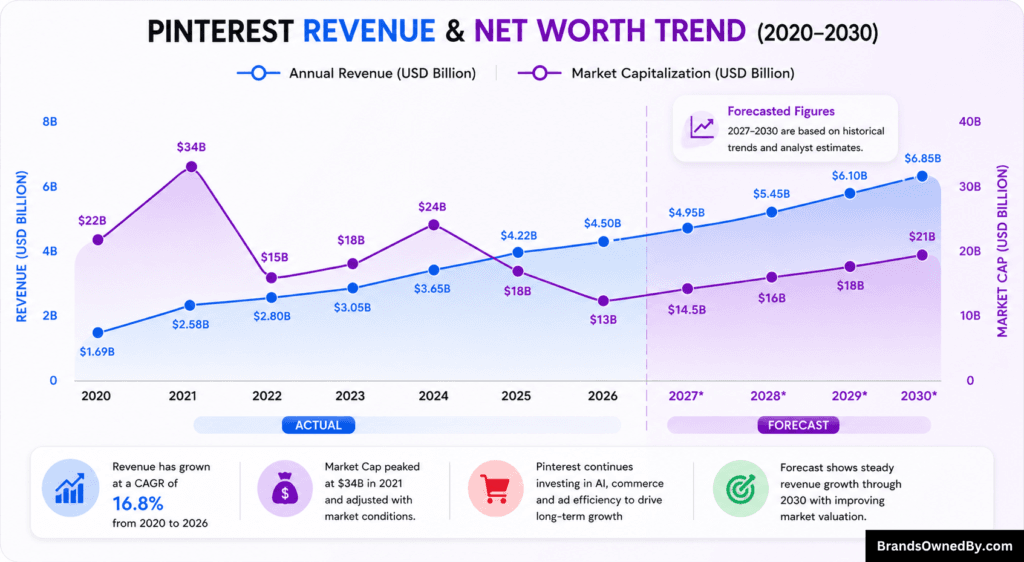
As of 2026, Pinterest generates an estimated annual revenue of $4.5 billion and maintains a market capitalization of nearly $13 billion. The company has evolved from a niche visual bookmarking platform into a major advertising and commerce-focused technology business.
Pinterest’s financial growth has been driven by improvements in advertising monetization, AI-powered recommendations, shopping integrations, and international expansion. However, its market valuation has fluctuated significantly due to changes in digital advertising demand, competition from larger social media platforms, and broader technology market conditions.
Pinterest Revenue Growth in 2026
In 2026, Pinterest’s estimated revenue reached $4.5 billion. This represented continued growth compared to previous years, despite slower global advertising spending across parts of the technology sector.
A major portion of Pinterest’s revenue still comes from digital advertising. Brands use promoted Pins, shopping ads, video advertisements, and sponsored discovery content to target users who are actively searching for products and ideas.
Pinterest’s advertising business benefits from high commercial intent. Unlike entertainment-focused platforms, Pinterest users often visit the platform while planning purchases or researching products. This makes Pinterest valuable for advertisers in sectors such as:
- Home decor
- Fashion
- Beauty
- Food and recipes
- DIY products
- E-commerce retail
- Travel planning.
The company also expanded its performance advertising capabilities in recent years. AI-powered recommendation systems improved ad targeting and user engagement, helping advertisers achieve stronger conversion rates.
Revenue Breakdown by Business Segments
Pinterest’s revenue structure is heavily concentrated in advertising operations.
Advertising revenue contributes the overwhelming majority of total company income. This includes:
- Promoted Pins
- Shopping advertisements
- Video advertising campaigns
- Performance marketing ads
- Mobile advertising placements.
International advertising revenue has also become increasingly important for Pinterest.
Although the United States remains the company’s largest revenue-generating market, Pinterest continues expanding monetization across Europe, Latin America, and other international regions.
The company also increased investment in commerce-related features that allow users to discover products directly through Pins and creator content.
Pinterest Net Worth and Market Capitalization
As of April 2026, Pinterest’s estimated market capitalization stands at approximately $13 billion.
The company’s valuation declined significantly compared to its 2021 peak when digital advertising companies experienced major stock market growth during the post-pandemic technology rally.
Several factors affected Pinterest’s market value over recent years:
- Slower advertising market growth
- Competition from platforms like Meta Platforms and TikTok
- Investor concerns about long-term user growth
- Rising AI infrastructure costs across the technology industry
- Volatility in technology stock valuations.
Despite valuation pressure, Pinterest continued improving operational efficiency and monetization performance under CEO Bill Ready.
Revenue and Net Worth Growth Trends
Pinterest experienced its strongest valuation growth during 2020 and 2021 when online engagement and digital advertising spending increased sharply.
The company’s market capitalization peaked near $34 billion in 2021 before falling during the broader technology stock correction.
Revenue growth, however, continued rising even after valuation declines. This showed that Pinterest’s operational business performance remained stronger than investor sentiment during parts of the market downturn.
The company increasingly focused on long-term monetization improvements instead of pure user growth metrics.
Forecast Revenue Growth Through 2030
Pinterest’s long-term growth outlook depends heavily on advertising expansion, AI-powered discovery tools, and commerce integration strategies.
Projected revenue estimates through 2030 include:
- 2027: Estimated revenue of $4.95 billion driven by AI-enhanced advertising optimization and international monetization growth.
- 2028: Estimated revenue of $5.45 billion supported by stronger shopping integrations and creator commerce tools.
- 2029: Estimated revenue of $6.10 billion as Pinterest expands deeper into visual commerce and performance advertising systems.
- 2030: Estimated revenue of $6.85 billion fueled by global advertiser expansion, AI recommendation improvements, and advanced visual search monetization.
Pinterest’s future financial performance will likely depend on how effectively the company competes in the digital advertising market while expanding its commerce ecosystem.
The company continues investing in:
- AI-powered recommendation systems
- Shopping integrations
- Creator monetization tools
- International advertising expansion
- Visual search technology.
If Pinterest successfully increases advertiser conversion efficiency and strengthens commerce-driven discovery, the company could continue growing revenue steadily through the end of the decade.
Companies Owned by Pinterest
Companies Owned by Pinterest
As of 2026, Pinterest does not own a massive portfolio of standalone consumer brands like larger technology conglomerates. Instead, the company has focused on acquiring technologies, commerce platforms, AI-driven shopping tools, and creator-focused systems that strengthen its visual discovery and advertising ecosystem.
Most of Pinterest’s acquisitions have been highly strategic rather than large-scale corporate takeovers. The company primarily acquires technology platforms, recommendation systems, shopping infrastructure, and engineering talent that can improve user engagement, personalization, and monetization.
Pinterest also operates several internal business platforms and commerce-related systems that support advertising, shopping discovery, creator monetization, and visual search functionality.
| Company | Year Acquired | Type of Business | Purpose of Acquisition | How Pinterest Uses It |
|---|---|---|---|---|
| The Yes | 2022 | AI-powered fashion shopping platform | Strengthen personalized shopping and commerce recommendations | Integrated into Pinterest’s AI-driven shopping and product recommendation systems |
| Vochi | 2021 | AI video editing and creator tools platform | Improve creator content tools and short-form video capabilities | Used to enhance video creation tools and creator engagement features |
| Instapaper | 2016 | Read-later content application | Expand content discovery and user engagement systems | Continued operating as a standalone app after acquisition |
| Jelly Industries | 2017 | Search and question-answer technology company | Improve search infrastructure and recommendation systems | Helped strengthen Pinterest’s search relevance and discovery algorithms |
| URX | 2016 | Mobile deep-linking and discovery platform | Improve mobile content discovery and personalization | Enhanced recommendation systems and mobile discovery infrastructure |
| VisualGraph | 2014 | Image recognition and visual search technology company | Strengthen computer vision and visual discovery systems | Contributed to Pinterest Lens and visual search technologies |
| Livestar | 2013 | Mobile recommendation technology platform | Improve personalized discovery and recommendation systems | Strengthened personalized content recommendations across Pins |
| Hackermeter | 2013 | Coding assessment and engineering platform | Acquire engineering talent and technical infrastructure expertise | Supported Pinterest’s engineering and platform scaling efforts |
| Punchfork | 2013 | Recipe discovery platform | Expand food and recipe content ecosystem | Improved recipe discovery and food-related recommendation systems |
| Hike Labs Team Acquisition | 2015 | Mobile publishing technology team | Strengthen mobile publishing and product development capabilities | Added engineering and mobile content expertise to Pinterest |
| Fleksy Team Acquisition | 2016 | Mobile keyboard technology team | Improve mobile interaction and product development systems | Enhanced mobile engineering and user interaction development |
| Highlight and Shorts Team Acquisition | 2016 | Social discovery and video-sharing app team | Improve creator engagement and mobile social discovery tools | Helped strengthen engagement and creator-focused features |
| tvScientific | 2025 | Connected TV advertising technology platform | Expand advertising capabilities into connected television advertising | Integrated shopping intent data with connected TV ad targeting systems. |
Pinterest Shopping
Pinterest Shopping is one of the company’s largest internally operated commerce ecosystems.
The platform allows businesses and retailers to upload product catalogs directly into Pinterest’s discovery environment. Users can browse products, save items to boards, and access direct purchase links.
Pinterest Shopping became increasingly important as the company shifted toward commerce-driven discovery under CEO Bill Ready.
The system includes several shopping-focused features such as:
- Shoppable Pins
- Product tagging
- Personalized shopping feeds
- Product recommendation systems
- Merchant storefront integrations.
Pinterest uses AI-powered visual discovery tools to connect users with products based on search behavior and image recognition patterns.
This commerce infrastructure has become one of Pinterest’s most important monetization systems.
The Yes
The Yes is Pinterest’s most important acquisition in the commerce and AI-shopping sector.
Pinterest acquired The Yes in 2022 to accelerate its expansion into personalized shopping and AI-driven commerce recommendations.
The Yes was founded as an AI-powered fashion shopping platform that created personalized shopping feeds based on user preferences, style interests, sizes, and shopping behavior.
The platform used machine learning systems to continuously adapt recommendations based on real-time user interactions.
This acquisition became strategically important because Pinterest wanted to transform its platform into a stronger commerce-driven discovery engine.
After the acquisition, Pinterest integrated The Yes technology into:
- Personalized shopping recommendations
- Fashion discovery systems
- AI-driven commerce personalization
- Product recommendation algorithms.
Pinterest later shut down the standalone The Yes app and website so the combined teams could focus entirely on integrating the technology into Pinterest’s shopping ecosystem.
Vochi
Vochi was acquired by Pinterest in 2021.
Vochi was a video creation and editing platform known for advanced AI-powered video effects and creator editing tools.
Pinterest acquired the company to strengthen its creator tools and short-form visual content capabilities.
The acquisition aligned with Pinterest’s strategy to compete more aggressively in creator-focused visual content and video engagement.
Vochi’s editing technology helped Pinterest improve:
- Creator publishing tools
- Video editing features
- Visual effects systems
- Interactive content creation capabilities.
The acquisition also brought engineering talent specializing in AI-enhanced video creation systems.
Instapaper
Instapaper was acquired by Pinterest in 2016.
Instapaper was a popular read-later application that allowed users to save articles and web pages for offline reading.
Unlike many Pinterest acquisitions that were fully absorbed into the platform, Instapaper continued operating as a standalone app after the acquisition.
Pinterest acquired Instapaper partly for its engineering expertise and content discovery technology.
The acquisition helped Pinterest strengthen user engagement and content organization systems.
Jelly Industries
Jelly Industries was acquired by Pinterest in 2017.
The company was founded by Biz Stone, one of the co-founders of X Corp. when it operated as Twitter.
Jelly focused on search and question-answering technology.
Pinterest acquired the company to improve its search infrastructure and recommendation systems.
The acquisition supported Pinterest’s long-term goal of improving visual discovery and search relevance across billions of Pins.
URX
URX was acquired by Pinterest in 2016.
URX specialized in mobile deep-linking and content discovery technology.
Pinterest acquired the startup to improve how users discovered and navigated content across mobile environments.
The acquisition helped Pinterest enhance:
- Recommendation systems
- Content understanding
- Mobile discovery infrastructure
- Personalized content delivery.
URX technology became especially valuable as Pinterest scaled its recommendation algorithms across massive volumes of visual content.
VisualGraph
VisualGraph was acquired by Pinterest in 2014.
VisualGraph specialized in image recognition and visual search technology.
The acquisition became important in Pinterest’s development of computer vision systems and image-based discovery tools.
VisualGraph technology contributed to Pinterest’s visual search capabilities that later evolved into advanced image-recognition systems like Pinterest Lens.
Livestar
Livestar was acquired by Pinterest in 2013.
Livestar focused on mobile recommendation technology and personalized discovery experiences.
Pinterest acquired the startup to improve recommendation systems and mobile content discovery infrastructure during the company’s rapid growth phase.
The acquisition helped Pinterest strengthen personalized recommendations for users browsing Pins and collections.
Hackermeter
Hackermeter was acquired by Pinterest in 2013.
Hackermeter operated as a coding challenge and technical assessment platform.
Pinterest primarily acquired the company for engineering talent and technical infrastructure expertise.
The acquisition supported Pinterest’s engineering expansion during its early scaling years.
Punchfork
Punchfork was acquired by Pinterest in 2013.
Punchfork was a recipe discovery platform that organized food and cooking content.
Pinterest acquired the platform to strengthen its food discovery ecosystem and recipe-related recommendation capabilities.
Food and recipe content later became one of Pinterest’s strongest engagement categories.
Hike Labs
Pinterest acquired the team behind Hike Labs in 2015.
Hike Labs had been developing a mobile publishing application called Drafty.
The acquisition focused heavily on acquiring engineering and product talent to strengthen Pinterest’s mobile publishing and content systems.
Fleksy
Pinterest acquired part of the team behind Fleksy in 2016.
Fleksy was known for its custom mobile keyboard technology.
Pinterest acquired engineering talent from the company to strengthen mobile product development and user interaction systems.
Highlight and Shorts Team Acquisition
Pinterest acquired the team behind the apps Highlight and Shorts in 2016.
These apps focused on social discovery and video-sharing experiences.
The acquisition helped Pinterest improve mobile engagement systems and creator-focused features.
tvScientific
tvScientific became one of Pinterest’s newest acquisitions after the company agreed to acquire the connected television advertising platform in late 2025.
tvScientific specializes in automated connected TV advertising systems.
The acquisition expanded Pinterest’s advertising ecosystem beyond traditional platform advertising into connected television ad infrastructure.
Pinterest planned to combine its high-intent shopping data with tvScientific’s advertising optimization systems to improve ad targeting and conversion measurement across connected TV environments.
Unlike some earlier acquisitions, tvScientific was expected to continue operating under its own brand after the acquisition.
Final Thoughts
Understanding who owns Pinterest requires looking at both shareholder ownership and operational control. Pinterest is a publicly traded company owned largely by institutional investors such as Vanguard, BlackRock, and Fidelity, alongside retail investors and insiders.
While no single person owns Pinterest outright, leadership decisions are driven by the executive team and board of directors. Under CEO Bill Ready, Pinterest has focused heavily on AI, shopping features, and advertising growth.
The company continues to position itself as a commerce-focused discovery platform rather than a traditional social media network. That strategy has helped Pinterest maintain a unique position in the digital advertising industry.
FAQs
Is Pinterest owned by Meta?
No, Meta Platforms does not own Pinterest. Pinterest operates as an independent publicly traded company listed on the New York Stock Exchange under the ticker symbol PINS.
Is Pinterest owned by Google?
No, Google does not own Pinterest. Although Google and Pinterest both operate in digital advertising and search-related markets, Pinterest is an independent company owned by institutional investors, insider shareholders, and public investors.
Who owns the Pinterest site?
Pinterest is owned collectively by its shareholders because it is a public company. The largest shareholders as of 2026 include The Vanguard Group, BlackRock, and other institutional investment firms, along with insider shareholders such as Ben Silbermann and Paul Sciarra.
Is Pinterest publicly traded?
Yes, Pinterest is publicly traded on the New York Stock Exchange under the ticker symbol PINS.
Who founded Pinterest?
Pinterest was founded in 2010 by Ben Silbermann, Paul Sciarra, and Evan Sharp.
What company owns Pinterest?
No parent company owns Pinterest. Pinterest operates as an independent public company owned by shareholders through the stock market.
Which country uses Pinterest the most?
The United States is Pinterest’s largest market and has the highest number of Pinterest users and advertisers. The platform is also widely used in countries such as Brazil, Mexico, Canada, and the United Kingdom.
Which country is Pinterest from?
Pinterest is an American company founded and headquartered in San Francisco, California, in the United States.
Is Pinterest an Israeli company?
No, Pinterest is not an Israeli company. It is an American technology company founded in the United States.
Is Pinterest owned by OpenAI?
No, OpenAI does not own Pinterest. The company operates independently as a publicly traded corporation owned by institutional investors and public shareholders.