
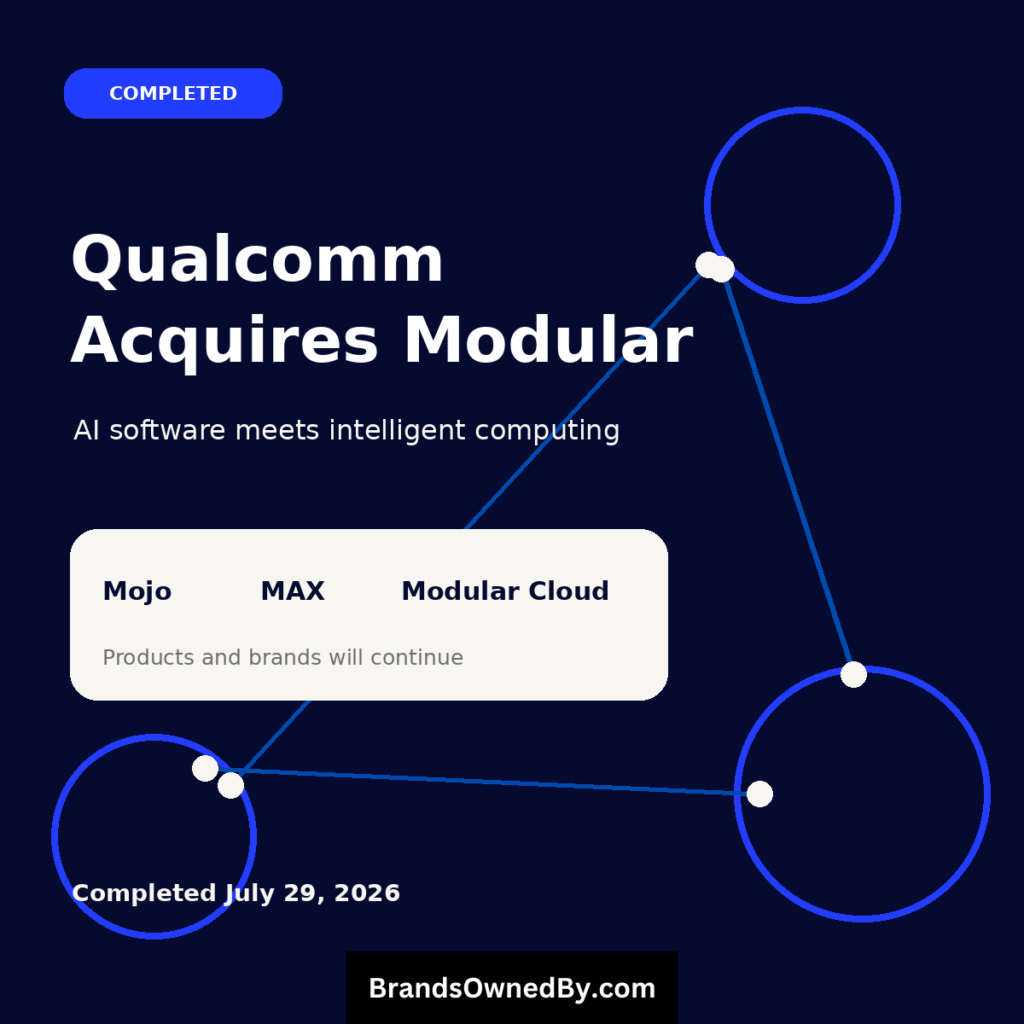
- Qualcomm acquires Modular Inc. on July 29, 2026, making Modular a Qualcomm-owned AI software business. The deal is completed as on 29 July 2026.
- The primarily stock-based transaction involved up to 19.2 million Qualcomm shares and had an estimated announcement-date value of approximately $3.9 billion.
- Mojo, MAX, and Modular Cloud will continue as products and brands, while co-founder Chris Lattner joins Qualcomm as executive vice president of advanced AI software and platforms.
- Qualcomm gains AI software, cloud infrastructure, engineering talent, intellectual property, and a developer ecosystem that can strengthen its expansion from chips into full-stack AI computing.
Qualcomm completed its acquisition of Modular Inc. on July 29, 2026, less than six weeks after publicly announcing the agreement. The transaction places Modular’s AI software platform, engineering team, developer community, and cloud infrastructure under Qualcomm’s ownership.
Mojo, MAX, and Modular Cloud are not disappearing. Qualcomm plans to continue offering all three under their existing product names. Modular co-founder Chris Lattner is also joining Qualcomm as executive vice president of advanced AI software and platforms.
The deal gives Qualcomm something it has been missing as it expands beyond mobile chips: a developer-focused software layer that can connect AI applications with different types of processors.
The transaction was structured mainly as a stock deal. Qualcomm agreed to issue up to 19.2 million of its shares to Modular’s equity holders. Based on Qualcomm’s share price around the announcement, financial publications valued the consideration at approximately $3.9 billion.
That number should be treated as an estimated announcement-date value rather than a fixed cash purchase price. The final economic value depends on Qualcomm’s share price, the actual number of shares issued, and other terms within the acquisition agreement.
![Qualcomm Acquires Modular [Deal Snapshot]](https://brandsownedby.com/wp-content/uploads/2026/07/Qualcomm-Acquires-Modular-Deal-Snapshot-683x1024.png)
What Happened?
Qualcomm signed a definitive agreement to acquire Modular on June 21, 2026. The companies publicly announced the deal three days later.
At that stage, Qualcomm had agreed to buy Modular but did not yet own it. The transaction still depended on regulatory reviews and other customary closing requirements.
Those conditions were completed quickly. Qualcomm announced the closing on July 29, 2026.
Modular is now part of Qualcomm’s corporate portfolio. Its founders and venture investors no longer control it as an independent company.
The closing does not mean Qualcomm is dismantling the Modular business. The initial integration strategy appears to be the opposite. Qualcomm is keeping the products, maintaining the brands, and placing Modular’s most recognizable founder in a senior executive role.
What is Modular?
Modular is an AI software infrastructure company founded in 2022 by Chris Lattner and Tim Davis.
The company was built around a problem that affects almost every serious AI developer: modern computing software is fragmented.
Different processors use different development tools. AI models may need to be rewritten, recompiled, or separately optimized before they can run efficiently on a new GPU, CPU, neural processing unit, or custom accelerator.
That creates extra work for developers. It can also make companies dependent on one hardware provider because moving to another platform becomes expensive and technically difficult.
Modular’s software tries to reduce that friction.
Its broader vision is to give developers a common environment for building and deploying AI applications across several types of hardware. Instead of creating a separate workflow for every chip architecture, developers can use Modular’s tools as an abstraction layer between their AI applications and the underlying processors.
That idea has become more valuable as the AI market expands beyond a small number of large data centers. AI models now run across cloud servers, personal computers, vehicles, industrial machines, smartphones, robots, and edge devices.
Qualcomm already has hardware products in many of those markets. Modular provides software that could connect them.
What Products Did Qualcomm Acquire?
Here’s an overview of what Qualcomm has acquired:
Mojo
Mojo is Modular’s programming language for AI and high-performance computing.
Its design borrows the approachable syntax associated with Python while adding lower-level performance and systems-programming capabilities.
That combination is meant to solve a practical development problem. Python is widely used in AI because it is familiar and supported by a large ecosystem. However, developers often rely on other languages or specialized libraries when they need greater performance or direct control over hardware.
Mojo attempts to bring those needs into one language.
It remains an emerging technology. It does not have the adoption, library depth, or industry reach of Python or C++. Still, it gives Qualcomm a long-term developer asset rather than a single-purpose software tool.
A successful programming language can influence how applications are written, which tools developers learn, and which hardware platforms receive early support.
MAX
MAX is Modular’s AI inference and deployment platform.
Inference is the stage at which a trained AI model processes a new request and generates a result. It is what happens when a chatbot answers a question, a vision system identifies an object, or an industrial model analyzes live sensor data.
Running inference at scale can be expensive. Developers need to manage performance, latency, memory usage, hardware utilization, and deployment reliability.
MAX is designed to simplify that process across different computing platforms. It gives developers tools to run, optimize, serve, and deploy AI models without rebuilding their entire software environment for each processor.
This is likely the most immediately useful part of Modular’s portfolio for Qualcomm.
Qualcomm wants its processors to support more generative and agentic AI workloads. MAX gives it a software layer that can turn those hardware capabilities into something developers can deploy.
Modular Cloud
Modular Cloud extends the company’s software into managed infrastructure.
Instead of requiring every customer to install and maintain the full platform independently, Modular Cloud allows developers to access its AI deployment tools through a cloud environment.
This matters because it gives Qualcomm a continuing relationship with the customer after the initial hardware decision.
A semiconductor company traditionally earns revenue when a component is sold. A cloud or software platform can generate recurring usage, support, subscription, or service revenue.
Qualcomm has not yet disclosed how Modular Cloud will be positioned within its broader commercial structure. However, it gives the company an entry point into a different type of business model.
Who Owned Modular Before Qualcomm?
Modular was privately held before the acquisition.
Its ownership was divided among its founders, employees, and outside investors. Chris Lattner and Tim Davis remained central to the company’s leadership, but Modular did not publish a complete capitalization table or disclose the founders’ individual ownership percentages.
The company had raised approximately $380 million before the sale.
Its September 2025 funding round brought in $250 million and reportedly valued Modular at $1.6 billion. Investors connected with the company included US Innovative Technology Fund, DFJ Growth, GV, General Catalyst, and Greylock.
The precise percentage held by each investor was not publicly disclosed.
That distinction matters. A list of participating investors is not the same as a verified ownership breakdown. Without the company’s capitalization records, it would be misleading to assign percentages to the founders or venture funds.
Who Owns Modular Now?
Qualcomm owns Modular following the July 29 closing.
The transaction ended Modular’s status as an independently controlled venture-backed company. Its previous shareholders exchanged their Modular interests for the consideration available under the acquisition agreement.
Qualcomm has not published a detailed internal organization chart showing exactly where Modular sits within every subsidiary and operating entity.
The practical ownership structure, however, is clear:
Qualcomm Incorporated controls Modular and its business.
Modular may continue using its existing name and product identities, but brand continuity should not be confused with independent ownership.
Modular Ownership Before and After the Acquisition
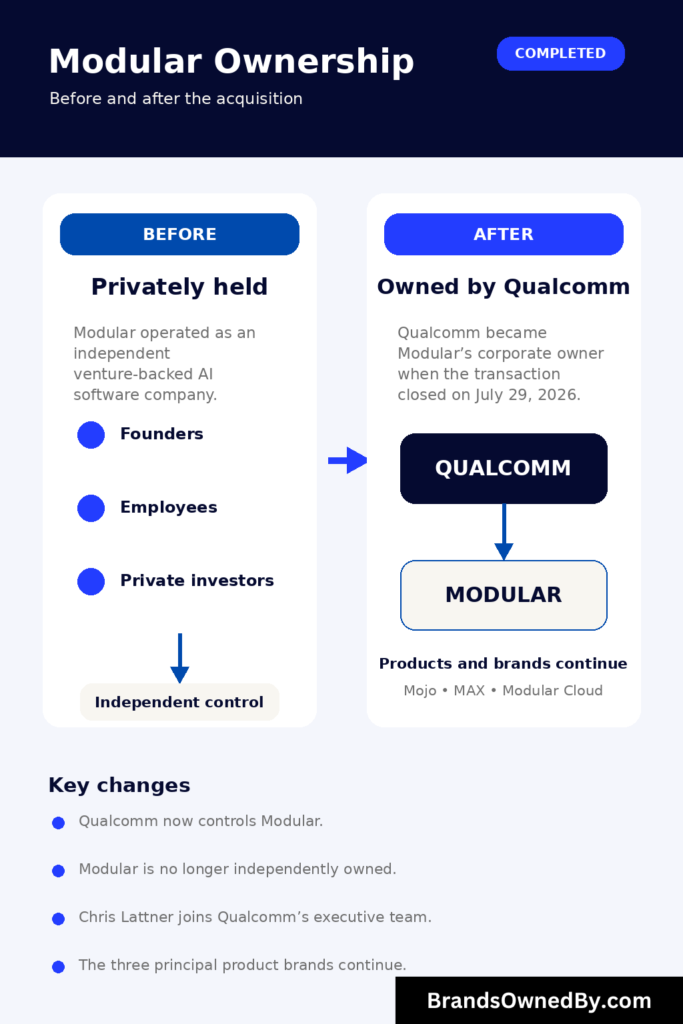
Before the deal, Modular’s founders and investors controlled the company through their private shareholdings. Modular raised its own capital, set its own product priorities, and operated as a standalone AI software business.
After the acquisition, Qualcomm became the ultimate owner. It now has the authority to determine Modular’s investment levels, commercial strategy, leadership structure, product roadmap, and long-term position within the Qualcomm portfolio.
Some visible parts of the business will remain familiar.
The Modular name is continuing. Mojo, MAX, and Modular Cloud are continuing. Chris Lattner will remain closely involved in the technology.
What changed is the source of control behind them.
Modular’s products are no longer backed by a collection of founders, employees, and venture investors. They are backed by a multinational semiconductor and computing company with global customers, established distribution, and far greater financial resources.
Why Did Qualcomm Buy Modular?
The easy explanation is that Qualcomm wanted more AI software.
The deeper explanation is that the company is trying to change its position within the computing market.
Qualcomm has historically been strongest at the hardware and intellectual-property layers. It designs processors, connectivity technologies, modems, and computing platforms. Other companies use those technologies to build devices and services.
That model remains valuable, but AI is making software ecosystems more important.
Developers do not select processors based only on benchmark scores. They also consider whether the hardware is easy to program, whether major models run properly, whether development tools are mature, and whether applications can move between systems without extensive rewriting.
This is one reason Nvidia became so difficult to challenge in AI. Its advantage is not limited to GPUs. CUDA, software libraries, developer tools, model support, documentation, and years of developer adoption reinforce the hardware business.
Qualcomm needs a stronger answer at the software layer.
Modular gives it one.
Qualcomm Wants to Become a Full-Stack AI Company
A full-stack computing company provides more than the physical processor.
It may offer the programming environment, compilers, model libraries, inference software, development tools, cloud services, networking, and deployment support around that processor.
Qualcomm already controls important hardware technologies. Modular expands the stack upward.
The combined platform could eventually cover:
- Qualcomm processors and AI accelerators.
- Mojo programming tools.
- MAX inference and model deployment.
- Modular Cloud infrastructure.
- Edge and device-level AI.
- Data center AI systems.
- Developer tools and enterprise integrations.
That does not mean all these parts are already fully integrated. They are not.
The acquisition gives Qualcomm the building blocks and the engineering team needed to create that platform over time.
The Data Center Opportunity
Qualcomm’s ambitions now extend well beyond smartphones.
The company is developing a broader data center strategy focused on AI inference, energy efficiency, and new computing platforms. Modular fits directly into that effort.
Breaking into the data center market is difficult. Customers do not purchase a chip in isolation. They need systems, networking, software, model compatibility, security, deployment tools, and reliable technical support.
Modular strengthens the parts of that offering that developers and enterprise customers interact with directly.
Its software could also help Qualcomm demonstrate results in more meaningful terms.
Instead of saying that a processor can perform a certain number of operations, Qualcomm could show how quickly and efficiently an actual AI model runs through MAX.
That makes the hardware easier to evaluate and potentially easier to sell.
Qualcomm is Reducing Its Dependence on Smartphones
The acquisition also fits Qualcomm’s long-running diversification effort.
Smartphone chips remain important to the company, but the market creates several risks. Device sales are cyclical. Large customers have significant negotiating power. Some customers are developing more components internally.
Apple’s move toward its own modem technology has made that risk more visible.
Qualcomm has responded by investing in automotive systems, personal computers, industrial devices, robotics, edge AI, extended reality, and data center infrastructure.
Modular can support several of those categories at once.
The same software platform could help developers deploy AI on a cloud server, a workstation, a vehicle, a factory system, or a portable device.
That cross-market relevance makes Modular more strategically useful than an AI tool built for only one product category.
What Qualcomm is Really Acquiring
The most visible assets are Mojo, MAX, and Modular Cloud. They are only part of the deal.
Specialized Engineering Talent
Modular assembled engineers with expertise in programming languages, compilers, AI runtimes, cloud infrastructure, distributed systems, and hardware optimization.
Teams with that combination of skills are difficult to recruit and even harder to coordinate.
Chris Lattner is an especially important part of the acquisition. His past work includes LLVM, Clang, MLIR, and Apple’s Swift programming language.
Qualcomm is not simply hiring him as an adviser. His executive vice president title suggests he will influence the company’s wider AI software strategy.
Intellectual Property
Qualcomm gains Modular’s code, software architecture, deployment systems, optimization techniques, and related intellectual property.
Some parts of the Modular ecosystem are open source. That does not remove their strategic value. The company still controls product development, commercial services, engineering expertise, and the wider platform built around those projects.
A Developer Community
Modular had already attracted a growing developer audience before the acquisition.
That community gives Qualcomm a way to reach software builders who may never have interacted directly with a semiconductor company.
Developers can become an important distribution channel. When they adopt a programming environment or deployment platform, their choices may influence which infrastructure their employers use later.
Hardware-Agnostic Positioning
Modular’s most distinctive claim is that its software can work across different hardware platforms.
That gives Qualcomm access to customers even when they are not using Qualcomm processors.
It also creates the deal’s biggest strategic tension.
Will Modular Remain Hardware Neutral?
Qualcomm says Modular’s open, heterogeneous computing mission will continue. Mojo, MAX, and Modular Cloud will also continue as products and brands.
That commitment is sensible. Modular would lose much of its appeal if Qualcomm turned it into software that worked only with Qualcomm hardware.
Developers choose hardware-neutral tools because they want flexibility. Cloud providers and enterprises often use processors from several vendors. They do not want to rebuild their software every time they change infrastructure.
Qualcomm can benefit from keeping the platform open.
It can earn influence across the wider AI ecosystem while making sure its own processors work particularly well with Modular’s software.
The concern is whether that neutrality will survive in practice.
Developers will watch which hardware receives the fastest updates, the best documentation, and the strongest optimization. Support can technically remain open while gradually becoming less equal.
Qualcomm will need to demonstrate neutrality through product decisions, not only through acquisition-day assurances.
What Changes for Modular?
The most immediate change is access to scale.
Modular can now draw on Qualcomm’s balance sheet, global sales organization, enterprise relationships, engineering facilities, and hardware expertise.
That could accelerate product development and make the platform more credible to large customers.
Qualcomm can also coordinate software development with future processor designs. Modular engineers may be able to influence hardware architecture earlier instead of optimizing products only after a processor is complete.
The company’s management structure will change as well.
Chris Lattner is moving from the CEO role at an independent startup to a senior executive position inside Qualcomm. His responsibilities may extend beyond the Modular product line.
The long-term role of co-founder Tim Davis has not been clearly detailed in the public completion announcement. It should not be assumed without a further company disclosure.
What is Staying the Same?
Qualcomm has been clear about several points.
Mojo will continue.
MAX will continue.
Modular Cloud will continue.
The Modular product identity will remain active, at least during the initial integration period.
The company’s commitment to open and heterogeneous computing is also expected to continue.
These decisions lower the immediate disruption for developers and customers. They also suggest Qualcomm understands that Modular’s value comes partly from its independent developer reputation.
More detailed questions remain unanswered.
Qualcomm has not provided a full product-integration schedule. It has not explained whether pricing will change. It has not disclosed whether Modular Cloud will remain operationally separate or become part of a larger Qualcomm service.
Those decisions will reveal more about the acquisition than the closing announcement itself.
How the Deal Changes Qualcomm’s Portfolio
Qualcomm has acquired software companies and engineering businesses before. Modular is unusual because it can influence several parts of the company simultaneously.
Mojo adds a programming-language asset.
MAX adds AI inference and deployment technology.
Modular Cloud adds managed infrastructure.
The engineering team adds software expertise.
The developer community adds distribution and credibility.
Together, these assets move Qualcomm closer to controlling the full path between an AI application and the hardware running it.
That is a larger strategic shift than simply adding another subsidiary.
Competitive Impact
This one is interesting, let’s see how this deal impacts competitors:
Nvidia
Nvidia is the clearest competitor affected by the deal.
Its CUDA ecosystem has become deeply embedded in AI development. Developers, researchers, and companies have built years of software around it.
Modular cannot replace that ecosystem overnight. Qualcomm cannot create an equivalent simply by purchasing one company.
The more realistic opportunity is to reduce the importance of hardware-specific software.
A reliable cross-hardware platform could make it easier for customers to use processors from Qualcomm, AMD, cloud providers, and other vendors without rebuilding every application.
That would not eliminate Nvidia’s advantage, but it could weaken the switching costs that protect it.
AMD and Intel
AMD and Intel face a more complicated impact.
Modular’s software could support their processors and make those products easier for developers to use. At the same time, Qualcomm owns the platform and may use it to improve the competitiveness of its own hardware.
The relationship could therefore involve both cooperation and competition.
Cloud Providers
Large cloud providers are developing their own AI chips.
A portable software platform could make those processors more accessible to developers who would otherwise remain tied to familiar GPU environments.
Qualcomm could benefit from Modular software even when a customer runs it on another company’s chip.
That creates an opportunity for software and cloud revenue beyond Qualcomm’s traditional hardware sales.
Main Risks
No acquisition is 100% secure. These are the key risks that Qualcomm might have to face:
Integration Risk
Modular was a young, fast-moving startup. Qualcomm is a large public company with more formal decision-making, budgeting, security, and legal processes.
The added structure can help Modular sell to enterprise customers. It can also slow development.
Qualcomm will need to protect the speed and technical culture that made the company attractive.
Talent Retention
A meaningful portion of Modular’s value sits with its engineering team.
If key employees leave after their acquisition incentives mature, Qualcomm may retain the products without retaining the knowledge and momentum behind them.
Developer Trust
Open-source communities can be cautious when a large corporation acquires a developer platform.
Users may worry about future licensing changes, product lock-in, telemetry, pricing, or reduced support for competing hardware.
Qualcomm will need to communicate consistently and make credible long-term commitments.
Valuation Risk
The acquisition value was substantially higher than Modular’s reported $1.6 billion valuation from its 2025 funding round.
The comparison is not exact. Financing valuations and acquisition prices are based on different terms and expectations.
Even so, Qualcomm paid for future potential rather than a mature, publicly documented earnings stream.
The financial return may depend on indirect benefits such as stronger chip adoption, data center sales, developer engagement, and platform influence.
Expert Assessment
Qualcomm’s acquisition of Modular is strategically convincing, although the price leaves little room for weak execution.
Qualcomm already has processors, connectivity, customers, and engineering scale. What it lacked was a strong, broadly positioned software platform built around AI developers.
Modular fills that gap more quickly than an internal development effort probably could.
The decision to keep Mojo, MAX, and Modular Cloud alive is also sensible. Retiring the brands or restricting the platform to Qualcomm hardware would destroy part of the value Qualcomm has purchased.
The best outcome is not a closed Qualcomm software ecosystem.
The stronger model is an open platform that works across the market while delivering especially good performance on Qualcomm hardware.
That approach could help Qualcomm win developers before those developers make a processor decision.
The acquisition becomes less attractive if Modular turns into a secondary internal tool, loses its leading engineers, or struggles to keep the confidence of developers who value hardware independence.
The technology is important. The integration philosophy will decide whether the transaction succeeds.
Why the Deal Matters Long Term
The AI market is often described as a competition between chips.
It is increasingly a competition between complete computing ecosystems.
Customers care about processing speed, but they also care about power use, software compatibility, deployment time, cloud availability, model support, and the ability to change infrastructure.
Qualcomm’s purchase of Modular acknowledges that reality.
The company is no longer trying only to provide the processor inside an AI system. It wants a role in the programming tools, deployment software, and cloud infrastructure surrounding that processor.
That shift could make Qualcomm a more serious competitor in data center and enterprise AI.
It could also give Modular the scale needed to test whether a portable AI software layer can reduce dependence on hardware-specific ecosystems.
The acquisition closed on July 29, 2026. The ownership question is settled.
The more important question now is whether Qualcomm can preserve what made Modular valuable while connecting it to a much larger computing portfolio.
Final Words
Qualcomm’s purchase of Modular is not simply another technology acquisition.
It is an attempt to close the gap between the chips Qualcomm designs and the applications developers want to run on them.
The company now owns Mojo, MAX, Modular Cloud, and the team responsible for building them. It also gains a platform designed around one of the AI industry’s most valuable promises: letting software work across different hardware without forcing developers to start again.
Qualcomm has the resources to push that idea into more markets. Modular has the technology and developer credibility to strengthen Qualcomm’s AI ambitions.
Whether the deal justifies its price will depend on what happens after closing.
Qualcomm must retain the team, preserve developer trust, maintain real support for heterogeneous computing, and turn Modular’s tools into products that customers use at scale.
If it succeeds, the acquisition could move Qualcomm from being viewed primarily as a chip supplier to being recognized as a broader AI computing platform company.
FAQs
Did Qualcomm acquire Modular?
Yes. Qualcomm completed the acquisition of Modular on July 29, 2026.
Who owns Modular now?
Qualcomm is Modular’s corporate owner following the completion of the transaction.
How much did Qualcomm pay for Modular?
The deal was valued at approximately $3.9 billion when announced. The consideration consisted mainly of up to 19.2 million Qualcomm shares, so the final economic value depends partly on Qualcomm’s share price and the number of shares issued.
When did Qualcomm announce the Modular acquisition?
Qualcomm publicly announced the agreement on June 24, 2026. The underlying acquisition agreement was signed on June 21.
What does Modular do?
Modular develops software that helps programmers build, optimize, and deploy artificial intelligence applications across different types of computing hardware.
Who founded Modular?
Chris Lattner and Tim Davis founded Modular in 2022.
What are Modular’s main products?
Its principal products are the Mojo programming language, the MAX AI inference platform, and Modular Cloud.
Is Modular still an independent company?
No. It may continue operating under the Modular name, but Qualcomm now owns and controls the company.
Will Qualcomm discontinue Mojo?
Qualcomm has said Mojo will continue as a product and brand.
Will MAX and Modular Cloud continue?
Yes. Qualcomm has stated that MAX and Modular Cloud will continue alongside Mojo.
What role is Chris Lattner taking at Qualcomm?
Lattner is joining Qualcomm as executive vice president of advanced AI software and platforms.
Will Modular continue supporting non-Qualcomm hardware?
Qualcomm has said Modular’s open and heterogeneous computing mission will continue. Developers will nevertheless watch future product support and optimization decisions closely.
Why did Qualcomm acquire Modular?
The acquisition gives Qualcomm a developer-oriented AI software platform that complements its processors, data center plans, edge-computing products, and broader diversification strategy.
Does the deal help Qualcomm compete with Nvidia?
It strengthens Qualcomm’s software position and gives it tools that could reduce hardware lock-in. However, Nvidia’s existing AI software ecosystem remains much larger and more established.