

- Adobe is a publicly traded company with no controlling owner. The largest shareholders are The Vanguard Group (10.1%), BlackRock (10.1%), and State Street Corporation (4.9%), while institutional investors collectively own more than 85% of the company’s outstanding shares.
- Ownership of Adobe is highly diversified among institutional investors, mutual funds, ETFs, pension funds, and retail shareholders. No individual, founder, or organization owns enough shares to control the company independently.
- Adobe is controlled through a corporate governance structure led by its Board of Directors, Chairman and CEO Shantanu Narayen, and major institutional shareholders who influence key decisions through voting rights and board elections.
- Adobe owns and operates a vast software ecosystem that includes Photoshop, Illustrator, Acrobat, Premiere Pro, Firefly, Creative Cloud, Experience Cloud, Adobe Commerce, Marketo, Frame.io, Behance, Workfront, and Substance 3D, making it one of the most diversified software companies in the world.
Adobe operates as a global technology entity specializing in software solutions for content creation, data management, and digital marketing. The corporate framework is divided into three primary segments. These are the Creative Cloud, the Document Cloud, and the Experience Cloud.
The Creative Cloud houses foundational tools like Photoshop, Illustrator, and Premiere Pro. The Document Cloud handles corporate workflows through Acrobat and Adobe Sign. The Experience Cloud provides enterprise-grade analytics, marketing automation, and customer data platforms.
The corporate model relies heavily on a software-as-a-service architecture. This model generates recurring subscription fees from millions of active users. The user base spans freelance graphic designers, independent video editors, and Fortune 500 marketing departments.
Founders of Adobe
The foundation of the enterprise traces back to the collaborative efforts of two visionary computer scientists. John Warnock and Charles Geschke met while working at Xerox Palo Alto Research Center, widely known as Xerox PARC.
During their tenure, they developed a groundbreaking technology designed to standardize how computers communicate with printing systems.
Frustrated by the reluctance of Xerox management to commercialize their innovation, the duo decided to build their own independent business. They resigned from their corporate roles and officially established Adobe in December 1982. The founders famously launched the business out of a residential garage, naming it after Adobe Creek, a stream that ran right behind Warnock’s home in California.
Their inaugural breakthrough was PostScript, a sophisticated page description language. This technology allowed computers to translate complex fonts, vectors, and layouts perfectly onto paper. The innovation laid the groundwork for the modern desktop publishing revolution, transforming graphic design from a highly manual layout process into a precise digital discipline.
Ownership History
Adobe’s ownership history reflects its transformation from a small software startup founded by two engineers into one of the world’s largest publicly traded software companies. Over more than four decades, ownership gradually shifted from the founders to institutional investors, mutual funds, pension funds, and millions of public shareholders.
Adobe Ownership Evolution
Founder-Owned
John Warnock & Charles Geschke
Apple Investment
Apple acquires a strategic minority stake.
IPO
Shares become available to public investors.
Expansion Era
Major acquisitions attract large investment funds.
Creative Cloud
Recurring revenue increases investor interest.
Current Ownership
Founding and Early Ownership (1982–1986)
Adobe was founded in December 1982 by John Warnock and Charles Geschke. Both founders previously worked at Xerox’s Palo Alto Research Center (PARC), where they helped develop advanced printing and graphics technologies.
The company was initially owned entirely by its founders and a small group of early investors. During this period, Warnock and Geschke maintained full control over business strategy, product development, hiring decisions, and company operations.
Adobe’s first major product was PostScript, a page description language that allowed computers and printers to communicate accurately. The technology quickly gained industry attention and became a cornerstone of the desktop publishing revolution.
As the company’s products gained commercial success, outside investors became interested in acquiring stakes in Adobe to support future growth.
Apple’s Early Investment in Adobe
One of the most significant events in Adobe’s ownership history occurred shortly after the company was founded.
Apple recognized the potential of PostScript technology and invested in Adobe during its early years. Apple purchased approximately 19% of Adobe for around $2.5 million.
This investment provided Adobe with critical funding at a time when the company was still relatively small. It also strengthened the relationship between Adobe and Apple, helping establish PostScript as an industry standard for printing and publishing.
Apple’s investment became one of the most successful strategic technology investments of the 1980s.
Adobe Becomes a Public Company (1986)
Adobe completed its Initial Public Offering (IPO) in August 1986.
The IPO marked the beginning of Adobe’s transition from a founder-owned business to a publicly owned corporation.
When Adobe shares became available on the public market, ownership expanded beyond the founders and early investors. Institutional investors, mutual funds, and retail investors were able to purchase shares for the first time.
Although John Warnock and Charles Geschke still held substantial ownership stakes after the IPO, their percentage ownership gradually declined as additional shares entered the market and ownership became more diversified.
The public listing also provided Adobe with access to capital markets, enabling the company to fund research, development, acquisitions, and international expansion.
Founder Influence During the Growth Years (1986–2000)
Throughout the late 1980s and 1990s, the founders remained highly influential despite the gradual dilution of their ownership stakes.
John Warnock served as CEO and later Chairman, while Charles Geschke played a major role in product innovation and corporate leadership.
During this period, Adobe launched several products that would become industry standards, including:
- Photoshop.
- Illustrator.
- Acrobat.
- PageMaker.
- InDesign.
As Adobe’s market value increased, institutional investors began acquiring larger positions in the company.
However, the founders still maintained significant influence because of their executive roles, board representation, and large personal shareholdings.
Ownership Changes Through Acquisitions (1990s–2010s)
Adobe’s acquisition strategy significantly impacted its ownership structure over time.
The company completed several major acquisitions that expanded its software portfolio and customer base.
Key acquisitions included:
Aldus Corporation (1994)
Adobe acquired Aldus Corporation, the creator of PageMaker.
This acquisition strengthened Adobe’s position in desktop publishing and professional design software.
Macromedia (2005)
Adobe acquired Macromedia for approximately $3.4 billion.
The deal brought several major products into Adobe’s portfolio, including:
- Flash.
- Dreamweaver.
- Fireworks.
- ColdFusion.
The acquisition helped Adobe dominate the web design and digital content creation market.
Omniture (2009)
Adobe purchased Omniture for approximately $1.8 billion.
This acquisition marked Adobe’s entry into digital marketing, analytics, and customer experience management.
Magento (2018)
Magento expanded Adobe’s capabilities in e-commerce technology and online retail solutions.
Marketo (2018)
Adobe acquired Marketo to strengthen its business-to-business marketing automation offerings.
Each acquisition increased Adobe’s market value and attracted additional institutional investment, gradually reducing the relative ownership influence of individual shareholders.
Rise of Institutional Ownership (2000–Present)
As Adobe grew into a global technology leader, institutional ownership increased dramatically.
Large investment firms began accumulating substantial positions because Adobe demonstrated:
- Strong revenue growth.
- Consistent profitability.
- Recurring subscription income.
- Strong cash flow generation.
- Market leadership in creative software.
Over time, investment firms such as Vanguard, BlackRock, State Street, Fidelity, and Capital Group became Adobe’s largest shareholders.
Today, institutional investors collectively own the vast majority of Adobe’s outstanding shares.
This ownership structure is common among large public technology companies.
Instead of a founder or family controlling the business, ownership is distributed among investment funds representing millions of individual investors.
The Creative Cloud Transformation and Ownership Shift
A major turning point in Adobe’s ownership history occurred when the company transitioned from perpetual software licenses to subscription-based services.
In 2013, Adobe launched Creative Cloud as its primary distribution model.
Initially, many investors were skeptical because subscription revenue temporarily reduced reported earnings.
However, the strategy ultimately proved highly successful.
Recurring subscriptions created predictable revenue streams and increased customer retention.
As financial performance improved, institutional investors significantly increased their holdings.
Adobe’s market capitalization expanded rapidly, making it one of the most valuable software companies in the world.
This period accelerated the shift toward institutional ownership and reduced the influence of smaller shareholders.
Who Owns Adobe Inc: Largest Shareholders
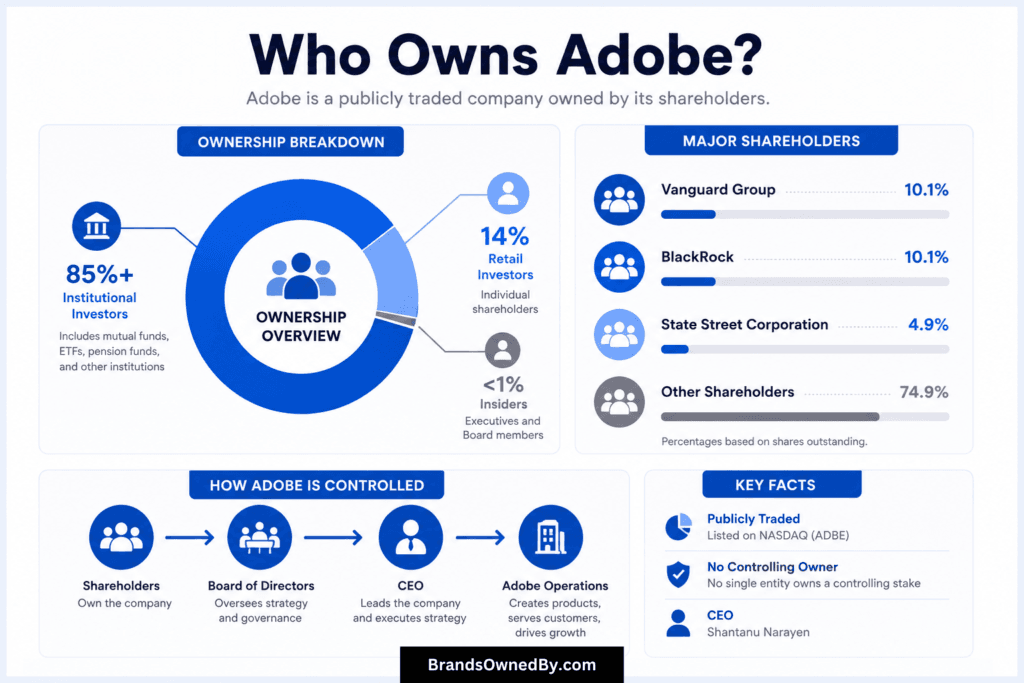
Adobe is a publicly traded company listed on the Nasdaq Stock Market under the ticker symbol ADBE. Unlike founder-controlled technology firms, Adobe does not have a single owner. Ownership is distributed among institutional investors, mutual funds, exchange-traded funds (ETFs), pension funds, company executives, and retail shareholders.
Institutional investors dominate Adobe’s shareholder base and collectively control more than 80% of the company’s outstanding shares. This means that large asset managers have significant influence over corporate governance, board elections, executive compensation, and major strategic decisions. The largest shareholders are primarily investment firms that manage money on behalf of millions of clients rather than owning the shares for themselves.
As of June 2026, the largest Adobe shareholders include Vanguard, BlackRock, State Street, Geode Capital Management, and several other major asset management firms. Together, these institutions represent the majority of voting power within the company.
Adobe Shareholder Structure (2026)
Largest Voting Influence
The Vanguard Group
The Vanguard Group is one of Adobe’s largest shareholders and has long been among the company’s most influential investors.
As of early 2026, Vanguard reported ownership of approximately 41.47 million Adobe shares, representing about 10.1% of the company. This makes Vanguard one of the few shareholders with a stake exceeding 10%.
Vanguard’s investment primarily comes through its index funds and ETFs. Millions of investors who own retirement accounts, mutual funds, or ETFs managed by Vanguard indirectly own a portion of Adobe through these investment vehicles.
Because of its large ownership position, Vanguard plays an important role during shareholder votes. However, Vanguard is considered a passive investor and generally does not seek direct operational control over Adobe.
BlackRock Inc.
BlackRock is another major Adobe shareholder and is often the largest institutional holder depending on reporting dates and filing methodologies.
As of March 2026, BlackRock controlled approximately 40.8 million Adobe shares, representing slightly more than 10% of the company’s outstanding stock.
BlackRock manages trillions of dollars through its investment products, including the iShares ETF family. Adobe is a significant holding across many of BlackRock’s technology-focused and broad-market investment funds.
Although BlackRock does not actively manage Adobe’s operations, its voting power gives it substantial influence over governance matters. BlackRock regularly votes on director appointments, executive compensation plans, shareholder proposals, and strategic initiatives.
State Street Corporation
State Street is another member of the “Big Three” asset managers that collectively hold substantial positions in many large public companies.
As of March 2026, State Street owned approximately 19.9 million Adobe shares, representing nearly 5% of the company.
State Street’s ownership is largely held through index funds and institutional investment products. Similar to Vanguard and BlackRock, State Street acts on behalf of pension funds, governments, institutions, and long-term investors.
Because Adobe’s ownership is widely dispersed, State Street’s stake provides meaningful voting influence despite being significantly smaller than the holdings of Vanguard and BlackRock.
Geode Capital Management
Geode Capital Management is one of Adobe’s largest institutional investors.
The firm owned approximately 11.7 million Adobe shares as of March 2026, representing roughly 2.9% of the company.
Geode specializes in index-based investment strategies and manages assets for large institutional clients. Its ownership position reflects Adobe’s importance within major stock market indexes and technology-focused investment portfolios.
Although Geode receives less attention than Vanguard or BlackRock, it remains one of the company’s most significant shareholders.
Vanguard Portfolio Management LLC
Vanguard Portfolio Management operates separately from Vanguard’s broader asset management organization and manages a number of investment portfolios.
As of March 2026, the firm held approximately 9.97 million Adobe shares, representing around 2.5% of the company.
Combined with other Vanguard-managed entities, Vanguard’s overall influence within Adobe is considerably larger than the holdings reported by individual subsidiaries.
UBS Asset Management
UBS Asset Management is among Adobe’s largest institutional shareholders.
As of March 2026, UBS Asset Management held approximately 7.19 million shares, representing nearly 1.8% ownership.
The company’s investment reflects Adobe’s strong position in the software industry and its importance within global equity portfolios.
Arrowstreet Capital
Arrowstreet Capital is another notable Adobe shareholder.
The investment firm owned approximately 6.79 million shares in Adobe as of March 2026, representing roughly 1.7% of the company.
Arrowstreet is known for its quantitative investment strategies and global institutional client base.
Norges Bank Investment Management
Norges Bank Investment Management manages Norway’s sovereign wealth fund, one of the largest investment funds in the world.
The fund held approximately 6.5 million Adobe shares, representing about 1.6% ownership.
As a long-term institutional investor, Norges Bank typically focuses on corporate governance, sustainability, and shareholder value creation.
Invesco Capital Management
Invesco is another significant Adobe shareholder through its mutual funds and ETFs.
As of March 2026, Invesco controlled approximately 4.85 million Adobe shares, representing around 1.2% of the company.
Adobe is a major holding within several technology and growth-focused funds managed by Invesco.
Amundi Asset Management
Amundi is Europe’s largest asset manager and one of Adobe’s significant institutional shareholders.
The firm owned approximately 4.83 million Adobe shares in 2026, giving it ownership of roughly 1.2% of the company.
Amundi’s investment demonstrates Adobe’s appeal to international institutional investors beyond North America.
Insider Ownership
Unlike founder-led technology companies, Adobe has relatively low insider ownership.
Executives and directors collectively own less than 1% of Adobe’s outstanding shares. Most founder ownership has gradually declined since the company’s IPO in 1986.
However, senior executives continue to hold Adobe stock through compensation plans and stock awards. This helps align management interests with those of shareholders.
Retail Shareholders
Retail investors also own a meaningful portion of Adobe.
These shareholders include individual investors who purchase Adobe stock through brokerage accounts, retirement plans, and investment platforms.
Although retail investors collectively own a smaller percentage than institutions, they still represent an important part of Adobe’s ownership structure. Their influence is generally exercised through shareholder voting and market participation.
Competitor Ownership Comparison
Ownership structures across the software industry vary significantly. Some companies are controlled by founders. Others are owned primarily by institutional investors. These differences often influence product development, acquisition strategies, risk tolerance, and long-term growth plans.
A comparison of Adobe’s major competitors shows how ownership can shape the direction of a technology company.
Competitor Ownership Comparison
Founder-Led
Canva
Figma
Autodesk
Microsoft
Salesforce
Intuit
HubSpot
Affinity
Corel
Ownership Control Spectrum
Canva
Canva remains a privately held company and is one of the largest privately owned software businesses in the world.
The company was founded by Melanie Perkins, Cliff Obrecht, and Cameron Adams. As of June 2026, the founders remain the largest shareholders and retain substantial voting control. Although Canva has raised funding from major investors such as Blackbird Ventures, Sequoia Capital, T. Rowe Price, Franklin Templeton, and several global investment firms, founder ownership remains significant.
This ownership structure gives Canva’s leadership team greater flexibility than public companies. Management can focus on long-term growth initiatives without facing quarterly earnings pressure from public shareholders.
The founder-led structure has allowed Canva to aggressively expand into AI-powered design tools, workplace collaboration software, enterprise products, video editing, and website creation.
Figma
Figma is another major competitor in the design software industry.
After the proposed acquisition by Adobe was abandoned, Figma continued operating as an independent company. The company remains privately owned, with founder and CEO Dylan Field serving as its most influential shareholder.
Major venture capital firms and institutional investors also hold significant stakes. These include Index Ventures, Greylock Partners, Kleiner Perkins, Sequoia Capital, and other growth-stage investors.
Unlike publicly traded software companies, Figma’s ownership remains highly concentrated. Founder leadership and venture capital backing allow the company to prioritize product innovation and market expansion over short-term profitability.
This structure has helped Figma become one of the fastest-growing design and collaboration platforms globally.
Autodesk
Autodesk has one of the ownership structures most similar to Adobe.
The company is publicly traded on the Nasdaq and is primarily owned by institutional investors. As of June 2026, Vanguard, BlackRock, and State Street remain Autodesk’s three largest shareholders.
Collectively, institutional investors control more than 85% of Autodesk’s outstanding shares.
Unlike founder-controlled companies, Autodesk’s strategic direction is determined by professional management teams, its board of directors, and major institutional shareholders.
This ownership model provides stability and access to capital while ensuring strong corporate governance standards.
Microsoft
Microsoft is one of the world’s largest software companies and competes across productivity software, cloud computing, artificial intelligence, collaboration tools, and enterprise solutions.
Its ownership structure closely resembles that of other mature public technology companies.
As of June 2026, Vanguard remains Microsoft’s largest shareholder with ownership exceeding 9%, followed by BlackRock with approximately 7% ownership. State Street and Fidelity also maintain substantial positions.
Founder Bill Gates no longer holds a controlling stake and owns only a small percentage of Microsoft’s outstanding shares.
Institutional investors collectively own the majority of Microsoft stock. As a result, strategic decisions are driven by the executive leadership team, board of directors, and shareholder interests rather than founder control.
Salesforce
Salesforce competes primarily in customer relationship management, marketing automation, analytics, and customer experience software.
The company is publicly traded and largely owned by institutional investors.
As of June 2026, Vanguard, BlackRock, State Street, and Fidelity are among Salesforce’s largest shareholders. Institutional ownership exceeds 75% of outstanding shares.
However, Salesforce differs from many software companies because founder Marc Benioff remains one of its most influential individual shareholders.
Although Benioff does not own a controlling stake, his leadership role and substantial ownership position continue to give him significant influence over company strategy.
This creates a hybrid ownership structure that combines institutional ownership with strong founder involvement.
Intuit
Intuit competes in financial software through products such as QuickBooks, TurboTax, Credit Karma, and Mailchimp.
The company is publicly traded and primarily owned by institutional investors.
As of June 2026, Vanguard and BlackRock remain Intuit’s largest shareholders, followed by State Street and Capital Research.
Institutional investors collectively control the majority of voting power. Founder ownership is minimal, making Intuit similar to other mature software companies where management operates under the oversight of large asset managers.
HubSpot
HubSpot is a leading provider of customer relationship management, marketing automation, and sales software.
The company is publicly traded but still retains some founder influence.
As of June 2026, Vanguard, BlackRock, and State Street are among HubSpot’s largest shareholders. However, founders Brian Halligan and Dharmesh Shah continue to own meaningful equity stakes compared with founders at larger software companies.
This balance allows HubSpot to benefit from institutional capital while preserving aspects of founder-led decision-making.
Affinity (Serif)
Affinity has emerged as a popular alternative to traditional creative software.
The company operates under Serif, a privately owned software developer headquartered in the United Kingdom.
Unlike publicly traded competitors, ownership remains concentrated among private stakeholders. There is no public shareholder base and no institutional ownership disclosures.
This ownership structure allows Affinity to maintain its one-time purchase pricing model while competing against subscription-based software providers.
Corel (Alludo)
Corel products such as CorelDRAW and PaintShop Pro continue to compete in graphic design and image editing markets.
Corel is owned by Alludo, a privately held software company backed by private equity investors.
Private equity ownership differs significantly from both public company ownership and founder-led ownership.
The primary objective is typically long-term value creation, operational improvements, and eventual investment returns through future sales, mergers, or recapitalizations.
What This Means?
The software industry is increasingly divided into two ownership models.
The first model is founder-led ownership, represented by companies such as Canva and Figma. These businesses can move quickly, take larger risks, and focus on long-term innovation because founders retain substantial control.
The second model is institutionally owned public companies such as Autodesk, Microsoft, Salesforce, Intuit, and HubSpot. These companies benefit from deep access to capital markets and strong governance structures but must also satisfy shareholder expectations regarding growth, profitability, and returns.
This comparison highlights how ownership can influence everything from product strategy and acquisitions to innovation speed and corporate governance.
Who Controls Adobe?
Adobe is not controlled by a founder, family, or a single shareholder. Unlike companies such as Meta or Alphabet, where founders maintain significant voting power, Adobe operates under a distributed governance model. Control is shared between the board of directors, executive leadership team, and major institutional shareholders.
As of June 2026, no shareholder owns enough stock to independently control Adobe. The company’s largest investors, including Vanguard and BlackRock, each own roughly 10% of outstanding shares. This means strategic decisions require cooperation between management, directors, and shareholders rather than approval from a single controlling owner.
In practical terms, Adobe’s direction is determined by the people running the company and the board overseeing them.
Adobe’s Corporate Governance Structure
Adobe’s control structure consists of four layers.
At the top are shareholders, who own the company and elect directors.
The board of directors acts on behalf of shareholders and provides strategic oversight.
The Chief Executive Officer leads the company and executes corporate strategy.
The executive leadership team manages individual business divisions and daily operations.
This structure creates multiple checks and balances. No individual has complete authority over the company.
Shantanu Narayen
Shantanu Narayen is the most influential person at Adobe.
He serves as Chairman and Chief Executive Officer, making him the highest-ranking executive within the organization. Although he does not own enough shares to control Adobe through ownership, his leadership position gives him significant influence over nearly every aspect of the business.
Narayen is responsible for:
- Corporate strategy.
- Product direction.
- Major acquisitions.
- Artificial intelligence initiatives.
- Financial performance.
- Investor relations.
- Executive leadership appointments.
Virtually every major business decision ultimately flows through the CEO’s office.
When Adobe launches new AI products, enters new markets, acquires companies, or adjusts long-term strategy, Narayen plays a central role in those decisions.
The Board of Directors
While the CEO runs Adobe, the board of directors is the company’s highest governing authority.
The board represents shareholder interests and oversees executive management. It has the power to approve or reject major corporate decisions and can appoint or remove senior leadership when necessary.
The board’s responsibilities include:
- Selecting and evaluating the CEO.
- Approving major acquisitions.
- Approving long-term strategy.
- Overseeing financial performance.
- Monitoring corporate governance.
- Managing executive succession.
- Reviewing risk management.
The board does not handle day-to-day operations. Instead, it focuses on long-term oversight and accountability.
For example, if Adobe pursues a multi-billion-dollar acquisition or a major strategic investment in artificial intelligence, board approval is typically required.
Adobe’s Independent Directors
Most Adobe directors are independent board members.
Independent directors are not employees of the company and are expected to provide objective oversight.
Their role is particularly important because Adobe does not have a controlling founder or majority shareholder.
Independent directors help ensure that management decisions align with shareholder interests and corporate governance standards.
They also serve on specialized committees that oversee areas such as:
- Executive compensation.
- Audit and financial reporting.
- Corporate governance.
- Leadership succession.
Adobe’s Executive Leadership Team
The executive leadership team controls Adobe’s day-to-day operations.
Each senior executive oversees a specific part of the business and reports to the CEO.
Together, these executives manage Adobe’s global workforce, products, finances, technology infrastructure, and enterprise operations.
Digital Media Leadership
The Digital Media division is Adobe’s largest business segment.
This division oversees products such as:
- Photoshop.
- Illustrator.
- Lightroom.
- Premiere Pro.
- After Effects.
- Creative Cloud.
Executives leading this division influence product development, pricing strategies, subscription growth, customer retention, and AI integration.
Because Digital Media generates the majority of Adobe’s revenue, its leadership team has substantial influence within the company.
Digital Experience Leadership
Adobe’s Digital Experience business serves enterprise customers through marketing, analytics, commerce, and customer experience software.
Leadership teams in this division oversee products used by major global brands for advertising, customer engagement, personalization, and data analytics.
Their decisions directly affect Adobe’s enterprise growth strategy and competitive positioning against companies such as Salesforce and Oracle.
Finance and Capital Allocation Leadership
Adobe’s financial leadership team controls the company’s capital allocation decisions.
Their responsibilities include:
- Budgeting.
- Financial planning.
- Investor communications.
- Mergers and acquisitions.
- Stock repurchase programs.
- Cash management.
These executives help determine how Adobe invests billions of dollars in research, acquisitions, infrastructure, and shareholder returns.
Artificial Intelligence Leadership
Artificial intelligence has become one of Adobe’s most strategically important areas.
Senior technology and AI executives oversee products and initiatives including:
- Adobe Firefly.
- Generative AI tools.
- AI-powered Acrobat features.
- Creative Cloud AI integrations.
- Enterprise AI solutions.
These leaders play a major role in shaping Adobe’s future growth strategy and competitive position in the rapidly evolving AI market.
How Institutional Investors Influence Adobe
Although institutional investors do not manage Adobe’s daily operations, they exercise considerable influence through voting rights.
The largest shareholders include:
Vanguard Group
Vanguard owns approximately 10% of Adobe’s outstanding shares, making it one of the company’s largest investors.
Because of its ownership position, Vanguard has substantial influence over board elections, governance proposals, and executive compensation votes.
BlackRock
BlackRock owns a similar stake and is another highly influential shareholder.
As the world’s largest asset manager, BlackRock regularly engages with management teams and participates in important shareholder votes.
State Street Corporation
State Street is another major institutional shareholder.
Although its stake is smaller than Vanguard’s and BlackRock’s, it still holds significant voting power due to Adobe’s widely distributed ownership structure.
Who Has the Most Power at Adobe?
Several groups share control of Adobe, but their influence differs.
1. Board of Directors
The board has ultimate oversight authority and represents shareholder interests.
2. Shantanu Narayen
As Chairman and CEO, Narayen is the most influential individual within Adobe and oversees overall strategy and operations.
3. Executive Leadership Team
Senior executives control Adobe’s major business divisions and execute company strategy.
4. Institutional Investors
Vanguard, BlackRock, State Street, and other large shareholders influence governance through voting power.
Who Ultimately Controls Adobe?
Adobe operates through a shared governance structure rather than founder control.
The board of directors provides oversight and approves major strategic decisions.
Shantanu Narayen leads the company and remains the most influential executive within Adobe.
The executive leadership team manages products, technology, finances, marketing, and global operations.
Meanwhile, institutional investors such as Vanguard, BlackRock, and State Street influence governance through shareholder voting.
As of June 2026, Shantanu Narayen is the most powerful individual at Adobe, while the board of directors remains the company’s most powerful governing body. Together, they shape the strategy, operations, and future direction of one of the world’s largest software companies.
Adobe Annual Revenue and Net Worth
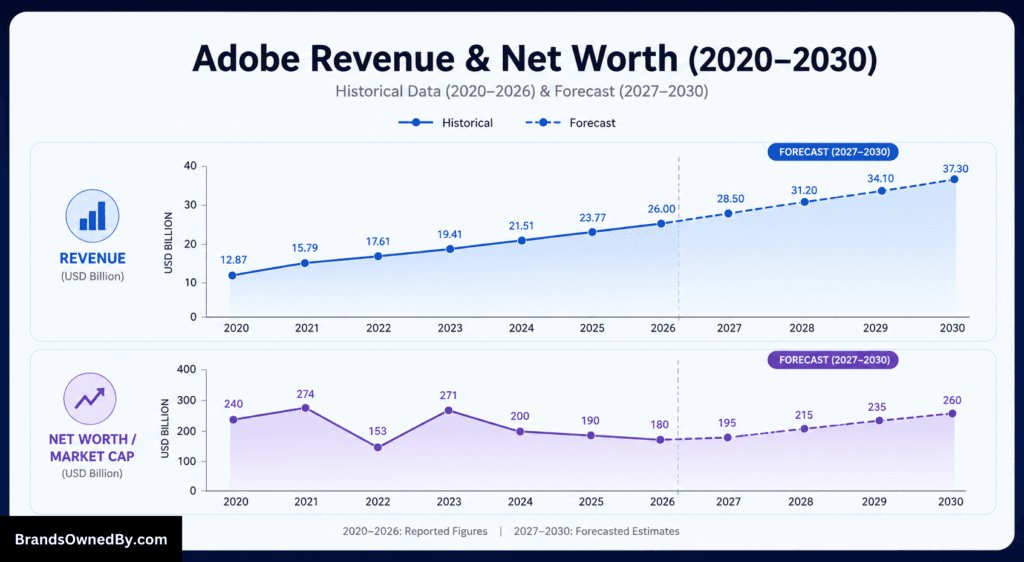
Adobe generated approximately $26 billion in revenue in 2026, up from approximately $23.8 billion in 2025, representing annual growth of about 9.4%. The company continues to rank among the largest software businesses globally, supported by recurring subscriptions, enterprise software contracts, and growing artificial intelligence monetization.
Adobe’s estimated market capitalization is approximately $180 billion as of June 2026. While this is below the valuation peaks seen during the technology boom, it still places Adobe among the world’s most valuable software companies. The company’s valuation is supported by strong profitability, recurring revenue, significant cash generation, and leadership positions across creative software, digital documents, and customer experience platforms.
Adobe Revenue & Net Worth (2020–2030)
Adobe Revenue Breakdown in 2026
Adobe operates through three primary revenue engines.
Digital Media
Digital Media remains Adobe’s largest business segment and is expected to generate approximately $19.5 billion to $20 billion in revenue during 2026.
This segment contributes roughly 75% to 77% of total company revenue and includes:
- Creative Cloud.
- Document Cloud.
- Acrobat.
- Photoshop.
- Illustrator.
- Premiere Pro.
- Lightroom.
- InDesign.
- Adobe Sign.
Creative Cloud alone accounts for the majority of Adobe’s revenue. The platform serves millions of paying subscribers across individual, business, educational, and enterprise markets.
The importance of this segment means that nearly three out of every four dollars earned by Adobe originate from Digital Media products.
Digital Experience
Adobe’s Digital Experience division is expected to generate approximately $5.8 billion to $6.2 billion during 2026.
This represents approximately 23% to 24% of total company revenue.
The division includes enterprise products such as:
- Adobe Experience Manager.
- Adobe Analytics.
- Adobe Commerce.
- Journey Optimizer.
- Customer Data Platform.
Many Fortune 500 companies use these solutions to manage customer journeys, digital marketing campaigns, analytics, and e-commerce operations.
Although smaller than Creative Cloud, Digital Experience remains strategically important because enterprise customers typically sign larger contracts and generate recurring revenue over many years.
Publishing and Advertising Revenue
Adobe also earns a relatively small amount of revenue from publishing, advertising services, partnerships, and other software-related activities.
These activities contribute less than 1% of total revenue but provide additional diversification.
Adobe’s Profitability in 2026
Revenue alone does not explain Adobe’s value.
One of Adobe’s biggest strengths is profitability.
For 2026, Adobe is expected to generate approximately:
- Operating income: $10 billion to $11 billion.
- Net income: $7.8 billion to $8.5 billion.
- Free cash flow: More than $9 billion.
This means Adobe converts a substantial portion of every revenue dollar into profit.
Many software companies generate high revenue but struggle with profitability. Adobe consistently achieves both.
Its operating margins remain among the highest in the software industry, typically exceeding 40%.
Adobe’s Artificial Intelligence Revenue Opportunity
Artificial intelligence is becoming one of Adobe’s most important growth drivers.
Adobe Firefly has generated billions of AI creations since launch and is now integrated across Photoshop, Illustrator, Express, Premiere Pro, Acrobat, and other applications.
Although Adobe does not separately report Firefly revenue, analysts estimate AI-related products and services could contribute $1 billion to $2 billion annually within the next few years through:
- Premium AI subscriptions.
- Generative credits.
- Enterprise AI licenses.
- AI-enhanced workflows.
- Usage-based pricing models.
This represents one of the largest growth opportunities within Adobe’s business.
Adobe Net Worth and Valuation Analysis
Adobe’s estimated market capitalization of $180 billion, as of June 2026, means investors currently value the company at approximately:
- 7 times annual revenue.
- 21–23 times annual earnings.
- 20 times free cash flow.
These valuation levels are lower than those seen during the software boom of 2020–2021 but remain strong compared with many mature technology companies.
The valuation reflects investor confidence in Adobe’s:
- Subscription business model.
- Market leadership.
- Strong profit margins.
- AI growth opportunities.
- Enterprise customer relationships.
How Adobe Generates its Revenue
Adobe’s revenue model is heavily subscription-driven.
Approximately 95% or more of total revenue comes from recurring subscriptions and contracts.
This provides significant predictability because customers pay monthly or annually rather than making one-time purchases.
The company now has millions of subscribers globally, including:
- Creative professionals.
- Content creators.
- Enterprises.
- Government organizations.
- Educational institutions.
- Small businesses.
This recurring revenue model is one of the primary reasons Adobe commands such a high valuation.
Revenue Forecast Through 2030
Adobe’s future growth is expected to come from four key areas:
Growth Driver 1: Creative Cloud Expansion
Creative Cloud remains Adobe’s largest business.
Even modest subscriber growth combined with premium pricing can add billions of dollars in additional annual revenue.
Analysts expect Creative Cloud revenue alone to exceed $22 billion annually by 2030.
Growth Driver 2: AI Monetization
Adobe is gradually turning AI into a direct revenue stream.
Unlike many competitors that provide AI features at little or no cost, Adobe is integrating monetized AI capabilities across its ecosystem.
Industry forecasts suggest AI-related products could contribute between $3 billion and $5 billion annually by 2030.
Growth Driver 3: Enterprise Software Growth
Adobe continues expanding its Digital Experience business.
Enterprise customers typically sign larger contracts and have lower churn rates than individual consumers.
This segment could exceed $8 billion in annual revenue by 2030 if adoption continues at current rates.
Growth Driver 4: International Expansion
Adobe still generates a significant portion of revenue from North America.
Growth in Asia-Pacific, Latin America, the Middle East, and Africa provides additional opportunities for subscriber growth and enterprise sales.
Adobe Revenue and Net Worth Forecast (2027–2030)
Based on current analyst expectations and historical growth rates, Adobe’s revenue could increase as follows:
- 2027: $28.5 billion.
- 2028: $31.2 billion.
- 2029: $34.1 billion.
- 2030: $37.3 billion.
This would represent approximately $11.3 billion in additional annual revenue over four years.
In percentage terms, Adobe would grow roughly 43% between 2026 and 2030.
If Adobe maintains its current profit margins and successfully monetizes artificial intelligence, its market capitalization could also expand significantly.
Estimated valuation projections include:
- 2027: $195 billion.
- 2028: $215 billion.
- 2029: $235 billion.
- 2030: $260 billion.
Under this scenario, Adobe would add approximately $80 billion in market value between 2026 and 2030.
That growth would be driven primarily by higher revenue, stronger AI monetization, continued enterprise adoption, and increasing free cash flow generation rather than simple valuation expansion.
By 2030, Adobe could be generating more than $37 billion in annual revenue, over $12 billion in operating income, and approximately $10 billion to $11 billion in annual net profit, reinforcing its position among the world’s most valuable software companies.
Companies Owned by Adobe
Adobe has built one of the largest software ecosystems in the world. Unlike many technology companies that rely on a single flagship product, Adobe operates dozens of software platforms across creative design, digital documents, marketing technology, customer experience management, e-commerce, artificial intelligence, collaboration, publishing, and content creation.
Many of Adobe’s most valuable businesses originated from acquisitions, while others were developed internally and later became market leaders. Together, these products serve millions of individual users and thousands of enterprise customers worldwide.
Adobe Ecosystem (2026)
Creative Cloud
Core Revenue Engine
Document Cloud
PDF Leadership
Experience Cloud
Enterprise Software
Firefly AI
AI Platform
Major Brands & Platforms
Major Acquisitions
Enterprise Technology Stack
Adobe Creative Cloud
Creative Cloud is Adobe’s largest and most valuable business platform. It is not a single product but a subscription ecosystem that combines more than 20 professional creative applications into one integrated service.
As of 2026, Creative Cloud remains Adobe’s biggest revenue generator and serves millions of paying subscribers worldwide. The platform is used by graphic designers, photographers, filmmakers, marketing agencies, publishers, content creators, educators, enterprises, and government organizations.
The service includes flagship applications such as Photoshop, Illustrator, Premiere Pro, Lightroom, InDesign, After Effects, Acrobat, Express, and Firefly.
Creative Cloud transformed Adobe from a software licensing company into a recurring revenue business. Instead of relying on one-time software purchases, Adobe now generates predictable monthly and annual subscription revenue from customers across more than 100 countries.
The platform also creates significant customer lock-in. A designer using Photoshop often uses Illustrator and InDesign. A video editor using Premiere Pro frequently uses After Effects and Frame.io. This interconnected ecosystem strengthens customer retention and increases lifetime customer value.
Adobe Photoshop
Photoshop remains Adobe’s most iconic software product and one of the most recognized technology brands globally.
The software dominates the professional image editing market and is widely considered the industry standard for photo manipulation, image enhancement, digital art creation, advertising design, and visual content production.
By 2026, Photoshop has evolved beyond traditional image editing. The integration of Adobe Firefly allows users to generate images, remove objects, expand backgrounds, create visual assets, and perform complex edits using natural language prompts.
Photoshop is used by professional photographers, advertising agencies, publishers, e-commerce businesses, media companies, social media creators, and large enterprises.
Its dominance is so significant that the term “Photoshopped” has become part of everyday language, demonstrating the product’s cultural influence beyond its commercial value.
Adobe Illustrator
Illustrator is the world’s leading vector graphics software and remains one of Adobe’s most important creative products.
The platform allows designers to create logos, brand identities, illustrations, packaging designs, product labels, infographics, typography systems, and scalable digital artwork.
Unlike Photoshop, which uses pixels, Illustrator uses vector technology. This allows designs to be resized from a business card to a billboard without any loss of quality.
Major corporations, design agencies, publishers, and marketing teams rely on Illustrator for branding projects. Many of the world’s best-known logos and corporate identities have been created using the platform.
Adobe continues to strengthen Illustrator through AI-assisted design tools, automated vector generation, and Firefly-powered creative features.
Adobe Premiere Pro
Premiere Pro has become one of Adobe’s most strategically important products because of the global growth of video content.
The software is used for professional video editing across television, film production, social media content creation, advertising, corporate communications, online education, and streaming platforms.
By 2026, Premiere Pro serves everyone from YouTube creators to major Hollywood studios.
The software integrates tightly with other Adobe products including After Effects, Audition, Photoshop, Frame.io, and Firefly. This integration allows creative teams to manage the entire production process within Adobe’s ecosystem.
The rapid growth of short-form video, social media content, online advertising, and digital entertainment continues to increase demand for Premiere Pro worldwide.
Adobe Acrobat
Acrobat has become one of Adobe’s most profitable products and remains the global leader in PDF technology.
The platform allows users to create, edit, secure, organize, convert, sign, and manage digital documents.
Today, PDF files are used throughout business, government, education, healthcare, finance, and legal industries. Acrobat sits at the center of that ecosystem.
In 2026, Adobe has significantly expanded Acrobat through AI-powered features. Acrobat AI Assistant can summarize lengthy reports, answer questions about documents, extract information, compare contracts, and automate document workflows.
Acrobat’s importance extends far beyond PDF editing. It has become a document productivity platform that serves millions of businesses worldwide.
Adobe Firefly
Firefly is Adobe’s flagship artificial intelligence platform and one of the company’s most important growth initiatives.
Introduced as Adobe’s answer to the generative AI revolution, Firefly allows users to create images, vectors, text effects, illustrations, videos, and design assets using natural language prompts.
What differentiates Firefly from many competitors is Adobe’s focus on commercially safe AI content. The platform was trained primarily using licensed and owned content, reducing copyright concerns for business customers.
By 2026, Firefly has been integrated into nearly every major Adobe product, including Photoshop, Illustrator, Premiere Pro, Express, InDesign, and Acrobat.
Adobe views Firefly as both a customer retention tool and a major future revenue generator. The company is increasingly monetizing AI through premium subscriptions, enterprise licenses, and generative credit systems.
Adobe Experience Cloud
Experience Cloud represents Adobe’s largest enterprise software business.
While products such as Photoshop and Acrobat target individual users and creative professionals, Experience Cloud focuses on large organizations and enterprise customers.
The platform provides tools for customer experience management, analytics, personalization, campaign management, digital commerce, audience targeting, and customer journey optimization.
Many of the world’s largest companies use Experience Cloud to manage their digital marketing operations.
This business has become increasingly important because enterprise contracts are typically larger, longer-term, and less sensitive to economic fluctuations than consumer software subscriptions.
Adobe Commerce (Magento)
Adobe Commerce originated from Adobe’s acquisition of Magento and has become one of the company’s most important enterprise assets.
The platform enables businesses to build, manage, and scale online stores.
Large retailers, manufacturers, wholesalers, and direct-to-consumer brands use Adobe Commerce to handle product catalogs, inventory management, customer experiences, payments, promotions, and digital transactions.
The acquisition gave Adobe a direct presence in the fast-growing e-commerce market and strengthened its enterprise software portfolio.
Today, Adobe Commerce integrates closely with Experience Cloud, Analytics, Customer Data Platform, and personalization tools, creating a comprehensive commerce ecosystem.
Marketo
Marketo remains one of Adobe’s most important acquisitions.
The platform specializes in marketing automation, lead management, customer nurturing, campaign execution, and business-to-business marketing.
Following its acquisition for approximately $4.75 billion, Marketo became a cornerstone of Adobe’s enterprise marketing strategy.
Large organizations use Marketo to automate customer engagement across email, web, social media, events, and sales channels.
The platform is particularly popular among B2B companies because of its sophisticated lead-scoring and customer lifecycle management capabilities.
Frame.io
Frame.io has become increasingly important within Adobe’s video ecosystem.
The platform provides cloud-based collaboration tools for creative teams working on video projects.
Editors, producers, clients, marketers, and production teams can review, comment on, approve, and manage content remotely.
The growth of distributed workforces and remote content production has increased demand for collaborative workflow solutions.
Frame.io strengthens Adobe’s position in professional video production while complementing Premiere Pro and After Effects.
Behance
Behance is the largest creative networking platform owned by Adobe.
The platform serves millions of designers, photographers, illustrators, animators, and creative professionals.
Users can showcase portfolios, discover creative work, recruit talent, find freelance opportunities, and build professional reputations.
For Adobe, Behance serves a strategic purpose beyond advertising revenue. It creates a direct relationship with the global creative community and helps keep creative professionals inside Adobe’s ecosystem.
Workfront
Workfront is Adobe’s enterprise work management platform.
The software helps organizations plan projects, allocate resources, manage workflows, track productivity, and coordinate large-scale marketing operations.
Many global enterprises use Workfront to manage the complex collaboration required between creative teams, marketing departments, executives, agencies, and external partners.
Workfront has become increasingly integrated into Adobe Experience Cloud, helping enterprise customers manage both content creation and campaign execution within a single ecosystem.
Conclusion
Adobe has evolved into one of the world’s most influential software companies, with a portfolio that spans creative design, digital documents, artificial intelligence, marketing technology, e-commerce, and enterprise experience management. While many people search for who owns Adobe, the company is actually owned by millions of shareholders and operates under a widely distributed ownership structure led by institutional investors, a board of directors, and executive leadership.
Understanding who owns Adobe provides valuable insight into how the company is governed, who influences its strategic decisions, and how it maintains its leadership across multiple software markets. With globally recognized brands such as Photoshop, Acrobat, Illustrator, Premiere Pro, Firefly, and Experience Cloud, Adobe continues to play a central role in the way individuals and businesses create, manage, and deliver digital content.
FAQs
Is Adobe Owned by Oracle?
No, Adobe is not owned by Oracle.
Adobe and Oracle are separate publicly traded software companies with different management teams, shareholders, and boards of directors. While the two companies compete in areas such as digital marketing, customer experience software, analytics, and enterprise solutions, Oracle does not own Adobe and has never controlled the company.
Adobe operates independently under its own corporate structure and leadership.
Who Owns Adobe Company?
Adobe is owned by its shareholders.
Since Adobe is a publicly traded company listed on the Nasdaq Stock Market under the ticker symbol ADBE, ownership is distributed among institutional investors, mutual funds, pension funds, ETFs, company insiders, and retail investors.
As of June 2026, the largest shareholders include Vanguard Group, BlackRock, and State Street Corporation. No individual or organization owns a controlling stake in Adobe.
Is Adobe Publicly Traded?
Yes, Adobe is publicly traded.
The company trades on the Nasdaq Stock Market under the ticker symbol ADBE.
Adobe became a public company in 1986 through its initial public offering (IPO). Since then, its shares have been available for purchase by individual and institutional investors worldwide.
What Company Owns Adobe Acrobat?
Adobe Acrobat is owned by Adobe Inc.
Acrobat is one of Adobe’s flagship products and forms a key part of Adobe Document Cloud. The software was developed internally by Adobe and remains wholly owned and operated by the company.
No separate company owns Acrobat.
Does Apple Own Adobe?
No, Apple does not own Adobe.
Apple made an early strategic investment in Adobe shortly after the company was founded and at one point owned approximately 19% of Adobe.
However, Apple later sold its stake. Today, Apple has no ownership interest in Adobe and does not control the company.
Adobe and Apple maintain a business relationship because Adobe software is widely used on macOS devices, but they operate as separate companies.
Does Microsoft Own Adobe?
No, Microsoft does not own Adobe.
Microsoft and Adobe are independent publicly traded companies.
Although the two companies have partnered on various cloud, artificial intelligence, and enterprise initiatives over the years, Microsoft does not own Adobe shares significant enough to control the company.
Adobe remains an independent software company with its own shareholders and leadership team.
Did Adobe Buy Aldus?
Yes, Adobe acquired Aldus Corporation in 1994.
The acquisition was one of Adobe’s most important early deals because Aldus was the creator of PageMaker, one of the leading desktop publishing applications of the time.
The transaction strengthened Adobe’s position in publishing and graphic design software and helped establish the company as a dominant force in the desktop publishing industry.
How Many Companies Does Adobe Own?
Adobe owns dozens of software products, platforms, technologies, and acquired businesses.
Some of the most notable companies and platforms acquired by Adobe include:
- Omniture.
- Magento.
- Marketo.
- Workfront.
- Frame.io.
- Behance.
- Mixamo.
- Fotolia.
In addition to acquisitions, Adobe owns and operates numerous internally developed brands such as Photoshop, Illustrator, Acrobat, Premiere Pro, Lightroom, InDesign, Firefly, Express, and Experience Cloud.
The exact number varies because Adobe regularly integrates acquired businesses into its broader software ecosystem. As of 2026, Adobe owns and operates more than 30 major software platforms, brands, services, and acquired technology businesses across creative software, document management, artificial intelligence, marketing technology, analytics, collaboration, and e-commerce.
Is Adobe Associated With Microsoft?
Yes, Adobe is associated with Microsoft through business partnerships, but Microsoft does not own Adobe.
The two companies collaborate in several areas, including cloud computing, artificial intelligence, productivity software, and enterprise solutions.
Adobe products integrate with Microsoft services such as:
- Microsoft Azure.
- Microsoft 365.
- Microsoft Teams.
- Dynamics 365.
These partnerships help customers connect Adobe’s creative and marketing tools with Microsoft’s enterprise software ecosystem.
Is Adobe an Egyptian Word?
No, Adobe is not an Egyptian word.
The word “adobe” comes from Spanish and refers to a type of building material made from earth, clay, sand, straw, and water that is dried in the sun.
The Spanish term originated from the Arabic word “al-tub” or “at-tub,” meaning brick.
Adobe Inc. adopted the name because Adobe Creek ran behind the home of co-founder John Warnock in Los Altos, California, where the company was founded.
Therefore, while the word has linguistic roots that trace back to Arabic, it is not an Egyptian word.