
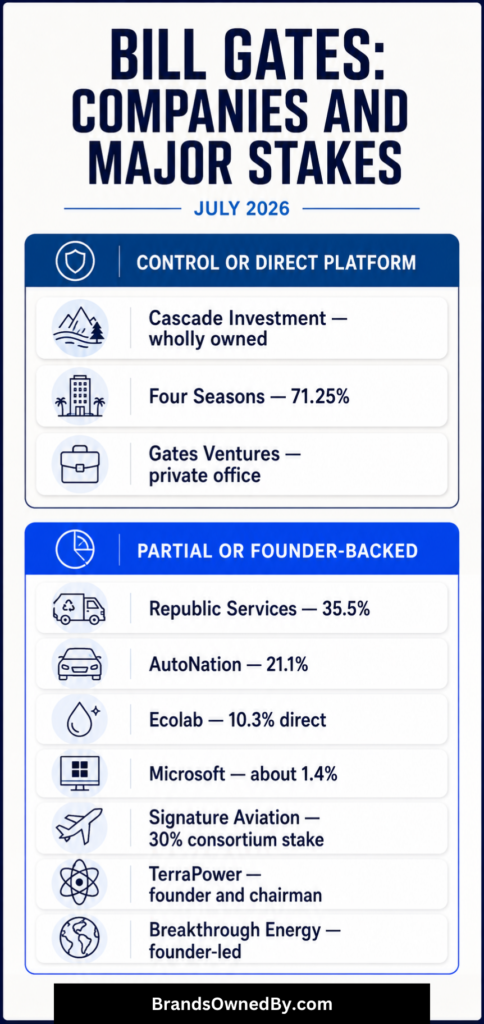
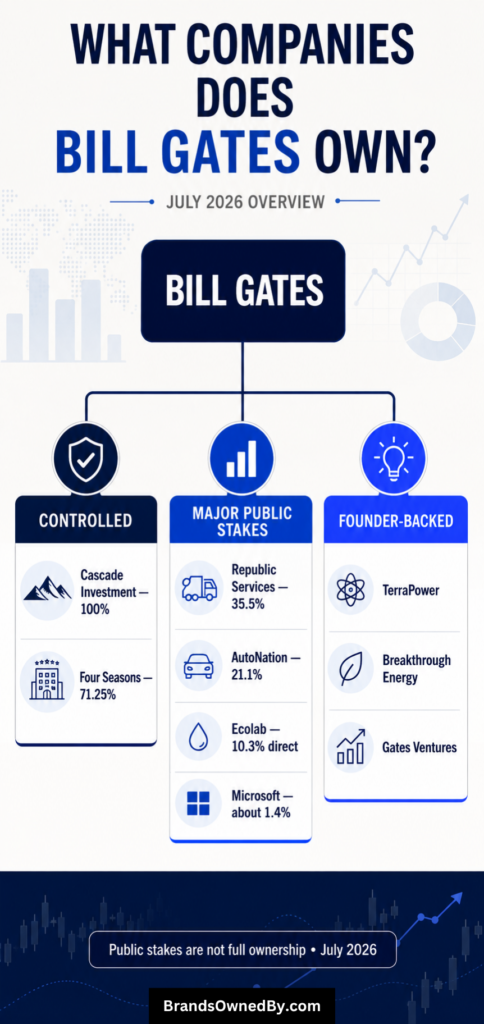
- Bill Gates wholly owns Cascade Investment, the private vehicle that manages much of his non-Microsoft wealth.
- Cascade controls 71.25% of Four Seasons Hotels and Resorts and holds major publicly disclosed stakes in Republic Services, AutoNation, Ecolab, and Deere.
- Gates founded TerraPower, Breakthrough Energy, and Gates Ventures, but outside investors also participate in several of these organizations and their associated funds.
- Microsoft remains an important part of Gates’s wealth, but he owns only an estimated 1.4% of the company and no longer controls its operations.
What companies does Bill Gates own?
The accurate answer extends far beyond Microsoft. Gates wholly owns Cascade Investment, his private investment vehicle. Through Cascade, he controls Four Seasons Hotels and holds major stakes in Republic Services, AutoNation, Ecolab, Deere, and other companies. He also founded TerraPower, Breakthrough Energy, and Gates Ventures.
However, not every Gates-linked investment is personally owned by him. The Gates Foundation Trust is a separate charitable endowment. Public-company stakes also represent partial ownership, not control of the entire business.
Bill Gates Business Origins
William Henry Gates III was born in Seattle, Washington, in 1955. His business career began with software rather than traditional investing.
Gates developed an early interest in computers while attending Lakeside School. That interest eventually led to his partnership with Paul Allen.
The pair saw an emerging opportunity. Personal computers were becoming commercially viable, but the software industry surrounding them was still undeveloped.
Paul Allen
Paul Allen was Gates’s childhood friend and Microsoft co-founder. Allen played an essential role in identifying the commercial potential of early personal computers.
In 1975, Gates and Allen formed Microsoft in Albuquerque, New Mexico. Their first major project involved developing a version of the BASIC programming language for the Altair 8800.
The business later moved to Washington state. Microsoft became a dominant software provider through operating systems, productivity applications, enterprise software, and developer tools.
The Origin of Microsoft
Microsoft’s defining opportunity arrived when it supplied an operating system for IBM’s first personal computer.
The agreement allowed Microsoft to license its operating system to other computer manufacturers. This created a scalable business model. Microsoft did not have to manufacture computers. It could earn licensing revenue as the personal-computer market expanded.
Microsoft completed its initial public offering in 1986. Gates retained approximately 44.9% of the company at that time.
Over the following decades, he sold or donated most of those shares. He also diversified the proceeds into other industries.
The Creation of Cascade Investment
Gates established Cascade Investment during the 1990s to manage and diversify his wealth outside Microsoft.
The investment office adopted a long-term approach. It invested in businesses with durable assets, recurring demand, strong cash flow, and defensible market positions.
Michael Larson became the principal investment manager behind this strategy. He remains Gates’s chief investment officer.
Cascade is particularly associated with environmental services, agriculture, industrial equipment, transportation, hospitality, real estate, and infrastructure.
List of Companies Owned by Bill Gates
No complete public list of every Bill Gates investment exists. Cascade is privately held and does not publish its entire portfolio.
The following list covers the most important controlled businesses, disclosed public-company stakes, and founder-led organizations connected to Gates as of August 2026.
Cascade Investment
Cascade Investment is the central business in Bill Gates’s personal investment structure.
Gates is Cascade’s sole member. In practical terms, this means he owns 100% of the entity. Investments held directly by Cascade can generally be attributed to Gates for beneficial-ownership reporting.
Cascade is different from a conventional conglomerate. It does not operate every company in its portfolio. It functions as a private investment and wealth-management vehicle.
Michael Larson oversees investment strategy and portfolio management. However, Larson is the manager rather than the disclosed owner.
Cascade invests across public stocks, private companies, real estate, hospitality, infrastructure, agricultural land, and alternative assets.
Four Seasons Hotels and Resorts
Four Seasons Hotels and Resorts is the clearest example of a major operating company controlled through Cascade.
Cascade first invested in Four Seasons in 1997. It later participated in taking the luxury hotel group private.
In 2022, a Cascade affiliate completed the purchase of an additional 23.75% interest from an affiliate of Kingdom Holding Company. The transaction increased Cascade’s ownership from 47.5% to 71.25%.
Kingdom Holding retained 23.75%. An entity associated with Four Seasons founder Isadore Sharp retained the remaining 5%.
Cascade therefore has majority economic ownership. It can exert decisive influence over major shareholder matters. Four Seasons still maintains its own management team and operates as an independent hospitality company.
Its business model is also important. Four Seasons does not own every hotel carrying its name. It primarily manages luxury hotels, resorts, residences, and branded properties for property owners.
Republic Services
Republic Services is one of Gates’s largest disclosed public-company investments.
The company provides waste collection, recycling, environmental services, landfill operations, and related infrastructure across North America. These services produce recurring demand because households and businesses require them regardless of economic conditions.
Gates and Cascade were reported as beneficial owners of 109.8 million Republic Services shares, representing 35.5% of the company as of the March 2026 record date.
Cascade subsequently purchased additional shares during May 2026. Its disclosed holding reached approximately 110.8 million shares.
The newer share count suggests that Cascade’s economic interest increased after the proxy record date. However, an exact July percentage requires a matching, updated outstanding-share denominator.
Republic Services is publicly traded. Gates does not wholly own it. Still, the size of Cascade’s position makes him the company’s most influential individual shareholder.
AutoNation
AutoNation is one of the largest automotive retailers in the United States.
The company operates new-vehicle dealerships, used-car operations, maintenance services, replacement-parts businesses, vehicle-financing products, and collision centers.
Cascade held 7,062,629 AutoNation shares as of May 2026. That represented 21.1% of the company based on the outstanding share count reported in AutoNation’s April 2026 quarterly filing.
The percentage had increased from 20.6% in March. This did not result from Cascade buying more shares. It resulted from AutoNation’s outstanding share count declining, largely through share repurchases.
This illustrates how ownership percentages can rise without an investor making a new purchase.
Gates is a major shareholder, but AutoNation remains a publicly traded company with an independent board and management team.
Ecolab
Ecolab provides water, hygiene, infection-prevention, cleaning, and industrial-efficiency solutions.
Its customers include hotels, restaurants, hospitals, food-processing facilities, manufacturers, and energy companies. The company combines physical products with service contracts and technical expertise.
Cascade’s most recently documented direct holding consisted of approximately 29.2 million Ecolab shares. This represented roughly 10.3% of Ecolab based on the applicable outstanding-share count.
Older combined ownership figures sometimes attribute additional Gates Foundation Trust shares to Bill Gates. That approach can be misleading.
Cascade’s shares are part of Gates’s personal investment structure. The Foundation Trust’s shares belong to a separate charitable endowment. They should not automatically be described as Bill Gates’s personal stock.
Michael Larson has served on Ecolab’s board. This gives Cascade additional visibility into governance, although board representation does not transfer day-to-day operational control.
Deere & Company
Deere & Company manufactures agricultural machinery, construction equipment, forestry machinery, engines, and precision-farming technology.
Cascade has been a major Deere shareholder for many years. Deere’s 2026 proxy materials reported that Cascade had sole voting power over approximately 19.8 million shares.
Gates’s interest in Deere fits Cascade’s broader investment strategy. Global food demand, farm automation, equipment replacement, precision agriculture, and infrastructure spending can support long-term demand for Deere products.
Owning millions of Deere shares does not mean Gates owns the entire John Deere brand. Deere remains a publicly traded corporation with institutional, individual, and employee shareholders.
Microsoft
Bill Gates co-founded Microsoft, but he does not own or control the entire company.
His personal holding is estimated at approximately 103 million Microsoft shares. Based on Microsoft’s outstanding share count, that would represent roughly 1.4% of the company.
The exact figure should be treated as an estimate. Gates left Microsoft’s board in 2020 and is no longer required to report every personal transaction through insider filings.
A 1.4% interest remains extremely valuable because of Microsoft’s market capitalization. However, it does not provide Gates with operational or voting control.
Microsoft is managed by its board and executive team. Satya Nadella serves as chairman and CEO.
The Gates Foundation Trust sold its remaining Microsoft shares during the first quarter of 2026. That transaction concerned the charitable endowment. It did not necessarily change Gates’s estimated personal holding.
Signature Aviation
Signature Aviation operates a global network of fixed-base operations serving private and business aircraft.
Its facilities provide fueling, ground handling, aircraft parking, passenger services, and other aviation support.
Signature was acquired by a consortium involving Blackstone, Global Infrastructure Partners, and Cascade. Under the announced consortium structure, Blackstone and Global Infrastructure Partners each held 35%. Cascade held 30%.
This is a substantial position, but it is joint ownership. Gates does not independently control Signature Aviation.
The investment gives Cascade exposure to business aviation infrastructure rather than aircraft manufacturing or airline operations.
TerraPower
Bill Gates founded TerraPower in 2006 and remains its chairman.
TerraPower develops advanced nuclear-reactor and nuclear-medicine technologies. Its best-known project is Natrium, which combines a sodium-cooled fast reactor with molten-salt energy storage.
The company is developing its first commercial Natrium project near Kemmerer, Wyoming. The system is designed to produce 345 megawatts of electricity and temporarily increase output to 500 megawatts through stored heat.
TerraPower has raised capital from Gates and other strategic investors. Nvidia’s venture arm and HD Hyundai were among the participants in a major funding round announced in 2025.
Gates is the company’s founder, chairman, and a leading financial backer. However, TerraPower’s precise private ownership breakdown is not publicly disclosed. It should not be described as 100% owned by Gates.
Breakthrough Energy
Gates founded Breakthrough Energy to accelerate the development and commercial deployment of low-carbon technologies.
Breakthrough Energy is an umbrella organization. It includes venture funds, project-financing initiatives, fellowship programs, and commercialization support.
Breakthrough Energy Ventures invests in companies working on energy storage, industrial decarbonization, alternative fuels, agriculture, carbon management, nuclear technology, and critical minerals.
Examples of companies backed through the broader network include KoBold Metals and several early-stage climate-technology businesses.
These portfolio companies are not wholly owned by Gates. They generally have multiple founders and investors. Gates’s exposure may be held through a Breakthrough Energy fund rather than as a direct personal shareholding.
Gates Ventures
Gates Ventures is Bill Gates’s private office.
It supports his work in science, technology, healthcare, energy, education, public policy, and strategic investment. It also helps coordinate research, publishing, personal projects, and partnerships.
Gates Ventures should not be confused with the Gates Foundation. Gates Ventures serves Gates’s personal and commercial activities. The foundation is a separate charitable organization.
Because Gates Ventures is private, detailed financial and ownership information is not published. Gates nevertheless controls the organization and sets its priorities.
Strategic Property Partners
Strategic Property Partners is a real-estate development and operating platform associated with Cascade and Tampa Bay Lightning owner Jeff Vinik.
Its best-known project is Water Street Tampa. The large mixed-use development combines offices, residences, hotels, retail space, restaurants, public areas, and wellness-focused infrastructure.
The investment gives Cascade direct exposure to urban real estate rather than merely holding shares in a listed property company.
Current ownership percentages are not publicly detailed. It is therefore more accurate to describe Strategic Property Partners as a Gates-linked joint venture rather than a wholly owned Bill Gates company.
Otter Tail Corporation
Otter Tail Corporation operates businesses in electric utilities, manufacturing, and plastics.
Cascade has maintained a substantial investment in Otter Tail. Public filings have also associated Gates with beneficial ownership of the Cascade-held shares.
The attraction is consistent with Cascade’s broader strategy. Regulated utilities can provide predictable cash flow. Manufacturing and plastics operations add industrial exposure.
Otter Tail remains publicly traded. Gates is an influential investor rather than its exclusive owner.
Agricultural Land Holdings
Bill Gates is widely associated with one of the largest private agricultural-land portfolios in the United States.
The properties are held through investment entities rather than directly under his name. Cascade describes agricultural land as one of its investment areas.
These assets can produce rental income, crop-related returns, and long-term land appreciation. They also provide diversification from publicly traded securities.
Owning farmland does not mean Gates owns the farms’ tenant businesses, the crops produced on them, or the agricultural brands operating nearby.
Companies Frequently Misidentified as Bill Gates-Owned
Several organizations are commonly placed on inaccurate lists of Bill Gates companies.
The Gates Foundation is not his personal company. It is a charitable foundation.
Berkshire Hathaway, Waste Management, Canadian National Railway, Caterpillar, Walmart, FedEx, and Coca-Cola have appeared in Gates Foundation Trust investment filings. Those positions belong to the charitable endowment unless a separate Cascade or personal holding is disclosed.
Apple is not owned by Gates. McDonald’s is not owned by Gates. Coca-Cola is not owned by Gates.
A fund or foundation owning shares in a public corporation does not make Gates the owner of that corporation.
Who Owns Bill Gates’s Investment Companies?
Bill Gates is a person, not a corporation. He does not have shareholders.
The relevant question is who owns the entities through which he invests and how ownership is divided within major portfolio companies.
Bill Gates: 100% of Cascade Investment
Bill Gates is the sole member of Cascade Investment.
This gives him ultimate economic ownership of Cascade’s personal-investment assets. He also has the legal ability to appoint managers and determine the organization’s overall mandate.
Michael Larson: Investment Manager
Michael Larson serves as Gates’s chief investment officer and is the business manager associated with Cascade.
Larson oversees portfolio strategy and investment execution. He does not appear in public filings as an equity owner of Cascade.
Management authority and ownership are therefore separated. Larson manages the assets. Gates owns the investment vehicle.
Four Seasons Shareholders
Cascade controls Four Seasons through its 71.25% interest.
Kingdom Holding Company retains 23.75%. Triples Holdings, associated with founder Isadore Sharp, retains 5%.
This structure gives Cascade majority control while preserving minority interests for the company’s long-term partners.
Signature Aviation Shareholders
Cascade holds a 30% consortium interest in Signature Aviation.
Blackstone holds 35%. Global Infrastructure Partners holds the remaining 35%.
Important decisions therefore require coordination among the consortium members.
Gates Foundation Trust
The Gates Foundation Trust manages the charitable endowment supporting the Gates Foundation.
It is not a personal subsidiary of Cascade. Its investments must support the foundation’s charitable purposes.
This distinction became especially important during 2026, when the Trust disclosed that it had sold its remaining Microsoft shares. That sale did not prove that Gates had sold all his personally owned Microsoft stock.
Competitor Ownership Comparison
Bill Gates does not operate a conventional parent company with direct industry competitors. A more useful comparison involves other billionaire founders who combine public-company ownership with private investments.
Bill Gates vs. Jeff Bezos
Jeff Bezos’s wealth remains closely connected to Amazon. He also controls Blue Origin and invests through Bezos Expeditions.
Gates’s structure is more diversified. Cascade places substantial capital in environmental services, hospitality, agricultural land, automobiles, industrial companies, utilities, and real estate.
Bezos remains more visibly connected to founder-led operating businesses. Gates uses a family-office model with professional investment management.
Bill Gates vs. Elon Musk
Elon Musk’s wealth and control are concentrated in businesses he actively leads. These include Tesla, SpaceX, xAI, and related technology ventures.
Gates’s public profile is different. He no longer manages Microsoft and does not run most Cascade portfolio companies.
TerraPower is the main exception. Gates remains closely involved as founder and chairman, although professional executives manage daily operations.
Bill Gates vs. Larry Ellison
Larry Ellison’s fortune remains heavily connected to Oracle. His large shareholding gives him considerable influence over the company he co-founded.
Gates reduced his Microsoft ownership more aggressively. He diversified into unrelated sectors and transferred substantial wealth to philanthropy.
Ellison therefore retains a more concentrated founder-company ownership model. Gates operates a broader capital-allocation model.
Bill Gates vs. Warren Buffett
Warren Buffett’s wealth is concentrated in Berkshire Hathaway. Berkshire itself owns subsidiaries and public-company investments.
Gates’s Cascade structure resembles Berkshire in its long-term approach, but the legal and operational models differ.
Berkshire is publicly traded and publishes consolidated financial statements. Cascade is private and does not publish a complete portfolio or consolidated results.
Bill Gates vs. Michael Bloomberg
Michael Bloomberg reportedly retains a controlling ownership position in Bloomberg LP, the financial-data and media company he founded.
Gates no longer holds comparable control over Microsoft. His wealth is distributed among investments managed through Cascade.
Bloomberg remains centered on one dominant private operating company. Gates has a more diversified collection of public securities, private businesses, land, hospitality assets, and founder-led projects.
Who Controls Bill Gates’s Companies?
Control across Bill Gates’s business portfolio is not concentrated in one executive team or parent corporation. His investments fall into three main groups: businesses controlled through Cascade Investment, minority positions in public companies, and founder-led ventures where Gates shapes long-term strategy.
Understanding these layers is important. Owning shares does not always mean controlling management. In some companies, Gates has majority voting power. In others, he is an influential investor with no authority over daily operations.
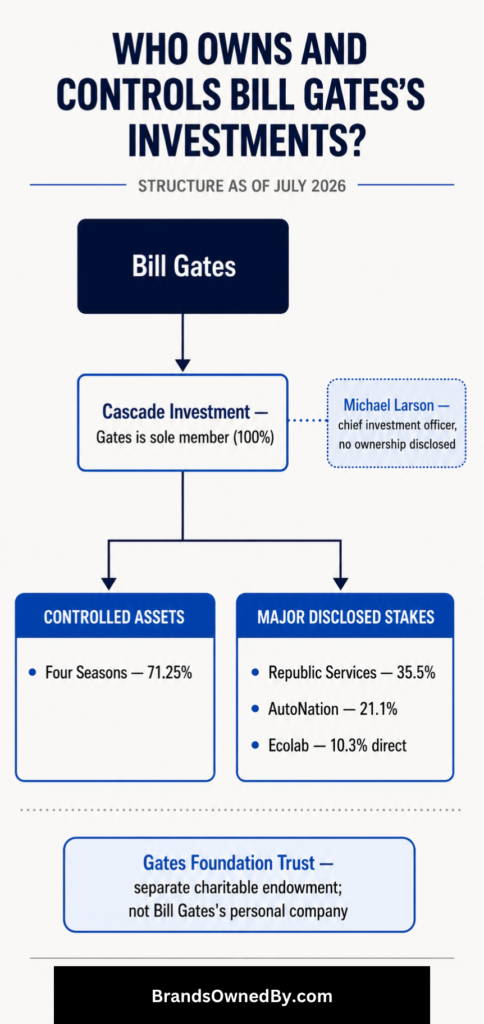
Bill Gates Has Ultimate Control Over Cascade Investment
Cascade Investment sits at the center of Gates’s personal investment structure. Gates is its sole member. This gives him ultimate ownership authority over the investment vehicle and the assets it holds.
However, Gates does not personally select every stock, negotiate every transaction, or manage each property. Much of that responsibility is delegated to a professional investment team.
Michael Larson serves as Gates’s chief investment officer. He has managed the broader investment strategy for decades. His responsibilities include portfolio allocation, risk management, acquisitions, disposals, and oversight of major investments.
The arrangement separates ownership from execution. Gates determines the broad direction and long-term objectives. Larson and Cascade’s investment professionals handle much of the implementation.
This structure allows Gates to maintain control without operating Cascade like a traditional chief executive.
Cascade Controls Its Majority-Owned Businesses
Cascade has direct control when it owns more than half of a company or investment entity.
Four Seasons Hotels and Resorts is the clearest example. Cascade owns 71.25% of the luxury hospitality group. This majority position gives it decisive voting power on major shareholder matters.
That does not mean Bill Gates approves hotel menus, room prices, hiring decisions, or individual property openings. Four Seasons has its own executives and operating teams.
Cascade’s control is exercised at the ownership and governance level. It can influence board appointments, capital allocation, major acquisitions, financing decisions, and long-term expansion plans. Management then operates the company within that strategic framework.
The same distinction applies to real estate and agricultural assets controlled through Cascade-related entities. Professional operators manage the properties. Cascade controls the investment decisions behind them.
Major Public-Company Stakes Provide Influence, Not Full Control
Gates holds substantial interests in several publicly traded companies through Cascade. Republic Services, AutoNation, Ecolab, Deere, and Otter Tail are important examples.
These positions can give Cascade meaningful influence. A large shareholder can vote on directors, executive compensation, mergers, governance proposals, and other corporate matters.
Republic Services is the strongest example. Cascade’s disclosed position represents more than one-third of the company. That makes Gates its most influential individual shareholder.
Even so, Republic Services remains a public corporation. Its board owes duties to all shareholders. Its executives manage daily operations. Gates cannot treat the company as a private subsidiary.
The same principle applies to AutoNation and Ecolab. Cascade’s stakes are large enough to matter, but they do not provide unrestricted control.
Board representation can strengthen that influence. Cascade executives have served on the boards of some portfolio companies. This gives the investment office a direct voice in governance and long-term planning.
Still, board participation should not be confused with operational management. Gates does not personally run waste routes, automobile dealerships, industrial-cleaning operations, or agricultural-equipment factories.
Consortium Investments Require Shared Control
Some Gates-linked businesses are owned through partnerships with other major investors.
Signature Aviation follows this model. Cascade holds a 30% consortium interest. Blackstone and Global Infrastructure Partners each hold 35%.
No single consortium member owns a majority. Important ownership decisions therefore require cooperation among the investors.
This limits Gates’s ability to act independently. Cascade can influence strategy, financing, leadership, and capital allocation, but it cannot unilaterally control the entire company.
Joint ownership can still be attractive. It allows Cascade to invest in a large global business while sharing financial exposure and specialist expertise with experienced infrastructure investors.
Gates Shapes Founder-Led Ventures Through Strategic Leadership
TerraPower, Breakthrough Energy, and Gates Ventures operate differently from Cascade’s conventional investments.
Gates founded these organizations around specific long-term objectives. His influence comes from a combination of capital, founder status, board authority, and strategic leadership.
At TerraPower, Gates serves as chairman and remains one of the company’s most important financial supporters. He helps establish the broader mission and advocates for advanced nuclear energy. Professional executives, engineers, regulators, government partners, and outside investors handle development and execution.
Breakthrough Energy is even more collaborative. Gates founded the organization, but its investment funds include capital from other investors. Its portfolio companies also have their own founders, boards, and shareholders.
Gates can influence which technologies and commercial problems receive attention. He does not automatically control every company funded by Breakthrough Energy Ventures.
Gates Ventures is more directly connected to his personal priorities. The private office supports his work across technology, healthcare, energy, education, research, and public policy. Gates sets its overall agenda, while specialized teams manage individual projects.
Microsoft Operates Independently of Bill Gates
Microsoft is the company most closely associated with Bill Gates, but it is no longer controlled by him.
Gates owns an estimated minority stake and remains connected to Microsoft as its co-founder. That gives him historical influence and industry credibility. It does not give him legal control over the company.
He stepped down as chairman in 2014 and left Microsoft’s board in 2020. Microsoft is now governed by its board and led by chairman and CEO Satya Nadella.
Gates may provide informal advice on technology or strategy. Any such involvement is advisory. He cannot independently direct Microsoft’s management, spending, acquisitions, or product development.
This is an important distinction for readers asking what companies Bill Gates owns. Microsoft helped create his fortune, but it is no longer part of a Gates-controlled business empire.
The Gates Foundation Is Separate From His Personal Portfolio
The Gates Foundation and its investment trust must be kept separate from Cascade.
The foundation is a charitable organization. Its assets exist to support its stated mission. They are not Bill Gates’s personal property.
The Gates Foundation Trust manages the endowment that finances the foundation’s activities. Although Gates participates in its governance, he cannot use those assets like money held in a personal investment account.
This distinction also affects ownership reporting. If the Foundation Trust owns shares in a public company, those shares should not automatically be added to Gates’s personal portfolio.
The separation became particularly relevant when the Trust sold its remaining Microsoft shares in 2026. That transaction did not necessarily mean Gates had sold his personally owned Microsoft stock.
Control Depends on the Type of Investment
Bill Gates’s control can therefore be summarized in three levels.
He has ultimate control over Cascade Investment and strong ownership control over businesses in which Cascade holds a majority stake. He has strategic influence over public companies where Cascade owns large minority positions. He also provides founder-level direction to organizations such as TerraPower and Breakthrough Energy.
Daily operations remain decentralized across all three groups. Independent executives run the businesses. Boards oversee corporate governance. Investment partners participate where ownership is shared.
Gates’s role is primarily that of an owner, capital allocator, founder, and long-term strategist. He is not the operating chief executive of a single conglomerate containing every company associated with his name.
Bill Gates Net Worth 2020-30
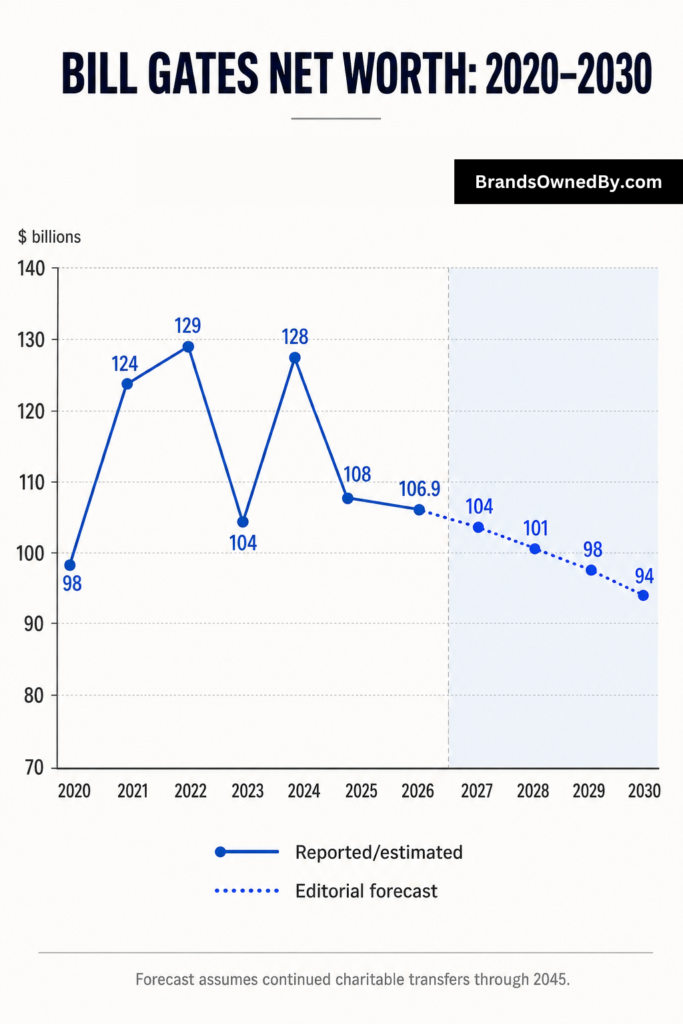
Bill Gates had an estimated net worth of $106.9 billion at the beginning of August 2026. This provides a close reference point for the end of July.
The estimate can change daily. Microsoft, Republic Services, Deere, Ecolab, AutoNation, private-company valuations, real estate, and other financial assets all influence the calculation.
Private holdings make the estimate less precise. Four Seasons, Cascade, TerraPower, and Gates Ventures do not have continuously quoted market values.
Microsoft Remains His Largest Individual Asset
Gates is estimated to own approximately 103 million Microsoft shares. At a share price of $464.72 at the end of July 2026, that position would be worth approximately $47.9 billion.
Microsoft therefore represents close to 45% of his estimated fortune. This is still a major concentration, but it is far below his original ownership.
When Microsoft went public in 1986, Gates owned approximately 44.9% of the company. His current estimated stake is closer to 1.4%. Decades of share sales, diversification, divorce-related transfers, and charitable donations explain the difference.
Republic Services Is His Second-Largest Disclosed Holding
Cascade held approximately 110.8 million Republic Services shares following its May 2026 purchases. At $210.55 per share, the position was worth approximately $23.3 billion at the end of July.
That equals almost 22% of Gates’s estimated net worth.
Republic Services gives the portfolio exposure to waste collection, recycling, landfills, and environmental infrastructure. These services produce recurring demand and relatively predictable cash flow. This makes the investment less dependent on technology-sector performance.
Microsoft and Republic Services together account for roughly two-thirds of Gates’s estimated personal wealth.
Industrial and Essential-Service Investments Add Another $21.3 Billion
Cascade’s disclosed positions in Deere, Ecolab, and AutoNation have an estimated combined value of $21.3 billion.
Deere is the largest of the three at approximately $11.7 billion. It provides exposure to agricultural machinery, construction equipment, infrastructure spending, and precision farming.
The Ecolab position is worth an estimated $8.1 billion. Ecolab benefits from recurring demand for water treatment, hygiene, food safety, and industrial-cleaning services.
AutoNation adds approximately $1.5 billion. It gives Cascade exposure to vehicle retailing, used cars, maintenance, financing, and replacement parts.
Together, these investments show why Gates’s wealth cannot be described simply as a Microsoft fortune. A significant portion is now connected to essential services and industrial businesses.
Private Assets Make Up the Remaining Estimated Wealth
Approximately $14.4 billion of the estimate is assigned to private businesses, property, agricultural land, cash, investment funds, and other assets.
Four Seasons is the most visible private holding. Cascade owns 71.25% of the luxury hospitality company. Its exact current value is not public, so assigning a precise figure would create false accuracy.
This category also includes Gates’s interests in TerraPower, Signature Aviation, Strategic Property Partners, Gates Ventures, farmland, and other private investments held through Cascade-related entities.
Some of these assets may eventually be worth considerably more than their current estimated contribution. TerraPower, for example, could gain value if its Natrium reactor technology reaches commercial deployment. The company also carries substantial technical, regulatory, and construction risks.
Why Gates’s Net Worth Has Not Risen Like Other Technology Fortunes
Gates’s net worth reached $129 billion in the 2022 annual estimate and $128 billion in 2024. It stood at $106.9 billion in July 2026.
This does not mean his investments lost more than $20 billion.
Charitable giving is a major part of the explanation. Gates has transferred tens of billions of dollars to philanthropy. He also announced plans to give away virtually all his remaining wealth through the Gates Foundation before it closes in 2045.
These transfers reduce his personal net worth even when the underlying investments perform well. Changes in how wealth trackers separate personal assets from foundation assets can also produce noticeable revisions.
The practical result is unusual. Gates owns a portfolio capable of generating substantial investment growth, but he is deliberately moving wealth out of his personal estate. His future net worth will therefore depend as much on the pace of his donations as on stock-market performance.
Net-Worth Forecast for 2027–2030
The forecast assumes Gates continues making planned charitable transfers while his remaining investments generate positive long-term returns.
Under this scenario, investment growth offsets part of the donations but does not fully replace the transferred wealth. Net worth gradually declines from $106.9 billion in 2026 to $94 billion in 2030.
Actual figures could be much higher if Microsoft, Republic Services, Four Seasons, or private technology investments appreciate strongly.
They could also be lower if Gates accelerates donations, transfers additional assets to the foundation, or financial markets experience a prolonged decline.
The forecast should therefore be viewed as an editorial scenario. It is not guidance issued by Gates, Cascade, or the Gates Foundation.
Final Words
The answer to what companies Bill Gates owns depends on the meaning of ownership.
He wholly owns Cascade Investment. Cascade controls Four Seasons and holds major stakes in Republic Services, AutoNation, Ecolab, Deere, Signature Aviation, and other businesses.
Gates also founded TerraPower, Breakthrough Energy, and Gates Ventures. However, several of those organizations involve outside investors or fund structures.
Microsoft remains valuable to Gates, but he owns only a small minority of the company and does not control it. The Gates Foundation Trust must also be kept separate from his personal holdings.
His modern business empire is best understood as a professionally managed investment network. It is diversified across essential services, industrial assets, hospitality, energy, technology, real estate, and agriculture.
FAQs
Does Bill Gates still own Microsoft?
Yes. Bill Gates is estimated to own approximately 103 million Microsoft shares, equal to roughly 1.4% of the company. The precise figure is not publicly confirmed through current insider filings.
Is Bill Gates the largest shareholder of Microsoft?
No. Institutional asset managers hold much larger positions in Microsoft. Gates is no longer the company’s controlling shareholder.
Does Bill Gates own Four Seasons?
Bill Gates indirectly owns a controlling interest through Cascade Investment. A Cascade affiliate holds 71.25% of Four Seasons Hotels and Resorts.
Does Bill Gates own Republic Services?
Cascade holds a major stake in Republic Services. Gates and Cascade reported 35.5% beneficial ownership at the March 2026 record date and purchased additional shares during May.
Does Bill Gates own AutoNation?
Cascade owned 7,062,629 AutoNation shares as of May 2026. This represented 21.1% of the company. Gates is a major shareholder rather than the exclusive owner.
Does Bill Gates own John Deere?
Gates does not own Deere & Company outright. Cascade owns a significant minority position consisting of approximately 19.8 million shares.
Does Bill Gates own Apple?
No. Bill Gates does not own Apple as a company. Any small Apple position held through an investment fund would represent ordinary minority share ownership.
Does Bill Gates own McDonald’s?
No. Gates does not own McDonald’s. The Gates Foundation Trust has held publicly traded consumer-company shares, but those investments belong to the charitable endowment.
Does Bill Gates own Coca-Cola?
No. Gates does not own The Coca-Cola Company. Investments connected with Coca-Cola FEMSA involve a separate bottling company and have appeared in institutional investment portfolios.
Who manages Bill Gates’s money?
Michael Larson serves as Gates’s chief investment officer. Cascade Asset Management manages Gates’s non-Microsoft investments and also provides investment-management services to the Gates Foundation Trust.
Is the Gates Foundation owned by Bill Gates?
No. The Gates Foundation is a charitable nonprofit organization. Its assets cannot be treated as Bill Gates’s personal property.
What is Bill Gates’s biggest controlled company?
Four Seasons Hotels and Resorts is one of his most prominent controlled operating companies. Cascade owns 71.25% of the luxury hospitality group.
What nuclear company does Bill Gates own?
Bill Gates founded and chairs TerraPower. He is a leading investor, but TerraPower has raised capital from other investors. Its precise private ownership percentages are not publicly available.
How much farmland does Bill Gates own?
Gates-linked investment entities hold a large agricultural-land portfolio across several states. Exact acreage can change as properties are acquired, sold, or transferred between entities.
Is Cascade Investment the same as the Gates Foundation Trust?
No. Cascade is Gates’s personal investment vehicle. The Gates Foundation Trust is a separate charitable endowment. Both use related investment-management expertise, but their assets have different owners and purposes.