
- Caterpillar Inc. is owned by its shareholders because it is a publicly traded company listed on the NYSE under the ticker symbol CAT. No shareholder owns a majority stake, meaning the company is not controlled by any individual, family, government, or parent corporation.
- The Vanguard Group is Caterpillar’s largest shareholder with approximately 10.2% ownership. Other major shareholders include BlackRock (8.0%), State Street Global Advisors (7.6%), State Farm Mutual Automobile Insurance Company (3.2%), Geode Capital Management (2.4%), and Fisher Asset Management (2.1%).
- Institutional investors collectively own approximately 72% of Caterpillar’s outstanding shares, while retail investors own about 27% and company insiders own roughly 1%. The combined ownership of Vanguard, BlackRock, and State Street exceeds 25%, making them the company’s most influential shareholder group.
- Founded in 1925 through the merger of Holt Manufacturing Company and C.L. Best Tractor Company, Caterpillar has grown into the world’s largest construction equipment manufacturer. As of 2026, the company is valued at approximately $225 billion and operates leading brands such as CAT, Perkins, Progress Rail, Solar Turbines, FG Wilson, EMD, and Cat Financial.
Caterpillar Inc. is an American manufacturer of construction equipment, mining machinery, industrial engines, gas turbines, and locomotives. Founded in 1925, the company is best known for its CAT-branded equipment, which is used on construction sites, mines, infrastructure projects, and energy operations worldwide.
As of 2026, Caterpillar is the world’s largest construction equipment manufacturer. Its products include excavators, bulldozers, wheel loaders, motor graders, mining trucks, generators, and diesel engines. The company serves customers in more than 190 countries and operates through one of the largest equipment dealer networks in the world.
Beyond equipment manufacturing, Caterpillar also provides equipment financing, aftermarket parts, maintenance services, and fleet management technologies through its various subsidiaries.
![Who Owns Caterpillar Inc [infographic]](https://brandsownedby.com/wp-content/uploads/2026/06/Who-Owns-Caterpillar-Inc-infographic-486x1024.png)
Founders of Caterpillar
Caterpillar was formed on April 15, 1925, through the merger of Holt Manufacturing Company and C.L. Best Tractor Company. The merger brought together two of the most successful tractor manufacturers in the United States and created what was then known as Caterpillar Tractor Co.
The company traces its roots to two industry pioneers: Benjamin Holt and Clarence Leo Best.
Benjamin Holt
Benjamin Holt was an American inventor and entrepreneur who founded Holt Manufacturing Company. He is widely credited with developing one of the first successful track-type tractors.
His use of continuous tracks revolutionized heavy machinery because tracked vehicles could operate on soft soil, mud, and uneven terrain where traditional wheeled equipment often failed. The movement of these tracks inspired the name “Caterpillar,” which later became the company’s official brand.
Clarence Leo (C.L.) Best
Clarence Leo Best founded C.L. Best Tractor Company and became one of the leading innovators in the agricultural machinery industry.
Best’s tractors gained a reputation for reliability and performance, making his company one of Holt Manufacturing’s strongest competitors. After the 1925 merger, Best became the first chairman of Caterpillar and helped guide the company’s early growth.
Ownership History
Caterpillar’s ownership history reflects its transformation from a small tractor manufacturer into one of the world’s largest industrial companies. Over the past century, ownership has shifted from founders and early investors to a broad base of institutional and retail shareholders.
Caterpillar Ownership History
How ownership evolved from founders to institutional investors
Founder-Controlled
Holt & Best families dominate ownership after merger.
Public Expansion
Ownership broadens as Caterpillar grows globally.
Institutional Entry
Pension funds and mutual funds become major shareholders.
Index Fund Era
Vanguard, BlackRock and ETFs increase ownership.
Widely Held Company
No controlling owner. Shares held by institutions and retail investors worldwide.
Early Ownership Under the Founders (1925–1930s)
Caterpillar was formed on April 15, 1925, through the merger of Holt Manufacturing Company and C.L. Best Tractor Company. At the time, ownership was concentrated among the companies’ founders, executives, and a relatively small group of investors.
Benjamin Holt’s family and Clarence Leo (C.L.) Best were among the most influential stakeholders in the newly created Caterpillar Tractor Co. During this period, ownership and management were closely connected, with company leaders directly involved in strategic and operational decisions.
The merger allowed the company to combine manufacturing resources, patents, dealer networks, and engineering expertise under a single corporate structure.
Expansion and Public Ownership Growth (1930s–1960s)
As Caterpillar expanded beyond agricultural machinery into construction and industrial equipment, the company required additional capital to support manufacturing growth and international expansion.
During this period, ownership gradually became more dispersed as more shares were purchased by public investors. The company’s growing reputation and increasing global presence attracted investment from banks, insurance companies, and private shareholders.
Although executives continued to hold meaningful stakes, no single individual or family maintained dominant ownership as the company expanded.
Rise of Institutional Investors (1970s–1990s)
The ownership structure changed significantly during the second half of the twentieth century.
Large institutional investors began accumulating Caterpillar shares as pension funds, mutual funds, and insurance companies increased their participation in the stock market. These institutions viewed Caterpillar as a stable industrial company with strong global operations and long-term growth potential.
As institutional ownership increased, founder influence gradually disappeared. Decision-making authority shifted toward a professional management team overseen by a board of directors elected by shareholders.
By the 1990s, institutional investors had become the dominant owners of Caterpillar stock.
Growth of Index Funds and Asset Managers (2000s–2020s)
The rise of index investing further changed Caterpillar’s ownership structure.
Major asset management firms such as Vanguard, BlackRock, and State Street began purchasing large numbers of Caterpillar shares through index funds and exchange-traded funds that track major stock market indexes.
Because Caterpillar is a component of the S&P 500, Dow Jones Industrial Average, and other major indexes, these investment firms automatically hold substantial positions on behalf of millions of investors.
As a result, ownership became even more diversified. Rather than a few large controlling shareholders, Caterpillar’s shares became spread across thousands of institutions and millions of individual investors worldwide.
Caterpillar’s Current Ownership Structure
As of 2026, Caterpillar operates as a widely held public company with no controlling shareholder.
Most shares are owned by institutional investors, including asset managers, pension funds, mutual funds, and exchange-traded funds. Individual investors also own a significant portion of the company’s stock through brokerage accounts and retirement plans.
The company’s largest shareholders are generally investment management firms rather than individuals or families. These firms manage money on behalf of clients and do not personally own the shares they oversee.
This ownership model means that control is distributed among many shareholders rather than concentrated in the hands of a founder, family, or parent company.
Who Owns Caterpillar: Largest Shareholders
Caterpillar is owned by its shareholders because it is a publicly traded company listed on the New York Stock Exchange under the ticker symbol CAT. As of 2026, no individual, family, or corporation owns a controlling stake in Caterpillar. Instead, ownership is spread across institutional investors, mutual funds, pension funds, ETFs, company insiders, and millions of individual investors.
The largest shareholder of Caterpillar is The Vanguard Group, which owns approximately 10% of the company’s outstanding shares. Other major shareholders include BlackRock, State Street Global Advisors, State Farm Mutual Automobile Insurance Company, Geode Capital Management, and Capital World Investors.
Institutional investors collectively control more than 70% of Caterpillar’s stock. This gives professional asset managers significant influence over corporate governance, board elections, executive compensation, and major strategic decisions. However, because ownership is highly diversified, no single shareholder has enough voting power to control the company.
Caterpillar Major Shareholders (2026)
Ownership of Outstanding Shares
The Vanguard Group
The Vanguard Group is Caterpillar’s largest shareholder, owning roughly 10% of the company’s outstanding stock.
Vanguard is one of the world’s largest asset management companies, managing more than $10 trillion in assets through mutual funds, retirement products, and exchange-traded funds. Its ownership stake in Caterpillar is primarily held through major index funds such as the Vanguard Total Stock Market Index Fund and the Vanguard 500 Index Fund.
Vanguard’s position is significant because Caterpillar is a component of both the S&P 500 and the Dow Jones Industrial Average. As money flows into Vanguard’s index products, the firm automatically purchases Caterpillar shares on behalf of investors.
Although Vanguard is the largest shareholder, it does not directly control Caterpillar. The shares are owned by the millions of investors whose money is invested in Vanguard funds. Nevertheless, Vanguard remains one of the most influential voices in shareholder votes and corporate governance matters.
BlackRock
BlackRock is Caterpillar’s second-largest shareholder, with ownership of approximately 8% of the company.
Founded in 1988, BlackRock has grown into the world’s largest asset manager, overseeing more than $11 trillion in assets. Much of its Caterpillar investment comes through its iShares ETF business, which operates some of the largest exchange-traded funds globally.
BlackRock’s ownership reflects institutional confidence in Caterpillar’s long-term position within the construction, mining, energy, and infrastructure sectors. Because BlackRock votes millions of shares during annual shareholder meetings, its decisions can influence board elections, executive compensation packages, and corporate governance proposals.
BlackRock is typically one of Caterpillar’s most influential shareholders alongside Vanguard and State Street.
State Street Global Advisors
State Street Global Advisors owns approximately 7% to 8% of Caterpillar’s outstanding shares, making it one of the company’s largest institutional investors.
State Street is a major asset manager and the sponsor of the SPDR family of ETFs, including the SPDR S&P 500 ETF, one of the largest exchange-traded funds in the world.
Like Vanguard and BlackRock, State Street’s investment in Caterpillar is largely tied to index-tracking strategies. Since Caterpillar is a major industrial component of several benchmark indexes, State Street maintains a substantial ownership position through its various investment products.
Together, Vanguard, BlackRock, and State Street control more than one-quarter of Caterpillar’s outstanding shares, making them the company’s most influential shareholder group.
State Farm Mutual Automobile Insurance Company
State Farm Mutual Automobile Insurance Company is one of Caterpillar’s largest long-term shareholders and one of the few major investors that is not primarily an asset management company.
State Farm manages a large investment portfolio to support its insurance operations. The company has historically invested in established businesses with strong market positions, durable cash flows, and long operating histories.
Its investment in Caterpillar reflects confidence in the company’s ability to generate consistent earnings through multiple economic cycles. Unlike index fund managers, State Farm’s holdings are actively selected as part of its investment strategy.
This makes State Farm one of Caterpillar’s most notable strategic institutional shareholders.
Geode Capital Management
Geode Capital Management is another significant Caterpillar shareholder, holding approximately 2% to 3% of the company’s stock.
Founded in 2001, Geode specializes in quantitative and index-based investment strategies. The firm manages hundreds of billions of dollars in assets for institutional clients and investment funds.
Many investors are unfamiliar with Geode because it operates largely behind the scenes. However, its ownership stake places it among Caterpillar’s largest shareholders.
Its position primarily reflects Caterpillar’s inclusion in major stock market indexes and the company’s importance within the U.S. industrial sector.
Capital World Investors
Capital World Investors is one of Caterpillar’s largest active investment managers.
The firm is part of Capital Group, one of the oldest and largest investment management organizations in the world. Unlike Vanguard and BlackRock, which primarily manage index funds, Capital World Investors actively selects companies based on research, valuation, competitive advantages, and long-term growth prospects.
Its substantial investment in Caterpillar demonstrates confidence in the company’s market leadership, global dealer network, strong brand recognition, and diversified business model.
Because Capital World Investors follows a long-term investment approach, its presence among Caterpillar’s largest shareholders is often viewed positively by other investors.
Fisher Asset Management
Fisher Asset Management, founded by billionaire investor Ken Fisher, is another major shareholder of Caterpillar.
The firm manages assets for wealthy individuals, pension funds, foundations, and institutional investors. Caterpillar has remained a significant holding because of its exposure to infrastructure spending, mining activity, industrial growth, and energy development.
Fisher Asset Management’s investment philosophy focuses on identifying companies with durable competitive advantages and strong long-term earnings potential. Its ownership stake reflects confidence in Caterpillar’s ability to maintain its leadership position in global equipment markets.
Bill & Melinda Gates Foundation Trust
The Bill & Melinda Gates Foundation Trust has also maintained a sizable investment in Caterpillar for many years.
The trust manages the financial assets that support the philanthropic activities of the Gates Foundation. Historically, it has favored investments in established market leaders with strong competitive positions and global operations.
Caterpillar’s dominant position in construction and mining equipment has made it an attractive long-term holding within the trust’s diversified investment portfolio.
Although the trust does not own enough shares to influence company control, it remains one of Caterpillar’s most notable institutional investors.
Insider Ownership
Caterpillar’s executives and directors collectively own only a small percentage of the company’s outstanding shares.
This is common among mature public corporations where ownership has become widely distributed among institutional investors. While insiders do not control the company through ownership, they often hold significant stock awards and performance-based compensation packages.
These stock holdings help align management’s interests with those of shareholders. When Caterpillar’s stock performs well, executives benefit alongside investors.
Who Ultimately Controls Caterpillar?
Despite having several large shareholders, Caterpillar does not have a controlling owner.
No investor owns a majority of the company’s shares, and no family maintains special voting rights. Instead, control is exercised through Caterpillar’s Board of Directors and executive leadership team, led by CEO and Chairman Joseph E. Creed.
Major shareholders influence the company through voting rights and corporate governance participation, but strategic decisions ultimately require board approval and oversight.
As of 2026, Caterpillar remains a widely held public company whose ownership is distributed across institutional investors, retail shareholders, and company insiders rather than concentrated in the hands of a single owner.
Competitor Ownership Comparison
Caterpillar operates as a widely held public company with no controlling shareholder. As of June 2026, its largest shareholders are The Vanguard Group, BlackRock, and State Street Global Advisors, which collectively own more than 25% of the company’s outstanding shares. However, none of these investors individually controls Caterpillar.
This ownership structure differs significantly from several of Caterpillar’s largest competitors, some of which remain family-controlled, while others are influenced by strategic shareholders or parent corporations.
Equipment Industry Ownership Comparison (2026)
How Caterpillar’s ownership compares with major competitors
Caterpillar
Deere
Komatsu
Volvo CE
CNH Industrial
Hitachi CM
Liebherr
Caterpillar vs Deere & Company
Deere & Company is Caterpillar’s closest competitor in North America and has a remarkably similar ownership structure.
Like Caterpillar, Deere is publicly traded and does not have a controlling shareholder. The company’s largest investors are also Vanguard, BlackRock, and State Street. As of June 2026, institutional investors own more than 80% of Deere’s outstanding shares.
Neither Caterpillar nor Deere is controlled by a founding family. Both companies are ultimately governed by their boards of directors and executive management teams.
The key difference is that Deere has a greater concentration of institutional ownership, while Caterpillar has a slightly larger proportion of retail shareholders.
Caterpillar vs Komatsu
Komatsu is Caterpillar’s largest global competitor in construction and mining equipment.
Unlike Caterpillar, Komatsu’s largest shareholders are primarily Japanese financial institutions and domestic asset managers. Major investors include The Master Trust Bank of Japan, Custody Bank of Japan, and Nippon Life Insurance.
As of 2026, no single shareholder controls Komatsu. However, Japanese institutional ownership is more concentrated than Caterpillar’s ownership structure.
Another notable difference is that Komatsu’s shareholder base is heavily centered in Japan, whereas Caterpillar’s ownership is dominated by U.S.-based institutional investors.
Caterpillar vs Volvo Construction Equipment
Volvo Construction Equipment operates under a completely different ownership model.
Volvo CE is not an independent publicly traded company. Instead, it is a wholly owned business division of Volvo Group.
As a result, investors cannot directly purchase shares in Volvo Construction Equipment. Ownership is determined through Volvo Group’s shareholder structure.
As of June 2026, Volvo Group’s largest shareholder is Industrivärden, a Swedish investment company that controls approximately 30% of voting rights through its holdings. Other major shareholders include Geely Holding, AMF Pension, Alecta, and Swedbank Robur.
This gives Volvo Construction Equipment a more concentrated ownership structure than Caterpillar.
Caterpillar vs CNH Industrial
CNH Industrial owns major construction and agricultural equipment brands including Case Construction Equipment and New Holland Construction.
Although CNH Industrial is publicly traded, its ownership remains heavily influenced by Exor N.V., the investment company controlled by Italy’s Agnelli family.
As of June 2026, Exor owns approximately 27% of CNH Industrial’s outstanding shares and controls more than 40% of the company’s voting power.
This makes CNH one of Caterpillar’s largest competitors that still has an influential long-term controlling shareholder.
Unlike Caterpillar, strategic decisions at CNH can be heavily influenced by a single shareholder group.
Caterpillar vs Hitachi Construction Machinery
Hitachi Construction Machinery has a more concentrated ownership structure than Caterpillar.
The company was historically controlled by Hitachi Ltd., which remained its largest shareholder for decades.
Following a major ownership restructuring, a consortium led by Itochu Corporation acquired a significant stake in the business. As of 2026, Hitachi Ltd. remains a major shareholder, while Itochu also holds substantial influence.
This strategic-shareholder model differs significantly from Caterpillar’s dispersed institutional ownership structure.
Rather than being owned primarily by investment funds, Hitachi Construction Machinery has several corporate shareholders with direct strategic interests in the business.
Caterpillar vs Liebherr
Liebherr represents the biggest ownership contrast among Caterpillar’s competitors.
Unlike Caterpillar, Liebherr is not publicly traded and has never been listed on a stock exchange.
The company remains privately owned by the Liebherr family, descendants of founder Hans Liebherr.
Family members continue to oversee the business through the Liebherr Group structure and maintain direct influence over strategic decisions.
Because Liebherr does not answer to public shareholders, management can pursue long-term investments without pressure from quarterly earnings expectations.
This family-controlled model stands in sharp contrast to Caterpillar’s institutional ownership structure.
Ownership Comparison Summary
Among the world’s largest equipment manufacturers, ownership structures generally fall into three categories:
Widely Held Public Companies
These companies are owned primarily by institutional investors and have no controlling shareholder.
Examples include:
- Caterpillar.
- Deere & Company.
- Komatsu.
Strategic Shareholder-Controlled Companies
These businesses have one or more major shareholders with substantial influence over corporate decisions.
Examples include:
- CNH Industrial (Exor).
- Hitachi Construction Machinery (Hitachi Ltd. and Itochu).
Family-Owned Companies
These companies remain under the control of founding families.
Examples include:
- Liebherr.
Parent Company-Owned Businesses
These businesses operate as divisions or subsidiaries of larger corporations.
Examples include:
- Volvo Construction Equipment (Volvo Group).
What Makes Caterpillar’s Ownership Unique?
Compared with its major competitors, Caterpillar has one of the most diversified ownership structures in the heavy equipment industry.
It is not controlled by a founding family like Liebherr.
It is not influenced by a dominant strategic shareholder like CNH Industrial.
It is not owned by a parent company like Volvo Construction Equipment.
Instead, Caterpillar is owned by thousands of institutions and millions of investors worldwide. This dispersed ownership structure makes the board of directors and executive management team the primary decision-makers while ensuring that no single shareholder can dictate the company’s direction.
Caterpillar Annual Revenue and Net Worth
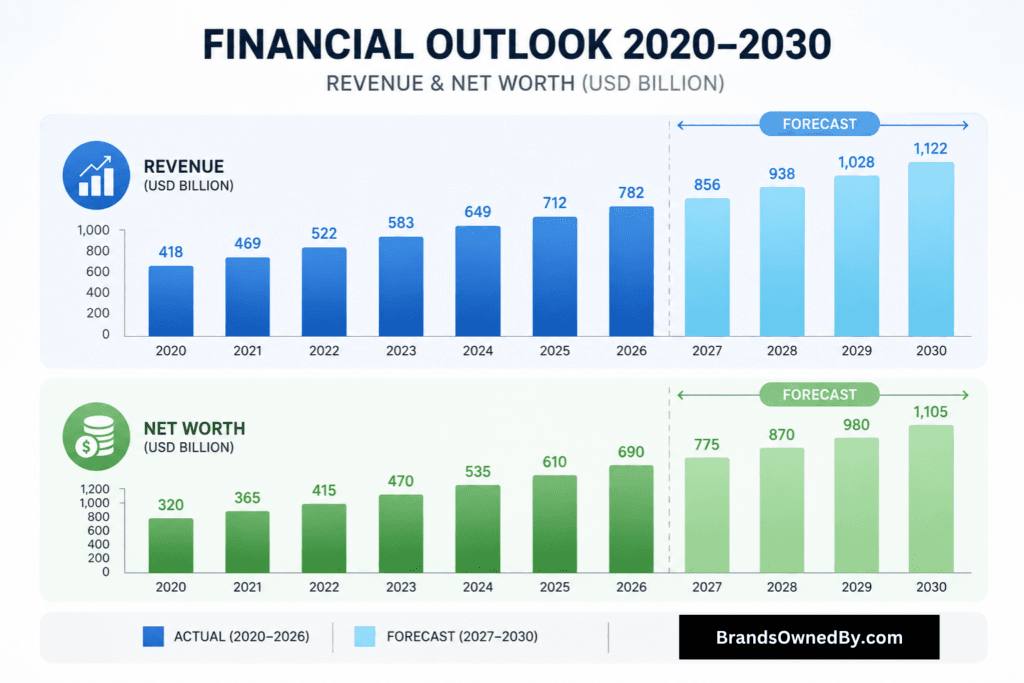
As of June 2026, Caterpillar is expected to generate approximately $74 billion in annual revenue and command a market capitalization of roughly $225 billion. This means the company is valued at more than three times its annual sales, reflecting investor confidence in its market leadership, profitability, aftermarket business, and long-term growth opportunities.
Between 2020 and 2026, Caterpillar’s annual revenue increased by nearly $32 billion, while its market value rose by approximately $130 billion. Few industrial manufacturers have experienced comparable growth during this period.
The company’s financial strength comes from a diversified business model spanning construction equipment, mining machinery, power systems, industrial engines, financial services, software solutions, and aftermarket support.
Caterpillar Revenue Breakdown by Business Segment
Caterpillar Revenue & Net Worth (2020–2030)
Historical Results and Forecast Growth
Unlike many industrial companies that depend heavily on a single market, Caterpillar generates revenue from multiple operating segments.
Based on 2025 results and 2026 estimates, the company’s revenue composition is approximately as follows:
| Segment | Estimated 2026 Revenue | Share of Total Revenue |
|---|---|---|
| Construction Industries | $29.6 billion | 40% |
| Resource Industries | $17.8 billion | 24% |
| Power & Energy | $19.3 billion | 26% |
| Financial Products & Other | $7.3 billion | 10% |
| Total | $74 billion | 100% |
Construction Industries Revenue
Construction Industries remains Caterpillar’s largest business segment and is expected to generate approximately $29.6 billion in revenue during 2026.
This division manufactures:
- Excavators.
- Bulldozers.
- Wheel loaders.
- Backhoe loaders.
- Motor graders.
- Asphalt paving equipment.
The segment benefits from large infrastructure projects, commercial construction, residential development, and government spending programs.
For example, major highway expansions, airport construction projects, bridges, ports, and industrial facilities often use Caterpillar equipment throughout the project lifecycle.
The division contributes approximately 40% of total company revenue, making it Caterpillar’s most important business segment.
Resource Industries Revenue
Resource Industries is expected to contribute approximately $17.8 billion in revenue during 2026.
This segment includes:
- Mining trucks.
- Hydraulic shovels.
- Underground mining systems.
- Drilling equipment.
- Large earthmoving machinery.
Mining customers represent some of Caterpillar’s largest individual accounts.
The growth of electric vehicles, renewable energy infrastructure, and battery manufacturing has increased demand for critical minerals such as copper, lithium, nickel, and cobalt.
As a result, major mining companies continue investing heavily in equipment fleets, supporting Caterpillar’s revenue growth.
The segment is expected to account for approximately 24% of total revenue.
Power & Energy Revenue
Power & Energy is expected to generate approximately $19.3 billion in revenue during 2026, representing around 26% of total company sales.
This segment includes:
- Diesel engines.
- Natural gas engines.
- Industrial turbines.
- Backup generators.
- Marine propulsion systems.
- Rail locomotives.
Power generation has become one of Caterpillar’s fastest-growing opportunities.
Data centers, AI infrastructure projects, utilities, hospitals, manufacturing plants, and energy facilities require large-scale backup power systems.
Several industry analysts expect power-related demand to become one of Caterpillar’s most important growth drivers throughout the remainder of the decade.
Financial Products Revenue
Cat Financial and other supporting businesses are expected to generate approximately $7.3 billion in revenue during 2026.
Although representing only about 10% of total revenue, this segment plays an important strategic role.
Cat Financial helps customers purchase equipment through loans, leases, and financing programs.
Without these financing solutions, many customers would delay or reduce equipment purchases.
The business also generates recurring interest income and strengthens customer retention.
Caterpillar Net Worth
Public companies do not report an official net worth figure. Instead, investors typically use market capitalization and enterprise value to estimate corporate worth.
As of June 2026, Caterpillar’s estimated market capitalization is approximately $225 billion.
However, the company’s economic value extends beyond its stock market valuation.
Value of the CAT Brand
One of Caterpillar’s most valuable assets is the CAT brand itself.
The CAT name is recognized worldwide and is associated with durability, reliability, and performance.
Many contractors specifically request CAT equipment because of its reputation and strong resale value.
The brand alone represents billions of dollars in intangible value.
Manufacturing Assets
Caterpillar owns and operates manufacturing facilities across North America, South America, Europe, Asia, and Australia.
These facilities collectively produce:
- Construction equipment.
- Mining machinery.
- Engines.
- Power systems.
- Components.
The replacement cost of these assets would amount to tens of billions of dollars.
Dealer Network Value
Perhaps Caterpillar’s most underrated asset is its dealer network.
The company works with more than 160 independent dealers operating thousands of facilities globally.
This network provides:
- Equipment sales.
- Parts distribution.
- Maintenance services.
- Equipment rentals.
- Technical support.
Many competitors struggle to replicate this infrastructure, giving Caterpillar a significant competitive advantage.
Parts and Service Business Value
Caterpillar generates billions of dollars annually from aftermarket parts and services.
A mining truck or bulldozer may remain in operation for decades.
During that time, customers purchase:
- Replacement components.
- Engine rebuilds.
- Maintenance services.
- Software upgrades.
- Monitoring solutions.
This recurring revenue stream makes Caterpillar more valuable than a company that relies solely on new equipment sales.
Cat Financial Portfolio
Cat Financial manages tens of billions of dollars in equipment loans and leases.
The financing portfolio generates recurring cash flow and helps support equipment sales.
This business alone represents a substantial portion of Caterpillar’s overall enterprise value.
Revenue and Net Worth Forecast Through 2030
Caterpillar’s projected growth through 2030 is driven by several identifiable trends rather than arbitrary assumptions.
1. AI Data Center Expansion
The rapid growth of artificial intelligence is creating unprecedented demand for power infrastructure.
Large data centers require backup generators, microgrids, turbines, and energy management systems.
Caterpillar’s Power & Energy segment is expected to be one of the primary beneficiaries of this trend.
2. Critical Minerals Mining Boom
Copper, lithium, nickel, and rare earth minerals are essential for electric vehicles, batteries, transmission networks, and renewable energy projects.
Mining companies continue investing billions of dollars in new projects and fleet expansions.
This directly supports demand for Caterpillar mining equipment.
3. Infrastructure Spending
Governments across North America, Europe, India, the Middle East, and Asia continue investing heavily in roads, rail systems, airports, ports, utilities, and industrial facilities.
These projects support long-term demand for construction equipment.
4. Growth of Aftermarket Revenue
Caterpillar’s installed equipment base continues expanding.
Every new machine sold creates future demand for parts, maintenance, rebuilds, and digital services.
As a result, aftermarket revenue is expected to grow faster than equipment sales in several markets.
Forecast Revenue Through 2030
- 2026: $74 billion.
- 2027: $79 billion.
- 2028: $85 billion.
- 2029: $91 billion.
- 2030: $98 billion.
Under this scenario, Caterpillar would add approximately $24 billion in annual revenue over four years, representing growth of roughly 32% from 2026 levels.
Forecast Net Worth Through 2030
- 2026: $225 billion.
- 2027: $245 billion.
- 2028: $270 billion.
- 2029: $295 billion.
- 2030: $325 billion.
If these projections materialize, Caterpillar would add approximately $100 billion in market value between 2026 and 2030.
The largest contributors to that increase would likely be Power & Energy, mining equipment demand, aftermarket services, and higher recurring revenue from software and connected equipment solutions.
Companies Owned by Caterpillar
Over its 100-year history, Caterpillar has expanded far beyond construction equipment through acquisitions, internal brand development, and strategic investments. As of 2026, the company operates a diverse portfolio of businesses serving construction, mining, energy, transportation, power generation, industrial manufacturing, and financial services markets.
Many of these businesses operate independently while benefiting from Caterpillar’s global dealer network, engineering expertise, and financial resources.
Caterpillar Business Empire (2026)
Major Brands, Companies & Operating Businesses
CAT
CAT is Caterpillar’s flagship brand and one of the most valuable industrial brands in the world.
The brand covers thousands of products, including excavators, bulldozers, wheel loaders, backhoe loaders, mining trucks, motor graders, compact equipment, generators, engines, and digital fleet management systems.
CAT equipment is used in virtually every major industry, including construction, mining, forestry, agriculture, transportation, waste management, and energy production.
The CAT brand generates the majority of Caterpillar’s revenue and serves as the foundation of the company’s global market leadership.
Caterpillar Financial Services (Cat Financial)
Cat Financial is Caterpillar’s wholly owned financial services subsidiary.
The business provides equipment financing, leasing, loans, insurance products, and extended protection plans for customers worldwide.
Cat Financial manages tens of billions of dollars in equipment financing assets and plays a critical role in supporting equipment sales.
Many contractors, mining companies, and industrial customers use Cat Financial programs to purchase or lease machinery rather than paying upfront.
Perkins Engines Company Limited
Perkins is one of the world’s largest manufacturers of diesel and gas engines.
Caterpillar acquired Perkins in 1998 from LucasVarity in a transaction valued at approximately $1.3 billion.
The company produces engines used in agricultural equipment, construction machinery, generators, industrial systems, and material handling equipment.
Perkins engines are installed in products manufactured by hundreds of equipment companies around the world.
Today, Perkins remains one of Caterpillar’s most important engine businesses and operates across Europe, Asia, North America, and emerging markets.
Progress Rail
Progress Rail is Caterpillar’s rail transportation subsidiary.
Caterpillar acquired Progress Rail in 2006 for approximately $1 billion.
The company provides locomotives, rail infrastructure, maintenance services, signaling systems, rail technology solutions, and track components.
Progress Rail serves freight railroads, passenger transit systems, ports, mining companies, and industrial rail operators.
The acquisition allowed Caterpillar to establish a major presence in the global rail industry.
Electro-Motive Diesel (EMD)
EMD operates under Progress Rail and remains one of the most recognized locomotive manufacturers in North America.
The brand designs and manufactures diesel-electric locomotives, rail engines, and propulsion systems.
Its locomotives are used by freight rail operators throughout North America, South America, Africa, Australia, and parts of Asia.
EMD’s products are often integrated with Progress Rail’s broader rail infrastructure and maintenance offerings.
Solar Turbines
Solar Turbines is one of Caterpillar’s most important energy businesses.
The company manufactures industrial gas turbines, compressors, power generation systems, and energy solutions.
Solar Turbines serves industries such as:
- Oil and gas.
- Utilities.
- Pipeline transportation.
- Industrial manufacturing.
- Power generation.
Its equipment is used in some of the world’s largest energy infrastructure projects.
The business has become increasingly important as global demand for energy security and power generation continues to grow.
FG Wilson
FG Wilson is a leading generator manufacturer owned by Caterpillar.
The company specializes in diesel and gas-powered generator sets used in hospitals, data centers, telecommunications facilities, industrial plants, airports, and infrastructure projects.
FG Wilson products are distributed across Europe, Africa, the Middle East, Asia, and Latin America.
The business strengthens Caterpillar’s position within the global power generation market.
SEM
SEM, short for Shandong Engineering Machinery, is Caterpillar’s construction equipment brand focused primarily on emerging markets.
The company manufactures:
- Wheel loaders.
- Bulldozers.
- Motor graders.
- Soil compactors.
SEM helps Caterpillar compete in price-sensitive markets while maintaining a broader customer base than the premium CAT brand alone.
The brand is particularly important in China and other developing economies.
Caterpillar Remanufacturing
Caterpillar Remanufacturing, commonly known as Cat Reman, specializes in rebuilding used engines, components, transmissions, hydraulics, and power systems.
Rather than replacing expensive machinery components, customers can purchase remanufactured parts that meet Caterpillar’s original specifications.
This business reduces ownership costs while supporting sustainability initiatives.
Cat Reman has become a major contributor to Caterpillar’s aftermarket strategy.
Caterpillar Energy Solutions
Caterpillar Energy Solutions focuses on decentralized energy systems and distributed power generation technologies.
The business develops solutions for industrial facilities, utilities, municipalities, and commercial customers requiring reliable onsite power generation.
Its products include combined heat and power systems, gas-powered generation systems, and microgrid technologies.
The segment has benefited from increasing demand for energy resilience and backup power infrastructure.
MWM
MWM is a German engine and power generation company owned by Caterpillar Energy Solutions.
The brand specializes in natural gas engines and decentralized power generation systems.
MWM products are widely used in:
- Biogas facilities.
- Utilities.
- Industrial operations.
- Municipal energy systems.
The business strengthens Caterpillar’s position in the distributed energy market.
MaK
MaK is Caterpillar’s marine engine brand.
The company produces medium-speed marine engines used in ferries, cargo vessels, offshore support ships, tugboats, and power generation facilities.
MaK engines are known for durability, fuel efficiency, and long service life.
The brand gives Caterpillar a significant presence in the global marine propulsion industry.
SPM Oil & Gas
SPM Oil & Gas provides pressure pumping equipment and flow control technologies used in oil and gas operations.
Its products include:
- Pumps.
- Valves.
- Flow control systems.
- Well service equipment.
SPM equipment is widely used in hydraulic fracturing and oilfield production activities.
The business strengthens Caterpillar’s exposure to the energy sector.
Caterpillar Oil & Gas
Caterpillar Oil & Gas supplies engines, turbines, generators, and power systems specifically designed for upstream, midstream, and downstream energy operations.
The division serves drilling contractors, pipeline operators, liquefied natural gas facilities, and oil producers worldwide.
Its solutions are often integrated with Solar Turbines and SPM Oil & Gas offerings.
Cat Digital
Cat Digital is Caterpillar’s technology and software business.
The division develops digital platforms that help customers manage fleets, monitor equipment health, improve productivity, and reduce operating costs.
Its products include:
- Equipment telematics.
- Predictive maintenance software.
- Fleet management solutions.
- Jobsite analytics.
- Connected machine technologies.
Digital services have become an increasingly important source of recurring revenue for Caterpillar.
VisionLink
VisionLink is Caterpillar’s flagship fleet management and equipment monitoring platform.
The software enables customers to track machine utilization, fuel consumption, maintenance schedules, operating efficiency, and equipment health in real time.
Large contractors and mining companies use VisionLink to improve productivity and reduce downtime.
The platform represents a key component of Caterpillar’s digital transformation strategy.
Cat MineStar Solutions
MineStar Solutions is Caterpillar’s mining technology platform.
The system integrates:
- Fleet management.
- Autonomous haulage.
- Equipment monitoring.
- Safety systems.
- Production analytics.
MineStar is widely used by major mining companies seeking to improve efficiency and reduce operating costs.
It is considered one of the most advanced mining technology platforms in the industry.
Caterpillar Defense
Caterpillar Defense develops engines, power systems, and specialized equipment for military and government applications.
Its products support armored vehicles, logistics systems, naval vessels, and defense infrastructure projects.
The business serves governments and defense contractors worldwide.
Anchor Drilling Fluids USA
Anchor Drilling Fluids operates within Caterpillar’s energy-related operations and supplies drilling fluid solutions for oil and gas customers.
Its products help improve drilling efficiency and well performance in challenging operating environments.
Final Thoughts
Caterpillar is owned by a diverse group of institutional and retail investors, with The Vanguard Group serving as its largest shareholder. However, no investor controls the company. Instead, ownership is distributed among numerous investment firms, pension funds, mutual funds, and individual shareholders.
The company is controlled through its board of directors and executive leadership team, led by CEO Joseph E. Creed. With annual revenue of nearly $65 billion, a market capitalization exceeding $180 billion, and a portfolio that includes Perkins, Progress Rail, Solar Turbines, FG Wilson, SEM, EMD, and Cat Financial, Caterpillar remains one of the most influential industrial companies in the world.
FAQs
Who owns Caterpillar Inc?
Caterpillar Inc. is owned by its shareholders because it is a publicly traded company listed on the New York Stock Exchange under the ticker symbol CAT. As of 2026, the largest shareholders include The Vanguard Group, BlackRock, and State Street Global Advisors. No single investor owns a controlling stake in the company.
Who bought Caterpillar?
No company has bought Caterpillar. Caterpillar remains an independent publicly traded corporation. Throughout its history, Caterpillar has acquired numerous companies, including Perkins, Progress Rail, Bucyrus International, and Electro-Motive Diesel, but it has not been acquired by another company.
Who owns Caterpillar Tractor Company?
Caterpillar Tractor Company was the original name of Caterpillar after its formation in 1925. The company later became Caterpillar Inc. Therefore, Caterpillar Tractor Company is effectively owned by the same shareholders who own Caterpillar Inc. today.
When did Caterpillar become a company?
Caterpillar was officially formed on April 15, 1925, through the merger of Holt Manufacturing Company and C.L. Best Tractor Company. The newly combined business was named Caterpillar Tractor Co.
When did Caterpillar go public?
Caterpillar became a publicly traded company in 1929 when its shares began trading on the New York Stock Exchange. Since then, the company has remained publicly listed and is currently a component of both the S&P 500 and the Dow Jones Industrial Average.
Who is the majority owner of Caterpillar?
Caterpillar does not have a majority owner. No shareholder owns more than 50% of the company’s outstanding shares. The Vanguard Group is the largest shareholder with approximately 10% ownership as of 2026, but this is far below a controlling stake.
Does Bill Gates own Caterpillar?
Bill Gates does not personally own Caterpillar. However, the Bill & Melinda Gates Foundation Trust has held a significant investment in Caterpillar for many years as part of its diversified investment portfolio. The trust is an institutional investor and does not control the company.
Which country owns Caterpillar?
No country owns Caterpillar. The company is a publicly traded corporation owned by shareholders from around the world. Caterpillar is headquartered in the United States and operates independently of any government ownership.
Who is the founder of Caterpillar?
Caterpillar was created through the merger of two companies founded by industry pioneers Benjamin Holt and Clarence Leo (C.L.) Best. Both men are widely regarded as the founders of Caterpillar because their companies combined to form Caterpillar Tractor Co. in 1925.
Who is bigger, John Deere or Caterpillar?
The answer depends on the metric being used.
In construction and mining equipment, Caterpillar is larger and is widely recognized as the world’s largest construction equipment manufacturer.
However, Deere & Company generally generates higher total annual revenue because of its dominant position in agricultural machinery. As of 2026, Deere’s annual revenue exceeds Caterpillar’s, while both companies rank among the largest industrial manufacturers in the world.
Is Caterpillar German or American?
Caterpillar is an American company. It was founded in the United States in 1925 and is headquartered in Irving, Texas. Although it operates globally and has manufacturing facilities in multiple countries, Caterpillar remains an American corporation.
Caterpillar is made in which country?
Caterpillar equipment is manufactured in multiple countries rather than a single location.
Major manufacturing operations are located in the United States, the United Kingdom, Brazil, China, India, Mexico, Australia, Indonesia, and several European countries. However, a significant portion of Caterpillar’s high-value equipment and engines continues to be produced in the United States. The country of manufacture depends on the specific machine, engine, or component being purchased.