

- Lotus Cars is primarily owned and controlled by Zhejiang Geely Holding Group, the Chinese automotive conglomerate led by billionaire Li Shufu, who indirectly controls the company through Geely-affiliated entities.
- Geely originally acquired a 51% controlling stake in Lotus in 2017, while Malaysian company Etika Automotive held the remaining 49% stake before later restructuring transactions consolidated more control under Lotus Technology.
- As of 2026, Lotus operates through Lotus Technology Inc., which oversees electric vehicles, intelligent driving systems, software ecosystems, and global EV expansion, while Geely maintains majority voting control.
- Lotus Cars now operates as a luxury performance and mobility brand with businesses spanning sports cars, electric SUVs, engineering services, AI-driven vehicle systems, and advanced hybrid-electric technologies.
Lotus Cars is a British luxury sports car and performance vehicle manufacturer headquartered in Hethel, Norfolk, England. The company is globally recognized for lightweight engineering, precision handling, and motorsport-inspired vehicle design.
The brand built its reputation around the philosophy of improving speed and performance through reduced vehicle weight rather than relying only on larger engines. This engineering approach helped Lotus become one of the most respected names in sports car development.
Lotus operates in both the automotive manufacturing and engineering sectors. The company designs high-performance sports cars, electric vehicles, hypercars, and advanced mobility technologies. In recent years, Lotus expanded aggressively into the premium EV market with products such as the Eletre electric SUV and the Emeya grand tourer.
The company currently operates through several major business divisions, including Lotus Cars, Lotus Technology, Lotus Engineering, and Lotus Advanced Performance.
Lotus is also known for its strong Formula One heritage. The brand introduced several innovations to motorsports, including advanced aerodynamics, monocoque chassis construction, and ground-effect technology. These developments influenced both racing and consumer vehicles across the automotive industry.
Unlike many traditional sports car manufacturers, Lotus combines British engineering heritage with global manufacturing and technology support from parent company Geely Holding Group. This structure allows Lotus to compete in modern luxury and electric vehicle markets while maintaining its performance-focused identity.
What Does Lotus Cars Specialize In?
Lotus specializes in:
- Lightweight sports cars.
- Electric performance vehicles.
- Automotive engineering services.
- Vehicle dynamics and chassis tuning.
- Hypercar development.
- Intelligent driving technologies.
The company is especially respected for steering precision and suspension engineering. Many automotive manufacturers have worked with Lotus Engineering to improve handling and ride quality in their own vehicles.
Over the years, Lotus has launched several iconic vehicles that shaped the brand’s identity.
Major Lotus models include:
- Lotus Elise.
- Lotus Exige.
- Lotus Evora.
- Lotus Emira.
- Lotus Evija.
- Lotus Eletre.
- Lotus Emeya.
The Elise became one of the company’s most influential vehicles because it revived the lightweight roadster segment during the 1990s. The Evija later demonstrated Lotus’ transition into electric hypercar technology.
Global Presence
Although Lotus started as a small British sports car company, it now operates globally.
The brand has expanded into:
- Europe.
- China.
- North America.
- Middle East markets.
- Asia-Pacific regions.
China became especially important after Geely acquired the company. The market now plays a major role in Lotus’ EV strategy and luxury vehicle expansion.
Lotus Cars Founders
Lotus Cars was founded in 1948 by Colin Chapman and Colin Dare in the United Kingdom.
Among the two founders, Colin Chapman became the defining figure behind Lotus’ engineering philosophy and motorsport success.
Colin Chapman
Anthony Colin Bruce Chapman was an engineer, inventor, and racing visionary. He is widely regarded as one of the most influential figures in automotive and Formula One history.
Chapman studied structural engineering at University College London. His engineering background heavily influenced the design philosophy of Lotus vehicles.
He believed that reducing weight was more effective than simply increasing engine power. His famous philosophy was:
“Simplify, then add lightness.”
This idea became the foundation of Lotus sports car development.
Chapman introduced several groundbreaking innovations in Formula One racing, including:
- Monocoque chassis construction.
- Ground-effect aerodynamics.
- Advanced suspension systems.
- Lightweight vehicle architecture.
These innovations later influenced the broader automotive industry.
Under Chapman’s leadership, Team Lotus became one of the most successful Formula One teams in history. The racing division won multiple Constructors’ and Drivers’ Championships.
Chapman also helped create legendary road cars that balanced speed, handling, and simplicity.
Colin Dare
Colin Dare co-founded Lotus alongside Chapman during the company’s early years.
Although Dare was involved in the initial formation of the business, Colin Chapman eventually became the dominant leader and public face of Lotus.
As the company expanded into motorsports and automotive manufacturing, Chapman took primary control over engineering, design philosophy, and business development.
Early Lotus Development
The first Lotus vehicles were built in small garages using modified Austin Seven components.
Lotus initially focused on racing cars before expanding into consumer sports vehicles.
One practical example of Lotus’ early innovation was the Lotus Seven. The car became famous for its minimalistic design and exceptional handling. Even today, the lightweight sports car formula inspired by the Lotus Seven continues through Caterham Cars.
The company’s early success in motorsports helped establish Lotus as a serious engineering brand despite limited financial resources during its startup years.
Ownership History
Lotus Cars has experienced several major ownership changes since its founding in 1948. Each owner influenced the company differently. Some focused on motorsports and engineering innovation, while others prioritized financial restructuring, technology development, or global expansion.
The company evolved from a small British racing manufacturer into a globally recognized luxury performance and electric vehicle brand through these ownership transitions.
Founding and Independent Ownership Era (1948–1986)
Lotus was founded in 1948 by Colin Chapman and Colin Dare in the United Kingdom.
During the early decades, Lotus operated as an independent British automotive and motorsports company. Colin Chapman controlled the company’s vision, engineering philosophy, and racing strategy.
The business initially focused on lightweight racing cars. Lotus later expanded into road-going sports cars as demand grew among enthusiasts.
Throughout the 1950s, 1960s, and 1970s, Lotus gained worldwide recognition because of its Formula One success and engineering innovations.
Some of the company’s most important achievements during the independent era included:
- Winning multiple Formula One championships.
- Introducing monocoque chassis technology.
- Developing ground-effect aerodynamics.
- Building lightweight sports cars with exceptional handling.
During this period, Lotus became more than just a car manufacturer. It also developed a strong engineering consultancy business. Other automakers began using Lotus expertise for suspension tuning, vehicle dynamics, and performance engineering.
However, despite its technological reputation, Lotus often struggled financially. The company operated on limited budgets compared to larger automotive manufacturers.
The death of Colin Chapman in 1982 created additional uncertainty for the business. Leadership instability and financial pressure eventually pushed Lotus toward external ownership.
General Motors Ownership (1986–1993)
In 1986, General Motors acquired Lotus Cars.
GM mainly purchased Lotus because of its engineering capabilities rather than its sports car production business. At the time, American automakers were looking for advanced engineering expertise to improve performance vehicles and chassis systems.
Lotus Engineering became especially valuable to GM.
One major example from this era was the Chevrolet Corvette ZR-1 project. Lotus helped engineer the advanced LT5 engine and contributed performance development expertise for the vehicle.
Under GM ownership, Lotus also worked on various engineering and consultancy projects for global automotive companies.
Although GM provided financial stability, Lotus remained a relatively small operation within the massive American automotive group.
The company is still focused on niche sports cars rather than high-volume manufacturing.
One of the most important developments during this ownership period was the creation of the Lotus Elan M100. The vehicle featured front-wheel drive, which was unusual for Lotus.
While the Elan demonstrated strong engineering quality, it did not achieve major commercial success.
GM eventually decided Lotus was not a core long-term strategic asset and prepared the company for sale.
Bugatti Ownership Period (1993–1996)
In 1993, Lotus was acquired by Bugatti Automobili.
At the time, Bugatti was controlled by Italian entrepreneur Romano Artioli, who was attempting to rebuild the Bugatti brand into a modern supercar company.
Artioli believed Lotus could strengthen Bugatti’s engineering and automotive development capabilities.
The ownership period was relatively short and financially unstable.
During this era, Lotus continued developing lightweight sports cars and engineering services. However, Bugatti itself faced growing financial pressure because of expensive development projects and limited production volumes.
As Bugatti’s financial problems worsened, Lotus also experienced operational uncertainty.
Despite the instability, Lotus managed to continue product development work that later influenced future models.
Proton Ownership Era (1996–2017)
In 1996, Malaysian automaker Proton acquired a majority stake in Lotus.
This became one of the longest ownership periods in Lotus history.
Proton saw Lotus as a valuable engineering asset. The Malaysian company wanted access to Lotus expertise in suspension tuning, ride quality, and vehicle handling.
During Proton ownership, Lotus Engineering played an important role in improving Proton vehicles.
Several Proton models received suspension and chassis improvements developed with Lotus support. This partnership helped Proton market some of its vehicles as having “Lotus-tuned” handling characteristics.
Challenges During the Proton Era
Although Proton helped stabilize Lotus financially, the company still faced several limitations.
Lotus remained a niche sports car manufacturer with relatively low production volumes. The brand maintained a strong reputation among driving enthusiasts but struggled to compete with larger luxury automakers that had bigger development budgets.
The company also experienced:
- Limited global expansion.
- Aging product lineups.
- Production scale challenges.
- High development costs.
- Frequent restructuring discussions.
Despite these difficulties, Lotus launched several important vehicles during this era.
Major Cars Introduced Under Proton Ownership
Some of the company’s most successful modern sports cars were developed during Proton ownership, including:
- Lotus Elise.
- Lotus Exige.
- Lotus Evora.
The Lotus Elise became especially important for the brand.
Released in the 1990s, the Elise revived Lotus’ lightweight sports car philosophy and became one of the most iconic small sports cars in modern automotive history.
The car used an innovative bonded aluminum chassis that delivered excellent performance while keeping the weight extremely low.
This engineering approach later influenced other sports car manufacturers.
Failed Expansion Plans
During the early 2010s, Lotus attempted aggressive expansion plans under then-CEO Dany Bahar.
The company proposed multiple new luxury models intended to compete directly with Ferrari and Porsche.
However, many of these projects were later canceled because of financial concerns and internal disagreements.
The situation highlighted the challenges Lotus faced while operating with limited capital compared to global luxury competitors.
Eventually, Proton itself encountered financial problems, leading to discussions about selling Lotus.
Geely Acquisition and Modern Transformation (2017–Present)
The most important ownership change in Lotus history occurred in 2017.
Chinese automotive giant Zhejiang Geely Holding Group acquired a controlling stake in Lotus from Proton owner DRB-HICOM.
Geely purchased approximately 51% of Lotus, while Malaysian company Etika Automotive retained a minority stake.
This acquisition transformed Lotus completely.
Why Geely Bought Lotus
Geely had already established itself as a major global automotive investor before acquiring Lotus.
The company previously acquired:
- Volvo Cars.
- Stakes in Daimler-related businesses.
- Polestar partnerships.
- Multiple Chinese EV brands.
Geely viewed Lotus as a valuable global performance and luxury brand with a strong engineering heritage.
The acquisition allowed Geely to expand further into premium sports cars and electric performance vehicles.
Major Changes Under Geely
Geely invested heavily in Lotus after the acquisition.
The company modernized operations, expanded manufacturing capabilities, and accelerated electric vehicle development.
Key changes included:
- Global EV expansion.
- Advanced technology integration.
- Chinese manufacturing support.
- New product platforms.
- Luxury repositioning.
- Digital ecosystem development.
This investment dramatically changed Lotus’ market position.
Instead of remaining a niche British sports car company, Lotus evolved into a global luxury EV brand.
Expansion Into Electric Vehicles
One of the biggest shifts under Geely ownership was Lotus’ transition toward electric mobility.
Major vehicles launched during this period include:
- Lotus Evija hypercar.
- Lotus Emira sports car.
- Lotus Eletre electric SUV.
- Lotus Emeya electric GT sedan.
The Eletre was especially significant because it represented Lotus’ entry into the luxury electric SUV market dominated by brands such as Porsche and Tesla.
Creation of Lotus Technology
Geely also helped create Lotus Technology, a broader mobility and EV-focused business division.
This entity focuses on:
- Intelligent driving systems.
- Vehicle software.
- Electric vehicle platforms.
- Smart mobility ecosystems.
- AI-powered technologies.
The structure allows Lotus to operate more like a modern technology-driven automotive company rather than only a traditional sports car manufacturer.
Current Ownership Structure
As of 2026, Geely Holding Group remains the controlling owner and largest shareholder of Lotus.
The ownership structure combines British engineering operations with Chinese financial and manufacturing support.
This hybrid structure gives Lotus access to:
- Large-scale EV technology.
- Global supply chains.
- Advanced manufacturing facilities.
- Luxury market expansion opportunities.
- Software and autonomous driving development.
At the same time, Lotus continues maintaining its British design and engineering identity through operations in Hethel, England.
Who Owns Lotus Cars: Major Shareholders
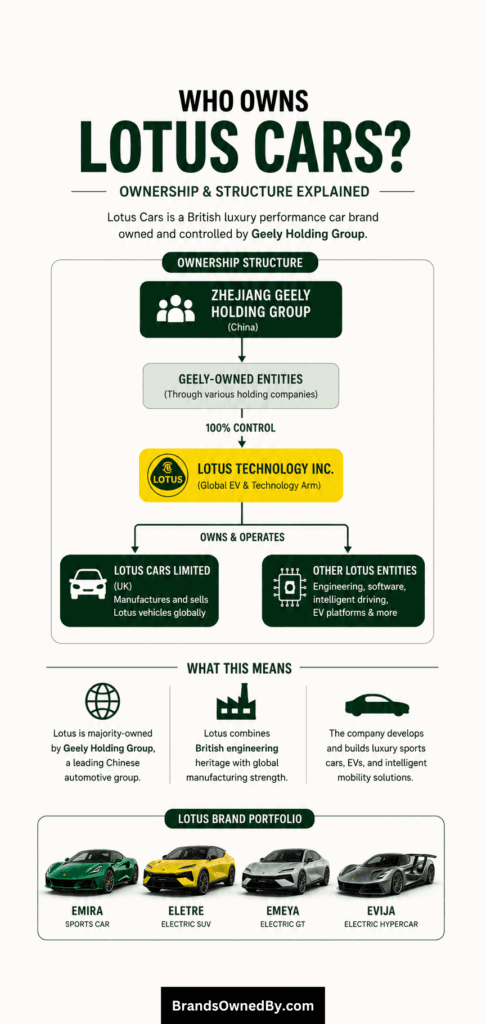
Lotus Cars is controlled by Zhejiang Geely Holding Group, the Chinese multinational automotive conglomerate led by billionaire entrepreneur Li Shufu. Geely became the controlling owner of Lotus in 2017 after acquiring the company from Malaysian automotive group DRB-HICOM, which previously owned Lotus through Proton.
As of May 2026, Lotus operates through a multi-layered ownership structure involving Geely-controlled holding companies, Lotus Technology Inc., Lotus Group International Limited, and minority institutional shareholders. Although Lotus Technology is publicly traded, Geely-affiliated entities still maintain majority voting control and remain the dominant force behind Lotus Cars’ strategic direction.
The ownership structure has evolved significantly since 2024 and 2025 because Lotus consolidated several UK and international operations under Lotus Technology. This restructuring strengthened Geely’s influence over manufacturing, EV operations, software development, and global expansion activities.
Zhejiang Geely Holding Group
Zhejiang Geely Holding Group is the largest shareholder and controlling owner of Lotus Cars.
In 2017, Geely acquired a 51% controlling stake in Lotus from DRB-HICOM. The remaining 49% stake was acquired by Etika Automotive, a Malaysian investment company. This ownership structure remained the foundation of Lotus operations for several years.
As of May 2026, Geely still effectively controls Lotus through multiple affiliated entities, including:
- Geely International (Hong Kong) Limited.
- Lotus Technology International Investment Limited.
- Lotus Advanced Technology Limited Partnership.
- Lotus Group International Limited.
These entities collectively hold majority voting rights across Lotus-related businesses.
Geely’s ownership influence extends far beyond simple equity participation. The company controls:
- EV platform sharing.
- Battery technology integration.
- Global manufacturing strategy.
- Vehicle software ecosystems.
- Autonomous driving investments.
- International supply chains.
- China market expansion.
A practical example of Geely’s influence is the Lotus Eletre SUV. The vehicle was developed using Geely-backed EV infrastructure, advanced digital architecture, and large-scale manufacturing capabilities that Lotus could not have funded independently.
Geely transformed Lotus from a niche British sports car company into a luxury electric mobility brand competing with Porsche, Tesla, Lucid, and high-end EV manufacturers.
Li Shufu (Eric Li) – Ultimate Controlling Shareholder
Li Shufu, also known internationally as Eric Li, is the ultimate controlling shareholder behind Lotus Cars because he controls Geely Holding Group.
As of February 2026 filings, Geely Holding itself is owned approximately:
- 82.2% by Li Shufu.
- 8.0% by Li Xingxing.
- 9.7% by Ningbo Yima Enterprise Management Partnership.
Through this structure, Li Shufu indirectly controls Lotus and several other major automotive brands.
His automotive portfolio includes:
- Volvo Cars.
- Polestar.
- Zeekr.
- Lynk & Co.
- Smart joint venture.
- LEVC.
- Lotus.
Li Shufu played a central role in Lotus’ transition toward premium electric vehicles and intelligent mobility systems.
Under his leadership, Lotus expanded into:
- Electric hypercars.
- Luxury EV SUVs.
- AI-powered driving systems.
- Connected mobility platforms.
- High-performance EV sedans.
He also supported the creation of Lotus Technology Inc., which became the company’s global EV and software-focused entity.
Etika Automotive
Etika Automotive was historically the second-largest shareholder in Lotus Cars.
When Geely acquired Lotus in 2017, Etika purchased the remaining 49% ownership stake in Lotus Advance Technologies Sdn Bhd, commonly referred to as Lotus UK.
Etika is linked to Malaysian billionaire Syed Mokhtar Albukhary and maintained strong relationships with DRB-HICOM and Proton.
For several years, the ownership structure looked like this:
| Shareholder | Historical Stake in Lotus UK |
|---|---|
| Geely Holding Group | 51% |
| Etika Automotive | 49% |
Etika’s involvement helped preserve continuity during Lotus’ transition from Proton ownership to Geely-led restructuring.
However, major changes occurred during 2025.
Etika exercised a put option requiring Lotus Technology to purchase its remaining 49% stake in Lotus UK. At the same time, Geely also initiated transactions involving its own Lotus UK holdings.
As a result, Lotus Technology moved toward full ownership integration of Lotus UK operations.
This restructuring allowed Lotus Technology to consolidate:
- Manufacturing operations.
- Engineering divisions.
- Sports car production.
- Hypercar development.
- EV business units.
Although Etika historically played a major role, its direct ownership influence has been significantly reduced following the 2025 restructuring process.
Lotus Technology Inc.
Lotus Technology Inc. became one of the most important entities within the Lotus ownership structure after the company expanded aggressively into electric vehicles.
The business was publicly listed through a Nasdaq SPAC transaction, allowing Lotus to raise capital from institutional and retail investors.
As of May 2026, Lotus Technology oversees:
- Electric vehicle operations.
- Intelligent driving systems.
- Software ecosystems.
- Global EV expansion.
- Digital mobility technologies.
Despite being publicly traded, Lotus Technology remains effectively controlled by Geely-affiliated entities because they hold majority voting power through interconnected holding structures.
The company had more than 642 million ordinary shares outstanding as of the end of 2025.
This structure allows Lotus to access public market financing while maintaining centralized strategic control under Geely leadership.
Lotus Advanced Technology Limited Partnership
Lotus Advanced Technology Limited Partnership is one of the key investment vehicles controlling Lotus Technology.
The entity functions primarily as a holding and investment platform tied to Geely-controlled ownership structures.
Through this structure, Geely-affiliated shareholders maintain significant beneficial ownership over Lotus Technology shares and voting rights.
This arrangement helps Geely preserve long-term control even while public shareholders own minority stakes through Nasdaq-listed shares.
Institutional and Public Shareholders
After Lotus Technology became publicly traded, institutional investors and public shareholders gained minority ownership exposure.
These shareholders include:
- Asset management firms.
- Hedge funds.
- EV-focused investment funds.
- Retail shareholders.
- Strategic mobility investors.
However, these investors collectively hold minority positions and do not control the company.
Their influence mainly relates to:
- Market valuation.
- Share liquidity.
- Public financing.
- Corporate governance oversight.
Geely-controlled entities still maintain dominant voting authority across the Lotus ecosystem.
Who Manufactures Lotus Cars?
Lotus Cars are manufactured by Lotus Cars Limited, the British automotive company headquartered in Hethel, Norfolk, England. The company is responsible for the design, engineering, development, and production of Lotus-branded vehicles.
As of 2026, Lotus operates through a global manufacturing and technology ecosystem that combines British engineering with Chinese-backed production infrastructure under parent company Geely Holding Group.
This means Lotus vehicles are no longer manufactured only in the United Kingdom. The company now uses a hybrid manufacturing model involving UK sports car production and China-based electric vehicle operations.
Lotus Cars Limited Manufactures Lotus Vehicles
Lotus Cars Limited is the main automotive manufacturing entity behind the Lotus brand.
The company handles:
- Vehicle engineering.
- Product development.
- Sports car manufacturing.
- Global vehicle distribution.
- Performance testing.
- Design integration.
Lotus Cars Limited remains one of the core operating businesses inside the broader Lotus ecosystem.
Historically, Lotus manufactured lightweight sports cars in relatively small numbers. However, after Geely acquired control of the company in 2017, Lotus expanded into large-scale luxury EV manufacturing and intelligent mobility systems.
As of 2026, Lotus manufactures several major vehicle lines including:
- Lotus Emira.
- Lotus Eletre.
- Lotus Emeya.
- Lotus Evija.
Each vehicle program uses different manufacturing and supply chain strategies depending on the model type.
Hethel, England Remains the Main Lotus Manufacturing Hub
Hethel, Norfolk remains the heart of Lotus manufacturing operations.
The facility has been associated with Lotus since 1966 and continues to function as the company’s primary British production and engineering center.
The Hethel site handles:
- Sports car production.
- Vehicle testing.
- Chassis engineering.
- Performance calibration.
- Prototype development.
- Manufacturing quality control.
The factory is especially important because Lotus’ brand identity remains closely tied to British engineering and motorsport heritage.
As of 2026, the Lotus Emira sports car is manufactured in Hethel.
The facility underwent major modernization after Geely invested heavily in the company. Upgrades included:
- Advanced assembly systems.
- Improved automation.
- Expanded production lines.
- Modern quality-control technologies.
The factory also includes Lotus’ famous test track, which was originally part of a former RAF airfield.
Many Lotus vehicles are still developed and tuned at Hethel before entering global production.
Lotus Emira Is Manufactured in the UK
The Lotus Emira is one of the most important vehicles still manufactured entirely in the United Kingdom.
Production takes place at the Hethel manufacturing facility in Norfolk.
The Emira became especially important because it replaced several previous Lotus sports car models including:
- Elise.
- Exige.
- Evora.
The vehicle combines traditional Lotus driving dynamics with more premium materials and global-market positioning.
Lotus invested significantly in the Emira production line to improve manufacturing quality and increase production capacity compared to earlier Lotus sports cars.
The model remains a major symbol of Lotus’ British manufacturing identity.
Lotus Electric Vehicles Are Connected to China-Based Manufacturing
Lotus’ electric vehicle manufacturing strategy is different from its traditional sports car operations.
Vehicles such as the Lotus Eletre and Lotus Emeya are heavily connected to Lotus Technology and Geely-backed manufacturing infrastructure in China.
This shift happened because EV production requires:
- Large-scale battery supply chains.
- Advanced electronics integration.
- Software ecosystems.
- High-volume manufacturing capacity.
China became central to Lotus’ EV operations because Geely already had extensive manufacturing capabilities and EV infrastructure there.
The company uses advanced Chinese facilities for:
- Luxury EV assembly.
- Battery integration.
- Intelligent driving technologies.
- Vehicle software systems.
- Digital cockpit development.
This manufacturing structure allows Lotus to compete more effectively against luxury EV rivals such as Porsche, Tesla, Lucid, NIO, and Mercedes-Benz.
Lotus Technology Plays a Major Manufacturing Role
Lotus Technology became one of the company’s most important operational entities after Lotus expanded aggressively into electric vehicles.
The division oversees many of Lotus’ modern manufacturing and EV-related activities.
As of 2026, Lotus Technology manages:
- EV production coordination.
- Intelligent mobility systems.
- Vehicle software integration.
- China-based operations.
- Global EV expansion.
- Smart manufacturing systems.
The company effectively acts as Lotus’ technology and EV manufacturing headquarters.
This structure separates Lotus’ traditional British sports car operations from its high-growth electric mobility business.
Geely Supports Lotus Manufacturing Globally
Although Lotus manufactures its own vehicles, the company now relies heavily on Geely’s industrial ecosystem.
Geely provides:
- Global supply chains.
- Battery sourcing.
- Manufacturing infrastructure.
- EV platform technologies.
- Software integration.
- Production scalability.
This support became essential because modern automotive manufacturing requires massive investment.
Without Geely’s backing, Lotus would likely struggle to compete in large-scale EV production.
A practical example is the Lotus Eletre.
Developing a luxury electric SUV independently would have required billions of dollars in battery development, manufacturing capacity, and software systems. Geely’s infrastructure allowed Lotus to scale production much faster than it could alone.
Lotus Manufacturing Focus Changed After Geely Acquisition
Before Geely acquired Lotus in 2017, the company mainly produced low-volume sports cars for enthusiasts.
Manufacturing was relatively small-scale and heavily centered around lightweight internal combustion vehicles.
After Geely’s investment, Lotus shifted toward:
- Luxury EV manufacturing.
- Hybrid-electric platforms.
- Intelligent mobility systems.
- Larger production volumes.
- Global distribution expansion.
This transformation changed Lotus from a niche British manufacturer into a globally integrated luxury automotive business.
Who Builds Lotus Engines?
Lotus has historically sourced engines from external manufacturers while focusing internally on:
- Chassis engineering.
- Vehicle dynamics.
- Suspension tuning.
- Lightweight design.
Several modern Lotus models use engines supplied by Toyota and Mercedes-AMG.
For example:
- The Lotus Emira V6 uses a Toyota-sourced 3.5-liter engine.
- The Emira i4 uses a Mercedes-AMG turbocharged engine.
Lotus then calibrates and modifies these powertrains to match its own performance and driving characteristics.
This strategy allows Lotus to focus resources on handling, aerodynamics, and engineering refinement rather than developing entirely new engines from scratch.
Competitor Ownership Comparison
Lotus Cars competes against some of the world’s most recognizable luxury sports car and premium electric vehicle brands. However, one important reality defines the modern automotive industry: most high-performance automotive companies are no longer fully independent.
Rising development costs in electric vehicles, battery systems, autonomous driving software, and global manufacturing have pushed luxury automakers toward consolidation. As of May 2026, nearly every major performance car brand is controlled either by a multinational automotive group, sovereign wealth-backed investors, or billionaire-led holding companies.
Lotus follows this model under Zhejiang Geely Holding Group. The company now operates with financial and technological backing from one of the world’s largest automotive conglomerates.
Comparing Lotus ownership with its competitors helps explain how different automotive groups approach luxury performance vehicles, EV expansion, and global market growth.
| Brand | Parent Company / Controlling Owner | Ownership Structure (May 2026) | Key Strategic Advantage |
|---|---|---|---|
| Lotus Cars | Zhejiang Geely Holding Group | Geely controls Lotus through Geely-affiliated entities and Lotus Technology Inc. | Access to EV technology, Chinese manufacturing scale, battery supply chains, and intelligent driving systems. |
| Ferrari | Exor N.V. | Exor owns around 24% equity stake with stronger voting control; Ferrari remains publicly traded. | High profit margins, exclusivity, Formula One branding, and strong operational independence. |
| Porsche | Volkswagen Group | Volkswagen Group remains majority owner despite Porsche AG public listing. | Shared EV platforms, global manufacturing infrastructure, and large-scale R&D resources. |
| Lamborghini | Audi AG / Volkswagen Group | Lamborghini operates under Audi, which is controlled by Volkswagen Group. | Shared engineering systems, advanced manufacturing, and platform integration. |
| McLaren Automotive | CYVN Holdings and sovereign-backed investors | Ownership involves Abu Dhabi-backed CYVN Holdings and Bahrain sovereign wealth participation. | Independent supercar positioning and specialized performance engineering. |
| Aston Martin | Public company with strategic investors | Controlled primarily by Yew Tree Consortium led by Lawrence Stroll alongside Saudi and Mercedes-linked investors. | Mercedes-AMG technology partnerships and luxury performance branding. |
| Maserati | Stellantis | Maserati operates within Stellantis’ multi-brand automotive structure. | Access to global production networks and shared automotive technologies. |
| Polestar | Geely Holding Group and Volvo Cars | Geely and Volvo remain the dominant shareholders in Polestar. | Shared EV platforms, Scandinavian branding, and Chinese manufacturing support. |
| Tesla | Publicly traded led by Elon Musk | Elon Musk remains the company’s largest shareholder. | Vertically integrated EV ecosystem, AI systems, and charging infrastructure. |
| Bugatti Rimac | Rimac Group and Porsche | Joint ownership structure between Rimac Group and Porsche AG. | Hypercar engineering expertise and EV performance technology. |
| Bentley | Volkswagen Group | Bentley operates as a Volkswagen Group luxury subsidiary. | Shared luxury vehicle architecture and global distribution support. |
| Rolls-Royce Motor Cars | BMW Group | Fully owned subsidiary of BMW Group. | Ultra-luxury engineering, global dealer network, and advanced powertrain technology. |
| Bentley | Volkswagen Group | Bentley remains fully controlled by Volkswagen Group. | Shared luxury platforms, premium engineering resources, and electrification support. |
| Alfa Romeo | Stellantis | Alfa Romeo operates as part of Stellantis’ global brand portfolio. | Shared manufacturing systems and access to Stellantis EV development. |
Lotus Cars: Controlled by Zhejiang Geely Holding Group
Lotus Cars is controlled by Zhejiang Geely Holding Group, the Chinese automotive conglomerate founded by Li Shufu.
Geely originally acquired a 51% controlling stake in Lotus in 2017 from DRB-HICOM and Proton. Since then, the ownership structure has evolved through Lotus Technology Inc., Geely-affiliated investment entities, and international restructuring transactions completed during 2024 and 2025.
As of May 2026, Geely remains the dominant shareholder and effective controlling authority behind Lotus operations.
This ownership structure fundamentally changed Lotus’ business model.
Historically, Lotus operated as a small British sports car manufacturer known mainly for lightweight gasoline-powered vehicles such as the Elise and Exige. Under Geely, the company expanded into luxury EVs, intelligent driving systems, and large-scale global manufacturing.
A practical example is the Lotus Eletre electric SUV. Developing a premium EV platform independently would have been extremely difficult for Lotus because of the massive investment required in battery systems, software architecture, and supply chains. Geely’s ownership provided the capital and industrial ecosystem needed to launch the vehicle globally.
Lotus also benefits from Geely’s broader automotive network, which includes Volvo Cars, Polestar, Zeekr, Lynk & Co., and Smart-related partnerships.
Ferrari: Controlled by Exor N.V.
Ferrari has one of the most unique ownership structures in the luxury automotive industry.
The company operates as a publicly traded automaker, but the Agnelli family maintains effective control through Exor N.V., its investment holding company.
As of May 2026:
| Major Ferrari Shareholder | Approximate Stake |
|---|---|
| Exor N.V. | Around 24% equity stake |
| Piero Ferrari | Around 10% |
| Public & Institutional Investors | Remaining majority |
Although Exor owns less than half of Ferrari’s total shares, it controls a significantly larger portion of voting power. This allows the Agnelli family to maintain long-term strategic control.
Ferrari differs from Lotus in several ways.
First, Ferrari generates extremely high profit margins and operates with limited production volumes. Second, the company maintains stronger operational independence compared to Lotus under Geely. Ferrari does not rely heavily on platform-sharing strategies with mass-market automotive brands.
Instead, Ferrari focuses on:
- Exclusivity.
- Motorsport branding.
- Ultra-premium customization.
- Limited production runs.
- High-margin supercars.
Ferrari’s Formula One presence also remains central to its identity and global marketing strategy.
Porsche: Controlled by Volkswagen Group
Porsche is controlled by Volkswagen Group, one of the largest automotive corporations in the world.
Although Porsche AG became publicly traded, Volkswagen still maintains majority control over the company.
As of May 2026, Volkswagen Group remains Porsche’s dominant shareholder through a layered corporate ownership structure involving Porsche Automobil Holding SE.
Porsche benefits heavily from Volkswagen’s global resources.
This includes access to:
- Shared EV platforms.
- Battery development.
- Software systems.
- Manufacturing infrastructure.
- Autonomous driving research.
- Global purchasing power.
For example, Porsche’s Taycan EV shares major technology architecture with Audi electric vehicle programs.
Lotus operates in a somewhat similar way under Geely because both brands rely on parent-group technology ecosystems to accelerate product development and reduce costs.
However, Porsche operates at a much larger scale than Lotus and generates substantially higher global sales volumes.
Lamborghini: Owned by Audi and Volkswagen Group
Lamborghini is indirectly controlled by Volkswagen Group through Audi.
This ownership model gives Lamborghini access to German engineering expertise, advanced manufacturing systems, and large-scale research and development resources.
The relationship became especially important after Lamborghini expanded beyond traditional supercars into the luxury SUV market with the Urus.
Several Lamborghini technologies now share connections with broader Volkswagen Group systems used across Audi, Porsche, and Bentley platforms.
This strategy mirrors Lotus’ modern approach under Geely ownership.
Both companies preserve distinct brand identities while leveraging parent-company technology and manufacturing support behind the scenes.
However, Lamborghini remains more focused on ultra-luxury combustion supercars and hybrid hypercars, while Lotus is transitioning aggressively toward fully electric performance vehicles.
McLaren Automotive: Backed by Sovereign Wealth Investors
McLaren Automotive operates under a very different ownership structure compared to Lotus.
Instead of being controlled by a major automotive conglomerate, McLaren has relied heavily on sovereign wealth investors and restructuring capital.
As of May 2026, Abu Dhabi-backed CYVN Holdings became one of the most influential stakeholders connected to McLaren’s restructuring and future investment activities. Bahrain sovereign wealth fund Mumtalakat also remained deeply involved in the company’s ownership structure.
McLaren’s relative independence provides greater design freedom and brand exclusivity. However, it also creates financial pressure because the company lacks the massive industrial ecosystem available to competitors like Lotus under Geely.
This difference became especially visible during industry-wide EV transitions.
While Lotus gained direct access to Geely’s EV infrastructure and battery technologies, McLaren had to rely more heavily on partnerships and external funding sources to support long-term electrification plans.
Aston Martin: Controlled by Strategic Investor Groups
Aston Martin operates as a publicly traded British luxury automaker, but its ownership structure is heavily influenced by strategic investor groups.
As of May 2026, major stakeholders include:
| Major Aston Martin Shareholder | Approximate Stake |
|---|---|
| Yew Tree Consortium (Lawrence Stroll) | Around 27% |
| Saudi Public Investment Fund | Significant minority stake |
| Mercedes-Benz Group | Around 9% |
| Institutional Investors | Remaining ownership |
Mercedes-Benz plays a particularly important role because Aston Martin relies on Mercedes-AMG technology for engines, electronics, infotainment systems, and software integration.
This partnership helps Aston Martin reduce development costs while remaining competitive against larger luxury automakers.
Lotus follows a similar logic under Geely ownership, although Lotus is more deeply integrated into its parent company’s technology ecosystem.
Maserati: Owned by Stellantis
Maserati is owned by Stellantis, the multinational automotive group created through the merger of Fiat Chrysler Automobiles and PSA Group.
Stellantis controls numerous global automotive brands including Jeep, Dodge, Peugeot, Alfa Romeo, Chrysler, Fiat, and Ram.
Unlike Lotus, Maserati operates inside a broader multi-brand automotive organization with large global production capabilities.
However, Maserati has faced challenges in maintaining a clear identity within the Stellantis portfolio.
Lotus, meanwhile, has benefited from Geely positioning the brand specifically around premium electric performance vehicles and advanced mobility technologies.
Both companies compete increasingly in the luxury EV and performance SUV categories.
Polestar: Controlled by Geely and Volvo Cars
Polestar represents one of the closest ownership comparisons to Lotus because both brands exist inside Geely’s automotive ecosystem.
Polestar originally started as Volvo’s performance division before becoming a standalone electric vehicle brand.
As of May 2026, Geely and Volvo Cars remain the dominant shareholders behind Polestar.
The company benefits from:
- Shared EV platforms.
- Battery sourcing.
- Chinese manufacturing.
- Volvo safety technologies.
- Global supply chains.
Although Lotus and Polestar share corporate connections, their market positioning differs significantly.
Polestar focuses more on minimalist Scandinavian EV luxury and sustainable mobility. Lotus emphasizes high-performance driving dynamics, motorsport heritage, and premium sports-oriented engineering.
Tesla: Publicly Traded but Elon Musk Led
Tesla differs from Lotus and most traditional competitors because it remains relatively independent from major automotive conglomerates.
The company operates as a publicly traded corporation, with Elon Musk remaining the largest shareholder as of May 2026.
Tesla controls much of its own ecosystem internally, including:
- Battery technology.
- Vehicle software.
- AI systems.
- Charging infrastructure.
- Autonomous driving development.
- Manufacturing operations.
Unlike Lotus, Tesla built its EV infrastructure independently rather than relying on a parent automotive group.
However, Tesla also operates at a much larger scale than Lotus and targets broader segments of the premium EV market.
Lotus competes more directly in the luxury performance EV niche rather than the mass-premium EV categories.
Who Controls Lotus Cars?
Lotus Cars is controlled through a combination of shareholder authority, board-level governance, and executive management led primarily by Zhejiang Geely Holding Group and Lotus Technology executives.
As of May 2026, Geely is not just a passive investor in Lotus. The company exercises direct strategic control through majority voting power, board representation, executive appointments, and integrated operational oversight across Lotus Cars and Lotus Technology.
The control structure became more centralized after Lotus completed several restructuring transactions during 2024 and 2025. These transactions consolidated Lotus UK operations, EV businesses, technology divisions, and international entities under the broader Lotus Technology ecosystem.
Today, control over Lotus is divided across three major layers:
- Geely Holding Group controls ownership and long-term strategy.
- Lotus Technology manages EV operations, global expansion, and digital systems.
- Lotus Cars UK leadership oversees engineering, manufacturing, and product execution.
This structure allows Lotus to maintain its British performance identity while operating with Chinese financial backing and large-scale EV infrastructure.
Geely Holding Group Controls the Company Through Majority Voting Power
Zhejiang Geely Holding Group is the ultimate controlling entity behind Lotus Cars.
Although Lotus Technology is publicly traded on Nasdaq, Geely-affiliated entities maintain majority beneficial ownership and voting control through a network of holding companies connected to founder Li Shufu.
As of May 2026, Geely-controlled entities collectively hold more than 55% voting control over Lotus Technology-related operations. This gives Geely authority over:
- Board appointments.
- Executive leadership decisions.
- Capital allocation.
- Acquisitions and restructuring.
- Manufacturing strategy.
- EV platform integration.
- International expansion.
The company’s control is exercised through entities including:
| Geely-Linked Entity | Role in Lotus Control Structure |
|---|---|
| Geely Holding Group | Parent automotive conglomerate controlling Lotus |
| Lotus Group International Limited | Major holding structure for Lotus operations |
| Lotus Technology International Ltd. | EV and mobility investment structure |
| Lotus Advanced Technology LP | Voting and ownership control vehicle |
| Geely International (Hong Kong) | International ownership coordination |
This governance model closely resembles how Geely controls other global automotive brands such as Volvo Cars and Polestar.
Unlike independent sports car companies, Lotus now operates as part of a centralized multinational automotive ecosystem.
Li Shufu Is the Ultimate Controlling Individual
Li Shufu, also known globally as Eric Li, is the most powerful individual behind Lotus Cars.
He founded Geely and remains chairman of Zhejiang Geely Holding Group.
As of early 2026 filings, Li Shufu indirectly controls Geely through majority ownership stakes in the parent organization. Because Geely controls Lotus, Li Shufu ultimately controls Lotus as well.
His influence over Lotus includes:
- Approval of major investment decisions.
- EV expansion strategy.
- Global partnerships.
- Chinese market positioning.
- Technology ecosystem integration.
- Cross-brand platform sharing.
Li Shufu was directly responsible for repositioning Lotus from a niche British sports car manufacturer into a global luxury EV company.
Under his leadership, Lotus launched several major projects including:
- Lotus Eletre electric SUV.
- Lotus Emeya electric GT.
- Lotus Evija hypercar.
- Lotus Technology’s intelligent mobility platform.
The strategic shift toward electric luxury vehicles was heavily driven from the Geely level rather than only from Lotus UK management.
This is one reason Lotus expanded into larger premium vehicles despite historically being associated with lightweight two-seat sports cars.
Feng Qingfeng Oversees Lotus’ Global Business Operations
Feng Qingfeng is one of the most important executives currently controlling Lotus operations.
As of May 2026, he serves as Chief Executive Officer of Lotus Technology and plays a central role in the company’s global restructuring, EV strategy, and operational integration.
Feng has become the public face of Lotus’ transformation into a technology-driven luxury EV brand.
His responsibilities include:
- Global business strategy.
- EV product planning.
- International market expansion.
- Investor relations.
- Technology partnerships.
- Manufacturing integration.
- Digital mobility development.
He also oversees coordination between Lotus’ UK engineering operations and Chinese EV manufacturing infrastructure.
Under Feng’s leadership, Lotus accelerated its expansion in China, Europe, and premium EV markets.
One practical example of his influence is the commercialization strategy behind the Lotus Eletre. The vehicle was designed not only as a performance SUV but also as a technology platform capable of competing with Porsche, Tesla, Lucid, and high-end Chinese EV brands.
Feng also played a key role in Lotus Technology’s Nasdaq listing and subsequent restructuring activities involving Lotus UK ownership consolidation.
Lotus Technology Became the Main Operational Control Center
Lotus Technology is now one of the most important operational entities inside the Lotus ecosystem.
Historically, Lotus Cars UK handled most automotive operations independently from Hethel, England. However, the company’s global expansion and EV transition required a much larger organizational structure.
The company effectively functions as Lotus’ modern global mobility and EV headquarters.
Although Lotus Cars UK still manages sports car engineering and performance tuning, Lotus Technology controls many of the company’s highest-growth business areas.
Lotus Cars UK Still Controls Engineering and Brand Identity
Despite Geely’s financial control, Lotus still maintains strong operational leadership in the United Kingdom.
The Hethel facility in Norfolk remains the center of:
- Sports car engineering.
- Chassis development.
- Vehicle dynamics testing.
- Manufacturing quality control.
- Brand heritage preservation.
This UK engineering structure remains extremely important because Lotus’ brand identity is closely tied to British motorsport history and lightweight performance engineering.
Executives managing Lotus Cars UK focus heavily on preserving characteristics traditionally associated with Lotus vehicles, including:
- Steering precision.
- Lightweight handling.
- Driver-focused dynamics.
- Motorsport-inspired performance.
This balance between Chinese ownership and British engineering has become one of Lotus’ defining corporate characteristics.
Board Governance Structure
Lotus governance operates through board-level oversight tied closely to Geely-controlled ownership structures.
Because Geely maintains majority voting power, Geely-affiliated representatives hold significant influence over:
- Corporate governance.
- Executive appointments.
- Strategic restructuring.
- Financial planning.
- Mergers and acquisitions.
- International investment decisions.
Lotus Technology’s board structure includes executives connected to Geely’s broader automotive ecosystem as well as independent directors linked to public market governance requirements.
Since Lotus Technology is publicly traded, the company must also comply with Nasdaq governance standards, financial reporting rules, and shareholder disclosure obligations.
This creates a hybrid governance structure combining:
- Public-company oversight.
- Geely-controlled strategic authority.
- International automotive governance practices.
Recent Leadership Evolution
Lotus leadership changed significantly during the company’s transformation from a niche sports car maker into a global EV brand.
Several executives played important roles in this transition.
| Executive | Leadership Impact |
|---|---|
| Feng Qingfeng | Led Lotus Technology expansion and EV restructuring |
| Matt Windle | Managed UK sports car operations and Hethel manufacturing |
| Phil Popham | Helped reposition Lotus globally during early EV transition |
| Dany Bahar | Attempted aggressive luxury expansion during Proton era |
The leadership transition reflects how ownership priorities changed over time.
During the Proton years, Lotus focused mainly on maintaining sports car operations with limited financial resources. Under Geely, management priorities shifted toward:
- EV scaling.
- Global luxury positioning.
- Technology ecosystems.
- Software integration.
- China expansion.
- Public market financing.
Lotus Cars Annual Revenue and Net Worth
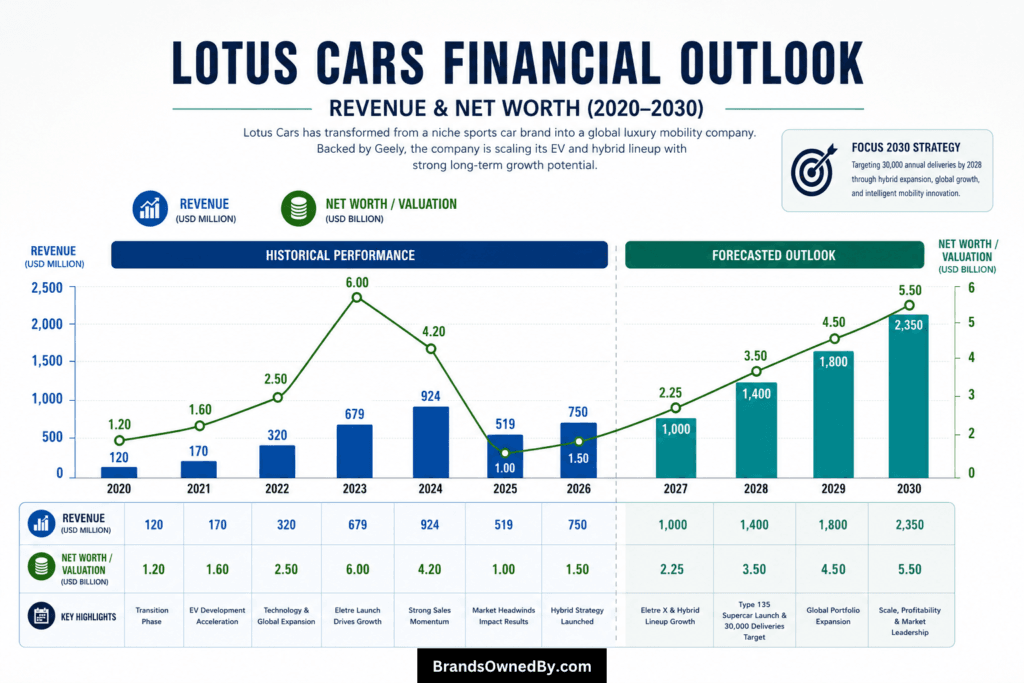
Lotus Cars entered a completely different financial era after Geely acquired control of the company. The business shifted from a small-volume British sports car manufacturer into a global luxury mobility and electric vehicle company operating through Lotus Technology Inc.
As of May 2026, Lotus generates revenue from multiple business segments including luxury EV sales, sports cars, engineering services, intelligent driving systems, software integration, and technology commercialization.
The company’s latest reported full-year revenue stood at $519 million for 2025, while its estimated market valuation and broader enterprise worth fluctuated between $1 billion and $1.8 billion depending on public market conditions, strategic assets, and future growth expectations. Although Lotus remains unprofitable, the company significantly reduced losses during 2025 and improved operational efficiency under Geely-backed restructuring.
Lotus’ financial position is now heavily tied to its luxury EV strategy, hybrid expansion plans, and long-term “Focus 2030” roadmap.
Lotus Revenue Growth Transformation
Lotus generated relatively modest revenue before Geely transformed the company into a luxury EV manufacturer.
Between 2020 and 2022, the company mainly relied on:
- Traditional sports car sales.
- Lotus Engineering services.
- Limited global vehicle deliveries.
- Small-scale manufacturing operations.
The launch of the Lotus Eletre SUV and Lotus Emeya GT dramatically changed the company’s revenue profile.
In 2023, Lotus revenue surged to approximately $679 million as global deliveries expanded and EV commercialization accelerated. The Nasdaq listing of Lotus Technology also increased investor attention around the company’s future valuation potential.
Revenue reached approximately $924 million in 2024 as Lotus expanded sales in China, Europe, and North America. This became the company’s strongest revenue year since its restructuring under Geely.
However, 2025 became a transition year.
Global EV demand weakened, tariffs disrupted certain markets, and Lotus reduced inventory while rolling out upgraded vehicle models. As a result, full-year revenue declined to $519 million despite improved gross margins and better cost controls.
Lotus 2025 Revenue Breakdown
Lotus reported $519 million in total revenue for full-year 2025.
The revenue decline reflected lower global deliveries, especially in Europe and North America. Total deliveries fell to 6,520 vehicles compared to nearly 12,000 vehicles during 2024.
The company’s revenue composition was divided across several business areas.
Vehicle sales remained the largest contributor. This included deliveries of:
- Lotus Eletre SUV.
- Lotus Emeya GT.
- Lotus Emira sports car.
- Other premium performance vehicles.
Lifestyle SUVs and sedans generated the majority of deliveries. These models accounted for 4,552 units during 2025, while sports cars contributed 1,968 units.
China became Lotus’ largest single regional market in 2025.
The geographic delivery breakdown looked like this:
| Region | 2025 Deliveries | Share of Total Deliveries |
|---|---|---|
| China | 2,960 | 45% |
| Europe | 2,198 | 34% |
| North America | 1,048 | 16% |
| Rest of World | 314 | 5% |
One of the company’s most important developments during 2025 was growth in service revenue and technology commercialization.
Lotus reported that service-related revenue increased 69% year-over-year, driven largely by:
- R&D services.
- Engineering commercialization.
- Technical licensing.
- Intelligent driving systems.
This is important because Lotus is increasingly positioning itself not only as an automaker but also as a luxury mobility technology company.
Lotus Gross Margin and Profitability Improvements
Although revenue declined during 2025, Lotus improved profitability metrics substantially.
Gross margin increased to 9% in 2025 compared to only 3% during 2024.
This improvement came from:
- Better product mix.
- Upgraded model deliveries.
- Reduced operational inefficiencies.
- Cost optimization measures.
- Improved pricing discipline.
The company also reduced operating losses significantly.
Key 2025 financial figures included:
| Financial Metric (2025) | Amount |
|---|---|
| Revenue | $519 million |
| Gross Profit | $45 million |
| Gross Margin | 9% |
| Operating Loss | $423 million |
| Net Loss | $464 million |
| Adjusted EBITDA Loss | $356 million |
Net losses narrowed substantially compared to 2024, when Lotus reported losses exceeding $1.1 billion.
This reduction demonstrated that Lotus’ restructuring strategy and operational controls were beginning to stabilize the business financially.
Lotus Net Worth and Market Valuation in 2026
As of May 2026, Lotus Technology’s public market capitalization fluctuated around $1 billion depending on Nasdaq trading conditions and investor sentiment toward luxury EV companies.
However, the company’s broader strategic value is significantly larger than its public stock market value alone.
Lotus owns several high-value assets including:
- Lotus brand intellectual property.
- Performance engineering technologies.
- EV platforms.
- Intelligent driving systems.
- Motorsport heritage.
- Lotus Engineering operations.
- Premium vehicle architecture.
Analysts and industry observers estimate Lotus’ broader enterprise valuation could range between $1.2 billion and $1.8 billion depending on future profitability expectations and execution of its Focus 2030 strategy.
Geely’s continued financial support also strengthens Lotus’ long-term stability because the company benefits from:
- Shared EV development.
- Battery supply chains.
- Manufacturing infrastructure.
- Technology integration.
- Access to Chinese luxury EV markets.
Without Geely’s backing, Lotus would likely face much greater financing pressure due to the enormous capital requirements associated with luxury EV manufacturing.
2026 Financial Position and Business Strategy
As of May 2026, Lotus is undergoing another strategic transition.
The company officially scaled back its earlier plan to become fully electric by 2028. Instead, Lotus introduced a hybrid-focused strategy called “Focus 2030.”
Under this roadmap, Lotus now aims for:
- 60% hybrid vehicles.
- 40% battery-electric vehicles.
This decision reflects slowing global EV demand and reduced government subsidies across major markets.
Lotus also launched its first major plug-in hybrid model, called “For Me” in China and “Eletre X” in Europe.
The vehicle uses Lotus’ 900V X-Hybrid platform and delivers:
- More than 1,400 kilometers combined range.
- 0–100 km/h acceleration in 3.3 seconds.
- Advanced intelligent driving capabilities.
According to Lotus executives, the Eletre X received more than 1,000 preorders shortly after launch in China.
Future Revenue Forecast Through 2030
Lotus expects long-term revenue growth to accelerate again as hybrid expansion, new product launches, and operational integration improve profitability.
The company is targeting approximately 30,000 annual vehicle deliveries by 2028 under its Focus 2030 strategy.
Projected revenue and valuation estimates as of May 2026 include:
- 2026 forecast revenue: $700 million–$850 million.
- 2027 forecast revenue: Around $1 billion.
- 2028 forecast revenue: Around $1.4 billion.
- 2029 forecast revenue: Around $1.8 billion.
- 2030 forecast revenue: $2.2 billion–$2.5 billion.
Estimated valuation and net worth projections include:
- 2026 estimated valuation: $1.2 billion–$1.8 billion.
- 2027 estimated valuation: Around $2 billion–$2.5 billion.
- 2028 estimated valuation: Around $3 billion–$4 billion.
- 2029 estimated valuation: Around $4 billion–$5 billion.
- 2030 estimated valuation: Around $5 billion–$6 billion.
Much of this future growth depends on:
- Hybrid vehicle adoption.
- China expansion.
- European luxury EV demand.
- Type 135 supercar launch in 2028.
- Intelligent mobility technologies.
- Operational consolidation between Lotus UK and Lotus Technology.
The company also expects deeper integration with Geely to improve margins, reduce manufacturing costs, and strengthen supply chain efficiency over the remainder of the decade.
Brands Owned by Lotus Cars
As of May 2026, Lotus operates a much broader ecosystem than its historical image as a lightweight British sports car manufacturer. The company now controls multiple automotive brands, EV product lines, technology platforms, engineering entities, software systems, and intelligent mobility businesses under the broader Lotus structure.
Unlike conglomerates such as Volkswagen Group or Stellantis, Lotus does not own dozens of unrelated automotive marques. Instead, the company focuses on expanding the Lotus-branded ecosystem itself through specialized subsidiaries, EV operations, software platforms, engineering businesses, and luxury performance vehicle programs.
Most of the company’s expansion happened internally after Geely acquired Lotus in 2017. Instead of buying external automotive brands, Lotus built new entities tied directly to electric mobility, software integration, intelligent driving systems, and luxury EV manufacturing.
| Company / Brand / Entity | Type | Primary Function | Key Details as of 2026 |
|---|---|---|---|
| Lotus Cars | Automotive Manufacturer | Core vehicle manufacturing and global automotive operations | Main automotive business headquartered in Hethel, England. Oversees production, sales, engineering, and global distribution of Lotus-branded vehicles. |
| Lotus Technology Inc. | EV & Mobility Company | Electric vehicles, intelligent mobility, and software ecosystem | Nasdaq-listed entity managing Lotus’ EV operations, connected technologies, AI systems, and global digital expansion strategy. |
| Lotus Engineering | Engineering Consultancy | Automotive engineering and performance development | Provides chassis tuning, lightweight engineering, EV development, suspension systems, and vehicle dynamics consulting to automotive manufacturers globally. |
| Lotus Robotics | Intelligent Driving Entity | Autonomous driving and AI-powered mobility systems | Develops advanced driver assistance systems, autonomous technologies, AI driving software, and intelligent cockpit systems. |
| Lotus Advanced Performance | Bespoke Performance Division | Hypercar development and vehicle personalization | Handles limited-production projects, high-performance customization, special editions, and ultra-premium engineering programs. |
| Lotus Hyper OS | Vehicle Software Platform | Proprietary vehicle operating system | Powers infotainment, vehicle connectivity, intelligent cockpit systems, over-the-air updates, and software integration across Lotus EVs. |
| Lotus Emira | Sports Car Brand | Premium internal combustion sports car lineup | One of Lotus’ final major gasoline-powered sports car programs. Replaced Elise, Exige, and Evora product families. Manufactured in Hethel. |
| Lotus Eletre | Luxury Electric SUV Brand | Premium EV SUV operations | Lotus’ first luxury electric SUV and one of its largest commercial programs. Competes in the global premium performance SUV market. |
| Lotus Emeya | Luxury Electric GT Brand | High-performance electric grand touring sedan | Premium EV grand tourer competing with Porsche Taycan and Lucid Air. Focuses on performance, luxury, and intelligent software systems. |
| Lotus Evija | Electric Hypercar Brand | Ultra-high-performance EV hypercar program | Limited-production electric hypercar producing more than 2,000 horsepower. Serves as Lotus’ flagship technology showcase vehicle. |
| Lotus Type 135 | Future Sports Car Platform | Next-generation electrified sports car architecture | Future lightweight electrified sports car project expected to replace the Emira-era platform later in the decade. |
| Lotus 900V Hyper Hybrid Platform | Hybrid Technology Platform | Hybrid-electric vehicle architecture | Advanced 900V platform supporting ultra-fast charging, long-range hybrid systems, and intelligent performance mobility technologies. |
| Lotus “For Me” | Hybrid Vehicle Brand | Luxury plug-in hybrid product line | Hybrid-focused luxury vehicle lineup launched initially in China using Lotus’ 900V Hyper Hybrid platform. |
| Lotus Lifestyle Division | Lifestyle & Merchandise Business | Premium branded merchandise and apparel | Oversees Lotus-branded fashion, collectibles, accessories, and luxury lifestyle products tied to the company’s motorsport identity. |
| Lotus Motorsport Heritage Assets | Motorsport Intellectual Property | Racing legacy and performance branding | Includes historical motorsport branding, racing technologies, Formula One heritage assets, and performance engineering intellectual property. |
| Lotus Manufacturing Operations Hethel | Manufacturing Entity | UK vehicle manufacturing operations | Main production facility located in Norfolk, England. Responsible for sports car assembly, engineering integration, and performance vehicle manufacturing. |
| Lotus China Operations | Regional EV Operations | China-based manufacturing and EV expansion | Oversees Lotus’ luxury EV expansion in China including sales, technology deployment, intelligent mobility systems, and regional partnerships. |
| Lotus Intelligent Cockpit Systems | Software & Vehicle Interface Platform | Smart cabin and digital interaction systems | Develops AI-integrated cockpit experiences, digital interfaces, voice systems, and connected in-car technologies. |
| Lotus Connected Mobility Ecosystem | Mobility Technology Platform | Connected vehicle and digital services infrastructure | Supports vehicle connectivity, cloud-based services, remote diagnostics, and intelligent mobility integration across Lotus EVs. |
| Lotus Global Retail Network | International Sales Entity | Worldwide dealership and retail operations | Manages Lotus showrooms, retail expansion, customer services, and global luxury vehicle distribution channels. |
Lotus Cars
Lotus Cars remains the core automotive manufacturing business and the company’s most important operating entity.
This division designs, engineers, manufactures, and sells Lotus-branded vehicles globally. The business is headquartered in Hethel, Norfolk, England, where Lotus has operated for decades.
Lotus Cars oversees all major production vehicle programs including:
- Lotus Emira.
- Lotus Eletre.
- Lotus Emeya.
- Lotus Evija.
Historically, Lotus Cars specialized in lightweight internal combustion sports cars. However, after Geely-backed restructuring, the company transformed into a luxury performance and EV-focused manufacturer.
The division now competes across multiple segments including:
- Luxury electric SUVs.
- Premium EV sedans.
- Hypercars.
- High-performance sports cars.
- Intelligent mobility vehicles.
Lotus Cars also controls global dealership operations, customer programs, manufacturing activities, and international distribution networks.
The Hethel factory remains central to Lotus’ manufacturing identity and still produces the Emira sports car as of 2026.
Lotus Technology Inc.
Lotus Technology Inc. became one of the company’s most important entities after Lotus expanded aggressively into electric vehicles and software-defined mobility.
The business was created to manage Lotus’ modern EV ecosystem and later became publicly traded through a Nasdaq listing.
As of 2026, Lotus Technology controls:
- EV development.
- Intelligent driving systems.
- Vehicle software architecture.
- Smart cockpit ecosystems.
- Connected mobility technologies.
- International EV operations.
- Digital infrastructure platforms.
The company effectively functions as Lotus’ global technology and electric mobility headquarters.
Lotus Technology became especially important after Lotus shifted away from being purely a sports car manufacturer.
The division now oversees many of the company’s highest-growth projects, particularly in China and luxury EV markets.
It also manages the company’s broader Focus 2030 strategy, which includes hybrid-electric expansion and intelligent mobility systems.
Lotus Engineering
Lotus Engineering is one of the company’s oldest and most respected operating entities.
The division operates as an automotive engineering consultancy business serving manufacturers worldwide.
Unlike the consumer-facing vehicle division, Lotus Engineering generates revenue through technical services, performance development, and advanced engineering solutions.
As of 2026, the division specializes in:
- Vehicle dynamics.
- Chassis engineering.
- Lightweight structures.
- Suspension systems.
- EV architecture.
- Performance calibration.
- Hybrid powertrain integration.
Lotus Engineering has worked with numerous automotive companies over the years.
Historically, the division contributed to engineering programs connected to:
- General Motors.
- Proton.
- Tesla.
- Various European and Asian automakers.
The engineering business remains strategically important because it allows Lotus to monetize technical expertise beyond vehicle sales.
The division also supports Lotus’ own internal EV and hybrid programs.
Lotus Robotics
Lotus Robotics is the company’s intelligent driving and autonomous mobility entity.
The division was established as Lotus expanded deeper into AI-driven transportation systems and software-based automotive technologies.
As of May 2026, Lotus Robotics develops:
- Autonomous driving systems.
- Advanced driver assistance technologies.
- AI-powered vehicle software.
- Smart cockpit ecosystems.
- Connected mobility platforms.
- Intelligent navigation systems.
This entity became increasingly important because luxury EV competition now depends heavily on software and intelligent driving capabilities rather than only mechanical engineering.
Lotus Robotics is heavily integrated into the company’s Chinese EV operations and broader digital mobility ecosystem.
The technology is especially important for newer Lotus models such as the Eletre and Emeya.
Lotus Advanced Performance
Lotus Advanced Performance operates as the company’s bespoke vehicle and ultra-premium development division.
The entity focuses on:
- Limited-production vehicles.
- Hypercar engineering.
- High-performance customization.
- Motorsport-inspired projects.
- Exclusive client commissions.
This division became much more important after Lotus entered the hypercar market with the Evija.
The business targets ultra-high-net-worth buyers looking for personalized and highly exclusive performance vehicles.
Lotus Advanced Performance also helps reinforce Lotus’ premium positioning globally.
The division plays a similar role to Ferrari’s Tailor Made program or Lamborghini’s Ad Personam personalization operations.
Lotus Hyper OS
Lotus Hyper OS is the company’s proprietary intelligent operating system for modern Lotus vehicles.
The platform powers the digital ecosystem across Lotus EVs and intelligent mobility products.
As of 2026, Hyper OS manages:
- Infotainment systems.
- Vehicle connectivity.
- AI interaction features.
- Smart cockpit experiences.
- Over-the-air software updates.
- Intelligent driving interfaces.
The platform became central to Lotus’ strategy because modern luxury EV buyers increasingly prioritize software experience alongside performance.
Hyper OS helps Lotus compete directly with software-focused EV manufacturers such as Tesla, NIO, Lucid, and XPeng.
Lotus Emira
The Lotus Emira operates as one of the company’s most important modern sports car brands.
Introduced as Lotus’ final major internal combustion sports car platform, the Emira replaced multiple legacy Lotus models including the Elise, Exige, and Evora.
The Emira combines traditional Lotus handling characteristics with a more premium and globally competitive interior design.
As of 2026, the vehicle remains a critical part of Lotus’ identity because it preserves the company’s sports car heritage during the transition toward electrification.
The Emira is manufactured in Hethel, England, and remains one of Lotus’ most recognizable enthusiast-focused products.
Lotus Eletre
The Lotus Eletre is one of the most commercially important brands inside the modern Lotus portfolio.
The vehicle became Lotus’ first luxury electric SUV and marked the company’s entry into the high-margin premium SUV market.
This launch fundamentally changed Lotus’ business model.
Historically, Lotus sold low-volume lightweight sports cars. The Eletre allowed the company to compete in one of the fastest-growing luxury automotive segments globally.
The model competes directly with:
- Porsche Cayenne EV-related products.
- Tesla Model X.
- BMW iX.
- Mercedes EQE SUV.
- Lamborghini Urus SE.
The Eletre also became a technology showcase for Lotus Robotics and Hyper OS integration.
China emerged as one of the vehicle’s largest markets because of strong luxury EV demand.
Lotus Emeya
The Lotus Emeya is the company’s luxury electric grand tourer brand.
The vehicle was designed to compete directly against high-performance premium EV sedans including:
- Porsche Taycan.
- Lucid Air.
- Tesla Model S Plaid.
- Mercedes-AMG EQS.
The Emeya combines Lotus’ traditional performance engineering philosophy with advanced EV architecture and luxury touring capabilities.
The vehicle became an important part of Lotus’ global expansion because it broadened the company’s customer base beyond traditional sports car buyers.
The Emeya also serves as a major platform for Lotus’ software ecosystem, intelligent cockpit technologies, and advanced charging systems.
Lotus Evija
The Lotus Evija is the company’s flagship electric hypercar.
The vehicle represents Lotus’ highest-performance and most technologically advanced automotive project as of 2026.
The Evija introduced several major technologies into the Lotus ecosystem including:
- Advanced carbon fiber architecture.
- Ultra-high-output electric propulsion systems.
- Active aerodynamic technologies.
- High-performance EV thermal management.
The hypercar produces more than 2,000 horsepower and became one of the most powerful production vehicles ever developed by a British automotive manufacturer.
Although production volumes remain extremely limited, the Evija plays a major strategic role in strengthening Lotus’ global performance image.
Lotus Type 135
The Lotus Type 135 is one of the company’s most important future-oriented vehicle projects.
The program is expected to become Lotus’ next-generation lightweight sports car platform replacing the Emira era later in the decade.
As of May 2026, the Type 135 project focuses heavily on:
- Electrified sports car technology.
- Lightweight EV architecture.
- Advanced battery integration.
- Driver-focused performance engineering.
The program is strategically important because it represents Lotus’ attempt to preserve its lightweight sports car DNA within an electrified future.
Lotus 900V Hyper Hybrid Platform
The Lotus 900V Hyper Hybrid platform became one of the company’s most important technology assets in 2026.
This platform was developed after Lotus revised its original fully electric strategy and adopted a hybrid-focused roadmap under its Focus 2030 initiative.
The platform supports:
- Plug-in hybrid systems.
- High-performance EV integration.
- Ultra-fast charging.
- Long-range intelligent mobility.
Lotus claims the platform can support driving ranges exceeding 1,400 kilometers in hybrid configurations.
The architecture became central to future Lotus product planning after the company recognized slowing global EV adoption rates.
Lotus “For Me” Hybrid Brand
“For Me” became Lotus’ first major plug-in hybrid product line introduced in China during 2026.
The model was launched as part of the company’s hybrid expansion strategy and uses the new 900V Hyper Hybrid platform.
The vehicle was designed specifically for premium Chinese consumers looking for:
- Luxury EV design.
- Extended hybrid range.
- Intelligent cockpit technologies.
- High-performance driving dynamics.
The model later expanded into broader international branding strategies connected to the Eletre X lineup.
Team Lotus Intellectual Property and Motorsport Assets
Lotus also controls valuable motorsport-related intellectual property and historical racing assets tied to its Formula One legacy.
Although Formula One ownership structures changed significantly over time, Lotus still owns and operates substantial motorsport heritage assets connected to:
- Vehicle engineering history.
- Racing technologies.
- Historical branding.
- Performance intellectual property.
The company continues using this heritage heavily in marketing, performance development, and brand positioning.
Lotus’ racing legacy remains one of the company’s most valuable long-term intangible assets globally.
Conclusion
The answer to the question of who owns Lotus Cars is closely tied to the company’s modern transformation. Under Geely’s control, Lotus evolved from a niche British sports car manufacturer into a global luxury performance and mobility brand with growing influence in electric and hybrid vehicles.
Despite major technological and business changes, Lotus continues to build its identity around performance engineering, lightweight dynamics, and motorsport heritage. The company now combines British automotive tradition with advanced EV technology, intelligent driving systems, and global expansion ambitions, making Lotus one of the most closely watched luxury automotive brands as of 2026.
FAQs
Who manufactures Lotus Cars?
Lotus Cars manufactures its vehicles through Lotus Cars Limited, the British automotive company headquartered in Hethel, Norfolk, England. The company designs and engineers its vehicles in the UK while also using manufacturing and technology support from parent company Geely.
As of 2026, Lotus produces sports cars such as the Emira in Hethel, England. Some electric vehicle operations and supply chain activities are also connected to Lotus’ facilities and partnerships in China through Lotus Technology.
Is Lotus Chinese owned?
Yes. Lotus is Chinese-owned through Zhejiang Geely Holding Group.
Geely acquired a controlling stake in Lotus in 2017 and remains the company’s largest shareholder as of 2026. Although Lotus maintains British engineering and manufacturing operations, the company is ultimately controlled by Geely and billionaire founder Li Shufu.
Does Lotus use a Toyota engine?
Yes. Several Lotus models have used Toyota-sourced engines over the years.
One of the most well-known examples is the Lotus Elise and Lotus Exige, which used Toyota four-cylinder engines. Lotus modified and tuned these engines to deliver higher performance and better driving dynamics.
The Lotus Emira also uses a Toyota-sourced 3.5-liter V6 engine in certain variants as of 2026.
Is Lotus British or Chinese?
Lotus is both British and Chinese in different ways.
The company is originally British and was founded in England in 1948 by Colin Chapman and Colin Dare. Lotus engineering, design heritage, and sports car manufacturing identity remain strongly British.
However, the company is now owned and financially controlled by Chinese automotive group Geely. Lotus also operates major EV and technology businesses in China through Lotus Technology.
Is Lotus owned by Toyota?
No. Lotus is not owned by Toyota.
Lotus is owned by Zhejiang Geely Holding Group. Toyota has never owned Lotus.
However, Lotus has used Toyota engines in several sports car models because Toyota engines are known for reliability, compact design, and strong tuning potential.
Where are Lotus cars made?
Lotus cars are primarily made in Hethel, Norfolk, England.
The Hethel facility remains the company’s main sports car manufacturing and engineering center. Vehicles such as the Lotus Emira are produced there.
Lotus also has manufacturing and EV-related operations connected to China through Lotus Technology and Geely-backed facilities, especially for newer electric vehicles such as the Eletre and Emeya.