
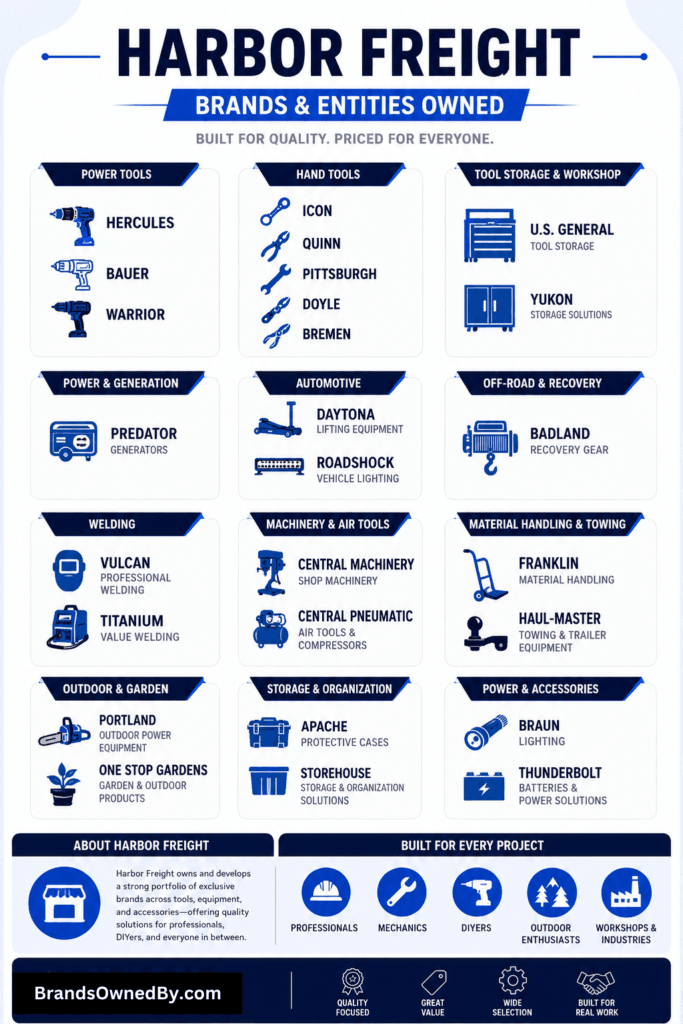
- Harbor Freight does not own many standalone companies through acquisitions. Instead, it owns and operates a portfolio of more than 25 proprietary brands, including Hercules, Bauer, Icon, Pittsburgh, Predator, Daytona, Vulcan, Titanium, U.S. General, and Badland, which are sold primarily through Harbor Freight stores and its online platform.
- The company’s most valuable brands are Hercules (professional power tools), Icon (professional automotive tools), Predator (generators and engines), Daytona (automotive lifting equipment), and U.S. General (tool storage systems). These brands help Harbor Freight compete directly with DeWalt, Milwaukee, Snap-on, Craftsman, and other industry leaders.
- Harbor Freight’s brand portfolio spans nearly every major tool category, including power tools, hand tools, automotive equipment, welding systems, generators, air compressors, workshop machinery, storage products, outdoor equipment, lighting, batteries, and material-handling equipment, making it one of the most vertically integrated tool retailers in North America.
- As of 2026, Harbor Freight remains a privately owned company controlled by Eric Smidt and generates approximately $9 billion in annual revenue, with its proprietary brands serving as the foundation of its business model, profitability, and long-term growth strategy.
Harbor Freight Tools is one of the largest privately owned tool and equipment retailers in the United States. The company specializes in affordable hand tools, power tools, automotive equipment, generators, welding products, tool storage systems, and industrial supplies.
Founded in 1977, Harbor Freight started as a small mail-order business selling discounted tools. Over the decades, it evolved into a nationwide retail chain with more than 1,600 stores across 48 states. The company is headquartered in Calabasas, California, and serves millions of customers every year through its physical stores and e-commerce platform.
Unlike many competitors that primarily sell third-party brands, Harbor Freight focuses heavily on exclusive in-house brands. This strategy allows the company to control product design, quality standards, pricing, and distribution while offering products that compete with premium brands at lower prices. Brands such as Hercules, Icon, Bauer, Predator, Daytona, and U.S. General have become major drivers of the company’s growth.
The company’s customer base includes professional contractors, mechanics, manufacturers, construction workers, tradespeople, workshop owners, and DIY enthusiasts. Harbor Freight has built its reputation by offering a broad product selection while maintaining a value-focused business model.
Harbor Freight Founders
Harbor Freight was founded in 1977 by father-and-son entrepreneurs Allan Smidt and Eric Smidt. The company began as a small mail-order business in California that sold discounted tools and equipment directly to customers. Their goal was simple: eliminate unnecessary middlemen and offer quality tools at lower prices.
The founders built the business around direct sourcing, value pricing, and a customer-focused retail model. What started as a modest operation eventually grew into one of the largest tool retailers in the United States. While Allan Smidt played a crucial role in establishing the company during its early years, Eric Smidt led its expansion into a national retail powerhouse and remains the company’s owner, chairman, and chief executive officer as of June 2026.
Eric Smidt
Eric Smidt is the co-founder, owner, chairman, and chief executive officer of Harbor Freight. He launched the company alongside his father in 1977 when he was still a teenager. From the beginning, Eric focused on eliminating middlemen and sourcing products directly from manufacturers. This approach became one of Harbor Freight’s biggest competitive advantages.
Allan Smidt
Allan Smidt co-founded Harbor Freight with his son Eric in 1977. During the company’s early years, he played a key role in building the mail-order business and establishing relationships with suppliers.
How the Founders Built Harbor Freight
The founders entered the market with a simple idea: provide quality tools at significantly lower prices than traditional retailers. Instead of relying on wholesalers and distributors, Harbor Freight sourced products directly from manufacturers. This strategy became the foundation of the company’s long-term growth and helped transform Harbor Freight from a small California startup into a nationwide retail brand.
List of Companies and Brands Owned by Harbor Freight
Unlike many large retailers that grow through acquisitions, Harbor Freight has primarily expanded through internal brand development. The company owns a portfolio of proprietary brands that cover nearly every major tool and equipment category. These brands are sold almost exclusively through Harbor Freight stores and its online platform.
As of June 2026, Harbor Freight does not operate a large collection of independently managed subsidiaries. Instead, its business revolves around exclusive brands that target different customer segments, ranging from entry-level DIY users to professional mechanics, contractors, welders, and industrial buyers.
Harbor Freight
Visual Portfolio of Owned Brands & Product Ecosystems
Power Tools
Hand Tools
Storage
Power & Engines
Welding
Automotive
Off-Road
Material Handling
Machinery & Air
Outdoor & Garden
Organization
Accessories
Power Tools
Hand Tools
Storage
Welding
Automotive
Outdoor
Hercules
Hercules is Harbor Freight’s flagship professional power tool brand. The brand was developed to compete directly with premium manufacturers such as Milwaukee, DeWalt, Makita, and Bosch.
The Hercules lineup includes cordless drills, impact drivers, rotary hammers, grinders, circular saws, reciprocating saws, lighting systems, batteries, chargers, and jobsite equipment. Harbor Freight has significantly expanded the Hercules battery ecosystem in recent years, making it one of the company’s most important growth platforms.
The brand targets contractors, electricians, plumbers, carpenters, and construction professionals who need durable tools for daily use. Hercules has become a key component of Harbor Freight’s strategy to move beyond its historical reputation as a discount tool retailer.
Bauer
Bauer serves as Harbor Freight’s mid-tier power tool brand. It sits below Hercules in terms of positioning but offers a broader range of affordable tools for homeowners and serious DIY users.
The Bauer product portfolio includes cordless and corded drills, saws, sanders, blowers, trimmers, pressure washers, shop vacuums, and outdoor equipment. One of Bauer’s strengths is its extensive battery compatibility across dozens of products.
Many customers view Bauer as an affordable alternative to Ryobi and Craftsman. The brand continues to receive significant investment as Harbor Freight expands its cordless tool offerings.
Warrior
Warrior is Harbor Freight’s entry-level power tool brand. It focuses on affordability and basic functionality.
The brand includes grinders, circular saws, drills, heat guns, sanding tools, cutting accessories, drill bits, grinding discs, and consumable products. Warrior tools are commonly purchased by occasional users who require equipment for home repairs and small projects.
The brand allows Harbor Freight to compete aggressively in the budget tool segment while maintaining higher-margin offerings through Hercules and Bauer.
Icon
Icon is Harbor Freight’s premium automotive and professional hand tool brand.
Introduced to challenge high-end tool truck brands such as Snap-on, Matco, and Mac Tools, Icon offers professional-grade ratchets, sockets, torque wrenches, screwdrivers, pliers, specialty automotive tools, and storage systems.
Professional mechanics increasingly use Icon products because they deliver premium performance at significantly lower prices than traditional professional tool brands. Harbor Freight has expanded Icon aggressively as it seeks greater penetration within automotive repair shops.
Quinn
Quinn is Harbor Freight’s upper-mid-tier hand tool brand.
The brand bridges the gap between entry-level Pittsburgh tools and premium Icon products. Quinn’s lineup includes pliers, socket sets, screwdrivers, wrenches, precision tools, and mechanic tool kits.
Quinn products are designed for users who need greater durability than basic hand tools but do not require professional-grade equipment.
Pittsburgh
Pittsburgh remains one of Harbor Freight’s most recognized brands.
For decades, Pittsburgh has served as the company’s primary hand tool brand. The lineup includes sockets, ratchets, wrenches, screwdrivers, pry bars, specialty automotive tools, and complete mechanic tool sets.
The brand’s popularity stems from its affordability and broad availability. Pittsburgh continues to generate substantial sales volume across Harbor Freight’s store network.
Doyle
Doyle specializes in professional hand tools and cutting equipment.
The product range includes aviation snips, cable cutters, crimpers, pliers, utility knives, bolt cutters, and specialty cutting tools. The brand is marketed toward electricians, mechanics, contractors, and industrial users.
Doyle fills an important niche within Harbor Freight’s hand tool portfolio by focusing on specialized professional applications.
Bremen
Bremen is Harbor Freight’s locking plier and clamping tool brand.
Its product lineup includes locking pliers, welding clamps, C-clamps, bar clamps, specialty gripping tools, and work-holding equipment. The brand is frequently used by welders, fabricators, and automotive technicians.
U.S. General
U.S. General is Harbor Freight’s leading tool storage brand.
The brand produces roller cabinets, tool chests, workstations, storage lockers, service carts, and workshop organization systems. U.S. General products have gained a strong reputation among mechanics and garage owners due to their durability and competitive pricing.
The brand competes directly with storage systems from Craftsman, Husky, and Snap-on.
Yukon
Yukon focuses on workshop storage and organizational solutions.
Products include cabinets, shelving systems, lockers, workbenches, and storage accessories. Yukon is positioned as a practical storage solution for garages, warehouses, workshops, and home improvement projects.
Predator
Predator is Harbor Freight’s engine and power generation brand.
The lineup includes portable generators, inverter generators, standby-capable generators, utility engines, water pumps, and related accessories. Predator generators have become particularly popular among homeowners, RV users, contractors, and emergency preparedness enthusiasts.
The brand has become one of Harbor Freight’s most successful proprietary product lines.
Daytona
Daytona specializes in automotive lifting equipment.
Its portfolio includes hydraulic floor jacks, low-profile jacks, racing jacks, bottle jacks, jack stands, and vehicle lifting accessories. Daytona products are widely recognized for their performance and have earned positive reviews from automotive enthusiasts and professional mechanics.
Badland
Badland focuses on off-road recovery and vehicle utility equipment.
The brand’s products include electric winches, recovery straps, shackles, towing accessories, trailer equipment, off-road lighting accessories, and recovery gear.
Badland has developed a loyal following among truck owners, off-road enthusiasts, and outdoor adventurers.
Roadshock
Roadshock is Harbor Freight’s vehicle lighting and off-road illumination brand.
The lineup includes LED light bars, auxiliary driving lights, work lights, rock lights, flood lights, and vehicle-mounted lighting systems. The brand serves both recreational and professional users.
Haul-Master
Haul-Master focuses on towing and trailer equipment.
Its products include trailer hitches, tie-down straps, cargo nets, trailer accessories, loading ramps, tow chains, and transportation equipment. The brand supports Harbor Freight’s growing presence in the utility and transportation equipment market.
Franklin
Franklin specializes in material handling equipment.
The product portfolio includes hand trucks, platform carts, furniture dollies, moving equipment, utility carts, and transportation accessories. Franklin products are commonly used in warehouses, retail operations, and residential moving projects.
Apache
Apache manufactures rugged protective storage cases.
The brand competes with premium protective case manufacturers by offering weather-resistant, impact-resistant storage solutions at lower prices. Apache cases are widely used for tools, electronics, photography equipment, drones, and specialized gear.
Pelican Alternative Product Strategy
Although not a separate brand, Harbor Freight actively positions Apache as an alternative to premium protective storage products sold by companies such as Pelican. This strategy has helped Apache become one of Harbor Freight’s fastest-growing storage product lines.
Vulcan
Vulcan is Harbor Freight’s premium welding brand.
The brand offers MIG welders, TIG welders, stick welders, plasma cutters, welding helmets, and professional welding accessories. Vulcan products target experienced welders and fabrication professionals.
The company has steadily expanded Vulcan’s capabilities to compete with established brands such as Lincoln Electric and Miller.
Titanium
Titanium serves as Harbor Freight’s value-oriented welding brand.
Its products include welding machines, plasma cutters, welding accessories, and beginner-friendly welding systems. Titanium appeals to hobbyists, small workshops, and budget-conscious users.
Together, Titanium and Vulcan allow Harbor Freight to address multiple segments of the welding market.
Central Machinery
Central Machinery specializes in woodworking and workshop machinery.
The lineup includes lathes, drill presses, band saws, bench grinders, milling equipment, planers, and workshop accessories. The brand serves hobbyists, craftsmen, and small-scale manufacturers.
Central Pneumatic
Central Pneumatic is Harbor Freight’s compressed-air equipment brand.
Products include air compressors, spray guns, air tools, pneumatic nailers, inflators, hoses, and accessories. The brand has been a core part of Harbor Freight’s product portfolio for many years.
McGraw
McGraw is Harbor Freight’s modern air compressor brand.
The company has increasingly positioned McGraw as a premium alternative within its compressed-air category. The lineup includes portable air compressors, stationary compressors, and industrial air systems.
Portland
Portland focuses on outdoor power equipment.
Its products include chainsaws, pressure washers, electric landscaping equipment, and outdoor maintenance tools. The brand targets homeowners seeking affordable lawn and garden solutions.
One Stop Gardens
One Stop Gardens serves the gardening and outdoor living market.
The brand offers planters, garden tools, landscaping accessories, irrigation products, greenhouse equipment, and outdoor décor items.
Storehouse
Storehouse specializes in organization and storage products.
The lineup includes storage bins, hardware organizers, containers, sorting trays, compartment boxes, and workshop organization solutions.
Braun
Braun is Harbor Freight’s lighting brand.
The company offers flashlights, work lights, rechargeable lighting systems, inspection lights, magnetic lights, and portable illumination products. Braun products are widely used in automotive and construction environments.
Thunderbolt
Thunderbolt focuses on batteries and portable power products.
Its offerings include alkaline batteries, rechargeable batteries, chargers, and portable power accessories. Thunderbolt products are sold throughout Harbor Freight’s retail network.
Admiral
Admiral specializes in woodworking and cutting accessories.
Products include saw blades, router bits, sanding products, cutting tools, and woodworking consumables. The brand is primarily aimed at hobbyists and workshop users.
Who Owns Harbor Freight Tools?
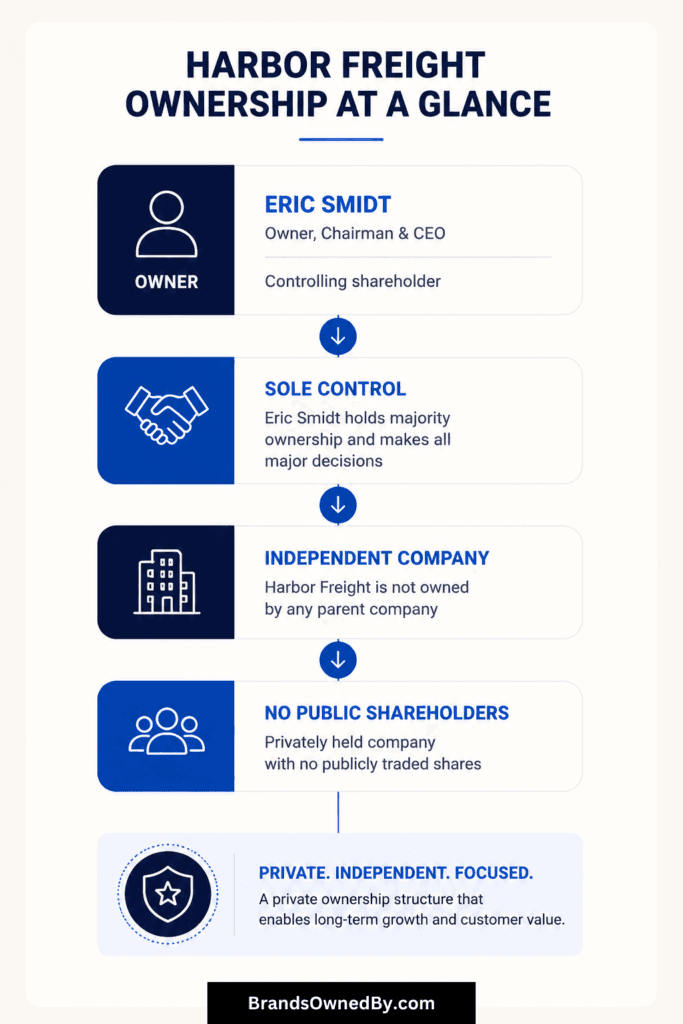
Harbor Freight is privately owned and controlled by billionaire entrepreneur Eric Smidt. Unlike publicly traded retailers such as Home Depot and Lowe’s, Harbor Freight does not have publicly traded shares, institutional investors, or retail shareholders.
The company’s ownership structure is unusually concentrated for a retailer of its size. Eric Smidt serves as owner, chairman, and chief executive officer, giving him both economic ownership and operational control over the business.
This ownership model has been a major factor behind Harbor Freight’s long-term growth strategy. Because the company does not answer to public shareholders, management can focus on store expansion, supply chain investments, product development, and proprietary brand building without the pressure of quarterly earnings expectations.
As of June 2026, Harbor Freight remains one of the largest privately owned retail companies in the United States.
Eric Smidt: The Controlling Owner of Harbor Freight
Eric Smidt is the co-founder and controlling owner of Harbor Freight.
He launched the company in 1977 alongside his father, Allan Smidt, when Harbor Freight operated as a small mail-order tool business. Over the following decades, Eric transformed the company into a nationwide retail chain with more than 1,600 stores and a growing portfolio of exclusive brands.
A pivotal moment occurred in 1999 when Eric acquired his father’s ownership interest in the company. The transaction consolidated ownership and gave Eric complete control over Harbor Freight’s future direction.
Since assuming full ownership, he has overseen several major initiatives, including:
- National store expansion.
- Development of proprietary tool brands.
- Growth of Harbor Freight’s logistics network.
- Expansion into professional-grade equipment.
- Investment in employee compensation and training.
- Modernization of the company’s e-commerce operations.
Because Harbor Freight is privately held, exact ownership percentages are not publicly disclosed. However, public records and company disclosures consistently identify Eric Smidt as the company’s sole owner and controlling shareholder.
Allan Smidt’s Role in Harbor Freight Ownership History
Allan Smidt played a critical role in the formation of Harbor Freight.
As co-founder, he helped establish the company’s original business model and supplier relationships. During Harbor Freight’s early years, ownership was shared between father and son.
However, Allan Smidt eventually exited the ownership structure when Eric purchased his stake in 1999. Since that transaction, no public information indicates that Allan Smidt retains an ownership position in Harbor Freight.
Although no longer an owner, his contribution remains significant because he helped build the foundation of what would become one of America’s largest tool retailers.
Harbor Freight Shareholder Structure
Harbor Freight differs significantly from publicly traded competitors because its ownership structure is highly concentrated.
Public companies typically have thousands of shareholders, including pension funds, mutual funds, hedge funds, institutional investors, executives, and retail investors.
Harbor Freight does not operate under that model.
Instead, ownership is concentrated around Eric Smidt and related private ownership entities. Because the company is privately held, shareholder information is not publicly reported through SEC filings.
The absence of outside shareholders gives Harbor Freight a level of strategic flexibility that many public retailers do not enjoy.
Has Harbor Freight Ever Been Acquired?
No.
Harbor Freight has remained independent throughout its history. The company has not been acquired by a larger retailer, private equity firm, or investment group.
Many major retail chains have experienced ownership changes through mergers, acquisitions, leveraged buyouts, or public listings. Harbor Freight has largely avoided these transactions and has remained under founder-led ownership for nearly five decades.
This independence has allowed the company to maintain a consistent long-term strategy centered on proprietary brands, low-cost sourcing, and aggressive store growth.
Has Harbor Freight Ever Gone Public?
Harbor Freight has never conducted an initial public offering.
Over the years, industry observers have occasionally speculated about a potential IPO because of the company’s size and profitability. However, management has consistently maintained private ownership.
Remaining private offers several advantages:
- Greater control over strategic decisions.
- Reduced regulatory disclosure requirements.
- Long-term investment flexibility.
- Freedom from quarterly earnings pressure.
- Strong founder control over corporate direction.
As a result, Harbor Freight continues to operate outside public equity markets.
Harbor Freight Annual Revenue and Net Worth
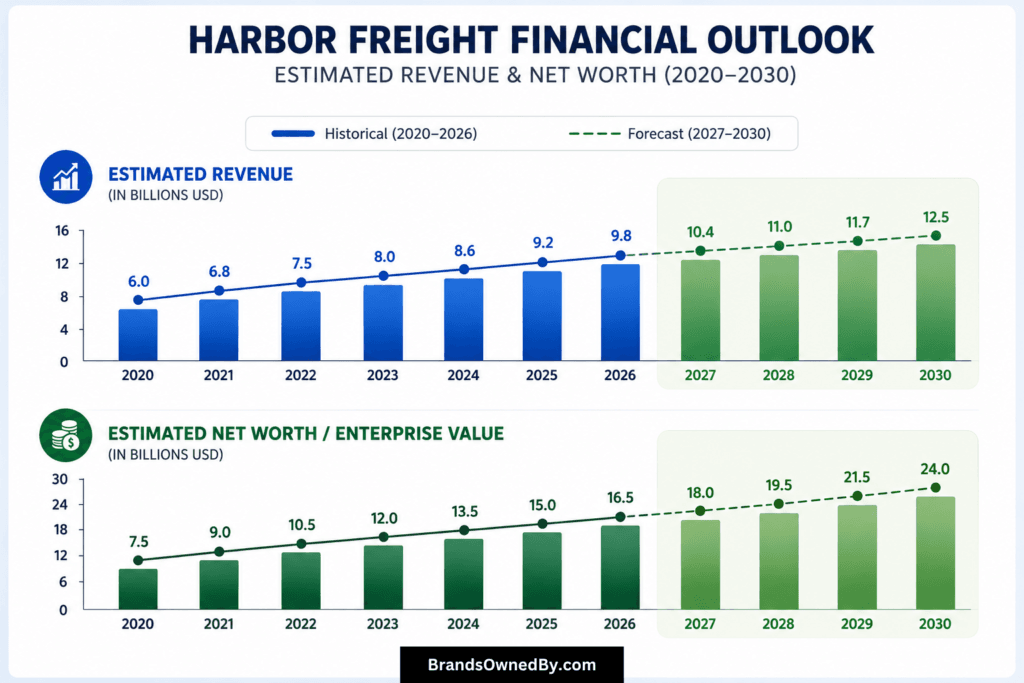
Harbor Freight is one of the largest privately owned retailers in the United States and one of the largest specialty tool retailers in North America. As of 2026, the company generates an estimated $9 billion in annual revenue and has an estimated net worth of approximately $10 billion.
These figures are particularly significant because Harbor Freight operates almost entirely through company-owned stores and proprietary brands rather than franchise operations or third-party licensing agreements. The company’s value is derived from its nationwide retail footprint, exclusive brand portfolio, logistics infrastructure, inventory assets, and customer base of more than 75 million shoppers.
Harbor Freight Revenue in 2026
Harbor Freight’s estimated revenue for 2026 is approximately $9 billion.
The company operates more than 1,600 stores across the United States. Based on estimated sales levels, the average Harbor Freight location generates approximately $5.5 million to $6 million annually. While performance varies by market, this illustrates the scale of the company’s retail operations.
Revenue growth has accelerated during the past decade as Harbor Freight expanded beyond low-cost hand tools into higher-value categories such as professional power tools, automotive equipment, generators, welding systems, and workshop storage products.
The introduction of brands such as Hercules, Icon, Daytona, Vulcan, and Predator has increased average transaction values and attracted more professional customers. These categories generally produce higher revenue per customer than traditional entry-level tools.
Revenue Distribution by Product Category
Although Harbor Freight does not publicly disclose category-level sales figures, industry analysts estimate that revenue is concentrated across several core product groups.
Hand tools remain the company’s largest category and are estimated to account for roughly one-quarter of total revenue. With annual sales of approximately $2.2 billion, brands such as Pittsburgh, Quinn, Doyle, and Icon continue to drive significant customer traffic.
Power tools represent another major revenue source. Brands including Hercules, Bauer, and Warrior are estimated to generate approximately $1.8 billion to $2 billion annually. This category has become increasingly important as Harbor Freight expands its cordless battery ecosystems.
Automotive equipment contributes an estimated $1.2 billion to $1.4 billion in annual revenue. Products such as Daytona floor jacks, Icon mechanic tools, vehicle lifts, diagnostic equipment, and garage accessories have strengthened Harbor Freight’s position among automotive enthusiasts and professional mechanics.
Tool storage products generate an estimated $800 million to $1 billion annually. U.S. General tool chests and workshop organization systems have become some of the company’s most successful product lines.
Generators, engines, and power equipment under the Predator brand are estimated to contribute approximately $700 million annually, making Predator one of Harbor Freight’s most valuable proprietary brands.
Welding equipment sold through Vulcan and Titanium contributes an estimated $500 million to $600 million annually, while outdoor equipment, lighting products, batteries, air compressors, and accessories generate the remaining share of revenue.
Revenue Growth Since 2020
Harbor Freight’s growth trajectory has been substantial.
Revenue was estimated at approximately $5 billion in the early 2020s. Continued store openings, category expansion, and increasing acceptance among professional users helped drive revenue beyond $8 billion by the middle of the decade.
The company’s estimated revenue now approaches $9 billion, representing growth of roughly 80% over a six-year period.
Several factors contributed to this expansion:
- Rapid store expansion across underserved markets.
- Growth of premium brands such as Icon and Hercules.
- Increased sales to professional contractors and mechanics.
- Expansion of cordless power tool ecosystems.
- Strong demand for generators and emergency power products.
- Improvements in supply chain efficiency.
Harbor Freight Net Worth in 2026
Harbor Freight’s estimated net worth is approximately $10 billion as of June 2026.
Unlike public companies, Harbor Freight does not have a market capitalization that can be measured directly through stock prices. Therefore, its estimated value is based on comparable private-company valuations, revenue multiples, operating performance, asset values, and market position.
The company’s valuation is supported by several major assets.
Its retail network alone represents billions of dollars in value. More than 1,600 locations provide Harbor Freight with one of the largest specialty retail footprints in the country.
The company’s proprietary brand portfolio is another significant contributor. Brands such as Hercules, Icon, Predator, Bauer, Daytona, Vulcan, and U.S. General have become recognizable names within their respective categories. Because Harbor Freight owns these brands outright, it captures both retail and brand value.
Its logistics infrastructure also contributes significantly to overall valuation. Harbor Freight operates large distribution centers that support nationwide inventory management and store replenishment. Replicating this infrastructure would require billions of dollars in investment.
What Drives Harbor Freight’s Valuation?
A key reason Harbor Freight commands a valuation near $10 billion is its private-label business model.
Many retailers rely heavily on third-party manufacturers and national brands. Harbor Freight instead controls a substantial portion of the products sold in its stores. This allows the company to maintain higher gross margins and stronger pricing control.
The company’s customer base is another valuable asset. More than 75 million customers have purchased products from Harbor Freight, creating a large recurring revenue opportunity. Many customers return repeatedly for replacement tools, accessories, consumables, storage products, and new equipment.
Brand equity also plays an important role. Over the past decade, Harbor Freight has successfully shifted consumer perception from a discount tool retailer to a legitimate competitor in several professional tool categories.
Harbor Freight Revenue Forecast Through 2030
Based on historical growth trends, store expansion plans, and continued investment in proprietary brands, Harbor Freight’s revenue is expected to continue rising during the remainder of the decade.
- 2026: Approximately $9.0 billion.
- 2027: Approximately $9.6 billion.
- 2028: Approximately $10.3 billion.
- 2029: Approximately $11.1 billion.
- 2030: Approximately $12.0 billion.
If Harbor Freight maintains its current growth rate and continues expanding premium brands such as Hercules and Icon, annual revenue could surpass $12 billion before the end of the decade.
Final Words on What Companies Are Owned by Harbor Freight Tools
Harbor Freight does not own a large collection of separate operating companies. Instead, it has built a powerful portfolio of proprietary brands that cover nearly every major tool category.
Brands such as Hercules, Icon, Bauer, Pittsburgh, Predator, Vulcan, Titanium, U.S. General, and Daytona form the foundation of Harbor Freight’s business strategy. These brands allow the company to compete directly with industry leaders while maintaining competitive pricing.
Ownership remains highly concentrated. Eric Smidt controls Harbor Freight and continues to direct the company’s growth strategy, product development efforts, and nationwide expansion.
FAQs
What is the net worth of Harbor Freight?
As of 2026, Harbor Freight has an estimated net worth of approximately $10 billion. Since the company is privately owned, it does not publicly disclose its market valuation. The estimate is based on factors such as annual revenue, store network size, proprietary brand portfolio, distribution infrastructure, customer base, and comparable valuations of similar retail businesses. Harbor Freight’s value is supported by more than 1,600 stores, dozens of exclusive brands, and billions of dollars in annual sales.
Is Harbor Freight publicly traded?
No, Harbor Freight is not publicly traded. The company is privately owned and has never launched an initial public offering (IPO). Unlike publicly listed retailers such as Home Depot and Lowe’s, Harbor Freight’s shares are not available on any stock exchange. The company remains under the ownership and control of founder and CEO Eric Smidt.
What tools does Harbor Freight sell?
Harbor Freight sells a wide range of tools and equipment for homeowners, DIY enthusiasts, contractors, mechanics, welders, and industrial users. Its product categories include hand tools, power tools, automotive tools, air tools, generators, welding equipment, tool storage systems, pressure washers, outdoor power equipment, lighting products, batteries, safety equipment, and workshop accessories.
Popular products include socket sets, wrenches, drills, impact drivers, floor jacks, tool chests, air compressors, welders, chainsaws, generators, winches, and work lights. The company primarily sells products under its own proprietary brands rather than third-party brands.
What brands does Harbor Freight own?
Harbor Freight owns a large portfolio of exclusive brands that cover different tool and equipment categories. Some of its most well-known brands include Hercules, Bauer, Warrior, Icon, Pittsburgh, Quinn, Doyle, U.S. General, Yukon, Predator, Daytona, Badland, Vulcan, Titanium, Central Machinery, Central Pneumatic, McGraw, Portland, Apache, Braun, Thunderbolt, Storehouse, Franklin, Haul-Master, Admiral, Bremen, and One Stop Gardens.
These brands allow Harbor Freight to serve customers ranging from casual DIY users to professional tradespeople while maintaining control over product development, pricing, and distribution.
Who is the CEO of Harbor Freight?
The CEO of Harbor Freight is Eric Smidt. He co-founded the company in 1977 alongside his father, Allan Smidt, and has led Harbor Freight’s growth into one of the largest privately owned retailers in the United States. In addition to serving as Chief Executive Officer, Eric Smidt is also the company’s chairman and controlling owner. Under his leadership, Harbor Freight expanded from a small mail-order business into a nationwide retail chain with more than 1,600 stores and a portfolio of proprietary brands.