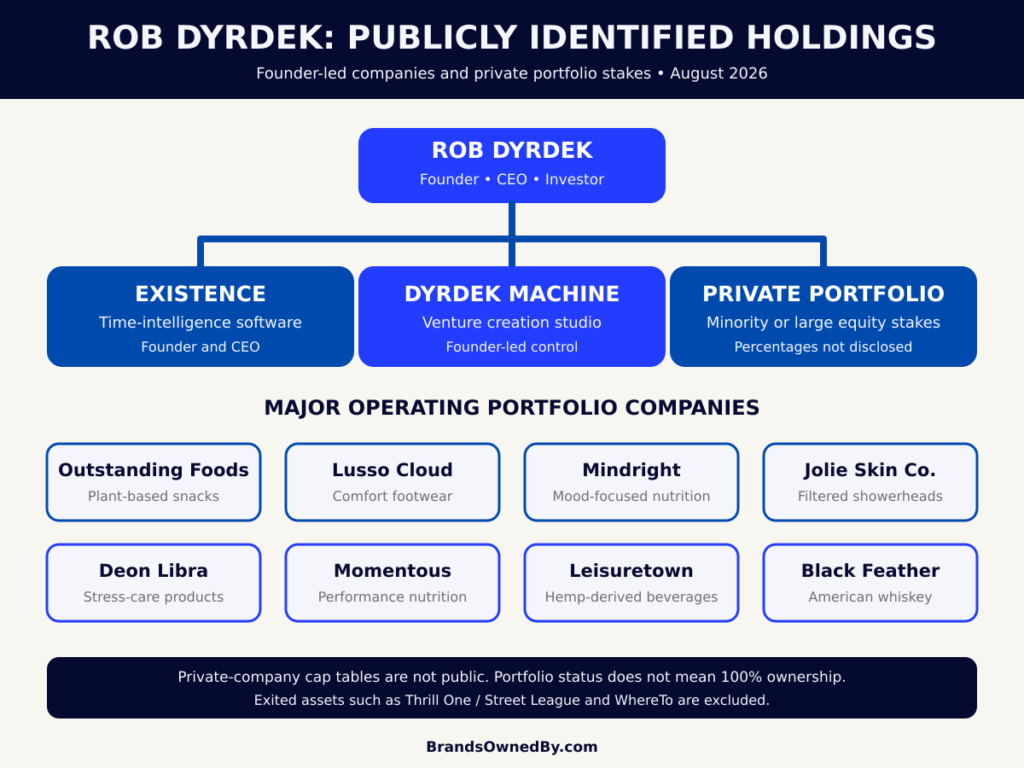
- Rob Dyrdek is the founder and controlling strategic figure behind Dyrdek Machine, his private venture creation studio.
- He is the founder and CEO of Existence, a time-intelligence software platform built around his personal productivity system.
- His publicly identified private-company portfolio includes Outstanding Foods, Lusso Cloud, Mindright, Jolie, Deon Libra, Momentous, Leisuretown, and Black Feather Whiskey.
- Street League Skateboarding, Superjacket Productions, Thrill One, WhereTo, Alien Workshop, and DNA Distribution should not be presented as companies he currently owns.
Rob Dyrdek is an entrepreneur, former professional skateboarder, television producer, and venture investor. He was born in Kettering, Ohio, in 1974.
Many people know him from MTV programs such as Rob & Big, Rob Dyrdek’s Fantasy Factory, and Ridiculousness. His commercial career began much earlier.
Dyrdek began skateboarding at 11. He became a professional skateboarder as a teenager and moved to Southern California to pursue the sport full time.
His first company was Orion Trucks. It manufactured skateboard trucks and accessories. Dyrdek has said that he started the business at approximately 18.
The company taught him an important ownership lesson. A business could generate substantially more long-term value than a sponsorship agreement. That principle later shaped his television contracts and venture-building strategy.
![What Companies Does Rob Dyrdek Own [infographic]](https://brandsownedby.com/wp-content/uploads/2023/08/What-Companies-Does-Rob-Dyrdek-Own-infographic-484x1024.png)
Building a Media Platform
Rob & Big premiered on MTV in 2006. Fantasy Factory followed in 2009. Ridiculousness launched in 2011 and ultimately became his largest television business.
Dyrdek did not treat television as entertainment income alone. He negotiated production fees, executive producer compensation, brand integrations, and ownership-related rights.
Court disclosures later showed that his Ridiculousness compensation reached at least $32.5 million for a typical annual production slate. The arrangement included on-camera fees, executive producer payments, and bonuses connected with new episode orders.
Production of new episodes ended after 46 seasons. Previously produced episodes continued airing in 2026.
Creating Dyrdek Machine
Dyrdek launched Dyrdek Machine in 2016. It is a private venture studio rather than a conventional venture capital fund.
The studio helps create companies from their earliest stages. It works on market positioning, financial planning, branding, product development, capital raising, and exit preparation.
Dyrdek has said that the ideal structure gives him between 25% and 75% of a venture. That represents his target model, not a confirmed ownership percentage for every portfolio company.
His official profile states that Dyrdek Machine has built 18 brands and completed six exits representing more than $550 million in combined enterprise value. Enterprise value is the value of the companies involved. It is not the amount Dyrdek personally received.
List of Companies Owned by Rob Dyrdek
The following list covers Dyrdek’s major publicly identified companies and private investments as of August 2026. Private-company ownership records are not fully public. Therefore, “owned” includes founder ownership and identifiable equity stakes rather than suggesting that he owns 100% of each business.
Existence
Existence is Rob Dyrdek’s newest founder-led technology company. He serves as its founder and CEO.
The platform converts a person’s calendar and recorded activities into structured personal data. Users can organize time across areas such as work, health, relationships, sleep, and personal development.
Existence grew from a system Dyrdek had used privately for years. He recorded how he allocated his time and evaluated whether each activity produced the intended result.
The commercial opportunity is broader than calendar management. Existence is positioned as a time-intelligence platform. Its proposed AI layer can study patterns, identify inefficient routines, and help users make more intentional decisions.
Dyrdek appears to exercise direct strategic control over the business. However, its legal cap table and outside investment arrangements have not been publicly disclosed.
Existence is particularly important because it represents his transition from consumer brands and television into subscription software. If successful, recurring software revenue could eventually replace some of the income lost after new Ridiculousness production ended.
Dyrdek Machine
Dyrdek Machine is the central company in Rob Dyrdek’s business portfolio. He founded the venture studio and remains its chief strategic decision-maker.
The company creates, finances, and advises businesses. It concentrates on consumer products, media, wellness, footwear, food, beverages, and selected technology opportunities.
Dyrdek Machine normally partners with an operating founder. The studio may provide early capital and business-building services in return for equity.
This arrangement differs from passive celebrity investing. Dyrdek and his team may help design the business model, identify the target customer, create the brand, recruit executives, and prepare the company for outside funding.
Dyrdek Machine’s president and chief operating officer, Brian Atlas, oversees significant portfolio operations. Dyrdek still controls the studio’s strategic direction, investment philosophy, and venture-selection process.
Outstanding Foods
Outstanding Foods produces plant-based snack products. Its best-known product lines have included PigOut snacks and TakeOut meal-inspired puffs.
The company was founded by entrepreneur Bill Glaser and chef Dave Anderson. Dyrdek Machine helped develop and fund the business. Rob Dyrdek has also served on its board.
Outstanding Foods demonstrates how his ownership model works. He did not simply license his name to a snack company. His studio helped refine the product, positioning, financing, and growth strategy.
The company raised outside capital. Consequently, ownership is divided among founders, Dyrdek-related interests, employees, and other investors. Dyrdek’s precise percentage is not public.
The company remains one of the strongest examples of an operating consumer brand within the Dyrdek Machine portfolio.
Lusso Cloud
Lusso Cloud is a premium comfort-footwear company. It was co-founded by Rob Dyrdek, Chris Noyes, and designer Jon Buscemi.
The company sells lightweight slip-on shoes designed for travel, recovery, casual use, and everyday comfort. Its positioning combines the convenience of a clog or slipper with a more premium appearance.
Dyrdek identified an opportunity between performance footwear and casual comfort brands. He wanted the company to compete in a category led by businesses such as Crocs, Ugg, and Birkenstock without duplicating their product designs.
He committed $5 million to Lusso Cloud during a difficult fundraising environment. That commitment indicates a material financial stake. It does not reveal his exact ownership percentage.
The operating founders and management team handle daily execution. Dyrdek Machine influences financing, brand strategy, positioning, and long-term exit planning.
Mindright
Mindright is a nutrition company focused on mood, stress, energy, and mental well-being. It was co-founded by Rob Dyrdek and consumer-products executive Chris Bernard.
The company has sold functional snacks and supplements containing ingredients associated with focus, mood, and stress support.
Musician Joe Jonas and drummer Travis Barker participated as investors. Their involvement means Mindright is not solely owned by Dyrdek.
Dyrdek Machine invested at the formation stage and later provided additional capital. Dyrdek’s ownership is therefore more substantial than a standard paid endorsement relationship. The exact stake remains private.
Mindright competes in a crowded functional-wellness category. Its commercial value depends on repeat purchases, credible product claims, retail distribution, and the ability to differentiate itself from conventional supplement brands.
Jolie
Jolie develops filtered showerheads and related water-filtration products for personal care.
The company’s main proposition is that shower water can affect skin and hair. Its filtered showerhead removes or reduces selected contaminants before the water reaches the user.
Ryan Babenzien and Arjan Singh are Jolie’s principal operating founders. Dyrdek Machine invested in the company and helped support its development. Rob Dyrdek should therefore be described as an investor and venture partner, not Jolie’s sole owner.
Jolie has a valuable recurring-revenue model. A customer first purchases the showerhead. The company can then sell replacement filters through a subscription.
For example, acquiring one customer may create multiple future filter orders. That can produce a stronger lifetime value than a one-time beauty-device sale.
Deon Libra
Deon Libra is a wellness company focused on stress management and personal care. It was founded by Devin McGhee.
Its product positioning combines supplements and daily wellness routines intended to support people experiencing chronic stress.
Dyrdek Machine invested in Deon Libra and helped develop its commercial strategy. Dyrdek publicly committed approximately $1 million to support the company during a difficult capital-raising environment.
He does not run its daily operations. McGhee remains the brand’s central operating founder. Dyrdek’s role is better described as an investor, venture partner, and strategic adviser.
The company’s ownership percentage has not been disclosed.
Momentous
Momentous is a performance-nutrition and supplement company. Its products serve athletes, trainers, military personnel, and consumers interested in recovery and performance.
Dyrdek helped create the original Momentous business with Matt Wan. The company later combined with Amp Human and expanded under the Momentous name.
Outside investors have funded the business. Its ownership is therefore shared across founders, executives, employees, Dyrdek-related entities, and institutional investors.
Dyrdek Machine continues to identify Momentous as a portfolio company. However, that does not mean Dyrdek controls its daily operations or owns a majority interest.
Momentous differs from smaller celebrity supplement brands because it has pursued sports certifications, professional partnerships, and institutional distribution.
Leisuretown
Leisuretown is a beverage company associated with hemp-derived and relaxation-focused products. Dyrdek developed the business with musician and producer Diplo.
The original concept targeted consumers seeking a social beverage without the traditional positioning of alcohol. Its products have operated in a regulatory environment that varies across states.
Dyrdek Machine helped create and finance the brand. Diplo’s involvement and any outside financing mean Dyrdek is not the exclusive owner.
Leisuretown illustrates the higher risk within Dyrdek’s portfolio. Hemp-derived beverage companies must manage changing state rules, distribution restrictions, ingredient limits, and payment-processing challenges.
Its exact current cap table and Rob Dyrdek’s ownership percentage are not publicly available.
Black Feather Whiskey
Black Feather Whiskey is an American whiskey business co-founded by Jeremy Rawle, Travis Pastrana, and Rob Dyrdek.
The brand was positioned as an accessible premium bourbon rather than a luxury collector product. It initially expanded through selected state markets and online distribution.
Jeremy Rawle has held the primary executive role. Dyrdek has participated as a co-founder, investor, and adviser.
Black Feather appears on the Dyrdek Machine portfolio network. However, its ownership breakdown has not been published. Dyrdek should not be described as owning the entire whiskey company.
The business also shows the difference between founder status and operating control. Dyrdek may influence strategy and branding while the company’s executive team manages production, distribution, inventory, and regulatory compliance.
Saint Midas
Saint Midas is an affordable-luxury jewelry and accessories brand developed through Dyrdek Machine.
The company has used influencer partnerships, digital marketing, limited collections, and collaborations to reach younger customers.
Saint Midas has appeared in Dyrdek Machine’s portfolio materials and business network. Its current ownership structure and Rob Dyrdek’s precise stake have not been released.
The brand should be considered a private Dyrdek Machine portfolio interest. There is not enough public information to describe it as a wholly owned Rob Dyrdek company.
Duty to Act Coffee
Duty to Act Coffee has appeared in investment databases connected with Dyrdek Machine. It operates in the beverage and packaged-coffee market.
Public information about the size, timing, and continuing status of the investment is limited. It is safer to classify Duty to Act Coffee as a disclosed investment relationship rather than a confirmed controlled subsidiary.
Other Minority Investments
Dyrdek has also invested in businesses such as Stance, BeatBox Beverages, Leesa, and UFC.
These were investment positions rather than companies controlled by him. Several have completed major financing rounds, ownership changes, or acquisitions since his original investment.
He does not own UFC. He also does not control Stance, BeatBox, or Leesa. Whether he retains any residual financial interests has not been publicly confirmed.
Companies Rob Dyrdek No Longer Owns or Controls
Several businesses continue to appear in outdated online lists. They need to be separated from his current portfolio.
Street League Skateboarding and Thrill One
Dyrdek founded Street League Skateboarding in 2010. It created a professional competition format for street skateboarders.
Street League later combined with Nitro Circus and Superjacket Productions to create Thrill One Sports & Entertainment.
Fiume Capital and Juggernaut Capital Partners acquired Thrill One in 2022 at a reported enterprise value of approximately $300 million. Dyrdek therefore ceased to be its controlling owner.
Thrill One-related production entities entered Chapter 11 proceedings in 2025. A proposed 2026 agreement called for MTV to pay more than $150 million to Dyrdek and other parties connected with Ridiculousness.
That amount should not be added entirely to Dyrdek’s income or net worth. The allocation among him, production entities, creditors, and other stakeholders was not publicly itemized.
Superjacket Productions
Dyrdek founded Superjacket Productions as his media-production company. It produced Ridiculousness and related programming.
Superjacket later became part of Thrill One’s corporate structure. Dyrdek remained essential to Ridiculousness through talent and producer agreements, but that did not make him the controlling shareholder of the post-acquisition parent company.
It is therefore inaccurate to list Superjacket as a current wholly owned Rob Dyrdek company.
WhereTo
WhereTo developed an AI-based corporate-travel platform. Dyrdek Machine participated in building and funding the company.
Flight Centre Travel Group acquired WhereTo in 2020. It now operates within the buyer’s corporate-travel organization.
WhereTo represents a completed Dyrdek Machine exit, not a current Rob Dyrdek-owned company.
Alien Workshop and DNA Distribution
Dyrdek Enterprises acquired DNA Distribution in 2012. DNA controlled skateboarding brands that included Alien Workshop, Habitat, and Reflex.
Pacific Vector Holdings purchased the controlling interest in 2013. Dyrdek retained a minority position at the time, but later restructuring changed the business again.
Alien Workshop is not currently owned or controlled by Rob Dyrdek.
DC Shoes
Rob Dyrdek had a long sponsorship and product-development relationship with DC Shoes. He designed signature footwear and helped market the brand.
He was not the owner of DC Shoes. A sponsorship, royalty agreement, or signature product line does not equal equity ownership.
Competitor Ownership Comparison
Dyrdek competes with other celebrity entrepreneurs for consumer attention, investment opportunities, operating talent, and brand partnerships. His closest comparisons are people who convert their public profiles into equity rather than relying only on endorsement fees.
Ryan Reynolds
Ryan Reynolds has built and invested in businesses including Maximum Effort, Aviation American Gin, and Mint Mobile.
He sold Aviation Gin’s parent company to Diageo and Mint Mobile’s parent to T-Mobile. He may retain contractual or performance-based economics, but he no longer controls those acquired companies.
Reynolds’ model focuses on creative marketing and large strategic exits. Dyrdek’s model is more systematic at the company-formation stage. Dyrdek Machine may work with a founder before the company has a finished product.
Kevin Hart
Kevin Hart controls his personal brand and remains the central creative figure behind Hartbeat, his entertainment company.
Hartbeat received a $100 million investment from Abry Partners. The transaction gave the investor a minority interest while Hart continued as chairman.
Hart’s portfolio is concentrated in entertainment, media, fitness, and consumer partnerships. Dyrdek’s portfolio is broader across food, footwear, beauty, wellness, software, and media.
Ashton Kutcher
Ashton Kutcher co-founded Sound Ventures. The firm invests in technology companies and manages outside investment capital.
His portfolio has included positions in major technology businesses. However, an investment in a company is not the same as owning or controlling that company.
Kutcher’s model resembles institutional venture capital. Dyrdek Machine resembles a venture studio. It helps form and build companies rather than concentrating only on outside investments.
Gwyneth Paltrow
Gwyneth Paltrow founded Goop and remains the company’s leading public and strategic figure.
Goop is a private lifestyle and wellness company supported by outside investors. Paltrow does not disclose a complete ownership percentage.
Her business is organized around one large consumer platform. Dyrdek spreads his capital and operating system across several separately incorporated companies.
Tony Hawk
Tony Hawk’s businesses include action-sports media, licensing, video games, skateboarding ventures, and the Skatepark Project.
Hawk’s commercial identity remains closely connected with skateboarding and licensing. Dyrdek used skateboarding as an entry point but developed a wider private-company portfolio.
Dyrdek also created and exited a major professional skateboarding platform through Street League and Thrill One. That experience gives him a stronger venture-creation comparison than a conventional athlete endorsement portfolio.
Who Controls Rob Dyrdek’s Businesses?
Control depends on the company. Rob Dyrdek controls his core founder-led platforms, but he does not personally manage every portfolio brand.
Rob Dyrdek Controls the Strategic Direction
Dyrdek is the founder and CEO of Existence. He defines its philosophy, product direction, and market positioning.
He also founded Dyrdek Machine. The studio is built around his capital, investment framework, personal network, and company-building methodology.
These are the two businesses where his direct strategic control is clearest.
Brian Atlas Oversees Venture Operations
Brian Atlas serves as president and chief operating officer of Dyrdek Machine. He helps manage finances, portfolio operations, fundraising support, and founder relationships.
This structure allows Dyrdek to focus on business design, major decisions, capital allocation, and long-term strategy.
Portfolio Founders Run Their Companies
The operating founders generally control daily execution inside portfolio companies.
For example, the founders and executives of Outstanding Foods, Jolie, Deon Libra, and Momentous manage staffing, distribution, product development, customer acquisition, and compliance.
Dyrdek may hold board rights or approval rights. Those arrangements have not been published for most companies.
Outside Investors Limit Unilateral Control
Several portfolio companies have raised external capital. New funding usually gives investors preferred shares, board representation, information rights, and protective approval provisions.
As a result, even a large shareholder may be unable to sell the company, issue substantial new equity, or change senior leadership without additional approvals.
The practical conclusion is straightforward. Rob Dyrdek controls his venture system. He influences his portfolio companies. He does not necessarily possess majority voting control over each brand.
Rob Dyrdek Annual Income and Net Worth
Rob Dyrdek’s private businesses do not publish consolidated financial statements. Revenue from his portfolio companies should not be treated as his personal income.
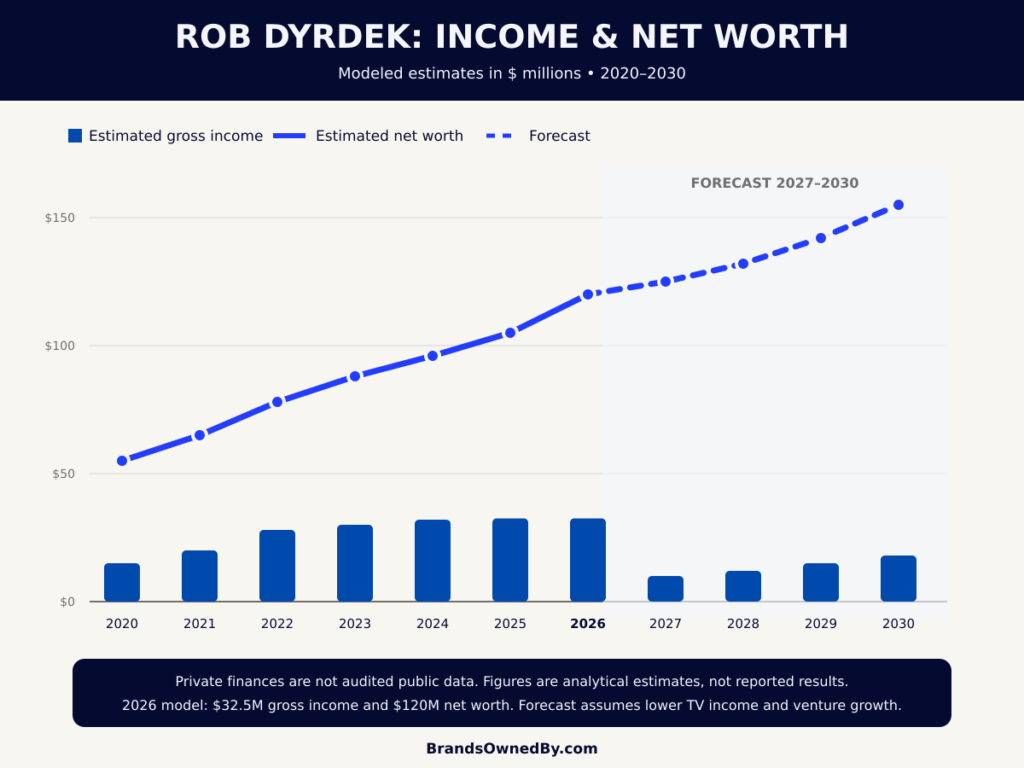
For that reason, the following figures use estimated gross annual income rather than revenue.
2026 Annual Income
A reasonable conservative estimate places Dyrdek’s 2026 gross income at approximately $32.5 million.
The estimate is anchored to his disclosed Ridiculousness compensation. His typical annual arrangement included on-camera fees, executive producer payments, and episode-order bonuses.
Possible venture distributions, investment returns, speaking income, licensing, and real estate income could increase that figure. However, those amounts are not separately disclosed.
The 2026 MTV settlement should also be treated cautiously. More than $150 million was allocated to Dyrdek and other parties. The entire settlement did not belong to him. Therefore, it is excluded from the annual-income point estimate.
2026 Income Bifurcation
The $32.5 million model can be interpreted through the following approximate mix:
- Television, production, and contractual compensation: $28 million to $32.5 million.
- Venture distributions and board-related income: $1 million to $3 million.
- Licensing, advisory, investments, and other income: $1 million to $2 million.
- Extraordinary settlement proceeds: excluded because Dyrdek’s personal allocation remains undisclosed.
These categories overlap. They should not be added at their highest values. The objective is to identify likely income sources rather than suggest accounting precision that does not exist.
2026 Net Worth
The article uses a $120 million net-worth estimate for August 2026. A logical valuation model might allocate that amount as follows:
| Asset Category | Modeled Value |
|---|---|
| Cash and marketable investments | $35 million |
| Private venture interests | $40 million |
| Media rights, receivables, and contract value | $25 million |
| Real estate and other personal assets | $20 million |
| Estimated Total | $120 million |
The largest uncertainty is private-company equity. A portfolio company can raise capital at a substantial valuation without creating immediately spendable wealth for its shareholders.
For example, a 25% interest in a company valued at $100 million may have a headline value of $25 million. The actual realizable value may be lower because the stake is illiquid, diluted, subject to preferred investor rights, and taxable when sold.
Income Forecast for 2027–2030
The model assumes gross annual income declines to $10 million in 2027 after the end of new Ridiculousness production.
That reduction is not presented as a collapse in Dyrdek’s finances. It reflects the loss of an unusually valuable television contract.
The forecast then increases income to $12 million in 2028, $15 million in 2029, and $18 million in 2030. Three assumptions support the recovery.
First, Existence could develop subscription revenue. A software company with recurring monthly payments can scale faster than a physical consumer brand.
Second, Dyrdek Machine may complete additional exits. Exit income will be uneven. One acquisition could produce far more income than several ordinary years combined.
Third, Dyrdek retains monetizable expertise in media, brand development, licensing, and business education. Those activities can produce income without requiring him to host hundreds of television episodes.
Net-Worth Forecast for 2027–2030
The net-worth forecast rises from $120 million in 2026 to $155 million in 2030. That represents annualized growth of approximately 6.6%.
This forecast is intentionally more conservative than simply adding gross income to net worth. Taxes, living costs, investment losses, company funding, and illiquid assets reduce wealth accumulation.
The strongest upside scenario would involve Existence achieving product-market fit or a major Dyrdek Machine exit. The downside scenario would involve portfolio write-downs, weak consumer demand, or Existence failing to generate recurring revenue.
Final Words
Rob Dyrdek’s business portfolio is built around equity, company creation, and strategic exits.
His two clearest founder-controlled businesses are Dyrdek Machine and Existence. He also holds disclosed or strongly identified interests in several private consumer companies.
The important distinction is ownership level. Dyrdek does not fully own every brand in the Dyrdek Machine network. Most have operating co-founders and outside investors. Their cap tables remain private.
He should also not be described as the current owner of Street League Skateboarding, Thrill One, Superjacket Productions, WhereTo, Alien Workshop, or DC Shoes.
FAQs
How many companies does Rob Dyrdek own?
Dyrdek says his venture studio has built 18 brands and completed six exits. The number he currently holds is lower because several businesses were acquired, closed, or restructured.
A precise number cannot be confirmed without access to private cap tables. His major publicly identified current interests include Existence, Dyrdek Machine, Outstanding Foods, Lusso Cloud, Mindright, Jolie, Deon Libra, Momentous, Leisuretown, and Black Feather Whiskey.
What is Rob Dyrdek’s main company?
Dyrdek Machine is his central venture-building company. Existence is his primary new operating company and technology venture.
Does Rob Dyrdek own Street League Skateboarding?
Not as a controlling owner. Dyrdek founded Street League Skateboarding, but it became part of Thrill One. Fiume Capital and Juggernaut Capital Partners acquired Thrill One in 2022.
Does Rob Dyrdek own DC Shoes?
No. Dyrdek had a long sponsorship and product-development relationship with DC Shoes. He was not the company’s owner.
Does Rob Dyrdek own UFC?
No. He reportedly made an early investment connected with UFC, but he did not control the company. UFC is part of TKO Group Holdings.
Does Rob Dyrdek own Ridiculousness?
Dyrdek created and hosted Ridiculousness and received executive producer compensation. MTV controls the television program and its distribution rights.
Production entities connected with Superjacket handled the program under contracts with MTV. Creating and producing the show did not give Dyrdek sole ownership of the entire franchise.
What happened to Rob Dyrdek’s production company?
Superjacket Productions became part of Thrill One. Thrill One-related entities later entered Chapter 11 proceedings.
Dyrdek did not personally file for bankruptcy. The proceedings involved corporate production entities and their lenders.
What is Rob Dyrdek’s new company?
His newest major company is Existence. It is a time-intelligence platform designed to help users measure, evaluate, and improve how they allocate their time.
Is Rob Dyrdek a billionaire?
There is no reliable evidence that Rob Dyrdek is a billionaire. His private companies have achieved large combined valuations and exits, but company enterprise value is not the same as personal net worth.
What is Rob Dyrdek’s net worth?
A reasonable August 2026 analytical estimate is approximately $120 million. His actual net worth has not been officially disclosed or independently audited.