
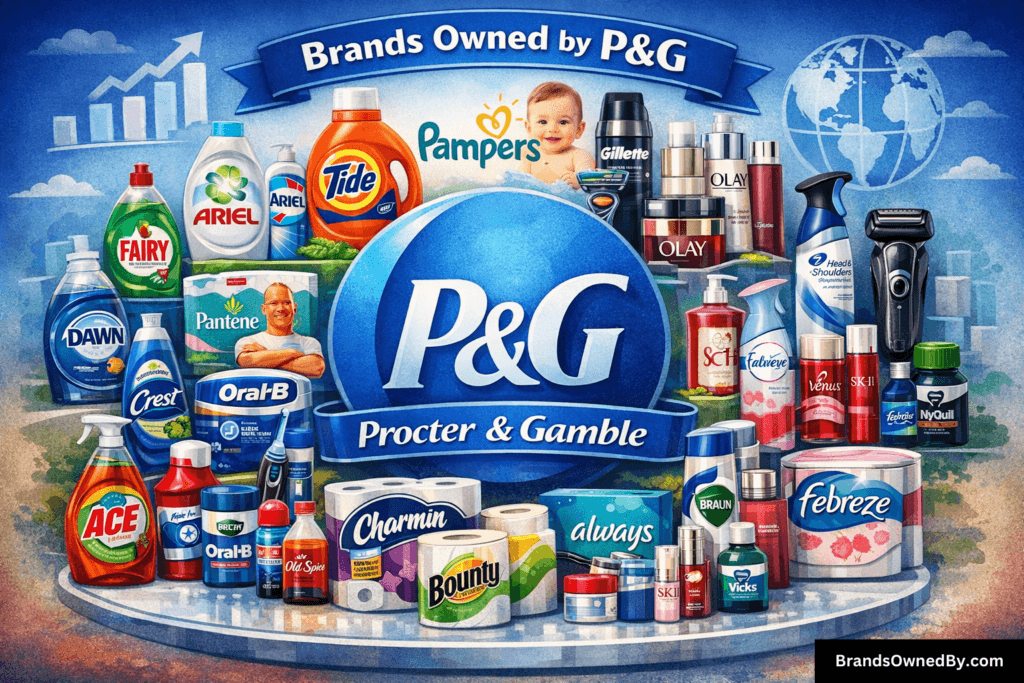
- Procter & Gamble owns more than 65 major consumer brands as of 2026, including Pampers, Tide, Gillette, Oral-B, Olay, Head & Shoulders, Pantene, Always, Charmin, and Vicks, with operations spanning beauty, healthcare, grooming, fabric care, and household cleaning categories.
- P&G’s largest revenue-driving brands are Tide, Pampers, Gillette, Oral-B, Ariel, Always, and Downy, while premium businesses such as SK-II, Olay, Braun, and Native continue strengthening the company’s higher-margin beauty and personal care portfolio.
- The company expanded its healthcare and prestige beauty operations through acquisitions including Gillette, Native, Walker & Company Brands, Tula Skincare, Farmacy Beauty, and Merck Consumer Health assets, which added brands such as Neurobion, Femibion, Seven Seas, and Sangobion.
- As of May 2026, Procter & Gamble generates more than $86 billion in annual revenue and maintains a market value above $337 billion, making it one of the largest and most valuable consumer goods companies globally.
Procter & Gamble, commonly known as P&G, is an American multinational consumer goods company headquartered in Cincinnati, Ohio. The company specializes in household products, personal care items, beauty brands, healthcare products, baby care solutions, and grooming products.
P&G is considered one of the largest consumer packaged goods companies in the world. Its products are sold in supermarkets, pharmacies, wholesale chains, convenience stores, and e-commerce platforms across more than 180 countries.
The company focuses on daily-use products that consumers regularly purchase. Its business model relies heavily on brand recognition, product innovation, retail partnerships, and global distribution networks.
Over the decades, Procter & Gamble built a portfolio of category-leading brands. Products like Tide, Pampers, Gillette, Oral-B, Pantene, and Head & Shoulders became household names in multiple countries.
P&G is also known for its aggressive marketing strategies. The company pioneered many modern advertising techniques, including radio sponsorships and television soap operas. In fact, the term “soap opera” became associated with P&G because the company sponsored serialized radio dramas to promote its soap products.
Today, Procter & Gamble operates through several major business segments, including:
- Beauty.
- Grooming.
- Healthcare.
- Fabric and home care.
- Baby, feminine, and family care.
The company continues to focus on premium products, supply chain efficiency, sustainability initiatives, and digital commerce expansion.
Founders of Procter & Gamble
The success of Procter & Gamble started with two immigrants who combined their manufacturing expertise to build a small soap and candle business in Ohio. Their partnership eventually evolved into one of the largest consumer goods companies in the world.
William Procter and James Gamble each brought different skills to the business. One specialized in candle production, while the other focused on soap manufacturing. Their combined experience helped create a strong operational foundation for the company during the 19th century.
William Procter
William Procter was born in England and later immigrated to the United States. Before founding Procter & Gamble, he worked as a candlemaker and operated a small candle manufacturing business.
After settling in Cincinnati, Ohio, Procter became known for his disciplined business approach and production management skills. He understood manufacturing efficiency, inventory control, and supply operations at a time when industrial-scale production was still developing in America.
His experience in candle production helped the company establish reliable manufacturing processes during its early years. Procter also played an important role in expanding the business during difficult economic periods in the mid-1800s.
James Gamble
James Gamble was born in Ireland and immigrated to the United States with his family. He trained as a soap maker and developed strong technical expertise in soap formulation and production methods.
Gamble contributed heavily to the product development side of the business. His understanding of ingredients, consistency, and manufacturing quality helped Procter & Gamble produce reliable soap products that gained consumer trust.
He also helped improve operational standards and production efficiency as the company expanded. His technical background became one of the key reasons the company established a reputation for product quality during its early growth phase.
How William Procter and James Gamble Formed the Company
William Procter and James Gamble became connected through marriage after marrying sisters from the same family. Their father-in-law reportedly encouraged them to form a partnership instead of operating separate competing businesses.
In 1837, the two officially launched Procter & Gamble in Cincinnati, Ohio.
The company initially focused on soap and candle production. During the American Civil War, Procter & Gamble secured supply contracts for military goods. This helped the company grow its manufacturing scale and increase national recognition.
The partnership between Procter and Gamble created the foundation for a company that later expanded into beauty, healthcare, grooming, fabric care, and household consumer products across global markets.
What Brands Are Owned by Procter & Gamble: Complete List
![What Brands Are Owned by Procter & Gamble [infographic]](https://brandsownedby.com/wp-content/uploads/2023/07/What-Brands-Are-Owned-by-Procter-Gamble-infographic-683x1024.png)
As of May 2026, Procter & Gamble operates one of the largest consumer goods portfolios in the world. The company focuses on five major operating divisions: Beauty, Grooming, Health Care, Fabric & Home Care, and Baby, Feminine & Family Care. P&G’s portfolio strategy is centered around billion-dollar brands with strong global market share, premium positioning, and recurring consumer demand.
Unlike previous decades, P&G now operates a more concentrated portfolio after divesting dozens of slower-growth brands. The company continues expanding through targeted acquisitions in premium beauty, personal wellness, and direct-to-consumer categories while heavily investing in product innovation, AI-driven manufacturing, and global retail distribution.
Pampers
Pampers remains P&G’s flagship baby care business and one of the company’s most valuable global brands. The brand dominates the premium disposable diaper category across North America, Europe, Asia, and Latin America.
P&G operates Pampers through multiple product segments including newborn diapers, premium protection diapers, baby wipes, swim diapers, training pants, and nighttime protection solutions. The company also expanded Pampers into digital parenting ecosystems, hospital partnerships, and pediatric-focused marketing campaigns.
The brand competes directly with Kimberly-Clark’s Huggies and private-label diaper manufacturers. Pampers continues to generate strong sales because of high customer retention and repeat purchasing behavior.
Luvs
Luvs operates as P&G’s value-focused diaper brand. The company positions Luvs below Pampers in pricing while maintaining core absorbency and leak-protection features.
The brand primarily targets cost-conscious families in the United States. P&G uses Luvs to compete against supermarket-owned diaper labels and discount baby care products without weakening Pampers’ premium positioning.
Ninjamas
Ninjamas is P&G’s nighttime underwear brand designed for older children experiencing bedwetting issues.
The company launched the brand to expand deeper into specialized pediatric care segments. Ninjamas products compete in a niche but high-margin category where comfort, discretion, and overnight protection are critical consumer priorities.
Gillette
Gillette remains one of the largest grooming companies owned by Procter & Gamble. Since the 2005 acquisition, the brand has become central to P&G’s male grooming operations.
The company sells manual razors, cartridge systems, disposable razors, shaving creams, beard care products, trimmers, and grooming accessories. Gillette also expanded heavily into subscription commerce and direct-to-consumer razor delivery models to compete with digital-native startups.
P&G uses Gillette as a technology-focused grooming brand. Product innovation centers around blade engineering, lubrication systems, precision shaving, and skin protection.
Gillette Venus
Venus operates under the broader Gillette grooming portfolio but focuses specifically on female shaving and body grooming products.
The brand includes razors, blades, skincare shaving gels, exfoliation products, and sensitive-skin grooming solutions. P&G positions Venus in the premium beauty and personal care category rather than purely functional grooming.
The company also expanded Venus into body hair-inclusive campaigns and younger consumer demographics through influencer-led marketing.
Braun
Braun is P&G’s premium grooming appliance and personal care device business. The German-engineered brand specializes in electric shavers, beard trimmers, epilators, IPL hair removal systems, and precision grooming devices.
Braun products are positioned above mass-market competitors in pricing and engineering quality. P&G continues investing heavily in connected grooming technology, battery performance, and ergonomic design improvements.
Braun also plays a strategic role in helping P&G compete against Philips and Panasonic in the premium electric grooming segment.
The Art of Shaving
The Art of Shaving is P&G’s luxury shaving and men’s grooming brand.
The business focuses on premium razors, shaving creams, beard oils, skincare products, fragrances, and luxury grooming accessories. P&G uses the brand to target affluent consumers seeking barbershop-style grooming experiences.
The brand also strengthens P&G’s position in prestige male skincare and premium retail channels.
Oral-B
Oral-B is one of P&G’s most technologically advanced healthcare businesses. The brand dominates the premium electric toothbrush category in many international markets.
The company operates Oral-B across manual toothbrushes, electric toothbrush systems, floss products, water flossers, oral irrigators, and dental accessories. Smart brushing technology has become a major growth driver for the brand.
P&G works closely with dental professionals and oral healthcare associations to position Oral-B as a clinically trusted oral care solution.
Crest
Crest remains one of the world’s largest toothpaste brands and a core part of P&G’s healthcare division.
The brand portfolio includes whitening toothpaste, cavity protection formulas, gum health products, enamel repair systems, mouthwash, and sensitivity treatments.
P&G continuously expands Crest into cosmetic oral care categories because whitening and aesthetic dentistry remain high-growth consumer segments.
Scope
Scope complements Crest and Oral-B within P&G’s oral care portfolio.
The brand specializes in antibacterial mouthwash, breath-freshening products, and oral hygiene rinses. P&G markets Scope heavily toward freshness-focused daily oral care routines.
Head & Shoulders
Head & Shoulders remains the global leader in anti-dandruff shampoo products. The brand operates across shampoos, scalp moisturizers, conditioners, intensive treatment systems, and men’s grooming products.
P&G expanded Head & Shoulders into scalp microbiome research and medicated scalp health categories as consumer awareness around scalp wellness increased.
The brand maintains strong market share in Asia-Pacific, the Middle East, Europe, and Latin America.
Pantene
Pantene remains one of the world’s largest haircare brands. The company positions the brand around science-backed hair repair and nutrient-based formulations.
Pantene products include shampoos, conditioners, styling sprays, hair masks, leave-in treatments, and anti-breakage solutions. P&G heavily markets Pantene through salon partnerships, celebrity endorsements, and performance-focused advertising.
The brand performs strongly in both developed and emerging markets because of its broad pricing structure and extensive product variety.
Herbal Essences
Herbal Essences focuses on botanical-inspired haircare and fragrance-driven beauty products.
P&G repositioned the brand around plant ingredients, sustainability messaging, and sensory haircare experiences. Product categories include shampoos, conditioners, hair oils, scalp treatments, and repair masks.
The brand competes heavily in the natural-inspired beauty segment against Unilever and L’Oréal haircare products.
Aussie
Aussie is a younger consumer-focused haircare brand owned by P&G.
The company markets the brand around hydration, curl care, and casual lifestyle branding. Aussie products are particularly popular among Gen Z and millennial consumers seeking affordable but trendy haircare products.
Rejoice
Rejoice is a major haircare brand in Asian markets.
P&G uses Rejoice extensively in Southeast Asia and parts of the Middle East where affordable haircare products generate high sales volumes. The brand focuses on daily-use shampoos and conditioners.
Olay
Olay is one of P&G’s largest skincare businesses and one of the company’s most profitable beauty brands.
The brand specializes in moisturizers, anti-aging creams, serums, facial cleansers, peptide treatments, retinol products, and vitamin-based skincare solutions.
P&G heavily expanded Olay’s premium skincare positioning in China and broader Asian beauty markets. The company also increased investments in dermatologist-backed formulations and science-driven beauty innovation.
SK-II
SK-II is P&G’s flagship luxury skincare business. The brand operates primarily in Japan, China, South Korea, Singapore, and luxury travel retail channels.
SK-II products command premium pricing and high profit margins. The brand is built around its signature Pitera ingredient and focuses heavily on anti-aging skincare, treatment essences, serums, and luxury facial care systems.
SK-II became strategically important for P&G because prestige beauty continues delivering higher margins than mass-market consumer goods.
Old Spice
Old Spice evolved from a traditional aftershave company into one of the world’s largest men’s personal care brands.
The company now operates Old Spice across deodorants, antiperspirants, body washes, shampoos, fragrances, body sprays, and skincare products.
P&G’s aggressive digital advertising campaigns transformed the brand’s image and significantly expanded its younger male customer base.
Secret
Secret remains one of the largest female deodorant and antiperspirant brands in North America.
The company expanded Secret into clinical-strength products, aluminum-free deodorants, skin-sensitive formulas, and wellness-focused personal care products.
Native
Native remains one of P&G’s most important modern acquisitions in personal care. The company acquired Native in 2017 to strengthen its position in clean-label and natural personal care categories.
Since the acquisition, P&G rapidly expanded Native beyond deodorants into body wash, shampoo, conditioner, toothpaste, and skincare products. The brand performs especially well in e-commerce and direct-to-consumer retail channels.
Native also helped P&G compete more effectively against digitally native beauty startups focused on ingredient transparency and minimalist branding.
Safeguard
Safeguard is P&G’s antibacterial soap and hygiene-focused cleansing brand.
The brand includes hand soaps, body washes, antibacterial cleansers, and hygiene protection products. Safeguard experienced increased demand after global public health awareness around sanitation and germ protection increased.
Ivory
Ivory remains one of the oldest active brands inside the P&G portfolio.
Originally famous for its floating soap bars, the brand later expanded into body washes, hand soaps, and gentle cleansing products. Ivory primarily targets consumers seeking simple and mild personal care products.
Tide
Tide is one of the most valuable laundry detergent brands globally and a major revenue driver for P&G’s Fabric & Home Care division.
The brand portfolio includes liquid detergents, pods, stain removers, hygienic cleaning products, specialty detergents, and cold-water cleaning systems.
P&G continuously invests in Tide because laundry detergents remain one of the company’s highest-volume recurring purchase categories.
Ariel
Ariel serves as P&G’s premium global detergent brand outside much of North America.
The company markets Ariel heavily around stain-removal performance, advanced cleaning technology, and premium laundry care systems. Ariel maintains strong market share across Europe, Asia, Africa, and Latin America.
Gain
Gain focuses on fragrance-centered laundry products and home care solutions.
The brand includes detergents, scent boosters, dryer sheets, fabric softeners, and dishwashing products. P&G differentiates Gain primarily through scent technology and fragrance intensity.
Downy
Downy is P&G’s leading fabric softener and laundry fragrance brand.
The company expanded Downy into wrinkle-release sprays, scent beads, and premium laundry enhancement products. Downy continues performing strongly because fragrance remains an important purchase factor in fabric care.
Bounce
Bounce specializes in dryer sheets and anti-static laundry products.
The brand complements Downy within P&G’s broader fabric enhancement portfolio.
Dreft
Dreft is P&G’s baby-focused detergent business.
The company markets Dreft specifically for infant clothing and sensitive skin washing needs. The brand benefits from strong crossover purchasing with Pampers consumers.
Cheer
Cheer operates primarily as a color-protection laundry detergent brand.
P&G uses Cheer to target consumers concerned about fading fabrics and garment care preservation.
Era
Era is another detergent brand owned and operated by Procter & Gamble.
The company positions Era as a value-oriented laundry solution in selected regional markets.
Febreze
Febreze remains one of the world’s largest odor elimination brands.
P&G expanded Febreze into fabric sprays, air fresheners, candles, plug-ins, car products, and home fragrance systems. The company differentiates Febreze by emphasizing odor elimination instead of fragrance masking.
Swiffer
Swiffer is one of P&G’s most successful household cleaning system brands.
The business includes disposable mops, dry sweepers, dusters, wet cleaning pads, and floor-cleaning systems. Swiffer created a major recurring-revenue model because consumers repeatedly purchase refill products.
Mr. Clean
Mr. Clean remains one of P&G’s core household cleaning brands.
The portfolio includes multi-surface cleaners, disinfectants, cleaning liquids, bathroom cleaners, and Magic Eraser products. P&G continues expanding Mr. Clean into hygiene and antibacterial cleaning categories.
Dawn
Dawn is one of the strongest dishwashing liquid brands in North America.
The company markets Dawn heavily around grease removal performance and concentrated cleaning formulations. The brand also maintains strong public recognition because of wildlife rescue partnerships during oil spill cleanup efforts.
Cascade
Cascade is P&G’s premium dishwasher detergent brand.
The business includes dishwasher pods, gels, powders, rinse aids, and appliance cleaning products. P&G positions Cascade as a high-performance automatic dishwashing system compatible with modern energy-efficient dishwashers.
Fairy
Fairy is one of P&G’s most important dishwashing and home cleaning brands in Europe and international markets.
The company uses Fairy similarly to Dawn in many countries while adapting branding and formulations to local consumer preferences.
Joy
Joy remains an active dishwashing brand in selected international markets.
The brand continues performing particularly well in Asia and Latin America where affordable dishwashing products maintain strong demand.
Ambi Pur
Ambi Pur is P&G’s home fragrance and air care brand operating in multiple global markets.
The company sells room fresheners, plug-in systems, bathroom fragrances, and car air fresheners under the Ambi Pur name.
Bounty
Bounty is one of P&G’s flagship paper towel brands.
The company positions Bounty around absorbency, durability, and premium household cleaning performance. Bounty maintains strong shelf placement across major retailers and warehouse chains.
Charmin
Charmin remains one of the largest toilet paper brands in North America.
P&G markets Charmin heavily through softness-focused branding and family-oriented advertising campaigns. The company also expanded the brand into ultra-premium tissue products and larger bulk packaging formats.
Puffs
Puffs is P&G’s facial tissue business.
The brand competes heavily during allergy seasons and cold-and-flu periods. P&G markets Puffs around softness, durability, and lotion-enhanced tissue products.
Always
Always remains one of the largest feminine hygiene brands globally.
The portfolio includes sanitary pads, liners, incontinence products, period underwear, and overnight protection systems. P&G continues investing heavily in menstrual health innovation and female wellness education campaigns.
Always Discreet
Always Discreet focuses specifically on adult incontinence products and bladder protection solutions.
The category continues growing because of aging populations in developed markets.
Tampax
Tampax is one of the world’s most recognized tampon brands.
The company expanded Tampax into sport-focused products, compact travel formats, and comfort-enhanced applicator systems.
Whisper
Whisper is P&G’s major feminine hygiene brand across parts of Asia and emerging markets.
The brand focuses primarily on sanitary pads and menstrual care products.
This is L
P&G acquired This is L to strengthen its position in organic and wellness-focused feminine hygiene categories.
The brand focuses on organic cotton menstrual products, period care solutions, and social-impact-oriented marketing initiatives.
Vicks
Vicks remains one of the largest respiratory healthcare brands owned by P&G.
The company sells vapor rubs, cough syrups, throat lozenges, inhalers, humidifier products, and cold-and-flu treatment solutions. Vicks maintains exceptionally strong brand recognition across both developed and emerging markets.
Pepto-Bismol
Pepto-Bismol is one of P&G’s core digestive healthcare businesses.
The brand focuses on nausea relief, upset stomach treatment, indigestion relief, and gastrointestinal healthcare products.
Metamucil
Metamucil remains a major digestive wellness and fiber supplement brand.
The company expanded Metamucil into gummies, powders, capsules, and sugar-free nutritional wellness products as digestive health awareness increased globally.
Neurobion
Neurobion is one of P&G’s largest vitamin and nerve-health supplement brands in international markets. The brand focuses mainly on vitamin B complex supplements designed to support nerve function, energy metabolism, and neurological health.
The product line includes tablets, injections, and nutritional formulations sold across Asia, Latin America, the Middle East, and parts of Europe. Neurobion maintains particularly strong market recognition in countries such as Indonesia, India, Mexico, and the Philippines.
P&G gained ownership of Neurobion through the acquisition of Merck KGaA’s consumer health business in selected markets during 2018. The transaction was valued at approximately $4.2 billion. The acquisition significantly expanded P&G’s healthcare and nutritional supplement portfolio outside North America.
Neurobion plays a strategic role in helping P&G strengthen its presence in over-the-counter wellness and preventative healthcare categories. The brand also gives the company greater exposure to aging populations and health-conscious consumers in emerging markets.
Femibion
Femibion is a prenatal nutrition and women’s wellness supplement brand operated by Procter & Gamble.
The brand focuses on nutritional supplements for pregnancy planning, prenatal care, and postnatal health support. Femibion products contain combinations of folic acid, omega-3 nutrients, iodine, and pregnancy-focused vitamins designed to support maternal and fetal development.
The brand maintains strong distribution across European healthcare and pharmacy markets. P&G uses Femibion to expand deeper into women’s health and nutritional wellness categories, which continue experiencing strong long-term growth globally.
P&G acquired Femibion as part of the broader Merck consumer health acquisition completed in 2018. That deal added several healthcare and supplement brands into the company’s international portfolio and strengthened its non-prescription healthcare operations.
Seven Seas
Seven Seas is a nutritional supplement and omega-3 wellness brand owned by Procter & Gamble.
The company markets fish oil supplements, cod liver oil capsules, multivitamins, immune support products, and heart-health supplements under the Seven Seas brand. The business is particularly strong in the United Kingdom and European wellness markets.
Seven Seas has operated for decades in nutritional healthcare and maintains strong recognition among consumers seeking preventative wellness products. P&G positions the brand within the growing global demand for supplements tied to heart health, joint support, immunity, and cognitive wellness.
The company acquired Seven Seas through the 2018 Merck consumer health transaction valued at approximately $4.2 billion. The acquisition helped P&G diversify further into higher-margin healthcare and supplement categories.
Sangobion
Sangobion is an iron supplement and nutritional wellness brand owned by P&G in selected international markets.
The brand focuses on iron-deficiency support, energy metabolism, and blood-health supplementation. Sangobion products are widely sold across Southeast Asia, Latin America, and emerging healthcare markets where iron deficiency remains a common nutritional concern.
P&G operates Sangobion mainly through pharmacies, healthcare retailers, and medical distribution channels. The company uses the brand to strengthen its international healthcare presence in developing economies with rising demand for nutritional wellness products.
Like Neurobion and Femibion, Sangobion became part of P&G through the Merck consumer health acquisition completed in 2018.
Clearblue
Clearblue is one of P&G’s most important women’s diagnostic healthcare brands.
The business specializes in pregnancy tests, ovulation tracking systems, fertility monitors, and reproductive health technologies. Clearblue products are sold globally through pharmacies, supermarkets, and online healthcare retailers.
The brand is known for digital pregnancy testing technology and advanced fertility monitoring systems. P&G positions Clearblue as a premium healthcare technology brand rather than a low-cost testing business.
Clearblue benefits from rising global consumer interest in fertility awareness, reproductive planning, and home healthcare diagnostics. The company continues investing in digital reproductive tracking and connected healthcare solutions tied to the brand.
New Chapter
New Chapter is a premium wellness and nutritional supplement brand owned by Procter & Gamble.
The brand focuses on vitamins, herbal supplements, probiotics, fermented nutrients, and organic wellness products. New Chapter products are widely sold through health-focused retailers, pharmacies, e-commerce platforms, and specialty wellness stores.
P&G acquired New Chapter in 2012 as part of its strategy to expand into natural health and wellness categories. The acquisition gave the company stronger exposure to organic nutritional supplements and health-conscious consumers seeking clean-label products.
The brand differentiates itself through non-GMO ingredients, fermented nutrients, whole-food-based formulations, and sustainability-focused marketing. New Chapter also operates heavily in premium wellness retail channels where consumer spending remains relatively resilient.
Align
Align is P&G’s probiotic supplement brand focused on digestive health and gut wellness.
The company markets Align around microbiome health, digestive balance, bloating reduction, and gastrointestinal support. The brand’s probiotic formulations are positioned as science-backed wellness products supported by clinical research.
Align operates in one of the fastest-growing healthcare segments globally because consumers increasingly focus on gut health and preventative wellness. P&G expanded the brand into daily digestive care routines and healthcare professional partnerships.
The company uses Align to strengthen recurring healthcare revenue streams tied to nutritional wellness and long-term supplement consumption.
Fixodent
Fixodent is one of P&G’s leading oral healthcare support brands.
The business focuses on denture adhesives, denture cleansers, and oral appliance care products. Fixodent products are primarily marketed toward aging populations and consumers requiring long-term denture support solutions.
The brand remains important because demographic aging trends continue increasing demand for senior-focused healthcare and oral support products. P&G distributes Fixodent through pharmacies, dental channels, supermarkets, and healthcare retailers globally.
Fixodent also complements P&G’s broader oral care portfolio that includes Crest and Oral-B.
Prilosec OTC
Prilosec OTC is a major over-the-counter acid reflux and heartburn treatment brand operated by P&G through licensing arrangements.
The product focuses on frequent heartburn treatment and long-lasting acid reduction. Prilosec OTC maintains strong pharmacy distribution and remains one of the most recognized heartburn relief products in North America.
The brand operates in the highly competitive gastrointestinal healthcare category, competing against antacid and acid-reduction products from Johnson & Johnson, Haleon, and other pharmaceutical companies.
P&G benefits from the recurring demand associated with digestive health conditions and over-the-counter medication consumption.
Walker & Company Brands
P&G acquired Walker & Company Brands in December 2018 to strengthen its multicultural beauty and grooming operations.
The acquisition added brands such as Bevel and FORM Beauty into P&G’s portfolio. Bevel focuses on shaving and grooming products designed primarily for men with coarse and textured hair, while FORM Beauty targets textured haircare and premium beauty categories.
The deal was strategically important because it expanded P&G’s reach into underserved multicultural consumer segments. It also improved the company’s direct-to-consumer capabilities and digital commerce infrastructure.
Although financial terms of the transaction were not officially disclosed, industry estimates placed the acquisition value in the range of tens of millions of dollars.
Tula Skincare
P&G acquired Tula Skincare in January 2022 as part of its prestige beauty expansion strategy.
Tula specializes in probiotic skincare products and wellness-focused beauty formulations. The brand became popular through social media marketing, influencer partnerships, and direct-to-consumer digital sales.
The acquisition helped P&G strengthen its position in premium skincare categories where growth rates and profit margins are significantly higher than traditional mass-market beauty products.
Industry estimates valued the acquisition at well above $100 million, although exact financial terms were not publicly disclosed.
P&G integrated Tula into its growing prestige skincare portfolio alongside SK-II and Farmacy Beauty.
Farmacy Beauty
Farmacy Beauty became part of P&G’s prestige skincare portfolio in late 2021.
The brand focuses on clean skincare products, honey-based ingredients, plant-derived formulations, and premium facial treatments. Farmacy gained strong popularity among younger consumers seeking ingredient transparency and sustainability-focused skincare products.
The acquisition allowed P&G to compete more aggressively against independent luxury skincare companies and digitally native beauty startups.
Farmacy products are distributed through premium beauty retailers, specialty skincare chains, and direct online channels. The company continues expanding the brand internationally as demand for clean beauty products rises globally.
Merck Consumer Health
P&G completed the acquisition of Merck KGaA’s consumer health business in selected international markets during 2018 for approximately $4.2 billion.
The transaction added several major healthcare and supplement brands into the company’s portfolio, including Neurobion, Femibion, Seven Seas, and Sangobion.
The acquisition significantly strengthened P&G’s healthcare division outside North America and improved the company’s position in vitamins, nutritional supplements, and wellness-focused consumer healthcare products.
The deal also expanded P&G’s pharmaceutical distribution relationships, healthcare retail partnerships, and exposure to emerging international healthcare markets.
P&G Professional (P&G PRO)
P&G Professional operates as Procter & Gamble’s commercial and institutional cleaning division.
The business supplies hotels, hospitals, restaurants, offices, industrial facilities, schools, and commercial cleaning operators with professional-grade cleaning and sanitation products.
P&G PRO uses commercial versions of brands such as Mr. Clean, Dawn, Tide, Febreze, and Cascade for institutional customers. The division became increasingly important after global demand for sanitation, hygiene, and workplace cleaning systems increased sharply.
The business also strengthens P&G’s exposure to B2B revenue streams outside traditional consumer retail channels.
Charlie Banana
Charlie Banana was a reusable diaper and eco-friendly baby care brand previously operated within P&G’s baby care portfolio.
The company originally acquired the brand in 2020 through its acquisition of Jellyworks. Charlie Banana specialized in reusable cloth diapers, washable inserts, baby accessories, and environmentally focused infant care products.
The acquisition helped P&G expand into sustainable baby care categories and reusable hygiene products. However, the company later divested Charlie Banana in August 2025 as part of its ongoing portfolio optimization strategy focused on scaling larger global brands.
The divestiture reflected P&G’s broader strategy of concentrating resources on billion-dollar brands and high-margin product categories.
Who Owns Procter & Gamble?
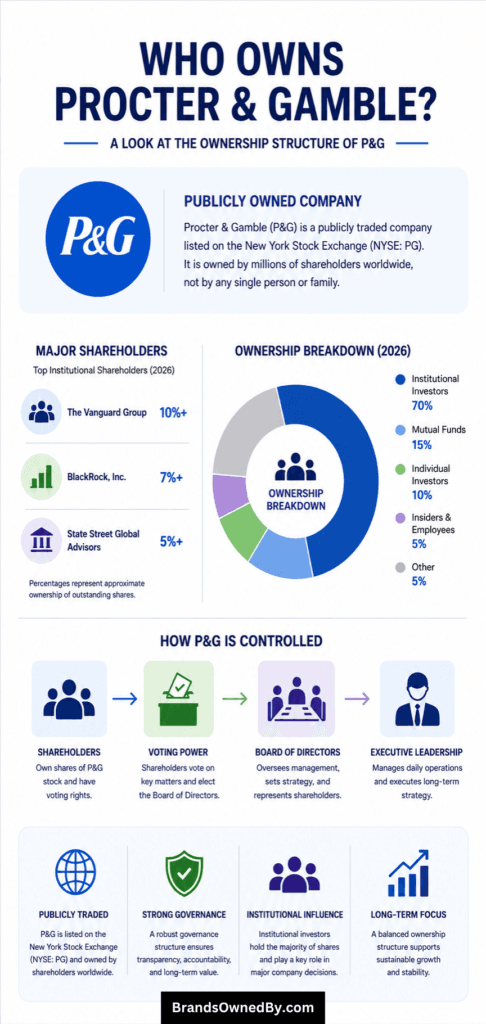
Procter & Gamble is a publicly traded company listed on the New York Stock Exchange under the ticker symbol PG. As of May 2026, the company does not have a single majority owner. Instead, ownership is spread across institutional investors, mutual funds, pension funds, ETFs, executives, and retail shareholders.
Institutional investors control most of the company’s outstanding shares. Large asset managers such as Vanguard, BlackRock, and State Street collectively own a significant portion of P&G because the company is included in major index funds, retirement portfolios, dividend ETFs, and long-term consumer staples investment strategies.
P&G’s ownership structure reflects its status as one of the largest and most stable consumer goods companies in the world. The company attracts long-term investors because of its consistent dividends, strong cash flow, defensive business model, and globally recognized brands.
Below is a list of the major shareholders of Procter & Gamble:
The Vanguard Group
The Vanguard Group is the largest shareholder of Procter & Gamble as of 2026.
Vanguard owns more than 237 million shares of P&G, representing approximately 10.2% of the company’s outstanding stock. Most of these holdings are spread across Vanguard index funds, retirement products, dividend funds, and exchange-traded funds.
The company’s largest Vanguard-managed positions include the Vanguard Total Stock Market Index Fund and Vanguard 500 Index Fund. Because P&G is a major component of the S&P 500 and consumer staples indexes, Vanguard maintains large passive ownership positions through its ETF ecosystem.
Although Vanguard generally acts as a passive investor, its voting power gives it substantial influence over corporate governance matters, executive compensation, board elections, ESG initiatives, and shareholder proposals.
BlackRock
BlackRock is the second-largest shareholder of Procter & Gamble.
As of 2026, BlackRock controls roughly 178 million to 187 million P&G shares, representing approximately 7.7% to 7.9% ownership depending on filing periods and fund adjustments.
Most of BlackRock’s ownership comes through iShares ETFs, institutional investment mandates, pension funds, and index-tracking products. P&G remains a core holding across BlackRock’s consumer staples and dividend-oriented investment products.
BlackRock’s influence is important because of its scale in corporate governance. The firm regularly participates in shareholder voting related to executive leadership, sustainability policies, and board oversight.
State Street Corporation
State Street Corporation is another major institutional shareholder of Procter & Gamble.
The investment firm owns approximately 100 million to 101 million shares, representing around 4.3% of the company.
State Street primarily holds P&G stock through its SPDR ETF business, institutional asset management operations, and retirement investment products.
Like Vanguard and BlackRock, State Street’s ownership position gives it considerable voting influence despite operating mainly as a passive institutional investor.
Geode Capital Management
Geode Capital Management is one of the largest secondary institutional shareholders of P&G.
As of 2026, the firm owns more than 60 million shares, representing approximately 2.6% of the company’s outstanding stock.
Geode primarily manages index-based investment strategies and institutional portfolios. Its holdings in P&G are tied largely to passive investment products linked to major equity indexes.
Morgan Stanley
Morgan Stanley is another major shareholder of Procter & Gamble through institutional asset management operations and wealth management investment portfolios.
The company controls more than 51 million P&G shares as of recent 2026 filings.
Morgan Stanley’s ownership comes mainly from managed investment accounts, ETFs, retirement portfolios, and institutional fund strategies.
Norges Bank Investment Management
Norway’s sovereign wealth fund, managed by Norges Bank Investment Management, also holds a significant stake in Procter & Gamble.
As of 2026, Norges Bank owns approximately 32 million shares of the company.
The fund invests heavily in large multinational corporations with stable earnings, strong governance structures, and global market leadership. P&G fits this strategy because of its defensive consumer staples positioning and reliable dividend history.
T. Rowe Price Associates
T. Rowe Price Associates remains one of the notable long-term institutional investors in P&G.
The investment company owns roughly 25 million shares as of 2026.
T. Rowe Price includes P&G in several actively managed equity and dividend-focused portfolios because of the company’s strong profitability and stable long-term performance.
Insider Ownership of Procter & Gamble
Insider ownership at Procter & Gamble remains relatively small compared to institutional ownership.
Executives and board members collectively own less than 1% of the company’s shares. However, senior leadership still holds substantial stock positions worth millions of dollars through compensation packages, restricted stock units, and long-term incentive programs.
The company’s leadership structure aligns executive compensation closely with shareholder performance and long-term stock appreciation.
Jon R. Moeller
Jon R. Moeller serves as Executive Chairman of Procter & Gamble.
He remains one of the company’s largest insider shareholders and has spent decades inside P&G leadership. Moeller previously served as Chief Financial Officer and later became CEO before transitioning into the chairman role.
His influence over long-term capital allocation, portfolio strategy, acquisitions, and operational restructuring has been significant.
Shailesh Jejurikar
Shailesh Jejurikar became President and Chief Executive Officer of Procter & Gamble in 2026.
He oversees global operations across beauty, healthcare, fabric care, grooming, and household products. Jejurikar has held numerous leadership positions within P&G and played a major role in expanding the company’s international operations and supply chain modernization initiatives.
Sundar Raman
Sundar Raman is another major executive shareholder and senior business leader within P&G.
He has overseen several major product categories and operational divisions, particularly within Fabric & Home Care operations, which represent one of the company’s largest revenue-generating segments.
Retail and Public Shareholders
Retail investors and public shareholders collectively own roughly 30% of Procter & Gamble shares.
Many individual investors hold P&G stock for dividend income and long-term portfolio stability. The company has one of the strongest dividend track records in the corporate world and is widely considered a blue-chip consumer staples investment.
P&G’s broad retail ownership also reflects strong public confidence in the company’s global brands, recurring consumer demand, and recession-resistant business model.
Competitor Ownership Comparison
Procter & Gamble competes against some of the largest consumer goods corporations in the world. As of May 2026, the company faces direct competition across beauty, grooming, healthcare, baby care, oral care, fabric care, feminine hygiene, and home cleaning categories.
What separates these companies is not only product portfolios but also ownership structure. Ownership affects acquisition strategy, shareholder pressure, innovation spending, operational flexibility, and long-term decision-making.
P&G remains one of the most institutionally controlled consumer goods companies globally. Institutional investors control nearly 70% of the company’s shares, creating a highly stable ownership environment focused on dividends, operational efficiency, and long-term shareholder returns.
Procter & Gamble vs Unilever
Unilever is one of P&G’s closest competitors globally. The company owns brands such as Dove, Rexona, Axe, Vaseline, Sunsilk, Lux, Surf, and Domestos. These brands compete directly against P&G products including Pantene, Head & Shoulders, Secret, Old Spice, Tide, Ariel, and Olay.
As of May 2026, Unilever operates with a heavily institutional ownership structure similar to P&G. Large asset managers such as BlackRock, Vanguard, Norges Bank, and Legal & General remain among its biggest shareholders.
However, Unilever has experienced significantly greater shareholder pressure in recent years. Between 2022 and 2025, activist investors criticized the company after weak volume growth, declining operating momentum, and the failed attempt to acquire GSK Consumer Healthcare. Investors pushed aggressively for cost reductions, restructuring programs, and management changes.
P&G avoided similar instability because of stronger execution in premium categories and better pricing power during inflationary periods. The company maintained stronger margins in grooming, fabric care, and oral care while continuing to generate stable free cash flow and dividend growth.
As of May 2026:
- P&G’s market capitalization exceeded $340 billion.
- Unilever’s valuation remained considerably lower despite broader geographic exposure.
- P&G generated stronger operating margins than Unilever in most consumer product categories.
Another key difference is portfolio composition. Unilever still maintains substantial exposure to lower-margin food and nutrition businesses, while P&G remains concentrated in higher-margin household and personal care categories.
Procter & Gamble vs Johnson & Johnson
Johnson & Johnson competes with P&G mainly in skincare, baby care, healthcare, and wellness categories.
Major competing brands include Neutrogena, Aveeno, Johnson’s Baby, Tylenol, and Listerine. These products compete directly against Olay, Pampers, Vicks, Crest, and Oral-B.
Although both companies are dominated by institutional shareholders, their operational structures differ significantly.
P&G operates primarily as a consumer goods company. Johnson & Johnson operates across three massive divisions:
- Pharmaceuticals.
- Medical devices.
- Consumer healthcare.
This changes the type of institutional investors involved. J&J attracts healthcare-focused funds and pharmaceutical investors, while P&G primarily attracts dividend investors, consumer staples funds, and defensive equity portfolios.
As of May 2026:
- Johnson & Johnson’s market value remained above $360 billion.
- P&G maintained a valuation above $340 billion.
- Both companies remained major holdings inside S&P 500 ETFs and retirement portfolios.
J&J also faces substantially higher litigation and regulatory risks because of pharmaceutical approvals, patent cycles, and medical device liabilities. P&G’s revenue model is considered more stable because it depends on recurring demand for everyday products such as Tide, Pampers, Gillette, and Charmin.
Procter & Gamble vs Kimberly-Clark
Kimberly-Clark remains one of P&G’s most direct competitors in diapers, tissue products, feminine hygiene, and paper-based household categories.
Its brands include Huggies, Pull-Ups, Kleenex, Scott, and Kotex. These products compete directly against Pampers, Charmin, Bounty, Always, and Puffs.
Like P&G, Kimberly-Clark’s ownership structure is heavily institution-driven. Vanguard, BlackRock, and State Street remain among its largest shareholders.
The major difference is scale.
As of May 2026:
- Kimberly-Clark’s market capitalization remained below $50 billion.
- P&G’s valuation exceeded $340 billion.
- P&G generated substantially higher annual revenue and free cash flow.
This scale advantage allows P&G to spend significantly more on:
- Advertising.
- Manufacturing automation.
- Supply chain optimization.
- AI-driven logistics.
- Product innovation.
- Retail partnerships.
P&G also benefits from broader diversification. Kimberly-Clark depends heavily on tissue and baby care categories, while P&G generates revenue from beauty, grooming, healthcare, oral care, cleaning products, and laundry categories simultaneously.
Procter & Gamble vs Colgate-Palmolive
Colgate-Palmolive competes heavily with P&G in oral care and household cleaning.
Its major brands include Colgate, Palmolive, Ajax, and Tom’s of Maine. Crest and Oral-B compete directly against Colgate products globally.
Both companies operate with highly institutionalized ownership structures. Vanguard, BlackRock, and State Street remain among the largest shareholders of both corporations.
However, Colgate-Palmolive is significantly more concentrated in oral care compared to P&G.
As of May 2026:
- Oral care remained Colgate’s largest revenue-generating category.
- P&G generated more diversified revenue streams across grooming, beauty, healthcare, fabric care, and household products.
- P&G operated at a substantially larger scale than Colgate-Palmolive.
P&G’s diversification reduces category-specific risk and creates more stable cash flow generation during market slowdowns.
Colgate, meanwhile, remains more vulnerable to competitive pressure inside oral care markets because a larger percentage of company revenue depends on toothpaste and dental hygiene products.
Procter & Gamble vs Reckitt
Reckitt competes with P&G in cleaning, hygiene, healthcare, and household categories.
Major Reckitt brands include Lysol, Dettol, Finish, Air Wick, Mucinex, and Durex.
Reckitt’s ownership structure has been more volatile than P&G’s because of aggressive acquisition strategies and restructuring efforts.
The company’s acquisition of Mead Johnson for approximately $17 billion created substantial debt pressure and integration challenges. Investors later criticized Reckitt for weaker operating performance and inconsistent execution.
P&G adopted a much more disciplined acquisition strategy after the Gillette transaction and focused heavily on scaling existing billion-dollar brands instead of pursuing multiple large debt-funded acquisitions.
As of May 2026:
- P&G maintained stronger operating margins than Reckitt.
- P&G generated more stable free cash flow.
- Reckitt experienced greater investor pressure around restructuring and portfolio optimization.
P&G’s shareholder base is also considered more stable because passive institutional investors control a larger percentage of shares.
Procter & Gamble vs L’Oréal
L’Oréal represents one of the biggest ownership structure contrasts compared to P&G.
The company owns brands including Lancôme, Maybelline, Garnier, Kiehl’s, La Roche-Posay, Redken, and CeraVe. These products compete against Olay, SK-II, Pantene, Herbal Essences, and Head & Shoulders.
Unlike P&G, L’Oréal operates with significant insider and strategic shareholder influence.
As of May 2026:
- The Bettencourt Meyers family remained the largest shareholder of L’Oréal.
- Nestlé continued holding a major ownership stake.
- Insider influence remained far stronger than at P&G.
This gives L’Oréal more centralized strategic control compared to P&G’s institutionally governed structure.
L’Oréal also moves faster in prestige beauty acquisitions and luxury skincare expansion because of stronger insider-led long-term strategic control.
P&G, by comparison, operates with greater emphasis on operational scale, mass-market leadership, and stable shareholder returns.
Procter & Gamble vs Estée Lauder
Estée Lauder competes directly with P&G in prestige skincare and luxury beauty categories.
The company owns brands including Estée Lauder, Clinique, MAC Cosmetics, La Mer, and The Ordinary.
A major ownership difference exists between the two companies.
As of May 2026:
- The Lauder family continued maintaining substantial voting control over Estée Lauder through special share structures.
- P&G had no founding family ownership influence.
- Institutional investors dominated P&G governance almost entirely.
This gives Estée Lauder greater insider control over acquisitions, branding, and luxury expansion strategies.
P&G’s governance system instead depends more heavily on institutional shareholder expectations, board oversight, and operational performance metrics.
Procter & Gamble vs Henkel
Henkel competes with P&G through brands such as Persil, Purex, Schwarzkopf, and Dial.
Unlike P&G, Henkel maintains strong family ownership influence despite being publicly traded.
The Henkel family controls a large portion of voting rights through holding structures. This allows the company to maintain more centralized long-term strategic control compared to P&G’s shareholder-driven governance model.
P&G’s structure is much more influenced by large institutional investors such as Vanguard, BlackRock, and State Street.
Henkel’s ownership structure allows faster long-term strategic decisions in certain categories, while P&G benefits from a larger global scale, stronger distribution infrastructure, and greater financial stability.
Why P&G’s Ownership Structure Is Considered Strong
As of May 2026, Procter & Gamble’s ownership structure is viewed as one of the most stable in the consumer goods industry.
Several factors contribute to this:
- Strong institutional investor confidence.
- Consistent dividend growth.
- Massive global brand portfolio.
- Stable recurring consumer demand.
- High free cash flow generation.
- Lower litigation exposure compared to healthcare competitors.
- Broad category diversification.
- Strong retailer relationships.
- Premium product positioning.
- Conservative acquisition strategy.
This ownership stability allows P&G to maintain long-term operational planning while continuing to dominate multiple global consumer product categories simultaneously.
Who Controls Procter & Gamble in 2026?
As of 2026, Procter & Gamble is controlled through a combination of executive leadership, the board of directors, and large institutional shareholders. Unlike founder-controlled companies or family-owned consumer businesses, P&G operates under a highly institutionalized governance structure where decision-making power is distributed across corporate leadership and major investors.
The company does not have a single controlling shareholder. Instead, operational control comes from executive management, while strategic oversight comes from the board of directors and institutional investors such as Vanguard, BlackRock, and State Street.
P&G’s governance structure is designed around long-term operational stability, shareholder returns, and disciplined portfolio management. This structure has allowed the company to maintain consistent leadership across global consumer categories for decades.
Shailesh Jejurikar Controls Daily Operations as CEO
Shailesh Jejurikar became President and Chief Executive Officer of Procter & Gamble on January 1, 2026, succeeding Jon Moeller after a planned leadership transition announced in July 2025.
As CEO, Jejurikar now controls the company’s global operations, corporate strategy execution, manufacturing priorities, product innovation pipeline, retail relationships, and international business expansion.
His role includes oversight of:
- Beauty operations.
- Grooming businesses.
- Fabric & Home Care.
- Baby, Feminine & Family Care.
- Healthcare operations.
- Global supply chain management.
- AI-driven operational modernization.
- Pricing and margin strategy.
Jejurikar is considered one of the most operationally experienced executives inside P&G. Before becoming CEO, he led multiple major divisions including Fabric & Home Care, one of the company’s largest business units containing brands such as Tide, Ariel, Downy, and Febreze. He also previously managed Health & Beauty Care operations and P&G Professional.
His appointment reflected P&G’s long-standing preference for internal leadership succession rather than external executive recruitment. Jejurikar joined P&G in 1989 and spent decades managing global operations before reaching the CEO position.
As of May 2026, Jejurikar oversees a company generating more than $84 billion in annual revenue with products sold in over 180 countries.
Jon Moeller Maintains Strategic Influence as Executive Chairman
Although Shailesh Jejurikar now runs daily operations, Jon Moeller continues holding significant influence over Procter & Gamble as Executive Chairman of the Board.
Moeller transitioned into the chairman role in January 2026 after serving as CEO since 2021. The transition was part of a planned governance succession approved by P&G’s board.
As Executive Chairman, Moeller now controls:
- Board leadership.
- Long-term strategic guidance.
- CEO advisory responsibilities.
- Corporate governance priorities.
- Shareholder engagement.
- Capital allocation oversight.
- Executive succession planning.
P&G specifically stated that Moeller would continue advising the CEO and leading the board of directors after stepping down as chief executive.
Moeller remains highly influential because he played a central role in one of the largest transformations in modern P&G history. During his leadership period, the company streamlined its portfolio, improved productivity, expanded premium product positioning, and strengthened margins across major operating segments.
The Board of Directors Controls Corporate Governance
The P&G board of directors remains one of the most powerful governing bodies inside the company.
As of 2026, the board includes senior executives and former leaders from major multinational corporations, healthcare businesses, financial institutions, and government organizations. The board oversees executive compensation, acquisitions, governance policies, shareholder protection, and long-term strategic planning.
Key board members include:
- Jon Moeller.
- Joseph Jimenez.
- Christopher Kempczinski.
- Rajesh Subramaniam.
- Christine McCarthy.
- Robert Portman.
- Ashley McEvoy.
- Debra Lee.
The board also maintains specialized committees responsible for:
- Audit and financial oversight.
- Executive compensation.
- Leadership development.
- Governance and public responsibility.
- Innovation and technology oversight.
P&G’s governance policies give the board substantial authority over executive leadership decisions and corporate accountability standards.
As of 2026, women represented approximately 36% of P&G’s board composition, reflecting the company’s emphasis on governance diversity and global representation.
Institutional Investors Influence Major Decisions
Although executives manage operations, institutional investors exercise major indirect control over Procter & Gamble through voting power and shareholder influence.
As of May 2026:
- Vanguard controlled roughly 10% of P&G shares.
- BlackRock held approximately 7% to 8%.
- State Street controlled over 4%.
- Geode Capital Management owned around 2.6%.
- Norges Bank remained another major shareholder.
Collectively, institutional investors controlled nearly 70% of P&G’s outstanding shares.
These investors influence:
- Executive compensation approval.
- Board elections.
- ESG policies.
- Capital return strategies.
- Share repurchase programs.
- Corporate restructuring decisions.
- Governance standards.
Because most large shareholders are passive institutional investors rather than activist hedge funds, P&G experiences relatively low governance instability compared to some competitors.
This stable institutional ownership structure allows leadership to focus heavily on long-term operational execution rather than short-term shareholder conflicts.
Business Unit CEOs Control Key Product Segments
P&G also operates through a decentralized leadership model where major business segments are controlled by division CEOs.
As of 2026, several executives manage large independent operating units inside the company:
- Freddy Bharucha leads Beauty operations.
- Gary Coombe leads Grooming.
- Sundar Raman oversees Fabric & Home Care and P&G Ventures.
- Ma. Fatima Francisco leads Baby, Feminine & Family Care.
- Paul Gama and Jennifer Davis oversee Healthcare operations.
These executives control category-specific strategy, product innovation, manufacturing priorities, and retail expansion inside their divisions.
This structure allows P&G to operate almost like multiple specialized consumer goods businesses under one corporate umbrella.
Institutional Governance Gives P&G Long-Term Stability
P&G’s control structure differs significantly from founder-led or family-controlled competitors such as L’Oréal, Henkel, or Estée Lauder.
The company operates with a highly institutional governance system built around:
- Board oversight.
- Executive accountability.
- Long-term shareholder returns.
- Stable dividend growth.
- Operational discipline.
- Conservative acquisition strategy.
This governance model has helped P&G remain one of the most stable consumer goods companies globally for decades.
As of May 2026, the company continued focusing on premium brand expansion, AI-driven supply chain modernization, manufacturing efficiency, and portfolio optimization under the combined leadership of Shailesh Jejurikar, Jon Moeller, the board of directors, and large institutional investors.
Procter & Gamble Annual Revenue and Net Worth
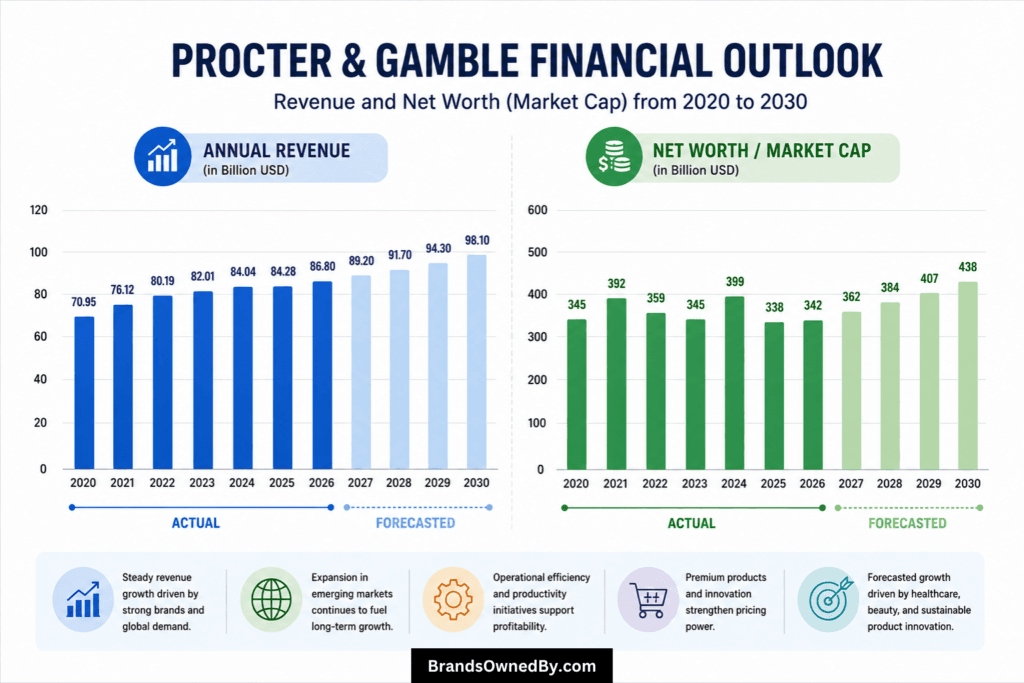
As of May 2026, Procter & Gamble remains one of the largest and most profitable consumer goods companies in the world. The company generated trailing twelve-month revenue of approximately $86.7 billion while maintaining a market capitalization fluctuating between $337 billion and $340 billion. P&G continued outperforming many competitors because of strong pricing power, premium product positioning, and stable global demand for household essentials.
The company’s financial performance in 2026 was driven by strong growth in beauty, fabric care, home cleaning, oral care, and premium healthcare products. Brands such as Tide, Pampers, Gillette, Oral-B, Olay, SK-II, Downy, and Head & Shoulders remained major revenue generators globally.
Procter & Gamble Revenue in 2026
As of March 2026, Procter & Gamble generated approximately $86.718 billion in trailing twelve-month revenue, representing roughly 3.3% year-over-year growth compared to fiscal 2025 revenue levels.
The company maintained growth despite inflationary pressure, foreign exchange volatility, tariff-related costs, and weaker discretionary spending in some North American retail channels.
P&G’s fiscal third quarter of 2026 delivered particularly strong performance. Quarterly net sales reached $21.2 billion, increasing 7% year-over-year. Organic sales growth reached 3%, driven primarily by a 2% increase in product volume and a 1% increase from pricing.
The company also reported:
- Quarterly operating income of approximately $4.58 billion.
- Quarterly net earnings near $3.93 billion.
- Quarterly operating cash flow of roughly $4 billion.
- Core earnings per share of $1.59 during Q3 FY2026.
P&G’s management stated in April 2026 that all 10 product categories and all geographic regions delivered growth during the quarter, demonstrating unusually broad operational strength across the portfolio.
Revenue Breakdown by Business Segment
Fabric & Home Care remained P&G’s largest business segment in 2026. During fiscal Q3 2026, the segment generated approximately $7.4 billion in quarterly revenue alone. Brands such as Tide, Ariel, Gain, Downy, Febreze, Cascade, Dawn, and Swiffer continued driving stable recurring demand globally. Organic sales growth for the segment reached 3%, supported mainly by increased unit volume in North America and Europe.
Beauty became one of the company’s fastest-growing divisions in 2026. The Beauty segment generated approximately $3.87 billion in quarterly sales during Q3 FY2026, with organic sales growth reaching 7%. Hair care delivered mid-single-digit growth while skincare and personal care categories achieved high-single-digit growth rates. Olay, SK-II, Pantene, and Head & Shoulders remained major contributors.
Healthcare generated approximately $3.07 billion in quarterly sales during the same period. Oral-B, Crest, Vicks, Metamucil, and Clearblue remained key revenue drivers. Oral care growth was supported by premium product mix improvements and innovation-based pricing in North America.
Grooming generated approximately $1.6 billion in quarterly revenue during Q3 FY2026. Gillette, Venus, Braun, and The Art of Shaving continued dominating premium grooming categories despite competitive pressure from subscription razor startups and direct-to-consumer brands.
Baby, Feminine & Family Care also remained a major revenue contributor. Pampers, Always, Tampax, Charmin, and Bounty continued producing strong global sales volumes, particularly across India, Greater China, the Middle East, and Africa where baby care demand remained strong.
Profitability and Operating Margins in 2026
P&G remained one of the highest-margin companies in the global consumer staples industry during 2026.
During Q3 FY2026:
- Gross profit exceeded $10.5 billion.
- Gross margin remained near 49.5%.
- Operating income exceeded $4.57 billion.
- Net earnings approached $4 billion for the quarter.
The company continued protecting profitability through aggressive productivity programs, automation investments, AI-driven supply chain optimization, and premium product pricing.
Management disclosed that productivity savings contributed approximately 210 basis points during the quarter, helping offset:
- Tariff-related costs.
- Commodity inflation.
- Higher transportation expenses.
- Increased reinvestment spending.
- Foreign exchange pressure.
P&G also stated that tariffs alone were expected to create an approximately $400 million after-tax headwind during fiscal 2026. Commodity costs created an additional estimated $150 million after-tax impact.
Despite these pressures, the company maintained some of the strongest operating margins among large consumer goods corporations globally.
Procter & Gamble Net Worth in 2026
As of May 2026, Procter & Gamble’s market capitalization fluctuated between approximately $337 billion and $340 billion depending on stock market movements. This valuation made P&G one of the most valuable consumer staples companies globally.
The company’s valuation remained supported by several factors:
- Stable recurring consumer demand.
- Massive institutional ownership.
- Strong free cash flow generation.
- Global brand dominance.
- Premium pricing power.
- Long-term dividend growth.
- Recession-resistant product categories.
P&G also maintained exceptionally strong investor confidence during 2026 because of its conservative financial structure and predictable cash flow profile.
The company expected to return approximately $15 billion to shareholders during fiscal 2026 through dividends and share repurchase programs. This included approximately $10 billion in dividend payments and roughly $5 billion in stock buybacks.
P&G also announced its 70th consecutive annual dividend increase during 2026, further strengthening its reputation as one of the world’s leading dividend-paying corporations.
Cash Flow and Financial Strength
P&G continued generating enormous cash flow during fiscal 2026.
During Q3 FY2026 alone:
- Operating cash flow reached approximately $4 billion.
- Adjusted free cash flow productivity reached 82%.
- More than $3.2 billion was returned to shareholders in a single quarter.
The company maintained strong balance sheet discipline and avoided excessive debt-heavy acquisitions after the Gillette transaction period.
Capital spending for fiscal 2026 was projected at approximately 4% to 5% of total annual sales. Major investment areas included:
- Manufacturing automation.
- AI-driven logistics systems.
- Supply chain digitization.
- Packaging innovation.
- Premium skincare expansion.
- E-commerce infrastructure.
Geographic Revenue Performance
North America remained P&G’s largest revenue-generating market in 2026. However, international markets became increasingly important growth drivers.
During fiscal Q3 2026:
- Enterprise Markets grew approximately 5%.
- Focus Markets grew approximately 3%.
- Europe delivered strong Home Care volume growth.
- India, the Middle East, and Africa contributed significant Baby Care growth.
- Greater China remained important for premium skincare and baby products.
P&G continued expanding premium product penetration across Asia and emerging economies because these regions still offered major long-term growth opportunities for brands such as Pampers, SK-II, Oral-B, and Ariel.
Revenue Forecast Through 2030
Analysts expect Procter & Gamble to maintain steady long-term growth through 2030 because of stable household demand, premiumization, AI-driven productivity gains, and healthcare expansion.
Projected revenue forecasts include:
- 2026: Approximately $86 billion to $87 billion.
- 2027: Approximately $89 billion to $91 billion.
- 2028: Approximately $92 billion to $95 billion.
- 2029: Approximately $96 billion to $99 billion.
- 2030: Potentially exceeding $100 billion in annual revenue.
Future growth is expected to come primarily from premium beauty products, healthcare expansion, oral care innovation, direct-to-consumer retail channels, and continued international market penetration.
Final Words
Procter & Gamble owns some of the most powerful consumer brands in the world. The company built its success through strong product innovation, global distribution, aggressive marketing, and disciplined portfolio management.
Brands like Pampers, Gillette, Tide, Pantene, Olay, Oral-B, and Head & Shoulders continue to dominate their categories across multiple countries.
P&G also benefits from stable consumer demand. Many of its products are everyday essentials. This gives the company consistent revenue even during economic uncertainty.
As of 2026, Procter & Gamble remains one of the most influential consumer packaged goods companies globally.
FAQs
What brands do P&G own?
Procter & Gamble owns dozens of major global brands across beauty, grooming, healthcare, fabric care, baby care, and household cleaning categories. Its most recognized brands include Tide, Pampers, Gillette, Oral-B, Crest, Pantene, Head & Shoulders, Olay, Always, Charmin, Downy, Febreze, Dawn, Swiffer, Braun, SK-II, Old Spice, Vicks, Metamucil, and Tampax.
As of 2026, P&G mainly focuses on billion-dollar brands with strong international market share and recurring consumer demand.
Procter and Gamble products list?
Procter & Gamble products include laundry detergents, diapers, razors, shampoos, skincare products, oral care products, feminine hygiene products, paper towels, toilet paper, vitamins, healthcare products, dishwashing liquids, and home cleaning products.
Major P&G product categories include:
- Laundry products such as Tide, Ariel, Gain, and Downy.
- Baby care products such as Pampers and Luvs.
- Grooming products such as Gillette, Venus, and Braun.
- Beauty brands such as Olay, Pantene, SK-II, and Head & Shoulders.
- Oral care products such as Oral-B and Crest.
- Household cleaning products such as Dawn, Cascade, Febreze, Swiffer, and Mr. Clean.
- Healthcare products such as Vicks, Metamucil, Align, and Clearblue.
What brands does PG own?
PG, or Procter & Gamble, owns more than 65 major consumer brands as of 2026.
Its most valuable brands include Pampers, Tide, Gillette, Oral-B, Ariel, Pantene, Olay, Head & Shoulders, Always, Charmin, Bounty, Vicks, Crest, Dawn, Febreze, SK-II, Braun, Old Spice, and Tampax.
The company also owns healthcare and wellness brands such as Neurobion, Metamucil, Femibion, Align, Seven Seas, and Clearblue in several international markets.
How many brands does P&G own?
As of 2026, Procter & Gamble owns and operates more than 65 major brands globally.
The company previously managed over 150 brands but later streamlined its portfolio to focus on faster-growing and higher-margin businesses. P&G now concentrates mainly on category-leading brands that generate strong global sales and profitability.
Many of its brands individually generate more than $1 billion in annual revenue.
Does Warren Buffett own Procter & Gamble?
Warren Buffett does not personally own Procter & Gamble directly in a major individual capacity as of 2026. However, Berkshire Hathaway historically held significant investments connected to P&G, particularly after the Gillette acquisition.
Berkshire Hathaway became one of P&G’s major shareholders because it owned a large stake in Gillette before Procter & Gamble acquired the company in 2005. That transaction converted Berkshire’s Gillette holdings into P&G shares.
Over time, Berkshire Hathaway reduced much of its direct P&G ownership. However, Warren Buffett has frequently praised Procter & Gamble as a strong consumer goods business with powerful global brands and stable long-term cash flow generation.