

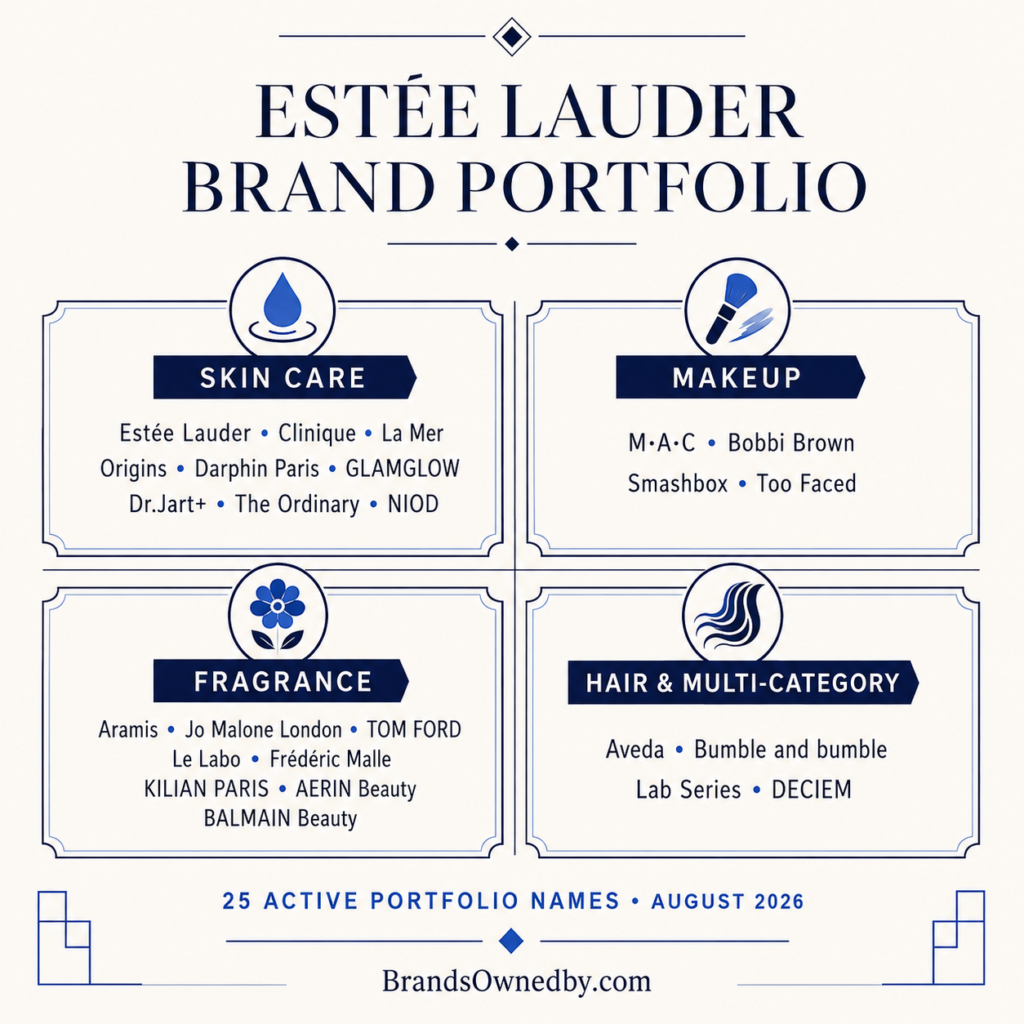
- The Estee Lauder Companies manages 25 active portfolio names, including Estée Lauder, Clinique, M·A·C, La Mer, Jo Malone London, TOM FORD, The Ordinary, and Dr.Jart+.
- Most portfolio brands are wholly owned. However, BALMAIN Beauty operates through a licensing agreement, while AERIN Beauty has a separate trademark-licensing structure.
- The company owns DECIEM, which gives it control of The Ordinary and NIOD. It completed the acquisition of DECIEM’s remaining shares in 2024.
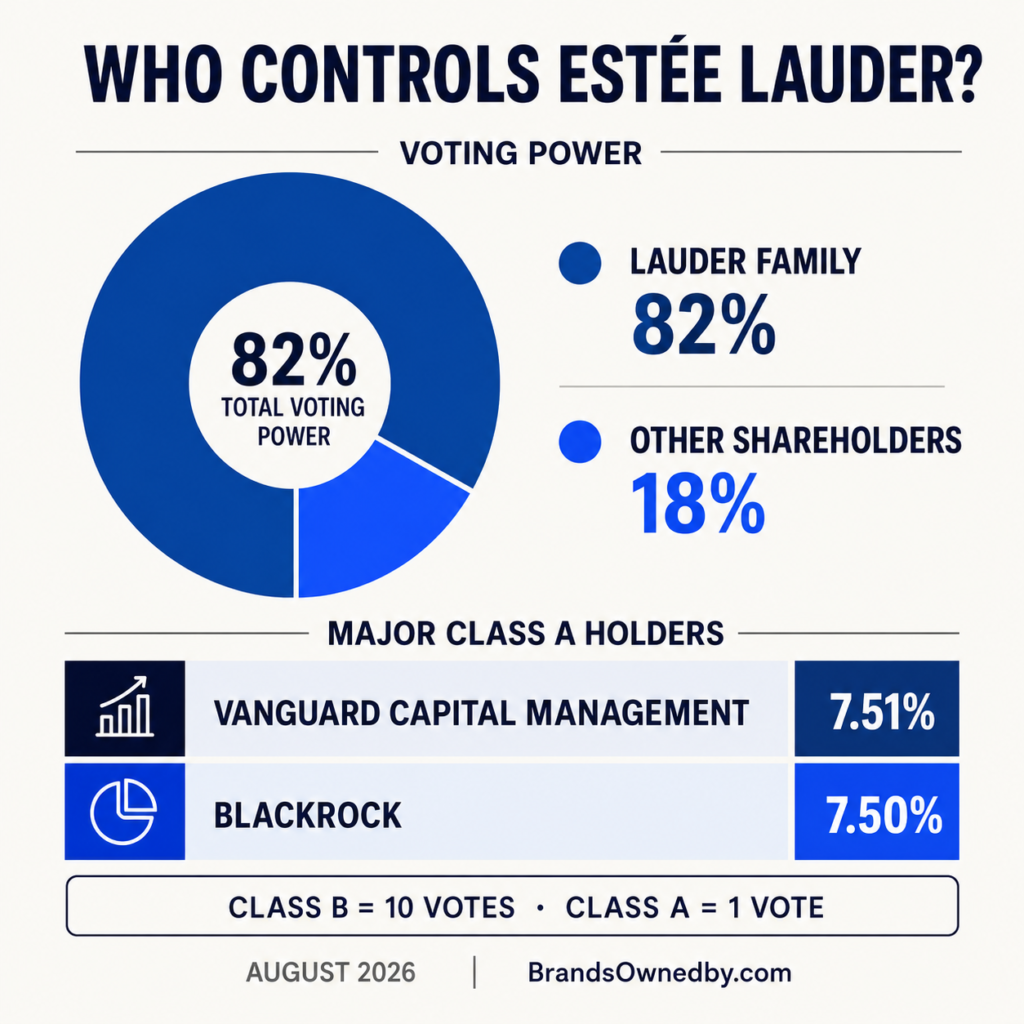
- Estée Lauder is publicly traded, but the Lauder family controls approximately 82% of the voting power through high-vote Class B shares.
What companies does Estée Lauder own? As of September 2026, The Estée Lauder Companies manages 25 active portfolio names across skin care, makeup, fragrance, hair care, and men’s grooming. Major holdings include Clinique, M·A·C, La Mer, Bobbi Brown Cosmetics, Aveda, Jo Malone London, The Ordinary, Dr.Jart+, Le Labo, Too Faced, and TOM FORD.
The group is publicly traded. However, the Lauder family retains approximately 82% of the company’s voting power. That allows the family to control major shareholder decisions despite owning a smaller percentage of the total economic equity.
![What Companies Does Estee Lauder Own [infographic]](https://brandsownedby.com/wp-content/uploads/2023/08/What-Companies-Does-Estee-Lauder-Own-infographic-683x1024.png)
Estée Lauder Origin
The Estée Lauder Companies began as a small family-operated beauty business. Its early growth came from product demonstrations, samples, direct customer contact, and selective department-store distribution.
Estée Lauder
Estée Lauder, born Josephine Esther Mentzer, was the company’s principal founder and product visionary. She learned about skin care through her uncle, John Schotz, who formulated creams in a small laboratory.
Estée began demonstrating and selling beauty products in salons and directly to customers. Her approach was unusually hands-on. She applied products herself, explained how they worked, and gave customers samples.
The company formally launched in New York in 1946. Its original range contained four products: Cleansing Oil, Skin Lotion, Super Rich All-Purpose Crème, and Crème Pack.
Estée also shaped the company’s prestige positioning. Instead of pursuing mass distribution, she focused on department stores where trained beauty advisers could demonstrate the products.
In 1953, she introduced Youth-Dew. The bath oil could also be worn as a fragrance. It encouraged women to buy fragrance for themselves rather than wait to receive perfume as a gift.
Joseph Lauder
Joseph Lauder, Estée’s husband, was the company’s co-founder and operational partner. While Estée focused heavily on product development, promotion, and customer relationships, Joseph helped manage production, finances, and business operations.
Their partnership established the model that would define the company for decades. Products combined prestige positioning with controlled distribution and high-touch customer service.
The Second Generation
Estée and Joseph’s sons, Leonard and Ronald Lauder, later joined the business.
Leonard Lauder played the larger operational role. He joined the company in 1958 and helped transform it into a global beauty group. He served as president from 1972 to 1995, chief executive officer from 1982 to 1999, and chairman from 1995 to 2009.
Under Leonard’s leadership, the company expanded internationally, developed brands such as Clinique, and acquired businesses including M·A·C, Bobbi Brown, La Mer, Aveda, and Jo Malone London.
Ronald Lauder also held senior roles. As of August 2026, he remains an executive officer and chairman of Clinique Laboratories.
List of Companies and Brands Owned by Estée Lauder
The official Estée Lauder portfolio contains 25 active names. Some were created internally. Others entered the group through acquisitions. A few operate through licensing arrangements.
Estée Lauder
Estée Lauder is the original brand around which the wider company was built. It is wholly owned and remains one of the group’s central prestige beauty businesses.
The brand operates across skin care, makeup, and fragrance. Its major product franchises include Advanced Night Repair, Double Wear, Revitalizing Supreme+, and Re-Nutriv.
The Estée Lauder brand should not be confused with The Estée Lauder Companies. The first is a consumer beauty brand. The second is the publicly traded parent company that controls the wider portfolio.
Aramis
Aramis was created internally in 1964. It was one of the first prestige fragrance and grooming brands developed specifically for men.
The Estée Lauder Companies owns the Aramis business. The brand became the foundation for the group’s expansion into men’s fragrances and grooming.
Aramis has a smaller commercial profile than Clinique or M·A·C. However, it remains strategically important because of its heritage and established fragrance franchises.
Clinique
Clinique was launched in 1968 by The Estée Lauder Companies. Its development involved Estée Lauder, Evelyn Lauder, beauty editor Carol Phillips, and dermatologist Dr. Norman Orentreich.
Clinique Laboratories is an Estée Lauder subsidiary. The company owns the brand and its operations.
The brand is built around dermatologist-guided skin care, allergy testing, and fragrance-free positioning. It also sells makeup and fragrance. Major franchises include Dramatically Different Moisturizing Lotion, Moisture Surge, Even Better, and Clinique Happy.
Lab Series
Lab Series is an Estée Lauder-owned men’s skin care brand. It was developed within the group and introduced in 1987.
The business focuses on cleansers, moisturizers, anti-aging products, shaving care, and targeted treatments. Its positioning is more technical and performance-oriented than the heritage fragrance positioning of Aramis.
Lab Series gives Estée Lauder a dedicated presence in prestige men’s skin care without relying on a third-party licensed name.
Origins
Origins was created by The Estée Lauder Companies in 1990. It is wholly owned rather than independently operated under an outside parent.
The brand combines plant-derived ingredients with cosmetic science. Its product categories include cleansers, moisturizers, masks, serums, and body care.
Origins helped Estée Lauder enter the naturally positioned prestige skin care segment. GinZing and Mega-Mushroom are among its best-known franchises.
M·A·C
The Estée Lauder Companies first invested in Make-Up Art Cosmetics in 1994. It acquired the remaining equity in 1998, making M·A·C a wholly owned brand.
M·A·C began as a professional makeup company created by Frank Toskan and Frank Angelo in Toronto. Its early products were designed for makeup artists, photographers, models, and stage professionals.
The brand now has global consumer distribution while retaining its professional identity. It competes in lip color, complexion products, eye makeup, brushes, and professional cosmetics.
La Mer
Estée Lauder acquired La Mer in 1995. The acquisition included the brand and its signature Crème de la Mer formulation.
La Mer operates in the ultra-premium skin care segment. Its positioning depends on luxury presentation, proprietary fermentation processes, and a highly concentrated product range.
The brand gives Estée Lauder exposure to consumers who are willing to pay significantly higher prices than those charged by mainstream prestige skin care brands. La Mer has historically been identified as one of the group’s largest brands.
Bobbi Brown Cosmetics
The Estée Lauder Companies acquired Bobbi Brown Cosmetics in 1995, four years after makeup artist Bobbi Brown launched the business.
The brand is wholly owned by Estée Lauder. Bobbi Brown, the founder, left the company in 2016 and no longer owns the business.
Bobbi Brown Cosmetics is known for natural-looking makeup, skin-tone inclusivity, complexion products, and professional artistry. Its product range includes foundation, correctors, lip color, eye makeup, brushes, and skin preparation products.
Aveda
Estée Lauder acquired Aveda in 1997. The brand was founded by hairstylist Horst Rechelbacher in 1978.
Aveda operates across professional hair care, hair color, skin care, body care, and aroma products. It also has a network of salons, spas, and educational institutes.
The acquisition gave Estée Lauder a professional salon channel that was structurally different from its department-store beauty business. Aveda remains one of the group’s primary hair care brands.
Jo Malone London
Estée Lauder acquired Jo Malone Limited in 1999. The company now fully owns Jo Malone London.
The brand was founded by British perfumer Jo Malone. She remained involved after the acquisition but later left the business. Jo Malone herself does not own the company today.
Jo Malone London sells colognes, candles, bath products, home fragrances, and scented lifestyle products. Its fragrance-combining concept encourages consumers to layer different scents.
Bumble and bumble
Estée Lauder acquired a majority interest in Bumble and bumble in 2000. It purchased the remaining interest in 2006.
The brand is therefore wholly owned. It operates in professional and consumer hair care, with roots in the New York salon industry.
Its portfolio includes shampoos, conditioners, styling sprays, texture products, treatments, and salon-focused formulas. The brand connects Estée Lauder with professional stylists as well as prestige retail customers.
Darphin Paris
The Estée Lauder Companies acquired Darphin in 2003. The Paris-based skin care brand had been founded by Pierre Darphin.
Darphin specializes in serums, essential-oil elixirs, creams, and targeted facial treatments. Its identity combines French pharmacy traditions with botanical ingredients.
The brand is owned by Estée Lauder. It serves a narrower prestige skin care segment than Clinique or La Mer and has stronger recognition in selected European and Asian markets.
TOM FORD
Estée Lauder completed its acquisition of the TOM FORD brand in 2023. The transaction valued the business at approximately $2.8 billion.
The deal was broader than Estée Lauder’s earlier TOM FORD Beauty licensing relationship. Estée Lauder became the owner of the underlying TOM FORD brand and intellectual property.
The operating structure remains divided. Estée Lauder directly operates TOM FORD Beauty. The fashion business is licensed to Ermenegildo Zegna Group. The eyewear business operates through a long-term license with Marcolin.
This means Estée Lauder owns the TOM FORD brand, but it does not manufacture every product carrying the name.
Smashbox
The Estée Lauder Companies acquired Smashbox Beauty Cosmetics in 2010.
Smashbox was founded by Dean and Davis Factor. Its identity developed around Smashbox Studios in Los Angeles and the technical needs of photography and studio makeup.
The brand is wholly owned. It is best known for complexion primers, long-wear makeup, and products designed to perform under cameras and studio lighting.
AERIN Beauty
AERIN Beauty launched in 2012 and is part of Estée Lauder’s official brand portfolio. Its legal structure is more nuanced than that of an ordinary wholly owned acquisition.
Aerin Lauder owns Aerin LLC, which controls certain AERIN trademarks and lifestyle activities. Estée Lauder manufactures, markets, and sells AERIN Beauty products under a licensing arrangement.
The beauty business focuses primarily on luxury fragrance, cosmetics, and selected skin care products. Therefore, Estée Lauder controls the AERIN Beauty operation, but the broader AERIN lifestyle identity should not be described as an uncomplicated wholly owned subsidiary.
Le Labo
Estée Lauder acquired Le Labo in 2014. The fragrance house was founded in New York in 2006 by Fabrice Penot and Eddie Roschi.
Le Labo is wholly owned by Estée Lauder. Its business model emphasizes individually prepared fragrances, minimalist packaging, boutique retail, and city-specific scents.
The brand has become one of Estée Lauder’s strongest luxury-fragrance growth assets. Its products include personal fragrance, candles, body products, and home scents.
Editions de Parfums Frédéric Malle
Estée Lauder acquired Editions de Parfums Frédéric Malle in 2015. The brand was founded by Frédéric Malle in 2000.
The company owns the fragrance house. However, its creative model continues to emphasize individual perfumers and places their names prominently alongside each fragrance.
The brand operates at the artistic end of the luxury fragrance market. Its portfolio includes fragrances developed by perfumers such as Dominique Ropion, Jean-Claude Ellena, Maurice Roucel, and Pierre Bourdon.
GLAMGLOW
The Estée Lauder Companies acquired GLAMGLOW in 2015.
GLAMGLOW originated as a treatment-oriented skin care brand associated with Hollywood and entertainment-industry users. It became widely known for facial masks with immediate sensory and visual effects.
The brand is wholly owned. It has a smaller current commercial profile than Estée Lauder’s leading skin care businesses, but it remains included in the company’s active August 2026 portfolio.
KILIAN PARIS
Estée Lauder acquired By Kilian in 2016. The fragrance business now operates under the KILIAN PARIS name.
The brand was founded by Kilian Hennessy. It occupies a high-luxury fragrance position and is known for ornate packaging, refillable bottles, and fragrance collections built around nightlife, spirits, and gourmand themes.
KILIAN PARIS is wholly owned by Estée Lauder. It has become an important part of the group’s expanding luxury-fragrance division.
Too Faced
The Estée Lauder Companies acquired Too Faced in 2016 for approximately $1.45 billion.
Too Faced was founded by Jerrod Blandino and Jeremy Johnson. The company built its identity around playful packaging, scented formulas, and accessible prestige makeup.
The brand is wholly owned. Its recognizable franchises include Better Than Sex mascara, Born This Way complexion products, and Lip Injection.
Recent performance has been uneven. However, Too Faced still gives Estée Lauder significant exposure to younger prestige makeup customers.
Dr.Jart+
Estée Lauder initially invested in Have & Be Co., the South Korean parent of Dr.Jart+. It acquired the remaining interest in 2019, bringing Dr.Jart+ under full ownership.
The transaction expanded Estée Lauder’s presence in Korean beauty and science-led skin care. Dr.Jart+ is known for products built around ingredients and concepts such as ceramides, cicapair, and moisturizing masks.
The brand has global distribution and provides a different product-development perspective from Estée Lauder’s American and European heritage businesses.
DECIEM
DECIEM is a multi-brand beauty company founded in Toronto in 2013. Estée Lauder began investing in the business in 2017 and increased its ownership over several transactions.
In 2021, Estée Lauder became DECIEM’s majority owner. It completed the acquisition of the remaining equity in May 2024.
DECIEM is now fully owned. Its most commercially important operations are The Ordinary and NIOD. The DECIEM corporate name also appears in Estée Lauder’s official portfolio.
The Ordinary
The Ordinary is owned by Estée Lauder through DECIEM.
It is known for ingredient-focused formulas, simple product names, transparent concentrations, and comparatively accessible prices. Its range includes acids, peptides, retinoids, moisturizers, hair treatments, and complexion products.
The Ordinary gives Estée Lauder exposure to a much lower price tier than La Mer, TOM FORD, or Jo Malone London. It has also strengthened the group’s position with younger, ingredient-aware consumers.
NIOD
NIOD is another DECIEM brand and is therefore ultimately owned by Estée Lauder.
The name stands for Non-Invasive Options in Dermal Science. NIOD operates at a more technical and premium price point than The Ordinary.
Its products emphasize advanced formulations, multi-pathway treatments, and specialized skin care technologies. NIOD is smaller than The Ordinary but serves a distinct customer who wants complex formulations and detailed ingredient information.
BALMAIN Beauty
BALMAIN Beauty is included in Estée Lauder’s official portfolio, but Estée Lauder does not own the Balmain fashion house.
Estée Lauder operates the beauty business through a long-term licensing partnership with Balmain. The collaboration initially focused on luxury fragrance and expanded with the launch of a prestige fragrance collection.
Estée Lauder handles beauty development, production, marketing, and distribution. Balmain retains ownership of the underlying fashion name. BALMAIN Beauty should therefore be described as a licensed Estée Lauder business rather than a wholly owned brand.
Forest Essentials
Forest Essentials was not yet a fully owned Estée Lauder company at the latest confirmed August 2026 update.
Estée Lauder had held a minority investment in the Indian Ayurvedic beauty company since 2008. In March 2026, it entered an agreement to acquire the remaining shares. The transaction was still described as subject to regulatory approvals in the company’s May 2026 update.
Until completion is formally announced, Forest Essentials should be classified as a minority investment with a pending full acquisition.
111Skin
Estée Lauder announced a minority investment in luxury skin care brand 111Skin in April 2026.
A minority investment does not make 111Skin an Estée Lauder-owned company. The founders and existing shareholders continue to own the business.
For that reason, 111Skin is not included among the 25 active Estée Lauder portfolio names in this article.
Who Owns Estee Lauder Companies?
The Estee Lauder Companies is listed on the New York Stock Exchange under the ticker EL. Public investors own tradable Class A shares. The Lauder family holds most of the company’s Class B shares.
Class A shares carry one vote each. Class B shares carry ten votes each. This dual-class structure separates economic ownership from voting control.
The Lauder Family
The Lauder family collectively controls approximately 82% of Estée Lauder’s voting power as of August 2026.
Its economic ownership is substantially lower. Based on the outstanding Class B share count and related family-held Class A positions, the family’s economic stake is approximately one-third of the company.
The difference is created by the ten-vote rights attached to Class B shares. This makes Estée Lauder a family-controlled public company rather than a conventionally dispersed public corporation.
LAL Family Corporation and LAL Family Partners
LAL Family Corporation is the general partner of LAL Family Partners. These entities represent the Leonard A. Lauder side of the family.
At the end of 2025, the structure beneficially owned 69.40 million Class B shares. Those shares represented approximately 21.9% of the company on an as-converted Class A basis.
More importantly, the position carried approximately 49.8% of Estée Lauder’s total voting power. This is the single largest disclosed family block.
The percentage is part of the wider Lauder family total. It should not be added to the family’s 82% voting figure.
Aerin Lauder Zinterhofer and Related Trusts
Following estate-planning transfers completed in 2026, Aerin Lauder Zinterhofer was reported as the beneficial owner of 19.10 million shares on an as-converted basis.
That represented approximately 7.2% of the relevant share base used in the filing. The position carried approximately 13.7% of total voting power because most of the holdings were Class B shares.
Some trust holdings overlap with shares reported by other family beneficiaries. They should therefore be interpreted carefully rather than added together as independent blocks.
Jane Lauder and Related Trusts
Jane Lauder owns shares directly and through family trusts. The latest detailed company proxy reported 22.35 million Class B shares associated with her beneficial ownership.
That position represented approximately 15% of total voting power at the time of the disclosure. Part of the reported holding was shared with Aerin Lauder through a descendants’ trust.
Jane Lauder no longer holds a full-time operating position in the company, but she remains part of the family governance structure.
Vanguard Capital Management
Vanguard Capital Management reported beneficial ownership of 18.59 million Estée Lauder shares as of March 31, 2026.
That represented 7.51% of the Class A share class. Measured against both Class A and Class B shares combined, the economic interest was approximately 5.1%.
This position is held through investment funds and managed accounts. It does not give Vanguard operating control comparable to the Lauder family’s Class B shares.
BlackRock
BlackRock reported 18.59 million Class A shares as of June 30, 2026. That represented 7.5% of Estée Lauder’s Class A stock.
BlackRock had sole voting power over approximately 16.91 million of those shares. Its combined economic interest equaled approximately 5.1% of all Class A and Class B shares outstanding.
Like Vanguard, BlackRock represents clients and investment funds. Its ownership is financially significant but does not challenge the family’s control.
FMR LLC
The latest company-provided major-holder disclosure listed FMR LLC with 14.33 million Class A shares.
That position represented 6.1% of the Class A share class and approximately 1% of total voting power at the time of the disclosure.
The voting-power percentage is much smaller than the ownership percentage because FMR holds ordinary one-vote Class A stock.
Capital World Investors
Capital World Investors was listed with 12.47 million Class A shares in the latest company proxy containing a full major-holder table.
That represented 5.3% of Class A stock and approximately 0.8% of total voting power.
The holding is economically meaningful. It does not provide control because it lacks the enhanced voting rights attached to Lauder family Class B shares.
Competitor Ownership Comparison
Estée Lauder competes with beauty companies and luxury groups that use different ownership models. Some are controlled by founding families. Others have dispersed institutional ownership.
L’Oréal
L’Oréal is a publicly traded French beauty group. The Bettencourt Meyers family owns approximately 35% of its capital. Nestlé owns approximately 20%.
The family is L’Oréal’s largest shareholder, but its structure is less voting-heavy than Estée Lauder’s. L’Oréal combines a major family block with a strategic corporate shareholder and public investors.
L’Oréal also has a much broader category and pricing mix. It owns mass-market, professional, dermatological, and luxury brands. Estée Lauder remains more concentrated in prestige beauty.
LVMH
LVMH is controlled by Bernard Arnault and his family through a network of holding companies.
The Arnault family crossed approximately 50% of LVMH’s capital in 2026 and controlled close to 66% of the voting rights. That gives the family both economic majority ownership and voting control.
Estée Lauder’s family controls more voting power but owns a smaller proportion of the economic equity. LVMH is also more diversified, with operations in fashion, jewelry, watches, wines, spirits, hospitality, and beauty.
Coty
Coty is publicly traded, but JAB is its controlling shareholder.
The latest detailed proxy data placed JAB Beauty’s ownership at approximately 50.3%, excluding additional interests associated with Peter Harf. Those additional interests increased the broader aligned ownership position.
Coty’s control therefore comes from majority common-equity ownership. Estée Lauder’s control comes primarily from unequal voting rights.
Coty is particularly exposed to licensed fragrances. Estée Lauder owns a greater proportion of the underlying brands in its portfolio.
Puig
Puig became publicly traded in 2024, but the Puig family retained decisive control through Class A shares carrying five votes each.
The family owns roughly the low-70% range of the company’s economic capital and more than 90% of its voting rights. Public investors mainly hold lower-vote Class B shares.
Puig therefore has the closest ownership model to Estée Lauder among major competitors. Both are listed, family-controlled beauty groups. Puig’s family owns a larger percentage of the economic equity, while both use enhanced-voting shares.
Estée Lauder and Puig discussed a possible combination in 2026. Those talks ended in May without a transaction.
Shiseido
Shiseido is a publicly traded Japanese beauty company with relatively dispersed institutional ownership.
No founding family controls Shiseido through a high-vote share class. Major Japanese trust banks, asset managers, foreign institutions, and retail investors collectively own the company.
Its governance is therefore more conventional. Management and the board are accountable to a broader shareholder base. Estée Lauder’s board operates within a structure where one family can ultimately determine most shareholder votes.
Who Controls Estée Lauder?
Control at Estée Lauder has three layers: shareholder voting control, board oversight, and day-to-day executive management.
The Lauder Family Controls Shareholder Votes
The Lauder family is the ultimate controlling shareholder group. Its approximately 82% voting power is enough to determine the outcome of most shareholder matters.
This includes director elections, major amendments, merger approvals, and other transactions requiring shareholder consent.
Estée Lauder consequently qualifies as a controlled company under New York Stock Exchange rules.
William P. Lauder Leads the Board
William P. Lauder serves as chair of the board. He is a grandson of Estée and Joseph Lauder and the son of Leonard Lauder.
The chair does not manage daily operations. The role supports board leadership, strategy, risk oversight, capital allocation, acquisitions, divestitures, and major corporate actions.
The board also has a lead independent director. This provides an additional governance mechanism within a family-controlled structure.
Stéphane de La Faverie Manages Operations
Stéphane de La Faverie became president and chief executive officer on January 1, 2025.
He manages company operations and leads the Beauty Reimagined strategy. The plan is designed to restore sales growth, simplify decision-making, improve execution, expand distribution, and rebuild margins.
The CEO has operational authority. However, he does not have ultimate shareholder control. The board supervises management, and the Lauder family controls the shareholder voting structure behind the board.
Family Control Does Not Mean Family Management
Estée Lauder is no longer managed exclusively by family members.
Professional executives run the company’s brands, regions, supply chain, finance, marketing, and product development. Family members provide long-term ownership influence and board representation.
This separation is practical. It allows the company to recruit global executives while preserving the family’s ability to influence succession, acquisitions, and long-term strategy.
Estée Lauder Annual Revenue and Net Worth
For a publicly traded company, “net worth” can have several meanings. This section uses market capitalization because it represents the market value of all outstanding shares.
Market capitalization is not the same as shareholder equity or enterprise value. It changes daily with the share price.
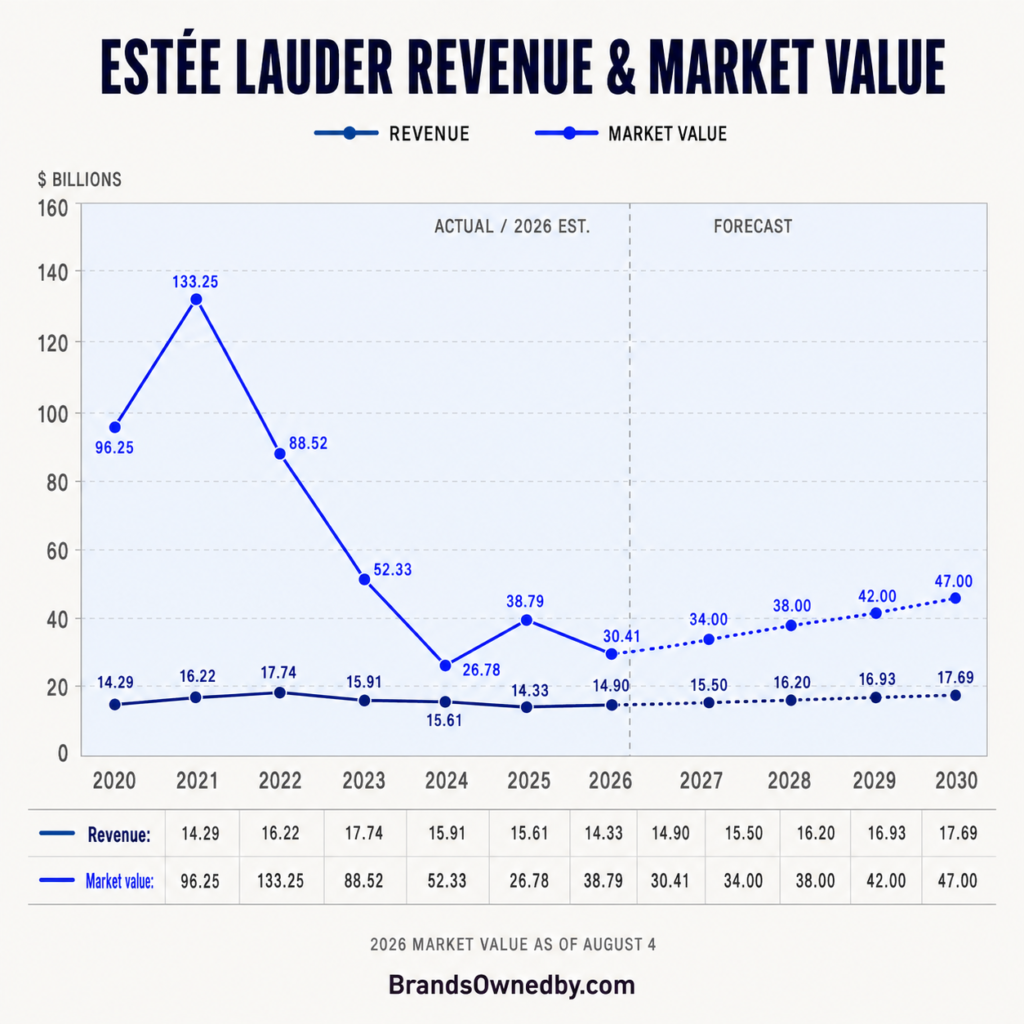
Fiscal 2026 revenue had not been formally reported as of August 4, 2026. The 2026 figure below is an estimate based on the company’s most recent outlook for 4% reported sales growth.
Estée Lauder Revenue in 2026
Estimated fiscal 2026 revenue is $14.90 billion. This represents approximately 4% growth from the $14.33 billion reported in fiscal 2025.
The estimate is supported by the company’s performance through March 2026. Reported sales for the first nine months reached $11.42 billion. That was 5% higher than the comparable period.
The third quarter generated $3.71 billion in reported sales. Fragrance was the strongest category, with growth led by Le Labo, KILIAN PARIS, BALMAIN Beauty, and TOM FORD.
Skin care was comparatively stable. La Mer and The Ordinary grew, while Clinique and Origins remained under pressure. Makeup performance was mixed. Growth at the Estée Lauder brand was offset by declines at Clinique and Too Faced.
The 2026 estimate should not be presented as a reported result. Final fiscal-year figures are expected when Estée Lauder releases its annual results later in August.
Estée Lauder Net Worth
Estée Lauder’s market capitalization was approximately $30.41 billion on August 4, 2026.
That value was calculated from the market price of its publicly traded shares and the company’s total outstanding share count. It was substantially below the $133.25 billion year-end valuation recorded in 2021.
The reduction cannot be explained by revenue alone. Annual sales declined from $17.74 billion in fiscal 2022 to $14.33 billion in fiscal 2025, a reduction of about 19%. Market capitalization fell much more sharply.
The larger valuation decline reflected several factors:
- Falling sales in Asian travel retail.
- Weak consumer demand in mainland China.
- Slower prestige beauty growth in the United States and Western Europe.
- Lower operating margins.
- Brand impairment charges.
- Restructuring expenses.
- Reduced investor confidence in the speed of the recovery.
In other words, the market reduced both its earnings expectations and the valuation multiple it was willing to place on those earnings.
Revenue Breakdown and Business Drivers
Skin care remains Estée Lauder’s largest product category. Its performance is heavily influenced by the Estée Lauder brand, La Mer, Clinique, The Ordinary, Origins, and Dr.Jart+.
Fragrance has become the clearest growth engine. Le Labo, KILIAN PARIS, TOM FORD, Jo Malone London, and BALMAIN Beauty give the company exposure to premium pricing and repeat purchasing.
Makeup remains important but inconsistent. M·A·C, Estée Lauder, Clinique, Bobbi Brown, Too Faced, and Smashbox compete in a crowded market where trends change quickly.
Hair care is the smallest reported category. Aveda and Bumble and bumble are the principal dedicated hair businesses, although The Ordinary and Le Labo also sell selected hair products.
Geographically, the recovery depends on continued improvement in mainland China, stabilization in travel retail, and stronger execution in North America.
Why the 2027 Revenue Forecast is $15.50 Billion
The $15.50 billion forecast assumes approximately 4% growth from the 2026 estimate.
This is the midpoint of management’s preliminary fiscal 2027 expectation for reported and organic sales growth of 3% to 5%.
The estimate does not assume an immediate return to the company’s 2022 peak. Instead, it reflects gradual improvement from product innovation, wider online distribution, specialty-retail expansion, fragrance growth, and stronger performance in selected emerging markets.
Management’s preliminary target for a 12.5% to 13% adjusted operating margin also supports a moderate recovery in investor confidence.
Revenue Forecasts for 2028–2030
The projections for 2028 through 2030 assume annual revenue growth of approximately 4.5%.
This would take revenue to $16.20 billion in 2028, $16.93 billion in 2029, and $17.69 billion in 2030.
The 2030 estimate is close to the company’s fiscal 2022 sales record. That makes the forecast achievable without assuming exceptional market-share gains.
The forecast depends on five major conditions:
First, fragrance must remain a dependable growth category. Estée Lauder has strong assets in luxury and niche fragrance.
Second, mainland China and travel retail must stabilize. A prolonged contraction would make the forecast difficult to achieve.
Third, the company must improve underperforming makeup and skin care brands rather than relying on a small number of growth businesses.
Fourth, digital expansion must add incremental demand. Moving existing customers from department stores to Amazon or brand websites would not be enough.
Finally, innovation must improve. Product launches need to attract younger customers while preserving pricing power among established consumers.
Market-Value Forecasts for 2027–2030
Market capitalization is more difficult to forecast than revenue because it depends on share prices, interest rates, investor sentiment, margins, and earnings expectations.
The estimates use a gradual recovery scenario rather than a return to the unusually high 2021 valuation.
A $34 billion value in 2027 assumes that sales growth continues and the adjusted operating margin approaches 13%.
The $38 billion estimate for 2028 assumes that restructuring benefits begin appearing more consistently in earnings and cash flow.
The $42 billion estimate for 2029 assumes that Estée Lauder sustains mid-single-digit growth while reducing execution risk.
The $47 billion estimate for 2030 assumes revenue reaches $17.69 billion and margins continue to normalize. Even at that level, the company would remain far below its 2021 market capitalization.
These are analytical estimates, not company guidance. A renewed decline in China, brand impairments, tariffs, unsuccessful product launches, or lower valuation multiples could produce materially different outcomes.
Final Words
The answer to “What companies does Estée Lauder own?” extends far beyond the original Estée Lauder cosmetics brand.
The group owns or controls major beauty businesses such as Clinique, M·A·C, La Mer, Bobbi Brown, Aveda, Jo Malone London, Le Labo, Too Faced, Dr.Jart+, DECIEM, The Ordinary, NIOD, and TOM FORD.
Its portfolio also contains relationships that are not conventional acquisitions. BALMAIN Beauty is licensed. AERIN Beauty has a separate trademark arrangement. Forest Essentials remained a pending full acquisition at the latest confirmed update.
The company’s ownership structure is equally important. Estée Lauder is publicly traded, but ordinary shareholders do not control it. The Lauder family’s Class B shares provide approximately 82% of the voting power and preserve family control over long-term governance.
FAQs
How many brands does Estée Lauder own?
The official Estée Lauder portfolio contained 25 active names as of August 2026. The company describes the group more generally as having more than 20 prestige brands.
The count includes DECIEM alongside its major brands, The Ordinary and NIOD. It also includes licensed beauty businesses such as BALMAIN Beauty.
Does Estée Lauder own Clinique?
Yes. Clinique was developed and launched by The Estée Lauder Companies in 1968. It operates through Clinique Laboratories and remains an Estée Lauder-owned brand.
Does Estée Lauder own M·A·C?
Yes. Estée Lauder first invested in M·A·C in 1994 and acquired the remaining equity in 1998. M·A·C is now wholly owned.
Does Estée Lauder own The Ordinary?
Yes. The Ordinary is owned through DECIEM. Estée Lauder completed its acquisition of DECIEM’s remaining shares in 2024.
Does Estée Lauder own TOM FORD?
Estée Lauder owns the TOM FORD brand and intellectual property. It directly operates TOM FORD Beauty.
The fashion business is licensed to Ermenegildo Zegna Group, while Marcolin holds the eyewear license. Estée Lauder therefore owns the name but does not directly operate every TOM FORD product category.
Does Estée Lauder own Jo Malone London?
Yes. Estée Lauder acquired Jo Malone Limited in 1999. Jo Malone London is a wholly owned fragrance and lifestyle beauty brand.
Does Estée Lauder own La Mer?
Yes. Estée Lauder acquired La Mer in 1995. The brand is one of the group’s highest-priced luxury skin care businesses.
Does Estée Lauder own Too Faced?
Yes. The company acquired Too Faced in 2016 for approximately $1.45 billion.
Does Estée Lauder own Dr.Jart+?
Yes. Estée Lauder acquired the remaining interest in Dr.Jart+ parent Have & Be Co. in 2019. The brand is fully owned.
Does Estée Lauder own Balmain?
No. Estée Lauder does not own the Balmain fashion house.
It operates BALMAIN Beauty through a licensing agreement. Balmain owns the underlying fashion name, while Estée Lauder develops and markets the beauty products.
Does Estée Lauder own Forest Essentials?
Not yet, based on the latest confirmed information available on August 4, 2026.
Estée Lauder held a minority interest and had agreed to acquire the remaining shares. The transaction was still subject to regulatory approvals in the latest company update.
Does Estée Lauder own 111Skin?
No. Estée Lauder made a minority investment in 111Skin in 2026. A minority investment does not equal full ownership or control.
Does Estée Lauder own L’Oréal?
No. L’Oréal is a separate publicly traded French beauty company. Its largest shareholder is the Bettencourt Meyers family, followed by Nestlé.
Does Estée Lauder own Sephora?
No. Sephora is owned by LVMH. It is a retailer that sells products from numerous Estée Lauder brands.
Is Estée Lauder still family-owned?
Estée Lauder is publicly traded, so it is not privately owned by the family.
However, it remains family-controlled. The Lauder family holds approximately 82% of voting power through Class B shares carrying ten votes each.
What is Estée Lauder’s biggest brand?
Estée Lauder does not publish complete revenue figures for every individual brand.
Historically, Estée Lauder, Clinique, M·A·C, and La Mer have been identified among its largest brands. The Ordinary, Le Labo, and TOM FORD have also become important growth businesses.