
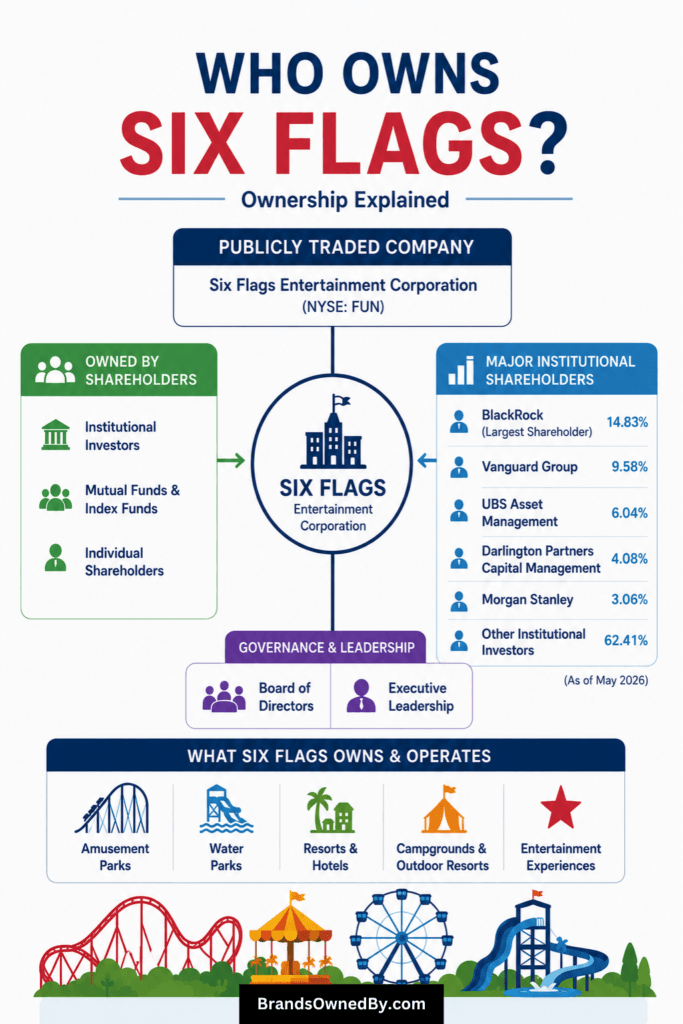
- Six Flags is a publicly traded company with no majority owner. Ownership is distributed among institutional investors, mutual funds, hedge funds, and public shareholders rather than a founder, family, or parent corporation.
- BlackRock is the largest shareholder of Six Flags, holding approximately 14.83% of the company’s stock as of 2026. Other major shareholders include Vanguard Group, UBS Asset Management, Darlington Partners Capital Management, and Morgan Stanley.
- The ownership structure became significantly larger after the 2024 merger with Cedar Fair. The merger created the largest regional amusement park operator in North America and brought major assets such as Cedar Point, Knott’s Berry Farm, Canada’s Wonderland, and Kings Island under Six Flags ownership.
- Control of Six Flags is shared between shareholders, the board of directors, and executive leadership. While institutional investors influence governance through voting rights, President and CEO John Reilly oversees the company’s day-to-day operations.
Six Flags Entertainment Corporation is one of the largest regional amusement park operators in North America. The company manages a wide portfolio of theme parks, water parks, and entertainment resorts across the United States, Canada, and Mexico.
The business is best known for operating thrill-focused amusement parks featuring roller coasters, family attractions, live entertainment, seasonal festivals, and water-based experiences. Over the decades, Six Flags has become one of the most recognizable names in the amusement park industry.
The company operates under the Six Flags brand while also managing several historic park brands acquired through mergers and acquisitions. Following its merger with Cedar Fair, the company expanded its footprint significantly and now oversees some of North America’s most visited amusement destinations.
Six Flags serves millions of guests every year through its network of parks. Its properties appeal to a broad audience, including families, teenagers, thrill-seekers, school groups, and tourists. The company also offers season passes, membership programs, resort accommodations, and special events that encourage repeat visitation.
Today, Six Flags is considered a major competitor to Disney, Universal, SeaWorld, and Merlin Entertainments within the amusement and attractions industry. While Disney and Universal focus heavily on destination resorts and intellectual property-based attractions, Six Flags is primarily known for regional theme parks and record-breaking roller coasters.
Its headquarters are located in Charlotte, North Carolina, following the merger with Cedar Fair. Its shares trade publicly on the New York Stock Exchange under the ticker symbol FUN.
Six Flags Founders
The origins of Six Flags date back to the development of the first Six Flags park in Arlington, Texas.
Angus G. Wynne Jr.
Angus Gilchrist Wynne Jr. is widely recognized as the founder of Six Flags. A Texas real estate developer, Wynne conceived the idea after visiting Disneyland in California during the 1950s. While impressed by Disneyland’s success, he believed Texas could support a large regional theme park with its own unique identity.
Wynne developed Six Flags Over Texas, which opened in 1961 in Arlington. The park’s name was inspired by the six nations that had governed Texas throughout its history: Spain, France, Mexico, the Republic of Texas, the Confederate States, and the United States.
His vision differed from traditional amusement parks of the era. Instead of focusing solely on rides, Wynne designed themed areas that reflected different periods of Texas history. This approach helped establish Six Flags as a pioneer in the modern regional theme park industry.
Great Southwest Corporation
Although Angus Wynne is considered the founder, the project was developed through Great Southwest Corporation, a real estate company he helped lead. The company played a crucial role in financing and developing the original park.
The success of Six Flags Over Texas eventually led to additional park developments and laid the foundation for what would become the modern Six Flags Entertainment Corporation.
Legacy of the Founders
Angus Wynne’s influence remains visible throughout the amusement park industry. His concept of combining themed environments, entertainment, and large-scale attractions inspired many regional parks that followed.
What began as a single Texas theme park evolved into one of North America’s largest amusement park operators. Even after numerous ownership changes, mergers, and restructurings, the company continues to build on the foundation established by Wynne’s original vision in 1961.
Ownership History
The ownership history of Six Flags is complex and reflects the broader evolution of the amusement park industry in North America. Since the opening of the first park in 1961, the company has passed through several owners, undergone major restructurings, experienced bankruptcy, and completed transformative mergers.
1961–1968: Founded by Angus G. Wynne Jr.
Six Flags began when Texas real estate developer Angus G. Wynne Jr. opened Six Flags Over Texas in Arlington, Texas, in 1961.
Wynne developed the park through Great Southwest Corporation. His goal was to create a family-oriented theme park inspired by Disneyland but centered on Texas history and culture. The concept proved successful and attracted large numbers of visitors.
During this period, ownership remained closely tied to Wynne and the original investors who financed the project.
1968–1982: Penn Central Acquires Six Flags
A major ownership change occurred in 1968 when Pennsylvania Railroad’s parent company, Penn Central, acquired Six Flags.
At the time, many large corporations were diversifying into entertainment and leisure businesses. Penn Central saw theme parks as an attractive growth opportunity and purchased the expanding Six Flags operation.
Under Penn Central ownership, the company continued adding new attractions and expanding its park portfolio.
However, Penn Central faced serious financial difficulties in other parts of its business. These challenges eventually led to changes in Six Flags ownership.
1982–1984: Bally Manufacturing Takes Control
In 1982, Bally Manufacturing acquired Six Flags from Penn Central.
Bally was primarily known for gaming equipment, casinos, and entertainment businesses. The company viewed theme parks as a natural extension of its leisure and entertainment portfolio.
Although Bally owned Six Flags for only a short period, it helped modernize operations and prepare the company for future expansion.
1984–1998: Time Warner Era
One of the most significant ownership periods began in 1984 when Time Warner acquired Six Flags.
Time Warner was one of the world’s largest media and entertainment companies. The acquisition allowed Six Flags to leverage popular intellectual property and entertainment brands.
During this period, many Six Flags parks introduced Warner Bros.-themed attractions featuring characters such as Bugs Bunny, Daffy Duck, Batman, Superman, and other DC Comics superheroes.
The Time Warner era helped strengthen the company’s brand recognition and expanded its appeal to families.
Several parks were developed or expanded during this time, establishing Six Flags as a leading regional amusement park operator.
1998–2005: Premier Parks Acquires Six Flags
A transformative ownership change occurred in 1998 when Premier Parks acquired Six Flags from Time Warner.
Premier Parks was already operating several regional amusement parks across the United States. The acquisition gave the company access to the well-known Six Flags brand and significantly increased its scale.
Following the transaction, Premier Parks adopted the Six Flags name and rebranded many of its existing parks as Six Flags properties.
The company pursued aggressive growth during this period. It acquired additional parks and expanded internationally. At its peak, Six Flags operated parks in North America and Europe.
While expansion increased the company’s footprint, it also created significant debt and operational complexity.
2005–2009: Shareholder Pressure and Financial Challenges
By the mid-2000s, investors began questioning the company’s strategy.
Several large shareholders argued that Six Flags had expanded too quickly and accumulated excessive debt. Activist investors became increasingly involved in corporate governance matters.
In 2005, investor Daniel Snyder and investment firm Red Zone LLC gained significant influence over the company. Leadership changes followed, and management attempted to improve profitability and reduce debt.
Despite these efforts, financial challenges continued.
The company struggled with declining attendance at some parks, high operating costs, and a substantial debt burden.
2009–2010: Bankruptcy and Ownership Restructuring
One of the most important events in Six Flags ownership history occurred in 2009 when the company filed for Chapter 11 bankruptcy protection.
The filing was primarily driven by heavy debt obligations accumulated during earlier expansion efforts.
During the restructuring process, ownership shifted away from previous shareholders and toward creditors and lenders.
When Six Flags emerged from bankruptcy in 2010, many of its former shareholders had lost most of their ownership stakes. New investors gained control through debt-for-equity conversions.
The restructuring significantly improved the company’s financial position and created a new foundation for future growth.
2010–2023: Institutional Investors Become Dominant Owners
After emerging from bankruptcy, Six Flags operated as a publicly traded company with a widely distributed shareholder base.
Large institutional investors gradually became the company’s largest owners. These included asset management firms, mutual funds, pension funds, and hedge funds.
During this period, companies such as BlackRock, Vanguard, State Street, and other investment firms accumulated significant positions.
Unlike earlier periods when ownership was concentrated in a parent corporation, Six Flags now operated under a modern public-company ownership structure.
No single shareholder held majority control.
Instead, governance depended on board elections, shareholder voting, and executive leadership.
The company also experienced several leadership transitions as investors sought improved operational performance and higher returns.
2024: Merger with Cedar Fair
The biggest ownership change in modern company history occurred in 2024.
Six Flags and Cedar Fair announced and completed a merger that combined two of North America’s largest amusement park operators.
Cedar Fair was known for operating major parks such as Cedar Point, Knott’s Berry Farm, Kings Island, Canada’s Wonderland, and Carowinds.
The merger created a much larger entertainment company with dozens of amusement parks, water parks, and resort properties.
Under the transaction structure, former Cedar Fair unitholders received approximately 51.2% ownership of the combined company, while former Six Flags shareholders received approximately 48.8%.
Although the combined business adopted the Six Flags Entertainment Corporation name, ownership was shared between investors from both legacy companies.
2024–Present: Modern Ownership Structure
Today, Six Flags operates as a publicly traded company owned primarily by institutional investors.
The largest shareholders include major asset management firms such as BlackRock, Vanguard, Morgan Stanley, and State Street.
Ownership remains highly diversified. No single investor possesses a controlling stake.
Instead, control is distributed among large institutional shareholders, executive leadership, and the board of directors through the corporate governance process.
This structure differs significantly from earlier periods when Six Flags was owned by individual corporations such as Penn Central, Bally Manufacturing, Time Warner, and Premier Parks.
As of 2026, the company represents the culmination of more than six decades of ownership transitions, strategic acquisitions, financial restructuring, and industry consolidation. The merger with Cedar Fair remains the most significant ownership event in the company’s history and continues to shape the direction of the business today.
Who Owns Six Flags: Largest Shareholders
Six Flags Entertainment Corporation is a publicly traded company owned by institutional investors, investment funds, pension funds, hedge funds, company insiders, and retail shareholders. Unlike family-controlled businesses or companies owned by a parent corporation, Six Flags does not have a single controlling owner.
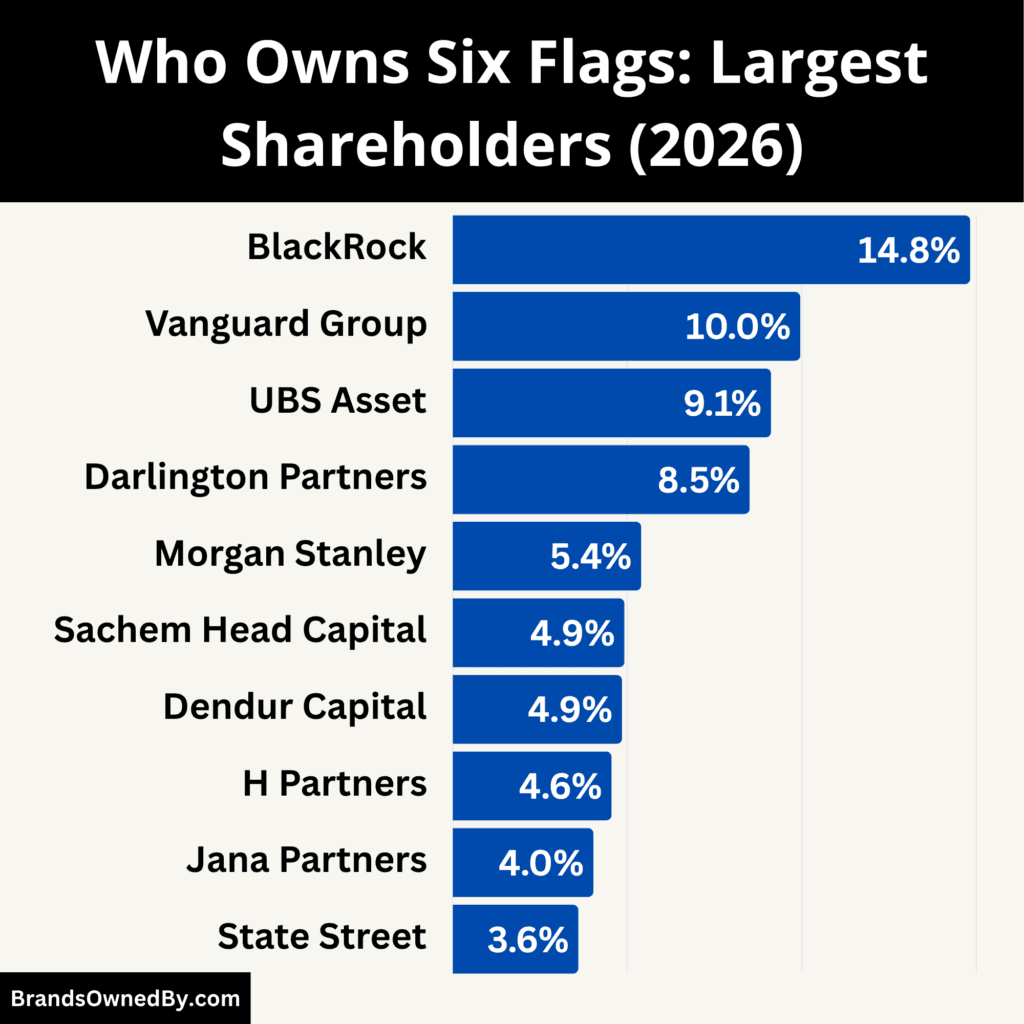
As of May 2026, ownership is concentrated among large institutional investors. BlackRock is the largest shareholder with a 14.83% stake, followed by Vanguard Group, UBS Asset Management, and Darlington Partners Capital Management. The company’s ten largest shareholders collectively control nearly 70% of outstanding shares.
This ownership structure gives major investors substantial influence over corporate governance, executive compensation, board elections, merger approvals, capital allocation decisions, and long-term business strategy. While management runs daily operations, the largest shareholders play a critical role in shaping the future direction of the company.
The current ownership structure emerged following the merger between Six Flags and Cedar Fair in 2024. That transaction created the largest regional amusement park operator in North America and combined two previously separate shareholder bases into a single publicly traded company.
| Category | Estimated Ownership |
|---|---|
| Institutional Investors | More than 66% |
| Mutual Funds & ETFs | Significant portion of institutional ownership |
| Company Insiders | Less than 1% |
| Retail Investors (Public Shareholders) | Remaining ownership |
| Largest Shareholder | BlackRock (15.16%) |
| Top 10 Shareholders Combined | More than 66% |
BlackRock
BlackRock is the largest shareholder of Six Flags, controlling approximately 14.83% of the company’s outstanding shares as of May 2026. The investment firm manages more than $11 trillion in assets, making it the world’s largest asset manager.
Most of BlackRock’s Six Flags holdings are owned through index funds, ETFs, retirement funds, and institutional investment portfolios. Because of its nearly 15% ownership position, BlackRock has significant influence over board elections, executive compensation votes, governance policies, and major corporate decisions.
Although BlackRock does not participate in day-to-day operations, its voting power makes it one of the most important stakeholders in the company. Management teams at large public companies often engage directly with BlackRock regarding governance practices and long-term strategy because of the firm’s substantial ownership influence.
The firm’s investment reflects confidence in Six Flags’ position as the largest regional amusement park operator in North America following the Cedar Fair merger.
Vanguard Group
Vanguard Group is the second-largest shareholder of Six Flags, holding nearly 10% of the company’s outstanding stock.
Founded by John Bogle, Vanguard is one of the world’s largest investment management firms and oversees more than $10 trillion in assets globally. The company’s ownership stake in Six Flags is primarily held through index funds, mutual funds, ETFs, and retirement investment products.
As a long-term institutional investor, Vanguard generally supports stable corporate governance, disciplined capital allocation, and sustainable shareholder returns. While the firm rarely takes an activist approach, its voting influence remains significant because of the size of its investment.
Combined, Vanguard and BlackRock control nearly one-quarter of Six Flags’ outstanding shares. This gives both firms considerable influence over shareholder votes and board-level decisions.
UBS Asset Management
UBS Asset Management ranks among the largest shareholders of Six Flags, owning more than 9% of the company.
UBS is part of UBS Group, one of the world’s largest wealth management and financial services organizations. Through its asset management division, the company manages investments for pension funds, institutions, governments, and high-net-worth individuals.
The firm’s large position in Six Flags demonstrates strong institutional confidence in the company’s long-term growth prospects. Following the merger with Cedar Fair, UBS emerged as one of the most influential shareholders in the combined business.
Because of its sizable ownership position, UBS plays an important role in shareholder voting matters and corporate governance discussions.
Darlington Partners Capital Management
Darlington Partners Capital Management is one of the largest non-index-fund investors in Six Flags, controlling approximately 8.5% of the company’s shares.
Unlike large asset managers such as BlackRock and Vanguard, Darlington follows a concentrated investment strategy. The firm typically invests in a relatively small number of companies where it sees significant upside potential.
Its large position in Six Flags makes the company one of Darlington’s most important investments. This level of ownership gives the firm meaningful influence over shareholder decisions and allows it to closely monitor management’s execution of strategic initiatives.
The firm’s continued investment suggests confidence in the long-term benefits of the Cedar Fair merger and the company’s ability to improve operational performance.
Morgan Stanley
Morgan Stanley owns more than 5% of Six Flags, making it one of the company’s largest institutional investors.
As one of the world’s leading financial institutions, Morgan Stanley manages trillions of dollars through wealth management services, institutional funds, and investment advisory platforms. Its ownership stake is spread across multiple investment vehicles and client portfolios.
While Morgan Stanley does not maintain the same level of influence as BlackRock or Vanguard individually, its ownership position remains large enough to impact important shareholder votes and governance decisions.
The firm’s investment highlights continued institutional interest in the amusement park sector and confidence in Six Flags’ long-term strategy.
Sachem Head Capital Management
Sachem Head Capital Management is one of the most influential activist-oriented shareholders in Six Flags.
Founded by investor Scott Ferguson, the hedge fund owns nearly 5% of the company. Sachem Head has built a reputation for working closely with management teams and boards to improve shareholder returns.
Unlike passive investors, activist investors often seek operational improvements, strategic changes, and stronger corporate performance. Because of its sizeable ownership stake, Sachem Head can exert meaningful influence during governance discussions and shareholder meetings.
Its presence in the shareholder base increases accountability for management and often encourages a stronger focus on profitability and shareholder value creation.
Dendur Capital
Dendur Capital is one of the largest hedge fund shareholders in Six Flags, controlling approximately 4.85% of the company’s outstanding shares as of May 2026.
Founded by former Viking Global investors, Dendur Capital focuses on concentrated investments in publicly traded companies where it believes long-term value has not been fully recognized by the market. Unlike passive asset managers, Dendur actively evaluates operational performance, profitability trends, capital allocation decisions, and strategic execution.
Its sizeable ownership position makes Six Flags one of the firm’s more significant investments within the leisure and entertainment sector. Because hedge funds typically maintain fewer holdings than large index fund managers, Dendur’s investment often signals strong conviction in the company’s future growth potential.
The firm’s continued ownership suggests confidence in Six Flags’ ability to improve margins, integrate Cedar Fair assets, and generate stronger long-term cash flow from its expanded park portfolio.
H Partners Management
H Partners Management owns approximately 4.55% of Six Flags and remains one of the company’s most influential long-term shareholders.
The investment firm is known for taking concentrated positions in consumer, hospitality, and entertainment businesses. H Partners has historically played an active role in corporate governance matters and has been involved in shareholder discussions regarding leadership performance, operational strategy, and board oversight.
Its involvement with Six Flags has extended across multiple management eras. The firm has previously advocated for stronger operational execution and improved shareholder returns.
Because of its history with the company, H Partners is often viewed as one of the more engaged investors within the shareholder base rather than a passive institutional holder.
Jana Partners
Jana Partners controls approximately 4.03% of Six Flags and is widely recognized as one of the most prominent activist investment firms in the United States.
Founded by Barry Rosenstein, Jana has built a reputation for acquiring significant stakes in public companies and pushing for changes designed to unlock shareholder value. These efforts often include governance reforms, cost-reduction initiatives, strategic reviews, leadership changes, and operational restructuring.
The firm’s ownership position gives it meaningful influence within Six Flags because activist investors frequently engage directly with boards of directors and management teams.
Jana’s presence in the shareholder base creates additional pressure for management to maintain strong operating performance and deliver measurable improvements in profitability, attendance growth, and shareholder returns.
State Street Global Advisors
State Street Global Advisors owns approximately 3.60% of Six Flags, making it one of the company’s largest institutional shareholders.
State Street manages trillions of dollars in assets and is one of the world’s largest investment management firms. Alongside BlackRock and Vanguard, it is frequently referred to as part of the “Big Three” institutional investors because of its enormous ownership positions across public markets.
Most of State Street’s Six Flags investment is held through index funds, ETFs, retirement products, and institutional portfolios.
Although State Street generally follows a passive investment approach, its voting power remains highly influential because of the size of its holdings. The firm regularly participates in shareholder votes involving governance matters, executive compensation policies, board appointments, sustainability initiatives, and risk management oversight.
Its ownership further strengthens the dominance of large institutional investors within the Six Flags shareholder structure.
Competitor Ownership Comparison
The ownership structure of Six Flags is very different from several of its largest competitors in the global amusement park industry. Some competitors are controlled by founding families, some are owned by large media conglomerates, and others are backed by private investment groups.
As of May 2026, Six Flags is primarily controlled by institutional investors. BlackRock owns approximately 14.83% of the company, Vanguard holds about 9.96%, UBS Asset Management controls roughly 9.12%, Darlington Partners owns 8.51%, and Morgan Stanley holds 5.40%. Together, the company’s largest investors control a substantial portion of its outstanding shares.
This ownership model makes Six Flags one of the most institutionally owned companies in the attractions industry.
| Ownership Factor | Six Flags | Disney | Universal | United Parks & Resorts | Merlin Entertainments | Herschend Family Entertainment |
|---|---|---|---|---|---|---|
| Publicly Traded | Yes | Yes | Indirectly through Comcast | Yes | No | No |
| Institutional Investor Controlled | Yes | Yes | Partially | Yes | No | No |
| Family Controlled | No | No | Yes (Roberts Family) | No | No | Yes |
| Private Equity Ownership | No | No | No | No | Yes | No |
| Parent Company Support | No | Yes | Yes | No | No | No |
| Subject to Shareholder Activism | High | Moderate | Low | High | Low | Very Low |
| Primary Decision Makers | Board & Institutional Investors | Disney Board & Management | Comcast Management & Roberts Family | Board & Institutional Investors | Ownership Consortium | Herschend Family |
Six Flags: Institutionally Controlled Public Company
Six Flags Entertainment Corporation operates as an independent publicly traded company listed on the New York Stock Exchange under the ticker symbol FUN.
Unlike founder-controlled businesses, no single shareholder has majority control. Instead, ownership is concentrated among major investment firms, pension funds, hedge funds, ETFs, and asset managers.
As of May 2026, the largest shareholders include:
| Shareholder | Ownership Stake |
|---|---|
| BlackRock | 14.83% |
| Vanguard Group | 9.96% |
| UBS Asset Management | 9.12% |
| Darlington Partners Capital Management | 8.51% |
| Morgan Stanley | 5.40% |
| Sachem Head Capital Management | 4.92% |
| Dendur Capital | 4.85% |
These seven investors alone control more than 57% of the company.
Because ownership is heavily institutional, corporate governance decisions are largely influenced through shareholder voting, board elections, and investor engagement.
Disney Parks: Owned by The Walt Disney Company
Disney Parks is owned by The Walt Disney Company, one of the world’s largest entertainment corporations.
Unlike Six Flags, Disney’s theme parks are not a standalone company. They operate as one division inside a much larger entertainment ecosystem that includes:
Disney itself is publicly traded and institutionally owned.
The largest Disney shareholders are Vanguard Group, BlackRock, and State Street Corporation. Combined, these investment firms control a significant percentage of Disney stock, similar to Six Flags.
However, Disney’s ownership structure provides a major advantage. The theme parks benefit from intellectual property generated across the company’s film, television, and streaming businesses.
This gives Disney access to brands such as Star Wars, Marvel, Frozen, Avatar, and Toy Story, which Six Flags cannot replicate.
Universal Destinations & Experiences: Controlled by Comcast
Universal theme parks operate under Universal Destinations & Experiences, which is owned by Comcast Corporation.
Comcast is publicly traded, but unlike Six Flags, the company maintains effective founder-family control.
The Roberts family controls Comcast through a special Class B voting share structure.
Brian Roberts serves as Chairman and Chief Executive Officer and retains substantial voting authority despite not owning a majority of Comcast’s economic shares.
This creates a major difference between Universal and Six Flags.
At Six Flags:
- No shareholder controls the company.
- Large investors influence decisions collectively.
- Activist investors can exert pressure on management.
At Comcast:
- The Roberts family maintains long-term strategic control.
- Management has greater protection from activist campaigns.
- Major decisions can be executed with less shareholder conflict.
This structure has allowed Universal to make massive long-term investments in projects such as Epic Universe, Super Nintendo World, and Harry Potter-themed expansions.
United Parks & Resorts (SeaWorld): Similar Ownership Structure to Six Flags
United Parks & Resorts, formerly known as SeaWorld Entertainment, has an ownership structure that closely resembles Six Flags.
The company is publicly traded and primarily owned by institutional investors.
Major shareholders include:
- Vanguard Group.
- BlackRock.
- State Street Corporation.
- Various hedge funds and investment managers.
Like Six Flags, United Parks & Resorts does not have a controlling founder, family, or parent corporation.
Both companies depend heavily on:
- Institutional investor support.
- Shareholder voting.
- Board governance.
- Executive leadership accountability.
However, SeaWorld’s business focuses more heavily on marine parks, animal attractions, and destination entertainment experiences, while Six Flags generates most of its attendance through regional amusement parks and roller coaster-focused attractions.
Merlin Entertainments: Private Equity and LEGO Family Ownership
Merlin Entertainments operates one of the largest attraction portfolios in the world.
Its major brands include:
- Legoland.
- Madame Tussauds.
- SEA LIFE.
- The London Eye.
- Alton Towers.
- Thorpe Park.
Unlike Six Flags, Merlin is privately owned.
The company was taken private through a multibillion-dollar acquisition led by:
- Blackstone.
- KIRKBI.
- Canada Pension Plan Investment Board (CPPIB).
KIRKBI is particularly important because it represents the investment arm of the LEGO founding family.
This means Merlin benefits from both private equity backing and family-linked ownership.
Because Merlin is private, management does not face quarterly earnings pressure from public shareholders.
This allows the company to focus more heavily on long-term attraction development and international expansion.
Herschend Family Entertainment: Family-Controlled Competitor
Herschend Family Entertainment operates attractions including:
- Dollywood.
- Silver Dollar City.
- Kentucky Kingdom.
- Wild Adventures.
Unlike Six Flags, Herschend remains privately controlled by the Herschend family.
This gives the company one of the most stable ownership structures in the industry.
Family ownership allows management to prioritize:
- Guest satisfaction.
- Brand reputation.
- Long-term growth.
- Operational consistency.
Without public shareholders demanding quarterly performance improvements, Herschend can often take a slower and more conservative expansion approach.
Cedar Fair Before the Merger: Former Competitor Turned Co-Owner
Before 2024, Cedar Fair was one of Six Flags’ largest competitors.
The company operated major parks including:
- Cedar Point.
- Knott’s Berry Farm.
- Kings Island.
- Canada’s Wonderland.
- Carowinds.
Like Six Flags, Cedar Fair was publicly traded and largely owned by institutional investors.
The merger between Cedar Fair and Six Flags fundamentally reshaped the industry.
Under the transaction structure:
- Former Cedar Fair investors received approximately 51.2% ownership.
- Former Six Flags shareholders received approximately 48.8% ownership.
This means many of today’s Six Flags shareholders originally gained their ownership through Cedar Fair’s investor base.
The merger created the largest regional amusement park operator in North America.
Which Competitor Has the Strongest Ownership Structure?
Each ownership model offers different advantages.
Disney benefits from massive corporate resources and globally recognized intellectual property.
Universal benefits from stable family-backed control through Comcast.
Merlin benefits from private ownership and long-term investment flexibility.
Herschend benefits from direct family leadership and operational consistency.
Six Flags benefits from access to institutional capital and public market financing. However, its ownership structure also makes it more exposed to shareholder activism and governance pressure.
As of 2026, Six Flags remains one of the most institutionally controlled companies in the global theme park industry. Its largest shareholders collectively own a substantial portion of the company, giving major investment firms significant influence over strategy, leadership decisions, mergers, and future expansion plans.
Who Controls Six Flags?
Six Flags is not controlled by a founder, family, or parent company. The company operates under a public-company governance structure where control is shared between the board of directors, executive leadership team, and major institutional investors.
As of May 2026, no shareholder owns enough stock to directly control the company. BlackRock is the largest shareholder with a 14.83% stake, but major decisions require board approval and support from multiple large investors. This means control of Six Flags is based on corporate governance rather than ownership concentration.
John Reilly Leads Daily Operations
John Reilly is the President and Chief Executive Officer of Six Flags Entertainment Corporation. He was appointed CEO in December 2025 following the departure of Richard Zimmerman. Reilly also serves on the company’s board of directors.
As CEO, Reilly is the most powerful executive within the company and has direct responsibility for operating the entire Six Flags portfolio.
His responsibilities include:
- Managing amusement parks, water parks, and resort operations.
- Executing growth and profitability strategies.
- Overseeing capital investments.
- Leading senior executives.
- Improving attendance and guest spending.
- Managing post-merger integration efforts.
- Driving operational performance across all properties.
Reilly brings more than three decades of experience in the amusement and attractions industry. His appointment came during a period of significant restructuring as Six Flags focused on improving performance after the Cedar Fair merger.
In 2026, Reilly has already overseen major strategic actions, including the sale of several regional parks as part of the company’s debt-reduction and portfolio-optimization strategy.
Richard Haddrill Oversees the Board
Richard Haddrill serves as Executive Chairman of Six Flags as of May 2026.
He was appointed after a board leadership change that followed pressure from activist investor Jana Partners. The appointment elevated Haddrill to one of the most influential positions within the company.
As Executive Chairman, Haddrill oversees:
- Board governance.
- Executive oversight.
- Long-term corporate strategy.
- Shareholder engagement.
- CEO performance evaluation.
- Major corporate transactions.
Unlike the CEO, Haddrill does not manage daily operations. Instead, he oversees the broader strategic direction of the company and acts as a key link between management and shareholders.
His appointment reflects the growing influence of activist investors and institutional shareholders within the Six Flags governance structure.
The Board of Directors Controls Major Strategic Decisions
The board of directors is responsible for overseeing management and protecting shareholder interests.
While the CEO manages operations, the board controls major corporate decisions, including:
- Acquisitions and divestitures.
- Debt reduction strategies.
- Executive compensation.
- Capital allocation.
- Governance policies.
- CEO appointments.
- Long-term business planning.
The board became especially important after the 2024 merger between Six Flags and Cedar Fair because it was responsible for overseeing the integration of both companies.
In 2026, the board approved one of the company’s largest post-merger transactions when Six Flags agreed to sell seven parks for approximately $331 million as part of its effort to streamline operations and reduce debt.
Institutional Investors Have Significant Influence
Institutional investors play an important role in shaping the direction of Six Flags, but they do not manage the company’s day-to-day operations. Instead, their influence comes through shareholder voting rights and corporate governance mechanisms.
Large shareholders can vote on director elections, executive compensation plans, governance proposals, and major corporate transactions. Because ownership is widely distributed and no investor holds a controlling stake, management must maintain support from multiple large shareholders rather than relying on a single dominant owner.
This influence became particularly visible after the Cedar Fair merger. Shareholders closely monitored integration progress, profitability targets, debt reduction efforts, and capital allocation decisions. Investor feedback and voting power continue to affect how management approaches strategic priorities and long-term planning.
Institutional investors also have the ability to influence board composition. If shareholders become dissatisfied with company performance, they can vote against directors, support alternative board candidates, or back governance reforms proposed by activist investors.
As a result, while executives such as CEO John Reilly control daily operations, major institutional shareholders help determine the level of accountability applied to management and the board. Their collective influence makes shareholder support a critical factor in the company’s long-term strategic decision-making.
Activist Investors Have Increased Their Influence
One of the most important developments in Six Flags’ governance structure during 2026 has been the growing influence of activist investors.
Jana Partners, Sachem Head Capital Management, H Partners Management, and Darlington Partners collectively own a meaningful percentage of the company.
Among them, Jana Partners has been particularly active.
In March 2026, Jana publicly pushed for board changes and urged Six Flags to explore strategic alternatives, including a potential sale of the company. The firm’s pressure contributed to leadership changes at the board level and increased scrutiny of management performance.
Activist investors typically focus on:
- Increasing shareholder value.
- Improving operational performance.
- Reducing costs.
- Optimizing assets.
- Strengthening governance.
- Driving strategic reviews.
Their involvement means management faces constant pressure to improve profitability and shareholder returns.
Control Shifted After the Cedar Fair Merger
The balance of power inside Six Flags changed significantly after the merger with Cedar Fair in 2024.
Former Cedar Fair investors received approximately 51.2% ownership of the combined company, while former Six Flags shareholders received approximately 48.8%.
The merger also reshaped leadership.
Several executives and directors from Cedar Fair assumed major leadership roles within the combined organization. This shifted operational influence toward executives with Cedar Fair backgrounds and helped shape the company’s current strategy.
Many of the company’s current priorities, including portfolio optimization, debt reduction, operational efficiency, and park investment discipline, reflect strategies previously associated with Cedar Fair’s management approach.
Who Has the Most Control Over Six Flags?
Control of Six Flags is divided among several groups rather than concentrated in one person or organization.
| Group | Role in Company Control |
|---|---|
| John Reilly | Controls daily operations as President and CEO. |
| Richard Haddrill | Oversees board governance and long-term strategy as Executive Chairman. |
| Board of Directors | Approves major strategic and financial decisions. |
| Institutional Investors | Influence governance through shareholder voting power. |
| Activist Investors | Pressure management and boards to improve performance and shareholder returns. |
As of May 2026, John Reilly has the greatest operational control over Six Flags, while the board of directors and major institutional investors collectively shape the company’s long-term direction. The company remains one of the most institutionally influenced businesses in the global amusement park industry, with no founder, family, or controlling shareholder exercising direct authority over the organization.
Six Flags Annual Revenue and Net Worth
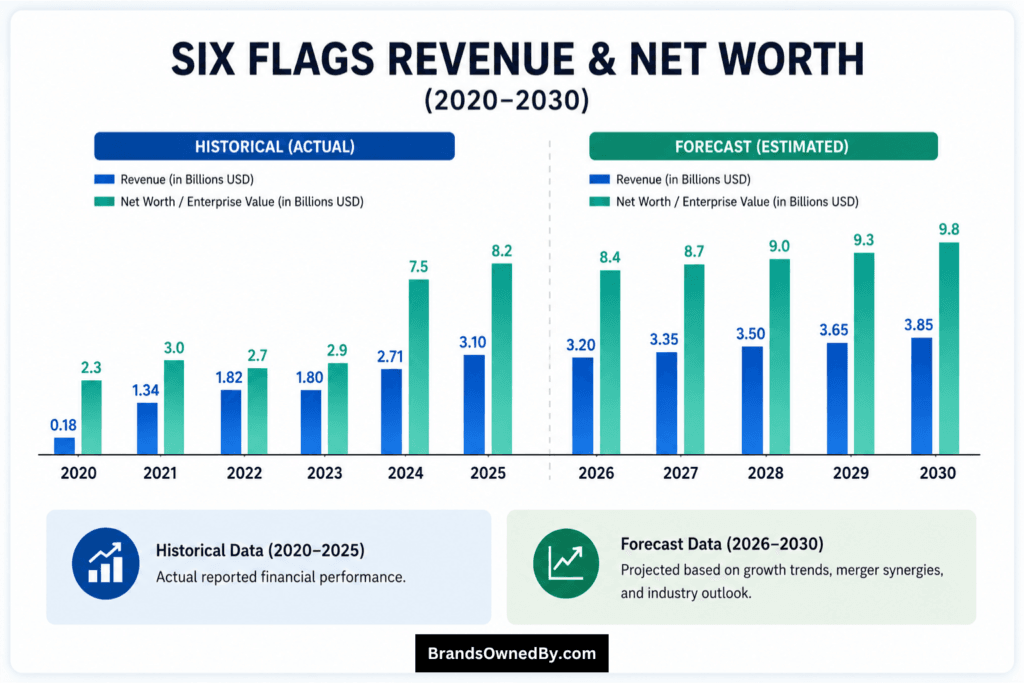
Six Flags entered 2026 as one of the largest amusement park operators in the world following its merger with Cedar Fair. As of May 2026, the company generates approximately $3.2 billion in annualized revenue and has an estimated enterprise value of around $8.4 billion. The business operates more than 40 amusement parks, water parks, resorts, and entertainment properties across North America.
The company’s financial scale increased significantly after the 2024 merger. In 2025, Six Flags reported $3.10 billion in total revenue, 47.4 million guest visits, and $792 million in adjusted EBITDA. Total assets stood at approximately $7.8 billion, while long-term debt exceeded $5.1 billion.
Six Flags 2026 Revenue Performance
The company reported a strong start to 2026.
During the first quarter of 2026, Six Flags generated $225.6 million in revenue, representing a 12% year-over-year increase. Attendance increased to approximately 2.9 million guests despite fewer operating days compared to the previous year. Guest spending also improved substantially, helping drive overall revenue growth.
Per-capita spending reached $69.26 during the quarter, increasing 6% year over year. Admissions spending increased 3%, while in-park spending on food, beverages, merchandise, and other products increased approximately 10%. Management attributed the improvement to higher-priced ticket products, revised pass programs, upgraded food offerings, and stronger merchandise sales.
Attendance growth was supported by stronger performance at parks in California, Texas, and Mexico, along with higher passholder activity and favorable spring operating conditions. Through early May 2026, the company had already welcomed approximately 5.7 million guests, representing a 4% increase compared with the same period in 2025.
Revenue Breakdown by Business Segment
Admissions remain the largest source of revenue for Six Flags.
Based on the company’s latest reported business mix, approximately 51.1% of revenue comes from admissions, including:
- Single-day tickets.
- Season passes.
- Membership programs.
- Premium admission products.
Food, merchandise, and games account for approximately 33.5% of total revenue. This category includes in-park dining, beverages, retail stores, souvenirs, apparel, and premium guest experiences.
The remaining 15.4% comes from accommodations, sponsorships, parking, resort operations, group events, Fast Lane products, Flash Pass sales, and other ancillary revenue streams.
This diversification has become increasingly important because management is focusing more on guest spending rather than relying solely on attendance growth.
2026 Net Worth and Enterprise Value
As of May 2026, Six Flags has an estimated enterprise value of approximately $8.4 billion.
Enterprise value is commonly used instead of traditional net worth because it reflects the full value of the business, including debt, assets, and market capitalization.
The company’s valuation is supported by an extensive portfolio of high-value amusement park assets, including:
- Cedar Point.
- Knott’s Berry Farm.
- Canada’s Wonderland.
- Kings Island.
- Carowinds.
- Six Flags Magic Mountain.
- Six Flags Great Adventure.
- Six Flags Fiesta Texas.
- Schlitterbahn Waterparks.
These parks represent some of the most visited regional amusement destinations in North America and generate substantial recurring revenue through season passes, memberships, food sales, and premium experiences.
At the end of 2025, Six Flags reported approximately $7.8 billion in total assets. The company also carried approximately $5.17 billion in long-term debt, making debt reduction one of management’s primary financial priorities heading into the second half of the decade.
Impact of the Cedar Fair Merger on Revenue and Valuation
The merger with Cedar Fair remains the single largest factor behind Six Flags’ financial growth.
Before the merger, legacy Six Flags generated approximately $1.8 billion in annual revenue. Cedar Fair separately generated approximately $1.9 billion annually. Combining the two companies created a business generating more than $3 billion in yearly revenue.
The merger added major assets including Cedar Point, Knott’s Berry Farm, Kings Island, Canada’s Wonderland, Carowinds, and several resort properties.
In 2024, the combined company reported approximately $2.71 billion in revenue. By 2025, revenue increased further to $3.10 billion. This growth reflected the first full year of combined operations, higher attendance levels, increased guest spending, and expanded operating scale.
Debt Reduction and Asset Optimization Strategy
A major financial focus in 2026 has been strengthening the balance sheet.
In April 2026, Six Flags agreed to sell six parks and announced plans to divest a seventh property. The transactions were valued at approximately $331 million. Management stated that proceeds would be used to reduce debt, improve liquidity, and reinvest in higher-performing core parks.
This strategy reflects a shift toward portfolio optimization rather than aggressive expansion. The company is focusing on improving profitability per park and increasing returns on invested capital.
Revenue Forecast Through 2030
Several factors are expected to support future revenue growth, including merger synergies, pricing improvements, higher guest spending, expanded resort operations, and operational efficiencies.
- 2027: Revenue is projected to reach approximately $3.35 billion as integration savings and portfolio optimization initiatives continue improving profitability.
- 2028: Revenue could increase to approximately $3.50 billion through stronger attendance trends, higher season-pass sales, and growth in premium guest experiences.
- 2029: Revenue may approach $3.65 billion if guest spending continues rising and major parks maintain strong attendance performance.
- 2030: Revenue could reach approximately $3.85 billion, supported by a fully integrated operating structure, improved margins, expanded resort offerings, and stronger pricing power across the park network.
Six Flags is now operating at a scale that did not exist before the Cedar Fair merger. The company controls one of the largest collections of regional amusement park assets in the world and serves tens of millions of guests annually.
Management’s financial strategy is centered on increasing guest spending, improving operating efficiency, reducing debt, optimizing the park portfolio, and generating stronger cash flow. If these initiatives are executed successfully, Six Flags could approach $4 billion in annual revenue and nearly $10 billion in enterprise value by 2030 while strengthening its position as the dominant regional amusement park operator in North America.
Companies Owned by Six Flags
As of 2026, Six Flags Entertainment Corporation owns and operates one of the largest portfolios of amusement parks, water parks, resorts, and entertainment destinations in North America. The company’s asset base expanded significantly following its merger with Cedar Fair in 2024, which combined two of the industry’s largest regional amusement park operators.
Six Flags operates more than 40 amusement parks and water parks across the United States, Canada, and Mexico. The most valuable assets include several iconic destination parks that attract millions of visitors annually and generate the majority of the company’s revenue.
| Brand / Entity | Type | Location | Acquired Through | Key Details |
|---|---|---|---|---|
| Six Flags Magic Mountain | Theme Park | California, USA | Legacy Six Flags | One of the world’s most famous roller coaster parks. Known for having one of the largest collections of major thrill rides globally. |
| Six Flags Great Adventure | Theme Park | New Jersey, USA | Legacy Six Flags | One of the largest theme parks in the United States and a flagship East Coast property attracting millions of visitors annually. |
| Six Flags Over Texas | Theme Park | Texas, USA | Original Six Flags Property | The original Six Flags park opened in 1961. Considered the birthplace of the Six Flags brand. |
| Six Flags Fiesta Texas | Theme Park | Texas, USA | Legacy Six Flags | One of the company’s highest-rated parks, known for its unique quarry setting and strong attendance performance. |
| Six Flags Over Georgia | Theme Park | Georgia, USA | Legacy Six Flags | Major regional amusement destination serving the southeastern United States. |
| Six Flags New England | Theme Park | Massachusetts, USA | Legacy Six Flags | Largest Six Flags property in New England and one of the company’s most important northeastern assets. |
| Six Flags Discovery Kingdom | Theme Park | California, USA | Legacy Six Flags | Unique combination of amusement rides, animal attractions, and marine-life experiences. |
| Six Flags México | Theme Park | Mexico City, Mexico | Legacy Six Flags | Largest international Six Flags park and one of the most visited seasonal attractions in Latin America. |
| Cedar Point | Theme Park & Resort Destination | Ohio, USA | Cedar Fair Merger | Often called the “Roller Coaster Capital of the World.” Widely considered the most valuable property in the company’s portfolio. |
| Knott’s Berry Farm | Theme Park & Resort | California, USA | Cedar Fair Merger | One of America’s oldest theme parks and among Southern California’s most recognized entertainment destinations. |
| Canada’s Wonderland | Theme Park | Ontario, Canada | Cedar Fair Merger | Canada’s largest amusement park and one of the highest-attended parks in North America. |
| Kings Island | Theme Park | Ohio, USA | Cedar Fair Merger | Major Midwest amusement destination known for strong season-pass sales and recurring attendance. |
| Carowinds | Theme Park | North Carolina/South Carolina, USA | Cedar Fair Merger | One of the fastest-growing parks in the portfolio due to its location near the Charlotte metropolitan area. |
| Kings Dominion | Theme Park | Virginia, USA | Cedar Fair Merger | Large East Coast amusement destination featuring roller coasters, water attractions, and family entertainment. |
| Dorney Park & Wildwater Kingdom | Theme Park & Water Park | Pennsylvania, USA | Cedar Fair Merger | Dual-gate attraction serving Pennsylvania, New Jersey, and New York markets. |
| Valleyfair | Theme Park | Minnesota, USA | Cedar Fair Merger | Leading amusement park in the Upper Midwest and a key regional entertainment asset. |
| Worlds of Fun | Theme Park | Missouri, USA | Cedar Fair Merger | Major amusement destination serving Kansas City and surrounding states. |
| Michigan’s Adventure | Theme Park & Water Park | Michigan, USA | Cedar Fair Merger | Largest amusement park in Michigan and an important Great Lakes region asset. |
| Schlitterbahn New Braunfels | Water Park & Resort | Texas, USA | Cedar Fair Merger | One of the most recognized water parks in the world and a major tourism destination in Texas. |
| Schlitterbahn Galveston | Water Park | Texas, USA | Cedar Fair Merger | Significant water park property serving the Gulf Coast tourism market. |
| Hurricane Harbor Brand | Water Park Brand | Multiple Locations | Legacy Six Flags | The company’s primary water park brand operating at numerous locations throughout North America. |
| Cedar Point Resorts | Resort & Hospitality Assets | Ohio, USA | Cedar Fair Merger | Collection of hotels, campgrounds, marinas, cottages, and resort facilities associated with Cedar Point. |
| Knott’s Hotel | Resort Property | California, USA | Cedar Fair Merger | Full-service hotel supporting Knott’s Berry Farm visitors and Southern California tourism. |
| Camp Cedar | Luxury Resort | Ohio, USA | Cedar Fair Merger | Premium outdoor resort featuring cabins, RV accommodations, and recreational facilities. |
| Sawmill Creek Resort | Resort & Conference Center | Ohio, USA | Cedar Fair Merger | Hospitality asset featuring lodging, golf facilities, dining, and conference services. |
Six Flags Brand
The Six Flags brand is the company’s most recognizable asset and serves as the foundation of its amusement park business.
Founded in 1961 with the opening of Six Flags Over Texas, the brand has evolved into one of the most recognized names in the global amusement park industry. The Six Flags portfolio includes major parks such as Six Flags Magic Mountain, Six Flags Great Adventure, Six Flags Fiesta Texas, Six Flags Over Georgia, Six Flags New England, and Six Flags México.
The brand is known primarily for thrill rides, record-breaking roller coasters, family attractions, seasonal events, and live entertainment. Unlike destination resort operators such as Disney and Universal, Six Flags focuses on regional amusement parks that attract repeat visitors through season passes and membership programs.
The Six Flags parks collectively serve millions of guests each year and remain the company’s largest revenue-generating assets.
Cedar Point
Cedar Point is widely considered the most valuable individual property owned by Six Flags.
Located in Sandusky, Ohio, the park has earned the nickname “Roller Coaster Capital of the World” because of its extensive collection of world-class roller coasters. The property attracts visitors from across the United States, Canada, and international markets.
The park spans hundreds of acres along the shores of Lake Erie and includes amusement rides, hotels, marinas, beaches, restaurants, retail operations, and resort facilities. Cedar Point’s combination of attractions and hospitality assets makes it one of the highest-profile regional amusement destinations in North America.
Following the Cedar Fair merger, Cedar Point became one of the crown jewels of the Six Flags portfolio and remains one of the company’s most strategically important assets.
Knott’s Berry Farm
Knott’s Berry Farm is one of the oldest continuously operating theme parks in the United States and one of Six Flags’ most valuable California properties.
Located in Buena Park, California, the park began as a small berry farm and restaurant before evolving into a major theme park destination. Today, it combines thrill rides, family attractions, themed entertainment, dining experiences, and seasonal events.
The park benefits from its location near Los Angeles and attracts both local visitors and tourists. Unlike many regional parks, Knott’s Berry Farm has strong year-round attendance and enjoys significant brand recognition throughout Southern California.
The property also includes hotel operations that contribute additional revenue beyond admissions.
Canada’s Wonderland
Canada’s Wonderland is the largest amusement park in Canada and one of the most important international assets owned by Six Flags.
Located near Toronto, the park serves one of North America’s largest metropolitan areas. The property features a large collection of roller coasters, water attractions, entertainment venues, and family rides.
Canada’s Wonderland consistently ranks among the most visited seasonal amusement parks in North America and serves as the company’s flagship Canadian property.
Its large attendance base and strong market position make it one of the company’s highest-performing parks.
Kings Island
Kings Island is one of the largest regional amusement parks in the Midwest and a cornerstone asset within the Six Flags portfolio.
Located near Cincinnati, Ohio, the park is known for its extensive roller coaster collection, family attractions, seasonal festivals, and water park offerings. The property has operated for decades and enjoys a loyal customer base throughout Ohio, Kentucky, Indiana, and neighboring states.
Kings Island is particularly important because of its strong season-pass business and repeat visitation rates. The park plays a major role in generating recurring revenue and maintaining Six Flags’ presence in the Midwest.
Carowinds
Carowinds is one of Six Flags’ most strategically positioned parks.
Located on the border of North Carolina and South Carolina, the property serves the rapidly growing Charlotte metropolitan area and attracts visitors from throughout the southeastern United States.
The park has received significant investment over the years, including major roller coaster additions and expanded guest amenities. Its location in one of the fastest-growing regions in the United States provides strong long-term growth potential.
Carowinds has become one of the company’s leading regional destinations and a key contributor to attendance and revenue.
Six Flags Magic Mountain
Six Flags Magic Mountain remains one of the company’s most iconic properties.
Located in Southern California, the park is internationally recognized for its collection of record-breaking roller coasters and extreme thrill attractions. It regularly attracts enthusiasts from around the world and is often considered one of the premier coaster parks globally.
Magic Mountain serves a different market segment than Disney or Universal by focusing heavily on thrill seekers rather than intellectual-property-driven attractions.
Its reputation within the amusement industry makes it one of the most important assets carrying the Six Flags name.
Schlitterbahn Waterparks
Schlitterbahn is one of the most respected water park brands in North America.
The brand includes major properties in New Braunfels and Galveston, Texas. Schlitterbahn parks are known for innovative water attractions, river systems, family-oriented experiences, and resort accommodations.
The New Braunfels property in particular is widely regarded as one of the best water parks in the world and attracts visitors from across the country.
The acquisition of Schlitterbahn through Cedar Fair strengthened Six Flags’ position in the water park sector and expanded its presence in Texas.
Hurricane Harbor
Hurricane Harbor is Six Flags’ dedicated water park brand and represents one of the company’s largest collections of water attractions.
Multiple Hurricane Harbor locations operate throughout North America, often alongside major Six Flags amusement parks. These properties provide additional seasonal revenue and allow the company to attract families seeking water-based entertainment.
The brand plays an important role in diversifying revenue streams because it generates admissions, food sales, cabana rentals, premium experiences, and season-pass revenue during peak summer months.
Resort and Hospitality Portfolio
In addition to amusement parks and water parks, Six Flags owns a growing collection of resort, lodging, and hospitality assets.
These include properties associated with Cedar Point, Knott’s Berry Farm, Kings Island, Schlitterbahn, and other major destinations. Examples include Cedar Point Resorts, Sawmill Creek Resort, Camp Cedar, hotel properties, campgrounds, RV resorts, and marina facilities.
These hospitality assets help increase guest spending and extend the average length of stay. They also provide a revenue stream that is less dependent on daily park attendance.
Following the Cedar Fair merger, the hospitality segment became a more important component of the company’s long-term growth strategy.
Final Thoughts
For those wondering who owns Six Flags, the company is ultimately owned by its shareholders rather than a founder, family, or parent corporation. This ownership structure reflects its position as a modern public company, where institutional investors play an important role in governance and long-term strategy. Beyond ownership, Six Flags is defined by its collection of well-known amusement parks and attractions that have entertained generations of visitors and established the company as a leader in the regional theme park market.
FAQs
Who bought Six Flags America?
Six Flags America was sold in 2026 as part of Six Flags Entertainment Corporation’s portfolio optimization strategy. The park was acquired by Herschend, a privately owned entertainment company known for operating attractions such as Dollywood and Silver Dollar City. The transaction was part of a broader effort by Six Flags to reduce debt and focus on its highest-performing assets.
Who does Six Flags own?
As of 2026, Six Flags owns and operates a large portfolio of amusement parks, water parks, resorts, and entertainment properties across North America. Major assets include Cedar Point, Knott’s Berry Farm, Canada’s Wonderland, Kings Island, Carowinds, Six Flags Magic Mountain, Six Flags Great Adventure, Six Flags Fiesta Texas, Schlitterbahn Waterparks, Hurricane Harbor water parks, and several resort and hospitality properties.
Who owns Six Flags parks?
Six Flags parks are owned by Six Flags Entertainment Corporation, a publicly traded company. Ownership is divided among shareholders, with major institutional investors such as BlackRock, Vanguard Group, UBS Asset Management, and other investment firms holding significant stakes in the company.
Where is Six Flags based?
Six Flags Entertainment Corporation is headquartered in Charlotte, North Carolina. The headquarters location was established following the merger between Six Flags and Cedar Fair, which combined the operations of both companies under a single corporate structure.
Who is the majority owner of Six Flags?
Six Flags does not have a majority owner. No individual, family, or company owns more than 50% of the business. The largest shareholder is BlackRock, but its ownership stake is well below a controlling interest. The company is primarily owned by institutional investors and public shareholders.
Did Warner Bros. own Six Flags?
Yes. Warner Bros.’ parent company, Time Warner, owned Six Flags from 1984 until 1998. During this period, Six Flags parks gained access to popular Warner Bros. and DC Comics characters, leading to attractions themed around Batman, Superman, Bugs Bunny, and other well-known franchises. Although Time Warner no longer owns Six Flags, the company continues to license certain Warner Bros. and DC intellectual property for use in some parks.
Does Dan Snyder still own Six Flags?
No. Dan Snyder no longer owns Six Flags. Through his investment group, Red Zone LLC, Snyder became involved with the company in the mid-2000s and served as chairman for a period. However, he eventually exited his ownership position, and Six Flags is now owned primarily by institutional investors and public shareholders.
Is Six Flags a Texas owned company?
No. While Six Flags was founded in Texas and opened its first park, Six Flags Over Texas, in Arlington in 1961, the company is no longer Texas-owned. It is a publicly traded corporation headquartered in North Carolina and owned by shareholders from around the world.
Who is the CEO of Six Flags?
As of 2026, John Reilly serves as President and Chief Executive Officer of Six Flags Entertainment Corporation. He assumed the role following leadership changes after the Cedar Fair merger and is responsible for overseeing the company’s amusement parks, water parks, resorts, and overall business operations.
How much did Travis Kelce invest in Six Flags?
Travis Kelce participated in an investment group that acquired a minority ownership interest in Six Flags in 2026. However, the exact amount of Kelce’s personal investment has not been publicly disclosed. While reports confirmed his involvement in the investor group, the specific dollar value of his individual contribution remains private.
How many Six Flags are there?
As of 2026, Six Flags operates more than 40 amusement parks, water parks, and resort properties across the United States, Canada, and Mexico. The portfolio includes both legacy Six Flags parks and properties added through the Cedar Fair merger.
Why is it called Six Flags?
The name “Six Flags” refers to the six different nations that have governed Texas throughout its history. These six flags are Spain, France, Mexico, the Republic of Texas, the Confederate States of America, and the United States. Founder Angus G. Wynne Jr. chose the name when he opened Six Flags Over Texas in 1961, and it has remained the company’s defining brand ever since.