
- Polaris is a publicly traded powersports company listed on the New York Stock Exchange under the ticker symbol PII. The company is not owned by a single person or family. Instead, ownership is mainly controlled by institutional investors and investment funds.
- As of May 2026, the largest Polaris shareholders include BlackRock with approximately 12% ownership, Capital Research and Management with around 11%, Vanguard Group with nearly 10%, State Street Global Advisors with about 5%, and the Polaris Employee Stock Ownership Plan (ESOP) with more than 5% of outstanding shares.
- Polaris is managed by CEO Mike Speetzen, while corporate oversight is handled by the board of directors chaired by John P. Wiehoff. Major institutional shareholders influence governance through shareholder voting and board elections.
- Polaris owns and operates major brands including RZR, Ranger, Sportsman, Indian Motorcycle, Slingshot, Bennington, Timbersled, GEM Electric Vehicles, and several aftermarket and marine businesses, making it one of the most diversified powersports companies in North America.
Polaris is an American powersports and recreational vehicle manufacturer headquartered in Medina, Minnesota. The company is best known for producing off-road vehicles, snowmobiles, motorcycles, utility vehicles, and commercial mobility solutions.
The business started as a snowmobile manufacturer in the 1950s. Over the decades, Polaris expanded into several vehicle categories. Today, it is considered one of the largest powersports companies in North America.
Polaris operates through multiple divisions and brands. Its products are sold through a large dealer network across the United States and international markets.
The company is especially recognized for its off-road vehicle lineup. Vehicles like the RZR and Ranger are widely used for trail riding, farming, hunting, rescue operations, and outdoor recreation.
Polaris also has a strong presence in motorcycles through Indian Motorcycle and Slingshot. In addition, the company manufactures electric utility vehicles and commercial transportation solutions.
One reason Polaris became successful is its focus on niche outdoor markets. Instead of competing directly with traditional automobile manufacturers, Polaris built products for adventure, utility, and recreation.
A practical example is the Polaris Ranger. Farmers and ranch owners commonly use it to transport equipment, feed supplies, and workers across rough terrain where regular pickup trucks struggle.
Polaris Industry Position
Polaris is considered a major player in the global powersports industry. The company competes with manufacturers such as Yamaha Motor, Honda Powersports, BRP, Kawasaki, and Arctic Cat.
Its strongest market position comes from side-by-side vehicles and utility terrain vehicles. Polaris helped popularize the modern recreational side-by-side segment through the success of the RZR lineup.
The company also benefits from a large aftermarket ecosystem. Many Polaris customers purchase accessories, upgraded suspension systems, lighting kits, and storage solutions after buying a vehicle.
Polaris Business Model
Polaris generates revenue through vehicle sales, accessories, replacement parts, apparel, licensing, and financing partnerships.
The company uses a dealer-based distribution system. Independent dealerships handle vehicle sales, servicing, repairs, and customer support.
This model allows Polaris to maintain a strong local presence in rural and recreational markets.
Polaris also invests heavily in product development. The company regularly launches updated vehicle platforms with improved suspension, safety systems, and engine performance.
Polaris Founders
Polaris was founded in 1954 by Edgar Hetteen, Allan Hetteen, and David Johnson in Minnesota.
The founders originally worked on creating practical snowmobiles that could handle harsh winter conditions. At the time, snowmobiles were still a developing category with limited commercial adoption.
Edgar Hetteen
Edgar Hetteen is widely recognized as one of the primary driving forces behind Polaris during its early years. He played a major role in designing and promoting the company’s first snowmobiles.
His vision focused on building lightweight vehicles capable of traveling across deep snow in remote areas.
Edgar later became one of the most influential figures in the snowmobile industry.
Allan Hetteen
Allan Hetteen contributed to the engineering and manufacturing side of the business. He helped improve vehicle reliability and performance during the company’s early expansion phase.
His technical involvement helped Polaris develop practical snowmobiles that appealed to both workers and recreational riders.
David Johnson
David Johnson was another key co-founder who supported the company’s product development and operational growth.
The founders initially operated on a small scale. Early Polaris snowmobiles were built using basic workshop equipment and limited resources.
The First Polaris Snowmobile
One of the company’s biggest milestones came when the founders built their first successful motorized snow vehicle. It was designed to travel through snow-covered terrain more efficiently than traditional transportation methods.
The prototype gained attention because it solved a real problem for people living in cold rural regions.
This early innovation laid the foundation for Polaris’ long-term growth in recreational and utility vehicles.
Ownership History
Polaris has gone through major ownership and structural changes since its founding in 1954. The company started as a small privately operated snowmobile business and later evolved into a publicly traded global powersports manufacturer.
Its ownership history reflects the broader growth of the American recreational vehicle industry. Polaris expanded from a regional workshop operation into a corporation controlled mainly by institutional investors and public shareholders.
Early Private Ownership (1954–1960s)
Polaris was originally founded by Edgar Hetteen, Allan Hetteen, and David Johnson in Roseau, Minnesota.
In the beginning, ownership was concentrated among the founders and a small group of early stakeholders. The business operated like many family-style manufacturing companies of that era. Decisions were made directly by the founders, who were also deeply involved in engineering, production, and sales.
The company focused entirely on snowmobiles during its early years. These vehicles became increasingly popular in northern U.S. states and Canada because they offered practical transportation across snow-covered terrain.
Polaris grew rapidly as snowmobile demand increased during the late 1950s and early 1960s.
Expansion and Corporate Development
As Polaris expanded, the company required additional capital to scale manufacturing operations, dealer networks, and research capabilities.
This growth gradually shifted Polaris from a founder-led operation into a more structured corporate business. Ownership became more distributed as outside investors and business stakeholders became involved.
The company also began developing a formal management structure. This reduced reliance on the founders for day-to-day operational decisions.
During this period, Polaris established itself as one of the leading snowmobile brands in North America.
Acquisition by Textron
One of the biggest ownership changes in Polaris history occurred in 1968 when Textron acquired the company.
Textron was already a diversified industrial conglomerate with interests in manufacturing and transportation businesses. The acquisition gave Polaris access to larger financial resources, operational infrastructure, and broader distribution capabilities.
Under Textron ownership, Polaris continued expanding its snowmobile operations. The company also improved manufacturing processes and increased production capacity.
However, the corporate ownership structure created some strategic disagreements over the direction of the business.
Management Buyout and Independence
In 1981, a group of Polaris executives and investors purchased the company back from Textron.
This management-led buyout was a major turning point in Polaris history. It restored Polaris as an independent company and allowed leadership to focus specifically on the powersports market.
The buyout gave Polaris greater flexibility in product development and long-term planning.
Following independence, Polaris aggressively expanded into new vehicle categories, including all-terrain vehicles (ATVs).
This decision became one of the most important strategic moves in company history. The ATV market later became a core revenue driver for Polaris.
Public Company Transition
Polaris eventually became a publicly traded corporation. Its shares were listed on the New York Stock Exchange under the ticker symbol PII.
The public listing fundamentally changed the company’s ownership structure.
Instead of being controlled by a small group of founders or executives, ownership became divided among:
- Institutional investors.
- Mutual funds.
- Pension funds.
- Hedge funds.
- Retail investors.
- Company executives and directors.
This structure remains in place today.
Large institutional investors gradually became the dominant shareholders because they purchased significant amounts of Polaris stock through index funds and investment portfolios.
Rise of Institutional Ownership
As Polaris grew into a multi-billion-dollar corporation, institutional ownership increased substantially.
Investment firms such as:
- Vanguard Group.
- BlackRock.
- State Street Global Advisors.
became some of the company’s largest shareholders.
These firms typically hold Polaris shares through ETFs, retirement funds, and broad market investment products.
This means millions of people indirectly own Polaris stock through retirement accounts and investment funds.
For example, an investor holding an S&P 500 index fund may indirectly own Polaris shares without purchasing the stock individually.
Acquisition-Led Growth Era
Ownership history at Polaris is also closely tied to its acquisition strategy.
Instead of relying only on internal product development, Polaris expanded through major acquisitions that reshaped the company.
Important acquisitions included:
- Indian Motorcycle.
- GEM Electric Vehicles.
- Aixam.
- Boat Holdings.
- Transamerican Auto Parts.
These acquisitions diversified Polaris beyond snowmobiles and ATVs.
The acquisition of Indian Motorcycle was particularly important. Polaris revived the historic American motorcycle brand and transformed it into a major Harley-Davidson competitor.
Similarly, the acquisition of Transamerican Auto Parts expanded Polaris into aftermarket accessories and off-road customization products.
Modern Ownership Structure
As of 2026, Polaris operates as a publicly owned corporation with no single controlling owner.
Institutional investors collectively own the majority of shares. However, company leadership and the board of directors still play the most important role in operational control and strategic decision-making.
This structure is common among major American manufacturing companies.
Polaris management remains responsible for:
- Product strategy.
- Acquisitions.
- Manufacturing expansion.
- Global operations.
- Electric vehicle investments.
- Shareholder value creation.
Although ownership is distributed across public shareholders, voting power is heavily influenced by large institutional investors because of their sizable holdings.
Evolution From Founder Business to Global Corporation
The ownership evolution of Polaris highlights how the company transformed over several decades.
It began as a founder-led snowmobile workshop in Minnesota. It later became part of a large industrial conglomerate under Textron. After regaining independence, Polaris expanded aggressively and eventually evolved into a publicly traded global powersports leader.
This transformation allowed Polaris to compete internationally while maintaining strong brand recognition in recreational and utility vehicle markets.
Who Owns Polaris: Top Shareholders
![Who Owns Polaris [top shareholders]](https://brandsownedby.com/wp-content/uploads/2026/05/Who-Owns-Polaris-top-shareholders-484x1024.png)
Polaris is a publicly traded company listed on the New York Stock Exchange under the ticker symbol PII. This means the company is not owned by a single individual or family. Instead, ownership is divided among institutional investors, mutual funds, pension funds, ETFs, company insiders, and retail shareholders.
The majority of Polaris shares are controlled by large investment management firms. These institutions manage money on behalf of millions of clients, retirement accounts, and index funds. As a result, a large portion of Polaris ownership is indirect.
As of May 2026, institutional investors collectively control most of Polaris stock. Insider ownership remains relatively small compared to institutional holdings. The company does not have a founder-controlled structure or dual-class voting system like some technology firms.
Polaris ownership is heavily influenced by long-term investment firms that focus on industrial, manufacturing, and consumer discretionary companies.
The largest shareholders of Polaris include:
- BlackRock.
- Capital Research and Management Company.
- Vanguard Group.
- State Street Global Advisors.
- Polaris Employee Stock Ownership Plan.
- Geode Capital Management.
These investors influence shareholder voting, corporate governance decisions, executive compensation approvals, and board elections.
Institutional Ownership Structure
Institutional ownership dominates Polaris. Most shares are held through:
- Exchange-traded funds (ETFs).
- Pension funds.
- Mutual funds.
- Asset management portfolios.
- Insurance investment funds.
This ownership structure is common among large American manufacturing companies.
For example, when an investor buys shares in a broad-market ETF that includes Polaris, they indirectly become a partial owner of the company.
Institutional investors prefer Polaris because of its strong brand portfolio, dealer network, and established position in the powersports market.
As of 2026, institutional ownership accounts for well over 90% of Polaris shares based on public filings and ownership databases.
BlackRock
BlackRock is one of the largest shareholders of Polaris. The investment management giant controls a major percentage of outstanding shares through its ETFs, index funds, and actively managed portfolios.
As of 2026, BlackRock owns roughly 12% of Polaris shares according to institutional ownership filings.
BlackRock’s Polaris holdings are spread across multiple investment products, including industrial sector funds and S&P 500-linked ETFs.
The company typically acts as a passive institutional investor. However, because of its large voting power, BlackRock can still influence:
- Corporate governance policies.
- Board elections.
- ESG reporting initiatives.
- Executive compensation decisions.
BlackRock’s ownership reflects strong institutional confidence in Polaris’ long-term manufacturing and recreational vehicle business.
Capital Research and Management Company
Capital Research and Management Company is another major Polaris shareholder. The firm manages assets for Capital Group investment funds.
As of 2026, Capital Research controls more than 11% of Polaris stock.
Capital Group is known for long-term investing strategies. Its investment approach focuses heavily on durable brands and established market leaders.
The company’s Polaris investment suggests confidence in the long-term growth potential of off-road vehicles, powersports, and outdoor recreation markets.
Capital Research has historically maintained large positions in industrial and consumer discretionary companies with strong dealer ecosystems.
Vanguard Group
Vanguard Group is one of the largest institutional owners of Polaris.
As of 2026, Vanguard owns roughly 9% to 11% of the company depending on quarterly filing periods.
Most Vanguard-owned Polaris shares are held through index funds and retirement portfolios.
Because Vanguard manages trillions of dollars in assets, it holds shares in thousands of publicly traded companies. Polaris is included in several broad-market and industrial-focused ETFs managed by Vanguard.
Vanguard usually takes a passive ownership approach. However, it still participates in major shareholder votes and governance matters.
Its ownership stake gives it substantial influence over board approvals and long-term strategic direction.
Polaris Employee Stock Ownership Plan (ESOP)
One of the unique shareholders of Polaris is the company’s Employee Stock Ownership Plan.
As of 2026, the Polaris ESOP owns more than 5% of company shares.
This structure allows employees to benefit from the company’s long-term stock performance.
Employee ownership plans are often viewed positively because they align worker incentives with shareholder performance.
The Polaris ESOP also strengthens employee retention and corporate culture. Workers indirectly benefit when the company performs well and the stock price increases.
State Street Global Advisors
State Street Global Advisors is another major institutional shareholder of Polaris.
As of 2026, State Street controls roughly 5% of Polaris shares.
State Street is one of the largest ETF and asset management firms in the world. The company owns Polaris shares primarily through index-tracking investment products.
Like Vanguard and BlackRock, State Street typically acts as a long-term institutional investor rather than an activist shareholder.
Its voting influence still matters because of the large amount of shares it controls.
Geode Capital Management
Geode Capital Management is another notable Polaris shareholder.
The company owns a smaller but still significant percentage of Polaris stock through passive investment strategies and institutional portfolios.
As of 2026, Geode controls more than 2% of Polaris shares according to institutional ownership filings.
Geode specializes in index-based investment management and quantitative portfolio strategies.
Its Polaris holdings are primarily connected to benchmark-tracking investment funds.
Insider Ownership
Polaris insiders also own shares in the company. This group includes:
- Executive leadership.
- Board members.
- Senior management.
Insider ownership is relatively small compared to institutional ownership.
As of 2026, insiders collectively control a low single-digit percentage of Polaris stock.
The CEO and senior executives receive stock-based compensation packages tied to company performance. This aligns leadership interests with shareholders.
Insider ownership remains important because it gives executives direct financial exposure to company performance and long-term strategy execution.
Retail Shareholders
Retail investors also own Polaris shares through personal brokerage accounts.
Although retail ownership is much smaller than institutional ownership, individual investors still collectively represent an important shareholder base.
Retail shareholders are often attracted to Polaris because of:
- Strong brand recognition.
- Dividend history.
- Outdoor recreation exposure.
- Manufacturing market position.
- Long-term powersports growth potential.
Some Polaris customers are also shareholders. This creates a strong brand-investor relationship that is common in enthusiast-driven industries like motorcycles and off-road vehicles.
Ownership Influence on Polaris Strategy
The ownership structure of Polaris affects how the company operates.
Large institutional investors generally prioritize:
- Long-term profitability.
- Stable margins.
- Market share growth.
- Operational efficiency.
- Shareholder returns.
Because Polaris has no dominant founder-owner, executive leadership must maintain strong relationships with institutional shareholders.
Major strategic decisions such as acquisitions, restructuring plans, manufacturing investments, and leadership changes are closely monitored by these investors.
For example, institutional shareholders played an important role in evaluating Polaris’ expansion into electric vehicles, aftermarket accessories, and marine businesses.
Competitor Ownership Comparison
Polaris competes against some of the largest powersports and recreational vehicle manufacturers in the world. These companies operate under very different ownership structures. Some are standalone public companies like Polaris, while others are divisions of much larger industrial conglomerates.
Ownership structure plays a major role in how these businesses operate. It affects product investment, manufacturing strategy, global expansion, acquisitions, and long-term priorities.
Polaris operates as an independent publicly traded corporation. Its ownership is heavily concentrated among institutional investors such as Vanguard, BlackRock, and other large asset management firms. The company focuses primarily on powersports, off-road vehicles, motorcycles, and recreational mobility.
Many competitors are more diversified than Polaris. Some generate revenue from automotive manufacturing, robotics, aerospace, industrial machinery, or marine engines. This creates major differences in business strategy and financial priorities.
| Company | Ownership Structure | Main Owners | Core Business Focus | Key Difference From Polaris |
|---|---|---|---|---|
| Polaris | Publicly traded independent company | Institutional investors such as Vanguard, BlackRock, and State Street | Off-road vehicles, motorcycles, snowmobiles, utility vehicles, marine products | Highly focused on powersports and recreational mobility |
| BRP (Can-Am) | Publicly traded company | Institutional investors and legacy Bombardier influence | Side-by-sides, snowmobiles, personal watercraft, powersports | Stronger presence in watercraft and Rotax engine manufacturing |
| Yamaha Motor | Publicly traded multinational corporation | Japanese institutions, banks, insurance firms, global investors | Motorcycles, marine engines, robotics, industrial systems | Much broader industrial diversification than Polaris |
| Honda Motor | Publicly traded global corporation | Global institutional investors and pension funds | Automobiles, motorcycles, aviation, robotics, power equipment | Powersports is only a small part of Honda’s overall business |
| Arctic Cat | Subsidiary of Textron | Controlled by Textron | Snowmobiles and off-road vehicles | Operates under a larger industrial conglomerate |
| Kawasaki Heavy Industries | Public industrial conglomerate | Japanese financial institutions and institutional investors | Aerospace, rail systems, heavy machinery, motorcycles | Large industrial and engineering-focused parent company |
| Harley-Davidson | Publicly traded company | Institutional investors including Vanguard and BlackRock | Heavyweight motorcycles and touring bikes | More dependent on motorcycle sales than Polaris |
| Suzuki Motor Corporation | Publicly traded multinational company | Institutional investors and Japanese corporate shareholders | Motorcycles, automobiles, marine engines | Larger automotive exposure than Polaris |
| CFMOTO | Privately influenced public company structure in China | Chinese founders, institutional investors, strategic partners | ATVs, motorcycles, side-by-sides | Faster expansion in global entry-level off-road markets |
| Kubota | Publicly traded corporation | Institutional investors and Japanese banks | Agricultural machinery and utility vehicles | Stronger focus on agriculture and commercial utility equipment |
Polaris vs BRP (Can-Am)
BRP, the parent company of Can-Am and Ski-Doo, is one of Polaris’ closest competitors in the powersports market.
Like Polaris, BRP is publicly traded and primarily owned by institutional investors. However, BRP has historically maintained stronger ties to its founding heritage through the Bombardier business legacy.
Both companies dominate the side-by-side and snowmobile markets. Polaris built its reputation around vehicles like the RZR and Ranger. BRP expanded aggressively with the Can-Am Maverick and Defender lineups.
The biggest difference is strategic concentration. Polaris focuses heavily on off-road utility vehicles, aftermarket accessories, and American motorcycle brands. BRP has stronger exposure to personal watercraft and Rotax engine manufacturing.
For example, Sea-Doo gives BRP a major position in the watercraft industry, while Polaris generates more revenue from utility terrain vehicles and recreational off-road machines.
Polaris vs Yamaha Motor
Yamaha Motor operates under a much broader corporate structure than Polaris.
The company is publicly traded in Japan and owned mainly by institutional investors, banks, insurance companies, and international investment funds. Unlike Polaris, Yamaha is not focused only on powersports.
Its operations extend into marine engines, robotics, industrial automation systems, motorcycles, and mobility technologies. This diversification reduces Yamaha’s dependence on recreational vehicle demand.
Polaris operates with a more specialized business model. The company concentrates primarily on outdoor recreation and utility vehicles. Yamaha spreads risk across multiple industries.
This difference affects how both companies approach product development.
For instance, Yamaha can leverage expertise from marine engineering and industrial technology when developing powersports products. Polaris relies more heavily on innovation directly tied to off-road and recreational vehicle markets.
Yamaha also has broader manufacturing reach across Asia and global export markets, while Polaris remains more heavily concentrated in North America.
Polaris vs Honda Powersports
Honda is another major Polaris competitor in ATVs and utility vehicles.
Although Honda is publicly traded like Polaris, the company operates on an entirely different scale. Honda’s ownership is distributed among institutional investors and global shareholders, but powersports represents only a small portion of its overall business.
Honda generates revenue from automobiles, motorcycles, aviation systems, robotics, power equipment, and industrial engines.
This gives Honda enormous engineering resources and manufacturing capabilities.
Polaris, on the other hand, operates with a much narrower industry focus. Its management team concentrates specifically on powersports, recreational mobility, and utility vehicles.
A good example is the competition between the Polaris Ranger and Honda Pioneer. Both target utility and recreational users, but Honda’s design philosophy often emphasizes durability and mechanical simplicity. Polaris tends to prioritize performance, customization, and rider experience.
Because Honda operates at such a large scale globally, powersports products compete internally for investment against much larger automotive divisions. Polaris does not face that challenge because powersports is its core business.
Polaris vs Arctic Cat
Arctic Cat has one of the most different ownership structures in the industry.
Unlike Polaris, Arctic Cat is no longer an independent public company. It became part of Textron after being acquired in 2017.
Textron is a diversified industrial corporation with businesses in aviation, defense, specialized vehicles, and industrial manufacturing.
As a result, Arctic Cat operates as a division within a much larger corporate ecosystem.
This structure gives Arctic Cat access to larger operational resources and corporate infrastructure. However, powersports is only one part of Textron’s broader business portfolio.
Polaris operates with more independence and stronger specialization in recreational vehicles.
The difference becomes clear in product strategy. Polaris aggressively expanded into side-by-side vehicles, electric mobility, and aftermarket accessories through targeted acquisitions and brand development. Arctic Cat has operated with a more conservative expansion approach under corporate ownership.
Polaris also maintains broader product diversification within the powersports category itself.
Polaris vs Kawasaki Heavy Industries
Kawasaki operates under a completely different corporate model than Polaris.
The company is part of Kawasaki Heavy Industries, a massive industrial conglomerate involved in aerospace, rail systems, shipbuilding, industrial robotics, heavy machinery, and energy systems.
Its ownership is distributed among Japanese financial institutions, banks, pension funds, and institutional shareholders.
Powersports represents only one division inside Kawasaki’s industrial empire.
This gives Kawasaki access to advanced engineering and manufacturing expertise across multiple industries. Technologies developed in heavy industry or aerospace operations can influence motorcycle and off-road vehicle engineering.
Polaris does not have that level of industrial diversification. However, its specialization allows the company to focus more directly on consumer recreation and utility markets.
For example, Kawasaki’s Teryx side-by-side vehicles compete against Polaris RZR models, but Polaris invests a larger percentage of its overall business resources into off-road recreational products.
Polaris vs Harley-Davidson
Harley-Davidson competes with Polaris mainly through Indian Motorcycle.
Both companies are publicly traded and largely owned by institutional investors. Major asset management firms hold substantial ownership stakes in both businesses.
However, Harley-Davidson depends far more heavily on heavyweight motorcycles than Polaris.
Polaris benefits from a broader product portfolio that includes side-by-side vehicles, ATVs, snowmobiles, utility vehicles, commercial mobility products, and marine operations.
This diversification reduces Polaris’ dependence on one customer segment.
Harley-Davidson’s business performance is closely tied to motorcycle demand and brand loyalty within the cruiser market. Polaris has more flexibility because of its exposure to multiple recreational categories.
The revival of Indian Motorcycle significantly increased competition between the two companies. Polaris used Indian to target premium motorcycle buyers while still maintaining strong growth in off-road vehicles.
Independent Focus vs Conglomerate Ownership
One of the biggest competitive advantages for Polaris is its specialized industry focus.
Many competitors operate within large industrial groups where powersports is only one division among many unrelated businesses. Those companies must allocate resources across automotive operations, aerospace systems, robotics, industrial machinery, or marine technologies.
Polaris concentrates almost entirely on powersports and recreational mobility.
This focused strategy allows faster responses to consumer trends in off-road recreation, utility vehicles, and adventure tourism.
For example, Polaris moved aggressively into the side-by-side segment years before several traditional competitors fully committed to the category. That early investment helped the company establish strong market leadership in North America.
At the same time, conglomerate-owned competitors often benefit from stronger engineering resources, larger manufacturing scale, and broader international infrastructure.
The competitive landscape therefore reflects two very different business models. Polaris operates as a focused recreational vehicle specialist, while many rivals compete as divisions inside much larger industrial corporations.
Who Controls Polaris?
Polaris is controlled through a corporate governance structure that combines executive leadership, board oversight, and institutional shareholder influence. Because the company is publicly traded, no single individual has absolute control over the business.
As of May 2026, operational control of Polaris is centered around CEO Michael “Mike” Speetzen and the company’s executive leadership team. Strategic oversight comes from the board of directors, led by Board Chair John P. Wiehoff.
Large institutional shareholders such as Vanguard, BlackRock, and Capital Research influence governance through voting power, but they do not directly manage daily operations.
The control structure of Polaris operates across three major levels:
| Leadership Level | Key People | Main Responsibilities |
|---|---|---|
| Executive Leadership | Mike Speetzen and senior executives | Daily operations, strategy execution, product development |
| Board of Directors | John P. Wiehoff and independent directors | Oversight, governance, CEO supervision |
| Institutional Shareholders | Vanguard, BlackRock, Capital Research | Voting influence and shareholder pressure |
This structure ensures that Polaris operates as a professionally managed corporation rather than a founder-controlled business.
Mike Speetzen: Chief Executive Officer
Michael T. Speetzen, commonly called Mike Speetzen, is the most powerful executive at Polaris as of May 2026. He serves as both Chief Executive Officer and a member of the board of directors.
Speetzen became CEO in April 2021 after previously serving as interim CEO and Chief Financial Officer.
He controls the company’s operational direction, including:
- Global strategy.
- Product investments.
- Manufacturing operations.
- Dealer network management.
- Cost control initiatives.
- Acquisition planning.
- Investor communication.
- Corporate restructuring decisions.
Before becoming CEO, Speetzen spent years inside Polaris leadership roles and developed a strong reputation in finance and operational management.
Under his leadership, Polaris focused heavily on:
- Off-road vehicle growth.
- Supply chain recovery.
- Margin improvement.
- Inventory reduction.
- Electric vehicle strategy.
- Dealer stabilization.
In 2026, Speetzen also led major strategic restructuring initiatives tied to Polaris’ motorcycle and portfolio operations.
Unlike founder-led companies where CEOs may hold majority voting power, Speetzen operates under board oversight and shareholder accountability.
John P. Wiehoff: Chairman of the Board
John P. Wiehoff serves as Chairman of the Polaris Board of Directors as of May 2026.
Wiehoff previously served as Chairman and CEO of C.H. Robinson, one of the largest logistics companies in the world.
As board chair, Wiehoff oversees:
- Corporate governance.
- CEO evaluation.
- Board leadership.
- Shareholder accountability.
- Executive oversight.
- Long-term strategic supervision.
The chairman position is extremely important because the board has authority over executive leadership. The board can approve or reject major corporate decisions and has the power to replace the CEO if necessary.
Wiehoff’s logistics and supply chain experience became especially valuable during recent years when Polaris faced manufacturing disruptions and global supply chain pressure.
Bob Mack: Chief Financial Officer
Robert “Bob” Mack serves as Executive Vice President and Chief Financial Officer of Polaris.
Mack plays one of the most influential roles inside the company because he oversees:
- Financial strategy.
- Capital allocation.
- Investor relations.
- Corporate development.
- Financial reporting.
- Mergers and acquisitions.
- Cost management.
The CFO position at Polaris carries major strategic importance because the company operates across multiple brands, manufacturing facilities, and international markets.
Mack works closely with Speetzen on long-term planning and shareholder communication.
For example, both executives jointly presented Polaris’ 2026 strategic outlook and restructuring updates to institutional investors during major investment conferences.
Matt Winings: General Counsel and Corporate Secretary
Matt Winings serves as Senior Vice President, General Counsel, and Corporate Secretary. He joined Polaris’ executive leadership team in 2025.
Winings oversees:
- Legal affairs.
- Corporate governance compliance.
- Regulatory oversight.
- Litigation management.
- Corporate ethics policies.
His role became increasingly important as Polaris expanded globally and faced growing regulatory complexity in manufacturing, environmental compliance, and vehicle safety.
James P. Williams: Chief Human Resources Officer
James P. Williams serves as Senior Vice President and Chief Human Resources Officer.
He manages:
- Executive talent development.
- Workforce strategy.
- Employee operations.
- Leadership recruitment.
- Compensation structures.
Williams helps shape Polaris’ corporate culture and long-term management pipeline.
This role is especially important for a manufacturing company with large operational workforces across factories, engineering divisions, and dealer support systems.
Polaris Board of Directors
The Polaris board includes several influential independent directors with backgrounds in manufacturing, finance, logistics, industrial operations, and investment banking.
Key board members as of May 2026 include:
| Board Member | Position | Background |
|---|---|---|
| John P. Wiehoff | Board Chair | Former CEO of C.H. Robinson |
| Mike Speetzen | CEO and Director | Polaris executive leadership |
| George W. Bilicic | Director | Investment banking executive |
| Gary E. Hendrickson | Director | Industrial manufacturing executive |
| Gwenne A. Henricks | Director | Aerospace and defense executive |
| Darryl R. Jackson | Director | Financial and governance leadership |
| Bernd F. Kessler | Director | International industrial executive |
The board operates through specialized committees focused on:
- Audit oversight.
- Compensation decisions.
- Governance nominations.
- Risk management.
These committees influence executive pay, strategic approvals, compliance standards, and shareholder accountability.
Institutional Shareholders and Voting Power
Although executives run Polaris daily, institutional shareholders hold major influence because they control large percentages of voting shares.
The largest shareholders include:
- Vanguard Group.
- BlackRock.
- Capital Research and Management.
- State Street Global Advisors.
These firms collectively influence:
- Board elections.
- Executive compensation approvals.
- Governance policies.
- ESG initiatives.
- Shareholder proposals.
Institutional investors do not directly operate Polaris facilities or manage products. However, they can pressure leadership through voting power and investor activism.
For example, if shareholders lose confidence in company strategy or financial performance, they can push for leadership changes or board restructuring.
How Major Decisions Are Controlled
Large decisions at Polaris move through several leadership layers before implementation.
For example, a major acquisition or manufacturing investment typically requires:
- Executive leadership analysis.
- Financial review by the CFO team.
- CEO approval.
- Board authorization.
- Shareholder communication.
This prevents unilateral decision-making by any single executive.
The structure also ensures that Polaris leadership remains accountable to shareholders and directors.
Who Ultimately Has the Most Control?
As of May 2026, Mike Speetzen holds the most operational control over Polaris because he manages daily business execution and corporate strategy.
However, ultimate corporate authority is shared between:
- Executive leadership.
- The board of directors.
- Institutional shareholders.
This shared governance structure is designed to prevent excessive concentration of power while protecting shareholder interests in a publicly traded corporation.
Polaris Annual Revenue and Net Worth
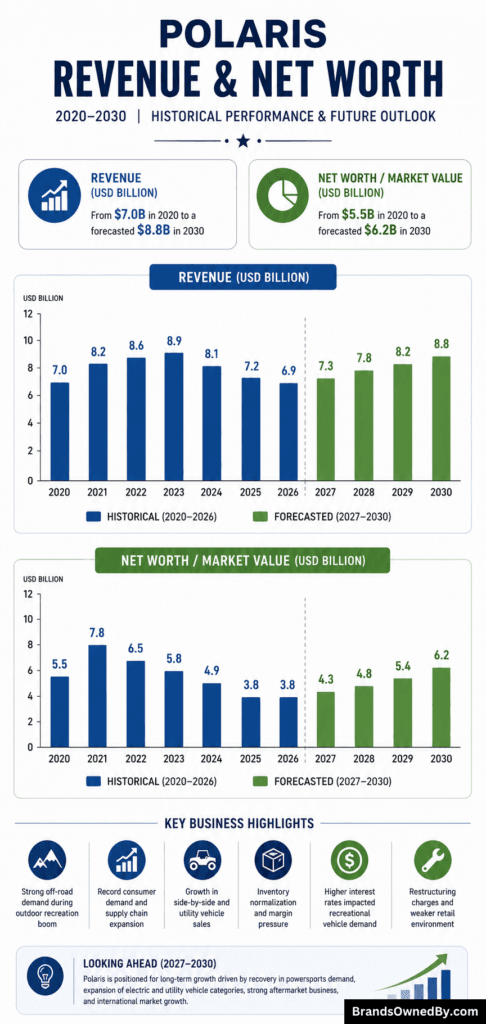
As of May 2026, Polaris is generating estimated annual revenue of approximately $6.9 billion after experiencing two years of slowing retail demand across the powersports industry. The company’s estimated market value currently ranges between $3.7 billion and $4.0 billion, significantly below its post-pandemic peak valuation.
Polaris remains one of the largest off-road and recreational vehicle manufacturers in North America despite softer market conditions. The company still controls major market share in side-by-side vehicles and utility terrain vehicles through brands such as RZR, Ranger, and Sportsman.
The biggest financial challenge facing Polaris in 2026 is weaker consumer demand caused by high financing costs and dealer inventory corrections. Recreational vehicles are heavily dependent on financing. As interest rates increased across North America, monthly payments for off-road vehicles and motorcycles became substantially more expensive.
At the same time, dealerships entered 2025 and 2026 with elevated inventory levels after over-ordering vehicles during the post-pandemic recreation boom.
Even with those pressures, Polaris continues operating a multi-billion-dollar global business with strong cash-generating brands and a massive dealer network.
Polaris 2026 Revenue Breakdown
The Off-Road segment remains the company’s largest revenue source in 2026. Vehicles such as the Polaris RZR, Ranger, General, and Sportsman account for the majority of company sales.
The Ranger lineup continues to perform strongly in utility applications. Farmers, ranch owners, construction crews, and outdoor property operators remain major buyers because these vehicles are widely used for transportation and hauling equipment across rough terrain.
The RZR brand remains Polaris’ flagship recreational platform. High-performance side-by-side vehicles continue attracting enthusiasts willing to spend heavily on upgrades and accessories.
Polaris also generates major recurring revenue from its Parts, Garments, and Accessories division. This business has become increasingly important because accessory margins are often higher than vehicle margins.
For example, many RZR owners purchase:
- Suspension upgrades.
- Roof systems.
- LED lighting packages.
- Storage accessories.
- Winches.
- Performance tires.
In many cases, customers spend several thousand dollars beyond the original vehicle purchase price.
Indian Motorcycle remains another major contributor to Polaris revenue. The company continues competing directly against Harley-Davidson in the heavyweight motorcycle market through models such as the Scout, Chieftain, Pursuit, and Roadmaster.
Marine operations also contribute meaningful revenue through Bennington pontoons and Godfrey boats, although marine sales slowed alongside broader discretionary consumer spending.
Polaris 2026 Financial Performance
Polaris entered 2026 following a difficult 2025 retail environment.
Vehicle shipments declined compared to earlier peak years because dealerships focused on reducing excess inventory rather than placing aggressive new orders.
The company responded by reducing production levels at certain manufacturing facilities and implementing operational efficiency measures designed to protect margins.
Mike Speetzen and the executive leadership team also focused heavily on cost controls, supply chain optimization, and inventory discipline during 2026.
One of the company’s most closely watched financial metrics has been dealer inventory normalization. During the peak demand years of 2021 and 2022, dealerships struggled to secure enough inventory. By 2024 and 2025, the opposite problem emerged as retail demand slowed while inventory remained elevated.
This shift created downward pressure on pricing and margins across the powersports industry.
Despite those conditions, Polaris still maintains strong brand loyalty in the off-road market. The company’s dealer network and aftermarket ecosystem continue generating stable recurring revenue streams.
Polaris Net Worth and Market Value in 2026
As of May 2026, Polaris has an estimated market capitalization of approximately $3.8 billion based on prevailing stock market valuations.
The company’s valuation has fallen considerably from its earlier highs during the outdoor recreation boom. During peak pandemic-era demand, investors aggressively valued powersports manufacturers because outdoor recreation spending surged.
However, several factors later reduced Polaris’ valuation:
- Higher interest rates.
- Slowing retail demand.
- Inventory corrections.
- Margin compression.
- Motorcycle restructuring costs.
- Broader consumer discretionary weakness.
Even with lower market value, Polaris still owns substantial tangible and intangible assets.
Its most valuable business assets include:
- Polaris Off Road.
- RZR.
- Ranger.
- Indian Motorcycle.
- Slingshot.
- Bennington.
- Global dealer infrastructure.
- Manufacturing facilities.
- Proprietary off-road engineering platforms.
The RZR lineup alone remains one of the strongest brands in the global side-by-side industry.
Polaris also benefits from long-term customer loyalty. Many off-road customers repeatedly upgrade vehicles, purchase accessories, and remain within the Polaris ecosystem for years.
Polaris Future Revenue and Net Worth Forecast (2027–2030)
Analysts expect Polaris to gradually recover after dealer inventory levels normalize and financing conditions improve.
The company’s future growth strategy is expected to focus heavily on premium off-road vehicles, commercial utility platforms, aftermarket accessories, and electric mobility expansion.
Polaris is also expected to continue emphasizing higher-margin segments rather than aggressively pursuing low-margin unit volume growth.
2027 Forecast
Polaris revenue is projected to recover to approximately $7.3 billion in 2027. Estimated market value could rise to roughly $4.3 billion if dealer inventory stabilizes and consumer financing conditions improve.
The biggest growth driver is expected to be renewed demand for side-by-side vehicles and utility platforms after multiple years of inventory correction.
2028 Forecast
By 2028, Polaris revenue could reach approximately $7.8 billion with estimated market value approaching $4.8 billion.
At this stage, analysts expect stronger contribution from electric utility vehicles, premium aftermarket accessories, and international sales growth.
Marine operations may also recover if discretionary consumer spending improves.
2029 Forecast
Polaris revenue could climb to approximately $8.2 billion in 2029 while estimated net worth may exceed $5.4 billion.
This forecast assumes stronger powersports demand cycles and continued dominance in North American off-road markets.
The company is also expected to expand its higher-margin accessories ecosystem, which could improve profitability even if vehicle unit growth remains moderate.
2030 Forecast
By 2030, Polaris revenue is projected to approach $8.8 billion with estimated market value potentially reaching $6.2 billion.
Several long-term industry trends support this outlook, including:
- Continued growth in outdoor recreation.
- Expansion of adventure tourism.
- Increased utility vehicle adoption.
- Electrification of off-road platforms.
- Growth in premium customization spending.
The company’s long-term success will likely depend on maintaining leadership in side-by-side vehicles while adapting to changing consumer preferences and electric mobility trends.
If Polaris successfully expands electric off-road technology while protecting its dominant RZR and Ranger market positions, the company could return to stronger valuation multiples later in the decade.
Companies Owned by Polaris
As of 2026, Polaris operates one of the largest portfolios in the global powersports industry. The company owns and manages off-road vehicle brands, motorcycle divisions, marine businesses, electric vehicle entities, aftermarket companies, and commercial mobility operations.
Unlike many competitors that focus only on motorcycles or ATVs, Polaris has built a diversified recreational and utility vehicle ecosystem. Its portfolio spans adventure vehicles, utility transportation, commercial fleet mobility, aftermarket accessories, and premium marine products.
Many of Polaris’ biggest growth initiatives came through acquisitions completed over the last two decades. These deals helped the company expand beyond snowmobiles and establish leadership positions in side-by-side vehicles, motorcycles, boats, and aftermarket off-road accessories.
| Company / Brand | Business Category | Main Products or Services | Strategic Importance to Polaris |
|---|---|---|---|
| Polaris Off Road | Off-road vehicle division | Side-by-sides, ATVs, utility vehicles | Core revenue-generating business segment |
| RZR | High-performance side-by-side brand | Sport UTVs and recreational off-road vehicles | Polaris’ flagship performance off-road brand |
| Ranger | Utility vehicle brand | Utility side-by-sides for work and recreation | Strong presence in agriculture and commercial markets |
| General | Crossover utility-recreation brand | Multi-purpose side-by-side vehicles | Combines utility and recreational capabilities |
| Sportsman | ATV division | All-terrain vehicles for recreation and work | One of Polaris’ oldest and most recognized ATV brands |
| XPEDITION | Adventure overlanding platform | Premium adventure utility vehicles | Expands Polaris into premium outdoor travel markets |
| Slingshot | Three-wheeled roadster brand | Open-air recreational vehicles | Unique lifestyle and tourism-focused vehicle category |
| Polaris Snowmobiles | Snowmobile division | Trail, mountain, utility, and crossover snowmobiles | Historic foundation business of Polaris |
| RMK | Mountain snowmobile lineup | Deep snow and mountain riding snowmobiles | Strong brand among mountain riders |
| INDY | Trail snowmobile lineup | Performance trail snowmobiles | One of Polaris’ most recognized snowmobile platforms |
| Timbersled | Snow bike conversion business | Snow bike track conversion kits | Expands Polaris into niche winter powersports |
| Aixam | European microcar company | Compact urban mobility vehicles | Strengthens Polaris’ European transportation business |
| Goupil | Commercial electric vehicle division | Electric utility and fleet vehicles | Expands commercial EV operations in Europe |
| GEM Electric Vehicles | Electric mobility division | Low-speed electric vehicles | Supports electrification and campus mobility markets |
| Ligier Electric Vehicle Assets | Electric mobility acquisition | Urban and commercial EV technologies | Strengthens European EV infrastructure |
| Boat Holdings | Marine business division | Recreational boats and marine brands | Diversifies Polaris beyond powersports |
| Bennington | Pontoon boat manufacturer | Luxury pontoons and recreational boats | One of Polaris’ strongest marine assets |
| Godfrey | Marine recreation brand | Pontoon and deck boats | Expands family recreation boating market share |
| Hurricane | Deck boat manufacturer | Watersport and recreational deck boats | Strengthens marine product diversification |
| Transamerican Auto Parts | Aftermarket accessories company | Off-road and truck accessories | Expanded Polaris into aftermarket customization |
| Pro Comp | Off-road aftermarket brand | Suspension systems, wheels, tires, lift kits | Important aftermarket performance brand |
| 4 Wheel Parts | Aftermarket retailer and distributor | Off-road accessories and customization products | Gives Polaris direct aftermarket retail presence |
| Assault Industries | Premium off-road accessories brand | Side-by-side performance accessories | Popular among Polaris off-road enthusiasts |
| Polaris Adventures | Experience and rental platform | Vehicle rentals and guided outdoor experiences | Expands recurring tourism and experience revenue |
| Polaris Government and Defense | Tactical mobility division | Military and rescue vehicles | Provides government and defense diversification |
| Polaris Commercial Vehicles | Commercial utility transportation | Industrial and workplace vehicles | Supports non-recreational commercial operations |
Polaris Off Road
RZR
RZR is Polaris’ flagship high-performance side-by-side brand and one of the most valuable off-road vehicle platforms in North America.
The brand dominates the sport side-by-side category and is heavily associated with desert racing, trail riding, dune recreation, and high-performance off-road driving.
Polaris launched RZR in 2007, and the product line transformed the off-road industry. Before RZR, utility-oriented side-by-side vehicles dominated the market. Polaris recognized growing demand for recreational performance-focused vehicles and aggressively expanded the segment.
As of 2026, RZR includes multiple product families such as:
- RZR XP.
- RZR Pro XP.
- RZR Turbo R.
- RZR Trail.
- RZR Pro R.
The RZR Pro R became especially important because of its high-horsepower platform designed for premium off-road enthusiasts.
RZR also generates substantial aftermarket revenue. Many owners spend thousands of dollars on upgrades including suspension systems, lighting, tires, cages, audio systems, and performance accessories.
The brand is deeply connected to off-road racing culture and remains one of Polaris’ strongest long-term assets.
Ranger
Ranger is Polaris’ utility side-by-side division focused on work-oriented applications.
Unlike RZR, which emphasizes recreational performance, Ranger vehicles target farmers, ranchers, construction operators, hunters, and commercial users.
The Ranger lineup became extremely popular because it combines utility functionality with off-road capability.
As of 2026, Ranger models are widely used in:
- Agriculture.
- Forestry.
- Property maintenance.
- Ranch operations.
- Utility services.
- Outdoor tourism businesses.
Ranger also plays an important role in Polaris’ government and commercial fleet business.
The platform is known for hauling capacity, towing ability, durability, and terrain versatility.
General
The Polaris General brand sits between RZR and Ranger.
It combines recreational performance with utility functionality. This positioning helped Polaris attract customers who wanted both trail capability and practical work applications.
General vehicles became popular among outdoor enthusiasts who use vehicles for camping, hunting, trail exploration, and property maintenance.
The brand fills an important market gap between hardcore sport side-by-sides and fully utility-focused models.
Sportsman
Sportsman is Polaris’ ATV division and one of the company’s longest-running product families.
The Sportsman lineup includes all-terrain vehicles designed for recreation, hunting, farming, and utility work.
Sportsman became one of the most recognized ATV brands in North America because of its reliability, suspension technology, and broad model range.
The platform remains a major contributor to Polaris off-road revenue.
Polaris XPEDITION
XPEDITION represents Polaris’ growing focus on premium adventure overlanding vehicles.
The platform targets customers interested in long-distance off-road travel, camping, and outdoor exploration.
These vehicles are positioned as adventure-oriented utility machines with enclosed cabins, cargo systems, and touring capabilities.
XPEDITION reflects Polaris’ strategy of targeting higher-income recreational customers willing to spend heavily on premium outdoor experiences.
Slingshot
Slingshot is Polaris’ three-wheeled roadster division.
The vehicle occupies a niche between motorcycles and sports cars. It features open-air seating, automotive-style controls, and aggressive styling.
Polaris launched Slingshot to create a new recreational mobility category rather than directly competing with traditional motorcycles.
As of 2026, Slingshot remains popular in:
- Tourism rental businesses.
- Recreational driving.
- Urban leisure markets.
- Experience-based travel.
The brand also became a strong social media and lifestyle product because of its distinctive appearance.
Polaris Snowmobiles
Snowmobiles remain a foundational business for Polaris because the company originally started in this industry.
The snowmobile division continues producing multiple platforms for recreational riding, mountain riding, trail riding, and utility applications.
Major snowmobile product families include:
- RMK.
- INDY.
- Switchback.
- Voyageur.
- Titan.
Polaris remains one of the largest snowmobile manufacturers in North America alongside Ski-Doo and Arctic Cat.
The RMK platform became especially popular in mountain riding communities because of its lightweight performance-oriented design.
Timbersled
Timbersled is a specialized off-road conversion business owned by Polaris.
The company manufactures snow bike conversion systems that allow dirt bikes to operate in deep snow using track systems and ski attachments.
Polaris acquired Timbersled to expand deeper into winter powersports and niche adventure riding categories.
The brand became highly popular among snow bike enthusiasts in mountain regions.
Aixam
Aixam is a European microcar company acquired by Polaris.
The acquisition gave Polaris access to lightweight urban mobility markets in Europe.
Aixam vehicles are commonly classified as quadricycles in European markets and are designed for urban transportation.
The brand strengthened Polaris’ international mobility presence beyond traditional powersports.
Goupil
Goupil operates within Polaris’ commercial electric vehicle business.
The company produces compact electric utility vehicles used in municipalities, industrial sites, airports, campuses, and urban logistics operations.
Goupil became strategically important because Polaris has increasingly invested in electric mobility and commercial fleet transportation.
These vehicles are commonly used for:
- Maintenance operations.
- Urban delivery.
- Facility transportation.
- Municipal fleet services.
GEM Electric Vehicles
GEM is Polaris’ low-speed electric vehicle division.
The company manufactures electric transportation vehicles used in:
- Resorts.
- Universities.
- Industrial facilities.
- Gated communities.
- Corporate campuses.
GEM vehicles became important for Polaris because they expanded the company into commercial electric transportation markets.
The brand also aligns with long-term electrification trends.
Ligier Electric Vehicle Assets
Polaris acquired certain electric vehicle assets from Ligier to strengthen its European electric mobility operations.
This acquisition supported Polaris’ strategy of expanding commercial and urban electric transportation capabilities.
The deal also improved Polaris’ presence in European low-speed vehicle markets.
Boat Holdings
Boat Holdings became one of Polaris’ most important diversification acquisitions.
The acquisition expanded Polaris into the marine industry and reduced dependence on off-road vehicle sales.
Boat Holdings included several major marine brands.
Bennington
Bennington is one of the leading pontoon boat manufacturers in North America.
The brand focuses on premium recreational pontoons with luxury seating, entertainment systems, and high-end marine features.
Bennington became one of Polaris’ most valuable marine assets after the Boat Holdings acquisition.
Godfrey
Godfrey manufactures pontoon and deck boats focused on family recreation and leisure boating.
The brand strengthened Polaris’ position in broader recreational marine categories.
Hurricane
Hurricane specializes in deck boats designed for watersports and family boating activities.
The acquisition helped Polaris enter additional marine recreation segments beyond pontoons.
Transamerican Auto Parts
Polaris acquired Transamerican Auto Parts to expand aggressively into aftermarket accessories and off-road customization.
The deal significantly increased Polaris’ presence in the Jeep, truck, and off-road aftermarket industry.
The acquisition included several well-known aftermarket brands.
Pro Comp
Pro Comp manufactures off-road suspension systems, wheels, tires, and lift kits.
The brand is widely recognized in the truck and Jeep aftermarket market.
4 Wheel Parts
4 Wheel Parts operates as a major off-road aftermarket retailer and distributor.
The business sells:
- Lift kits.
- Suspension systems.
- Wheels.
- Tires.
- Off-road accessories.
The acquisition gave Polaris direct exposure to aftermarket retail distribution.
Assault Industries
Assault Industries focuses on premium aftermarket accessories for side-by-side vehicles.
The company produces:
- Steering wheels.
- Mirrors.
- Suspension components.
- Billet accessories.
- Performance upgrades.
The brand became especially popular among Polaris RZR owners and off-road customization enthusiasts.
Polaris Adventures
Polaris Adventures is a rental and outdoor experience platform operated by Polaris.
The business allows customers to rent off-road vehicles, Slingshots, and adventure equipment through certified partners.
This platform represents Polaris’ push into experience-based recreation and tourism.
The program expanded significantly across North America as adventure tourism demand increased.
Polaris Government and Defense Operations
Polaris also operates specialized government and military vehicle programs.
The company manufactures military-grade off-road and tactical vehicles for defense and emergency response applications.
These vehicles are designed for:
- Mobility operations.
- Rescue missions.
- Remote transportation.
- Tactical support.
Government contracts provide Polaris with additional diversification beyond consumer recreation markets.
Polaris Commercial Vehicles
Polaris maintains a commercial vehicle division focused on industrial utility transportation.
These vehicles serve industries such as:
- Warehousing.
- Manufacturing.
- Hospitality.
- Facility management.
Commercial operations remain strategically important because they generate less cyclical demand compared to recreational vehicle sales.
Final Thoughts
Polaris is owned by public shareholders, with institutional investors holding the largest stakes. Vanguard, BlackRock, and other major asset managers are among the company’s biggest owners.
The company remains one of the most influential powersports manufacturers in the world. Its success comes from strong off-road brands, strategic acquisitions, and diversified revenue streams.
Polaris also controls several important brands, including Indian Motorcycle, Slingshot, and GEM Electric Vehicles. Its broad product portfolio helps the company compete across multiple transportation and recreation categories.
FAQs
Who owns Polaris Inc?
Polaris Inc. is a publicly traded company owned by institutional investors, mutual funds, ETFs, insiders, and retail shareholders. As of 2026, the company’s largest shareholders include BlackRock, Vanguard Group, Capital Research and Management, and State Street Global Advisors.
Is Polaris an American company?
Yes, Polaris is an American company. It was founded in the United States and remains headquartered in Minnesota. The company is one of the largest American powersports manufacturers.
Who is the largest shareholder of Polaris?
As of May 2026, BlackRock is one of the largest shareholders of Polaris with an ownership stake of roughly 12% of outstanding shares. Vanguard Group and Capital Research and Management are also among the top shareholders.
Did Polaris buy John Deere?
No, Polaris did not buy John Deere. The two companies are separate businesses. However, Polaris has competed with John Deere in utility vehicle and off-road vehicle markets through products such as the Polaris Ranger.
Is Polaris American made?
Polaris manufactures many of its vehicles and products in the United States. The company operates major manufacturing facilities in states such as Minnesota, Alabama, Iowa, and South Dakota. However, some components and products are also sourced globally.
Does Polaris own Indian?
Yes, Polaris owns Indian Motorcycle. Polaris acquired and revived the historic American motorcycle brand after years of decline under previous ownership groups. Indian Motorcycle is now one of Polaris’ most important premium brands.
Where is Polaris headquartered?
Polaris is headquartered in Medina, Minnesota, United States. The headquarters manages the company’s global operations, leadership, engineering, and corporate strategy.
Where was Polaris founded?
Polaris was founded in Roseau, Minnesota, in 1954 by Edgar Hetteen, Allan Hetteen, and David Johnson. The company originally started as a snowmobile manufacturer before expanding into off-road vehicles, motorcycles, and marine products.