
- KitchenAid is fully owned and controlled by Whirlpool Corporation as of 2026. The brand operates as Whirlpool’s premium kitchen appliance business and does not function as an independent company.
- Whirlpool acquired KitchenAid from Dart & Kraft in 1986, transforming the company from a stand mixer brand into a global premium appliance business focused on major appliances, countertop products, and smart kitchen systems.
- Since Whirlpool is publicly traded on the New York Stock Exchange, KitchenAid is indirectly owned by institutional shareholders including Vanguard Group, BlackRock, and State Street Corporation, which are among Whirlpool’s largest investors.
- KitchenAid generates an estimated $4.2 billion in annual revenue and holds an estimated brand net worth of approximately $8.7 billion as of May 2026, making it one of Whirlpool’s most valuable premium appliance brands globally.
KitchenAid is an American kitchen appliance brand known for premium cooking and food preparation products. The company is especially recognized for its stand mixers, which became a staple in both home and professional kitchens.
The brand focuses on kitchen-centered appliances rather than general home electronics. Its product lineup includes mixers, ovens, refrigerators, cooktops, dishwashers, blenders, coffee machines, and cookware accessories.
KitchenAid built its reputation around durability, consistent performance, and timeless product design. Its stand mixers are particularly known for their metal construction and attachment system, which allows users to perform multiple kitchen tasks using a single machine.
Over the years, KitchenAid expanded from small kitchen appliances into complete kitchen solutions. The company now competes in the premium appliance segment alongside brands like Bosch, Samsung, LG, and JennAir.
One of KitchenAid’s biggest strengths is brand loyalty. Many consumers continue using KitchenAid appliances for years due to reliability and product consistency. The brand is also heavily associated with baking culture, culinary enthusiasts, and professional-style home kitchens.
KitchenAid products are sold through:
- Appliance retailers.
- Department stores.
- E-commerce platforms.
- Specialty kitchen stores.
- Direct-to-consumer channels.
The company maintains a strong presence in North America while also expanding internationally across Europe, Asia, and Latin America.
What Makes KitchenAid Different?
KitchenAid differentiates itself through product design, premium positioning, and culinary-focused innovation.
Unlike many appliance brands that compete mainly on price, KitchenAid markets itself as a performance-driven kitchen brand. Its appliances are designed for users who cook frequently and want professional-style equipment at home.
The brand is also known for:
- Signature retro-inspired aesthetics.
- Wide color customization options.
- Strong attachment ecosystem for mixers.
- Durable metal-based construction.
- Consistent product branding across categories.
For example, KitchenAid stand mixers support attachments for pasta making, meat grinding, vegetable slicing, and ice cream preparation. This ecosystem approach increases long-term customer retention.
KitchenAid Founder
KitchenAid was originally created by Hobart Manufacturing Company in 1919. The brand itself was not founded by a single entrepreneur in the traditional startup sense. Instead, it emerged as a product innovation within Hobart’s engineering division.
Herbert Johnston
Herbert Johnston played a major role in the creation of the original KitchenAid mixer. He was an engineer at Hobart Manufacturing and developed the first mixer after observing bakers struggling with manual dough mixing.
Johnston initially designed industrial food mixers for commercial bakeries. The success of those machines inspired the idea of creating a smaller version for household kitchens.
His innovation eventually led to the launch of the KitchenAid H-5 mixer.
Why the Name “KitchenAid” Was Chosen
According to company history, one of the early product testers reportedly said the mixer was “the best kitchen aid” they had ever used. The phrase later became the official brand name.
The name helped position the product as a practical assistant for household cooking rather than just another appliance.
Hobart Manufacturing’s Role
Hobart Manufacturing provided the engineering expertise, manufacturing infrastructure, and distribution network that helped KitchenAid grow rapidly during its early years.
The company already had experience producing industrial food equipment, which gave KitchenAid a strong technical foundation from the beginning.
Hobart’s commercial appliance background also influenced KitchenAid’s reputation for durability and performance.
Early Market Positioning
KitchenAid mixers were initially marketed toward affluent households and serious home bakers. The products were more expensive than many competing appliances at the time.
Instead of focusing on low-cost manufacturing, KitchenAid emphasized:
- Product longevity.
- Professional-grade performance.
- Heavy-duty construction.
- Premium kitchen aesthetics.
This premium positioning continues to influence the brand today under Whirlpool ownership.
Ownership History
KitchenAid has gone through multiple ownership phases since its creation in 1919. Each transition shaped the brand’s manufacturing strategy, product expansion, and global market position. The company evolved from a mixer-focused appliance business into a globally recognized premium kitchen brand.
Founding Under Hobart Manufacturing Company
KitchenAid began as a product division of Hobart Manufacturing Company. Hobart was an American industrial equipment manufacturer specializing in commercial food service machinery.
The company originally focused on industrial mixers used in bakeries and restaurants. Engineer Herbert Johnston developed one of Hobart’s early commercial mixers after noticing bakers manually mixing dough for long hours.
The success of commercial mixers encouraged Hobart to enter the household appliance market. In 1919, the company introduced the KitchenAid H-5 stand mixer for home kitchens.
During this period, KitchenAid operated entirely under Hobart’s ownership and manufacturing infrastructure.
Early Brand Development in the 1920s and 1930s
KitchenAid quickly became associated with premium kitchen equipment. The brand focused on affluent households and professional-style cooking environments.
The stand mixer became the company’s signature product. Unlike many small appliances of the time, KitchenAid mixers emphasized durability and long-term use.
Hobart invested heavily in product engineering during these decades. The company also expanded color options and attachment systems to increase consumer appeal.
By the 1930s, KitchenAid had established a recognizable design identity. Some mixer models from that era still influence modern KitchenAid designs today.
Expansion During the Mid-20th Century
Throughout the 1940s, 1950s, and 1960s, KitchenAid expanded beyond mixers into additional kitchen appliance categories.
The brand introduced:
- Dishwashers.
- Garbage disposals.
- Cooking appliances.
- Refrigeration products.
Hobart used KitchenAid’s growing reputation to compete in the expanding post-war appliance market. American households were increasingly purchasing modern kitchen equipment during this period.
KitchenAid maintained its premium positioning rather than competing aggressively on price.
Acquisition by Dart & Kraft
A major ownership shift occurred when Dart & Kraft acquired Hobart Corporation during the 1980s.
Dart & Kraft was a large consumer products conglomerate created through mergers involving Dart Industries and Kraft. The company owned businesses across multiple industries, including appliances, food products, and retail operations.
Through the acquisition of Hobart, Dart & Kraft gained ownership of the KitchenAid brand.
However, KitchenAid was not the primary strategic focus for Dart & Kraft. The appliance business represented only one part of a much larger corporate portfolio.
This ownership phase was relatively short but important because it eventually opened the door for Whirlpool’s acquisition.
Whirlpool Corporation Acquires KitchenAid
In 1986, Whirlpool Corporation acquired KitchenAid from Dart & Kraft. This became one of the most significant ownership changes in KitchenAid’s history.
At the time, Whirlpool was already one of the largest home appliance manufacturers in the world. The acquisition allowed Whirlpool to strengthen its premium appliance offerings.
KitchenAid brought several advantages to Whirlpool:
- Strong brand recognition.
- Loyal customer base.
- Premium market positioning.
- Established mixer leadership.
- Culinary-focused brand identity.
Whirlpool recognized that KitchenAid could compete more effectively in the premium appliance segment than Whirlpool’s mainstream brand lineup.
Why Whirlpool Wanted KitchenAid
The acquisition aligned with Whirlpool’s long-term growth strategy.
During the 1980s and 1990s, appliance manufacturers increasingly focused on brand segmentation. Companies wanted separate brands for budget, mainstream, and premium consumers.
KitchenAid gave Whirlpool a strong, premium kitchen brand with established consumer trust.
The acquisition also allowed Whirlpool to compete more aggressively against luxury appliance companies like:
- Sub-Zero.
- Thermador.
- Viking.
- Bosch.
KitchenAid became Whirlpool’s culinary-focused premium appliance brand while Whirlpool itself continued targeting broader mass-market consumers.
KitchenAid’s Expansion Under Whirlpool
Whirlpool significantly expanded KitchenAid after the acquisition.
Originally, KitchenAid was heavily associated with stand mixers and selected kitchen appliances. Whirlpool transformed it into a complete kitchen appliance ecosystem.
The company expanded KitchenAid into:
- Built-in refrigeration.
- Premium dishwashers.
- Luxury cooking appliances.
- Countertop kitchen products.
- Smart kitchen appliances.
Whirlpool also increased international distribution. KitchenAid products became more widely available across Europe, Asia, and Latin America.
Brand Modernization and Smart Technology Era
During the 2000s and 2010s, Whirlpool modernized KitchenAid’s product portfolio.
The company invested in:
- Smart appliance integration.
- Touchscreen controls.
- Connected cooking systems.
- Energy-efficient technologies.
- Premium kitchen aesthetics.
KitchenAid also strengthened its identity around culinary culture and home baking trends.
The rise of social media food content and home baking communities significantly increased KitchenAid mixer visibility worldwide.
KitchenAid’s Position Within Whirlpool Today
As of 2026, KitchenAid remains a wholly owned brand of Whirlpool Corporation.
The brand operates as part of Whirlpool’s broader appliance portfolio, which includes:
- Whirlpool.
- Maytag.
- JennAir.
- Amana.
- Hotpoint.
- Indesit.
KitchenAid continues to serve as Whirlpool’s premium culinary appliance brand.
Although KitchenAid maintains distinct branding and product development teams, major operational decisions are controlled at the Whirlpool corporate level.
These include:
- Manufacturing strategy.
- Supply chain operations.
- International expansion.
- Capital investment.
- Product category growth.
KitchenAid remains one of Whirlpool’s most strategically valuable brands because of its strong consumer loyalty and premium market positioning.
Who Owns KitchenAid?
![who owns KitchenAid [infographic]](https://brandsownedby.com/wp-content/uploads/2026/05/who-owns-KitchenAid-infographic-683x1024.png)
KitchenAid is fully owned by Whirlpool Corporation as of 2026. The brand operates as a wholly owned subsidiary within Whirlpool’s global appliance portfolio.
Although KitchenAid has its own branding, product development teams, and market positioning, it does not function as an independent company. Whirlpool controls the brand’s manufacturing operations, strategic direction, global distribution, and long-term business decisions.
KitchenAid is one of Whirlpool’s most important premium appliance brands. It plays a major role in the company’s luxury and culinary-focused product strategy.
Parent Company: Whirlpool Corporation
Whirlpool Corporation is an American multinational home appliance manufacturer headquartered in Benton Harbor, Michigan.
The company is one of the largest appliance manufacturers in the world. It operates across multiple regions including:
- North America.
- Europe.
- Latin America.
- Asia.
- Middle East markets.
Whirlpool manufactures products across several categories such as:
- Refrigerators.
- Washing machines.
- Dryers.
- Ovens.
- Dishwashers.
- Small kitchen appliances.
The company owns several well-known appliance brands besides KitchenAid, including:
- Whirlpool.
- Maytag.
- JennAir.
- Amana.
- Hotpoint.
- Indesit.
KitchenAid serves as Whirlpool’s premium culinary appliance brand. It is positioned above Whirlpool’s mainstream products and focuses on consumers seeking performance-driven kitchen equipment.
Is KitchenAid an Independent Company?
No. KitchenAid is not an independent public company.
Many consumers assume KitchenAid operates separately because the brand has a strong standalone identity. However, all major corporate operations are controlled by Whirlpool Corporation.
KitchenAid does not have:
- Independent shareholders.
- Separate public stock listings.
- Independent financial reporting.
- Independent corporate governance.
Instead, Whirlpool integrates KitchenAid into its broader corporate structure while maintaining the brand’s distinct marketing and design identity.
Acquisition of KitchenAid by Whirlpool
Whirlpool acquired KitchenAid in 1986 from Dart & Kraft.
This acquisition became one of the most strategically important deals in Whirlpool’s history because it strengthened the company’s position in the premium appliance market.
At the time, KitchenAid already had a respected reputation in stand mixers and kitchen appliances. Whirlpool saw the opportunity to expand the brand into a full premium kitchen ecosystem.
Why Whirlpool Acquired KitchenAid
Whirlpool wanted to strengthen its presence in higher-margin appliance categories.
Before the acquisition, Whirlpool was heavily associated with mainstream household appliances. KitchenAid provided immediate access to premium consumers and culinary-focused buyers.
The acquisition helped Whirlpool:
- Expand into luxury kitchen appliances.
- Increase premium brand recognition.
- Compete with European appliance manufacturers.
- Diversify its product portfolio.
- Strengthen customer loyalty in cooking appliances.
KitchenAid also had strong emotional brand recognition among home bakers and cooking enthusiasts. This brand loyalty made the acquisition especially valuable.
Ownership Structure of Whirlpool Corporation
Since Whirlpool is publicly traded, KitchenAid is indirectly owned by Whirlpool shareholders.
No single person owns KitchenAid outright. Ownership is distributed among institutional investors, investment funds, and public shareholders.
Largest Shareholders of Whirlpool
Whirlpool’s largest shareholders typically include major institutional investment firms.
Vanguard Group
Vanguard is usually among the largest shareholders of Whirlpool Corporation. The company manages retirement funds, ETFs, and institutional investment portfolios.
BlackRock
BlackRock also holds a substantial ownership stake through its investment management business and index funds.
State Street Corporation
State Street is another major institutional investor with significant holdings in Whirlpool shares.
Together, these investment firms influence shareholder voting and corporate governance matters. However, they do not directly manage KitchenAid’s day-to-day operations.
How Whirlpool Controls KitchenAid
KitchenAid operates within Whirlpool’s centralized corporate structure.
Major business decisions are approved by Whirlpool executives and board members. KitchenAid management teams focus primarily on brand operations and product strategy.
Whirlpool controls areas such as:
- Manufacturing facilities.
- Global supply chain operations.
- Capital investment.
- International expansion.
- Technology integration.
- Corporate budgeting.
KitchenAid still maintains its own branding and product identity. This separation helps Whirlpool target different customer segments without diluting brand value.
For example:
- Whirlpool targets mainstream household consumers.
- KitchenAid targets premium kitchen buyers.
- JennAir targets luxury appliance customers.
This multi-brand strategy allows Whirlpool to compete across multiple pricing tiers simultaneously.
KitchenAid’s Role Inside Whirlpool’s Portfolio
KitchenAid is considered one of Whirlpool’s most strategically valuable brands.
The brand plays an important role in premium kitchen appliances and small kitchen equipment. Its stand mixers remain among the most recognizable appliances globally.
KitchenAid also helps Whirlpool compete in:
- Built-in kitchen systems.
- Luxury cooking appliances.
- Smart culinary products.
- Premium countertop appliances.
The company benefits from Whirlpool’s large-scale manufacturing and distribution network while preserving its own premium identity.
This balance is one of the main reasons KitchenAid continues to maintain strong brand loyalty decades after the acquisition.
How the Acquisition Changed KitchenAid
The Whirlpool acquisition significantly expanded KitchenAid’s business.
Before Whirlpool ownership, KitchenAid was primarily associated with stand mixers and limited appliance categories.
After the acquisition, Whirlpool expanded the brand into:
- Refrigeration systems.
- Dishwashers.
- Wall ovens.
- Cooktops.
- Smart appliances.
- Connected kitchen technology.
Whirlpool also accelerated international growth. KitchenAid products became widely available in global appliance markets rather than remaining heavily concentrated in North America.
The acquisition transformed KitchenAid from a niche premium mixer brand into a full-scale premium kitchen appliance company.
Does Whirlpool Manufacture KitchenAid Products?
Yes. Whirlpool oversees the manufacturing of KitchenAid appliances through its global production network.
Some KitchenAid products are manufactured in Whirlpool-owned facilities in the United States, while others are produced through international operations depending on product category and region.
Whirlpool manages:
- Engineering.
- Product development.
- Supply chain sourcing.
- Manufacturing logistics.
- Distribution systems.
This shared infrastructure allows KitchenAid to scale globally while maintaining consistent product quality standards.
KitchenAid’s Brand Positioning Under Whirlpool
Whirlpool positions KitchenAid as a premium culinary lifestyle brand rather than a basic appliance manufacturer.
The company focuses heavily on:
- Design aesthetics.
- Professional-style cooking experiences.
- Product customization.
- Culinary partnerships.
- Premium finishes and materials.
KitchenAid’s iconic stand mixers are a major example of this strategy. The products are marketed as both functional appliances and long-term kitchen centerpieces.
This positioning helps Whirlpool maintain stronger pricing power compared to lower-cost competitors.
Future Ownership Outlook
There are currently no major indications that Whirlpool plans to sell KitchenAid.
The brand remains one of Whirlpool’s strongest premium assets. Its customer loyalty, strong product identity, and global recognition make it strategically important for Whirlpool’s long-term appliance business.
Future growth will likely focus on:
- Smart kitchen ecosystems.
- Connected appliances.
- Premium home cooking experiences.
- International expansion.
- Sustainable appliance technologies.
KitchenAid is expected to remain under Whirlpool ownership for the foreseeable future due to its strong market position and premium consumer appeal.
Competitor Ownership Comparison
KitchenAid competes against brands that are owned under very different corporate structures. Some competitors are controlled by publicly traded appliance giants, while others are owned by technology conglomerates or private family businesses.
These ownership differences influence how aggressively competitors expand, how much they invest in technology, and which customer segments they target.
KitchenAid vs GE Appliances Ownership
KitchenAid’s biggest North American competitor is GE Appliances, but the two brands are owned very differently.
KitchenAid is owned by Whirlpool Corporation, an American appliance-focused company. GE Appliances, meanwhile, is owned by Haier Smart Home, a Chinese multinational appliance conglomerate.
The difference becomes important when comparing strategic priorities.
Whirlpool mainly focuses on home appliances and kitchen products. Haier operates a much larger international acquisition-driven ecosystem with brands across multiple global markets.
Haier uses GE Appliances to strengthen its U.S. market dominance, while Whirlpool uses KitchenAid to strengthen its premium appliance positioning.
Another major difference is acquisition history.
KitchenAid became part of Whirlpool through a focused premium-brand acquisition strategy. GE Appliances became part of Haier through a massive international expansion deal worth billions of dollars.
This means:
| Comparison Area | KitchenAid Ownership | GE Appliances Ownership |
|---|---|---|
| Parent Company | Whirlpool Corporation | Haier Smart Home |
| Country of Parent Company | United States | China |
| Ownership Type | Public corporation | Public multinational conglomerate |
| Ownership Goal | Premium appliance expansion | Global market expansion |
| Key Strategy | Culinary premium branding | International scale and manufacturing |
KitchenAid vs Bosch Ownership
Bosch competes heavily with KitchenAid in premium kitchen appliances, but their ownership models are structured differently.
KitchenAid is controlled by Whirlpool shareholders through a publicly traded corporate structure. Bosch appliances are controlled through BSH Hausgeräte, which is heavily influenced by the Bosch Group’s long-term industrial ownership model.
The major difference is operational philosophy.
Whirlpool focuses heavily on market share, appliance branding, and consumer scalability. Bosch focuses more on engineering precision and long-term manufacturing stability.
Bosch also controls several premium brands simultaneously through BSH, including:
- Thermador.
- Gaggenau.
- Siemens Home Appliances.
- Neff.
Whirlpool also owns multiple brands, but Bosch’s ownership structure gives it a stronger influence in European premium appliance markets.
| Comparison Area | KitchenAid Ownership | Bosch Ownership |
|---|---|---|
| Parent Company | Whirlpool Corporation | BSH Hausgeräte / Bosch Group |
| Ownership Type | Public corporation | Bosch-controlled industrial structure |
| Strategic Focus | Premium culinary branding | Engineering and manufacturing precision |
| Market Strength | North America | Europe and premium global markets |
| Multi-Brand Ownership | KitchenAid, JennAir, Maytag | Bosch, Thermador, Gaggenau |
KitchenAid vs Samsung Ownership
Samsung competes with KitchenAid very differently because Samsung is not primarily an appliance company.
KitchenAid operates under Whirlpool, which focuses mainly on home appliances. Samsung appliances operate under Samsung Electronics, part of one of the world’s largest technology conglomerates.
This changes how both companies invest in products.
Samsung can integrate technologies from its smartphone, AI, semiconductor, and smart-home divisions directly into its appliances.
KitchenAid relies more on culinary reputation, product durability, and kitchen-focused branding.
Samsung’s ownership model gives it stronger technology integration capabilities, while Whirlpool gives KitchenAid deeper appliance specialization.
| Comparison Area | KitchenAid Ownership | Samsung Ownership |
|---|---|---|
| Parent Company | Whirlpool Corporation | Samsung Electronics |
| Parent Industry | Appliances | Technology conglomerate |
| Main Competitive Strength | Culinary appliances | Smart technology ecosystems |
| Ownership Structure | Appliance-focused corporation | Diversified global conglomerate |
| Innovation Priority | Cooking performance | AI and connected-home integration |
KitchenAid vs LG Ownership
LG’s ownership structure is also very different from KitchenAid’s.
LG appliances operate under LG Electronics, which is part of the larger LG Group conglomerate. This gives LG access to a broader technology infrastructure than Whirlpool.
However, Whirlpool has stronger specialization in appliances.
LG’s ownership structure supports:
- AI development.
- Connected ecosystems.
- Smart-home integration.
- Display technology integration.
Whirlpool’s ownership structure supports:
- Appliance manufacturing scale.
- Culinary product specialization.
- Premium kitchen branding.
- Long-term appliance retail partnerships.
The ownership difference explains why LG emphasizes digital features while KitchenAid emphasizes cooking experiences and product aesthetics.
| Comparison Area | KitchenAid Ownership | LG Ownership |
|---|---|---|
| Parent Company | Whirlpool Corporation | LG Electronics |
| Ownership Model | Appliance manufacturer | Electronics conglomerate |
| Product Focus | Culinary appliances | Smart-home technology |
| Core Strength | Premium kitchen identity | Connected digital ecosystems |
| Strategic Advantage | Appliance specialization | Technology integration |
KitchenAid vs Miele Ownership
Miele has one of the most different ownership structures among KitchenAid competitors.
Unlike KitchenAid, Miele is privately owned by the founding Miele and Zinkann families in Germany.
This creates major strategic differences.
Because Miele is privately controlled, the company can focus more heavily on long-term product quality and brand exclusivity without pressure from public shareholders.
Whirlpool, in contrast, must balance KitchenAid’s growth with shareholder expectations, quarterly performance targets, and large-scale global operations.
Miele therefore operates with a more luxury-focused and slower-growth ownership philosophy.
| Comparison Area | KitchenAid Ownership | Miele Ownership |
|---|---|---|
| Ownership Type | Public corporation | Private family ownership |
| Parent Company | Whirlpool Corporation | Miele family ownership |
| Growth Strategy | Global premium scaling | Long-term luxury positioning |
| Shareholder Pressure | High | Low |
| Market Position | Premium mass market | Ultra-premium luxury market |
KitchenAid vs Electrolux Ownership
Frigidaire competes with KitchenAid indirectly through Electrolux ownership.
Electrolux operates under a European public corporation structure and owns multiple appliance brands across global markets.
The biggest difference is geographic influence.
Whirlpool’s strategy is historically North America-centered, while Electrolux has stronger European operational influence.
Electrolux focuses more heavily on:
- Sustainability regulations.
- European energy standards.
- Eco-friendly appliance engineering.
Whirlpool focuses more heavily on brand segmentation and premium kitchen positioning.
| Comparison Area | KitchenAid Ownership | Electrolux Ownership |
|---|---|---|
| Parent Company | Whirlpool Corporation | Electrolux AB |
| Corporate Base | United States | Sweden |
| Strategic Focus | Brand segmentation | Sustainability and efficiency |
| Premium Strategy | Culinary branding | European appliance engineering |
| Global Strength | North America | Europe and global distribution |
Who Controls KitchenAid?
KitchenAid is controlled directly by Whirlpool Corporation’s senior leadership team and board of directors. The brand does not have an independent CEO or a standalone executive structure. Instead, Whirlpool executives oversee KitchenAid through Whirlpool’s North American appliance operations, global product organization, finance division, and brand-management structure.
As of May 2026, the people with the most direct control over KitchenAid are Marc Bitzer and Whirlpool’s executive leadership team.
Marc Bitzer Controls Whirlpool’s Overall KitchenAid Strategy
Marc Bitzer is the single most powerful executive influencing KitchenAid.
He serves as:
- Chairman of the Board.
- Chief Executive Officer of Whirlpool Corporation.
Bitzer became Whirlpool CEO in October 2017 and chairman in January 2019. Before becoming CEO, he previously led Whirlpool North America and Whirlpool Europe, giving him direct experience in the company’s core appliance operations.
Under Bitzer’s leadership, KitchenAid evolved from primarily a premium mixer brand into one of Whirlpool’s most important premium appliance businesses.
Bitzer has personally overseen Whirlpool’s strategic shift toward:
- Premium appliance categories.
- Higher-margin kitchen products.
- Smart kitchen ecosystems.
- Connected appliance technology.
- Global operational restructuring.
This strategy became increasingly important after Whirlpool faced intense pricing pressure from Samsung, LG, Bosch, and Haier-owned GE Appliances.
KitchenAid became central to Whirlpool’s premium growth strategy because the brand carries stronger margins and stronger consumer loyalty than Whirlpool’s mainstream appliance products.
Ludovic Beaufils Directly Oversees KitchenAid Small Appliances
One of the most important executives directly connected to KitchenAid is Ludovic Beaufils.
As of May 2026, he serves as Executive President of KitchenAid Small Appliances, Whirlpool Latin America, Global Information Technology, and Design.
This role gives him direct authority over KitchenAid’s small appliance business globally.
That includes oversight of products such as:
- Stand mixers.
- Blenders.
- Espresso machines.
- Food processors.
- Countertop appliances.
- KitchenAid Go cordless products.
Beaufils also oversees Whirlpool’s global design organization, which is highly important because KitchenAid relies heavily on premium aesthetics and industrial design as part of its competitive positioning.
His role combines:
- Product strategy.
- Design leadership.
- Technology integration.
- Consumer product innovation.
This makes him one of the key executives shaping KitchenAid’s modern product direction.
Juan Carlos Puente Influences KitchenAid Manufacturing and Sourcing
Another major executive controlling KitchenAid operations is Juan Carlos Puente.
As of 2026, he serves as Executive President of North America and Global Strategic Sourcing.
His role became increasingly important after Whirlpool’s leadership restructuring announced in late 2025.
Puente oversees major operational areas affecting KitchenAid including:
- Appliance sourcing.
- Supplier relationships.
- North American operations.
- Manufacturing efficiency.
- Cost optimization.
- Supply chain strategy.
This matters because KitchenAid products depend heavily on Whirlpool’s manufacturing infrastructure and global procurement systems.
Puente therefore influences:
- Production allocation.
- Factory sourcing decisions.
- Component procurement.
- Manufacturing costs.
- Distribution efficiency.
These decisions directly affect KitchenAid product pricing, margins, and availability.
Roxanne Warner Controls Financial Oversight
As of January 2026, Roxanne Warner became Whirlpool Corporation’s Chief Financial Officer after succeeding longtime CFO James Peters.
Warner now controls Whirlpool’s financial allocation strategy, which directly impacts KitchenAid investments.
Her responsibilities include approving and overseeing:
- Capital expenditures.
- Brand investment budgets.
- Product development funding.
- Manufacturing spending.
- Cost-reduction programs.
- Profitability targets.
Because KitchenAid is one of Whirlpool’s premium-margin brands, its investment levels are heavily influenced by Whirlpool’s broader financial performance and debt-reduction priorities.
This became especially important in 2026 after Whirlpool faced significant financial pressure, declining appliance demand, and restructuring initiatives.
Whirlpool’s Board of Directors Ultimately Controls KitchenAid
Even though executives run daily operations, ultimate control over KitchenAid sits with Whirlpool’s board of directors.
The board approves:
- Executive appointments.
- Long-term strategy.
- Major restructuring programs.
- Manufacturing investments.
- Global expansion initiatives.
- Shareholder policies.
Marc Bitzer serves both as chairman and CEO, giving him unusually strong influence over Whirlpool’s direction compared to companies where those roles are separated.
As of 2026, Whirlpool’s leadership structure became even more centralized after executive changes involving former CFO James Peters and former North America president Alessandro Perucchetti.
Those changes increased direct oversight concentration around Bitzer and Whirlpool’s remaining senior leadership team.
Institutional Investors Influence KitchenAid Indirectly
KitchenAid is also indirectly influenced by Whirlpool’s largest shareholders because Whirlpool is publicly traded.
As of 2026, the company’s largest institutional shareholders include:
- Vanguard Group.
- BlackRock.
- State Street Corporation.
These firms do not directly manage KitchenAid products or operations. However, they influence Whirlpool through shareholder voting and pressure for profitability, restructuring, and margin improvement.
This investor pressure has become increasingly important as Whirlpool faced slowing appliance demand and rising debt concerns in 2025 and 2026.
Because KitchenAid generates stronger premium margins than many Whirlpool brands, investors view it as one of Whirlpool’s most strategically valuable assets.
KitchenAid Does Not Operate Independently
Despite its strong standalone branding, KitchenAid has very limited corporate independence.
The brand does not independently control:
- Manufacturing plants.
- Corporate financing.
- Major technology investments.
- International expansion.
- Supply chain systems.
- Executive appointments.
Those decisions are centralized under Whirlpool leadership.
KitchenAid mainly controls branding, marketing identity, product styling, and culinary-focused positioning, while Whirlpool executives control the operational and financial infrastructure behind the brand.
KitchenAid Annual Revenue and Net Worth
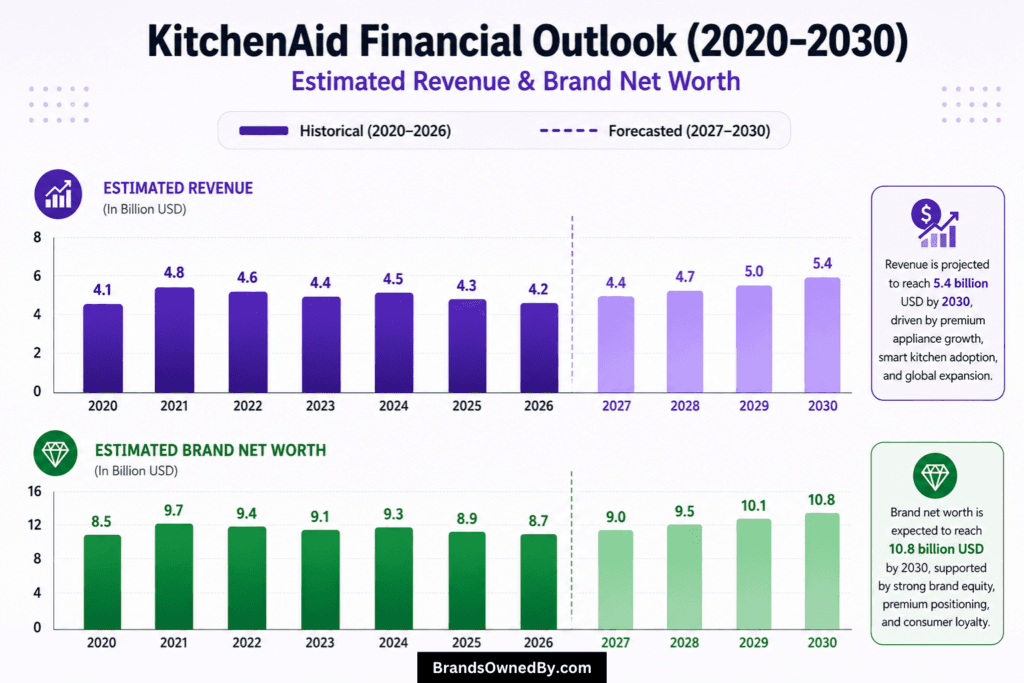
As of May 2026, KitchenAid is estimated to generate approximately $4.2 billion in annual revenue, while the brand’s estimated net worth stands at around $8.7 billion. These figures make KitchenAid one of the most valuable premium kitchen appliance brands in the world.
Although Whirlpool Corporation does not separately disclose KitchenAid’s exact financial statements, industry analysts estimate the brand contributes a significant share of Whirlpool’s premium appliance profits because of its strong pricing power, high-margin product categories, and premium customer base.
KitchenAid’s valuation remains significantly stronger than many mainstream appliance brands because of its dominant stand mixer business, premium built-in kitchen appliances, and globally recognized brand identity.
KitchenAid 2026 Revenue Analysis
KitchenAid’s estimated $4.2 billion revenue in 2026 comes primarily from premium kitchen appliances and countertop products.
The company generates revenue across four major business segments:
| Segment | Estimated 2026 Revenue Contribution |
|---|---|
| Countertop & Small Appliances | $1.6 billion |
| Major Kitchen Appliances | $1.9 billion |
| Accessories & Attachments | $320 million |
| International Licensing & Other Revenue | $380 million |
Countertop Appliances Generate the Highest Margins
KitchenAid’s countertop appliance division remains one of the company’s most profitable business areas.
This division includes:
- Stand mixers.
- Espresso machines.
- Blenders.
- Food processors.
- Toasters.
- Coffee appliances.
The stand mixer category alone is estimated to contribute more than $1 billion annually because KitchenAid dominates the premium mixer segment globally.
Industry data shows the global mixer market was valued at approximately $2.7 billion in 2026, and KitchenAid continues holding one of the strongest premium market positions in North America and Europe.
KitchenAid’s mixer business is especially profitable because the company generates recurring revenue through attachments and accessories.
Products such as:
- Pasta maker attachments.
- Meat grinders.
- Ice cream bowls.
- Vegetable slicers.
- Grain mills.
continue generating high-margin accessory sales years after initial mixer purchases.
Major Appliances Remain a Core Revenue Driver
KitchenAid’s major appliance division contributes an estimated $1.9 billion annually.
This category includes:
- Refrigerators.
- Wall ovens.
- Dishwashers.
- Ranges.
- Cooktops.
- Microwaves.
The company strengthened this division significantly during 2025 and 2026 after launching one of its largest premium kitchen relaunches in more than a decade.
KitchenAid introduced several premium products featuring:
- AI-enabled cooking systems.
- Intelligent cooking cameras.
- Smart refrigerators.
- Enhanced dishwasher systems.
These premium appliance launches became strategically important because Whirlpool increasingly shifted KitchenAid toward higher-margin luxury kitchen categories.
North America Drives Most Revenue
North America remains KitchenAid’s largest market and likely contributes roughly 65% to 70% of total global revenue.
The United States remains especially important because KitchenAid has extremely strong brand recognition among:
- Home bakers.
- Premium kitchen consumers.
- Kitchen remodeling buyers.
- Culinary enthusiasts.
The company also maintains strong retail distribution through:
- Best Buy.
- Lowe’s.
- Home Depot.
- Costco.
- Amazon.
- Specialty kitchen retailers.
International markets continue expanding gradually, especially in Europe and premium urban markets in Asia.
KitchenAid 2026 Net Worth Breakdown
KitchenAid’s estimated brand net worth of $8.7 billion reflects far more than physical products or manufacturing assets.
Most of the brand’s valuation comes from intangible assets such as:
| Brand Value Component | Estimated Contribution |
|---|---|
| Brand Recognition & Reputation | $2.5 billion |
| Premium Pricing Power | $1.8 billion |
| Stand Mixer Ecosystem | $1.4 billion |
| Consumer Loyalty | $1.2 billion |
| Global Retail Presence | $900 million |
| Intellectual Property & Product Design | $900 million |
Brand Recognition Adds Significant Value
KitchenAid possesses one of the most recognizable appliance identities globally.
Its stand mixer silhouette has remained visually consistent for decades, creating unusually strong long-term consumer recognition.
Very few appliance brands have a flagship product with comparable cultural visibility.
This recognition allows KitchenAid to maintain premium pricing even during periods of weak appliance demand.
Premium Pricing Power Supports Valuation
KitchenAid products consistently sell at higher price points than mainstream competitors.
For example:
- Premium stand mixers regularly retail between $350 and $750.
- Built-in refrigerators can exceed $8,000.
- Premium wall oven systems often exceed $4,000.
Consumers continue paying premium prices because KitchenAid has established itself as a performance-focused culinary brand rather than a budget appliance company.
This pricing strength significantly increases long-term brand value.
Consumer Loyalty Strengthens Net Worth
KitchenAid maintains unusually strong customer retention rates compared to many appliance competitors.
Many consumers who purchase a KitchenAid stand mixer later purchase:
- Dishwashers.
- Refrigerators.
- Espresso machines.
- Blenders.
- Cookware accessories.
This ecosystem effect increases customer lifetime value and strengthens KitchenAid’s overall net worth.
Revenue Performance From 2020 to 2026
KitchenAid experienced major growth during 2020 and 2021 as pandemic-driven home cooking activity boosted demand for premium kitchen appliances.
The company’s estimated revenue peaked near $4.8 billion in 2021 before broader appliance industry demand slowed.
Several factors affected KitchenAid’s performance between 2022 and 2026:
- High interest rates reduced appliance replacement demand.
- Weak housing activity slowed kitchen remodeling projects.
- Inflation pressured discretionary consumer spending.
- Competition intensified from Samsung, LG, Bosch, and GE Appliances.
- Whirlpool implemented restructuring and cost-reduction programs.
Whirlpool’s broader financial pressure during 2025 and 2026 also affected KitchenAid because the brand operates under Whirlpool’s corporate structure. Whirlpool reduced guidance, suspended dividends, and accelerated debt reduction initiatives during 2026 amid weakening appliance demand.
Despite those pressures, KitchenAid remained more resilient than many mainstream appliance categories because premium consumers were less price-sensitive.
Forecasted Revenue Through 2030
KitchenAid’s long-term growth outlook remains positive despite short-term appliance industry weakness during 2025 and 2026.
Several market trends are expected to support future revenue expansion.
- 2027: KitchenAid revenue is projected to recover to approximately $4.4 billion in 2027 as housing activity stabilizes and premium kitchen remodeling demand improves.
- 2028: Revenue could reach roughly $4.7 billion as smart kitchen adoption increases and KitchenAid expands premium connected appliances globally.
- 2029: KitchenAid may cross $5 billion in annual revenue for the first time as premium appliance demand strengthens internationally and countertop appliance sales continue growing.
- 2030: By 2030, KitchenAid’s revenue could potentially exceed $5.4 billion with brand net worth approaching $11 billion.
This growth will likely be supported by:
- Smart kitchen ecosystems.
- AI-enabled cooking appliances.
- Premium kitchen remodeling demand.
- Expansion in Asia and Europe.
- Higher-margin countertop appliance growth.
- Continued dominance in premium stand mixers.
The broader global kitchen appliance market is also expected to continue expanding through 2030, particularly in premium and connected appliance categories.
Brands Owned by KitchenAid
As of 2026, KitchenAid does not own multiple standalone corporations in the same way conglomerates like Whirlpool, Haier, or Samsung do. KitchenAid itself operates as a single premium appliance brand under Whirlpool Corporation rather than a parent holding company.
Because of this structure, KitchenAid does not directly own large independent subsidiaries or major external consumer brands.
However, KitchenAid does control several internally operated branded product ecosystems, licensed entities, premium collections, and commercial product lines that function as major business units under the KitchenAid name.
| Brand / Entity | Type | Main Products / Focus | Key Details as of 2026 |
|---|---|---|---|
| KitchenAid Artisan | Premium consumer appliance line | Tilt-head stand mixers and countertop appliances | One of KitchenAid’s best-selling global product lines known for premium colors, attachment compatibility, and lifestyle-focused branding. Targets home bakers and premium kitchen consumers. |
| KitchenAid Professional Series | High-performance appliance line | Bowl-lift mixers and heavy-duty kitchen appliances | Focuses on higher-capacity mixers designed for serious baking, frequent usage, and professional-style home kitchens. Generates higher average selling prices than standard mixer lines. |
| KitchenAid Commercial | Commercial appliance entity | NSF-certified mixers and foodservice equipment | Targets bakeries, restaurants, culinary schools, and catering businesses. Maintains KitchenAid’s professional culinary heritage originating from Hobart Manufacturing. |
| KitchenAid Go | Cordless appliance ecosystem | Battery-powered kitchen appliances | Includes portable mixers, food choppers, cordless blenders, and rechargeable appliances using interchangeable battery systems. One of KitchenAid’s fastest-growing modern ecosystems. |
| KitchenAid Espresso Collection | Premium coffee appliance line | Espresso machines and coffee systems | Competes in the luxury home coffee market against Breville and De’Longhi. Includes semi-automatic espresso machines, grinders, and milk frothing systems. |
| KitchenAid Cordless Collection | Portable kitchen appliance line | Rechargeable prep appliances | Focuses on compact cordless kitchen tools designed for flexibility and portability in modern kitchens. |
| KitchenAid Color of the Year Collection | Limited-edition branding initiative | Seasonal and premium color appliances | Annual color-focused campaigns that strengthen premium branding, consumer engagement, and social media visibility. Especially popular in stand mixer collections. |
| KitchenAid Attachments Ecosystem | Accessory ecosystem | Mixer attachments and culinary accessories | Includes pasta makers, meat grinders, slicers, grain mills, juicers, and ice cream attachments. Creates recurring revenue and long-term ecosystem loyalty. |
| KitchenAid Licensed Cookware and Kitchenware | Licensed consumer products business | Cookware, bakeware, knives, and kitchen tools | Operates through licensing and retail partnerships. Expands KitchenAid’s brand presence beyond appliances into broader culinary lifestyle categories. |
| KitchenAid Smart Appliance Ecosystem | Connected appliance platform | Smart ovens, refrigerators, and app-connected appliances | Focuses on connected kitchens, guided cooking systems, smart-home integration, and premium intelligent appliance experiences. |
| KitchenAid Built-In Appliance Collection | Premium major appliance lineup | Refrigerators, ovens, dishwashers, cooktops | Competes directly with Bosch, Café, Samsung Bespoke, and LG Studio in premium kitchen remodeling and luxury appliance categories. |
| KitchenAid Countertop Appliance Collection | Small appliance ecosystem | Blenders, food processors, toasters, mixers | One of KitchenAid’s largest revenue-generating product groups outside major appliances. Strong focus on premium kitchen aesthetics and performance. |
| KitchenAid Mixer Attachment Platform | Long-term accessory platform | Compatible mixer accessories | One of the strongest ecosystem-retention strategies in the appliance industry. Supports cross-generation compatibility and recurring customer purchases. |
| KitchenAid Premium Finish Collections | Design-focused product initiative | Matte, metallic, and limited-edition finishes | Supports KitchenAid’s premium positioning through luxury-inspired finishes and designer kitchen aesthetics. |
| KitchenAid Culinary Partnerships | Brand collaboration initiative | Culinary campaigns and chef collaborations | Includes partnerships with chefs, baking creators, culinary schools, and premium kitchen retailers to strengthen culinary-focused brand identity. |
KitchenAid Artisan
KitchenAid Artisan is one of the company’s most successful and recognizable premium product brands.
The Artisan lineup primarily focuses on premium stand mixers and countertop appliances designed for home bakers and culinary enthusiasts.
The Artisan Series became especially important because it helped transform KitchenAid mixers into lifestyle-oriented premium kitchen products rather than simple appliances.
The lineup is known for:
- Premium finishes.
- Wide color selections.
- Tilt-head mixer systems.
- Mid-range premium pricing.
- Attachment compatibility.
Artisan mixers remain among KitchenAid’s best-selling products globally and contribute significantly to the company’s countertop appliance revenue.
The Artisan branding is also heavily promoted through social media baking communities, influencer marketing, and premium kitchen retail channels.
KitchenAid Professional Series
The Professional Series represents KitchenAid’s higher-performance appliance lineup.
This brand ecosystem focuses on:
- Bowl-lift stand mixers.
- High-capacity kitchen equipment.
- Heavy-duty baking applications.
- Advanced motor systems.
Professional Series mixers target:
- Serious home bakers.
- Small commercial users.
- Culinary creators.
- Professional-style home kitchens.
The Professional branding allows KitchenAid to compete against commercial-grade mixer manufacturers while maintaining premium consumer positioning.
The series also generates higher average selling prices than the standard Artisan lineup.
KitchenAid Commercial
KitchenAid Commercial operates as the company’s professional foodservice and commercial appliance entity.
This business focuses on NSF-certified equipment designed for:
- Restaurants.
- Bakeries.
- Commercial kitchens.
- Culinary schools.
- Catering businesses.
The commercial lineup includes:
- Commercial stand mixers.
- Heavy-duty countertop appliances.
- Food-prep systems.
- Professional culinary equipment.
KitchenAid Commercial helps preserve the company’s historical connection to professional foodservice equipment dating back to the Hobart Manufacturing era.
This commercial entity also strengthens KitchenAid’s premium brand reputation among professional chefs and culinary professionals.
KitchenAid Go
KitchenAid Go became one of the company’s newest branded ecosystems during the 2020s.
The platform centers around cordless kitchen appliances powered by interchangeable battery systems.
KitchenAid Go products include:
- Cordless hand mixers.
- Portable blenders.
- Food choppers.
- Coffee grinders.
- Compact cordless appliances.
The company launched this ecosystem to compete with growing consumer demand for portable and rechargeable kitchen products.
The interchangeable battery platform also creates ecosystem lock-in, encouraging repeat purchases within the KitchenAid product family.
As of 2026, KitchenAid continues expanding the Go ecosystem internationally.
KitchenAid Espresso Collection
KitchenAid expanded aggressively into premium coffee appliances during the early 2020s through its Espresso Collection branding.
This product ecosystem includes:
- Semi-automatic espresso machines.
- Burr grinders.
- Milk frothing systems.
- Premium coffee accessories.
The expansion became strategically important because premium home coffee appliances represent one of the fastest-growing kitchen appliance categories globally.
KitchenAid positioned the Espresso Collection against competitors such as:
- Breville.
- De’Longhi.
- Philips.
- Jura.
The company leveraged its premium kitchen branding to enter the luxury home coffee market without acquiring external coffee appliance brands.
KitchenAid Cordless Collection
The Cordless Collection operates as another internally branded KitchenAid ecosystem.
This collection focuses on compact battery-powered kitchen tools and appliances designed for flexible kitchen usage.
The lineup includes:
- Cordless hand blenders.
- Cordless food choppers.
- Portable mixers.
- Rechargeable prep tools.
The collection became increasingly important as consumers sought portable and space-efficient kitchen products.
This ecosystem also supports KitchenAid’s broader smart and modern kitchen positioning strategy.
KitchenAid Color of the Year Collection
KitchenAid’s Color of the Year program functions as one of the company’s most unique internal branded initiatives.
Unlike most appliance manufacturers, KitchenAid heavily markets seasonal and limited-edition color collections.
These annual launches often generate significant consumer demand and social media visibility.
The program helps KitchenAid:
- Maintain premium positioning.
- Increase collector demand.
- Drive repeat purchases.
- Differentiate products visually.
- Strengthen lifestyle branding.
Limited-edition mixer colors frequently become viral products within baking and home décor communities.
This initiative has become one of KitchenAid’s strongest non-technical brand differentiators.
KitchenAid Attachments Ecosystem
The KitchenAid Attachments platform operates almost like a standalone accessory business.
This ecosystem includes:
- Pasta roller systems.
- Meat grinders.
- Vegetable slicers.
- Ice cream makers.
- Grain mills.
- Juicers.
The attachment ecosystem significantly increases customer lifetime value because consumers continue purchasing additional accessories years after buying mixers.
This business model also strengthens ecosystem loyalty since attachments remain compatible across many KitchenAid mixer generations.
Few appliance competitors possess a similarly strong long-term accessory ecosystem.
KitchenAid Licensed Cookware and Kitchenware
KitchenAid also operates licensed kitchenware and cookware businesses through retail and manufacturing partnerships.
These branded products include:
- Cookware sets.
- Bakeware.
- Kitchen utensils.
- Storage containers.
- Knives.
- Culinary tools.
Many of these products are manufactured through licensing agreements rather than direct internal production.
This strategy allows KitchenAid to expand into broader culinary lifestyle categories without building entirely separate manufacturing operations.
KitchenAid Smart Appliance Ecosystem
KitchenAid’s smart appliance ecosystem became increasingly important during the 2020s as connected kitchens expanded globally.
This ecosystem includes:
- Smart ovens.
- Connected refrigerators.
- App-controlled appliances.
- Guided cooking systems.
- Intelligent cooking features.
KitchenAid uses this platform to compete against Samsung, LG, and GE Appliances in connected kitchen technologies.
Rather than acquiring external smart-home companies independently, KitchenAid leverages Whirlpool’s technology infrastructure while maintaining KitchenAid-specific branding and premium positioning.
Conclusion
KitchenAid is owned by Whirlpool Corporation, one of the world’s largest appliance manufacturers. The acquisition transformed KitchenAid from a mixer-focused brand into a global premium kitchen appliance company.
Today, KitchenAid remains one of the most recognizable culinary appliance brands in the market. Its strong reputation, premium positioning, and loyal customer base continue to make it a major asset within Whirlpool’s brand portfolio.
The brand’s future growth will likely focus on smart kitchen technology, premium cooking experiences, and international expansion. Despite intense competition from Samsung, LG, Bosch, and GE Appliances, KitchenAid continues to hold a powerful position in the premium kitchen appliance industry.
FAQs
Who is the parent company of KitchenAid?
The parent company of KitchenAid is Whirlpool Corporation. Whirlpool acquired KitchenAid in 1986 and continues to fully own and operate the brand as of 2026. KitchenAid functions as Whirlpool’s premium kitchen appliance brand.
Where are KitchenAid appliances made?
KitchenAid appliances are manufactured in multiple countries depending on the product category. Many major appliances are produced in Whirlpool-owned manufacturing facilities in the United States, particularly in states such as Ohio, Iowa, and South Carolina.
Some KitchenAid products and components are also manufactured in:
- Mexico.
- China.
- Canada.
- Italy.
- Other international Whirlpool production facilities.
KitchenAid stand mixers for the North American market are primarily manufactured in Greenville, Ohio.
Who makes KitchenAid mixers?
KitchenAid mixers are manufactured by Whirlpool Corporation through KitchenAid’s appliance operations.
Most KitchenAid stand mixers sold in North America are assembled at Whirlpool’s manufacturing facility in Greenville, Ohio. This facility has produced KitchenAid mixers for decades and remains one of the company’s most important production centers.
Who owns KitchenAid appliances?
KitchenAid appliances are fully owned by Whirlpool Corporation as of 2026.
Because Whirlpool is publicly traded, the brand is indirectly owned by Whirlpool shareholders, including major institutional investors such as Vanguard Group, BlackRock, and State Street Corporation.
What is the sister brand of KitchenAid?
KitchenAid’s sister brands are other appliance brands owned by Whirlpool Corporation.
These include:
- Whirlpool.
- Maytag.
- JennAir.
- Amana.
- Hotpoint.
- Indesit.
Among these, JennAir is considered KitchenAid’s closest premium sister brand because both target higher-end kitchen appliance consumers.
Are KitchenAid and GE the same?
No, KitchenAid and GE are not the same company.
KitchenAid is owned by Whirlpool Corporation, while GE Appliances is owned by Haier Smart Home, a Chinese multinational appliance company.
Although both brands compete in kitchen appliances, they operate under completely different parent corporations.
Are Bosch and KitchenAid the same company?
No, Bosch and KitchenAid are separate companies owned by different parent organizations.
KitchenAid is owned by Whirlpool Corporation, while Bosch appliances are owned by BSH Hausgeräte, which is controlled by Bosch Group in Germany.
Both brands compete in premium kitchen appliances, but they are not connected through ownership.
Are LG and KitchenAid the same?
No, LG and KitchenAid are not the same company.
KitchenAid is owned by Whirlpool Corporation, while LG appliances are owned by LG Electronics, part of South Korea’s LG Group conglomerate.
LG focuses heavily on smart-home technology and connected appliances, while KitchenAid is more strongly associated with premium culinary appliances and stand mixers.