
Kenworth is one of the most recognized names in the American truck manufacturing industry. But many people still ask, who owns Kenworth today?
In this article, we’ll explore the ownership, leadership, revenues, and related companies of Kenworth in 2025.
Kenworth Company Profile
Kenworth is one of the oldest and most respected truck manufacturers in the United States. It specializes in the design and production of medium-duty and heavy-duty trucks, especially Class 8 vehicles. These trucks are commonly used in freight hauling, construction, and industrial transport. Known for their durability, advanced engineering, and driver comfort, Kenworth trucks are popular among fleet operators and owner-operators alike.
Company Details
- Full Name: Kenworth Truck Company
- Industry: Automotive / Commercial Vehicle Manufacturing
- Founded: 1923
- Headquarters: Kirkland, Washington, USA
- Type: Wholly owned subsidiary of PACCAR Inc
- Products: Class 5 to Class 8 trucks (diesel, CNG, and electric models)
- Market Presence: United States, Canada, Mexico, Australia, and select global markets
Kenworth has production facilities in multiple locations across the U.S. and Mexico. The company also collaborates with PACCAR divisions for engine manufacturing, financial services, and parts supply.
Founders
Kenworth was originally formed from the Gerlinger Motor Car Works, which was founded in 1912 in Portland, Oregon. It was acquired in 1916 by Seattle-based businessmen Harry Kent and Edgar Worthington, who eventually renamed the company Kenworth in 1923—a combination of their last names.
- Harry W. Kent: A businessman and engineer known for improving truck designs for rugged terrain.
- Edgar K. Worthington: A finance-oriented industrialist who focused on business expansion and stability.
Together, they transformed the company into a respected manufacturer of custom-built trucks optimized for logging, freight, and long-distance hauling.
Major Milestones
1923 – Kenworth is officially incorporated as Kenworth Motor Truck Company. The company focuses on building trucks for the logging and industrial sectors in the Pacific Northwest.
1933 – Kenworth becomes the first American truck manufacturer to install diesel engines as standard equipment.
1945 – PACCAR (then known as Pacific Car and Foundry Company) acquires Kenworth, making it a subsidiary. This acquisition gives Kenworth access to more capital and global markets.
1950s–1960s – Kenworth expands production facilities and begins selling trucks internationally. The brand becomes widely known for durability and innovation.
1985 – Kenworth opens its Chillicothe, Ohio assembly plant—one of the most advanced heavy-duty truck plants in North America.
2000s – Kenworth introduces aerodynamic designs like the T2000 and later the T680, aimed at improving fuel efficiency for long-haul trucking.
2010s – Launch of the PACCAR MX engine line, providing in-house high-performance engines to Kenworth trucks.
2020s – Kenworth begins developing electric trucks such as the T680E, as part of PACCAR’s commitment to sustainable transport solutions. The brand also integrates advanced driver-assist and telematics systems.
Who Owns Kenworth Trucks in 2025?
Kenworth is a wholly owned subsidiary of PACCAR Inc, a global leader in the commercial vehicle manufacturing industry. While Kenworth operates with its own branding, facilities, and product line, all strategic, financial, and executive decisions are controlled by PACCAR. The ownership structure ensures that Kenworth operates as a key division within PACCAR’s broader truck manufacturing business.
Parent Company: PACCAR Inc
PACCAR Inc is a publicly traded American corporation listed on the NASDAQ under the ticker symbol PCAR. Headquartered in Bellevue, Washington, PACCAR designs and manufactures commercial trucks and related components through its subsidiaries. The company also offers financial services and information technology solutions for the trucking industry.
PACCAR owns three major truck brands globally:
- Kenworth (North America, Australia, and international markets)
- Peterbilt (North America)
- DAF Trucks (Europe and other global regions)
Each of these brands operates under PACCAR’s centralized business strategy, including shared use of PACCAR’s proprietary engines, parts supply, R&D, and financial support.
Acquisition Insights: PACCAR’s Purchase of Kenworth
Kenworth was acquired by PACCAR in 1945. At the time, PACCAR was known as Pacific Car and Foundry Company. The acquisition was part of PACCAR’s post-World War II industrial expansion. By acquiring Kenworth, PACCAR added a respected truck manufacturer to its portfolio, aligning with its long-term vision of becoming a leader in heavy-duty vehicle production.
The acquisition gave Kenworth access to more funding, engineering resources, and wider markets. In return, PACCAR gained a foothold in the truck manufacturing space, which would become the core of its business for the next eight decades.
Since the acquisition, PACCAR has kept Kenworth’s brand identity intact. However, all executive oversight, budgeting, and R&D investments are managed at the PACCAR level. Kenworth no longer operates as an independent legal entity.
Ownership Structure
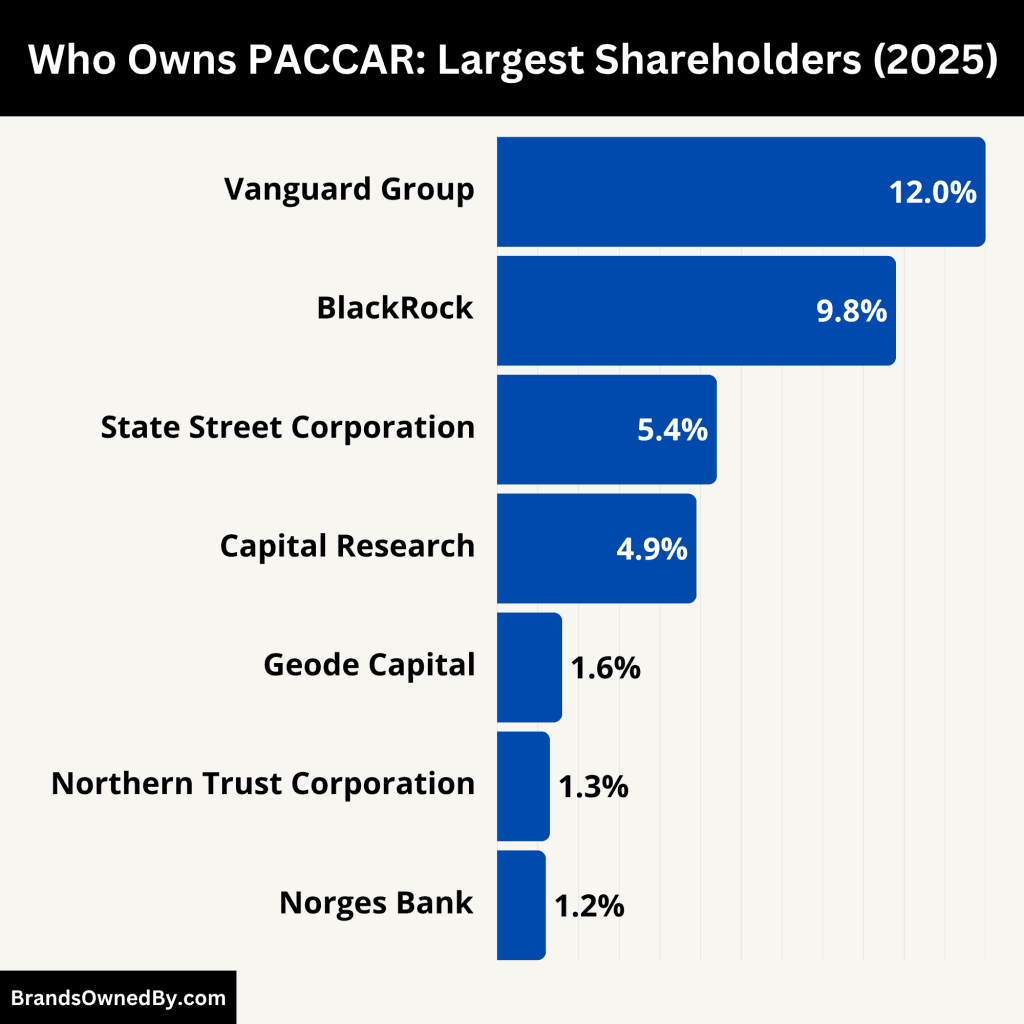
Because PACCAR is publicly traded, the ownership of Kenworth is tied to PACCAR’s shareholder base. This includes a mix of institutional investors, individual shareholders, and PACCAR executives. Shareholders do not hold stock in Kenworth directly but gain economic interest in Kenworth through their PACCAR shares.
Some of PACCAR’s largest institutional shareholders include:
PACCAR executives and board members also own shares, aligning leadership incentives with company performance. PACCAR’s shareholders vote on major decisions at the corporate level, but Kenworth-specific decisions are handled by PACCAR’s executive team.
Control and Governance
Kenworth’s strategic decisions—such as new product development, factory expansions, or global partnerships—are determined by PACCAR’s executive board and CEO. Kenworth’s internal management handles day-to-day operations, sales, and plant management but remains fully accountable to PACCAR.
The CEO of PACCAR leads all its subsidiaries, including Kenworth. PACCAR’s centralized structure allows its brands to share technology platforms, engines, and even logistics systems, creating cost efficiencies and product consistency.
Other Relevant Ownership Facts
- Kenworth has no external investors or subsidiaries of its own.
- All its profits are consolidated into PACCAR’s corporate earnings.
- It is considered a flagship brand within PACCAR’s North American truck division.
- While Kenworth operates globally, its international sales and support are managed under PACCAR’s global strategy.
Who Makes Kenworth Engines?
Kenworth trucks are known for performance, durability, and customization. A key factor behind their reputation is the engine technology they use. As of 2025, Kenworth sources its engines from a combination of in-house manufacturers and strategic third-party partners, offering a flexible range of options for different truck applications.
PACCAR Engines: Kenworth’s In-House Power
Kenworth primarily uses PACCAR engines, which are designed and manufactured by its parent company, PACCAR Inc. These engines are built specifically to power Kenworth and Peterbilt trucks and have become a major part of Kenworth’s identity in recent years.
The most common PACCAR engines in Kenworth trucks include:
- PACCAR MX-13: A high-performance engine used in long-haul Class 8 trucks. Known for fuel efficiency, reliability, and low emissions.
- PACCAR MX-11: A slightly smaller engine ideal for regional and vocational applications.
- PACCAR PX-7 and PX-9: Medium-duty engines used in Kenworth’s T270, T370, and other vocational or delivery trucks.
These engines are produced at PACCAR’s engine manufacturing facility in Columbus, Mississippi, a state-of-the-art plant with advanced machining, testing, and assembly systems.
Cummins Engines: Kenworth’s Long-Term Partner
Kenworth also offers Cummins engines as an alternative, especially for customers who prefer a non-proprietary powertrain or require specific engine capabilities not covered by PACCAR’s lineup.
Common Cummins engines offered in Kenworth trucks include:
- Cummins X15: A popular heavy-duty diesel engine with high horsepower ratings, used in Class 8 models like the Kenworth W990 and T880.
- Cummins L9 and B6.7: Widely used in medium-duty trucks where emissions, efficiency, and performance must be balanced.
Cummins engines are manufactured by Cummins Inc, an independent global engine company headquartered in Columbus, Indiana. These engines are known for their aftermarket support and wide servicing network, which appeals to some fleet buyers and vocational operators.
Electric Powertrains: PACCAR Electric and Third-Party Integration
Kenworth has also entered the electric vehicle market with models like the Kenworth T680E. These electric trucks use PACCAR Electric Powertrain Systems, developed internally with components sourced from various partners including Dana and Meritor.
Although not traditional “engines,” these electric drive units replace diesel powertrains. They include a battery-electric motor, integrated drive system, and onboard charging equipment, all optimized by PACCAR engineers for Kenworth’s electric trucks.
Custom Engine Selection for Fleets
Kenworth allows large fleet customers to custom-specify their engines, depending on their route profiles, weight class, and environmental requirements. Many fleets prefer PACCAR engines for tighter integration and warranty alignment, while others opt for Cummins engines for familiarity or specific performance needs.
Who is the CEO of Kenworth?
As of 2025, the CEO of PACCAR—and therefore the key decision‑maker for Kenworth—is R. Preston Feight, often known as Preston Feight. He has led the company since July 2019. His experience spans over 26 years within PACCAR, including significant roles in engineering, manufacturing, and executive leadership.
Kenworth does not have a standalone CEO. As a division of PACCAR Inc., the company is led under the executive structure of its parent organization. As of 2025, the Chief Executive Officer of PACCAR—and therefore the top decision-maker overseeing Kenworth—is R. Preston Feight. His leadership directly influences Kenworth’s strategic direction, innovation, manufacturing policies, and global expansion efforts.
Background and Education
Preston Feight holds a Bachelor of Science in Mechanical Engineering from Northern Arizona University. He later completed a Master of Science in Engineering Management from the University of Colorado. Before joining PACCAR, Feight gained experience at Ford Motor Company and AlliedSignal, where he worked in engineering and product development. His educational and technical foundation has played a strong role in his data-driven and innovation-focused leadership style at PACCAR.
Career at PACCAR and Kenworth
Feight began his career at PACCAR in the early 2000s and has held various key leadership roles within the organization. He previously served as Chief Engineer and later as General Manager of Kenworth Truck Company, giving him direct operational experience with the brand. From 2016 to 2018, he was appointed President of DAF Trucks, PACCAR’s European division. In 2019, he became Executive Vice President of PACCAR and was promoted to CEO in July 2019, a role he continues to hold as of 2025.
His rise through PACCAR demonstrates a deep understanding of both the American and European commercial vehicle markets. His experience at Kenworth specifically gives him hands-on insight into the challenges and opportunities facing the brand today.
Leadership Style and Strategic Focus
Feight is known for his practical leadership style with a strong focus on engineering excellence, operational efficiency, and long-term investment in clean and connected technologies. Under his direction, PACCAR and Kenworth have accelerated the development of electric trucks, zero-emission vehicles, and advanced driver-assistance systems (ADAS). He also emphasizes digital integration, including vehicle telematics and smart fleet solutions.
During his tenure, Kenworth has introduced electric models like the T680E and strengthened its role in the evolving zero-emissions transport market. Feight’s leadership has allowed Kenworth to maintain strong profitability while investing in the future of sustainable trucking.
Executive Compensation and Ownership
As of early 2025, Preston Feight earns an executive compensation package that includes salary, performance bonuses, and long-term stock incentives. He holds over 200,000 shares of PACCAR Inc., with a value estimated at around $19 million, depending on market conditions. This substantial ownership aligns his personal financial interests with the success of PACCAR and its divisions, including Kenworth.
Board Memberships and Industry Influence
In addition to serving as CEO, Feight sits on the Board of Directors of PACCAR Inc., contributing to long-term corporate governance and strategy. In 2024, he was also appointed to the Board of Deere & Company, reflecting his broader recognition within the industrial and manufacturing sectors. His influence now extends beyond trucks to larger discussions on technology, automation, and global supply chains.
Past CEOs
Before Feight, PACCAR was led by Ron Armstrong from 2014 to 2019. Armstrong oversaw strong global growth, especially in PACCAR’s financial services and digital innovation. Prior to Armstrong, Mark Pigott served as CEO from 1997 to 2014 and played a pivotal role in expanding PACCAR’s global footprint and technological leadership. Both former CEOs left strong legacies that Preston Feight has continued to build upon.
Kenworth Annual Revenue and Net Worth
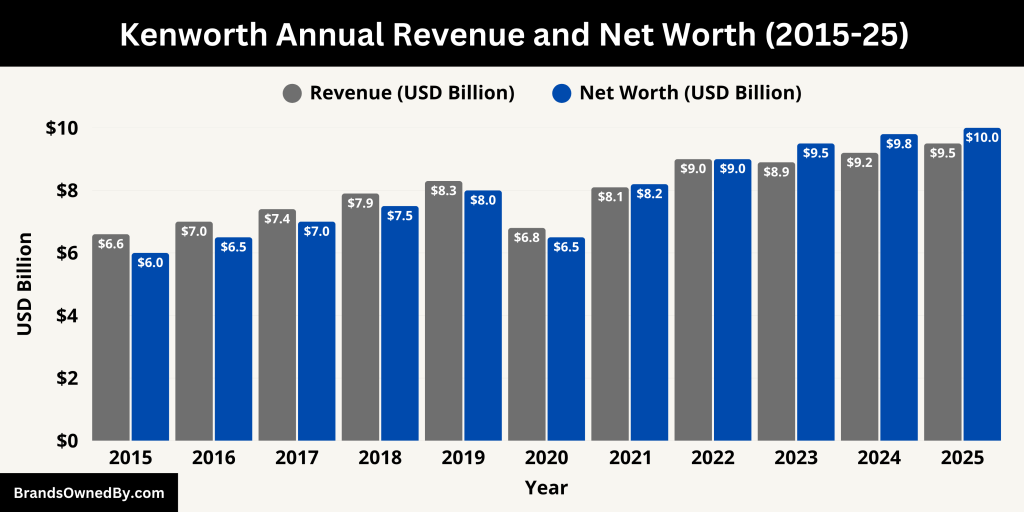
Kenworth generated an estimated $8–9.5 billion in revenue in 2025 and holds a net worth of $7–10 billion. It continues to be a major player in the North American trucking industry and a critical source of strength within PACCAR’s global portfolio.
In 2025, PACCAR reported total revenues of approximately $32.3 billion. Industry analysts and PACCAR’s own operational breakdowns suggest that Kenworth contributes roughly 25–30% of this figure. That places Kenworth’s estimated annual revenue between $8 billion and $9.5 billion for the year ending 2025.
Kenworth’s revenue comes primarily from the sale of heavy-duty Class 8 trucks, medium-duty vehicles, and growing contributions from electric truck sales, such as the T680E. Other revenue sources include aftermarket parts, service contracts, and customer support solutions. The brand’s strong presence in the U.S., Canada, Mexico, and Australia contributes to its consistent revenue performance.
Key Revenue Drivers
Kenworth has seen steady demand in freight, construction, and infrastructure markets. The launch of new models with aerodynamic designs, integrated PACCAR engines, and advanced safety features has helped sustain its market share in a competitive landscape. Kenworth also benefits from PACCAR’s global parts distribution system, which boosts recurring revenue through parts and service.
Kenworth’s fleet modernization initiatives and expansion into alternative fuel trucks have added new revenue streams. Its electric trucks are slowly gaining traction among environmentally conscious fleets and government transportation contracts.
Net Worth of Kenworth
Kenworth’s net worth is not published separately, as it is an operating division within PACCAR. However, based on its revenue contribution, historical performance, brand value, and production capacity, Kenworth’s estimated net worth in 2025 is between $7 billion and $10 billion.
This valuation includes its physical assets, such as manufacturing plants in Washington and Ohio, its proprietary truck designs, dealership networks, and share of PACCAR’s research and development infrastructure. It also reflects brand equity built over more than 100 years of manufacturing excellence and customer trust.
Financial Significance Within PACCAR
Kenworth is considered one of PACCAR’s most profitable divisions. Its trucks often command premium pricing due to their engineering quality, durability, and brand loyalty among long-haul operators. The division’s efficiency and strong dealer support network help maintain healthy margins. While exact profit figures are not disclosed, analysts believe that Kenworth alone generates billions in gross profit annually, making it a cornerstone of PACCAR’s financial performance.
Here is the historical revenue and estimated net worth of Kenworth for the last 10 years (2015–2025):
| Year | Estimated Revenue (USD Billion) | Estimated Net Worth (USD Billion) | Notes |
|---|---|---|---|
| 2025 | 8.5 – 9.5 | 7.0 – 10.0 | Slight dip in truck demand, stable aftermarket growth |
| 2024 | 9.2 – 9.8 | 8.5 – 9.8 | Strong global demand, peak production year |
| 2023 | 8.9 – 9.5 | 8.0 – 9.5 | High North American sales, electric model ramp-up |
| 2022 | 8.3 – 9.0 | 7.5 – 9.0 | Post-COVID growth, infrastructure boom |
| 2021 | 7.6 – 8.1 | 6.8 – 8.2 | Supply chain recovery, increased fleet renewals |
| 2020 | 6.2 – 6.8 | 5.5 – 6.5 | COVID-19 disruption, drop in production |
| 2019 | 7.8 – 8.3 | 6.8 – 8.0 | Strong freight economy, heavy-duty demand surge |
| 2018 | 7.3 – 7.9 | 6.5 – 7.5 | Steady performance, new model rollouts |
| 2017 | 6.9 – 7.4 | 6.0 – 7.0 | Rising sales in construction segment |
| 2016 | 6.4 – 7.0 | 5.8 – 6.5 | Moderate growth, new plant investment |
| 2015 | 6.1 – 6.6 | 5.5 – 6.0 | Strong Class 8 sales recovery in North America |
Brands Owned by Kenworth
Below is a breakdown of the key entities, brands, and divisions that are directly owned and operated by Kenworth itself in 2025:
| Entity/Division Name | Type | Location | Primary Function |
|---|---|---|---|
| Kenworth Truck Company | Core Division | Kirkland, Washington (HQ) | Designs, engineers, and manages all Kenworth-branded truck operations |
| Chillicothe Manufacturing Plant | Production Facility | Chillicothe, Ohio, USA | Builds heavy-duty Class 8 trucks like T680 and W990 |
| Renton Manufacturing Plant | Production Facility | Renton, Washington, USA | Manufactures medium-duty and vocational trucks |
| Mexicali Manufacturing Plant | Production Facility | Mexicali, Baja California, Mexico | Supports regional truck production for North America |
| Kenworth T-Series Line | Product Line Division | Company-wide | Manages development, engineering, and lifecycle of all T-series truck models |
| Kenworth EV Program | R&D and Engineering | Multiple locations (R&D hubs) | Develops electric truck platforms like the T680E and EV fleet services |
| Kenworth Dealer Network | Franchised Network | 430+ locations (North America) | Offers vehicle sales, leasing, parts, and servicing under Kenworth standards |
| Fleet Solutions & Custom Engineering | B2B Service Division | Based at HQ and plants | Provides tailored vehicle designs and integrated fleet support to commercial buyers |
Kenworth Truck Company
Kenworth Truck Company is the core operating entity responsible for the design, engineering, and manufacturing of all Kenworth-branded trucks. It handles everything from heavy-duty Class 8 trucks to medium-duty models in the Class 5–7 range. The company oversees research and development, innovation in truck design, and integration of advanced technologies such as telematics, electric drivetrains, and fuel-efficient aerodynamics. It operates semi-independently within the PACCAR structure and has its own brand strategy, dealer network, and customer service model.
Kenworth Manufacturing Plants
Kenworth operates multiple manufacturing facilities that are branded and controlled under the Kenworth name. These plants are not standalone corporations but function as Kenworth-managed production hubs.
- Chillicothe, Ohio Plant: This is Kenworth’s largest and most advanced production facility. It assembles most of Kenworth’s Class 8 highway trucks, including the T680 and W990. The plant is fully automated with robotic systems and lean manufacturing processes.
- Renton, Washington Plant: This facility produces Kenworth’s medium-duty and vocational trucks. It also serves as a major innovation hub for aerodynamic design and prototype development.
- Mexicali, Mexico Plant: This plant supports North American production, especially for export and regional distribution. It focuses on medium-duty vehicles and some heavy-duty models.
Each plant operates under the Kenworth brand and supports global logistics, engineering, and customer support for its region.
Kenworth T-Series Product Line
Though not a separate company, the Kenworth T-Series is treated internally as a structured product line with its own engineering teams, marketing strategies, and lifecycle management.
- T680 & T680E (Electric): These models are focused on long-haul transport, with options for traditional diesel and zero-emission electric drivetrains.
- T880: A vocational workhorse used in construction, mining, and heavy payload applications.
- T280, T380, T480: Medium-duty trucks used for urban delivery, utility work, and local freight. These are part of Kenworth’s expansion into flexible fleet solutions.
Each T-series model is engineered with unique platforms, engines, and options, and they collectively define Kenworth’s market identity. These models are developed and managed under Kenworth’s engineering group with full autonomy over design and performance benchmarks.
Kenworth Dealer Network & Customer Support
Kenworth operates a certified dealership network that functions like a franchised extension of the brand. As of 2025, the company supports over 430 dealer locations across North America, each offering vehicle sales, maintenance, leasing, and parts.
While the dealerships are independently owned, Kenworth oversees brand compliance, parts logistics, service quality, and digital connectivity through centralized systems. The dealer network is an essential part of Kenworth’s operating ecosystem and is treated as an extended arm of its operations.
Kenworth Electric Vehicle Program
Kenworth has built an internal EV Program Division, responsible for designing and supporting its electric truck offerings. This includes the T680E and future planned models such as medium-duty electric delivery trucks. The division handles battery integration, charging infrastructure consulting, and software management systems tied to EV fleet optimization.
This group works closely with PACCAR’s shared technology platforms but is branded and operated under Kenworth’s own engineering and development leadership. It also manages relationships with utility companies and charging infrastructure providers for Kenworth customers.
Kenworth Custom Engineering & Fleet Solutions
Kenworth offers custom truck design and fleet engineering services under its brand. These are in-house divisions responsible for:
- Fleet configuration for large corporate buyers
- Industry-specific solutions for construction, oil & gas, agriculture, and logistics
- Custom interior, engine, and drivetrain modifications
- Integrated digital fleet management systems
This division often works directly with corporate clients and leasing companies to deliver purpose-built trucks.
Conclusion
Kenworth is a well-established American truck manufacturer known for its innovation and quality. It is fully owned by PACCAR Inc, which manages several global truck brands. The question who owns Kenworth can be answered simply—PACCAR does, and PACCAR’s shareholders hold indirect ownership through public shares.
Kenworth benefits from being part of a larger corporate ecosystem. It has access to cutting-edge technologies, global supply chains, and financial support. This allows it to maintain a leading position in the heavy-duty truck industry.
FAQs
Who is Kenworth owned by?
Kenworth is wholly owned by PACCAR Inc, a publicly traded American corporation. It has been a PACCAR subsidiary since 1945 and operates under PACCAR’s truck manufacturing division.
What family owns PACCAR?
PACCAR is a public company listed on the NASDAQ, so it does not belong to a single family. However, the Pigott family has historically played a significant leadership role. Mark Pigott, a fourth-generation descendant of the founders, served as PACCAR’s CEO and later as executive chairman. The family remains influential but does not own PACCAR privately.
Is Kenworth or Peterbilt better?
Both Kenworth and Peterbilt are owned by PACCAR and share many components, including engines and technology. Kenworth is often favored for fuel efficiency, rugged design, and vocational applications, while Peterbilt is known for premium driver comfort and styling. The better brand depends on individual business needs and driver preferences.
Who makes Kenworth engines?
Kenworth trucks primarily use PACCAR engines, including the MX-13, MX-11, PX-7, and PX-9. Some models also offer Cummins engines such as the X15 and L9, depending on the customer’s preference and application.
Is Kenworth Volvo?
No, Kenworth is not owned by Volvo. Kenworth is a subsidiary of PACCAR Inc, while Volvo Trucks is owned by the Volvo Group, a separate Swedish multinational company.
Are Peterbilt and Kenworth sister companies?
Yes, Peterbilt and Kenworth are sister companies. Both are owned by PACCAR Inc and share manufacturing platforms, engines, and corporate resources, although they maintain distinct brand identities.
Are Kenworth and Mack the same company?
No, Kenworth and Mack are not the same company. Kenworth is owned by PACCAR, while Mack Trucks is a subsidiary of the Volvo Group. They are competitors in the heavy-duty truck industry.
Which engine is used in Kenworth?
Kenworth trucks use a range of engines, including the PACCAR MX-13, MX-11, PX-9, and PX-7. For certain applications, Cummins engines like the X15 and L9 are also available.
Does PACCAR own Kenworth?
Yes, PACCAR Inc. fully owns Kenworth. The company has operated as a subsidiary of PACCAR since it was acquired in 1945.
Who owns Kenworth Truck Company?
Kenworth Truck Company is 100% owned by PACCAR Inc, a U.S.-based public corporation that specializes in commercial vehicle manufacturing.
Who is the parent company of Kenworth?
PACCAR Inc is the parent company and full owner of Kenworth.
Is Kenworth a publicly traded company?
No, Kenworth is not publicly traded. It is a division of PACCAR Inc, which trades on NASDAQ under the symbol PCAR.
Does Peterbilt own Kenworth?
No, Peterbilt does not own Kenworth. Both are owned by PACCAR and are sister companies under the same parent group.
Where is Kenworth headquartered?
Kenworth is headquartered in Kirkland, Washington, USA.
Who manufactures Kenworth trucks?
Kenworth trucks are manufactured by Kenworth Truck Company, a division of PACCAR Inc.
When did PACCAR acquire Kenworth?
PACCAR acquired Kenworth in 1945.