
- Indian Motorcycle is majority owned and controlled by private investment firm Carolwood LP as of 2026, following its acquisition of a controlling stake from Polaris.
- Polaris Inc. still retains a minority ownership stake in Indian Motorcycle but no longer manages the company’s daily operations or strategic direction.
- Indian Motorcycle operates as a standalone premium motorcycle company focused on heavyweight cruisers, touring motorcycles, performance bikes, racing programs, and branded accessories.
- The company’s most important motorcycle brands and platforms include Indian Scout, Indian Chief, Indian Challenger, Indian Pursuit, Indian Roadmaster, Indian FTR, PowerPlus engines, and Indian Motorcycle Racing.
Indian Motorcycle is one of the oldest motorcycle brands in the world. The company was founded in 1901 and is widely recognized as America’s first motorcycle company. The brand built its reputation through heavyweight cruisers, touring motorcycles, racing bikes, and military motorcycles.
As of May 2026, Indian Motorcycle operates as an independent motorcycle company controlled by private equity firm Carolwood LP after Polaris completed the sale of a majority stake in February 2026.
The company focuses mainly on premium motorcycles. Its lineup includes models such as:
- Indian Scout.
- Indian Chief.
- Indian Challenger.
- Indian Pursuit.
- Indian Roadmaster.
- Indian Springfield.
- Indian FTR.
Indian Motorcycle competes directly with Harley-Davidson in the American heavyweight motorcycle segment. The brand is known for combining classic American styling with modern performance technology.
Several features define the company’s motorcycles:
- Large V-twin engines.
- Touring-focused comfort.
- Retro-inspired designs.
- Advanced rider technology.
- Premium customization options.
Indian Motorcycle also maintains a strong presence in flat-track racing and motorcycle culture events. Racing has been part of the brand’s identity since the early 1900s.
A practical example of the company’s market strategy is the Indian Challenger lineup. The motorcycle was developed to compete directly against Harley-Davidson touring models using liquid-cooled engine technology and modern performance engineering.
As of 2026, Indian Motorcycle is entering a major transition period. The company is now operating as a standalone motorcycle-focused business after separating from Polaris. New leadership under CEO Mike Kennedy is focused on expanding dealer support, strengthening rider experience, and increasing the brand’s global relevance.
Founders of Indian Motorcycle
Indian Motorcycle was founded by George M. Hendee and Oscar Hedstrom in 1901.
The partnership combined business leadership and engineering expertise. Their collaboration helped build one of the earliest successful motorcycle companies in America.
George M. Hendee
George M. Hendee was an entrepreneur, bicycle manufacturer, and former bicycle racer. Before motorcycles, he operated the Hendee Manufacturing Company, which originally produced bicycles.
Hendee saw commercial potential in motorized transportation during the late 1890s. He believed motorcycles could become both recreational and practical transportation vehicles.
His business skills helped Indian Motorcycle establish production operations, distribution networks, and early national recognition.
Oscar Hedstrom
Oscar Hedstrom was a mechanic and engineer known for designing lightweight racing bicycles and engines.
He built the company’s first motorcycle prototype using a single-cylinder engine. His engineering designs became the foundation of Indian Motorcycle’s early success.
Hedstrom focused heavily on performance and reliability. This helped Indian motorcycles perform well in endurance races and competitive events.
How the Founders Built Indian Motorcycle
Hendee and Hedstrom used motorcycle racing as a marketing tool. Their motorcycles won major competitions during the early 1900s, helping the company gain credibility in a rapidly growing market.
One practical example was the company’s participation in endurance races. These events demonstrated that Indian motorcycles could handle long-distance riding and difficult conditions better than many early competitors.
The founders also expanded production aggressively during the 1910s. Indian Motorcycle eventually became one of the world’s largest motorcycle manufacturers during that era.
Ownership History
Indian Motorcycle has one of the most complex ownership histories in the motorcycle industry. The company changed owners multiple times over more than a century. It experienced shutdowns, bankruptcies, failed revivals, and major corporate restructurings before becoming the modern motorcycle brand known today.
The ownership journey of Indian Motorcycle reflects both the strength of the brand name and the challenges of surviving in the highly competitive motorcycle market.
Founding and Early Independent Ownership (1901–1945)
Indian Motorcycle was founded in 1901 by George M. Hendee and Oscar Hedstrom in Springfield, Massachusetts.
During its early decades, the company operated independently under the Hendee Manufacturing Company. Indian quickly became one of the largest motorcycle manufacturers in the United States.
The company gained national recognition through:
- Racing victories.
- Military contracts.
- Dealer expansion.
- Large-scale production.
By the 1910s, Indian Motorcycle was competing directly with Harley-Davidson for dominance in the American motorcycle market.
The company became especially successful during World War I when it supplied motorcycles to military forces. However, this strategy also created problems because civilian dealers struggled with inventory shortages.
During the 1920s and 1930s, Indian Motorcycle faced increasing competition, economic instability, and operational challenges. Harley-Davidson gained stronger long-term market positioning while Indian struggled with profitability and management issues.
DuPont Motors Ownership (1945–1953)
In 1945, Indian Motorcycle was acquired by DuPont Motors.
The acquisition was intended to revive the struggling company after World War II. However, the new ownership failed to stabilize production or rebuild market share.
Several problems hurt the company during this period:
- Weak dealer confidence.
- Manufacturing inefficiencies.
- Rising competition.
- Financial instability.
- Declining consumer demand.
Indian Motorcycle attempted to introduce smaller and imported motorcycle models to survive financially. Many loyal riders criticized these changes because they moved away from the company’s traditional heavyweight motorcycle identity.
By 1953, production operations shut down completely.
This marked the collapse of the original Indian Motorcycle company.
Licensing and Revival Attempts (1953–1990s)
After the original company collapsed, the Indian Motorcycle brand name passed through multiple owners and licensing agreements.
Several businesses attempted to revive the brand during the following decades. Most projects struggled with financing, manufacturing scale, or product quality.
Different companies associated with the Indian Motorcycle name included:
- Brockhouse Engineering.
- Associated Motor Cycles.
- Floyd Clymer’s Indian Corporation.
- American Moped Associates.
- IMCOA.
- Indian Motorcycle Manufacturing Company.
Many of these companies imported motorcycles from Europe or Asia and sold them under the Indian Motorcycle name.
These revival efforts often failed because consumers expected authentic American heavyweight motorcycles rather than rebadged imported products.
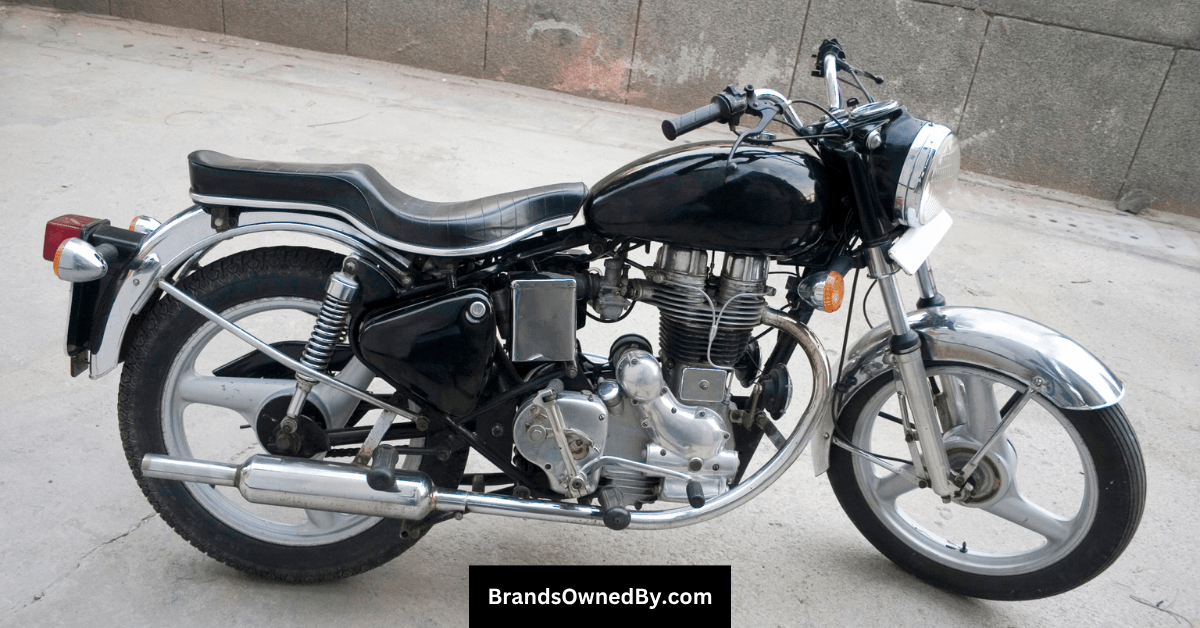
A practical example was the Floyd Clymer era during the 1960s. The company sold Royal Enfield-based motorcycles under the Indian name. Although this kept the brand alive, it did not fully restore Indian Motorcycle’s original market position.
IMC Ownership and Modern Revival (1999–2003)
A more serious revival effort began in 1999 when a new company called Indian Motorcycle Company of America (IMCA) acquired rights to the brand.
This ownership group attempted to rebuild Indian Motorcycle as a premium American motorcycle manufacturer.
Production restarted in Gilroy, California. The company introduced heavyweight cruiser motorcycles designed to compete directly with Harley-Davidson.
These motorcycles attracted attention because they restored classic Indian styling elements such as:
- Valanced fenders.
- Large V-twin engines.
- Retro-inspired designs.
- Traditional American cruiser styling.
Despite strong brand recognition, the company struggled financially. Manufacturing costs remained high while dealer expansion moved slowly.
In 2003, the company entered bankruptcy.
Stellican Limited Ownership (2004–2011)
In 2004, investment firm Stellican Limited acquired Indian Motorcycle.
This acquisition became one of the most important turning points in the brand’s modern history.
Stellican specialized in reviving historic premium brands. The company focused on rebuilding Indian Motorcycle carefully rather than chasing rapid expansion.
Production moved to Kings Mountain, North Carolina.
Under Stellican ownership, Indian Motorcycle improved:
- Product quality.
- Engineering reliability.
- Manufacturing standards.
- Brand positioning.
- Dealer relationships.
The company launched motorcycles with more modern engineering while preserving classic styling.
Although Indian Motorcycle still operated on a relatively small scale, the Stellican era restored credibility to the brand after years of instability.
Polaris Ownership Era (2011–2026)
In 2011, Polaris Industries acquired Indian Motorcycle.
This became the most transformative ownership period in the company’s modern history.
Polaris already had extensive experience in powersports manufacturing through brands such as Polaris Off-Road and Victory Motorcycles. The company invested heavily in Indian Motorcycle immediately after the acquisition.
Major Polaris investments included:
- New engine development.
- Dealer network expansion.
- Manufacturing modernization.
- Global distribution.
- Marketing campaigns.
- Product redesigns.
Polaris eventually discontinued Victory Motorcycles in 2017 and focused its motorcycle resources primarily on Indian Motorcycle.
Several major motorcycle platforms were launched during this period, including:
- Indian Scout.
- Indian Challenger.
- Indian FTR.
- Indian Pursuit.
- Redesigned Chief lineup.
A practical example of Polaris’ strategy was the development of the PowerPlus engine platform for the Challenger touring motorcycle. This allowed Indian Motorcycle to compete directly against Harley-Davidson touring bikes using liquid-cooled performance technology.
Under Polaris ownership, Indian Motorcycle significantly expanded global visibility and market share.
Carolwood LP Majority Ownership (2026–Present)
As of May 2026, Indian Motorcycle entered another major ownership transition.
In February 2026, Polaris completed the sale of a majority stake in Indian Motorcycle to private equity firm Carolwood LP. The transaction separated Indian Motorcycle from Polaris’ core corporate structure and allowed the company to operate more independently.
Following the transaction:
- Indian Motorcycle became a standalone motorcycle-focused business.
- Mike Kennedy became CEO of the company.
- Polaris retained a minority ownership stake.
- Carolwood LP became the controlling owner.
The new ownership structure is focused on:
- Expanding international growth.
- Strengthening dealer operations.
- Improving rider engagement.
- Accelerating product innovation.
- Increasing operational flexibility.
This marks the beginning of a new phase for Indian Motorcycle after nearly 15 years under Polaris ownership.
Who Owns Indian Motorcycle in 2026?
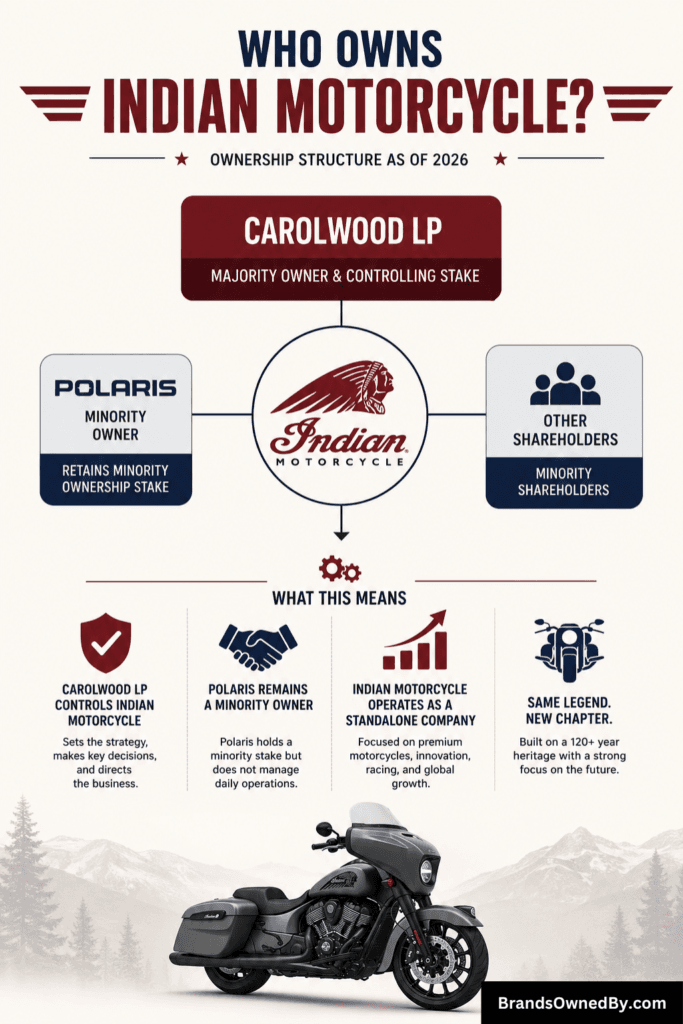
As of May 2026, Indian Motorcycle is primarily owned and controlled by private equity firm Carolwood LP. The company became the majority owner after acquiring a controlling stake in Indian Motorcycle from Polaris in February 2026.
Indian Motorcycle now operates as a standalone motorcycle business focused entirely on the premium motorcycle market. Although Polaris no longer controls the company, it still retains a minority ownership stake in the business.
This ownership transition represents one of the biggest structural changes in Indian Motorcycle’s modern history.
Parent Company: Carolwood LP
Indian Motorcycle’s parent company is now Carolwood LP, a private investment firm focused on long-term business growth and operational development.
Before the 2026 transaction, Indian Motorcycle operated as a wholly owned subsidiary of Polaris Inc. for nearly 15 years.
Under the new structure:
- Carolwood LP acts as the controlling owner.
- Polaris remains a minority investor.
- Indian Motorcycle operates with greater independence.
- The company has its own executive leadership team.
The new ownership model allows Indian Motorcycle to focus specifically on motorcycle operations rather than functioning as one division inside a broader powersports corporation.
This structure gives the company more flexibility in areas such as:
- Product planning.
- Dealer expansion.
- International growth.
- Brand partnerships.
- Motorcycle-focused investments.
A practical example of this shift is the creation of dedicated leadership teams focused entirely on Indian Motorcycle’s long-term motorcycle strategy rather than broader Polaris business priorities.
Carolwood LP Acquisition of Indian Motorcycle
In February 2026, private investment firm Carolwood LP acquired a majority stake in Indian Motorcycle from Polaris. This transaction officially made Carolwood LP the new parent company and controlling owner of Indian Motorcycle.
The acquisition marked one of the biggest ownership changes in the company’s modern history. For the first time since 2011, Indian Motorcycle stopped operating as a fully controlled Polaris subsidiary and became a standalone motorcycle-focused business.
Under the agreement:
- Carolwood LP became the majority owner.
- Polaris retained a minority ownership stake.
- Indian Motorcycle began operating independently.
- A dedicated executive leadership structure was introduced.
The deal was part of a broader restructuring strategy designed to position Indian Motorcycle for long-term growth in the global premium motorcycle market.
Why Carolwood LP Acquired Indian Motorcycle
Carolwood LP acquired Indian Motorcycle because of the brand’s strong heritage value, loyal customer base, and growth potential in the heavyweight motorcycle industry.
Indian Motorcycle is considered one of the most recognizable American motorcycle brands in the world. The company has a strong presence in:
- Premium touring motorcycles.
- Cruiser motorcycles.
- Performance motorcycles.
- Motorcycle accessories and apparel.
- Rider community events.
Carolwood viewed the company as a long-term strategic investment rather than a short-term financial asset.
The acquisition also gave Carolwood access to:
- An established global dealer network.
- Manufacturing infrastructure.
- Strong brand licensing opportunities.
- Premium customer demographics.
- Existing motorcycle platforms.
A practical example of the brand’s value is the Indian Scout lineup. The Scout series has become one of the company’s most important motorcycle families because it appeals to both younger riders and experienced cruiser customers.
Structure of the Acquisition
The acquisition was structured as a majority stake purchase rather than a complete buyout.
This means:
- Carolwood LP controls the company.
- Polaris still owns a minority interest.
- Indian Motorcycle operates with greater independence.
- Both companies remain financially connected.
The structure benefits both sides.
Carolwood gains operational control and long-term ownership influence. Polaris continues participating in future financial upside while reducing direct operational responsibilities.
This arrangement also reduces transition risk because Polaris can still support certain operational functions during the separation period.
Leadership Changes After the Acquisition
Following the acquisition, Indian Motorcycle introduced a new leadership structure focused entirely on motorcycle operations.
Mike Kennedy became CEO of Indian Motorcycle after the transaction.
His responsibilities include:
- Corporate strategy.
- Product planning.
- Dealer expansion.
- International growth.
- Brand development.
- Operational management.
The leadership transition is important because Indian Motorcycle now has executives focused solely on the motorcycle business rather than broader Polaris powersports operations.
This creates a more specialized management approach similar to standalone motorcycle manufacturers.
How the Acquisition Changes Indian Motorcycle’s Strategy
The Carolwood LP acquisition gives Indian Motorcycle more operational flexibility.
Under Polaris ownership, Indian Motorcycle competed internally for corporate resources alongside:
- Off-road vehicles.
- Snowmobiles.
- Marine businesses.
- Utility vehicles.
As a standalone company, Indian Motorcycle can now prioritize motorcycle-specific investments more aggressively.
Potential focus areas include:
- Faster product development.
- Expanded international distribution.
- Premium motorcycle innovation.
- Dealer network growth.
- Enhanced rider experiences.
- Stronger racing programs.
A practical example could be increased investment in performance touring motorcycles and next-generation cruiser platforms aimed directly at Harley-Davidson and European premium competitors.
Impact of the Acquisition on Dealers and Customers
The acquisition is also significant for dealers and riders.
Indian Motorcycle dealers now work with a company focused entirely on motorcycles rather than a diversified powersports corporation.
This could improve:
- Dealer support programs.
- Motorcycle inventory planning.
- Rider engagement initiatives.
- Brand marketing.
- Customer experience programs.
For customers, the acquisition is expected to preserve Indian Motorcycle’s heritage-focused identity while allowing the company to modernize more aggressively in technology and performance categories.
The company continues operating under the Indian Motorcycle name and maintains its existing motorcycle lineup after the ownership transition.
Long-Term Importance of the Acquisition
The Carolwood LP acquisition may shape the next phase of Indian Motorcycle’s global growth.
The company already established itself as Harley-Davidson’s strongest American heavyweight motorcycle competitor during the Polaris era. The new ownership structure is designed to help Indian Motorcycle expand further as an independent premium motorcycle manufacturer.
Industry analysts view the transaction as a strategic attempt to unlock faster motorcycle-focused growth while preserving the brand’s historic identity.
The success of the acquisition will likely depend on:
- Product innovation.
- Dealer expansion.
- International market penetration.
- Brand loyalty.
- Operational execution.
As of May 2026, Indian Motorcycle is entering a new era under Carolwood LP ownership with a stronger focus on specialized motorcycle operations and long-term premium brand development.
Competitor Ownership Comparison
Indian Motorcycle competes in the premium motorcycle industry, particularly in the heavyweight cruiser, touring, and performance motorcycle segments. The company faces competition from both American and international motorcycle manufacturers.
One major difference between Indian Motorcycle and many competitors is ownership structure. Some motorcycle brands operate independently, while others are controlled by large automotive groups, investment firms, or public corporations.
As of May 2026, Indian Motorcycle is majority owned by Carolwood LP, with Polaris retaining a minority stake. This ownership structure differs significantly from many of its rivals.
Understanding competitor ownership helps explain how motorcycle companies make decisions related to product development, manufacturing investment, pricing strategies, and international expansion.
| Motorcycle Brand | Parent Company / Owner | Ownership Type | Headquarters | Main Motorcycle Segments | Key Competitive Position Against Indian Motorcycle |
|---|---|---|---|---|---|
| Indian Motorcycle | Carolwood LP (majority owner) with minority stake held by Polaris | Privately controlled motorcycle company | United States | Cruisers, touring motorcycles, performance bikes | Competes through American heritage, premium touring bikes, and heavyweight cruisers |
| Harley-Davidson | Harley-Davidson, Inc. | Public company | United States | Heavyweight cruisers, touring motorcycles, custom bikes | Indian Motorcycle’s biggest direct American rival in the cruiser and touring market |
| Ducati | Audi AG (Volkswagen Group) | Subsidiary of global automotive group | Italy | Sport bikes, naked bikes, premium performance motorcycles | Competes more in premium performance and technology-focused categories |
| Triumph Motorcycles | Bloor Holdings | Private company | United Kingdom | Modern classics, adventure bikes, roadsters, cruisers | Competes in retro-inspired and premium motorcycle segments |
| BMW Motorrad | BMW Group | Subsidiary of automotive corporation | Germany | Touring bikes, adventure motorcycles, premium motorcycles | Competes through technology, luxury touring, and engineering innovation |
| Royal Enfield | Eicher Motors | Public company | India | Retro motorcycles, middleweight cruisers | Competes in heritage styling but at lower pricing and engine displacement |
| Honda Motorcycles | Honda Motor Co. | Public multinational corporation | Japan | Cruisers, touring bikes, commuters, sport bikes, adventure motorcycles | Competes through scale, reliability, and broad global product range |
| Yamaha Motorcycles | Yamaha Motor Co. | Public multinational corporation | Japan | Sport bikes, touring motorcycles, cruisers, adventure motorcycles | Competes through diversified motorcycle lineup and global reach |
| Kawasaki Motorcycles | Kawasaki Heavy Industries | Subsidiary division | Japan | Sport bikes, touring motorcycles, cruisers | Strong engineering and performance-focused competition |
| KTM | Pierer Mobility AG | Public company | Austria | Adventure motorcycles, naked bikes, off-road motorcycles | Competes mainly in performance and younger rider markets |
| Moto Guzzi | Piaggio Group | Subsidiary of public company | Italy | Heritage motorcycles, touring motorcycles | Competes through vintage styling and heritage branding similar to Indian Motorcycle |
Harley-Davidson Ownership Structure
Harley-Davidson is Indian Motorcycle’s biggest competitor in the United States.
Unlike Indian Motorcycle, Harley-Davidson operates as an independent publicly traded company called Harley-Davidson, Inc.
The company is listed on the New York Stock Exchange under the ticker symbol HOG. Ownership is distributed among:
- Institutional investors.
- Mutual funds.
- Asset management firms.
- Retail shareholders.
Major shareholders typically include large investment firms such as:
Because Harley-Davidson is publicly traded, the company faces constant pressure from shareholders regarding profitability, revenue growth, and market performance.
A practical example is Harley-Davidson’s strategic shift toward younger riders and electric motorcycles through its LiveWire division. Public market expectations heavily influenced those decisions.
Compared to Indian Motorcycle, Harley-Davidson operates with more direct shareholder pressure but greater corporate independence from a parent company.
Ducati Ownership Structure
Ducati is owned by Audi AG, which itself operates under the Volkswagen Group.
This makes Ducati part of one of the world’s largest automotive corporations.
The ownership structure gives Ducati access to:
- Advanced engineering resources.
- Global manufacturing expertise.
- Automotive technology sharing.
- Large-scale research and development funding.
Volkswagen acquired Ducati in 2012 through Audi.
Unlike Indian Motorcycle, Ducati benefits from direct integration with a massive global automotive ecosystem. However, the company mainly focuses on high-performance sport motorcycles rather than heavyweight American cruisers.
A practical example of this ownership advantage is Ducati’s continued investment in racing technology and electronics systems influenced by broader Volkswagen engineering capabilities.
Triumph Motorcycles Ownership Structure
Triumph Motorcycles is privately owned by Bloor Holdings, controlled by British businessman John Bloor.
Unlike Indian Motorcycle, Triumph remains under private ownership rather than institutional or corporate ownership.
This structure allows Triumph to focus heavily on long-term brand development without quarterly shareholder pressure.
Triumph competes with Indian Motorcycle in selected cruiser and touring segments but is more diversified across:
- Adventure motorcycles.
- Naked bikes.
- Sport motorcycles.
- Modern classic motorcycles.
The private ownership model gives Triumph greater flexibility in product experimentation and long-term investment planning.
BMW Motorrad Ownership Structure
BMW Motorrad is the motorcycle division of BMW Group.
The brand benefits from the resources of a global luxury automotive company.
BMW Motorrad has access to:
- Advanced engineering.
- Global manufacturing systems.
- Premium technology development.
- Luxury branding expertise.
Unlike Indian Motorcycle, BMW Motorrad operates as one division inside a diversified automotive corporation.
BMW competes with Indian Motorcycle mainly in touring and premium motorcycle categories.
A practical example is BMW’s investment in advanced rider assistance systems, adaptive electronics, and premium touring technology using resources shared across the broader BMW Group.
Royal Enfield Ownership Structure
Royal Enfield is owned by Eicher Motors, an Indian publicly traded automotive company.
Royal Enfield focuses heavily on retro-styled motorcycles and competes with Indian Motorcycle in heritage-inspired motorcycle segments.
However, Royal Enfield mainly targets mid-sized motorcycles at lower price points.
The ownership structure gives Royal Enfield access to:
- Large-scale manufacturing operations.
- International expansion funding.
- Global distribution growth.
In recent years, Royal Enfield expanded aggressively into Europe, Latin America, and North America.
Compared to Indian Motorcycle, Royal Enfield operates at much higher production volumes but lower average motorcycle pricing.
Honda Motorcycle Ownership Structure
Honda motorcycles are produced by Honda Motor Co., one of the world’s largest automotive and powersports manufacturers.
Honda operates as a publicly traded multinational corporation.
Its motorcycle division benefits from enormous manufacturing scale and global distribution infrastructure.
Honda competes across nearly every motorcycle category, including:
- Cruisers.
- Touring motorcycles.
- Sport bikes.
- Commuter motorcycles.
- Adventure motorcycles.
Unlike Indian Motorcycle, Honda focuses more heavily on mass-market global volume rather than premium American heritage positioning.
Honda’s ownership structure allows the company to spread research and development costs across multiple industries, including automobiles, robotics, and power equipment.
Yamaha Motorcycle Ownership Structure
Yamaha motorcycles are owned by Yamaha Motor Co., a Japanese multinational corporation.
Yamaha competes across a broad range of motorcycle categories globally.
The company benefits from:
- Global manufacturing scale.
- Strong motorsports involvement.
- Extensive engineering resources.
- Diversified powersports operations.
Unlike Indian Motorcycle, Yamaha’s business model focuses on high-volume international sales rather than primarily premium heavyweight motorcycles.
Yamaha’s ownership structure supports rapid product diversification and international expansion.
Indian Motorcycle’s Competitive Ownership Advantage
Indian Motorcycle’s current ownership model combines characteristics of both private ownership and strategic corporate backing.
The company benefits from:
- Motorcycle-focused leadership.
- Reduced public shareholder pressure.
- Premium brand specialization.
- Continued minority support from Polaris.
This structure may allow Indian Motorcycle to make longer-term strategic decisions without facing the same quarterly market pressures as publicly traded competitors like Harley-Davidson.
At the same time, the company still benefits from operational experience developed during the Polaris ownership era.
A practical example is Indian Motorcycle’s ability to focus aggressively on premium touring motorcycles and rider experience initiatives without balancing unrelated off-road or automotive business priorities.
Who Controls Indian Motorcycle?
As of May 2026, Indian Motorcycle is controlled by Los Angeles-based private equity firm Carolwood LP, which officially assumed ownership control of the company on February 2, 2026.
The company no longer operates as a division of Polaris. Instead, Indian Motorcycle now functions as a standalone motorcycle manufacturer with its own executive leadership, operational structure, and motorcycle-focused business strategy.
Carolwood LP controls Indian Motorcycle through majority ownership, executive appointments, and strategic oversight of the company’s long-term operations.
Indian Motorcycle currently operates under a mixed ownership model.
| Stakeholder | Role in Control Structure |
|---|---|
| Carolwood LP | Majority owner and controlling stakeholder |
| Polaris Inc. | Minority equity holder |
| Indian Motorcycle Executive Team | Responsible for day-to-day operations and business execution |
Carolwood LP has final authority over:
- Corporate strategy.
- Executive leadership decisions.
- Capital allocation.
- Long-term expansion plans.
- Operational restructuring.
- Product investment priorities.
Polaris still holds a minority stake but no longer controls the company’s operations or strategic direction.
CEO of Indian Motorcycle
As of May 2026, Mike Kennedy serves as CEO of Indian Motorcycle.
He was appointed during the separation from Polaris and now leads the standalone company under Carolwood ownership.
Kennedy is not a generic corporate executive brought in from outside the industry. He has over 35 years of motorcycle industry experience and previously held leadership positions at:
- Harley-Davidson.
- Vance & Hines.
- RumbleOn / RideNow Powersports.
His appointment was a major signal that Carolwood intended to run Indian Motorcycle as a serious long-term motorcycle business rather than a short-term financial investment.
Kennedy directly oversees:
- Product strategy.
- Dealer operations.
- Manufacturing direction.
- Brand positioning.
- Racing activities.
- International expansion.
He reports to the ownership group at Carolwood LP.
Indian Motorcycle’s Leadership Priorities Under Mike Kennedy
Following the February 2026 acquisition, Kennedy publicly outlined four specific operational priorities for Indian Motorcycle.
1. Cruiser and Touring Market Share Growth
Kennedy stated that Indian Motorcycle intends to aggressively increase market share in:
- Cruisers.
- Middleweight baggers.
- Heavyweight touring motorcycles.
This places the company in direct competition with Harley-Davidson’s core business.
The strategy focuses heavily on premium American V-twin motorcycles rather than expanding into unrelated vehicle categories.
2. American Manufacturing Control
One of the biggest operational decisions under the new leadership structure is the consolidation of manufacturing around U.S. facilities.
As of 2026, Indian Motorcycle’s production operations are centered in:
| Facility | Function |
|---|---|
| Spirit Lake, Iowa | Main motorcycle manufacturing |
| Monticello, Minnesota | Aluminum casting and machining |
| Wyoming, Minnesota | Engineering and product development |
| Burgdorf, Switzerland | Design and technology development |
Kennedy stated that the company plans to lean heavily into its “Built in America” positioning as a competitive advantage.
This manufacturing-focused strategy is now part of Indian Motorcycle’s core control structure and brand identity.
3. Dealer-Centric Operating Model
Kennedy repeatedly emphasized that dealer success will become a primary business metric under the new ownership structure.
Indian Motorcycle now operates with a stronger dealer-driven decision model.
The company’s leadership structure includes direct collaboration with dealers on:
- Product planning.
- Inventory management.
- Marketing initiatives.
- Customer experience programs.
This is a notable shift from traditional centralized corporate management systems.
4. Motorcycle-Only Strategic Focus
One of the biggest operational changes after the Carolwood acquisition is that Indian Motorcycle is no longer competing internally for resources against unrelated Polaris divisions.
Under Polaris, Indian Motorcycle shared corporate priorities with:
- Off-road vehicles.
- Snowmobiles.
- Marine businesses.
- Utility vehicles.
Under Carolwood, the company is now singularly focused on motorcycles.
Kennedy specifically stated that the new structure allows Indian Motorcycle to react faster to market conditions and product opportunities.
Size of the Standalone Company
The standalone Indian Motorcycle company now includes approximately 900 employees who transitioned from Polaris after the acquisition closed in February 2026.
These employees work across:
- Manufacturing.
- Engineering.
- Product development.
- Sales.
- Dealer support.
- Marketing.
- Racing operations.
The transition effectively created a dedicated motorcycle-focused organization instead of a motorcycle division inside a broader powersports corporation.
Racing and Performance Control
Performance and racing operations now play a larger role in Indian Motorcycle’s leadership strategy.
The company continues supporting:
- King of the Baggers racing.
- Flat-track competition.
- Performance partnerships.
Mike Kennedy specifically confirmed continued collaboration with Vance & Hines in racing programs after the acquisition.
This is important because racing serves as both:
- Brand marketing.
- Product development testing.
The leadership team views racing as part of Indian Motorcycle’s long-term identity rather than a side marketing project.
Decision-Making Structure After Polaris Separation
The control structure changed significantly after the separation from Polaris.
Under Polaris (2011–2026)
Indian Motorcycle operated as a division inside a diversified powersports corporation.
Major decisions often passed through Polaris corporate leadership and broader operational priorities.
Under Carolwood LP (2026–Present)
Indian Motorcycle now operates with:
- Independent executive leadership.
- Dedicated motorcycle-focused strategy.
- Standalone operational planning.
- Faster product decision-making.
- Direct ownership oversight.
This gives the company more flexibility in responding to motorcycle market trends.
A practical example is Kennedy’s decision to simplify portions of the product lineup to improve dealer efficiency and inventory management.
How Much Influence Does Polaris Still Have?
Polaris retains a minority equity position in Indian Motorcycle, but it no longer controls:
- Corporate leadership.
- Product direction.
- Market strategy.
- Daily operations.
However, Polaris may still maintain limited influence through transitional agreements, operational partnerships, or manufacturing support relationships.
The company’s operational control now clearly rests with:
- Carolwood LP as majority owner.
- Mike Kennedy and the executive leadership team.
- Independent Indian Motorcycle management operations.
Strategic Direction as of May 2026
Indian Motorcycle’s current control structure is centered around becoming a stronger premium American motorcycle company with tighter operational focus.
The leadership team is prioritizing:
- Heavyweight motorcycle growth.
- Dealer relationships.
- American manufacturing.
- Product differentiation.
- Touring motorcycle expansion.
- Rider-focused brand culture.
Unlike some competitors pursuing aggressive diversification into electric mobility or entry-level motorcycles, Indian Motorcycle’s current leadership is focused primarily on strengthening its core cruiser and touring business.
Indian Motorcycle Annual Revenue and Net Worth
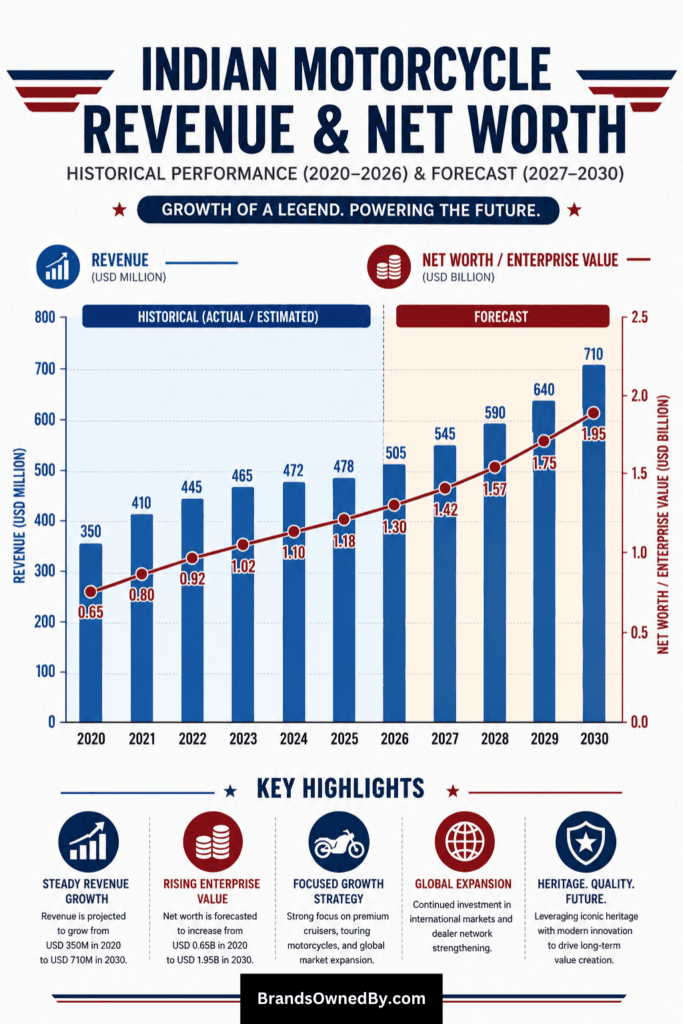
As of May 2026, Indian Motorcycle generates an estimated annual revenue of $505 million and carries an estimated enterprise value of approximately $1.3 billion following the Carolwood LP acquisition.
The company remains one of the largest premium American motorcycle brands after Harley-Davidson. Revenue is heavily concentrated in heavyweight touring motorcycles, cruiser motorcycles, accessories, apparel, and financing-related dealer operations.
The 2026 restructuring significantly changed the company’s financial profile because Indian Motorcycle now operates as a standalone motorcycle business instead of a division inside Polaris.
Indian Motorcycle Revenue in 2026
Indian Motorcycle’s estimated 2026 revenue of $505 million is primarily generated from four major business segments.
Touring Motorcycle Revenue
Estimated 2026 touring motorcycle revenue: $222 million.
Touring motorcycles remain Indian Motorcycle’s largest revenue category and account for roughly 44% of total annual revenue.
The main touring models include:
- Indian Challenger.
- Indian Pursuit.
- Indian Roadmaster.
- Indian Springfield.
These motorcycles typically sell between $25,000 and $40,000 depending on trim levels, customization, and accessory packages.
The Challenger and Pursuit platforms generate particularly strong revenue because they compete directly in the high-margin American bagger and touring market dominated by Harley-Davidson.
Industry registration estimates suggest touring motorcycles represented approximately 8,800 to 9,200 units globally during the 2025–2026 sales cycle.
Average transaction values are significantly higher than cruiser motorcycles because touring customers purchase:
- Factory-installed infotainment systems.
- Touring luggage systems.
- Heated seats and grips.
- Premium audio packages.
- Extended warranties.
- Dealer customization packages.
Touring motorcycles also generate the company’s highest per-unit profitability.
Cruiser Motorcycle Revenue
Estimated 2026 cruiser motorcycle revenue: $176 million.
Cruiser motorcycles account for approximately 35% of total annual revenue.
The largest contributors include:
- Indian Scout lineup.
- Indian Chief lineup.
- Super Chief models.
The Scout platform remains Indian Motorcycle’s highest-volume motorcycle family worldwide.
Average pricing ranges between $13,000 and $23,000 depending on configuration and trim.
The Scout lineup generates high sales volume because it appeals to:
- First-time premium motorcycle buyers.
- Younger riders.
- Urban cruiser customers.
- Female riders entering heavyweight motorcycles.
Industry analysts estimate Indian Motorcycle sold approximately 11,000 to 12,000 Scout-family motorcycles globally in 2025.
The Chief lineup generates lower unit volume but higher average selling prices.
Cruiser revenue also benefits heavily from customization spending because buyers frequently purchase:
- Performance exhaust systems.
- Handlebars.
- Seats.
- Wheels.
- Paint upgrades.
Parts, Garments, and Accessories Revenue
Estimated 2026 PG&A revenue: $72 million.
PG&A stands for Parts, Garments, and Accessories.
This segment contributes approximately 14% of annual company revenue but produces significantly higher gross margins than motorcycle manufacturing.
The category includes:
- Riding jackets.
- Helmets.
- Branded apparel.
- Touring accessories.
- Performance upgrades.
- Saddlebags.
- Exhaust systems.
- Rider electronics.
Industry analysts estimate the average Indian Motorcycle touring customer spends between $2,500 and $4,000 on accessories and upgrades within the first 18 months of ownership.
The company’s strongest PG&A revenue drivers in 2026 include:
- Touring luggage systems.
- Audio upgrades.
- Performance exhaust kits.
- Limited-edition riding apparel.
The aftermarket business remains strategically important because it generates recurring revenue after motorcycle purchases.
Dealer Services and Licensing Revenue
Estimated 2026 dealer services and licensing revenue: $35 million.
This category includes:
- Dealer financing support.
- Licensing agreements.
- Branded merchandise partnerships.
- Rider event programs.
- Extended service contracts.
Indian Motorcycle also generates licensing income through partnerships involving:
- Lifestyle merchandise.
- Collectibles.
- Co-branded accessories.
The company’s historic brand identity gives it stronger licensing power than many newer motorcycle manufacturers.
Indian Motorcycle Net Worth in 2026
As of May 2026, Indian Motorcycle’s estimated enterprise value and net worth are approximately $1.3 billion.
This valuation is based on operational assets, brand value, dealer infrastructure, intellectual property, and long-term market positioning.
Brand Valuation
Estimated brand equity value: $520 million.
Indian Motorcycle’s heritage remains one of its most valuable assets.
The company was founded in 1901 and is marketed as America’s first motorcycle company.
The brand valuation reflects:
- Historic market recognition.
- Premium positioning.
- Strong customer loyalty.
- Long-term licensing potential.
Indian Motorcycle’s heritage positioning allows the company to maintain premium pricing compared to many competitors.
Manufacturing and Operational Assets
Estimated operational asset value: $340 million.
Indian Motorcycle’s manufacturing and engineering infrastructure includes major facilities in:
| Facility | Operational Role |
|---|---|
| Spirit Lake, Iowa | Final motorcycle assembly |
| Monticello, Minnesota | Engine casting and machining |
| Wyoming, Minnesota | Engineering and R&D |
| Burgdorf, Switzerland | Design and technology development |
The company transitioned roughly 900 employees into the standalone business following the Carolwood LP acquisition.
Manufacturing assets contribute heavily to enterprise valuation because premium motorcycle production requires specialized tooling, engine development capability, and supplier integration.
Dealer Network and Distribution Value
Estimated dealer and distribution network value: $240 million.
Indian Motorcycle maintains one of the largest premium motorcycle dealer networks in North America outside Harley-Davidson.
The company operates hundreds of dealerships globally across:
- United States.
- Canada.
- Europe.
- Australia.
- Middle East markets.
Dealer relationships are financially valuable because dealerships generate:
- Vehicle sales.
- Service revenue.
- Financing contracts.
- PG&A sales.
- Long-term customer retention.
Intellectual Property and Technology Assets
Estimated IP and technology asset value: $200 million.
Indian Motorcycle owns valuable intellectual property related to:
- Thunderstroke engines.
- PowerPlus engines.
- Motorcycle platform architecture.
- Design patents.
- Brand trademarks.
- Rider technology systems.
The PowerPlus liquid-cooled engine platform significantly increased the company’s valuation because it gave Indian Motorcycle stronger competitive positioning against Harley-Davidson touring motorcycles.
Indian Motorcycle Revenue Forecast Through 2030
Industry analysts expect Indian Motorcycle’s revenue to continue growing under Carolwood LP ownership, although the company still faces challenges related to global heavyweight motorcycle demand and international diversification.
2027 Forecast
- Estimated revenue: $545 million.
- Estimated net worth: $1.42 billion.
Forecast growth is expected to come from increased touring motorcycle production and expanded dealer penetration in Europe and Australia.
Industry analysts also expect higher accessory revenue because touring customers continue increasing customization spending.
Projected 2027 revenue mix:
- Touring motorcycles: $248 million.
- Cruiser motorcycles: $188 million.
- PG&A: $82 million.
- Dealer services and licensing: $27 million.
2028 Forecast
- Estimated revenue: $590 million.
- Estimated net worth: $1.57 billion.
Analysts expect Indian Motorcycle to launch updated touring platforms between late 2027 and 2028.
Projected growth drivers include:
- New touring platform upgrades.
- Expanded premium trim offerings.
- Increased PowerPlus engine adoption.
- Higher international sales volume.
Projected 2028 revenue mix:
- Touring motorcycles: $272 million.
- Cruiser motorcycles: $198 million.
- PG&A: $90 million.
- Dealer services and licensing: $30 million.
2029 Forecast
- Estimated revenue: $640 million.
- Estimated net worth: $1.75 billion.
The company is expected to focus aggressively on international premium motorcycle markets during this period.
Expected expansion regions include:
- Germany.
- United Kingdom.
- UAE.
- Australia.
- Brazil.
Projected 2029 revenue mix:
- Touring motorcycles: $301 million.
- Cruiser motorcycles: $208 million.
- PG&A: $98 million.
- Dealer services and licensing: $33 million.
2030 Forecast
- Estimated revenue: $710 million.
- Estimated net worth: $1.95 billion.
The 2030 forecast assumes Indian Motorcycle successfully strengthens its position as the second-largest premium American motorcycle manufacturer globally.
Projected 2030 revenue mix:
- Touring motorcycles: $340 million.
- Cruiser motorcycles: $225 million.
- PG&A: $108 million.
- Dealer services and licensing: $37 million.
The long-term forecast assumes:
- Continued touring motorcycle growth.
- Higher dealer profitability.
- Expanded international distribution.
- Increased premium accessory spending.
- Stable heavyweight motorcycle demand in North America.
Brands Owned by Polaris
As of 2026, Indian Motorcycle operates primarily as a focused premium motorcycle company rather than a diversified conglomerate with dozens of independent subsidiaries. Unlike larger automotive groups, Indian Motorcycle’s business structure revolves around internally controlled motorcycle platforms, performance programs, licensing divisions, rider communities, racing operations, and branded product ecosystems.
It does not own major standalone automotive subsidiaries. Instead, it operates several motorcycle brands, proprietary engine families, factory programs, licensing operations, and performance divisions directly under the Indian Motorcycle business structure.
Its operations are concentrated around:
- Motorcycle platforms.
- Proprietary engine families.
- Factory racing programs.
- Rider organizations.
- Branded apparel.
- Licensing businesses.
- Customization divisions.
- Performance development initiatives.
Below are the major entities, brands, and operational divisions controlled directly by Indian Motorcycle as of 2026:
| Brand / Entity | Category | Primary Products / Operations | Strategic Role Within Indian Motorcycle | Estimated 2026 Contribution / Importance |
|---|---|---|---|---|
| Indian Scout | Cruiser motorcycle brand | Scout Bobber, Scout Rogue, Sport Scout, Scout Sixty | Highest-volume motorcycle platform targeting younger and mid-tier premium riders | Estimated $110 million–$125 million annual revenue |
| Indian Chief | Heavyweight cruiser brand | Chief Dark Horse, Sport Chief, Super Chief | Core heritage cruiser lineup competing against Harley-Davidson Softail models | Estimated $70 million–$85 million annual revenue |
| Indian Challenger | Performance touring and bagger brand | Challenger Limited, Challenger Dark Horse, Challenger Elite | Main performance touring platform built around PowerPlus engine | Estimated $95 million+ annual revenue |
| Indian Pursuit | Luxury touring motorcycle brand | Pursuit Limited, Pursuit Dark Horse, Pursuit Elite | Premium long-distance touring lineup with high-margin accessories and upgrades | Estimated $55 million–$65 million annual revenue |
| Indian Roadmaster | Heritage touring motorcycle brand | Roadmaster Limited, Roadmaster Elite | Traditional American luxury touring motorcycle platform | Estimated $40 million–$50 million annual revenue |
| Indian Springfield | Touring cruiser brand | Springfield Dark Horse, Springfield touring models | Mid-range touring cruiser platform balancing heritage styling and lighter touring capability | Strong North American dealer demand |
| Indian FTR | Performance street motorcycle brand | FTR Sport, FTR Carbon, FTR R Carbon | Expands company presence into sport and naked motorcycle segments | Important for younger rider acquisition and European markets |
| PowerPlus Engine Platform | Proprietary engine division | Liquid-cooled V-twin touring engines | Powers Challenger, Pursuit, and racing motorcycles | Major technology and performance asset |
| Thunderstroke Engine Platform | Proprietary engine division | Air-cooled V-twin cruiser engines | Powers heritage cruiser and touring motorcycles | Core heritage engine platform |
| Indian Motorcycle Racing | Factory racing division | King of the Baggers and flat-track racing programs | Supports performance branding and motorcycle development | Critical for marketing and performance credibility |
| Indian Motorcycle Riders Group (IMRG) | Rider community organization | Dealer-supported rider chapters and events | Builds rider loyalty, repeat purchases, and dealer engagement | Major customer retention ecosystem |
| Indian Motorcycle Apparel Division | Apparel and merchandise division | Riding gear, jackets, helmets, lifestyle apparel | Generates recurring high-margin merchandise revenue | Important PG&A revenue contributor |
| Indian Motorcycle Licensing Division | Licensing and partnerships | Lifestyle merchandise and co-branded products | Expands monetization beyond motorcycle sales | Supports global brand visibility |
| Indian Motorcycle Custom Accessories | Aftermarket accessories business | Exhaust systems, luggage, seats, handlebars, electronics | Drives post-purchase customer spending and dealer profitability | High-margin recurring revenue stream |
| Indian Motorcycle Touring Division | Touring motorcycle operations | Challenger, Pursuit, Roadmaster touring ecosystem | Largest revenue-generating motorcycle category | Approximately 44% of total company revenue |
| Indian Motorcycle Cruiser Division | Cruiser motorcycle operations | Scout and Chief motorcycle ecosystem | Largest unit-volume motorcycle segment | Approximately 35% of total company revenue |
| Indian Motorcycle PG&A Operations | Parts, Garments, and Accessories division | Apparel, accessories, performance upgrades | High-margin recurring aftermarket business | Approximately 14%–18% of total revenue |
| Indian Motorcycle International Operations | Global expansion division | Dealer expansion and overseas distribution | Expands market penetration outside North America | Focused on Europe, Australia, UAE, and Latin America |
Indian Scout
Indian Scout is the company’s highest-volume motorcycle brand and one of its most commercially important product families.
The Scout lineup operates as Indian Motorcycle’s entry-to-mid premium cruiser platform. It targets younger riders, urban cruiser buyers, and first-time premium motorcycle customers.
The Scout family includes:
- Scout Bobber.
- Scout Rogue.
- Sport Scout.
- Super Scout.
- Scout Sixty.
As of 2026, the Scout lineup generates an estimated $110 million to $125 million in annual revenue globally.
The platform remains strategically important because it introduces customers into the Indian Motorcycle ecosystem at lower price points compared to full touring motorcycles.
Scout motorcycles are heavily tied to the company’s customization and accessories business because owners frequently purchase:
- Performance exhaust systems.
- Seats.
- Handlebars.
- Saddlebags.
- Lighting upgrades.
- Cosmetic kits.
The Scout family also plays a major role in expanding Indian Motorcycle internationally because middleweight cruisers perform better than heavyweight touring motorcycles in many global markets.
Indian Chief
Indian Chief is one of the company’s flagship heavyweight cruiser brands.
The Chief lineup represents Indian Motorcycle’s classic American V-twin identity and directly competes against Harley-Davidson Softail motorcycles.
The lineup includes:
- Chief Dark Horse.
- Sport Chief.
- Super Chief.
- Chief Bobber.
As of 2026, the Chief platform generates an estimated $70 million to $85 million annually.
The Sport Chief became especially important after its launch because it targeted performance-oriented cruiser riders rather than traditional touring buyers.
The Chief lineup also serves as a major platform for limited-edition customization and premium factory upgrades.
Indian Challenger
Indian Challenger operates as Indian Motorcycle’s primary performance touring and bagger motorcycle brand.
The platform was developed specifically to compete against Harley-Davidson’s Road Glide lineup.
The Challenger lineup includes:
- Challenger Dark Horse.
- Challenger Limited.
- Challenger Elite.
As of 2026, Challenger motorcycles represent one of the company’s highest-revenue platforms with estimated annual revenue exceeding $95 million.
The platform is built around the company’s liquid-cooled PowerPlus engine architecture, which significantly modernized Indian Motorcycle’s touring performance capabilities.
The Challenger also became central to Indian Motorcycle’s King of the Baggers racing strategy.
This motorcycle family plays a critical role in attracting younger touring riders seeking performance-focused American touring motorcycles.
Indian Pursuit
Indian Pursuit is the company’s luxury touring motorcycle brand.
The platform was launched to compete in the premium long-distance touring segment dominated by Harley-Davidson Ultra Limited and Honda Gold Wing models.
Pursuit motorcycles include:
- Pursuit Limited.
- Pursuit Dark Horse.
- Pursuit Elite.
As of 2026, the Pursuit lineup generates estimated annual revenue of $55 million to $65 million.
These motorcycles carry some of the highest average transaction prices in the company’s portfolio, often exceeding $35,000 after accessories and touring upgrades.
The Pursuit lineup is especially profitable because touring customers typically spend heavily on:
- Premium audio systems.
- Luggage upgrades.
- Heated touring equipment.
- Extended warranties.
- Rider accessories.
Indian Roadmaster
Indian Roadmaster operates as the company’s heritage-focused luxury touring motorcycle brand.
The Roadmaster lineup targets traditional American touring customers seeking classic styling combined with premium touring comfort.
The lineup includes:
- Roadmaster Limited.
- Roadmaster Dark Horse.
- Roadmaster Elite.
Roadmaster motorcycles continue generating strong revenue despite increasing competition from newer touring platforms.
As of 2026, the Roadmaster family contributes an estimated $40 million to $50 million annually.
The brand remains important because it preserves Indian Motorcycle’s traditional styling identity.
Indian Springfield
Indian Springfield serves as the company’s classic touring cruiser platform positioned between heavyweight cruisers and full luxury touring motorcycles.
The Springfield lineup appeals heavily to riders seeking:
- Simpler touring motorcycles.
- Traditional styling.
- Lower weight compared to full dress touring bikes.
The Springfield brand remains smaller than the Challenger or Pursuit families but continues contributing steady revenue and strong dealer demand.
Indian FTR
Indian FTR is Indian Motorcycle’s performance street motorcycle and flat-track-inspired brand.
The platform was originally developed based on the company’s successful flat-track racing motorcycles.
The lineup includes:
- FTR Sport.
- FTR Carbon.
- FTR R Carbon.
- FTR x 100% R Carbon.
The FTR lineup is strategically important because it allows Indian Motorcycle to compete outside traditional cruiser segments.
The platform targets:
- Younger riders.
- Sport-oriented customers.
- European-style naked bike buyers.
Although FTR volume is smaller than Scout or Chief motorcycles, the platform significantly improves the company’s performance image globally.
PowerPlus Engine Platform
PowerPlus is Indian Motorcycle’s liquid-cooled V-twin engine platform.
The company developed this engine architecture internally to compete directly against Harley-Davidson’s modern touring platforms.
As of 2026, PowerPlus engines power:
- Challenger motorcycles.
- Pursuit motorcycles.
- King of the Baggers race bikes.
The PowerPlus platform is considered one of the company’s most valuable proprietary technology assets.
The engine significantly improved Indian Motorcycle’s:
- Performance reputation.
- Racing competitiveness.
- Touring capability.
- Premium positioning.
Thunderstroke Engine Platform
Thunderstroke is Indian Motorcycle’s traditional air-cooled V-twin engine family.
The platform powers many of the company’s heritage-oriented motorcycles including:
- Chief models.
- Springfield motorcycles.
- Roadmaster motorcycles.
Thunderstroke engines are designed to preserve classic American cruiser styling and riding characteristics.
The engine platform remains commercially important because many Indian Motorcycle customers prefer traditional air-cooled V-twin motorcycles over modern liquid-cooled alternatives.
Indian Motorcycle Racing
Indian Motorcycle Racing operates as the company’s official factory racing division.
The racing division oversees participation in:
- King of the Baggers.
- American Flat Track.
- Performance development programs.
As of 2026, racing operations play a major strategic role in the company’s marketing and product development strategy.
The division works closely with:
- S&S Cycle.
- Performance engineering partners.
- Professional race teams.
Indian Motorcycle Racing helped establish the company’s performance credibility against Harley-Davidson and other competitors.
Indian Motorcycle Riders Group (IMRG)
The Indian Motorcycle Riders Group, commonly called IMRG, is the company’s official rider community and ownership organization.
The program operates globally through dealer-supported riding chapters.
IMRG helps Indian Motorcycle strengthen:
- Customer retention.
- Dealer relationships.
- Brand loyalty.
- Rider engagement.
The organization hosts:
- Group rides.
- National events.
- Touring rallies.
- Community meetups.
This rider ecosystem is financially valuable because highly engaged motorcycle communities often generate stronger repeat purchase behavior.
Indian Motorcycle Apparel and Licensing Division
Indian Motorcycle also operates a major branded apparel and licensing business.
The company sells:
- Riding jackets.
- Helmets.
- Gloves.
- Casual apparel.
- Lifestyle merchandise.
- Heritage collections.
The apparel division benefits heavily from Indian Motorcycle’s historical American identity.
As of 2026, the company continues expanding co-branded partnerships and premium lifestyle merchandise programs globally.
Final Words
Indian Motorcycle remains one of the most influential American motorcycle brands in the premium cruiser and touring market. For anyone wondering who owns Indian Motorcycle, the company now operates under Carolwood LP while continuing to build on more than a century of motorcycle heritage.
The brand’s strength comes from its combination of classic American styling, modern engineering, strong touring platforms, and loyal rider community. With motorcycles like the Scout, Chief, Challenger, and Pursuit, Indian Motorcycle continues to compete directly with the biggest names in the industry while maintaining its own distinct identity.
FAQs
Who bought Indian Motorcycle company?
Indian Motorcycle was bought by private investment firm Carolwood LP in 2026 after the company acquired a controlling stake from Polaris. Before that, Polaris Industries owned Indian Motorcycle from 2011 to 2026 and played a major role in rebuilding the brand into a leading American motorcycle manufacturer.
Is Indian Motorcycle going out of business?
No, Indian Motorcycle is not going out of business. The company continues operating as a standalone premium motorcycle manufacturer with active production, global dealerships, racing programs, and new motorcycle development. The 2026 ownership transition to Carolwood LP was a strategic restructuring move rather than a shutdown or bankruptcy.
Who owns Indian Motorcycle now?
As of 2026, Indian Motorcycle is majority owned by Carolwood LP. Polaris still holds a minority ownership stake, but Carolwood controls the company’s operations, leadership, and long-term strategy.
Who owned Indian motorcycles before Polaris?
Before Polaris acquired Indian Motorcycle in 2011, the company was owned by Stellican Limited, a private investment group focused on reviving heritage brands. Earlier in its history, Indian Motorcycle also passed through multiple owners and revival companies after the original business shut down in 1953.
Why is Indian Motorcycle named Indian?
The company was named Indian Motorcycle in the early 1900s because the founders wanted a name that reflected American identity and heritage. During that era, many companies used Native American-themed branding to market products as uniquely American. The name became one of the most recognizable motorcycle brand identities in the United States.
Where are Indian motorcycles made?
Indian motorcycles are primarily manufactured in Spirit Lake, Iowa, United States. The company also operates engineering, casting, and product development facilities in Minnesota and maintains a technology and design center in Switzerland.