
- Erewhon Market is primarily owned and controlled by the Antoci family, which holds an estimated 70%–80% majority stake in the company as of 2026.
- Tony Antoci serves as CEO and is the leading decision-maker behind Erewhon’s expansion, luxury wellness branding, and long-term business strategy, while Josephine Antoci plays a major role in brand identity, customer experience, and celebrity-driven marketing initiatives.
- Stripes is Erewhon’s largest outside investor and holds an estimated 20%–30% minority stake after investing in the company to support expansion and operational growth.
- Erewhon remains a privately owned company rather than a publicly traded corporation, allowing its owners to maintain strong control over pricing strategy, store expansion, luxury positioning, and long-term brand development without pressure from public shareholders.
Erewhon Market is a luxury organic grocery chain headquartered in Los Angeles. The company is known for selling premium organic groceries, wellness products, supplements, prepared meals, and health-focused beverages. It has built a strong reputation for strict ingredient standards and high-quality natural products.
The brand mainly operates in Southern California. Its stores attract health-conscious consumers, celebrities, athletes, and social media influencers. Erewhon has become widely recognized for combining luxury retail with wellness culture.
Unlike traditional supermarkets, Erewhon focuses heavily on curated shopping experiences. Many stores include tonic bars, organic cafes, wellness sections, and ready-to-eat health meals. The company carefully selects products that align with its organic and clean-label standards.
Erewhon also became highly popular through social media marketing and celebrity collaborations. Its limited-edition smoothies and wellness drinks often go viral online, helping the brand gain international attention.
Erewhon Founders
Erewhon was originally founded in 1966 by Aveline Kushi and Michio Kushi. The couple was major supporter of the macrobiotic movement in the United States.
They created Erewhon as part of their mission to promote healthier eating habits and natural living. The store focused on organic foods, whole grains, and macrobiotic products at a time when health food stores were still uncommon in America.
The name “Erewhon” came from the novel Erewhon written by Samuel Butler. The word is famously interpreted as “nowhere” spelled almost backward.
The founders helped introduce many Americans to alternative nutrition and natural food products. Their influence played an important role in the early growth of the organic food industry in the United States.
Erewhon operates as a premium wellness-focused grocery retailer. The company emphasizes exclusivity, organic sourcing, and luxury customer experiences rather than competing on low prices.
Its business model combines grocery retail with lifestyle branding. Customers visit not only for groceries but also for wellness experiences, prepared foods, and trendy health products.
The company also benefits from influencer marketing and celebrity partnerships. These collaborations help Erewhon maintain strong brand visibility and cultural relevance in the luxury wellness market.
Ownership History
The ownership history of Erewhon Market spans several decades and reflects the evolution of the organic food industry in the United States. The company started as a small health-food business connected to the macrobiotic movement. Over time, it transformed into one of the most recognizable luxury wellness grocery chains in America.
As of April 2026, Erewhon remains a privately controlled company led primarily by the Antoci family, with outside investment support from growth equity firm Stripes.
The Founding Ownership Structure (1966–1979)
Erewhon was founded in 1966 by Michio Kushi and Aveline Kushi in Boston. The founders were major advocates of macrobiotic diets and holistic wellness practices.
The original business focused on natural foods, organic ingredients, and macrobiotic products. During the 1960s, organic grocery retail was still a niche industry in the United States. Erewhon became one of the early pioneers of the natural foods movement.
The founders controlled the company directly during its early years. Their mission centered on promoting healthy eating habits and educating consumers about natural nutrition.
The company later expanded operations to California. In 1969, the founders opened the Fairfax District location in Los Angeles, which eventually became the brand’s most historically important store.
Bankruptcy and Ownership Transition (1979)
Despite its strong identity in the health-food industry, the company faced financial difficulties during the late 1970s. Competition increased and operational challenges hurt profitability.
In 1979, Erewhon went through bankruptcy-related struggles. During this period, employee Tom DeSilva acquired the business from bankruptcy proceedings.
This ownership change helped keep the Erewhon brand alive during a difficult period for independent natural-food retailers.
Under DeSilva’s ownership, the business remained relatively small and localized. The company preserved its reputation among health-conscious consumers, but it did not expand aggressively like larger grocery chains entering the organic market.
Years of Limited Growth and Market Pressure
Throughout the 1980s, 1990s, and early 2000s, Erewhon remained a niche organic grocery business in Southern California.
During this period, competitors such as Whole Foods Market expanded rapidly across the United States. Traditional supermarkets also started adding organic food sections, which increased competitive pressure on smaller independent chains.
Erewhon struggled to scale at the same pace as larger grocery retailers. The brand maintained a loyal customer base but lacked the modern branding and expansion strategy needed for national recognition.
By the late 2000s, the company had become a relatively small operation compared to major organic grocery competitors.
Acquisition by Tony and Josephine Antoci (2011)
A major turning point came in 2011 when Tony Antoci and Josephine Antoci acquired Erewhon from the DeSilva family. At the time, the business had only one remaining store in the Fairfax District of Los Angeles.
The Antoci family believed the Erewhon brand still had enormous potential. Instead of operating it as a traditional organic grocery store, they decided to reposition the company as a luxury wellness retailer.
This acquisition completely changed the future of the business.
Transformation Into a Luxury Wellness Brand
After taking control, the Antoci family modernized nearly every part of the business.
Stores were redesigned with upscale interiors and premium layouts. Product offerings expanded into luxury wellness categories including supplements, beauty products, high-end organic foods, and prepared meals.
The company also introduced a stronger lifestyle-focused brand identity. Erewhon stopped positioning itself as only a grocery store. Instead, it became a wellness destination tied to luxury culture and aspirational living.
This strategy proved highly successful in affluent parts of Los Angeles.
Under the Antoci family’s ownership, Erewhon became strongly associated with celebrity culture, wellness influencers, and premium lifestyle branding. Viral smoothie collaborations and influencer marketing campaigns helped push the brand into mainstream cultural conversations.
Private Equity Investment From Stripes (2019)
In 2019, New York-based growth equity firm Stripes acquired a substantial minority stake in Erewhon.
This investment marked another major stage in the company’s ownership history.
The partnership provided additional capital to support expansion plans, operational scaling, and infrastructure growth. Reports at the time indicated that the investment would help Erewhon expand beyond its existing locations and potentially enter new markets.
Despite the investment, the Antoci family maintained leadership control over the company. Erewhon continued operating as a privately held business rather than becoming publicly traded.
Expansion Era and “Erewhon 2.0”
Between 2020 and 2026, Erewhon entered an aggressive expansion phase.
The company opened new stores in affluent areas across Los Angeles County including Beverly Hills, Studio City, Pasadena, Culver City, and Manhattan Beach.
In early 2025, Tony Antoci described the company’s next growth stage as “Erewhon 2.0.” The business announced multiple new store openings as part of its expansion strategy.
The company also expanded its cultural influence through celebrity smoothie partnerships and luxury collaborations. Erewhon became known internationally for turning grocery shopping into a lifestyle experience.
Current Ownership Structure as of 2026
As of April 2026, Erewhon remains privately owned.
The Antoci family continues to hold the dominant ownership and operational influence within the company. Tony Antoci serves as CEO, while Josephine Antoci remains heavily involved in brand direction and company culture.
Growth equity firm Stripes continues to hold a minority investment stake in the company. However, Erewhon has not publicly disclosed detailed ownership percentages.
Because the business remains private, leadership can focus on long-term brand development without pressure from public shareholders.
Who Owns Erewhon?
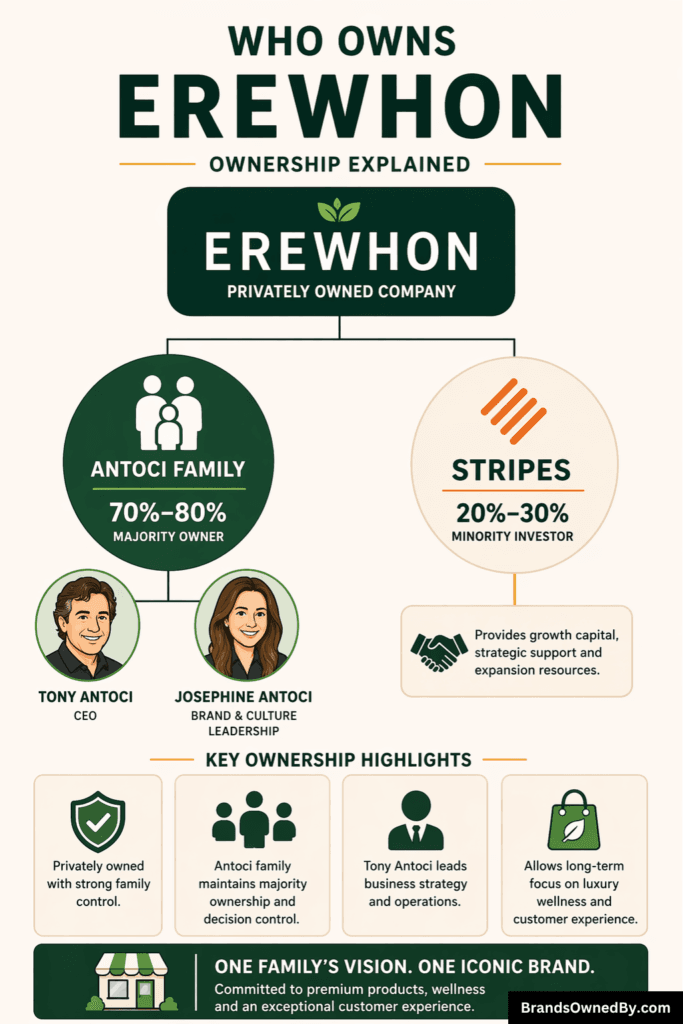
Erewhon Market is a privately owned luxury organic grocery chain based in Los Angeles. The company’s ownership is concentrated among a small group of private stakeholders led by the Antoci family.
As of April 2026, the Antoci family remains the controlling ownership group behind Erewhon. They oversee the company’s long-term strategy, expansion plans, branding decisions, and operational direction. The company also has backing from growth equity investment firm Stripes, which holds a minority stake after investing in the business to support expansion.
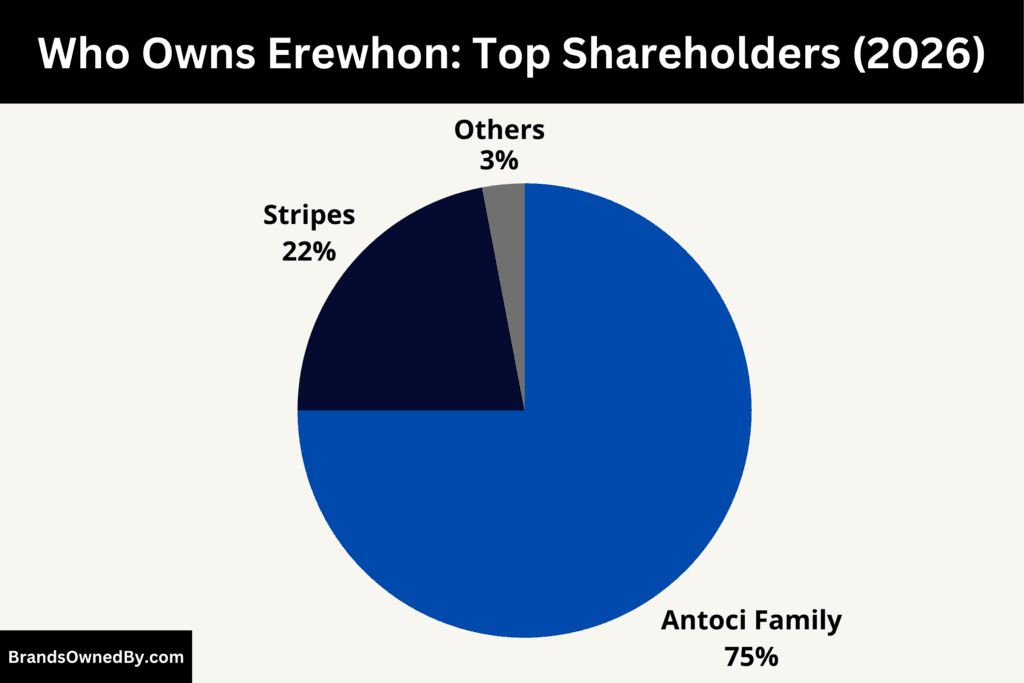
Although Erewhon has not publicly disclosed exact ownership percentages, multiple industry reports and investment disclosures indicate that the Antoci family continues to hold majority control of the company while Stripes remains the largest outside investor. Based on available private-market reporting and investment disclosures as of 2026, the ownership structure is widely estimated to be the following:
- Antoci Family: estimated 70%–80% controlling stake
- Stripes: estimated 20%–30% minority stake
- Small internal equity holders: estimated under 5% combined.
Because the company remains privately held, these figures are estimates based on private investment reporting and industry analysis rather than official SEC filings.
Tony Antoci: Majority Controlling Shareholder
Tony Antoci is believed to be the single most influential shareholder in Erewhon through the Antoci family ownership structure.
After acquiring the company in 2011, Tony Antoci led Erewhon’s transformation from a small organic grocery store into one of the most recognizable luxury wellness retail brands in the United States.
As CEO and controlling owner, he oversees major business decisions including store expansion, brand partnerships, pricing strategy, product selection, and long-term corporate growth planning.
Under his leadership, Erewhon expanded aggressively across affluent Southern California neighborhoods including Beverly Hills, Santa Monica, Pasadena, Studio City, and Culver City. The company also strengthened its identity as a premium wellness lifestyle brand rather than a traditional grocery retailer.
Industry analysts widely believe Tony Antoci holds the largest individual ownership influence within the company through the family’s controlling stake.
Josephine Antoci: Co-Owner and Brand Strategy Leader
Josephine Antoci is a major co-owner of Erewhon and one of the key figures behind the company’s luxury image and cultural positioning.
She played a major role in shaping Erewhon’s premium customer experience strategy. This includes store aesthetics, wellness branding, influencer collaborations, and celebrity-focused marketing campaigns.
Erewhon’s transformation into a high-status wellness destination is closely connected to Josephine Antoci’s branding vision. The company became widely recognized for turning grocery shopping into a luxury lifestyle experience.
As part of the controlling family ownership structure, she continues to influence strategic expansion and brand development decisions.
The Antoci Family Ownership Group
The Antoci family collectively controls Erewhon through a majority ownership position that is estimated to exceed 70% as of 2026.
This controlling stake gives the family significant authority over corporate strategy and operational decisions. Unlike publicly traded grocery chains that answer to institutional investors and public shareholders, Erewhon’s ownership structure allows leadership to maintain tighter control over long-term planning.
The family has intentionally focused on selective expansion instead of rapid nationwide scaling. This approach helps preserve the company’s exclusivity and premium image.
The Antoci family ownership structure also allows Erewhon to maintain strong control over product curation, brand partnerships, and marketing strategy.
Stripes
Stripes is the largest outside investor in Erewhon.
The New York-based growth equity firm invested in the company in 2019 to help finance expansion and operational growth. As of April 2026, Stripes is estimated to hold roughly 20%–30% of the company based on private investment reporting and market analysis.
Stripes is known for investing in high-growth consumer and technology companies. Its investment in Erewhon reflected growing confidence in the luxury wellness retail sector and Erewhon’s strong brand influence among affluent consumers.
Despite the investment, Stripes does not control the company. The Antoci family retained majority ownership and voting control following the deal.
The investment partnership helped Erewhon accelerate store openings, strengthen infrastructure, and scale operations while still preserving family control over the brand.
Internal Equity Stakeholders
A small portion of Erewhon’s equity is also believed to be held by select executives and internal stakeholders connected to company operations and long-term growth initiatives.
These ownership stakes are estimated to represent less than 5% of the company combined as of 2026. However, Erewhon has not publicly disclosed detailed internal shareholder records because it remains privately owned.
Competitor Ownership Comparison
Erewhon Market operates in the premium grocery and organic retail industry, but its ownership structure is very different from most of its competitors. While many large grocery chains are owned by multinational corporations, institutional investors, or private equity firms, Erewhon remains primarily controlled by a private family ownership group.
This ownership difference affects how each company expands, prices products, builds its brand, and makes strategic decisions.
| Company | Ownership Type | Main Owners / Parent Company | Ownership Structure Details | How Ownership Impacts the Business |
|---|---|---|---|---|
| Erewhon Market | Privately owned family-controlled company | Antoci family (majority owners) and Stripes (minority investor) | The Antoci family is estimated to control around 70%–80% of the company as of 2026, while Stripes holds an estimated 20%–30% minority stake. | Allows strong control over luxury branding, selective expansion, premium pricing, and long-term wellness-focused strategy without pressure from public shareholders. |
| Whole Foods Market | Wholly owned subsidiary | Amazon | Amazon acquired Whole Foods in 2017 for approximately $13.7 billion. The company operates under Amazon’s corporate ecosystem. | Gives Whole Foods access to massive logistics networks, technology integration, national scale, and delivery infrastructure tied to Amazon services. |
| Trader Joe’s | Privately owned company | Ownership connected to the Albrecht family empire behind ALDI | Trader Joe’s remains privately controlled through the family ownership structure linked to Aldi’s founding family interests. | Supports long-term decision-making, operational secrecy, strong private-label strategy, and pricing flexibility without public market pressure. |
| Sprouts Farmers Market | Publicly traded company | Major shareholders include The Vanguard Group, BlackRock, and State Street Corporation | Ownership is distributed among institutional investors, hedge funds, mutual funds, and retail shareholders through public stock markets. | Creates pressure for quarterly growth, profitability improvements, investor returns, and large-scale expansion strategies. |
| The Fresh Market | Private equity-owned company | Apollo Global Management | The company operates under private equity ownership after being taken private by Apollo. | Ownership focuses heavily on operational efficiency, profitability optimization, and long-term value creation. |
| Gelson’s Markets | Subsidiary ownership model | Pan Pacific International Holdings | The upscale grocery chain operates under ownership from the Japanese retail conglomerate. | Provides international investment support, financial backing, and larger operational infrastructure capabilities. |
| Bristol Farms | Corporate subsidiary ownership | Good Food Holdings, backed by Uni-President Enterprises Corporation | Bristol Farms operates under a layered corporate ownership structure connected to a large Taiwanese conglomerate. | Supports expansion and supply chain advantages through corporate-level financial and operational resources. |
Erewhon Market: Family-Controlled Private Ownership
Erewhon operates under a privately controlled ownership structure led by the Antoci family. As of April 2026, the family is estimated to control roughly 70%–80% of the company, while growth equity firm Stripes holds a minority investment stake.
Because the company is privately owned, Erewhon leadership can focus heavily on long-term brand positioning rather than quarterly earnings pressure from public shareholders.
This ownership structure allows Erewhon to maintain strict control over:
- Product curation
- Luxury pricing strategy
- Store expansion pace
- Celebrity partnerships
- Wellness-focused branding
- Customer experience design.
The company’s owners have intentionally limited expansion compared to national grocery chains. This strategy helps maintain exclusivity and brand prestige.
Whole Foods Market: Owned by Amazon
Whole Foods Market has a completely different ownership structure compared to Erewhon.
The company is fully owned by Amazon after Amazon acquired Whole Foods in 2017 for approximately $13.7 billion.
Under Amazon ownership, Whole Foods became part of one of the largest technology and retail corporations in the world.
This ownership structure gives Whole Foods access to:
- Massive capital resources
- Advanced logistics systems
- Technology integration
- National distribution networks
- Data-driven retail operations.
Amazon’s ownership also influenced pricing strategies and delivery integration through services connected to Amazon Prime.
Unlike Erewhon’s selective luxury expansion model, Whole Foods operates on a much larger national scale with hundreds of stores across multiple countries.
Trader Joe’s: Controlled by the Albrecht Family Empire
Trader Joe’s is privately owned through the family structure connected to the founders of ALDI.
The company operates under the ownership umbrella tied to the Albrecht family business empire in Germany.
Like Erewhon, Trader Joe’s is privately owned. However, the two companies operate with very different business strategies.
Trader Joe’s focuses heavily on:
- Affordable pricing
- High private-label sales
- Smaller store formats
- Mass-market accessibility
- Efficient inventory systems.
Erewhon instead focuses on premium pricing and luxury wellness positioning.
Because Trader Joe’s remains private, leadership can make long-term operational decisions without public shareholder pressure. This is one similarity it shares with Erewhon.
Sprouts Farmers Market: Public Shareholder Ownership
Sprouts Farmers Market operates under a public ownership structure.
The company trades publicly on the NASDAQ stock exchange, meaning ownership is distributed among institutional investors, mutual funds, hedge funds, and retail investors.
As of April 2026, major institutional shareholders in Sprouts include large investment firms such as:
Because Sprouts is publicly traded, company leadership must answer to shareholders and financial markets.
This often creates pressure for:
- Quarterly revenue growth
- Margin improvements
- Faster expansion
- Investor returns.
Erewhon’s private ownership structure gives it more flexibility to focus on brand exclusivity instead of shareholder-driven growth targets.
The Fresh Market: Private Equity Ownership
The Fresh Market is owned by private equity firm Apollo Global Management.
Private equity ownership typically focuses strongly on operational efficiency, profitability improvements, and long-term value creation before a potential resale or public offering.
Under Apollo Global Management, businesses often undergo restructuring initiatives designed to improve margins and operational performance.
This differs from Erewhon’s ownership structure, where brand identity and luxury positioning play a central role in decision-making.
Gelson’s Markets: Investment Firm Ownership
Gelson’s Markets is another upscale grocery competitor operating mainly in Southern California.
The company is owned by Japanese retail conglomerate Pan Pacific International Holdings, which acquired the business through investment expansion into the U.S. grocery sector.
This corporate ownership model gives Gelson’s access to international investment backing and broader retail infrastructure.
Erewhon, in contrast, remains locally controlled through family ownership.
Bristol Farms: Corporate Grocery Ownership
Bristol Farms is owned by Good Food Holdings, which itself operates under ownership connected to Taiwanese conglomerate Uni-President Enterprises Corporation.
This layered corporate ownership structure provides financial backing and operational scale advantages.
However, Erewhon’s leadership uses its independent ownership model to maintain a more niche and exclusive market identity.
How Ownership Structures Shape Competition
Ownership structures directly influence how grocery retailers operate.
Erewhon’s family-controlled model supports:
- Slow and selective expansion
- Strong brand control
- Premium pricing flexibility
- Luxury wellness positioning
- Highly curated inventory selection.
Publicly traded competitors often prioritize scale and shareholder returns.
Private equity-owned businesses may focus more aggressively on profitability optimization.
Large corporate-owned chains benefit from economies of scale and stronger logistics networks.
Erewhon’s ownership structure allows the company to operate differently from most competitors. Instead of pursuing mass-market grocery dominance, the company focuses on exclusivity, wellness culture, and luxury consumer experiences.
As of 2026, this strategy continues to differentiate Erewhon from nearly every major grocery competitor in the United States.
Who Controls Erewhon?
Control of Erewhon Market is concentrated within the Antoci family, which maintains majority ownership and operational authority over the company as of April 2026. Because Erewhon is privately owned, decision-making power is far more centralized compared to publicly traded grocery chains that must answer to large institutional shareholders and public investors.
The company’s leadership structure allows a small group of executives and owners to directly influence expansion strategy, brand partnerships, pricing decisions, store development, and long-term business direction.
Tony Antoci: Chief Executive Officer and Primary Decision-Maker
Tony Antoci is the CEO of Erewhon and the most powerful executive within the company’s leadership structure.
Since acquiring Erewhon in 2011 alongside Josephine Antoci, he has overseen the company’s transformation into a luxury wellness retailer.
As CEO, Tony Antoci controls many of the company’s major strategic decisions, including:
- Store expansion strategy
- Market positioning
- Executive leadership appointments
- Brand collaborations
- Operational growth plans
- Real estate expansion decisions
- Vendor partnerships
- Pricing strategies.
Under his leadership, Erewhon expanded from a small organic grocery operation into a highly influential premium retail brand with locations in affluent Southern California markets.
Industry reporting as of 2026 consistently identifies Tony Antoci as the central operational leader responsible for Erewhon’s long-term growth strategy.
Josephine Antoci: Brand and Cultural Control
Josephine Antoci plays a major leadership role within Erewhon despite operating more behind the scenes compared to Tony Antoci.
She has significant influence over the company’s brand identity, customer experience strategy, and cultural positioning.
Her influence can be seen in several major areas:
- Luxury store aesthetics
- Wellness-focused branding
- Celebrity partnership strategies
- Influencer collaborations
- Premium customer experience design
- Lifestyle-focused marketing campaigns.
Josephine Antoci helped shape Erewhon into more than a grocery retailer. Under her influence, the company became associated with luxury wellness culture and aspirational living.
This branding control became one of Erewhon’s biggest competitive advantages.
The Antoci Family’s Voting Control
The Antoci family collectively controls the company through its estimated majority ownership stake of roughly 70%–80% as of 2026.
This ownership concentration gives the family effective voting control over major corporate decisions.
Because Erewhon is privately held, the family has strong authority over:
- Corporate governance
- Expansion pace
- Financial strategy
- Executive leadership decisions
- Brand partnerships
- Product approval standards
- Store opening approvals.
This structure allows Erewhon to maintain consistency in brand direction without outside shareholder interference.
Influence of Stripes as Minority Investor
Stripes remains Erewhon’s most significant outside investor after acquiring a minority stake in the company in 2019.
Although Stripes provides strategic investment support and growth capital, the firm does not appear to control daily operations or core strategic decisions.
The Antoci family retained majority ownership and voting authority after the investment deal.
However, Stripes likely maintains influence in areas such as:
- Growth planning
- Financial scaling strategy
- Expansion infrastructure
- Long-term investment planning.
This type of relationship is common in private growth-equity investments where founders or controlling families maintain operational control.
Leadership Structure Inside Erewhon
Erewhon operates with a relatively centralized leadership structure compared to major public grocery corporations.
Key decisions are believed to move through a small executive leadership group closely aligned with the ownership team.
This structure allows faster decision-making in areas such as:
- Product launches
- Celebrity collaborations
- New store concepts
- Wellness trend adoption
- Brand marketing campaigns.
Because leadership control is tightly managed, Erewhon can quickly adapt to luxury consumer trends and social media-driven wellness culture.
How Control Differs From Public Grocery Chains
Public grocery companies often face pressure from institutional investors and shareholders focused on short-term financial performance.
Erewhon operates differently because control remains concentrated among private owners.
This gives the company more flexibility to prioritize:
- Brand prestige
- Exclusive product offerings
- Customer experience quality
- Controlled expansion
- Long-term luxury positioning.
The company can avoid aggressive national expansion that could weaken its premium image.
Control Through Brand Identity
One of the most important forms of control within Erewhon is control over brand identity itself.
The company carefully manages:
- Which products enter stores
- Which celebrities collaborate with the brand
- How stores are designed
- Which wellness trends are promoted
- How the company is perceived publicly.
This tight control over branding has helped Erewhon maintain exclusivity and cultural relevance.
As of 2026, Erewhon’s leadership continues to focus heavily on maintaining its image as a luxury wellness destination rather than simply operating as a traditional grocery retailer.
Erewhon Annual Revenue and Net Worth
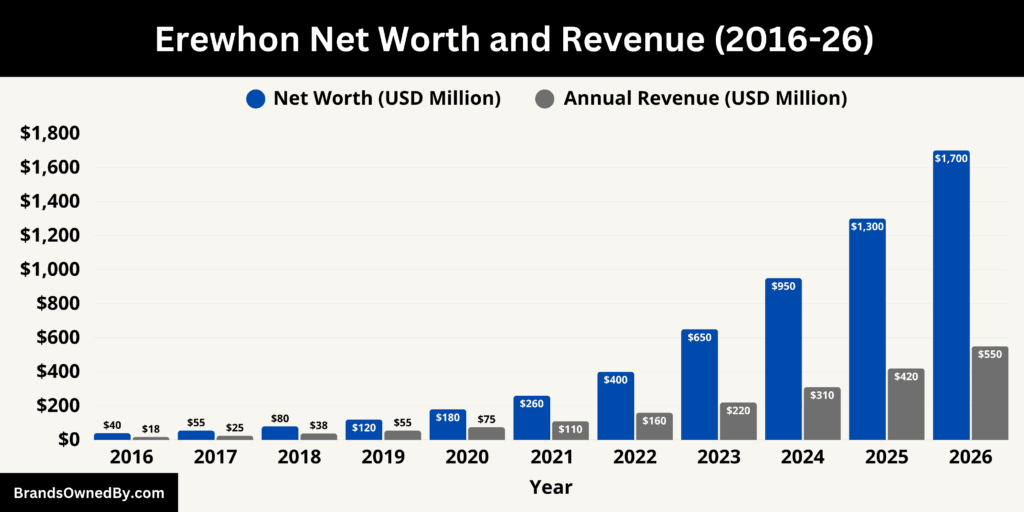
As of April 2026, the company generates approximately $550 million in annual revenue and holds an estimated corporate valuation of $1,700 million.
The company’s rapid growth reflects the increasing demand for premium organic groceries, wellness-focused prepared foods, celebrity-driven product collaborations, and luxury retail experiences. Erewhon has successfully positioned itself as more than a supermarket. It operates as a high-end wellness lifestyle brand that attracts affluent consumers, celebrities, influencers, and health-conscious shoppers across Southern California.
Its strong financial growth has been driven by aggressive expansion, high-margin wellness products, premium pricing strategies, and strong brand recognition within luxury consumer markets.
2026 Revenue Breakdown
In 2026, Erewhon’s annual revenue reached approximately $550 million. A large portion of this revenue comes from premium grocery sales and prepared foods.
The grocery division remains the company’s largest revenue segment. Organic groceries, imported wellness products, premium supplements, and specialty health foods generate roughly $240 million annually. Erewhon’s customers typically spend significantly more per visit compared to shoppers at traditional supermarkets.
Prepared foods represent another major revenue driver. Ready-to-eat organic meals, salads, sushi, soups, and wellness-focused dining products generate approximately $110 million in yearly revenue. This segment expanded rapidly as consumers increasingly looked for premium convenience foods with organic ingredients.
The company’s tonic bars and beverage operations contribute nearly $85 million annually. Celebrity smoothie collaborations became one of Erewhon’s most profitable marketing and sales categories. Viral drinks promoted through influencers and celebrities helped drive customer traffic and social media visibility.
Private-label wellness products and branded packaged goods generate approximately $70 million in annual revenue. Erewhon expanded its branded products into categories such as snacks, beverages, supplements, sauces, and wellness items.
Beauty, skincare, and wellness supplements contribute another $45 million annually. The company increasingly positioned itself as a wellness destination beyond traditional grocery retail.
2026 Net Worth and Company Valuation
As of 2026, Erewhon’s estimated net worth and private market valuation reached approximately $1,700 million.
Several factors contributed to this dramatic increase in company value.
One of the largest drivers is the company’s brand power. Erewhon has become one of the most culturally influential grocery brands in the luxury wellness sector. Its association with celebrity culture and high-income consumers significantly increased brand equity.
The company’s strong revenue growth also improved investor confidence. Between 2016 and 2026, Erewhon expanded from a relatively small organic grocery operator into a multi-location luxury retail business generating hundreds of millions in yearly sales.
Its high-margin business model also increased valuation potential. Erewhon operates with premium pricing across many product categories, allowing the company to generate stronger profit margins compared to traditional grocery chains.
Real estate positioning also strengthened the company’s value. Erewhon stores are strategically located in wealthy Southern California markets where consumer spending on luxury wellness products remains high.
The investment from Stripes further strengthened expansion capabilities and increased private-market investor interest in the company.
Revenue Growth Strategy
Erewhon’s financial growth strategy focuses heavily on premium positioning rather than mass-market scale.
The company intentionally limits store expansion to affluent communities where customers are willing to pay premium prices for organic products and wellness experiences.
Unlike traditional grocery chains competing on affordability, Erewhon competes on exclusivity, product quality, brand identity, and cultural relevance.
Its marketing strategy also plays a major role in revenue growth. Celebrity collaborations and influencer partnerships generate massive social media visibility without relying heavily on traditional advertising campaigns.
This strategy allows the company to attract younger luxury consumers while maintaining strong brand loyalty.
Profitability and Margin Strength
Erewhon benefits from unusually strong margins compared to traditional supermarkets.
Traditional grocery retailers often operate with very thin profit margins due to pricing competition. Erewhon’s luxury positioning allows the company to charge significantly higher prices for many products.
Prepared foods, wellness beverages, supplements, and private-label products generate especially strong margins for the business.
This pricing flexibility has become one of the company’s strongest financial advantages.
Future Revenue Forecast Through 2030
Industry analysts expect Erewhon to continue expanding aggressively over the next several years as luxury wellness spending increases in the United States.
Projected future revenue forecasts include:
- 2027: $700 million
- 2028: $880 million
- 2029: $1,050 million
- 2030: $1,300 million.
Future growth will likely be driven by new store openings, expansion into additional luxury markets, stronger private-label product sales, and continued dominance in influencer-driven wellness retail culture.
As of 2026, Erewhon remains one of the most valuable and fastest-growing luxury organic grocery chains in the American wellness retail industry.
Brands Owned by Erewhon
Erewhon is primarily focused on operating its own grocery and wellness business rather than owning a large portfolio of independent companies. However, the brand operates several important business divisions and branded concepts.
Below is a list of the major brands owned by Erewhon as of April 2026:
| Company / Brand / Division | Type | Main Products or Services | Role in Erewhon’s Business | Key Details as of 2026 |
|---|---|---|---|---|
| Erewhon Market Stores | Luxury organic grocery retail chain | Organic groceries, premium produce, supplements, prepared foods, wellness products | Core business operation and primary revenue generator | Operates multiple luxury grocery locations across affluent Southern California markets including Beverly Hills, Santa Monica, Pasadena, Studio City, Culver City, and Manhattan Beach. |
| Erewhon Tonic Bar | Wellness beverage division | Smoothies, adaptogenic drinks, juices, wellness tonics, herbal beverages | Major revenue-generating wellness beverage business | Became globally recognized through celebrity smoothie collaborations and viral social media marketing campaigns. |
| Erewhon Private Label Products | Private-label consumer goods division | Organic snacks, wellness beverages, supplements, sauces, pantry products | Expands profit margins and strengthens customer loyalty | Focuses on premium wellness-focused branded products aligned with Erewhon’s ingredient standards. |
| Erewhon Prepared Foods Division | Prepared meal and food service division | Organic ready-to-eat meals, salads, sushi, soups, hot foods | Major recurring revenue segment | Serves health-conscious consumers seeking premium convenience meals with organic ingredients. |
| Erewhon Wellness and Supplement Division | Wellness retail division | Vitamins, probiotics, protein powders, adaptogens, functional wellness products | Expands wellness-focused retail ecosystem | Targets affluent wellness consumers looking for premium health and supplement products. |
| Erewhon Beauty and Skincare Division | Clean beauty and personal care division | Organic skincare, clean beauty products, wellness cosmetics | Supports luxury wellness lifestyle positioning | Focuses on non-toxic beauty and personal care products integrated into the wellness retail model. |
| Erewhon Café and Food Service Operations | Café and dining operations | Organic coffee, baked goods, breakfast meals, wellness drinks | Enhances customer experience and in-store engagement | Operates café-style food and beverage concepts inside selected Erewhon locations. |
| Erewhon Celebrity Collaboration Programs | Brand partnership and marketing entity | Celebrity smoothie collaborations and limited-edition wellness products | Drives viral marketing and customer traffic | Collaborations with celebrities and influencers generate strong social media engagement and brand visibility. |
| Erewhon Digital and Social Commerce Operations | Digital commerce and marketing division | Online ordering, delivery integration, digital promotions | Supports customer engagement and digital sales growth | Uses influencer-driven digital marketing and social commerce campaigns to strengthen brand awareness. |
| Erewhon Wellness Lifestyle Ecosystem | Integrated wellness retail ecosystem | Combined grocery, wellness, beauty, food service, and lifestyle operations | Strengthens Erewhon’s luxury wellness identity | Operates as a premium wellness-focused ecosystem rather than a traditional grocery retail model. |
Erewhon Market Stores
The core business operated by Erewhon is its chain of luxury organic grocery stores across Southern California.
As of 2026, the company operates multiple high-end retail locations in affluent markets including Beverly Hills, Santa Monica, Studio City, Pasadena, Culver City, Silver Lake, Pacific Palisades, Manhattan Beach, and Calabasas.
These stores serve as the foundation of Erewhon’s business model.
Each location combines organic grocery retail with luxury wellness experiences. Stores feature premium organic produce, imported specialty foods, wellness supplements, luxury beauty products, fresh baked goods, and prepared meals.
The company carefully selects store locations in wealthy communities where consumers are willing to spend heavily on premium wellness products.
Erewhon stores also function as cultural and lifestyle hubs. Celebrity customers, influencers, athletes, and wellness-focused consumers regularly visit locations, helping strengthen the brand’s luxury image.
Erewhon Tonic Bar
The Erewhon Tonic Bar has become one of the company’s most successful business divisions.
Located inside many Erewhon stores, these wellness beverage bars sell smoothies, adaptogenic drinks, juices, herbal tonics, wellness lattes, protein beverages, and specialty health drinks.
By 2026, the Tonic Bar division generates tens of millions of dollars annually for the company.
The business became internationally recognized because of celebrity smoothie collaborations with influencers, actors, musicians, and wellness personalities.
Limited-edition drinks often generate viral attention across social media platforms such as TikTok and Instagram.
These collaborations helped transform the Tonic Bar into both a revenue generator and a powerful marketing engine for the Erewhon brand.
Erewhon Private Label Products
Erewhon owns and operates a growing portfolio of private-label wellness and grocery products.
These products are sold directly through Erewhon stores and increasingly represent an important part of the company’s long-term growth strategy.
The private-label division includes:
- Organic snacks
- Wellness beverages
- Protein products
- Sauces and condiments
- Packaged foods
- Supplements
- Health-focused pantry items
- Functional wellness products.
Private-label goods allow Erewhon to increase profit margins while strengthening customer loyalty.
The company carefully designs these products to align with its premium wellness positioning and strict ingredient standards.
Erewhon Prepared Foods Division
Prepared foods have become one of Erewhon’s largest operational divisions.
The company operates an extensive prepared foods business that includes:
- Organic meals
- Fresh salads
- Soups
- Sushi
- Hot food bars
- Wellness-focused dishes
- Ready-to-eat health meals.
This division serves customers seeking convenience without sacrificing organic ingredients or wellness-focused nutrition.
Prepared foods became especially important during the rise of health-conscious convenience dining trends in California.
As of 2026, the prepared foods segment represents one of the company’s strongest recurring revenue categories.
Erewhon Wellness and Supplement Division
Erewhon operates a major wellness and supplement retail division inside its stores.
The company sells high-end vitamins, herbal products, adaptogens, probiotics, protein powders, functional mushrooms, and wellness supplements.
This division became increasingly important as wellness culture expanded in the United States.
Erewhon carefully curates wellness brands that align with its ingredient standards and luxury health-focused identity.
Many products sold in this category are positioned as premium or exclusive wellness solutions targeted toward affluent consumers.
Erewhon Beauty and Skincare Division
The company also operates a growing luxury beauty and skincare retail segment.
This division focuses on clean beauty, organic skincare, wellness-based cosmetics, and non-toxic personal care products.
The beauty segment became an important expansion category because many Erewhon customers are highly interested in holistic wellness and clean-living products.
The company sells both third-party premium brands and selected wellness-focused beauty products integrated into its broader luxury wellness ecosystem.
Erewhon Café and Food Service Operations
Several Erewhon locations include café-style dining operations and food service concepts.
These operations offer organic coffee drinks, wellness beverages, baked goods, breakfast foods, and fresh meals.
The café environment helps extend customer visit times and strengthens the company’s identity as a wellness lifestyle destination rather than only a grocery retailer.
Celebrity Collaboration Partnerships
Although not standalone acquisitions or subsidiaries, Erewhon’s celebrity collaboration partnerships function as major business entities within its marketing and revenue strategy.
The company has partnered with numerous celebrities and influencers for limited-edition drinks and wellness collaborations.
These partnerships generate major online attention and drive strong customer traffic.
Many collaborations sell out quickly and become viral marketing campaigns across social media platforms.
This strategy helped Erewhon strengthen its influence far beyond traditional grocery retail.
Erewhon Digital and Social Commerce Operations
By 2026, Erewhon expanded its digital presence through online ordering systems, delivery partnerships, branded digital marketing campaigns, and social-media-driven commerce initiatives.
The company uses digital engagement heavily to promote new products, celebrity partnerships, and store launches.
Its online presence became one of the biggest drivers of brand awareness among younger luxury consumers.
Conclusion
Erewhon has evolved from a small natural foods store into one of America’s most recognizable luxury wellness grocery brands. For those asking who owns Erewhon, the answer centers on Tony and Josephine Antoci, whose leadership transformed the company into a premium lifestyle-driven retailer.
The company remains privately owned and family-controlled. That ownership structure allows Erewhon to maintain strong control over branding, customer experience, and expansion strategy. As the wellness industry continues growing, Erewhon remains a powerful symbol of luxury organic retail culture in the United States.
FAQs
Who owns Erewhon Market?
Erewhon Market is primarily owned by the Antoci family as of 2026. Tony Antoci and Josephine Antoci acquired the company in 2011 and transformed it into a luxury wellness grocery chain. The company also has minority investment backing from Stripes, a growth equity investment firm.
Who made Erewhon?
Erewhon was originally created by Michio Kushi and Aveline Kushi in 1966. They launched the business to promote macrobiotic nutrition, organic foods, and healthier eating habits in the United States.
Who founded Erewhon?
The founders of Erewhon were Michio Kushi and Aveline Kushi. They established the company during the rise of the natural foods movement in America and helped popularize organic and macrobiotic products long before they became mainstream in grocery retail.
What is the story behind Erewhon?
The story behind Erewhon began in 1966 when Michio and Aveline Kushi created a small natural foods business focused on macrobiotic diets and organic nutrition. The company became one of the early pioneers of the American health-food movement.
Over time, the business faced financial struggles and remained relatively small for decades. In 2011, Tony and Josephine Antoci acquired the company and transformed it into a luxury wellness grocery brand focused on premium organic products, celebrity partnerships, influencer marketing, and upscale customer experiences.
Today, Erewhon is known globally for its luxury wellness culture, celebrity smoothie collaborations, and high-end organic grocery stores across Southern California.
Is Erewhon Japanese or Korean?
Erewhon is an American company based in Los Angeles. However, its origins were strongly influenced by Japanese macrobiotic philosophy because founder Michio Kushi was Japanese.
The company is not Korean-owned or Korean-founded. Its early wellness philosophy was heavily inspired by Japanese macrobiotic teachings and natural nutrition practices.
What family owns Erewhon?
The Antoci family owns and controls Erewhon as of 2026. The family holds the majority ownership stake in the company and oversees its business strategy, expansion plans, branding decisions, and operations.
Is Erewhon owned by Hailey Bieber?
No, Hailey Bieber does not own Erewhon.
She collaborated with the company on a highly popular smoothie partnership that gained viral attention online, but she does not hold ownership control over the business. Erewhon remains primarily owned by the Antoci family.