
- Clorox’s major businesses include Clorox cleaning products, Purell hand hygiene, Glad bags and wraps, Fresh Step cat litter, Kingsford grilling products, Hidden Valley food products, Brita water filtration, and Burt’s Bees personal care.
- Clorox completed its $2.25 billion acquisition of GOJO Industries in April 2026. The acquired business now operates as Clorox Purell and gives Clorox a much larger professional and institutional hygiene platform.
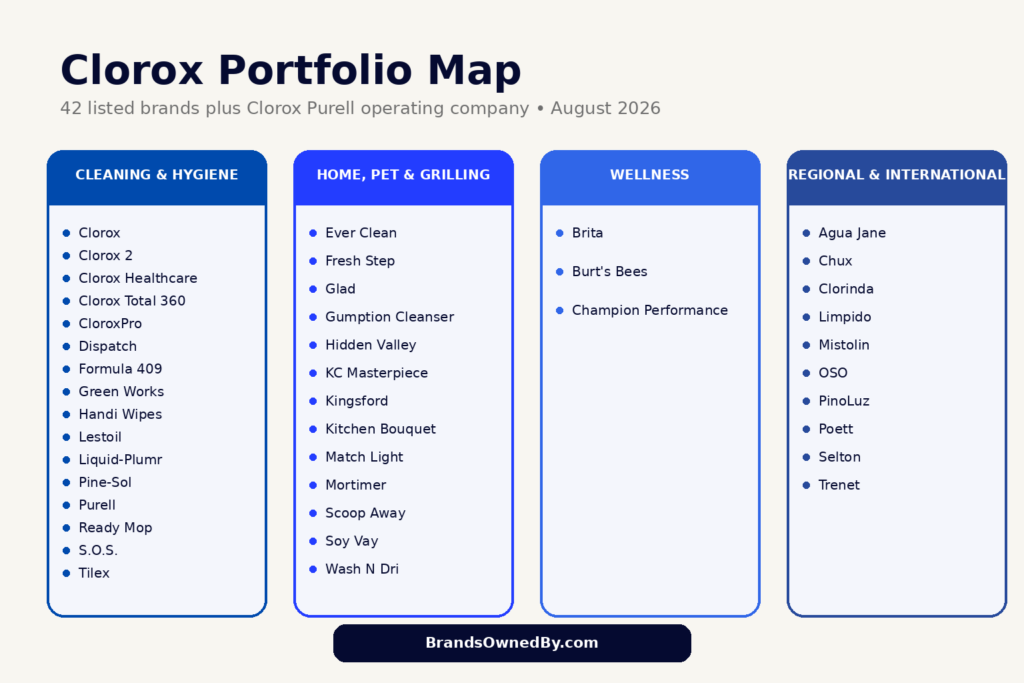
- The official Clorox family list contains 42 named brands. Some are global brands, while others are regional, professional, licensed, or smaller product lines.
- Clorox is publicly owned. No founder, family, parent company, or single investment manager owns a controlling majority of its shares.
What companies does Clorox own? The Clorox Company controls a broad consumer-products portfolio that extends well beyond bleach. Its businesses cover household cleaning, professional disinfection, hand hygiene, trash bags, cat litter, grilling products, food, water filtration, and personal care. The biggest recent change is the acquisition of GOJO Industries, maker of Purell, completed in April 2026. As of August 2026, Clorox’s official family list names 42 brands sold across more than 100 countries.
![What Companies Does Clorox Own [Infographic]](https://brandsownedby.com/wp-content/uploads/2023/08/What-Companies-Does-Clorox-Own-Infographic-683x1024.png)
Clorox Founders
Clorox did not begin as a diversified consumer-goods group. It started with one product, limited capital, and five founders whose professional backgrounds were very different from the chemical industry Clorox would eventually help shape.
The Five Founding Partners
Archibald Taft, Edward Hughes, Charles Husband, Rufus Myers, and William Hussey founded the Electro-Alkaline Company on May 3, 1913. Taft was a banker. Hughes sold wood and coal. Husband was a bookkeeper. Myers was a lawyer. Hussey was a miner.
Each founder invested $100. Their initial $500 funded the early venture in Oakland, California. The business planned to turn brine into sodium hypochlorite bleach through an electrolytic process. This was technically ambitious for a small startup at that time.
From Industrial Bleach to a Household Product
The early company sold concentrated bleach to commercial customers. Dairies, breweries, and laundries were practical buyers because they already understood the need for sanitation.
Household adoption came later. William Murray became general manager in 1916. His wife, Annie Murray, helped reposition the product for home use. A less concentrated formula and free samples made liquid bleach easier for ordinary households to understand. The Clorox name combined ideas from chlorine and sodium hydroxide, two inputs associated with the original manufacturing process.
How Clorox Became Independent Again
Procter & Gamble acquired Clorox in 1957. The Federal Trade Commission challenged the transaction. The U.S. Supreme Court ultimately required divestiture on competition grounds. Clorox became independent again in 1969.
That history matters today. Procter & Gamble is a competitor, not Clorox’s parent. Clorox is now a separately traded public company listed on the New York Stock Exchange under the ticker CLX.
List of Companies and Brands Owned by Clorox
Clorox presents its portfolio as a family of brands rather than a simple list of legal subsidiaries. Most operations sit within The Clorox Company and its regional affiliates. Some rights are market-specific. Brita is the clearest example because Clorox operates the brand in the Americas rather than owning the entire global Brita system.
The list below reflects the company’s official portfolio as of September 2026 and explains the practical ownership position of each name.
Clorox Purell
Clorox acquired GOJO Industries in April 2026 for $2.25 billion in cash. The acquired operation now conducts business as Clorox Purell. It includes Purell hand sanitizer and a wider range of skin-health, soap, dispensing, surface-hygiene, and professional solutions.
The business remains an operating platform within Clorox rather than an independent public company. Its value is strategic. GOJO brought a large business-to-business distribution base, installed dispensers, and strong access to healthcare, education, food service, workplaces, and public facilities. Clorox expects at least $50 million in annual run-rate cost synergies from the combination.
Agua Jane
Agua Jane is a regional cleaning and bleach name included in Clorox’s official brand family. It helps the company adapt its cleaning portfolio to local recognition and shopping habits instead of relying only on the Clorox master brand.
The brand is managed through Clorox’s international operations. Its role is narrower than the company’s major global platforms, but it extends Clorox’s reach in household cleaning markets where regional brand familiarity matters.
Brita
Brita sells water-filter pitchers, dispensers, replacement filters, and portable bottles. For a household, the practical value proposition is simple. A consumer can filter tap water at home and reduce dependence on single-use bottled water.
Clorox controls the Brita business in the Americas through its regional rights and operating entities. It does not own the entire Brita brand worldwide. That distinction is important because the broader international Brita system has separate ownership outside Clorox’s territory.
Burt’s Bees
Burt’s Bees is Clorox’s natural personal-care platform. Its range includes lip balm, facial skincare, body care, baby products, and related items. The company acquired Burt’s Bees in 2007, giving Clorox a position in personal care that differs from its cleaning-led heritage.
Burt’s Bees operates as a Clorox-owned brand. It retains a distinct consumer identity and product philosophy. For Clorox, the brand provides access to higher-value wellness categories and retailers that are less dependent on bleach, trash bags, or other traditional household staples.
Champion Performance
Champion Performance appears in Clorox’s official family list as a specialist brand. It is not one of the company’s heavily promoted global consumer platforms. Its commercial relevance is more targeted and may vary by market and distribution channel.
Clorox includes the name within its controlled brand family. Investors should not assume that every listed name contributes a material standalone share of revenue. Smaller brands often support particular customer groups, product formats, or regional assortments.
Chux
Chux is a cleaning-tools and household-care brand with a strong presence in Australia and New Zealand. Its products include cloths, scourers, sponges, gloves, and related cleaning aids.
Clorox owns and manages Chux through its international operations. The brand demonstrates how Clorox competes with local strength. Rather than placing the Clorox name on every item, the company can use Chux’s established recognition in cleaning utensils and household maintenance.
Clorinda
Clorinda is one of Clorox’s international cleaning brands. It supports the company’s bleach and home-care presence in selected markets where a regional identity may be more effective than a global label.
The brand is part of Clorox’s international portfolio. Product availability and formats can differ by country. This makes Clorinda a useful example of why Clorox’s brand count is larger than the number of names commonly seen in U.S. stores.
Clorox
Clorox is the company’s namesake and foundational brand. It covers bleach, disinfecting wipes, sprays, toilet-care products, laundry additives, and other cleaning solutions. The brand also supports product extensions such as Clorox Scentiva and Clorox PURE.
The Clorox brand is owned and controlled by The Clorox Company. It is central to the Health and Wellness business. Its commercial role goes beyond retail bleach because the name carries established credibility in cleaning, sanitation, and disinfection.
Clorox 2
Clorox 2 is a laundry-care line focused on stain removal, color-safe bleach alternatives, and laundry enhancement. It lets Clorox participate in laundry occasions where chlorine bleach may not be appropriate.
Clorox 2 is part of the Clorox master-brand system. It is not a separate public company. The range uses Clorox’s distribution and consumer recognition while addressing a different task: preserving color while treating stains and odors.
Clorox Healthcare
Clorox Healthcare develops disinfectants and cleaning products for hospitals, clinics, and other healthcare environments. Products are designed around professional infection-prevention requirements rather than ordinary household cleaning alone.
The brand sits within CloroxPro and the wider professional-products operation. Clorox controls the business. Its key advantage is access to institutional channels, technical expertise, and products designed for demanding settings where surface compatibility, contact time, and pathogen claims matter.
Clorox Total 360
Clorox Total 360 is associated with electrostatic spraying and whole-room surface coverage. It is designed for professional environments such as schools, offices, athletic facilities, and public spaces.
The offering is controlled through Clorox’s professional business. It illustrates how the company sells systems as well as chemicals. The commercial proposition can include equipment, compatible solutions, training, and repeat product demand.
CloroxPro
CloroxPro is the umbrella platform for professional cleaning and disinfection. It serves businesses, schools, healthcare facilities, hospitality operators, and other shared environments.
Clorox owns the platform and uses it to organize professional brands, technical resources, and commercial solutions. Following the GOJO acquisition, Clorox has a stronger combined professional hygiene position. CloroxPro and Purell can address both surfaces and hands, which creates cross-selling potential through institutional distributors.
Dispatch
Dispatch is a professional disinfectant brand associated with bleach-based healthcare cleaning products. It is positioned for settings that require fast, dependable disinfection and clear professional-use instructions.
Dispatch is managed within Clorox Healthcare and CloroxPro. It is a controlled product brand rather than a separate operating company. Its value comes from specialization and established use in clinical and institutional cleaning routines.
Ever Clean
Ever Clean is a premium cat-litter brand. It generally competes on odor control, clumping performance, and specialized formulas for different household needs.
Clorox owns Ever Clean within its cat-care portfolio. The brand complements Fresh Step and Scoop Away. Maintaining multiple cat-litter labels lets Clorox serve different price points, consumer preferences, retail channels, and geographic markets without forcing every product under one name.
Formula 409
Formula 409 is a household cleaning brand known for multipurpose cleaners and grease-cutting products. Consumers commonly use it on kitchen and other hard surfaces.
Clorox owns Formula 409 and manages it within the home-care portfolio. The brand provides a distinct cleaning identity alongside Clorox and Pine-Sol. This reduces dependence on one label and allows each name to compete around a different consumer expectation.
Fresh Step
Fresh Step is one of Clorox’s most prominent cat-litter brands. It sells clumping, lightweight, odor-control, and other litter formats. Product innovation is aimed at improving convenience for cat owners and maintaining a cleaner home environment.
Clorox owns the brand and reports the business within its Household segment. Fresh Step’s importance is strategic because cat litter is a repeat-purchase category. A household with one or more cats can buy the product throughout the year, creating a different demand pattern from occasional cleaning purchases.
Glad
Glad sells trash bags, food-storage bags, wraps, and related household products. It is one of Clorox’s largest non-cleaning names and a major part of the Household segment.
Clorox previously operated Glad through a venture in which Procter & Gamble held a 20% interest. That venture ended on January 31, 2026. Clorox acquired P&G’s interest, leaving Clorox with full ownership of the Glad business. The transaction removes a long-standing minority interest and simplifies control.
Green Works
Green Works is a cleaning line developed around plant- and mineral-based product positioning. It gave Clorox a dedicated label for consumers seeking alternatives to conventional household cleaners.
Clorox owns the brand. Its current retail prominence may differ from earlier years, but it remains on the official family list. This is another reason to distinguish between an owned brand and a major revenue platform. Ownership does not always mean broad current distribution.
Gumption Cleanser
Gumption Cleanser is a household cleaning brand known in Australia and nearby markets. It is used for stubborn dirt, grease, and marks across suitable household surfaces.
The brand is controlled through Clorox’s international operations. It works alongside Chux and other regional names. This combination gives Clorox a wider home-care offering in markets where local brand loyalty can be stronger than recognition of the corporate parent.
Handi Wipes
Handi Wipes offers reusable cleaning cloths for household tasks. The product sits between disposable paper towels and longer-life cloths, giving consumers a washable cleaning option.
Clorox acquired the brand through its purchase of First Brands in 1999. Handi Wipes remains within the Clorox portfolio. It benefits from the company’s retail relationships and home-care distribution, even though it is smaller than Clorox, Glad, or Pine-Sol.
Hidden Valley
Hidden Valley is Clorox’s major food brand. It sells ranch dressing, dips, seasoning mixes, and related flavor products. The brand also expands through licensed food collaborations when an external manufacturer is better suited to a particular format.
Clorox owns the core Hidden Valley brand and manages its principal retail food business. A licensed product carrying the name is not necessarily manufactured directly by Clorox. This structure lets the company extend the brand while limiting the need to build every new food capability internally.
KC Masterpiece
KC Masterpiece is a barbecue-sauce and flavor brand within the Clorox family. It complements the company’s grilling and food interests.
Clorox controls the brand, although market availability can be narrower than it once was. The label remains useful as intellectual property and as part of Clorox’s broader food portfolio. It also has a natural strategic connection with Kingsford’s grilling occasion.
Kingsford
Kingsford is a leading grilling-fuel brand. It sells charcoal briquets, pellets, lighting products, and related grilling items. Demand is influenced by weather, holidays, outdoor cooking, and seasonal retail activity.
Clorox owns Kingsford and reports it within the Household segment. The brand diversifies Clorox beyond cleaning. It also gives the company a strong position in a category where performance, ignition, burn consistency, and consumer habit can support brand loyalty.
Kitchen Bouquet
Kitchen Bouquet is a browning and seasoning sauce used to add color and flavor to gravies, meats, and other dishes. It is a smaller food label within Clorox’s official family.
Clorox controls the brand through its food operations. Kitchen Bouquet is not a separate company. Its value lies in a specific cooking use case and a long-established product identity rather than the scale of a broad condiment platform.
Lestoil
Lestoil is a heavy-duty multipurpose cleaner associated with removing grease, oil, and difficult stains. It serves consumers who need stronger cleaning performance for particular jobs.
Clorox owns Lestoil and includes it in its cleaning portfolio. The brand has a more specialized position than the main Clorox line. That specialization can help retain consumers who recognize Lestoil for a specific task rather than general everyday cleaning.
Limpido
Limpido is a regional household-cleaning name within the Clorox family. Its products and distribution depend on the local market.
The brand is managed through Clorox’s international structure. Like Agua Jane and Clorinda, it shows how the company uses local portfolio architecture. Regional brands can preserve existing consumer trust and give Clorox access to markets where one global name would not be the strongest commercial choice.
Liquid-Plumr
Liquid-Plumr sells products for clogged and slow drains. The range includes formulas designed for hair, grease, odor, maintenance, and more difficult blockages.
Clorox owns the brand and manages it within home care. Liquid-Plumr has a clear task-based position. A consumer with a blocked sink may shop by immediate problem rather than by general cleaning preference, making strong category recognition valuable.
Match Light
Match Light is a Kingsford-associated charcoal product designed to light without separate lighter fluid. It focuses on convenience and faster grill preparation.
The name sits within Clorox’s grilling portfolio. It is better understood as a product brand or sub-brand than as an independent company. Clorox controls its commercialization as part of the Kingsford business.
Mistolin
Mistolin is a household-cleaning brand serving selected markets, including parts of the Caribbean and U.S. multicultural retail channels. Products include multipurpose cleaners and fragrance-led cleaning solutions.
Clorox owns or controls the brand through its regional operations. Mistolin helps the company reach consumers whose cleaning preferences may differ by scent, format, language, and retail channel.
Mortimer
Mortimer is a smaller name on Clorox’s official family list. It is not presented as one of the company’s core global growth brands.
Clorox retains the brand within its portfolio. Smaller or legacy trademarks can support limited product lines, regional sales, or future commercialization. Their inclusion should not be interpreted as evidence of a separate large operating company.
OSO
OSO is an international or regional brand listed within Clorox’s family. Its role is concentrated in selected markets rather than broad global distribution.
Clorox controls the brand through its international portfolio. The commercial logic resembles other regional labels: use an established local name when it provides better recognition, relevance, or channel access than the corporate brand.
Pine-Sol
Pine-Sol is a major multipurpose-cleaner brand. It is known for grease-cutting performance, deodorizing, concentrated formats, and a range of scents.
Clorox acquired Pine-Sol in 1990 and continues to own it. The brand has its own identity within the cleaning aisle. It competes alongside, rather than simply beneath, the Clorox name. That gives the company more shelf presence and a wider set of consumer propositions.
Purell
Purell is the flagship hand-hygiene brand acquired with GOJO Industries. It covers hand sanitizers, soaps, dispensers, wipes, and surface products for consumer and professional environments.
Clorox owns the Purell business following the April 2026 acquisition. The brand is particularly valuable in institutional markets. Its installed dispenser base can create recurring refill demand, while its consumer recognition supports retail sales. Purell is now a central part of Clorox’s health and hygiene strategy.
PinoLuz
PinoLuz is a regional cleaning brand in the Clorox portfolio. The name is associated with household-cleaning uses in selected international markets.
Clorox manages the brand through its regional operations. It adds another locally relevant option to the company’s cleaning lineup. As with several international names, availability is market-specific and may change without altering Clorox’s overall corporate structure.
Poett
Poett is an international home-care brand known for fragrance-led multipurpose cleaners. It has a meaningful presence in several Latin American markets.
Clorox owns and manages Poett through its international business. The brand combines cleaning with scent and household experience. It is one of the international names Clorox highlights publicly, which signals greater strategic visibility than many smaller regional labels.
Ready Mop
Ready Mop is a floor-cleaning brand or product system included in the Clorox family. It addresses convenient, ready-to-use household floor care.
Clorox controls the name within its home-care portfolio. It is a more focused product proposition than the broad Clorox or Pine-Sol franchises. Its inclusion reflects Clorox’s ability to hold several trademarks for different cleaning tools and occasions.
Selton
Selton is a regional name in Clorox’s official portfolio. It is not one of the company’s principal U.S. consumer brands.
The brand is managed through the international business. Clorox may use such names to support local product categories, distribution relationships, and consumer familiarity. Revenue from smaller regional labels is generally reported within the International segment rather than disclosed brand by brand.
S.O.S.
S.O.S. is a cleaning-pad and scrubber brand used for difficult cookware and household cleaning tasks. It is closely associated with steel-wool soap pads.
Clorox owns the brand and markets it as a specialized cleaning solution. S.O.S. complements liquid cleaners by addressing mechanical scrubbing. This gives Clorox exposure to another part of the household-cleaning basket.
Scoop Away
Scoop Away is a clumping cat-litter brand. It competes around odor control, scoopability, and value for multi-cat or high-use households.
Clorox owns Scoop Away as part of its cat-care portfolio. It sits alongside Fresh Step and Ever Clean. The multi-brand structure lets Clorox cover premium, mainstream, and value-oriented needs across retailers and consumer segments.
Soy Vay
Soy Vay is a sauce and marinade brand that combines Asian-inspired flavors with convenient meal preparation. Its range has included teriyaki and related sauces.
Clorox owns the brand within its food portfolio. Soy Vay is smaller than Hidden Valley but adds a different flavor profile and cooking occasion. This gives Clorox food exposure beyond ranch dressing and traditional barbecue products.
Tilex
Tilex is a bathroom and surface-cleaning brand known for mold, mildew, shower, and tile applications. It targets specific moisture-prone cleaning problems.
Clorox owns Tilex and manages it within home care. The brand benefits from a clear problem-solution identity. It can also share formulation, manufacturing, and distribution capabilities with other Clorox cleaning lines.
Trenet
Trenet is a regional brand included in Clorox’s family list. Its products and current availability are concentrated in selected international markets.
Clorox controls the brand through its international structure. Investors and consumers should treat Trenet as a regional portfolio asset rather than a separate global subsidiary.
Wash N Dri
Wash N Dri is a household wipes and cleaning name included in the Clorox portfolio. It is associated with convenient, premoistened cleaning formats.
Clorox owns or controls the brand as part of its wider home-care family. It is a smaller line, but it fits the company’s expertise in wipes, household cleaning, and convenience-focused products.
Who Owns Clorox: Major Shareholders
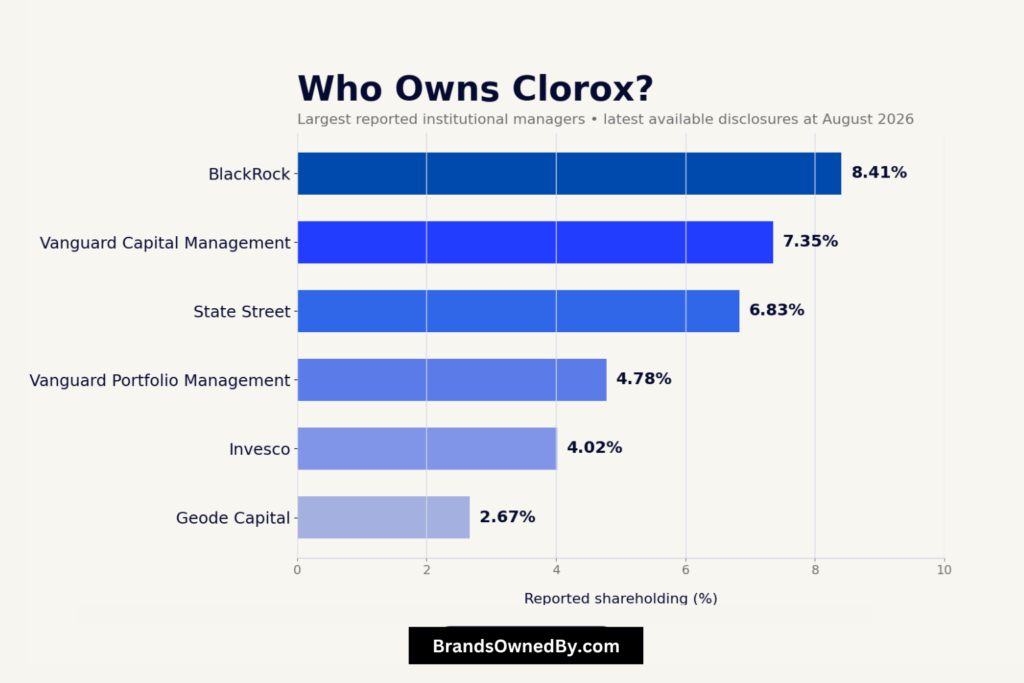
The Clorox Company is owned by public shareholders who hold its common stock. Its shares trade on the New York Stock Exchange under CLX. Institutional investors hold most shares, but their positions are generally managed on behalf of index funds, mutual funds, pensions, and other clients. These firms are shareholders, not parent companies.
The percentages below use the latest available disclosures reviewed for August 2026. Most institutional data reflects positions reported for March 31, 2026. Holdings can change after the reporting date. Vanguard also reorganized its reporting structure in 2026, so affiliated management units appear separately.
BlackRock
BlackRock reported approximately 10.17 million Clorox shares, equal to 8.41% of the company. This made it the largest individually reported institutional manager in the reviewed holdings data.
Most of the position is held through funds and managed portfolios. BlackRock does not own Clorox as a corporate subsidiary. Its influence is exercised through shareholder voting, stewardship, and investment management responsibilities.
Vanguard Capital Management
Vanguard Capital Management reported beneficial ownership of approximately 8.89 million shares, or 7.35%, in an April 2026 Schedule 13G covering the March 31 position.
The filing followed an internal Vanguard reporting realignment. It is important not to confuse this entity with every Vanguard-affiliated fund or management unit. The disclosed shares are held in the ordinary course of investment management, not as a controlling acquisition.
State Street
State Street reported approximately 8.25 million Clorox shares, representing 6.83%. Many of these shares are associated with index, institutional, and asset-management mandates.
State Street is a major voter but does not have unilateral control over Clorox. A 6.83% stake is significant in a widely held public company, yet it remains far below a majority.
Vanguard Portfolio Management
Vanguard Portfolio Management reported approximately 5.78 million shares, equal to 4.78%. This is presented separately because Vanguard’s 2026 reporting changes divided positions among affiliated business units.
The stake should not be read as a founder or strategic parent holding. It represents managed investment exposure and is subject to changes in client flows, index weights, and portfolio decisions.
Invesco
Invesco’s aggregated reported position was approximately 4.86 million shares, or 4.02%. The total includes holdings managed across Invesco entities.
Like other large asset managers, Invesco primarily holds Clorox shares for investment products and client accounts. Its ownership creates voting rights but not direct operating authority.
Geode Capital Management
Geode Capital Management reported approximately 3.23 million shares, equal to 2.67%. Geode is an important institutional holder, although its position is smaller than those of BlackRock, Vanguard’s main disclosed units, and State Street.
The holding contributes to Clorox’s institutional ownership base. It does not confer control over daily business decisions.
Competitor Ownership Comparison
Clorox competes against larger diversified groups and more focused household-products companies. All five competitors below are publicly traded. None operates under a simple founder-controlled structure. The main difference is scale, portfolio breadth, geographic reach, and the concentration of voting power among institutions.
Procter & Gamble
Procter & Gamble is a widely held public company. Large asset managers, including Vanguard, BlackRock, and State Street, are among its major shareholders. Its board and executive team control operations on behalf of shareholders.
P&G is much larger and more diversified than Clorox. It competes in fabric care, home care, personal care, grooming, baby care, and other consumer categories. P&G once owned Clorox from 1957 until the court-ordered divestiture. It also held 20% of the Glad venture until January 2026. It does not own Clorox or Glad today.
Unilever
Unilever PLC is publicly traded and widely held by global institutions and individual investors. Control sits with its board and executive leadership rather than a parent corporation or founding family.
Unilever competes with Clorox in home care and personal care. Its global reach and large brand portfolio exceed Clorox’s scale. Clorox is more concentrated in U.S. household, cleaning, and specialized lifestyle categories.
Colgate-Palmolive
Colgate-Palmolive is a public company with a dispersed shareholder base dominated by institutional investors. Its board oversees management and capital allocation.
The company is best known for oral care but also competes in personal care, home care, and pet nutrition. Clorox has greater exposure to bleach, disinfecting, bags, grilling, and food. Colgate has much greater concentration in oral care and a broader global footprint.
Church & Dwight
Church & Dwight is publicly traded and institutionally owned. Its operations are directed by its board and executive team.
The company competes with Clorox in household cleaning, laundry, personal care, and specialty consumer products. Church & Dwight often builds its portfolio through targeted acquisitions around a smaller number of power brands. Clorox has a broader mix of cleaning, food, cat litter, grilling, water filtration, and professional hygiene.
Reckitt
Reckitt Benckiser Group PLC is a publicly traded British consumer-health and hygiene company. Its shareholders elect the board, and management controls operations under board oversight.
Reckitt competes directly in disinfecting, surface care, hygiene, and consumer health. Brands such as Lysol create clear competition with Clorox cleaning and disinfecting products. Reckitt is more exposed to consumer health, while Clorox owns a stronger mix of U.S. household categories such as bags, cat litter, charcoal, and ranch dressing.
Who Controls Clorox?
Clorox does not have a controlling shareholder, parent company, or founder-led voting bloc. It is a publicly traded company with one class of common stock. Each share carries one vote.
The largest institutional investors individually own less than 10% of the outstanding shares. Their holdings give them influence in director elections and shareholder votes. However, none can appoint management or direct Clorox’s operations independently.
Control is therefore divided among shareholders, the board of directors, and the executive team.
Linda Rendle Retains Executive Control During the CEO Transition
As of August 2026, Linda Rendle remained Clorox’s chair and chief executive officer. She has served as CEO since September 2020 and chair since January 2021.
Rendle announced on May 28, 2026, that she would step down for health reasons. However, her announcement did not immediately transfer control to another executive. Clorox confirmed that she would remain chair and CEO until the board appoints her successor.
Rendle therefore continued to hold the company’s highest executive position. She remained responsible for strategy execution, operating performance, capital deployment, senior leadership decisions, and integration of the newly acquired GOJO Industries business.
Clorox also said Rendle would serve as an adviser for a period after the new CEO takes office. That arrangement is intended to preserve continuity, but the incoming CEO will assume formal executive authority once appointed.
An Independent Board Committee Controls the CEO Search
The board did not delegate the succession decision to Rendle or another executive. It established an independent search committee to lead the process. The committee is working with an external executive-search firm.
The board has not announced a fixed deadline or publicly identified candidates. The search is described as comprehensive, which allows the committee to consider internal and external executives.
This is a significant control point. The person selected by the board will inherit responsibility for integrating GOJO, rebuilding organic growth, managing increased debt, completing Clorox’s operating transformation, and implementing the company’s simplified fiscal 2027 organizational structure.
Clorox Has an 11-Member Board
Clorox’s published board roster contained 11 directors in August 2026. Linda Rendle was the only serving company executive on the board. The remaining members were outside directors with backgrounds in consumer products, finance, operations, marketing, technology, retail, and corporate leadership.
The board members were:
- Linda Rendle.
- Matthew J. Shattock.
- Gina Boswell.
- Stephen B. Bratspies.
- Pierre R. Breber.
- Julia Denman.
- Esther Lee.
- A.D. David Mackay.
- Stephanie Plaines.
- Russell J. Weiner.
- Christopher J. Williams.
Directors stand for election every year. Clorox uses majority voting in uncontested elections. A nominee must receive more votes “for” than “against.” A director who fails to receive majority support is expected to submit a resignation for board consideration.
The board approves major corporate actions. These include acquisitions, capital-structure decisions, financial policies, executive compensation, risk management, CEO succession, and long-term strategy. Management cannot independently complete a transformational acquisition or materially alter Clorox’s capital structure without board authorization.
Matthew Shattock Leads Independent Board Oversight
Because Rendle holds both the chair and CEO positions, Clorox appoints a lead independent director. Matthew J. Shattock held that role in August 2026.
Shattock is not merely an honorary board representative. Clorox’s governance rules give the lead independent director authority to approve board agendas and materials, coordinate the independent directors, preside over their executive sessions, call additional independent-director meetings, and lead board meetings when the chair is absent.
He also participates in evaluating the CEO and can communicate directly with major shareholders. These powers provide an independent counterweight to the combined chair-and-CEO structure.
Shattock also publicly represented the board when Clorox announced Rendle’s planned departure. His role in the transition reinforces that the independent directors, rather than the outgoing CEO, control the succession process.
Three Independent Committees Exercise Specific Control
Clorox divides detailed oversight among three standing board committees. Each committee consists entirely of independent directors.
The Audit Committee oversees financial reporting, internal controls, external and internal auditors, risk-management policies, cybersecurity, data privacy, information technology, and climate-related reporting risks.
The Management Development and Compensation Committee evaluates executive performance, approves executive pay, and oversees leadership development and succession below the CEO level. It also conducts the annual CEO evaluation with input from the other independent directors.
The Nominating, Governance and Corporate Responsibility Committee oversees director nominations, governance policies, ethics and compliance, shareholder engagement, political participation, sustainability governance, and board evaluations.
This committee structure prevents control over financial reporting, executive pay, and director nominations from resting solely with the CEO.
The Executive Team Controls Daily Operations
The board provides oversight, but daily operating authority rests with Rendle and Clorox’s executive leadership.
Chris Hyder serves as executive vice president and chief operating officer. His position places him at the center of operating execution across Clorox’s businesses.
Luc Bellet has served as executive vice president and chief financial officer since April 2025. He controls financial planning, treasury, reporting, funding, and financial discipline. His responsibilities became more important after Clorox used substantial new debt to fund the $2.25 billion GOJO acquisition.
Nina Barton, executive vice president and chief growth and strategy officer, leads growth priorities and corporate strategy. Angela Hilt serves as chief legal and external affairs officer and corporate secretary. Kirsten Marriner is chief administrative officer.
Carey Jaros leads the acquired GOJO operation as president of Clorox Purell. She manages that business within Clorox’s corporate structure and reports through Clorox leadership. GOJO’s former owners no longer control the operation.
Shareholders Retain Ultimate Voting Authority
Clorox shareholders elect directors and vote on matters submitted at annual or special meetings. They can influence governance through director elections, compensation votes, shareholder proposals, and approval of transactions that legally require a shareholder vote.
Large asset managers such as BlackRock, Vanguard, State Street, and Invesco hold substantial voting positions. However, these firms generally hold shares through funds and client accounts. They do not manage Clorox’s brands, employees, factories, pricing, or acquisitions.
The practical control structure is therefore clear. Shareholders elect the board. The board controls strategy, succession, capital policy, and oversight. Linda Rendle and the executive team control daily operations until the board appoints Clorox’s next CEO.
Clorox Annual Revenue and Net Worth
Clorox reports on a fiscal year ending June 30. Its fiscal 2026 results therefore cover the 12 months from July 1, 2025, through June 30, 2026.
Revenue and net worth measure different things. Revenue records annual sales. For a publicly traded company, net worth is commonly represented by market capitalization. Clorox’s accounting equity is also relevant, but it is not the same as the market value of the company.

Clorox Revenue in Fiscal 2026
Clorox generated $6.72 billion in net sales during fiscal 2026. Revenue declined 5% from $7.104 billion in fiscal 2025.
The reported decline was not caused entirely by weaker consumer demand. Retailers placed additional orders before Clorox moved its U.S. operations onto a new enterprise resource planning system in fiscal 2025. Those early shipments increased fiscal 2025 sales by approximately 3.5 percentage points.
Retailers then reduced new orders while selling that inventory during fiscal 2026. Clorox calculated that this inventory drawdown reduced fiscal 2026 sales growth by approximately 7.5 percentage points.
The GOJO acquisition moved results in the opposite direction. Clorox completed the transaction on April 1, 2026, and included three months of GOJO revenue in its annual results. The acquisition added approximately three percentage points to fiscal 2026 sales growth.
After excluding acquisitions, divestitures, and foreign-currency movements, Clorox’s organic sales declined 8%.
Clorox Revenue History
Clorox’s annual sales have remained within a relatively narrow range since the pandemic-era increase in cleaning demand.
Revenue was $6.721 billion in fiscal 2020 and increased to $7.341 billion in fiscal 2021. It declined to $7.107 billion in fiscal 2022 before reaching $7.389 billion in fiscal 2023.
Sales then fell to $7.093 billion in fiscal 2024, recovered slightly to $7.104 billion in fiscal 2025, and declined to $6.720 billion in fiscal 2026.
Fiscal 2026 revenue was almost identical to fiscal 2020 revenue. The difference was only $1 million. This means Clorox had not produced meaningful cumulative sales growth over that six-year period, despite price increases, portfolio changes, and acquisitions.
The addition of GOJO changes the comparison from fiscal 2027 onward because Clorox will consolidate a full year of Purell and GOJO’s professional hygiene operations.
Revenue by Business Segment
Health and Wellness was Clorox’s largest segment in fiscal 2026. It generated $2.697 billion in sales, unchanged from fiscal 2025. The segment represented 40.1% of total company revenue. It includes cleaning products, professional products, and the newly acquired Clorox Purell business.
Household generated $1.787 billion, down 11% from $2.001 billion. It accounted for 26.6% of total revenue. This segment contains Glad bags and wraps, Fresh Step and Scoop Away cat litter, and Kingsford grilling products.
Lifestyle produced $1.123 billion, down 14% from $1.303 billion. It represented 16.7% of sales. Hidden Valley food products, Brita water filtration, and Burt’s Bees personal care are reported within this segment.
International sales increased 5% to $1.113 billion from $1.065 billion. The business contributed 16.6% of total revenue. Foreign-exchange movements provided part of the reported increase. Organic international sales grew 1%.
Profitability Declined Alongside Revenue
Clorox earned $587 million in net income attributable to its shareholders during fiscal 2026. That was down 28% from $810 million in fiscal 2025.
Diluted earnings per share declined 26%, from $6.52 to $4.81. Adjusted earnings per share fell from $7.72 to $5.53.
Gross profit decreased from $3.213 billion to $2.844 billion. Gross margin contracted by 290 basis points, from 45.2% to 42.3%.
Lower sales, increased manufacturing and logistics expenses, and GOJO acquisition costs reduced profitability. The ERP-related shipment comparison lowered gross margin by approximately 100 basis points. GOJO-related inventory accounting reduced it by another 50 basis points.
Clorox recorded $58 million in GOJO acquisition and integration expenses during fiscal 2026. That reduced after-tax earnings by $44 million, or approximately $0.36 per diluted share.
Interest expense also increased from $88 million to $130 million. The increase reflects the larger debt burden associated with the GOJO acquisition and the purchase of Procter & Gamble’s interest in the Glad venture.
Cash Flow and Balance-Sheet Position
Clorox generated $612 million in operating cash flow during fiscal 2026. That was 38% below the $981 million generated in fiscal 2025. The company attributed much of the decline to the payment required to terminate the Glad joint-venture agreement.
Cash and cash equivalents stood at $143 million on June 30, 2026, down from $167 million a year earlier.
Total assets increased from $5.561 billion to $7.794 billion. The GOJO acquisition caused much of that increase. Goodwill rose from $1.229 billion to $1.945 billion. Trademarks increased from $502 million to $989 million. Other intangible assets increased from $64 million to $606 million.
Debt also rose sharply. Notes and loans payable increased from $4 million to $1.086 billion. Long-term debt increased from $2.484 billion to $3.981 billion.
Clorox consequently ended fiscal 2026 with approximately $5.07 billion in interest-bearing borrowings before subtracting cash. This higher leverage makes debt reduction, cash conversion, and successful GOJO integration important factors in the company’s future valuation.
Clorox Net Worth
Clorox does not publish an official “net worth” figure. The most useful public-market measure is its market capitalization, calculated by multiplying the share price by the number of outstanding shares.
Clorox had a market capitalization of approximately $11.29 billion on September 8, 2026. Market capitalization changes throughout every trading session because Clorox shares trade on the New York Stock Exchange under the ticker CLX.
Market value should not be confused with revenue or accounting equity. Clorox’s $11.29 billion market capitalization represented the equity value assigned by investors. It was not the amount of cash held by the company or the value at which all its assets could necessarily be sold.
Clorox reported only $90 million in equity attributable to Clorox shareholders at June 30, 2026. Total stockholders’ equity, including $162 million of noncontrolling interests, was $252 million.
The low accounting-equity figure reflects accumulated dividends, share repurchases recorded as treasury stock, acquisition financing, and the accounting treatment of assets and liabilities. Treasury stock reduced reported equity by $1.582 billion at the end of fiscal 2026.
Including approximately $5.07 billion of debt and subtracting $143 million of cash produces an enterprise value of approximately $16.2 billion based on the September 8 market capitalization. Enterprise value provides a broader measure of what investors and creditors collectively value the operating business at.
Fiscal 2027 Revenue Outlook
Clorox expects fiscal 2027 net sales to increase between 13% and 14%. Applied to fiscal 2026 revenue, that guidance implies sales of approximately $7.59 billion to $7.66 billion.
GOJO is expected to contribute about 9.5 percentage points of the reported growth because fiscal 2027 will include the acquired business for a full year. Clorox expects organic sales growth of 3.5% to 4.5%.
More than 3.5 percentage points of expected organic growth will come from cycling past the fiscal 2026 retailer inventory drawdown. The guidance therefore does not imply that underlying consumer demand will accelerate by the full reported growth rate.
Management expects gross margin of approximately 42%. That would remain slightly below the 42.3% recorded in fiscal 2026. Cost savings are expected to be offset by above-normal inflation and an unfavorable product mix.
Clorox forecasts GAAP diluted earnings of $5.41 to $5.71 per share. Adjusted diluted earnings are expected to range from $5.70 to $6.00. The company expects another $46 million in GOJO-related costs, equal to $35 million after tax or approximately $0.29 per share.
What Will Determine Clorox’s Future Valuation?
The fiscal 2027 sales increase will be heavily influenced by acquisition accounting and easier prior-year comparisons. Investors will therefore need to look beyond headline revenue growth.
The more important measures will be organic volume, gross-margin stabilization, operating cash flow, debt reduction, and GOJO integration. Clorox has targeted at least $50 million in annual run-rate cost synergies from GOJO. Realizing those savings without weakening the Purell business would support earnings and cash generation.
A higher market capitalization is not guaranteed by revenue growth alone. Clorox must convert the larger revenue base into stronger margins and free cash flow. Otherwise, additional interest expense and acquisition-related debt could offset much of the benefit from owning GOJO.
Final Words
Clorox owns far more than its namesake bleach business. Its most important assets now include Purell, Glad, Fresh Step, Hidden Valley, Kingsford, Brita, Burt’s Bees, Pine-Sol, Liquid-Plumr, and a large collection of professional and regional cleaning brands.
The April 2026 GOJO acquisition is the defining portfolio change. It moves Clorox deeper into hand hygiene, professional distribution, healthcare, and institutional environments. At the same time, the end of the Glad venture gives Clorox full ownership of another major household platform.
Clorox remains a widely held public company. Institutional investors own large positions, but no single shareholder controls it. Strategic authority rests with the board, while Linda Rendle and the executive team continue to manage operations during the CEO succession process.
FAQs
Does Clorox Own Purell?
Yes. Clorox completed its acquisition of GOJO Industries, the maker of Purell, in April 2026. The acquired operation now conducts business as Clorox Purell. Purell hand sanitizers, soaps, dispensers, and related hygiene products are part of Clorox’s portfolio.
Does Clorox Own Pine-Sol?
Yes. Clorox acquired Pine-Sol in 1990. Pine-Sol remains a major Clorox-owned multipurpose-cleaning brand.
Does Clorox Own Burt’s Bees?
Yes. Clorox acquired Burt’s Bees in 2007. The brand operates as Clorox’s main natural personal-care platform and sells lip, face, body, and baby-care products.
Does Clorox Own Hidden Valley Ranch?
Yes. Clorox owns the core Hidden Valley brand and its main dressing, dip, and seasoning business. Some products that use the Hidden Valley name may be produced by external companies under licensing agreements.
Does Clorox Own Glad?
Yes. Clorox now fully owns Glad. Procter & Gamble previously held a 20% interest in the Glad bags and wraps venture. The venture ended on January 31, 2026, and Clorox acquired P&G’s interest.
Is Clorox Owned by Procter & Gamble?
No. Procter & Gamble acquired Clorox in 1957, but antitrust action required divestiture. Clorox became independent again in 1969. The two companies are now competitors.
Does Clorox Own Brita?
Clorox controls the Brita water-filtration business in the Americas. It does not own Brita worldwide. The global brand has separate ownership and operating arrangements outside Clorox’s territory.
What Is Clorox’s Biggest Business Segment?
Health and Wellness was Clorox’s largest reported segment in fiscal 2026, with $2.697 billion in net sales. It included cleaning, professional products, and Clorox Purell. Clorox has said its broader global health and hygiene portfolio now represents more than half of company sales when the portfolio is viewed across geographic reporting lines.
Who Is the CEO of Clorox?
Linda Rendle remained chair and CEO in August 2026. She plans to step down after the board appoints a successor. An independent board committee is conducting the search.
How Many Brands Does Clorox Own?
Clorox’s official family list contained 42 named brands in August 2026. The exact answer depends on whether a count includes sub-brands, regional trademarks, licensed rights, professional product systems, and the newly acquired GOJO operating business.