
Baskin-Robbins is one of the world’s most iconic ice cream chains. Known for its “31 flavors” concept, the brand has a long and flavorful history. If you’re wondering who owns Baskin-Robbins today, this article explores its ownership, company profile, leadership, financials, and more.
Baskin-Robbins Company Profile
Baskin-Robbins is one of the largest ice cream specialty chains in the world. It is best known for its “31 flavors” concept, representing a different flavor for every day of the month. The brand is a household name across North America, Asia, and the Middle East.
As of 2025, Baskin-Robbins operates over 7,700 locations globally, with about 2,300 in the United States and the rest spread across more than 50 countries. Most of its stores are franchised. The brand is recognized for its constantly rotating flavors, themed promotions, and ice cream cakes.
- Headquarters: Canton, Massachusetts, USA
- Global Presence: 50+ countries
- Franchise Model: Over 90% of stores are franchised
- Employees: Approximately 800 corporate employees, thousands more through franchise operations
- Parent Company: Inspire Brands (since 2020).
Baskin-Robbins continues to focus on innovation in 2025. This includes plant-based flavors, global flavor fusion offerings, and new store concepts like dessert cafés and express counters in grocery stores and gas stations.
Founders of Baskin-Robbins
Baskin-Robbins was founded in 1945 by Burt Baskin and Irv Robbins in Glendale, California. Both men owned separate ice cream parlors before deciding to merge their operations to create a single brand focused on quality, variety, and customer experience.
Irv Robbins believed that people should have the opportunity to try a different flavor every day, which led to the creation of the “31 flavors” slogan. Burt Baskin brought strong business instincts and brand vision. Together, they created a model that mixed a family-friendly atmosphere with premium-quality ice cream.
Their legacy is still embedded in the company culture today. Many original flavors developed under their leadership continue to rotate in stores.
Major Milestones of Baskin-Robbins (1945–2025)
1945 – Baskin-Robbins is founded in Glendale, California.
1953 – The company officially adopts the name “Baskin-Robbins” and introduces the “31 flavors” slogan.
1967 – Acquired by United Brands Company.
1973 – Becomes part of Allied Domecq, a British multinational company.
1993–2000 – Begins aggressive international expansion, especially in Asia and the Middle East.
2005 – Dunkin’ Brands is formed, merging Dunkin’ Donuts and Baskin-Robbins under one parent company.
2011 – Launch of new logo and store design to modernize the brand.
2020 – Inspire Brands acquires Dunkin’ Brands Group for $11.3 billion. Baskin-Robbins becomes part of Inspire’s portfolio.
2022–2024 – Focus on digital innovation, app-based ordering, drive-thru concepts, and international store growth.
2025 – Launch of “Baskin-Robbins Signature Café” pilot stores in New York, London, and Dubai—offering premium desserts, sundaes, and artisan ice cream-based drinks.
Today, Baskin-Robbins stands as a global icon in frozen desserts. Its continued success comes from a mix of nostalgic branding, flavor innovation, and the scale provided by Inspire Brands.
Who Owns Baskin-Robbins?
As of 2025, Baskin-Robbins is wholly owned by Inspire Brands, a privately held American holding company. Inspire Brands acquired Baskin-Robbins in 2020 as part of its purchase of Dunkin’ Brands Group, which also included Dunkin’ Donuts.
This acquisition integrated Baskin-Robbins into a large portfolio of restaurant brands, streamlining its operations under a centralized leadership model. Baskin-Robbins no longer operates as an independent or publicly traded entity.
Ownership Summary
- Brand: Baskin-Robbins
- Owner: Inspire Brands
- Ultimate Owner: Roark Capital Group (via Inspire Brands)
- Ownership Type: Privately held
- Acquired From: Dunkin’ Brands Group in 2020
- Acquisition Value: $11.3 billion (including Dunkin’)
Parent Company: Inspire Brands
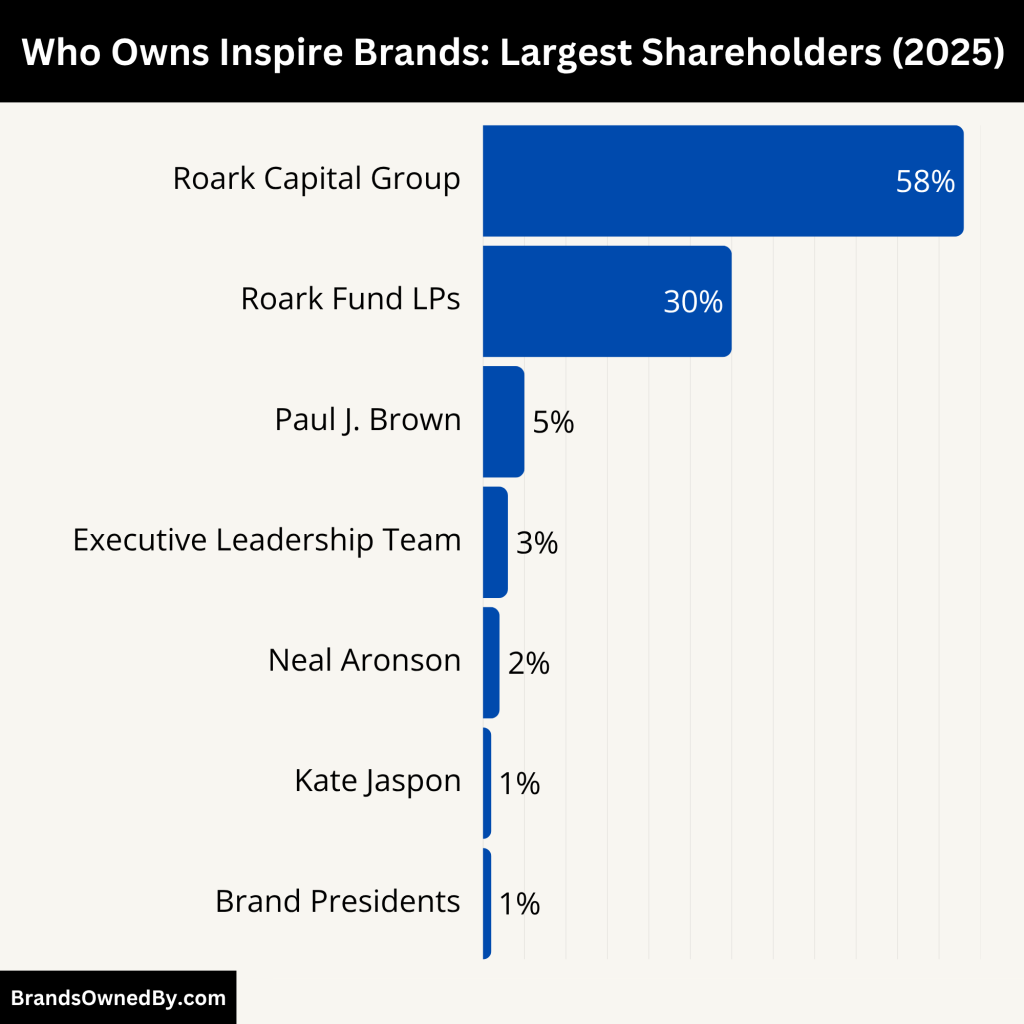
Inspire Brands is the current parent company of Baskin-Robbins. Founded in 2018, Inspire is headquartered in Atlanta, Georgia, and is one of the largest restaurant groups in the world by system sales.
The company operates a multi-brand strategy with a focus on shared services in marketing, data, operations, and technology. Baskin-Robbins benefits from this structure by gaining access to advanced analytics, loyalty programs, and cross-brand promotional strategies used across the group.
Inspire Brands also owns other major food chains including:
Together, these brands account for more than 32,000 restaurants in over 60 countries.
Private Equity Backing: Roark Capital Group
Roark Capital Group, a U.S.-based private equity firm, is the majority owner of Inspire Brands. Roark specializes in franchised and multi-location businesses and has billions in assets under management.
Roark does not directly manage Baskin-Robbins but provides financial support, governance oversight, and strategic guidance through its stake in Inspire. Because both Inspire Brands and Roark Capital are private, their ownership percentages are not publicly disclosed, but Roark holds a controlling interest.
Acquisition of Dunkin’ Brands (2020)
In October 2020, Inspire Brands announced its acquisition of Dunkin’ Brands Group for approximately $11.3 billion, including the assumption of debt. The transaction closed in December 2020.
This deal included both Dunkin’ Donuts and Baskin-Robbins, making it one of the largest quick-service restaurant acquisitions in U.S. history at the time.
Key points from the acquisition:
- Baskin-Robbins was previously publicly traded under Dunkin’ Brands (NASDAQ: DNKN).
- With the acquisition, it became a privately held brand under Inspire.
- The transition enabled Baskin-Robbins to expand internationally and modernize its operations using Inspire’s technology platforms.
- The deal aimed to accelerate digital ordering, drive-thru innovation, and franchise development.
Baskin-Robbins today is part of a well-capitalized, professionally managed restaurant group focused on long-term growth and innovation. Its integration into Inspire Brands has significantly increased its ability to scale globally and modernize in a highly competitive dessert industry.
Who is the CEO of Baskin-Robbins?
Paul J. Brown serves as the Co‑Founder and CEO of Inspire Brands, the parent company that oversees Baskin‑Robbins among other major restaurant brands. As CEO, he provides overall leadership across all brands, including Baskin‑Robbins, and drives the strategic direction of the entire portfolio.
Here’s a quick overview of the Baskin-Robbins CEO as of July 2025:
| Role | Description |
|---|---|
| CEO | Paul J. Brown |
| Brands Overseen | Baskin‑Robbins, Dunkin’, Arby’s, Sonic, Buffalo Wild Wings, Jimmy John’s |
| Key Leadership Activities | Major acquisitions, digital transformation, operational integration |
| Education | Georgia Tech, Northwestern Kellogg, McCormick |
| Community | Chairs Children’s Healthcare of Atlanta, serves on other nonprofit and educational boards |
Before co‑founding Inspire Brands in 2018, Brown had extensive experience in hospitality and brand management:
- He served as CEO of Arby’s from 2013 to 2018, spearheading a significant brand turnaround through marketing campaigns and menu innovation.
- Prior roles include President of Brands and Commercial Services at Hilton Worldwide, where he handled global marketing, loyalty, pricing, and e‑commerce.
- He also led Expedia.com and Expedia’s Partner Services Group, and earlier worked at McKinsey & Company, specializing in travel and hospitality.
Achievements Since Becoming CEO
Since Inspire’s founding, Brown has led major acquisitions that shaped the current brand portfolio:
- Acquisition and integration of Buffalo Wild Wings and Sonic Drive‑In in 2018
- Acquisition of Jimmy John’s in 2019
- Major acquisition of Dunkin’ Brands, including Baskin‑Robbins, in 2020 for approximately $11.3 billion.
Under his leadership, in 2024, Inspire achieved over $32.6 billion in global system sales, supported by 650,000+ team members across all brands.
Decision-Making Structure
As CEO, Brown operates within a centralized executive model. He works alongside other senior leaders—like the CFO, CIO, Chief Growth Officer, and Brand Presidents—to shape corporate strategy, allocate resources, and ensure brand growth.
While each brand maintains some operational independence, key decisions on finance, tech, loyalty, and marketing flow from Inspire’s leadership under Brown’s guidance.
Baskin‑Robbins benefits from these shared services in areas like digital ordering platforms, loyalty programs, data analytics, and international development.
Previous CEOs Over the Years
- 2013–2018: Arby’s under Brown—though he was then CEO of Arby’s only.
- Under Dunkin’ Brands (pre‑2020): Nigel Travis (CEO until 2018), followed by Dave Hoffmann.
- Post‑2020: After Inspire’s acquisition, Baskin‑Robbins no longer retained its own CEO; oversight shifted to Corporate Executives under Paul Brown at Inspire.
Education and Community Engagement
Paul Brown holds a BSc in Management from Georgia Tech, an MBA from Northwestern’s Kellogg School, and a Master of Engineering Management from the McCormick School at Northwestern.
He is deeply involved in community and nonprofit leadership. In January 2025, he became Chair of the Board at Children’s Healthcare of Atlanta. He also serves on boards such as Georgia Tech Foundation and Metro Atlanta Chamber
Baskin-Robbins Annual Revenue and Net Worth
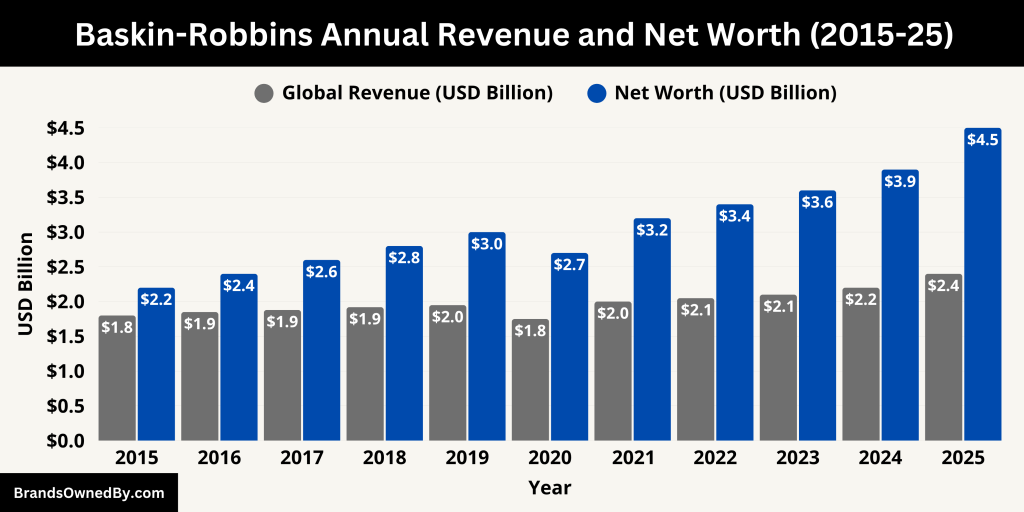
Baskin‑Robbins, as part of Inspire Brands, contributes significantly to the group’s total system sales. In fiscal 2024, the brand operated more than 7,800 locations worldwide, generating approximately $2.2 billion in system sales.
As of July 2025, the estimated net worth of Baskin-Robbins is well over $4.5 billion.
Annual Revenue of Baskin-Robbins
As of 2025, Baskin-Robbins generates approximately $2.2 billion in annual system-wide sales globally. This figure includes all revenue produced across its franchised and company-owned stores worldwide. While the majority of its locations operate under franchise agreements, Baskin-Robbins earns revenue from multiple streams, including franchise fees, royalties, product supply, branded merchandise, and direct sales from company-owned outlets.
In the U.S. market alone, the brand brings in an estimated $600 million to $700 million annually through domestic franchise operations, frozen dessert sales, cakes, and beverages. International markets, particularly South Korea, India, Japan, and the Middle East, account for a large portion of the remaining global sales. South Korea remains one of the top-performing markets for the brand outside North America.
The brand has seen steady revenue growth over the last three years. This is largely due to global store expansion, improved digital ordering channels, the introduction of limited-edition flavors, and the growing popularity of ice cream cakes and desserts in new markets. Seasonal launches and local flavor customization have also boosted sales in Asia and the Middle East.
Net Worth of Baskin-Robbins
While Baskin-Robbins does not report net worth as an independent entity, its estimated brand valuation in July 2025 is around $4.5 billion. This valuation considers the brand’s global franchise footprint, earnings potential, consistent revenue growth, and market strength in the frozen dessert industry.
This estimated net worth is derived from factors such as:
- Over 7,800 operating locations worldwide
- High brand recognition and loyalty across diverse regions
- Strong and stable franchise model
- Growth in same-store sales across multiple international markets
- High-margin product categories like ice cream cakes, beverages, and branded novelties
Baskin-Robbins also holds a significant intangible value through its trademark, proprietary flavors, and longstanding reputation. These brand assets contribute to its valuation, even though it does not trade independently on public markets.
In franchise sales, Baskin-Robbins continues to outperform several competing ice cream chains. It maintains one of the highest franchise penetration rates among quick-service dessert brands. As a result, it is seen as a valuable, self-sustaining asset within the Inspire Brands portfolio.
Here is an overview of Baskin-Robbins’ estimated historical revenue and net worth over the past 10 years (2015–2025):
| Year | Estimated Global Revenue (USD) | Estimated Brand Net Worth (USD) |
|---|---|---|
| 2015 | $1.80 billion | $2.2 billion |
| 2016 | $1.85 billion | $2.4 billion |
| 2017 | $1.88 billion | $2.6 billion |
| 2018 | $1.92 billion | $2.8 billion |
| 2019 | $1.95 billion | $3.0 billion |
| 2020 | $1.75 billion (COVID impact) | $2.7 billion |
| 2021 | $2.00 billion | $3.2 billion |
| 2022 | $2.05 billion | $3.4 billion |
| 2023 | $2.10 billion | $3.6 billion |
| 2024 | $2.20 billion | $3.9 billion |
| 2025 | $2.30–2.40 billion (est.) | $4.2–4.5 billion (est.) |
Financial Outlook for 2025 and Beyond
In 2025, Baskin-Robbins is expected to post moderate year-over-year growth, with projected system sales nearing $2.4 billion by year-end. The expansion of the Baskin-Robbins Signature Café concept and greater digital ordering adoption are key contributors to this projection. Additionally, global economic recovery and strong consumer demand for affordable indulgences have helped drive ice cream sales, even amid inflationary pressures.
The brand’s international strength, especially in markets like India and South Korea, positions it for continued expansion. Its strategy of localizing flavors and offering culturally relevant products has allowed it to maintain relevance in highly competitive markets.
Brands Owned by Baskin-Robbins
Baskin-Robbins is part of Inspire Brands, it operates a wide network of internal entities, brands, and divisions that directly contribute to its global presence and revenue. These units—from Signature Café to the Flavor Innovation Lab—enable Baskin-Robbins to remain one of the most recognized and successful ice cream brands in the world.
Here is a list of major brands owned by Baskin-Robbins as of 2025:
| Entity/Brand Name | Type | Function/Description | Region | Launched/Established |
|---|---|---|---|---|
| Baskin-Robbins U.S. | Regional Division | Manages all U.S. operations including franchising, marketing, and product development. | United States | 1945 |
| Baskin-Robbins International | Global Division | Oversees global franchising and operations in 50+ countries. | Global (non-U.S.) | 1970s |
| Signature Café | Sub-brand / Retail Format | Premium in-store café experience with sundaes, coffee, and plated desserts. | Select global cities | 2024 |
| Cakes Division | Internal Business Unit | Focuses on design, production, and sales of ice cream cakes. | Global | 2000s |
| Product Licensing (CPG) | Licensing/Consumer Goods | Manages branded packaged ice cream and novelties sold in retail stores. | North America, Asia | Early 2010s |
| Express & Kiosk Model | Compact Format Division | Operates small-format locations in malls, airports, and convenience stores. | Global | Mid-2010s |
| Flavor Innovation Lab | R&D / Product Development | Develops new flavors, seasonal recipes, and plant-based formulations. | Primarily U.S.-based | 2000s (expanded in 2020s) |
| Training & Franchise Support | Training & Development | Provides franchisee onboarding, certification, and operational guidance. | Global (HQs in US, Dubai, Seoul) | 1990s (digitally expanded 2020s) |
Baskin-Robbins U.S.
This is the domestic division of the brand responsible for operations, franchising, and marketing within the United States. It manages over 2,300 locations across all 50 states. Baskin-Robbins U.S. handles product development specific to American tastes, brand partnerships (such as NFL and movie promotions), and holiday campaigns like National Ice Cream Month and seasonal flavor launches.
Baskin-Robbins U.S. also runs the online ordering platform for cakes and desserts and manages delivery through partnerships with third-party services. The U.S. division is often used as the testbed for new formats, such as express kiosks and co-branded locations with other Inspire-owned businesses like Dunkin’.
Baskin-Robbins International
This is the global wing of the brand, responsible for expansion, franchising, and regional adaptation across more than 50 countries. As of 2025, there are over 5,500 Baskin-Robbins locations outside the United States.
Key markets include:
- South Korea (the largest international market)
- India (rapidly growing, especially in Tier 2 cities)
- Japan, Saudi Arabia, the UAE, and the Philippines
The International division adapts flavor offerings to local tastes—such as green tea, gulab jamun, or mochi-themed options—and controls master franchise agreements with regional operators.
Baskin-Robbins Signature Café
Launched in 2024, Baskin-Robbins Signature Café is a new sub-brand focusing on premium in-store experiences. These cafés are larger-format stores offering artisan ice cream sundaes, hot dessert pairings, coffee beverages, and plated desserts.
Pilot locations opened in New York City, London, and Dubai in early 2024. The cafés target urban markets and compete with boutique dessert cafés. Signature Café reflects Baskin-Robbins’ attempt to enter the fast-casual dessert space with sit-down service and higher-ticket menu items.
Baskin-Robbins Cakes Division
This internal division focuses on developing, producing, and distributing custom and ready-made ice cream cakes. The cakes segment is a major revenue contributor for Baskin-Robbins, especially during holidays, birthdays, and special occasions.
The division works with centralized facilities and supports franchisees with ready-to-decorate products. It also manages marketing for cake designs, digital cake builders, and online ordering systems.
As of 2025, Baskin-Robbins Cakes Division has expanded its range to include:
- Vegan and dairy-free cakes
- Premium cake slices for in-store purchase
- Seasonal and branded themes like superhero, sports, and animated characters
Baskin-Robbins Product Licensing (CPG)
Baskin-Robbins operates a consumer packaged goods (CPG) business, licensing its brand to manufacturers who sell retail products in grocery stores and convenience outlets.
This includes:
- Pre-packaged ice cream tubs in signature flavors like Jamoca Almond Fudge and Pralines ‘n Cream
- Ice cream bars and sandwiches
- Beverages such as milkshakes and ice cream-based coffee drinks
As of 2025, Baskin-Robbins CPG products are distributed across North America and select Asian markets. The division works closely with grocery chains and handles packaging design, flavor development, and co-marketing campaigns.
Baskin-Robbins Express & Kiosk Model
To capture high-traffic and small-format opportunities, Baskin-Robbins has developed the Express/Kiosk model. These compact outlets operate in:
- Airports
- Train stations
- Movie theaters
- Shopping malls
- Gas stations and convenience stores
These outlets offer a limited menu focused on scoops, pre-packed pints, beverages, and novelty items. They are fully franchised and often run by existing partners expanding into non-traditional locations.
This model supports rapid scalability in markets where full stores are not feasible and contributes to brand visibility in travel and retail zones.
Baskin-Robbins Flavor Innovation Lab
This is the research and development unit behind all Baskin-Robbins flavor creation, testing, and food science. Located in the U.S., this lab is responsible for creating the monthly Flavor of the Month, region-specific recipes, and limited-time offerings.
As of 2025, the Flavor Innovation Lab has increased its focus on:
- Vegan, dairy-free, and plant-based formulas
- Low-sugar and keto-friendly recipes
- Alcohol-inspired (non-alcoholic) flavors
- Nostalgic and retro flavor revivals
This lab also supports global franchisees by localizing formulas and customizing flavor rollouts for specific holidays and festivals around the world.
Baskin-Robbins Training & Franchise Support Center
This entity is the core of franchisee onboarding, training, and ongoing business development. It offers courses, modules, and certifications for new and existing franchisees. The center also manages operations manuals, food safety protocols, and customer service standards.
In 2025, this division operates virtually and through in-person centers in Massachusetts, Dubai, and Seoul. The goal is to maintain global consistency in service, product quality, and operational excellence.
Final Thoughts
Baskin-Robbins is no longer a standalone company. It is part of a powerful restaurant group led by Inspire Brands and backed by Roark Capital. With strategic leadership and strong financial support, Baskin-Robbins continues to expand globally. Its ownership under Inspire Brands ensures that the legacy of the “31 flavors” continues to delight ice cream lovers around the world.
FAQs
Who is the current owner of Baskin-Robbins?
Baskin-Robbins is currently owned by Inspire Brands, a privately held American restaurant company. Inspire acquired Baskin-Robbins in 2020 as part of its $11.3 billion purchase of Dunkin’ Brands.
Who inherited the Baskin-Robbins fortune?
The Baskin and Robbins families were the original founders. After they sold the company, they no longer had ownership. Irv Robbins’ son, John Robbins, chose not to inherit the ice cream business or its wealth. He later became a well-known advocate for plant-based diets and animal rights.
Which country owns Baskin-Robbins?
Baskin-Robbins is an American brand, and it is owned and operated by Inspire Brands, which is based in Atlanta, Georgia, USA. So, it is owned by the United States through a U.S.-based private company.
Does Starbucks own Baskin-Robbins?
No, Starbucks does not own Baskin-Robbins. Starbucks is a separate company. Baskin-Robbins is owned by Inspire Brands, which also owns Arby’s, Dunkin’, and other restaurant chains.
How much is Baskin-Robbins worth?
As of July 2025, Baskin-Robbins is estimated to be worth between $4.2 billion and $4.5 billion. This valuation is based on its global brand equity, annual revenue, and international franchise operations.
What does 31 mean in Baskin-Robbins?
The number “31” represents 31 flavors—a different flavor for every day of the month. This was a unique selling point when the company launched and remains a core part of its identity.
Who is the heir to Baskin-Robbins?
There is no current heir to the company, as Baskin-Robbins is no longer family-owned. The Robbins family’s son, John Robbins, chose to step away from the business. Today, the brand is corporately owned and has no familial inheritance structure.
What is the original name of Baskin-Robbins?
Originally, it was not a single brand. Burt Baskin and Irv Robbins each ran their own ice cream shops—Burt’s Ice Cream and Snowbird Ice Cream. In 1945, they merged their businesses and eventually renamed it Baskin-Robbins in 1953.
Is Baskin-Robbins halal?
Yes, in many countries, Baskin-Robbins offers halal-certified products. Certification depends on the country and local supplier regulations. For example, in the UAE, Saudi Arabia, Malaysia, and parts of India, Baskin-Robbins operates with verified halal compliance. In the U.S., some products may be halal, but the company does not guarantee halal certification across all stores.
Who owns Baskin-Robbins ice cream?
The Baskin-Robbins ice cream brand is owned by Inspire Brands. They manage product development, distribution, and branding through their supply chain and franchise partners worldwide.
Who is the founder of Baskin-Robbins?
Baskin-Robbins was founded by Burt Baskin and Irv Robbins in 1945. They merged their two ice cream shops in California to create what would become a global dessert brand.
Where is Baskin-Robbins located?
Baskin-Robbins is headquartered in Canton, Massachusetts, USA. It operates over 7,800 stores in more than 50 countries, with major markets including the U.S., South Korea, India, Japan, and the Middle East.
Who owns Arby’s and Baskin-Robbins?
Both Arby’s and Baskin-Robbins are owned by Inspire Brands. Inspire Brands is a private U.S.-based restaurant holding company backed by Roark Capital Group. It also owns Sonic, Buffalo Wild Wings, Dunkin’, Jimmy John’s, and Rusty Taco.
Is Baskin-Robbins a part of Dunkin’?
Yes. Baskin-Robbins was part of Dunkin’ Brands until both were acquired by Inspire Brands in 2020.
Is Baskin-Robbins privately owned?
Yes. Baskin-Robbins is part of Inspire Brands, which is privately owned by Roark Capital Group.
Does Baskin-Robbins have its own CEO?
No. It is managed under Inspire Brands, whose CEO is Paul Brown.
Where is the headquarters of Baskin-Robbins?
The brand’s U.S. headquarters is located in Canton, Massachusetts.