

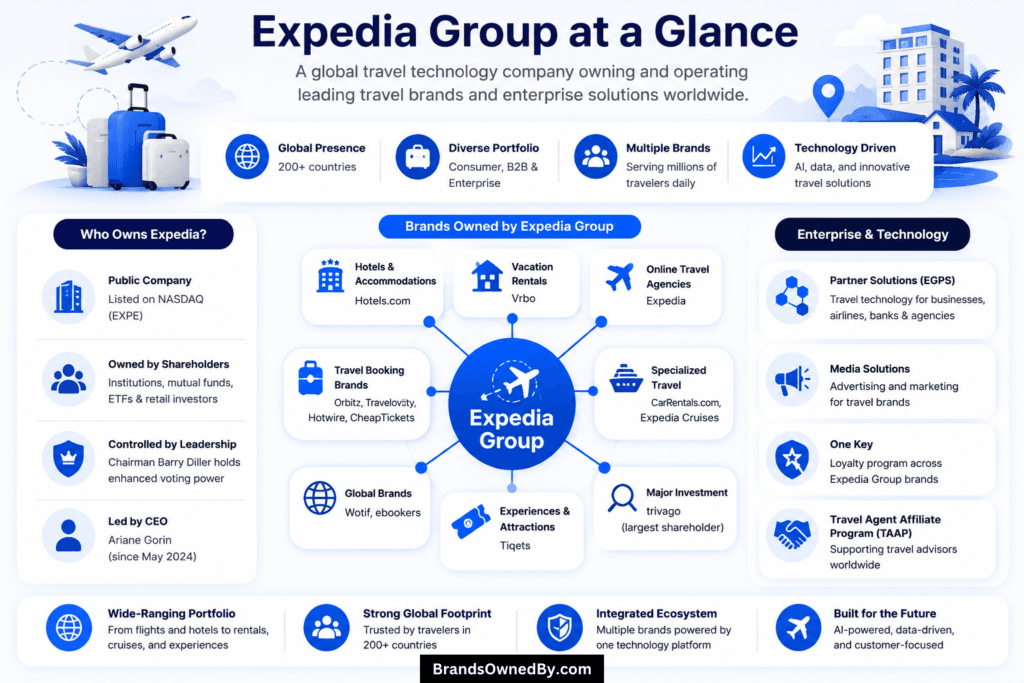
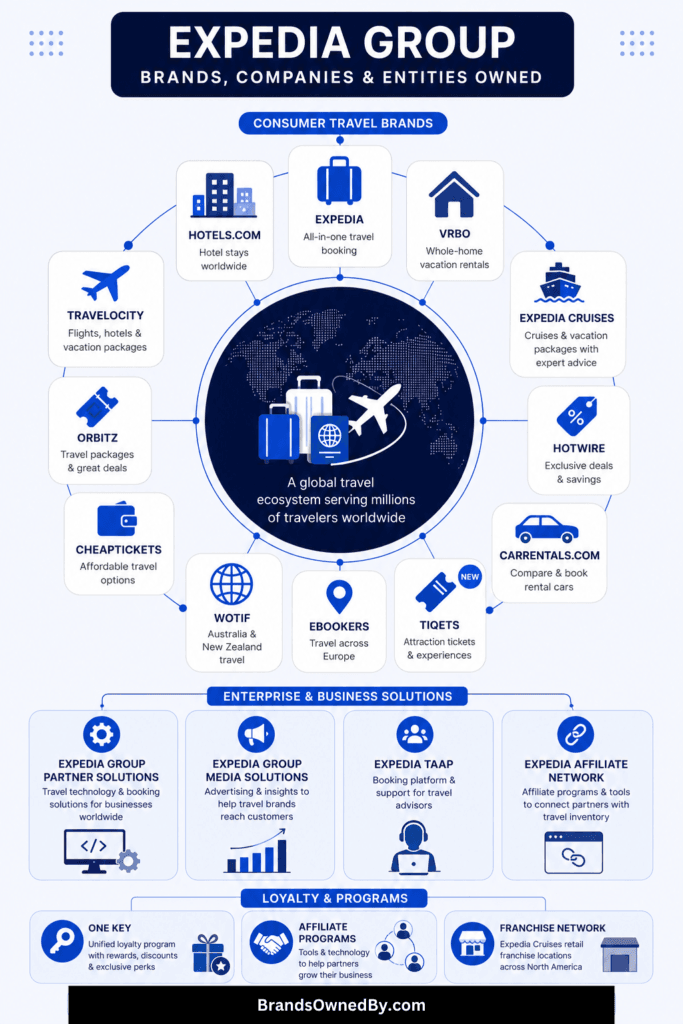
- Expedia Group owns more than a dozen travel brands, including Expedia, Hotels.com, Vrbo, Travelocity, Orbitz, Hotwire, CheapTickets, Wotif, ebookers, CarRentals.com, Expedia Cruises, and Tiqets, serving travelers across hotels, flights, vacation rentals, cruises, and attractions.
- The company also operates major enterprise businesses, such as Expedia Group Partner Solutions (EGPS), Expedia Group Media Solutions, One Key, and Expedia Travel Agent Affiliate Program (TAAP), providing travel technology, advertising, and loyalty services to businesses and consumers worldwide.
- Expedia is the largest shareholder of trivago, giving it significant influence over the hotel metasearch platform, although trivago continues to operate as an independent publicly traded company.
- Expedia’s multi-brand strategy allows it to target different travel markets without consolidating every business under one name, making it one of the world’s largest and most diversified travel technology companies with operations spanning online travel agencies, vacation rentals, metasearch, enterprise travel solutions, digital advertising, and travel experiences.
Expedia Group is one of the world’s largest travel technology companies. It operates a portfolio of well-known travel brands that help consumers book hotels, flights, vacation rentals, rental cars, cruises, and holiday packages from a single ecosystem. The company serves both individual travelers and business partners through consumer booking platforms and enterprise travel technology solutions.
Rather than relying on one website, Expedia has built a multi-brand strategy. Its brands target different customer segments, geographic markets, and travel preferences. For example, Hotels.com focuses on hotel bookings, Vrbo specializes in whole-home vacation rentals, while Expedia.com offers a complete travel booking experience. This approach allows the company to reach millions of travelers worldwide without depending on a single brand.
Expedia also provides technology solutions to airlines, banks, travel agencies, loyalty programs, and corporate travel providers through Expedia Group Partner Solutions. Its travel ecosystem includes more than 3.5 million accommodation listings and access to flights operated by over 500 airlines, making it one of the largest online travel marketplaces globally.
The company continues to invest heavily in artificial intelligence, personalized trip planning, unified loyalty programs such as One Key, and creator-focused travel tools. These initiatives strengthen its position in the highly competitive online travel industry while improving the customer booking experience.
Expedia Founders
Expedia was founded inside Microsoft in 1996 by Rich Barton, who led a small team that transformed the traditional travel booking process into an online experience. His vision was to give consumers direct access to airfare, hotel, and rental car bookings without relying solely on travel agents. Expedia later became an independent public company and evolved into today’s Expedia Group.
Rich Barton
Rich Barton is an American technology entrepreneur best known for founding Expedia. Before launching the company, he worked as a product manager at Microsoft. After Expedia’s successful public listing, Barton went on to found Zillow and co-found Glassdoor, making him one of the most influential entrepreneurs in the internet marketplace industry. His focus on using technology to improve consumer transparency continues to shape Expedia’s long-term strategy.
Lloyd Frink
Although Rich Barton is officially recognized as Expedia’s founder, Lloyd Frink played a critical role in developing the platform during its early years. Frink worked alongside Barton at Microsoft and helped build Expedia’s technology and data-driven search capabilities. He later became a co-founder of Zillow with Barton, further demonstrating the long-term partnership between the two entrepreneurs.
List of Companies Owned by Expedia
Over the past three decades, Expedia Group has expanded primarily through acquisitions while also developing several brands internally. Rather than consolidating every acquisition under one name, the company has preserved many well-known consumer brands to serve different traveler segments and geographic markets. Its portfolio includes online travel agencies, vacation rental platforms, metasearch businesses, cruise agencies, travel advertising services, enterprise technology platforms, and loyalty programs.
Expedia
Expedia is the company’s flagship online travel brand and the foundation of Expedia Group’s global business. Originally launched in 1996 inside Microsoft, it has grown into one of the world’s largest online travel agencies.
The platform allows travelers to book flights, hotels, vacation rentals, rental cars, cruises, airport transportation, travel insurance, attractions, and complete holiday packages from a single website or mobile application.
Expedia also offers AI-powered trip planning tools, personalized recommendations, price tracking, package discounts, and integrated travel management features. It operates in dozens of languages and serves customers across more than 70 countries.
For many consumers, Expedia functions as the primary gateway into the broader Expedia Group ecosystem.
Hotels.com
Hotels.com is one of the world’s best-known hotel booking websites and has been part of Expedia Group since 2001.
The platform specializes in hotel reservations while also offering resorts, apartments, vacation homes, boutique hotels, hostels, and luxury accommodations. Hotels.com is particularly popular among travelers comparing accommodation options without booking flights.
The brand now operates using Expedia Group’s unified technology platform while maintaining its own customer experience, search interface, promotions, and marketing identity.
Hotels.com also participates in Expedia Group’s One Key rewards ecosystem.
Vrbo
Vrbo, short for Vacation Rentals by Owner, is Expedia Group’s dedicated vacation rental marketplace.
Unlike many accommodation marketplaces that emphasize shared spaces, Vrbo focuses almost exclusively on entire private properties. Families, groups, and longer-stay travelers make up a significant portion of its customer base.
Property owners can list houses, villas, cabins, beach homes, mountain retreats, and luxury residences across hundreds of destinations worldwide.
Vrbo has become one of Expedia Group’s fastest-growing brands as consumer demand for alternative accommodations continues to increase.
Travelocity
Travelocity remains one of the most recognized names in online travel.
Although much of its technology has been integrated into Expedia’s booking platform, Travelocity continues operating as an independent consumer-facing brand.
The website offers flights, hotels, vacation packages, rental cars, cruises, and activities while targeting travelers looking for value-oriented travel planning.
Its long-established brand recognition continues to attract loyal customers in North America.
Orbitz
Orbitz joined Expedia Group following its acquisition in 2015.
The platform provides comprehensive travel booking services including airfare, accommodations, rental vehicles, cruises, vacation packages, and destination activities.
Orbitz continues to maintain its own branding, promotions, loyalty benefits, and customer experience while utilizing Expedia Group’s technology infrastructure.
The brand remains particularly popular among frequent domestic travelers in the United States.
Hotwire
Hotwire focuses on discounted travel products.
Its business model differs from Expedia by offering opaque pricing, where travelers receive significant discounts before the hotel or airline name is revealed.
This allows hotels and airlines to sell excess inventory without reducing publicly advertised prices.
Hotwire continues to serve budget-conscious travelers looking for last-minute deals.
CheapTickets
CheapTickets targets travelers searching for affordable vacations and discounted airfare.
The platform offers hotel reservations, airline tickets, vacation packages, cruises, rental cars, and destination experiences.
Although much of its technology is shared with Orbitz, CheapTickets maintains separate branding and marketing aimed at price-sensitive consumers.
Wotif
Wotif is Expedia Group’s leading online travel brand across Australia and New Zealand.
The company specializes in domestic and regional travel while offering hotel reservations, flights, rental cars, vacation packages, and local attractions.
Wotif enjoys strong brand recognition throughout Oceania and continues operating independently within Expedia Group’s portfolio.
ebookers
ebookers serves travelers across Europe.
The platform allows users to book flights, accommodations, holiday packages, rental vehicles, cruises, and travel experiences.
It has maintained strong recognition in several European markets despite sharing Expedia’s backend technology.
ebookers remains one of Expedia’s key international consumer brands.
CarRentals.com
CarRentals.com is Expedia Group’s dedicated vehicle rental platform.
Rather than functioning as a full-service travel agency, the website focuses exclusively on comparing rental car prices from leading international and regional providers.
Customers can compare vehicle types, suppliers, insurance options, pickup locations, and pricing before making reservations.
Its specialized focus makes it one of the largest standalone rental car comparison platforms within the travel industry.
Expedia Cruises
Expedia Cruises is the company’s retail travel franchise network.
Unlike Expedia’s online booking websites, Expedia Cruises operates through hundreds of physical franchise locations across North America.
Travel consultants assist customers in booking ocean cruises, river cruises, expedition voyages, escorted tours, luxury vacations, safaris, resort stays, travel insurance, and complete vacation packages.
The combination of in-person expertise and Expedia’s booking technology distinguishes Expedia Cruises from traditional online travel agencies.
trivago
Expedia Group remains the largest shareholder of trivago.
Unlike Expedia’s booking platforms, trivago operates as a hotel metasearch engine. Instead of processing bookings directly, it compares hotel prices from hundreds of travel websites before redirecting users to booking partners.
Its business model relies primarily on advertising and referral revenue rather than direct travel sales.
Although trivago is publicly traded, Expedia continues to exercise significant influence through its ownership stake.
Expedia Group Partner Solutions (EGPS)
Expedia Group Partner Solutions is Expedia’s global B2B travel platform.
Instead of serving consumers directly, EGPS provides travel technology to airlines, banks, online retailers, loyalty programs, travel agencies, telecommunications companies, financial institutions, and corporate partners.
Businesses can integrate Expedia’s booking technology into their own websites or mobile applications using APIs and white-label solutions.
This division represents one of Expedia Group’s most strategically important businesses because it generates recurring enterprise revenue beyond consumer travel bookings.
Expedia Group Media Solutions
Expedia Group Media Solutions is the company’s travel advertising division.
Hotels, airlines, tourism boards, destinations, cruise operators, attractions, and travel brands use the platform to advertise across Expedia Group’s extensive portfolio.
Advertisers can purchase sponsored listings, display advertising, audience targeting, travel insights, first-party traveler data, and campaign analytics.
This business has become an increasingly important part of Expedia’s overall ecosystem as travel companies seek highly targeted digital advertising.
One Key
One Key is Expedia Group’s unified loyalty program.
Introduced to replace multiple legacy rewards systems, One Key allows members to earn and redeem rewards across Expedia, Hotels.com, and Vrbo.
Members receive travel discounts, exclusive offers, loyalty pricing, and tier-based benefits that encourage customers to remain within Expedia’s ecosystem instead of booking with competing travel companies.
The program has become one of Expedia’s key customer retention initiatives.
Expedia TAAP
Expedia Travel Agent Affiliate Program (TAAP) is Expedia’s dedicated platform for professional travel advisors.
Travel agents can access Expedia’s inventory of hotels, flights, vacation packages, rental cars, and activities while earning commissions on eligible bookings.
TAAP operates in numerous international markets and supports thousands of independent travel agencies.
It strengthens Expedia’s relationships with travel professionals while expanding the company’s distribution network.
Expedia Affiliate Network
Expedia Affiliate Network enables websites, publishers, travel businesses, and digital platforms to integrate Expedia’s accommodation inventory into their own services.
Partners receive access to millions of hotel listings through APIs, booking widgets, and white-label technology.
Although much of its functionality has been incorporated into Expedia Group Partner Solutions, the affiliate network remains an important distribution channel within Expedia’s enterprise business.
Tiqets
Tiqets became part of Expedia Group following the completion of its acquisition in early 2026.
The Amsterdam-based company specializes in digital ticketing for museums, cultural attractions, theme parks, landmarks, guided tours, and live experiences.
Its platform allows travelers to purchase instant mobile tickets for thousands of attractions around the world.
The acquisition significantly expands Expedia’s experiences business and strengthens its ability to offer complete end-to-end trip planning, from transportation and accommodation to destination activities and attractions.
Who Owns Expedia: Major Shareholders
Expedia Group is a publicly traded company listed on the NASDAQ Stock Exchange under the ticker symbol EXPE. Since its shares trade on the open market, ownership is spread among institutional investors, company insiders, mutual funds, exchange-traded funds (ETFs), and individual retail investors.
Institutional investors collectively own the majority of Expedia’s outstanding shares. However, corporate control is not based solely on economic ownership. Chairman Barry Diller holds Class B shares that carry enhanced voting rights, giving him significant influence over the company’s governance despite owning a much smaller percentage of the total equity.
As of July 2026, the largest shareholders of Expedia Group are as follows:
Expedia Ownership Structure
Major Shareholders • July 2026
Expedia
NASDAQ : EXPEBarry Diller
Voting Control
Class B Shares
The Vanguard Group
The Vanguard Group is Expedia Group’s largest shareholder.
The investment management company owns approximately 12.3% of Expedia’s outstanding common stock through numerous index funds and exchange-traded funds. Vanguard invests on behalf of millions of individual and institutional clients worldwide.
Its ownership is primarily passive, meaning it generally does not participate in the day-to-day management of Expedia. However, because of its large shareholding, Vanguard has considerable voting influence during shareholder meetings, including elections of directors and major corporate governance matters.
BlackRock
BlackRock is Expedia’s second-largest shareholder.
The global asset management firm owns approximately 8.2% of the company’s outstanding shares through its extensive range of mutual funds, institutional portfolios, and iShares ETFs.
Like Vanguard, BlackRock is a long-term institutional investor. While it does not manage Expedia’s operations, it actively votes on governance proposals, executive compensation, and board appointments.
State Street Global Advisors
State Street Global Advisors ranks among Expedia’s largest institutional investors.
The firm owns roughly 4.7% of Expedia Group through index funds and institutional investment products. State Street is one of the world’s largest asset managers and frequently appears among the top shareholders of major publicly traded companies.
Its investment reflects confidence in Expedia’s long-term growth rather than operational involvement.
Geode Capital Management
Geode Capital Management is another significant shareholder.
The firm manages index-based investment portfolios for institutional and retail clients and owns approximately 2.3% of Expedia Group.
Although Geode rarely takes an active role in management decisions, its ownership contributes to the strong institutional base supporting Expedia’s public ownership structure.
JPMorgan Chase & Co.
JPMorgan Chase & Co. also maintains a substantial investment in Expedia Group through its various asset management and investment funds.
Its ownership is estimated at around 2% of outstanding shares, making it one of the company’s largest institutional shareholders.
Like other major investment firms, JPMorgan primarily holds Expedia shares on behalf of clients and investment funds rather than for operational control.
Barry Diller
Barry Diller is Expedia Group’s most influential individual shareholder.
Although his direct economic ownership represents less than 2% of the company’s outstanding shares, he controls substantially greater voting power through Expedia’s Class B common stock, which carries enhanced voting rights.
As Chairman of the Board, Diller has played a central role in Expedia’s strategic direction for more than two decades. His voting control allows him to influence board composition, executive leadership, major acquisitions, and other significant corporate decisions.
This dual-class share structure means that Barry Diller exercises considerably more influence than his economic ownership alone would suggest.
Other Institutional Investors
Beyond the largest shareholders, Expedia’s stock is widely held by hundreds of institutional investors worldwide.
These include pension funds, insurance companies, sovereign wealth funds, mutual funds, hedge funds, university endowments, and ETF providers. Collectively, institutional investors own well over 90% of Expedia’s publicly traded shares.
This broad institutional ownership provides liquidity while reducing reliance on any single investor.
Retail Investors
Individual investors also own Expedia Group shares through brokerage accounts and retirement portfolios.
Although retail shareholders collectively own a relatively small percentage compared with institutional investors, they remain an important part of Expedia’s ownership base. They participate in shareholder voting and benefit from the company’s long-term performance through capital appreciation and dividends when declared.
Competitor Ownership Comparison
Expedia Group competes with several global travel technology companies. While many of these businesses offer similar services such as hotel reservations, flight bookings, vacation rentals, and travel experiences, their ownership structures vary considerably. Some remain influenced by their founders, while others are largely controlled by institutional investors.
Travel Industry Ownership Models
Major Expedia Competitors • July 2026
Booking Holdings
Booking Holdings is Expedia Group’s largest competitor and one of the world’s biggest online travel companies. Its portfolio includes Booking.com, Priceline, Agoda, KAYAK, OpenTable, and Rentalcars.com.
Unlike Expedia, Booking Holdings does not have a controlling founder or a dual-class share structure. The company operates under a traditional public company model where institutional investors collectively own the majority of outstanding shares.
As of July 2026, The Vanguard Group is the largest shareholder with approximately 9.6% ownership, followed by BlackRock with around 8.5%. Other major investors include T. Rowe Price Associates, State Street Global Advisors, and Fidelity Management & Research. Because no single investor controls a significant percentage of shares, major corporate decisions are made by the board of directors and executive management on behalf of all shareholders.
This ownership structure gives Booking Holdings a more decentralized governance model compared to Expedia.
Airbnb
Airbnb is Expedia’s biggest competitor in the vacation rental market, competing directly with Vrbo while also expanding into experiences and long-term stays.
The company differs significantly from Expedia because its founders continue to maintain substantial control. Brian Chesky, Airbnb’s co-founder and Chief Executive Officer, remains the company’s largest individual shareholder. Through Airbnb’s dual-class share structure, he holds enhanced voting rights that give him significant influence over strategic decisions despite owning a relatively modest percentage of the company’s total equity.
Institutional investors still own a large portion of Airbnb’s publicly traded shares. The largest include The Vanguard Group, BlackRock, Fidelity Management & Research, and Capital Research & Management Company. However, the founders collectively retain voting control, allowing Airbnb to pursue long-term strategic initiatives without relying heavily on shareholder approval.
Trip.com Group
Trip.com Group is China’s largest online travel company and one of Expedia’s fastest-growing international competitors. The company operates several well-known travel brands, including Trip.com, Ctrip, Skyscanner, Qunar, Travix, and TrainPal.
Ownership of Trip.com Group is more concentrated than many Western travel companies because it combines institutional ownership with significant strategic investors. Baillie Gifford & Co. remains one of the company’s largest shareholders, while Tencent Holdings continues to hold a substantial strategic investment. Other major shareholders include The Vanguard Group, BlackRock, and numerous global institutional investment firms.
Unlike Expedia and Airbnb, Trip.com does not rely on a dual-class voting structure for corporate control. Instead, leadership is exercised through its executive management team and board of directors under Chairman James Liang, who has remained closely associated with the company since its early years.
Tripadvisor
Tripadvisor has evolved from a travel review website into a diversified travel platform offering hotel comparisons, experiences, restaurant reservations, and vacation planning tools. It competes with Expedia through its hotel metasearch services and growing experiences business.
Following the acquisition of Liberty Tripadvisor Holdings, the company operates under a conventional public ownership structure. Institutional investors collectively own the majority of outstanding shares, with The Vanguard Group and BlackRock serving as the two largest shareholders. Other major investors include Starboard Value LP, State Street Global Advisors, and several large mutual fund managers.
Unlike Expedia, Tripadvisor does not have a founder or executive with enhanced voting rights. Strategic decisions are made collectively by the board of directors and senior management, making it one of the more traditionally governed companies in the online travel industry.
Despegar
Despegar is Latin America’s leading online travel company and competes with Expedia throughout Mexico, Central America, South America, and the Caribbean. The company provides hotel reservations, airline tickets, vacation packages, travel financing, and destination services.
Although Despegar remains publicly traded, its ownership is dominated by institutional investors rather than company founders. Prosus N.V. is among its most influential shareholders through its strategic investments in online marketplaces. Other significant investors include The Vanguard Group, BlackRock, and several Latin American investment funds.
Despegar’s governance follows a traditional public company model, with executive leadership accountable to a diversified shareholder base rather than a controlling founder or family.
Travel + Leisure Co.
Travel + Leisure Co. competes with Expedia primarily in the vacation ownership, holiday exchange, and leisure travel sectors rather than traditional online travel bookings. The company owns well-known brands such as Club Wyndham, WorldMark, Margaritaville Vacation Club, and Panorama.
The company has a widely distributed ownership structure dominated by institutional investors. The Vanguard Group is its largest shareholder, followed by BlackRock, State Street Global Advisors, Dimensional Fund Advisors, and Geode Capital Management. No founder or executive maintains controlling voting power, and governance is carried out through its board of directors and executive leadership team.
Its institutional ownership structure closely resembles that of Booking Holdings and contrasts with Expedia’s founder-influenced governance model.
Overall Comparison
Among the world’s leading travel companies, Expedia and Airbnb stand out because both continue to be significantly influenced by individuals holding enhanced voting rights. Barry Diller maintains substantial control over Expedia through Class B shares, while Brian Chesky exercises similar influence at Airbnb through Airbnb’s dual-class share structure.
By contrast, competitors such as Booking Holdings, Tripadvisor, Despegar, and Travel + Leisure Co. are primarily controlled by institutional investors, with no single individual exercising dominant voting authority. Trip.com Group represents a hybrid model, combining significant institutional ownership with strategic corporate investors and long-serving executive leadership.
These different ownership models influence how each company approaches acquisitions, innovation, long-term investments, shareholder returns, and corporate governance, making ownership structure an important competitive differentiator within the global travel industry.
Who Controls Expedia?
Although Expedia Group is a publicly traded company with millions of shares owned by institutional and retail investors, control of the company is concentrated among its leadership rather than its largest shareholders. This is because Expedia operates with a dual-class share structure, giving certain Class B shares substantially greater voting power than ordinary common shares.
As of July 2026, Expedia’s strategic direction is shaped by four key groups: the Chairman, the Chief Executive Officer, the Board of Directors, and the executive leadership team.
- Barry Diller controls long-term corporate governance through enhanced voting rights.
- Ariane Gorin manages the company’s global operations as Chief Executive Officer.
- The Board of Directors oversees governance, executive performance, and strategic decisions.
- Institutional investors influence corporate policy through shareholder voting but do not exercise day-to-day control.
- The executive leadership team executes Expedia’s business strategy across its worldwide portfolio of travel brands.
This governance model enables Expedia Group to maintain strategic continuity while remaining accountable to its public shareholders and institutional investors.
Barry Diller Holds Ultimate Voting Control
Barry Diller is the most influential person at Expedia Group.
While institutional investors such as Vanguard and BlackRock collectively own a much larger economic stake, Diller controls the company’s voting structure through his Class B common shares. These shares carry enhanced voting rights, allowing him to exercise significant influence over major corporate decisions despite owning less than 2% of the company’s economic interest.
His voting authority allows him to influence decisions involving:
- Election of directors.
- Appointment or removal of senior executives.
- Major acquisitions and divestitures.
- Corporate governance changes.
- Long-term strategic direction.
- Significant shareholder proposals.
Expedia’s governance agreement also places specific restrictions on the transfer and use of these Class B shares, ensuring that Diller’s voting influence cannot simply be transferred without triggering predefined governance protections.
Ariane Gorin Leads Daily Operations
While Barry Diller controls long-term governance, Ariane Gorin is responsible for managing Expedia’s day-to-day business.
She became Chief Executive Officer in May 2024 and continues to lead the company as of July 2026. Gorin oversees Expedia’s global operations, consumer brands, enterprise businesses, artificial intelligence initiatives, product development, marketing, and international expansion.
Her responsibilities include:
- Executing Expedia’s long-term strategy.
- Managing the company’s global workforce.
- Overseeing Expedia, Hotels.com, Vrbo, Orbitz, Travelocity, Wotif, and other consumer brands.
- Expanding Expedia Group Partner Solutions and Media Solutions.
- Driving AI-powered travel planning and personalization.
- Improving operational efficiency and customer experience.
Although she manages the business, she remains accountable to Expedia’s Board of Directors.
The Board of Directors Provides Strategic Oversight
Expedia’s Board of Directors represents shareholders and oversees the company’s governance.
The board approves major corporate decisions rather than participating in daily operations.
Its primary responsibilities include:
- Selecting and evaluating the Chief Executive Officer.
- Approving major acquisitions and investments.
- Reviewing financial performance.
- Establishing executive compensation.
- Managing corporate governance policies.
- Monitoring enterprise risk.
Because Barry Diller serves as Chairman, he plays a leading role in board discussions and long-term strategic planning while working closely with the CEO.
Executive Leadership Team
Expedia’s executive leadership team manages the company’s global business operations.
Senior executives oversee key functions including:
- Consumer brands.
- Technology and engineering.
- Finance.
- Product development.
- Marketing.
- Human resources.
- Legal affairs.
- Global partnerships.
In 2026, Expedia also strengthened its leadership team with the appointment of Derek Andersen as Chief Financial Officer, reporting directly to Ariane Gorin and leading the company’s global finance organization.
The executive team is responsible for implementing corporate strategy while ensuring each business unit achieves its operational and financial objectives.
Institutional Investors Influence Governance
Although institutional investors do not directly manage Expedia, they still influence important corporate decisions through shareholder voting.
The largest institutional investors include:
- The Vanguard Group.
- BlackRock.
- State Street Global Advisors.
- Geode Capital Management.
- JPMorgan Chase.
These investors vote on matters such as:
- Election of directors.
- Executive compensation.
- Auditor appointments.
- Corporate governance proposals.
- Certain shareholder resolutions.
However, because of Expedia’s dual-class share structure, their collective voting influence is moderated by Barry Diller’s enhanced voting rights.
Dual-Class Share Structure Strengthens Leadership Stability
One of the defining features of Expedia’s governance is its dual-class ownership model.
Ordinary shareholders own the vast majority of the company’s economic value, while Class B shares carry superior voting rights. This structure allows the company to pursue long-term strategic initiatives without becoming overly dependent on short-term shareholder sentiment.
The governance framework also includes provisions governing the future transfer, conversion, and voting limitations of Class B shares, helping preserve stability while balancing the interests of public shareholders.
Expedia Annual Revenue and Net Worth
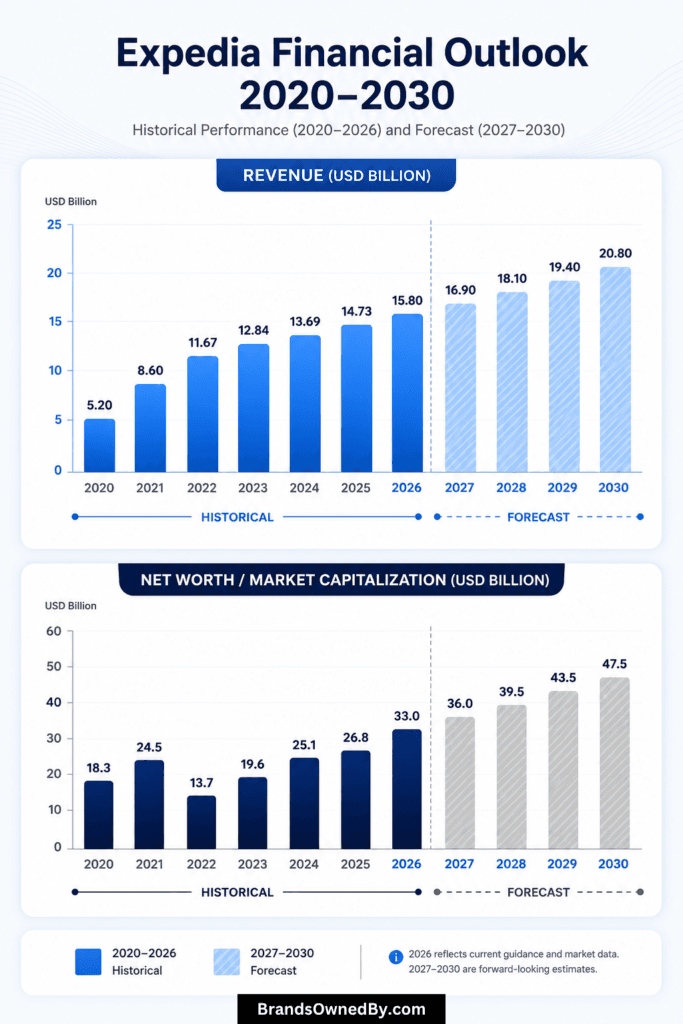
Expedia Group has experienced a remarkable financial recovery since the pandemic-driven slowdown in 2020. The company has steadily increased its revenue through higher global travel demand, stronger hotel bookings, growth in its vacation rental business, and expansion of its enterprise technology platform. At the same time, its market value has rebounded as investors gained confidence in its long-term strategy, artificial intelligence initiatives, and diversified portfolio of travel brands.
As of 2026, Expedia Group is expected to generate approximately $15.8 billion in annual revenue and has an estimated market capitalization (net worth) of around $33 billion, making it one of the largest publicly traded travel technology companies in the world.
Expedia Revenue in 2026
Expedia Group is projected to generate approximately $15.8 billion in revenue during 2026, representing annual growth of more than 7% compared to the previous year. The increase reflects continued strength across the company’s consumer brands, including Expedia, Hotels.com, and Vrbo, along with higher demand for international travel and vacation rentals.
The company earns revenue from several business segments rather than relying on a single source. Hotel reservations continue to contribute the largest share of revenue, followed by vacation rentals, airline ticket bookings, advertising services, travel packages, rental cars, cruises, and enterprise technology solutions offered through Expedia Group Partner Solutions.
A growing contributor is Expedia Group Media Solutions, which provides digital advertising services for hotels, airlines, tourism boards, and travel brands. In addition, the company’s B2B business continues to expand as banks, airlines, travel agencies, and loyalty programs integrate Expedia’s booking technology into their own platforms.
The acquisition of Tiqets has also strengthened Expedia’s experiences business by expanding its portfolio of museums, attractions, tours, and event ticketing, creating additional cross-selling opportunities across its travel ecosystem.
Revenue Breakdown by Business Segment
Expedia generates revenue from multiple travel categories, creating a diversified business model that reduces dependence on any single market.
The estimated revenue mix for 2026 is as follows:
- Lodging (Hotels & Vacation Rentals): Approximately 70% of total revenue.
- Air Travel: Approximately 10%.
- Advertising & Media Solutions: Approximately 8%.
- B2B Travel Technology (Expedia Group Partner Solutions): Approximately 7%.
- Car Rentals, Cruises, Activities & Other Services: Approximately 5%.
This diversified revenue structure allows Expedia to benefit from growth across both consumer travel and enterprise travel technology.
Expedia Net Worth in 2026
Based on its market capitalization, Expedia Group has an estimated net worth of approximately $33 billion in 2026. Market capitalization is calculated by multiplying the company’s share price by the total number of outstanding shares and represents the market’s assessment of Expedia’s overall value.
The company’s valuation has increased significantly since the pandemic recovery due to improving profitability, stronger cash flow generation, higher investor confidence, and continued demand for online travel services.
Expedia remains one of the world’s most valuable online travel companies, ranking behind Booking Holdings while competing closely with Airbnb, Trip.com Group, and Tripadvisor in various travel segments.
What Drives Expedia’s Valuation?
Several factors influence Expedia Group’s market value and long-term growth potential.
The largest driver is global travel demand. As more consumers book vacations, business trips, and international holidays, Expedia benefits from increased booking volumes across its portfolio of brands.
The company’s diversified brand portfolio also strengthens its valuation. Rather than depending on a single website, Expedia generates revenue from multiple consumer brands including Expedia, Hotels.com, Vrbo, Orbitz, Travelocity, Hotwire, Wotif, and ebookers, allowing it to serve different customer segments and geographic markets.
Technology investments are another major factor. Expedia continues to invest heavily in artificial intelligence, personalized trip planning, dynamic pricing, recommendation engines, and automation to improve customer experience and operational efficiency.
Its growing enterprise business also contributes to long-term value. Expedia Group Partner Solutions powers travel bookings for airlines, banks, online retailers, and loyalty programs, creating recurring revenue streams beyond direct consumer bookings.
In addition, the company benefits from increasing demand for digital travel advertising through Expedia Group Media Solutions, which connects travel suppliers with millions of travelers across Expedia’s global network.
Revenue and Net Worth History (2020–2030)
The table below illustrates Expedia Group’s historical financial recovery following the pandemic, along with projected growth through 2030.
(Insert the Revenue and Net Worth table here.)
Expedia Revenue Forecast (2027–2030)
Based on current growth trends, expanding international travel demand, increasing adoption of artificial intelligence, and continued investment in its travel ecosystem, Expedia Group is expected to maintain steady long-term growth.
- 2027: Projected revenue of $16.9 billion as international travel and enterprise partnerships continue expanding.
- 2028: Expected revenue of $18.1 billion, supported by higher vacation rental bookings, digital advertising growth, and increased travel experiences.
- 2029: Forecast revenue of $19.4 billion, driven by continued expansion of global travel demand, AI-powered personalization, and B2B travel technology.
- 2030: Estimated revenue of $20.8 billion, with sustained growth across consumer brands, enterprise services, loyalty programs, and destination experiences.
If these projections are achieved, Expedia Group will continue strengthening its position as one of the world’s leading travel technology companies while maintaining a diversified portfolio of travel brands and digital services.
Final Words
Expedia Group owns far more than just Expedia.com. Its portfolio includes Hotels.com, Vrbo, Orbitz, Travelocity, Hotwire, CheapTickets, ebookers, Wotif, CarRentals.com, Expedia Cruises, and major business platforms like Expedia Group Partner Solutions and Expedia Group Media Solutions. It also remains the largest shareholder of trivago.
This broad collection of brands allows Expedia to serve travelers with different budgets and preferences while generating revenue from both consumers and business partners. Its diversified ownership strategy has helped it remain one of the world’s leading travel technology companies.
FAQs
What brands are owned by Expedia?
Expedia Group owns a diverse portfolio of travel brands serving different customer segments around the world. Its major brands include Expedia, Hotels.com, Vrbo, Travelocity, Orbitz, Hotwire, CheapTickets, Wotif, ebookers, CarRentals.com, Expedia Cruises, Expedia Group Partner Solutions, Expedia Group Media Solutions, One Key, and Expedia Travel Agent Affiliate Program (TAAP). The company is also the largest shareholder of trivago and completed the acquisition of Tiqets in 2026 to strengthen its attractions and experiences business.
Who is Expedia owned by?
Expedia Group is a publicly traded company listed on the NASDAQ Stock Exchange (EXPE). It is owned by a combination of institutional investors, mutual funds, ETFs, retail shareholders, and company insiders. As of July 2026, The Vanguard Group is the largest shareholder, followed by BlackRock, State Street Global Advisors, Geode Capital Management, and JPMorgan Chase & Co. Although Barry Diller owns a relatively small percentage of Expedia’s outstanding shares, he exercises significant voting control through the company’s Class B shares.
Is TripAdvisor owned by Expedia?
No. Tripadvisor is not owned by Expedia Group. It is an independent publicly traded travel company that operates its own travel review, hotel comparison, restaurant reservation, and experiences platforms. Although Expedia previously held an ownership interest in Tripadvisor when it was spun off in 2011, the two companies now operate as separate businesses and compete in several travel segments.
Does Expedia own Travelocity?
Yes. Expedia Group owns Travelocity. Expedia acquired Travelocity from Sabre Corporation in 2015 for approximately $280 million. Although Travelocity continues to operate under its own brand, it uses Expedia Group’s booking platform, technology infrastructure, and travel inventory while maintaining its own website and customer experience.
Who is the CEO of Expedia?
As of July 2026, Ariane Gorin serves as the Chief Executive Officer (CEO) of Expedia Group. She assumed the role in May 2024, succeeding Peter Kern. Gorin is responsible for overseeing Expedia’s global operations, technology strategy, artificial intelligence initiatives, consumer brands, enterprise business, and long-term growth.
Is Expedia owned by another company?
No. Expedia is not owned by another company. It operates as an independent publicly traded corporation listed on the NASDAQ. Although it was originally created as a division of Microsoft in 1996, Microsoft spun Expedia off as an independent company in 1999. Today, Expedia Group owns numerous travel brands but is not itself a subsidiary of any parent company.
Does Expedia own Priceline?
No. Expedia does not own Priceline. Priceline is owned by Booking Holdings Inc., one of Expedia Group’s largest competitors. Booking Holdings also owns several other well-known travel brands, including Booking.com, Agoda, KAYAK, OpenTable, and Rentalcars.com.
Is Expedia owned by Microsoft?
No. Microsoft is not the current owner of Expedia. Microsoft launched Expedia as an internal travel booking service in 1996 but spun it off as an independent publicly traded company in 1999. Microsoft no longer owns Expedia or controls its operations.
Is Expedia owned by Booking.com?
No. Expedia is not owned by Booking.com. In fact, Expedia Group and Booking Holdings are direct competitors in the global online travel industry. Expedia Group owns brands such as Expedia, Hotels.com, Vrbo, Travelocity, and Orbitz, while Booking Holdings owns Booking.com, Priceline, Agoda, KAYAK, OpenTable, and Rentalcars.com. Both companies operate independently and compete for travelers worldwide.