
- Robert Kraft’s core holding company is The Kraft Group, a private family-operated business spanning sports, paper and packaging, forest-products distribution, real estate, analytics, and investments.
- The Kraft family controls the New England Patriots, New England Revolution, Gillette Stadium, Patriot Place, and Kraft Analytics Group. The family retained more than 90% of the Patriots after selling an 8% non-controlling interest.
- Kraft’s original fortune came from Rand-Whitney and International Forest Products. The group now includes several packaging businesses and joint ventures, including New-Indy Container Corporation and UN1F1ED² Global Packaging Group.
- Robert Kraft does not own Kraft Foods or The Kraft Heinz Company. Those food businesses have no corporate connection to Robert Kraft or The Kraft Group.
Robert Kraft owns and controls a broad collection of businesses through The Kraft Group, his privately held family company. His best-known asset is the New England Patriots. The portfolio also includes the New England Revolution, Gillette Stadium, Patriot Place, paper and packaging manufacturers, a global forest-products trader, a sports analytics company, real estate operations, and private investments.
Not every business has the same ownership structure. Some are controlled by the Kraft family. Others are joint ventures or minority investments. That distinction matters when determining what Robert Kraft actually owns.
The ownership infographic organizes the portfolio into four operating areas. Sports and entertainment contain the most recognizable names. Paper, packaging, and global commodities form the industrial foundation. Real estate supports major developments around the sports properties. Private investments extend the portfolio into technology, healthcare, and life sciences.
![What Companies Does Robert Kraft Own [infographic]](https://brandsownedby.com/wp-content/uploads/2025/02/What-Companies-Does-Robert-Kraft-Own-infographic-683x1024.png)
Who Owns The Kraft Group?
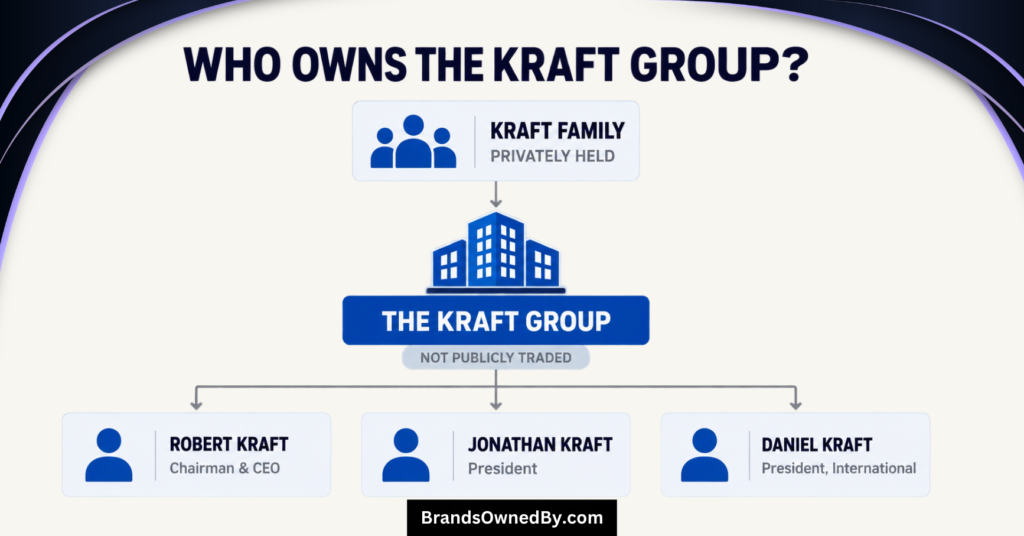
The Kraft Group is owned by the Kraft family and remains under the leadership of its founder, Robert Kraft. It is a privately held holding company. Its shares are not listed on a stock exchange, and outside investors cannot purchase an interest through the public market.
Robert Kraft serves as chairman and chief executive officer. His sons, particularly Jonathan and Daniel Kraft, hold senior operating roles. However, the company does not publish a detailed family share register. It would therefore be inaccurate to assign specific ownership percentages to Robert Kraft or individual family members without verified disclosures.
The Kraft Family Owns the Parent Company
The Kraft Group describes itself as the holding company for the Kraft family’s business interests. The parent organization sits above a collection of operating companies, sports properties, real estate assets, joint ventures, and investment holdings.
This means the Kraft family does not necessarily hold every asset in individual names. The New England Patriots, International Forest Products, Rand-Whitney businesses, Gillette Stadium, and other holdings operate through separate legal entities within the wider family organization.
The holding-company structure serves several purposes. It separates legal liabilities among businesses. It allows each operation to maintain its own management and finances. It also gives the family a central platform for allocating capital, approving major investments, and coordinating long-term strategy.
For example, a packaging business and an NFL franchise have very different customers and risks. Placing them in separate operating entities protects that distinction. The Kraft Group can still direct capital and strategy across both businesses from the parent level.
Robert Kraft Remains the Controlling Figure
Robert Kraft is the founder, chairman, and chief executive officer of The Kraft Group. He remains the central decision-maker associated with the organization.
Kraft built the family’s original industrial base through Rand-Whitney and International Forest Products. He later expanded into investments, professional sports, stadium ownership, and real estate development. These businesses were eventually organized under The Kraft Group.
His position as chairman gives him authority over the group’s broader direction. His CEO role places him at the top of its executive structure. Major acquisitions, capital-allocation decisions, and changes involving the family’s most valuable assets remain closely connected to his leadership.
Robert Kraft is also chairman and CEO of the New England Patriots. The family’s sale of an 8% non-controlling interest in the team did not remove that authority. The Kraft family continues to own more than 90% of the franchise and retains operating control.
The outside Patriots investors own an economic interest in that particular franchise. They do not own 8% of The Kraft Group or its other businesses. They also did not acquire interests in the New England Revolution, Gillette Stadium, International Forest Products, or Rand-Whitney through that transaction.
Jonathan Kraft Oversees Day-to-Day Operations
Jonathan Kraft is president of The Kraft Group. He joined the family business in 1990 after working at Bain & Company and completing an MBA at Harvard Business School.
As president, Jonathan oversees the day-to-day activities of the group’s operating businesses. He is also involved in developing the organization’s plans for expansion and diversification.
His responsibilities extend across the portfolio, but he is especially visible in professional sports. Jonathan serves as president of the New England Patriots and has played a major role in the franchise’s commercial operations, league relationships, stadium development, and long-term planning.
Jonathan’s management role does not automatically disclose his exact ownership stake. Management authority and equity ownership are related but separate issues. The available company information confirms his executive position but does not provide a verified percentage of The Kraft Group owned by him personally.
Daniel Kraft Leads the International Businesses
Daniel Kraft serves as president of The Kraft Group’s international operations. He is also president and chief executive officer of International Forest Products.
International Forest Products is one of the family’s foundational businesses. It trades and distributes paper, pulp, recovered fiber, containerboard, lumber, and other forest-product commodities across more than 100 countries.
Daniel’s position reflects how the family divides operating responsibilities. Jonathan has broader oversight of the group and a prominent role in sports. Daniel concentrates on international commerce and the forest-products business.
Daniel previously worked in the sports division, where he handled areas such as sponsorship sales, broadcast rights, marketing, advertising, and special events. His experience across both industrial and sports operations gives him a wider understanding of the family portfolio.
As with Jonathan, the company does not publicly disclose Daniel Kraft’s exact equity interest. His role establishes management responsibility, not a publicly verified ownership percentage.
Is The Kraft Group Wholly Owned by Robert Kraft?
The most accurate description is that The Kraft Group is owned and controlled by the Kraft family, with Robert Kraft serving as its founder, chairman, and CEO.
It is often described informally as “Robert Kraft’s company” because he built the organization and remains its senior leader. However, describing him as the sole owner would go beyond the available public information. The company consistently presents itself as a family-owned and family-operated enterprise.
There is no public filing showing how ownership is divided among Robert Kraft, his sons, family trusts, or other family-controlled entities. Private companies are generally not required to publish the same shareholder information as publicly traded corporations.
This lack of a public ownership breakdown should not be mistaken for outside control. There is no indication that an external corporation, private-equity firm, or public shareholder base controls The Kraft Group.
Ownership Varies Across the Portfolio
The Kraft family controls the parent company, but that does not mean The Kraft Group owns 100% of every business associated with it.
Its portfolio contains several ownership arrangements:
- Controlled businesses and assets include International Forest Products, the Rand-Whitney operations, the New England Revolution, Gillette Stadium, Patriot Place, and Kraft Analytics Group.
- The New England Patriots remain controlled by the Kraft family, but outside investors own a combined 8% non-controlling interest.
- New-Indy Container Corporation is a 50/50 joint venture between The Kraft Group and Schwarz Partners.
- UN1F1ED² Global Packaging Group is a joint venture between Rand-Whitney Packaging and AGlobal Solutions.
- Venture-capital and private-equity positions are generally minority investments rather than companies controlled by Robert Kraft.
These differences are important. A controlled subsidiary, a joint venture, and a minority investment should not be presented as identical forms of ownership.
For example, The Kraft Group can direct the operations of a controlled business. In a 50/50 joint venture, major decisions generally require cooperation with the other owner. A minority investment may provide an economic return without giving the Kraft family authority over daily operations.
The Kraft Group Has No Public Shareholders
The Kraft Group is not publicly traded. It has no stock symbol, and there is no market price for its shares.
This private structure allows the Kraft family to make long-term decisions without answering to public shareholders every quarter. The company can retain earnings, move capital among operations, develop property, or hold investments for extended periods without the same disclosure and short-term earnings pressure faced by a listed corporation.
The tradeoff is limited transparency. The Kraft Group does not release complete audited financial statements, a detailed valuation of every subsidiary, or a comprehensive ownership schedule to the public.
Published revenue estimates can indicate the group’s scale, but revenue does not reveal how much the family owns, how much profit the businesses generate, or how the underlying assets are divided among family entities.
Who Controls The Kraft Group’s Future?
Robert Kraft continues to hold the highest executive authority. Jonathan Kraft’s role as president gives him responsibility for day-to-day operations and strategic planning. Daniel Kraft leads the international side of the organization and its largest forest-products trading company.
This structure indicates that management is already distributed across generations. However, The Kraft Group has not publicly released a detailed succession plan or future ownership allocation.
It would be speculative to claim that one son will automatically inherit control of the entire group. The portfolio could ultimately be held through trusts, divided among family members, or continue under shared family ownership.
What is clear is that The Kraft Group remains a family-controlled enterprise. Robert Kraft sets its direction as chairman and CEO, while Jonathan and Daniel Kraft manage important parts of its operations. No public company or outside investor controls the parent organization.
What Companies Does Robert Kraft Own in Sports and Entertainment?
Kraft Sports + Entertainment coordinates the family’s major sports, venue, and event operations. The division connects the New England Patriots, New England Revolution, Gillette Stadium, Patriot Place, and related commercial activities.
This structure creates more value than team ownership alone. A game or concert can generate ticket income, sponsorship revenue, parking fees, food and beverage sales, merchandise purchases, and spending at nearby restaurants and shops. Controlling several parts of that ecosystem allows The Kraft Group to participate in more of each visitor’s total spending.
New England Patriots
The New England Patriots are Robert Kraft’s most valuable and recognizable holding. Kraft purchased the NFL franchise for $172 million in 1994. It was the highest price paid for an NFL team at the time.
The purchase was the final step in a strategy that had begun years earlier. Kraft acquired an option on land surrounding the old Foxboro Stadium in 1985. He then purchased the stadium out of bankruptcy in 1988. The stadium came with a lease that made relocating the Patriots difficult without Kraft’s cooperation.
When then-owner James Orthwein considered moving the franchise to St. Louis, Kraft declined a reported $75 million offer to terminate the stadium lease. He instead bought the team. This is an important part of the ownership story because Kraft secured control over the property and contractual position before acquiring the franchise itself.
The Patriots won six Super Bowls under Kraft ownership. Success on the field, national media rights, sponsorships, stadium economics, and the scarcity of NFL franchises produced an extraordinary increase in value.
The ownership structure changed in 2025. The Kraft family sold an 8% non-controlling interest in the Patriots. Dean Metropoulos acquired 5%, while investment firm Sixth Street acquired 3%. NFL owners subsequently approved the transaction.
The deal valued the Patriots at approximately $9 billion. Later estimates have placed the franchise above $10 billion. These are different measures. The $9 billion figure came from an actual minority transaction, while a higher media valuation is an estimate of the entire franchise’s current value.
The Kraft family retained more than 90% of the Patriots and continues to control the team. The transaction did not include the New England Revolution. It also did not give the new investors control over football or business operations.
New England Revolution
The Kraft family founded the New England Revolution as one of Major League Soccer’s 10 original clubs. The club began play in 1996 and remains under Kraft ownership.
The Revolution share Gillette Stadium with the Patriots. This arrangement gives the family another major tenant for a venue it controls. It also brings soccer audiences, sponsorship opportunities, and additional event dates to the Foxborough property.
The club has reached the MLS Cup five times. It won the U.S. Open Cup in 2007, the North American SuperLiga in 2008, and the Supporters’ Shield in 2021.
The Revolution must be treated as a separate holding from the Patriots. The 8% Patriots transaction did not give Dean Metropoulos or Sixth Street an interest in the MLS club.
Gillette Stadium
The Kraft organization owns and operates Gillette Stadium. The venue opened in 2002 after being privately financed by the Kraft family. Its original construction cost was approximately $325 million.
Gillette Stadium is the home of the Patriots and the Revolution. It also hosts concerts, international soccer, college football, lacrosse, motorsports, and other large events. The stadium is scheduled to host seven matches during the 2026 FIFA Men’s World Cup, including a quarterfinal.
The word “Gillette” reflects a naming-rights agreement. It does not mean the Gillette shaving brand owns the stadium. Robert Kraft owns the venue through the family’s business organization. Gillette is the commercial naming partner.
Stadium ownership is financially important. A team that rents a venue may surrender part of its event income to a landlord. The Kraft organization controls the franchise, the building, and many related event operations. That gives it greater influence over scheduling, premium seating, sponsorship inventory, food service, parking, and non-football events.
Patriot Place
Patriot Place is a mixed-use retail, dining, healthcare, office, and entertainment development beside Gillette Stadium. The project turned the surrounding property into a year-round destination rather than land used mainly on event days.
Its tenants and attractions include restaurants, shops, a hotel, a cinema, medical facilities, and the Patriots Hall of Fame. The individual retailers are not owned by Robert Kraft merely because they operate at Patriot Place. The Kraft organization owns and manages the broader development and leases space to many independent businesses.
This distinction is useful in practical terms. Kraft’s property company can receive rent and benefit from increased traffic without owning every restaurant or retail brand located within the complex.
Patriot Place also demonstrates how the group combines sports and real estate. The Patriots attract visitors. Gillette Stadium provides events. The surrounding development gives those visitors more reasons to arrive early, stay longer, and return when no game is being played.
Kraft Analytics Group
Kraft Analytics Group, commonly called KAGR, is a technology and consulting company serving sports and entertainment organizations. Its work covers customer data, analytics, strategy, and fan engagement.
KAGR grew from systems developed inside the Patriots organization. It was established as a separate company in 2016 so the technology and expertise could be sold to outside clients.
The business now works across major U.S. professional leagues, college athletics, and other entertainment properties. Practical applications include combining ticketing and customer records, identifying valuable audience segments, measuring purchasing patterns, and improving retention.
KAGR is not a sports franchise. It is a business-to-business technology and services company. Its value comes from turning knowledge developed inside Kraft’s sports operations into a product that other organizations can purchase.
TeamOps
TeamOps provides event staffing, security, guest services, and operational support. Its work is closely associated with Gillette Stadium and other large events.
The company helps manage the less visible side of venue ownership. This includes crowd movement, access control, event-day staffing, and guest safety. These capabilities are essential to operating a stadium but are different from owning the Patriots or promoting entertainment events.
Bringing these functions within the wider Kraft organization gives the group greater control over the customer experience. It also preserves operational knowledge from one event to the next.
What Paper and Packaging Companies Does Robert Kraft Own?
Paper and packaging built the economic base of Robert Kraft’s fortune. These businesses receive less public attention than the Patriots, but they remain central to The Kraft Group.
The portfolio covers several stages of the supply chain. It collects and processes recovered material, manufactures containerboard, produces corrugated packaging, distributes forest products, and participates in joint ventures. This creates a more integrated industrial operation than a simple collection of unrelated packaging companies.
International Forest Products
Robert Kraft founded International Forest Products in 1972. The company is a global physical trader and distributor of forest-product commodities.
Its products include containerboard, market pulp, recovered fiber, paperboard, printing and writing papers, logs, lumber, panels, and bioenergy products. It also provides services in transportation, logistics, credit, finance, market intelligence, and operations.
IFP conducts business in more than 100 countries. The Kraft Group identified it as the sixth-largest North American exporter in 2024. This international network makes IFP fundamentally different from a local paper mill. It connects producers and buyers while managing pricing, transport, credit, and supply-chain risk.
Daniel Kraft serves as president and chief executive officer of IFP. Robert Kraft remains chairman.
Rand-Whitney Container
Rand-Whitney was Robert Kraft’s entry into the paper and packaging industry. He began working for the business after completing his MBA. The company was controlled by his father-in-law, Jacob Hiatt.
Kraft took control of Rand-Whitney through a leveraged buyout in 1968. That means Rand-Whitney, rather than the Patriots, was the first major business he controlled.
Rand-Whitney Container designs and manufactures corrugated boxes, protective packaging, retail displays, and digitally printed packaging. It describes itself as the largest independent corrugated packaging manufacturer in New England.
The company sells practical products used throughout the economy. Manufacturers, retailers, food companies, and online sellers all need packaging to protect and transport goods. This produces a broad customer base that is less dependent on the performance of any single consumer brand.
Rand-Whitney Containerboard
Rand-Whitney Containerboard manufactures recycled linerboard. Linerboard forms the flat outer layers of corrugated cardboard.
The mill uses approximately 275,000 tons of post-consumer waste fiber. It was also designed to use recycled municipal wastewater in its production process. These systems reduce the need for virgin material and divert recovered paper from landfills or incineration.
Containerboard production gives the group a position further upstream in the packaging supply chain. Rand-Whitney Container can turn board into finished packaging, while the containerboard operation supplies a critical input.
Rand-Whitney Mid-Atlantic and Rand-Whitney Recycling
Rand-Whitney Mid-Atlantic joined the Rand-Whitney family in 2019. It designs, manufactures, and distributes corrugated packaging and packaging supplies for customers in the Mid-Atlantic region.
Rand-Whitney Recycling handles recovered paper and related material. Recycling is strategically useful because used fiber can return to the production system as an input rather than being treated only as waste.
Together, these operations extend the company’s geographic reach and strengthen its supply chain. The business can recover material, produce containerboard, design packaging, manufacture boxes, and serve customers across multiple regions.
New-Indy Container Corporation
New-Indy Container Corporation is not wholly owned by Robert Kraft. It is a 50/50 joint venture between The Kraft Group and Schwarz Partners.
The two family-owned groups formed New-Indy in 2012. The business has expanded through mills and corrugated-packaging operations in several parts of the United States.
The joint venture combines the Kraft organization’s paper and packaging background with Schwarz Partners’ industry network. Its operations cover recycled and virgin containerboard as well as finished corrugated products.
Calling New-Indy a Kraft-owned company is reasonable only with a qualification. The Kraft Group owns half of the venture, not the entire business.
UN1F1ED² Global Packaging Group
UN1F1ED² Global Packaging Group is another joint venture. It was formed in 2018 by Rand-Whitney Packaging and AGlobal Solutions.
The business provides custom protective packaging and related supply-chain services. Its purpose is to give customers a single source for packaging design, materials, manufacturing, and delivery coordination.
The available public information confirms the joint-venture structure but does not provide a precise ownership percentage. It should therefore be described as a Kraft-affiliated joint venture rather than a wholly owned Robert Kraft company.
Robert Kraft’s Real Estate and Construction Businesses
The Kraft Group maintains an internal construction and real estate development operation. Its best-known projects are Gillette Stadium and Patriot Place, but its experience also includes offices, healthcare facilities, sports properties, and mixed-use developments.
The group reports that its team has overseen more than $3 billion of development projects. More than $1 billion of that work was completed specifically for Kraft Group properties.
This capability has strategic value beyond construction fees. The group can coordinate land, venue design, infrastructure, tenant planning, and long-term property operations around its core assets.
Gillette Stadium provides a practical example. The stadium attracts large crowds on a limited number of event days. Patriot Place converts that traffic into ongoing activity across retail, hospitality, healthcare, and entertainment. The real estate operation therefore increases the economic value of the sports business without requiring another team acquisition.
Robert Kraft’s Private-Equity and Venture Investments
Robert Kraft began diversifying outside the operating businesses during the 1980s. The Kraft Group now allocates capital to hedge funds, private-equity funds, venture funds, and direct investments.
Its direct-investment focus includes technology, healthcare, and life sciences. The Patriots’ official biography describes the wider portfolio as containing more than 100 venture and private-equity investments.
The complete list is not publicly available. The Kraft Group is private and does not have to disclose its portfolio in the same way as a public investment company. Some investments are also held through funds, making the underlying exposure different from direct ownership.
This creates an important reporting distinction. A minority position in a startup does not mean Robert Kraft controls that company. Likewise, investing in a private-equity fund does not make every company held by the fund a Robert Kraft-owned business.
DraftKings is one example frequently associated with the Kraft investment portfolio. Such names should be treated as reported investments rather than permanent controlled subsidiaries unless a current stake and ownership percentage can be verified.
How Did Robert Kraft Make His Money?
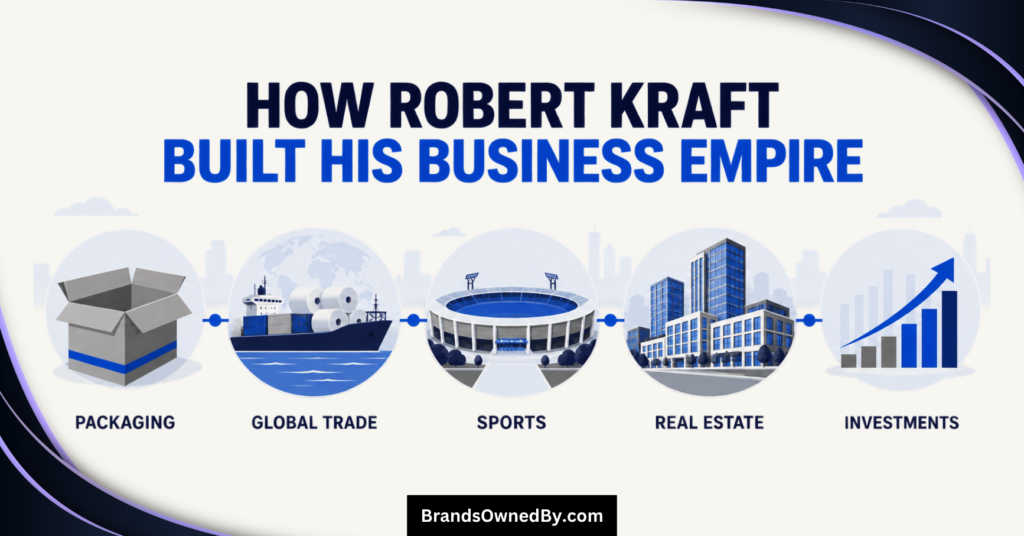
Robert Kraft made his first substantial fortune in paper, packaging, and international commodity trading. The New England Patriots later became his most valuable identifiable asset, but football was not the original source of his wealth.
Kraft’s financial progression can be divided into three stages. He first built cash flow through industrial businesses. He then used that capital and borrowing capacity to acquire strategic real estate and the Patriots. Finally, he expanded the portfolio into stadium operations, mixed-use property, sports analytics, and private investments.
Rand-Whitney Created the Industrial Foundation
After earning his MBA from Harvard Business School in 1965, Kraft joined Rand-Whitney Group. The packaging company was controlled by his father-in-law, Jacob Hiatt.
Kraft took control of Rand-Whitney through a leveraged buyout in 1968. A leveraged buyout uses borrowed money to finance part of an acquisition. The acquired company’s operations and cash flow then help support the debt.
Rand-Whitney gave Kraft an operating position in corrugated packaging. This was a practical industry with recurring demand. Manufacturers, food companies, retailers, and distributors all needed boxes and protective packaging to move products.
The business later expanded beyond finished boxes. The wider Rand-Whitney operation now includes corrugated packaging, recycled containerboard, digital printing, protective packaging, and recovered-material processing.
Rand-Whitney Container describes itself as the largest independent corrugated packaging manufacturer in New England. Rand-Whitney Containerboard uses approximately 275,000 tons of post-consumer waste fiber to manufacture recycled linerboard.
These were not passive investments. They created operating cash flow, customer relationships, physical assets, and borrowing capacity. That industrial base allowed Kraft to pursue larger opportunities later.
International Forest Products Expanded the Business Globally
Kraft founded International Forest Products in 1972. The company trades and distributes containerboard, pulp, recovered fiber, paperboard, lumber, logs, panels, and other forest-product commodities.
IFP does more than buy and sell paper. It also handles transportation, logistics, trade finance, credit, operations, and market intelligence. Those services help connect mills, packaging companies, manufacturers, and buyers across different countries.
The company now does business in more than 100 countries. The Patriots’ corporate biography places that reach at more than 120 countries and identifies IFP as the sixth-largest exporter in North America.
The wider Kraft paper and packaging operation produces, converts, or trades more than 4 million tons of paper annually. It also recycles approximately 1.5 million tons of material each year.
These figures explain why describing Kraft’s early business merely as a “paper company” understates its scale. The operation combines manufacturing, recycling, commodity trading, international distribution, and logistics.
International Forest Products is led by Daniel Kraft, Robert Kraft’s son. It remains one of the central operating companies within The Kraft Group.
Kraft Used Real Estate to Gain Leverage Over the Patriots
Kraft’s acquisition of the New England Patriots was not a single transaction. It was the result of a series of property and contractual moves that strengthened his position over almost a decade.
In 1985, Kraft purchased an option connected to land surrounding the Patriots’ existing stadium in Foxborough. He then bought the stadium out of bankruptcy in 1988.
The stadium came with a lease that required the Patriots to continue playing there through the 2001 season. That lease became extremely valuable when team owner James Orthwein considered relocating the franchise to St. Louis.
Kraft was reportedly offered $75 million to terminate the lease and allow the relocation. He rejected the offer. Instead, he used his control of the stadium and lease to remain central to any decision involving the team’s future.
In January 1994, Kraft purchased the Patriots for $172 million. It was a record price for an NFL franchise at the time.
This was a calculated concentration of risk. Kraft committed a large amount of family capital to an underperforming team. The Patriots had missed the playoffs in each of the previous seven seasons and had won only 19 of 80 games during the five years before his purchase.
The value was not based only on the team’s recent performance. Kraft was buying a scarce NFL franchise, its regional market, its media rights, and the opportunity to connect the team with property he already controlled.
The Patriots Became Kraft’s Largest Value-Creation Success
The Patriots reached the playoffs during Kraft’s first season as owner. The franchise later won six Super Bowls and appeared in 11 under his ownership.
Success increased ticket demand, sponsorship value, merchandise sales, national visibility, and the commercial value of the Patriots brand. At the same time, the NFL’s national television contracts and limited number of franchises pushed team valuations higher across the league.
Kraft paid $172 million for the team in 1994. A 2025 minority transaction valued the Patriots at approximately $9 billion. That was more than 52 times the original purchase price.
Forbes valued the team at $10.6 billion in September 2026. On that estimate, the franchise was worth approximately 61.6 times the amount Kraft originally paid. The increase was about $10.43 billion before considering subsequent investment, debt, transaction costs, or changes in ownership.
That appreciation did not become cash in Kraft’s personal account. Most of the value remains embedded in the franchise. It nevertheless explains why the Patriots now represent such a large part of his estimated fortune.
Gillette Stadium Added a Second Major Asset
The Kraft family privately financed Gillette Stadium, which opened in 2002. The project cost approximately $325 million.
Owning the venue changed the economics of the sports business. The Kraft organization could participate in revenue from premium seating, sponsorships, parking, concessions, concerts, and other events. It did not have to rely solely on the Patriots’ share of NFL revenue.
Gillette Stadium also became the home of the New England Revolution. The venue has hosted concerts, international soccer, college football, lacrosse, motorsports, and other large events. It is hosting seven matches during the 2026 FIFA Men’s World Cup, including a quarterfinal.
The Patriots and Revolution provide anchor tenants. Concerts and special events create additional operating days. The stadium therefore earns revenue from several audiences rather than depending only on NFL home games.
Patriot Place Monetized the Surrounding Land
The Kraft Group developed Patriot Place beside Gillette Stadium. The mixed-use project includes retail stores, restaurants, entertainment venues, a hotel, offices, and healthcare facilities.
Patriot Place allows the organization to earn property and operating income outside the stadium. Visitors can spend money before and after games. The development can also attract customers when no sporting event is taking place.
The strategy increased the economic value of the Foxborough site. Kraft did not simply own a team and its stadium. The organization developed an entertainment and commercial district around both assets.
Individual tenants at Patriot Place are not necessarily owned by Robert Kraft. Many are independent companies leasing space. The Kraft organization benefits through the broader property development and related commercial arrangements.
Private Investments Added Diversification
Kraft began allocating money outside the operating businesses during the 1980s. The Kraft Group now invests through hedge funds, private-equity funds, venture funds, and direct company stakes.
Its disclosed areas of interest include technology, healthcare, and life sciences. The Patriots’ official biography describes the wider portfolio as containing more than 100 venture and private-equity investments.
The full portfolio is not public. The Kraft Group is privately held and does not file a complete investment schedule comparable to the reports required from public investment companies.
These investments are important, but they should not be confused with controlled subsidiaries. A venture investment may give The Kraft Group a minority stake without providing authority over the company’s daily operations.
Kraft’s wealth was therefore built through several connected channels. Packaging and global trading created the original capital. Strategic real estate helped him acquire the Patriots. Team and league growth produced substantial asset appreciation. Stadium and property development added operating income. Private investments diversified the resulting wealth.
Robert Kraft’s Wealth, Revenue, and Business Value
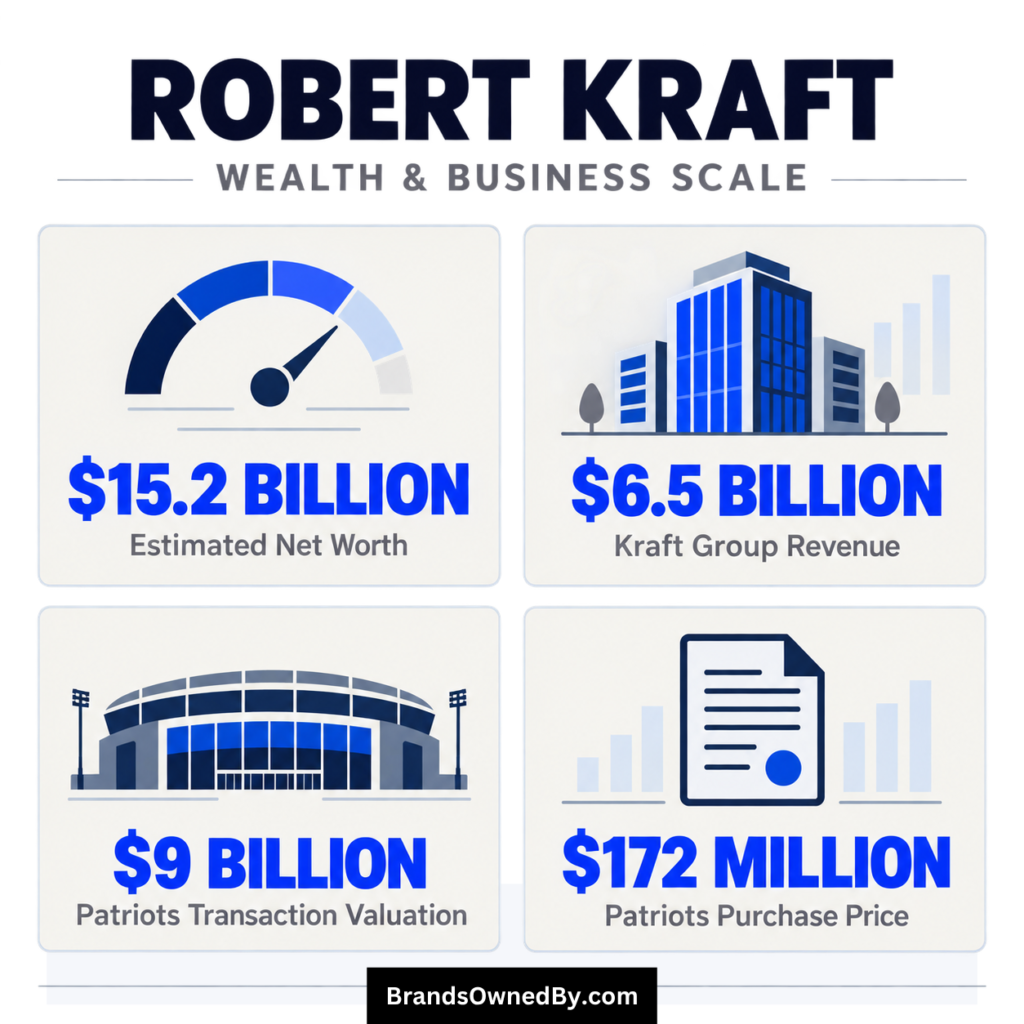
Robert Kraft’s net worth, The Kraft Group’s revenue, and the Patriots’ valuation measure three different things. They cannot be added together or used interchangeably.
As of September 2026, Forbes estimated Robert Kraft’s personal net worth at $15.2 billion. The Kraft Group’s latest annual revenue estimate was $6.5 billion. Forbes separately valued the New England Patriots at $10.6 billion.
These figures overlap economically. Kraft’s ownership of the Patriots and private businesses is already reflected in his estimated net worth. Adding the $10.6 billion team valuation to his $15.2 billion fortune would count much of the same value twice.
Robert Kraft’s Estimated Net Worth Is $15.2 Billion
Forbes estimated Robert Kraft’s real-time net worth at $15.2 billion on September 16, 2026.
This is an estimate of the value of his assets after accounting for relevant liabilities. It is not a measure of annual earnings or available cash.
A large part of Kraft’s wealth is tied to illiquid private assets. These include his family’s controlling interest in the Patriots, paper and packaging companies, International Forest Products, real estate, sports operations, and investment holdings.
Private-company wealth cannot be measured as precisely as publicly traded stock. There is no daily share price for The Kraft Group. Valuation analysts must estimate the worth of its businesses using industry comparisons, reported revenue, transaction values, and other available information.
Kraft’s net worth can therefore rise or fall even when he does not buy or sell an asset. A higher estimated value for NFL franchises can increase his calculated fortune. A decline in private-company valuations, investment markets, or business performance can reduce it.
The Kraft Group Generated an Estimated $6.5 Billion in Revenue
The Kraft Group generated an estimated $6.5 billion in revenue in 2025. That was up from an estimated $5 billion in 2024, representing an increase of approximately 30%.
Estimated revenue was $5.4 billion in 2023, $6.2 billion in 2022, and $5.5 billion in 2021. These figures show that annual sales can fluctuate. The portfolio is exposed to paper prices, commodity volumes, freight conditions, packaging demand, sports operations, and event activity.
Revenue does not equal profit. The $6.5 billion figure is the estimated amount generated before operating costs, employee compensation, raw materials, freight, interest, taxes, depreciation, and other expenses.
It is also not Robert Kraft’s personal income. Revenue belongs to the operating companies. Some cash must remain in those businesses to pay expenses, fund inventory, service debt, maintain facilities, and finance expansion.
The Kraft Group is private and does not release a complete audited income statement to the public. Its net income, operating cash flow, consolidated debt, and profit margins are therefore not publicly available. Any article claiming a precise annual personal income for Robert Kraft would be relying on an estimate rather than disclosed financial statements.
The Patriots Are Valued at $10.6 Billion
Forbes valued the New England Patriots at $10.6 billion in September 2026. That placed the franchise fourth among NFL teams in the publication’s ranking.
The valuation represented an increase of approximately $10.43 billion over Kraft’s $172 million purchase price. The team was worth about 61.6 times what he paid in 1994.
This comparison shows the scale of the value creation, but it is not a calculation of Kraft’s realized profit. The family invested additional money in the organization, facilities, personnel, and stadium infrastructure. Valuation also does not deduct any franchise-level debt or selling costs.
The $10.6 billion figure is an estimate of the entire team’s value. Robert Kraft no longer owns 100% of the franchise. The Kraft family sold an 8% non-controlling interest in 2025 and retains more than 90%.
The Minority Sale Established a $9 Billion Transaction Valuation
The 2025 minority transaction provides a useful market-based reference point because outside investors agreed to purchase actual ownership interests.
Dean Metropoulos acquired a 5% stake. Sixth Street acquired 3%. The combined 8% transaction valued the Patriots at approximately $9 billion.
At that valuation, 8% of the franchise had an implied value of $720 million. Metropoulos’ 5% interest implied a value of approximately $450 million. Sixth Street’s 3% interest implied a value of approximately $270 million.
Those figures are based on the announced valuation. They do not prove that Robert Kraft personally received $720 million. Transaction structure, fees, capital retained by the team, and other terms can affect how proceeds are used.
The deal also did not value the entire Kraft business empire. It covered an interest in the Patriots. It did not include The Kraft Group, the New England Revolution, Gillette Stadium, Patriot Place, International Forest Products, Rand-Whitney, or the private investment portfolio.
Gillette Stadium and Patriot Place Add Value Outside the Team
The Patriots’ estimated value does not necessarily capture every related Kraft asset.
Gillette Stadium is owned and operated through the Kraft organization. The venue was built for approximately $325 million and opened in 2002. Its economics include Patriots games, Revolution matches, concerts, international soccer, premium seating, sponsorships, parking, and other events.
Patriot Place is a separate mixed-use development surrounding the stadium. It contains retail, dining, hospitality, entertainment, office, and healthcare uses.
These assets reinforce the value of the Patriots but also have their own operating and real estate economics. Public information does not provide a current standalone valuation for Gillette Stadium or Patriot Place.
The Kraft Group reports that its construction and real estate team has overseen more than $3 billion in projects. More than $1 billion of that development was completed specifically for Kraft Group properties.
The Industrial Businesses Remain Material to Kraft’s Fortune
The Patriots receive most of the attention because their value is easier to estimate. The paper, packaging, and forest-products companies remain economically significant.
The Kraft Group’s related operations rank collectively among the five largest paper and packaging businesses in the United States. They produce, convert, or trade more than 4 million tons of paper annually and recycle approximately 1.5 million tons of material.
International Forest Products operates in more than 100 countries. Rand-Whitney spans packaging manufacturing, containerboard, recycling, and regional distribution. The group also owns interests in joint ventures such as New-Indy Container Corporation and UN1F1ED² Global Packaging Group.
No reliable standalone public valuation is available for these businesses. Their value is incorporated into estimates of Kraft’s overall fortune, but it cannot be separated precisely using public data.
What the Numbers Actually Show
The $15.2 billion net-worth estimate measures Robert Kraft’s overall personal fortune. The $6.5 billion revenue estimate measures one year of business activity across The Kraft Group. The $10.6 billion Patriots valuation measures the estimated value of the entire NFL franchise. The $9 billion transaction valuation reflects the price benchmark used for the 2025 minority investment.
The $172 million purchase price is historical cost. Comparing it with the Patriots’ current valuation demonstrates the magnitude of the asset’s appreciation.
The most defensible conclusion is that Kraft’s fortune rests on two major economic foundations. His industrial businesses created the original capital and remain large operating companies. The Patriots then became the portfolio’s largest visible store of value, supported by stadium ownership, real estate development, league media economics, and more than three decades of franchise growth.
Companies Robert Kraft No Longer Owns
Current ownership articles often repeat historical holdings without checking whether they remain active. Robert Kraft has participated in several sports businesses that are no longer part of the current portfolio.
Boston Breach
Kraft Sports Group and Oxygen Esports established Boston Breach as a Call of Duty League franchise. It appeared in older descriptions of Kraft’s sports portfolio.
M80 acquired the Boston Breach franchise in August 2026. The team should therefore be treated as a former Kraft-affiliated holding rather than a company Robert Kraft currently owns. Financial terms were not publicly disclosed.
Boston Uprising
Boston Uprising competed in the Overwatch League from 2017. The team later became part of the wider Oxygen Esports arrangement.
The Overwatch League ended its former franchise structure, and Boston Uprising ceased operations in 2024. It is not a current Robert Kraft-owned sports team.
San Jose Clash
Kraft operated the San Jose Clash, now known as the San Jose Earthquakes, from 1998 to 2000. This was connected to Major League Soccer’s early investor-operator model.
The club is no longer owned by Kraft. Its historical inclusion helps explain his role in establishing MLS, but it does not belong on a present-day company list.
Boston Lobsters
Kraft was part of the ownership group that purchased the Boston Lobsters of World TeamTennis in the 1970s. The team folded after the 1978 season.
This was one of Kraft’s earliest sports investments. It is historically relevant but has no place among his current holdings.
Does Robert Kraft Own Kraft Heinz?
Robert Kraft does not own Kraft Heinz, Kraft Foods, Kraft Mac & Cheese, or any other food brand that uses the Kraft name.
The shared surname is coincidental. Robert Kraft’s company is The Kraft Group, a privately owned holding company based in Foxborough. The Kraft Heinz Company is a separate publicly traded food business with a different corporate history and ownership structure.
Buying Kraft Heinz products does not generate revenue for Robert Kraft. Similarly, owning shares in Kraft Heinz does not give an investor an interest in the Patriots or The Kraft Group.
Are Robert Kraft’s Foundations Part of His Business Portfolio?
The Kraft Family Foundation, New England Patriots Foundation, New England Revolution Foundation, and Foundation to Combat Antisemitism are philanthropic organizations. They are not commercial companies owned for profit.
The family has committed close to $1 billion to charitable and community work over several decades. These activities are significant to Kraft’s public profile, but combining them with operating companies creates a misleading ownership list.
The same principle applies to nonprofit partnerships. Kraft may fund, establish, or serve in a leadership role at an organization without owning it as a business asset.
Conclusion
Robert Kraft’s portfolio extends far beyond the New England Patriots. The Kraft Group controls sports teams, a major stadium, a mixed-use development, analytics and event businesses, global forest-products distribution, packaging manufacturers, real estate operations, and a private investment portfolio.
The ownership details are not identical across the group. The Kraft family controls its primary operating companies and sports properties. New-Indy and UN1F1ED² are joint ventures. Private-equity and venture positions are generally minority investments. Former esports teams and philanthropic foundations should not be presented as current commercial holdings.
That structure explains how Kraft built and preserved his fortune. Paper and packaging produced the original capital. Global trading expanded it. Sports created a scarce and increasingly valuable asset. Real estate and specialized services allowed the family to capture more value around that asset.
FAQs
What companies are owned by Robert Kraft?
Robert Kraft controls The Kraft Group and its major interests in the New England Patriots, New England Revolution, Gillette Stadium, Patriot Place, Kraft Analytics Group, TeamOps, International Forest Products, and the Rand-Whitney packaging businesses. The group also participates in joint ventures, including New-Indy Container Corporation and UN1F1ED² Global Packaging Group.
How much of the New England Patriots does Robert Kraft own?
The Kraft family owns more than 90% of the Patriots. It sold an 8% non-controlling interest in 2025. Dean Metropoulos acquired 5%, and Sixth Street acquired 3%. The family retained control of the franchise.
Does Robert Kraft still control the Patriots?
Yes. The minority investors do not control the team. The Kraft family remains the controlling owner, and Robert Kraft remains chairman and chief executive officer.
Does Robert Kraft own the New England Revolution?
Yes. The Kraft family founded and owns the New England Revolution. The minority sale involving the Patriots did not include the soccer club.
Does Robert Kraft own Gillette Stadium?
Yes. The Kraft organization owns and operates Gillette Stadium. Gillette holds the naming rights but does not own the venue.
Does Robert Kraft own Patriot Place?
The Kraft organization developed and controls Patriot Place. However, Kraft does not own every restaurant, shop, hotel operator, or healthcare provider that leases space within the development.
Does Robert Kraft own Kraft Foods or Kraft Heinz?
No. Robert Kraft has no ownership connection to Kraft Foods or The Kraft Heinz Company. The companies share his surname but are otherwise unrelated.
What was Robert Kraft’s first company?
Rand-Whitney was the first major business Robert Kraft controlled. He took control through a leveraged buyout in 1968. International Forest Products, founded in 1972, was the major company he started himself.
Is The Kraft Group publicly traded?
No. The Kraft Group is privately held and family operated. Investors cannot purchase shares of The Kraft Group on a public stock exchange.
Does Robert Kraft still own Boston Breach?
No. M80 acquired the Boston Breach Call of Duty League franchise in August 2026. Older pages that list Boston Breach as a current Kraft holding are outdated.
What is Robert Kraft’s largest business asset?
The New England Patriots appear to be Kraft’s most valuable identifiable asset. A 2025 minority transaction valued the franchise at approximately $9 billion, while later estimates have placed its value above $10 billion. The Kraft Group does not publish a complete valuation for every operating company and investment.