
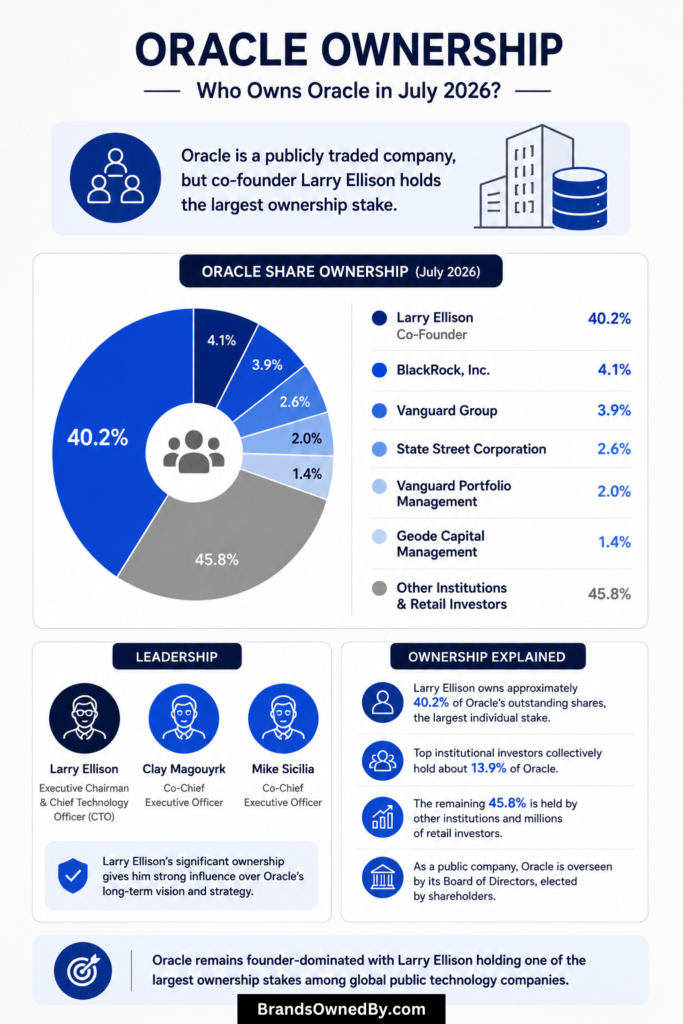
- Oracle is a publicly traded company, but its largest shareholder is co-founder Larry Ellison, who owns approximately 40.2% of the company’s outstanding shares as of July 2026, giving him significant influence over Oracle’s long-term strategy and corporate governance.
- The remaining shares are primarily held by institutional investors, including BlackRock (4.1%), Vanguard Capital Management (3.9%), State Street Corporation (2.6%), Vanguard Portfolio Management (2.0%), and Geode Capital Management (1.4%), while the balance is owned by millions of retail investors and other institutions worldwide.
- Oracle is led by Co-CEOs Clay Magouyrk and Mike Sicilia, while Larry Ellison serves as Executive Chairman and Chief Technology Officer (CTO). This leadership structure combines founder oversight with professional executive management.
- Unlike most major technology companies, Oracle remains founder-dominated, with Larry Ellison retaining one of the largest ownership stakes among global public tech companies, providing exceptional strategic continuity while operating as a publicly traded corporation.
Oracle Corporation is one of the world’s leading enterprise technology companies, specializing in cloud computing, database management, artificial intelligence (AI), enterprise software, and cloud infrastructure. It develops technologies that help businesses store, manage, analyze, and secure large volumes of data while running mission-critical applications.
The company serves organizations of all sizes, from small businesses to multinational corporations and government agencies. Its products are used across industries such as finance, healthcare, manufacturing, retail, telecommunications, education, and the public sector. Oracle is particularly known for its enterprise database software, which remains one of the most widely used database management systems in the world.
Over the years, Oracle has evolved from a database software company into a comprehensive cloud technology provider. Its portfolio now includes cloud infrastructure, enterprise resource planning (ERP), customer relationship management (CRM), human capital management (HCM), supply chain management (SCM), and industry-specific solutions. The company has also invested heavily in AI capabilities, integrating machine learning and automation into many of its cloud services.
Today, Oracle operates in more than 175 countries and supports millions of users through its global network of cloud regions, data centers, and technology partners. Its focus on innovation and strategic acquisitions has made it one of the most influential companies in the global enterprise software industry.
Founders of Oracle
Oracle was founded in 1977 by Larry Ellison, Bob Miner, and Ed Oates under the name Software Development Laboratories (SDL). The three founders shared a vision of developing a commercial relational database management system based on groundbreaking research published by IBM scientist Edgar F. Codd.
Larry Ellison
Larry Ellison is the best-known founder of Oracle and remains one of the most influential figures in the company’s history. He served as Oracle’s Chief Executive Officer for nearly four decades before stepping down in 2014. Today, he serves as Executive Chairman and Chief Technology Officer (CTO), where he continues to guide Oracle’s long-term technology strategy, particularly in cloud computing and artificial intelligence.
Bob Miner
Bob Miner was Oracle’s chief software architect and played a critical role in designing the company’s early database technology. He led the engineering efforts behind Oracle’s first commercial database products and was instrumental in establishing the company’s reputation for database innovation. His technical expertise laid the foundation for Oracle’s long-term success.
Ed Oates
Ed Oates contributed to Oracle’s early product development and business operations. As one of the company’s original founders, he helped build Oracle during its formative years and supported its growth into a leading software company before leaving the business in the 1990s.
What Does Oracle Do?
Oracle develops software and cloud-based technologies that help organizations manage data, automate business processes, and improve operational efficiency. Its major business areas include:
- Database management systems.
- Oracle Cloud Infrastructure (OCI).
- Enterprise Resource Planning (ERP).
- Human Capital Management (HCM).
- Customer Relationship Management (CRM).
- Supply Chain Management (SCM).
- Artificial Intelligence (AI) services.
- Healthcare technology through Cerner.
These solutions enable businesses to modernize their IT infrastructure, improve cybersecurity, analyze data more effectively, and deploy AI-powered applications across their operations.
Ownership History
Oracle’s ownership history reflects its evolution from a small founder-led startup into one of the world’s largest publicly traded technology companies. While its shareholder base has expanded dramatically since its founding in 1977, one characteristic has remained remarkably consistent: co-founder Larry Ellison has retained a significant ownership stake throughout Oracle’s history.
Today, Oracle is owned by a combination of institutional investors, individual shareholders, company executives, and its founders. Unlike many large technology companies where ownership is widely dispersed, Oracle continues to have a highly concentrated ownership structure because of Larry Ellison’s approximately 40.2% stake, making him the company’s largest shareholder by a wide margin.
1977–1986: Oracle Begins as a Founder-Owned Company
Oracle was founded in 1977 by Larry Ellison, Bob Miner, and Ed Oates under the name Software Development Laboratories (SDL). During its early years, the company was privately owned almost entirely by its founders and a small group of early employees.
Larry Ellison served as the driving force behind Oracle’s business strategy and commercial vision. Bob Miner led software engineering and was responsible for developing Oracle’s pioneering relational database technology, while Ed Oates contributed to software development and day-to-day operations.
Because Oracle relied on private funding during this period, ownership remained highly concentrated. This enabled the founders to make strategic decisions quickly without outside shareholder influence. As Oracle’s database software gained traction among government agencies and large enterprises, the company’s valuation grew rapidly.
1986: Initial Public Offering Changes the Ownership Structure
Oracle became a publicly traded company in March 1986 through its Initial Public Offering (IPO). Listing its shares on the stock market allowed institutional investors, mutual funds, and retail investors to purchase ownership in the company.
The IPO provided Oracle with fresh capital to fund product development, expand internationally, and compete more aggressively in the growing enterprise software market.
Although public investors acquired shares, Larry Ellison retained a substantial ownership stake. This ensured that he remained Oracle’s largest shareholder and continued to influence the company’s long-term strategy.
The IPO also introduced the governance standards required of public companies, including an independent board of directors, regular financial disclosures, and shareholder voting rights.
Late 1980s and 1990s: Public Ownership Expands
Following its IPO, Oracle experienced rapid global growth as demand for enterprise database software increased.
During this period, ownership gradually diversified as:
- Institutional investment firms accumulated Oracle shares.
- Pension funds added Oracle to their portfolios.
- Mutual funds and index funds became long-term investors.
- Individual investors purchased shares through public markets.
Even as institutional ownership increased, Larry Ellison remained Oracle’s dominant shareholder. His large equity position gave investors confidence that the company’s founder remained committed to its long-term success.
2000s: Acquisitions Broaden the Shareholder Base
The early 2000s marked Oracle’s transformation from a database software company into a diversified enterprise technology provider.
Oracle completed several high-profile acquisitions, including:
- PeopleSoft.
- Siebel Systems.
- Hyperion Solutions.
- BEA Systems.
- Sun Microsystems.
Some of these transactions involved issuing Oracle shares as part of the purchase price. This increased the number of outstanding shares and brought new shareholders into the company.
Although these deals slightly reduced the ownership percentage of existing shareholders, Larry Ellison remained by far the company’s largest individual shareholder. Oracle’s growing market value also attracted more institutional investors seeking exposure to enterprise software and cloud technology.
2010s: Rise of Institutional Investors
As Oracle matured into one of the world’s largest technology companies, institutional ownership continued to increase.
Global asset managers such as BlackRock, Vanguard, State Street, Geode Capital Management, and other investment firms accumulated significant positions through mutual funds, exchange-traded funds (ETFs), and retirement portfolios.
Unlike activist investors, these institutions generally invest on behalf of millions of clients and typically focus on long-term value creation.
Despite their combined ownership representing a substantial portion of Oracle’s publicly traded shares, no single institutional investor came close to matching Larry Ellison’s voting power.
Oracle’s Cloud Transformation
Beginning in the mid-2010s, Oracle shifted its focus toward cloud computing, artificial intelligence, enterprise applications, and cloud infrastructure.
The company invested billions of dollars in Oracle Cloud Infrastructure (OCI) while continuing to expand through acquisitions such as NetSuite and Cerner.
This strategic transformation attracted additional long-term institutional investors who viewed Oracle as a major competitor in the cloud computing market.
Although Oracle’s investor base continued to expand, the overall ownership structure remained relatively stable because Larry Ellison retained most of his shares.
Current Ownership Structure (July 2026)
As of July 2026, Oracle is a publicly traded company listed on the New York Stock Exchange (NYSE) under the ticker symbol ORCL. Its ownership is divided among institutional investors, individual shareholders, company executives, and directors.
Larry Ellison remains Oracle’s largest shareholder, holding approximately 40.2% of the company’s outstanding shares. This makes Oracle one of the few global technology companies where a founder still owns such a significant stake. The remainder of the company is primarily owned by institutional investors—including BlackRock, Vanguard, State Street, and Geode Capital Management—as well as millions of retail investors worldwide.
Oracle’s ownership structure has remained relatively stable over the years, with Larry Ellison continuing to be the company’s most influential shareholder while institutional ownership has steadily increased. The following section explains Oracle’s current ownership in greater detail.
Why Oracle’s Ownership Has Remained Remarkably Stable
Oracle has maintained one of the most stable ownership structures in the technology industry. The primary reason is Larry Ellison’s long-term commitment to retaining his shares rather than gradually selling them, as many technology founders have done after their companies matured.
Oracle has also conducted extensive share repurchase programs over the years, reducing the total number of outstanding shares. Because Ellison largely retained his holdings while Oracle bought back stock, his ownership percentage increased over time without requiring significant additional share purchases. This has strengthened his voting power and reinforced his influence over Oracle’s strategic direction.
Today, Oracle combines the governance of a publicly traded company with the stability of a founder-led business. Millions of shareholders collectively own the majority of the company, but Larry Ellison’s 40% stake continues to make him the single most influential shareholder, giving Oracle a level of strategic continuity that few companies of its size can match.
Who Owns Oracle: Major Shareholders
Oracle Corporation is a publicly traded company listed on the New York Stock Exchange (NYSE) under the ticker symbol ORCL. Unlike a privately owned business, Oracle does not have a single owner. Instead, its shares are owned by a diverse group of shareholders, including its co-founder, institutional investors, mutual funds, pension funds, company executives, and millions of individual investors around the world.
What makes Oracle’s ownership structure unique is the continued dominance of its co-founder, Larry Ellison. More than four decades after founding the company, Ellison remains Oracle’s largest shareholder with an ownership stake of approximately 40.2%. This is one of the highest founder ownership stakes among the world’s largest publicly traded technology companies. His significant shareholding gives him considerable influence over Oracle’s long-term strategy, board appointments, and major corporate decisions, even though the company is managed by a professional executive team led by CEO Safra Catz.
Beyond Larry Ellison, Oracle’s ownership is primarily concentrated among leading global asset management firms. Companies such as BlackRock, Vanguard, State Street, and Geode Capital Management collectively own a significant portion of Oracle on behalf of pension funds, exchange-traded funds (ETFs), mutual funds, retirement accounts, and other institutional clients. While these firms are major shareholders, none individually owns enough shares to challenge Larry Ellison’s position as Oracle’s dominant shareholder.
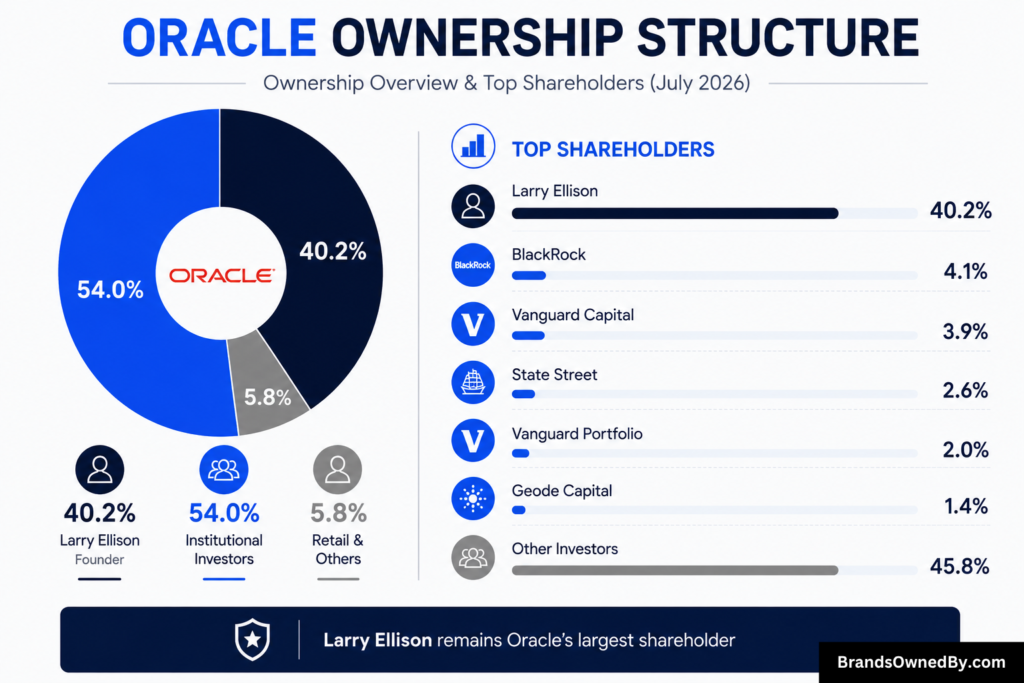
Larry Ellison (40.2%)
Larry Ellison is the co-founder, Executive Chairman, and Chief Technology Officer (CTO) of Oracle. He is also the company’s largest shareholder, owning approximately 40.2% of its outstanding shares as of July 2026.
Ellison co-founded Oracle in 1977 and served as its Chief Executive Officer for nearly 37 years before stepping down in 2014. Although he no longer manages the company’s day-to-day operations, he continues to play a central role in shaping Oracle’s long-term technology strategy, particularly in cloud computing, artificial intelligence, database innovation, and enterprise software.
His ownership stake is extraordinary by the standards of large public technology companies. While founders of companies such as Microsoft, Alphabet, and Amazon still own meaningful stakes, none controls a percentage comparable to Ellison’s ownership in Oracle. His voting power allows him to significantly influence the election of directors, executive leadership decisions, capital allocation, major acquisitions, and strategic investments.
Another reason Ellison’s ownership has remained so influential is Oracle’s long-running share repurchase program. Over the years, Oracle has bought back billions of dollars’ worth of its own stock, reducing the number of outstanding shares. Since Ellison has retained most of his holdings, these buybacks have gradually increased his ownership percentage without requiring him to purchase a significant number of additional shares.
BlackRock Advisors LLC (4.1%)
BlackRock Advisors is Oracle’s largest institutional shareholder, holding approximately 4.1% of the company’s outstanding shares.
BlackRock is the world’s largest asset manager, overseeing trillions of dollars in investments for governments, pension funds, insurance companies, corporations, and individual investors. Its Oracle holdings are spread across a wide range of mutual funds, index funds, and exchange-traded funds rather than representing a direct corporate investment.
As one of Oracle’s largest shareholders, BlackRock participates in shareholder voting on matters such as board elections, executive compensation, governance policies, and shareholder proposals. However, unlike Larry Ellison, BlackRock acts primarily as a fiduciary on behalf of its clients and does not participate in Oracle’s day-to-day management.
Vanguard Capital Management LLC (3.9%)
Vanguard Capital Management owns approximately 3.9% of Oracle, making it one of the company’s largest institutional investors.
Vanguard is one of the world’s leading investment management companies and holds Oracle shares through numerous index funds, retirement plans, and exchange-traded funds. Millions of investors indirectly own Oracle stock through Vanguard-managed investment products.
Vanguard is known for its long-term investment philosophy. Rather than actively trading its holdings, it typically maintains ownership based on the composition of the market indices its funds track. As a result, Vanguard has remained a consistent long-term shareholder in Oracle.
State Street Corporation (2.6%)
State Street Corporation is another major institutional shareholder, with an ownership stake of approximately 2.6%.
Through its investment management business, State Street manages assets for pension funds, sovereign wealth funds, universities, charitable foundations, and financial institutions across the globe. Like other large institutional investors, State Street owns Oracle shares on behalf of clients rather than for its own account.
Although State Street has meaningful voting rights as a shareholder, its ownership remains substantially smaller than Larry Ellison’s individual stake.
Vanguard Portfolio Management LLC (2.0%)
Vanguard Portfolio Management holds approximately 2.0% of Oracle’s outstanding shares through additional Vanguard-managed investment portfolios.
Together with Vanguard Capital Management, Vanguard’s combined ownership represents one of the largest institutional investments in Oracle. These shares are distributed across numerous retirement products, mutual funds, and ETFs held by millions of investors worldwide.
The firm’s continued investment reflects Oracle’s importance within major U.S. stock market indices and large-cap technology portfolios.
Geode Capital Management (1.4%)
Geode Capital Management owns approximately 1.4% of Oracle, making it another notable institutional shareholder.
Geode specializes in managing index-based investment strategies and quantitative portfolios for institutional clients. Much of its Oracle investment is held through passive investment funds that mirror the performance of major stock market benchmarks.
Although Geode’s ownership stake is considerably smaller than those of BlackRock and Vanguard, it remains one of Oracle’s largest institutional investors and contributes to the company’s stable shareholder base.
Other Institutional Investors
In addition to its largest shareholders, Oracle is owned by hundreds of investment firms, pension funds, insurance companies, sovereign wealth funds, hedge funds, university endowments, and mutual fund managers.
These institutional investors collectively own a substantial percentage of Oracle’s outstanding shares. Their investments are typically driven by long-term growth expectations, dividend income, and Oracle’s position as one of the world’s leading enterprise software and cloud computing companies.
Because ownership is spread across many different institutions, no single investor other than Larry Ellison exercises dominant influence over the company.
Retail Shareholders
Millions of individual investors also own Oracle shares through personal brokerage accounts, retirement plans, and employee stock ownership programs.
Retail shareholders generally own relatively small percentages of the company individually, but collectively they represent an important part of Oracle’s ownership base. These investors benefit from Oracle’s long-term share price appreciation, dividend payments, and stock repurchase programs while exercising voting rights on key corporate matters during annual shareholder meetings.
Oracle’s Ownership Structure at a Glance
Oracle’s ownership structure combines the stability of founder leadership with the transparency and accountability of a publicly traded company. Larry Ellison remains the company’s dominant shareholder, while institutional investors provide broad market participation and long-term capital. This balance has allowed Oracle to pursue ambitious investments in cloud infrastructure, artificial intelligence, enterprise applications, and strategic acquisitions while maintaining consistent leadership and strategic direction for nearly five decades.
Competitor Ownership Comparison
Oracle competes with some of the world’s largest enterprise software, cloud computing, and business technology companies. While these companies are all publicly traded, their ownership structures differ considerably. Most are dominated by institutional investors such as Vanguard, BlackRock, and State Street, with no single shareholder exercising significant control. Oracle is the exception, as Larry Ellison continues to own approximately 40% of the company.
Comparing Oracle’s competitors provides useful insight into how ownership influences corporate governance, strategic decision-making, and long-term business direction.
Ownership Structure Comparison
How Oracle’s major competitors are owned
Microsoft
Institution LedAmazon
Institution LedSAP
Mixed OwnershipSalesforce
Institution LedIBM
Public CompanyOracle
Founder DominatedMicrosoft
Microsoft has one of the most diversified ownership structures among global technology companies. Unlike Oracle, Microsoft does not have a controlling founder or individual shareholder. The company’s shares are primarily owned by institutional investors, with The Vanguard Group and BlackRock serving as its two largest shareholders, followed by State Street Corporation.
Former CEO Steve Ballmer remains Microsoft’s largest individual shareholder after accumulating shares during his 34-year career at the company. However, his ownership represents only a small percentage of Microsoft’s outstanding shares and does not provide controlling voting power.
This dispersed ownership means Microsoft operates under a governance model where strategic decisions are driven by its board of directors and executive leadership rather than by a dominant shareholder. CEO Satya Nadella, together with the board, is responsible for the company’s long-term direction, while institutional investors primarily influence governance through shareholder voting on board appointments, executive compensation, and major corporate proposals.
Amazon
Amazon also has a widely distributed ownership structure despite being founded by Jeff Bezos. Although Bezos remains Amazon’s largest individual shareholder, his ownership stake is substantially lower than Larry Ellison’s ownership in Oracle.
Most of Amazon’s shares are held by institutional investors, including The Vanguard Group, BlackRock, and State Street Corporation. These firms own Amazon shares through mutual funds, index funds, pension funds, and exchange-traded funds on behalf of millions of investors.
Because no shareholder holds a dominant ownership position, Amazon’s corporate governance depends largely on its board of directors and executive management. CEO Andy Jassy oversees the company’s operations, while strategic decisions require board approval and are subject to shareholder oversight. This ownership structure reflects the typical governance model used by most large publicly traded U.S. technology companies.
SAP
SAP SE, Europe’s largest enterprise software company, has a more balanced ownership structure than Oracle. While co-founder Hasso Plattner remains the company’s largest individual shareholder and continues to serve as Chairman of SAP’s Supervisory Board, institutional investors collectively own the majority of SAP’s shares.
Leading global investment firms, including BlackRock, The Vanguard Group, and several European asset managers, hold significant positions in the company. This diversified ownership limits the influence of any single investor while ensuring that strategic decisions are made through SAP’s two-tier corporate governance system, consisting of a Management Board and an independent Supervisory Board.
Unlike Oracle, where Larry Ellison retains exceptional voting power through his large ownership stake, SAP’s founder primarily influences the company’s direction through leadership experience and board oversight rather than through shareholder control.
Salesforce
Salesforce has one of the most institutionally owned shareholder bases in the enterprise software industry. Founder and CEO Marc Benioff continues to own a meaningful stake in the company, but his ownership is considerably smaller than Larry Ellison’s stake in Oracle and does not give him majority influence over shareholder votes.
The company’s largest shareholders include The Vanguard Group, BlackRock, State Street Corporation, and other major investment firms that collectively own a significant portion of Salesforce’s outstanding shares.
This ownership model encourages strong board oversight and shareholder accountability. Although Marc Benioff remains Salesforce’s most recognizable leader and has considerable influence over product strategy and corporate culture, major governance decisions are ultimately shaped by institutional shareholders and the board of directors rather than by founder ownership alone.
IBM
IBM has one of the most diversified ownership structures among enterprise technology companies. Unlike Oracle, IBM no longer has any founder ownership because the company has been publicly traded for more than a century.
Its largest shareholders are institutional investment firms such as The Vanguard Group, BlackRock, and State Street Corporation, along with numerous pension funds, insurance companies, and mutual fund managers. Company executives and directors collectively own only a very small percentage of IBM’s outstanding shares.
This dispersed ownership structure places greater emphasis on corporate governance and board independence. CEO Arvind Krishna leads IBM’s business strategy, while shareholders primarily influence the company through annual voting on directors, executive compensation, and governance proposals. Without a dominant shareholder, IBM’s strategic direction is determined through collaboration between executive leadership and the board rather than by any individual investor.
Workday
Workday is another major competitor in the enterprise software and cloud applications market. Its ownership is largely institutional, with The Vanguard Group, BlackRock, and other investment firms among its largest shareholders.
Co-founder Aneel Bhusri remains an influential shareholder and continues to play an important leadership role as Executive Chair, but his ownership stake is considerably smaller than Larry Ellison’s position at Oracle. While Bhusri’s industry experience provides strategic guidance, Workday’s ownership is broadly distributed across institutional and retail investors.
Like Salesforce and Microsoft, Workday follows a governance model in which management is accountable to a diverse shareholder base rather than to a single controlling investor. This structure promotes independent oversight while allowing the company to pursue long-term investments in human capital management (HCM), financial management software, and artificial intelligence.
Key Differences Between Oracle and Its Competitors
Among Oracle’s major competitors, the common pattern is broad institutional ownership with no shareholder holding a controlling or near-controlling stake. Microsoft, Amazon, Salesforce, IBM, SAP, and Workday all rely heavily on institutional investors, whose combined ownership outweighs that of any individual shareholder. As a result, strategic decisions at these companies are generally shaped through board governance, executive leadership, and shareholder consensus.
Oracle stands apart because Larry Ellison continues to own approximately 40% of the company, giving him a level of influence that no founder or individual shareholder enjoys at its major competitors. This unique ownership structure provides Oracle with exceptional strategic continuity while still benefiting from the transparency and accountability required of a publicly traded company.
Who Controls Oracle?
Although Oracle is a publicly traded company with thousands of shareholders, control of the business is concentrated among its executive leadership and Board of Directors. As of July 2026, Oracle operates under a co-CEO leadership model, supported by Executive Chairman and Chief Technology Officer Larry Ellison and Executive Vice Chair Safra Catz. This structure separates operational management, technology leadership, and board oversight while maintaining continuity in Oracle’s long-term strategy.
Unlike many large public companies where leadership changes frequently, Oracle’s senior leadership has remained relatively stable for decades. Larry Ellison continues to shape the company’s technology vision, while the co-CEOs oversee day-to-day operations across Oracle’s cloud infrastructure, enterprise applications, healthcare technology, and global business operations.
Larry Ellison: Executive Chairman and Chief Technology Officer
Larry Ellison remains Oracle’s most influential executive despite stepping down as Chief Executive Officer in 2014. As Executive Chairman and Chief Technology Officer (CTO), he oversees the company’s long-term technology strategy and product innovation.
Ellison plays a leading role in Oracle’s most important strategic initiatives, including artificial intelligence, Oracle Cloud Infrastructure (OCI), database technologies, cloud architecture, cybersecurity, and large-scale infrastructure investments. He is also actively involved in evaluating major acquisitions, capital investments, and partnerships that shape Oracle’s future.
His influence extends beyond his executive position. Because he owns approximately 40.2% of Oracle’s outstanding shares, he possesses significant voting power over board appointments and major corporate decisions. This combination of executive leadership and substantial ownership makes Ellison the single most influential person within Oracle.
Clay Magouyrk: Chief Executive Officer
Clay Magouyrk was appointed Co-Chief Executive Officer in September 2025 after serving as Executive Vice President of Oracle Cloud Infrastructure (OCI). He is widely regarded as the architect behind Oracle’s cloud infrastructure platform and has played a central role in transforming Oracle into one of the world’s leading hyperscale cloud providers.
As Co-CEO, Magouyrk primarily oversees Oracle’s technology platforms, including:
- Oracle Cloud Infrastructure (OCI).
- Database services.
- Artificial intelligence platforms.
- Cloud engineering.
- Infrastructure expansion.
- Global cloud operations.
His leadership focuses on scaling Oracle’s cloud business, expanding AI infrastructure, and competing with Amazon Web Services, Microsoft Azure, and Google Cloud.
Mike Sicilia: Chief Executive Officer
Mike Sicilia serves alongside Clay Magouyrk as Oracle’s second Co-Chief Executive Officer. Before becoming CEO, he served as President of Oracle Industries, where he was responsible for Oracle’s industry-specific software solutions and played a key role in integrating Cerner into Oracle Health.
As Co-CEO, Sicilia oversees Oracle’s customer-facing business operations, including:
- Enterprise applications.
- Oracle Fusion Cloud Applications.
- Oracle Health.
- Industry-specific cloud solutions.
- Global sales and customer success.
- Product strategy across healthcare, construction, manufacturing, telecommunications, financial services, and other industries.
His experience in enterprise software and vertical industries complements Magouyrk’s deep expertise in cloud infrastructure, creating a leadership structure that aligns with Oracle’s two largest business segments.
Safra Catz: Executive Vice Chair
After serving as Oracle’s Chief Executive Officer for more than a decade, Safra Catz transitioned to the role of Executive Vice Chair of the Board of Directors in September 2025 as part of Oracle’s leadership succession plan.
Although she is no longer responsible for daily operations, Catz continues to play a significant role in Oracle’s strategic direction. She works closely with Larry Ellison and the co-CEOs on corporate strategy, financial planning, acquisitions, investor relations, and board-level governance.
Throughout her career at Oracle, Catz led many of the company’s largest acquisitions, including PeopleSoft, Sun Microsystems, NetSuite, and Cerner. Her extensive experience in corporate finance and mergers continues to make her one of Oracle’s most influential executives.
Oracle Board of Directors
Oracle’s Board of Directors provides oversight of the company’s governance, risk management, executive compensation, financial reporting, and long-term strategy. The board represents the interests of all shareholders while supervising executive management.
The board includes experienced business leaders, technology executives, and independent directors with expertise in finance, cybersecurity, enterprise software, healthcare, and global business. Alongside Larry Ellison, Executive Vice Chairs Safra Catz and Jeffrey O. Henley continue to play important roles in board leadership and corporate governance.
Major responsibilities of the Board include:
- Appointing and evaluating the Chief Executive Officers.
- Approving major acquisitions and investments.
- Overseeing financial performance.
- Managing corporate governance and compliance.
- Protecting shareholder interests.
- Supervising executive compensation and succession planning.
How Oracle’s Leadership Structure Works
Oracle follows a leadership model that divides responsibilities among its most experienced executives rather than concentrating operational authority in a single individual.
Larry Ellison provides long-term technology vision and strategic guidance while continuing to influence major corporate decisions through both his executive position and significant ownership stake. Clay Magouyrk leads Oracle’s cloud infrastructure, engineering, AI, and database businesses, while Mike Sicilia oversees enterprise applications, industry solutions, Oracle Health, and commercial operations. Safra Catz supports the executive team through board leadership, financial strategy, and corporate governance.
This distribution of responsibilities allows Oracle to manage one of the world’s largest enterprise technology businesses while maintaining clear accountability across infrastructure, applications, finance, and corporate strategy.
Who Ultimately Controls Oracle?
From a governance perspective, Oracle is controlled by its Board of Directors, which oversees executive management on behalf of shareholders. Operational control rests with the two Co-CEOs, who are responsible for executing the company’s business strategy.
However, Larry Ellison remains Oracle’s most influential leader. His role as Executive Chairman and Chief Technology Officer, combined with his approximately 40.2% ownership stake, gives him unmatched influence over Oracle’s technology roadmap, strategic investments, executive appointments, and long-term direction. As a result, while Oracle operates under a modern public-company governance structure, its long-term vision continues to be closely aligned with Ellison’s leadership.
Oracle Annual Revenue and Net Worth
Oracle has experienced one of the strongest growth periods in its history, driven by the rapid expansion of cloud computing, artificial intelligence (AI), and enterprise software. What was once primarily known as a database software company has evolved into a global cloud technology provider serving businesses, governments, and organizations across more than 175 countries.
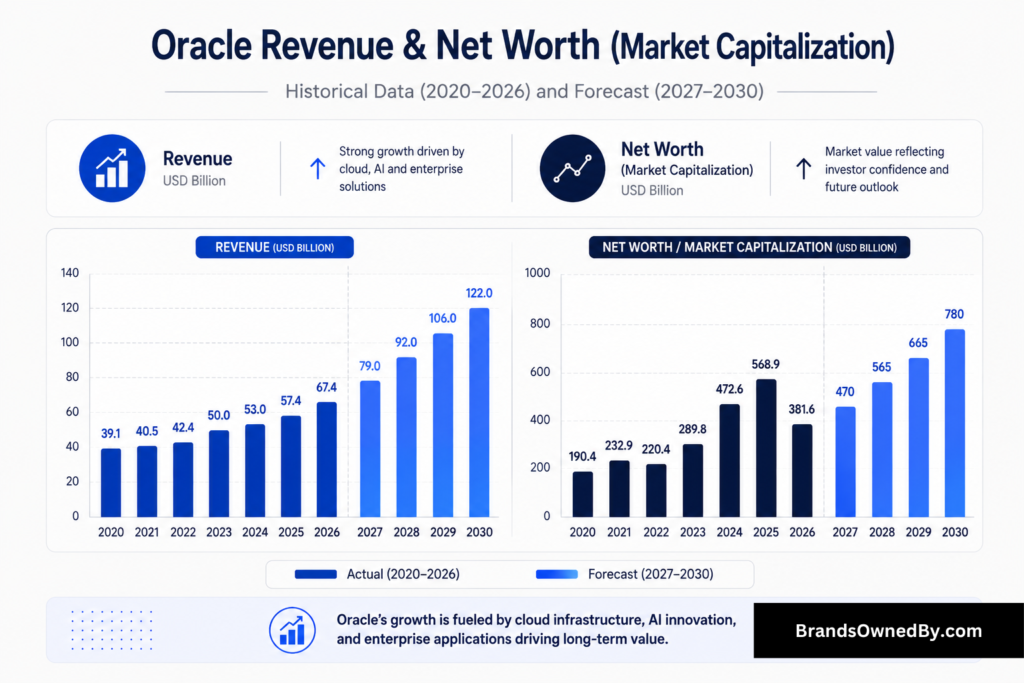
For fiscal year 2026, Oracle reported record annual revenue of approximately $67.4 billion, representing an increase of nearly 17% compared to fiscal 2025. The company has also become one of the world’s most valuable technology businesses, with a market capitalization of approximately $382 billion as of July 2026. This strong financial performance reflects growing demand for Oracle Cloud Infrastructure (OCI), AI computing capacity, cloud applications, and healthcare technology following the Cerner acquisition.
Oracle Revenue in 2026
Oracle generated approximately $67.4 billion in total revenue during fiscal year 2026, making it the highest annual revenue in the company’s history. The business added nearly $10 billion in new revenue compared to the previous fiscal year, demonstrating the accelerating adoption of its cloud platform and enterprise software portfolio.
Much of Oracle’s growth was fueled by increasing customer demand for cloud infrastructure capable of supporting artificial intelligence workloads. Enterprises, governments, and technology companies continued migrating mission-critical applications to Oracle Cloud Infrastructure (OCI), while existing customers expanded their spending on cloud databases, enterprise resource planning (ERP), and healthcare solutions.
The company’s strong revenue growth also reflects long-term customer contracts, recurring subscription income, and continued expansion across international markets. Unlike hardware-focused technology companies, Oracle generates a large proportion of its revenue from subscription-based software and cloud services, providing predictable recurring cash flows and improving long-term financial stability.
Revenue Breakdown by Business Segment
Oracle generates revenue from several major business segments, with cloud services now accounting for the majority of the company’s business.
Cloud Services and License Support remained Oracle’s largest revenue contributor during fiscal 2026, generating approximately $47 billion. This segment includes Oracle Cloud Infrastructure (OCI), Autonomous Database, cloud applications, and ongoing software support contracts.
Cloud License and On-Premise License revenue contributed approximately $6 billion, reflecting continued demand from organizations operating hybrid IT environments and businesses that still rely on Oracle’s traditional software licensing model.
Hardware revenue accounted for approximately $3.7 billion, primarily from Oracle Engineered Systems, servers, storage products, and integrated hardware solutions that support enterprise workloads.
Services revenue contributed approximately $10.7 billion, including consulting, implementation, technical support, Oracle Health services, and customer success programs that help organizations deploy and optimize Oracle technologies.
This diversified revenue mix enables Oracle to reduce dependence on any single product category while maintaining stable long-term growth.
Cloud Business Continues to Drive Growth
Oracle’s cloud business remained the company’s fastest-growing segment throughout fiscal 2026.
Oracle Cloud Infrastructure (OCI) continued expanding at one of the highest growth rates among major hyperscale cloud providers, supported by increasing demand for AI model training, enterprise cloud migration, and high-performance computing workloads.
The company also benefited from strategic partnerships with leading cloud providers and AI companies, allowing customers to run Oracle databases across multiple cloud environments while expanding Oracle’s reach beyond its own infrastructure.
Cloud applications, including Oracle Fusion ERP, Human Capital Management (HCM), Supply Chain Management (SCM), and Customer Experience (CX), also recorded healthy subscription growth as organizations modernized legacy enterprise systems.
Oracle Net Worth in 2026
Because Oracle is a publicly traded company, its net worth is generally measured using market capitalization, which represents the total market value of all outstanding shares rather than the company’s book value.
As of July 2026, Oracle’s market capitalization stood at approximately $382 billion, placing it among the world’s most valuable enterprise software and cloud computing companies.
Although Oracle’s market value fluctuated during the year due to broader market conditions and increased investment in AI infrastructure, investor confidence remained strong because of the company’s accelerating cloud growth, expanding AI business, and long-term revenue visibility.
The company’s valuation has increased substantially over the past several years, reflecting Oracle’s successful transformation from a traditional database software provider into a global cloud infrastructure leader.
Factors Supporting Oracle’s Valuation
Oracle’s strong market valuation is supported by several long-term business fundamentals.
The company generates recurring revenue through multi-year cloud subscriptions and software support contracts, creating highly predictable cash flows. This business model reduces earnings volatility and improves long-term financial stability.
Oracle also benefits from exceptionally high customer retention because enterprise customers rarely replace mission-critical databases and enterprise applications once deployed. Long-term relationships with governments, financial institutions, healthcare organizations, manufacturers, and multinational corporations provide a stable customer base that continues to expand cloud spending over time.
Another important driver of Oracle’s valuation is its aggressive investment in artificial intelligence infrastructure. The company has committed billions of dollars to expanding Oracle Cloud Infrastructure (OCI) data centers worldwide to support growing demand for AI model training and inference workloads. These investments are expected to strengthen Oracle’s competitive position against Amazon Web Services (AWS), Microsoft Azure, and Google Cloud over the coming years.
Oracle Revenue Forecast Through 2030
Oracle is expected to maintain strong growth over the remainder of the decade as cloud infrastructure, AI services, enterprise applications, and healthcare technology become increasingly important contributors to its business. Based on current growth trends, industry demand, and analyst expectations, the following revenue outlook represents a reasonable long-term forecast:
- 2027: Approximately US$79 billion, supported by continued expansion of Oracle Cloud Infrastructure, AI workloads, and enterprise cloud applications.
- 2028: Approximately US$92 billion, driven by higher cloud subscription revenue, international expansion, and growing adoption of Oracle Health solutions.
- 2029: Approximately US$106 billion, as recurring cloud revenue becomes the dominant contributor to Oracle’s overall business and AI infrastructure investments mature.
- 2030: Approximately US$122 billion, reflecting Oracle’s potential to strengthen its position among the world’s leading cloud infrastructure and enterprise software providers.
Oracle’s financial outlook remains closely tied to the continued adoption of cloud computing and artificial intelligence. The company’s recurring subscription-based revenue model, expanding cloud infrastructure business, and large enterprise customer base provide a strong foundation for sustained growth. If Oracle continues executing its AI and cloud strategy successfully, both revenue and market capitalization are expected to increase steadily over the remainder of the decade, reinforcing its position as one of the world’s most valuable enterprise technology companies.
Companies Owned by Oracle
Oracle has built one of the broadest enterprise technology portfolios in the world through a combination of in-house innovation and strategic acquisitions. Since its founding in 1977, the company has completed more than 150 acquisitions, allowing it to expand beyond database software into cloud computing, enterprise applications, healthcare technology, customer relationship management (CRM), human capital management (HCM), financial software, and industry-specific solutions.
Many of Oracle’s acquisitions remain independent product lines within the Oracle ecosystem, while others have been integrated into Oracle Cloud Applications and Oracle Cloud Infrastructure (OCI). Together, these businesses enable Oracle to provide end-to-end technology solutions for organizations of every size.
Below are the major companies, brands, products, and business units owned and operated by Oracle as of July 2026.
Oracle Companies & Brands
Major businesses operated by Oracle (July 2026)
ORACLE
Enterprise TechnologyCloud
Database
ERP & Business
Healthcare
CRM & HR
Construction
Financial
Industry
Oracle Cloud Infrastructure (OCI)
Oracle Cloud Infrastructure (OCI) is Oracle’s flagship cloud computing platform and one of its fastest-growing business segments. Introduced to compete with Amazon Web Services (AWS), Microsoft Azure, and Google Cloud, OCI provides computing, networking, storage, databases, analytics, artificial intelligence, and security services through Oracle’s global network of cloud regions.
OCI has become a key driver of Oracle’s growth, particularly as enterprises adopt AI-powered workloads requiring high-performance computing. The platform supports thousands of organizations worldwide, including governments, financial institutions, healthcare providers, telecommunications companies, and large enterprises.
Oracle Database
Oracle Database remains one of the company’s most valuable and recognizable products. It is one of the world’s most widely deployed relational database management systems (RDBMS), powering mission-critical applications across banking, healthcare, retail, manufacturing, telecommunications, and government sectors.
Over the years, Oracle has continuously enhanced its database platform with autonomous capabilities, advanced security, high availability, and artificial intelligence features. The database is available both on-premises and through Oracle Cloud Infrastructure, enabling customers to operate hybrid and multi-cloud environments.
Oracle Autonomous Database
Oracle Autonomous Database is Oracle’s self-managing cloud database service designed to automate routine administrative tasks such as patching, tuning, backups, scaling, and security updates.
Using machine learning and automation, the platform significantly reduces manual database management while improving performance and reliability. It has become a key component of Oracle’s AI and cloud strategy, helping organizations reduce operational costs while improving database availability.
Oracle Fusion Cloud Applications
Oracle Fusion Cloud Applications represent Oracle’s next-generation enterprise software suite delivered through the cloud.
The platform includes integrated business applications covering:
- Enterprise Resource Planning (ERP).
- Human Capital Management (HCM).
- Supply Chain Management (SCM).
- Customer Experience (CX).
- Enterprise Performance Management (EPM).
These applications help organizations automate financial management, procurement, manufacturing, workforce management, customer engagement, and operational planning while supporting digital transformation initiatives.
NetSuite
Oracle acquired NetSuite in 2016 for approximately US$9.3 billion, marking one of the company’s largest acquisitions.
NetSuite is one of the world’s leading cloud-based Enterprise Resource Planning (ERP) platforms for small and medium-sized businesses (SMBs). Its software combines accounting, financial management, inventory control, customer relationship management (CRM), ecommerce, procurement, and business analytics into a single cloud platform.
Although NetSuite operates as part of Oracle, it continues to maintain its own brand identity and serves millions of users globally.
Cerner (Oracle Health)
Oracle completed its acquisition of Cerner in 2022 for approximately US$28.3 billion, representing the largest acquisition in the company’s history.
Following the acquisition, Oracle rebranded the business as Oracle Health. The division develops healthcare technology solutions for hospitals, clinics, healthcare providers, and government health agencies.
Oracle Health’s portfolio includes:
- Electronic Health Records (EHR).
- Clinical Information Systems.
- Healthcare Analytics.
- Population Health Management.
- Revenue Cycle Management.
- Patient Engagement Solutions.
Oracle continues integrating AI, cloud computing, and automation into Oracle Health to modernize healthcare delivery worldwide.
Java
Oracle became the owner of Java through its acquisition of Sun Microsystems in 2010.
Java remains one of the world’s most widely used programming languages and software development platforms. Millions of developers use Java to build enterprise applications, financial systems, mobile applications, cloud services, embedded systems, and enterprise middleware.
Oracle continues to maintain and develop the Java platform through regular feature releases, security updates, and long-term support versions.
MySQL
MySQL became part of Oracle through the Sun Microsystems acquisition.
It is one of the world’s most popular open-source relational database management systems and powers millions of websites, ecommerce platforms, web applications, and cloud services.
Oracle continues to offer both the free Community Edition and commercial Enterprise Edition, providing advanced security, monitoring, backup, and performance optimization capabilities.
Solaris
Solaris is Oracle’s enterprise operating system designed for mission-critical workloads requiring high availability, security, and scalability.
Although cloud adoption has reduced demand for proprietary operating systems, Solaris continues to support many enterprise customers operating Oracle databases and business-critical applications on SPARC servers.
Oracle continues to provide updates and long-term support for Solaris customers.
PeopleSoft
Oracle acquired PeopleSoft in 2005 following one of the most significant hostile takeover battles in enterprise software history.
PeopleSoft specializes in enterprise applications for:
- Human Resources.
- Payroll.
- Financial Management.
- Campus Solutions.
- Supply Chain Management.
Many governments, universities, and multinational corporations continue to rely on PeopleSoft applications, and Oracle remains committed to supporting existing customers through ongoing updates and extended support programs.
Siebel CRM
Oracle acquired Siebel Systems in 2006, significantly strengthening its position in customer relationship management software.
Siebel CRM remains one of the most comprehensive CRM platforms for large enterprises, offering sales automation, customer service, marketing automation, contact center management, and field service capabilities.
Although Oracle now emphasizes Oracle Fusion Cloud Customer Experience (CX), many organizations continue using Siebel for mission-critical customer management operations.
JD Edwards
JD Edwards joined Oracle’s portfolio following the acquisition of PeopleSoft.
The software provides enterprise resource planning solutions for manufacturing, construction, engineering, agriculture, logistics, and distribution businesses.
Oracle continues investing in JD Edwards through regular software updates, cloud integrations, and industry-specific enhancements.
Hyperion Solutions
Oracle acquired Hyperion Solutions in 2007 to strengthen its enterprise performance management capabilities.
Hyperion software enables organizations to perform:
- Financial consolidation.
- Budgeting.
- Forecasting.
- Strategic planning.
- Financial reporting.
- Business performance analysis.
Its capabilities have been integrated into Oracle Fusion Cloud Enterprise Performance Management (EPM).
BEA Systems
Oracle acquired BEA Systems in 2008 to expand its middleware portfolio.
The acquisition added several enterprise technologies, including Oracle WebLogic Server, application integration software, and enterprise middleware products.
Today, these technologies continue supporting enterprise application development, cloud integration, and large-scale business systems.
Primavera
Primavera is Oracle’s leading project portfolio management (PPM) software.
Used extensively across construction, engineering, energy, manufacturing, defense, and government sectors, Primavera helps organizations manage complex projects involving thousands of activities, contractors, and resources.
Its scheduling and portfolio management capabilities have made it one of the industry’s leading project management platforms.
MICROS Systems
Oracle acquired MICROS Systems in 2014 to strengthen its presence in the hospitality and retail industries.
MICROS develops:
- Point-of-sale (POS) systems.
- Restaurant management software.
- Hotel management systems.
- Retail management solutions.
- Hospitality analytics.
Its software is widely used by hotels, restaurants, casinos, cruise lines, and retailers worldwide.
Taleo
Oracle acquired Taleo in 2012 to enhance its human capital management portfolio.
Taleo specializes in cloud-based talent management solutions, including:
- Recruitment.
- Applicant tracking.
- Employee onboarding.
- Performance management.
- Learning management.
- Succession planning.
Many of these capabilities have since been integrated into Oracle Fusion Cloud Human Capital Management.
Aconex
Oracle acquired Aconex in 2018 to strengthen its construction and engineering software portfolio.
Aconex provides cloud-based collaboration software for construction projects, enabling owners, contractors, engineers, architects, and suppliers to coordinate documentation, workflows, quality control, and project delivery across large infrastructure developments.
Oracle Financial Services Software (Major Stake)
Oracle also holds a controlling interest in Oracle Financial Services Software Limited (OFSS), a publicly listed company specializing in banking and financial technology solutions.
OFSS develops software for:
- Core Banking.
- Digital Banking.
- Risk Management.
- Regulatory Compliance.
- Anti-Money Laundering.
- Financial Crime Prevention.
- Treasury Management.
Its products are used by hundreds of financial institutions across more than 150 countries.
Oracle Communications
Oracle Communications develops telecommunications software used by mobile network operators, internet service providers, and communications companies worldwide.
Its solutions include:
- Billing and Revenue Management.
- Network Policy Control.
- Customer Experience Management.
- Session Border Controllers.
- Communications Cloud Services.
The business serves many of the world’s leading telecom operators.
Oracle Retail
Oracle Retail provides software solutions specifically designed for retailers.
Its products help businesses manage merchandising, inventory optimization, pricing, supply chain operations, customer loyalty, ecommerce, and omnichannel retail experiences.
The platform is widely used by supermarkets, department stores, fashion retailers, and specialty retail chains.
Oracle Hospitality
Oracle Hospitality develops cloud-based technology solutions for hotels, resorts, restaurants, casinos, cruise operators, and food service businesses.
Its portfolio includes hotel property management systems, restaurant point-of-sale software, reservations, inventory management, payment processing, and guest experience solutions.
Oracle Construction and Engineering
Oracle Construction and Engineering brings together Primavera, Aconex, and several construction-focused technologies into a unified business unit.
The division offers project controls, cost management, scheduling, contract administration, field collaboration, and capital project management software for large infrastructure and industrial projects.
Oracle Advertising
Oracle Advertising provides digital marketing and advertising technologies that help businesses manage customer data, campaign measurement, audience targeting, and digital advertising performance.
Although Oracle has streamlined portions of this business in recent years, it continues offering selected advertising and marketing technology solutions as part of its broader customer experience portfolio.
Conclusion
Oracle is a publicly traded technology company rather than a privately owned business. Although millions of investors own shares, Larry Ellison remains the largest shareholder with roughly 40% ownership, giving him substantial influence over the company’s strategic direction. Daily operations are led by CEO Safra Catz, while Ellison continues to shape Oracle’s long-term technology vision as Executive Chairman and Chief Technology Officer.
Supported by strong institutional investors and a portfolio of industry-leading software and cloud businesses, Oracle remains one of the most influential enterprise technology companies in the world.
FAQs
What does Oracle do?
Oracle develops enterprise software, cloud computing platforms, database management systems, and artificial intelligence (AI) solutions for businesses and governments worldwide. The company is best known for Oracle Database and Oracle Cloud Infrastructure (OCI), which help organizations store, manage, secure, and analyze data. Oracle also provides enterprise applications for finance, human resources, supply chain management, customer relationship management (CRM), healthcare, telecommunications, retail, and construction. Its products are used by millions of businesses to automate operations, improve productivity, and support digital transformation.
Who founded Oracle?
Oracle was founded in 1977 by Larry Ellison, Bob Miner, and Ed Oates under the name Software Development Laboratories (SDL). The company was established to commercialize relational database technology inspired by IBM researcher Edgar F. Codd’s groundbreaking work. Larry Ellison led Oracle’s business strategy, Bob Miner served as the chief software architect behind the company’s early database products, and Ed Oates contributed to software development and operations. The company later changed its name to Oracle Corporation after the success of its flagship Oracle Database.
Who owns Oracle NetSuite?
Oracle NetSuite is wholly owned by Oracle Corporation. Oracle acquired NetSuite in 2016 for approximately US$9.3 billion, making it one of the company’s largest acquisitions at the time. Although NetSuite continues to operate under its own brand name, it functions as an Oracle business unit and specializes in cloud-based Enterprise Resource Planning (ERP) software for small and medium-sized businesses. NetSuite’s solutions include financial management, accounting, inventory management, customer relationship management (CRM), ecommerce, and business analytics.
Who is the CEO of Oracle?
As of July 2026, Oracle is led by Co-Chief Executive Officers Clay Magouyrk and Mike Sicilia.
Clay Magouyrk oversees Oracle’s cloud infrastructure, engineering, database technologies, and artificial intelligence initiatives. Mike Sicilia leads Oracle’s enterprise applications, Oracle Health, industry-specific cloud solutions, and global business operations. They succeeded Safra Catz, who became Executive Vice Chair of the Board, while Larry Ellison continues to serve as Executive Chairman and Chief Technology Officer (CTO).
Is Larry Ellison richer than Elon Musk now?
No. As of July 2026, Larry Ellison is one of the world’s wealthiest individuals, largely due to his substantial ownership stake in Oracle. However, Elon Musk remains wealthier than Larry Ellison, with a higher estimated net worth driven primarily by his holdings in Tesla, SpaceX, xAI, and other ventures. Rankings can change over time because they depend on stock prices and private company valuations, but Elon Musk continues to rank ahead of Larry Ellison on global billionaire lists.
Is TikTok owned by Oracle?
No. TikTok is not owned by Oracle. TikTok is owned by ByteDance Ltd., a Chinese technology company headquartered in Beijing.
Oracle has a commercial partnership with TikTok in the United States, providing cloud infrastructure and data hosting services under Project Texas, an initiative designed to enhance the security of U.S. user data. While Oracle stores and helps secure certain TikTok user data in the U.S., it does not own TikTok or have control over ByteDance’s operations.
Is Oracle a Microsoft partner?
Yes. Oracle and Microsoft are strategic technology partners despite competing in cloud computing.
The two companies have collaborated on several initiatives, including Oracle Database@Azure, which allows customers to run Oracle Database services directly within Microsoft Azure data centers. Oracle and Microsoft also support high-speed interconnection between Oracle Cloud Infrastructure (OCI) and Microsoft Azure, enabling organizations to deploy applications across both cloud platforms. This partnership allows businesses to combine Oracle’s database technologies with Microsoft’s cloud services while maintaining low latency and simplified management.
What does Oracle own?
Oracle owns a broad portfolio of enterprise technology companies, software platforms, and cloud services. Some of its most notable businesses include Oracle Cloud Infrastructure (OCI), Oracle Database, Oracle Fusion Cloud Applications, NetSuite, Oracle Health (formerly Cerner), MySQL, Java, Solaris, PeopleSoft, Siebel CRM, JD Edwards, Hyperion, BEA Systems, Primavera, Taleo, Aconex, MICROS Systems, Oracle Financial Services Software (majority stake), Oracle Communications, Oracle Retail, and Oracle Hospitality.
These businesses enable Oracle to offer comprehensive solutions across cloud computing, enterprise software, healthcare technology, financial services, retail, telecommunications, construction, hospitality, and database management, making it one of the world’s most diversified enterprise technology companies.