
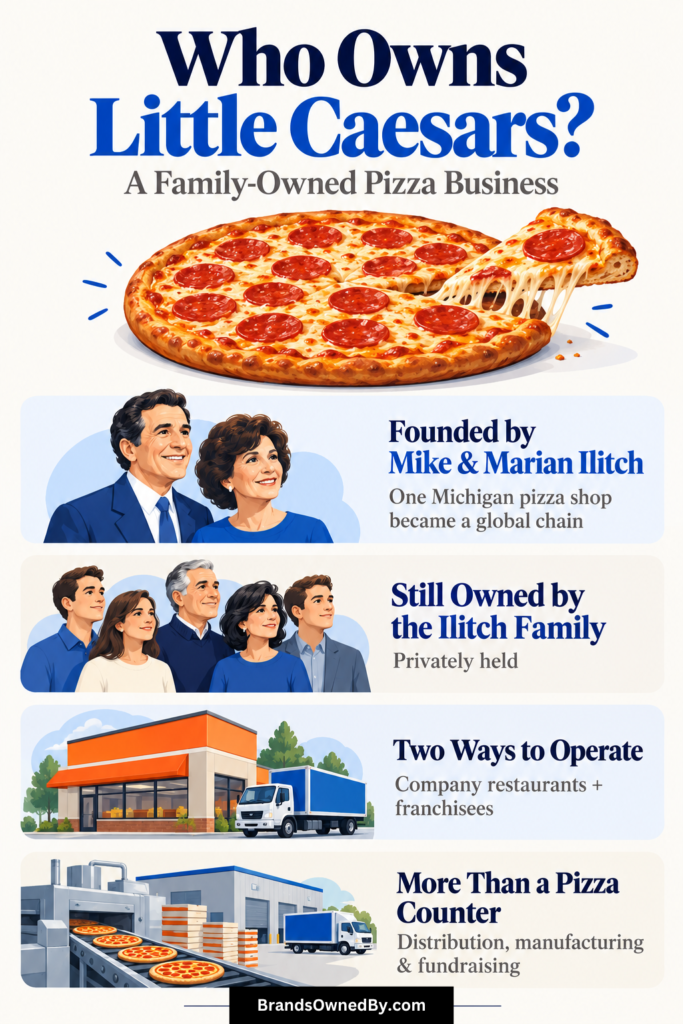
- The Ilitch family owns Little Caesars. The business remains privately held, with no publicly traded shares.
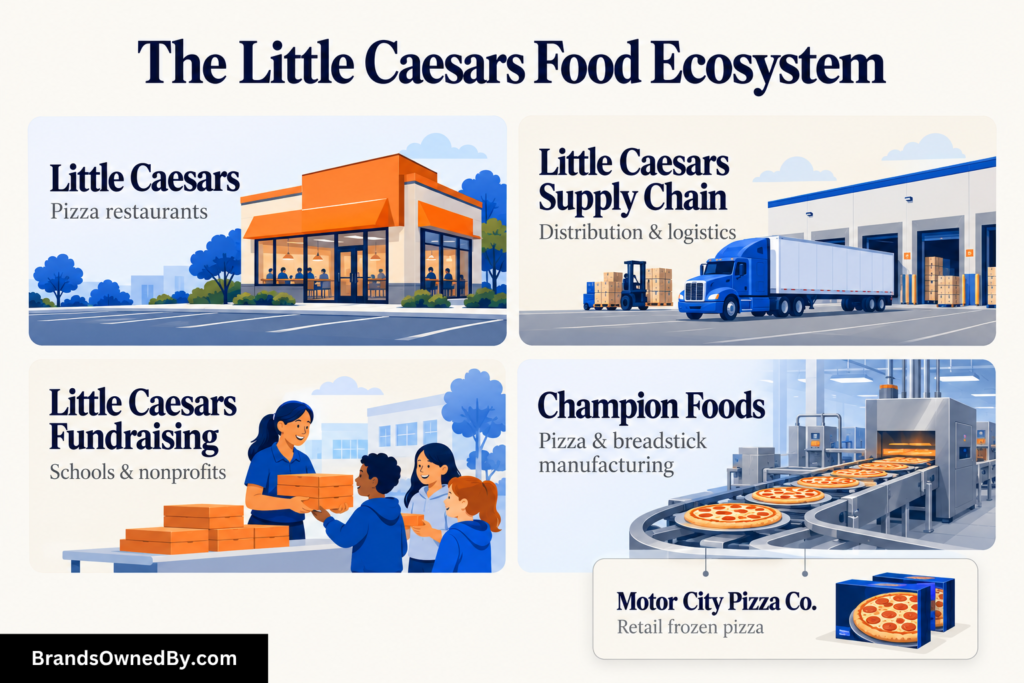
- Little Caesars Fundraising is a division of Little Caesars. It sells pizza kits and other products to support schools, sports teams, and nonprofits.
- The wider family food business includes Little Caesars Supply Chain, previously known as Blue Line Distribution, and pizza manufacturer Champion Foods. Champion Foods lists Motor City Pizza Co. among its brands.
- The Detroit Tigers, Detroit Red Wings, and other Ilitch businesses belong to the wider family portfolio. They should not be presented as subsidiaries owned by the Little Caesars restaurant chain.
Little Caesars is owned by the Ilitch family, whose food, sports, and entertainment businesses are grouped under Ilitch Companies. Mike and Marian Ilitch founded the chain in Michigan in 1959. It remains privately held as of October 2026. However, owning the pizza brand differs from owning a neighborhood restaurant. Many locations belong to independent franchisees. Its food operations also connect with distribution, manufacturing, and fundraising businesses, including a less obvious link to frozen pizza sold in grocery stores.
Little Caesars Overview
Little Caesars is a Detroit-based pizza business built around value and convenient pickup. Its restaurant network combines company operations with independently owned franchises. The founding family has retained the business while expanding well beyond its original pizza shop.
Who Founded Little Caesars?
Mike Ilitch and Marian Ilitch founded Little Caesars together. Their first restaurant opened on May 8, 1959, in Garden City, Michigan, a Detroit suburb. It originally operated as Little Caesar’s Pizza Treat.
Mike brought an entrepreneurial approach to selling pizza. Marian helped establish the financial discipline behind the operation. Both belong in the founding story. Describing Little Caesars solely as Mike Ilitch’s company leaves out a cofounder who helped build the business from its beginning.
The founders did not start with a nationwide restaurant platform. They started with a neighborhood shop. Expansion came through a combination of additional restaurants, franchising, and investment in the infrastructure needed to support a larger system.
Where Did Little Caesars Start?
The company’s origins are in Garden City, rather than downtown Detroit. Detroit became the headquarters and the center of the family’s wider business activities.
That distinction explains why Little Caesars is routinely described as a Detroit company even though its first restaurant opened outside the city. Its identity spans both places: a suburban Michigan beginning and a long corporate presence in Detroit.
The chain now serves customers across the United States and in international markets. Its core proposition remains recognizable. Customers can buy familiar pizzas at value-oriented prices, with a strong emphasis on carryout convenience.
What Makes Its Business Model Different?
Little Caesars built its reputation around making a pizza purchase quick and predictable. HOT-N-READY reduces the need to place an order in advance for participating ready-made products. Digital ordering adds another way to buy, including pizzas that require preparation after an order is placed.
The distinction matters in practice. Someone collecting dinner on the way home may prioritize immediate availability. Another customer may want a customized order and a scheduled pickup. The brand serves both occasions without depending entirely on traditional delivery.
Behind that customer experience sits a broader food system. Distribution, equipment, product development, and manufacturing help support the restaurants. Understanding those activities gives a more complete picture of the business than a list of menu items does.
Ownership History
Little Caesars’ ownership history is largely a story of continuity. The founding family retained the business as its operating model, geographic reach, and management structure changed.
1959: Mike And Marian Ilitch Establish The Business
The first restaurant was a family venture. The Ilitches invested their savings and developed the operation themselves. There was no public stock listing or large restaurant conglomerate behind the original shop.
This starting point remains relevant to current ownership. Little Caesars did not become an Ilitch business through an acquisition. It was the business from which much of the family’s later commercial expansion developed.
1962: Franchising Creates A Second Layer Of Ownership
The first Little Caesars franchise opened in Warren, Michigan, in 1962. Franchising allowed other entrepreneurs to invest in restaurants using the brand’s name and operating system.
It also created two different meanings of “owner.” The Ilitch family owned the pizza business. A franchisee could own a particular restaurant business under an agreement with the franchisor.
That structure remains essential to understanding the chain. A franchisee’s investment expands the network without giving that operator ownership of the entire Little Caesars brand.
1971: The Family Invests In Its Food Supply
The Ilitches purchased a mushroom farm in 1971 to improve ingredient quality and pricing. That operation developed into the distribution business historically known as Blue Line Foodservice Distribution.
The current family business website identifies the operation as Little Caesars Supply Chain. Its role extends to food and equipment distribution and logistics.
This was an important strategic step. A restaurant network needs dependable inputs as well as customers. Building supply capabilities gave the family another way to support growth and manage the practical demands of serving more locations.
1999: Ilitch Holdings Formalizes Shared Business Services
Mike and Marian established Ilitch Holdings in 1999 to provide professional and technical services to their businesses. The wider organization is now presented publicly as Ilitch Companies.
These names can cause confusion. “Ilitch Companies” describes the family’s broader collection of businesses. It should not be treated as a reason to place every family asset beneath the Little Caesars restaurant company.
For example, the family’s professional sports interests and its pizza operations share an ownership connection. That does not make a baseball team a pizza-chain subsidiary.
2017 Onward: Family Ownership Continues After Mike Ilitch’s Death
Mike Ilitch died on February 10, 2017. Little Caesars remained within the Ilitch family business organization.
The company did not become publicly traded following his death. Its current public identity continues to emphasize private family ownership.
Chris Ilitch represents the second generation of family leadership. Professional executives also hold major responsibilities within the pizza business. This combination allows family oversight and specialist management to coexist.
2026: Management Changes Without A Change Of Owner
Leadership promotions took effect on January 1, 2026. Dave Scrivano became vice chairman. Paula Vissing became president and CEO of Global Retail. Ed Gleich became president and CEO of Global Services. Leigh Burnside became chief financial officer and chief administrative officer.
These were management changes. They were not an announcement that Little Caesars had been sold or that ownership had transferred to its executives.
Who Owns Little Caesars?
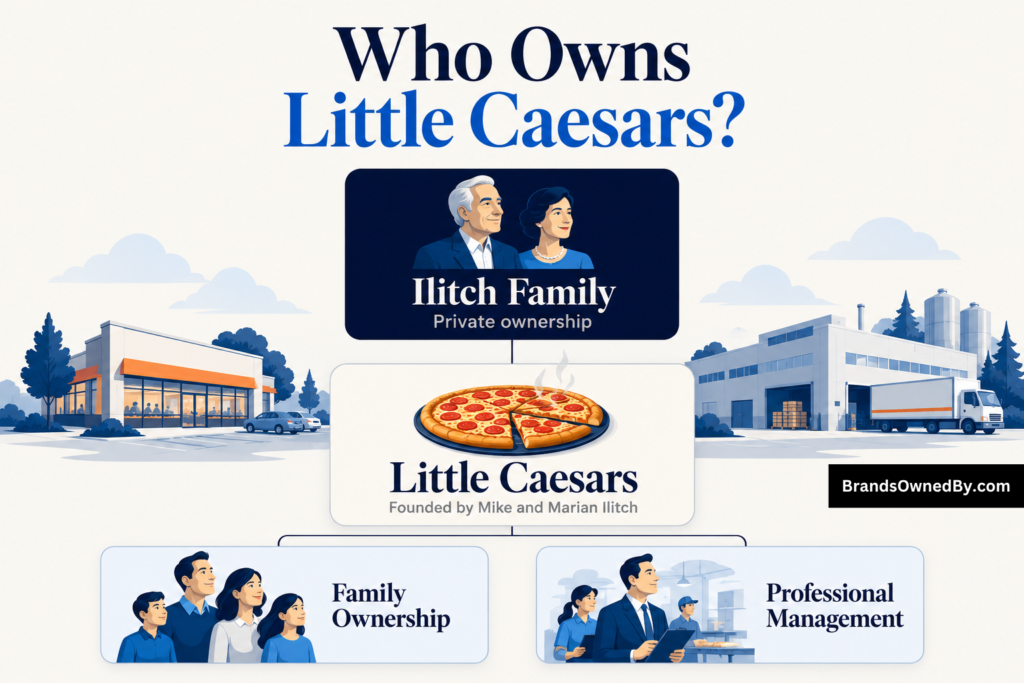
The Ilitch family owns Little Caesars as a private business. Little Caesar Enterprises, Inc. is the corporate entity associated with the restaurant franchise system. The chain forms part of the wider Ilitch Companies family of businesses.
There is no public shareholder register showing a complete allocation of Little Caesars shares among individual family members or family holding arrangements. Consequently, precise percentages for Marian Ilitch, Chris Ilitch, or other relatives should not be presented as established facts.
The Ilitch Family
The family is the central ownership group. Its relationship with Little Caesars began with the founders and continues through the next generation’s leadership.
Private ownership means investors cannot purchase Little Caesars shares through an ordinary stock exchange transaction. It also means the company does not publish the same routine shareholder disclosures expected from a listed restaurant business.
This limits how precisely an outside reader can map the family’s economic interests. Family control is clear. A complete public breakdown of individual equity and voting rights is not available.
It is therefore more accurate to identify Little Caesars as Ilitch family-owned than to invent a shareholder table with unsupported percentages.
Marian Ilitch
Marian Ilitch is a cofounder and a central figure in the family’s ownership story. Her role extends beyond being the spouse of the better-known founder. She participated in establishing the restaurant business and its financial foundations.
Her personal wealth is often discussed alongside Little Caesars and other family assets. Those wealth estimates do not establish the pizza company’s standalone value. They also do not disclose a complete Little Caesars shareholding structure.
A claim that Marian personally owns a specific percentage requires evidence about the relevant legal entity and the date of that ownership. Her importance to the business can be explained without assigning an unverified number.
Chris Ilitch And Second-Generation Family Leadership
Chris Ilitch is CEO of Ilitch Companies and has led the wider organization since 2004. He is the son of Mike and Marian Ilitch.
His position gives him an important role in overseeing the family’s business interests. However, a CEO title does not establish an individual’s exact ownership stake.
This distinction is especially important in family companies. The person leading daily or strategic decisions may act on behalf of a wider ownership group. Public information identifies Chris’s leadership responsibilities, while leaving the detailed family allocation of Little Caesars equity private.
Ilitch Companies And Ilitch Holdings
Ilitch Holdings is the name many readers encounter when researching Little Caesars’ corporate connections. The current public-facing organization uses Ilitch Companies to describe its family business portfolio.
The group brings together food, sports, entertainment, real estate, and other activities. Its shared leadership and business services help explain the connection between those operations.
For readers asking who owns Little Caesars, the useful answer is the Ilitch family within this broader business organization. A detailed legal ownership chart requires entity-level disclosures. Shared branding or common executives alone cannot establish every direct parent-and-subsidiary relationship.
Franchisees Are Restaurant Owners, Not Automatically Brand Shareholders
A franchisee may own one Little Caesars restaurant or operate a large regional network. That ownership concerns the local restaurant business and its rights under a franchise agreement.
For example, an operator could own the company that employs the staff, leases the premises, and runs several locations. The operator still uses Little Caesars’ brand under contractual terms.
Buying that operator’s business would not automatically buy shares in Little Caesar Enterprises. The distinction becomes particularly important when investment firms acquire large franchise groups.
Competitor Ownership Comparison
Little Caesars competes with pizza businesses that use several ownership models. Some have public shareholders. Others are privately controlled or backed by investment firms. Restaurant-level franchising appears across these models, so a familiar sign does not identify the ultimate owner by itself.
Domino’s: A Publicly Traded Pizza Company
Domino’s Pizza, Inc. is publicly traded under the ticker DPZ. Its ownership is divided among shareholders, including institutional and individual investors.
That differs from Little Caesars’ private family ownership. Investors can buy Domino’s shares through the public market. They cannot make an equivalent stock-market purchase of Little Caesars.
Both businesses use franchising extensively. A local Domino’s operator and a local Little Caesars operator may therefore have similar responsibilities for running restaurants. The ownership structures above those restaurants are different.
Domino’s also publishes financial results for shareholders. This creates greater visibility into corporate revenue, profitability, and business performance than Little Caesars generally provides to the public.
Pizza Hut: A Change Of Ownership In 2026
As of October 2026, Pizza Hut’s ownership differs from the long-standing description of the chain as a Yum! Brands business.
Yum! completed the sale of Pizza Hut outside Mainland China to LongRange Capital on September 1, 2026. The Mainland China business was sold separately to Yum China, with that transaction closing on August 7, 2026.
For the U.S. comparison, the relevant owner is LongRange Capital. This puts Pizza Hut under an investment-firm ownership model, while Little Caesars remains within its founding family’s business organization.
These transactions also show why ownership answers need a geographic qualification. A global brand can have different ownership arrangements in different territories. The buyer of one regional business does not necessarily acquire every operation worldwide.
Papa John’s: Public Shareholders And Separate Franchise Operators
Papa John’s International, Inc. lists its common shares on Nasdaq under PZZA. Its public shareholders own interests in the corporate business.
The company should also be distinguished from the independent operators running franchised Papa John’s restaurants. Buying a franchise location and buying PZZA shares are different investments.
For Little Caesars readers, this is a useful comparison. The two chains can compete for the same family dinner order while offering very different routes to business ownership. Little Caesars provides franchise opportunities, but its brand-level equity is privately held.
The founder’s name in the Papa John’s brand does not mean every restaurant or all corporate shares belong to that founder. Brand identity, executive authority, and equity ownership need separate examination.
Marco’s Pizza: Another Private Franchise Business
Marco’s Pizza is a privately held competitor founded by Pasquale “Pat” Giammarco. Its expansion has been associated with Jack Butorac, who became involved with the brand and helped develop its franchising platform.
Its official leadership information identifies Butorac as chairman and co-CEO, alongside Tony Libardi as president and co-CEO. A full allocation of private ownership interests is not publicly listed.
The comparison with Little Caesars is closer than it is with a public company. Both brands rely on private business structures and franchise development. However, Little Caesars’ identity remains tied to the family that founded it, while Marco’s growth story includes a later franchising leadership transition.
Neither chain’s restaurant count alone tells readers who owns the underlying business. Operators, franchisors, and investors occupy different positions in the system.
Who Controls Little Caesars?
Control operates at several levels. The Ilitch family provides the ownership foundation. Chris Ilitch leads the wider family organization. Little Caesars executives direct major operating functions. Franchisees manage their own restaurants within the franchise system.
Chris Ilitch Oversees The Wider Family Business
Chris Ilitch leads Ilitch Companies. His group-level position connects Little Caesars with the family’s broader commercial organization.
That role should not be confused with personally running every restaurant. A business of this scale delegates substantial authority across executive teams and local operators.
The distinction helps explain how family control works in practice. Ownership can remain concentrated while responsibilities for restaurant growth, distribution, finance, and staffing sit with different people.
Dave Scrivano Guides Long-Term Brand Priorities
Dave Scrivano became vice chairman of Little Caesars effective January 1, 2026. The company described his continuing focus as long-term strategy, culture, and innovation.
He therefore remains an important leader, although the older description of him simply as the current CEO misses the revised structure.
His position also illustrates why executive succession is different from an ownership transfer. A leader can change roles while the family retains the business.
Paula Vissing Leads Global Retail
Paula Vissing serves as president and CEO of Global Retail. Her responsibilities center on the restaurant side of the business, including franchise performance and growth.
For a franchise operator, this part of the organization is especially relevant. Restaurant expansion depends on more than approving new addresses. Stores need operating support and a business model that can work for the people investing in them.
Ed Gleich Leads Global Services
Ed Gleich serves as president and CEO of Global Services. The remit includes major supporting functions, such as supply chain, equipment, distribution, and manufacturing.
This separates restaurant-facing leadership from the infrastructure supporting the restaurants. It also explains why an ownership article should examine more than the pizza shops themselves.
Leigh Burnside Oversees Finance And Administration
Leigh Burnside serves as chief financial officer and chief administrative officer. Her expanded role includes human resources and legal oversight.
These functions connect growth ambitions with practical business requirements. A restaurant network needs financial planning, employees, contracts, and organizational support alongside menu development and marketing.
Her executive authority does not, by itself, establish an ownership stake. The same principle applies to other professional managers across the business.
Who Owns Individual Little Caesars Restaurants?
The owner of the Little Caesars brand may differ from the owner of the restaurant serving your order. This is one of the most useful distinctions for customers, employees, and prospective franchisees.
Company-Operated Restaurants
Company-operated locations sit within Little Caesars’ own restaurant operations. They differ from outlets run by independent franchise owners.
A customer may see little difference at the counter. The restaurant uses the same brand and participates in the same broader system. Behind the counter, however, the ownership and operating arrangements differ.
For an employee, the distinction can help identify the employing business. For a commercial landlord or supplier, it helps establish which entity is responsible for the relevant agreement.
Independently Owned Franchise Restaurants
Franchise restaurants are operated by independent businesses using Little Caesars’ name and system under an agreement.
A franchise owner generally invests in the restaurant operation and manages local business responsibilities. The franchisor maintains the brand relationship and establishes contractual operating requirements.
Consider a hypothetical operator with five locations. Selling those five restaurant businesses could change their local owner while leaving the Little Caesars brand in Ilitch family ownership. The signs might stay the same even though the local operating company changes hands.
Why Bain Capital Appears In Little Caesars Ownership Searches
Bain Capital lists Sizzling Platter in its portfolio following a 2025 investment. Sizzling Platter operates restaurants under several brands, including Little Caesars.
This creates an indirect connection to some Little Caesars locations. It does not make Bain the owner of the Little Caesars brand.
The distinction is straightforward: an investor can acquire a franchise operating platform without acquiring the franchisor. The same platform can operate restaurants from competing brand systems under separate agreements.
Consequently, a report about a franchise group changing ownership should not be rewritten as a sale of Little Caesars itself.
How To Find The Owner Of A Specific Location
Start with the legal business name associated with the restaurant. It may appear on employment paperwork, a business license, a receipt, or other location-specific documentation.
The restaurant manager or Little Caesars customer support may also help identify the operator. State business records can provide additional information once the relevant legal name is known.
The name on the storefront identifies the brand. It does not necessarily identify the company that owns the local restaurant business or employs its staff.
Brands in The Little Caesars Food Business
Little Caesars connects with a broader food operation covering restaurants, fundraising, distribution, and manufacturing. These activities do not all have the same legal status. Little Caesars Fundraising identifies itself as a division, while other businesses are presented within the wider Ilitch family portfolio.
Little Caesars Pizza
The pizza restaurant brand is the central consumer business. It encompasses the menu, ordering experience, restaurant identity, and franchise system customers recognize.
Little Caesar Enterprises, Inc. is the entity associated with the franchise offering. Independent franchisees operate their restaurant businesses through their own entities and agreements.
Menu names such as Crazy Bread and HOT-N-READY belong to the brand’s product and service identity. They are not separate restaurant companies simply because they have distinctive names.
That distinction keeps the portfolio clear. A list of every menu item would describe the product range, rather than the companies owned or operated within the business.
Little Caesars Fundraising
Little Caesars Fundraising is a division of Little Caesars. Established in 1997, it helps schools, sports teams, and nonprofit organizations raise money through food sales.
Its products include pizza kits and other items that supporters can prepare at home. The division also offers different fundraising formats, including online sales and meal-related programs.
For example, a school team can organize a campaign without opening a restaurant. Supporters buy products through the program, and the organization earns money from eligible sales.
The fundraising division is a commercial program serving community organizations. It should be distinguished from a charitable foundation or the brand’s mobile food-relief activity.
Little Caesars Supply Chain, Previously Blue Line Distribution
Little Caesars Supply Chain provides distribution and logistics support. The business traces its history to the operation founded in 1971 and long known as Blue Line Distribution.
It belongs within the Ilitch family’s food business network. Its work concerns the movement of food, equipment, and other supplies that restaurant operations need.
A customer sees a finished pizza. The supply business deals with a different set of tasks: getting the right inputs to the right places and supporting consistent operations across a dispersed network.
Its presence helps explain the family’s involvement beyond franchising. The economic activity surrounding a pizza system includes physical distribution as well as restaurant sales and brand licensing.
Champion Foods
Champion Foods is an Ilitch family food manufacturing business specializing in pizza and breadsticks. It serves retail and foodservice customers, including private-label and branded programs.
Private-label manufacturing means the name on a grocery product may differ from the manufacturer’s corporate name. A retailer can sell a product under its own store brand while a specialist manufacturer makes it.
Champion Foods therefore reaches a different market from a neighborhood Little Caesars restaurant. Its capabilities include product development and manufacturing for products sold through other channels.
The business belongs in an explanation of the wider food portfolio. It should not be used as evidence that every grocery brand it manufactures for is owned by Little Caesars or the Ilitch family.
Motor City Pizza Co.
Champion Foods lists Motor City Pizza Co. among its brands. This connects the family’s food interests with Detroit-style frozen pizza sold through retail channels.
The ownership connection runs through Champion Foods. Motor City Pizza Co. is not simply another name for a Little Caesars restaurant pizza.
The two brands serve different buying occasions. Little Caesars sells prepared restaurant food. Motor City Pizza Co. gives shoppers a packaged pizza to bake at home.
This is one of the less obvious connections in the portfolio. A customer can encounter the family’s food business in a grocery freezer without seeing the Little Caesars name on the front of the package.
Why The Tigers And Red Wings Are Separate
The Detroit Tigers and Detroit Red Wings belong to the wider Ilitch family business portfolio. They should be described alongside Little Caesars when discussing the family’s interests.
They should not be placed beneath Little Caesars as though the restaurant chain directly owns them. The same caution applies to family interests in entertainment, real estate, and hospitality.
Little Caesars Arena can add to the confusion because the pizza brand’s name is attached to a major sports venue. Naming rights and venue branding do not, by themselves, establish who owns the building or the teams playing inside it.
Why Is Little Caesars So Cheap?
Little Caesars’ value positioning is closely connected to its operating model. Price depends on several business choices working together, rather than a single explanation about ingredients or ownership.
Carryout Changes The Service Model
An operation built around convenient pickup has different service requirements from a full-service restaurant. It does not need to replicate the same dining-room experience for every customer.
HOT-N-READY also allows selected products to be prepared around expected demand. When demand forecasting works, customers can collect food quickly and staff can organize production around a repeatable process.
There is a tradeoff. Preparing ahead creates waste risk when demand is weaker than expected. The model depends on execution, rather than eliminating costs automatically.
Scale And Supply Infrastructure Support Value
Large restaurant systems can spread certain costs across many locations. Distribution and manufacturing capabilities can also support coordination and consistency.
Little Caesars’ connections with supply and food businesses are relevant here. They help explain the infrastructure behind its value proposition.
However, low menu prices do not reveal the profit earned by a particular franchisee. Local rent, wages, sales volume, food costs, and operating discipline still affect restaurant performance.
Promotional Prices Are Not The Whole Menu
Customers often associate Little Caesars with a headline pizza price. That does not mean every product, customization, or ordering channel carries the same price.
A basic carryout pizza and a customized delivery order can have different total costs. Prices and availability also vary by location and offer.
The practical comparison is the complete order. Customers should compare the pizza size, toppings, sides, and applicable charges when judging value against another chain.
Final Thoughts
Little Caesars remains an Ilitch family-owned business as of October 2026. Its ownership story combines continuity at the family level with a management structure that has changed as the company has grown.
The most useful distinction is between the brand, the restaurant operator, and the wider family portfolio. Little Caesars owns and develops a pizza business. Franchisees can own individual restaurant operations. Related family businesses support distribution, fundraising, and manufacturing, including Champion Foods’ Motor City Pizza Co. brand.
Keeping those relationships clear explains who owns Little Caesars without attributing every Ilitch asset to the restaurant chain.
FAQs
Is Little Caesars Still Owned By The Original Family?
Yes. Little Caesars remains privately owned by the Ilitch family. Mike and Marian Ilitch founded the business in 1959. Chris Ilitch now leads the wider Ilitch Companies organization. A complete public breakdown of individual family shareholdings is not available.
Who Is The CEO Of Little Caesars In 2026?
The current structure includes Paula Vissing as president and CEO of Global Retail and Ed Gleich as president and CEO of Global Services. Dave Scrivano became vice chairman on January 1, 2026. Chris Ilitch is CEO of the wider Ilitch Companies organization.
Does Little Caesars Have Publicly Traded Stock?
No. Little Caesars is privately held and has no publicly traded stock ticker. Buying a franchise is a different transaction from buying equity in the company that owns the brand.
Does Bain Capital Own Little Caesars?
Bain Capital’s connection is through Sizzling Platter, a franchise operating platform in its portfolio. That business operates Little Caesars locations alongside restaurants from other brands. Owning a franchise operator does not establish ownership of the Little Caesars brand.
Does Little Caesars Own Motor City Pizza Co.?
Motor City Pizza Co. is listed as a Champion Foods brand. Champion Foods belongs to the wider Ilitch family food portfolio. The connection is through that manufacturing business, so it is more precise than describing Motor City Pizza Co. simply as a Little Caesars restaurant subsidiary.
Does Little Caesars Own The Detroit Tigers Or Red Wings?
The teams and Little Caesars are part of the wider Ilitch family business portfolio. They should be described as related family businesses. The restaurant chain should not be presented as their direct owner.
Is Little Caesars Owned By Pizza Hut Or Domino’s?
No. Little Caesars is owned by the Ilitch family. Domino’s is a separate publicly traded company. As of October 2026, Pizza Hut outside Mainland China belongs to LongRange Capital following its sale by Yum! Brands. The Mainland China business belongs to Yum China.
Is Little Caesars Connected To Caesars Entertainment?
Little Caesars and Caesars Entertainment are separate businesses. The similar names do not establish a shared ownership structure. Little Caesars belongs to the Ilitch family business organization.
Are All Little Caesars Restaurants Franchises?
No. The system includes company-operated restaurants and independently owned franchise locations. The operator of a specific restaurant can therefore differ from the family that owns the brand.
Where Is Little Caesars Headquartered?
Little Caesars is headquartered in Detroit, Michigan. Its first restaurant opened in Garden City, a Detroit suburb. The original restaurant location and the corporate headquarters are different places.