

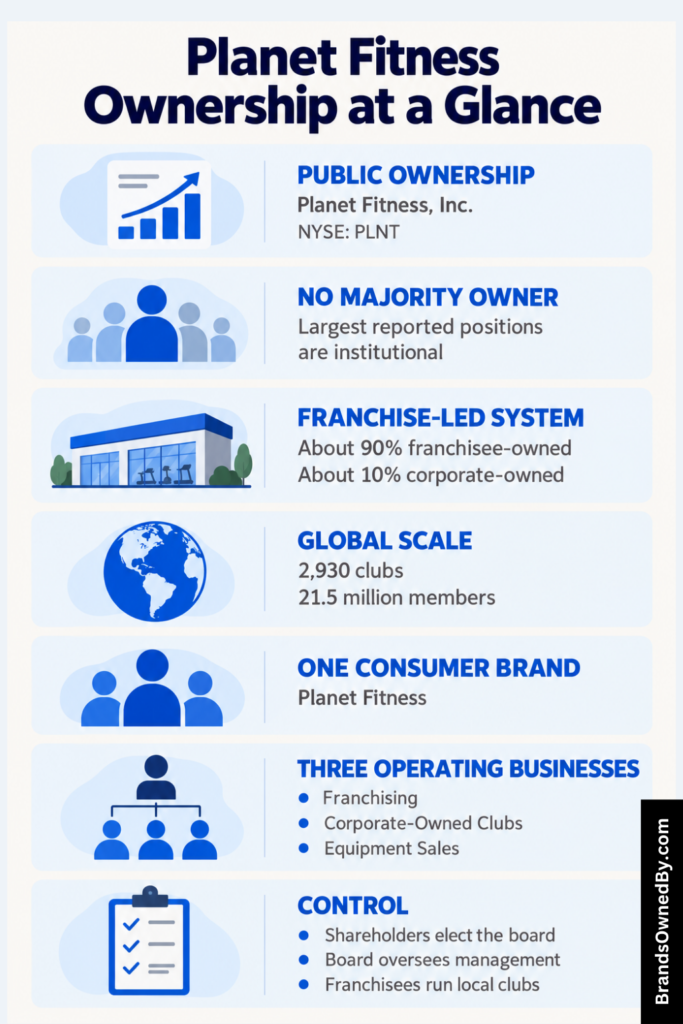
- Planet Fitness, Inc. is a public company. Its shareholders collectively own the corporation, while no single shareholder has majority control.
- T. Rowe Price Group and BlackRock reported the largest institutional positions as of June 30, 2026, with stakes of 11.22% and 11.10%, respectively.
- Independent franchisees own and operate about 90% of Planet Fitness clubs. The corporation owns the remaining locations and controls brand standards across the system.
- Planet Fitness owns one principal consumer brand. Its business is organized around franchising, corporate-owned clubs and equipment sales.
Planet Fitness is owned by the shareholders of Planet Fitness, Inc., a publicly traded company listed on the New York Stock Exchange under PLNT. No founder, private equity firm or parent corporation owns a controlling stake.
However, owning Planet Fitness stock is different from owning a Planet Fitness gym. Independent franchisees operate about 90% of its locations, while the public company owns the brand and controls the franchise system.
Planet Fitness Overview
Planet Fitness is a high-value, low-price fitness company. It combines a national membership brand with an extensively franchised club network.
As of June 30, 2026, the system had 2,930 clubs. The latest disclosed membership count was approximately 21.5 million at March 31, 2026. Its markets included all 50 U.S. states, Washington, D.C., Puerto Rico, Canada, Mexico, Panama, Australia and Spain.
Who Founded Planet Fitness?
Brothers Michael and Marc Grondahl started the business in Dover, New Hampshire, in 1992. They acquired a struggling gym and experimented with different operating formats before focusing on consumers who felt uncomfortable in traditional bodybuilding-oriented gyms.
Chris Rondeau joined the business in 1993. He began working at the front desk and later helped develop its operating model. He eventually became chief executive and led much of the brand’s national franchise expansion.
Rick Berks also has an important place in the brand’s history. He operated gyms under the Planet Fitness name in Florida. The Grondahls later acquired the rights to that name and incorporated it into their expanding concept.
This distinction matters. Michael and Marc Grondahl founded the New Hampshire operating business that became the modern company. Berks was connected to the origin of the Planet Fitness name.
How the Business Model Developed
The founders concluded that experienced bodybuilders represented only a limited part of the potential fitness market. A larger opportunity existed among first-time gym users, occasional exercisers and customers primarily interested in cardio equipment.
Planet Fitness therefore reduced membership prices, removed several features associated with full-service athletic clubs and emphasized a less intimidating environment. The company introduced its well-known low-price membership model in the late 1990s.
The format also suited franchising. A club could use a standardized floor plan, centralized membership billing, nationally coordinated marketing and a defined equipment package. Franchisees supplied local capital and market knowledge. The parent company supplied the brand, operating system and purchasing structure.
Planet Fitness Today
Planet Fitness operates through three reportable segments:
- Franchising.
- Corporate-owned clubs.
- Equipment sales.
The model creates several ways to earn money from the same club network. A franchise location can generate royalties and advertising contributions for Planet Fitness. It can also produce equipment revenue when it opens or replaces its machines.
A corporate-owned club generates membership dues directly. This makes company-owned locations more capital-intensive, but it also lets Planet Fitness capture the club-level economics rather than only receiving a royalty.
Planet Fitness Ownership History
Planet Fitness moved through three significant ownership stages. It began as a founder-controlled private business. It later accepted private equity investment. It then became a publicly traded corporation.
Founder Ownership From 1992
Michael and Marc Grondahl initially controlled the business. The early company was concentrated in New Hampshire and developed gradually through company-operated gyms.
The founders refined the format before committing to national expansion. That work included the low-price membership structure, a standardized club experience and positioning directed toward casual gym users.
Franchising became the primary expansion mechanism. Sunshine Fitness opened the first franchised Planet Fitness club in Florida in 2003. Other regional operators subsequently acquired development rights and built clusters of clubs.
TSG Consumer Partners Acquired a Majority Stake
Investment funds affiliated with TSG Consumer Partners acquired a majority interest in Planet Fitness in November 2012. This was a change in financial control rather than a sale of the concept to another gym operator.
TSG helped professionalize the organization and prepare it for faster expansion. The company invested in franchise support, management systems, marketing and the infrastructure required to serve a larger club network.
Chris Rondeau became chief executive in 2013. The transition reduced the founders’ direct operational role and placed day-to-day leadership with an executive who had worked inside the business since 1993.
The 2015 Initial Public Offering
Planet Fitness, Inc. was incorporated in Delaware on March 16, 2015, to facilitate an initial public offering and related restructuring.
The company began trading on the New York Stock Exchange on August 6, 2015. Its Class A stock was priced at $16 per share. The completed offering covered 15.525 million shares and had a value of approximately $248.4 million.
The IPO did not mean that Planet Fitness, Inc. directly replaced every underlying operating entity. It became the sole managing member of Pla-Fit Holdings and obtained control over the operating group.
That structure remains relevant because Planet Fitness, Inc. is technically a holding company. Its principal operating interest sits below it through Pla-Fit Holdings, Planet Intermediate and Planet Fitness Holdings.
TSG’s Position After the IPO
TSG remained an important shareholder after Planet Fitness entered the public market. Its influence declined as shares were sold and the public float expanded.
TSG is not the current controlling owner of Planet Fitness. It does not appear among the company’s largest reported institutional positions in the latest June 30, 2026 ownership data.
TSG later became involved with Sunshine Fitness, a major Planet Fitness franchisee. Planet Fitness acquired Sunshine’s 114 clubs in February 2022. That transaction should not be confused with TSG’s earlier investment in the parent company.
The Sunshine Fitness Acquisition
Planet Fitness agreed to acquire Sunshine Fitness Growth Holdings for $800 million in cash and stock. The transaction closed on February 10, 2022.
Sunshine operated 114 Planet Fitness clubs across Alabama, Florida, Georgia, North Carolina and South Carolina. Those locations were added to Planet Fitness’s corporate-owned portfolio.
This was not an acquisition of a competing gym brand. Sunshine was already a Planet Fitness franchisee. The transaction transferred club-level ownership from an independent operator to the public company.
The acquisition materially increased Planet Fitness’s direct exposure to membership revenue. It also demonstrated that the company can move locations between franchise ownership and corporate ownership without changing the customer-facing brand.
Who Owns Planet Fitness: Top Shareholders
As of September 2026, Planet Fitness is collectively owned by holders of its publicly traded shares and the remaining holders of units in its underlying LLC structure.
The latest institutional positions generally reflect holdings reported for June 30, 2026. These investment managers may hold shares across multiple funds and client accounts. The figures therefore identify reported investment positions, not personal ownership by the executives of those firms.
Planet Fitness has no majority shareholder. Its largest investors can influence director elections and other shareholder votes, but none can independently dictate company policy.
![Who Owns Planet Fitness [Top Shareholders]](https://brandsownedby.com/wp-content/uploads/2026/09/Who-Owns-Planet-Fitness-Top-Shareholders-1024x536.png)
T. Rowe Price Group
T. Rowe Price Group reported approximately 8.44 million Planet Fitness shares as of June 30, 2026. The position represented about 11.22% of outstanding shares, making it the largest reported institutional position.
These shares can be spread across funds and separately managed portfolios. T. Rowe Price’s position does not mean that it operates Planet Fitness clubs or manages the company.
Its influence comes through shareholder voting, engagement with directors and the economic consequences of changes in Planet Fitness’s share price.
BlackRock
BlackRock reported approximately 8.35 million shares, equal to about 11.10% of Planet Fitness.
BlackRock commonly holds public-company shares through index funds, exchange-traded funds and active investment products. Some of the Planet Fitness position may therefore reflect index ownership rather than a concentrated strategic investment.
BlackRock has substantial voting power relative to most individual shareholders. It still cannot control Planet Fitness on its own. Its reported interest remains far below the level required for majority ownership.
SRS Investment Management
SRS Investment Management reported approximately 4.92 million shares as of June 30, 2026. That equaled about 6.54% of Planet Fitness.
SRS is more concentrated than a broad index manager. A position of this size can give it meaningful economic exposure to the company’s performance.
However, the reported stake does not amount to legal control. SRS would need support from other shareholders to influence a contested director election or major corporate transaction.
Vanguard Capital Management
Vanguard Capital Management reported approximately 4.10 million shares, representing about 5.44% of Planet Fitness.
Vanguard-associated positions require careful interpretation because different investment-management entities can appear separately in institutional databases. The position reported under Vanguard Capital Management should not automatically be combined with every other Vanguard-labelled entry without checking the underlying filings.
Like BlackRock, Vanguard generally exercises influence through proxy voting and investment stewardship. It does not operate the gyms in which its funds invest.
Vanguard Portfolio Management
Vanguard Portfolio Management separately reported approximately 3.67 million shares, or 4.87% of the company.
This is an example of why ownership databases can show institutional holdings that appear to overlap. Different advisers, sub-advisers and reporting units may manage distinct portfolios under the same broader investment group.
For readers trying to identify who owns Planet Fitness, the central point is that Vanguard-related funds are substantial investors. Vanguard is not the parent company of Planet Fitness.
Dorsal Capital Management
Dorsal Capital Management reported 2.78 million shares. Its position represented approximately 3.69% of outstanding shares.
The investment is large enough to align Dorsal closely with changes in Planet Fitness’s earnings and valuation. It remains a minority position and does not provide unilateral governance authority.
AQR Capital Management
AQR Capital Management reported approximately 2.64 million shares, equal to 3.50% of Planet Fitness.
AQR applies quantitative investment strategies across a large number of public companies. Its Planet Fitness position represents financial ownership. It does not give AQR operational responsibility for clubs, pricing, or franchise relationships.
State Street Investment Management
State Street reported approximately 2.50 million shares, or 3.32% of Planet Fitness.
State Street is another major index and institutional asset manager. Its voting decisions can matter when combined with those of other large shareholders, particularly in director elections and compensation votes.
It does not independently control the board because its stake remains relatively small in absolute voting terms.
Company Executives and Directors
Planet Fitness executives and directors own shares, restricted stock units and, in some cases, interests connected to the underlying LLC structure.
Their combined economic ownership is small relative to the large institutional positions. CEO Colleen Keating is therefore responsible for managing the company, but she is not its owner in the conventional sense.
The difference is practical. Shareholders can elect directors. Directors oversee management. Management operates the company. None of these functions means that the CEO personally owns the Planet Fitness brand.
Who Owns Individual Planet Fitness Gyms?
The ownership of the public company is different from the ownership of a local club. Approximately 90% of Planet Fitness locations are independently owned and operated franchises.
What a Franchisee Owns
A franchisee owns or controls the local operating company. It normally signs the property lease, hires employees, pays utilities and manages daily club operations.
The franchisee does not own the Planet Fitness name. It receives contractual permission to use the brand, operating system and approved intellectual property.
If the franchise agreement ends, the operator can lose the right to trade as Planet Fitness. The local company may still own certain equipment or leasehold assets, but it cannot continue presenting itself as part of the brand.
What Planet Fitness Corporate Controls
Planet Fitness controls the brand standards, membership architecture, approved equipment, national marketing, technology platforms and franchise requirements.
The company can require franchisees to remodel clubs, replace equipment and follow operating standards. It also manages important parts of the billing and royalty-collection system.
For example, a local franchisee may employ the staff handling a membership dispute. Corporate systems and the franchise agreement still shape how the membership is sold, billed and serviced.
Major Planet Fitness Franchise Operators
Planet Fitness’s franchise network includes large, professionally financed multi-unit groups rather than thousands of single-club owners.
IGNITE Fitness Holdings operates more than 140 Planet Fitness clubs across the United States and Canada. Its markets include Connecticut, New York, Tennessee, Georgia, New Mexico, Arizona, British Columbia, Alberta and Saskatchewan.
Flynn Group entered the Planet Fitness system in 2023. It subsequently expanded its gym portfolio through further acquisitions. Flynn is also a major operator of restaurant franchises, including Applebee’s, Arby’s, Panera Bread, Taco Bell, Pizza Hut and Wendy’s.
Franchise Equity Partners acquired Bravo Fit, the Australian Planet Fitness franchisee, in 2026. Planet Fitness exited its former minority investment in Bravo Fit as part of that transaction.
The identity of the largest franchisee can change when groups buy or sell club portfolios. Claims about the single largest operator should therefore include a specific date.
How to Identify the Owner of a Particular Club
Check the membership agreement, billing descriptor, employment notice and legal information displayed at the club. These often identify the local operating company.
State corporate registries and local business licences can provide further confirmation. Searching only for the gym’s trading name may not reveal the owner because the franchisee often uses a separate LLC.
Competitor Ownership Comparison
Planet Fitness competes with public gym companies, privately held operators and private equity-backed franchise systems. These structures affect access to capital, disclosure requirements and expansion strategies.
Anytime Fitness
Anytime Fitness is owned through Purpose Brands, a privately held wellness franchising group. Purpose Brands was formed after Self Esteem Brands and Orangetheory Fitness completed their merger in 2024.
Roark Capital has been an investor in the businesses behind the combined group. Purpose Brands operates more than 7,000 locations across its portfolio, which includes Anytime Fitness, Orangetheory Fitness, Waxing the City and The Bar Method.
This makes its structure different from Planet Fitness. Planet Fitness is a listed single-brand-focused company. Anytime Fitness sits inside a private multi-brand franchising platform.
Orangetheory Fitness
Orangetheory is also part of Purpose Brands. The 2024 combination brought it under the same parent platform as Anytime Fitness.
Orangetheory occupies a different market segment. Its coach-led interval workouts and class-based model command higher prices and require scheduled participation. Planet Fitness concentrates on affordable, self-directed gym access.
The ownership comparison is still useful. Both rely heavily on franchisees, but Planet Fitness shareholders can buy its parent company directly through the NYSE. Purpose Brands does not have publicly traded stock.
Crunch Fitness
Leonard Green & Partners agreed to acquire a majority interest in Crunch Fitness from TPG Growth and minority shareholders in 2025.
Crunch remains a privately held company. Its management and existing investors continued to participate alongside Leonard Green following the transaction.
Crunch uses a mixture of franchised and corporate gyms. Its ownership is more concentrated than Planet Fitness because a private equity sponsor holds the majority interest. Planet Fitness, in contrast, has widely distributed institutional ownership and no controlling shareholder.
LA Fitness
LA Fitness is owned by the privately held Fitness International, LLC. The group also operates Esporta Fitness, City Sports Club and Club Studio.
Unlike Planet Fitness, LA Fitness does not publish the same level of financial, ownership and voting data required from an NYSE-listed company. It also operates a broader consumer-brand portfolio.
LA Fitness clubs tend to offer a wider amenity set, including pools, basketball courts and group classes at many locations. That operating format requires larger facilities and a different capital structure from the standardized Planet Fitness model.
Life Time
Life Time Group Holdings is publicly traded on the New York Stock Exchange under LTH. Its shareholders collectively own the company.
Life Time follows a premium, capital-intensive strategy. Its large athletic country clubs can include pools, cafés, spas, childcare, pickleball courts and coworking facilities.
Planet Fitness pursues almost the opposite economic model. It relies heavily on franchise capital and standardized, lower-priced clubs. Life Time retains greater direct ownership of its facilities and collects substantially more revenue per membership.
Who Controls Planet Fitness?
Control is divided among shareholders, the board, senior management and franchise owners. Each group controls a different part of the system.
Shareholder Voting Control
No shareholder holds more than 50% of Planet Fitness. There is therefore no majority owner capable of controlling shareholder votes alone.
The large institutional investors have influence because of their voting positions. T. Rowe Price, BlackRock, SRS and Vanguard-associated managers can collectively affect director elections and governance proposals.
However, their interests are not automatically coordinated. Each manager votes according to its own policies, investment mandates and fiduciary responsibilities.
The Board of Directors
The board has ultimate responsibility for corporate oversight. It appoints the chief executive, approves major capital decisions and monitors strategy, risk and executive performance.
Stephen Spinelli Jr. serves as board chair. His governance position gives him influence over the board’s work, but it does not make him the majority owner of Planet Fitness.
The board can approve acquisitions, debt transactions, share-repurchase programs and changes in senior leadership. It does not manage individual clubs every day.
CEO Colleen Keating
Colleen Keating has served as chief executive since June 2024. She controls day-to-day corporate execution under authority delegated by the board.
Her responsibilities include corporate strategy, pricing tests, member growth, marketing, international expansion and the relationship between Planet Fitness and its franchisees.
For example, management can test a different Black Card price or adjust the equipment package required for new clubs. It cannot simply ignore the franchise agreements, debt covenants or board-approved capital plan.
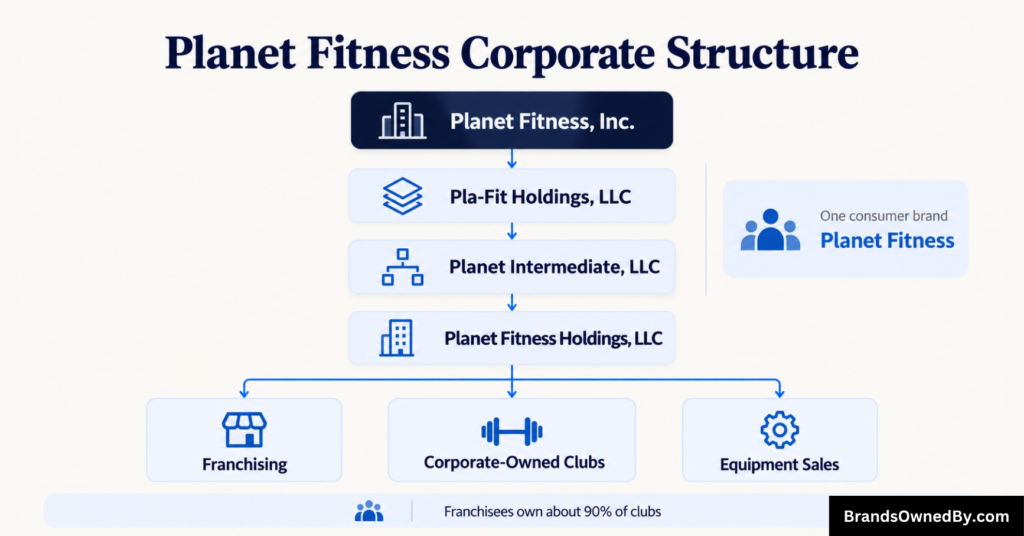
Planet Fitness, Inc. and Pla-Fit Holdings
Planet Fitness, Inc. is the sole managing member of Pla-Fit Holdings. It controls 100% of the voting interest in that entity.
Pla-Fit Holdings owns Planet Intermediate, LLC. Planet Intermediate owns Planet Fitness Holdings, LLC, which conducts the underlying franchising and club operations through its subsidiaries.
This structure means public shareholders own the listed holding company, while the listed company exercises operating control through the LLC chain below it.
Franchisee Control at the Club Level
Independent franchisees own about 90% of Planet Fitness locations. They typically control the local legal entity, lease, staffing, payroll and daily club operations.
Corporate control remains extensive. Franchisees must follow the operating manual, approved branding, membership systems, equipment standards and marketing requirements. They also pay royalties and contribute to advertising programs.
Consider a customer disputing a charge at a franchised location. The local franchisee may be the legal operator responsible for the membership relationship. Planet Fitness corporate still controls the systems and brand standards that shape that interaction.
Corporate ownership and club ownership are therefore connected but not identical.
Planet Fitness Annual Revenue and Net Worth
Planet Fitness has expanded revenue through new club openings, membership growth, franchise royalties and equipment sales. However, its market value has not moved in a straight line with revenue.
Revenue measures what the company earns from its operations. Net worth, in this section, refers to Planet Fitness’s stock-market value. It is calculated by multiplying the share price by outstanding shares. It should not be confused with book equity or enterprise value.
Planet Fitness Revenue Growth From 2020 to 2025
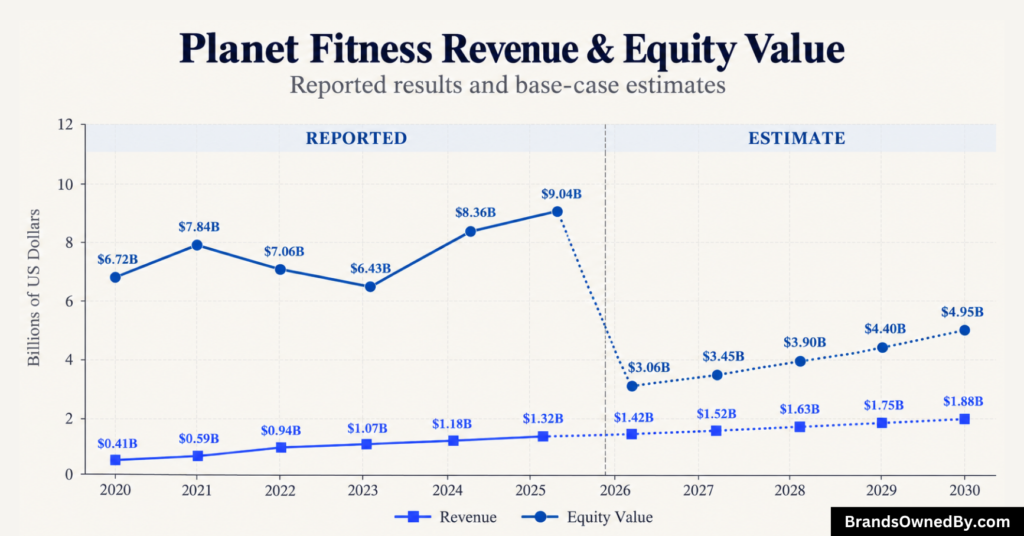
Planet Fitness generated $406.6 million in revenue in 2020. Temporary club closures and membership disruptions caused a sharp decline from pre-pandemic levels.
Revenue recovered to $587.0 million in 2021 as clubs reopened and membership activity improved. The recovery accelerated in 2022. Revenue reached $936.8 million following stronger club performance, equipment sales and the Sunshine Fitness acquisition.
The Sunshine acquisition had a significant effect on reported revenue. Planet Fitness acquired 114 franchised locations for $800 million in February 2022. Before the transaction, the company primarily received royalties and equipment-related revenue from those clubs. After the acquisition, it began consolidating their membership dues and operating expenses.
Revenue exceeded $1 billion for the first time in 2023. Planet Fitness reported $1.07 billion, followed by $1.18 billion in 2024.
Revenue increased another 12.1% to $1.324 billion in 2025. This represented an increase of $142.5 million from the previous year. Planet Fitness also reported $5.3 billion in system-wide sales, compared with $4.8 billion in 2024.
The difference between company revenue and system-wide sales is important. System-wide sales include membership dues and annual fees collected by both company-owned and franchised clubs. Most of the money collected by franchised locations belongs to the franchisees. Planet Fitness records its royalties, advertising contributions and other contractual fees rather than the franchisees’ entire sales.
Planet Fitness Revenue in 2026
Planet Fitness generated $337.2 million in revenue during the first quarter of 2026. Revenue increased to $365.2 million in the second quarter, up 7.1% from $340.9 million one year earlier.
This brought first-half revenue to approximately $702.4 million. The second-quarter result also showed how the company earns money from different parts of its system.
Franchise segment revenue increased 13.5% to $135.8 million. The largest driver was a higher contribution rate to the National Advertising Fund. Royalty revenue also benefited from new clubs and a 1.7% increase in franchise same-club sales.
Corporate-owned club revenue reached $143.9 million. New locations added approximately $5.0 million. Clubs included in the comparable base produced another $4.8 million of growth. This was partly offset by the sale of eight California clubs to a franchisee in August 2025.
Equipment revenue increased 4.1% to $85.6 million. Planet Fitness supplied equipment to 21 new franchise locations during the quarter, compared with 19 one year earlier. Sales to existing clubs also increased as operators replaced older equipment.
Management maintained its expectation for full-year revenue growth of approximately 7%. Applying that rate to 2025 revenue produces an estimated 2026 result of about $1.42 billion.
The estimate is supported by first-half performance, planned club openings and recurring royalties. However, it is below the company’s earlier 9% growth target. Planet Fitness reduced that outlook after member growth during the important first-quarter enrollment period was weaker than expected.
How Planet Fitness Makes Its Money
Planet Fitness generated revenue from three reportable segments in 2025. Each segment has a different economic profile.
Corporate-owned clubs were the largest revenue source. They generated $546.1 million, representing 41.2% of total revenue. This segment includes monthly membership dues, annual fees, enrollment charges and retail sales.
Approximately 92% of members at company-owned clubs paid their monthly dues electronically at the end of 2025. Automated billing makes the revenue stream relatively predictable. However, corporate clubs also carry direct expenses such as rent, payroll, utilities, maintenance and local marketing.
The franchise segment generated $468.0 million, or 35.4% of total revenue. This included royalties, franchise fees, transfer fees, development-agreement payments and contributions to national advertising funds.
Franchise revenue is strategically valuable because independent operators supply most of the capital required to open and run clubs. Planet Fitness receives fees without carrying every location’s lease, staff and operating costs.
Equipment sales contributed $310.1 million, equal to 23.4% of total revenue. Equipment revenue increased 21.1% from 2024. Most of that growth came from replacement purchases by existing franchisees.
Planet Fitness generally requires franchise clubs to replace equipment every five to nine years. This creates a recurring revenue cycle. Even if new club development slows temporarily, older clubs still need approved replacement machines.
The three segments also have different profit characteristics. In 2025, the franchise segment produced $336.6 million in segment adjusted EBITDA. Corporate-owned clubs produced $206.3 million, while equipment generated $94.5 million.
The franchise segment therefore contributed less revenue than corporate clubs but substantially more segment adjusted EBITDA. This illustrates the financial advantage of the franchise model.
Planet Fitness Net Worth in September 2026
Planet Fitness had an estimated market capitalization of approximately $3.06 billion on September 24, 2026. Its enterprise value was approximately $5.60 billion.
Market capitalization represents the value investors assign to the company’s equity. Enterprise value also considers debt, cash and other financial claims. The large difference between the two measures reflects Planet Fitness’s leveraged capital structure.
The company’s securitized subsidiaries had approximately $2.5 billion of outstanding debt at the end of 2025. That debt supports acquisitions, capital investment and share repurchases, but it also increases interest expense and financial risk.
Planet Fitness had a market value of approximately $6.72 billion at the end of 2020. Its valuation increased to $7.84 billion in 2021, despite revenue still being below pre-pandemic levels. Investors were pricing in a reopening-led recovery.
Market capitalization declined to $7.06 billion in 2022 and $6.43 billion in 2023. It then recovered to $8.36 billion at the end of 2024 and reached approximately $9.04 billion at the end of 2025.
The decline to approximately $3.06 billion in September 2026 was therefore not caused by falling revenue. Revenue continued to grow. The decline reflected a sharp reduction in the valuation multiple investors were willing to pay.
Why Planet Fitness’s Market Value Fell in 2026
The major change came after the company reduced its 2026 outlook in May.
Planet Fitness lowered its expected revenue growth from approximately 9% to 7%. Management also withdrew its previous three-year growth algorithm. This created uncertainty about the company’s medium-term membership, earnings and same-club sales trajectory.
The company reported slower-than-expected net membership growth during the peak enrollment season. It also paused a planned national increase in the PF Black Card price while conducting a broader pricing review.
Investors had previously valued Planet Fitness as a predictable growth company. Its 2025 market capitalization of $9.04 billion was nearly 6.8 times annual revenue. That was a demanding valuation for a company with significant debt and slowing member growth.
At a $3.06 billion market capitalization and estimated 2026 revenue of $1.42 billion, the price-to-sales multiple falls to approximately 2.2. The lower multiple reflects weaker expectations rather than a collapse in current revenue.
This provides a practical example of why revenue and net worth can move in opposite directions. A company can increase sales while its share price declines if investors expect slower future growth, lower margins or greater execution risk.
Revenue Forecast From 2027 to 2030
Our base-case forecast assumes Planet Fitness revenue reaches approximately $1.52 billion in 2027. It then increases to $1.63 billion in 2028, $1.75 billion in 2029 and $1.88 billion in 2030.
This represents annual growth of roughly 7% to 8%. The forecast is more conservative than the 12.1% growth recorded in 2025.
Club development remains the most visible revenue driver. Planet Fitness expected approximately 180 to 190 system-wide openings in 2026. Most new locations are likely to be franchisee-owned. Each opening can produce franchise fees, recurring royalties, advertising contributions and an initial equipment sale.
Existing clubs provide a second growth engine. Higher average membership prices can increase royalties and corporate-club revenue without requiring a similar increase in location count.
The standard Classic membership price for new U.S. members increased from $10 to $15 in 2024. Planet Fitness also has room to refine its PF Black Card pricing after completing its 2026 review. Price increases must be balanced against member retention and the company’s value-focused positioning.
Equipment replacement should remain an important contributor. The required five-to-nine-year replacement cycle creates demand from the existing club base. With 2,930 clubs in operation at June 30, 2026, even a stable replacement rate can support substantial annual equipment sales.
International expansion provides another opportunity, although its near-term contribution remains limited. The United States generated approximately $1.285 billion of Planet Fitness’s $1.324 billion in 2025 revenue. All international markets combined contributed only $39.5 million.
This shows that the company is still heavily dependent on the U.S. market. International growth could become more meaningful, but it should not be treated as the primary driver of the 2027 to 2030 forecast.
Planet Fitness Net Worth Forecast From 2027 to 2030
Our base-case estimate places Planet Fitness’s market value at approximately $3.45 billion in 2027. It could increase to $3.90 billion in 2028, $4.40 billion in 2029 and $4.95 billion in 2030.
These estimates assume the company gradually rebuilds investor confidence. They do not assume an immediate return to the $9.04 billion valuation recorded at the end of 2025.
The projected 2030 market value of $4.95 billion would equal approximately 2.6 times forecast revenue of $1.88 billion. That is moderately higher than the company’s September 2026 multiple, but far below its 2025 valuation.
A higher valuation would require improved net member growth, stable same-club sales, successful pricing changes and continued franchise development. Planet Fitness would also need to demonstrate that new clubs can expand without materially weakening sales at existing locations.
Debt reduction could support the equity valuation as well. Lower leverage would reduce interest expense and allow more operating cash flow to reach shareholders.
The downside scenario remains significant. If membership growth stays weak, franchisees delay openings or pricing changes increase cancellations, the market may continue applying a low valuation multiple. Higher equipment costs and rising franchisee financing expenses could also slow system expansion.
The forecasts should therefore be treated as structured estimates. Revenue growth is easier to model because it is connected to club openings, royalties and membership pricing. Market capitalization is less predictable because it also depends on interest rates, investor sentiment, debt and the valuation multiple assigned to future earnings.
Brands Owned by Planet Fitness
Planet Fitness does not own a collection of unrelated gym chains. It is a focused company built around one consumer-facing fitness brand.
The entities below perform different legal and operating functions. They should not be mistaken for separate consumer gym brands.
Planet Fitness
Planet Fitness is the group’s principal consumer brand. The name is licensed to franchisees and used by corporate-owned clubs.
The brand covers the membership proposition, club format, marketing system, mobile app and operating standards. It also supports the Classic and PF Black Card membership tiers.
Planet Fitness controls the intellectual property and decides which operators can use it. A franchisee may own the physical club business, but it does not own the national Planet Fitness brand.
Pla-Fit Holdings, LLC
Pla-Fit Holdings is the key entity immediately below the public company.
Planet Fitness, Inc. is its sole managing member and controls 100% of its voting interest. At the end of 2025, the public company also held approximately 99.6% of its economic interest. Continuing LLC owners held the remaining 0.4%.
Pla-Fit Holdings does not operate as a separate gym brand. Its purpose is to hold the underlying operating group and facilitate the company’s post-IPO ownership structure.
Planet Intermediate, LLC
Pla-Fit Holdings owns 100% of Planet Intermediate.
Planet Intermediate has no material standalone operations. It acts as an intermediate holding entity between Pla-Fit Holdings and Planet Fitness Holdings.
Including this entity is important when explaining the legal ownership chain. It is not a brand that customers encounter.
Planet Fitness Holdings, LLC
Planet Intermediate owns 100% of Planet Fitness Holdings.
Planet Fitness Holdings sits closer to the operating businesses. Through subsidiaries, the group conducts franchising, corporate club operations and equipment activities.
It also plays a central role in the company’s securitized financing structure. Royalties, membership collections and other eligible cash flows support debt issued through specialized subsidiaries.
The Corporate-Owned Club Portfolio
Planet Fitness directly owned 292 clubs at the end of 2025. The company opened or acquired 23 corporate locations during the year and sold eight California clubs to a franchisee for $21.6 million.
The system continued expanding in 2026. Of the 23 clubs opened during the second quarter, 21 were franchisee-owned and two were corporate-owned.
Corporate ownership gives Planet Fitness direct membership revenue and greater control over the customer experience. It also requires the company to fund leases, equipment, staffing and club-level capital expenditure.
The Former Sunshine Fitness Clubs
The 114 clubs acquired from Sunshine Fitness in 2022 became part of the corporate-owned portfolio.
Planet Fitness did not continue Sunshine as a separate public-facing fitness brand. Customers continued to see Planet Fitness clubs before and after the transaction.
The acquisition changed who received the club-level cash flow. Before the deal, Sunshine paid royalties as a franchisee. After the acquisition, the public company consolidated the locations’ membership revenue and operating expenses.
Planet Fitness Equipment Operations
Planet Fitness sells approved fitness equipment to franchisee-owned clubs in the United States, Canada and Mexico.
Equipment is a meaningful operation rather than a minor procurement service. It generated $310.1 million in 2025, or 23.4% of total company revenue.
Franchisees generally buy an approved equipment package when opening a location. They must also replace equipment according to the required cycle. This creates a second source of company revenue beyond royalties.
Final Thoughts
Planet Fitness is owned by public shareholders, not by one founder, franchisee or private equity firm. T. Rowe Price and BlackRock held the two largest reported institutional positions as of June 30, 2026. Neither had enough shares to control the company independently.
Planet Fitness, Inc. controls the brand, strategy and operating system. Its board oversees management, while CEO Colleen Keating leads corporate execution.
Individual gyms have a different ownership structure. About 90% are owned by independent franchisees. The remaining clubs are operated by the corporate group.
That distinction provides the most accurate answer to who owns Planet Fitness: shareholders own the public company, Planet Fitness controls the brand, and franchisees own most local clubs.
FAQs
Is Planet Fitness privately owned?
No. Planet Fitness, Inc. has been publicly traded on the New York Stock Exchange under PLNT since August 6, 2015. Institutional investors, funds, insiders and other shareholders can own its Class A stock.
A particular gym may still be privately owned. Approximately 90% of Planet Fitness clubs are operated by independent franchise businesses.
Is Planet Fitness owned by BlackRock?
BlackRock is a major Planet Fitness shareholder, but it does not own the company outright. BlackRock reported approximately 8.35 million shares as of June 30, 2026, representing about 11.10% of Planet Fitness.
That stake provides voting influence, not majority control. BlackRock also manages investments on behalf of funds and clients rather than operating Planet Fitness clubs itself.
Is Planet Fitness owned by T. Rowe Price?
T. Rowe Price Group reported the largest institutional position as of June 30, 2026. It held approximately 8.44 million shares, or 11.22%.
Planet Fitness remains a widely held public company. An 11.22% stake does not allow T. Rowe Price to control the business without support from other shareholders.
Does the Planet Fitness CEO own the company?
No. Colleen Keating is Planet Fitness’s chief executive. She manages the company under the board’s supervision but does not own a controlling stake.
Her authority comes from her executive position. Shareholders retain the economic ownership and voting rights attached to their shares.
Are all Planet Fitness gyms owned by the same company?
No. Independent franchisees own approximately 90% of Planet Fitness clubs. Planet Fitness corporate owns the remaining locations.
Two gyms using the same membership system and signage may have different legal owners. This can affect local staffing, leases, employment matters and the handling of certain customer complaints.
How can I find the owner of a specific Planet Fitness location?
Start by checking the membership agreement, billing descriptor, club website and legal disclosures displayed at the location. These may show the franchisee’s operating-company name.
State corporate registries and local business licences can provide further information. Asking who operates the club is more precise than asking for its manager, because the manager may only be an employee of the franchise owner.
Who owns the Planet Fitness brand?
The Planet Fitness corporate group owns and controls the brand and related intellectual property. Franchisees receive contractual rights to use the name, systems and marks in approved territories.
A franchisee owns its local operating business. It does not acquire permanent ownership of the national brand.
What percentage of Planet Fitness locations are franchises?
Approximately 90% of Planet Fitness clubs are independently owned and operated. At the end of 2025, franchisees operated 2,604 of the company’s 2,896 clubs.
The proportion can move slightly as new gyms open, the company acquires franchise locations or corporate clubs are sold to franchisees.
Does Planet Fitness own other gym brands?
Planet Fitness does not operate a major portfolio of separate consumer gym brands. Its customer-facing business remains concentrated on Planet Fitness.
Its subsidiaries perform holding, franchising, club-operation, financing and equipment functions. They are not separate national gym chains comparable to Crunch, Anytime Fitness or LA Fitness.
Who owns the most Planet Fitness stock?
Based on institutional positions reported for June 30, 2026, T. Rowe Price Group held the largest reported position at approximately 8.44 million shares, or 11.22%.
BlackRock followed with approximately 8.35 million shares, representing 11.10%. Holdings can change each quarter as investment managers buy or sell stock.
Can a Planet Fitness franchisee set its own membership prices?
Franchisees operate their local businesses, but their discretion is limited by franchise agreements and corporate programs. Planet Fitness coordinates membership products, promotional structures, billing systems and brand-wide pricing initiatives.
Actual charges may still vary because of taxes, local promotions, legacy memberships, annual fees and market-specific tests.
Is Planet Fitness a parent company?
Planet Fitness, Inc. is the publicly traded holding company at the top of the group. Its principal asset is its controlling interest in Pla-Fit Holdings.
Pla-Fit Holdings owns Planet Intermediate, which owns Planet Fitness Holdings. The operating businesses sit within this consolidated corporate structure.