

TriStar Pictures is a major American film studio with a rich history in Hollywood. If you have ever wondered who owns TriStar Pictures, the answer connects to one of the largest entertainment companies in the world. From its beginnings as a collaboration between major corporations to its current position as part of Sony Pictures, the studio has a fascinating story.
TriStar Pictures Company Profile
TriStar Pictures is a film studio and production company. It is part of the Sony Pictures Motion Picture Group, under Sony Group Corporation. The studio is known for both mid-budget films and genre-driven acquisitions.
Company Details
TriStar Pictures was originally founded on March 2, 1982, under the name Nova Pictures. The studio was renamed Tri-Star later that year before officially adopting the name TriStar Pictures. Its headquarters are in Culver City, California, where it operates alongside Sony Pictures Entertainment.
The company was established as a unique joint venture between Columbia Pictures, CBS, and HBO. This collaboration allowed the three media giants to share the rising costs of film production and distribution during the early 1980s. TriStar became one of the first studios created by combining resources from both broadcast television and cable networks, along with a major film studio.
Founders
The concept for TriStar was created by Victor Kaufman, a senior Columbia Pictures executive. He brought together Columbia Pictures (then a Coca-Cola subsidiary), CBS, and HBO to share resources and reduce film production costs. The studio’s original name was Nova Pictures, renamed Tri-Star in May 1983 to avoid confusion with the PBS program Nova.
Major Milestones
- 1982: Established as Nova Pictures on March 2.
- 1983: Renamed Tri-Star Pictures.
- 1984: Released its first produced film, The Natural starring Robert Redford.
- Mid-1980s: Scored box-office successes with titles like Rambo: First Blood Part II and Look Who’s Talking.
- 1985–1986: CBS then HBO exited the venture; Columbia Pictures took over the stakes.
- 1987: Merged into Columbia Pictures Entertainment under Coca-Cola’s merger with Columbia.
- 1989: Sony acquired Columbia Pictures Entertainment for $3.4 billion; TriStar became part of Sony.
- 1991: Officially dropped the hyphen and became “TriStar Pictures”.
- 1998: After the Godzilla flop, merged with Columbia to form Columbia TriStar Motion Picture Group.
- 2004: Relaunched as a genre and acquisitions label.
- 2015: Sony established TriStar Productions, a joint venture with Tom Rothman for film and TV production.
- 2024: TriStar TV division was closed, its projects absorbed by Sony Pictures Television’s drama group.
- 2025: TriStar released Eleanor the Great; this marks its latest known theatrical project
Who Owns TriStar Pictures?
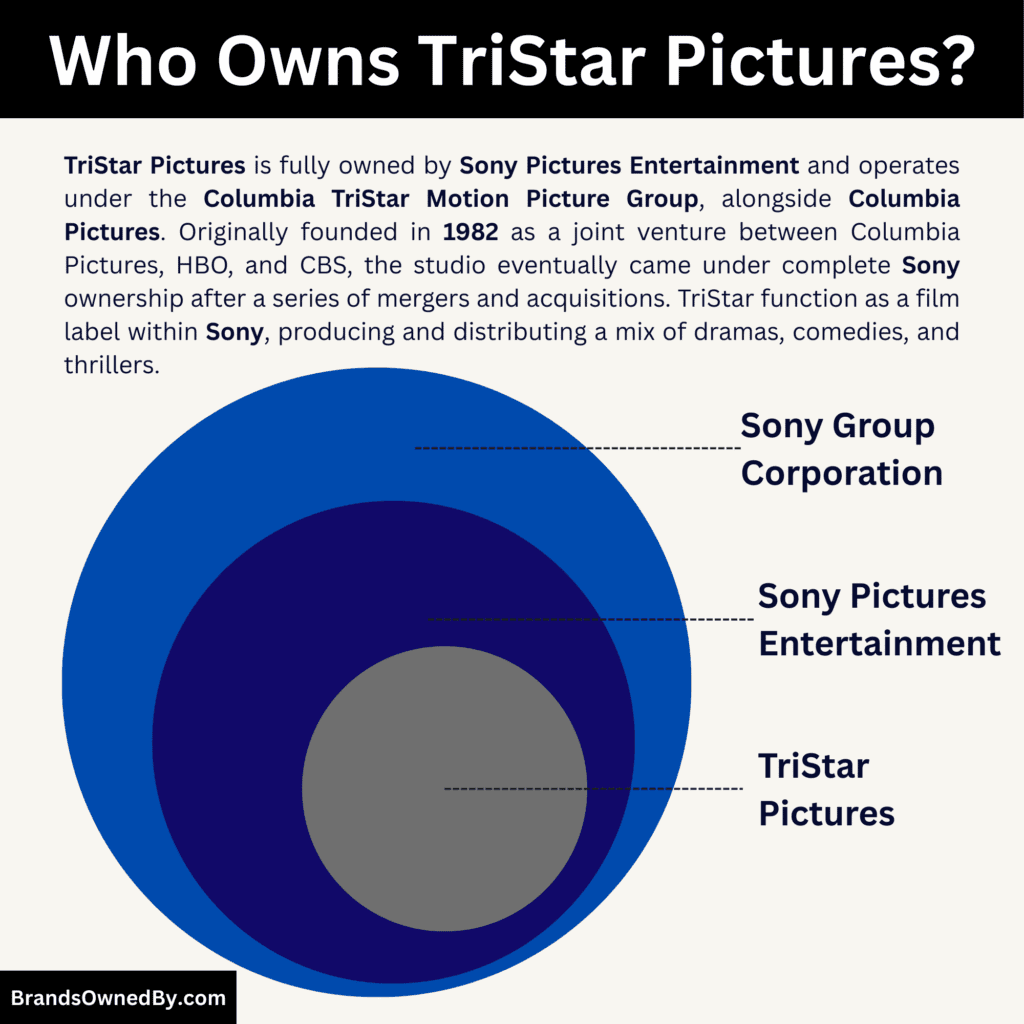
TriStar Pictures is fully owned by Sony Pictures Entertainment. It no longer operates as an independent company. Instead, it functions as a film production and distribution label under Sony’s motion picture division. Ownership and control rest with Sony, which oversees all creative, financial, and operational decisions for TriStar.
As a label, TriStar does not have its own stockholders or independent shares. Its financial results are absorbed into Sony Pictures Entertainment’s performance, which in turn is part of the publicly traded Sony Group Corporation.
- In 1991, Tri-Star Pictures dropped the hyphen in its name and became officially known as TriStar Pictures.
- By 1998, after mixed box-office results, TriStar was merged into Columbia TriStar Motion Picture Group, but the label continued to be used for select releases.
- In 2013, Sony revived TriStar as a label for specific projects, including films overseen by Tom Rothman, who later became Chairman and CEO of Sony Pictures Motion Picture Group.
- In 2015, TriStar Productions was launched as a joint venture with Rothman, focusing on both film and television, strengthening the brand within Sony.
- In 2024, Sony shut down TriStar Television, folding it into the larger Sony Pictures Television drama unit, but kept TriStar Pictures active as a film label.
Today, in 2025, TriStar Pictures remains a vital part of Sony Pictures’ strategy. It is positioned for mid-budget films, prestige dramas, and specialty projects, complementing Columbia Pictures’ blockbuster focus and Sony Pictures Classics’ art-house niche.
Parent Company: Sony Group Corporation
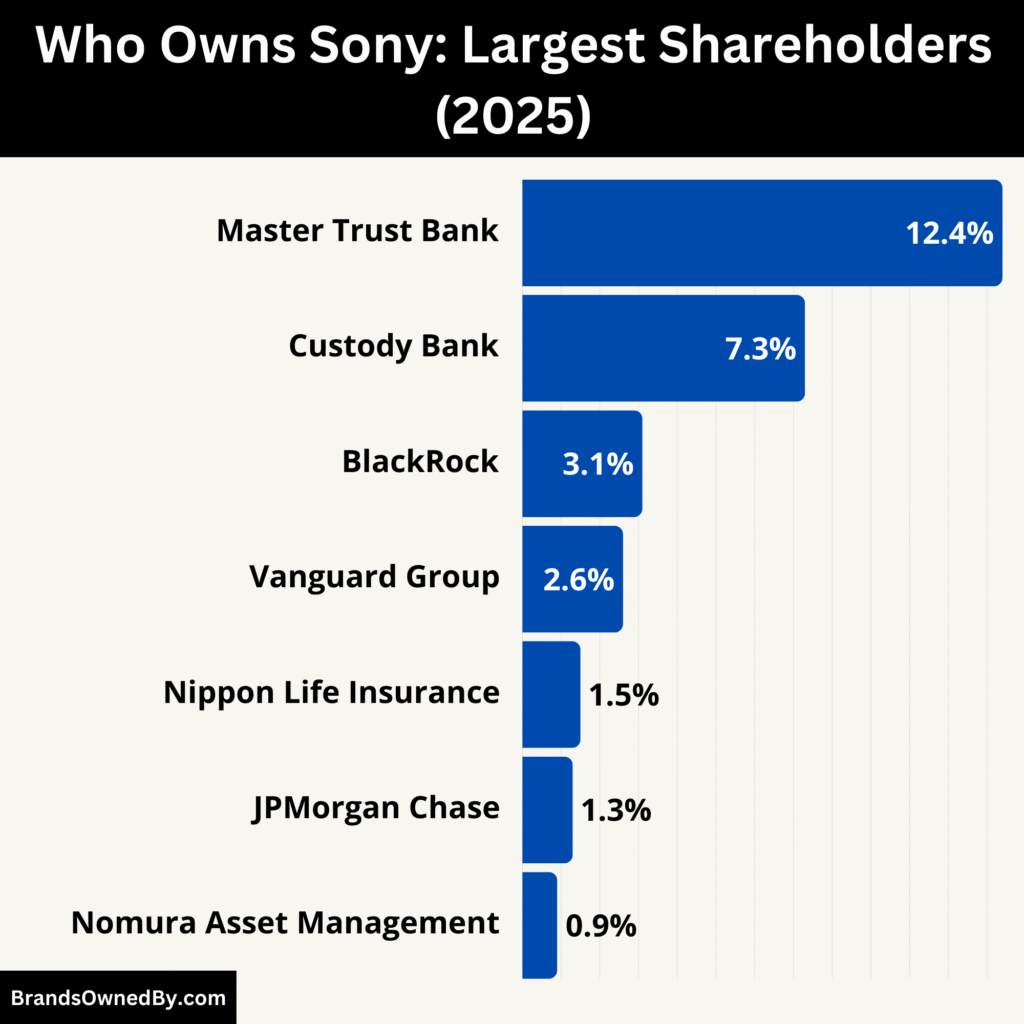
The ultimate parent of TriStar Pictures is Sony Group Corporation, headquartered in Tokyo, Japan. Sony is a multinational conglomerate operating in technology, electronics, gaming, music, and entertainment.
TriStar falls under Sony Pictures Entertainment, based in Culver City, California. Sony Pictures Entertainment manages film studios like Columbia Pictures, Screen Gems, Sony Pictures Classics, and TriStar Pictures. This structure gives TriStar the backing of one of the most diversified global companies, ensuring access to large budgets, international distribution, and cross-media opportunities.
Acquisition Insights and Details
TriStar Pictures was created in 1982 as a joint venture among Columbia Pictures, CBS, and HBO. The original purpose was to share the high costs of making movies. Within a few years, CBS and HBO sold their stakes, leaving Columbia Pictures as the sole owner.
In 1987, Coca-Cola, which owned Columbia at the time, merged Columbia and TriStar into Columbia Pictures Entertainment. This move consolidated operations and set the stage for a larger acquisition.
In 1989, Sony acquired Columbia Pictures Entertainment, including both Columbia and TriStar, for $3.4 billion. This was one of the most high-profile acquisitions in Hollywood history, marking Sony’s deep entry into the global film business. Since then, TriStar has remained a part of Sony, undergoing structural changes but never leaving the Sony umbrella.
Major Films Produced by TriStar Pictures
TriStar Pictures has created a lasting impact in Hollywood with a catalog of films that balance commercial appeal and critical acclaim. Since its founding in 1982, the studio has released classics across genres, from groundbreaking science fiction to powerful dramas.
Below are the most popular films produced and released by TriStar Pictures as of 2025:
The Natural (1984)
This baseball drama starring Robert Redford was TriStar’s first theatrical release. It received critical acclaim and earned several Academy Award nominations. The film set the tone for TriStar as a studio capable of blending artistry with mainstream appeal.
RoboCop (1987)
A science fiction action film directed by Paul Verhoeven, RoboCop became a cult classic. It was notable for its satirical take on corporate power and law enforcement, as well as its groundbreaking special effects. The film later spawned sequels, TV adaptations, and a lasting franchise.
The Running Man (1987)
Starring Arnold Schwarzenegger, this dystopian action film became another cult favorite. It showcased TriStar’s ability to produce commercially successful action movies during the late 1980s.
Terminator 2: Judgment Day (1991)
One of the most significant films in TriStar’s history, T2 revolutionized visual effects and became a global blockbuster. Directed by James Cameron, it earned over $500 million worldwide and won multiple Academy Awards, cementing TriStar’s place in cinematic history.
Philadelphia (1993)
This groundbreaking drama tackled the subject of HIV/AIDS and workplace discrimination. Starring Tom Hanks and Denzel Washington, the film won Hanks his first Academy Award for Best Actor. It showcased TriStar’s strength in producing socially impactful and critically acclaimed films.
Cliffhanger (1993)
An action thriller starring Sylvester Stallone, Cliffhanger was a commercial success and highlighted TriStar’s dominance in the action genre during the early 1990s. Its mountain-climbing stunts and visual effects were widely praised.
Legends of the Fall (1994)
Starring Brad Pitt and Anthony Hopkins, this epic drama became both a critical and commercial success. Its sweeping story and performances further established TriStar as a studio capable of delivering prestige films.
Stuart Little (1999)
A family-friendly animated/live-action hybrid, Stuart Little was a departure from TriStar’s traditional focus. The film became a hit with younger audiences and launched a successful sequel, showing the studio’s versatility.
A Beautiful Day in the Neighborhood (2019)
This biographical drama starred Tom Hanks as Fred Rogers and earned widespread acclaim. It was a critical success and reinforced TriStar’s role as a home for thoughtful, character-driven films.
The Woman King (2022)
A historical epic starring Viola Davis, The Woman King became one of TriStar’s most acclaimed recent projects. Praised for its storytelling, performances, and cultural significance, the film reestablished TriStar as a relevant force in modern Hollywood.
One of Them Days (2025)
Featuring Keke Palmer and SZA in her film debut, this buddy comedy follows two friends racing to come up with rent money after a wild night. Made on a modest $14 million budget, it grossed over $51 million—earning both commercial success and strong critical response. A sequel is already in early development.
Upcoming: The Breadwinner
Set to arrive in March 2026, The Breadwinner stars comedian Nate Bargatze and a cast including Mandy Moore and Kumail Nanjiani. Directed by Eric Appel, it began production in mid-2025 and promises to reflect TriStar’s continued interest in fresh voices and engaging storytelling.
Who is the CEO of TriStar Pictures?
Ravi Ahuja officially became President and Chief Executive Officer of Sony Pictures Entertainment (SPE) on January 2, 2025, succeeding Tony Vinciquerra. Vinciquerra remains involved until the end of 2025 in an advisory capacity as non-executive chairman. Ahuja reports directly to Sony Group’s top leadership.
Ahuja joined SPE in 2021, taking on the role of Chairman of Global Television Studios while also serving as President & COO. In this capacity, he led the company’s day-to-day operations across television studios, international productions, nonfiction, kids programming, game shows, and its India business.
Ravi Ahuja holds a BS in Economics and an MBA in Strategic Management from the Wharton School, University of Pennsylvania. In 2023, he was appointed to Wharton’s Undergraduate Executive Board, reflecting his continued engagement with the academic community.
Strategic Achievements and M&A Leadership
Since joining SPE, Ahuja has spearheaded several high-impact strategic moves:
- Oversaw acquisitions including Industrial Media, Bad Wolf, Pixomondo, and Alamo Drafthouse Cinema—which supported the launch of Sony Pictures Experiences.
- Managed the sale of GSN Games to Scopely.
- Under his oversight, SPE produced acclaimed television series such as The Crown, The Boys, Better Call Saul, Shark Tank, and The Last of Us.
Pre-Sony Experience
Before joining Sony, Ahuja held senior leadership roles across major entertainment companies:
- At Walt Disney Television, he served as President of Business Operations and CFO, helping to integrate Disney/ABC Television and Fox Networks following their merger.
- At Fox Networks Group, he was CFO and led finance, strategy, and business development across multiple segments. He also guided the company’s streaming initiatives including its involvement in Hulu, and led strategic investments.
- Earlier roles included CFO at Virgin Entertainment Group, and positions in management consulting and investment banking.
TriStar Pictures Annual Revenue and Net Worth
Sony Pictures Entertainment, the film and television arm of Sony Group, continues to contribute meaningfully to the corporation’s financial health. As a standalone entity, SPE’s performance reflects both its content success and the evolving media landscape.
Annual Revenue and Operating Income
In the fiscal quarter ending March 31, 2025 (Q4), SPE reported segment revenue of approximately US $2.7 billion. This includes revenues from motion pictures, television production, and media networks. Even though year-on-year revenue remained relatively flat, operating income surged by about 70 percent, reaching US $354 million—an indication of tighter cost control and smarter marketing spend even amid a quieter theatrical slate.
Q1 Highlights: Output Across Media Platforms
For Q1 of fiscal year 2025, SPE’s television production arm stood out with revenue of US $841 million, driven by strong streaming hits. Meanwhile, media network revenue slid modestly to US $674 million, despite a robust global subscriber base exceeding 675 million across 40 channels.
Quarterly Profitability Boost
In Sony Group’s Q1 report, the Pictures division reported net income of ¥18.7 billion, about $127 million. This figure represented a 65 percent increase from the same period the previous year. While overall sales dipped by 3% to ¥327 billion (approx. US $2.2 billion), the gain in profitability underscores better performance from TV production and the motion picture back catalog.
Net Worth
As of mid-2025, Sony Pictures Entertainment’s estimated net worth stands at around $10 billion. This valuation reflects its expansive content library, brand reputation, licensing capabilities, and sustained digital distribution momentum—especially via YouTube content, theatrical rights, and TV syndication.
While data specific to SPE is limited, these numbers offer a snapshot of the studio’s solid footing in 2025. Whether through profitable TV initiatives or optimized film launches, SPE remains an engine of value that underpins Sony’s broader entertainment ambitions.
Brands Owned by TriStar Pictures
TriStar Pictures functions as a film label within Sony’s motion picture group. It finances, develops, produces, and releases films under the TriStar banner. The label does not maintain a broad portfolio of standalone subsidiaries. Most corporate services—distribution, marketing operations, home entertainment, and consumer products—are provided at the studio group level.
Below are the entities and brands owned by TriStar Pictures as of 2025:
TriStar Pictures (Feature Film Label)
TriStar Pictures is the core brand and operating entity. It develops and produces theatrical features, and selectively acquires finished films for domestic release. The label’s slate skews toward character-driven stories, prestige projects, and mid-budget commercial titles.
Distribution in the U.S. runs through the studio’s releasing arm, while international rollouts are coordinated with the group’s global distribution network. Day-to-day, TriStar maintains its own creative development, physical production, and marketing teams that manage the label’s pipeline from greenlight to release.
TriStar Productions
TriStar Productions is a distinct production banner that develops and produces film and limited television projects aligned with the TriStar sensibility. It operates as a banner closely tied to TriStar’s pipeline rather than a broad, independently staffed studio.
The banner is used on select projects to signal the creative positioning that TriStar champions—filmmaker-forward titles, awards-leaning dramas, and literary or real-life adaptations. In practice, TriStar Productions leverages the same financing and distribution infrastructure used by TriStar Pictures releases.
TriStar Pictures, Inc.
TriStar operates through the TriStar Pictures, Inc. corporate entity and controls the TriStar name and Pegasus logo trademarks for motion picture use. This legal entity executes production services agreements, talent and rights deals, and other label-specific contracts.
The Pegasus branding is applied to marketing materials, on-screen logos, and awards campaigns for films released under the TriStar banner.
Library and brand usage under the TriStar imprint
TriStar curates and exploits its labeled film library for repertory screenings, catalog marketing, and limited re-issues. While home entertainment, television licensing, and streaming sales are transacted by the studio group, the TriStar brand is used in packaging, trailers, and artwork for titles originally released by TriStar.
This preserves the label identity across catalog exploitation without spinning up a separate distribution subsidiary.
Strategic partnerships and first-look arrangements
TriStar engages in project-specific arrangements with producers, authors’ estates, and filmmaker-run companies. These are not owned subsidiaries. They are time-bound development or co-financing pacts tailored to individual films.
The label uses these relationships to secure underlying rights, talent attachments, and festival-ready acquisitions that fit TriStar’s editorial lane.
Conclusion
TriStar Pictures has evolved from a joint venture among three media giants to a fully integrated label within Sony Pictures Entertainment. When people ask “who owns TriStar Pictures,” the answer today is clear: it is owned by Sony Group Corporation through its entertainment division. While TriStar does not operate independently, its role within Sony allows it to continue producing memorable films while benefiting from global resources and reach.
FAQs
Is TriStar Pictures a Sony company?
Yes, TriStar Pictures is a film production label owned by Sony Pictures Entertainment. It operates under the Columbia TriStar Motion Picture Group, which also includes Columbia Pictures and other film divisions of Sony.
Who is the owner of Tri-Star Productions?
Tri-Star Productions was originally launched in 1982 as a joint venture between Columbia Pictures, HBO, and CBS. Today, it is fully owned by Sony Pictures Entertainment after several mergers and consolidations in the 1980s and 1990s.
Does Sony own TriStar?
Yes, Sony owns TriStar Pictures through its entertainment division, Sony Pictures Entertainment. Since Sony acquired Columbia Pictures in 1989, TriStar has remained part of its studio operations.
Who owns Tri-Star films?
TriStar Films, better known today as TriStar Pictures, is owned by Sony Pictures Entertainment. The label is primarily used for select projects, mid-budget releases, and sometimes prestige films.
Is TriStar Pictures still around?
Yes, TriStar Pictures is still active as of 2025. The studio continues to release films, with recent titles including Thanksgiving (2023) and One of Them Days (2025). Its output is smaller compared to Columbia Pictures but remains significant.
Who owns TriStar Pictures and Columbia?
Both TriStar Pictures and Columbia Pictures are owned by Sony Pictures Entertainment. They operate under the Columbia TriStar Motion Picture Group, making them sister labels within Sony’s film division.