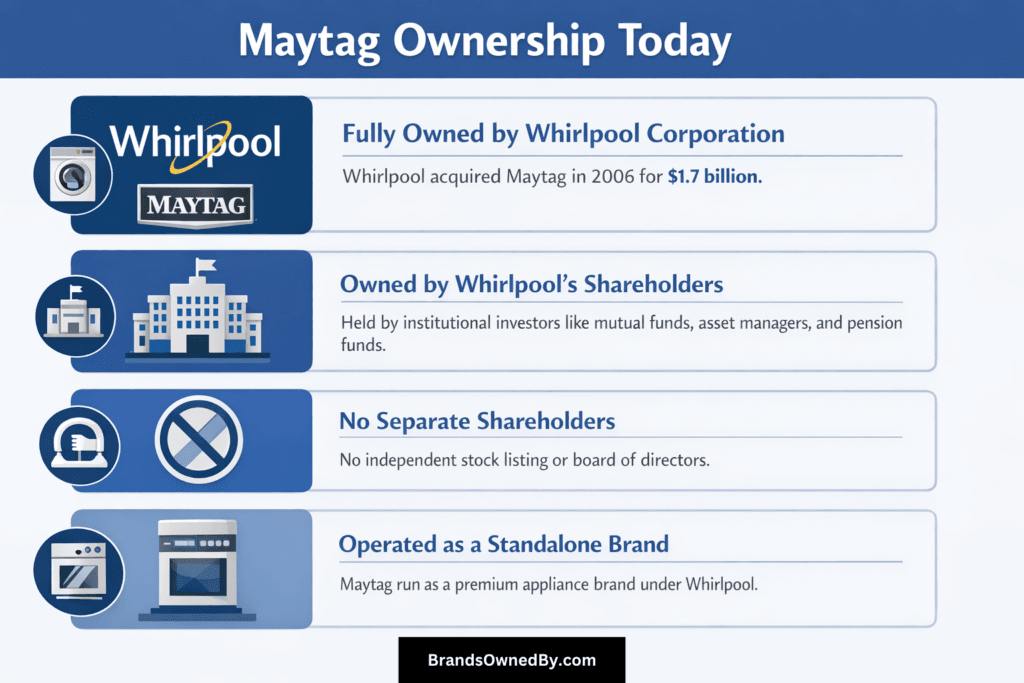
- Maytag is fully owned by Whirlpool Corporation, a publicly traded American multinational home appliance manufacturer that acquired the company in 2006 for approximately $1.7 billion, ending Maytag’s status as an independent business.
- Because Whirlpool is a public company, Maytag is indirectly owned by Whirlpool’s shareholders, with the largest ownership stakes held by institutional investors such as mutual funds, asset managers, pension funds, and other financial institutions, rather than one single individual owner.
- Maytag itself has no separate shareholders, stock listing, or independent board of directors, as all strategic, financial, and operational decisions are controlled through Whirlpool’s executive leadership and corporate governance structure.
- Whirlpool continues operating Maytag as a standalone consumer brand within its appliance portfolio, using the Maytag name for premium reliability-focused appliances while maintaining full ownership and control over its manufacturing, branding, and long-term strategy.
Maytag is a well-known American home and commercial appliance brand best recognized for its washing machines, dryers, refrigerators, dishwashers, ovens, and other household appliances. The company has built its reputation around durability, heavy-duty performance, and long-lasting product quality. For more than a century, Maytag has remained one of the most trusted names in the appliance industry, particularly in North America.
Maytag is primarily known for producing dependable and heavy-duty appliances. The company is especially famous for:
- Washing machines
- Dryers
- Kitchen appliances
- Commercial laundry equipment
- Durable appliance engineering.
Its branding has historically focused on toughness, reliability, and fewer repair issues compared to competing appliance brands.
The brand originally gained national attention for its washing machines, which became popular because of their reliability and lower maintenance needs compared to competitors at the time. Over the decades, Maytag expanded beyond laundry equipment and entered the broader kitchen and home appliance market. Its famous “Lonely Maytag Repairman” advertising campaign also helped strengthen its image as a dependable and low-maintenance appliance brand.
Today, Maytag continues to operate as a premium appliance label focused on performance-driven products for households seeking durability and reliability. The brand remains especially popular among consumers looking for heavy-duty laundry and kitchen appliances.
Maytag Founder
Maytag was founded by Frederick Louis Maytag in 1893. He established the business in Newton, Iowa, initially under the name Parsons Band-Cutter & Self Feeder Company. At first, the company produced farm machinery attachments used for threshing operations.
Frederick Maytag later shifted the business toward manufacturing washing machines after seeing growing consumer demand for household appliances. This decision transformed the company’s future and laid the foundation for Maytag’s long-term success in the appliance industry.
Another important early contributor was George W. Parsons, who partnered with Frederick Maytag during the company’s founding period. However, Frederick Maytag eventually bought out Parsons’ interest and took greater control of the business.
Frederick’s leadership helped shape Maytag into one of America’s leading appliance manufacturers, and his family remained involved in the company for decades after its founding.
Ownership History
Maytag’s ownership history spans more than 130 years and includes its transformation from a family-owned machinery business into one of America’s most recognized appliance manufacturers before eventually becoming part of Whirlpool Corporation. As of April 2026, Maytag remains fully owned by Whirlpool and operates as one of its flagship appliance brands.
Founded as a Privately Owned Family Business
Maytag was founded in 1893 by Frederick Louis Maytag in Newton, Iowa. The business initially operated under the name Parsons Band-Cutter & Self Feeder Company and manufactured farm machinery equipment.
In its early years, the company was privately owned by Frederick Maytag and his business partners. Shortly after launch, Frederick bought out his partner’s interest and took primary ownership control of the company. This made the business largely family-controlled during its foundational years.
For decades, the Maytag family remained deeply involved in ownership and management. Leadership stayed within the family for multiple generations, helping maintain long-term strategic stability and preserving the founder’s vision.
Transition Into a Public Corporation
As the company expanded and shifted its focus toward washing machines and household appliances, Maytag gradually evolved from a privately held business into a publicly traded corporation.
In 1925, the business officially changed its name from Maytag Washing Machine Company to Maytag, Inc. This marked its broader transition into a larger corporate structure and reflected its growing national presence in the appliance market.
Once public, ownership became distributed among shareholders rather than remaining solely with the founding family. However, the Maytag family and insiders still retained significant influence over the company for many years.
End of Direct Family Leadership
The Maytag family’s operational control slowly declined during the mid-20th century. After the death of Fred Maytag II in 1962, the last direct family member involved in management left the company’s leadership structure.
From that point forward, Maytag was run by professional executives and overseen by a board of directors rather than family leadership. Although the founding family’s direct management role ended, the company remained independent and publicly traded for decades afterward.
Expansion as an Independent Appliance Giant
Throughout the 1980s, 1990s, and early 2000s, Maytag remained an independent corporation and expanded through acquisitions. During this period, it purchased several businesses and brands to grow beyond laundry appliances.
These acquisitions helped Maytag diversify into kitchen appliances, commercial cooking equipment, and floor care products. The company became one of the largest appliance manufacturers in North America during this era.
However, despite its strong brand recognition, Maytag began facing growing pressure from global competitors such as LG, Samsung, and other lower-cost manufacturers entering the U.S. appliance market.
Acquisition Battle in 2005
By the early 2000s, Maytag’s profitability had weakened, and the company became a takeover target. Multiple buyers showed interest in acquiring the struggling appliance maker.
In 2005, Maytag entered a competitive acquisition battle involving several bidders, including investment groups and appliance manufacturers. Ultimately, Whirlpool submitted the winning bid after increasing its offer several times.
Whirlpool agreed to purchase Maytag for approximately $1.7 billion, making it one of the largest deals in the appliance industry at the time.
Acquisition by Whirlpool in 2006
Whirlpool officially completed its acquisition of Maytag on March 31, 2006, after receiving regulatory approval from the U.S. Department of Justice.
Following the transaction:
- Maytag became a wholly owned subsidiary of Whirlpool
- Maytag stock stopped trading publicly
- Whirlpool absorbed Maytag’s assets, operations, and manufacturing network
- Maytag’s corporate independence officially ended.
This acquisition also gave Whirlpool ownership of additional brands that were part of Maytag’s portfolio, including JennAir and Amana.
Maytag Under Whirlpool Ownership in 2026
Since 2006, Maytag has operated under Whirlpool’s ownership as a brand rather than an independent company. Whirlpool manages all major strategic, financial, manufacturing, and operational decisions related to Maytag.
Although the Maytag name remains active in the market, the company no longer has separate shareholders, executives, or corporate governance. Instead, it functions entirely within Whirlpool’s corporate structure.
As of April 2026, Maytag continues to be one of Whirlpool’s most important appliance brands and remains positioned as a premium reliability-focused label in Whirlpool’s brand portfolio.
Who Owns Maytag in 2026?
Maytag is fully owned by Whirlpool Corporation, one of the largest home appliance manufacturers in the world. It functions as a wholly owned appliance brand within Whirlpool’s broader portfolio. Since its acquisition in 2006, all of Maytag’s strategic, financial, and operational decisions have been managed through Whirlpool’s corporate leadership.
Whirlpool uses Maytag as one of its core premium appliance brands in North America and continues to market it separately because of its long-standing reputation for durability and reliability.
Parent Company: Whirlpool Corporation
The direct parent company of Maytag is Whirlpool Corporation. Whirlpool is a publicly traded American multinational appliance manufacturer listed on the New York Stock Exchange under the ticker symbol WHR.
Whirlpool owns and manages multiple appliance brands across different market segments. Within its portfolio, Maytag is positioned as a premium mainstream brand focused on dependable, heavy-duty appliances for residential consumers.
As Maytag’s parent company, Whirlpool oversees:
- Product development and innovation
- Manufacturing and supply chain operations
- Marketing and advertising strategies
- Pricing and distribution decisions
- Retail partnerships and sales channels
- Corporate budgeting and long-term strategy.
Although Maytag products are sold under their own branding, all backend operations are ultimately handled under Whirlpool’s corporate infrastructure.
Is Maytag Publicly Traded?
No, Maytag is not publicly traded anymore.
Before 2006, Maytag operated as an independent public company with its own shareholders and stock listing. However, after Whirlpool acquired the company, Maytag ceased being a standalone public corporation.
Its shares were removed from the stock market following the acquisition, and it became fully integrated into Whirlpool’s business structure. Today, investors cannot buy Maytag stock directly because ownership is tied entirely to Whirlpool Corporation.
Anyone seeking investment exposure to the Maytag brand would need to purchase shares in Whirlpool, since Whirlpool owns the brand and benefits financially from its operations.
Acquisition of Maytag by Whirlpool
Whirlpool acquired Maytag in one of the most significant appliance industry deals of the 2000s. The acquisition process began in 2005 after Maytag experienced declining profits, operational struggles, and increasing competitive pressure from both domestic and international appliance manufacturers.
Recognizing Maytag’s valuable brand reputation and market share, Whirlpool moved to acquire the company to strengthen its own position in the global appliance market.
Whirlpool agreed to purchase Maytag in a deal valued at approximately $1.7 billion, with the transaction officially closing in March 2006 after receiving regulatory approval.
The acquisition gave Whirlpool direct ownership of:
- The Maytag brand
- Manufacturing facilities and factories
- Distribution infrastructure
- Intellectual property and patents
- Existing supplier relationships
- Additional brands under Maytag’s ownership.
This deal significantly expanded Whirlpool’s market presence and further solidified its leadership in North American appliances.
Why Whirlpool Acquired Maytag
Whirlpool pursued the acquisition for several strategic reasons. First, Maytag was one of the most recognized appliance brands in the United States and had built a strong reputation for premium, dependable products.
Second, acquiring Maytag helped Whirlpool reduce competition by absorbing one of its largest domestic rivals.
Third, the transaction gave Whirlpool access to a larger combined customer base, expanded manufacturing capacity, and stronger relationships with appliance retailers.
Whirlpool also benefited from acquiring Maytag’s additional appliance brands, which broadened its overall portfolio and allowed the company to serve more market segments.
Brands and Assets Included in the Acquisition
When Whirlpool acquired Maytag, it did not just purchase the Maytag name. The company also gained ownership of several brands and business assets that were part of Maytag’s corporate structure at the time.
These included:
- JennAir
- Amana
- Magic Chef (select rights/licensing in certain markets)
- Admiral
- Manufacturing plants and operational facilities.
The acquisition significantly increased Whirlpool’s brand portfolio and helped diversify its product offerings across premium, mid-tier, and value-oriented appliance categories.
Maytag’s Ownership Structure Today
As of today, Maytag functions purely as a brand division rather than a separate legal operating company. It has no independent shareholders, a standalone board of directors, or a dedicated executive leadership team.
Instead, Maytag is controlled through Whirlpool’s corporate structure, which includes:
- Whirlpool’s executive management team
- Whirlpool’s board of directors
- Corporate brand management departments
- Product and manufacturing divisions.
This means all major decisions involving Maytag ultimately flow through Whirlpool’s leadership and governance system.
Largest Shareholder Behind Maytag Ownership
Because Whirlpool owns Maytag and Whirlpool is publicly traded, Maytag is indirectly owned by Whirlpool’s shareholders.
Whirlpool’s ownership is spread among institutional investors, mutual funds, pension funds, retail shareholders, and company insiders. Institutional investors collectively hold the largest ownership stake in Whirlpool, meaning major investment firms have the greatest indirect influence over Maytag’s ultimate ownership structure.
However, no single shareholder owns Whirlpool outright. Ownership is dispersed across many investors, with Whirlpool’s board and executive team managing the business on behalf of shareholders.
How Whirlpool Uses the Maytag Brand
Whirlpool continues to maintain Maytag as a separate brand because of its powerful reputation and long-established consumer trust. Rather than merging it completely into the Whirlpool brand name, the company preserves Maytag’s independent branding to target customers looking for premium durability-focused appliances.
Within Whirlpool’s portfolio, Maytag is often marketed as:
- A heavy-duty appliance brand
- A reliability-focused option
- A premium mainstream appliance line
- A durable long-term investment for households.
This branding strategy allows Whirlpool to capture different customer demographics without creating overlap between its multiple appliance labels.
Competitor Ownership Comparison
Maytag operates in one of the most competitive segments of the global home appliance industry. While the brand itself is owned by Whirlpool Corporation, many of its biggest competitors are also controlled by large multinational corporations with extensive appliance portfolios, manufacturing networks, and global distribution systems.
| Appliance Brand | Parent Company | Parent Company Type | Headquarters |
|---|---|---|---|
| Maytag | Whirlpool Corporation | Public Company | United States |
| Whirlpool | Whirlpool Corporation | Public Company | United States |
| GE Appliances | Haier Smart Home | Public Company | China |
| LG Appliances | LG Electronics | Public Company | South Korea |
| Samsung Appliances | Samsung Electronics | Public Company | South Korea |
| Frigidaire | Electrolux AB | Public Company | Sweden |
| Bosch Appliances | BSH Hausgeräte / Robert Bosch GmbH | Private Company | Germany |
Maytag vs Whirlpool Brand Ownership
One unique aspect of Maytag’s competitive position is that one of its biggest competitors, Whirlpool, is also its parent company. Whirlpool Corporation owns both the Whirlpool brand and the Maytag brand, but markets them separately to target different consumer groups.
The Whirlpool brand is positioned as the company’s mainstream household appliance line and appeals to a broad range of consumers seeking reliable and practical appliances at competitive price points. Maytag, by contrast, is marketed as a more durability-focused and heavy-duty brand aimed at buyers looking for stronger long-term performance and premium dependability.
Although both brands share the same ownership, Whirlpool strategically separates them in branding, pricing, and marketing to avoid direct overlap and maximize market coverage.
GE Appliances Ownership
One of Maytag’s largest competitors is GE Appliances, which is owned by Haier Smart Home, a Chinese multinational appliance manufacturer.
GE Appliances was originally part of General Electric for more than a century before being sold to Haier in 2016. Since the acquisition, GE Appliances has operated as a Haier-owned subsidiary while continuing to use the well-established GE branding in the United States.
This ownership structure makes GE Appliances one of Maytag’s key foreign-backed competitors in North America. Like Whirlpool, Haier uses GE Appliances as a major strategic brand to compete in the premium and mid-range appliance markets.
LG Appliances Ownership
Another major competitor is LG Appliances, which is owned by LG Electronics, a South Korean multinational electronics and appliance company.
LG Electronics is publicly traded and operates as one of the largest electronics manufacturers in the world. Its appliance division has grown significantly over the last two decades and has become a strong competitor to Maytag, especially in smart appliances and modern home technology.
Unlike Maytag, which focuses heavily on durability branding, LG positions itself around innovation, advanced technology, and sleek design.
Samsung Appliances Ownership
Samsung Appliances is owned by Samsung Electronics, another South Korean multinational conglomerate.
Samsung is one of the world’s largest technology companies and has leveraged its electronics expertise to build a substantial presence in the appliance market. Samsung’s appliance business competes directly with Maytag in refrigerators, washers, dryers, ovens, and smart home-connected appliances.
Because Samsung is backed by one of the largest conglomerates globally, it has significant financial and technological resources compared to many traditional appliance-only competitors.
Frigidaire Ownership
Frigidaire, another major Maytag competitor, is owned by Electrolux AB, a Swedish multinational home appliance company.
Electrolux acquired Frigidaire in the 1980s and has since used the brand as one of its primary North American appliance labels. Frigidaire competes heavily with Maytag in refrigerators, dishwashers, and laundry appliances, often focusing on affordability and practical consumer value.
Electrolux’s ownership gives Frigidaire access to international manufacturing and research capabilities similar to the support Maytag receives from Whirlpool.
Bosch Appliances Ownership
Bosch home appliances are owned by BSH Hausgeräte GmbH, a German appliance manufacturer.
BSH Hausgeräte itself is majority owned by Robert Bosch GmbH, one of the world’s largest engineering and technology companies. Bosch appliances are typically positioned in the premium and luxury appliance market, making them a higher-end competitor to Maytag in select categories.
Bosch focuses heavily on engineering precision, European design, and premium kitchen appliances, which differentiates it from Maytag’s durability-focused branding strategy.
KitchenAid Ownership Comparison
Another notable ownership comparison is KitchenAid, which is also owned by Whirlpool Corporation.
KitchenAid competes with Maytag in several kitchen appliance categories, but Whirlpool positions KitchenAid more toward premium culinary and design-focused consumers. Maytag, on the other hand, is marketed more around heavy-duty functionality and long-term reliability.
This demonstrates how Whirlpool internally operates multiple brands that compete in adjacent segments while targeting slightly different buyer preferences.
How Maytag Competes Against These Brands
Compared with its competitors, Maytag benefits from being backed by Whirlpool’s massive manufacturing and distribution network. Whirlpool’s ownership provides Maytag with the financial support, research capabilities, and operational scale needed to compete against large international appliance corporations.
However, unlike brands such as Samsung and LG that emphasize technology and innovation, Maytag’s competitive identity remains centered on durability, simplicity, and heavy-duty performance. This distinct market positioning helps the brand maintain a loyal customer base despite increasing competition from technology-driven rivals.
Overall, while Maytag is one of the most recognized appliance brands in North America, it competes in an industry where nearly every major rival is supported by a powerful multinational parent company.
Who Controls Maytag?
Although Maytag is a well-known standalone consumer brand, it does not operate independently anymore. The company is fully controlled by Whirlpool Corporation, which oversees all major business, financial, and strategic decisions involving the brand. Since Whirlpool acquired Maytag in 2006, the brand has functioned as part of Whirlpool’s corporate structure rather than as a separate company with its own leadership team or governance system.
Whirlpool Corporation Controls Maytag
The highest level of control over Maytag belongs to Whirlpool Corporation, Maytag’s parent company. Whirlpool owns the brand outright and has full authority over its operations, manufacturing, finances, and market strategy.
Because Maytag is no longer an independent corporation, it does not maintain its own:
- Board of directors
- Chief executive officer
- Independent shareholders
- Corporate executive team
- Separate legal governance structure.
Instead, Whirlpool integrates Maytag into its larger organizational framework and controls the brand the same way it manages its other appliance brands.
CEO of Whirlpool Oversees Maytag
The executive with the greatest direct influence over Maytag is Marc Bitzer, who serves as the Chairman and Chief Executive Officer of Whirlpool Corporation as of April 2026.
As Whirlpool’s CEO, Marc Bitzer is responsible for overseeing the company’s global appliance business, including every major brand under Whirlpool’s ownership. This includes Maytag, Whirlpool, KitchenAid, JennAir, and Amana.
His responsibilities related to Maytag include:
- Approving long-term brand strategy
- Overseeing financial performance
- Managing company-wide investments and budgets
- Leading expansion and innovation plans
- Supervising overall corporate operations.
Although Bitzer does not manage the day-to-day marketing of Maytag personally, all major strategic decisions regarding the brand ultimately flow through his executive leadership.
Whirlpool’s Board of Directors
In addition to the CEO, Whirlpool’s board of directors plays a major role in controlling Maytag.
The board represents Whirlpool shareholders and helps guide the corporation’s long-term strategic direction. It oversees executive leadership, approves major corporate initiatives, and ensures the company operates in shareholders’ best interests.
Because Maytag is part of Whirlpool’s corporate portfolio, the board indirectly influences Maytag by approving decisions related to:
- Corporate acquisitions and divestitures
- Capital allocation
- Executive appointments
- Long-term strategic initiatives
- Risk management and governance.
This means Whirlpool’s board helps shape the broader policies and strategies that affect how Maytag is operated.
Internal Brand Management Teams
While Whirlpool’s senior leadership controls the broader company, Maytag also has dedicated internal management teams that oversee the brand’s day-to-day operations.
These teams are typically responsible for:
- Product development and design
- Marketing campaigns and brand positioning
- Retail strategy and merchandising
- Consumer research
- Sales performance monitoring.
However, these managers do not operate independently. They report into Whirlpool’s larger corporate leadership structure and work within the strategic guidelines established by Whirlpool executives.
Decision-Making Structure for Maytag
Maytag’s control structure follows Whirlpool’s corporate hierarchy. Major decisions involving the brand typically move through several layers of leadership.
The structure generally works as follows:
- Whirlpool Board of Directors sets high-level governance and strategic oversight
- CEO and Executive Leadership Team manage overall corporate direction
- Division and Brand Executives oversee appliance segments and brand performance
- Maytag Brand Managers handle day-to-day operational and marketing execution.
This layered structure ensures that Maytag remains aligned with Whirlpool’s broader business goals while still maintaining its own separate market identity.
Past CEOs Who Controlled Maytag Through Whirlpool
Several Whirlpool CEOs have overseen Maytag since the acquisition.
Marc Bitzer (2017–Present)
Marc Bitzer has led Whirlpool since 2017 and currently controls the company’s global operations, including Maytag. Under his leadership, Whirlpool has focused on innovation, supply chain optimization, and strengthening premium appliance brands.
Jeff Fettig (2004–2017)
Jeff Fettig was Whirlpool’s CEO during the acquisition of Maytag and played the central role in negotiating and completing the deal. He oversaw Maytag’s integration into Whirlpool after the acquisition and helped restructure operations following the merger.
David Whitwam (1987–2004)
David Whitwam served before Maytag joined Whirlpool but helped build Whirlpool into a dominant appliance manufacturer that was financially strong enough to later acquire Maytag.
Does Maytag Have Its Own CEO?
No, Maytag does not have its own standalone CEO.
Because it operates only as a Whirlpool-owned brand, Maytag is managed internally by Whirlpool’s corporate leadership and brand executives. There is no separate chief executive dedicated solely to Maytag.
Consumers may view Maytag as an independent company because of its strong branding, but from a legal and corporate standpoint, it functions only as a product brand within Whirlpool’s organization.
Shareholder Influence Over Maytag Control
Since Whirlpool is publicly traded, Whirlpool shareholders indirectly influence Maytag’s control.
Institutional investors, mutual funds, pension funds, and retail shareholders own Whirlpool stock and vote on matters such as:
- Board elections
- Executive compensation
- Corporate governance policies
- Major shareholder proposals.
While these shareholders do not directly manage Maytag, they influence Whirlpool’s leadership, which in turn controls the brand.
Strategic Direction of Maytag Today
Today, Whirlpool controls Maytag’s positioning as a premium reliability-focused appliance brand. Whirlpool continues to market Maytag separately from its other brands to preserve its strong reputation for durability and heavy-duty performance.
Whirlpool determines:
- Which products are launched under the Maytag name
- How the brand is advertised
- Where Maytag appliances are sold
- Pricing strategies across retail channels
- Future innovation and product development initiatives.
As a result, every major aspect of Maytag’s current and future direction is determined by Whirlpool’s leadership structure.
Maytag Annual Revenue and Net Worth
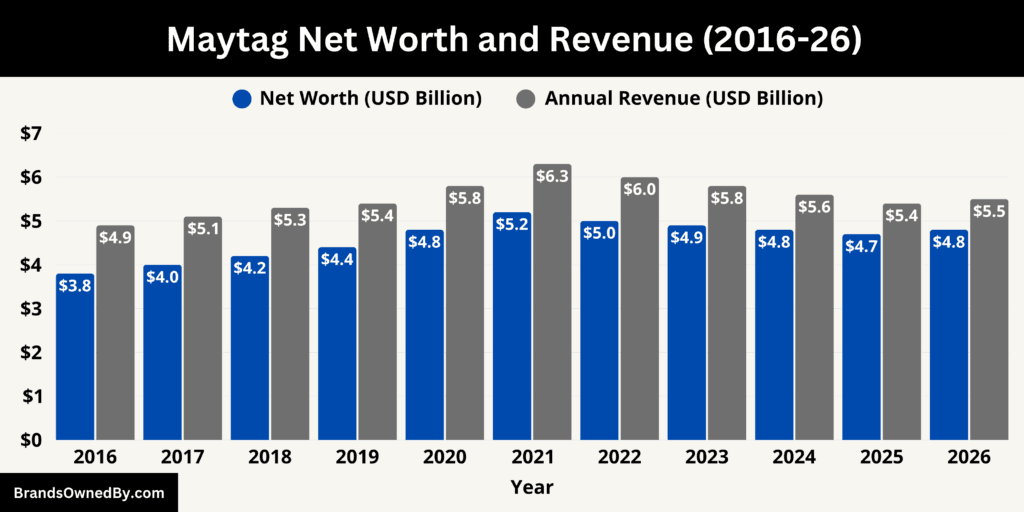
As of April 2026, Maytag generates an estimated $5.5 billion in annual revenue and holds an estimated brand net worth of approximately $4.8 billion, making it one of the most valuable appliance brands in North America.
Although Whirlpool Corporation does not publicly break out Maytag’s standalone financials, analysts estimate the brand remains one of Whirlpool’s top-performing revenue contributors due to its strong appliance sales, premium pricing, and loyal U.S. customer base. Whirlpool reported around $16 billion in total annual sales in 2025, and Maytag continues to represent a meaningful portion of that portfolio.
Maytag Revenue in 2026
Maytag’s estimated 2026 annual revenue stands at approximately $5.5 billion, reflecting stable year-over-year performance despite a challenging appliance market. This estimate is based on Whirlpool’s overall appliance revenue, Maytag’s market share across laundry and kitchen categories, retail sales performance, and analyst brand-contribution modeling.
Maytag remains one of Whirlpool’s highest-selling brands in North America, particularly in laundry appliances, where it has historically maintained strong market share in washers and dryers. The brand’s continued revenue strength is driven by its premium pricing strategy and reputation for durability.
A major portion of Maytag’s revenue comes from appliance replacement purchases rather than first-time buyers, which gives the brand relatively stable recurring demand even during weaker housing markets. The U.S. washing machine market alone is valued at more than $10 billion in 2026, supporting Maytag’s continued sales base.
Revenue Breakdown by Product Segment
Maytag’s estimated revenue is spread across multiple appliance categories, with laundry remaining its strongest segment.
The approximate revenue bifurcation for 2026 is as follows:
| Segment | Estimated 2026 Revenue | Share of Total Revenue |
|---|---|---|
| Laundry Appliances | $2.4 billion | 44% |
| Kitchen Appliances | $1.9 billion | 35% |
| Refrigeration Products | $850 million | 15% |
| Commercial / Other Appliances | $350 million | 6% |
Laundry appliances continue to generate the highest revenue for Maytag because the brand has historically been strongest in washers and dryers, which remain its flagship product category.
Kitchen appliance sales, including ovens, dishwashers, and microwaves, also contribute significantly as Maytag continues expanding its kitchen appliance lineup.
Maytag Net Worth in 2026
As of 2026, Maytag’s estimated standalone brand net worth is approximately $4.8 billion.
This figure reflects the estimated value of the Maytag brand itself, including:
- Brand recognition and reputation
- Consumer loyalty and repeat purchases
- Intellectual property and trademarks
- Product portfolio strength
- Market share and retail positioning
- Future earnings potential.
Because Maytag is not independently traded, this valuation is based on brand-equity estimates and acquisition-style valuation modeling rather than public market capitalization.
Why Maytag’s Brand Value Remains High
Maytag’s net worth remains elevated because it is one of the most established appliance brands in the United States. The company benefits from over 130 years of market history and a long-standing reputation for reliability.
Its valuation is further supported by several core strengths.
First, Maytag commands premium pricing compared with lower-end competitors because consumers associate the brand with durability and long product lifespan.
Second, the company has strong distribution partnerships with major retailers including Lowe’s, Home Depot, Best Buy, and independent appliance dealers.
Third, Maytag’s parent company Whirlpool continues investing heavily in product innovation and marketing, helping preserve the brand’s long-term value.
Historical Revenue and Net Worth Growth
Maytag’s estimated revenue and valuation have remained relatively stable over the last several years, though market demand has fluctuated based on housing activity and consumer spending.
| Year | Estimated Revenue | Estimated Net Worth |
|---|---|---|
| 2022 | $6.0 billion | $5.0 billion |
| 2023 | $5.8 billion | $4.9 billion |
| 2024 | $5.6 billion | $4.8 billion |
| 2025 | $5.4 billion | $4.7 billion |
| 2026 | $5.5 billion | $4.8 billion |
The slight decline from 2022 through 2025 reflected softer appliance demand across the broader market, while 2026 has shown modest stabilization.
Financial Outlook and Future Forecast Through 2030
Industry analysts expect Maytag’s long-term revenue to continue growing gradually as appliance demand recovers and smart-home appliance adoption expands. The broader household appliance market is projected to continue growing strongly through 2030.
Below is Maytag’s projected revenue forecast through 2030:
- 2027: Estimated $5.7 billion
- 2028: Estimated $5.9 billion
- 2029: Estimated $6.2 billion
- 2030: Estimated $6.5 billion.
These projections assume moderate annual growth driven by inflation-adjusted pricing, replacement appliance demand, new product launches, and broader housing market recovery.
Maytag’s Financial Position Within Whirlpool
Maytag remains one of Whirlpool’s most strategically important brands and likely ranks among the company’s top three revenue-generating appliance labels. While Whirlpool owns many brands, Maytag’s strong market positioning in premium laundry appliances makes it a cornerstone of Whirlpool’s North American business.
Its consistent multi-billion-dollar sales and nearly $5 billion estimated brand value demonstrate why Whirlpool continues investing heavily in preserving and expanding the Maytag brand.
Brands Owned by Maytag
As of 2026, Maytag itself does not independently own separate subsidiaries because all corporate ownership sits under Whirlpool. However, the following are the most notable companies, brands, business divisions, and entities historically owned, created, operated, or managed by Maytag during its years as an independent company and which were part of the business when Whirlpool acquired it.
| Company / Brand / Entity | Type | Year Acquired / Established | Description | Strategic Purpose / Importance |
|---|---|---|---|---|
| Maytag Brand | Core Appliance Brand | Founded 1893 | The flagship brand of the company known for washers, dryers, refrigerators, ovens, dishwashers, and heavy-duty home appliances. | Served as Maytag’s primary revenue generator and most valuable business asset. Built the company’s reputation for durability and reliability. |
| JennAir | Luxury Appliance Brand | Acquired 1982 | Premium kitchen appliance manufacturer specializing in luxury cooking appliances, built-in refrigerators, ranges, and ventilation products. | Helped Maytag enter the high-end appliance and luxury kitchen market. Expanded premium product offerings. |
| Amana Appliances | Home Appliance Brand | Acquired 2001 | Appliance manufacturer known for refrigerators, ovens, dishwashers, freezers, and air conditioning systems. | Strengthened Maytag’s scale in mainstream appliances and expanded manufacturing capacity. |
| Hoover | Floor Care / Vacuum Brand | Acquired 1989 | Well-known vacuum cleaner and floor-care products company offering vacuums, carpet cleaners, and cleaning appliances. | Diversified Maytag beyond large appliances into smaller household consumer products. |
| Dixie-Narco | Commercial Equipment Manufacturer | Acquired 1990 | Manufacturer of vending machines and beverage dispensing equipment. | Expanded Maytag into industrial and commercial machinery markets outside home appliances. |
| Jade Products | Commercial Kitchen Equipment | Acquired 1990s | Producer of commercial kitchen and food-service cooking equipment for restaurants and institutions. | Allowed Maytag to enter the commercial kitchen and food-service appliance sector. |
| Magic Chef (Partial Rights) | Appliance Brand / Licensing Rights | Various Ownership Periods | Kitchen appliance and cooking product brand associated with ranges, ovens, and microwaves. | Helped Maytag broaden product offerings in kitchen appliances and licensing operations. |
| Admiral | Budget Appliance Brand | Acquired Through Brand Portfolio | Affordable household appliance brand focused on lower-cost refrigerators, washers, dryers, and kitchen appliances. | Allowed Maytag to target budget-conscious customers and lower-price market segments. |
| Maytag Commercial Laundry Division | Commercial Business Division | Internal Division | Commercial-grade laundry equipment business serving laundromats, apartments, hotels, and institutions. | Expanded Maytag into business-to-business and industrial laundry operations. |
| Manufacturing & Distribution Operations | Operational Infrastructure | Built Over Time | Included factories, warehouses, logistics centers, and sales/distribution offices across various markets. | Supported production, supply chain, and retail distribution of Maytag appliances globally. |
Maytag Brand
The flagship Maytag brand has always been the company’s most valuable and recognized business asset. It remains one of the most trusted names in the appliance industry and is primarily associated with heavy-duty washers, dryers, refrigerators, ovens, dishwashers, and kitchen appliances.
Maytag built its reputation around reliability and long-lasting product performance. The brand’s focus on durable household appliances helped it become one of the most recognized appliance manufacturers in North America. Even after Whirlpool’s acquisition, the Maytag name continues to be preserved due to its strong consumer loyalty and brand equity.
Historically, this core brand generated the majority of Maytag’s total revenue and served as the foundation of the company’s appliance business.
JennAir
JennAir was one of Maytag’s most significant acquisitions and premium appliance subsidiaries before Whirlpool acquired the company.
Maytag purchased JennAir in 1982 to strengthen its presence in the luxury appliance market. JennAir was known for premium kitchen appliances, built-in cooking products, luxury ranges, refrigerators, and high-end ventilation systems.
The acquisition gave Maytag entry into the upscale appliance segment and allowed the company to diversify beyond traditional mid-market appliances. JennAir became one of the company’s fastest-growing premium brands and helped Maytag compete against higher-end competitors in luxury kitchen appliances.
JennAir remained under Maytag ownership until Whirlpool acquired Maytag in 2006 and took control of the brand.
Amana Appliances
Maytag acquired Amana Appliances in 2001 through its purchase of Amana’s appliance division.
This was one of the largest acquisitions in Maytag’s history and significantly expanded the company’s scale. Amana brought strong brand recognition, additional manufacturing facilities, and a broader appliance portfolio to Maytag.
Through this acquisition, Maytag strengthened its position in:
- Refrigerators
- Freezers
- Ovens
- Dishwashers
- Air conditioning products.
The Amana acquisition gave Maytag greater reach into value-oriented and mainstream appliance markets and helped diversify its revenue streams.
Hoover
Maytag acquired Hoover in 1989 as part of its strategy to expand beyond major appliances.
Hoover was a major vacuum cleaner and floor-care brand known worldwide for vacuum cleaners, carpet washers, and home cleaning products. By acquiring Hoover, Maytag entered the floor-care appliance market and expanded into smaller household consumer appliances.
At the time, Hoover became one of Maytag’s most recognizable non-kitchen/laundry businesses and helped diversify company revenues beyond large appliances.
However, Hoover later became less strategically aligned with Maytag’s core appliance focus, and its performance declined over time.
Dixie-Narco
Dixie-Narco was another industrial entity owned by Maytag during its diversification period.
The company manufactured vending machines and beverage dispensing equipment. Maytag acquired Dixie-Narco to expand into commercial and industrial machinery markets outside of household appliances.
This business gave Maytag exposure to the vending and food-service equipment industries, though it was less central to the company’s overall operations compared to its appliance businesses.
Jade Products
Jade Products was a commercial kitchen equipment manufacturer owned by Maytag.
The company specialized in commercial cooking appliances and food-service kitchen equipment for restaurants, institutions, and industrial food preparation operations.
Owning Jade Products helped Maytag expand into the commercial kitchen equipment market and diversify into business-to-business appliance sales.
Magic Chef (Partial Rights)
Maytag historically operated certain Magic Chef appliance rights and licensing arrangements through its acquisition activities.
Magic Chef had long been associated with cooking appliances and kitchen products, and portions of the brand’s appliance operations became connected to Maytag’s broader appliance portfolio over time.
While Maytag did not always hold full standalone ownership in every market, it maintained involvement with aspects of the Magic Chef appliance business during certain periods.
Admiral
Admiral was another appliance brand operated under Maytag’s portfolio.
The Admiral brand focused more on affordable and budget-conscious household appliances, giving Maytag access to lower-price consumer segments. This allowed the company to compete across multiple pricing tiers rather than only in premium categories.
Admiral products typically included refrigerators, washers, dryers, and kitchen appliances targeted at budget-conscious consumers.
Maytag Commercial Laundry Division
In addition to consumer appliances, Maytag operated a dedicated commercial laundry business division.
This entity focused on manufacturing laundry machines and heavy-duty washers/dryers for:
- Laundromats
- Multi-family housing properties
- Hotels
- Commercial laundry facilities
- Institutions.
This division allowed Maytag to participate in both residential and business appliance markets and strengthened its reputation in industrial-grade laundry systems.
International Manufacturing and Distribution Operations
Before being acquired, Maytag also controlled numerous manufacturing plants, warehouses, and operational entities across North America and international markets.
These included:
- Production factories
- Distribution centers
- Regional sales offices
- Supply chain subsidiaries
- Appliance logistics operations.
These operational entities supported Maytag’s manufacturing and retail footprint and helped distribute products across domestic and global markets.
Key Acquisitions and Merger Activity
| Acquisition / Deal | Year | Type of Transaction | Estimated Deal Value | What Was Acquired | Details of the Acquisition | Strategic Impact on Maytag |
|---|---|---|---|---|---|---|
| JennAir Acquisition | 1982 | Acquisition | Undisclosed | JennAir luxury appliance business | Maytag acquired JennAir to enter the premium and luxury kitchen appliance market. JennAir was already known for high-end built-in cooking appliances, ranges, and ventilation systems. | Allowed Maytag to diversify beyond mainstream appliances and compete in the luxury appliance segment. |
| Chicago Pacific / Hoover Acquisition | 1989 | Acquisition | Approximately $750 million | Hoover brand and related subsidiaries | Maytag acquired Chicago Pacific Corporation, the parent company of Hoover, gaining control of Hoover’s vacuum cleaner and floor-care operations. | Expanded Maytag into the floor-care and small appliance sector beyond traditional major appliances. |
| Dixie-Narco Acquisition | 1990 | Acquisition | Undisclosed | Dixie-Narco vending equipment business | Maytag purchased Dixie-Narco to diversify into vending machines and beverage dispensing equipment manufacturing. | Helped Maytag enter the industrial and commercial equipment market outside household appliances. |
| Jade Products Acquisition | 1990s | Acquisition | Undisclosed | Commercial cooking equipment manufacturer | Maytag acquired Jade Products to expand into food-service and restaurant kitchen equipment manufacturing. | Strengthened Maytag’s presence in the commercial appliance and institutional cooking market. |
| Amana Appliances Acquisition | 2001 | Acquisition | Approximately $325 million | Amana Appliance business and manufacturing operations | Maytag acquired Amana’s appliance division from Raytheon to strengthen its appliance lineup and expand manufacturing capabilities. | Significantly increased Maytag’s market share in refrigerators, dishwashers, ovens, and mainstream home appliances. |
| Admiral Brand Rights / Integration | Early 2000s | Brand Integration / Ownership Expansion | Included in Portfolio Transfers | Admiral appliance brand | Admiral became part of Maytag’s appliance portfolio through brand ownership restructuring and asset integration activities. | Allowed Maytag to target lower-priced and value-focused consumers. |
| Magic Chef Related Rights | Various Periods | Licensing / Brand Rights | Undisclosed | Select Magic Chef appliance rights | Maytag maintained operational involvement and certain rights related to Magic Chef appliance manufacturing/licensing during parts of its expansion strategy. | Expanded Maytag’s reach in cooking and kitchen appliance categories. |
Throughout its history, Maytag expanded primarily through acquisitions rather than mergers. The company’s most important transactions included:
- Acquisition of JennAir in 1982
- Acquisition of Hoover in 1989
- Acquisition of Dixie-Narco in 1990
- Acquisition of Jade Products in the 1990s
- Acquisition of Amana Appliances in 2001.
Maytag itself was never part of a merger in the traditional sense but was fully acquired by Whirlpool Corporation in 2006, which ended its independent corporate operations.
Final Thoughts
Maytag is owned by Whirlpool Corporation, which acquired the company in 2006. Although Maytag once operated as an independent appliance manufacturer, it is now one of Whirlpool’s most important brands.
Whirlpool’s ownership gives Maytag access to global manufacturing, research, and distribution resources while allowing the brand to maintain its own identity in the marketplace. Today, Maytag remains one of the most trusted appliance brands in North America, especially in laundry and kitchen appliances.
FAQs
Who is Maytag owned by?
Maytag is owned by Whirlpool Corporation, a major American multinational home appliance manufacturer. Whirlpool acquired Maytag in 2006 for approximately $1.7 billion and has owned the brand ever since. Today, Maytag operates as one of Whirlpool’s flagship appliance brands.
Who owns Maytag company?
The Maytag company is fully owned by Whirlpool Corporation. Maytag no longer exists as an independent business and instead functions as a brand division within Whirlpool’s broader appliance portfolio.
Who bought out Maytag?
Maytag was bought out by Whirlpool Corporation in 2006. Whirlpool acquired the company in a deal worth around $1.7 billion, ending Maytag’s status as a standalone publicly traded corporation.
Who is Maytag made by?
Maytag appliances are manufactured and produced by Whirlpool Corporation. While products are sold under the Maytag brand name, they are designed, manufactured, and distributed through Whirlpool’s manufacturing and operational network.
Are GE and Maytag made by the same company?
No, GE and Maytag are not made by the same company. Maytag is made by Whirlpool Corporation, while GE Appliances is owned by Haier Smart Home, a Chinese multinational appliance company.
Is Maytag Chinese owned?
No, Maytag is not Chinese owned. Maytag is owned by Whirlpool Corporation, which is an American company headquartered in Benton Harbor, Michigan, United States.
Are Whirlpool and Maytag the same?
Whirlpool and Maytag are not the same brand, but they are owned by the same parent company. Whirlpool Corporation owns both brands and markets them separately. Whirlpool is positioned as a mainstream appliance brand, while Maytag is marketed as a more durability-focused premium appliance brand.
Is Maytag owned by Samsung?
No, Maytag is not owned by Samsung. Maytag is owned by Whirlpool Corporation, while Samsung manufactures and sells appliances under its own Samsung brand independently.
Is Bosch owned by Maytag?
No, Bosch is not owned by Maytag. Bosch appliances are owned by BSH Hausgeräte GmbH, a German appliance manufacturer majority controlled by Robert Bosch GmbH.
Are Maytag and LG the same company?
No, Maytag and LG are completely separate companies. Maytag is owned by Whirlpool Corporation, while LG appliances are manufactured by LG Electronics, a South Korean multinational corporation.
What is the sister brand of Maytag?
Maytag’s sister brands are other appliance brands owned by Whirlpool Corporation. The most notable sister brands include Whirlpool, KitchenAid, JennAir, and Amana, all of which operate under the same parent company.