
- Fenty Beauty is jointly owned by Rihanna and LVMH through Kendo Holdings, with both parties holding approximately 50% ownership stakes as of 2026.
- Rihanna is the co-founder, major shareholder, and creative leader of Fenty Beauty, while LVMH controls operations, manufacturing, retail distribution, and global expansion through Kendo Holdings.
- Fenty Beauty launched in 2017 and became one of the world’s most successful celebrity-owned beauty brands through inclusive makeup products, Sephora distribution, and strong international growth.
Fenty Beauty is a global cosmetics brand launched in September 2017. The company was created to solve a major gap in the beauty industry. Many makeup brands offered limited foundation shades, especially for darker skin tones. Fenty Beauty entered the market with a broader and more inclusive product strategy.
The brand focuses on makeup, skincare, fragrance, and beauty-related products. Its product lineup includes:
- Foundations.
- Concealers.
- Lip products.
- Highlighters.
- Skincare essentials.
- Makeup tools and accessories.
Fenty Beauty became widely recognized for creating products suitable for different skin tones, undertones, and textures. The company positioned inclusivity as a core part of its identity rather than a marketing campaign.
The brand mainly sells products through Sephora stores, official online channels, and selected retail partners in international markets. Its retail model helped it expand quickly across North America, Europe, Asia, and the Middle East.
Fenty Beauty also uses a digital-first marketing approach. Product launches are heavily promoted through social media, influencer campaigns, tutorials, and celebrity-driven branding. Rihanna’s direct involvement helped create stronger customer trust compared to traditional celebrity licensing deals.
The company is known for influencing broader beauty industry trends. After Fenty Beauty launched, several competitors expanded their shade ranges and updated their inclusivity messaging. This shift became known in the cosmetics sector as the “Fenty Effect.”
Another important part of the company’s strategy is product accessibility. For example, many makeup tutorials demonstrate how beginners can use Fenty Beauty products with minimal tools. This helped the brand appeal to both professional makeup artists and casual consumers.
Fenty Beauty continues expanding its product ecosystem through skincare, fragrance, and haircare categories connected to the broader Fenty brand portfolio.
Founders of Fenty Beauty
Fenty Beauty was founded in 2017 by Rihanna in partnership with Kendo Holdings, a beauty incubator owned by LVMH. Rihanna helped create the brand’s vision, product strategy, and marketing direction, while Kendo managed operations, manufacturing, and global distribution. The company launched through Sephora and quickly became known for its inclusive makeup products and wide foundation shade range.
Rihanna
Rihanna is the founder and public face of Fenty Beauty. She played a direct role in developing the company’s identity, product standards, and marketing approach.
Before launching Fenty Beauty, Rihanna had experience working with luxury fashion and cosmetics brands through endorsements and collaborations. However, she wanted greater creative control and long-term ownership instead of a traditional licensing arrangement.
She was heavily involved in:
- Product testing.
- Shade development.
- Packaging design.
- Campaign direction.
- Brand messaging.
Rihanna’s personal experiences also influenced the brand’s creation. She often discussed difficulties finding makeup products that matched different skin tones and undertones. This became one of the main reasons behind Fenty Beauty’s inclusive product strategy.
Her celebrity status helped attract global attention during launch, but the company’s long-term success came from product quality, broad shade availability, and strong retail execution.
Kendo Holdings
Kendo Holdings is considered the operational co-founder behind Fenty Beauty. The company helped transform Rihanna’s vision into a scalable global cosmetics business.
Kendo is a beauty incubator owned by LVMH. It specializes in developing and managing prestige beauty brands.
Kendo contributed expertise in:
- Manufacturing.
- Product formulation.
- Supply chain operations.
- Retail partnerships.
- International distribution.
The partnership between Rihanna and Kendo allowed Fenty Beauty to launch at a much larger scale than most celebrity beauty startups.
LVMH’s Role in Founding the Brand
LVMH played a major role in establishing Fenty Beauty through its ownership of Kendo Holdings.
The luxury conglomerate provided:
- Global business infrastructure.
- Luxury branding expertise.
- Retail access through Sephora.
- International market support.
This structure gave Fenty Beauty immediate access to premium retail channels and experienced beauty industry leadership.
Unlike many startup cosmetics brands, Fenty Beauty launched with strong global distribution from the beginning. That early scale became one of the company’s biggest competitive advantages.
Ownership History
Fenty Beauty’s ownership history is closely connected to Rihanna’s partnership with LVMH, the world’s largest luxury goods company. Unlike many celebrity beauty brands that operate through licensing agreements, Fenty Beauty was structured as a long-term joint business venture. Rihanna secured real ownership and creative influence in the company from the beginning.
The brand officially launched in 2017 through Kendo Holdings, a beauty incubator owned by LVMH. Over time, the ownership structure became one of the most discussed partnerships in the global beauty industry because it combined celebrity branding with luxury corporate infrastructure.
As of May 2026, Fenty Beauty continues to operate under a joint ownership structure involving Rihanna and LVMH.
2016: Rihanna Partnered With LVMH Before Launch
The ownership journey began in 2016 when Rihanna started working with LVMH to create a new global beauty brand. Instead of signing a simple endorsement deal, Rihanna negotiated a partnership that gave her an ownership stake and strategic control over the brand’s direction.
LVMH decided to develop the business through Kendo Holdings. Kendo already had experience building successful beauty brands for the prestige cosmetics market. The company handled:
- Product development.
- Manufacturing partnerships.
- Packaging operations.
- Retail distribution.
- International logistics.
This structure gave Fenty Beauty immediate access to luxury-level infrastructure before the company even launched.
2017: Fenty Beauty Officially Launched Under Kendo Holdings
Fenty Beauty officially launched on September 8, 2017, through Sephora stores and online platforms in multiple countries simultaneously.
The launch itself reflected the ownership strength behind the company. Most new cosmetics brands begin with limited regional distribution. Fenty Beauty entered major international markets immediately because Sephora is also owned by LVMH.
At launch, ownership was effectively shared between:
- Rihanna.
- LVMH through Kendo Holdings.
Rihanna controlled the creative side of the business. She worked directly on:
- Product testing.
- Shade development.
- Campaign strategy.
- Brand positioning.
- Inclusivity standards.
Kendo and LVMH handled operational management and global expansion.
2018: The “Fenty Effect” Increased Brand Value
During 2018, Fenty Beauty became one of the fastest-growing prestige makeup brands in the industry. The company gained massive attention because of its inclusive foundation range and marketing strategy.
This period became important in the company’s ownership history because the success validated the Rihanna-LVMH partnership model.
Several competitors changed their product strategies after Fenty Beauty’s rise. Major beauty brands started expanding foundation shades and promoting diversity-focused campaigns. Industry analysts later called this market shift the “Fenty Effect.”
The rapid growth also strengthened Rihanna’s business reputation beyond entertainment. She became recognized as an active beauty entrepreneur rather than only a celebrity founder.
2019–2020: Expansion Beyond Makeup
Between 2019 and 2020, the Fenty ecosystem expanded into new categories.
The company introduced:
- Fenty Skin.
- Additional complexion products.
- International market launches.
- New digital commerce initiatives.
Ownership structure remained stable during this expansion phase. Rihanna continued holding a significant stake in the company while LVMH maintained operational control through Kendo Holdings.
This period also demonstrated how the partnership balanced creative leadership and corporate scalability. Rihanna focused heavily on brand identity and consumer engagement, while LVMH managed production capacity and retail growth.
2021–2023: Rihanna’s Billionaire Status Increased Attention on Ownership
As Rihanna’s net worth increased, public interest in who owns Fenty Beauty also grew significantly.
Business analysts widely reported that a large percentage of Rihanna’s wealth came from her ownership stake in Fenty Beauty rather than her music career.
This shifted public perception of the brand. Fenty Beauty was no longer viewed as only a celebrity cosmetics line. Instead, it became seen as one of the most successful founder-led beauty businesses globally.
During this period, the company also strengthened its position in:
- E-commerce.
- Luxury beauty retail.
- Social media marketing.
- Gen Z and millennial consumer markets.
2024–2025: Reports of Strategic Ownership Discussions
In late 2024 and throughout 2025, industry reports suggested that LVMH explored strategic options related to its ownership stake in Fenty Beauty.
Some reports indicated that the luxury group considered potential partial stake sales or outside investor interest. These discussions attracted attention because Fenty Beauty had become one of the most valuable celebrity-backed beauty brands in the market.
However, as of May 2026, no confirmed full ownership transfer has been completed publicly.
The company continues operating through the Rihanna-LVMH partnership structure.
Ownership Structure as of May 2026
As of May 2026, Fenty Beauty remains jointly owned by Rihanna and LVMH through Kendo Holdings.
The current structure works as follows:
- Rihanna remains the co-owner and primary creative force behind the brand.
- LVMH remains the largest corporate stakeholder through Kendo Holdings.
- Kendo manages operations, manufacturing, and retail infrastructure.
- Sephora continues serving as one of the company’s main global retail partners.
This ownership model remains one of the strongest examples of a successful partnership between a celebrity entrepreneur and a global luxury conglomerate.
Who Owns Fenty Beauty: Top Shareholders
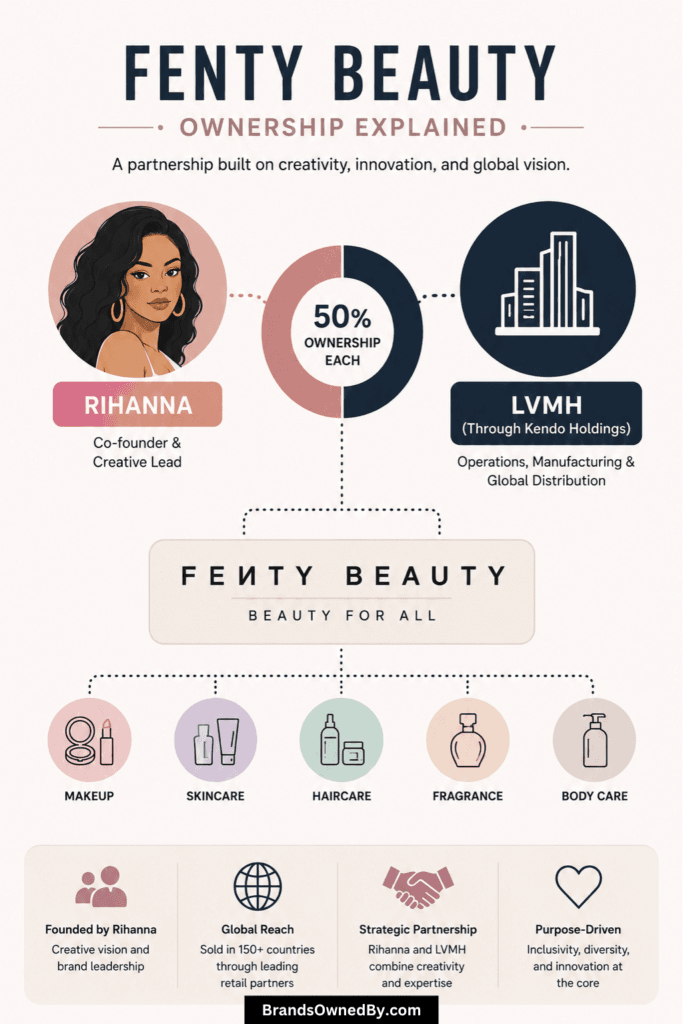
Fenty Beauty is jointly owned by Rihanna and LVMH through its beauty incubator division, Kendo Holdings. As of May 2026, the company continues operating under a 50/50 ownership structure, making Rihanna and LVMH the two main shareholders of the business. This partnership has remained one of the most successful celebrity-corporate joint ventures in the global beauty industry.
Unlike traditional celebrity beauty brands that mainly use licensing agreements, Fenty Beauty was built as an equity partnership from the beginning. Rihanna secured direct ownership and long-term control over the brand’s image, while LVMH provided infrastructure, manufacturing, and global retail support through Kendo Holdings.
The ownership structure gives Fenty Beauty two major advantages:
- Celebrity-led branding and consumer influence through Rihanna.
- Luxury retail infrastructure and operational scale through LVMH.
As of May 2026, no publicly confirmed ownership transfer has been completed despite reports that LVMH explored selling its stake in the company during late 2025 and early 2026. Rihanna and LVMH remain the primary shareholders.
Rihanna: 50% Ownership
Rihanna, whose full name is Robyn Rihanna Fenty, owns approximately 50% of Fenty Beauty as of 2026. She is the co-founder, major shareholder, and primary creative force behind the brand.
Her ownership role goes far beyond celebrity marketing. Rihanna has direct involvement in:
- Product development.
- Shade testing.
- Campaign direction.
- Brand partnerships.
- Inclusivity strategy.
- Consumer engagement.
Before launching Fenty Beauty, Rihanna had already worked with brands like MAC Cosmetics and Puma. However, Fenty Beauty became her first major cosmetics company, where she held real equity ownership instead of simply acting as a brand ambassador.
Her influence helped Fenty Beauty become culturally relevant almost immediately after launch. The company’s inclusive foundation range changed beauty industry standards and forced competitors to expand product diversity.
Rihanna’s ownership stake has also become one of the biggest contributors to her billionaire status. Business analysts frequently identify Fenty Beauty as the core asset in her business portfolio.
As of May 2026, Rihanna remains actively involved in strategic branding decisions and continues serving as the public face of the company.
LVMH: 50% Ownership
LVMH owns the remaining 50% stake in Fenty Beauty through Kendo Holdings, its beauty incubator subsidiary.
LVMH is the world’s largest luxury goods conglomerate and owns brands including:
- Louis Vuitton.
- Dior.
- Sephora.
- Givenchy.
- Tiffany & Co.
- Fendi.
The company played a major role in scaling Fenty Beauty into a global cosmetics brand. LVMH contributed:
- Manufacturing infrastructure.
- Supply chain operations.
- Retail partnerships.
- Global expansion expertise.
- Luxury branding support.
One of the biggest advantages for Fenty Beauty was immediate access to Sephora’s retail network. Since Sephora is also owned by LVMH, Fenty Beauty gained premium shelf placement and global distribution from launch day.
LVMH manages its involvement through Kendo Holdings rather than operating the brand directly under its fashion division.
Kendo Holdings: Operational Shareholder
Kendo Holdings functions as the operational management company behind Fenty Beauty. Although the ownership stake belongs to LVMH, Kendo manages the day-to-day infrastructure of the brand.
Kendo specializes in developing prestige beauty brands and has experience working with several luxury cosmetics companies.
Its responsibilities include:
- Product manufacturing.
- Packaging development.
- Supply chain coordination.
- Retail logistics.
- International operations.
- Product launches.
Kendo helped transform Rihanna’s brand vision into a scalable global business. The company’s operational expertise allowed Fenty Beauty to expand rapidly across international markets within its first few years.
As of 2026, Kendo’s portfolio includes:
- Fenty Beauty.
- Fenty Skin.
- Fenty Hair.
- Fenty Fragrance.
This structure allows Rihanna to focus heavily on branding and innovation while Kendo handles operational execution.
Potential Ownership Changes in 2025–2026
In late 2025 and early 2026, several reports stated that LVMH explored selling its 50% stake in Fenty Beauty. Investment bank Evercore was reportedly involved in evaluating strategic options for the luxury group.
The reports attracted significant attention because Fenty Beauty remains one of the strongest celebrity-backed beauty brands globally.
Industry analysts suggested several possible reasons behind the discussions:
- Luxury market slowdown.
- Portfolio restructuring at LVMH.
- Increasing interest from private equity firms.
- High valuation potential for Fenty Beauty.
Some reports estimated the brand’s valuation between $1 billion and $2.5 billion during these discussions.
However, as of May 2026:
- Rihanna still owns approximately 50%.
- LVMH still owns approximately 50%.
- No officially completed sale has been publicly confirmed.
The ownership structure, therefore, remains unchanged as of the latest available data.
Competitor Ownership Comparison
Fenty Beauty competes with some of the largest cosmetics and celebrity beauty brands in the world. However, its ownership structure is very different from most competitors. The company operates as a joint venture between Rihanna and LVMH, while many rival brands are either fully corporate-owned, founder-controlled, or partially acquired by beauty conglomerates.
This ownership structure affects how each brand handles product development, expansion, retail strategy, and decision-making. Some competitors rely heavily on celebrity branding alone, while others operate under large multinational corporations with little founder involvement.
As of May 2026, Fenty Beauty remains one of the few major celebrity beauty brands where the founder still maintains significant ownership and strategic influence.
| Brand | Main Owner(s) | Ownership Structure | Founder Involvement | Key Difference From Fenty Beauty |
|---|---|---|---|---|
| Fenty Beauty | Rihanna and LVMH (via Kendo Holdings) | 50/50 joint venture | Very high. Rihanna remains deeply involved in branding, products, and strategy. | Combines celebrity ownership with luxury conglomerate infrastructure. |
| Rare Beauty | Selena Gomez and private investors | Privately owned company | High. Selena Gomez remains actively involved. | Does not have backing from a major luxury conglomerate like LVMH. |
| Kylie Cosmetics | Coty Inc. and Kylie Jenner | Majority corporate ownership | Moderate. Kylie Jenner still promotes the brand. | Coty owns the controlling stake, unlike Fenty Beauty’s equal partnership structure. |
| Huda Beauty | Huda Kattan family | Founder-controlled private company | Very high. Huda Kattan leads branding and product direction. | Operates independently without luxury conglomerate ownership. |
| MAC Cosmetics | The Estée Lauder Companies | Fully corporate-owned brand | None from original founders. | Operates under a traditional multinational beauty corporation structure. |
| Charlotte Tilbury Beauty | Puig and Charlotte Tilbury | Majority corporate ownership | High creative involvement from Charlotte Tilbury. | Founder no longer holds equal ownership control after Puig investment. |
| Pat McGrath Labs | Pat McGrath and private investors | Founder-plus-investor model | Very high. Pat McGrath controls creative direction. | Smaller global retail scale compared to Fenty Beauty’s Sephora-backed expansion. |
Fenty Beauty vs Rare Beauty
Rare Beauty is owned by Selena Gomez and Rare Beauty Brands Inc., a privately held company. Unlike Fenty Beauty, Rare Beauty is not owned by a major luxury conglomerate such as LVMH.
Fenty Beauty benefits from:
- Sephora distribution through LVMH.
- Large-scale manufacturing infrastructure.
- Luxury retail expertise.
- Global operational support.
Rare Beauty operates more independently and focuses heavily on mental health branding and community engagement.
The biggest difference is operational scale. Fenty Beauty launched globally from the beginning because of LVMH’s infrastructure, while Rare Beauty expanded more gradually.
Another major difference is shareholder structure:
- Fenty Beauty operates under a Rihanna-LVMH partnership.
- Rare Beauty remains founder-led with private investors.
Fenty Beauty vs Kylie Cosmetics
Kylie Cosmetics has one of the most discussed ownership histories in the beauty industry.
Originally, Kylie Jenner owned most of the company independently. In 2020, Coty Inc. acquired a 51% controlling stake in Kylie Cosmetics for $600 million. As of 2026:
- Coty remains the majority shareholder.
- Kylie Jenner retains a minority ownership stake.
This differs significantly from Fenty Beauty because Rihanna still maintains equal ownership with LVMH instead of becoming a minority stakeholder.
Operationally, Coty controls much of Kylie Cosmetics’ manufacturing, expansion, and corporate strategy. In comparison, Rihanna remains deeply involved in Fenty Beauty’s branding and product direction.
Fenty Beauty is also positioned more strongly in the prestige luxury beauty category, while Kylie Cosmetics targets a more mass-market and trend-driven consumer base.
Fenty Beauty vs Huda Beauty
Huda Beauty remains one of Fenty Beauty’s closest founder-controlled competitors.
As of May 2026, Huda Kattan and her family continue holding major ownership control over Huda Beauty. The company regained stronger founder control after ending certain investment relationships in previous years.
Unlike Fenty Beauty:
- Huda Beauty operates independently.
- It is not owned by a luxury conglomerate.
- Founder control remains centralized within the Kattan family.
Huda Beauty relies heavily on digital commerce, influencer marketing, and direct founder engagement.
Fenty Beauty, on the other hand, combines celebrity branding with luxury retail infrastructure. This gives it stronger international retail distribution through Sephora and LVMH channels.
The ownership models also shape branding strategies:
- Huda Beauty emphasizes influencer-led entrepreneurship.
- Fenty Beauty emphasizes luxury positioning and inclusivity.
Fenty Beauty vs MAC Cosmetics
MAC Cosmetics is owned entirely by The Estée Lauder Companies.
Unlike Fenty Beauty, MAC does not operate as a founder-led celebrity brand. It functions as part of a large publicly traded beauty corporation.
The Estée Lauder Companies control:
- Product strategy.
- Global expansion.
- Retail operations.
- Executive management.
MAC became famous for professional makeup artistry and fashion industry partnerships long before celebrity beauty brands became mainstream.
However, Fenty Beauty disrupted MAC’s complexion business after launching its inclusive shade ranges. Many industry analysts believe the “Fenty Effect” forced legacy brands like MAC to accelerate inclusivity efforts.
Ownership-wise, MAC is fully corporate-controlled, while Fenty Beauty still maintains strong founder influence through Rihanna.
Fenty Beauty vs Charlotte Tilbury Beauty
Charlotte Tilbury Beauty is majority-owned by Puig, the Spanish beauty and fashion group.
Charlotte Tilbury originally founded the company independently before Puig acquired a majority stake. As of 2026:
- Puig controls the business operationally.
- Charlotte Tilbury remains involved creatively and publicly.
This structure is somewhat similar to Fenty Beauty because both brands combine founder branding with corporate infrastructure.
However, there is a key difference:
- Rihanna still reportedly owns 50% of Fenty Beauty.
- Charlotte Tilbury no longer holds equal ownership control after Puig’s acquisition.
Fenty Beauty also leans more heavily into inclusivity and celebrity-driven marketing, while Charlotte Tilbury focuses on luxury glam beauty and professional artistry positioning.
Fenty Beauty vs Pat McGrath Labs
Pat McGrath Labs operates as a founder-led prestige beauty brand backed by outside investors.
Pat McGrath remains the central creative authority behind the company. However, the business has also received investment from private equity and venture capital firms.
Compared with Fenty Beauty:
- Pat McGrath Labs operates at a smaller retail scale.
- Fenty Beauty benefits from Sephora’s global infrastructure.
- Pat McGrath Labs focuses more on high-fashion artistry and luxury editorial makeup.
Both brands compete strongly in prestige cosmetics, but their ownership structures differ significantly.
Fenty Beauty relies on the Rihanna-LVMH partnership model, while Pat McGrath Labs follows a founder-plus-investor structure.
How Fenty Beauty’s Ownership Structure Stands Out
Fenty Beauty’s ownership structure remains unusual in the beauty industry because it combines:
- Equal founder ownership.
- Luxury conglomerate backing.
- Global retail infrastructure.
- Strong creative control from the founder.
Most celebrity beauty brands eventually shift toward majority corporate ownership after scaling. Fenty Beauty has largely maintained a balance between founder influence and corporate operational support.
This hybrid structure helped the company scale rapidly while still preserving Rihanna’s direct influence over branding, inclusivity standards, and product development.
As of May 2026, Fenty Beauty remains one of the strongest examples of a successful celebrity-founded beauty company operating at a luxury global scale without removing the founder from decision-making authority.
Who Controls Fenty Beauty?
Fenty Beauty is controlled through a shared structure involving Rihanna, LVMH, and Kendo Holdings. While Rihanna remains the public face and creative leader of the brand, operational control is managed through Kendo, the beauty incubator owned by LVMH.
This structure allows Fenty Beauty to combine celebrity-driven branding with large-scale corporate infrastructure. Rihanna controls the brand identity, product vision, and marketing direction, while LVMH and Kendo oversee manufacturing, global retail operations, logistics, and expansion strategy.
As of May 2026, Fenty Beauty’s control structure can be summarized as follows:
| Area of Control | Primary Decision Maker |
|---|---|
| Brand identity and marketing | Rihanna |
| Product inclusivity strategy | Rihanna and creative teams |
| Manufacturing and operations | Kendo Holdings |
| Financial and corporate management | LVMH |
| Retail distribution | Sephora and LVMH |
| International expansion | Kendo Holdings and LVMH |
Rihanna Controls Creative Direction
Rihanna remains the most influential figure behind Fenty Beauty’s public image and product strategy. Even though the company operates through a partnership structure, she plays a direct role in many major decisions.
Her responsibilities include:
- Product approval.
- Shade range development.
- Campaign direction.
- Brand partnerships.
- Marketing strategy.
- Inclusivity standards.
Unlike many celebrity founders who mainly promote products, Rihanna has consistently maintained hands-on involvement in the company. This is one reason why Fenty Beauty developed a stronger brand identity than many competing celebrity cosmetics brands.
For example, Rihanna was heavily involved in the original Pro Filt’r foundation launch, which introduced one of the beauty industry’s widest shade ranges at the time. That decision helped define the company’s identity and changed competitor strategies across the cosmetics market.
As of 2026, Rihanna continues serving as the face of the brand and remains one of the key strategic decision-makers.
LVMH Controls Corporate Infrastructure
LVMH controls the corporate and operational side of Fenty Beauty through Kendo Holdings.
The luxury conglomerate oversees areas such as:
- Manufacturing operations.
- Global supply chain management.
- Retail expansion.
- International logistics.
- Financial planning.
- Corporate partnerships.
LVMH’s involvement gave Fenty Beauty immediate access to luxury retail infrastructure through Sephora, which is also owned by LVMH.
This operational control is important because scaling a global cosmetics company requires:
- Manufacturing capacity.
- Retail relationships.
- International compliance systems.
- Inventory management.
- Distribution networks.
Most independent celebrity beauty startups struggle with these areas during expansion. Fenty Beauty avoided many of those challenges because LVMH already had global infrastructure in place.
Kendo Holdings Manages Day-to-Day Operations
Kendo Holdings acts as the operational management company behind Fenty Beauty.
Kendo specializes in launching and managing prestige beauty brands. The company handles the technical and operational side of the business while Rihanna focuses on creative leadership.
Kendo’s responsibilities include:
- Product formulation.
- Packaging production.
- Vendor management.
- Retail coordination.
- Product launch execution.
- International market operations.
The company also helps coordinate product rollouts across Sephora stores and e-commerce channels worldwide.
This structure allows Fenty Beauty to operate efficiently at a global scale without requiring Rihanna to directly manage corporate operations.
CEO and Executive Leadership Structure
Fenty Beauty does not operate like a traditional standalone public company with a highly visible independent CEO structure. Instead, leadership responsibilities are integrated into Kendo Holdings and LVMH’s beauty management system.
Senior executives connected to Kendo and LVMH oversee:
- Brand operations.
- Product category expansion.
- International growth.
- Retail strategy.
- Financial management.
Over the years, multiple beauty industry executives have helped manage Fenty Beauty’s expansion across makeup, skincare, fragrance, and haircare categories.
Although these executives handle corporate operations, Rihanna remains the most influential figure from a strategic branding perspective.
Role of Sephora in Operational Control
Sephora plays a major role in Fenty Beauty’s retail control and global visibility.
Because Sephora is owned by LVMH, Fenty Beauty benefits from:
- Premium retail placement.
- Global in-store distribution.
- Marketing support.
- International product launches.
- Direct consumer access.
This relationship gives the company a major competitive advantage compared to independent beauty startups that must negotiate shelf space with third-party retailers.
Sephora’s support also helped Fenty Beauty expand rapidly into international markets shortly after launch.
Fenty Beauty Annual Revenue and Net Worth
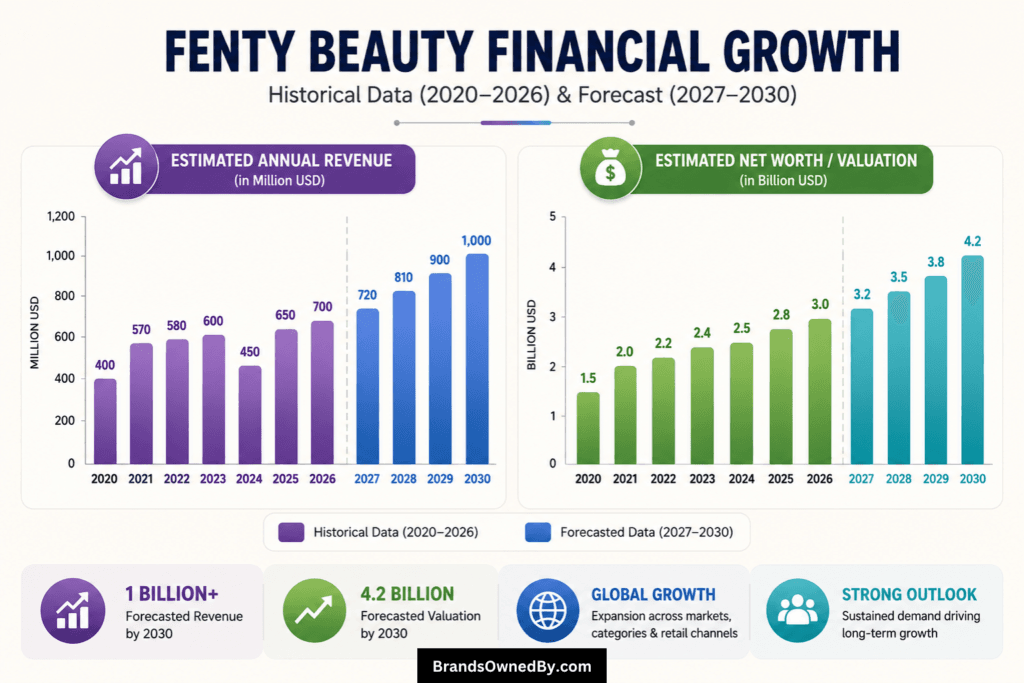
As of May 2026, the company is estimated to generate between $650 million and $700 million in annual revenue, while its estimated valuation stands near $3 billion. The brand’s financial strength comes from high-margin prestige cosmetics, Sephora-backed global distribution, strong direct-to-consumer sales, and consistent demand across makeup and skincare categories.
Unlike many celebrity beauty brands that experienced short-term hype followed by declining sales, Fenty Beauty maintained strong global positioning because of repeat purchases, international expansion, and product diversification. Makeup products still account for the largest share of revenue, but skincare and body products continue growing rapidly.
2026 Revenue Performance
In 2026, complexion products remain the company’s biggest revenue category. Foundations, concealers, contour products, and skin-focused makeup lines continue generating the highest sales volume globally. The Pro Filt’r foundation line remains one of the brand’s strongest long-term revenue drivers because of its broad shade range and strong customer retention.
Industry analysts estimate that makeup products account for roughly 65% to 70% of Fenty Beauty’s total annual revenue in 2026. Skincare products under Fenty Skin contribute an estimated 20% to 25%, while fragrance, body care, and newer product categories make up the remaining share.
North America remains the company’s largest market. However, Asia-Pacific is currently the fastest-growing region for the brand. Growth in countries such as China, Singapore, South Korea, and the Middle East increased significantly after Sephora expanded premium beauty operations in those markets.
Digital commerce also contributes a major share of revenue. Analysts estimate that direct online sales and mobile commerce account for more than one-third of total annual revenue in 2026. This gives Fenty Beauty stronger margins compared to brands that rely mainly on third-party retail channels.
2026 Net Worth and Brand Valuation
As of May 2026, Fenty Beauty’s estimated valuation is approximately $3 billion. This valuation is based on:
- Annual revenue performance.
- Prestige beauty market positioning.
- Strong EBITDA margins common in luxury cosmetics.
- Global distribution strength.
- High brand recognition.
- Long-term consumer retention.
The company’s valuation increased significantly after Fenty Skin expanded the business beyond cosmetics. Investors now view the Fenty ecosystem as a multi-category beauty platform rather than a standalone makeup company.
Rihanna’s ownership stake remains one of the largest wealth contributors in her business portfolio. Based on current valuation estimates, her 50% ownership stake in Fenty Beauty is valued at roughly $1.5 billion before taxes and private market adjustments.
LVMH’s involvement also increases the company’s enterprise value because the group provides operational stability, luxury positioning, and access to Sephora’s premium retail infrastructure.
Revenue Growth Between 2020 and 2026
Fenty Beauty’s revenue growth remained relatively strong despite increasing competition from celebrity beauty brands and luxury cosmetics companies.
In 2020, estimated annual revenue stood near $400 million. During that period, online beauty sales surged globally, benefiting digitally native beauty brands with strong social media engagement.
By 2021, revenue estimates crossed $550 million after the expansion of Fenty Skin and increased global Sephora distribution. The company maintained momentum in 2022 and 2023 as skincare sales improved customer retention rates and increased average order value.
Revenue growth slowed slightly during parts of 2024 because of broader weakness in the luxury beauty sector and reduced discretionary consumer spending in some markets. However, the brand continued outperforming many competing celebrity-owned cosmetics companies because of strong international demand and stable Sephora partnerships.
In 2025 and 2026, growth accelerated again due to:
- Expansion in Asia-Pacific markets.
- Strong fragrance demand.
- Increased body care sales.
- Better direct-to-consumer conversion rates.
- Product expansion into haircare and lifestyle categories.
Profitability and Business Model
Fenty Beauty operates primarily in the prestige beauty segment, which generally produces higher gross margins than mass-market cosmetics brands.
The company benefits from several high-margin business advantages:
- Premium pricing strategy.
- Limited dependency on discount retail.
- Strong online sales mix.
- Low traditional advertising costs due to Rihanna’s global influence.
- High repeat purchase rates for complexion and skincare products.
Industry analysts estimate that Fenty Beauty’s EBITDA margins are comparable to other leading prestige beauty brands operating through Sephora and luxury retail channels.
The company also benefits from efficient retail scaling because Sephora already provides established global shelf space, logistics systems, and customer acquisition infrastructure.
Future Revenue Forecast Through 2030
Analysts expect Fenty Beauty to continue growing steadily through 2030, although at a slower pace than its early launch years. Growth forecasts are primarily driven by skincare expansion, Asia-Pacific demand, premium beauty market growth, and stronger direct-to-consumer sales.
Projected annual revenue estimates include:
- 2027: $720 million.
- 2028: $810 million.
- 2029: $900 million.
- 2030: More than $1 billion.
Projected valuation estimates include:
- 2027: $3.2 billion.
- 2028: $3.5 billion.
- 2029: $3.8 billion.
- 2030: $4.2 billion.
Most long-term growth is expected to come from skincare, fragrance, and international expansion rather than traditional makeup products alone. Analysts also expect the company to strengthen its presence in luxury body care and premium haircare categories over the next several years.
Brands Owned by Fenty Beauty
As of 2026, Fenty Beauty operates a growing beauty ecosystem that extends beyond traditional cosmetics. The company has expanded into skincare, fragrance, haircare, and body-focused beauty categories under the broader Fenty brand umbrella. Unlike large conglomerates that own dozens of unrelated subsidiaries, Fenty Beauty focuses mainly on internally developed Fenty-branded businesses rather than acquiring outside companies.
The company’s strategy centers on vertical brand expansion. Instead of purchasing independent brands, Fenty Beauty and its management structure under Kendo Holdings have expanded through category extensions connected to Rihanna’s Fenty identity.
| Company / Brand | Launch Year | Category | Main Products / Services | Role in Fenty Ecosystem | Key Details as of 2026 |
|---|---|---|---|---|---|
| Fenty Beauty | 2017 | Cosmetics and Makeup | Foundation, concealers, lipsticks, blushes, eye makeup, makeup tools | Core flagship business | Best known for inclusive shade ranges and prestige beauty positioning through Sephora distribution. |
| Fenty Skin | 2020 | Skincare | Cleansers, moisturizers, toners, serums, SPF products, body skincare | Skincare division | One of the company’s fastest-growing segments with strong global demand, especially in Asia-Pacific markets. |
| Fenty Hair | 2024 | Haircare | Hair repair systems, curl products, scalp care, styling products | Haircare expansion business | Focuses on textured hair and premium repair-focused formulations for multiple hair types. |
| Fenty Eau de Parfum | 2021 | Fragrance | Luxury perfume products | Fragrance division | Positioned as a premium fragrance brand with limited-release luxury marketing strategy. |
| Fenty Body and Personal Care | 2022 | Body Care and Beauty | Body creams, shimmer products, scrubs, hydration products | Body care expansion | Helps increase repeat customer purchases and strengthens category diversification. |
| Fenty Beauty Digital Commerce Operations | 2017 | E-commerce and Digital Retail | Online product sales, mobile commerce, digital marketing, loyalty systems | Direct-to-consumer operations | Generates a major share of annual revenue through global online sales and exclusive product launches. |
| Fenty Beauty International Retail Operations | 2017 | Global Retail Distribution | Sephora retail distribution, international beauty retail partnerships | Global expansion infrastructure | Supports large-scale distribution across North America, Europe, Asia-Pacific, and the Middle East. |
Fenty Beauty
Fenty Beauty remains the core business within the Fenty beauty ecosystem. Launched in 2017, the company specializes in prestige cosmetics and complexion-focused makeup products.
The brand became globally recognized after launching the Pro Filt’r Soft Matte Longwear Foundation with one of the beauty industry’s widest foundation shade ranges. This product launch helped establish Fenty Beauty as an inclusivity-focused cosmetics brand.
As of 2026, Fenty Beauty operates across multiple makeup categories, including:
- Foundation and complexion products.
- Lip products.
- Eye makeup.
- Highlighters and blushes.
- Makeup tools and accessories.
The company sells products primarily through:
- Sephora stores.
- Official e-commerce platforms.
- International beauty retail partners.
Fenty Beauty remains the largest revenue-generating business inside the broader Fenty beauty portfolio.
Fenty Skin
Fenty Skin is the skincare division of the Fenty beauty ecosystem. The company launched in 2020 to expand beyond cosmetics into daily skincare and wellness-focused products.
The brand focuses on simplified skincare routines and gender-inclusive marketing. Product categories include:
- Cleansers.
- Moisturizers.
- Toners.
- Serums.
- Sunscreen products.
- Body care products.
Fenty Skin became one of the company’s fastest-growing segments because it expanded customer retention beyond makeup consumers. Many skincare buyers also transitioned into other Fenty product categories.
As of 2026, Fenty Skin plays a major role in the company’s international growth strategy, particularly in Asia-Pacific markets where skincare demand remains extremely strong.
Fenty Hair
Fenty Hair is the company’s haircare business launched to expand into textured hair and hair repair markets.
The brand focuses on:
- Hair repair systems.
- Strengthening treatments.
- Curl and texture-focused products.
- Styling products.
- Scalp care solutions.
Fenty Hair targets consumers seeking premium haircare products designed for multiple hair textures and styling needs. The company positions the brand similarly to Fenty Beauty by emphasizing inclusivity and broad consumer accessibility.
The launch of Fenty Hair also helped the broader Fenty ecosystem compete more directly with celebrity-backed haircare brands and prestige salon-focused companies.
Fenty Eau de Parfum
Fenty Eau de Parfum represents the fragrance division of the company.
The fragrance line launched as a luxury-focused extension of the broader Fenty ecosystem. The company positioned the perfume as a premium product rather than a mass-market celebrity fragrance.
The fragrance business helped Fenty expand into higher-margin luxury beauty categories. Early launches generated strong demand through limited-release strategies and direct online sales.
As of 2026, fragrance remains a smaller revenue contributor compared to makeup and skincare, but it continues strengthening the overall luxury positioning of the Fenty brand.
Fenty Body and Personal Care Products
Fenty Beauty has also expanded into body-focused beauty and personal care categories.
These products include:
- Body creams.
- Body scrubs.
- Shimmer body products.
- Hydration-focused skincare.
- Beauty accessories.
The expansion into body care reflects broader industry trends where prestige beauty companies increasingly diversify beyond facial cosmetics and skincare.
Body care products also help increase customer lifetime value because consumers purchase these products more frequently than premium makeup items.
Fenty Beauty Digital Commerce Operations
The company operates a major direct-to-consumer digital business through its official online platforms.
This division manages:
- Global e-commerce operations.
- Product launches.
- Consumer data systems.
- Online marketing campaigns.
- Loyalty and customer retention initiatives.
Digital commerce has become one of the company’s most important operational assets. As of 2026, online sales contribute a significant share of annual revenue because direct-to-consumer channels generate stronger margins than third-party retail distribution.
The company’s digital infrastructure also supports rapid international product launches and exclusive online product drops.
International Retail Operations
Fenty Beauty operates an extensive global retail network through Sephora and regional beauty partners.
The company’s retail operations include:
- North American Sephora distribution.
- European retail partnerships.
- Asia-Pacific expansion.
- Middle Eastern luxury beauty distribution.
Unlike many independent celebrity beauty brands, Fenty Beauty gained immediate large-scale retail access because of its partnership with LVMH and Kendo Holdings.
International operations remain one of the company’s biggest competitive advantages in the prestige beauty market.
Conclusion
Fenty Beauty is owned through a partnership between Rihanna and LVMH, with LVMH acting as the largest controlling shareholder through Kendo Holdings. Rihanna remains deeply involved in the company’s creative and strategic direction.
The company transformed the beauty industry through inclusive product development, celebrity-driven branding, and global retail execution. Its success also demonstrated how founder-led beauty brands can compete with legacy cosmetics giants.
As of 2026, Fenty Beauty remains one of the most influential beauty brands in the global cosmetics market.
FAQs
How much of Fenty does Rihanna own?
As of 2026, Rihanna owns approximately 50% of Fenty Beauty. The remaining 50% is owned by LVMH through its beauty incubator division, Kendo Holdings. Rihanna’s ownership stake makes her one of the wealthiest celebrity entrepreneurs in the beauty industry.
Who created Fenty Beauty?
Fenty Beauty was created by Rihanna in partnership with Kendo Holdings, an LVMH-owned beauty incubator. The company officially launched in September 2017 through Sephora stores and online platforms worldwide.
Where is Fenty Beauty located?
Fenty Beauty operates globally, but its business operations are primarily managed through Kendo Holdings in San Francisco, California, United States. The brand sells products internationally through Sephora stores, official e-commerce platforms, and regional beauty retailers.
What company owns Fenty Beauty?
Fenty Beauty is jointly owned by Rihanna and LVMH through Kendo Holdings. LVMH manages the operational and retail infrastructure, while Rihanna remains a major shareholder and the company’s creative leader.
Does Rihanna still own Fenty Beauty?
Yes. As of May 2026, Rihanna still owns approximately 50% of Fenty Beauty and remains actively involved in branding, product development, marketing strategy, and creative direction.
Is Fenty Beauty owned by LVMH?
Yes. LVMH partially owns Fenty Beauty through Kendo Holdings. As of 2026, LVMH holds approximately a 50% ownership stake in the company alongside Rihanna.