

- The Daily Beast is owned through IAC Inc., a publicly traded American media and internet holding company controlled by billionaire media executive Barry Diller as of 2026.
- Barry Diller is the most influential figure behind The Daily Beast because of his voting control and leadership authority at IAC, even though institutional investors own larger financial stakes.
- Major shareholders connected to The Daily Beast ownership structure include Southeastern Asset Management (approximately 12.5%), Vanguard Group (8.8%), BlackRock (7.4%), and State Street Global Advisors (4.5%) as of May 2026.
- The Daily Beast operates as a digital-first political news and investigative journalism platform with revenue generated from advertising, subscriptions, podcasts, sponsored content, and multimedia operations, with estimated 2026 revenue of $182 million and estimated valuation of $680 million.
The Daily Beast is an American digital news and opinion platform known for political reporting, investigative journalism, entertainment coverage, and cultural commentary. The company operates as a digital-first publication rather than a traditional newspaper or television network.
The platform publishes breaking news, long-form investigations, interviews, analysis pieces, and opinion articles. Its reporting often focuses on U.S. politics, government controversies, media trends, celebrity news, and global affairs.
The Daily Beast became popular because of its fast publishing model and aggressive editorial style. Unlike older print publications that relied heavily on weekly publishing cycles, the company was designed for real-time online news consumption.
Its audience mainly includes:
- Political readers.
- Media professionals.
- Younger digital audiences.
- Entertainment readers.
- Social media users following trending news.
The publication is especially active during major political events such as presidential elections, congressional investigations, and international crises.
Over the years, The Daily Beast has built a reputation for publishing exclusive investigations and controversial stories that frequently get picked up by larger television networks and newspapers.
Digital-First Media Strategy
The Daily Beast was created during a period when traditional newspapers were struggling to adapt to the internet era. Instead of focusing on print circulation, the company concentrated on digital traffic, online engagement, and viral reporting.
For example, many of its stories are optimized for:
- Mobile readers.
- Social media sharing.
- Search engine visibility.
- Fast news updates.
- Multimedia consumption.
This approach helped the company compete with newer digital publishers instead of competing directly with traditional print-only newspapers.
Editorial Focus
The Daily Beast covers multiple categories, but politics remains its strongest area. Its newsroom is known for opinion-driven political reporting and investigative journalism.
Major coverage areas include:
- U.S. politics.
- White House coverage.
- Entertainment news.
- International affairs.
- Media industry reporting.
- Crime and investigations.
- Technology and culture.
The publication often blends traditional journalism with conversational digital storytelling. This style appeals to online audiences looking for faster and more engaging news coverage.
The Daily Beast Founder
Tina Brown is the founder of The Daily Beast. She launched the company in 2008 after building a major reputation in the magazine industry.
Before founding The Daily Beast, Brown served as editor of Vanity Fair and later The New Yorker. She was already considered one of the most influential magazine editors in American media.
Her experience in celebrity journalism, politics, and cultural reporting heavily influenced The Daily Beast’s editorial direction.
Brown launched The Daily Beast during a major transformation in the media industry. Print advertising revenues were declining rapidly, while digital news consumption was growing.
She believed traditional media companies were moving too slowly online. The Daily Beast was designed to operate faster, publish more aggressively, and attract internet-based audiences.
For example, instead of waiting for scheduled print editions, the platform focused on:
- Continuous news updates.
- Viral headlines.
- Real-time political commentary.
- Digital audience engagement.
This strategy helped the company grow quickly during its early years.
Early Leadership and Vision
Tina Brown did more than simply launch the publication. She shaped its editorial personality and newsroom culture.
The early vision of The Daily Beast focused on combining:
- Serious investigative journalism.
- Celebrity and entertainment coverage.
- Sharp political commentary.
- Internet-driven storytelling.
This hybrid style separated the company from more traditional newspapers.
Brown also recruited experienced journalists, political writers, and editors from major media organizations. That helped establish credibility early in the company’s growth phase.
Influence on Modern Digital Journalism
The Daily Beast became part of a broader shift toward digital-native media companies. Its publishing model influenced how many online news organizations approached breaking news and audience engagement.
For example, many modern digital publishers now use strategies that The Daily Beast adopted early, including:
- Rapid publishing cycles.
- Mobile-first reporting.
- Social media traffic strategies.
- Personality-driven journalism.
- Opinion-heavy digital content.
Tina Brown’s role in building the company remains one of the most important parts of The Daily Beast ownership and history discussion.
Ownership History
The ownership history of The Daily Beast reflects the broader transformation of the digital media industry. The company moved through multiple phases involving independent startup ownership, corporate mergers, restructuring, and large media holding company control.
Each stage changed how the publication operated, expanded, and competed in the online news market.
Founding as an Independent Digital Media Company
The Daily Beast was founded in 2008 by Tina Brown as an independent digital news platform. At the time, most major media companies still focused heavily on print newspapers and magazines.
Brown wanted to build a publication designed specifically for internet audiences. The company launched with backing from investors who believed digital journalism would eventually replace large portions of traditional print media.
During its early years, The Daily Beast operated independently with Tina Brown leading both editorial direction and business growth efforts.
The company focused on:
- Breaking political news.
- Fast publishing cycles.
- Opinion journalism.
- Entertainment reporting.
- Viral digital storytelling.
This strategy helped the platform quickly gain recognition among politically engaged readers and media professionals.
Early Investor Support
Like many digital media startups launched during the late 2000s, The Daily Beast required outside investment to expand operations, hire journalists, and compete against established news brands.
Early investors supported the company because online readership was growing rapidly while traditional newspaper circulation was declining.
The publication invested heavily in:
- Digital newsroom operations.
- Website infrastructure.
- Political coverage.
- Editorial talent.
- Social media distribution.
This period was critical because the company needed audience growth before becoming financially sustainable.
Merger With Newsweek
One of the biggest turning points in the company’s ownership history came in 2010 when The Daily Beast merged with Newsweek magazine.
The merged business became known as The Newsweek Daily Beast Company.
This deal was significant because it combined:
- A modern digital-first publication.
- A legacy print magazine with decades of history.
At the time, Newsweek was facing severe financial pressure due to declining print advertising and falling circulation numbers. The merger was viewed as an attempt to modernize Newsweek through The Daily Beast’s digital strategy.
Tina Brown became editor of the combined operation.
Why the Newsweek Merger Happened
The merger happened because both companies offered something the other lacked.
The Daily Beast brought:
- Digital publishing expertise.
- Faster newsroom operations.
- Online audience growth.
- Internet-focused journalism.
Newsweek brought:
- Brand recognition.
- Historical credibility.
- Established subscriber relationships.
- International media presence.
The goal was to create a hybrid media business capable of surviving the digital disruption affecting newspapers and magazines.
Challenges During the Newsweek Period
The merger created operational difficulties almost immediately.
The Daily Beast operated like a fast-moving digital startup. Newsweek operated like a traditional legacy publication with print-focused structures.
Combining these two cultures proved difficult.
Some major challenges included:
- Declining print revenue.
- High operational costs.
- Different newsroom cultures.
- Pressure to modernize quickly.
- Competition from newer digital publishers.
Newsweek eventually stopped its print edition for a period as the company tried shifting further toward digital publishing.
IAC Becomes the Main Controlling Force
Barry Diller’s media conglomerate IAC became increasingly important in The Daily Beast’s ownership structure during this period.
IAC, also known as InterActiveCorp, had already built a reputation for investing in internet-based businesses. The company saw potential in digital media despite the financial struggles affecting traditional journalism.
Under IAC’s influence, The Daily Beast focused more aggressively on digital audience expansion and online monetization strategies.
This included a stronger emphasis on:
- Online advertising.
- Subscription growth.
- Mobile traffic.
- Political journalism.
- Viral digital content.
Separation From Newsweek
Over time, it became clear that Newsweek and The Daily Beast were moving in different strategic directions.
Eventually, Newsweek was separated from The Daily Beast and sold to new owners. This allowed The Daily Beast to focus entirely on its digital-first media strategy without the burden of managing a struggling print magazine business.
This separation was important because it simplified ownership and operational management.
After the split:
- Newsweek continued under separate ownership.
- The Daily Beast remained connected to IAC.
The company could now focus fully on digital publishing and investigative reporting.
Expansion as a Standalone Digital Brand
After separating from Newsweek, The Daily Beast strengthened its identity as an independent-style digital publication.
The company invested more heavily in:
- Investigative journalism.
- Political reporting.
- Subscription programs.
- Multimedia content.
- Podcasts and video.
This period helped The Daily Beast compete more directly with companies such as Politico, Axios, BuzzFeed News, and other digital-native publishers.
Ownership Stability Under IAC
Compared to many digital media startups that faced bankruptcy, shutdowns, or repeated ownership changes, The Daily Beast benefited from relatively stable corporate backing through IAC.
IAC’s ownership structure gave the company access to:
- Corporate financing.
- Technology resources.
- Strategic management support.
- Digital business expertise.
This stability became especially important as advertising markets became more volatile across the media industry.
For example, many digital publishers struggled after major social media algorithm changes reduced traffic from platforms like Facebook.
The Daily Beast survived these industry shifts partly because of stronger ownership backing and diversified revenue strategies.
Modern Ownership Structure
As of 2026, The Daily Beast remains connected to IAC’s media investment ecosystem.
Although the publication operates with its own newsroom leadership and editorial teams, overall corporate ownership remains tied to IAC and its shareholders.
Barry Diller continues to be the most influential figure associated with the company’s ownership because of his leadership role at IAC.
This ownership structure allows The Daily Beast to function with a combination of:
- Editorial independence.
- Corporate financial oversight.
- Long-term strategic backing.
The model is similar to how many modern media brands operate under larger parent companies while maintaining separate editorial identities.
Who Owns The Daily Beast?
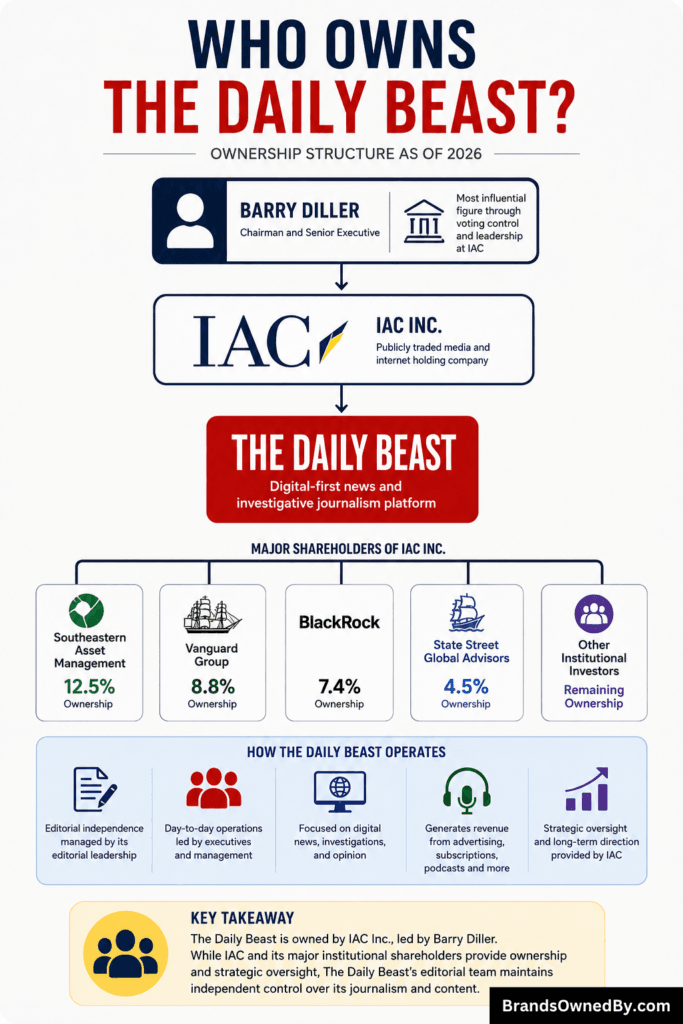
The Daily Beast is owned through IAC Inc., the American media and internet holding company led by billionaire media executive Barry Diller. While The Daily Beast operates as a separate digital news publication with its own editorial leadership, its ownership is tied to IAC’s shareholder structure.
As of May 2026, institutional investors control most of IAC’s outstanding shares. However, Barry Diller remains the most influential individual because of his voting control, board authority, and long-term leadership position inside the company.
Unlike traditional family-owned newspapers, The Daily Beast operates under a public company ownership structure. This means investment firms, hedge funds, insiders, and institutional shareholders collectively own the parent company behind the publication.
The ownership structure includes:
- Institutional shareholders holding the most common shares.
- Insider ownership is tied to executives and board members.
- Special voting influence connected to Barry Diller.
- Public market investors through the Nasdaq-listed IAC stock.
Although The Daily Beast itself is not independently traded on the stock market, ownership of IAC effectively determines who owns and influences the publication.
Barry Diller
Barry Diller is the most powerful individual connected to The Daily Beast ownership structure.
As of May 2026, Diller directly owns roughly 1.4% to 1.5% of IAC’s outstanding shares based on public market ownership disclosures.
However, his real influence is much larger than his economic stake because of IAC’s governance structure and enhanced voting arrangements.
Diller serves as:
- Chairman of IAC.
- Senior Executive of the company.
- Strategic decision-maker behind major acquisitions and investments.
His influence comes from decades of control over IAC and its predecessor companies. He has played a central role in building the company’s internet and media portfolio, including investments in:
- Dotdash Meredith.
- Vimeo.
- Match Group.
- Ask Media.
- The Daily Beast.
Although institutional investors own larger percentages financially, Diller effectively controls strategic direction because of concentrated voting authority and board influence.
For example, major decisions involving acquisitions, media expansion, executive appointments, or asset sales typically require leadership alignment with Diller’s long-term strategy.
Southeastern Asset Management
Southeastern Asset Management is currently one of the largest institutional shareholders connected to The Daily Beast ownership structure through IAC.
As of May 2026, the investment firm controls approximately 12.5% of IAC shares.
The firm is known for value-focused investing and often targets companies it believes are undervalued relative to long-term business potential.
Its investment in IAC reflects confidence in the company’s digital media and internet assets.
Southeastern Asset Management typically focuses on:
- Long-term corporate value creation.
- Asset monetization opportunities.
- Strategic portfolio management.
- Undervalued media businesses.
Although the firm holds a large financial stake, it does not directly manage editorial operations at The Daily Beast.
Vanguard Group
The Vanguard Group is another major shareholder indirectly connected to The Daily Beast.
As of May 2026, Vanguard owns approximately 8.8% of IAC shares.
Vanguard is one of the world’s largest asset managers and mainly holds shares through:
- Index funds.
- ETFs.
- Retirement portfolios.
- Institutional investment products.
Its ownership stake reflects IAC’s position as a publicly traded media and internet company.
Vanguard generally acts as a passive institutional investor. It does not participate in newsroom management or editorial content decisions at The Daily Beast.
However, because of the size of its holdings, Vanguard remains influential in:
- Shareholder voting.
- Corporate governance matters.
- Board-related decisions.
- Executive compensation approvals.
BlackRock
BlackRock is another major institutional shareholder tied to The Daily Beast through IAC ownership.
As of May 2026, BlackRock controls approximately 7.4% of IAC shares.
BlackRock is the world’s largest asset management company. It manages trillions of dollars in assets globally through mutual funds, ETFs, pension investments, and institutional portfolios.
Its stake in IAC is primarily financial rather than operational.
BlackRock’s investment exposure to media companies like IAC is usually spread across large diversified investment funds rather than direct strategic involvement.
Still, because of its size, BlackRock plays an important role in shareholder voting and public-company governance discussions.
State Street Global Advisors
State Street Global Advisors is another major institutional shareholder in IAC.
As of May 2026, the company owns nearly 4.5% of IAC shares.
State Street is one of the largest institutional asset managers in the world and holds investments across thousands of publicly traded companies.
Like Vanguard and BlackRock, State Street’s ownership mainly comes through:
- Index-tracking funds.
- Institutional investment accounts.
- Retirement products.
- ETF portfolios.
The firm does not directly influence The Daily Beast newsroom. Its role is primarily financial and governance-related.
Insider Ownership and Executive Holdings
In addition to institutional investors, IAC insiders collectively own more than 4% of company shares as of May 2026.
This insider ownership includes:
- Executives.
- Directors.
- Senior leadership.
- Corporate insiders.
Insider ownership is important because it aligns management interests with long-term shareholder performance.
For example, executives with equity stakes may prioritize:
- Audience growth.
- Subscription expansion.
- Long-term profitability.
- Digital media investments.
This can affect how businesses like The Daily Beast are funded and managed internally.
Competitor Ownership Comparison
The Daily Beast competes with several major digital news companies, political media platforms, and legacy news organizations. However, its ownership structure is very different from many of its competitors.
Some rival companies are controlled by billionaire families. Others are owned by global media conglomerates or private investment groups. These ownership structures affect how companies expand, invest in journalism, and generate revenue.
The Daily Beast operates under IAC ownership, which gives it corporate financial backing while still allowing the publication to function as a digital-first newsroom. Compared to some competitors, it operates on a smaller scale but with a more aggressive online publishing strategy.
| Media Company | Owner | Ownership Type | Key Ownership Details | Main Business Focus |
|---|---|---|---|---|
| The Daily Beast | IAC Inc. | Public company with executive voting control | Controlled through IAC’s corporate structure. Barry Diller remains the most influential figure because of voting influence and leadership control. | Digital news, political reporting, investigations, entertainment coverage |
| Politico | Axel Springer | Private media conglomerate | Acquired by German publishing giant Axel Springer in a deal valued at more than $1 billion. | Political journalism, policy intelligence, subscription-based reporting |
| Axios | Cox Enterprises | Private family-owned conglomerate | Owned by Cox Enterprises, which gives Axios flexibility without public shareholder pressure. | Newsletter-driven journalism, business and political news |
| CNN | Warner Bros. Discovery | Public multinational media conglomerate | Operates under one of the world’s largest entertainment and news companies with global television infrastructure. | Television news, global reporting, streaming and digital media |
| Fox News | Fox Corporation | Public company with family control | The Murdoch family maintains major influence through voting control and long-term ownership structures. | Cable news, political commentary, television broadcasting |
| The New York Times | The New York Times Company | Public company with family voting control | The Sulzberger family controls voting power through a dual-class share structure. | Subscription journalism, international reporting, digital media |
| BuzzFeed | BuzzFeed Inc. | Public digital media company | Ownership is spread across public investors, institutional shareholders, and company insiders. | Viral media, entertainment, digital journalism |
| Newsweek | Independent ownership group | Privately controlled media company | Operates separately after splitting from The Daily Beast years earlier. | General news, global editions, digital publishing |
The Daily Beast vs Politico
Politico is one of The Daily Beast’s closest competitors in political journalism and Washington coverage. However, the ownership structures of the two companies are very different.
The Daily Beast operates under IAC, while Politico is owned by German media giant Axel Springer. Axel Springer acquired Politico in a deal worth more than $1 billion to strengthen its presence in the U.S. political media market.
Politico focuses heavily on policy reporting, government intelligence, and subscription-based professional services. Much of its business comes from high-priced corporate and institutional subscriptions through Politico Pro.
The Daily Beast follows a broader digital media model. It combines political reporting with entertainment news, investigative journalism, opinion content, and viral online coverage.
Another major difference is audience strategy. Politico mainly targets policymakers, lobbyists, executives, and government professionals. The Daily Beast targets a wider online audience interested in politics, breaking news, and cultural commentary.
The Daily Beast vs Axios
Axios operates under ownership of Cox Enterprises, a privately held American conglomerate owned by the Cox family.
Unlike IAC, Cox Enterprises is not publicly traded. This allows Axios to operate with less pressure from public shareholders and quarterly earnings expectations.
Axios became popular because of its short-form “Smart Brevity” writing style. The company focuses heavily on newsletters, business reporting, and executive-focused news products.
The Daily Beast takes a different approach. Its reporting style is more traditional and opinion-driven. The platform publishes longer investigations, political analysis, entertainment stories, and fast-moving breaking news coverage.
Ownership also affects monetization strategies. Axios relies heavily on sponsorships, newsletters, and corporate media partnerships. The Daily Beast depends more on digital advertising, subscriptions, and high-traffic online journalism.
The Daily Beast vs CNN
CNN operates on a much larger scale than The Daily Beast.
The company is owned by Warner Bros. Discovery, one of the world’s largest media and entertainment corporations. CNN benefits from global television infrastructure, international bureaus, streaming investments, and massive newsroom resources.
The Daily Beast, in comparison, is primarily a digital-native publication. It does not operate cable television networks or large international broadcast divisions.
This creates major operational differences.
CNN has the ability to invest billions of dollars into:
- Television production.
- International reporting.
- Streaming platforms.
- Large newsroom operations.
The Daily Beast competes differently. It focuses on speed, online engagement, political investigations, and viral digital reporting rather than large-scale broadcast journalism.
CNN also serves a much broader international audience, while The Daily Beast is more heavily focused on U.S. politics and American digital readers.
The Daily Beast vs Fox News
Fox News is owned by Fox Corporation, which remains heavily influenced by the Murdoch family.
The Murdochs maintain significant control through voting power and long-term family ownership structures. This gives Fox News a more centralized ownership model compared to The Daily Beast.
Fox News operates one of the most profitable television news businesses in the United States. Its revenue comes from cable distribution fees, television advertising, streaming services, and digital operations.
The Daily Beast operates with a completely different business structure. It focuses almost entirely on digital publishing rather than television broadcasting.
Another major difference is scale. Fox News has significantly larger financial resources, larger audiences, and broader distribution networks.
However, The Daily Beast competes by emphasizing investigative reporting, fast political commentary, and aggressive digital storytelling that spreads quickly online.
The Daily Beast vs The New York Times
The New York Times is controlled by The New York Times Company, but the Sulzberger family maintains long-term voting control through a dual-class share structure.
This arrangement allows the family to preserve editorial and corporate influence even though the company is publicly traded.
The Daily Beast does not operate under family ownership. Instead, control comes through IAC’s corporate structure and Barry Diller’s leadership influence.
The New York Times also operates a far larger subscription business. The company earns substantial revenue from digital subscriptions, print products, podcasts, games, cooking apps, and advertising.
The Daily Beast has a much smaller and more concentrated digital media operation.
Editorial positioning also differs. The New York Times focuses heavily on traditional reporting, international journalism, and institutional credibility. The Daily Beast publishes more opinion-driven and personality-focused digital journalism designed for fast online engagement.
The Daily Beast vs BuzzFeed
BuzzFeed and The Daily Beast both emerged during the rise of digital-native media companies. However, their ownership structures and growth strategies developed differently over time.
BuzzFeed became publicly traded through BuzzFeed Inc. after years of venture capital funding and aggressive social media expansion.
The company initially focused heavily on viral internet content, quizzes, entertainment articles, and platform-driven traffic. It later expanded into investigative journalism and political reporting through BuzzFeed News.
The Daily Beast took a different path. From the beginning, it focused more heavily on politics, investigations, and opinion journalism rather than viral entertainment content.
BuzzFeed’s business model depended heavily on social media distribution, especially Facebook traffic. The Daily Beast built a more politically focused audience tied to direct readership and search-driven news consumption.
Ownership structures also differ significantly. BuzzFeed’s shareholder base became fragmented after public listing, while The Daily Beast remains tied to IAC’s centralized corporate ownership structure.
The Daily Beast vs Newsweek
Newsweek has a unique relationship with The Daily Beast because the two companies were previously merged under The Newsweek Daily Beast Company.
However, the brands later separated and moved under different ownership structures.
Newsweek now operates independently and focuses more on global licensing, international editions, and legacy brand expansion. The Daily Beast remained focused on digital-first journalism and aggressive online reporting.
The separation allowed both companies to pursue different business strategies.
Newsweek retained stronger ties to its historic print identity and international recognition. The Daily Beast focused more aggressively on online traffic, political investigations, and digital audience engagement.
How Ownership Shapes Competition
Ownership structures play a major role in how media companies compete.
Large conglomerates like Warner Bros. Discovery can fund global newsroom operations and television networks. Family-controlled companies like Fox Corporation can maintain long-term editorial influence through concentrated voting power.
The Daily Beast operates differently. Its ownership through IAC provides financial backing and digital business expertise while still allowing the publication to function as a relatively agile online newsroom.
This flexibility helps The Daily Beast compete through:
- Fast publishing speed.
- Investigative political coverage.
- Viral digital reporting.
- Strong social media engagement.
- Opinion-driven journalism.
Even though it operates on a smaller scale than giants like CNN or The New York Times, The Daily Beast remains competitive because of its aggressive digital publishing strategy and strong political media presence.
Who Controls The Daily Beast?
Control of The Daily Beast is divided between corporate ownership, executive management, and editorial leadership. While the publication is owned through IAC, the company does not operate under a single individual making every decision.
Instead, The Daily Beast functions through a layered structure where corporate leadership oversees financial and strategic matters while editors and newsroom executives manage journalism and publishing operations.
This system is common across major media companies. It allows the business side and editorial side to operate separately while still remaining connected through executive oversight.
As of 2026, Barry Diller remains the most influential figure tied to The Daily Beast because of his leadership position at IAC. However, the newsroom itself is controlled by editorial executives responsible for day-to-day journalism and publishing decisions.
Barry Diller’s Influence Over The Daily Beast
Barry Diller controls The Daily Beast indirectly through IAC, the media and internet holding company that owns the publication.
Although Diller is not involved in writing articles or managing reporters, he plays a major role in the company’s long-term direction. His influence comes from his position as Chairman and Senior Executive of IAC, along with governance and voting control inside the company.
This gives him authority over broader business matters such as executive appointments, investment priorities, acquisitions, restructuring decisions, and corporate strategy.
Diller is one of the most experienced media executives in the United States. Before leading IAC, he helped build major entertainment and television businesses including Fox Broadcasting and Paramount Pictures.
His leadership style focuses heavily on digital media growth and internet-based business expansion. That experience helped shape The Daily Beast’s position as a digital-first news publication rather than a traditional print outlet.
Even though institutional investors own much larger financial stakes in IAC, Diller still maintains the strongest overall influence because of the company’s governance structure and board-level authority.
Executive Leadership and Business Operations
The Daily Beast also has its own executive management structure responsible for business operations and commercial performance.
These executives manage areas such as advertising revenue, subscription growth, audience development, partnerships, technology operations, and digital expansion strategies.
Unlike editors who focus on journalism, business executives focus on making the company financially sustainable in a highly competitive digital media market.
This role became increasingly important as online publishers faced major industry challenges including declining digital advertising rates, social media traffic changes, and growing competition for subscriptions.
For example, The Daily Beast has expanded beyond traditional website publishing into podcasts, video content, premium memberships, and branded content partnerships. These business initiatives are typically supervised by executive management rather than editorial leadership.
The executive team also works closely with IAC leadership regarding budgeting, hiring approvals, investment planning, and long-term growth strategies.
Editorial Leadership and Newsroom Control
While corporate leadership controls financial and operational matters, editorial leadership controls journalism and publishing decisions.
The Daily Beast’s editors and newsroom executives decide:
- Which stories are investigated.
- Political coverage priorities.
- Editorial tone and publishing standards.
- Opinion content strategy.
- Breaking news direction.
This separation between ownership and editorial management is important in the modern media industry. Large shareholders and parent companies generally avoid direct involvement in daily newsroom decisions.
For example, institutional investors connected to IAC do not determine which political investigations The Daily Beast publishes. Those decisions are handled internally by editors and newsroom managers.
Editorial leadership also shapes the company’s public identity. The Daily Beast is known for aggressive political reporting, fast digital publishing, and opinion-driven journalism. Much of that reputation comes from editorial strategy rather than corporate ownership itself.
Tina Brown’s Role in Shaping Control
Tina Brown, the founder of The Daily Beast, played the most important role in establishing the publication’s original editorial identity.
When she launched the company in 2008, Brown controlled both the editorial direction and much of the company’s public image. She designed The Daily Beast to compete with traditional newspapers through faster publishing, more aggressive headlines, and internet-focused storytelling.
Her leadership style blended serious political journalism with entertainment reporting and cultural commentary. That combination became one of the publication’s defining characteristics.
Brown also led the company during its merger with Newsweek, where she managed both editorial strategy and broader newsroom integration efforts.
Even after her departure, much of The Daily Beast’s digital publishing culture continued following the model she established during the company’s early years.
John Avlon and Editorial Expansion
John Avlon later became one of the most influential editorial leaders associated with The Daily Beast.
During his leadership period, the publication strengthened its reputation in political journalism and investigative reporting. The company expanded its focus on elections, national security coverage, and long-form political analysis.
Avlon helped position The Daily Beast as a strong competitor in the rapidly growing digital political media sector.
His leadership reflected a broader shift happening across online journalism at the time. Readers increasingly consumed political news through digital platforms instead of traditional newspapers or television networks.
Under Avlon’s editorial direction, The Daily Beast became more aggressive in breaking political stories quickly and competing for online audience engagement.
Heather Dietrick and Operational Management
Heather Dietrick became another important figure in the company’s leadership structure, particularly on the business and operational side.
Her role focused more heavily on corporate management, subscription strategy, digital operations, and long-term business sustainability.
This reflected changing realities in the digital publishing industry. Media companies could no longer rely entirely on advertising revenue. They needed stronger subscription businesses, audience retention strategies, and diversified revenue streams.
Dietrick’s leadership helped The Daily Beast continue adapting to these industry changes while maintaining its core editorial identity.
Separation Between Ownership and Editorial Independence
One of the most important aspects of The Daily Beast’s control structure is the separation between corporate ownership and editorial operations.
IAC and corporate leadership influence areas such as budgeting, investments, executive oversight, and long-term strategic planning. However, newsroom leaders handle publishing and journalism decisions internally.
This separation helps maintain editorial credibility and operational independence.
For example, Barry Diller may influence the company’s broader growth strategy, but editors still decide how political investigations are handled or which stories receive major coverage.
At the same time, ownership can indirectly affect editorial operations through financial decisions. Expanding newsroom budgets may increase investigative reporting capacity, while cost reductions could limit staffing and coverage resources.
Because of this, corporate influence and editorial independence remain connected even when they operate separately.
Who Ultimately Controls The Daily Beast?
As of 2026, ultimate corporate control of The Daily Beast rests with IAC and Barry Diller through ownership and governance authority.
However, operational control is shared across multiple layers.
Corporate executives manage financial performance and business strategy. Editorial leaders control journalism and newsroom direction. Senior management coordinates between these groups to keep the company operationally and financially stable.
This structure allows The Daily Beast to function both as a corporate-backed digital media business and as an independent-style political news publication focused on aggressive online journalism.
The Daily Beast Annual Revenue and Net Worth
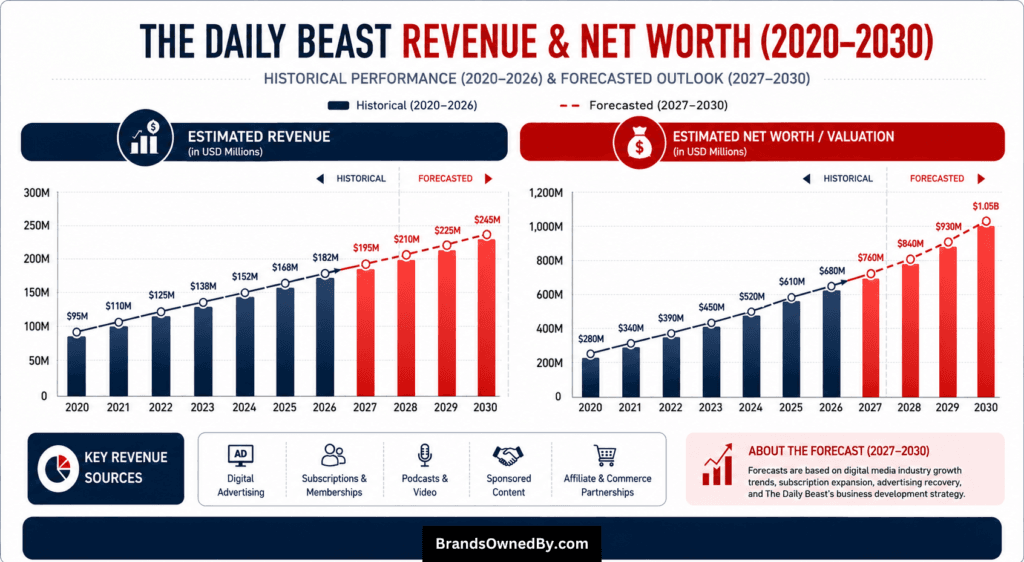
As of May 2026, The Daily Beast is estimated to generate approximately $182 million in annual revenue, while its estimated valuation or net worth stands near $680 million. These estimates are based on digital media industry analysis, advertising performance, subscription growth, political traffic trends, and the company’s position within IAC’s publishing portfolio.
Over the past several years, The Daily Beast has expanded from a politically focused digital publication into a broader multimedia news platform with revenue streams tied to advertising, premium memberships, branded partnerships, affiliate commerce, podcasts, and video content.
The company’s valuation has increased steadily because of rising political readership, stronger subscription retention, and growing demand for premium digital journalism during election cycles and major global news events.
The Daily Beast Revenue in 2026
In 2026, The Daily Beast is estimated to generate around $182 million in total annual revenue.
A major portion of this revenue still comes from digital advertising. High-traffic political reporting continues to attract premium advertisers, especially during election coverage, geopolitical crises, and breaking news cycles.
Industry estimates suggest digital advertising contributes roughly 45% to 50% of the company’s total revenue. This means advertising alone likely generates more than $80 million annually for the publication.
Subscription and membership revenue has also become increasingly important. Premium membership offerings, ad-free experiences, and exclusive journalism content are estimated to contribute nearly $40 million to $45 million annually.
Sponsored content and branded partnerships represent another major business segment. Large brands increasingly partner with digital publishers for native advertising campaigns and sponsored editorial-style content. This segment is estimated to contribute approximately $25 million to $30 million in annual revenue.
The remaining revenue comes from affiliate partnerships, podcast sponsorships, video monetization, licensing arrangements, and content distribution deals.
Compared to earlier years, The Daily Beast is now less dependent on display advertising alone. This diversification has helped the company remain competitive despite declining advertising rates across much of the digital publishing industry.
Net Worth and Valuation in 2026
As of May 2026, The Daily Beast’s estimated valuation is approximately $680 million.
This valuation reflects several factors beyond direct annual revenue.
One major factor is the company’s political media influence. Publications with loyal political audiences often command higher market valuations because they attract premium advertisers, subscription retention, and strong engagement during election years.
Another important factor is brand recognition. The Daily Beast remains one of the most recognizable digital political media brands in the United States.
Its valuation also benefits from:
- Strong search engine visibility.
- High social media engagement.
- Investigative journalism reputation.
- Recurring subscription revenue.
- Multimedia expansion opportunities.
Digital media valuations are often based on projected future earnings rather than current profitability alone. Companies with growing subscription models and strong audience loyalty generally receive higher valuation multiples.
The Daily Beast also benefits from operating inside IAC’s broader digital ecosystem, which provides financial stability and operational support that many smaller independent publishers lack.
Revenue Breakdown by Business Segment
The company’s revenue model has become more diversified since its early years.
In 2026, estimated revenue distribution is structured approximately as follows:
| Revenue Segment | Estimated Contribution |
|---|---|
| Digital Advertising | 48% |
| Subscriptions & Memberships | 23% |
| Sponsored Content | 15% |
| Affiliate & Commerce Revenue | 7% |
| Podcasts & Video Monetization | 5% |
| Licensing & Other Revenue | 2% |
Political advertising cycles continue to play a major role in yearly fluctuations. During major U.S. elections, political publishers often experience significant traffic spikes, stronger subscription growth, and increased advertiser demand.
For example, investigative stories and election-related coverage can dramatically increase monthly readership, which directly boosts advertising inventory and subscriber conversions.
Growth Drivers Behind The Daily Beast’s Valuation
Several business trends are helping increase The Daily Beast’s estimated long-term value.
One major driver is recurring subscription revenue. Investors generally view recurring membership income as more stable than advertising revenue because it creates a predictable cash flow.
Another growth factor is multimedia expansion. The Daily Beast has increased investment in podcasts, video interviews, and digital streaming partnerships to reduce dependence on website traffic alone.
The publication also benefits from audience loyalty in political news coverage. Readers who consume political journalism regularly are more likely to become paying subscribers compared to casual entertainment audiences.
Artificial intelligence and search engine changes are also reshaping digital publishing economics. Publications with strong brand recognition and direct readership relationships are expected to perform better than traffic-dependent websites.
This favors companies like The Daily Beast that already have strong direct audience engagement.
Historical Revenue and Net Worth Growth
The Daily Beast experienced particularly strong growth between 2020 and 2026.
The COVID-19 pandemic, U.S. elections, international conflicts, and rising political polarization significantly increased digital news consumption during this period.
As traffic increased, the company expanded its subscription strategy and diversified monetization channels.
| Year | Estimated Revenue | Estimated Net Worth / Valuation |
|---|---|---|
| 2020 | $95 million | $280 million |
| 2021 | $110 million | $340 million |
| 2022 | $125 million | $390 million |
| 2023 | $138 million | $450 million |
| 2024 | $152 million | $520 million |
| 2025 | $168 million | $610 million |
| 2026 | $182 million | $680 million |
The steady increase in valuation reflects broader investor interest in premium digital media businesses with recurring subscription potential and high political engagement.
Future Revenue Forecast Through 2030
Industry analysts expect The Daily Beast to continue expanding its digital revenue over the next several years. Future growth projections are tied to subscription expansion, multimedia monetization, podcast growth, and continued strength in political journalism.
Forecasted estimates through 2030 include:
- 2027 estimated revenue: $195 million with an estimated valuation of $760 million.
- 2028 estimated revenue: $210 million with an estimated valuation of $840 million.
- 2029 estimated revenue: $225 million with an estimated valuation of $930 million.
- 2030 estimated revenue: $245 million with an estimated valuation exceeding $1.05 billion.
These projections assume continued growth in premium memberships, stronger podcast monetization, expanded branded partnerships, and rising demand for politically focused digital journalism.
However, future performance will still depend heavily on advertising markets, subscription competition, audience retention, and broader changes in digital media consumption patterns.
Brands Owned by The Daily Beast
As of 2026, The Daily Beast mainly operates through internally developed editorial brands, content divisions, podcasts, newsletters, video operations, and membership products instead of acquiring large independent companies.
The company’s structure is centered around expanding its digital journalism ecosystem while strengthening audience engagement, subscriptions, and multimedia distribution.
| Company / Brand / Entity | Type | Main Focus | Key Details as of 2026 |
|---|---|---|---|
| The Daily Beast Main Platform | Digital News Platform | Breaking news, politics, investigations, entertainment | Core business and flagship media property of the company. Generates most of the company’s traffic, subscriptions, and advertising revenue. |
| The Daily Beast Investigations | Investigative Journalism Division | Political investigations, corruption reporting, national security | Known for exclusive investigative stories and high-impact political journalism that frequently gains national media attention. |
| Beast Inside | Premium Membership Program | Subscription journalism and premium content | Paid membership platform offering ad-free access, exclusive stories, premium newsletters, and investigative reports. |
| The Daily Beast Podcasts | Multimedia Audio Division | Political podcasts, culture discussions, interviews | Expanding podcast network focused on political analysis, media commentary, and digital audience engagement. |
| The Daily Beast Video Division | Video & Multimedia Unit | News clips, interviews, digital video journalism | Produces political interviews, investigative features, entertainment videos, and streaming-friendly news content. |
| Daily Beast Newsletters | Newsletter Publishing Division | Audience retention and direct reader engagement | Operates multiple political and breaking-news newsletters to drive recurring readership and subscription growth. |
| Entertainment and Culture Division | Entertainment Media Unit | Celebrity news, TV reviews, pop culture | Covers Hollywood, streaming platforms, celebrity interviews, and entertainment industry developments. |
| Opinion and Commentary Operations | Editorial Commentary Division | Political analysis and opinion journalism | Publishes opinion columns, commentary pieces, and analysis from journalists, analysts, and political contributors. |
| Social Media & Audience Distribution Operations | Audience Growth Division | Multi-platform content distribution | Manages traffic and audience engagement across X, Facebook, Instagram, YouTube, TikTok, Apple News, and Google News. |
| Multimedia Advertising & Sponsored Content Studio | Branded Content Division | Native advertising and sponsored campaigns | Creates sponsored articles, multimedia campaigns, native advertising, and brand partnership content for advertisers. |
| The Newsweek Daily Beast Company (Historical) | Former Merged Media Entity | Print and digital news publishing | Historical merger between Newsweek and The Daily Beast formed in 2010 before later separation into independent businesses. |
The Daily Beast Main News Platform
The Daily Beast’s core asset is its primary digital news platform.
This remains the company’s flagship brand and largest operational entity. The platform publishes breaking news, political investigations, opinion content, entertainment reporting, and cultural commentary.
The publication became especially influential because of its aggressive digital publishing strategy and rapid response political journalism.
Its newsroom structure includes:
- Political reporters.
- Investigative journalists.
- Opinion writers.
- Entertainment editors.
- Multimedia producers.
- Podcast and video teams.
The main platform generates most of the company’s traffic, subscription growth, and advertising revenue.
As of 2026, politics continues to be the company’s strongest traffic category, especially during election periods and major geopolitical events.
The Daily Beast Investigations
The Daily Beast Investigations division operates as one of the company’s most important editorial entities.
This investigative journalism unit focuses on:
- Political corruption stories.
- Government investigations.
- National security reporting.
- Corporate controversies.
- Exclusive insider reporting.
The division helped build The Daily Beast’s reputation for aggressive journalism and high-impact digital investigations.
Many investigative stories published by the company are later referenced by major television networks, newspapers, and political commentators.
The investigative unit also plays a major role in subscriber retention because premium journalism often drives membership growth and recurring readership.
Beast Inside Membership Program
The Beast Inside is The Daily Beast’s premium subscription and membership division.
The company launched this program to diversify revenue beyond digital advertising and create recurring subscription income.
Subscribers receive benefits such as:
- Ad-free reading.
- Exclusive articles.
- Early access content.
- Premium investigative reports.
- Member-only newsletters.
The membership program became increasingly important after advertising markets across the digital publishing industry became more volatile.
As of 2026, subscription revenue represents one of the company’s fastest-growing business segments.
The Beast Inside also helps strengthen audience loyalty because politically engaged readers are more likely to maintain recurring memberships compared to casual entertainment audiences.
The Daily Beast Podcasts
Podcasting has become one of The Daily Beast’s most important multimedia expansion areas.
The company operates multiple podcast properties tied to politics, culture, media analysis, and investigative journalism.
These podcasts help The Daily Beast expand beyond website traffic and reach audiences through streaming platforms and mobile listening apps.
Podcast operations generate revenue through:
- Sponsorships.
- Advertising placements.
- Platform partnerships.
- Premium content integrations.
The company’s podcast strategy also strengthens audience engagement because listeners tend to spend significantly more time with audio content compared to traditional written articles.
As of 2026, podcasting remains one of the fastest-growing digital media segments for political publishers.
The Daily Beast Video Division
The Daily Beast operates its own video and multimedia publishing division focused on interviews, political commentary, digital news clips, and streaming-friendly content.
The company expanded video production as online audiences increasingly shifted toward short-form and visual media consumption.
The video division produces:
- Political interviews.
- News explainers.
- Investigative documentaries.
- Election coverage clips.
- Celebrity and entertainment features.
Video operations also support advertising growth because video advertising rates are generally higher than traditional display advertising.
The company distributes video content across:
- Its website.
- YouTube.
- Social media platforms.
- Streaming partnerships.
- Embedded news distribution channels.
Daily Beast Newsletters
Email newsletters have become a major audience-retention tool for The Daily Beast.
The company operates multiple newsletter products covering politics, breaking news, investigations, and culture.
Newsletter operations are strategically important because they create direct audience relationships without depending entirely on search engines or social media algorithms.
This became increasingly valuable after major technology platforms reduced organic news traffic for publishers.
The Daily Beast uses newsletters to:
- Increase subscriber retention.
- Drive repeat traffic.
- Promote premium memberships.
- Support advertising partnerships.
- Expand political audience engagement.
As of 2026, newsletter-driven media strategies remain one of the most effective audience-retention tools in digital publishing.
Entertainment and Culture Division
Although politics drives much of the company’s visibility, The Daily Beast also operates a major entertainment and culture reporting division.
This section covers:
- Hollywood news.
- Celebrity interviews.
- Television reviews.
- Streaming industry coverage.
- Pop culture analysis.
Entertainment reporting helps diversify the audience beyond political readers.
For example, major celebrity controversies and streaming-related stories often generate viral traffic spikes and social media engagement.
The entertainment division also attracts advertisers targeting lifestyle and consumer audiences rather than purely political readers.
Opinion and Commentary Operations
Opinion journalism remains one of The Daily Beast’s defining editorial products.
The company operates a large commentary division featuring political analysts, journalists, public intellectuals, former government officials, and media personalities.
Opinion content helps generate:
- Audience engagement.
- Social media sharing.
- Reader discussion.
- Subscription conversions.
This section plays a major role in shaping the publication’s public identity because many viral Daily Beast stories involve strong political or cultural viewpoints.
Unlike traditional newspapers that separate opinion and news more rigidly, The Daily Beast blends analysis and commentary more aggressively into its digital publishing strategy.
Social Media and Audience Distribution Operations
The Daily Beast also operates large internal audience distribution and social media teams.
These divisions are essential for modern digital publishers because online traffic increasingly depends on multi-platform distribution strategies.
The company actively distributes content across:
Social media operations focus heavily on viral political engagement, breaking news amplification, and audience acquisition.
These distribution teams help maximize visibility for investigative reports and opinion content.
Multimedia Advertising and Sponsored Content Studio
The Daily Beast operates an internal branded content and sponsored media division.
This unit works with advertisers and corporate partners to create sponsored editorial-style campaigns designed for digital audiences.
Sponsored content has become increasingly important across digital publishing because traditional display advertising revenue has become less predictable.
The company’s branded content studio develops:
- Sponsored articles.
- Multimedia campaigns.
- Video sponsorships.
- Event partnerships.
- Native advertising experiences.
As of 2026, branded content represents a major revenue category for most premium digital publishers.
Conclusion
The Daily Beast is owned by IAC, the media and internet holding company led by Barry Diller. The publication has gone through several ownership phases since its founding in 2008, including its merger with Newsweek and later restructuring into an independent digital media operation.
Its influence comes less from print circulation and more from digital reach, political reporting, and investigative journalism. While the company operates in a highly competitive media environment, it remains a recognized player in online news publishing.
As digital journalism continues evolving, ownership structures like IAC’s provide financial backing that helps media brands survive changing advertising markets and subscription pressures.
FAQs
Does Barry Diller own The Daily Beast?
Barry Diller does not personally own The Daily Beast as an individual private asset. The publication is owned through IAC Inc., the publicly traded media and internet holding company he controls. As Chairman and Senior Executive of IAC, Diller remains the most influential figure behind The Daily Beast because of his voting power and leadership authority within the company.
Who runs The Daily Beast?
The Daily Beast is run through a combination of executive management and editorial leadership. Corporate oversight comes from IAC, while day-to-day operations are managed by company executives, editors, newsroom leaders, and digital media teams.
The publication’s editorial staff controls journalism, investigations, publishing decisions, and political coverage, while business executives manage advertising, subscriptions, partnerships, and operational strategy.
Who publishes The Daily Beast?
The Daily Beast is published by The Daily Beast Company under the ownership structure of IAC Inc. The company operates as a digital-first media publication focused on politics, investigations, entertainment, and opinion journalism.
It publishes content through its website, newsletters, podcasts, video platforms, and social media distribution channels.
Is The Daily Beast credible?
The Daily Beast is generally considered a credible digital news publication within the online media industry, particularly for political reporting, investigative journalism, and breaking news coverage.
The company employs professional journalists, editors, investigative reporters, and media analysts. Its reporting is frequently cited by larger news organizations, television networks, and political commentators.
However, like many opinion-driven digital media outlets, critics sometimes argue that its editorial tone can be aggressive or politically opinionated. Readers often compare its reporting with multiple sources when covering highly political topics.
Is The Daily Beast Republican or Democrat?
The Daily Beast is widely viewed as center-left or liberal-leaning in its editorial tone and political coverage. The publication is generally more critical of conservative political figures and Republican leadership than liberal or Democratic figures.
However, it is not officially affiliated with the Democratic Party. The company operates as an independent digital news organization with opinion writers, investigative journalists, and contributors from different political perspectives.
Its political positioning is often compared with other left-leaning or center-left digital media outlets in the U.S. political news market.