
- Chobani is a privately owned food and beverage company primarily controlled by founder Hamdi Ulukaya, who owns an estimated 68%–83.5% stake as of 2026.
- The company’s minority shareholders include employee equity participants, who collectively own around 10% of Chobani, and institutional investor TPG Capital, which holds a minority private equity stake.
- Chobani owns and operates multiple brands and business divisions including Chobani Greek Yogurt, Chobani Oat Milk, Chobani Flip, Chobani Complete, Chobani Coffee, Chobani Creamers, and La Colombe Coffee Roasters.
- As of 2026, Chobani generates an estimated $4.5 billion in annual revenue and is valued at approximately $22 billion, making it one of the largest privately held food companies in the United States.
Chobani is an American food company best known for its Greek yogurt products. The company operates in the dairy and plant-based food industry and has become one of the most recognizable yogurt brands in North America.
The business was founded in 2005 and is headquartered in Norwich, New York. Chobani initially focused on Greek yogurt but later expanded into oat milk, creamers, probiotic drinks, cold brew coffee, and nutrition-focused dairy products.
The company became popular because it introduced thick, protein-rich Greek yogurt to mainstream American consumers at affordable prices. Before Chobani’s rise, Greek yogurt was considered a niche product with limited supermarket presence.
Chobani manufactures its products in large production facilities located in New York and Idaho. These factories handle yogurt processing, packaging, and product innovation for the company’s growing portfolio.
The brand is widely distributed across grocery chains, wholesale clubs, convenience stores, and online retailers. Chobani products are commonly found in Walmart, Costco, Kroger, Target, Whole Foods, and many regional supermarket chains.
The company also focuses heavily on clean-label ingredients. Many Chobani products avoid artificial preservatives and emphasize natural ingredients, high protein content, and functional nutrition benefits.
In addition to dairy products, Chobani expanded into plant-based beverages to compete in the fast-growing alternative milk market. Its oat milk products helped the company diversify beyond traditional yogurt sales.
Another key part of Chobani’s business strategy is vertical manufacturing control. Instead of outsourcing large portions of production, the company invested heavily in its own facilities. This allows tighter quality control and faster product development.
Chobani is also known for employee-focused initiatives and community investment programs. The company has publicly supported refugee hiring programs, local manufacturing employment, and worker equity participation.
Chobani Founder
Hamdi Ulukaya is the founder of Chobani and the most important figure in the company’s history.
He was born in Turkey and later moved to the United States for education and business opportunities. Before launching Chobani, Ulukaya operated a small feta cheese business in New York.
In 2005, he purchased a closed Kraft yogurt factory in South Edmeston, New York. Many industry experts believed reopening the aging facility would be too risky because the yogurt market was already dominated by large multinational companies.
Instead of competing directly with standard yogurt products, Ulukaya focused on authentic Greek yogurt recipes inspired by traditional strained yogurt methods.
He spent nearly two years refining the product before launching Chobani nationally.
Hamdi Ulukaya played a direct role in:
- Product development.
- Factory operations.
- Brand positioning.
- Retail expansion.
- Manufacturing strategy.
- Company culture.
His approach emphasized premium-quality yogurt at accessible prices. This helped Chobani gain rapid traction with American consumers.
Ulukaya also became widely recognized for promoting employee ownership programs. He later distributed company equity to thousands of workers, which became one of the most discussed employee participation initiatives in the food industry.
Even after stepping back from daily CEO duties, he continued to control the company as majority owner and chairman.
Ownership History
Chobani’s ownership history reflects a rare example of a founder-led food company that expanded into a multibillion-dollar brand while maintaining strong internal control. Unlike many consumer food businesses that were quickly acquired by large corporations or heavily diluted through investor funding, Chobani remained largely controlled by its founder, Hamdi Ulukaya.
Founding and Early Ownership Structure
Chobani was founded in 2005 by Hamdi Ulukaya after he purchased a closed Kraft yogurt factory in South Edmeston, New York.
At the beginning, the company was almost entirely founder-owned. Ulukaya financed the factory purchase through a Small Business Administration-backed loan and personal business funding connected to his earlier cheese business.
Unlike many food startups that immediately raised venture capital, Chobani initially operated with very limited outside investment. This allowed Ulukaya to retain strong ownership control during the company’s earliest growth phase.
The company focused on producing authentic Greek yogurt for the U.S. market. At that time, Greek yogurt represented a very small portion of supermarket dairy shelves.
Because the business was privately held, ownership details were not publicly disclosed in the same way as public corporations. However, Hamdi Ulukaya remained the dominant shareholder from the beginning.
Rapid Growth and Founder Control
Between 2007 and the mid-2010s, Chobani experienced extremely rapid expansion.
The brand quickly gained market share in grocery stores because consumers increasingly preferred high-protein yogurt products. Major retailers expanded shelf space for Chobani products as demand surged.
During this period, the company scaled manufacturing operations in New York and later expanded into Idaho with one of the largest yogurt production facilities in the world.
Despite aggressive expansion, Hamdi Ulukaya maintained majority ownership and resisted giving up significant control to external investors.
This approach was unusual in the food industry. Many fast-growing consumer brands typically dilute founder ownership through multiple funding rounds. Chobani instead relied heavily on operational cash flow and selective investment partnerships.
Founder control allowed the company to make long-term decisions without pressure from public shareholders or activist investors.
TPG Capital Minority Investment
One of the most important ownership changes in Chobani’s history came when private equity firm TPG Capital acquired a minority stake in the company.
The investment was designed to help Chobani expand manufacturing capacity, strengthen distribution networks, and compete more aggressively in the dairy market.
Although financial terms were not fully disclosed publicly, industry analysts viewed the investment as a major milestone because it validated Chobani’s position as a dominant food brand.
Even after TPG’s investment, Hamdi Ulukaya remained the controlling shareholder.
The ownership arrangement was structured in a way that allowed Chobani to access institutional capital while preserving founder influence over corporate strategy.
TPG did not take operational control of the company. Instead, the firm functioned primarily as a financial partner supporting growth initiatives.
Employee Equity Initiative
In 2016, Chobani introduced one of the most widely discussed employee ownership programs in the food industry.
Hamdi Ulukaya announced that company shares would be allocated to thousands of employees based on tenure and role within the business.
The initiative effectively turned many factory workers and staff members into equity participants.
Under the structure, employees could potentially receive financial payouts if:
- Chobani went public.
- The company was sold.
- Ownership shares were monetized in future transactions.
For some long-term workers, projected equity values reached substantial amounts.
The program attracted attention because employee equity plans are more common in technology startups than in large food manufacturing companies.
This move also reinforced Ulukaya’s long-term ownership philosophy. Instead of concentrating all value creation among investors and executives, Chobani expanded participation across its workforce.
IPO Speculation and Delayed Public Listing
As Chobani’s brand value increased, speculation about a potential initial public offering grew.
The company explored IPO plans multiple times during its growth history. Financial markets viewed Chobani as a strong consumer brand candidate because of its market leadership in Greek yogurt and expanding plant-based product portfolio.
At different stages, analysts estimated that a public listing could value Chobani at several billion dollars.
However, the company delayed IPO efforts due to multiple factors, including:
- Market volatility.
- Inflation concerns.
- Supply chain disruptions.
- Shifting consumer spending patterns.
- Broader public market weakness.
Remaining private allowed Chobani to avoid quarterly earnings pressure and maintain long-term operational flexibility.
As of 2026, Chobani still operates as a privately held company.
Expansion Into New Product Categories
Ownership stability also helped Chobani diversify beyond yogurt.
Because the company was not heavily constrained by public shareholder expectations, management invested aggressively in new categories such as:
- Oat milk.
- Coffee creamers.
- Probiotic beverages.
- Ready-to-drink coffee.
- Functional nutrition products.
These investments required substantial manufacturing expansion and marketing spending.
Founder-led control allowed the company to prioritize long-term category development instead of short-term profit optimization.
For example, Chobani invested in refrigerated beverage infrastructure and plant-based product lines even as competition increased from established dairy and beverage corporations.
Current Ownership Structure as of 2026
As of 2026, Chobani remains privately owned with Hamdi Ulukaya serving as the company’s majority owner and controlling figure.
The current ownership structure mainly includes:
- Hamdi Ulukaya as majority shareholder.
- TPG Capital and affiliated investors with minority stakes.
- Employee equity participants.
- Other private investors and stakeholders.
Because the company is privately held, exact ownership percentages are not publicly updated on a regular basis.
However, Ulukaya continues to maintain effective control over:
- Corporate strategy.
- Leadership appointments.
- Manufacturing expansion.
- Product diversification.
- Long-term investments.
This ownership model differentiates Chobani from many competitors that are controlled by multinational public corporations or institutional investors.
Who Owns Chobani: Major Shareholders
![who owns chobani [top shareholders]](https://brandsownedby.com/wp-content/uploads/2026/05/who-owns-chobani-top-shareholders-486x1024.png)
Chobani is a privately owned food company controlled primarily by its founder, Hamdi Ulukaya. Unlike many major dairy and beverage companies that are owned by public shareholders or multinational corporations, Chobani has remained founder-led since its launch in 2005.
The company’s ownership structure combines founder control, institutional investment, and employee equity participation. Over the years, Chobani accepted outside capital to support manufacturing expansion and product diversification, but Hamdi Ulukaya continued to maintain majority ownership and voting control.
As of May 2026, Chobani is still not publicly traded. This means its shares are not available on stock exchanges, and ownership information is only partially disclosed through private market reports, financial filings, credit assessments, and investor discussions.
Recent private market estimates and financial reports indicate that Hamdi Ulukaya remains the dominant shareholder with a controlling stake that exceeds two-thirds of the company. Employee shareholders collectively hold one of the largest minority ownership positions due to Chobani’s well-known worker equity initiative. Institutional investors such as TPG Capital continue to hold minority stakes connected to earlier investment rounds.
Hamdi Ulukaya: Founder and Majority Shareholder
Hamdi Ulukaya is the founder, chairman, and controlling shareholder of Chobani.
As of 2026, ownership estimates connected to private credit reports, Bloomberg data, and market filings suggest that Ulukaya owns between approximately 68% and 83.5% of Chobani depending on the share structure and valuation period referenced. Earlier company ownership references widely cited a 68% stake, while more recent private credit assessments referenced by Bloomberg and S&P Global Ratings suggest his economic ownership may now exceed 80%.
Even at the lower end of those estimates, Ulukaya remains the undisputed controlling shareholder.
His ownership position gives him substantial authority over:
- Long-term corporate strategy.
- Executive leadership appointments.
- Product diversification.
- Manufacturing investments.
- IPO planning decisions.
- Capital allocation.
- Acquisitions and partnerships.
Unlike many startup founders who lose operational influence after multiple funding rounds, Ulukaya retained control while scaling Chobani into one of America’s largest yogurt and refrigerated food companies.
His control structure is believed to include enhanced voting rights tied to private share arrangements. Reports tied to Chobani’s IPO planning process indicated governance structures designed to preserve founder control even if outside ownership expanded in the future.
Ulukaya also personally led several major strategic expansions, including:
- Chobani Oat Milk.
- Chobani Creamers.
- Chobani Complete nutrition products.
- Functional beverage expansion.
- Ready-to-drink coffee initiatives.
- La Colombe integration efforts.
His ownership philosophy differs from traditional private equity-driven food businesses. He repeatedly emphasized long-term brand building, manufacturing control, and employee participation instead of short-term profitability targets.
Employee Shareholders
Employee shareholders collectively own around 10% of Chobani as of 2026.
This ownership stake originated from Hamdi Ulukaya’s 2016 decision to allocate company shares to employees across manufacturing plants, logistics operations, and corporate offices.
The equity allocation covered approximately 2,000 employees at the time of announcement. Share distributions were largely based on employee tenure and role within the company.
The initiative became one of the most recognized employee ownership programs in the food manufacturing industry.
For some long-serving employees, projected equity values reportedly reached hundreds of thousands or even more than $1 million depending on future company valuation outcomes.
The employee ownership structure allows workers to financially benefit from:
- Future IPO activity.
- Secondary share transactions.
- Company valuation growth.
- Strategic liquidity events.
Although employees collectively hold a meaningful economic stake, voting control remains concentrated with Hamdi Ulukaya and the founder-controlled governance structure.
Still, the program significantly changed Chobani’s ownership model compared to most privately held food companies, where factory workers rarely receive direct equity participation.
The employee stake also reduced dilution pressure on founder ownership because it aligned workforce incentives with long-term company performance.
TPG Capital
TPG Capital is Chobani’s best-known institutional investor and one of the company’s largest outside shareholders.
The private equity firm acquired a minority stake during Chobani’s rapid expansion phase to help finance manufacturing growth, operational scaling, and distribution expansion.
Although Chobani has never publicly disclosed TPG’s exact current ownership percentage, historical investment reports and market discussions commonly estimated the firm’s stake in the 10%–20% range after multiple financing arrangements and equity restructuring events.
TPG’s investment helped Chobani:
- Expand production capacity in Idaho and New York.
- Improve nationwide cold-chain logistics.
- Scale retailer relationships.
- Support category expansion beyond yogurt.
Despite TPG’s investment, the firm never gained operational control over the company.
Hamdi Ulukaya retained majority voting influence throughout the partnership. This structure allowed Chobani to raise institutional capital while preserving founder-led governance.
TPG’s involvement also increased investor confidence in Chobani during periods when the company explored public listing opportunities and large-scale expansion initiatives.
Other Minority Private Investors
In addition to TPG Capital, Chobani also has smaller private investors connected to financing rounds, strategic partnerships, and internal equity arrangements.
These investors collectively hold a relatively small portion of the company compared to Hamdi Ulukaya’s controlling position.
Because Chobani is privately held, the company does not publish a detailed shareholder registry or cap table like publicly traded corporations.
However, private market reports indicate that various institutional participants were involved in financing activities related to:
- Manufacturing facility expansion.
- Supply chain investment.
- Beverage category growth.
- Refrigerated distribution infrastructure.
- Strategic acquisitions.
These investors generally function as financial stakeholders rather than controlling operators.
Competitor Ownership Comparison
Chobani operates in a highly competitive dairy and plant-based food industry where ownership structures vary significantly between companies. Some competitors are controlled by multinational public corporations, while others remain family-owned or private-equity-backed businesses.
One of the biggest differences between Chobani and many of its competitors is founder control. Hamdi Ulukaya still maintains a majority influence over Chobani as of 2026, whereas several competing yogurt brands are owned by global food conglomerates with institutional shareholders and corporate boards controlling operations.
This ownership structure affects how companies approach expansion, pricing, acquisitions, innovation, and long-term strategy.
| Company | Ownership Type | Major Owners | Control Structure |
|---|---|---|---|
| Chobani | Private company | Hamdi Ulukaya, employees, TPG Capital | Founder-controlled |
| Danone | Public company | Institutional investors | Board and shareholder controlled |
| Yoplait | Licensing and cooperative structure | Sodiaal, General Mills | Corporate partnership model |
| Fage | Private company | Filippou family | Family-controlled |
| Oatly | Public company | Institutional shareholders | Public shareholder controlled |
| Stonyfield Organic | Private subsidiary | Lactalis | Corporate subsidiary |
| Siggi’s | Private subsidiary | Lactalis | Multinational corporate control |
Chobani vs Danone
Danone is one of Chobani’s largest competitors in the yogurt industry through brands such as:
- Oikos.
- Activia.
- Light + Fit.
- Too Good.
- Silk.
- So Delicious.
Unlike Chobani, Danone is a publicly traded multinational corporation headquartered in France.
As of 2026, Danone is owned primarily by institutional investors, pension funds, mutual funds, and retail shareholders. Major institutional shareholders include investment firms such as BlackRock, Amundi, and The Vanguard Group.
No single shareholder controls Danone in the same way Hamdi Ulukaya controls Chobani.
This creates a very different governance structure. Danone’s leadership must answer to public shareholders, board oversight requirements, quarterly earnings expectations, and European corporate governance standards.
Chobani, on the other hand, operates with centralized founder-led decision-making. This allows the company to move faster in certain categories without requiring public shareholder approval.
Danone also has a broader global portfolio spanning dairy, bottled water, medical nutrition, and infant nutrition. Chobani remains more focused on refrigerated foods and beverages.
Chobani vs Yoplait
Yoplait is one of the oldest yogurt brands competing directly with Chobani in North America.
The ownership structure of Yoplait is more complex because the brand is jointly controlled through licensing and partnership arrangements.
French dairy cooperative Sodiaal owns the global Yoplait trademark rights, while General Mills controls Yoplait operations in the United States and several international markets through licensing agreements.
This means Yoplait is indirectly tied to two major ownership systems:
- Farmer cooperative ownership through Sodiaal.
- Public shareholder ownership through General Mills.
General Mills itself is publicly traded and owned by institutional shareholders including Vanguard, BlackRock, and State Street.
Compared to Chobani’s founder-led structure, Yoplait operates under a more corporate and layered ownership framework.
Strategic decisions involving Yoplait often depend on licensing agreements, international partnerships, and broader corporate priorities at General Mills.
Chobani vs Fage
Fage is one of the closest competitors to Chobani in the Greek yogurt category.
Unlike Danone or General Mills, Fage remains privately owned and controlled by the Filippou family.
This creates some similarities with Chobani because both companies retain strong founder-family influence instead of institutional public ownership.
However, there are still major differences.
Fage operates with a more traditional family-controlled dairy structure, while Chobani expanded into a large-scale diversified refrigerated food company with private equity participation and employee ownership initiatives.
Chobani also invested more aggressively in U.S. mass-market retail expansion, national advertising, and adjacent product categories such as oat milk and creamers.
Fage remains more concentrated in yogurt and dairy-focused operations.
Chobani vs Oatly
Oatly competes with Chobani primarily in the oat milk and plant-based beverage market.
Unlike Chobani, Oatly is a publicly traded company listed on U.S. stock exchanges.
Its ownership structure includes:
- Institutional investors.
- Public shareholders.
- Investment funds.
- Strategic investors.
Over the years, Oatly attracted investment from several high-profile backers, including Blackstone and celebrity-linked investment groups.
Because Oatly is publicly traded, ownership percentages change frequently based on stock market trading activity.
Chobani’s ownership structure is much more stable because the company remains private and founder-controlled.
This stability gives Chobani flexibility in long-term manufacturing investments without immediate public market pressure.
However, Oatly benefits from easier access to public capital markets for expansion funding.
Chobani vs Stonyfield Organic
Stonyfield Organic competes with Chobani in organic yogurt and health-focused dairy products.
The company was originally founded as an independent organic yogurt business, but later became part of larger multinational ownership structures.
As of 2026, Stonyfield is owned by Lactalis, the massive French dairy conglomerate.
Lactalis is privately controlled by the Besnier family and operates one of the largest dairy empires in the world.
This ownership structure differs from Chobani because Lactalis manages hundreds of brands across multiple dairy categories globally.
Stonyfield functions as one brand within a much larger corporate portfolio.
Chobani, in contrast, still operates primarily around its own central brand identity and founder-driven strategy.
Chobani vs Siggi’s
Siggi’s competes with Chobani in the premium yogurt category.
The brand became popular through Icelandic-style skyr yogurt products, emphasizing high protein and lower sugar content.
Siggi’s is owned by Lactalis after being acquired through broader dairy expansion activity.
As a result, Siggi’s operates under multinational dairy ownership instead of founder control.
This provides advantages such as:
- Global dairy supply access.
- Large-scale distribution.
- International manufacturing capabilities.
- Corporate purchasing power.
However, Chobani maintains a stronger independent brand positioning and more centralized strategic direction because decision-making remains concentrated around its founder and executive leadership team.
Why Chobani’s Ownership Structure Matters
Chobani’s ownership structure directly influences how the company operates and competes.
Because Hamdi Ulukaya retains majority control, Chobani can prioritize:
- Long-term manufacturing investments.
- Employee ownership programs.
- Product experimentation.
- Brand independence.
- Faster strategic decisions.
Public competitors often face stronger short-term profitability pressure from shareholders and financial markets.
For example, Chobani invested heavily in oat milk infrastructure and refrigerated beverage expansion even during uncertain economic periods. Public companies may face more investor scrutiny for similar long-term spending strategies.
Chobani’s founder-led structure also helps preserve brand consistency and corporate culture. This became especially important as the company expanded from yogurt into broader health-focused food and beverage categories.
Who Controls Chobani?
Chobani is controlled primarily by its founder, Hamdi Ulukaya, through majority ownership, voting influence, and long-term strategic authority. Although the company has outside investors and a professional executive management team, ultimate control over the business remains concentrated around founder-led governance as of 2026.
Unlike publicly traded food corporations, where decision-making authority is distributed across institutional shareholders and boards, Chobani operates with a highly centralized ownership and leadership structure.
This control model gives the company greater flexibility in manufacturing expansion, product innovation, pricing strategy, and long-term investment planning.
Hamdi Ulukaya’s Control Over Chobani
Hamdi Ulukaya remains the most powerful decision-maker at Chobani.
As the majority shareholder and chairman, he controls the company through his dominant ownership stake, which is estimated to exceed two-thirds of total equity as of May 2026.
His ownership position gives him substantial influence over:
- Corporate governance.
- Executive appointments.
- Strategic partnerships.
- Manufacturing investments.
- Product diversification.
- Capital allocation.
- IPO planning decisions.
- Long-term business strategy.
Even after stepping away from day-to-day CEO responsibilities, Ulukaya continued to oversee the company’s broader direction and operational philosophy.
Unlike many founders who gradually lose influence after outside investment rounds, Ulukaya preserved effective control throughout Chobani’s growth into a multibillion-dollar food company.
His leadership style heavily shaped Chobani’s business identity, especially in areas such as:
- Employee equity participation.
- Domestic manufacturing expansion.
- Refugee hiring initiatives.
- Clean-label product positioning.
- Vertical production integration.
This founder-led structure allows Chobani to operate more independently compared to competitors controlled by public shareholders or multinational parent companies.
Peter McGuinness: Chief Executive Officer
Peter McGuinness serves as the CEO of Chobani as of 2026.
He officially became President and Chief Operating Officer before later transitioning into the CEO role as Hamdi Ulukaya reduced direct involvement in daily operational management.
McGuinness brought extensive consumer brand experience to Chobani. Before joining the company, he held senior executive positions at major consumer goods and marketing organizations.
As CEO, he oversees:
- Daily operations.
- Product development.
- Retail expansion.
- Sales performance.
- Supply chain management.
- Marketing strategy.
- International growth initiatives.
However, despite serving as CEO, McGuinness does not control the company in an ownership sense.
Strategic authority ultimately remains tied to Hamdi Ulukaya’s majority ownership and chairman role.
This creates a dual structure commonly seen in founder-controlled private companies:
- A professional executive team manages operations.
- The founder maintains strategic and governance control.
Under McGuinness, Chobani accelerated expansion into adjacent categories such as:
- Oat milk.
- Coffee creamers.
- Functional beverages.
- Ready-to-drink coffee.
- High-protein nutrition products.
His leadership also focused heavily on retailer relationships and refrigerated category growth.
Chobani’s Executive Leadership Structure
Chobani operates with a professional executive management structure designed to support large-scale manufacturing and nationwide retail distribution.
The company’s leadership system includes executives responsible for:
- Finance.
- Operations.
- Manufacturing.
- Supply chain logistics.
- Retail partnerships.
- Marketing.
- Product innovation.
- Human resources.
- International expansion.
Despite having a broad executive structure, major strategic decisions remain closely aligned with founder leadership.
This differs from many public food corporations where executive teams are often more directly accountable to boards dominated by institutional shareholders.
At Chobani, executive leadership operates within a founder-controlled governance environment.
This allows faster execution of long-term initiatives without extensive shareholder approval processes.
Board Influence and Governance Structure
Because Chobani is privately held, its governance structure is more centralized than publicly traded competitors.
The company’s board includes senior executives, investor representatives, and founder-linked leadership figures. However, Hamdi Ulukaya’s majority ownership position gives him significant influence over board composition and strategic direction.
In practice, this means:
- Founder priorities heavily influence company strategy.
- Outside investors have limited operational control.
- Long-term expansion projects can move faster.
- Corporate restructuring decisions remain centralized.
This governance model became especially important during periods when Chobani explored potential IPO plans.
Reports connected to earlier IPO filings suggested governance arrangements designed to preserve founder voting control even if public ownership increased in the future.
Role of TPG Capital and Outside Investors
TPG Capital remains one of Chobani’s most important outside investors.
However, the firm does not control the company operationally.
Its role is primarily financial and advisory rather than managerial.
Although TPG holds a significant minority stake, Hamdi Ulukaya retained majority voting authority after the investment partnership.
This ownership arrangement allowed Chobani to raise institutional capital while avoiding the governance shifts that often occur after major private equity deals.
Other minority investors similarly lack controlling authority over Chobani’s operations.
Employee Ownership Without Management Control
Chobani’s employee shareholders collectively own around 10% of the company through the employee equity initiative introduced in 2016.
While this gives workers economic participation in the company’s growth, it does not significantly dilute founder governance control.
Employee ownership at Chobani functions more as a wealth-sharing and incentive structure rather than a voting-control mechanism.
The arrangement allows employees to benefit financially from company valuation growth while maintaining centralized leadership authority under founder governance.
How Chobani’s Control Structure Differs From Competitors
Chobani’s governance model differs significantly from many major food companies.
For example:
- Danone operates under public shareholder governance.
- General Mills answers to institutional investors and public markets.
- Oatly faces public market reporting pressure.
- Lactalis controls subsidiaries through multinational corporate management.
Chobani instead combines:
- Founder control.
- Professional executive management.
- Private ownership flexibility.
- Employee equity participation.
This hybrid structure gives the company operational agility while still maintaining a centralized strategic direction.
Why Founder Control Matters at Chobani
Founder control plays a major role in Chobani’s long-term strategy.
Because Hamdi Ulukaya retains majority influence, the company can make decisions based on long-term market positioning rather than short-term shareholder expectations.
This approach helped Chobani:
- Invest heavily in manufacturing infrastructure.
- Expand into plant-based beverages.
- Develop employee ownership programs.
- Maintain independent brand positioning.
- Compete against multinational food corporations.
The structure also allows Chobani to preserve its identity as an independent food company instead of becoming part of a larger corporate portfolio.
Chobani Annual Revenue and Net Worth
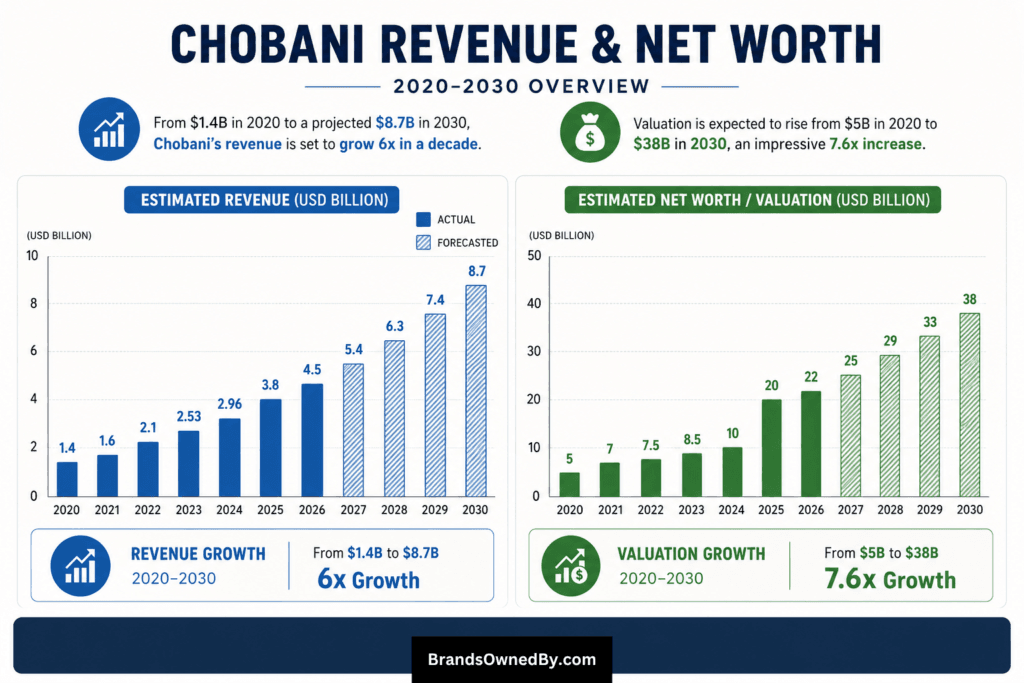
As of May 2026, the company is estimated to generate approximately $4.5 billion in annual revenue with a private market valuation of around $22 billion.
The company’s financial growth accelerated significantly after expanding beyond yogurt into oat milk, creamers, ready-to-drink coffee, functional beverages, and high-protein nutrition products. Large manufacturing investments, acquisitions, and category diversification helped Chobani strengthen its position against multinational competitors such as Danone, General Mills, and Lactalis.
One of the biggest turning points came in late 2025 when Chobani raised approximately $650 million in fresh funding at a valuation close to $20 billion. That funding round dramatically increased investor confidence in the company’s long-term growth potential and pushed founder Hamdi Ulukaya’s estimated net worth above $13 billion.
Chobani Revenue Growth in 2026
Chobani’s estimated 2026 revenue stands at approximately $4.5 billion.
The company’s sales growth is being driven by multiple business segments rather than yogurt alone. Greek yogurt remains the largest contributor to revenue, but newer categories are growing rapidly and reducing dependence on a single product line.
The company’s revenue structure in 2026 is estimated to be divided across the following categories:
| Business Segment | Estimated 2026 Revenue Contribution |
|---|---|
| Greek Yogurt and Dairy Products | Approximately $2.3 billion |
| Oat Milk and Plant-Based Products | Approximately $850 million |
| Coffee and Ready-to-Drink Beverages | Approximately $700 million |
| Creamers and Functional Nutrition | Approximately $450 million |
| Other Products and International Sales | Approximately $200 million |
Greek yogurt continues to generate more than half of Chobani’s total revenue. However, oat milk and coffee categories are growing much faster than traditional yogurt sales.
The acquisition of La Colombe Coffee Roasters also significantly boosted Chobani’s beverage revenue. The ready-to-drink coffee market became one of the company’s most important expansion areas after 2023.
Industry estimates also indicate that Chobani’s adjusted earnings before interest, taxes, depreciation, and amortization exceeded $1 billion in 2026 projections. This reflects improving operational scale and stronger margins across higher-growth product categories.
Chobani Net Worth and Valuation in 2026
Chobani’s estimated net worth or enterprise valuation reached approximately $22 billion in 2026.
This valuation is based on:
- Private funding rounds.
- Revenue growth rates.
- Manufacturing assets.
- Brand strength.
- Market share.
- Expansion potential.
- Investor demand for premium food brands.
The company’s valuation increased sharply after the 2025 funding round that valued Chobani at around $20 billion. Continued revenue growth and aggressive expansion plans further strengthened valuation estimates in 2026.
Several major factors contributed to Chobani’s rising valuation.
First, the company successfully diversified beyond yogurt into multiple high-growth categories.
Second, Chobani expanded its manufacturing infrastructure with major investments in Idaho and New York. The company announced approximately $1.7 billion in combined factory expansion projects, including a new dairy processing facility in Rome, New York, and expanded operations in Twin Falls, Idaho.
Third, Chobani strengthened its premium consumer brand positioning. The company now competes not only in dairy but also in functional wellness beverages and nutrition-focused foods.
Revenue Growth Drivers
Chobani’s financial expansion during 2026 was fueled by several major growth drivers.
Greek Yogurt Market Leadership
Chobani remained the leading Greek yogurt brand in the United States.
The company maintained dominant refrigerated shelf positioning in major retailers such as Walmart, Costco, Target, and Kroger. Strong consumer loyalty and premium brand perception continued supporting high sales volumes.
Oat Milk and Plant-Based Expansion
Chobani’s oat milk business became one of the fastest-growing divisions within the company.
Consumer demand for plant-based alternatives increased significantly throughout the decade, allowing Chobani to compete directly with Oatly, Silk, Califia Farms, and private-label grocery brands.
The company expanded its oat milk portfolio into:
- Barista blends.
- Creamers.
- Vanilla oat beverages.
- Extra creamy variants.
- Dairy-free nutrition products.
Coffee and Beverage Growth
The La Colombe acquisition strengthened Chobani’s position in the premium coffee market.
Ready-to-drink beverages became one of the company’s most strategically important categories because of higher growth rates and stronger profit margins compared to traditional dairy products.
Coffee-related revenue increased through:
- Cold brew beverages.
- Espresso drinks.
- Café distribution.
- Retail packaged coffee products.
Manufacturing Expansion
Chobani invested heavily in production infrastructure to support long-term growth.
The company’s expansion projects included:
- A $1.2 billion New York manufacturing facility.
- A $500 million Idaho expansion.
- Increased dairy processing capacity.
- Expanded refrigerated logistics systems.
These investments are expected to substantially increase production capacity after 2027.
Chobani Revenue Forecast Through 2030
Chobani is expected to maintain strong revenue growth through 2030 as the company expands beyond yogurt into oat milk, coffee, creamers, and functional nutrition products. Increased manufacturing capacity, stronger retail distribution, and rising demand for premium health-focused foods are projected to push Chobani’s annual revenue close to $9 billion by 2030.
- 2027: Chobani’s revenue is projected to reach approximately $5.4 billion. This growth is expected to come from expanded manufacturing output after the company’s new New York and Idaho production facilities become fully operational. The company is also likely to increase distribution across convenience stores, foodservice channels, and international retail markets. Oat milk, creamers, and ready-to-drink coffee products are expected to contribute a larger percentage of total sales compared to previous years.
- 2028: Revenue is forecasted to grow to around $6.3 billion. By this stage, Chobani is expected to strengthen its position in the premium refrigerated beverage market. The company will likely benefit from higher demand for functional nutrition products, protein-focused beverages, probiotic drinks, and dairy alternatives. International expansion in Canada, Australia, and selected European and Asian markets could also contribute additional revenue streams.
- 2029: Chobani’s annual revenue is projected to reach approximately $7.4 billion. Growth during this period is expected to be supported by stronger penetration in health-focused consumer categories. The company may further expand its nutrition portfolio with products targeting high-protein diets, wellness consumers, and meal-replacement segments. Beverage operations, especially cold brew coffee and functional drinks, are expected to become one of Chobani’s largest business divisions by this point.
- 2030: Revenue is projected to approach $8.7 billion if current growth trends continue. Analysts expect Chobani to operate as a diversified food and beverage company rather than primarily a yogurt manufacturer by the end of the decade. Plant-based products, premium beverages, and functional nutrition categories are expected to account for a much larger portion of total revenue. Continued retail expansion, higher production capacity, and possible IPO-driven capital investment could further accelerate the company’s long-term financial growth.
Chobani’s long-term valuation potential depends heavily on execution in high-growth beverage and nutrition categories.
If the company eventually launches an IPO, analysts expect Chobani could command a premium valuation compared to traditional dairy companies because investors increasingly view the business as a diversified health-focused food platform rather than a yogurt manufacturer alone.
The company’s combination of:
- Strong brand recognition.
- Founder-led control.
- Large-scale manufacturing assets.
- Premium product positioning.
- Fast-growing beverage operations.
continues to support expectations for further valuation growth through the end of the decade.
Brands Owned by Chobani
Chobani has evolved from a single-product yogurt company into a diversified food and beverage business operating across dairy, plant-based beverages, coffee, creamers, functional nutrition, and refrigerated drinks. As of 2026, the company owns and operates multiple brands, product divisions, manufacturing entities, and beverage businesses that support its expansion strategy.
Unlike multinational conglomerates that own hundreds of separate subsidiaries, Chobani mainly operates through vertically integrated branded business units under the broader Chobani corporate structure. The company also strengthened its portfolio through strategic acquisitions and beverage expansion initiatives during the 2020s.
| Company / Brand / Entity | Category | Description | Key Products / Operations |
|---|---|---|---|
| Chobani Greek Yogurt | Dairy Products | Chobani’s flagship and largest business division focused on Greek yogurt products. | Greek yogurt, whole milk yogurt, non-fat yogurt, drinkable yogurt, fruit yogurt. |
| Chobani Flip | Yogurt Snacks | Dessert-style yogurt sub-brand combining yogurt with toppings and mix-ins. | Yogurt with granola, chocolate, cookies, nuts, and candy-inspired toppings. |
| Chobani Complete | Functional Nutrition | High-protein and wellness-focused dairy product line. | Protein yogurt drinks, functional dairy beverages, probiotic products. |
| Chobani Zero Sugar | Health-Focused Dairy | Low-sugar yogurt division targeting wellness and low-carb consumers. | Zero sugar yogurt, keto-friendly yogurt, reduced-calorie dairy products. |
| Chobani Oat Milk | Plant-Based Beverages | Chobani’s non-dairy oat beverage division competing in the plant-based milk market. | Oat milk, barista blends, vanilla oat milk, extra creamy oat beverages. |
| Chobani Creamers | Refrigerated Creamers | Coffee creamer division offering dairy and oat-based creamers. | Sweet cream, hazelnut, vanilla, caramel, oat milk creamers. |
| Chobani Coffee | Ready-to-Drink Beverages | Refrigerated coffee and cold brew beverage division. | Cold brew coffee, espresso beverages, dairy coffee drinks, oat milk coffee. |
| La Colombe Coffee Roasters | Premium Coffee Business | Chobani-owned premium coffee company and beverage expansion asset. | Café operations, canned coffee, packaged coffee beans, cold brew products. |
| Chobani Probiotic Drinks | Functional Beverages | Digestive wellness and probiotic beverage division. | Gut health drinks, probiotic beverages, nutrition-focused dairy drinks. |
| Chobani Kids | Children’s Dairy Products | Kid-focused yogurt and dairy snack division. | Yogurt pouches, reduced-sugar yogurt, drinkable yogurt for children. |
| Twin Falls Manufacturing Facility | Manufacturing Entity | One of the world’s largest yogurt and refrigerated beverage production plants. | Yogurt production, beverage manufacturing, packaging, logistics. |
| New York Manufacturing Operations | Manufacturing Entity | Core dairy and beverage processing operations in New York. | Dairy processing, packaging, product development, distribution. |
| Rome, New York Expansion Project | Manufacturing Expansion | Large-scale dairy and beverage facility expansion project. | Yogurt production, oat-based beverages, refrigerated product manufacturing. |
| Chobani Foodservice Operations | Commercial Distribution | Institutional and foodservice supply division. | Products supplied to schools, airlines, universities, cafeterias, hospitality businesses. |
| Chobani International Operations | International Business | Chobani’s overseas market and export operations. | International yogurt distribution, export operations, Asia-Pacific expansion. |
Chobani Greek Yogurt
Chobani Greek Yogurt remains the company’s flagship and largest business division.
The brand helped popularize Greek yogurt in the United States after its launch in 2007. Before Chobani’s rise, Greek yogurt represented a small niche category within the broader dairy market.
The division includes multiple product categories such as:
- Non-fat Greek yogurt.
- Whole milk Greek yogurt.
- Low-fat yogurt.
- Flip yogurt products.
- Drinkable yogurt.
- Fruit-on-the-bottom yogurt.
- High-protein yogurt.
- Kids yogurt products.
Chobani Greek Yogurt remains one of the top-selling yogurt brands in North America as of 2026.
The brand competes directly with:
- Oikos.
- Yoplait Greek.
- Fage.
- Siggi’s.
- Activia.
The division continues generating the majority of Chobani’s total dairy-related revenue.
Chobani Flip
Chobani Flip operates as one of the company’s most recognizable sub-brands.
The product line combines Greek yogurt with mix-ins such as:
- Chocolate.
- Granola.
- Nuts.
- Cookies.
- Candy-inspired toppings.
- Fruit blends.
The brand targets younger consumers and snack-focused buyers looking for dessert-style yogurt products.
Chobani Flip became an important retail growth driver because it expanded Chobani’s appeal beyond traditional health-focused yogurt consumers.
Chobani Complete
Chobani Complete focuses on functional nutrition and high-protein dairy products.
The division targets:
- Fitness consumers.
- Athletes.
- Meal replacement users.
- Protein-focused diets.
- Active lifestyle consumers.
Products in this segment include:
- High-protein yogurt drinks.
- Protein yogurt cups.
- Functional dairy beverages.
- Probiotic nutrition products.
The brand became increasingly important during the 2020s as consumer demand shifted toward protein-rich and wellness-focused foods.
Chobani Zero Sugar
Chobani Zero Sugar operates as the company’s low-sugar yogurt division.
The product line was developed to compete in the growing market for:
- Keto-friendly foods.
- Low-carb products.
- Reduced-sugar snacks.
- Diabetic-friendly dairy products.
The brand uses natural sweetener systems while maintaining high protein levels and lower calorie counts.
This division allowed Chobani to compete more aggressively against wellness-focused dairy competitors.
Chobani Oat Milk
Chobani Oat Milk became one of the company’s fastest-growing non-dairy divisions during the 2020s.
The brand was launched to compete directly with:
- Oatly.
- Silk.
- Califia Farms.
- Planet Oat.
The product line includes:
- Original oat milk.
- Extra creamy oat milk.
- Vanilla oat milk.
- Chocolate oat beverages.
- Barista edition oat milk.
- Oat milk creamers.
This division significantly diversified Chobani’s revenue beyond traditional dairy products.
The oat milk business also positioned the company inside the rapidly growing plant-based beverage market.
Chobani Creamers
Chobani Creamers operates as the company’s coffee creamer business division.
The line includes both dairy-based and oat-based creamers sold in refrigerated grocery sections.
Popular product categories include:
- Sweet cream creamers.
- Vanilla creamers.
- Hazelnut creamers.
- Caramel-inspired creamers.
- Oat milk creamers.
The division benefited from increasing consumer demand for premium refrigerated creamers with cleaner ingredient labels.
Chobani Coffee
Chobani Coffee represents the company’s ready-to-drink beverage and cold brew business.
The brand expanded aggressively after Chobani increased investments in beverage infrastructure and premium coffee categories.
Products include:
- Cold brew coffee.
- Espresso beverages.
- Dairy-based coffee drinks.
- Oat milk coffee products.
- Refrigerated coffee beverages.
This division became strategically important because ready-to-drink beverages generally offer higher growth rates and stronger margins than traditional yogurt categories.
La Colombe Coffee Roasters
La Colombe became one of Chobani’s most significant acquisitions and beverage assets.
Chobani acquired a controlling stake in La Colombe to strengthen its premium coffee and ready-to-drink beverage operations.
La Colombe operates across several business segments including:
- Café operations.
- Ready-to-drink canned coffee.
- Packaged coffee beans.
- Cold brew beverages.
- Espresso products.
The acquisition significantly expanded Chobani’s presence in the premium beverage industry.
La Colombe also provided Chobani with:
- Café retail infrastructure.
- Beverage innovation capabilities.
- Coffee distribution systems.
- Premium urban consumer positioning.
The business operates independently in many areas while still functioning under Chobani’s broader corporate ownership structure.
Chobani Probiotic Drinks
Chobani expanded into probiotic and digestive health beverages during the 2020s.
These products focus on:
- Gut health.
- Functional nutrition.
- Digestive wellness.
- Protein-enhanced beverages.
The category became increasingly important as consumers shifted toward health-focused refrigerated drinks.
This division also positioned Chobani more directly against wellness beverage companies operating in functional nutrition markets.
Chobani Kids
Chobani Kids operates as the company’s child-focused dairy division.
The brand includes products specifically designed for younger consumers, including:
- Yogurt pouches.
- Drinkable yogurt.
- Reduced-sugar yogurt products.
- Lunchbox-friendly dairy snacks.
The division helped Chobani expand into the family and school-focused grocery market.
Chobani Manufacturing Operations
Chobani also owns and operates major manufacturing and processing facilities that function as critical business entities within the company.
Twin Falls, Idaho Manufacturing Facility
The Twin Falls facility is one of the largest yogurt manufacturing plants in the world.
The operation handles:
- Yogurt production.
- Beverage manufacturing.
- Refrigerated product packaging.
- Distribution logistics.
The Idaho facility became one of the company’s most strategically important production assets.
New York Manufacturing Operations
Chobani operates multiple manufacturing and processing operations in New York.
The company originally expanded from its South Edmeston factory before later announcing major investments in additional New York production infrastructure.
These facilities support:
- Dairy processing.
- Product innovation.
- Packaging operations.
- National refrigerated distribution.
Rome, New York Expansion Project
One of Chobani’s largest investments during the 2020s involved the development of a massive new dairy and beverage manufacturing facility in Rome, New York.
The project represented approximately $1.2 billion in planned investment and is expected to become one of the largest natural food manufacturing facilities in the United States.
The facility is expected to support:
- Increased yogurt production.
- Beverage manufacturing.
- Oat-based product expansion.
- National supply chain operations.
Chobani Foodservice Operations
Chobani also operates foodservice and commercial distribution entities supplying products to:
- Schools.
- Universities.
- Airlines.
- Corporate cafeterias.
- Hospitality businesses.
- Healthcare institutions.
This division became increasingly important as the company diversified beyond retail grocery channels.
Chobani International Operations
Although Chobani remains primarily focused on North America, the company also operates international business activities.
The business maintains market presence and distribution operations in:
- Australia.
- Selected Asia-Pacific regions.
- International export markets.
International expansion remains a long-term growth opportunity for the company as of 2026.
Conclusion
Chobani remains primarily owned and controlled by founder Hamdi Ulukaya as of 2026. Despite receiving outside investment from firms such as TPG Capital, the company stayed privately held and founder-led.
The business grew from a small yogurt factory into a multibillion-dollar food company competing across dairy, oat milk, creamers, and functional nutrition products. Chobani’s ownership structure gives it more flexibility than many publicly traded competitors.
Its long-term growth now depends on category expansion, manufacturing efficiency, and continued consumer demand for healthier food products.
FAQs
Where was Chobani founded?
Chobani was founded in South Edmeston, New York, United States, in 2005. The company started after founder Hamdi Ulukaya purchased a closed Kraft yogurt factory in the area and transformed it into a Greek yogurt production facility.
Who is Chobani owned by?
Chobani is primarily owned by its founder, Hamdi Ulukaya. As of 2026, he remains the company’s majority shareholder and controlling owner. Minority stakes are also held by employee shareholders, TPG Capital, and other private investors.
Is Chobani privately owned?
Yes, Chobani is a privately owned company as of 2026. The company is not publicly traded, and its shares are not listed on any stock exchange.
Who does Chobani own?
Chobani owns and operates several brands, business divisions, and entities including:
- Chobani Greek Yogurt.
- Chobani Flip.
- Chobani Complete.
- Chobani Oat Milk.
- Chobani Creamers.
- Chobani Coffee.
- Chobani Kids.
- Chobani Zero Sugar.
- La Colombe Coffee Roasters.
- Chobani manufacturing and foodservice operations.
The company also owns major manufacturing facilities in Idaho and New York.
Does PepsiCo own Chobani?
No, PepsiCo does not own Chobani. Chobani remains an independent private company controlled by founder Hamdi Ulukaya and its private shareholders.
Did Chobani partner up with Ivanka Trump?
Chobani did not enter a formal business partnership with Ivanka Trump. However, the company became part of a public political discussion in 2016 after Ivanka Trump publicly praised Chobani’s business investments and job creation efforts in Idaho. The situation generated media attention, but there was no ownership, merger, or strategic partnership between Chobani and Ivanka Trump.
Where is Chobani yogurt manufactured?
Chobani yogurt is primarily manufactured in the United States.
The company operates major production facilities in:
- Twin Falls, Idaho.
- South Edmeston, New York.
- Rome, New York expansion operations.
These facilities handle yogurt production, beverage manufacturing, packaging, and refrigerated distribution.
Is Chobani owned by Nestlé?
No, Nestlé does not own Chobani. Chobani operates independently and is not part of Nestlé’s corporate portfolio.
Is the owner of Chobani Muslim?
Yes, Chobani founder Hamdi Ulukaya is Muslim. He was born into a Kurdish Muslim family in Turkey and has publicly discussed his background and humanitarian initiatives over the years.