

- Blue Origin is a privately owned aerospace company founded and primarily controlled by Jeff Bezos, who remains the dominant shareholder as of 2026 through concentrated founder ownership and long-term private financing.
- Jeff Bezos funded Blue Origin largely through personal wealth generated from his ownership in Amazon, which allowed him to retain strong ownership control without major dilution from outside investors or venture capital firms.
- Blue Origin’s ownership structure gives Jeff Bezos direct influence over executive leadership appointments, long-term aerospace strategy, capital investment decisions, and expansion into orbital launch systems, lunar infrastructure, and propulsion technologies.
Blue Origin is an American private aerospace and space technology company focused on reusable rockets, orbital launch systems, and long-term space infrastructure development. The company was founded in 2000 with the goal of making space travel more accessible and sustainable.
The business operates in multiple areas of the aerospace industry. These include reusable launch vehicles, rocket engine manufacturing, lunar exploration systems, and commercial human spaceflight.
Blue Origin became widely recognized after successfully developing reusable rocket landing technology through its New Shepard program. The company later expanded into large-scale orbital launch systems with New Glenn and advanced propulsion systems through its BE engine programs.
The company operates testing facilities, launch infrastructure, and manufacturing operations across several U.S. states. Its launch site in West Texas became an important center for suborbital testing and commercial tourism missions.
Blue Origin also works on government and defense-related aerospace programs. The company collaborates with organizations such as NASA on lunar exploration and space infrastructure projects.
Core Business Areas
Blue Origin focuses on several major operational areas:
- Reusable rocket development.
- Orbital launch systems.
- Rocket engine production.
- Commercial space tourism.
- Lunar transportation systems.
- Space infrastructure projects.
The company’s long-term strategy centers on reducing the cost of space access while building systems that support future commercial activity beyond Earth.
Blue Origin Founder
Jeff Bezos founded Blue Origin in 2000. He is best known as the founder of Amazon, but Blue Origin became one of his most ambitious long-term projects outside e-commerce and cloud computing.
Bezos created the company with a vision of expanding human activity into space. His long-term philosophy focused on lowering launch costs through reusable rocket technology.
Unlike many space startups that depended heavily on outside investors, Bezos financed Blue Origin largely through his personal wealth. This allowed the company to operate privately and pursue long-term aerospace projects without strong short-term investor pressure.
His influence shaped the company’s direction in several ways:
- Emphasis on reusable launch systems.
- Long-term infrastructure planning.
- Gradual engineering development.
- Large-scale investment in aerospace manufacturing.
- Focus on future lunar and orbital operations.
Bezos has remained deeply connected to Blue Origin’s strategic vision even after stepping down as CEO of Amazon.
Early Leadership Vision
In its early years, Blue Origin operated with a highly secretive culture. The company avoided major public announcements and focused heavily on engineering research and testing.
This approach differed from some competitors that relied on aggressive public marketing and rapid media exposure. Blue Origin instead concentrated on internal development and long-term technology building.
The founder’s philosophy continues to influence the company’s operational culture and long-term strategic planning today.
Ownership History
The ownership history of Blue Origin is closely tied to its founder, Jeff Bezos. Unlike many aerospace startups that changed ownership through venture capital rounds or public offerings, Blue Origin remained largely under the control of Bezos since its creation in 2000.
The company developed through founder-backed financing, long-term private ownership, and strategic independence from public market pressure.
Foundation and Early Ownership Structure
Jeff Bezos founded Blue Origin in 2000 as a privately controlled aerospace company.
At the time, the commercial space industry was far smaller than it is today. Private spaceflight companies were considered highly risky investments. Instead of relying on institutional investors during the early stages, Bezos used his personal capital to fund operations.
This created a very centralized ownership structure from the beginning.
Because Blue Origin remained private, Bezos could focus on experimental aerospace technologies without worrying about quarterly earnings expectations or shareholder activism.
During the company’s early years, ownership remained tightly controlled. There were no public share offerings and no publicly disclosed large institutional investors.
Self-Funded Growth Strategy
One of the most important parts of Blue Origin’s ownership history is its financing model.
Jeff Bezos reportedly sold large amounts of stock from Amazon over the years to help fund Blue Origin’s expansion. This gave the company access to long-term capital without depending heavily on venture capital firms.
This ownership approach had several strategic advantages.
Long-Term Decision Making
Blue Origin could invest in technologies that might take years or decades to become commercially successful.
For example, reusable rocket development requires extensive testing, infrastructure investment, and repeated engineering failures before profitability becomes possible.
A publicly traded company may face pressure to reduce these long-term expenditures. Blue Origin avoided much of that pressure because ownership remained concentrated.
Reduced Investor Influence
Because outside ownership remained limited, Bezos retained strong influence over strategic priorities.
This allowed the company to continue funding projects such as:
- Reusable launch systems.
- Lunar transportation programs.
- Rocket engine development.
- Heavy-lift orbital rockets.
- Space infrastructure initiatives.
Private Ownership and Strategic Secrecy
Blue Origin spent many years operating with limited public visibility.
The private ownership structure supported this approach. The company was not required to disclose the same level of operational detail as public aerospace corporations.
This allowed Blue Origin to develop technologies quietly while competitors and media had limited insight into internal operations.
The company gradually became more public as commercial spaceflight gained attention. However, ownership still remained private and concentrated around Bezos.
Expansion Phase and Ownership Stability
As Blue Origin expanded, many private aerospace firms would normally raise large external investment rounds that dilute founder ownership.
Blue Origin largely avoided this pattern.
The company expanded through:
- Founder-backed capital support.
- Government contracts.
- Aerospace partnerships.
- Internal infrastructure investment.
This helped preserve Bezos’ dominant ownership position.
The ownership structure also gave Blue Origin flexibility to build expensive aerospace infrastructure including:
- Rocket manufacturing facilities.
- Launch infrastructure.
- Engine production centers.
- Testing operations.
Relationship Between Ownership and Corporate Strategy
The ownership model shaped Blue Origin’s corporate culture and business strategy.
Because Bezos maintained strong ownership control, the company focused heavily on long-term infrastructure development instead of short-term commercial wins.
This became visible in areas such as:
Reusable Rocket Technology
Blue Origin invested heavily in reusable launch systems long before reusable rockets became widely accepted across the industry.
Lunar Infrastructure
The company committed resources to lunar transportation and moon-based infrastructure projects tied to future space expansion goals.
Heavy Manufacturing Investment
Blue Origin developed large aerospace manufacturing capabilities instead of outsourcing major portions of production.
This required major long-term investment commitments that many investor-driven startups may have avoided.
Current Ownership Position
As of May 2026, Blue Origin remains privately owned.
Jeff Bezos is still considered the dominant owner and strategic force behind the company. There is no public evidence showing a major shift in controlling ownership away from Bezos.
The company has also avoided an initial public offering. This means ownership remains highly concentrated compared to publicly traded aerospace competitors.
That ownership structure continues to shape the company’s long-term approach to space infrastructure, launch systems, and lunar development programs.
Who Owns Blue Origin in 2026?
![Who Owns Blue Origin [infographic]](https://brandsownedby.com/wp-content/uploads/2026/05/Who-Owns-Blue-Origin-infographic-683x1024.png)
Blue Origin is privately owned and controlled primarily by Jeff Bezos. Unlike publicly traded aerospace companies, Blue Origin does not publish detailed shareholder filings through public stock exchanges. The company operates as a private aerospace enterprise, which allows ownership to remain highly concentrated.
As of May 2026, Jeff Bezos remains the dominant shareholder and controlling figure behind the company. There is no public evidence showing that institutional investors or outside venture capital firms hold enough equity to challenge his control. The ownership structure gives Bezos significant influence over strategic planning, capital allocation, leadership appointments, and long-term aerospace investments.
Blue Origin’s ownership model differs from many modern aerospace startups because the company relied heavily on founder financing instead of repeated external fundraising rounds. This helped Bezos preserve control while funding expensive projects such as reusable rockets, lunar systems, and orbital launch infrastructure.
Jeff Bezos
Jeff Bezos is the founder, principal owner, and controlling shareholder of Blue Origin.
He established the company in 2000 as a long-term aerospace venture focused on reusable spaceflight systems and future space infrastructure development. Bezos reportedly financed the company largely through personal wealth generated from his ownership stake in Amazon.
Over the years, Bezos sold large amounts of Amazon stock to support Blue Origin’s expansion. This funding strategy reduced dependence on outside investors and helped maintain centralized ownership control. Industry reports have repeatedly indicated that Bezos committed billions of dollars toward the company’s growth and aerospace development programs.
His ownership influence extends across nearly every major strategic area of the business, including:
- Rocket development programs.
- Long-term lunar initiatives.
- Manufacturing expansion.
- Government contract strategy.
- Executive leadership decisions.
- Orbital infrastructure planning.
Because Blue Origin remains private, Bezos can pursue long-horizon projects that may require years of investment before generating consistent returns.
For example, projects like New Glenn and lunar landing systems require enormous infrastructure spending, testing programs, and engineering development timelines. Public shareholders in traditional corporations may resist such long-duration investment cycles. Bezos’ ownership structure gives Blue Origin more flexibility.
Minority Investors and Strategic Funding Partners
Blue Origin has historically avoided large-scale public fundraising rounds compared to other private aerospace companies.
There have been reports of government-backed development funding and aerospace-related contract support tied to projects involving organizations such as NASA and the United States Space Force. However, these contracts do not necessarily translate into ownership stakes.
Some private funding rounds and strategic financing arrangements have been discussed in industry reports over the years. However, no publicly verified data shows outside investors holding major controlling ownership positions in the company as of 2026.
This means Blue Origin remains far more founder-controlled than many venture-backed aerospace firms.
Internal Ownership Structure
Blue Origin operates through a tightly controlled private corporate structure.
Because the company is not publicly traded, detailed cap table information is not available publicly. However, available industry reporting strongly indicates that Bezos retains overwhelming ownership control.
This ownership concentration affects company operations in several ways.
Faster Strategic Alignment
Major decisions can move through a smaller ownership structure without large shareholder approval processes.
Long-Term Infrastructure Focus
The company can prioritize projects with long development cycles instead of focusing mainly on short-term profitability targets.
Reduced Market Pressure
Blue Origin does not face quarterly earnings scrutiny from public markets.
This allows management to continue investing heavily in:
- Rocket engine programs.
- Reusable launch systems.
- Lunar technologies.
- Orbital infrastructure.
- National security launch systems.
Ownership Influence on Corporate Direction
The ownership structure has shaped Blue Origin’s culture and strategic priorities since its founding.
Jeff Bezos promoted a long-term aerospace philosophy centered on gradual development and infrastructure building. The company often uses the phrase “Gradatim Ferociter,” meaning “step by step, ferociously.”
This approach influenced several major business decisions.
Reusable Rocket Investment
Blue Origin invested heavily in reusable launch systems before the concept became widely accepted across the commercial launch market.
Lunar Expansion Strategy
The company committed major resources toward lunar lander systems and moon-focused infrastructure partnerships.
Manufacturing Control
Blue Origin invested in internal manufacturing capabilities rather than outsourcing large portions of aerospace production.
This required substantial capital spending that became possible because of stable founder-backed ownership.
Competitor Ownership Comparison
The ownership structure of Blue Origin is very different from most companies in the aerospace and launch industry. As of May 2026, the commercial space sector is dominated by a mix of founder-controlled private firms, publicly traded defense contractors, and hybrid aerospace companies backed by institutional investors.
Ownership structure matters in the space industry because launch systems, propulsion technology, and orbital infrastructure require massive long-term investment. A company controlled by a founder can often take larger strategic risks and wait longer for returns. Public corporations usually face stronger pressure from institutional shareholders and financial markets.
Blue Origin remains one of the most tightly controlled major aerospace companies in the industry. Jeff Bezos continues to hold dominant ownership and strategic control over the company. This gives Blue Origin a very different operating model compared to traditional aerospace corporations and even some modern private space companies.
| Company | Ownership Type | Main Controlling Force | Ownership Characteristics | Strategic Effect |
|---|---|---|---|---|
| Blue Origin | Private | Jeff Bezos | Highly concentrated founder ownership | Long-term infrastructure investment |
| SpaceX | Private | Elon Musk with institutional investors | Founder-led with major outside capital participation | Aggressive expansion and scaling |
| Boeing | Public | Institutional shareholders | Public market governance | Financial discipline and shareholder accountability |
| Lockheed Martin | Public | Institutional investors | Defense-oriented governance structure | Stable government contract focus |
| Rocket Lab | Public | Mixed shareholder ownership | Market-driven ownership structure | Growth and investor expectation balance |
Blue Origin vs SpaceX Ownership Structure
The most important ownership comparison in the commercial space industry is between Blue Origin and SpaceX.
Both companies are private aerospace firms founded by billionaire entrepreneurs. However, their ownership evolution and financing strategies differ significantly.
Blue Origin’s Founder-Controlled Structure
Blue Origin has remained heavily controlled by Jeff Bezos since its founding in 2000.
The company relied primarily on founder-backed financing for most of its growth phase. Bezos funded development using personal wealth generated largely through his ownership in Amazon.
This strategy allowed Blue Origin to avoid large-scale ownership dilution.
As of May 2026, Bezos remains the dominant controlling shareholder. There is no public evidence suggesting outside investors hold enough equity to influence company direction in a major way.
This ownership structure gives Blue Origin several strategic advantages.
The company can commit billions of dollars to projects with long development cycles. It can also continue funding programs during periods where launch revenue may not yet justify the scale of investment.
For example, projects such as New Glenn, lunar landing systems, and orbital infrastructure development require years of capital expenditure before producing stable commercial returns.
SpaceX’s Hybrid Private Ownership Model
SpaceX operates differently despite remaining privately held.
Elon Musk remains the company’s most influential shareholder. However, SpaceX raised large amounts of outside capital from institutional investors, venture funds, and strategic investment firms over the years.
As of May 2026, major investment groups reportedly hold significant minority positions in SpaceX. This includes exposure through private equity firms and institutional investment vehicles.
This ownership model helped SpaceX raise enormous amounts of capital for:
- Starship development.
- Starlink satellite deployment.
- launch infrastructure expansion.
- global telecommunications systems.
- advanced spacecraft programs.
However, outside investment also increases pressure for operational performance and long-term valuation growth.
Strategic Impact of the Ownership Difference
The ownership differences between Blue Origin and SpaceX shaped their business strategies.
SpaceX developed a faster operational culture focused on rapid launch iteration and aggressive deployment schedules.
Blue Origin historically moved more cautiously. The company focused heavily on infrastructure development, engineering validation, and long-term system reliability.
This difference became especially visible in launch cadence, orbital deployment speed, and product rollout timelines.
Blue Origin vs Boeing Ownership Structure
Boeing represents the traditional public aerospace ownership model.
Unlike Blue Origin, Boeing is publicly traded and owned by institutional shareholders, pension funds, mutual funds, and retail investors.
Institutional Ownership at Boeing
As of May 2026, Boeing’s largest shareholders continue to include major asset management firms such as:
These firms collectively influence corporate governance through voting power and board influence.
How Public Ownership Affects Boeing
Because Boeing answers to public shareholders, management decisions are heavily influenced by financial performance expectations.
The company must balance:
- shareholder returns.
- quarterly earnings performance.
- defense contract execution.
- regulatory oversight.
- production efficiency.
- stock market confidence.
This creates a different strategic environment from Blue Origin.
Blue Origin can continue investing aggressively in experimental aerospace systems even when immediate commercial returns remain uncertain.
Boeing faces greater pressure to maintain financial predictability and shareholder confidence.
Blue Origin vs Lockheed Martin Ownership Structure
Lockheed Martin operates under another institutional ownership model common in the defense industry.
The company is publicly traded and controlled largely through institutional investment ownership.
Governance and Shareholder Influence
Lockheed Martin uses a highly structured governance system involving:
- board oversight.
- institutional shareholder influence.
- regulatory compliance systems.
- government contract accountability frameworks.
This structure is optimized for large-scale defense contracting and stable long-term government partnerships.
Difference in Strategic Flexibility
Blue Origin’s ownership model allows greater flexibility in speculative space infrastructure projects.
Lockheed Martin typically prioritizes programs tied to predictable defense budgets and government procurement systems.
This creates major differences in risk tolerance.
Blue Origin can invest aggressively in future lunar systems or commercial orbital infrastructure even if profitability timelines remain unclear.
Blue Origin vs Rocket Lab Ownership Structure
Rocket Lab uses a more market-driven ownership structure.
The company became publicly traded after entering public markets through a SPAC merger.
Public Market Exposure
As of May 2026, Rocket Lab operates under direct public market scrutiny.
The company must regularly report financial performance and respond to investor expectations regarding:
- launch growth.
- profitability targets.
- satellite expansion.
- defense contracts.
- manufacturing scalability.
This creates operational pressure that Blue Origin largely avoids as a private company.
Founder Influence at Rocket Lab
Founder Peter Beck remains influential within Rocket Lab. However, ownership is much more distributed compared to Blue Origin.
Public shareholders and institutional investors now play a major role in governance and long-term market expectations.
Blue Origin vs Traditional Defense Aerospace Companies
Large aerospace defense contractors such as:
- Northrop Grumman.
- RTX Corporation.
- General Dynamics.
operate under shareholder-driven corporate systems.
These companies focus heavily on:
- defense procurement contracts.
- predictable revenue generation.
- institutional investor confidence.
- operational stability.
Blue Origin operates more like a founder-driven industrial technology company than a traditional defense contractor.
How Ownership Structures Influence Innovation
Ownership structure directly affects how aerospace companies approach innovation and risk.
Blue Origin’s Long-Term Investment Advantage
Because Jeff Bezos maintains concentrated ownership control, Blue Origin can continue investing in technologies that may require decades to mature.
This includes:
- reusable heavy launch systems.
- lunar cargo transportation.
- orbital habitats.
- advanced propulsion systems.
- long-duration space infrastructure.
This level of long-term investment patience is difficult for many public companies to sustain.
Public Company Constraints
Public aerospace corporations often face pressure to justify major expenditures quickly.
Large research projects that lack near-term profitability can create shareholder concerns and stock market pressure.
This sometimes limits experimental investment behavior.
Who Controls Blue Origin?
Control of Blue Origin is concentrated around its founder, executive leadership team, and internal strategic management structure. Although the company has professional executives managing daily operations, ultimate influence remains closely connected to Jeff Bezos because of his dominant ownership position.
As of May 2026, Blue Origin operates under a founder-influenced private governance model. This gives the company a different control structure compared to publicly traded aerospace corporations that answer to large institutional shareholders and external boards.
Control inside Blue Origin is divided across several layers:
- Founder-level strategic influence.
- Executive operational leadership.
- Aerospace engineering leadership teams.
- Program management divisions.
- Government contract and mission oversight groups.
Because the company remains privately held, decision-making authority is more centralized than in many large public aerospace firms.
Jeff Bezos’ Role in Controlling Blue Origin
Jeff Bezos remains the most influential figure inside Blue Origin.
Even though he is not involved in every operational activity, his ownership position gives him substantial authority over the company’s long-term direction.
His influence extends into several major areas of the business.
Long-Term Strategic Vision
Bezos has shaped Blue Origin around a long-term philosophy focused on building permanent space infrastructure.
This strategy differs from companies focused only on short-term launch contracts or rapid commercialization.
Under Bezos’ influence, Blue Origin invested heavily in:
- reusable launch systems.
- lunar transportation programs.
- orbital infrastructure development.
- advanced propulsion systems.
- large-scale aerospace manufacturing facilities.
These projects require enormous investment and long development timelines.
Because Bezos controls the company through concentrated ownership, Blue Origin can continue funding these initiatives without heavy pressure from public shareholders.
Leadership Appointments
Bezos also plays a major role in executive leadership decisions.
Major executive appointments, leadership restructuring, and strategic management changes are believed to require approval from Bezos because of his controlling ownership influence.
Leadership changes in recent years reflected growing pressure to improve launch execution speed and operational competitiveness.
Capital Allocation Decisions
Blue Origin requires billions of dollars in long-term investment.
As the dominant owner, Bezos strongly influences where capital is deployed across projects such as:
- New Glenn development.
- engine manufacturing expansion.
- lunar lander systems.
- launch infrastructure.
- national security launch capabilities.
This gives him enormous influence over the company’s future direction.
Role of CEO Dave Limp
As of May 2026, the CEO of Blue Origin is Dave Limp.
He became CEO after leadership changes designed to accelerate operational performance and improve execution across major aerospace programs.
Dave Limp previously held senior leadership positions at Amazon, where he worked on technology and hardware-related operations.
His appointment signaled a shift toward stronger operational discipline and faster execution inside Blue Origin.
Operational Leadership Responsibilities
As CEO, Dave Limp oversees daily operations across major divisions of the company.
This includes management of:
- launch operations.
- engineering programs.
- manufacturing systems.
- workforce expansion.
- government aerospace contracts.
- mission execution planning.
He also helps coordinate development timelines for major aerospace projects.
Focus on Competitive Execution
Blue Origin faced criticism in previous years for slower development timelines compared to competitors such as SpaceX.
Under Dave Limp’s leadership, the company increased focus on:
- operational efficiency.
- launch readiness.
- engineering accountability.
- production scalability.
- faster program execution.
This became increasingly important as competition in orbital launch systems intensified.
Previous CEO Leadership
Before Dave Limp, Blue Origin was led by Bob Smith.
Bob Smith became CEO after working in the aerospace and defense industry.
Bob Smith’s Leadership Period
During his leadership period, Blue Origin expanded significantly in manufacturing and infrastructure development.
Major projects during this era included:
- New Glenn development expansion.
- engine production growth.
- launch infrastructure investment.
- workforce scaling.
However, the company also faced criticism regarding development speed and execution timelines during this period.
Leadership transition later became part of broader efforts to strengthen operational performance.
Engineering Leadership Teams
Engineering leadership groups oversee critical aerospace systems development.
These teams manage areas such as:
- propulsion engineering.
- launch vehicle systems.
- avionics.
- flight safety systems.
- manufacturing integration.
- testing operations.
Because aerospace programs involve high technical risk, engineering leadership plays a major role in operational decisions.
Program Management Divisions
Large aerospace projects inside Blue Origin operate through dedicated program structures.
Programs such as New Glenn and lunar systems have separate management teams responsible for:
- budget oversight.
- engineering coordination.
- testing schedules.
- supplier integration.
- mission planning.
This structure resembles operational systems used by major aerospace contractors.
Government Contract Oversight
Blue Origin also manages relationships with organizations including NASA and the United States Space Force.
Government-related programs require additional compliance and oversight systems.
These contracts influence operational priorities and development timelines.
Board and Governance Influence
Because Blue Origin is privately held, its governance structure is less transparent than public corporations.
Public aerospace firms must disclose detailed board governance systems and shareholder voting processes.
Blue Origin operates with more internalized governance control.
This gives company leadership greater flexibility in decision-making.
However, it also means strategic authority remains concentrated among senior leadership and founder-level influence.
How Control Structure Impacts Company Strategy
Blue Origin’s control structure directly affects how the company operates.
Long-Term Infrastructure Focus
Founder control allows the company to prioritize long-duration aerospace projects without strong quarterly financial pressure.
High Capital Investment Tolerance
The company can continue investing aggressively in infrastructure-heavy programs even during long development phases.
Strategic Secrecy
Private control allows Blue Origin to maintain tighter control over operational disclosures and internal program information.
Why Control Matters in the Space Industry
Control structures are extremely important in aerospace because projects often require:
- massive capital investment.
- long engineering timelines.
- regulatory approvals.
- infrastructure development.
- high technical risk tolerance.
Blue Origin’s centralized control structure allows the company to pursue projects that may take many years before producing significant commercial returns.
As of May 2026, this remains one of the defining characteristics of how Blue Origin operates and competes in the global space industry.
Blue Origin Annual Revenue and Net Worth
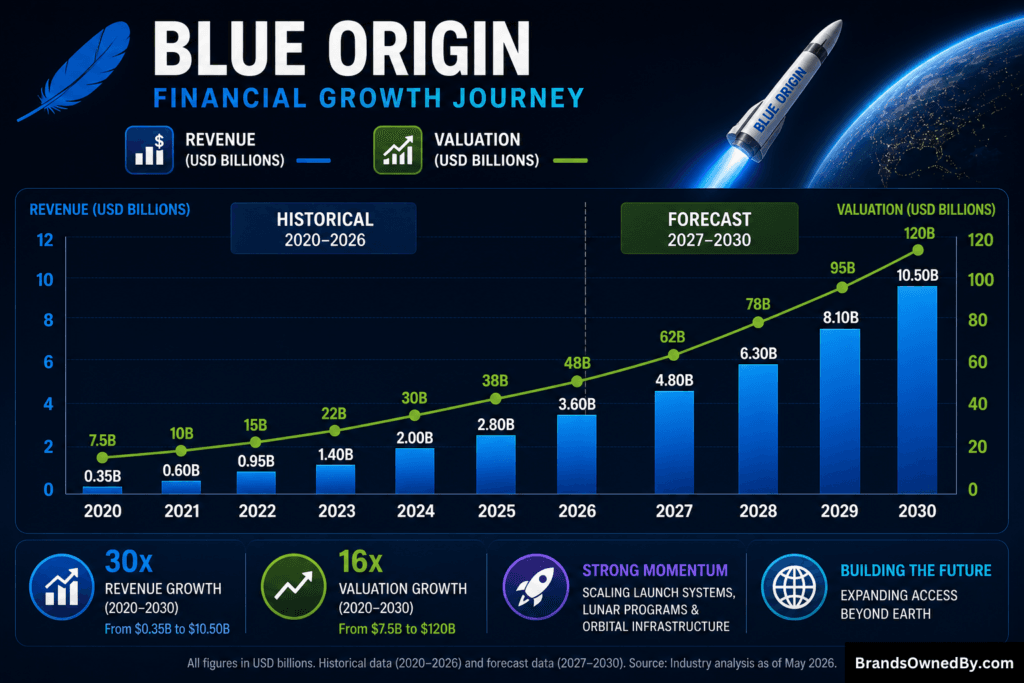
As of May 2026, Blue Origin is estimated to generate approximately $3.6 billion in annual revenue, while its estimated private valuation and net worth stand near $48 billion.
Although the company remains privately held and does not publicly release audited financial statements, industry analysts estimate that Blue Origin’s financial growth accelerated sharply between 2022 and 2026 due to expansion in orbital launch systems, government aerospace contracts, propulsion technology programs, and lunar infrastructure development.
The company’s valuation growth has also been driven by rising demand for reusable launch systems and increasing competition in the commercial space economy.
Blue Origin Revenue Growth in 2026
Blue Origin’s estimated 2026 revenue of $3.6 billion reflects major expansion across several aerospace business segments.
The company evolved from a research-focused aerospace operation into a multi-segment space infrastructure business generating revenue from launch systems, propulsion technology, government partnerships, and commercial aerospace programs.
A major portion of the projected 2026 revenue comes from orbital launch and aerospace infrastructure programs connected to New Glenn operations.
Orbital Launch Services
Orbital launch operations are estimated to represent one of the largest contributors to Blue Origin’s 2026 revenue.
The company expanded New Glenn launch operations as competition intensified in the heavy-lift launch market.
Revenue in this segment is estimated at approximately $1.4 billion in 2026.
This includes:
- commercial satellite deployment contracts.
- national security launch missions.
- orbital logistics programs.
- private aerospace payload deployments.
Blue Origin’s push into reusable heavy-launch systems became increasingly important after expanded launch activity during 2025 and 2026.
Government and Defense Contracts
Government aerospace contracts became another major revenue driver.
Blue Origin continued expanding partnerships involving organizations such as NASA and the United States Space Force.
Estimated 2026 revenue from government and defense-related aerospace programs is approximately $950 million.
This includes programs connected to:
- lunar landing systems.
- national security launch programs.
- propulsion technology development.
- orbital infrastructure systems.
Government-backed lunar development initiatives became especially important for long-term revenue expansion.
Rocket Engine Manufacturing
Blue Origin’s propulsion division continued growing through development of the BE engine series.
The BE-4 engine program became strategically important in the U.S. aerospace launch market.
Estimated 2026 revenue from propulsion systems and engine-related contracts is approximately $700 million.
This includes:
- internal propulsion system deployment.
- external aerospace engine partnerships.
- propulsion manufacturing agreements.
Commercial Space Tourism
The New Shepard tourism program previously generated strong commercial visibility for Blue Origin.
However, operational focus shifted more heavily toward lunar and orbital systems in 2026.
Estimated tourism-related revenue for 2026 is approximately $250 million.
Although smaller than orbital launch revenue, the tourism business helped strengthen Blue Origin’s brand position in commercial spaceflight.
Blue Origin Net Worth and Valuation in 2026
As of May 2026, Blue Origin’s estimated private valuation is approximately $48 billion.
Some private aerospace analysts estimate the company could potentially exceed $60 billion in valuation if New Glenn launch scaling continues successfully over the next several years. Broader private market estimates for Blue Origin have ranged significantly because the company remains privately held.
The company’s valuation growth is tied heavily to future commercial space infrastructure potential rather than only current operational revenue.
Launch Infrastructure Assets
Blue Origin invested billions of dollars into aerospace manufacturing facilities, launch systems, testing infrastructure, and propulsion manufacturing operations.
These industrial assets significantly increased the company’s long-term enterprise value.
Reusable Rocket Technology
Reusable launch systems remain one of the most valuable areas of the commercial space industry.
Blue Origin’s progress in reusable heavy-launch technology improved long-term market confidence around future launch scalability.
Lunar Infrastructure Programs
The company’s lunar transportation and moon infrastructure initiatives increased strategic value in the growing lunar economy sector.
NASA-related lunar development partnerships also strengthened long-term commercial positioning.
Future Space Infrastructure Potential
Investors and analysts increasingly view orbital infrastructure as a major future economic sector.
Blue Origin’s involvement in areas such as:
- orbital logistics.
- lunar transportation.
- reusable propulsion systems.
- commercial space habitats.
- heavy launch systems.
contributed significantly to valuation expansion.
Historical Revenue and Net Worth Growth (2020–2026)
| Year | Estimated Revenue | Estimated Net Worth / Valuation |
|---|---|---|
| 2020 | $0.35 billion | $7.5 billion |
| 2021 | $0.60 billion | $10 billion |
| 2022 | $0.95 billion | $15 billion |
| 2023 | $1.4 billion | $22 billion |
| 2024 | $2 billion | $30 billion |
| 2025 | $2.8 billion | $38 billion |
| 2026 | $3.6 billion | $48 billion |
The company’s strongest growth period occurred between 2023 and 2026 as launch infrastructure expansion accelerated and government aerospace partnerships increased.
Future Revenue Forecast Through 2030
Industry analysts expect Blue Origin’s revenue to continue growing rapidly if the company successfully scales orbital launch operations and expands lunar infrastructure programs during the second half of the decade.
Projected future revenue estimates include:
- 2027 Forecast: $4.8 billion driven by higher New Glenn launch cadence and defense launch contracts.
- 2028 Forecast: $6.3 billion supported by lunar transportation systems and large-scale satellite deployment missions.
- 2029 Forecast: $8.1 billion fueled by orbital infrastructure projects and recurring government aerospace contracts.
- 2030 Forecast: $10.5 billion driven by mature heavy-launch operations, lunar logistics systems, and commercial orbital infrastructure expansion.
Much of this projected growth depends on successful execution in reusable launch systems, government mission reliability, and expansion of commercial space infrastructure markets.
As of May 2026, Blue Origin remains one of the most strategically important private aerospace companies competing in the global commercial space industry.
Brands Owned by Blue Origin
As of 2026, Blue Origin operates a growing portfolio of aerospace programs, launch systems, propulsion technologies, infrastructure projects, and space-related commercial initiatives. It controls specialized aerospace entities, operational programs, and advanced technology divisions tied directly to space transportation and infrastructure development.
Its operational ecosystem includes reusable launch systems, rocket engine programs, lunar transportation projects, orbital infrastructure initiatives, and aerospace manufacturing operations.
It has also expanded through strategic partnerships, infrastructure investments, and technology-focused operational divisions designed to strengthen its long-term position in the commercial space economy.
| Company / Program / Entity | Type | Primary Function | Key Details as of 2026 |
|---|---|---|---|
| New Shepard | Reusable Suborbital Launch System | Commercial human spaceflight and research missions | Used for commercial tourism flights and scientific payload missions. Features reusable booster technology with vertical landing capability. One of Blue Origin’s most recognized commercial aerospace programs. |
| New Glenn | Heavy-Lift Orbital Rocket Program | Orbital satellite deployment and government launch missions | Designed to compete in the global heavy-launch market. Supports commercial satellites, national security launches, and deep-space payload operations. Incorporates reusable booster systems. |
| BE-4 Engine Program | Aerospace Propulsion Division | Rocket engine manufacturing and propulsion systems | High-performance liquid oxygen and LNG rocket engine program used in advanced launch systems. Supports Blue Origin launch operations and aerospace propulsion partnerships. |
| BE-3 Engine Program | Reusable Rocket Engine System | Suborbital propulsion technology | Powers New Shepard missions and supports reusable vertical landing technology development. Helped establish Blue Origin’s reusable propulsion expertise. |
| Blue Moon | Lunar Transportation Program | Lunar cargo and moon infrastructure systems | Focused on lunar surface transportation and moon logistics systems. Supports future lunar infrastructure and NASA-related moon exploration initiatives. |
| Orbital Reef | Commercial Space Station Initiative | Orbital infrastructure development | Designed as a future commercial space station ecosystem for research, manufacturing, and private orbital operations in low Earth orbit. |
| Blue Origin Engines Division | Aerospace Engineering Division | Propulsion research and manufacturing | Handles propulsion engineering, reusable engine systems, testing infrastructure, and advanced aerospace propulsion development. |
| Blue Origin Launch Operations | Launch Infrastructure Division | Rocket launch and testing operations | Manages launch logistics, testing operations, launch infrastructure systems, and reusable rocket recovery operations. |
| West Texas Launch Site | Aerospace Launch Facility | Suborbital launches and testing operations | Primary site for New Shepard launches, propulsion testing, crewed spaceflight missions, and reusable landing operations. |
| Launch Complex 36 | Orbital Launch Facility | Heavy orbital launch operations | Supports New Glenn orbital launch missions and large-scale aerospace launch infrastructure operations. |
| Blue Origin Manufacturing Operations | Aerospace Manufacturing Infrastructure | Rocket and propulsion production | Operates large-scale manufacturing systems for rockets, propulsion units, structural aerospace components, and assembly operations. |
| Blue Origin Lunar Systems Division | Lunar Infrastructure Division | Moon exploration and logistics systems | Focuses on lunar transportation systems, cargo delivery technologies, and moon infrastructure support operations. |
| Blue Origin Space Tourism Operations | Commercial Spaceflight Division | Private civilian space tourism | Operates commercial human spaceflight missions using reusable suborbital systems targeting high-net-worth private customers. |
| Blue Origin Government Aerospace Programs | Government Contract Operations | Defense and aerospace partnerships | Handles aerospace programs tied to government agencies including NASA and national security-related launch operations. |
New Shepard
New Shepard is one of Blue Origin’s most recognized aerospace programs.
The reusable suborbital rocket system was developed for commercial human spaceflight and research missions. The program became globally known after successfully launching civilian passengers into suborbital space.
The system consists of a reusable booster and crew capsule designed for vertical takeoff and vertical landing operations.
New Shepard serves multiple operational purposes.
Commercial Space Tourism
The system became a major platform for high-net-worth commercial passengers seeking short-duration spaceflight experiences.
Passengers experience several minutes of weightlessness before returning to Earth through parachute-assisted landing systems.
Research Payload Missions
The platform is also used for scientific payload missions involving microgravity research experiments.
Universities, research organizations, and aerospace institutions use New Shepard flights for short-duration scientific testing.
Reusable Rocket Testing
The system helped Blue Origin refine reusable rocket landing technologies that later influenced larger launch vehicle development programs.
New Glenn
New Glenn is Blue Origin’s heavy-lift orbital launch vehicle division.
As of 2026, this program represents one of the company’s most strategically important operational assets.
The rocket was designed to compete in the global orbital launch market against systems operated by companies such as SpaceX.
Commercial Satellite Launches
New Glenn targets commercial satellite deployment markets.
This includes missions involving:
- telecommunications satellites.
- Earth observation systems.
- broadband infrastructure payloads.
- private aerospace deployment contracts.
National Security Missions
The launch system also supports government and defense-related launch operations.
Blue Origin expanded its focus on national security launch contracts as defense-related space programs increased in importance.
Reusable Launch Technology
The rocket incorporates reusable booster technology designed to reduce long-term launch costs.
This became a critical competitive area in the commercial launch industry.
BE-4 Engine Program
The BE-4 engine program became one of Blue Origin’s most valuable propulsion assets.
The engine was developed as a high-performance liquid oxygen and liquefied natural gas rocket engine system.
As of 2026, the program plays a major role in Blue Origin’s propulsion strategy.
Internal Launch Integration
The BE-4 engine powers major Blue Origin launch systems including New Glenn.
External Aerospace Partnerships
The engine program also expanded Blue Origin’s influence within the broader aerospace supply chain.
Engine partnerships and propulsion agreements increased the strategic importance of the division.
Advanced Propulsion Development
Blue Origin continued investing in next-generation propulsion technologies to improve efficiency, reliability, and reusable launch capabilities.
BE-3 Engine Program
The BE-3 engine system supports Blue Origin’s suborbital launch operations.
The engine became important in reusable vertical landing systems developed through New Shepard missions.
The program also helped Blue Origin establish technical expertise in reusable propulsion engineering.
Blue Moon Lunar Program
Blue Moon is Blue Origin’s lunar transportation and moon infrastructure initiative.
As of 2026, the program remains central to the company’s long-term lunar strategy.
The project focuses on cargo transportation systems designed for moon missions and lunar infrastructure support.
Lunar Cargo Transportation
The program aims to support delivery of equipment and cargo to the lunar surface.
NASA Lunar Programs
Blue Origin expanded collaboration efforts connected to lunar exploration initiatives involving NASA.
These projects increased the company’s role in future moon-based operations.
Long-Term Lunar Infrastructure
The company positioned Blue Moon as part of a broader strategy focused on future lunar industrial development and infrastructure systems.
Orbital Reef
Orbital Reef is Blue Origin’s commercial space station initiative.
The project focuses on building long-duration orbital infrastructure designed for future commercial space operations.
As of 2026, the initiative remained one of the company’s most ambitious orbital infrastructure projects.
Commercial Space Infrastructure
The platform is designed to support future commercial activity in low Earth orbit.
Potential operational uses include:
- scientific research.
- commercial manufacturing.
- tourism operations.
- private orbital facilities.
Strategic Partnerships
Orbital Reef operates through collaboration with aerospace and infrastructure partners.
The initiative reflects Blue Origin’s broader vision of creating large-scale space infrastructure ecosystems.
Blue Origin Engines Division
Beyond individual engine systems, Blue Origin operates a broader propulsion manufacturing and engineering division.
This operational entity focuses on:
- propulsion manufacturing.
- engine testing systems.
- aerospace propulsion research.
- reusable engine development.
The division became increasingly important as launch demand expanded across government and private aerospace sectors.
Blue Origin Launch Operations
Blue Origin operates large-scale launch and testing infrastructure across the United States.
These operational assets function as critical infrastructure entities within the company’s aerospace ecosystem.
West Texas Launch Site
The company’s West Texas facility became central to suborbital testing and tourism missions.
The site supports:
- launch testing.
- reusable rocket landings.
- crewed missions.
- propulsion testing operations.
Launch Complex 36
Blue Origin operates launch infrastructure at Cape Canaveral in Cape Canaveral.
The site supports orbital launch operations connected to New Glenn missions.
Final Thoughts
Understanding who owns Blue Origin is relatively simple compared to many large aerospace companies. Jeff Bezos remains the dominant owner and strategic force behind the company.
That ownership structure gives Blue Origin flexibility to pursue long-term aerospace projects without short-term shareholder pressure. It also allows the company to invest heavily in reusable rockets, lunar systems, and orbital infrastructure.
The company now faces increasing pressure to compete more aggressively in launch frequency and execution. Leadership changes and expanding government partnerships show that Blue Origin is evolving from an experimental aerospace venture into a major commercial space competitor.
FAQs
Is Blue Origin a private company?
Yes, Blue Origin is a privately held aerospace company. It is not publicly traded on any stock exchange, and its ownership remains concentrated primarily under Jeff Bezos.
Who owns Blue Origin space?
Blue Origin is primarily owned and controlled by Jeff Bezos, who founded the company in 2000. He remains the dominant shareholder and strategic decision-maker behind the company as of 2026.
What is Jeff Bezos’s space company name?
Jeff Bezos’s space company is called Blue Origin. The company focuses on reusable rockets, orbital launch systems, lunar infrastructure, and commercial spaceflight technologies.
Who owns Blue Origin rockets?
The rockets developed by Blue Origin, including New Shepard and New Glenn, are owned and operated by Blue Origin itself. Since Jeff Bezos controls the company, he indirectly controls these rocket programs through his ownership position.
When was Blue Origin founded?
Blue Origin was founded in 2000 by Jeff Bezos.
What does it cost to fly on Blue Origin?
Blue Origin does not publicly disclose standard ticket pricing for all passengers. However, estimates for a seat on a New Shepard suborbital spaceflight have ranged from several hundred thousand dollars to over $1 million depending on the mission and passenger arrangements.
Does Jeff Bezos own all of Blue Origin?
Jeff Bezos is believed to own the vast majority of Blue Origin and remains the controlling shareholder. While there may be limited internal stakeholders or small strategic financial participants, no public information suggests that outside investors hold significant controlling ownership stakes as of 2026.
Is Blue Origin cheaper than SpaceX?
Blue Origin and SpaceX operate in different areas of the space industry, so direct pricing comparisons are difficult. SpaceX is generally considered more cost-efficient in orbital launch services due to its high launch frequency and mature reusable rocket systems. Blue Origin continues expanding its reusable launch capabilities through New Glenn and other programs.
Is Blue Origin owned by Amazon?
No, Amazon does not own Blue Origin. Both companies were founded by Jeff Bezos, but they operate as separate businesses.