
- Hoka is fully owned by Deckers Outdoor Corporation, meaning it is not an independent company and has no separate shareholders or stock listing.
- As a publicly traded company (NYSE: DECK), Deckers’ ownership is distributed among institutional investors, with major stakes held by The Vanguard Group, BlackRock, and FMR LLC.
- No single entity controls Hoka directly; control is exercised through Deckers’ board of directors and executive leadership, led by CEO Stefano Caroti.
- Hoka benefits from a stable, institutional ownership structure, allowing it to scale globally with strong financial backing while maintaining brand-level operational focus.
Hoka is a global performance footwear brand specializing in running, trail, and athletic lifestyle shoes. It was founded in 2009 in Annecy, France, and is now headquartered in the United States under its parent company, Deckers Outdoor Corporation.
Hoka became known for its unconventional design. At a time when the industry was focused on minimalist shoes, Hoka introduced “maximalist” footwear with oversized midsoles and enhanced cushioning.
This design improved shock absorption and stability. It allowed runners to maintain speed while reducing strain on joints. Initially, the brand gained popularity among ultramarathon and trail runners. Over time, it expanded into road running, training, and everyday wear.
Hoka operates globally. Its products are used by professional athletes and casual consumers alike. The brand continues to focus on innovation, comfort, and performance-driven design rather than following traditional footwear trends.
Founders of Hoka
Hoka was founded by two experienced sports industry professionals: Nicolas Mermoud and Jean-Luc Diard. Both founders brought deep expertise in product development and outdoor sports.
Nicolas Mermoud
Nicolas Mermoud is a former trail runner and product developer. Before launching Hoka, he worked in the outdoor and sports footwear industry, including experience with brands like Salomon.
Mermoud’s technical mindset shaped Hoka’s early product innovation. He focused on performance challenges faced by endurance runners. His goal was to reduce fatigue and improve downhill running efficiency. This led to the development of highly cushioned, lightweight shoes.
Jean-Luc Diard
Jean-Luc Diard co-founded Hoka alongside Mermoud. He previously held leadership roles at Salomon, including senior positions in innovation and management.
Diard played a major role in strategy, branding, and scaling the company. He helped position Hoka as a disruptive force in the running shoe market. His industry experience allowed the brand to grow quickly after launch.
Founders’ Vision and Idea
The founders started Hoka with a clear objective. They wanted to design a shoe that allowed runners to move faster downhill while reducing impact on the body.
The idea came from their experience in mountain running. Traditional shoes were not providing enough cushioning or protection during long descents. They experimented with oversized soles and lightweight materials.
This approach was unconventional at the time. The market was dominated by minimalist designs. However, Hoka’s concept proved effective. It gained early adoption among ultramarathon runners and gradually expanded into mainstream running culture.
Their vision reshaped the footwear industry. Today, maximal cushioning is widely accepted, and many competitors have adopted similar design principles inspired by Hoka’s early innovation.
Ownership History
The ownership history of Hoka is relatively straightforward, but strategically important. Unlike many footwear brands that change hands multiple times, Hoka has had a single major ownership transition. That transition enabled its transformation from a niche startup into a global performance leader.
Independent Startup Phase (2009–2013)
Hoka was founded in 2009 by Nicolas Mermoud and Jean-Luc Diard in France.
In its early years, Hoka operated as an independent company. It focused almost entirely on product innovation. The founders did not prioritize mass-market appeal initially. Instead, they targeted serious runners, especially those involved in trail running and ultramarathons.
The brand gained early traction through specialty running stores and athlete communities. It built credibility through performance rather than heavy advertising. However, this phase also exposed limitations. The company lacked the capital, supply chain scale, and global distribution needed to meet growing demand.
By 2012, Hoka had proven strong product-market fit. Its growth potential was clear, but scaling required a larger platform.
Acquisition by Deckers Outdoor Corporation (2013)
In 2013, Hoka was acquired by Deckers Outdoor Corporation.
This was a strategic acquisition rather than a distressed sale. Deckers identified Hoka as a high-growth asset early in its lifecycle. At that time, Deckers was already established with brands like UGG and Teva, but it lacked a strong presence in performance running footwear.
The acquisition gave Hoka immediate access to:
- Global sourcing and manufacturing capabilities
- Established wholesale and retail distribution networks
- Capital for product development and marketing
- Operational expertise in scaling consumer brands.
Importantly, Deckers chose not to reposition Hoka as a mass-market brand immediately. Instead, it preserved the brand’s performance-first identity.
Post-Acquisition Integration and Brand Positioning (2013–2018)
After joining Deckers Outdoor Corporation, Hoka entered a structured growth phase.
Deckers integrated Hoka into its portfolio while allowing it to operate with relative autonomy. This hybrid model was critical. It ensured that Hoka retained its innovation culture while benefiting from corporate infrastructure.
During this period, Hoka expanded beyond trail running. It entered road running and training categories. It also broadened its retail presence, moving from niche specialty stores into larger sporting goods channels.
International expansion accelerated as well. Deckers leveraged its global footprint to introduce Hoka into Europe and Asia at scale.
Acceleration Phase and Mainstream Adoption (2019–2023)
From 2019 onward, Hoka shifted from a specialist brand to a mainstream growth engine.
Several structural changes defined this phase:
- Strong expansion of direct-to-consumer channels, including e-commerce
- Increased investment in brand marketing and athlete endorsements
- Entry into lifestyle and everyday wear segments.
Hoka’s design philosophy began influencing broader footwear trends. Maximal cushioning, once considered unconventional, became widely accepted across the industry.
Within Deckers, Hoka transitioned from a developing brand into a primary revenue driver. It started contributing a significant share of overall company growth.
Strategic Core Brand Within Deckers (2024–2026)
As of 2025, Hoka is positioned as a core strategic brand within Deckers Outdoor Corporation.
The company has increasingly prioritized Hoka in its long-term growth strategy. This includes:
- Continued investment in performance innovation
- Expansion into new international markets
- Growth of physical retail and brand-owned stores
- Strengthening of premium brand positioning.
Hoka is no longer treated as a niche or emerging label. It is now central to Deckers’ portfolio alongside its largest brands.
The brand continues to scale globally while maintaining a strong identity in performance footwear. Its product pipeline, athlete partnerships, and category expansion remain key focus areas.
Who Owns Hoka?
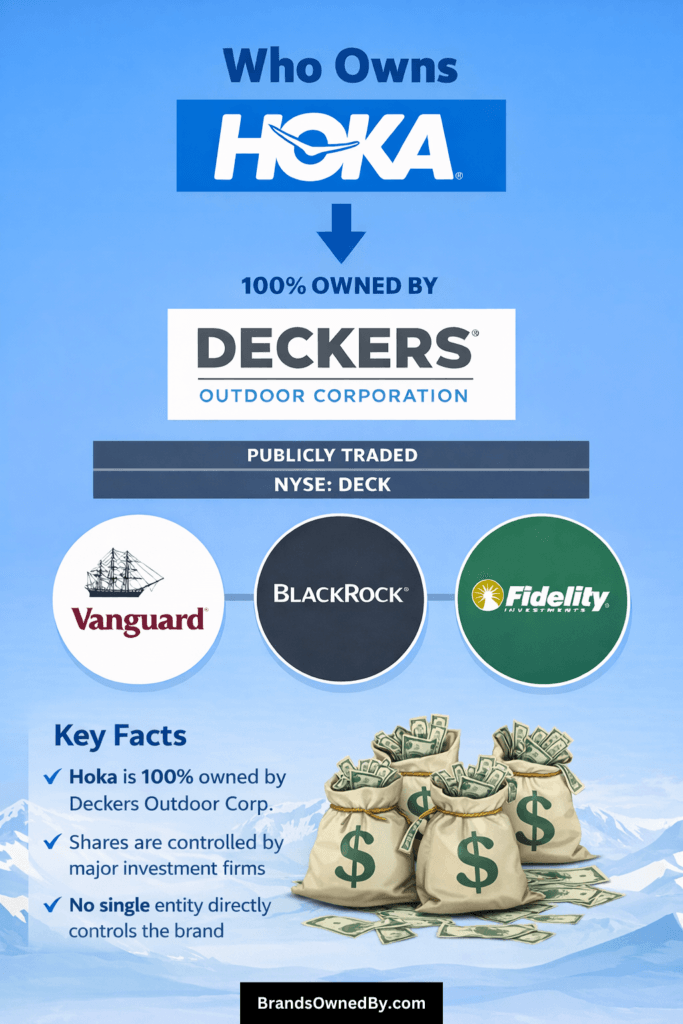
Hoka is fully owned by Deckers Outdoor Corporation. It is not a standalone company. It operates as a brand within Deckers’ corporate structure.
This means Hoka does not have its own shares, investors, or independent governance. All ownership sits at the Deckers level. Anyone who owns shares in Deckers indirectly owns a portion of Hoka.
Deckers is a publicly listed company on the New York Stock Exchange under the ticker DECK. Its ownership is widely distributed across institutional investors, mutual funds, and retail shareholders. No single entity has controlling ownership. Instead, control is exercised through the board of directors and executive leadership.
This structure gives Hoka stability. It benefits from long-term capital, global infrastructure, and a centralized strategy while continuing to operate as a focused performance brand.
Parent Company: Deckers Outdoor Corporation
Deckers Outdoor Corporation is a global footwear group that manages multiple brands across different segments. It is best known for building and scaling brands into dominant category leaders rather than simply acquiring and holding them.
As a public company, Deckers’ shareholder base is dominated by large institutional investors. The largest among them is The Vanguard Group, which holds roughly 11%–12% of the company. BlackRock follows closely with around 10%–11%. Other major stakeholders include FMR LLC and State Street Corporation, each holding meaningful stakes.
These firms do not manage daily operations. Their influence comes through governance. They vote on board appointments, executive compensation, and major corporate decisions. This creates a system where ownership is dispersed, but oversight remains structured and institutional.
Deckers operates through a portfolio model. Each brand is positioned differently to avoid overlap. Hoka represents its performance and technical footwear segment. Other brands like UGG and Teva focus on lifestyle and outdoor categories.
What makes Deckers relevant to Hoka’s growth is not just ownership, but execution capability. The company provides a fully integrated operating platform. This includes global sourcing, manufacturing partnerships, logistics networks, and a rapidly expanding direct-to-consumer ecosystem.
Over the past few years, Deckers has increasingly prioritized Hoka. The brand has moved from being an emerging asset to a central pillar of the company’s growth strategy. This shift is visible in increased investment in innovation, marketing, and retail expansion.
At the leadership level, decisions flow through Deckers’ executive team, led by CEO Stefano Caroti. Brand leadership at Hoka operates within this framework, focusing on execution rather than corporate governance.
Acquisition Details
Hoka was acquired by Deckers Outdoor Corporation in 2013. The financial terms of the deal were not publicly disclosed. This usually indicates that the acquisition size was relatively modest at the time, especially compared to large-scale industry transactions.
However, the importance of the deal lies in its timing and strategic fit rather than its disclosed value.
When Deckers acquired Hoka, the brand was still early in its lifecycle. It had built strong credibility among trail runners and endurance athletes, but it lacked scale. Distribution was limited. Production capacity was constrained. Marketing reach was minimal.
Deckers identified that Hoka had something rare. It was not just another running shoe brand. Its product design introduced a different approach to cushioning and performance. This gave it a clear identity in a crowded market.
The acquisition was driven by a structural gap in Deckers’ portfolio. At that time, the company did not have a strong presence in performance running. Hoka provided immediate entry into that category without the need to build a brand from scratch.
After the acquisition, Deckers did not rush to mass-market expansion. Instead, it scaled Hoka in phases. It expanded distribution gradually, increased production capacity, and invested in product development. This controlled approach helped preserve the brand’s credibility.
A key reason the acquisition worked is the integration model. Hoka was not absorbed into a generic corporate system. It retained its design philosophy and innovation culture. At the same time, it gained access to Deckers’ infrastructure, including supply chain, retail relationships, and global logistics.
Over time, this combination of independence and support allowed Hoka to expand beyond its niche. It moved into road running, training, and eventually lifestyle categories. Its appeal broadened from elite athletes to everyday consumers.
Today, the acquisition is widely seen as a high-impact strategic decision. Hoka has become one of the most important brands within Deckers. It plays a central role in shaping the company’s future growth.
The deal itself may not have been large in financial terms at the time. But in strategic terms, it fundamentally reshaped Deckers’ position in the global footwear market.
Competitor Ownership Comparison
Hoka operates in a highly competitive global footwear market. Most of its direct competitors are not standalone brands. They are owned either by large public corporations or structured as publicly traded companies themselves. This ownership structure shapes how these brands invest, scale, and compete.
| Brand | Parent Company / Owner | Ownership Type | Key Shareholders / Control | Strategic Implication |
|---|---|---|---|---|
| Hoka | Deckers Outdoor Corporation | Public (via parent) | Institutional investors like The Vanguard Group, BlackRock | Backed by parent infrastructure with focused brand execution |
| Nike | Nike Inc. | Public (dual-class structure) | Controlled influence by Phil Knight | Strong insider control enables long-term strategy and aggressive scaling |
| Adidas | Adidas AG | Public | Major institutional investors (no dominant owner) | Balanced governance with global diversification |
| Brooks Running | Berkshire Hathaway | Private subsidiary | Controlled by Warren Buffett | Long-term ownership with minimal pressure for short-term results |
| On Running | On Holding AG | Public (independent) | Backed by investors including Roger Federer | Full strategic independence but higher operational burden |
| ASICS | ASICS Corporation | Public | Institutional and domestic shareholders | Strong legacy positioning in performance footwear |
| Puma | Puma SE | Public with anchor investor | Significant stake held by Kering | Strategic influence from a major shareholder |
Nike: Fully Controlled Public Corporation
Nike is owned by Nike Inc., a publicly traded corporation.
Nike operates under a dual-class share structure. This gives disproportionate voting power to insiders, particularly co-founder Phil Knight and related entities. While institutional investors hold large economic stakes, voting control remains concentrated.
This structure allows Nike to make long-term strategic decisions without heavy external pressure. It invests aggressively in innovation, athlete endorsements, and global marketing.
Compared to Hoka, Nike has far greater scale and direct control over its brand ecosystem. However, Hoka benefits from being more focused within Deckers’ portfolio, allowing faster execution in specific categories like running.
Adidas: Widely Held Public Company
Adidas is owned by Adidas AG, which is publicly listed in Germany.
Adidas has a dispersed ownership structure. Large institutional investors such as BlackRock and The Vanguard Group hold significant stakes, but no single shareholder controls the company.
This model is similar to Deckers. Strategic decisions are made by the board and executive team, with oversight from institutional investors.
The key difference is scale and diversification. Adidas operates across multiple categories globally, while Hoka is positioned more narrowly within performance footwear under Deckers.
Brooks Running: Privately Controlled Subsidiary
Brooks Running is owned by Berkshire Hathaway.
This ownership model is fundamentally different. Berkshire Hathaway, led by Warren Buffett, is a conglomerate known for long-term ownership and minimal operational interference.
Brooks operates as a subsidiary with significant autonomy. It focuses almost entirely on running, similar to Hoka’s core category.
Compared to Hoka, Brooks benefits from patient capital and long-term stability. However, Deckers tends to take a more active role in scaling Hoka, especially in marketing, retail expansion, and international growth.
On Running: Independent Public Company
On Running operates under On Holding AG, a publicly traded company.
Unlike Hoka, On is not part of a larger multi-brand group. It operates independently with its own corporate structure, shareholders, and leadership.
A notable stakeholder is Roger Federer, who holds an equity stake and plays a role in brand development.
This independent structure gives On full control over its strategy and brand direction. However, it also means it must build and fund its own infrastructure, unlike Hoka which leverages Deckers’ existing platform.
ASICS: Public Company with Corporate Legacy
ASICS is owned by ASICS Corporation.
ASICS is publicly listed and has a traditional corporate structure with a mix of institutional and domestic Japanese shareholders. It has deep roots in performance running and a strong reputation for technical footwear.
Its ownership model is similar to Adidas in terms of dispersion. However, its strategy is more focused on performance categories rather than lifestyle expansion.
Compared to Hoka, ASICS represents an established legacy player, while Hoka is a newer, faster-growing challenger brand within Deckers.
Puma: Public Company with Strategic Anchor Shareholder
A key difference is the presence of a major anchor shareholder. Kering holds a significant stake in Puma, giving it strategic influence.
This creates a hybrid structure. Puma is publicly traded, but a single large shareholder has meaningful influence over direction.
Hoka, in contrast, does not have a dominant controlling shareholder through Deckers. Its ownership is more distributed.
Key Ownership Differences and Strategic Impact
Hoka’s position under Deckers creates a hybrid advantage. It is not fully independent, but it is also not constrained by a single controlling owner.
Compared to competitors:
- Nike benefits from concentrated voting control and massive scale
- Adidas and ASICS operate under dispersed public ownership similar to Deckers
- Brooks operates under a long-term private conglomerate model
- On Running functions as an independent public company
- Puma combines public ownership with a strong anchor investor.
Hoka’s structure sits in the middle. It benefits from shared infrastructure, capital, and governance through Deckers, while maintaining brand-level focus.
This balance allows Hoka to scale efficiently without the operational burden of being fully independent. At the same time, it retains enough flexibility to compete with both legacy giants and newer entrants in the performance footwear market.
Who Controls Hoka?
Control of Hoka sits with its parent company, Deckers Outdoor Corporation. The brand does not have independent governance. All major decisions flow through Deckers’ leadership structure, supported by its board and influenced by large institutional shareholders.
This creates a centralized control model with delegated execution at the brand level.
Corporate Control: Board of Directors and CEO
At the top of the control structure is the board of directors of Deckers Outdoor Corporation. The board is responsible for governance, oversight, and protecting shareholder interests. It approves high-level decisions such as capital allocation, long-term strategy, and executive appointments.
Operational control is led by CEO Stefano Caroti, who took over leadership of Deckers in 2024. He is responsible for the overall direction of the company and all its brands, including Hoka.
He works alongside a senior executive team that includes:
- Steve Fasching (Chief Financial Officer)
- Cindy Davis (Brand leadership oversight)
- Dave Powers remains influential historically, but no longer holds executive control.
This leadership team determines where capital is deployed. That includes how much investment Hoka receives for innovation, marketing, and global expansion.
Brand-Level Control: Hoka Leadership
At the brand level, execution is handled by Hoka’s internal leadership team.
As of 2026, Wendy Yang leads the brand. She is responsible for Hoka’s global strategy, product direction, and market expansion.
Her role includes:
- Overseeing product innovation and category expansion
- Managing global marketing and brand positioning
- Driving growth across direct-to-consumer and wholesale channels.
However, her authority operates within Deckers’ corporate framework. Major investments, strategic pivots, and large-scale expansion plans require approval from Deckers’ executive leadership.
This ensures alignment between brand execution and corporate priorities.
Role of Institutional Shareholders
Because Deckers Outdoor Corporation is publicly traded, control is also influenced at the shareholder level.
The largest investors include:
- The Vanguard Group
- BlackRock
- FMR LLC
- State Street Corporation.
These firms do not manage daily operations. They do not decide product launches or marketing campaigns.
Their influence comes through governance. They vote on board members, executive pay, and major corporate actions. If performance declines, they can pressure leadership or support strategic changes.
This creates accountability at the top without interfering in day-to-day brand operations.
Decision-Making Structure
Control of Hoka follows a clear hierarchy.
Strategic decisions originate at the Deckers level. These include entering new markets, scaling retail operations, or increasing investment in specific categories.
The executive team, led by Stefano Caroti, defines these priorities. The board reviews and approves major moves.
Once the strategy is set, execution shifts to Hoka’s leadership under Wendy Yang. Her team translates corporate strategy into product launches, campaigns, and market expansion.
This layered structure avoids fragmentation. It ensures that Hoka grows in alignment with Deckers’ broader objectives while still maintaining speed in execution.
Hoka Annual Revenue and Net Worth
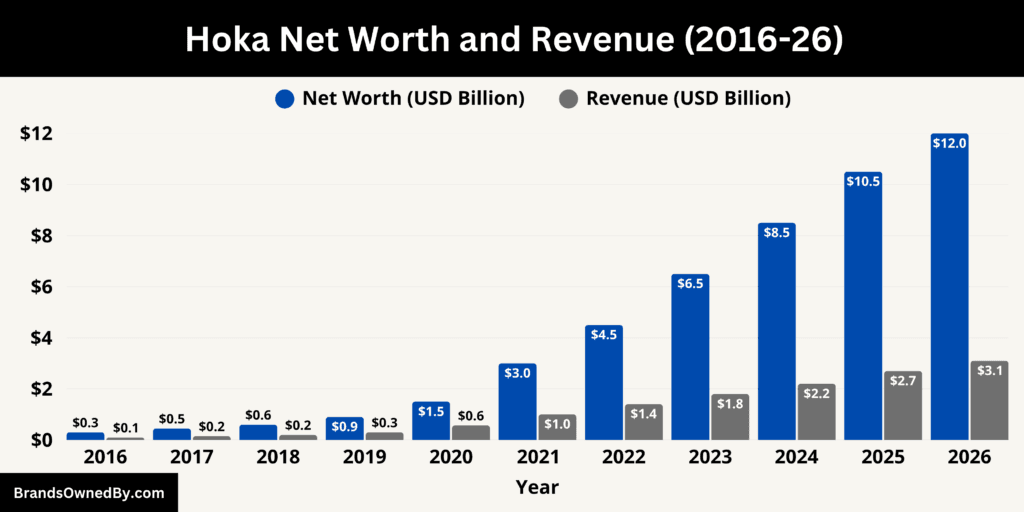
As of April 2026, Hoka generates over $3.1 billion in annual revenue, with continued double-digit growth. Its estimated brand value has also surged to around $12 billion, reflecting strong demand, premium pricing power, and global expansion.
2026 Revenue Performance and Breakdown
In fiscal 2026, Hoka continues to deliver strong growth momentum. Recent quarterly results show the brand generating $628.9 million in a single quarter, up nearly 18.5% year-over-year. Other quarters in the same fiscal cycle have also exceeded $600 million, indicating consistent high-volume performance.
When annualized, this places Hoka firmly in the $2.7–$3.1 billion revenue range for 2026.
A closer look at revenue composition shows how the brand is scaling:
Geographic split: Hoka’s largest market remains the United States. However, international markets are now a major growth driver. Regions such as Europe and Asia-Pacific are expanding rapidly, supported by retail store openings and localized marketing.
Channel mix (DTC vs Wholesale): Direct-to-consumer (DTC) is becoming increasingly important. Deckers reported over $1 billion in DTC revenue in a single quarter across brands, with Hoka contributing a growing share. This includes e-commerce and owned retail stores. Wholesale partnerships still play a key role but are no longer the sole growth engine.
Product segmentation: Hoka’s revenue is driven primarily by performance footwear. However, lifestyle and everyday wear categories are growing fast. Premium-priced running shoes, often in the $140+ range, contribute significantly to margins and overall revenue mix.
Net Worth and Brand Valuation in 2026
Hoka does not report an official standalone net worth because it is not a separate legal entity. However, based on its revenue scale, growth rate, and market positioning, analysts estimate its brand value to be around $12 billion as of April 2026.
This valuation is supported by several factors:
- Sustained double-digit revenue growth
- Strong brand differentiation in cushioning and performance
- Premium pricing strategy with high full-price sell-through
- Expanding global footprint.
Hoka has also gained market share from major competitors, reinforcing its position as a high-value asset within Deckers’ portfolio.
Growth Drivers Behind Revenue Expansion
Hoka’s revenue growth is not accidental. It is driven by a combination of structural and strategic factors.
The brand has positioned itself in the premium running segment. This allows it to maintain higher average selling prices. At the same time, it continues to innovate in cushioning technology, which differentiates it from competitors.
International expansion is another key driver. Deckers has increased investment in markets outside the U.S., where growth rates are higher. Retail store expansion and localized marketing strategies are accelerating brand adoption globally.
The shift toward direct-to-consumer sales also improves margins and strengthens brand control. This allows Hoka to capture more value from each sale while building stronger customer relationships.
Revenue Forecast (2027–2030)
The forward outlook for Hoka is anchored in its current scale and growth profile under Deckers Outdoor Corporation. As of April 2026, Hoka is already operating above the $2.5–$3 billion annual revenue range while sustaining double-digit growth. That combination—large base with continued expansion—is what makes the forecast credible rather than speculative.
Growth Trajectory and Scaling Logic
Hoka is no longer an early-stage brand where revenue can double quickly from a small base. It is now a scaled business. This changes the growth curve.
From 2020 to 2023, Hoka experienced hypergrowth as it moved from under $1 billion to nearly $2 billion in revenue. Between 2024 and 2026, growth remained strong but began to normalize into the mid-teens range. This is a typical transition from the expansion phase to the scale phase.
Going forward, revenue growth is expected to remain strong but gradually moderate. The key driver is not just volume growth, but geographic expansion and channel optimization. International markets are still underpenetrated, while direct-to-consumer continues to increase revenue per customer.
Revenue Forecast Estimates
Based on current momentum, management positioning, and market expansion, the projected revenue path is:
- 2027: $3.4–$3.6 billion
- 2028: $3.8–$4.1 billion
- 2029: $4.2–$4.5 billion
- 2030: $4.6–$5.0 billion.
These projections reflect a gradual shift from high double-digit growth to high single-digit growth as the brand matures.
Revenue Expansion Drivers
The most important factor supporting this forecast is international growth. As of 2026, Hoka is still heavily weighted toward the U.S. market. Expansion in Europe, China, and other Asia-Pacific regions is accelerating. These markets are growing faster than the U.S. and have not yet reached saturation.
Another key driver is the continued shift toward direct-to-consumer sales. This is not just about revenue growth. It improves margins and increases lifetime customer value. Hoka is expanding its owned retail stores and strengthening its e-commerce presence, which will support consistent revenue scaling through 2030.
Product diversification also plays a role. While performance running remains the core category, Hoka is gaining traction in lifestyle footwear. This expands its addressable market beyond athletes into everyday consumers.
Constraints and Realistic Expectations
Despite strong growth, there are natural constraints that shape the forecast.
As revenue increases, maintaining a very high percentage growth becomes mathematically difficult. A brand generating $3 billion cannot grow at the same rate as one generating $500 million.
There are also external pressures. Pricing sensitivity, global economic conditions, and competition from brands like Nike and Adidas can impact demand in certain regions.
However, Hoka’s positioning in the premium segment provides a buffer. It is less dependent on discounting and more reliant on brand strength and product differentiation.
Strategic Outlook Toward 2030
By 2030, Hoka is expected to transition into a mature global brand within the performance footwear segment.
At that stage, growth will likely stabilize in the high single-digit range. However, total revenue will be significantly higher, potentially approaching or exceeding $5 billion.
More importantly, the quality of revenue will improve. A higher share of sales will come from direct-to-consumer channels. International markets will contribute a larger portion of total revenue. Brand equity will support premium pricing.
This positions Hoka not just as a growth brand, but as a long-term value driver within Deckers Outdoor Corporation.
Brands Owned by Hoka
As of 2026, Hoka’s owned entities are best understood as distinct branded product franchises and extensions. These are not separate legal companies, but they function as recognizable sub-brands in the market and drive category-specific growth.
| Brand / Line | Category | Core Purpose | Target Users | Strategic Role |
|---|---|---|---|---|
| Clifton | Road Running | Lightweight cushioning for daily runs | Beginner to intermediate runners | Entry-point product and high-volume seller |
| Bondi | Max Cushion Running | Maximum comfort and shock absorption | Long-distance runners, professionals on feet | Expands into comfort and lifestyle usage |
| Speedgoat | Trail Running | Grip and durability for rugged terrain | Trail runners, ultramarathon athletes | Strengthens performance credibility |
| Arahi | Stability Running | Support and guidance for overpronation | Runners needing stability control | Expands technical running segment |
| Mach | Performance Running | Lightweight speed and responsiveness | Competitive and tempo runners | Competes in fast training category |
| Challenger | Hybrid (Road + Trail) | Versatility across surfaces | Casual runners, mixed terrain users | Broadens user base with flexibility |
| Tecton X | Elite Performance | Carbon plate and advanced tech | Elite athletes, racers | Competes in premium racing segment |
| Ora Recovery | Recovery Footwear | Post-run comfort and fatigue reduction | Athletes and general consumers | Expands into recovery category |
| Anacapa | Hiking / Outdoor | Cushioning for hiking and outdoor use | Hikers and outdoor users | Entry into outdoor footwear market |
| Transport | Lifestyle / Urban | Everyday comfort and commuting | Urban consumers, walkers | Drives lifestyle and casual market growth |
Clifton
The Clifton line is one of Hoka’s most successful and recognizable product franchises.
It is positioned as a lightweight, everyday running shoe with balanced cushioning. The Clifton series plays a critical role in customer acquisition. Many first-time Hoka users enter the brand through this line.
Over multiple iterations, the Clifton has evolved into a core revenue driver. It appeals to both casual runners and serious athletes looking for comfort and versatility.
Bondi
The Bondi franchise represents Hoka’s maximal cushioning philosophy at its extreme.
It is designed for long-distance running, recovery runs, and all-day comfort. The Bondi line is also widely adopted outside running. Healthcare workers and professionals who spend long hours on their feet are a key customer segment.
This line has helped Hoka expand beyond performance into everyday wear.
Speedgoat
The Speedgoat line is a flagship in Hoka’s trail running category.
It is built for rugged terrain, with aggressive grip, durability, and stability. Named after elite ultrarunner Karl Meltzer, this line reinforces Hoka’s credibility in endurance sports.
Speedgoat is one of the most recognized trail running shoes globally. It plays a major role in maintaining Hoka’s performance-first identity.
Arahi
The Arahi line focuses on stability running.
It is designed for runners who need support and guidance without sacrificing cushioning. This segment is important because it addresses a specific biomechanical need in the running community.
Arahi strengthens Hoka’s presence in the technical running shoe market.
Mach
The Mach series is built for speed and responsiveness.
It targets runners who want a lighter, more performance-oriented shoe for training and racing. Compared to other Hoka models, Mach emphasizes energy return and agility.
This line allows Hoka to compete in the faster training and tempo run segment.
Challenger
The Challenger line is positioned as a hybrid shoe.
It is designed for both road and light trail use. This versatility makes it attractive to a broader audience, especially casual runners who do not specialize in one terrain.
The hybrid category is growing, and Challenger helps Hoka capture that demand.
Tecton X
The Tecton X represents Hoka’s high-performance innovation segment.
It features carbon plate technology and advanced materials aimed at elite athletes and competitive runners. This line competes directly with premium racing shoes from brands like Nike and Adidas.
Tecton X reinforces Hoka’s position at the high end of performance footwear.
Ora Recovery
The Ora Recovery line focuses on post-run and recovery footwear.
These products are designed to reduce fatigue and improve comfort after intense physical activity. Recovery footwear is a niche but growing category.
Ora has become popular among both athletes and everyday users seeking comfort.
Anacapa
The Anacapa line extends Hoka into hiking and outdoor footwear.
It combines Hoka’s cushioning with durability and support for hiking conditions. This line allows Hoka to compete in the outdoor footwear market alongside established brands.
It also supports diversification beyond running.
Transport
The Transport line reflects Hoka’s push into urban and lifestyle footwear.
It is designed for walking, commuting, and everyday use. This line blends performance technology with casual design.
Transport is part of Hoka’s broader strategy to expand into the lifestyle segment, which has significantly larger market potential than performance-only categories.
Conclusion
Hoka is fully owned by Deckers Outdoor Corporation. Its success is closely tied to the parent company’s strategy and resources. At the same time, Hoka maintains its own brand identity and innovation pipeline.
The brand has evolved from a niche running startup into a global powerhouse. Its ownership structure provides stability, while its product innovation drives growth.
FAQs
Is Hoka an American company?
Hoka was originally founded in France, but it is now considered an American company.
This is because it operates under Deckers Outdoor Corporation, which is headquartered in the United States. Its global operations, leadership, and business strategy are managed from the U.S.
Who makes Hoka brand shoes?
Hoka shoes are designed and developed by the brand’s internal teams under Deckers.
Manufacturing is outsourced to third-party factories, mainly located in Asia. This is a standard model in the footwear industry, also used by brands like Nike and Adidas.
Who owns Hoka shoe company?
The Hoka shoe company is fully owned by Deckers Outdoor Corporation.
It is not independently owned and does not have separate shareholders.
Who owns Hoka brand?
The Hoka brand is owned 100% by Deckers Outdoor Corporation.
Ownership is indirect through Deckers’ public shareholders, including large institutional investors like The Vanguard Group and BlackRock.
Is Hoka owned by Deckers?
Yes, Hoka is fully owned by Deckers Outdoor Corporation.
Deckers acquired Hoka in 2013 and has retained complete ownership since then.
Do Nike own Hoka?
No, Nike does not own Hoka.
Nike and Hoka are competitors in the global athletic footwear market. Hoka operates under Deckers, while Nike is owned by Nike Inc..
Are Hoka and Asics the same?
No, Hoka and ASICS are completely different companies.
Hoka is owned by Deckers Outdoor Corporation, while ASICS is owned by ASICS Corporation.
They compete in similar categories, especially running shoes, but operate independently.