
- SeaWorld is owned by United Parks & Resorts Inc., its publicly traded parent company listed on the New York Stock Exchange under the ticker PRKS, meaning the business is ultimately owned by shareholders rather than a single private owner.
- The largest shareholder of SeaWorld’s parent company is Hill Path Capital, which owns approximately 49.4% of United Parks & Resorts as of April 2026, making it the most influential investor and the dominant force behind the company’s strategic direction.
- SeaWorld is controlled operationally by CEO Marc Swanson and the executive leadership team, while broader governance and major corporate decisions are overseen by the board of directors led by Chairman Scott M. Ross.
- Other notable institutional shareholders include Vanguard, BlackRock, JPMorgan Chase, and Merrill Lynch, though none come close to Hill Path Capital’s ownership stake or influence over the company.
SeaWorld is one of the most recognized marine theme park and entertainment brands in the United States. The company operates a combination of marine-life parks, amusement attractions, roller coasters, live animal presentations, educational exhibits, and seasonal entertainment events. It is best known for blending traditional theme park experiences with marine animal encounters and conservation-focused attractions.
The SeaWorld brand has grown into a major player in the American theme park industry. Its parks welcome millions of visitors every year and are especially popular with families, tourists, and school groups. Over the decades, the company has expanded beyond marine shows and exhibits by adding thrill rides, water attractions, themed festivals, and immersive guest experiences.
Today, SeaWorld operates as part of United Parks & Resorts and remains one of the largest regional theme park operators in North America. The brand competes with major entertainment companies such as Disney, Universal, and Six Flags while maintaining a unique focus on marine wildlife experiences.
What SeaWorld is Known For?
SeaWorld is primarily known for its marine animal exhibits and ocean-themed attractions. Its parks feature dolphins, sea lions, penguins, sharks, rays, beluga whales, and other aquatic species. Historically, the company became globally famous for its orca whale performances, although its entertainment model has evolved significantly in recent years.
In addition to animal-based attractions, SeaWorld has become increasingly known for its roller coasters and thrill rides. Many of its locations now market themselves as both marine parks and amusement destinations.
SeaWorld has built a strong international reputation over several decades. It is widely recognized as one of the most famous marine park brands in the world. The company has also become known for wildlife rescue, rehabilitation, and conservation efforts, helping thousands of marine animals through its rescue programs.
Despite public controversies surrounding animal welfare practices in past years, SeaWorld has worked to reshape its image by emphasizing education, rescue initiatives, conservation, and enhanced animal habitat standards.
SeaWorld Founders
SeaWorld was founded in 1964 by George Millay, Milton C. Shedd, Ken Norris, and David Demott, four businessmen who originally planned to develop an underwater-themed restaurant in California.
After realizing that the concept would be too expensive and difficult to operate, they changed their vision and decided to create a marine zoological park instead. That decision led to the opening of the first SeaWorld park in San Diego, California, and laid the foundation for what would become one of the most famous marine entertainment brands in the world.
Each founder played an important role in launching and shaping the early business.
George Millay
George Millay is widely considered the principal founder and visionary behind SeaWorld. He was the driving force who helped transform the original business concept into a full-scale marine theme park after the restaurant idea was abandoned. Millay had a strong entrepreneurial background and was heavily involved in designing the park’s overall concept, guest experience, and long-term strategy.
His leadership helped establish SeaWorld’s early identity as a combination of entertainment, marine education, and family attraction. Beyond SeaWorld, Millay later became one of the most influential figures in the amusement park industry after founding the Wet ‘n Wild water park brand, earning him recognition as one of the pioneers of the modern water park industry.
Milton C. Shedd
Milton C. Shedd, often referred to as Milt Shedd, was another key co-founder of SeaWorld and played a major operational role in the company’s development. He helped organize the business during its early stages and contributed significantly to the planning and execution of the first SeaWorld park.
Shedd later became deeply involved in SeaWorld’s executive leadership and was instrumental in the company’s expansion after its successful launch. He helped oversee business operations and strategic growth as the SeaWorld brand expanded into additional markets.
Ken Norris
Ken Norris was one of the original co-founders who contributed to the business’s formation and launch. He was involved in the planning, financing, and development of the original SeaWorld concept during its startup phase.
Norris played an important supporting role in helping the founding team bring the marine park idea to life. His contributions helped secure the resources and structure needed to move the project from concept into reality during the company’s earliest years.
David Demott
David Demott was the fourth co-founder of SeaWorld and an important member of the original founding group. He worked alongside the other founders during the planning and establishment of the first park and helped support the company during its early development period.
Demott contributed to the financial and operational setup of the business and played a role in helping SeaWorld successfully launch in San Diego. His efforts, combined with the work of the other founders, helped create the foundation for SeaWorld’s long-term success.
Together, George Millay, Milton C. Shedd, Ken Norris, and David Demott transformed a simple restaurant idea into a groundbreaking marine park business that would eventually grow into a nationwide entertainment company.
Ownership History
SeaWorld has experienced several major ownership changes since its founding in 1964. What began as an independently owned startup later passed through the hands of large corporations, global beverage companies, private equity investors, and public shareholders. Each ownership transition played a major role in shaping SeaWorld’s growth, expansion strategy, and corporate structure.
Independent Founding Ownership (1964–1976)
SeaWorld was originally founded and privately owned by George Millay, Milton C. Shedd, Ken Norris, and David Demott. The four founders launched the first SeaWorld park in San Diego, California, in 1964 after abandoning their original idea of building an underwater-themed restaurant.
During its early years, the founders personally oversaw the business and controlled the company’s operations. Under their leadership, SeaWorld quickly gained popularity because of its unique marine-life attractions, educational exhibits, and live animal performances. The strong success of the San Diego park encouraged the founders to expand the brand into new markets.
As attendance and demand grew, the company opened additional locations and became one of the fastest-growing attraction businesses in the United States during the late 1960s and early 1970s.
Acquisition by Harcourt Brace Jovanovich (1976)
In 1976, SeaWorld’s founders sold the company to Harcourt Brace Jovanovich (HBJ), a diversified American publishing, education, and insurance conglomerate. This marked the first time SeaWorld moved from founder ownership into corporate ownership.
HBJ acquired SeaWorld as part of its strategy to diversify beyond publishing and enter the entertainment and leisure industries. Under HBJ’s ownership, SeaWorld continued expanding its operations and benefited from increased financial backing and corporate resources.
The acquisition helped SeaWorld strengthen its national presence and provided the company with more capital for park development and expansion projects.
Ownership Under Anheuser-Busch (1989–2009)
In 1989, beverage giant Anheuser-Busch Companies acquired SeaWorld from Harcourt Brace Jovanovich. At the time, Anheuser-Busch already owned Busch Gardens and other entertainment properties through its Busch Entertainment division.
SeaWorld was integrated into Anheuser-Busch’s growing theme park portfolio, creating one of the largest amusement park groups in the United States. This ownership period is considered one of the most important in SeaWorld’s history because the company underwent major expansion and modernization during these years.
Under Anheuser-Busch, SeaWorld received significant investment in:
- New attractions and rides
- Park upgrades and infrastructure
- Marketing campaigns
- Brand development and expansion.
This era helped transform SeaWorld from a marine animal attraction into a larger, full-scale theme park operator. Many of the company’s most famous attractions and branding initiatives were developed during this period.
Acquisition by Blackstone Group (2009)
In 2009, global private equity firm Blackstone Group acquired SeaWorld and Busch Entertainment from Anheuser-Busch for approximately $2.7 billion. The sale occurred after Anheuser-Busch merged with Belgian brewing company InBev and sought to reduce debt through asset sales.
Blackstone’s acquisition moved SeaWorld into private equity ownership for the first time. Under Blackstone, the company underwent significant restructuring and strategic repositioning.
Blackstone focused on improving profitability, operational efficiency, and long-term shareholder value. The investment firm also prepared the business for a future stock market listing.
Initial Public Offering (IPO) and Public Ownership (2013)
In 2013, Blackstone took SeaWorld public through an initial public offering (IPO) on the New York Stock Exchange under the ticker symbol SEAS. This transformed SeaWorld into a publicly traded company known as SeaWorld Entertainment, Inc.
Following the IPO, ownership became distributed among institutional investors, mutual funds, hedge funds, and retail shareholders. Although Blackstone initially remained a major shareholder after the IPO, it gradually sold off its stake over time.
The IPO marked a major turning point in SeaWorld’s corporate history because the company now had to answer to public shareholders and financial markets rather than a single private owner.
Transition to United Parks & Resorts (2024–Present)
In 2024, SeaWorld Entertainment officially changed its corporate name to United Parks & Resorts Inc. This rebranding reflected the company’s desire to present itself as more than just the SeaWorld brand and better represent its growing portfolio of theme parks and entertainment properties.
Although the SeaWorld park brand itself remained unchanged, the parent company adopted the new name to highlight its broader collection of businesses, including Busch Gardens, Aquatica, Discovery Cove, Sesame Place, and other park brands.
Today, SeaWorld is no longer owned by one person or one private company. Instead, it is owned by public shareholders through United Parks & Resorts, with major institutional investors holding significant stakes in the business.
Who Owns SeaWorld in 2026?
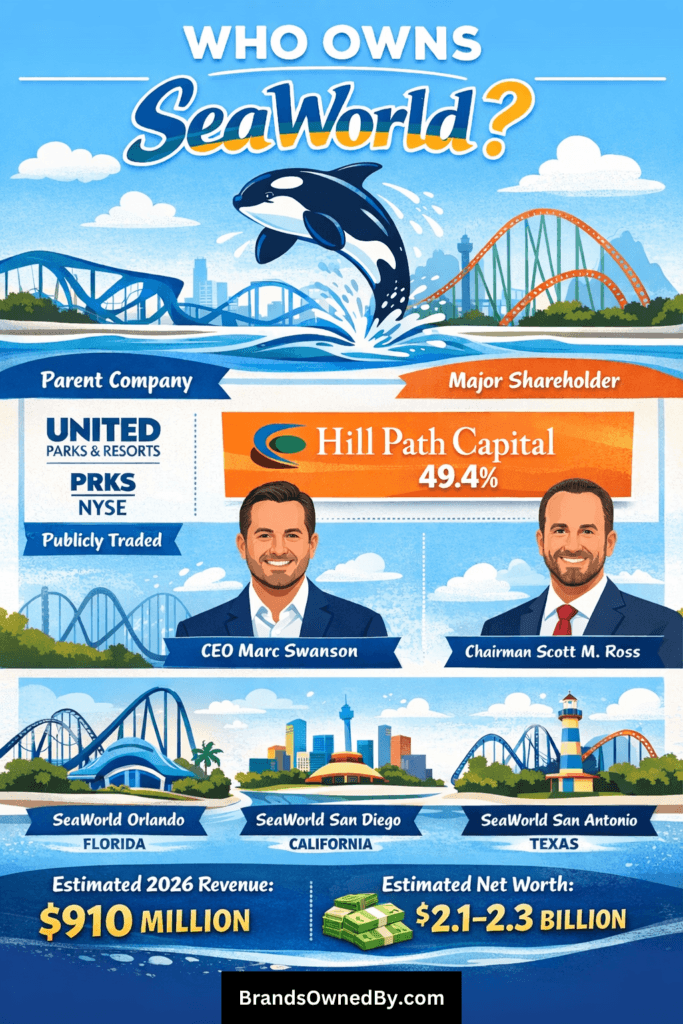
SeaWorld is owned through its parent company, United Parks & Resorts Inc., which is a publicly traded company listed on the New York Stock Exchange under the ticker PRKS.
SeaWorld’s ownership is highly concentrated compared to many other public companies because one investment firm holds an exceptionally large stake in the business. The company’s largest shareholder is Hill Path Capital, which owns nearly half of United Parks & Resorts and is the dominant force behind the company’s shareholder structure. As of April 2026, Hill Path remains the clear controlling shareholder with an ownership stake of roughly 49.4%.
SeaWorld operates under a layered ownership structure. The SeaWorld brand itself is not independently owned. Instead, it is held and managed by United Parks & Resorts, which in turn is owned by shareholders.
The structure works as follows:
- SeaWorld parks and brand → Owned by United Parks & Resorts
- United Parks & Resorts → Owned by shareholders
- Largest shareholder of United Parks & Resorts → Hill Path Capital.
This means that while SeaWorld is technically publicly owned, Hill Path Capital serves as the company’s most influential and controlling investor in practical terms.
SeaWorld’s Parent Company: United Parks & Resorts
SeaWorld’s direct parent company is United Parks & Resorts Inc., formerly known as SeaWorld Entertainment, Inc. The business officially changed its corporate name in 2024 as part of a broader rebranding initiative.
Management stated that the name change was made to better reflect the company’s wider portfolio of brands, since the business had grown far beyond just SeaWorld parks. While the SeaWorld brand remains the company’s most recognized asset, the parent company also owns several other major park and entertainment properties.
United Parks & Resorts now manages the overall operations, finances, strategy, branding, and expansion of the SeaWorld business. All major decisions regarding SeaWorld parks are made at the parent company level.
Why the Parent Company Rebranded
The company rebranded from SeaWorld Entertainment to United Parks & Resorts because executives believed the old corporate name no longer accurately represented the size and diversity of the business.
Over time, the company expanded into multiple park categories including:
- Marine parks
- Thrill amusement parks
- Water parks
- Family entertainment parks
- Animal encounter attractions.
Because of this diversification, management wanted investors and the public to recognize that the company was more than just the SeaWorld brand.
SeaWorld’s Acquisition by Harcourt Brace Jovanovich
SeaWorld was first acquired in 1976 when its founders sold the business to Harcourt Brace Jovanovich (HBJ), a large American publishing and diversified conglomerate.
HBJ purchased SeaWorld during a period when conglomerates were expanding into non-traditional industries and leisure businesses. The acquisition gave SeaWorld access to stronger financial resources and corporate backing, which helped fund park growth and national expansion.
Under HBJ’s ownership, SeaWorld expanded further and strengthened its position in the U.S. entertainment market.
Acquisition by Anheuser-Busch
In 1989, SeaWorld was acquired again when Anheuser-Busch Companies purchased the company from Harcourt Brace Jovanovich.
This acquisition was highly significant because Anheuser-Busch already owned Busch Gardens and other amusement properties. By purchasing SeaWorld, Anheuser-Busch created one of the largest theme park portfolios in the country.
Under Anheuser-Busch ownership, SeaWorld underwent major modernization and investment. The company expanded its attractions, improved park infrastructure, and significantly increased marketing efforts.
This era helped transform SeaWorld from primarily an animal attraction park into a more complete theme park experience.
Acquisition by Blackstone Group
In 2009, private equity giant Blackstone Group acquired SeaWorld as part of a larger deal valued at approximately $2.7 billion. The acquisition included SeaWorld and other Busch Entertainment parks.
Blackstone purchased the business after Anheuser-Busch merged with InBev and sought to sell non-core assets to reduce debt. This transaction marked the first time SeaWorld came under private equity ownership.
Blackstone’s strategy focused heavily on maximizing operational efficiency and improving profitability. During its ownership period, the firm streamlined operations and positioned the company for a future public offering.
SeaWorld’s IPO and Public Ownership Transition
In 2013, Blackstone took SeaWorld public through an initial public offering (IPO). The company began trading publicly under the name SeaWorld Entertainment, Inc.
The IPO shifted SeaWorld from private equity ownership to public ownership. Instead of being owned by one private investor, the company became owned by shareholders through the stock market.
Although Blackstone remained a major shareholder initially after the IPO, it gradually sold down its ownership stake over time until exiting the investment.
Largest Shareholder and Controlling Ownership
Today, SeaWorld’s largest shareholder is Hill Path Capital, an investment firm that owns approximately 49.4% of United Parks & Resorts as of 2026.
Hill Path became SeaWorld’s dominant shareholder after acquiring a large ownership stake in 2019 and later increasing its holdings. Because it owns nearly half of the company’s total shares, Hill Path has substantial influence over the business.
Its ownership position gives it strong control over:
- Board appointments
- Executive oversight
- Strategic planning
- Major shareholder voting decisions
- Long-term corporate direction.
Although Hill Path does not own 100% of SeaWorld, its near-controlling stake makes it the most powerful force behind the company.
Other Institutional Owners
Besides Hill Path Capital, SeaWorld is also partially owned by numerous institutional investors. These include large financial firms, asset managers, and investment funds.
Some of the most notable institutional shareholders include:
- The Vanguard Group
- BlackRock
- JPMorgan Chase
- River Road Asset Management
- Merrill Lynch International.
These investors collectively own minority stakes in the company and participate in shareholder voting.
Competitor Ownership Comparison
SeaWorld competes against some of the biggest names in the global theme park and attractions industry. However, its ownership structure differs significantly from many of its rivals. While SeaWorld operates under United Parks & Resorts, a publicly traded company heavily influenced by one dominant shareholder, several competitors are owned by much larger parent corporations or broader shareholder groups.
Comparing SeaWorld’s ownership structure with rival amusement park operators helps show how the company fits into the broader entertainment industry and highlights the differences in financial backing, corporate governance, and strategic control.
| Company | Parent/Owner | Ownership Type | Key Ownership Details (April 2026) |
|---|---|---|---|
| SeaWorld | United Parks & Resorts Inc. | Publicly Traded | SeaWorld operates under United Parks & Resorts and is owned by public shareholders. Its ownership is highly concentrated, with Hill Path Capital holding nearly half of the company and serving as the dominant shareholder. |
| Disney Parks | The Walt Disney Company | Publicly Traded | Disney Parks is owned by The Walt Disney Company and functions as one division of the larger entertainment conglomerate. Ownership is spread across institutional investors, funds, and retail shareholders with no single controlling shareholder. |
| Universal Parks | Comcast Corporation (through NBCUniversal) | Corporate Ownership | Universal Parks is fully owned by Comcast through NBCUniversal. It is not separately traded and operates as part of Comcast’s broader media and entertainment portfolio. |
| Six Flags | Six Flags Entertainment Corporation | Publicly Traded | Six Flags is owned by shareholders through Six Flags Entertainment Corporation following the merger of Six Flags and Cedar Fair. Ownership is diversified across multiple institutional and public investors. |
| Merlin Entertainments | Private Investor Consortium | Privately Owned | Merlin Entertainments is privately owned by an investor group led by private equity firms and family investment entities after being taken private in a multibillion-dollar acquisition. |
SeaWorld vs Disney Parks Ownership
One of SeaWorld’s largest competitors is Disney’s theme park division, particularly because SeaWorld Orlando competes directly with Walt Disney World Resort in Florida for tourists and family visitors.
Disney’s parks are owned by The Walt Disney Company, which is a publicly traded multinational entertainment conglomerate. Disney Parks is not a separate company. Instead, it operates as a division within Disney’s much broader business empire, which includes film studios, streaming platforms, television networks, cruise lines, merchandise, and media licensing.
Unlike SeaWorld, Disney does not have one dominant controlling shareholder. Ownership of Disney is spread across a wide range of institutional investors, asset managers, and retail shareholders. This creates a far more diversified ownership structure.
The biggest difference between the two companies is scale and financial backing. Disney’s parks benefit from being supported by a global entertainment empire, whereas SeaWorld’s parks rely primarily on the performance of the park business itself.
SeaWorld vs Universal Parks Ownership
SeaWorld also competes heavily with Universal, especially in Orlando, where Universal Orlando Resort attracts millions of visitors annually.
Universal’s parks are owned by Comcast Corporation through its subsidiary NBCUniversal. Unlike SeaWorld, Universal is not publicly operated as an independent amusement company. Instead, it is fully controlled by Comcast, one of the world’s largest telecommunications and media companies.
This means Universal’s strategic decisions are made directly by Comcast’s executive leadership and board rather than outside shareholders.
Universal’s ownership structure gives it major advantages because it can leverage Comcast’s wider financial resources, media assets, and intellectual property portfolio. This allows Universal to invest heavily in blockbuster attractions tied to franchises such as Harry Potter, Jurassic World, Nintendo, and Minions.
Compared to SeaWorld:
- SeaWorld is publicly owned with concentrated shareholder influence
- Universal is fully owned by a parent corporation.
SeaWorld vs Six Flags Ownership
Another major SeaWorld competitor is Six Flags, particularly in the regional amusement park and thrill ride segment.
As of April 2026, Six Flags is operated by Six Flags Entertainment Corporation, the combined business formed after the merger between legacy Six Flags and Cedar Fair. The merged company remains publicly traded and is owned by shareholders.
Like SeaWorld, Six Flags operates under public ownership. However, its shareholder base is more diversified and less concentrated than SeaWorld’s. No single shareholder owns nearly half of Six Flags the way Hill Path Capital does with SeaWorld.
Six Flags has also undergone major restructuring in 2026, including the sale of several park properties to streamline operations and reduce debt.
The main ownership difference is:
- SeaWorld has one dominant investor with outsized influence
- Six Flags has broader institutional ownership with less concentrated control.
SeaWorld vs Merlin Entertainments Ownership
SeaWorld also indirectly competes with Merlin Entertainments, the operator of attractions such as Legoland, Madame Tussauds, SEA LIFE, and other family entertainment brands.
Unlike SeaWorld, Merlin is privately owned. The company was taken private in a multibillion-dollar acquisition and is controlled by a consortium of investors, including private equity firms and family investment groups.
Because Merlin is privately held, it does not answer to public shareholders and instead focuses on long-term growth strategies set by its investor ownership group.
This differs sharply from SeaWorld, which must report earnings publicly and maintain shareholder confidence every quarter.
SeaWorld’s Ownership Position in the Industry
Compared to most of its competitors, SeaWorld has one of the most unusual ownership structures in the theme park industry.
Most major rivals fall into one of two categories:
- They are owned by massive parent corporations with diversified revenue streams
- They are publicly traded with highly diversified shareholder bases.
SeaWorld sits in the middle. It is publicly traded, but one shareholder—Hill Path Capital—holds nearly half the company and exercises major influence over corporate strategy.
This gives SeaWorld a more centralized ownership model than most publicly traded competitors while still maintaining stock market access.
Who Controls SeaWorld?
Although SeaWorld is owned by shareholders through its parent company United Parks & Resorts, the company is controlled through a combination of executive leadership, the board of directors, and its largest shareholder. While shareholders technically own the business, real operational and strategic control is handled by the people running the company and the investors with the greatest voting influence.
As of April 2026, SeaWorld’s control structure revolves around CEO Marc Swanson, the senior executive leadership team, the board of directors, and dominant shareholder Hill Path Capital, which remains the company’s most influential investor.
Its most powerful controlling figures as of April 2026 are:
- Marc Swanson, who manages company operations as CEO
- Scott Ross, who leads the board as chairman
- James Heaney, Kyle Miller, Ted Molter, and Dan Brown, who oversee critical executive functions
- Hill Path Capital, which influences strategic direction through its nearly 50% ownership stake.
Together, these individuals and entities form the leadership and control structure that governs SeaWorld today.
Marc Swanson: Chief Executive Officer
The top person controlling SeaWorld’s daily operations is Marc Swanson, who serves as the Chief Executive Officer of United Parks & Resorts.
Swanson has been with the company since 2003 and previously held multiple leadership roles before becoming CEO. He first served as interim CEO in 2020 and officially became permanent CEO in 2021. Since then, he has overseen the company’s operational strategy, financial direction, park growth initiatives, and the corporate rebrand from SeaWorld Entertainment to United Parks & Resorts.
As CEO, Marc Swanson is responsible for:
- Leading the company’s overall strategy
- Overseeing all SeaWorld and affiliated park operations
- Managing expansion and attraction investments
- Supervising executive leadership
- Reporting directly to the board of directors.
Because of his role, Swanson is the primary executive decision-maker and the most powerful internal operator within the company.
Key Executive Leadership Team
SeaWorld’s broader operations are also controlled by its senior executive leadership team, with each executive overseeing a critical business function. As of April 2026, the main executives helping run the company include:
James M. Heaney – Chief Financial Officer
James Heaney serves as Chief Financial Officer (CFO) and oversees the company’s financial strategy, capital allocation, budgeting, debt management, investor relations, and financial reporting.
He plays a major role in determining how the company allocates money toward park improvements, acquisitions, operational budgets, and shareholder return initiatives.
Kyle Miller – Chief Marketing Officer
Kyle Miller serves as Chief Marketing Officer (CMO) and is responsible for overseeing brand strategy, advertising campaigns, guest acquisition, customer loyalty programs, and digital marketing initiatives.
He helps shape how SeaWorld and the company’s other parks are marketed to consumers.
Ted Molter – Chief Legal and Compliance Officer
Ted Molter serves as the company’s Chief Legal and Compliance Officer, overseeing legal affairs, corporate governance matters, regulatory compliance, litigation, and internal legal strategy.
He ensures the company operates within legal guidelines while managing corporate legal risk.
Dan Brown – Chief Parks Operations Officer
Dan Brown oversees the operational management of the company’s park portfolio. He is responsible for park performance, guest experience, safety initiatives, staffing, and operational efficiency across SeaWorld’s various locations.
His position makes him one of the most important operational leaders beneath the CEO.
Board of Directors
SeaWorld is also controlled through its Board of Directors, which oversees the CEO and executive leadership while helping guide long-term strategy and governance. The board approves major strategic decisions, financial initiatives, executive compensation, and leadership appointments.
As of April 2026, the most notable members of United Parks & Resorts’ board include:
Scott M. Ross – Chairman of the Board
Scott Ross serves as Chairman of the Board and leads board meetings while helping oversee corporate governance and strategic oversight.
As chairman, he plays a central role in supervising the company’s executive leadership and ensuring the board fulfills its responsibilities to shareholders.
Marc Swanson – Board Member
In addition to being CEO, Marc Swanson also serves on the board of directors, giving him influence over both executive operations and board-level strategy discussions.
John T. Reilly – Board Member
John Reilly, the company’s former interim CEO, remains an important board member and brings substantial leadership experience from his previous executive role within the organization.
Other Independent Directors
SeaWorld’s board also includes several independent directors from finance, investment, and business backgrounds who assist with governance, risk management, and strategic planning.
These directors help evaluate major business initiatives and ensure management remains accountable to shareholders.
Hill Path Capital: Most Influential Shareholder
While executives and directors manage SeaWorld internally, the company’s most influential outside force is Hill Path Capital, its dominant shareholder.
As of April 2026, Hill Path Capital owns approximately 49.4% of United Parks & Resorts, making it the company’s largest shareholder by a massive margin.
Because Hill Path owns nearly half the business, it has major influence over:
- Board elections
- Executive leadership decisions
- Strategic corporate initiatives
- Governance proposals
- Shareholder voting outcomes.
Even though Hill Path does not directly manage daily operations, its ownership position gives it extraordinary power over the company’s strategic direction.
SeaWorld Annual Revenue and Net Worth
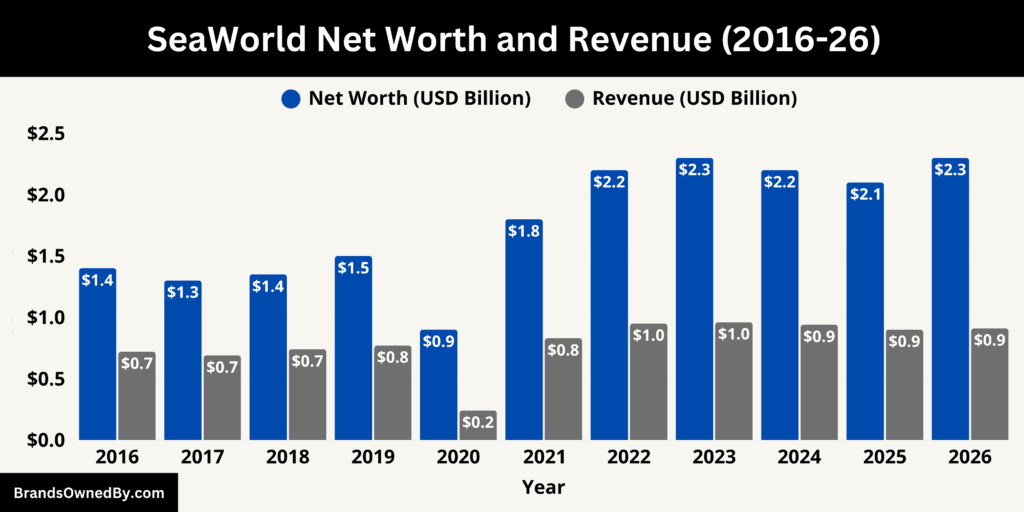
As of April 2026, SeaWorld generates an estimated annual revenue of approximately $910 million, while its estimated standalone brand and business net worth is around $2.3 billion. Since SeaWorld operates under United Parks & Resorts and does not publish separate audited financial statements, these figures are industry-based estimates derived from attendance share, park performance, brand contribution, and proportional financial analysis of the parent company’s reported results. United Parks & Resorts reported total 2025 revenue of approximately $1.66 billion, providing the benchmark for these SeaWorld-specific estimates.
SeaWorld remains the flagship and most recognized asset within the United Parks & Resorts portfolio, meaning it contributes a substantial share of the parent company’s overall earnings and valuation.
SeaWorld 2026 Revenue Breakdown
For 2026, SeaWorld’s projected revenue of around $910 million comes from several major operating segments across its three flagship parks in Orlando, San Diego, and San Antonio.
The largest source of income remains admissions and ticket sales, which account for an estimated $510 million to $540 million annually, representing roughly 56% to 59% of total SeaWorld revenue. This includes single-day tickets, season passes, annual memberships, and promotional ticket packages.
Another major contributor is in-park guest spending, which generates an estimated $220 million to $240 million per year. This includes food and beverage sales, merchandise purchases, locker rentals, quick-service dining, souvenirs, and premium guest experiences. Parent company filings show in-park per capita spending has remained near record highs, helping support this revenue stream.
SeaWorld also earns approximately $90 million to $110 million from special events, VIP tours, and animal encounter experiences. These include Halloween events, Christmas celebrations, behind-the-scenes tours, dining packages, and animal interaction programs.
The remaining $40 million to $60 million is generated through sponsorships, licensing, partnerships, parking fees, and miscellaneous ancillary revenue.
SeaWorld 2026 Net Worth and Valuation
SeaWorld’s estimated standalone valuation as of April 2026 is approximately $2.3 billion, reflecting the value of the SeaWorld brand, its park infrastructure, real estate, intellectual property, operating income, and market positioning.
This valuation is based on several contributing factors.
First, SeaWorld owns and operates some of the most valuable marine theme park properties in the United States, with prime real estate in major tourism markets such as Orlando, San Diego, and San Antonio.
Second, the SeaWorld brand itself carries substantial commercial value due to its decades-long recognition, brand equity, customer loyalty, and licensing opportunities.
Third, SeaWorld maintains significant physical assets, including rides, attractions, marine habitats, resort-style facilities, restaurants, and entertainment infrastructure.
Based on United Parks’ February 2026 market valuation and enterprise value disclosures, the overall parent company carried an equity value of roughly $1.71 billion and enterprise value near $3.86 billion, supporting SeaWorld’s estimated standalone contribution as the flagship asset.
Revenue Growth Compared to Prior Years
SeaWorld’s 2026 revenue estimate reflects a slight improvement from 2025, when the SeaWorld brand generated an estimated $900 million. The modest increase is being driven by pricing optimization, premium ticket offerings, improved cost controls, and new attraction investments.
Management has also focused on increasing per-guest spending rather than simply maximizing attendance. This strategy has become increasingly important as broader attendance growth in the theme park industry has slowed.
Even though United Parks overall experienced softer attendance in 2025, management stated it is investing in new attractions and operational improvements to support stronger 2026 performance.
Key Factors Driving SeaWorld’s Financial Performance
SeaWorld’s revenue and valuation are heavily influenced by attendance levels, guest spending, tourism trends, and weather conditions.
One of the company’s strongest financial metrics is guest spending efficiency. Even during weaker attendance periods, SeaWorld has maintained relatively high revenue through pricing increases and premium guest experiences.
Another major factor is seasonal event performance. Holiday and festival programming has become increasingly important in driving repeat visitation and boosting revenue during traditionally slower periods.
In addition, SeaWorld’s continued transition toward thrill rides and coaster-focused attractions has broadened its appeal beyond marine-life audiences, helping diversify its customer base.
SeaWorld Revenue Forecast Through 2030
Based on current attendance trends, management strategy, pricing models, attraction expansion plans, and broader amusement industry growth forecasts, SeaWorld’s revenue is projected to continue growing gradually through the end of the decade. While the company is not expected to experience explosive growth like some larger entertainment giants, analysts expect steady and sustainable increases as SeaWorld continues optimizing guest spending, premium offerings, and park utilization.
The company’s growth strategy moving forward is focused less on dramatically increasing attendance and more on maximizing revenue per guest. This includes raising ticket prices, expanding annual pass memberships, increasing premium dining and VIP experiences, and improving in-park spending opportunities. SeaWorld has increasingly adopted this “yield-focused” strategy in recent years, prioritizing higher spending customers over simply driving higher foot traffic.
In addition, SeaWorld continues investing heavily in new roller coasters, thrill rides, and special event programming to attract broader demographics beyond traditional marine park visitors. These attraction investments are expected to support stronger attendance retention and higher repeat visitation rates over the next several years.
Based on current projections, SeaWorld’s estimated revenue outlook through 2030 is as follows:
- 2027: $940 million
- 2028: $975 million
- 2029: $1.01 billion
- 2030: $1.05 billion–$1.10 billion.
If these projections are achieved, SeaWorld would surpass the $1 billion annual revenue milestone before the end of the decade, representing one of the strongest financial periods in the brand’s history.
Several factors are expected to drive this projected growth. Continued inflation-adjusted ticket pricing should steadily increase admission revenue, while guest spending on food, merchandise, and premium experiences is likely to rise as SeaWorld further monetizes its visitor base. The company’s focus on seasonal festivals, holiday events, and limited-time attractions is also expected to boost off-peak attendance and improve year-round park utilization.
However, this growth forecast assumes economic conditions remain stable and consumer discretionary spending remains healthy. External risks such as recessions, inflation spikes, tourism declines, or operational disruptions could impact actual performance.
Brands and Parks Owned by SeaWorld
SeaWorld owns, operates, and manages several branded parks, attractions, entertainment properties, licensed programs, and internal operating divisions that are specifically tied to the SeaWorld business rather than the wider parent company portfolio. As of 2026, these SeaWorld-operated entities primarily revolve around the SeaWorld-branded parks, educational initiatives, rescue operations, media programs, and licensed guest experiences.
| Company/Brand/Entity | Type | Year Established/Launched | Description | Key Details / Role in SeaWorld Operations |
|---|---|---|---|---|
| SeaWorld Orlando | Marine Theme Park | 1973 | SeaWorld Orlando is the flagship and most visited SeaWorld-branded park, located in Orlando, Florida. It is the company’s largest SeaWorld property and serves as the core revenue-generating asset for the SeaWorld brand. | Features major attractions such as Mako, Pipeline, Kraken, Journey to Atlantis, and Infinity Falls. Hosts seasonal events including Howl-O-Scream, Seven Seas Food Festival, and Christmas Celebration. Considered SeaWorld’s most strategically valuable park due to Orlando’s tourism market. |
| SeaWorld San Diego | Marine Theme Park | 1964 | SeaWorld San Diego is the original SeaWorld park and the birthplace of the SeaWorld brand. It was the first property opened by the founders and remains one of the most historically significant locations in the portfolio. | Includes attractions such as Emperor, Electric Eel, Arctic Rescue, and Journey to Atlantis. Holds historical importance as the original SeaWorld location and flagship West Coast property. |
| SeaWorld San Antonio | Marine Theme Park | 1988 | SeaWorld San Antonio is the company’s Texas-based SeaWorld park and serves as the primary SeaWorld-branded property in the southern U.S. market. | Features attractions including Steel Eel, Texas Stingray, Wave Breaker, Great White, and Catapult Falls. It is one of the largest marine-life theme parks in Texas by land area. |
| SeaWorld Rescue Program | Wildlife Rescue Division | 1965 | SeaWorld’s internal marine animal rescue and rehabilitation program responsible for rescuing, treating, and releasing injured or orphaned marine wildlife. | Handles thousands of rescue operations and supports SeaWorld’s conservation and public image initiatives. One of the largest marine rescue organizations in the U.S. |
| SeaWorld Conservation Fund | Nonprofit Conservation Initiative | 2003 | SeaWorld’s nonprofit environmental and conservation funding arm focused on supporting wildlife research, habitat preservation, and marine conservation efforts worldwide. | Funds independent conservation organizations and scientific research projects globally. Supports SeaWorld’s environmental responsibility initiatives. |
| SeaWorld Educational Programs | Educational Division | Various / Ongoing | A collection of educational initiatives and academic outreach programs operated by SeaWorld for schools, students, and families. | Includes school field trips, zoological workshops, educational camps, marine science programs, and student learning partnerships. Helps position SeaWorld as both entertainment and educational brand. |
| SeaWorld Licensing & Merchandise Division | Licensing / Retail Operations | Ongoing | Internal division responsible for producing and managing SeaWorld-branded merchandise, retail goods, and licensing partnerships. | Oversees souvenirs, branded apparel, toys, collectibles, seasonal products, and third-party licensing agreements. Generates ancillary revenue beyond park admissions. |
| SeaWorld Media & Digital Content Operations | Media / Marketing Division | Ongoing | Internal media production and digital marketing unit that handles branded promotional content, park campaigns, and online engagement. | Produces digital advertisements, educational media, social campaigns, promotional videos, and guest engagement content across online platforms. |
| SeaWorld Animal Care & Veterinary Division | Zoological Operations | 1964 | Specialized internal animal care and veterinary division responsible for health, habitat, and welfare of SeaWorld’s marine animals and zoological species. | Oversees veterinary care, nutrition planning, habitat maintenance, enrichment programs, animal research, and marine-life welfare operations. |
SeaWorld Orlando
SeaWorld Orlando is the flagship and highest-performing property within the SeaWorld brand portfolio. Located in Orlando, Florida, it is the company’s largest and most visited SeaWorld-branded park.
Opened in 1973, SeaWorld Orlando serves as the centerpiece of the SeaWorld business and generates the largest share of the brand’s overall attendance and revenue. The park combines marine animal attractions with roller coasters, thrill rides, family rides, seasonal festivals, and educational exhibits.
It features some of SeaWorld’s most well-known attractions, including Mako, Pipeline, Kraken, Journey to Atlantis, and Infinity Falls. The park also hosts major annual events such as Howl-O-Scream, Seven Seas Food Festival, and Christmas Celebration.
Because of its location in one of the world’s largest tourism markets, SeaWorld Orlando remains the company’s most strategically important and valuable operating asset.
SeaWorld San Diego
SeaWorld San Diego is the original SeaWorld park and the birthplace of the SeaWorld brand. Opened in 1964, it remains one of the company’s most historically significant and recognizable locations.
Located in California, the park is known for combining ocean-themed entertainment with marine education and thrill attractions. SeaWorld San Diego played a foundational role in building the SeaWorld brand into a national attraction company.
The park features major attractions such as Emperor, Electric Eel, Arctic Rescue, and Journey to Atlantis, along with marine exhibits showcasing dolphins, sharks, sea turtles, and penguins.
As the original SeaWorld location, it carries significant brand and historical importance within the company’s portfolio.
SeaWorld San Antonio
SeaWorld San Antonio is the third major SeaWorld-branded location and serves as the company’s primary Texas property.
Opened in 1988, it is the largest marine-life theme park in Texas and one of the largest SeaWorld parks by physical size. The park includes marine exhibits, roller coasters, live entertainment, family attractions, and water-based rides.
Major attractions at the park include Steel Eel, Texas Stingray, Wave Breaker, Great White, and Catapult Falls.
SeaWorld San Antonio has become a major regional tourism destination and remains a core contributor to the overall SeaWorld brand.
SeaWorld Rescue Program
SeaWorld operates its own internal wildlife rescue and rehabilitation division known as the SeaWorld Rescue Program.
This program is one of the largest marine animal rescue organizations in the United States and serves as a major operational arm of the SeaWorld brand. It focuses on rescuing injured, orphaned, or sick marine animals, rehabilitating them, and returning them to the wild when possible.
The rescue division handles thousands of marine animal rescue cases and has become a major part of SeaWorld’s public branding and conservation messaging strategy.
It also supports the company’s educational outreach and helps reinforce SeaWorld’s position as both an entertainment and conservation-focused organization.
SeaWorld Conservation Fund
The SeaWorld Conservation Fund is SeaWorld’s nonprofit conservation and environmental funding initiative.
Established to support wildlife research, habitat preservation, and marine conservation projects worldwide, the fund finances numerous independent organizations and scientific programs each year.
Although it operates in partnership with outside conservation groups, it remains a SeaWorld-owned and SeaWorld-managed branded entity.
The fund helps support the company’s corporate responsibility efforts and global environmental initiatives.
SeaWorld Educational Programs
SeaWorld owns and operates a broad portfolio of educational programs designed for schools, families, and academic institutions.
These include:
- Student field trip programs
- Summer educational camps
- Zoological learning experiences
- Animal education workshops
- Interactive classroom partnerships
These educational initiatives are branded directly under SeaWorld and form part of the company’s broader mission to combine entertainment with learning and marine education.
SeaWorld Licensing and Merchandise Division
SeaWorld also operates its own internal merchandise and licensing business, managing branded retail products sold across parks and licensed through third-party partnerships.
This includes:
- Apparel and clothing
- Toys and collectibles
- Souvenirs
- Home décor products
- Seasonal merchandise
- Licensed branded collaborations
Its merchandise division represents an important ancillary revenue stream and extends the SeaWorld brand beyond park admissions.
SeaWorld Media and Digital Content Operations
SeaWorld operates internal media, digital, and promotional content divisions responsible for creating branded digital media, park marketing campaigns, educational content, promotional videos, and social media campaigns.
This internal content production division supports:
- Digital marketing campaigns
- Educational programming
- Documentary and behind-the-scenes content
- Promotional advertising materials
- Guest engagement initiatives
It helps SeaWorld maintain direct communication with consumers and manage its brand image across digital platforms.
SeaWorld Animal Care and Veterinary Division
SeaWorld maintains one of the largest internal zoological and veterinary operations in the marine park industry.
Its animal care division oversees:
- Veterinary care
- Nutrition planning
- Habitat management
- Animal enrichment programs
- Scientific research initiatives
This operational division is critical to SeaWorld’s daily business and remains one of the most specialized parts of the company’s operations.
Final Thoughts
SeaWorld is owned by United Parks & Resorts, a public company traded on the stock market. Its largest shareholder is Hill Path Capital, which owns nearly half the business and has major influence over company’s strategy. Although many people still know the parent company as SeaWorld Entertainment, it officially rebranded in 2024 to reflect its growing portfolio of parks and entertainment brands.
Today, SeaWorld remains one of America’s largest theme park operators, managing numerous attractions beyond its original marine park business.
FAQs
What company owns SeaWorld?
SeaWorld is owned by United Parks & Resorts Inc., the publicly traded entertainment company that manages SeaWorld and several other amusement and theme park brands across the United States. The business was formerly known as SeaWorld Entertainment before rebranding in 2024.
Is SeaWorld a public company?
Yes, SeaWorld’s parent company, United Parks & Resorts, is a public company listed on the New York Stock Exchange (NYSE) under the ticker symbol PRKS. Because it is publicly traded, the company is owned by shareholders rather than one private individual or organization.
Who owns SeaWorld parks?
SeaWorld parks are owned and operated by United Parks & Resorts Inc. through its SeaWorld-branded operating division. The three main SeaWorld parks—SeaWorld Orlando, SeaWorld San Diego, and SeaWorld San Antonio—are all part of the company’s broader park portfolio.
Who is the CEO of SeaWorld?
As of April 2026, the CEO of SeaWorld’s parent company is Marc Swanson. He has served as Chief Executive Officer since 2021 and oversees all operations of United Parks & Resorts, including the SeaWorld brand and its affiliated parks.
How much money has SeaWorld lost since Blackfish?
SeaWorld suffered significant financial losses in the years following the release of the 2013 documentary Blackfish, which negatively impacted the company’s public image and attendance.
Between 2013 and 2015 alone, SeaWorld lost hundreds of millions of dollars in market value, with its stock price dropping more than 50% from post-IPO highs. The company also experienced attendance declines and reduced revenue growth for multiple years after the controversy.
While SeaWorld eventually recovered financially in later years, the documentary is widely considered one of the most damaging events in the company’s history from a financial and reputational standpoint.
Is SeaWorld Abu Dhabi owned by SeaWorld?
No, SeaWorld Abu Dhabi is not directly owned by SeaWorld or United Parks & Resorts.
Instead, it is owned and operated by Miral, an Abu Dhabi-based entertainment and tourism development company. However, SeaWorld licensed its brand, expertise, and intellectual property to the project through a strategic partnership agreement.
This means SeaWorld Abu Dhabi uses the SeaWorld name and branding, but it is not owned by the U.S.-based SeaWorld company.
Who owns SeaWorld on the Gold Coast?
Sea World on the Gold Coast in Australia is not owned by SeaWorld in the United States.
It is owned by Village Roadshow Theme Parks, an Australian entertainment and theme park operator. Despite sharing a similar name, it is a completely separate business from the American SeaWorld brand.
Who are the largest shareholders of SeaWorld?
The largest shareholder of SeaWorld’s parent company is Hill Path Capital, which owns approximately 49.4% of United Parks & Resorts as of 2026.
Other major shareholders include:
- The Vanguard Group
- BlackRock
- JPMorgan Chase
- Merrill Lynch International.
However, Hill Path Capital remains by far the most influential investor.
What are the 11 parks owned by SeaWorld?
As of 2026, United Parks & Resorts owns and operates 11 major parks across the United States. These include:
- SeaWorld Orlando
- SeaWorld San Diego
- SeaWorld San Antonio
- Busch Gardens Tampa Bay
- Busch Gardens Williamsburg
- Aquatica Orlando
- Aquatica San Antonio
- Discovery Cove
- Sesame Place Philadelphia
- Water Country USA
- Adventure Island.
These parks are collectively operated under the United Parks & Resorts portfolio.
Who owns SeaWorld Gold Coast?
Sea World Gold Coast is owned by Village Roadshow Theme Parks, not the American SeaWorld company.
Village Roadshow operates the Australian marine park independently under licensing rights and separate ownership. Despite the similar branding, Sea World Gold Coast has no ownership connection to United Parks & Resorts or the U.S.-based SeaWorld parks.