
- Hobby Lobby is a privately owned company controlled by the Green family. Founder David Green and his family members hold ownership through family holdings and the Green family trust, with no public shareholders, institutional investors, or publicly traded shares.
- Ownership is concentrated within the Green family. Estimated ownership stakes are David Green (40%), Steve Green (20%), Mart Green (20%), Barbara Green (10%), and Darsee Lett (10%), while the Green family trust holds 100% of the company’s voting control.
- The company has never gone public. Unlike competitors such as Michaels or Joann, Hobby Lobby has remained privately held since its founding in 1972, allowing the Green family to retain full ownership and long-term control.
- Leadership remains within the founding family. David Green founded the company and continues to influence its direction, while Steve Green serves as president and oversees the company’s operations.
Hobby Lobby is a large American arts and crafts retail chain that sells a wide range of creative supplies and home décor products. The company focuses on items used for hobbies, DIY projects, interior decoration, and seasonal celebrations. Customers can find art supplies, fabrics, scrapbooking materials, floral decorations, picture frames, and craft tools in its stores.
The retailer operates hundreds of large-format stores across the United States. These stores typically offer thousands of products that support creative hobbies and home decoration projects. Hobby Lobby is also known for its strong company values. The business follows Christian principles that influence company policies, such as closing all stores on Sundays.
Another defining feature of Hobby Lobby is its ownership structure. Unlike many major retailers, the company is privately owned. It remains under the control of the founding Green family rather than public investors.
Hobby Lobby Founder
Hobby Lobby was founded by David Green and Barbara Green in 1972. The couple started the business with a very small investment and built it into one of the largest craft retailers in the United States.
David Green began the company by producing miniature picture frames in the garage of his home. These frames were sold to local stores in Oklahoma. The business quickly gained demand, which encouraged the family to expand into retail.
Barbara Green played an important role during the early years of the company. She helped manage the business operations and supported the growth of the family venture while raising their children.
The couple opened the first Hobby Lobby retail store in Oklahoma City in 1972. The store focused on craft supplies and framing products. Over time, the product range expanded to include fabrics, home décor, seasonal decorations, and art supplies.
David Green continued to lead the company as it expanded nationwide. His entrepreneurial vision and conservative business strategy helped Hobby Lobby grow without relying on outside investors.
Today, the Green family remains closely involved in the company. Their leadership and values still shape the direction of Hobby Lobby and its long-term strategy.
Ownership History
The ownership history of Hobby Lobby is closely connected to the Green family. Since the company was founded in 1972, ownership has never moved outside the founding family. Hobby Lobby remains a privately held company, meaning its shares are not traded on any public stock exchange. This structure has allowed the Green family to maintain complete control over the business and its long-term direction.
Founding and Early Family Ownership (1970–1980s)
Hobby Lobby began as a small home-based business started by David Green. In 1970, Green borrowed $600 and began producing miniature picture frames from his home. The frames were sold to local stores and quickly became popular.
As demand grew, David Green and his wife Barbara opened the first Hobby Lobby retail store in Oklahoma City in August 1972. The store initially occupied only a few hundred square feet but focused entirely on arts and crafts products.
During this early stage, the business was fully owned by the Green family. Instead of seeking outside investors, the family reinvested profits to expand operations. This allowed them to maintain complete ownership and control over the company’s strategy.
Expansion While Remaining Privately Owned (1980s–2000s)
Hobby Lobby began expanding rapidly during the 1980s and 1990s. The company opened multiple new stores across the United States. By the early 1990s, the chain had grown to dozens of locations across several states.
Despite its growth, the company chose not to pursue an initial public offering (IPO). Many retail companies go public to raise expansion capital. However, the Green family preferred to keep Hobby Lobby private.
This approach allowed the family to avoid shareholder pressure and maintain control over company policies. It also allowed the leadership to run the business according to their long-term vision and values.
Ownership Through the Green Family and Trust Structures
As the company grew larger, ownership began to be organized through family holdings and trusts. These structures were designed to preserve family control and help with long-term succession planning.
The Green family continues to hold full ownership of the company. David Green remains the central figure behind the business, while his children have taken leadership roles within the organization.
For example, Steve Green serves as the president of Hobby Lobby and is involved in strategic decision-making. Other family members also participate in the company’s leadership and governance structure.
Modern Ownership Structure
Today, Hobby Lobby remains a 100% privately owned family business controlled by the Green family. The company has not issued public shares and does not have institutional shareholders.
This ownership structure is unusual for a retailer of its size. Many companies with nationwide retail operations eventually go public or accept private equity investment. Hobby Lobby has chosen a different path by keeping ownership within the founding family.
The Green family continues to influence the company’s strategy, culture, and corporate policies. Their ownership also shapes the company’s philanthropic efforts, including funding educational and religious initiatives such as the Museum of the Bible in Washington, D.C.
Commitment to Long-Term Family Control
One of the defining features of Hobby Lobby’s ownership history is the family’s commitment to long-term control. The Greens have repeatedly emphasized the importance of keeping the business privately owned so that it can operate according to their values and mission.
This approach has allowed the company to remain a family-led organization even as it has grown into one of the largest arts and crafts retailers in the United States.
As of 2026, Hobby Lobby continues to operate under the same ownership structure established by its founders more than five decades ago, with the Green family maintaining full control of the company.
Who Owns Hobby Lobby Stores: Major Shareholders
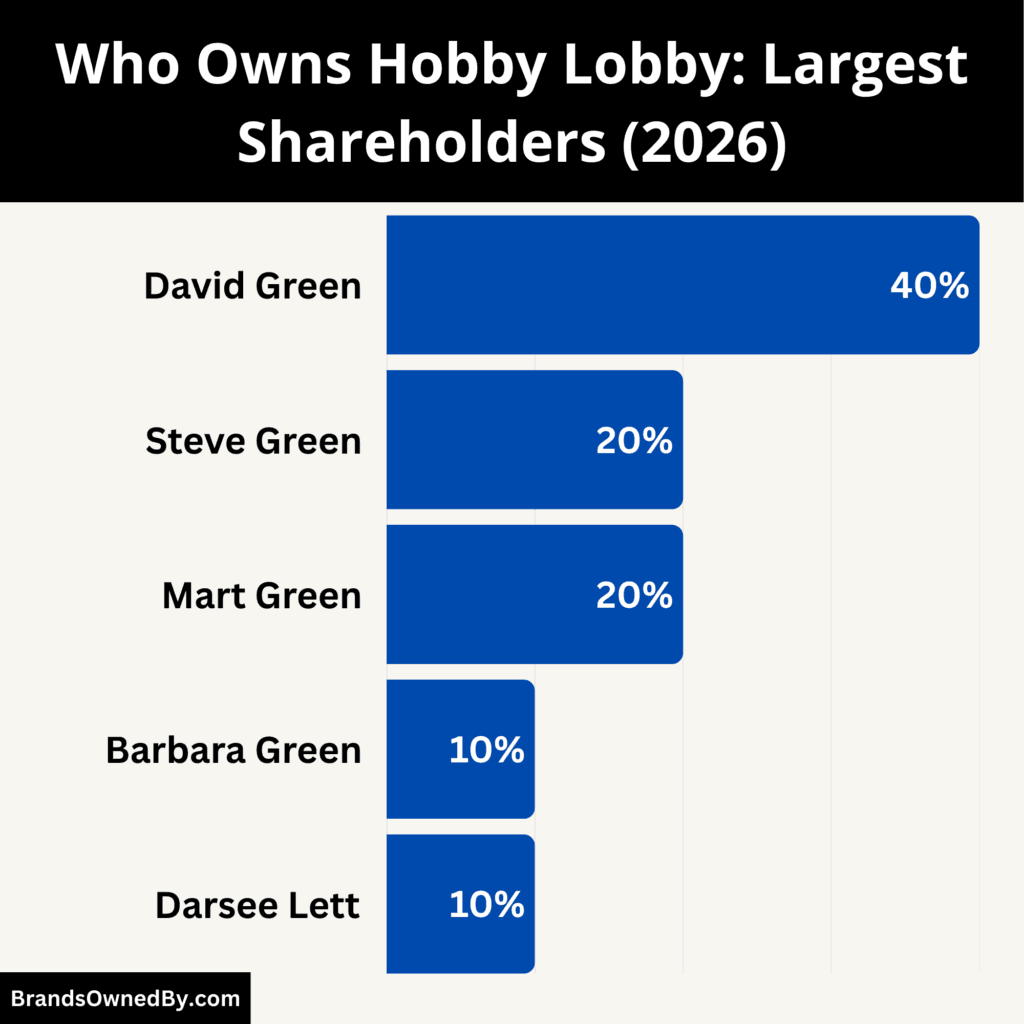
Hobby Lobby is a privately owned company controlled entirely by the Green family, the same family that founded the business in 1972.
The ownership structure is designed to keep the company under long-term family control. The Green family holds the equity in the business and also occupies many of the key leadership positions within the company. This allows the family to influence strategic decisions, corporate policies, and company culture.
A major ownership development occurred in October 2022, when founder David Green transferred 100% of Hobby Lobby’s voting stock into a family trust. The trust structure ensures that the company continues to operate according to the family’s values and prevents ownership from being diluted by outside investors.
David Green (40% Stake)
David Green is the founder and principal owner of Hobby Lobby. He started the company in 1972 after borrowing $600 and launching a small picture frame business from his garage in Oklahoma City.
Over several decades, Green built the company into one of the largest arts and crafts retailers in the United States. For most of the company’s history, he personally held the largest ownership stake.
As of 2026, David Green is estimated to control about 40% of the economic interest in Hobby Lobby, although the voting shares are held within the Green family trust. Even after transferring the voting stock to the trust in 2022, he remains the central figure in the company’s ownership and governance.
Green’s leadership philosophy has shaped Hobby Lobby’s identity. The company operates according to Christian principles, closes stores on Sundays, and donates significant profits to charitable causes.
Barbara Green (10% Stake)
Barbara Green, the co-founder and wife of David Green, holds an estimated 10% ownership stake in Hobby Lobby through family holdings and trusts.
She played a significant role in the early development of the company. During the early years, Barbara supported the business while it was still operating out of the family home. She helped manage early operations and contributed to the growth of the company during its startup phase.
Although she is not involved in the daily management of the company today, Barbara Green remains part of the family ownership structure that controls the business.
Steve Green (20% Stake)
Steve Green is the president of Hobby Lobby and one of the largest individual shareholders within the family.
He is the son of David and Barbara Green and has been involved in the company for many years. Steve became president of Hobby Lobby in 2004 and oversees many aspects of the company’s operations and strategic expansion.
Steve Green is estimated to hold around 20% of the ownership interest in the company through the family trust structure and related holdings.
Beyond the retail business, Steve Green is also widely known for founding the Museum of the Bible in Washington, D.C., which was funded by the Green family.
Mart Green (20% Stake)
Mart Green, another son of David and Barbara Green, is also a major shareholder in the Hobby Lobby family business.
He is the founder and CEO of Mardel Christian & Education, a Christian bookstore and educational retailer that operates within the Hobby Lobby group of companies.
Mart Green is estimated to hold approximately 20% ownership in the broader Hobby Lobby enterprise through the Green family trust and associated family holdings.
Although he focuses more on faith-based ventures and educational initiatives, he remains part of the core ownership structure of the company.
Darsee Lett (10% Stake)
Darsee Lett, the daughter of David and Barbara Green, also holds an ownership stake in the family business.
She serves as Vice President of Art and Creative at Hobby Lobby and contributes to the development of creative product lines and merchandising strategies.
Darsee Lett is estimated to hold around 10% ownership in the company through the family trust structure.
Green Family Trust: Voting Control (100%)
While the economic interests are distributed among family members, 100% of Hobby Lobby’s voting shares are held by the Green family trust.
David Green transferred the voting stock into this trust in 2022 to ensure long-term stability and succession planning. The trust structure ensures that control of the company remains within the family even as leadership transitions occur between generations.
This means that even though individual family members hold economic stakes, strategic control of the company remains centralized through the trust.
Competitor Ownership Comparison
Hobby Lobby operates in the arts and crafts retail industry. Several large retailers compete in the same market. These include Michaels, Joann, and Hobbycraft. While they sell similar products, their ownership structures are very different.
Most large retail chains rely on public investors or private equity firms. Hobby Lobby follows a different model. The company remains privately owned by the Green family. This ownership model gives the family full control over strategic decisions, company policies, and long-term planning.
| Company | Founded | Headquarters | Ownership Type | Current Owner(s) | Ownership Notes |
|---|---|---|---|---|---|
| Hobby Lobby | 1972 | Oklahoma City, Oklahoma, United States | Private family-owned company | Green family | Fully controlled by the Green family. Voting shares are held through the Green family trust. No public shareholders or institutional investors. |
| Michaels | 1973 | Irving, Texas, United States | Private equity-owned company | Apollo Global Management | Acquired by Apollo Global Management in 2021 in a deal worth about $5 billion. The company was taken private and is now owned by Apollo investment funds. |
| Joann | 1943 | Hudson, Ohio, United States | Institutional investor ownership (post-restructuring) | Lenders and institutional investors | After filing for Chapter 11 bankruptcy in 2024, ownership shifted largely to creditors and institutional investors who converted debt into equity during restructuring. |
| Hobbycraft | 1995 | Bournemouth, United Kingdom | Private equity-owned company | Bridgepoint Group | The UK’s largest craft retailer. Owned by the private equity firm Bridgepoint as part of its retail investment portfolio. |
Michaels
Michaels is one of the largest competitors to Hobby Lobby in North America. The company operates a large network of arts and crafts retail stores across the United States and Canada. Its stores sell craft supplies, framing products, seasonal décor, and DIY project materials.
The company was founded in 1973 by Michael J. Dupey. Over the decades, Michaels grew into the largest arts and crafts retail chain in North America.
In 2021, Michaels was acquired by the private equity firm Apollo Global Management in a deal valued at approximately $5 billion. After the acquisition, the company was taken private and removed from the public stock market.
As of March 2026, Michaels remains owned by investment funds managed by Apollo Global Management. This means that the company is controlled by a financial investment firm rather than founders or family owners. The strategic direction of Michaels is therefore influenced by private equity investors who focus on operational efficiency and long-term investment returns.
This structure is very different from Hobby Lobby, which remains controlled by its founding family.
Joann
Joann is another major retailer competing with Hobby Lobby in the craft and fabric segment. The company focuses heavily on fabrics, sewing supplies, craft materials, and home décor products.
Joann was founded in 1943 in Cleveland, Ohio. The company operated as a public company for several years after completing an initial public offering in 2021.
However, the company experienced financial difficulties in recent years due to declining sales, rising operational costs, and supply chain challenges. As a result, Joann entered Chapter 11 bankruptcy proceedings in early 2024 as part of a restructuring plan.
Following the restructuring, ownership shifted primarily to the company’s lenders and institutional investors. These financial stakeholders became the main owners after converting debt into equity during the restructuring process.
As of March 2026, Joann continues to operate with a shareholder base dominated by institutional investors and restructuring lenders rather than founding families or private owners.
This ownership structure contrasts sharply with Hobby Lobby’s family-controlled model.
Hobbycraft
Hobbycraft is the largest arts and crafts retailer in the United Kingdom. The company operates dozens of stores across the UK and offers a wide range of craft materials, art supplies, sewing products, and hobby kits.
Hobbycraft was founded in 1995 and quickly became the leading craft retailer in the British market. The brand focuses on DIY crafts, creative hobbies, and educational craft activities.
The company is owned by Bridgepoint Group, a London-based private equity firm. Bridgepoint acquired Hobbycraft as part of its investment portfolio in the retail sector.
Private equity ownership means that the company is managed with a strong focus on investment performance, expansion opportunities, and eventual exit strategies such as resale or public listing.
This structure is common among modern retail chains but differs from Hobby Lobby’s long-term family ownership approach.
Hobby Lobby’s Ownership Compared With Competitors
When comparing Hobby Lobby with its major competitors, the biggest difference is its ownership model. Most large craft retailers are either publicly traded companies or owned by investment firms.
Hobby Lobby stands out because it remains fully owned by the Green family. The company has never gone public and does not rely on institutional investors.
This family ownership allows Hobby Lobby to operate with long-term strategic independence. The company can focus on gradual growth and internal financing rather than quarterly investor expectations.
It also allows the Green family to maintain control over company culture, religious values, and corporate policies.
As of 2026, Hobby Lobby remains one of the largest family-owned retail chains in the United States, which makes its ownership structure unique compared with most major competitors in the craft retail industry.
Who Controls Hobby Lobby?
Hobby Lobby is a privately owned company, and control of the business remains concentrated within the Green family. While the family owns the company through trusts and private holdings, day-to-day management is handled by a leadership team led by founder David Green and senior executives from the family.
Because the company is not publicly traded, there is no board controlled by outside shareholders or institutional investors. Strategic decisions are made internally by the Green family and the company’s executive leadership team. This structure allows Hobby Lobby to maintain a consistent vision, culture, and long-term strategy.
David Green: Founder and Chief Executive Officer
David Green is the founder and long-time chief executive officer of Hobby Lobby. Since launching the company in 1972, he has remained the primary authority over the company’s strategic direction.
As CEO, Green historically made the major decisions regarding company expansion, product strategy, corporate policies, and organizational culture. He oversaw the company’s growth from a small home-based frame business into a nationwide craft retail chain with more than 1,000 stores.
Even after transferring voting stock into the Green family trust in 2022, David Green continues to play a key role in guiding the company’s overall vision and long-term strategy.
His leadership also established several well-known company policies, including:
- Closing all stores on Sundays
- Maintaining private family ownership
- Donating a portion of company profits to charitable and faith-based initiatives.
These policies continue to shape how the company operates today.
Steve Green: President and Operational Leader
Steve Green serves as the President of Hobby Lobby and is responsible for overseeing the company’s daily operations.
He has held the position since 2004 and manages the company’s operational strategy. His responsibilities include:
- Managing nationwide retail operations
- Overseeing store expansion and development
- Coordinating merchandising and product strategy
- Supervising corporate departments and executives.
Under Steve Green’s operational leadership, Hobby Lobby expanded its retail footprint significantly across the United States.
Because of his leadership role and ownership stake, Steve Green is widely viewed as the primary successor in the company’s long-term leadership structure.
Green Family Trust: Voting Control
A key element of control within Hobby Lobby is the Green family trust.
In October 2022, David Green transferred 100% of the company’s voting shares into the trust. This move ensured that control of the company would remain unified within the family and protected from external influence.
The trust structure serves several purposes:
- Preserves long-term family control of the company
- Prevents outside investors from acquiring voting power
- Ensures future leadership follows the family’s mission and values
- Simplifies succession planning for future generations.
Although individual family members hold economic ownership stakes, the trust holds the voting authority that ultimately controls the company.
Leadership Continuity Within the Green Family
Unlike many large retail corporations that frequently change leadership, Hobby Lobby has maintained stable leadership within the founding family for more than five decades.
Several members of the Green family remain involved in the broader organization:
- Mart Green — founder of Mardel Christian & Education, a retail brand owned by Hobby Lobby
- Darsee Lett — Vice President of Art and Creative at Hobby Lobby.
While these family members focus on specific business areas, overall corporate control remains centered around David Green, Steve Green, and the Green family trust.
Centralized Decision-Making Structure
Hobby Lobby operates under a centralized decision-making model typical of privately owned family businesses. Major strategic decisions are made internally by family leadership rather than by a board representing outside shareholders.
Key decisions typically involve:
- Company expansion and store openings
- Product assortment and merchandising strategy
- Corporate policies and company culture
- Large investments or new business initiatives.
Because the company does not have public shareholders, leadership can prioritize long-term strategy rather than quarterly financial expectations.
This centralized control structure is one of the main reasons Hobby Lobby has been able to maintain consistent policies, culture, and leadership since its founding in 1972.
Hobby Lobby Annual Revenue and Net Worth
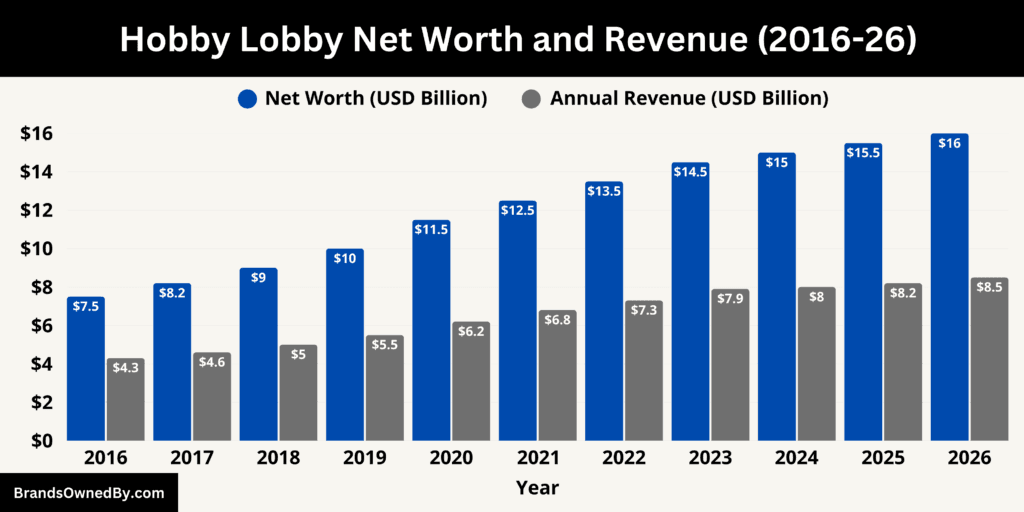
As of March 2026, the company generates an estimated annual revenue of around $8.2–$8.5 billion, with an overall business valuation estimated at about $16 billion. These figures place Hobby Lobby among the largest private retail companies in America and the leading retailer in the arts and crafts segment.
The company’s financial growth is driven primarily by its nationwide store network, seasonal décor sales, private-label craft products, and steady demand for DIY hobby materials. Hobby Lobby also benefits from its conservative financial structure, operating with strong internal cash flows and limited reliance on outside financing.
Revenue Breakdown and Business Segments
Hobby Lobby’s revenue comes from several major retail categories that together generate billions in annual sales. The largest portion of revenue comes from in-store retail sales, which represent the core of the company’s business model. With more than 1,050 stores operating across the United States, physical stores generate the majority of the company’s total revenue through craft supplies, home décor, seasonal decorations, fabrics, and art materials.
Another important revenue stream is seasonal and home décor merchandise, which includes holiday decorations, wall art, furniture accents, and decorative accessories. These products often generate high margins and are major contributors to revenue during holiday seasons such as Christmas, Easter, and fall décor cycles.
Private-label brands also play a major role in Hobby Lobby’s financial performance. The company sells many products under in-house brands such as decorative candles, craft materials, and hobby supplies. Private labels allow the company to maintain higher profit margins compared with selling third-party brands.
Hobby Lobby also generates a growing portion of revenue through online sales and e-commerce. Its main website produces hundreds of millions of dollars in annual online revenue, including approximately $723 million in online sales during 2024, reflecting continued growth in digital retail channels.
Together, these segments contribute to Hobby Lobby’s multi-billion-dollar annual revenue.
Historical Revenue Growth
Hobby Lobby has experienced steady financial growth over the past decade. The company expanded from a mid-sized retailer generating a few billion dollars in revenue to one of the largest private retail chains in the United States.
Revenue growth has been driven primarily by store expansion and increased consumer demand for home decoration and DIY crafts. By 2023, Hobby Lobby’s annual revenue reached approximately $7.9 billion, reflecting a strong nationwide sales performance.
The company continued to grow in 2024, with estimated annual revenue rising to around $8.0 billion, supported by more than 1,000 stores and a workforce exceeding 46,000 employees.
In 2025, revenue remained around the $8 billion level, keeping Hobby Lobby ranked among the largest private companies in the United States retail sector.
Hobby Lobby Net Worth and Company Valuation
Although Hobby Lobby does not publicly disclose its valuation because it is privately owned, estimates based on company revenue, market share, and comparable retailers place its corporate value at roughly $16 billion as of March 2026.
This valuation reflects the company’s strong retail footprint, consistent cash flow, and dominant position in the U.S. arts and crafts market. The value of the company is also reflected in the wealth of its founder.
David Green, the founder and CEO of Hobby Lobby, has accumulated a fortune through the success of the company. His personal net worth has been estimated at around $13–$14 billion, placing him among the wealthiest retail entrepreneurs in the United States.
Because the Green family owns the company outright, most of the company’s value is tied directly to their private ownership.
Financial Stability and Profitability
One reason Hobby Lobby maintains a strong net worth is its conservative financial strategy. The company historically avoided large debt levels and relied heavily on reinvested profits to fund expansion.
This strategy has allowed the company to grow its store network gradually while maintaining strong financial stability. With over 1,000 retail locations and tens of thousands of employees, Hobby Lobby generates billions in sales while remaining financially independent from public investors.
The company also benefits from strong profit margins on decorative items, seasonal merchandise, and private-label craft supplies.
Future Revenue Forecast
Looking ahead, Hobby Lobby’s revenue is expected to continue growing moderately over the next several years. The broader arts and crafts market is expanding steadily as more consumers participate in DIY hobbies, home decoration, and creative projects.
Industry forecasts estimate that the global arts and crafts market will grow significantly through the late 2020s, providing opportunities for retailers such as Hobby Lobby to expand their sales further.
If current trends continue, Hobby Lobby’s annual revenue could reach $9–$10 billion by the end of the decade. Growth will likely come from several areas, including store expansion in underserved markets, stronger e-commerce operations, and new product lines within home décor and craft categories.
The company’s strong financial foundation, family ownership structure, and loyal customer base position it well for continued growth in the retail craft industry.
Brands Owned by Hobby Lobby Stores
Hobby Lobby operates a relatively focused portfolio of companies and brands that support its core arts, crafts, and home décor retail business. It also develops numerous proprietary product brands that are sold exclusively through its stores and online platform. These brands help Hobby Lobby control product design, pricing, and merchandising while differentiating its offerings from competitors.
As of 2026, the following are the main companies, brands, and entities owned and operated directly by Hobby Lobby:
| Company / Brand | Type | Founded / Introduced | Category | Key Details |
|---|---|---|---|---|
| Hobby Lobby | Retail chain | 1972 | Arts & crafts retail | Flagship brand of the company. Operates more than 1,050 stores across the United States selling craft supplies, home décor, seasonal decorations, fabrics, and DIY hobby products. |
| Mardel Christian & Education | Retail chain | 1981 | Christian books and education | Faith-based retailer focused on Bibles, Christian books, church supplies, homeschooling curriculum, and religious gifts. Founded by Mart Green and operates multiple stores along with an online platform. |
| Hemispheres | Retail / décor brand | 2019 | Home décor and furniture | A global-inspired home décor brand launched by Hobby Lobby. Originally operated as standalone stores selling furniture, lighting, rugs, and decorative accessories before being integrated into Hobby Lobby’s décor assortment. |
| Mardel Publishing | Publishing division | 1980s | Christian publishing | Produces religious books, devotionals, and educational materials that are sold primarily through Mardel Christian & Education stores and their online platforms. |
| Brother Sister Design Studio | Private-label brand | 2010s | Home décor | Decorative home accessories and wall art brand focused on modern and contemporary design styles sold exclusively through Hobby Lobby stores. |
| I Love This Yarn! | Private-label brand | 2000s | Craft supplies | Popular proprietary yarn brand offering knitting and crochet yarn products in multiple colors and textures for craft enthusiasts. |
| Artiste | Private-label brand | 2000s | Art supplies | In-house art supply brand offering affordable paints, brushes, drawing tools, and beginner art materials for students and hobbyists. |
| The Paper Studio | Private-label brand | 2000s | Scrapbooking & paper crafts | Brand focused on scrapbooking materials, decorative paper, craft stickers, embellishments, and paper crafting tools. |
| Master’s Touch | Private-label brand | 2000s | Professional art supplies | Premium private-label art brand offering artist canvases, paints, charcoal sets, and drawing tools designed for professional and serious hobby artists. |
Hobby Lobby
Hobby Lobby is the flagship retail brand and the primary company operated by Hobby Lobby Stores, Inc. The chain focuses on arts and crafts supplies, home décor, fabrics, framing materials, and seasonal decorations.
The first Hobby Lobby store opened in 1972 in Oklahoma City, Oklahoma. Since then, the brand has grown into one of the largest arts and crafts retail chains in the United States. The company now operates more than 1,050 stores across the country.
Hobby Lobby stores typically occupy large retail spaces and carry tens of thousands of products. These products include craft tools, scrapbooking materials, artificial flowers, wall décor, furniture accents, and holiday decorations.
Seasonal décor is one of the brand’s strongest product categories. Stores feature large seasonal sections for Christmas, fall, spring, and Easter décor, which generate significant revenue each year.
The Hobby Lobby brand represents the core business of the company and accounts for the vast majority of its revenue.
Mardel Christian & Education
Mardel Christian & Education is a Christian retail chain owned and operated by Hobby Lobby. The brand focuses on Christian books, Bibles, church supplies, gifts, music, and educational materials.
The company was founded in 1981 by Mart Green, the son of Hobby Lobby founder David Green. The name “Mardel” comes from the combination of Mart Green’s name and that of his wife, Dela.
Mardel operates several retail stores across the United States along with an online store that sells religious and educational products. The brand primarily serves churches, pastors, Christian schools, and homeschooling families.
Product categories include Christian literature, devotional books, worship music, teaching resources, homeschooling curriculum, and church supplies.
Because the Green family strongly supports Christian education and ministry initiatives, Mardel plays an important role within the broader Hobby Lobby business ecosystem.
Hemispheres
Hemispheres was a home décor retail brand launched by Hobby Lobby to expand into the global home furnishings market.
The brand specializes in furniture, lighting, rugs, and decorative accessories inspired by international cultures. Products often featured handcrafted designs sourced from countries around the world.
Hemispheres stores were larger than typical craft stores and focused primarily on interior décor rather than craft supplies. The concept allowed Hobby Lobby to compete with specialty home décor retailers.
Although standalone Hemispheres stores were later closed, the product concept and merchandise categories were incorporated into Hobby Lobby’s home décor departments. Many of the decorative items originally sold under the Hemispheres brand continue to appear within Hobby Lobby’s store assortments.
Mardel Publishing
Mardel Publishing is a publishing entity associated with the Mardel Christian & Education brand. The publishing operation produces religious books, devotionals, and Christian educational materials.
These publications are primarily distributed through Mardel retail stores and online platforms. The publishing division focuses on faith-based education, Bible study materials, and homeschooling resources.
The division allows Hobby Lobby to create proprietary content tailored to Christian families, churches, and educational institutions.
Brother Sister Design Studio
Brother Sister Design Studio is one of Hobby Lobby’s private-label home décor brands. The brand focuses on contemporary decorative products and modern wall art.
Products under this label include framed artwork, decorative signs, wall accents, and interior design pieces that appeal to younger homeowners and modern interior design styles.
The brand was developed to provide stylish décor options that align with current home design trends while remaining affordable for Hobby Lobby customers.
Brother Sister Design Studio products are sold exclusively through Hobby Lobby stores and its online platform.
I Love This Yarn!
I Love This Yarn! is a proprietary craft brand owned by Hobby Lobby that specializes in knitting and crochet yarn products.
The brand is widely recognized among craft enthusiasts and offers a variety of yarn textures, colors, and materials suitable for knitting, crocheting, and textile crafts.
Products include acrylic yarn, cotton yarn, specialty yarn blends, and knitting accessories. The brand has become one of the most popular private-label yarn lines in the craft retail market.
By offering its own yarn brand, Hobby Lobby competes directly with craft supply brands sold in competing retailers.
Artiste
Artiste is a private-label art supply brand owned by Hobby Lobby. The brand focuses on products used by artists, hobbyists, and students.
The product line includes paint brushes, drawing pencils, sketch pads, watercolor sets, acrylic paints, and other art tools.
Artiste products are positioned as affordable art supplies that allow beginners and hobbyists to access quality materials at lower prices.
The brand is widely stocked across Hobby Lobby stores and forms an important part of the company’s art supply product category.
The Paper Studio
The Paper Studio is a private-label brand owned by Hobby Lobby that specializes in scrapbooking and paper crafting materials.
The brand offers decorative paper packs, scrapbooking tools, stickers, embellishments, and crafting accessories used in memory books, greeting cards, and paper art projects.
Scrapbooking remains a major category within craft retail, and The Paper Studio has become one of the most recognizable in-house brands within Hobby Lobby’s product lineup.
The brand helps the company compete with specialty scrapbooking brands sold by other craft retailers.
Master’s Touch
Master’s Touch is another private-label brand owned by Hobby Lobby that focuses on professional-grade art supplies.
The brand targets more experienced artists and offers higher-quality materials compared with beginner art brands. Products include artist canvases, acrylic paints, oil paints, charcoal sets, and professional drawing tools.
Master’s Touch products are designed to appeal to artists seeking reliable supplies without paying the premium prices associated with high-end art brands.
Final Thoughts
Hobby Lobby remains one of the largest privately owned retailers in the United States. The company is controlled by the Green family, with founder David Green holding the largest ownership stake.
This family ownership structure has shaped the company’s culture, business strategy, and values. It has also allowed Hobby Lobby to grow without outside investors or public shareholders.
As the company continues expanding its retail network, the Green family is expected to maintain ownership and leadership for future generations.
FAQs
Who owns Hobby Lobby?
Hobby Lobby is owned by the Green family, the same family that founded the company. Founder David Green and his family members hold ownership through family holdings and trusts. The company is privately held and not publicly traded.
What company owns Hobby Lobby?
No parent company owns Hobby Lobby. The retailer is operated by Hobby Lobby Stores, Inc., a privately owned company fully controlled by the Green family. Because it is not publicly listed, there are no institutional investors or corporate parent companies involved.
What family owns Hobby Lobby?
The Green family owns Hobby Lobby. Key members of the family involved in ownership include David Green, Steve Green, Mart Green, Barbara Green, and Darsee Lett. Ownership is structured through family holdings and the Green family trust.
Who founded Hobby Lobby?
Hobby Lobby was founded in 1972 by David Green and his wife Barbara Green in Oklahoma City, Oklahoma. The business started as a small picture frame company operating from their home before expanding into a nationwide arts and crafts retail chain.
Is Hobby Lobby Christian owned?
Yes, Hobby Lobby is widely considered a Christian-owned company. The Green family operates the business based on Christian values. This is reflected in company policies such as closing all stores on Sundays and supporting various faith-based charitable initiatives.
Who bought Hobby Lobby?
Hobby Lobby has never been sold or acquired. The company remains privately owned by the Green family since its founding in 1972. No other corporation or investment firm has purchased the company.
What is David Green’s net worth?
As of 2026, David Green’s net worth is estimated at around $13–$14 billion. Most of his wealth comes from his ownership stake in Hobby Lobby.
Is Hobby Lobby owned by Walmart?
No, Hobby Lobby is not owned by Walmart. The two companies are completely separate businesses. Hobby Lobby is privately owned by the Green family, while Walmart is a publicly traded company owned by shareholders.