
- Lincoln is owned by Ford Motor Company, which acquired the brand in 1922. The luxury automaker now operates as Ford’s premium vehicle division and is not a separate publicly traded company.
- Control of Lincoln ultimately rests with Ford’s executive leadership and board, led by CEO Jim Farley, while the Ford family retains major voting influence through special Class B shares.
- Ford Motor Company itself is a publicly traded company, meaning Lincoln is indirectly owned by Ford’s shareholders, including large institutional investors such as Vanguard Group, BlackRock, and State Street.
- Through Ford’s ownership structure, Lincoln benefits from global engineering, manufacturing, and technology resources, allowing the brand to compete with luxury automakers like Cadillac, Lexus, BMW, and Mercedes-Benz.
Lincoln is an American luxury automobile brand headquartered in Dearborn, Michigan. The company focuses on producing premium vehicles that emphasize comfort, advanced technology, and refined design. Lincoln operates as the luxury vehicle division of Ford Motor Company.
The brand primarily manufactures luxury SUVs and previously produced luxury sedans as well. Popular models include the Navigator, Aviator, Corsair, and Nautilus. These vehicles compete with luxury models from brands such as Cadillac, Lexus, BMW, and Mercedes-Benz.
Lincoln is known for its quiet interiors, smooth driving experience, and elegant styling. The brand places strong emphasis on customer experience and modern luxury features. In recent years, Lincoln has focused heavily on SUVs because of rising global demand for larger premium vehicles.
The brand also has strong recognition in the United States due to its long association with presidential limousines. Several U.S. presidents have used specially built Lincoln vehicles for official transportation.
Today, Lincoln continues to evolve with modern technology, electrification initiatives, and expanded presence in international markets.
Founders of Lincoln
Lincoln Motor Company was founded in 1917 by Henry Leland and his son Wilfred Leland.
Henry Leland was a highly respected engineer and automobile pioneer. Before founding Lincoln, he co-founded Cadillac and helped establish the company’s reputation for precision engineering and manufacturing excellence. Leland believed in strict quality control and mechanical accuracy, which became the core principles of his companies.
After leaving Cadillac, Henry Leland started Lincoln Motor Company during World War I. The company initially produced Liberty aircraft engines for the U.S. military. These engines were used in thousands of aircraft during the war.
After the war ended, the company shifted from aircraft engines to luxury automobiles. The Lelands aimed to create one of the finest luxury car brands in the United States.
Although the founders established Lincoln’s engineering philosophy and reputation for quality, financial difficulties eventually forced the company into receivership. In 1922, Ford Motor Company purchased Lincoln and continued developing the brand into a major luxury automobile manufacturer.
Henry Leland’s legacy still influences Lincoln today. His focus on precision engineering and craftsmanship helped shape the early identity of the brand.
Ownership History
Lincoln’s ownership history spans more than a century and reflects the evolution of the American automotive industry. The brand began as an independent manufacturer but soon became part of Ford Motor Company. Since the early 1920s, Lincoln has remained under Ford’s ownership and operates as its luxury vehicle division.
Founding and Early Independent Ownership (1917–1922)
Lincoln Motor Company was founded in 1917 by Henry M. Leland and his son Wilfred Leland in Detroit, Michigan. The company was initially created to manufacture Liberty aircraft engines for the United States during World War I. The government contract allowed Lincoln to quickly expand its production facilities and workforce.
After the war ended, demand for aircraft engines dropped sharply. The Lelands decided to shift the company’s focus toward manufacturing luxury automobiles. In 1920, Lincoln produced its first passenger vehicle, the Lincoln Model L.
However, the transition from aircraft engines to luxury cars proved difficult. Production costs were high and the post-war economy weakened demand for expensive vehicles. As a result, Lincoln struggled financially and entered receivership in 1922 when it could no longer meet its financial obligations.
This financial crisis forced the founders to sell the company.
Acquisition by Ford Motor Company (1922)
The most important event in Lincoln’s ownership history occurred on February 4, 1922. Ford Motor Company purchased the struggling automaker for approximately $8 million.
Henry Ford made the acquisition to expand Ford’s product lineup beyond mass-market vehicles such as the Model T. Lincoln gave Ford an established luxury brand that could compete with premium American automakers.
Edsel Ford, Henry Ford’s son, became the president of Lincoln after the acquisition. He played a major role in transforming Lincoln into a respected luxury car manufacturer. Edsel introduced improved styling, stronger branding, and a focus on design excellence.
Although Henry and Wilfred Leland initially remained with the company after the sale, disagreements with Ford’s management led to their departure within a few months.
Development as Ford’s Luxury Division (1940–2000s)
During the following decades, Lincoln became firmly integrated into Ford Motor Company’s corporate structure. By 1940, Lincoln was formally established as a division within Ford.
After World War II, Ford grouped Lincoln with its mid-range Mercury brand to form the Lincoln-Mercury Division. This structure lasted for several decades and allowed Ford to offer a broader range of vehicles, from mainstream cars to luxury models.
Lincoln introduced several famous vehicles during this period. These included the Lincoln Continental and other luxury models that strengthened the brand’s reputation for premium craftsmanship.
Throughout the late 20th century, Lincoln remained Ford’s flagship luxury brand in North America.
Corporate Restructuring and Brand Changes (2000s–2010s)
In the early 2000s, Ford reorganized many of its global luxury brands under a unit called the Premier Automotive Group. This group included brands such as Jaguar, Land Rover, Aston Martin, and Volvo.
However, Ford later sold most of these brands to focus on its core operations. During this restructuring, Lincoln remained within Ford and became the company’s primary luxury automotive brand.
Another major change occurred in 2010 when Ford discontinued the Mercury brand. After Mercury’s closure, Lincoln became Ford’s only dedicated luxury brand worldwide.
In 2012, Ford revived the official name “Lincoln Motor Company” as part of a major rebranding effort aimed at strengthening the brand’s identity.
Lincoln Under Ford Motor Company (2020s–2026)
As of March 2026, Lincoln continues to operate as a wholly owned brand of Ford Motor Company. The brand focuses on luxury SUVs and premium vehicle technology while competing with brands such as Cadillac, Lexus, BMW, and Mercedes-Benz.
Ford oversees Lincoln’s strategy, vehicle development, and global expansion. The brand plays a key role in Ford’s luxury vehicle segment and is particularly important in markets such as North America and China.
More than a century after its founding, Lincoln remains closely tied to Ford Motor Company. Since the 1922 acquisition, the brand has operated under Ford’s ownership and continues to represent the company’s premium automotive division.
Who Owns Lincoln?
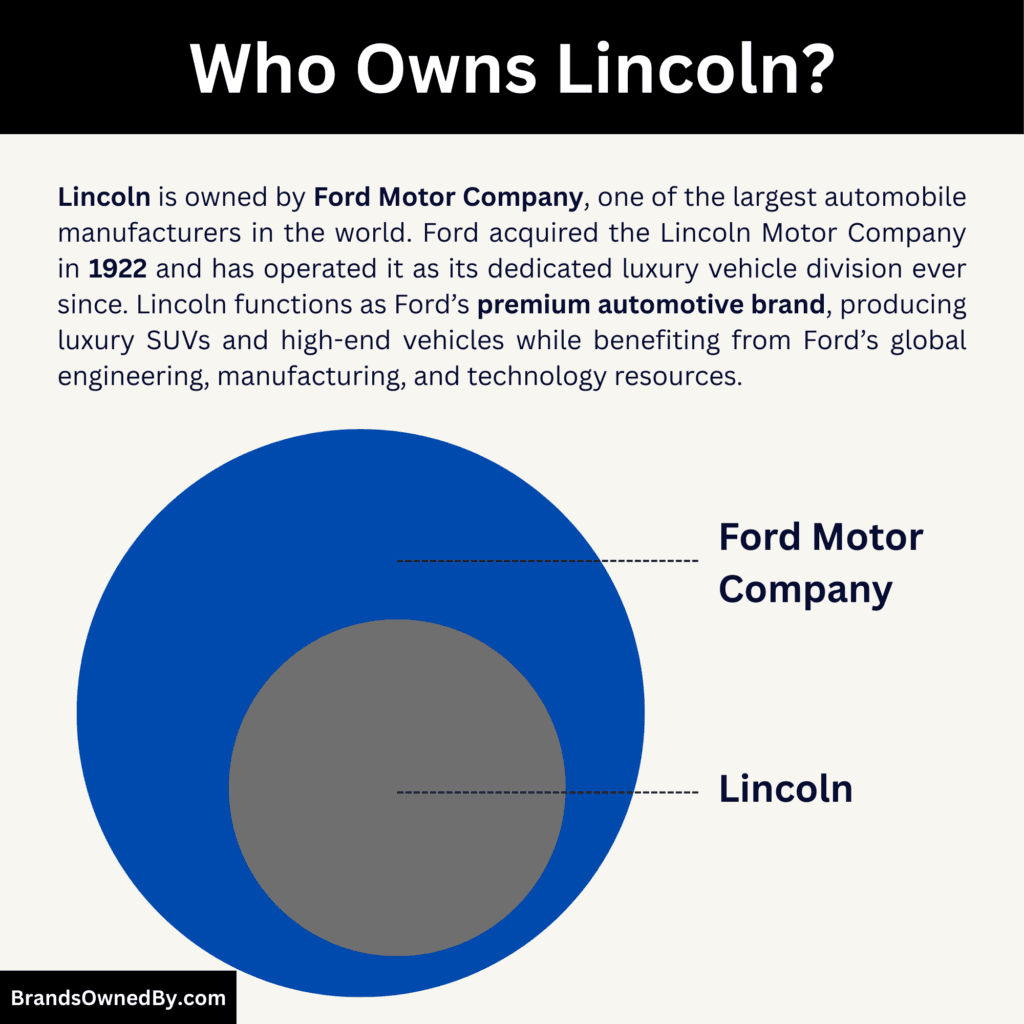
Lincoln is owned by Ford Motor Company. The luxury automobile brand operates as a wholly owned division of Ford and is not a separate publicly traded company. Ford acquired Lincoln in 1922 and has controlled the brand ever since. As a result, Lincoln’s ownership ultimately belongs to Ford Motor Company and its shareholders, while the Ford family maintains significant voting influence within the parent company.
Parent Company: Ford Motor Company
Ford Motor Company is the global automaker that owns and operates the Lincoln brand. Founded in 1903 and headquartered in Dearborn, Michigan, Ford is one of the largest automobile manufacturers in the world. The company produces vehicles under two primary brands: Ford and Lincoln.
Lincoln represents Ford’s luxury vehicle division. The brand focuses on premium SUVs and advanced comfort technology. Vehicles are designed using Ford’s global engineering platforms but are positioned in the luxury segment of the market. Lincoln’s major models include the Navigator, Aviator, Corsair, and Nautilus.
Ford manages Lincoln’s strategy, vehicle development, manufacturing, marketing, and global expansion. Major business decisions involving Lincoln are made at Ford’s executive leadership and board level. This includes product development investment, electrification strategy, and international market expansion.
Ford Motor Company is listed on the New York Stock Exchange under the ticker symbol F. The company has a broad shareholder base consisting mainly of institutional investors, retail investors, company insiders, and the Ford family. As of early 2026, institutional investors hold the majority of Ford’s publicly traded shares.
The largest institutional shareholders include Vanguard Group, BlackRock, Charles Schwab Investment Management, and State Street Global Advisors. These investment firms manage index funds, ETFs, and pension portfolios that hold Ford stock on behalf of millions of investors worldwide.
Despite the large institutional ownership, the Ford family maintains significant influence over the company. Through a dual-class share structure, the family holds special Class B shares that carry greater voting power than ordinary shares. This structure gives the Ford family roughly 40% of the company’s voting rights while owning a much smaller percentage of total equity.
William Clay Ford Jr., the great-grandson of Henry Ford, serves as Executive Chair of Ford Motor Company. Jim Farley is the company’s Chief Executive Officer as of March 2026 and oversees Ford’s global operations, including the Lincoln division.
Ford generates more than $170 billion in annual revenue and operates manufacturing facilities across North America, Europe, Asia, and other regions. Within this global structure, Lincoln serves as the company’s premium automotive brand competing with luxury divisions such as Cadillac, Lexus, BMW, and Mercedes-Benz.
Lincoln Acquisition by Ford
Lincoln Motor Company was founded in 1917 by Henry M. Leland and his son Wilfred Leland. The company initially produced Liberty aircraft engines for the U.S. military during World War I.
After the war ended, the company shifted its focus toward building luxury automobiles. Lincoln introduced its first passenger car, the Model L, in 1920. The vehicle was engineered with high quality standards, but was expensive to manufacture and struggled to gain strong market traction.
Financial difficulties quickly emerged due to production costs and economic challenges following the war. By 1922, Lincoln entered receivership after failing to meet its financial obligations.
Ford Motor Company purchased Lincoln on February 4, 1922 for approximately $8 million. The acquisition allowed Ford to enter the luxury automobile segment, which was previously dominated by brands such as Cadillac and Packard.
Edsel Ford, Henry Ford’s son, played a critical role in the brand’s revival. After the acquisition, Edsel was placed in charge of Lincoln and began redesigning the vehicles to improve their styling and appeal. Under his leadership, Lincoln developed a stronger luxury identity and expanded its customer base.
One of the most important milestones following the acquisition was the introduction of the Lincoln Continental in 1939. The model became one of the most iconic American luxury cars and significantly strengthened Lincoln’s reputation.
Lincoln remained part of Ford’s corporate structure throughout the twentieth century. During this time the brand produced several influential luxury vehicles and became closely associated with American presidential transportation.
In later decades Ford reorganized its global luxury strategy multiple times. Some luxury brands owned by Ford were eventually sold, including Jaguar, Land Rover, Volvo, and Aston Martin. Lincoln, however, remained within Ford’s portfolio and continued to serve as the company’s primary luxury brand.
As of March 2026, Lincoln continues to operate as a fully owned brand within Ford Motor Company. The brand focuses mainly on luxury SUVs and plays an important role in Ford’s premium vehicle strategy, particularly in North America and China.
Who Manufactures Lincoln?
Lincoln vehicles are manufactured by Ford Motor Company, which owns the Lincoln brand and produces all of its vehicles through Ford’s global manufacturing network. Production takes place at Ford-owned plants in the United States and through Ford’s international joint-venture manufacturing operations, particularly in China. The manufacturing strategy combines Ford’s North American assembly plants with joint-venture facilities that supply vehicles to global markets.
Lincoln does not operate its own independent factories. Instead, each vehicle model is assembled at specific Ford plants or joint-venture factories depending on the market and production strategy.
Kentucky Truck Plant – Navigator Production
The Kentucky Truck Plant in Louisville, Kentucky is one of the most important facilities for Lincoln manufacturing. This plant produces the Lincoln Navigator, which is the brand’s flagship full-size luxury SUV.
The facility is one of Ford’s largest assembly plants and also builds the Ford Expedition, which shares a body-on-frame architecture with the Navigator. The Navigator is assembled on the same production line but receives Lincoln-specific engineering, luxury interiors, and technology features.
Navigator production at this plant has been continuous for more than a decade and remains the global manufacturing source for the model.
Chicago Assembly Plant – Aviator Production
The Chicago Assembly Plant in Illinois manufactures the Lincoln Aviator. This factory is one of Ford’s oldest continuously operating vehicle plants and has been producing vehicles since 1924.
The Aviator shares its platform with the Ford Explorer but is assembled with a different suspension setup, interior design, and luxury components to meet Lincoln’s premium standards. The plant also produces the Ford Explorer and Police Interceptor Utility on the same architecture.
Chicago Assembly is the primary global production facility for the Aviator sold in North America.
Louisville Assembly Plant – Corsair Production
The Louisville Assembly Plant in Kentucky produces the Lincoln Corsair, which is Lincoln’s compact luxury SUV.
The Corsair is built on a platform shared with the Ford Escape, but it features redesigned body panels, upgraded interiors, and additional technology systems that distinguish it from Ford models.
This plant serves as the primary production facility for Corsair vehicles sold in the United States and other international markets.
Changan Ford Joint Venture – China Manufacturing
Lincoln also manufactures vehicles in China through Changan Ford, a joint venture between Ford Motor Company and Chongqing Changan Automobile Co. The venture is structured as a 50-50 partnership and operates multiple assembly plants across China.
Changan Ford builds several Lincoln vehicles specifically for the Chinese market and for export to other regions.
Key production facilities include:
Hangzhou Assembly Plant (Zhejiang, China): This plant manufactures the Lincoln Nautilus and also produces the Aviator for the Chinese market.
The second-generation Lincoln Nautilus, introduced for the 2024 model year, is produced exclusively in China and exported to North America and other global markets.
Chongqing Assembly Complex (Chongqing, China): This facility produces several Lincoln models including the Lincoln Corsair and other China-specific vehicles.
The plant began producing the Corsair in 2020, marking the first time a Lincoln vehicle was manufactured in China for the local market.
Through these facilities, Ford significantly expanded Lincoln production in China to support demand in the world’s largest luxury vehicle market.
Manufacturing Strategy
Lincoln’s manufacturing strategy combines North American production for core global models with localized production in China through the Changan Ford joint venture.
The Navigator, Aviator, and Corsair are largely produced in Ford’s U.S. plants, while models like the Nautilus are produced in China and exported globally. This approach allows Ford to reduce production costs, serve regional markets more efficiently, and scale Lincoln production based on demand.
Overall, Lincoln vehicles are manufactured through Ford Motor Company’s global production system and its joint-venture partnership with Changan Automobile in China, ensuring the brand can supply luxury vehicles to both North American and international markets.
Competitor Ownership Comparison
Lincoln competes with several global luxury automobile brands. While Lincoln operates as a luxury division of Ford Motor Company, most of its competitors are either owned by large automotive conglomerates or operate as flagship brands within their own corporate groups.
As of March 2026, the ownership structures of these competitors vary significantly, reflecting different corporate strategies across the global auto industry.
| Luxury Brand | Parent Company | Ownership Type | Key Controlling Shareholders / Owners (2026) | Notes |
|---|---|---|---|---|
| Lincoln | Ford Motor Company | Public company with dual-class shares | Ford family (≈40% voting power), Vanguard Group, BlackRock, State Street, Charles Schwab | Lincoln operates as Ford’s luxury vehicle division |
| Cadillac | General Motors | Publicly traded company | Vanguard Group, BlackRock, State Street, Capital Research | Cadillac is GM’s flagship luxury brand |
| Lexus | Toyota Motor Corporation | Public company | Toyota Industries, Japanese financial institutions, Vanguard, BlackRock | Lexus is Toyota’s global luxury vehicle division |
| BMW | BMW Group | Public company with family control | Quandt family (largest shareholder group), institutional investors | BMW Group also owns MINI and Rolls-Royce Motor Cars |
| Mercedes-Benz | Mercedes-Benz Group AG | Public company with strategic investors | BAIC Group (~9.98%), Li Shufu (~9.7%), Kuwait Investment Authority (~6.8%), institutional investors | Mercedes-Benz focuses primarily on luxury vehicles |
| Audi | Volkswagen Group | Public company with controlling shareholder | Porsche Automobil Holding SE (majority voting rights), Lower Saxony state government | Audi is Volkswagen Group’s primary premium brand |
| Volvo | Zhejiang Geely Holding Group | Privately controlled multinational group | Geely Holding founder Li Shufu and affiliated investment entities | Volvo operates alongside brands like Polestar and Lotus |
Cadillac (Owned by General Motors)
Cadillac is Lincoln’s closest American competitor and operates as the luxury vehicle division of General Motors (GM). General Motors owns several automotive brands including Chevrolet, GMC, Buick, and Cadillac. The company is publicly traded on the New York Stock Exchange and headquartered in Detroit, Michigan.
Because Cadillac is a division within GM, its ownership reflects GM’s shareholder structure. Institutional investors hold the majority of GM shares. The largest shareholders include The Vanguard Group, BlackRock, and State Street Corporation. These firms manage investment funds that hold GM shares on behalf of millions of investors.
GM’s leadership team oversees Cadillac’s global strategy, product development, and investment in new technologies such as electric vehicles. Models like the Cadillac Escalade and Lyriq compete directly with Lincoln’s Navigator and other luxury SUVs.
Lexus (Owned by Toyota Motor Corporation)
Lexus is the luxury vehicle division of Toyota Motor Corporation. The brand was created by Toyota in 1989 to compete in the premium automotive market, particularly in North America and Europe.
Toyota is one of the largest automakers in the world and fully owns the Lexus brand. Lexus is not a separate company and operates within Toyota’s corporate structure.
Toyota Motor Corporation is publicly traded on the Tokyo Stock Exchange and has a broad shareholder base including institutional investors, financial institutions, and individual investors. The company also maintains cross-shareholdings with several Japanese corporations and holds strategic stakes in other automakers such as Subaru, Mazda, and Suzuki.
Under Toyota’s ownership, Lexus has expanded globally and competes with Lincoln primarily in the luxury SUV segment with vehicles such as the Lexus LX, GX, and RX.
BMW (Owned by BMW Group)
BMW is the flagship brand of BMW Group, a German multinational automotive manufacturer headquartered in Munich. Unlike Lincoln or Lexus, BMW itself is the primary brand within its corporate group rather than a luxury division of another automaker.
BMW Group owns several premium brands including BMW, MINI, and Rolls-Royce Motor Cars. The company is publicly traded but has a distinctive ownership structure dominated by the Quandt family, which remains the largest long-term shareholder group.
The Quandt family collectively controls a large portion of BMW Group’s voting rights through holding companies and private investment entities. This gives the family significant influence over the company’s strategic direction.
BMW vehicles such as the X5 and X7 compete directly with Lincoln SUVs like the Aviator and Navigator.
Mercedes-Benz (Owned by Mercedes-Benz Group AG)
Mercedes-Benz is owned by Mercedes-Benz Group AG, a German luxury automotive corporation headquartered in Stuttgart. The company focuses heavily on premium passenger vehicles and commercial vehicles.
Mercedes-Benz Group has a diversified ownership structure. Institutional investors hold the majority of shares, while several major strategic investors also own significant stakes. The largest individual shareholder is China’s BAIC Group, which holds about 9.98% of the company’s voting rights. Chinese entrepreneur Li Shufu also holds approximately 9.7% through his investment company. The Kuwait Investment Authority owns around 6.8% of the company.
Mercedes-Benz vehicles such as the GLS and GLE compete with Lincoln’s high-end SUVs. The company invests heavily in electric luxury vehicles under its EQ lineup.
Audi (Owned by Volkswagen Group)
Audi is a luxury automotive brand owned by Volkswagen Group. Volkswagen Group is one of the largest automotive conglomerates in the world and manages a large portfolio of brands across different market segments.
The group owns major brands including Volkswagen, Porsche, Audi, Bentley, Lamborghini, Skoda, and SEAT.
Volkswagen Group itself has a complex ownership structure. Porsche Automobil Holding SE is the largest controlling shareholder and holds a majority of the voting rights in the company. The state of Lower Saxony in Germany also owns a significant stake, while institutional investors and retail shareholders hold the remaining shares.
Audi competes with Lincoln primarily in the premium SUV segment with models such as the Audi Q7 and Q8.
Volvo (Owned by Geely Holding Group)
Volvo Cars is owned by Zhejiang Geely Holding Group, a Chinese multinational automotive company. Geely acquired Volvo from Ford Motor Company in 2010 and has since invested heavily in modernizing the brand.
Geely Holding Group owns several automotive brands including Volvo, Polestar, Lotus, and stakes in other global mobility companies.
Under Geely’s ownership, Volvo has expanded its focus on safety technologies, electrification, and premium SUVs such as the XC90 and XC60. These vehicles compete with Lincoln models in the luxury SUV category.
Industry Ownership Structure
The luxury automotive industry is dominated by large multinational automotive groups. Lincoln operates as Ford Motor Company’s luxury division, while Cadillac functions similarly within General Motors.
Other competitors such as Lexus also operate as luxury divisions of larger automakers, whereas brands like BMW and Mercedes-Benz represent core brands within companies that focus heavily on the premium market.
Meanwhile, conglomerates such as Volkswagen Group and Geely Holding Group manage multiple automotive brands across different price segments.
This industry structure highlights how luxury vehicle brands often rely on the financial strength, research capabilities, and manufacturing scale of large parent companies. Lincoln remains Ford’s primary strategy for competing in the global luxury automotive market against these major automotive groups.
Who Controls Lincoln?
Lincoln is controlled by Ford Motor Company. The luxury car brand operates as a division within Ford and does not have its own independent corporate governance. Strategic authority over Lincoln comes from Ford’s top leadership and board of directors. These leaders decide the brand’s vehicle lineup, capital investment, manufacturing strategy, and long-term technology roadmap.
As of March 2026, the individuals who effectively control Lincoln through Ford Motor Company are the CEO, the Executive Chair representing the Ford family, and key executives responsible for product development and global automotive operations.
Jim Farley – Chief Executive Officer of Ford Motor Company
Jim Farley is the primary decision-maker overseeing Lincoln. As President and CEO of Ford Motor Company since October 2020, he controls the company’s global automotive strategy, including the direction of the Lincoln luxury brand.
Farley approves major investments, product programs, and market expansion strategies. Decisions such as Lincoln’s transition toward a predominantly SUV lineup were implemented under his leadership. Models such as the Navigator, Aviator, Nautilus, and Corsair form the core of Lincoln’s portfolio because Ford leadership prioritized the high-margin luxury SUV segment.
Farley also directs Ford’s global electrification strategy. Future Lincoln electric vehicles are being developed within Ford’s broader EV platform strategy that he oversees.
William Clay Ford Jr. – Executive Chair and Ford Family Leader
William Clay Ford Jr. is the Executive Chair of Ford Motor Company and represents the Ford family’s long-standing influence over the company. He is the great-grandson of Ford founder Henry Ford.
Although he does not manage day-to-day operations, Ford Jr. plays a powerful role in shaping long-term strategy. The Ford family controls roughly 40% of Ford’s voting power through special Class B shares, which gives them significant influence over corporate decisions.
This governance structure allows the Ford family to guide major strategic decisions affecting Ford and its divisions, including Lincoln.
Kumar Galhotra – Chief Operating Officer of Ford Motor Company
Kumar Galhotra serves as Ford’s Chief Operating Officer and oversees the company’s global automotive operations. His responsibilities include vehicle development, manufacturing operations, supply chain management, and product quality.
Because Lincoln vehicles are developed and produced within Ford’s global manufacturing system, Galhotra’s operational decisions directly influence Lincoln’s product development and production strategy.
Galhotra also previously served as President of Ford North America and earlier held leadership roles closely tied to Lincoln product programs.
Hau Thai-Tang – Chief Industrial Platform Officer
Hau Thai-Tang is Ford’s Chief Industrial Platform Officer and leads global product development, engineering, and platform strategy.
His team designs the vehicle architectures, powertrain technologies, and engineering systems used across Ford and Lincoln vehicles. This role is critical because Lincoln vehicles share underlying engineering platforms with Ford vehicles while receiving luxury-focused upgrades in design and technology.
Decisions about which platforms Lincoln uses, how future vehicles are engineered, and how electrification technologies are integrated fall under his oversight.
Overall Control Structure
Lincoln’s control structure is centralized within Ford Motor Company. Strategic authority sits with CEO Jim Farley and Ford’s executive leadership team. Governance oversight comes from the board of directors and Executive Chair William Clay Ford Jr., who represents the Ford family’s voting influence.
Lincoln’s brand executives then implement these strategic decisions through vehicle design, marketing, and customer experience programs.
In practice, this means Lincoln’s direction is determined by Ford’s leadership priorities—especially investments in luxury SUVs, advanced driver technology, and the company’s transition toward electric vehicles.
Lincoln Annual Revenue and Net Worth
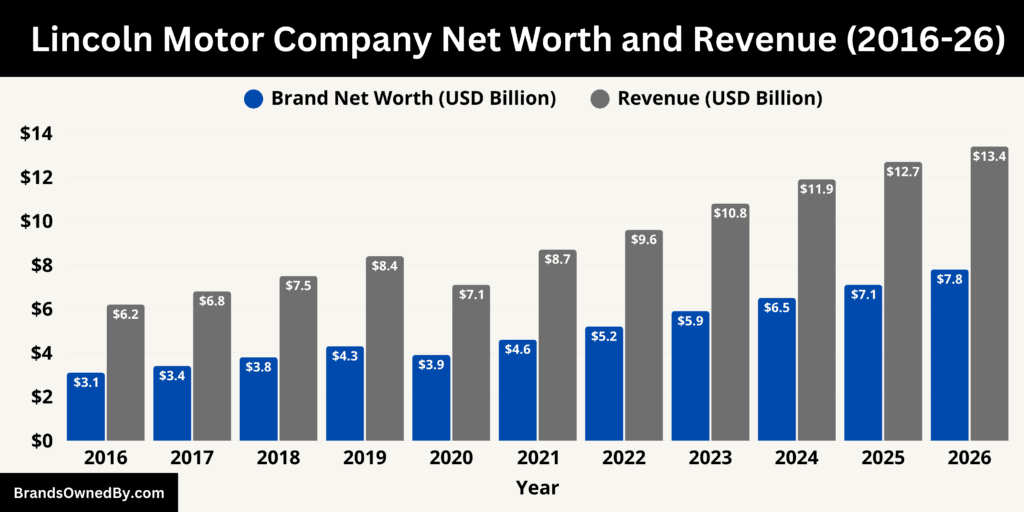
As of March 2026, Lincoln generates an estimated $13–14 billion in annual revenue and has an estimated brand net worth of around $8 billion. The brand’s financial strength is largely driven by premium SUVs such as the Navigator, Aviator, Nautilus, and Corsair, which command higher margins compared with standard vehicles.
Lincoln’s growth over the past decade has been tied to strong SUV demand, expanding sales in China, and Ford’s strategic shift toward higher-margin premium vehicles.
Lincoln Revenue in 2026
Lincoln’s estimated revenue for 2026 is approximately $13.4 billion. This estimate is based on global vehicle sales volumes and average selling prices for Lincoln’s luxury SUV lineup.
In 2025, Lincoln sold more than 106,800 vehicles in the United States alone, marking the second consecutive year the brand surpassed 100,000 annual sales in its largest market.
Sales growth has been supported by strong demand for flagship SUVs. For example:
- The Lincoln Navigator recorded strong growth with 22,185 units sold in 2025, one of the best years for the model in more than a decade.
- The Lincoln Nautilus also experienced strong demand, with over 33,000 units sold in the United States in 2025.
- The Lincoln Aviator maintained stable sales above 24,000 units in 2025, reinforcing its role in the midsize luxury SUV segment.
Because luxury SUVs typically sell between $45,000 and $100,000, the combination of high vehicle pricing and stable demand allows Lincoln to generate billions in revenue annually despite a relatively modest sales volume compared with mass-market brands.
Revenue Composition by Vehicle Segment
Lincoln’s revenue structure is heavily concentrated in SUVs, which account for nearly all of the brand’s global sales.
Full-size luxury SUVs
The Navigator is Lincoln’s flagship product and generates a large portion of the brand’s profit. With pricing that often exceeds $90,000 for premium trims, it is one of the highest-margin vehicles in Ford’s portfolio.
Mid-size luxury SUVs
Vehicles such as the Aviator and Nautilus represent Lincoln’s core sales volume. These models target the mid-size luxury SUV market and contribute a significant share of overall revenue.
Compact luxury SUVs
The Corsair serves as Lincoln’s entry-level luxury model. It expands the brand’s customer base and helps increase global sales volume, especially in markets like China.
Lincoln Net Worth and Brand Value
Lincoln’s estimated brand net worth in March 2026 is approximately $8 billion. This valuation reflects the brand’s market presence, profitability within Ford’s portfolio, and its position in the global luxury vehicle market.
Several factors contribute to Lincoln’s brand valuation:
Premium market positioning
Lincoln competes in the global luxury automotive segment alongside Cadillac, Lexus, BMW, and Mercedes-Benz. Vehicles in this category typically generate higher profit margins due to premium pricing and luxury features.
Strong SUV portfolio
The brand’s focus on luxury SUVs aligns with consumer demand trends. Large and mid-size SUVs remain among the most profitable segments in the global automotive industry.
Global market expansion
Lincoln has expanded production and sales in China over the past decade. Localized manufacturing and increasing demand for luxury vehicles have strengthened the brand’s international market presence.
Future Revenue Forecast
Lincoln’s revenue is expected to grow steadily through the remainder of the decade as the brand continues expanding its luxury SUV lineup, strengthens its position in China, and gradually introduces electrified vehicles built on Ford’s next-generation platforms. Industry projections suggest the brand could cross $18–20 billion in annual revenue by 2030 if current market trends continue.
Below is a projected revenue outlook for Lincoln through 2030 based on SUV demand trends, expected product updates, and global luxury vehicle market growth.
- 2026: Estimated revenue around $13.4 billion with strong performance from the Navigator, Aviator, Nautilus, and Corsair. Continued demand for large luxury SUVs supports stable growth.
- 2027: Revenue projected to reach about $14.2 billion as Lincoln expands its refreshed SUV lineup and strengthens sales in North America and China.
- 2028: Revenue expected to grow to approximately $15.3 billion driven by new model updates, improved vehicle technology, and expansion in international luxury markets.
- 2029: Revenue could reach around $16.7 billion as Ford’s electrification strategy begins influencing Lincoln’s premium vehicle lineup and introduces higher-margin luxury technologies.
- 2030: Revenue forecast to approach $18.5–$19 billion, supported by growth in luxury SUV demand, potential electric Lincoln vehicles, and continued expansion in global markets.
Overall, Lincoln’s financial outlook remains closely tied to Ford Motor Company’s long-term strategy. The company is focusing heavily on premium SUVs, electrified platforms, and high-margin vehicle segments. If these initiatives continue to perform well, Lincoln is expected to see steady revenue growth through the end of the decade.
Brands Owned by Lincoln
As of 2026, Lincoln’s operational structure centers primarily on its luxury SUV lineup and premium ownership programs. Unlike large automotive groups that manage multiple independent companies, Lincoln focuses on maintaining a streamlined luxury brand identity.
The Navigator, Aviator, Nautilus, and Corsair form the foundation of Lincoln’s vehicle portfolio, while programs such as Black Label and specialized design operations support the brand’s premium positioning.
| Brand / Entity | Type | Year Introduced | Description | Role in Lincoln Business |
|---|---|---|---|---|
| Lincoln Navigator | Full-size luxury SUV | 1998 | Flagship luxury SUV known for large size, premium interiors, and high-end technology. Competes with Cadillac Escalade and BMW X7. | One of Lincoln’s most profitable vehicles and a major revenue driver. |
| Lincoln Aviator | Mid-size luxury SUV | 2002 (revived 2019) | Premium mid-size SUV offering powerful engines, hybrid options, and advanced driver technology. | Core global model positioned between Corsair and Navigator. |
| Lincoln Nautilus | Mid-size luxury SUV | 2019 | Modern luxury SUV featuring advanced digital displays and driver assistance systems. | Key model for both North American and Chinese luxury SUV markets. |
| Lincoln Corsair | Compact luxury SUV | 2020 | Entry-level luxury SUV designed to attract younger premium buyers. | Expands Lincoln’s customer base and increases global sales volume. |
| Lincoln Black Label | Ultra-luxury program | 2015 | Exclusive luxury trim program offering customized interiors, concierge services, and premium ownership benefits. | Enhances Lincoln’s premium positioning and increases profit margins. |
| Lincoln Presidential Limousine Program | Government vehicle program | 1939 | Custom-built luxury limousines used historically for U.S. presidential transportation. | Strengthens Lincoln’s historic reputation as an American luxury symbol. |
| Lincoln Design Studio | Internal design division | 2012 | Responsible for vehicle design, interior materials, and brand aesthetics. | Maintains Lincoln’s distinct luxury design language across models. |
| Lincoln China Operations | Regional business unit | 2014 | Localized manufacturing, marketing, and sales operations for the Chinese luxury vehicle market. | Supports expansion in one of the world’s largest luxury automotive markets. |
Lincoln Navigator
The Lincoln Navigator is the brand’s flagship full-size luxury SUV and one of the most important vehicles in Lincoln’s portfolio. First introduced in 1998, the Navigator helped define the modern luxury SUV segment in the United States.
The vehicle competes directly with large luxury SUVs such as the Cadillac Escalade, BMW X7, and Mercedes-Benz GLS. It is known for its large interior space, high-end materials, and powerful twin-turbocharged V6 engine.
Navigator models typically sit at the top of Lincoln’s price range, with premium trims often exceeding $90,000. Because of this pricing, the Navigator is one of Lincoln’s most profitable vehicles and plays a major role in the brand’s overall revenue.
The model is produced primarily in the United States and sold across North America and other global markets.
Lincoln Aviator
The Lincoln Aviator is a mid-size luxury SUV positioned between the Corsair and Navigator in Lincoln’s lineup. The vehicle was originally introduced in 2002 but was discontinued after a short production run.
Lincoln revived the Aviator in 2019 as part of the brand’s renewed focus on luxury SUVs. The modern Aviator offers advanced technology features, a refined interior, and a powerful twin-turbocharged engine.
The model also introduced hybrid powertrain options, reflecting Ford’s broader move toward electrification. The Aviator competes with vehicles such as the BMW X5, Audi Q7, and Lexus GX.
Because of its balance between size, luxury, and price, the Aviator represents one of Lincoln’s core global vehicles.
Lincoln Nautilus
The Lincoln Nautilus is a mid-size luxury SUV that replaced the earlier Lincoln MKX model. It represents Lincoln’s entry into the competitive mid-size premium SUV segment.
The Nautilus underwent a major redesign in recent years and now features one of the most technologically advanced interiors in the brand’s lineup. The vehicle includes a large panoramic digital display and advanced driver-assistance systems.
The model has become particularly important for Lincoln’s expansion in China. Several versions of the Nautilus are produced specifically for the Chinese luxury vehicle market.
Because of its global appeal and strong technology features, the Nautilus has become one of Lincoln’s fastest-growing vehicles.
Lincoln Corsair
The Lincoln Corsair is the brand’s compact luxury SUV and serves as Lincoln’s entry-level vehicle. It was introduced in 2020 to replace the earlier Lincoln MKC model.
The Corsair targets younger luxury buyers and customers entering the premium vehicle segment for the first time. Despite being the smallest SUV in Lincoln’s lineup, it offers many of the same luxury features found in the brand’s larger vehicles.
These include advanced safety technology, premium interior materials, and hybrid powertrain options.
The Corsair plays an important role in expanding Lincoln’s customer base and increasing global sales volume.
Lincoln Black Label
Lincoln Black Label is a premium luxury program offered by the brand rather than a separate company. It represents the highest level of luxury within Lincoln vehicles.
The program provides exclusive interior themes, premium materials, and additional ownership benefits such as concierge services and enhanced vehicle customization.
Black Label trims are available across several Lincoln vehicles including the Navigator, Aviator, and Nautilus. These models feature upgraded leather interiors, unique design themes, and specialized craftsmanship.
The Black Label program helps Lincoln compete more effectively with high-end luxury brands by offering an ultra-premium ownership experience.
Lincoln Presidential Limousine Program
Lincoln has long operated specialized programs for government and ceremonial vehicles. One of the most historically significant is the presidential limousine program.
For decades, specially modified Lincoln vehicles have served as official presidential limousines in the United States. These vehicles are custom-built with advanced security features, reinforced armor, and specialized communication systems.
While the modern presidential limousine is technically produced under government contract, Lincoln continues to be historically associated with presidential transportation.
This legacy has played a major role in shaping Lincoln’s brand image as a symbol of American luxury and prestige.
Lincoln Design Studio
Lincoln Design Studio is an internal design division responsible for the visual identity of Lincoln vehicles. This team develops exterior styling, interior materials, and the brand’s signature design language.
The design studio focuses heavily on modern luxury aesthetics, emphasizing clean lines, minimalist interiors, and high-quality materials. Many of Lincoln’s recent vehicles reflect this design philosophy.
The studio also collaborates with Ford’s global engineering teams to ensure that Lincoln vehicles maintain a distinct visual identity separate from standard Ford models.
Lincoln China Operations
Lincoln has established dedicated operations focused on the Chinese luxury vehicle market. China is one of the brand’s most important growth regions.
Several Lincoln models are produced locally through partnerships within Ford’s Chinese manufacturing network. This localized production helps reduce costs and improve competitiveness in China’s luxury SUV market.
Lincoln China operations also include specialized marketing strategies and product features tailored to Chinese consumer preferences.
Final Words
Lincoln remains one of the most recognizable American luxury automobile brands, known for its long history, premium SUVs, and association with presidential vehicles. The brand operates as the luxury vehicle division of Ford Motor Company and benefits from Ford’s global engineering, manufacturing, and research capabilities.
For readers wondering who owns Lincoln, the answer lies in its long-standing relationship with Ford. The brand has been part of Ford Motor Company for more than a century and continues to evolve under its leadership. With a strong focus on luxury SUVs, modern technology, and premium customer experience, Lincoln continues to hold a distinct position in the global luxury automotive market.
FAQs
Lincoln belongs to which brand?
Lincoln belongs to Ford Motor Company. It operates as Ford’s dedicated luxury vehicle brand and focuses on premium SUVs and luxury vehicles. While Lincoln has its own brand identity and design philosophy, it functions as a division within Ford’s global automotive business.
What company owns Lincoln vehicles?
Ford Motor Company owns Lincoln vehicles. Ford acquired the Lincoln Motor Company in 1922 and has owned the brand ever since. All Lincoln models are designed, engineered, and produced under Ford’s corporate structure.
Who makes Lincoln vehicles?
Lincoln vehicles are manufactured by Ford Motor Company. Production takes place at Ford assembly plants in the United States, including the Kentucky Truck Plant, Chicago Assembly Plant, and Louisville Assembly Plant, as well as through Ford’s joint-venture manufacturing operations in China.
Who owns Lincoln Car Company?
The Lincoln Motor Company is owned by Ford Motor Company. Lincoln operates as a luxury vehicle division within Ford and does not function as a separate publicly traded company.
Is Lincoln owned by Ford?
Yes, Lincoln is owned by Ford Motor Company. Ford purchased the company in 1922 and has operated Lincoln as its luxury automotive brand for more than a century.
Are Lincoln and Cadillac made by the same company?
No, Lincoln and Cadillac are made by different companies. Lincoln is owned by Ford Motor Company, while Cadillac is owned by General Motors (GM). The two brands compete directly in the luxury vehicle market.
Does Chrysler own Lincoln?
No, Chrysler does not own Lincoln. Lincoln is owned by Ford Motor Company. Chrysler is part of Stellantis, which owns brands such as Jeep, Dodge, Ram, and Chrysler.
Why did Ford buy Lincoln?
Ford bought Lincoln in 1922 to enter the luxury automobile market. At that time, Ford primarily produced affordable mass-market vehicles. Acquiring Lincoln allowed Ford to compete with luxury brands such as Cadillac and Packard.
Is Cadillac owned by Lincoln?
No, Cadillac is not owned by Lincoln. Cadillac is a luxury brand owned by General Motors, while Lincoln is owned by Ford Motor Company.
Does Jaguar own Lincoln?
No, Jaguar does not own Lincoln. Lincoln is owned by Ford Motor Company. Jaguar is currently owned by Tata Motors, an Indian multinational automotive company.