

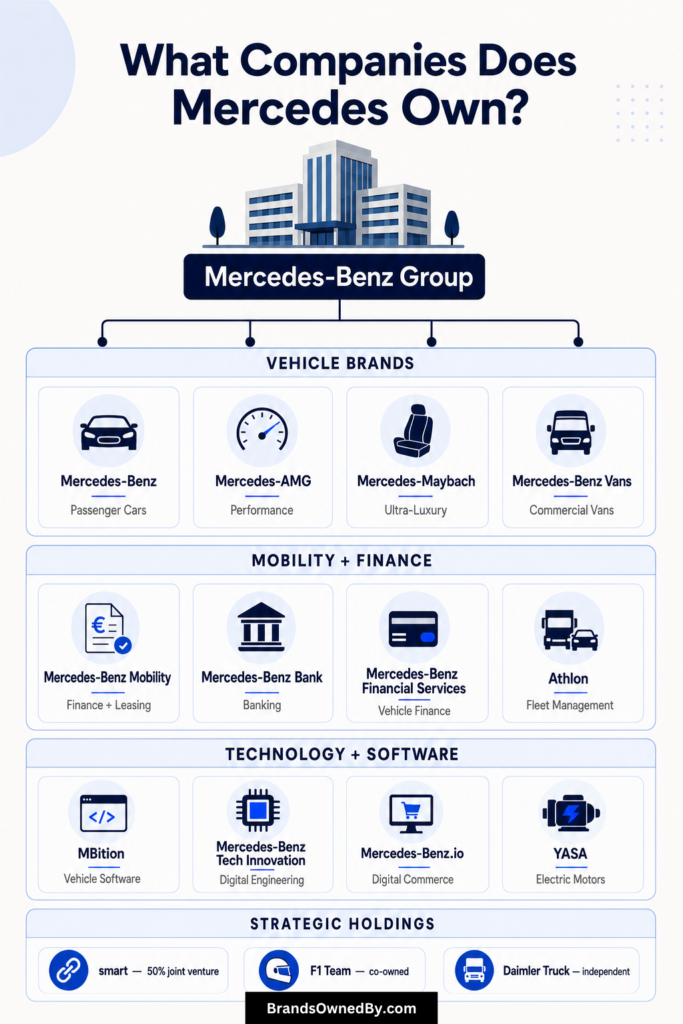
- Mercedes-Benz Group owns its core Mercedes-Benz passenger car and van businesses. These operations produce luxury cars, electric vehicles, commercial vans, and related mobility solutions.
- Its major automotive brands include Mercedes-Benz, Mercedes-AMG, Mercedes-Maybach, and Mercedes-Benz Vans. AMG focuses on performance vehicles, while Maybach serves the ultra-luxury market.
- Mercedes-Benz Mobility is the group’s financial-services division. It provides vehicle financing, leasing, insurance, fleet management, and digital payment services.
- Mercedes does not wholly own smart, and it no longer owns Daimler Truck. Smart is operated through a joint venture with Geely, while Daimler Truck became an independent publicly traded company.
Mercedes-Benz Group AG owns the Mercedes-Benz passenger-car and van businesses. It also owns Mercedes-AMG, Mercedes-Maybach, Mercedes-Benz Bank, Athlon, YASA, and several charging, battery, software, and financial-service companies.
The group also holds important minority interests. These include Daimler Truck, smart, Aston Martin, Beijing Benz, BAIC Motor, IONITY, and the Mercedes Formula One team.
This distinction matters. A wholly owned subsidiary is controlled by Mercedes-Benz Group. A minority investment is not. Mercedes can influence these businesses, but it does not make every operating decision.
Mercedes-Benz Group AG is headquartered in Stuttgart, Germany. Its shares trade on the Frankfurt Stock Exchange under the ticker MBG. It is also part of Germany’s DAX index.
Mercedes Founder(s)
Mercedes-Benz did not originate from a single company or one founder. It emerged from the work of two separate automotive pioneers. Their businesses later merged.
Carl Benz
Carl Benz developed the Benz Patent-Motorwagen. He filed the patent for the vehicle in January 1886.
The Patent-Motorwagen is widely recognized as the first practical automobile powered by an internal combustion engine. It combined the engine, chassis, transmission, and steering system into one purpose-built vehicle.
Benz established Benz & Cie. in Mannheim. The business became one of the world’s earliest large-scale automobile manufacturers.
Carl Benz was an engineer, but the early company also depended on commercial support. His wife, Bertha Benz, played an important practical role. She financed parts of his work and completed a long-distance journey in the Patent-Motorwagen in 1888.
That journey demonstrated that the automobile could work outside a workshop. It also exposed practical problems involving fuel supply, braking, and maintenance.
Gottlieb Daimler
Gottlieb Daimler developed high-speed internal combustion engines with Wilhelm Maybach. Their goal was broader than building a single automobile. They wanted an engine that could power vehicles on land, water, and in the air.
Daimler and Maybach built a four-wheeled motorized carriage in 1886. Their work developed separately from Carl Benz’s automobile.
Daimler-Motoren-Gesellschaft, commonly known as DMG, was established in 1890. It produced engines and vehicles based on Daimler and Maybach’s technology.
Wilhelm Maybach
Wilhelm Maybach was one of the most important engineers behind Daimler’s early vehicles. He developed engines, carburetion systems, and vehicle designs.
Maybach helped design the Mercedes 35 hp. The vehicle appeared in 1901 and introduced a lower center of gravity, a longer wheelbase, and improved engine placement.
These features made it look and operate more like a modern car. Earlier motor vehicles often resembled horse-drawn carriages with engines added to them.
Maybach later established his own engineering company. The Maybach name eventually became associated with large luxury automobiles. Mercedes-Benz revived it as a luxury marque decades later.
Emil Jellinek and the Mercedes Name
The name “Mercedes” came from Mercédès Jellinek, the daughter of automobile entrepreneur Emil Jellinek.
Jellinek was a major customer and distributor of Daimler vehicles. He ordered cars from DMG and entered them in racing events using his daughter’s name.
The Mercedes name gained commercial recognition after the success of these vehicles. DMG registered Mercedes as a trademark in 1902.
The name therefore came from Jellinek’s marketing activities rather than from Carl Benz, Gottlieb Daimler, or Wilhelm Maybach.
Formation of Daimler-Benz
Benz & Cie. and Daimler-Motoren-Gesellschaft faced difficult economic conditions after World War I. The two companies began cooperating in 1924.
They merged in 1926 to form Daimler-Benz AG. The combined company introduced the Mercedes-Benz vehicle brand.
Daimler-Benz later became DaimlerChrysler after merging with Chrysler in 1998. The Chrysler business was separated in 2007. The German parent then operated as Daimler AG.
Most of Daimler’s truck and bus operations were separated into the independently listed Daimler Truck Holding AG in 2021.
Daimler AG changed its name to Mercedes-Benz Group AG in February 2022. The change reflected its narrower focus on luxury passenger vehicles, premium vans, and related services.
List of Companies Owned by Mercedes
Mercedes-Benz Group has hundreds of legal entities. Many handle manufacturing, financing, distribution, intellectual property, real estate, and regional sales.
The following are its most important companies, brands, and strategic holdings.
Core Brands
- Mercedes-Benz AG100%
- Mercedes-AMG100%
- Mercedes-MaybachBrand
- Mercedes-Benz G100%
- Mercedes-Benz VansDivision
Services & Tech
- Financial Services100%
- Mercedes-Benz Bank100%
- Athlon100%
- YASA100%
- Accumotive100%
- Mercedes-Benz Energy100%
- High-Power Charging100%*
- MBition100%
- Tech Innovation100%
- Mercedes Pay100%
Joint Ventures
- Beijing Benz49%
- smart43.22%
- Mercedes F1 Team33.33%
- Automotive Cells Co.31.45%
Minority Stakes
- Daimler Truck32.25%
- IONITY15.12%
- IONNA14.29%
- BAIC Motor9.55%
- Aston Martin7.54%
Mercedes-Benz AG
Mercedes-Benz AG is the group’s principal operating company. Mercedes-Benz Group AG owns 100% of it.
The company develops, manufactures, and sells Mercedes-Benz passenger cars and vans. It also manages major production, technology, purchasing, and sales activities.
Mercedes-Benz Group AG functions as the listed parent. Mercedes-Benz AG conducts much of the actual automotive business.
For example, a Mercedes-Benz vehicle sold in the United States may be manufactured or distributed through regional subsidiaries. Those subsidiaries ultimately sit within the Mercedes-Benz Group structure.
Mercedes-Benz Passenger Cars
Mercedes-Benz is the group’s core vehicle brand. It covers luxury sedans, SUVs, coupes, convertibles, electric vehicles, and performance-oriented models.
The passenger-car portfolio includes the CLA, C-Class, E-Class, S-Class, GLA, GLC, GLE, GLS, and G-Class. Electric models are increasingly integrated into these established vehicle families.
Mercedes previously used EQ branding more prominently for electric vehicles. EQ is better understood as an electric-product designation. It is not an independently owned automaker.
The passenger-car business generates most of the group’s industrial revenue. It also provides the customer base for financing, insurance, charging, maintenance, software, and digital services.
Mercedes-Benz Vans
Mercedes-Benz Vans is the group’s premium commercial-van division. It is not a separate publicly traded company.
Its main products include the Sprinter, eSprinter, Vito, eVito, V-Class, and related regional models. The division serves both commercial and private customers.
A delivery company may purchase a Sprinter fleet and finance it through Mercedes-Benz Financial Services. Mercedes therefore earns money from the vehicle sale and the financing relationship.
The van business also supports vehicle conversions. Examples include ambulances, refrigerated transport vehicles, shuttle vans, and mobile workshops.
Mercedes-AMG GmbH
Mercedes-Benz Group owns 100% of Mercedes-AMG GmbH.
AMG began as an independent engineering company in 1967. Hans Werner Aufrecht and Erhard Melcher founded it. The company specialized in racing engines and modified Mercedes vehicles.
Mercedes gradually acquired AMG. Full ownership was completed in 2005.
Mercedes-AMG now operates as the group’s performance brand. It develops high-performance engines, chassis systems, software, and complete vehicles.
Its products include AMG versions of regular Mercedes-Benz models. It also develops dedicated vehicles such as the Mercedes-AMG GT.
AMG allows Mercedes to reach customers who prioritize speed and driving performance. It also raises average selling prices and generates revenue through options, customization, and limited-production vehicles.
Mercedes-Maybach
Mercedes-Maybach is a wholly controlled ultra-luxury brand within Mercedes-Benz.
The historical Maybach business was associated with Wilhelm Maybach and Karl Maybach. Daimler-Benz acquired the Maybach company in 1960.
Mercedes revived Maybach as a standalone luxury-car marque in the early 2000s. The initial revival struggled to achieve sufficient volume against Rolls-Royce and Bentley.
Mercedes later repositioned Maybach as a sub-brand. Current products are based on Mercedes platforms but receive specialized interiors, materials, suspension tuning, and luxury features.
The Mercedes-Maybach S-Class is based on the S-Class. However, it offers a longer wheelbase and a more exclusive rear passenger environment. Mercedes-Maybach also offers luxury versions of the GLS and SL.
Maybach is not owned by another luxury conglomerate. It is part of Mercedes-Benz Group.
Mercedes-Benz G GmbH
Mercedes-Benz G GmbH is a wholly owned Austrian subsidiary associated with the G-Class.
The company supports the engineering and development of the G-Class. Vehicle production takes place in Graz, Austria, through a manufacturing arrangement with Magna Steyr.
This creates an important distinction. Mercedes owns the G-Class brand and product. It does not own Magna Steyr.
The G-Class has become one of Mercedes’ highest-value product lines. It includes standard Mercedes-Benz models, AMG versions, and customized vehicles.
Mercedes-Benz Financial Services
Mercedes-Benz Financial Services is the group’s customer-facing financial-services brand.
It provides vehicle financing, leasing, insurance-related services, fleet solutions, and dealer financing. These services are offered through different legal subsidiaries in each country.
The business supports vehicle sales. A customer who cannot or does not want to pay the full price upfront can lease or finance the vehicle.
It also creates recurring income. Mercedes can earn financing revenue after recognizing the original vehicle sale.
Mercedes-Benz Mobility AG previously acted as the major corporate structure for this division. It merged into Mercedes-Benz AG at the end of 2025. The Mercedes-Benz Financial Services brand and its local companies continue operating.
Mercedes-Benz Bank AG
Mercedes-Benz Bank AG is wholly owned by the group.
The bank provides financing and leasing products. It also supports Mercedes dealers and commercial customers.
Mercedes-Benz Bank is important because luxury vehicles often involve large financing balances. The financing relationship can increase customer retention.
For example, a customer may return at the end of a three-year lease and replace the vehicle with a newer Mercedes model. That creates another vehicle transaction and another financing contract.
Athlon
Mercedes owns the Athlon fleet-management and vehicle-leasing business.
Athlon serves corporate fleets rather than focusing only on individual Mercedes customers. It can manage multi-brand fleets. That means an Athlon customer’s fleet may include Mercedes vehicles and cars from competing manufacturers.
Its services include leasing, fleet management, vehicle rental, mobility consulting, and cost management.
This gives Mercedes access to a broader mobility market. It also produces income that is less dependent on selling one specific Mercedes model.
YASA Limited
Mercedes-Benz Group owns 100% of YASA Limited.
YASA is a British electric-motor technology company. It develops axial-flux electric motors.
Axial-flux motors can deliver high power and torque from a compact design. This makes them relevant to performance electric vehicles.
Mercedes acquired YASA in 2021. The investment supports future Mercedes-AMG electric models and other advanced powertrain projects.
YASA continues to operate as a specialized technology company. Its engineering capabilities can help Mercedes develop proprietary components instead of buying every important electric-drive technology from external suppliers.
Accumotive
Mercedes owns Accumotive GmbH & Co. KG.
Accumotive produces battery systems for electric and electrified Mercedes vehicles. Its operations include battery manufacturing activities in Germany.
Battery-pack production is strategically important. The battery is one of the most expensive components in an electric vehicle.
Owning relevant battery-system capabilities gives Mercedes more control over design, integration, quality, production scheduling, and intellectual property.
Mercedes still depends on external companies for battery cells and raw materials. Accumotive’s role focuses more on battery systems and pack production than on controlling the full raw-material supply chain.
Mercedes-Benz Energy
Mercedes-Benz Energy GmbH is a wholly owned group company.
It develops energy-storage applications using automotive battery technology. This includes second-life projects that reuse batteries after their original vehicle application.
An electric-vehicle battery can lose some of its peak automotive capacity while remaining useful for stationary energy storage. It may then support power grids, renewable energy, or industrial energy systems.
This business helps Mercedes recover additional value from battery assets. It also supports recycling and lifecycle-management goals.
Mercedes-Benz High-Power Charging
Mercedes owns several high-power charging companies in Europe, Asia, and North America.
Mercedes-Benz High Power Charging Europe is wholly owned. The group also operates charging entities in Japan, South Korea, Canada, and other markets.
The North American structure includes outside partners. Mercedes does not own every regional charging entity outright.
These businesses are developing branded charging locations and digital charging services. The strategy addresses a practical barrier to electric-vehicle adoption.
A luxury electric vehicle loses part of its value proposition if public charging is unreliable. Mercedes therefore has a commercial reason to influence the charging experience.
Mercedes Pay
Mercedes owns Mercedes Pay and related payment entities.
Mercedes Pay enables payments through Mercedes digital platforms and connected vehicles. Potential uses include charging, parking, subscriptions, and digital services.
The business supports the transition from one-time vehicle sales to recurring digital revenue.
A driver may activate a feature after purchasing the vehicle. Mercedes can process that transaction through its own digital ecosystem.
MBition
MBition is a wholly owned Mercedes software company based in Berlin.
It works on automotive software, infotainment, navigation, and digital vehicle systems. Its capabilities support the wider Mercedes-Benz Operating System strategy.
Software ownership is becoming more important because modern cars receive updates after delivery. Digital functions can influence vehicle safety, navigation, entertainment, and customer retention.
Mercedes still works with major technology partners. However, MBition helps the company retain internal expertise in core vehicle software.
Mercedes-Benz Tech Innovation
Mercedes-Benz Tech Innovation is a wholly owned software and technology subsidiary.
The company develops digital systems for vehicles, manufacturing operations, sales, and internal business processes.
Its work can include cloud services, data platforms, artificial intelligence, and enterprise software.
The company is less visible to car buyers than AMG or Maybach. However, it supports the group’s ability to develop and operate digital products.
Mercedes-Benz USA
Mercedes-Benz USA, LLC is wholly owned through the group’s corporate structure.
It handles vehicle distribution, marketing, dealer relationships, and customer operations in the United States.
Mercedes-Benz USA does not independently own the Mercedes brand. It acts as the group’s regional operating company.
Similar subsidiaries exist in Canada, the United Kingdom, Australia, Japan, South Korea, India, and many other countries.
Mercedes-Benz U.S. International
Mercedes-Benz U.S. International is a wholly owned manufacturing subsidiary.
It operates the group’s vehicle plant in Alabama. The facility produces major SUV models and supports exports to international markets.
This subsidiary demonstrates how Mercedes structures its global operations. The parent owns the brand and technology. Regional entities handle manufacturing, sales, or financing.
Mercedes AMG High Performance Powertrains
Mercedes AMG High Performance Powertrains is wholly owned by Mercedes-Benz Group.
The British company develops Formula One power units and advanced electrified powertrain technology.
It supplies the Mercedes Formula One operation. It has also supplied power units to other Formula One teams.
The company gives Mercedes access to specialized engineering in combustion efficiency, hybrid systems, energy recovery, and high-performance electric technology.
Mercedes-Benz Grand Prix
Mercedes-Benz Group owns 33.33% of Mercedes-Benz Grand Prix Ltd., the company behind the Mercedes Formula One team.
The remaining interests are associated with INEOS and team leadership. Mercedes therefore does not own the Formula One team outright.
However, a one-third interest is large enough to provide significant influence. The Formula One team also uses the Mercedes name and technology.
The team supports global marketing. It also provides an engineering environment for testing materials, software, hybrid systems, and operational processes.
smart
Mercedes does not fully own smart.
The current smart business operates as a partnership between Mercedes-Benz and Geely. Mercedes’ 2025 investment disclosures showed a 43.22% interest in the main smart mobility holding entity.
Mercedes focuses heavily on design and brand positioning. Geely contributes engineering, platform, and manufacturing resources.
The arrangement helps Mercedes retain exposure to smart without carrying the entire cost of developing and manufacturing its vehicles.
Because smart is a joint venture, it should not be presented as a wholly owned Mercedes company.
Daimler Truck Holding AG
Mercedes-Benz Group held a 32.25% interest in Daimler Truck Holding AG at the end of 2025.
Daimler Truck owns commercial-vehicle brands such as Freightliner, Western Star, Thomas Built Buses, FUSO, BharatBenz, and Setra.
Mercedes-Benz Group no longer controls those businesses. Daimler Truck is an independent publicly traded company with its own management and shareholders.
The Mercedes-Benz Group stake is still economically significant. It allows Mercedes to share in part of Daimler Truck’s earnings and long-term value.
The two groups also retain historical, operational, and technological connections. They should not be treated as one company.
Beijing Benz Automotive
Mercedes owns 49% of Beijing Benz Automotive Co., or BBAC.
BAIC owns the remaining controlling interest. The joint venture manufactures Mercedes-Benz vehicles in China.
Local manufacturing reduces import costs and helps Mercedes adapt vehicles to Chinese customers. It also places Mercedes closer to one of the world’s largest luxury-car markets.
However, Mercedes cannot control BBAC in the same way it controls a wholly owned German subsidiary.
BAIC Motor
Mercedes owns 9.55% of BAIC Motor Corporation.
BAIC is a major Chinese automotive group. It is also connected to Mercedes through the Beijing Benz joint venture.
The cross-shareholding strengthens the relationship between the companies. BAIC’s parent group separately owns 9.98% of Mercedes-Benz Group’s voting rights.
This creates mutual economic interests. It does not make BAIC a Mercedes subsidiary.
Aston Martin
Mercedes-Benz Group held 7.54% of Aston Martin Lagonda Global Holdings at the end of 2025.
The relationship has included technology and component cooperation. Aston Martin has used Mercedes-AMG engines and Mercedes electronic systems in several models.
Mercedes does not control Aston Martin. Aston Martin remains a separately listed British automaker.
The investment gives Mercedes economic exposure and supports technology cooperation. It does not give Mercedes ownership of the Aston Martin brand.
Automotive Cells Company
Mercedes held 31.45% of Automotive Cells Company, or ACC, at the end of 2025.
ACC is a European battery venture. Its other major partners include Stellantis and TotalEnergies subsidiary Saft.
The venture was established to develop and manufacture battery cells in Europe.
This investment is different from Accumotive. ACC focuses on cell manufacturing. Accumotive focuses more heavily on battery systems and pack integration.
IONITY
Mercedes owns 15.12% of IONITY.
IONITY operates a high-power electric-vehicle charging network in Europe. Other automotive investors are involved in the business.
Mercedes customers can use IONITY charging stations, but the network is not exclusive to Mercedes vehicles.
The investment gives Mercedes exposure to shared charging infrastructure without requiring it to fund the entire network.
IONNA
Mercedes held 14.29% of IONNA at the end of 2025.
IONNA is a North American charging-network venture backed by several automakers.
The venture spreads infrastructure costs among multiple manufacturers. It can also increase network utilization because vehicles from different brands can use the charging sites.
Mercedes’ stake is strategic. It does not control IONNA alone.
Who Owns Mercedes: Top Shareholders
Mercedes-Benz Group AG is a publicly traded company. It is not owned by one person, family, country, or parent corporation.
Its registered share capital consisted of approximately 963 million shares in March 2026. The shares were distributed among strategic investors, institutional investors, and retail shareholders.
BAIC Group: 9.98%
BAIC Group is Mercedes-Benz Group’s largest disclosed individual shareholder. It controls 9.98% of the voting rights.
BAIC is connected to the Beijing municipal government. Its investment gives Mercedes a significant Chinese state-linked shareholder.
BAIC does not control Mercedes. It owns less than 10% of the voting rights and does not have unilateral authority over the Board of Management.
The relationship is commercially important because Mercedes and BAIC jointly operate Beijing Benz Automotive.
Li Shufu and Tenaciou3 Prospect Investment: 9.69%
Li Shufu holds 9.69% of Mercedes-Benz Group through Tenaciou3 Prospect Investment Limited.
Li Shufu is the founder and chairman of Zhejiang Geely Holding Group. Geely has interests in several automotive companies and brands.
Li’s Mercedes holding is a personal strategic investment through the disclosed investment company. It is not the same as Mercedes being owned outright by Geely.
The investment supports potential cooperation in technology, mobility, and electric vehicles. The smart joint venture is a practical example of cooperation between Mercedes and the wider Geely ecosystem.
Kuwait Investment Authority: 5.57%
The Kuwait Investment Authority owns approximately 5.57% of Mercedes-Benz Group.
Kuwait has been a Mercedes shareholder since 1974. This makes the sovereign wealth fund one of the company’s longest-standing major investors.
Kuwait Investment Authority previously held a larger stake. It reduced the position through a share sale in 2023.
The fund remains an important shareholder. It does not control daily operations.
BlackRock
BlackRock is a major institutional investor in Mercedes-Benz Group.
Its reported voting position changes because BlackRock manages many funds and financial instruments. The company reported voting rights above the 5% disclosure threshold during 2025 and 2026.
This should not be confused with a strategic controlling stake. BlackRock generally holds shares on behalf of clients, index funds, and investment products.
The voting-rights figure can also include financial instruments. It may differ from BlackRock’s direct economic ownership of Mercedes shares.
Institutional and Retail Investors
The remaining Mercedes shares are widely held.
Institutional investors include pension funds, asset managers, insurance companies, mutual funds, and sovereign investors. Retail investors include individuals who purchase Mercedes shares through public markets.
No founder’s family controls Mercedes-Benz Group. This differs from BMW, where the Quandt family holds a large combined voting position.
Competitor Ownership Comparison
Mercedes competes with companies that have very different ownership structures.
Some rivals are publicly traded groups. Others are wholly owned brands inside larger automotive corporations. This affects capital allocation, governance, and brand strategy.
Mercedes-Benz vs. BMW
Mercedes-Benz Group and BMW AG are both publicly listed German automakers. However, their ownership structures differ.
Mercedes has several strategic shareholders. None owns more than 10%. BAIC and Li Shufu each hold close to 10%.
BMW has concentrated family ownership. Stefan Quandt held 25.3% and Susanne Klatten held 20.5% of BMW’s ordinary and preference shares as of June 2026. Their combined economic position was 45.8%.
The Quandt family can exercise greater long-term influence over BMW than any single Mercedes shareholder can exercise over Mercedes.
BMW also has a broader portfolio of independently positioned vehicle brands. It owns BMW, MINI, Rolls-Royce Motor Cars, and BMW Motorrad.
Mercedes is more concentrated around one master brand. AMG and Maybach operate as extensions of Mercedes-Benz.
Mercedes-Benz vs. Audi
Audi is wholly owned by Volkswagen AG. It does not have a separate group of public shareholders.
Volkswagen completed the acquisition of Audi’s remaining minority shares in 2020. Audi now operates within Volkswagen Group’s brand structure.
This gives Volkswagen direct ownership control over Audi. Volkswagen can coordinate Audi with Porsche, Bentley, and Lamborghini.
Mercedes-Benz Group is different. Mercedes is itself the publicly traded parent. It does not sit underneath another automobile conglomerate.
Mercedes shareholders elect representatives and vote at Mercedes-Benz Group’s annual meetings. Audi’s ultimate ownership decisions sit within the Volkswagen Group structure.
Mercedes-Benz vs. Lexus
Lexus is a brand of Toyota Motor Corporation. It is not an independently listed company.
Toyota owns and controls Lexus. Lexus uses Toyota’s manufacturing scale, hybrid technology, supplier network, and financial resources.
Mercedes-Benz has a more independent corporate structure. The Mercedes brand is the principal commercial identity of its publicly traded parent.
Lexus benefits from Toyota’s mass-market scale. Mercedes benefits from a group designed specifically around premium cars, vans, and services.
For example, Toyota can spread hybrid technology across Toyota and Lexus models. Mercedes can focus investment more directly on luxury platforms, AMG performance, Maybach vehicles, and premium digital services.
Mercedes-Benz vs. Volvo Cars
Volvo Car AB is publicly traded, but Zhejiang Geely Holding retains a controlling position through Geely Sweden Holdings.
Geely held about 78.65% of Volvo Cars’ shares and voting rights in the latest detailed ownership disclosure.
Mercedes has no majority shareholder. Li Shufu is a major Mercedes investor, but his 9.69% interest does not provide the control Geely has over Volvo Cars.
This distinction is important. Both Mercedes and Volvo have Chinese shareholder connections. Only Volvo Cars has a Chinese controlling shareholder.
Mercedes remains a German publicly listed group governed through its independent management and supervisory boards.
Mercedes-Benz vs. Jaguar Land Rover
Jaguar Land Rover is owned by Tata Motors. Tata Motors acquired Jaguar and Land Rover from Ford in 2008.
Jaguar Land Rover is not independently controlled by public investors. Its ultimate corporate control sits with Tata Motors and the wider Tata structure.
Mercedes has more dispersed ownership. Its management is accountable to many shareholder groups.
Jaguar Land Rover operates two major luxury marques under one subsidiary. Mercedes operates one primary master brand with AMG and Maybach positioned around it.
Who Controls Mercedes?
No individual shareholder controls Mercedes-Benz Group in 2026.
Corporate authority is divided among shareholders, the Supervisory Board, and the Board of Management. German corporate and labor laws shape this structure.
Board of Management
The Board of Management controls the company’s daily operations.
Ola Källenius serves as Chairman of the Board of Management. He is effectively the group’s chief executive.
The board sets product strategy, financial targets, investment priorities, and operating plans. It also manages major areas such as manufacturing, technology, sales, finance, and human resources.
For example, decisions involving future vehicle platforms or production-cost reductions are management decisions. BAIC or Li Shufu cannot individually issue operating instructions to Mercedes executives.
Supervisory Board
The Supervisory Board appoints and oversees the Board of Management. Martin Brudermüller serves as its chairman.
Mercedes-Benz Group’s Supervisory Board has 20 members. Ten represent shareholders. Ten represent employees.
This equal representation reflects Germany’s co-determination system for large companies.
The Supervisory Board reviews major strategic and financial decisions. It does not normally manage daily vehicle development, pricing, or manufacturing.
Shareholders
Shareholders exercise control collectively through voting rights.
They elect shareholder representatives to the Supervisory Board. They also vote on matters such as dividend proposals, auditor appointments, capital measures, and approval of management actions.
BAIC is the largest individual shareholder, but its 9.98% voting position is insufficient for unilateral control.
Li Shufu’s 9.69% interest also provides influence without control. The same applies to the Kuwait Investment Authority.
Employee Representation
Employees have meaningful influence through the Supervisory Board.
Employee representatives can participate in decisions involving leadership appointments, plant strategy, labor relations, and major restructuring.
This matters when Mercedes considers factory changes or workforce reductions. Management must address financial goals and employee concerns within the governance process.
Practical Control of Mercedes
Ola Källenius and the Board of Management exercise operational control.
Martin Brudermüller and the Supervisory Board exercise oversight. Shareholders exercise collective ownership rights.
No Chinese investor, sovereign wealth fund, family, or asset manager has independent control of Mercedes-Benz Group.
Mercedes Annual Revenue and Net Worth
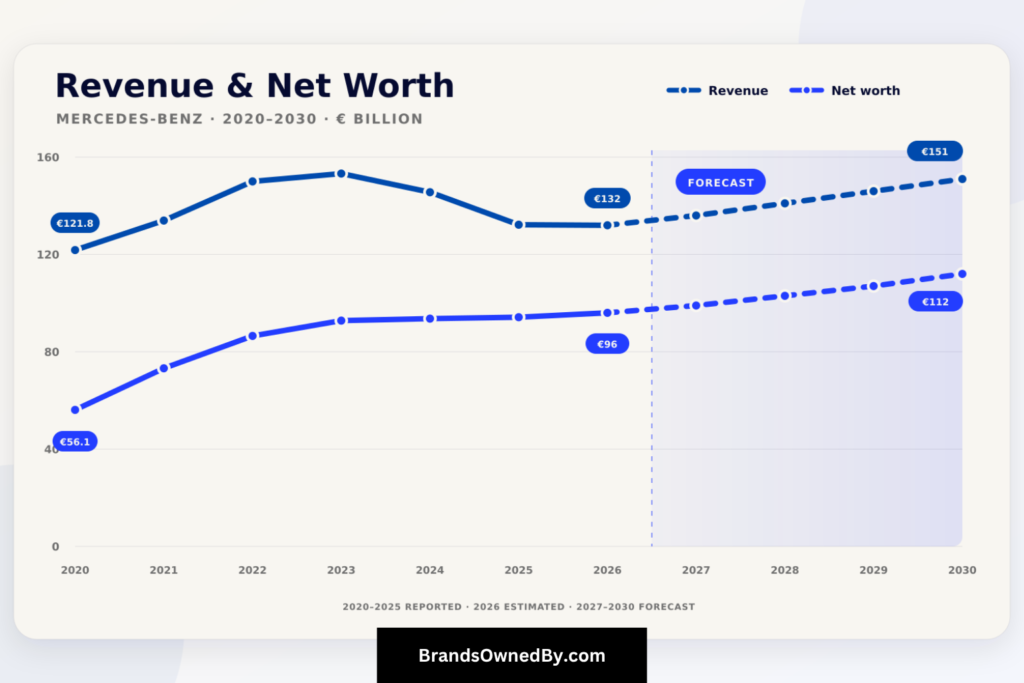
Mercedes-Benz Group reports its financial results in euros.
For this analysis, net worth means total shareholder equity. This is the group’s assets minus its recognized liabilities.
This measure is more stable and verifiable than market capitalization. Market capitalization changes every trading day. Shareholder equity is reported in the company’s financial statements.
Mercedes Revenue in 2025
Mercedes-Benz Group generated €132.2 billion in revenue in 2025. This was down from €145.6 billion in 2024.
Several factors contributed to the decline.
Vehicle volumes were weaker, particularly in China. Pricing pressure increased. Currency movements reduced reported revenue. Tariffs also raised the cost of serving important markets.
Mercedes continued to prioritize high-value vehicles rather than chasing maximum volume. Top-End vehicles accounted for 15% of Mercedes-Benz Cars sales.
Mercedes-Benz Cars generated the largest share of group revenue. Vans and financial services provided additional diversification.
The financial-services portfolio stood at €128.8 billion. New financial-services business reached €55.9 billion.
Mercedes Net Worth in 2025
Mercedes’ accounting net worth reached €94.2 billion at the end of 2025. This was slightly higher than €93.6 billion in 2024.
The increase is notable because group earnings weakened.
Equity remained supported by retained earnings and the value of the company’s accumulated assets. These include factories, financial receivables, cash, intellectual property, inventory, and strategic investments.
Dividends and share repurchases reduce equity. Retained profits increase it. Currency movements and pension adjustments can also change the reported total.
Mercedes’ market capitalization may be lower than its book equity. That does not mean the financial statements are incorrect.
Investors may apply a discount because Mercedes operates in a cyclical industry. The group also faces tariffs, Chinese competition, electric-vehicle investment requirements, and financing-related liabilities.
Mercedes Revenue Estimate for 2026
Mercedes’ 2026 revenue is estimated at €132.0 billion.
The estimate assumes broadly stable group sales and revenue. It also reflects a difficult operating environment in the first part of the year.
Several factors could limit growth.
China remains intensely competitive. Local electric-vehicle manufacturers are placing pressure on established luxury brands. Tariffs and currency movements may also affect reported revenue.
Mercedes nevertheless has a large product-launch program. More than 40 new or updated models are planned across the 2025–2027 period.
The new CLA, electric GLC, updated S-Class, new GLB, and future van products should gradually improve the sales mix.
Revenue could exceed the estimate if product launches produce strong demand. It could fall below it if China weakens further or global tariffs increase.
Mercedes Net Worth Estimate for 2026
Mercedes’ 2026 net worth is estimated at €96.0 billion.
This assumes the group remains profitable and retains part of its earnings. It also accounts for dividend payments and share repurchases.
Mercedes proposed a €3.50 per-share dividend for the 2025 financial year. It also continued a share-repurchase program in 2026.
Both activities return cash to shareholders. They reduce the amount of profit retained inside the company.
A modest increase in equity is therefore more realistic than applying Mercedes’ full annual profit to net worth.
Mercedes Revenue Forecast for 2027–2030
Revenue is forecast to recover to €136.0 billion in 2027 and €141.0 billion in 2028.
The forecast assumes Mercedes benefits from its expanded product portfolio. It also assumes vehicle sales stabilize near the company’s medium-term planning level.
Mercedes plans to adjust production capacity to about 2.2 million vehicles in 2028. This suggests management is focused on profitable capacity rather than aggressive volume expansion.
Revenue growth should come from several sources:
- Higher sales of new electric and hybrid models.
- Stronger AMG, Maybach, G-Class, and S-Class demand.
- Digital services and paid vehicle features.
- Financial services, charging, insurance, and fleet management.
- Pricing and inflation.
Revenue is forecast to reach €146.0 billion in 2029 and €151.0 billion in 2030.
This projection does not assume Mercedes immediately returns to its 2023 profitability. It assumes gradual revenue recovery with a premium product mix.
A faster recovery is possible if Mercedes performs better in China or gains market share in electric luxury vehicles.
A weaker result is possible if Chinese competitors expand internationally, tariffs remain elevated, or buyers resist premium electric-vehicle pricing.
Mercedes Net Worth Forecast for 2027–2030
Mercedes’ net worth is forecast to reach €99.0 billion in 2027 and €103.0 billion in 2028.
Management plans to reduce fixed costs by 10% between 2024 and 2027. It also targets a 10% reduction in production costs per vehicle from 2027 compared with 2024.
Material-cost savings are another important factor. Mercedes is targeting savings through component standardization, local sourcing, supplier negotiations, and engineering changes.
These actions should improve retained earnings if Mercedes delivers them without damaging product quality.
Net worth is forecast to reach €107.0 billion in 2029 and €112.0 billion in 2030.
The forecast assumes annual profits remain sufficient to cover dividends, investment, and share repurchases. It also assumes Mercedes does not make a large debt-funded acquisition.
Equity could grow more slowly if the company expands its buyback program. Share repurchases reduce outstanding shares, but they also reduce total equity.
Final Words
Mercedes-Benz Group owns a focused collection of luxury, performance, financial-service, software, battery, and charging businesses.
Its most important wholly owned operations include Mercedes-Benz AG, Mercedes-AMG, Mercedes-Maybach, Mercedes-Benz Bank, Athlon, YASA, Accumotive, and several technology subsidiaries.
Mercedes also has a large investment portfolio. It holds interests in Daimler Truck, smart, Beijing Benz, BAIC Motor, Aston Martin, ACC, IONITY, and the Mercedes Formula One team.
These companies should not all be described as fully owned Mercedes subsidiaries. Some are joint ventures or minority investments.
Mercedes itself is publicly owned. BAIC Group is its largest individual shareholder with 9.98% of the voting rights. Li Shufu follows with 9.69%. Neither investor controls the company.
Operational control rests with the Board of Management. Oversight rests with the Supervisory Board. This makes Mercedes an independently governed German automotive group rather than a subsidiary of another manufacturer.
FAQs
What companies does Mercedes own?
Mercedes owns Mercedes-Benz AG, Mercedes-AMG, Mercedes-Maybach, Mercedes-Benz Bank, Athlon, YASA, Accumotive, Mercedes-Benz Energy, MBition, and several financial, charging, software, manufacturing, and regional distribution companies.
It also owns minority interests in Daimler Truck, smart, Aston Martin, Beijing Benz, BAIC Motor, IONITY, ACC, and the Mercedes Formula One team.
Who owns Mercedes-Benz?
Mercedes-Benz is owned by the shareholders of Mercedes-Benz Group AG.
The largest individual shareholder is BAIC Group with 9.98% of the voting rights. Li Shufu holds 9.69% through Tenaciou3 Prospect Investment. Kuwait Investment Authority holds approximately 5.57%.
The remaining shares are distributed among institutional and retail investors.
Is Mercedes owned by China?
Mercedes is not owned or controlled by China.
Two Chinese investors hold major stakes. BAIC Group controls 9.98% of the voting rights. Li Shufu holds 9.69%.
Their combined position is economically significant. However, neither investor has unilateral control over Mercedes-Benz Group.
Does Mercedes own AMG?
Yes. Mercedes-Benz Group owns 100% of Mercedes-AMG GmbH.
AMG operates as Mercedes’ performance brand. It develops engines, high-performance vehicles, chassis systems, and performance technologies.
Does Mercedes own Maybach?
Yes. Mercedes owns and controls the Maybach automotive brand.
Mercedes-Maybach is positioned as an ultra-luxury extension of Mercedes-Benz. Its vehicles are based on selected Mercedes platforms but receive additional luxury features and engineering changes.
Does Mercedes own smart?
Mercedes does not own smart outright.
The smart business operates through a partnership involving Mercedes-Benz and Geely. Mercedes held 43.22% of the main smart mobility holding entity at the end of 2025.
Does Mercedes own Daimler Truck?
Mercedes owns a substantial minority interest in Daimler Truck Holding AG.
Its disclosed interest was 32.25% at the end of 2025. Daimler Truck remains an independent publicly traded company with its own management and shareholders.
What truck companies does Mercedes own?
Mercedes-Benz Group owns the Mercedes-Benz Vans business. It does not control the former Daimler heavy-truck brands.
Freightliner, Western Star, FUSO, BharatBenz, Thomas Built Buses, and Setra belong to Daimler Truck.
Mercedes-Benz Group owns a minority interest in Daimler Truck, but it does not directly control those brands.
Does Mercedes own Aston Martin?
Mercedes does not control Aston Martin.
Mercedes-Benz Group held 7.54% of Aston Martin Lagonda Global Holdings at the end of 2025. The companies also have a technology relationship involving engines and electronic systems.
Does Mercedes own BMW?
No. Mercedes-Benz Group and BMW Group are separate competitors.
Mercedes shares trade under the ticker MBG. BMW shares trade separately. BMW has significant family ownership through Stefan Quandt and Susanne Klatten.
Does Mercedes own Audi?
No. Audi is owned by Volkswagen AG.
Volkswagen completed its full takeover of Audi in 2020. Audi operates inside Volkswagen Group alongside brands such as Porsche, Bentley, and Lamborghini.
Does Mercedes own Rolls-Royce?
Mercedes does not own Rolls-Royce Motor Cars.
Rolls-Royce Motor Cars is owned by BMW Group. The aerospace and aircraft-engine company Rolls-Royce Holdings is a separate publicly traded company.
Does Mercedes own Brabus?
No. Brabus is an independent German automotive tuning and engineering company.
Brabus modifies Mercedes-Benz vehicles, but Mercedes-Benz Group does not own it.
Does Mercedes own Chrysler?
Mercedes does not own Chrysler.
Daimler-Benz and Chrysler combined in 1998 to form DaimlerChrysler. Daimler separated from Chrysler in 2007.
Chrysler is now part of Stellantis.
Does Mercedes own McLaren?
Mercedes does not own McLaren.
Mercedes previously held an ownership interest in McLaren. That investment ended years ago.
Mercedes and McLaren now operate separate Formula One teams. McLaren has used Mercedes power units under a supplier relationship.
Who owns the Mercedes Formula One team?
Mercedes-Benz Group owns 33.33% of Mercedes-Benz Grand Prix Ltd.
INEOS and team leadership hold the other major interests. Mercedes therefore has significant influence but does not own the Formula One team outright.
Is the G-Wagon owned by Mercedes?
Yes. The G-Class, commonly called the G-Wagon, is a Mercedes-Benz product.
Mercedes owns the brand and associated intellectual property. Mercedes-Benz G GmbH supports its development. Magna Steyr manufactures the vehicle in Austria under contract.
What is the difference between Daimler and Mercedes-Benz?
Daimler AG was the former name of Mercedes-Benz Group AG.
The company separated most of its truck and bus operations into Daimler Truck in 2021. Daimler AG then changed its name to Mercedes-Benz Group AG in February 2022.
Mercedes-Benz Group and Daimler Truck are now separate publicly traded companies.
Is Mercedes-Benz a private company?
No. Mercedes-Benz Group AG is a publicly traded company.
Its shares trade in Frankfurt under the ticker MBG. The company is included in the DAX index.
What is Mercedes-Benz’s net worth?
Mercedes-Benz Group reported total shareholder equity of €94.2 billion at the end of 2025.
Its estimated 2026 accounting net worth is €96.0 billion. This estimate uses shareholder equity rather than stock-market capitalization.
How much revenue does Mercedes make?
Mercedes-Benz Group generated €132.2 billion in revenue in 2025.
Revenue for 2026 is estimated at €132.0 billion. The estimate reflects stable group guidance, new model launches, cost pressures, tariffs, and challenging market conditions in China.
Meta Title: What Companies Does Mercedes Own? Full Brand List 2026
Meta Description: Discover what companies Mercedes owns, including AMG, Maybach, YASA, Athlon, Mercedes-Benz Bank, smart, Daimler Truck, Aston Martin, and other major investments.