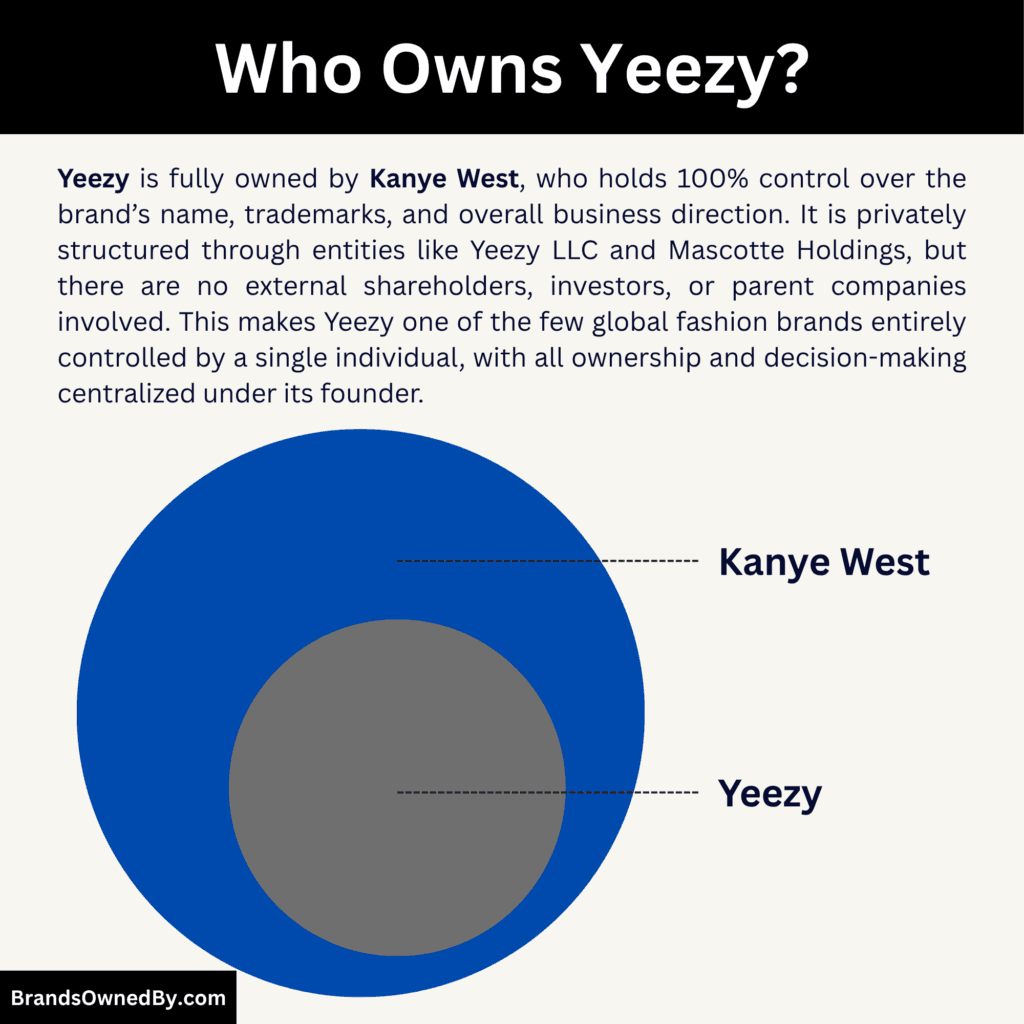
- Yeezy is fully owned by Kanye West, who holds 100% ownership with no external shareholders or investors involved
- The brand operates as a privately held entity through companies like Yeezy LLC and Mascotte Holdings, but ultimate ownership remains centralized under Kanye West
- Yeezy has no parent company or corporate ownership, making it one of the few globally recognized fashion brands controlled entirely by a single individual
- Unlike competitors, Yeezy does not have institutional or public shareholders, giving it complete independence in decision-making and brand direction.
Yeezy is a fashion and lifestyle brand known for its minimalist design, neutral color palettes, and strong cultural influence. It focuses on footwear, apparel, and limited-edition drops that create high demand. The brand blends streetwear with luxury fashion, which makes it stand out in a crowded market.
The identity of Yeezy is deeply tied to Kanye West. His creative vision shapes everything from product design to marketing. Yeezy products often sell out quickly due to scarcity and hype-driven releases.
The brand first gained global attention through its collaboration with Adidas. That partnership helped scale production and reach a wider audience. After the collaboration ended, Yeezy shifted toward a more independent, direct-to-consumer approach.
Today, Yeezy operates as a founder-led brand. It focuses on creative control, exclusivity, and direct engagement with its audience.
Yeezy Founder
Yeezy was founded by Kanye West, who is the sole creator and driving force behind the brand. Unlike many fashion labels that are started by teams or corporate groups, Yeezy was built around a single individual’s vision. Kanye West launched Yeezy to merge fashion, music, and culture into one unified identity. From the beginning, he positioned the brand as a creative extension of himself rather than a traditional company.
Kanye West
Kanye West established Yeezy after gaining experience in the fashion industry through earlier collaborations. He had worked with major brands before launching Yeezy, which helped him understand design, production, and branding.
As the founder, he plays multiple roles. He is the creative director, strategist, and public face of the brand. Every major decision, from product design to marketing approach, reflects his personal vision.
Kanye West’s approach to Yeezy focuses on simplicity, functionality, and cultural impact. He aimed to create products that feel different from traditional luxury or sportswear brands. This vision helped Yeezy build a strong identity and loyal following.
Role of Strategic Partnerships
While Kanye West is the only founder, partnerships played a critical role in Yeezy’s growth. The most notable collaboration was with Adidas. This partnership helped transform Yeezy from a personal project into a global brand.
Adidas supported manufacturing, supply chain, and global distribution. However, these partnerships did not make Adidas a founder or owner of Yeezy. Kanye West retained full ownership of the brand while using these collaborations to scale its reach.
These strategic alliances allowed Yeezy to grow rapidly while maintaining its founder-led identity.
Ownership History
Yeezy’s ownership history is not linear like most fashion brands. It is built around the personal ownership of Kanye West, combined with strategic licensing deals and complex intellectual property arrangements. As of 2026, the brand has gone through three major phases: independent ownership, corporate partnership, and post-partnership restructuring.
Foundation and Trademark Control (2013–2015)
Yeezy was officially launched in 2013 under Kanye West’s control. From the start, ownership of the brand name and trademarks remained with Kanye West and his business entities, particularly through holding companies that manage intellectual property.
This is a critical distinction. Yeezy was never “owned” by a corporation. Instead, it was structured as a privately held brand where Kanye West retained full legal ownership of trademarks such as “Yeezy” and “YZY.”
During this phase, Yeezy lacked manufacturing scale. It relied on external partnerships to bring products to market. However, these were operational relationships, not ownership transfers.
Licensing Model with Adidas (2015–2022)
The most important phase in Yeezy’s ownership history began with its partnership with Adidas in 2015.
This was not a sale or acquisition. It was a licensing agreement. Kanye West licensed the Yeezy brand name to Adidas in exchange for royalties, reportedly around 15% of product sales.
Under this structure:
- Kanye West retained ownership of the Yeezy brand and trademarks
- Adidas controlled manufacturing, distribution, and global retail
- Both parties shared commercial success, but not ownership.
However, a key complexity emerged. While Kanye West owned the brand name, Adidas owned the rights to many of the product designs created during the partnership, including popular sneaker silhouettes.
This created a split ownership structure:
- Brand ownership → Kanye West
- Product design ownership → Adidas.
This hybrid model allowed Yeezy to scale rapidly. It became one of the most influential sneaker brands globally. But it also created long-term dependency on Adidas.
Peak Influence and Structural Tension (2020–2022)
During its peak years, Yeezy operated as a hybrid brand. It looked like a corporate-backed global business but was still fundamentally owned by Kanye West.
Tensions began to rise during this period. Kanye West publicly criticized Adidas for lack of control over retail strategy and alleged design copying. These disputes highlighted a structural issue. Yeezy was owned by Kanye, but key parts of its business were controlled by Adidas.
This imbalance set the stage for the eventual split.
Termination of Adidas Partnership (2022)
In October 2022, Adidas officially ended its partnership with Kanye West.
This marked the most significant shift in Yeezy’s ownership history.
After the termination:
- Kanye West retained full ownership of the Yeezy brand and trademarks
- Adidas retained ownership of existing Yeezy product designs
- Adidas continued selling the remaining Yeezy inventory without Kanye’s involvement.
This created a rare situation in the fashion industry. A brand owner (Kanye West) no longer controlled many of the products associated with that brand.
Post-Split Transition and Inventory Liquidation (2023–2025)
After the split, Adidas began selling off its remaining Yeezy inventory. This process continued through 2023 and 2024, generating significant revenue for Adidas despite the partnership ending.
By late 2024, Adidas had fully cleared its Yeezy inventory.
This effectively closed the Adidas-Yeezy chapter from an operational standpoint.
During this period, Yeezy entered a transitional phase:
- The brand operated independently under Kanye West
- Production shifted to smaller-scale or alternative manufacturing partners
- The business model moved toward direct-to-consumer sales.
However, the loss of Adidas meant losing global infrastructure, which impacted scale and consistency.
Current Ownership Structure (2026)
As of 2026, Yeezy is fully owned and controlled by Kanye West through his private entities, including Yeezy LLC.
The ownership structure is now centralized:
- Full brand ownership → Kanye West
- No major corporate equity partners
- Independent operational model.
However, the legacy of the Adidas partnership still affects the brand:
- Adidas owns historical Yeezy designs
- New Yeezy products must avoid those protected designs
- The brand must rebuild manufacturing and distribution independently.
This makes Yeezy fundamentally different from its earlier version. It is no longer a large-scale corporate collaboration. It is a founder-owned brand operating with full control but fewer external resources.
Who Owns Yeezy?
Yeezy is fully owned by Kanye West as of 2026. The ownership is private, centralized, and not divided among public or institutional investors. Unlike most global fashion brands, Yeezy does not have multiple shareholders or a parent corporation controlling it.
The entire brand, including its name, identity, and intellectual property, is owned by Kanye West. This makes him the sole and ultimate owner of Yeezy.
Kanye West
Kanye West is the sole owner of Yeezy as of March 2026. His ownership is complete and undiluted. No external investors, corporations, or shareholders hold any equity in the brand.
He owns the Yeezy name, trademarks, and all associated intellectual property. This includes core brand assets such as “Yeezy” and “YZY,” which define the identity of the business. These assets are the foundation of Yeezy’s value, and full ownership of them gives Kanye West absolute control.
His ownership is both legal and strategic. Legally, he is the ultimate beneficial owner of all Yeezy-related entities. Strategically, he controls how the brand is positioned, expanded, and monetized. There is no board of directors or shareholder group influencing decisions.
This level of ownership is rare at a global scale. Most fashion brands operate under shared ownership or corporate control. Yeezy remains fully founder-owned, which allows for fast decision-making and a consistent brand vision.
Even during earlier large-scale commercial phases, ownership of the Yeezy brand itself never changed hands. That consistency continues in 2026, where Kanye West remains the single controlling owner.
Ownership Through Private Entities
Although Yeezy is fully owned by Kanye West, the ownership is structured through privately controlled entities. This is a standard approach used to manage risk, protect intellectual property, and organize business operations.
The two most important entities in this structure are Yeezy LLC and Mascotte Holdings. These companies do not act as independent owners. Instead, they function as legal vehicles through which Kanye West holds and manages his ownership.
Yeezy LLC is the primary entity associated with the brand’s commercial presence. It is used to manage business activities, contracts, and brand-related operations. Ownership of this entity ultimately traces back to Kanye West.
Mascotte Holdings plays a critical role in holding Yeezy’s intellectual property. It owns trademarks, brand rights, and licensing authority. By placing these assets in a separate entity, the brand’s core ownership is protected and isolated from operational risks.
This layered structure creates a clear separation:
- Brand ownership is secured at the intellectual property level
- Business activities are managed through operational entities.
Despite this structure, there is no division of ownership. All entities are fully controlled by Kanye West. He remains the sole beneficiary and decision-maker across the entire structure.
As of 2026, this setup allows Yeezy to maintain centralized ownership while operating with a structured legal framework. It ensures long-term control over the brand while enabling flexibility in how the business is run.
Competitor Ownership Comparison
Yeezy’s ownership structure stands apart from nearly every major competitor in the fashion and sportswear industry. While Yeezy is fully owned by Kanye West, competing brands operate under complex ownership systems involving shareholders, institutional investors, or parent conglomerates. This difference shapes how each brand is controlled, funded, and scaled.
Founder-Controlled vs Shareholder-Controlled Models
Yeezy follows a pure founder-controlled model. Ownership is concentrated in one individual, with no equity dilution. This means all strategic, creative, and commercial decisions ultimately align with Kanye West’s vision.
In contrast, competitors operate under shareholder-controlled systems. Ownership is distributed across thousands of investors. These include institutional funds, asset managers, and retail shareholders. Decision-making is delegated to executives who must balance growth, profitability, and shareholder expectations.
This structural difference creates a clear contrast in governance:
- Yeezy prioritizes creative independence and centralized control
- Competitors prioritize financial performance and shareholder returns.
As a result, Yeezy can pivot quickly, while public companies must follow structured approval processes.
Nike Ownership Structure
Nike represents a classic publicly traded ownership model. Its shares are widely held across global markets, with large institutional investors controlling significant portions.
Although Phil Knight remains an influential figure, he does not own the company outright. Control is exercised through voting power, board representation, and executive leadership.
Nike’s ownership structure includes:
- Institutional investors holding major stakes
- A board of directors overseeing governance
- Executive leadership responsible for operations.
This setup separates ownership from daily control. Unlike Yeezy, no single person dictates the brand’s direction. Instead, decisions are made collectively, often with long-term shareholder value in mind.
Adidas Ownership Structure
Adidas operates under a similar public ownership framework. Its shares are listed on the stock exchange and owned by a diverse group of global investors.
The company is governed through a dual-board system:
- A management board handling operations
- A supervisory board overseeing strategy and compliance.
Ownership is fragmented, with no dominant individual controlling the company. This ensures stability but reduces flexibility.
Compared to Yeezy, Adidas reflects a highly institutionalized structure. Creative direction, product strategy, and financial planning are all managed within a corporate hierarchy rather than by a single owner.
Puma Ownership Structure
Puma follows a hybrid ownership model. It is publicly traded but has a major controlling shareholder.
The luxury group Kering holds a significant stake in Puma. This gives Kering a strong influence over strategic decisions, even though other shareholders are also involved.
This structure combines elements of both centralized and distributed ownership:
- A dominant shareholder with strategic influence
- Public investors contributing to overall ownership
- Corporate governance systems guiding operations.
Unlike Yeezy, Puma’s ownership is not tied to a founder’s personal vision. Instead, it aligns with the broader objectives of its controlling shareholder and market expectations.
Luxury Conglomerate Model
Luxury fashion brands typically operate under conglomerate ownership. Balenciaga, for example, is owned by Kering.
In this model, ownership is centralized at the group level rather than the brand level. Kering owns multiple luxury brands and allocates resources, sets financial targets, and oversees long-term strategy.
Individual brands like Balenciaga function as divisions within the larger group. They have creative directors, but ownership and financial control remain with the parent company.
This structure is fundamentally different from Yeezy. There is a clear separation between ownership (Kering) and creative leadership (brand designers). Yeezy combines both under one individual.
Structural Differences That Define Yeezy
When compared to competitors, Yeezy’s ownership model reveals several defining characteristics.
It is fully privately owned, with no external equity participation. Control is unified, meaning ownership and decision-making are aligned. There is no dependency on shareholder approval or corporate governance layers.
Competitors, on the other hand, operate with:
- Distributed ownership across investors
- Formal governance structures
- Separation between ownership and brand direction.
These differences affect speed, risk tolerance, and brand identity. Yeezy can take unconventional approaches without external resistance. Competitors must balance innovation with financial accountability.
Who Controls Yeezy?
Control of Yeezy is fully centralized under Kanye West as of March 2026. There is no separation between ownership and control. The same individual who owns the brand also directs its strategy, creative output, and business decisions.
Yeezy operates as a privately controlled brand under Yeezy LLC, which is directly tied to Kanye West. This means control is not delegated to shareholders, a corporate board, or independent executives.
Kanye West as the Controlling Authority
Kanye West is the ultimate controlling authority of Yeezy. He owns the trademarks through his entities and directly oversees the brand’s direction.
His control is based on two concrete factors:
- Ownership of all core trademarks such as “Yeezy” and “YZY” through his company Mascotte Holdings
- Full control of the parent entity (Yeezy LLC), which governs the brand’s operations.
Because of this structure, no external party has decision-making power over the brand. There are no voting rights, equity stakes, or governance mechanisms that can override him.
Absence of Corporate Governance Structure
Yeezy does not operate with a traditional corporate governance model.
There is:
- No board of directors
- No public shareholders
- No independent executive leadership controlling the company.
This is a key distinction. In most global brands, control is distributed across executives and boards. At Yeezy, control is singular and direct.
All major decisions—branding, product direction, pricing strategy, and distribution approach—are ultimately determined by Kanye West.
Operational Leadership vs Control
While Kanye West controls Yeezy, certain operational roles exist within the ecosystem.
For example, manufacturing and production activities have been linked to external operators such as Dov Charney, who has been described as the CEO of production operations connected to Yeezy manufacturing.
However, this does not represent control of the brand.
There is a clear distinction:
- Operational leadership → Handles execution (manufacturing, logistics)
- Brand control → Remains fully with Kanye West.
No external executive has authority over brand-level decisions.
Control Through Intellectual Property
A critical part of Yeezy’s control structure lies in intellectual property ownership.
Kanye West’s entity Mascotte Holdings controls a large portfolio of Yeezy trademarks, with over 160 registrations and applications linked to the brand.
This gives him:
- Legal control over the brand identity
- Authority over how the name is used commercially
- Power to approve or reject any use of the Yeezy brand.
This IP control reinforces his overall authority. Even if operations involve external partners, they cannot use the brand without his approval.
Yeezy Annual Revenue and Net Worth
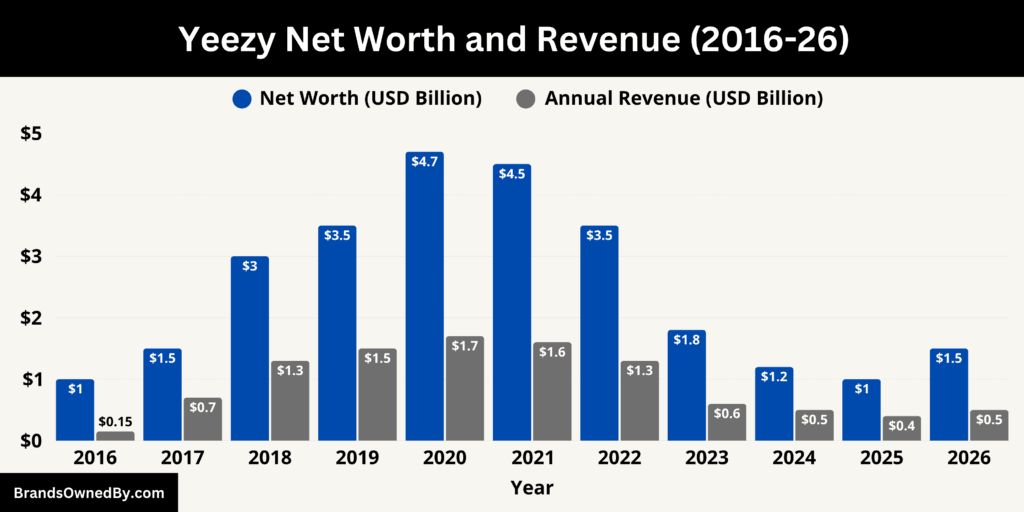
As of March 2026, Yeezy generates an estimated $0.50 billion in annual revenue and holds an implied brand valuation of around $1.50 billion, based on post-partnership performance and independent operations. The brand no longer operates at its previous global scale, but it continues to generate substantial revenue through direct sales and retains significant value due to full ownership of its intellectual property.
Revenue Performance
Yeezy’s 2026 revenue of approximately $0.50 billion reflects a major structural shift from its earlier business model. At its peak, Yeezy generated close to $1.7 billion annually through large-scale global distribution.
In 2026, revenue is driven primarily by:
- Direct-to-consumer online sales
- Limited sneaker drops and controlled inventory releases
- Smaller-scale apparel production.
Footwear remains the dominant revenue contributor. Historically, sneakers alone generated nearly $1.7 billion in annual sales at peak scale, and they continue to account for the majority of Yeezy’s current revenue.
The reduction in total revenue is directly tied to reduced production scale rather than declining demand. Yeezy still holds around 3% global sneaker market share, maintaining relevance despite operating independently.
Net Worth and Brand Valuation in 2026
Yeezy’s estimated valuation of $1.50 billion as of March 2026 is primarily derived from its intellectual property and brand equity. The most important factor is that Kanye West owns 100% of the Yeezy trademark.
This ownership directly impacts overall net worth calculations. There are two widely recognized valuation perspectives:
- Forbes-based estimate: Around $0.40 billion net worth based on verifiable assets such as cash, real estate, and music catalog
- Founder-claimed valuation: $2.77 billion, which includes the full value of Yeezy and future earning potential.
The difference between these figures is driven by how Yeezy is valued:
- Conservative models only include realized income and tangible assets
- Aggressive models include brand value, trademarks, and projected growth.
At its peak, Yeezy alone was valued between $4 billion and $5 billion. The current valuation of $1.50 billion reflects a recalibrated, independent business model without large-scale corporate infrastructure.
Future Revenue Forecast (2027–2030)
Yeezy’s future revenue trajectory is expected to reflect gradual and controlled growth rather than rapid expansion. As of 2026, the brand operates at approximately $0.50 billion in annual revenue, and any future increase depends on scaling production without losing exclusivity.
The projected revenue growth from 2027 to 2030 is based on three measurable factors: expansion of direct-to-consumer infrastructure, increased production capacity, and sustained global demand for Yeezy footwear.
- 2027: $0.60 billion: In 2027, revenue is expected to grow modestly as Yeezy continues to refine its independent supply chain. Growth at this stage is driven by improved fulfillment capabilities and more consistent product drops. The increase of $0.10 billion reflects operational stabilization rather than aggressive expansion.
- 2028: $0.75 billion: By 2028, Yeezy is projected to achieve stronger revenue growth due to increased product frequency and broader global reach through its own platforms. At this stage, the brand is expected to scale manufacturing partnerships, allowing higher unit output while maintaining controlled releases. This results in a $0.15 billion year-over-year increase.
- 2029: $0.90 billion: In 2029, Yeezy approaches near-billion-dollar revenue again. This growth is tied to higher repeat customer rates and stronger international penetration, particularly in Asia and emerging markets. The brand’s ability to sustain demand while gradually increasing supply supports continued upward movement.
- 2030: $1.10 billion: By 2030, Yeezy is projected to cross the $1 billion revenue mark once again. This milestone reflects a matured independent model where production, logistics, and direct sales channels operate efficiently at scale. However, this growth remains controlled and does not match the previous peak of $1.70 billion, as the brand is expected to prioritize margin and exclusivity over volume.
Brands Owned by Yeezy
Yeezy is not a traditional multi-brand conglomerate. It operates as a tightly controlled ecosystem centered around a single brand identity. However, as of 2026, it includes several internal entities, product lines, and controlled platforms that function like independent business units. All of these are owned and controlled by Kanye West through his private structure.
| Company / Entity | Type | Core Function | Ownership | Key Details |
|---|---|---|---|---|
| Yeezy LLC | Operating Company | Manages overall business operations, product development, and brand execution | Fully owned by Kanye West | Central entity through which Yeezy conducts all commercial activities and controls product releases |
| Mascotte Holdings Inc. | Intellectual Property Holding Company | Holds trademarks, licensing rights, and brand IP | Fully owned by Kanye West | Owns “Yeezy” and “YZY” trademarks; protects long-term brand ownership |
| Yeezy Supply | Direct-to-Consumer Platform | Online sales and distribution channel | Controlled by Kanye West | Primary sales platform; enables direct sales, limited drops, and pricing control |
| Yeezy Footwear Division | Product Division | Design and sale of sneakers and footwear | Owned under Yeezy structure | Main revenue driver; responsible for majority of Yeezy’s global demand |
| Yeezy Apparel Division | Product Division | Clothing and lifestyle products | Owned under Yeezy structure | Focuses on minimalist apparel; supports brand expansion beyond footwear |
| Yeezy Pods | Product Line / Sub-Brand | Experimental footwear category | Owned under Yeezy structure | Known for sock-like design; represents innovation and broader accessibility |
| Yeezy Gap (Defunct) | Former Brand Line | Mass-market apparel collaboration | Previously controlled under Yeezy branding | Discontinued; aimed to bring Yeezy designs to a wider audience |
| Yeezy Home | Concept / Development Unit | Architecture and housing design concepts | Controlled by Kanye West | Focuses on future expansion into housing and design innovation |
| Yeezy Digital / Media | Internal Ecosystem | Digital launches, branding, and customer engagement | Controlled by Kanye West | Supports direct-to-consumer model through online drops and brand communication. |
Yeezy LLC
Yeezy LLC is the core operating company behind the brand. It serves as the primary legal and commercial entity through which Yeezy conducts business.
This entity manages product development, branding, internal operations, and execution of product releases. All commercial activities, including sales and partnerships, are structured through Yeezy LLC. It acts as the central hub that connects design, production, and distribution under one framework.
As of 2026, Yeezy LLC is fully owned and controlled by Kanye West, with no external equity participation.
Mascotte Holdings Inc.
Mascotte Holdings Inc. is the intellectual property holding entity behind Yeezy. It owns the trademarks, brand names, and licensing rights associated with the Yeezy brand.
This includes control over “Yeezy,” “YZY,” and multiple related trademarks registered globally. The purpose of this entity is to secure long-term ownership of brand assets and separate them from operational risk.
By holding intellectual property in a dedicated company, Yeezy ensures that its core brand identity remains protected regardless of operational changes.
Yeezy Supply
Yeezy Supply is the official direct-to-consumer platform of the brand. It functions as the primary sales channel for Yeezy products.
This platform allows Yeezy to sell footwear and apparel directly to customers without relying on third-party retailers. It plays a critical role in the brand’s current business model, which is focused on independence and higher margin retention.
Yeezy Supply also serves as a distribution control mechanism. It enables limited releases, manages product availability, and maintains exclusivity in the market.
Yeezy Footwear Division
The Yeezy Footwear division is the most commercially significant part of the brand. It includes all sneaker and footwear-related products released under the Yeezy name.
This division built the brand’s global reputation and continues to generate the majority of revenue as of 2026. It focuses on innovative designs, unique silhouettes, and limited production runs.
Although earlier designs were created during external collaborations, current footwear releases are developed independently and reflect a shift toward new design language and production methods.
Yeezy Apparel Division
The Yeezy Apparel division focuses on clothing collections. These include hoodies, jackets, t-shirts, and other essentials designed with a minimalist aesthetic.
Apparel plays a supporting role compared to footwear but remains an important part of the brand’s identity. It helps expand Yeezy beyond sneakers into a full lifestyle brand.
As of 2026, apparel production is more controlled and limited, aligning with the brand’s focus on exclusivity and direct sales.
Yeezy Pods
Yeezy Pods represent a newer product category introduced under the Yeezy brand. These sock-like footwear products gained attention due to their unconventional design and accessible pricing strategy.
This category reflects Yeezy’s experimentation with product innovation and market positioning. Unlike traditional Yeezy sneakers, Yeezy Pods are designed to be more widely accessible while still maintaining brand identity.
They also demonstrate the brand’s ability to create new sub-categories within its ecosystem.
Yeezy Gap
Yeezy Gap was a distinct product line created as part of a collaboration between Yeezy and Gap. It was designed to bring Yeezy aesthetics to a broader audience at lower price points.
The line included apparel collections that were more accessible than core Yeezy products. However, the collaboration ended, and Yeezy Gap is no longer an active brand line as of 2026.
Despite being discontinued, it remains an important part of Yeezy’s expansion history as it demonstrated the brand’s ability to scale into mass-market segments.
Yeezy Home
Yeezy Home is an experimental extension of the Yeezy brand focused on architecture and housing design concepts.
While not fully commercialized as a large-scale business, this initiative reflects Kanye West’s broader vision for Yeezy as more than a fashion brand. It includes concepts for affordable housing and design innovation.
As of 2026, Yeezy Home remains in development and concept stages, but it represents a potential future expansion into non-fashion industries.
Yeezy Digital and Media Extensions
Yeezy also operates within digital and media-related spaces, particularly through its online presence and direct engagement strategies.
This includes:
- Digital product launches
- Online-exclusive drops
- Brand-controlled communication channels.
These digital extensions function as an internal ecosystem rather than separate companies. They support sales, marketing, and customer engagement without relying on external platforms.
Conclusion
The answer to who owns Yeezy is clear but also what makes the brand unique. Yeezy is entirely owned by Kanye West, with no shared equity, no parent company, and no external shareholders influencing its direction.
This level of ownership concentration is rare in the global fashion industry. Most competing brands operate under complex corporate structures, but Yeezy remains founder-controlled at every level. That structure allows decisions to be made quickly and keeps the brand aligned with a single creative and strategic vision.
At the same time, this ownership model places full responsibility on one individual. Growth, positioning, and long-term success depend entirely on how the brand is managed internally. As Yeezy continues to evolve, its independent ownership remains its defining strength and its biggest differentiator.
FAQs
Does Adidas own Yeezy?
No, Adidas does not own Yeezy. It previously partnered with the brand for manufacturing and distribution, but ownership of the Yeezy name and intellectual property always remained with Kanye West.
Who owns Yeezy now?
As of 2026, Yeezy is fully owned by Kanye West. There are no external shareholders, investors, or parent companies involved in its ownership.
Does Kanye West own Yeezy?
Yes, Kanye West owns Yeezy entirely. He controls the brand’s trademarks, business structure, and overall direction without any shared ownership.
What are Yeezys called now?
Yeezy products are still sold under the Yeezy or YZY name. The branding has remained consistent, even though the business model has shifted to independent operations.
Who owns 100% of Yeezy?
Kanye West owns 100% of Yeezy. The brand is privately held and does not have any public or institutional shareholders.
Is Kim Kardashian still owner of Yeezy?
No, Kim Kardashian has never been an owner of Yeezy. Her association with the brand was personal and promotional, not based on any equity or ownership stake.
Who is the CEO of Yeezy?
Yeezy does not have a traditional CEO structure. Kanye West effectively acts as the controlling authority, making key decisions across the brand.