

- Wikipedia is not owned by any individual, corporation, or shareholders. It is legally owned and operated by the Wikimedia Foundation, a non-profit organization created to protect free and open access to knowledge.
- There are no shareholders or equity owners in Wikipedia. Control and oversight are exercised through a Board of Trustees that includes founder representation, community-elected members, and appointed experts acting as stewards rather than owners.
- Wikipedia cannot be sold, acquired, or privatized. Its assets, trademarks, and platforms are legally restricted for charitable and educational use, ensuring long-term independence from commercial and political influence.
- The absence of investors shapes how Wikipedia operates. Without profit pressure, Wikipedia prioritizes neutrality, accuracy, and public trust, which is central to why it remains one of the world’s most trusted information platforms.
Wikipedia is the world’s largest free online encyclopedia. It is a digital knowledge platform where anyone with internet access can read detailed articles on virtually any topic. Wikipedia publishes content in hundreds of languages. It is built on a collaborative model where volunteers from around the world create, edit, and manage the encyclopedia entries.
The platform uses a web-based editing system that allows rapid updates and wide participation. It is designed to be accessible, reliable, and neutral in tone. Wikipedia’s commitment to open knowledge has made it a reference point for students, professionals, and curious learners everywhere.
Wikipedia’s infrastructure operates on wiki software. This software lets multiple users contribute and revise content in real time. The platform’s policies emphasize verifiability, neutrality, and citation of sources. While any user can edit most pages, administrators and experienced contributors help enforce quality and resolve disputes.
The Wikimedia Foundation, a non-profit, oversees technical and legal support, hosting, and global community engagement.
Wikipedia Founders
Wikipedia was founded by Jimmy Wales and Larry Sanger, two individuals with very different professional backgrounds but a shared vision for free knowledge. Wales brought experience in internet entrepreneurship, while Sanger contributed academic expertise in philosophy. Their collaboration shaped Wikipedia’s early structure, editorial philosophy, and long-term mission. While both played key roles at the beginning, their involvement evolved differently as the platform grew.
Jimmy Wales
Jimmy Wales is an American internet entrepreneur and co-founder of Wikipedia. He was born in Alabama and developed an early interest in economics and finance. Wales studied finance at Auburn University and later pursued graduate studies in finance.
Before Wikipedia, he co-founded Bomis, an online portal that provided the financial and technical foundation for Wikipedia’s early development.
Wales envisioned a freely accessible encyclopedia written and maintained by volunteers. He emphasized openness, neutrality, and community-driven governance. Over time, he became the public face of Wikipedia. Although he never served as CEO, he has remained influential through his role on the Wikimedia Foundation’s Board of Trustees and as a symbolic leader of the project.
Larry Sanger
Larry Sanger is an American philosopher and co-founder of Wikipedia. He earned a PhD in philosophy from Ohio State University, with a focus on epistemology, the study of knowledge. Sanger was hired by Wales as Wikipedia’s first editor-in-chief during its launch phase.
Sanger played a key role in shaping Wikipedia’s early editorial framework. He helped define naming conventions, content guidelines, and quality standards. He supported a more structured approach to knowledge creation in Wikipedia’s formative years.
Although he left the project early, his contributions remain central to Wikipedia’s foundation and early development.
Ownership Snapshot
Wikipedia is not owned by an individual, corporation, or government entity. It is owned and operated by the Wikimedia Foundation, a registered non-profit organization. This foundation holds legal ownership of Wikipedia’s name, domains, trademarks, and technical infrastructure.
Because of this structure, Wikipedia has no equity ownership. There are no shares, no private owners, and no public shareholders. The platform exists solely to advance its mission of providing free and open knowledge to the world.
Absence of Shareholders or Investors
Unlike commercial internet platforms, Wikipedia does not raise capital through venture funding, private equity, or public markets. There are no institutional investors, angel investors, or controlling stakeholders.
This means no individual or entity can claim an ownership percentage in Wikipedia. Decisions are not influenced by profit expectations, stock performance, or investor returns. This ownership model is central to Wikipedia’s independence and neutrality.
Role of the Wikimedia Foundation
The Wikimedia Foundation serves as the legal and operational owner of Wikipedia. It is responsible for hosting servers, maintaining the software, managing legal matters, protecting trademarks, and supporting the global editor community.
The foundation does not “own” Wikipedia in a commercial sense. Instead, it holds the platform in trust for public benefit. Its governing documents restrict asset use to charitable and educational purposes. Wikipedia cannot be sold, acquired, or transferred for private gain.
Board of Trustees as Stewards
Ownership oversight is exercised through governance rather than equity control. The Wikimedia Foundation is governed by a Board of Trustees. These trustees act as stewards, not owners.
The board includes a mix of community-elected members, appointed experts, and founder representation. Their role is to safeguard Wikipedia’s mission, approve long-term strategy, and ensure legal and ethical compliance.
Trustees do not receive ownership rights. They cannot extract profits or transfer control. Their authority exists only within the framework of the foundation’s non-profit charter.
Community Contribution Without Ownership
Millions of volunteers contribute content to Wikipedia. However, contributors do not gain ownership rights over articles or the platform. Content is published under open licenses, allowing free use and modification.
This model ensures that Wikipedia remains collectively built but centrally protected. The platform is community-driven, yet legally owned by a non-profit entity that ensures continuity and mission alignment.
Ownership History
Wikipedia’s ownership history explains how the platform evolved from a small experimental project into a globally trusted public resource. The decisions made in its early years shaped its long-term independence, governance model, and resistance to commercial or political influence. Unlike many internet platforms, Wikipedia’s ownership was deliberately structured to prioritize public benefit over growth-driven control.
Early Concept and Initial Control
Wikipedia was launched in 2001 as an experimental online encyclopedia project. In its earliest phase, ownership and operational control were informal. The project was closely associated with Bomis, a for-profit internet company co-founded by Jimmy Wales. Bomis provided the initial funding, hosting, and technical support.
At this stage, Wikipedia did not have a separate legal owner. The platform functioned as a project under the umbrella of Wales’s existing business activities. This arrangement raised early concerns about long-term independence and neutrality.
Transition Toward Non-Profit Ownership
As Wikipedia grew rapidly, the need for a clear and independent ownership structure became evident. The project was expanding beyond a small startup and becoming a global public resource. Relying on a private company for ownership and infrastructure was not sustainable.
In response, the Wikimedia Foundation was created in 2003 as a non-profit organization. Ownership of Wikipedia’s domains, trademarks, and core assets was transferred to this new entity. This marked a formal shift away from private influence.
Establishment of the Wikimedia Foundation
The creation of the Wikimedia Foundation fundamentally reshaped Wikipedia’s ownership history. The foundation was designed to exist solely for charitable and educational purposes. Its legal framework ensured that Wikipedia could not be sold or controlled by commercial interests.
From this point forward, Wikipedia became fully owned by a non-profit foundation rather than individuals or businesses. This move cemented Wikipedia’s role as a public knowledge platform rather than a commercial product.
Elimination of Founder Ownership Claims
Once ownership was transferred to the foundation, the founders no longer held any personal ownership rights over Wikipedia. Jimmy Wales and Larry Sanger did not retain equity, shares, or special ownership privileges.
Their influence continued through advisory and governance roles, but legal ownership rested entirely with the foundation. This separation between founders and ownership reduced conflicts of interest and strengthened institutional independence.
Stability of Ownership Model Over Time
Since the establishment of the Wikimedia Foundation, Wikipedia’s ownership structure has remained stable. There have been no mergers, acquisitions, or ownership transfers involving Wikipedia.
The foundation model has protected Wikipedia from takeovers, privatization, or restructuring into a commercial entity. This continuity has helped preserve editorial independence and community trust.
Legal Safeguards and Asset Protection
Wikipedia’s ownership history is also defined by legal safeguards. The foundation’s charter restricts how assets can be used. Wikipedia’s intellectual property must support the mission of free knowledge.
Even in the event of organizational changes, Wikipedia’s assets cannot be redirected for private benefit. These safeguards ensure that Wikipedia remains a non-profit public resource regardless of leadership changes.
Long-Term Implications of Ownership History
The long-term implications of Wikipedia’s ownership history are significant. By removing private and commercial ownership early, Wikipedia avoided many of the pressures faced by other large digital platforms.
This structure allows Wikipedia to resist advertising influence, political capture, and profit-driven content manipulation. Decisions can prioritize accuracy, neutrality, and community consensus rather than revenue or growth targets.
The non-profit ownership model also supports long-term continuity. Wikipedia is not dependent on founders, investors, or market cycles. Its governance can evolve without threatening its existence or mission.
Ultimately, Wikipedia’s ownership history explains its unique position on the internet. Ownership was never designed for control or monetization. It was designed for stewardship, stability, and global public trust.
Who Owns Wikipedia?
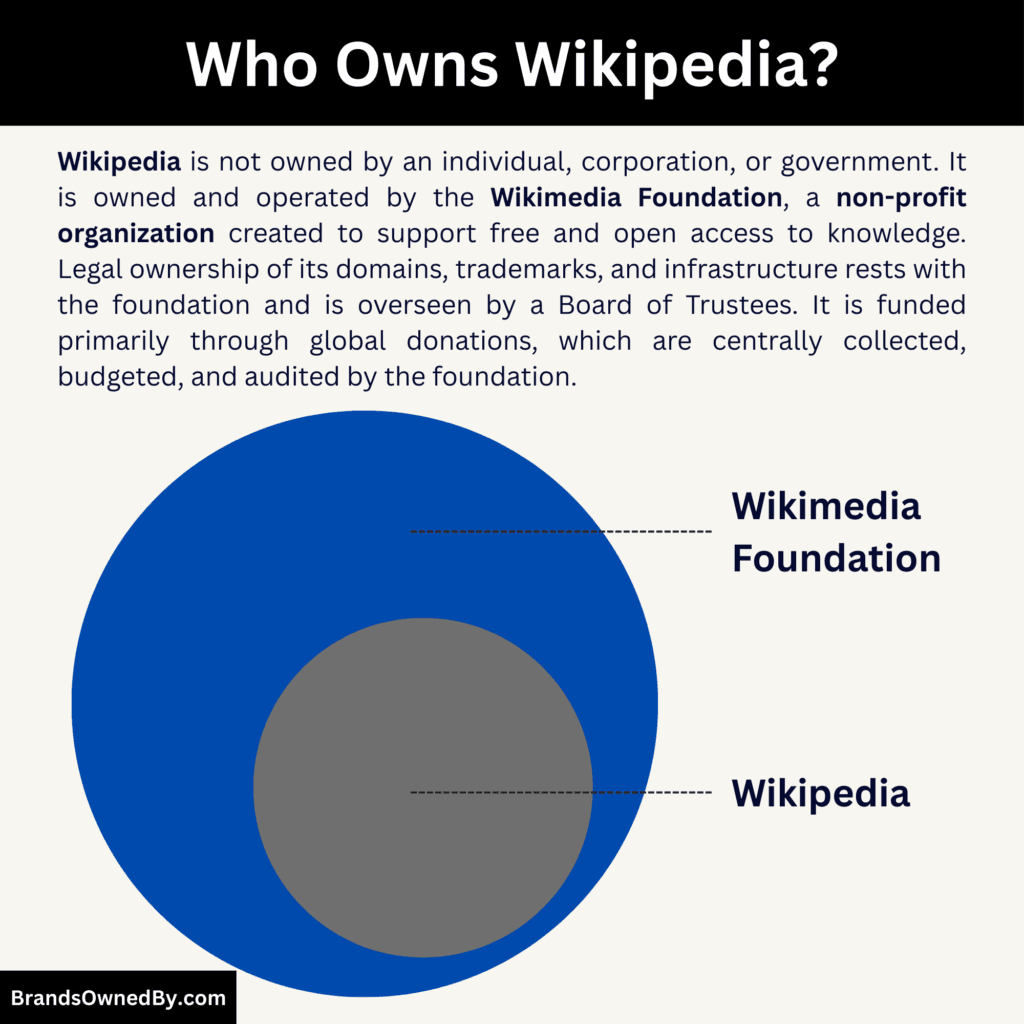
Unlike most major digital platforms, Wikipedia is not owned by shareholders or private investors. There are no equity holders, stock options, or profit-seeking owners. Wikipedia operates under the legal ownership of the Wikimedia Foundation, a tax-exempt nonprofit organization based in the United States.
This means that control and oversight are exercised through governance structures rather than financial stakes. The Wikimedia Foundation safeguards Wikipedia’s mission of providing free and open knowledge to everyone, rather than generating profit or allocating ownership shares.
Below are the key trustees who fulfill roles similar to owners in nonprofit governance. They do not hold shares, but they have ultimate responsibility for the stewardship of the platform.
Nataliia Tymkiv – Chair of the Board
Nataliia Tymkiv serves as Chair of the Wikimedia Foundation Board of Trustees. As chair, she sets board agendas and leads governance discussions. She plays a central role in aligning long-term strategy with Wikipedia’s mission. Her position carries significant influence over institutional priorities, risk oversight, and executive accountability.
Jimmy Wales – Founder Trustee
Jimmy Wales holds a permanent founder trustee seat. He does not own Wikipedia, but his role preserves historical continuity. Wales provides institutional memory and mission guidance. His presence ensures that governance decisions remain aligned with Wikipedia’s founding principles of neutrality, openness, and free access to knowledge.
Shani Evenstein Sigalov – Community-Selected Trustee
Shani Evenstein Sigalov represents the global volunteer community. She is elected by contributors and affiliates rather than appointed internally. Her role ensures that editor concerns, community norms, and volunteer sustainability are considered in board decisions. This seat reinforces Wikipedia’s bottom-up governance culture.
Luis Bitencourt-Emilio – Board-Appointed Trustee
Luis Bitencourt-Emilio is a board-appointed trustee selected for strategic and organizational expertise. Trustees in this category are chosen to strengthen governance capabilities. His role focuses on long-term planning, organizational resilience, and adapting Wikipedia’s structure to global challenges.
Raju Narisetti – Board-Appointed Trustee
Raju Narisetti contributes extensive experience in global media and publishing. His background helps the board navigate issues related to public trust, information integrity, and platform responsibility. He supports strategic decisions around Wikipedia’s role in the wider information ecosystem.
Kathy Collins – Board-Appointed Trustee
Kathy Collins brings financial oversight and governance expertise. She plays a key role in audit, risk management, and internal controls. Trustees with financial backgrounds help ensure that Wikipedia’s assets are responsibly managed and aligned with long-term sustainability.
Victoria Doronina – Community-Selected Trustee
Victoria Doronina represents volunteer contributors from diverse regions. Her role strengthens geographic and cultural representation within governance. She ensures that policy and strategic decisions reflect the realities of global editor communities rather than a single region.
Lorenzo Losa – Community-Selected Trustee
Lorenzo Losa brings a strong technical and product-focused perspective. He contributes insights on software development, platform scalability, and contributor tools. His position helps bridge community needs with technical strategy at the board level.
Christel Steigenberger – Community-Selected Trustee
Christel Steigenberger adds experience in volunteer engagement and organizational development. Her governance focus includes community health, contributor retention, and movement partnerships. She helps ensure that Wikipedia’s growth does not come at the expense of volunteer sustainability.
Maciej Nadzikiewicz – Community-Selected Trustee
Maciej Nadzikiewicz contributes governance and coordination experience from within the Wikimedia movement. He supports policies related to decentralization and affiliate collaboration. His role strengthens accountability between the foundation and local Wikimedia groups.
Bobby Shabangu – Community-Selected Trustee
Bobby Shabangu represents a significant expansion of geographic diversity in governance. As a community-elected trustee from Africa, he brings regional perspectives often underrepresented in global platforms. His role enhances inclusivity and global legitimacy in ownership stewardship.
Michał Buczyński – Community-Selected Trustee
Michał Buczyński joined following the most recent community election cycle. He has extensive experience in movement leadership and policy discussions. His contributions focus on governance transparency, long-term mission alignment, and community empowerment.
Who Financially Supports Wikipedia?
Wikipedia is financially supported and funded exclusively through the Wikimedia Foundation, the non-profit organization that operates Wikipedia and its sister projects. Wikipedia itself does not accept or manage funds directly.
As of 2026, the Wikimedia Foundation’s annual funding consistently exceeds $200 million, with the majority coming from donations rather than commercial activity.
Below is the funding breakdown as of January 2026:
- Individual small donors: $180–$190 million
- High-value individuals: $8–$10 million
- Corporate philanthropy: $20–$25 million
- Foundations and grants: $6–$8 million
- Enterprise revenue: $8 million
- Endowment income: $5–$7 million.
Individual Small Donors
Individual readers are the single largest funding source for Wikipedia.
- Annual individual donations total approximately $180–$190 million
- More than 8 million individual donors contribute each year
- The average donation is about $11
- Over 90% of donations are under $50.
These contributions are geographically distributed across North America, Europe, Asia, and emerging markets. No individual small donor has ownership rights, voting power, or editorial influence.
High-Value Individual Donors
Wikipedia also receives significant donations from well-known philanthropists. These donations are publicly disclosed and unrestricted.
- George Soros: Donated $2 million through the Open Society Foundations to support free knowledge initiatives.
- Craig Newmark: Donated $1 million directly to the Wikimedia Foundation to support platform sustainability and information integrity.
- Pierre Omidyar (via Omidyar Network): Contributed $4.5 million across multiple funding rounds to support global access to information.
None of these donors hold board seats tied to donations. Contributions do not grant governance rights or influence over Wikipedia content.
Corporate and Institutional Donors
Corporate support comes through philanthropic arms only and represents a minor share of total funding.
- Google (via Google.org): Contributed approximately $15.0 million in cumulative grants supporting infrastructure, security, and accessibility.
- Amazon (via AmazonSmile and direct grants): Contributed approximately $5.0 million before discontinuation of AmazonSmile.
- Apple: Contributed approximately $2.5 million in recurring philanthropic donations.
These contributions are strictly separated from editorial and governance decisions.
Philanthropic Foundations
- Sloan Foundation: Provided approximately $3.6 million in grants for technical infrastructure and research support.
- Ford Foundation: Contributed approximately $2 million, focused on knowledge equity and global participation.
Foundation funding is project-based and time-bound, not operationally controlling.
Wikimedia Endowment
To ensure long-term stability, the Wikimedia Foundation operates an endowment fund.
- Endowment assets exceed $110 million
- Endowment income contributes $5–$7 million annually
- Funds are invested for long-term sustainability, not operational dominance.
The endowment does not replace fundraising. It acts as a financial buffer during downturns.
Revenue from Wikimedia Enterprise
Wikipedia also generates limited non-donation revenue through Wikimedia Enterprise.
- Annual revenue from Enterprise: $8.3 million
- Represents less than 5% of the total funding
- Clients pay for premium data delivery, not content control.
This revenue does not affect Wikipedia’s free access model.
Competitor Ownership Comparison
Wikipedia operates under a non-profit ownership structure. It is owned by the Wikimedia Foundation and has no shareholders, private owners, or equity investors. Control is exercised through governance, community participation, and a board of trustees. This model prioritizes public access, neutrality, and long-term knowledge preservation over financial returns.
To understand how unusual this structure is, it helps to compare Wikipedia’s ownership with that of its closest competitors and alternative knowledge platforms.
| Platform | Ownership Type | Owner / Controlling Entity | Shareholders or Investors | Key Ownership Impact |
|---|---|---|---|---|
| Wikipedia | Non-profit | Wikimedia Foundation | None | Mission-driven governance, no profit motive, no ads, community-led content |
| Encyclopaedia Britannica | Private company | Privately held holding company | Private owners | Subscription-based access, centralized editorial control |
| Fandom | For-profit | Investor-backed corporation | Private investors | Advertising-driven model, corporate control over platform policies |
| Quora | Private company | Founder- and VC-owned | Venture capital firms | Growth and monetization focused, algorithm-driven content visibility |
| Public company | Alphabet Inc. | Public shareholders | Knowledge integrated into ad-supported search ecosystem |
Encyclopaedia Britannica
Encyclopaedia Britannica operates under a private ownership model. It is owned by a holding company controlled by private investors. Unlike Wikipedia, Britannica functions as a commercial enterprise.
Ownership is centralized, and strategic decisions are driven by revenue objectives. Content access is partially restricted behind subscription models. This ownership structure allows tighter editorial control but limits open participation and free access compared to Wikipedia.
Fandom
Fandom is a for-profit wiki-hosting platform. It is owned by private investors and operates under a corporate governance structure. Fandom hosts thousands of fan-driven communities across entertainment, gaming, and media.
Unlike Wikipedia, Fandom monetizes heavily through advertising. Ownership interests influence platform design, content placement, and user experience. While communities contribute content, final control rests with corporate management rather than volunteers.
Quora
Quora is a privately held company backed by venture capital. Ownership is divided among founders, early investors, and institutional stakeholders.
Because Quora is investor-backed, platform decisions are influenced by growth metrics, monetization strategies, and long-term exit expectations. Content visibility, moderation policies, and product features are shaped by commercial priorities rather than purely public-interest goals.
Google Knowledge Panels and Search-Based Answers
Google provides knowledge panels and instant answers through its search engine. These features are owned and controlled entirely by Google as a publicly traded corporation.
Ownership by public shareholders means strategic decisions are ultimately accountable to investors. Knowledge presentation is integrated into a broader advertising-driven ecosystem. This contrasts sharply with Wikipedia’s independent and non-commercial ownership.
Open Educational Platforms
Some open educational platforms operate under hybrid models. They may be owned by non-profits, but still partner with commercial entities for funding or distribution.
Wikipedia differs by maintaining full non-profit ownership without equity partners. There are no external stakeholders with financial leverage over content or governance.
Key Differences in Ownership and Control
The primary difference between Wikipedia and its competitors lies in ownership incentives. Commercial platforms are accountable to owners or shareholders. Their survival depends on revenue generation.
Wikipedia’s owner, the Wikimedia Foundation, is accountable to its mission and the public. There is no financial incentive to alter content for profit. This allows Wikipedia to remain open, volunteer-driven, and globally accessible.
Why the Comparison Matters
Ownership structures shape platform behavior. Wikipedia’s non-profit ownership explains why it avoids advertising, paywalls, and sponsored content.
Competitors with private or investor ownership may deliver high-quality information, but their priorities are influenced by financial goals. Wikipedia’s ownership model reduces those pressures and supports long-term trust, neutrality, and stability in knowledge sharing.
Who Controls Wikipedia?
Wikipedia is not controlled by an owner or shareholder. Control is exercised through a layered governance structure built around stewardship rather than ownership. The platform is operated by the Wikimedia Foundation, which provides legal, technical, and organizational oversight. Decision-making authority is distributed across leadership, trustees, staff, and the global volunteer community.
This model ensures that no single individual or group has unilateral control over Wikipedia.
Role of the Wikimedia Foundation
The Wikimedia Foundation is the central controlling body responsible for Wikipedia’s operations. It manages servers, software development, legal protection, fundraising, and partnerships. The foundation also employs staff who support engineering, trust and safety, product development, and community engagement.
However, the foundation does not directly control article content. Its authority is structural and administrative rather than editorial. This separation is intentional and is a core principle of Wikipedia’s governance.
Board of Trustees and Strategic Control
Strategic control sits with the Wikimedia Foundation’s Board of Trustees. The board sets long-term direction, approves major policies, and oversees executive leadership. Trustees act as fiduciaries, meaning they are legally obligated to act in the best interests of the mission.
The board includes founder representation, community-elected trustees, and appointed experts. This mix prevents concentration of power and ensures that strategic control reflects both institutional expertise and community values.
Chief Executive Officer and Executive Leadership
Day-to-day operational control is handled by the Chief Executive Officer of the Wikimedia Foundation. As of recent years, the CEO is Maryana Iskander.
The CEO oversees staff, executes board-approved strategy, and manages organizational priorities. This includes fundraising campaigns, platform infrastructure, legal risk management, and global outreach. The CEO does not control editorial decisions or individual articles.
Past CEOs include Katherine Maher and Lila Tretikov. Each played a role in expanding Wikipedia’s global reach, strengthening governance, and modernizing operations.
Editorial Control and the Volunteer Community
Editorial control is decentralized and community-driven. Millions of volunteers write, edit, and review Wikipedia articles. Content decisions are governed by community policies such as neutrality, verifiability, and notability.
No employee, trustee, or founder can dictate article content. Disputes are resolved through community discussion, consensus-building, and established processes. Administrators and experienced editors enforce rules, but they do not own content.
This structure ensures that control over knowledge remains distributed rather than centralized.
Separation of Power Between Governance and Content
One of Wikipedia’s defining features is the strict separation between governance and content control. The Wikimedia Foundation controls infrastructure and legal matters. The community controls editorial content.
This separation reduces risks of censorship, political pressure, or commercial influence. It also protects Wikipedia’s credibility by preventing top-down manipulation of information.
Founder Influence Without Ownership Control
Jimmy Wales retains influence as a founder and trustee, but he does not control Wikipedia. He holds no executive authority and cannot override community or board decisions.
His role is advisory and symbolic. This balance preserves historical continuity while preventing founder dominance.
Wikipedia’s control structure is designed for resilience. Power is distributed across institutions, leadership, and volunteers. No single failure point can compromise the platform.
This model allows Wikipedia to remain neutral, independent, and publicly trusted. Control exists to protect the mission, not to direct content or extract value.
Wikipedia Annual Revenue and Net Worth
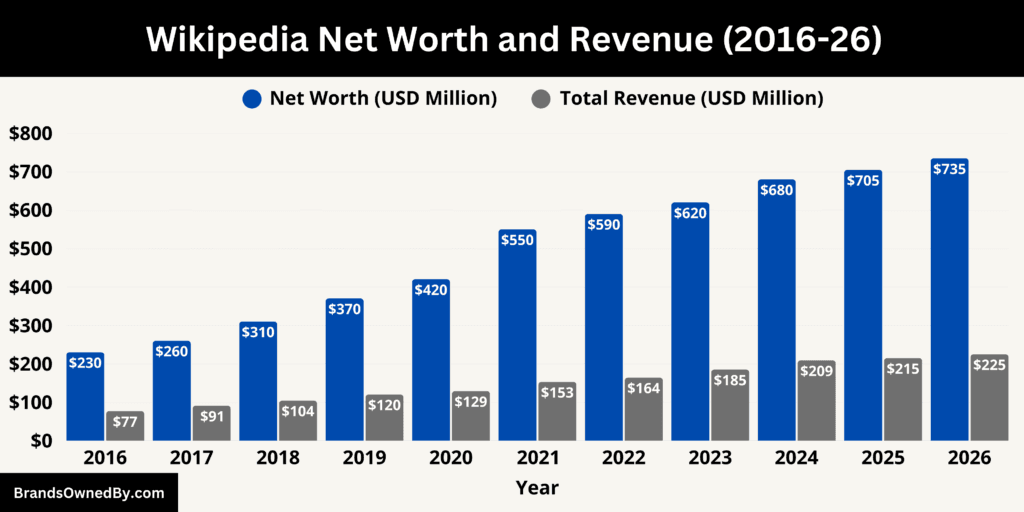
As of January 2026, Wikipedia operates with an annual revenue of approximately $225 million and a net worth, reported as net assets, of about $735 million. These figures reflect the financial position of the Wikimedia Foundation, the non-profit organization that owns and operates Wikipedia. The financial model is built around donations, limited service revenue, and long-term reserves rather than profit generation or shareholder returns.
Revenue in 2026
Total revenue for 2026 is approximately $225 million. This revenue is highly concentrated in donations and contributions.
Individual donations account for an estimated $185 million, representing about 82% of total revenue. These donations come from more than 8 million donors worldwide, with an average contribution of approximately $11 per donation. The vast majority of donations are under $50, which prevents donor concentration and limits financial influence from any single source.
Institutional grants and large philanthropic gifts contribute roughly $25 million, or about 11% of total revenue. This category includes funding from named philanthropists and charitable foundations. These funds are typically unrestricted or lightly restricted and do not convey governance rights, editorial input, or board representation.
Service-based revenue, primarily from Wikimedia Enterprise, generates approximately $8.3 million, accounting for around 3.7% of total revenue. This revenue comes from enterprise-grade data access services provided to commercial users. It does not involve advertising, content licensing, or preferential access to Wikipedia articles.
Investment income and miscellaneous revenue streams make up the remaining $6–7 million, or roughly 3% of total revenue. This includes interest income and returns on short-term investments.
Expense Discipline and Surplus Retention
Wikipedia does not aim to match revenue growth with proportional spending increases. Operating expenses consume the majority of annual revenue, but a controlled surplus is consistently retained.
In 2026, operating expenses are estimated at $195–200 million, meaning Wikipedia retains an annual surplus of approximately $25–30 million. This surplus is not treated as profit. It is allocated to reserves, long-term investments, and endowment growth.
This disciplined approach has been consistent for more than a decade and explains the steady expansion of net assets.
Net Worth in 2026
Wikipedia’s $735 million net worth represents total assets minus liabilities held by the Wikimedia Foundation.
Cash and short-term investments account for approximately $280–300 million, ensuring liquidity and operational resilience. Long-term investments and endowment assets total approximately $430–450 million, including the Wikimedia Endowment, which alone exceeds $110 million.
The remaining balance consists of fixed assets, receivables, and operational reserves. Liabilities remain relatively low compared to total assets, resulting in a strong balance sheet with minimal financial leverage.
Net Worth Growth Rate
Wikipedia’s net worth has grown from approximately $230 million in 2016 to $735 million in 2026, an increase of $505 million over ten years. This represents a compound annual growth rate of roughly 12% in net assets.
This growth has occurred without equity financing, debt issuance, advertising revenue, or ownership dilution. Net worth expansion is driven almost entirely by donation surpluses and conservative investment management.
Relationship Between Revenue Scale and Net Worth
Annual revenue of $225 million supports global infrastructure, staffing, legal defense, and community programs. Net worth of $735 million functions as a long-term stability mechanism.
The ratio of net worth to annual revenue is approximately 3.3×, which is unusually high for a non-profit media platform. This ratio allows Wikipedia to absorb multi-year revenue shocks without altering its operating model or introducing commercial monetization.
Brands Owned by Wikipedia
Below is a detailed breakdown of the core platforms, brands, and entities owned and operated by Wikipedia as of 2026, each serving a distinct role in the global free-knowledge ecosystem:
| Entity / Platform | Type | Primary Purpose | Core Function Within the Ecosystem |
|---|---|---|---|
| Wikipedia | Encyclopedia platform | General reference knowledge | Flagship platform providing free, neutral, collaboratively edited encyclopedic content across hundreds of languages |
| Wikimedia Commons | Media repository | Free images, video, and audio | Supplies openly licensed multimedia content to Wikipedia and sister projects while enabling global media reuse |
| Wikidata | Data platform | Machine-readable knowledge | Central data repository powering infoboxes, facts, and structured information across all Wikipedia language editions |
| Wiktionary | Dictionary | Lexical and language reference | Provides definitions, pronunciations, etymologies, and translations for words across thousands of languages |
| Wikibooks | Educational platform | Open textbooks and manuals | Hosts collaboratively written textbooks and learning guides that support open education worldwide |
| Wikiquote | Reference platform | Verified quotations | Collects and curates notable quotations with emphasis on attribution, accuracy, and context |
| Wikisource | Digital archive | Primary source documents | Preserves public-domain books, legal texts, historical manuscripts, and official documents |
| Wikivoyage | Travel guide | Community-written travel content | Provides non-commercial travel information including destinations, logistics, and cultural insights |
| Wikiversity | Learning platform | Open education and research | Supports courses, collaborative learning projects, and experimental educational initiatives |
| Meta-Wiki | Governance platform | Project coordination | Central hub for global governance, elections, policy discussions, and cross-project planning |
| Wikimedia Incubator | Development platform | New language projects | Enables emerging language communities to build and test new Wikipedia and sister projects |
Wikipedia
Wikipedia is the primary and most widely recognized platform within the ecosystem. It functions as a comprehensive general knowledge encyclopedia covering history, science, technology, politics, culture, geography, and notable individuals and organizations.
Wikipedia’s defining characteristic is its open, collaborative editing model. Articles are written and maintained by volunteers who follow strict editorial policies centered on neutrality, verifiability, and notability. Content is continuously reviewed, updated, and corrected through community consensus rather than centralized editorial control.
The platform operates without advertising, subscriptions, or sponsored content. This allows Wikipedia to prioritize accuracy and public value over traffic monetization. Wikipedia serves as the foundational hub that connects and draws upon data, media, and resources from all other entities in the ecosystem.
Wikimedia Commons
Wikimedia Commons is the centralized multimedia repository that supplies visual and audio content to Wikipedia and its sister platforms. It hosts millions of freely licensed images, videos, illustrations, diagrams, maps, and sound files.
Commons plays a critical operational role by ensuring that Wikipedia articles can include media without copyright risk. All files are uploaded under free licenses or are in the public domain. Volunteers categorize, moderate, and improve files to maintain quality and legal compliance.
Beyond Wikipedia, Wikimedia Commons is widely used by educators, journalists, and researchers. Its open licensing model allows media to be reused globally, making it one of the largest free media libraries in existence.
Wikidata
Wikidata functions as the structured data backbone of the Wikipedia ecosystem. Instead of narrative text, it stores facts in machine-readable formats, such as dates, coordinates, identifiers, and relationships between entities.
Wikidata enables consistency across Wikipedia’s many language editions. A single data point, such as a population figure or officeholder, can be updated once and reflected across hundreds of articles. This reduces duplication and improves accuracy.
The platform is also heavily used outside Wikipedia. Developers, academic institutions, libraries, and search engines rely on Wikidata as an open data source. Its role extends beyond reference content into the global knowledge infrastructure.
Wiktionary
Wiktionary is a multilingual dictionary and lexical reference platform. It focuses on words rather than topics, providing definitions, pronunciations, grammatical forms, etymologies, and translations across languages.
Wiktionary supports both major and minority languages. It plays an important role in language preservation by documenting terms that may not be covered by commercial dictionaries. Entries are created and refined by contributors with linguistic expertise.
Unlike traditional dictionaries, Wiktionary evolves continuously. Content is updated as languages change, new terms emerge, and usage shifts, making it a living linguistic resource.
Wikibooks
Wikibooks hosts collaboratively written textbooks, manuals, and instructional guides. These resources cover academic subjects, technical skills, and practical topics.
Wikibooks is designed to support open education. Content can be freely reused, adapted, and translated. Unlike static textbooks, Wikibooks’ content is updated over time as contributors improve explanations, add examples, and correct errors.
The platform is particularly valuable in regions where access to educational materials is limited. It complements Wikipedia by offering structured learning rather than reference-style summaries.
Wikiquote
Wikiquote is dedicated to collecting notable quotations from historical figures, authors, public speeches, films, and literature. It emphasizes accuracy, attribution, and contextual relevance.
Wikiquote differs from casual quote collections by enforcing sourcing and editorial standards. Quotes are reviewed to avoid misattribution, distortion, or fabrication. Context is provided to explain when and how statements were made.
The platform serves researchers, writers, and educators who need reliable quotation references rather than viral or entertainment-focused content.
Wikisource
Wikisource operates as a digital archive of original source documents. It includes public-domain books, historical manuscripts, legal texts, treaties, constitutions, and government publications.
Wikisource focuses on preservation and accuracy rather than interpretation. Volunteers transcribe, proofread, and validate texts to ensure fidelity to original documents. This makes Wikisource a trusted repository for primary sources.
The platform supports academic research and historical study. It also strengthens Wikipedia by providing direct access to original references cited in articles.
Wikivoyage
Wikivoyage is a free, community-written travel guide. It offers destination overviews, transportation advice, cultural insights, and practical travel information.
Unlike commercial travel platforms, Wikivoyage avoids advertising, paid listings, and affiliate promotions. Content is written from a traveler’s perspective, prioritizing usefulness and neutrality.
Wikivoyage is particularly valuable for budget travelers, independent explorers, and users seeking non-commercial recommendations. It reflects Wikipedia’s editorial principles applied to travel content.
Wikiversity
Wikiversity supports open learning, teaching, and collaborative research. It hosts courses, learning modules, study projects, and academic experiments.
Wikiversity differs from Wikibooks by focusing on active learning rather than static instructional content. It encourages discussion, assignments, and research collaboration among participants.
The platform supports lifelong learning and experimentation in education. It also serves as a space for developing educational methods that may later be adopted across other Wikipedia projects.
Meta-Wiki
Meta-Wiki functions as the central coordination and governance platform for all Wikipedia-related projects. It hosts global policy discussions, elections, strategy proposals, and cross-project initiatives.
Meta-Wiki is not a public knowledge platform. Its primary audience is contributors, organizers, and governance participants. Decisions made on Meta-Wiki shape how Wikipedia and its sister projects operate worldwide.
It plays a critical role in maintaining transparency, coordination, and democratic participation within the ecosystem.
Wikimedia Incubator
Wikimedia Incubator supports the creation of new Wikipedia language editions and sister projects. It allows emerging language communities to develop content before receiving full project approval.
The incubator is essential for linguistic diversity. It enables smaller or underrepresented language communities to build knowledge resources using the same infrastructure as Wikipedia.
Successful incubator projects may eventually graduate into full standalone platforms, expanding Wikipedia’s global reach.
Conclusion
Wikipedia stands apart from most digital platforms because of how it is owned, governed, and operated. For those asking who owns Wikipedia, the answer is not a corporation, investor group, or individual. It is a non-profit platform held in trust for the public and supported by a global community of contributors. This ownership structure shapes every aspect of how Wikipedia functions, from content creation to long-term decision-making.
Without shareholders or profit pressure, Wikipedia is able to focus on neutrality, accuracy, and open access to knowledge. Its governance model, leadership framework, and network of independently operated platforms all reinforce the same mission. The absence of acquisitions, mergers, and commercial ownership ensures stability and independence at scale.
FAQs
Who owns the Wikimedia Foundation?
The Wikimedia Foundation has no owner in the corporate or shareholder sense. It is a registered non-profit organization. Legal control rests with its Board of Trustees, who act as fiduciaries for the public mission. The foundation does not issue shares, has no equity holders, and cannot be privately owned or sold.
Who is the owner of Wikipedia?
Wikipedia is owned and operated by the Wikimedia Foundation. No individual, company, or government owns Wikipedia. The platform is held by the foundation for charitable and educational purposes, with governance oversight rather than ownership stakes.
Who owns Wikipedia encyclopedia?
The Wikipedia encyclopedia is legally owned by the Wikimedia Foundation. Content itself is licensed under free-use licenses, meaning contributors do not own articles, and the public can reuse content under those terms. Ownership of domains, trademarks, and infrastructure belongs to the foundation.
How many employees does Wikipedia have?
Wikipedia does not employ staff directly. The Wikimedia Foundation employs approximately 700–750 employees globally as of 2026. These employees work in engineering, trust and safety, legal, fundraising, communications, and community support. Editorial content is created and maintained by volunteers, not employees.
Who are Wikipedia’s largest donors?
Wikipedia’s largest named donors and funding sources include a mix of individuals, foundations, and corporate philanthropy:
- Pierre Omidyar (via Omidyar Network): approximately $4.5 million
- George Soros (via Open Society Foundations): approximately $2.0 million
- Craig Newmark: approximately $1.0 million
- Google (via Google.org): approximately $15.0 million cumulatively
- Amazon (philanthropic programs): approximately $5.0 million
- Apple: approximately $2.5 million.
No donor receives ownership, governance control, or editorial influence.
Who is the current CEO of Wikipedia?
Wikipedia does not have a CEO as a standalone platform. The Chief Executive Officer of the Wikimedia Foundation is Maryana Iskander. She oversees operations, fundraising, staffing, and strategy for Wikipedia and all sister projects. She does not control editorial content.
How much is the CEO of Wikipedia worth?
The personal net worth of Maryana Iskander is not publicly disclosed. As a non-profit executive, she does not hold equity in Wikipedia or the Wikimedia Foundation. There is no ownership stake associated with the role, and compensation does not translate into wealth derived from the platform.
Who are the biggest contributors to Wikipedia?
The biggest contributors in aggregate are individual readers:
- Over 8 million individual donors contribute annually
- Individual donations total approximately $185 million per year
- The average donation is about $11
- Over 90% of donations are under $50.
Volunteer editors also contribute non-financially. Millions of editors worldwide create and maintain content without payment.
Where does Wikipedia get most of its funding?
Wikipedia gets most of its funding from individual donations, which account for approximately 82% of total annual revenue. The remaining funding comes from philanthropic foundations, named high-value donors, limited service revenue such as Wikimedia Enterprise, and modest investment income. Wikipedia does not use advertising, subscriptions, or sponsored content.