
- Soros doesn’t run a conglomerate. His holdings sit inside Soros Fund Management, a private family office with a $9.12 billion disclosed US equity book as of the March 2026 filing.
- Top 2026 positions include Amazon, Electronic Arts, NVIDIA, Taiwan Semiconductor, and Alphabet, plus a fresh bet on Linde and a sharply reduced Disney stake.
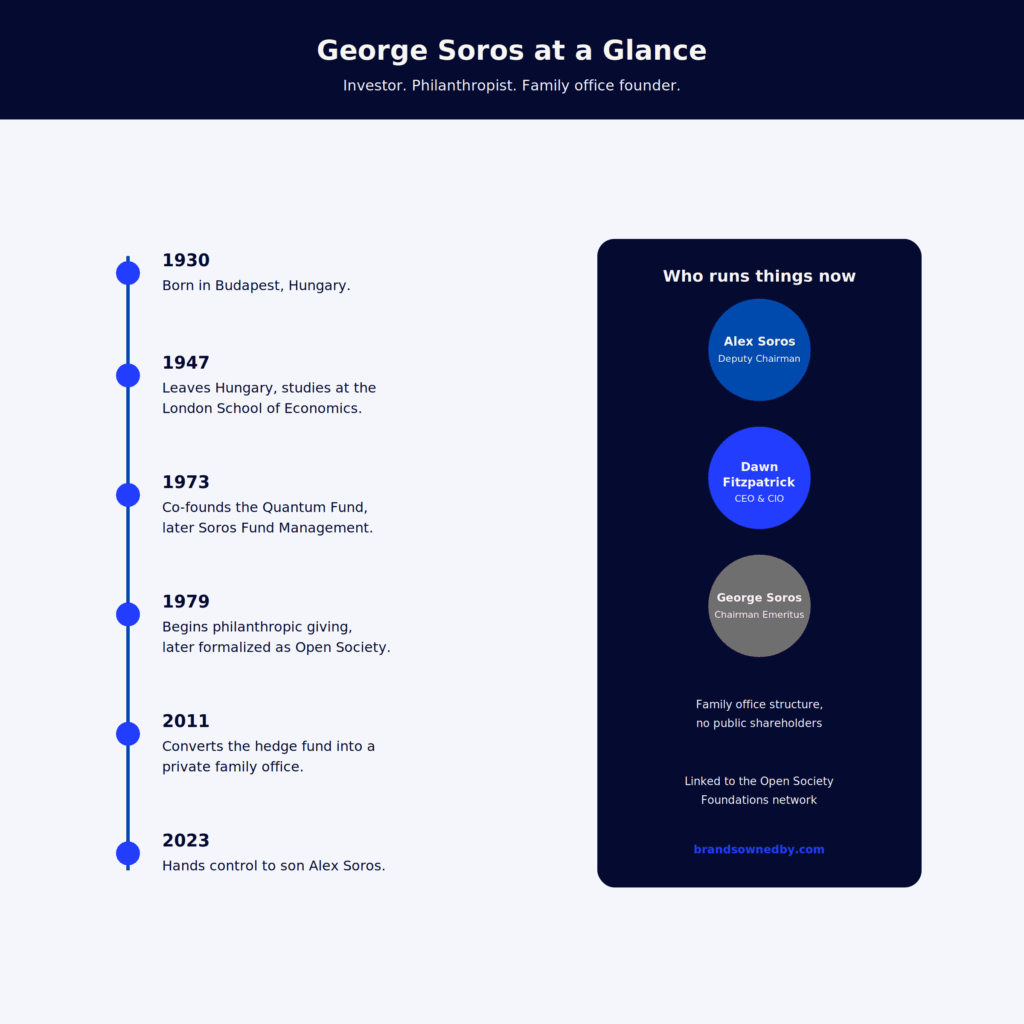
- Control passed from George Soros to his son Alex Soros in 2023. Day-to-day trading is run by CEO and CIO Dawn Fitzpatrick, in the job since 2017.
- Soros’s personal net worth sits around $7.2 to $7.5 billion in 2026, a fraction of the $32 billion-plus he’s already given to the Open Society Foundations.
What companies does George Soros own? The short answer: almost none, directly.
Soros isn’t a conglomerate builder. He’s not Buffett stacking up operating businesses. He built a trading firm, turned it into a family office, and now holds stakes in public companies through that vehicle. A separate philanthropic arm spends a different pile of his money entirely.
This guide covers what Soros Fund Management actually holds in 2026, who runs it now, and how its structure stacks up against other billionaire-founded investment firms.
Who is George Soros?
George Soros is a Hungarian-born American investor and philanthropist. He survived the Nazi occupation of Budapest as a teenager. In 1947, he left Hungary for London.
He studied philosophy at the London School of Economics. He paid his way working as a railway porter and a waiter. That early instability shaped how he later thought about markets.
His theory, reflexivity, holds that prices aren’t neutral. Traders’ beliefs actively shape the fundamentals those prices are supposed to reflect. It became the intellectual backbone of every fund he ran.
Soros is best known for one trade. In September 1992, he bet against the British pound and forced the UK out of the European Exchange Rate Mechanism. He made roughly a billion dollars in a single day and earned the nickname “the man who broke the Bank of England.”
The Founders: From Double Eagle to Quantum Fund
Soros launched his first hedge fund, Double Eagle, in 1969. Profits from it seeded a second fund in 1973.
He ran that fund with a young analyst named Jim Rogers. Together they built the Quantum Fund, registered offshore in Curaçao.
Rogers left in 1980 to run his own money. Soros kept building. What he built became Soros Fund Management LLC, the entity that still sits at the center of everything in this report.
From Hedge Fund to Family Office
For decades, Soros Fund Management took outside investor capital, like any hedge fund. That changed in 2011.
Soros returned money to external investors and converted the firm into a private family office. No public shareholders. No ticker. No obligation to publish performance.
Everything it holds in US equities is disclosed only through the SEC’s quarterly 13F filing, the same disclosure every manager over $100 million has to make.
List of Companies Owned by George Soros
Soros’s holdings split into two layers. The first is what he and his family actually own and control outright. The second is the portfolio of public-company stakes his fund trades. That second layer is investments, not acquisitions.
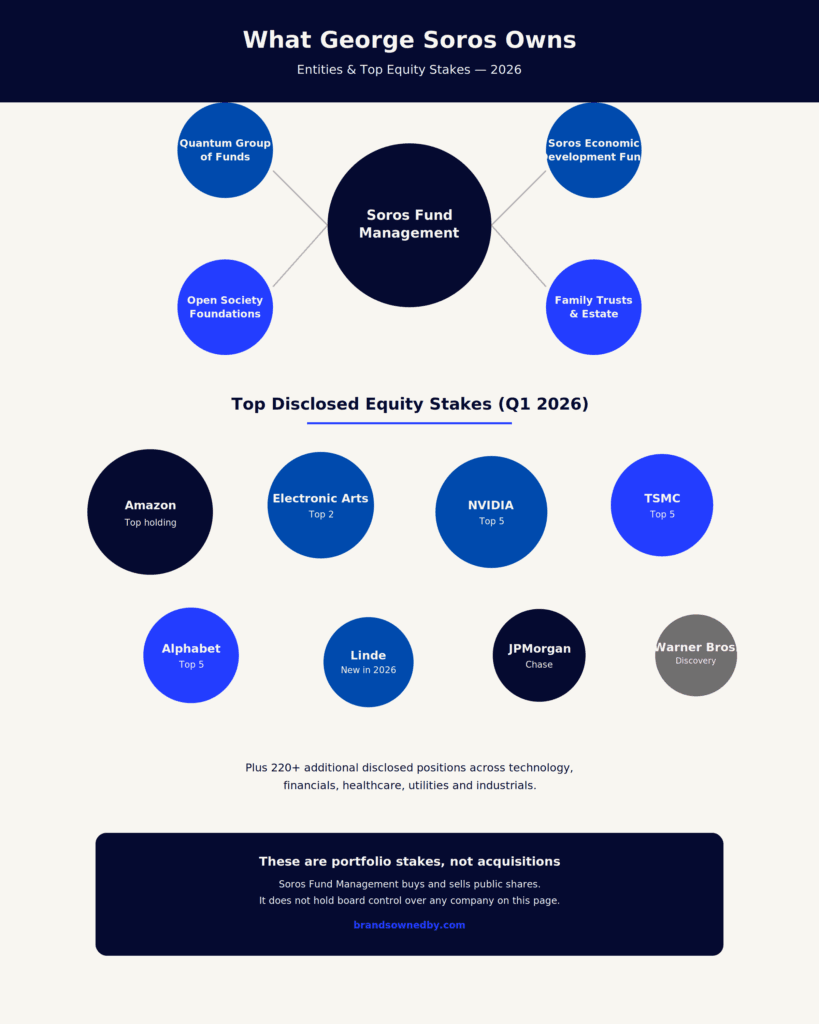
Soros Fund Management LLC
The management company itself. Headquartered at 888 Seventh Avenue in Manhattan, the same address it’s used for decades.
Wholly owned by the Soros family. It employs the traders and analysts who run the money, and it reported roughly $25 to $28 billion in total assets under management heading into 2026, once the philanthropic endowments it manages are counted in.
It’s been a pure family office since 2011. No outside investor can buy in. In 2025 the firm had to publicly warn that scammers were impersonating its staff on social media to solicit fake investments.
Quantum Group of Funds
The Quantum Endowment Fund traces straight back to the 1973 Soros-Rogers partnership. At its 1990s peak, it was the largest hedge fund in the world, and it was the vehicle behind the 1992 pound trade.
Today it’s internal only. It holds family capital and a share of the Open Society endowments, run inside the same Soros Fund Management infrastructure.
Soros Economic Development Fund
Founded in 1997. This is the impact-investing arm of the Open Society network, and it’s genuinely active, not a dormant legacy vehicle.
It has committed more than $569 million in debt, equity, and guarantees since inception. As of 2026 it carries roughly $333 million in committed capital across 36 live investments.
Its most recent public move: a $5 million reinvestment in June 2026 into the Working Capital Fund III, an early-stage venture fund backing supply-chain accountability technology, part of that fund’s $31 million initial close toward a $100 million target.
It’s also put $25 million into Allied Climate Partners, a public-private vehicle unlocking climate financing across Asia, Africa, and Latin America. Heading into 2026, SEDF’s own leadership has flagged a pivot toward African critical minerals and the intersection of AI and independent media.
Open Society Foundations
Not an investment vehicle, but fully controlled by the family, and worth including because most people asking what Soros “owns” are really asking about the network he directs.
It’s the largest private funder of independent human-rights and democracy groups in the world. More than $32 billion donated since 1984, including an $18 billion single transfer in 2017. Roughly $23 billion still sits in endowment assets.
Alex Soros chairs its board. The foundation drew fresh political scrutiny after federal prosecutors were directed to investigate its operations under the current administration, an inquiry the foundation has publicly pushed back on. It kept grantmaking through it, including a $30 million, three-year commitment announced in May 2026 to combat antisemitism and anti-Muslim hate.
Amazon
Amazon has sat at or near the top of the disclosed portfolio through every recent filing, usually around 4% of reported US equity value.
The fund has carried it for years. It trims the position when the stock runs hot and holds the rest of the time. That’s patience, not a trade.
Electronic Arts
Gaming isn’t the sector people expect from a macro-driven family office. But Electronic Arts grew into one of the fund’s two or three largest positions by early 2026.
The timing lines up with renewed takeover chatter across the gaming publisher space. A stake that size doesn’t happen by accident.
NVIDIA
A fixture since the AI infrastructure trade took off in 2023. The fund kept exposure through the sharper pullbacks of early 2026, when AI-valuation jitters hit the whole sector.
Position size has moved with the stock’s swings. It’s stayed a top-five name through the most recent filing.
Taiwan Semiconductor Manufacturing Company
TSMC is the most strategically loaded name on this list. It’s the single company that manufactures the advanced silicon almost every AI and consumer electronics business depends on, sitting on an island with a live geopolitical fault line running through it.
Soros has never shied from macro-political trades. Holding TSMC at scale, right alongside NVIDIA and Alphabet in the top five, fits that instinct.
Alphabet
Alphabet rounds out the mega-cap technology core. Even after a trim in early 2026, it stayed among the largest single positions by dollar value.
The pattern across Amazon, NVIDIA, and Alphabet is telling. The fund holds the obvious names at real size, and does its higher-conviction work in smaller, less crowded bets like Electronic Arts and Linde.
Linde
One of the largest brand-new positions opened in the first quarter of 2026. A fresh bet worth well over $100 million on an industrial gas company most retail investors have never heard of.
Linde supplies the gases used in semiconductor fabrication and large-scale data-center cooling. It’s a quieter, indirect way to ride the same AI buildout as NVIDIA and TSMC.
JPMorgan Chase
The fund added aggressively to its JPMorgan Chase stake in early 2026, one of several moves that pushed financial services to roughly 9% of the disclosed book.
Adding to a bank this size isn’t speculative. It’s ballast, exposure to a strong economy without single-company execution risk.
Warner Bros. Discovery
Still on the books, but cut back meaningfully heading into 2026 as the media consolidation story around the company kept shifting.
The fund lightened up rather than exited outright. That reads as a hedge, not an abandonment.
Who Owns Soros Fund Management?
Soros Fund Management is private. There’s no shareholder register to check. Ownership and control run through the family, a small executive team, and family trusts.
George Soros: Founder and Chairman
George Soros turns 96 in August 2026. He’s now described as chairman emeritus, not an active decision-maker.
He still legally owns the wealth the firm manages. His reflexivity framework still shapes how the firm talks about risk internally. But he makes few public appearances now, and the public-facing job belongs to his son and to Fitzpatrick.
Alexander “Alex” Soros: Deputy Chairman and Successor
Alex Soros holds the only family seat on the investment committee. In June 2023, his father handed him control of the roughly $25 billion Soros network, spanning the family office and the Open Society Foundations, which Alex also chairs.
He’s described himself as more overtly political than his father. That’s shown in how the network has engaged with US politics since the handover.
Dawn Fitzpatrick: Chief Executive Officer and Chief Investment Officer
Fitzpatrick runs the firm day to day. She joined in 2017 after 25 years at UBS, where she had global oversight of more than $500 billion in client assets.
She holds both the CEO and CIO titles, so she controls strategy and operations. She also sits on Barclays’ board.
The Wider Soros Family
George Soros has five children. Alex didn’t inherit an empty field.
Jonathan Soros runs his own investment firm and spends most of his energy on political finance reform. Robert Soros held the deputy chairman title before Alex did. Gregory Soros and Andrea Soros Colombel stayed on the philanthropic side, with Andrea running the Trace Foundation for Tibetan cultural continuity, separate from Open Society.
None of them hold a formal seat inside Soros Fund Management today. That concentration in one sibling is a departure from how a lot of wealthy families handle succession.
Open Society Foundations as an Internal Stakeholder
A big chunk of the roughly $25 to $28 billion Soros Fund Management manages isn’t George Soros’s personal money. It belongs to the Open Society endowments, reportedly well over half of the family office’s total assets.
That means Open Society’s own governance choices, including how it responds to its federal investigation, feed directly back into how the fund invests that portion of the book.
Competitor Ownership Comparison
Soros Fund Management sits in an odd category: a private family office large enough to move markets, structured nothing like the public asset managers people compare it to. Succession is the throughline, and it plays out differently at each firm.
Bridgewater Associates
Ray Dalio founded Bridgewater in 1975. For decades it was the largest hedge fund in the world by assets.
Dalio stepped down as co-CIO in 2022 and handed his voting rights to the board. That wasn’t the full exit, though.
In July 2025, he sold his last remaining ownership stake back to the firm and left the board entirely. Bridgewater’s CEO and co-chair confirmed the transaction in a letter to investors, closing out a transition that had taken years.
Bridgewater is now run by a group of co-CIOs, Karen Karniol-Tambour, Bob Prince, and Greg Jensen, with Prince emerging as the largest individual partner. Brunei’s sovereign wealth fund picked up a minority stake around the same time.
Reported figures for the firm’s assets vary by source, somewhere between $92 billion and $124 billion depending on whether leverage and non-institutional vehicles are counted. Unlike Soros Fund Management, Bridgewater takes only institutional money, pension funds, foundations, endowments, never private individuals.
Renaissance Technologies
Jim Simons, a mathematician, founded Renaissance in 1982. He stepped down as CEO in 2010 but stayed on as non-executive chairman until 2021.
He remained personally invested in the firm’s famous Medallion fund until his death in May 2024, at age 86. His net worth at the time was estimated at $31.4 billion.
Renaissance is employee-owned, and it was already built that way before Simons died. Peter Brown, one of his earliest hires, now runs the firm alone after co-CEO Robert Mercer resigned.
No member of the Simons family holds an investment or governance role at Renaissance today. That’s the sharpest possible contrast with Soros Fund Management, where Alex Soros sits on the investment committee specifically because he’s family.
Medallion itself, closed to outside investors since the 1990s, has generated more than $100 billion in trading profits since 1988. Renaissance’s other funds, open to outside capital, run roughly $55 billion combined.
Berkshire Hathaway
Warren Buffett ran Berkshire for roughly six decades before handing the CEO title to Greg Abel in 2025.
He didn’t give up control on the way out. Buffett still holds around 14% of Berkshire’s shares, but thanks to the company’s dual-class structure, that translates into close to a third of total voting power.
That’s the Buffett model in one sentence: step back from daily operations, keep enough voting weight to intervene if it ever mattered. It’s the closest parallel to how George Soros has handled his own exit.
Berkshire is also the only fully public company on this list besides Icahn Enterprises. Its filings, holdings, and governance are matters of public record in a way nothing at Soros Fund Management is.
Citadel
Ken Griffin founded Citadel in 1990. He still owns roughly 85% of the firm and still runs it personally as CEO and co-CIO.
There’s no succession plan in public view. Griffin, unlike Dalio, Buffett, or Soros, simply hasn’t started stepping back.
Citadel entered 2026 managing around $67 billion, after returning roughly $5 billion to investors the year before. It has posted $90.4 billion in net gains since inception, among the best records of any hedge fund in history.
Citadel Securities, the separate market-making business, shares Griffin’s ownership but is a legally distinct company from the hedge fund.
Icahn Enterprises
Carl Icahn founded and still runs Icahn Enterprises, and he hasn’t diluted his grip on it. SEC filings from 2026 put his stake, held through a web of affiliated entities, at roughly 86% to 87% of outstanding units.
It’s the most publicly documented ownership structure on this entire list, because it trades on Nasdaq under the ticker IEP and has to disclose everything.
The firm reported an indicative net asset value of about $3.4 billion as of March 2026. It also pays an unusually large distribution, recently yielding above 25%, a hallmark of how Icahn has always run the vehicle.
Like Griffin, Icahn shows no visible sign of handing over control. He’s in his late eighties and still personally directs the firm’s activist campaigns.
How Soros Fund Management Compares
Griffin and Icahn still run their own firms outright, with no handover in sight. Buffett and Dalio both stepped back while keeping economic value, Buffett gradually and on his own terms, Dalio through a longer and messier process that ended with a full stake sale in 2025.
Simons’s death forced Renaissance into a fully post-founder structure with zero family involvement. Soros sits closest to the Buffett pattern, but with a twist Buffett never had: control split two ways at once, a family member holding strategic authority through Alex, a professional CEO holding operational authority through Fitzpatrick.
Who Controls George Soros’s Empire in 2026
Three years after the 2023 handover, Alex Soros is the public face and ultimate decision-maker across both the philanthropic and investment sides of the operation.
His public profile has grown with that authority. He married Huma Abedin, the longtime Hillary Clinton aide, in June 2025, putting him at the intersection of Democratic political circles and New York social life in a way his more behind-the-scenes father never was.
Dawn Fitzpatrick’s Day-to-Day Command
Investment decisions, hiring, and trading strategy run through Fitzpatrick’s office, not through the family directly.
In March 2026, she used a stage at the Bloomberg Invest conference to warn that private equity and private credit were heading into a “massive culling,” pointing to overallocated investors and frozen distributions across the industry. That’s a lot of operating latitude for a hired CEO to have.
The Investment Committee Structure
Below Fitzpatrick and Alex Soros sits a conventional institutional structure, with sector heads and portfolio managers responsible for individual positions.
That’s a real departure from the 1990s Quantum Fund era, when Soros himself made concentrated macro calls with comparatively little process around them.
Notable Alumni: The Soros-to-Washington Pipeline
One of the stranger footnotes to this story: a former Soros Fund Management CIO now runs the US Treasury.
Scott Bessent worked at the firm twice. First as managing partner of its London office from 1991 to 2000, where he helped run the 1992 pound trade. Then as CIO from 2011 to 2015, overseeing a portfolio in the $25 to $30 billion range.
Bessent left in 2015, drifted toward Republican politics, and was confirmed as Treasury Secretary in January 2025 under Donald Trump, whose allies have spent years attacking Soros by name.
George Soros Annual Revenue and Net Worth in 2026
George Soros’s personal net worth sits at roughly $7.2 to $7.5 billion through 2026, around the 500th spot on Forbes’s global billionaire ranking. That figure looks modest next to Buffett or Griffin only because Soros has already given away most of what he earned.
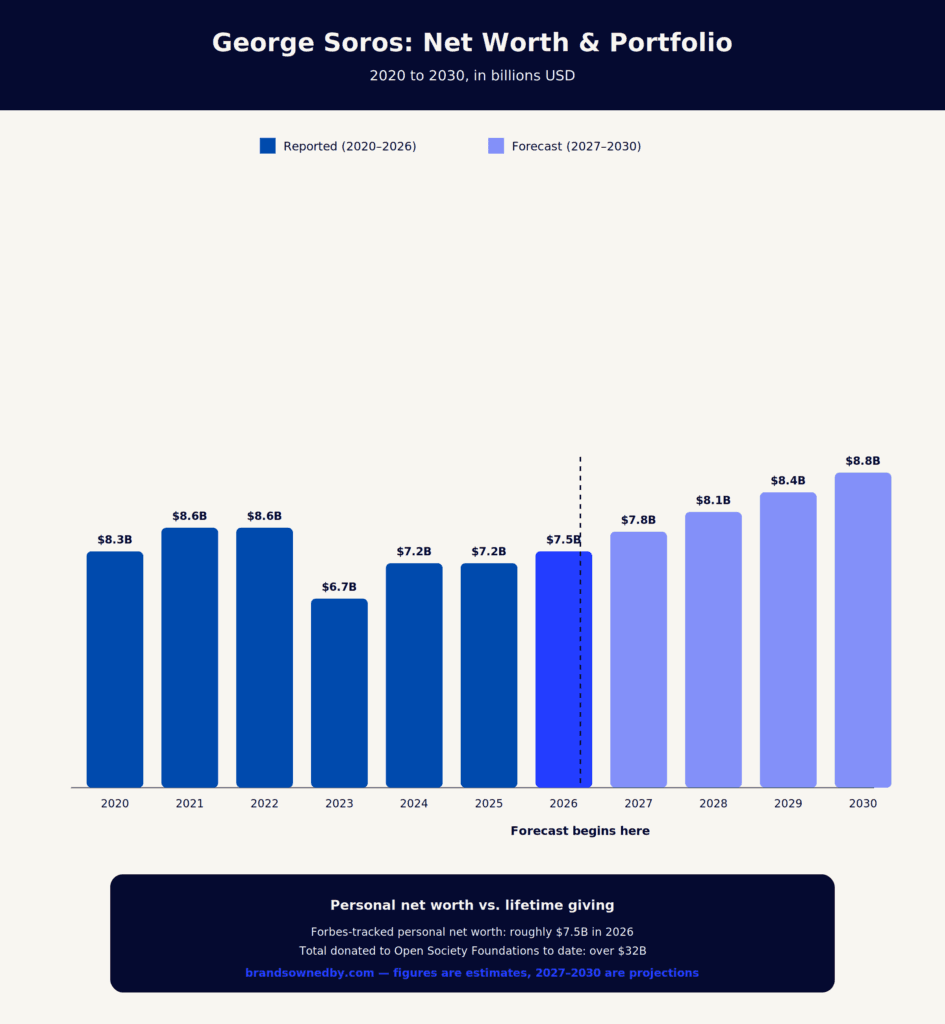
2026 Net Worth Snapshot
Two numbers matter here, and it’s easy to conflate them. The Forbes-tracked figure reflects what remains in Soros’s own accounts after a lifetime of donations.
The far larger number, more than $32 billion given to Open Society since 1984, sits outside that calculation entirely. It already left his estate.
Assets Under Management and Portfolio Performance
The 13F equity portfolio grew from roughly $6.02 billion in early 2024 to $9.12 billion by the first quarter of 2026.
The fund returned 8.67% for full-year 2025. It then posted a rougher -4.32% start to 2026, in line with the same AI-valuation jitters Fitzpatrick has been warning clients about publicly. Trailing 12-month return sits at 7.39%.
Roughly 53% of the book now sits in large-cap and mega-cap names, a meaningfully more conservative tilt than the fund’s reputation as an aggressive macro trader might suggest.
Revenue, Net Worth, and Portfolio Value: 2020–2030
The table below tracks three numbers side by side: what Forbes estimates Soros is personally worth, what the family office manages in total, and what the fund discloses in US equities each year.
| Year | Personal net worth | Family office AUM | 13F equity portfolio |
|---|---|---|---|
| 2020 | $8.3B | $25B | Not tracked separately |
| 2021 | $8.6B | $25B | Not tracked separately |
| 2022 | $8.6B | $25B | Not tracked separately |
| 2023 | $6.7B | $25B | Not tracked separately |
| 2024 | $7.2B | $25B | $6.02B |
| 2025 | $7.2B | $28B | $8.6B |
| 2026 | $7.5B | $28B | $9.12B |
| 2027 (forecast) | $7.8B | $29B | $9.6B |
| 2028 (forecast) | $8.1B | $30B | $10.1B |
| 2029 (forecast) | $8.4B | $31B | $10.6B |
| 2030 (forecast) | $8.8B | $32B | $11.2B |
Why the Numbers Diverge
Personal net worth barely moves year to year. Family office AUM grows slowly. The 13F portfolio is the volatile one. There’s a reason for each of those patterns, and they’re worth spelling out.
The 13F filing is a snapshot, not a running total. Managers report their US-listed long equity positions as of one specific date each quarter, filed up to 45 days later. It excludes cash, bonds, non-US listings, real estate, and most short positions. It also excludes anything held through vehicles like the Soros Economic Development Fund, which makes private, unlisted bets that never show up in a 13F at all.
That narrow scope is exactly why the number swings so much. A single strong or weak quarter in Amazon or NVIDIA can move the reported figure by hundreds of millions of dollars without the fund trading a single share. The -4.32% return Soros Fund Management posted in the first quarter of 2026 shows up directly in that quarter’s 13F value, even on positions the fund never touched.
Net worth estimates diverge for a different reason: nobody outside the family actually knows the real number, so different outlets build it differently. Forbes tracks Soros’s stake using public filings and market pricing. Bloomberg has taken a more aggressive approach, starting from the family office’s total AUM, roughly $28 billion as of its December 2025 estimate, and then subtracting the roughly $18.3 billion that belongs to the Open Society endowments rather than to Soros personally. That method left Bloomberg with a personal figure closer to $9.7 billion, notably higher than Forbes’s number. A spokesperson for Soros called Bloomberg’s estimate inaccurate at the time, without offering an alternative figure.
That disagreement, over what actually counts as “Soros’s money” once so much of it legally belongs to a foundation, is the whole story of this report in miniature. Even the professionals who track this for a living can’t fully agree on where the family office ends and the man himself begins.
Forecast to 2030
These are directional, not guaranteed. Assuming no major policy shock to the family’s philanthropic status:
- 2027: personal net worth near $7.8 billion, family office AUM approaching $29 billion.
- 2028: personal net worth near $8.1 billion, disclosed equity portfolio crossing $10 billion.
- 2029: family office AUM approaching $31 billion as Open Society endowment assets keep compounding.
- 2030: personal net worth approaching $8.8 billion, total family office assets near $32 billion.
Final Words
Soros’s real portfolio isn’t a shelf of household-name acquisitions the way Apollo’s or LVMH’s is. It’s a fast-moving book of public equity stakes, managed on behalf of a family that already redirected most of its fortune somewhere else.
That’s why the ownership question is worth asking properly. The interesting story was never which brands carry his name. It’s how much of his money isn’t really his anymore, how fast control passed to the next generation, and how a professional CEO now runs the machine that made him famous.
Anyone still asking what companies does George Soros own in 2026 is really asking who controls that machine now. The honest answer: a son, a CEO, and roughly 230 stock tickers.
FAQs
Does George Soros own any companies outright?
No. He doesn’t hold controlling, board-level stakes in operating companies the way a private equity firm does. Everything in his 13F filings is a portfolio position, bought and sold through Soros Fund Management.
Who runs Soros Fund Management in 2026?
Dawn Fitzpatrick has been CEO and CIO since 2017 and handles day-to-day decisions. Alex Soros holds the only family seat on the investment committee and has held ultimate control of the broader network since 2023.
What is George Soros’s biggest stock holding right now?
Amazon and Electronic Arts have alternated as the largest disclosed positions heading into 2026. NVIDIA, Taiwan Semiconductor, and Alphabet round out the top five.
Is George Soros still involved in day-to-day trading?
No. He stepped back years ago and is generally described as chairman emeritus. Decisions now run through Fitzpatrick’s team and the investment committee.
What’s the difference between Soros Fund Management and the Open Society Foundations?
Soros Fund Management is the private investment vehicle managing the family’s wealth, including a large share of Open Society’s own endowment. The Open Society Foundations is the grantmaking network that spends money on human-rights and democracy causes instead of making investments.
How much has George Soros donated to charity?
More than $32 billion since 1984, including an $18 billion single transfer to the Open Society Foundations in 2017. That’s the large majority of his lifetime fortune.