
- USA Today is owned by Gannett Company, a publicly traded media company, meaning it does not have a single owner but is controlled through a corporate structure.
- Gannett’s ownership is dominated by institutional investors such as BlackRock, Vanguard Group, and State Street Corporation, which collectively hold significant influence through voting power.
- No individual, family, or entity has majority control, making USA Today part of a widely distributed ownership model unlike competitors controlled by billionaires or families.
- Strategic and operational control is exercised by Gannett’s leadership, led by CEO Michael Reed, while editorial decisions remain with USA Today’s newsroom.
USA Today is a national daily newspaper in the United States. It was launched in 1982 with a clear goal. The aim was to create a newspaper that could reach readers across the entire country.
Unlike traditional papers, USA Today focused on simplicity. It introduced short articles, visual storytelling, and easy-to-scan layouts. This made it accessible to a wider audience. It quickly became known for its colorful design and infographics.
As of April 2026, USA Today operates as a major digital-first media brand. Its website and mobile platforms attract a large global audience. It serves breaking news, analysis, and multimedia content.
It is also the flagship publication of Gannett Company. Through the USA Today Network, its content is distributed across hundreds of local newspapers. This gives it a strong national footprint and influence in the U.S. media landscape.
USA Today Founder
USA Today was founded by Al Neuharth. He was the chairman of Gannett at the time. He envisioned a modern newspaper that would break away from traditional formats.
Neuharth believed readers wanted quick and clear information. He introduced shorter stories, bold headlines, and visual elements. This approach was very different from conventional newspapers in the early 1980s.
He played a direct role in launching the publication in 1982. Despite early criticism, his strategy worked. USA Today grew rapidly and became one of the most recognized newspapers in the country.
Role of Gannett in the Founding
The founding of USA Today was strongly supported by the Gannett Company. The company provided the financial backing and infrastructure needed for a national launch.
Gannett used its existing network of local newspapers to distribute USA Today. This allowed the paper to scale quickly. It also ensured a wide national reach from the beginning.
As of April 2026, this relationship remains central. USA Today continues to operate as Gannett’s flagship brand. It plays a key role in content sharing across the company’s nationwide media network.
Ownership History
The ownership history of USA Today is closely tied to its parent company, Gannett Company. Unlike many newspapers that changed hands multiple times, USA Today has remained under the Gannett umbrella since its launch. However, the structure of that ownership has evolved significantly over time.
1982–2014: Direct Ownership Under Gannett
USA Today was launched in 1982 as a wholly owned property of Gannett. At the time, Gannett was primarily a newspaper publishing company.
The company expanded aggressively during this period. It acquired dozens of local newspapers across the United States. USA Today became its national flagship.
Ownership during this era was straightforward. Gannett directly owned and operated USA Today. The company was publicly traded, so its shares were held by a mix of institutional and retail investors.
This period was marked by growth. USA Today became one of the highest-circulation newspapers in the country. It also established its identity as a modern, visually driven publication.
2015: Corporate Split and Structural Change
In 2015, Gannett underwent a major corporate restructuring. The company split into two separate entities.
The broadcasting and digital media businesses were spun off into a new company called Tegna Inc..
The remaining entity retained the Gannett name. It focused entirely on publishing. This included USA Today and hundreds of local newspapers.
This split was designed to unlock shareholder value. It allowed each business to focus on its core operations. For USA Today, this meant becoming part of a more focused publishing group rather than a diversified media company.
2019: Merger with GateHouse Media
A major shift in ownership structure occurred in 2019. Gannett merged with GateHouse Media.
GateHouse was owned by New Media Investment Group. The merger was structured in a way that GateHouse’s parent effectively acquired Gannett.
After the deal, the combined company chose to operate under the Gannett name. However, the leadership and strategic direction were heavily influenced by the GateHouse side.
This merger created the largest newspaper publisher in the United States. It brought together hundreds of publications under one corporate structure. USA Today became the centerpiece of this expanded network.
2020–2026: Public Ownership with Institutional Dominance
After the merger, Gannett continued as a publicly traded company. As of April 2026, its ownership is widely distributed among shareholders.
Large institutional investors hold the biggest stakes. These include firms like Vanguard Group, BlackRock, and State Street Corporation.
No single shareholder has controlling ownership. This means USA Today is indirectly owned by a broad base of investors.
During this period, Gannett has focused on digital transformation. It has shifted toward subscription models and digital advertising. USA Today plays a central role in this strategy. It acts as the national content hub for the entire network.
Who Owns USA Today?
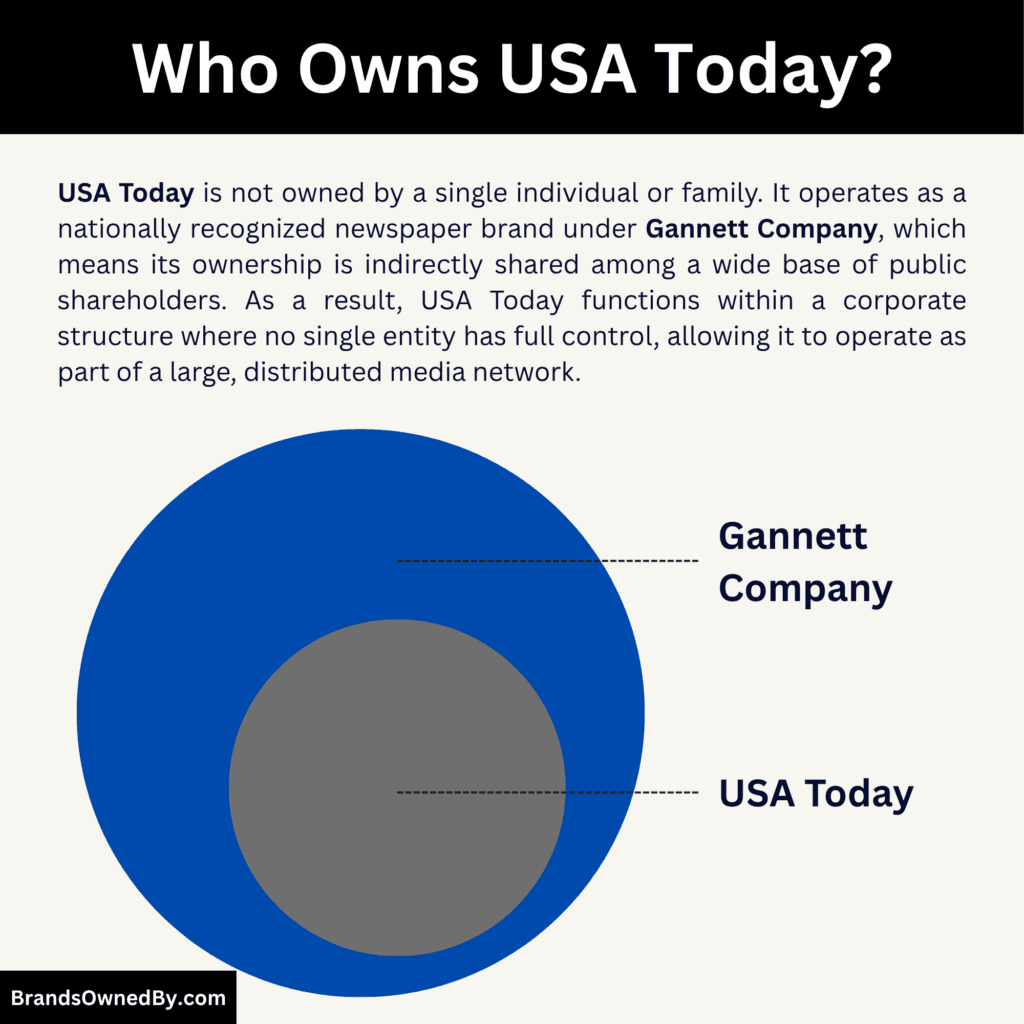
USA Today is not an independent company. It is owned and operated by its parent organization, Gannett Company.
As of April 2026, the ownership of USA Today is directly tied to Gannett’s corporate structure. This means anyone asking who owns USA Today is essentially asking who owns Gannett.
Gannett is a publicly traded company. Its shares are widely distributed across institutional investors, funds, and individual shareholders. No single entity has outright control. Instead, ownership is spread across multiple stakeholders, with institutional investors holding the largest portion.
Parent Company: Gannett Company
Gannett Company is the direct owner of USA Today. It is the largest newspaper publisher in the United States as of April 2026.
The company operates hundreds of local newspapers along with national brands. USA Today serves as its flagship publication. It acts as the central content hub for the entire USA Today Network.
Gannett’s business model focuses on digital media, subscriptions, and advertising. Over the years, it has shifted from print-heavy operations to a digital-first strategy. USA Today plays a critical role in this transformation due to its national reach and strong online presence.
Shareholders of Gannett Company
Since Gannett is publicly listed, its ownership is divided among shareholders. As of April 2026, institutional investors dominate its shareholding structure.
The largest stakeholders include major asset management firms and hedge funds such as BlackRock, Vanguard Group, and State Street Corporation.
In addition to these, several hedge funds and investment firms hold notable stakes. These include firms like Two Seas Capital, Apollo-linked entities, and Alta Fundamental Advisers.
No single shareholder owns a majority stake. This creates a dispersed ownership model. However, large institutional investors still influence corporate governance through voting rights and board-level decisions.
Insider ownership, including executives like Michael Reed, remains relatively small. Still, it aligns management interests with company performance.
Acquisition and Merger History
A major turning point in the ownership structure of USA Today came in 2019. This was when Gannett merged with GateHouse Media.
GateHouse was owned by New Media Investment Group. The deal was structured so that New Media effectively acquired Gannett. However, the combined entity retained the Gannett name due to its stronger brand recognition.
This was a landmark acquisition in the U.S. media industry. It created the largest newspaper publishing company in the country. The combined group controlled hundreds of local newspapers along with national platforms like USA Today.
The merger was driven by several strategic goals. These included cost reduction, operational efficiency, and scaling digital transformation. The media industry was facing declining print revenues. Consolidation was seen as a way to remain competitive.
Following the merger, Michael Reed, who previously led GateHouse’s parent company, became the CEO of the combined Gannett. This reflected the significant influence of the acquiring side in the new structure.
The integration process involved combining operations, reducing redundancies, and centralizing content distribution. USA Today became even more important after the merger. It served as the national backbone for content shared across the expanded network.
As of April 2026, the effects of this acquisition are still evident. Gannett continues to operate as a consolidated media powerhouse. USA Today remains at the center of its national strategy, both in print and digital media.
Competitor Ownership Comparison
The ownership structure of a news organization shapes everything. It influences editorial independence, long-term strategy, investment decisions, and even newsroom culture. In the U.S., major newspapers follow very different ownership models. Some are tightly controlled by families. Others are owned by billionaires with long-term visions. A few, like Gannett Company, operate under dispersed public ownership.
USA Today falls into the last category. It is part of a publicly traded corporation with no single controlling owner. To understand how unique this is, it is important to compare it with its closest competitors.
| Newspaper | Parent / Owner | Ownership Type | Control Structure | Key Decision Makers | Strategic Implications |
|---|---|---|---|---|---|
| USA Today | Gannett Company | Publicly traded | Dispersed ownership (no controlling shareholder) | Board of directors, CEO Michael Reed | Focus on profitability, digital scale, and nationwide integration across the USA Today Network |
| The New York Times | The New York Times Company | Public (dual-class shares) | Family-controlled via voting power | Sulzberger family | Long-term editorial stability, reduced market pressure, strong brand control |
| The Washington Post | Jeff Bezos | Private ownership | Single-owner control | Jeff Bezos | High flexibility, long-term investments, rapid innovation without shareholder pressure |
| The Wall Street Journal | News Corp | Public (dual-class shares) | Family-controlled corporate model | Rupert Murdoch family | Centralized strategic direction, alignment across media assets, strong executive control |
| Los Angeles Times | Patrick Soon-Shiong | Private ownership | Individual ownership | Patrick Soon-Shiong | Editorial independence with reliance on owner’s vision and financial backing |
The New York Times
The New York Times Company operates under a dual-class share structure. This system separates economic ownership from voting control.
The Sulzberger family holds special Class B shares. These shares carry significantly higher voting power than regular shares. As a result, the family controls the company despite owning a smaller economic stake.
As of April 2026, institutional investors such as large asset managers hold a significant percentage of total shares. However, they have limited influence over major decisions. The Sulzberger family retains the ability to appoint leadership, guide editorial direction, and block unwanted takeovers.
This model is designed for stability. It allows The New York Times to focus on long-term journalism rather than short-term market pressures. Compared to USA Today, this is a controlled public company, where power is centralized even though ownership is partially distributed.
The Washington Post
The Washington Post follows a completely different ownership model. It is privately owned by Jeff Bezos.
Bezos acquired the paper in 2013 through his personal investment vehicle. This means the company is not subject to stock market pressures or quarterly earnings expectations.
As of April 2026, this structure allows for aggressive long-term investment. Bezos has funded technology upgrades, newsroom expansion, and digital innovation. The company can prioritize growth and experimentation without worrying about shareholder reactions.
However, this model also concentrates power. Strategic direction ultimately depends on a single owner. Unlike USA Today, there is no distributed governance or institutional oversight.
The Wall Street Journal
The Wall Street Journal is owned by News Corp.
News Corp itself is publicly traded. However, it operates under a dual-class structure that gives control to the Rupert Murdoch family. The Murdoch family holds voting shares that ensure long-term control over the company.
As of April 2026, this creates a hybrid ownership model. Institutional investors provide capital and liquidity. But real decision-making authority remains with the Murdoch family.
This model allows for coordinated strategy across multiple media assets. It also ensures editorial direction aligns with the controlling family’s vision. Compared to USA Today, this structure is far more centralized despite being publicly listed.
Los Angeles Times
Los Angeles Times is owned by Patrick Soon-Shiong.
He acquired the newspaper in 2018 during a period of financial instability. The deal returned the paper to local ownership after years under corporate control.
As of April 2026, the Los Angeles Times operates under private ownership. This allows flexibility in decision-making and editorial direction. Soon-Shiong has invested in newsroom rebuilding and digital transformation.
However, like The Washington Post, this model depends heavily on a single individual’s financial capacity and strategic priorities. There is no broad shareholder base to distribute risk or influence.
USA Today vs Competitors: Structural Differences
USA Today, through Gannett Company, represents a fully dispersed public ownership model. This is fundamentally different from most major competitors.
There is no controlling family. There is no billionaire owner. There is no dual-class structure concentrating voting power. Instead, ownership is spread across institutional investors, funds, and public shareholders.
This creates a governance system driven by a board of directors and executive leadership. Decisions must align with shareholder expectations, financial performance, and long-term sustainability.
In contrast:
- The New York Times prioritizes family-controlled stability
- The Washington Post emphasizes owner-driven innovation
- The Wall Street Journal reflects corporate scale with family control
- Los Angeles Times operates on individual ownership and a localized strategy.
USA Today stands apart as a pure corporate media model.
Strategic Implications of Ownership Models
Ownership directly impacts how these organizations operate.
Publicly owned companies like Gannett must balance profitability with journalism. They face pressure from investors to improve margins and grow digital revenue. This can lead to cost controls and operational restructuring.
Family-controlled or privately owned outlets often have more flexibility. They can invest heavily in journalism without immediate financial returns. They can also take editorial risks that public companies might avoid.
However, public ownership offers advantages. It provides access to capital markets. It spreads financial risk. It enforces governance standards through regulatory oversight.
As of April 2026, USA Today operates within this framework. Its strategy is shaped by scale, efficiency, and digital growth across a nationwide network.
Who Controls USA Today?
Control of USA Today does not sit with a single owner. It operates within a layered corporate structure under Gannett Company.
As of April 2026, control is divided across executive leadership, the board of directors, and the newsroom hierarchy. Ownership provides influence, but operational and editorial control is exercised through management systems.
To understand who really controls USA Today, it is important to break this into three levels: corporate control, executive leadership, and editorial control.
Corporate Control: Gannett’s Governance Structure
At the highest level, USA Today is controlled by Gannett’s corporate governance framework.
Gannett is a publicly traded company. It is overseen by a board of directors. The board represents shareholders and sets long-term strategy. It approves major decisions such as acquisitions, restructuring, and executive appointments.
The board does not manage daily newsroom operations. However, it has ultimate authority over the company’s direction. This includes budget allocation, digital strategy, and cost management.
Because ownership is dispersed, no single shareholder dictates decisions. Instead, control is exercised collectively through governance mechanisms.
Executive Leadership: CEO and Management Team
Day-to-day control of USA Today flows through Gannett’s executive leadership.
The CEO of Gannett is Michael Reed. As of April 2026, he is the most influential decision-maker in the organization.
Michael Reed became CEO after the 2019 merger between Gannett and GateHouse Media. His leadership has focused on integration, cost efficiency, and digital transformation.
Under him, the executive team manages operations across all Gannett properties, including USA Today. This includes:
- Business strategy
- Revenue models (advertising and subscriptions)
- Technology and digital platforms
- Organizational structure.
While Reed does not control editorial content directly, his decisions shape the environment in which journalism operates.
Editorial Control: USA Today Newsroom Leadership
Editorial control of USA Today is handled separately from corporate management.
The newsroom is led by senior editors. These include the Editor-in-Chief and managing editors. They oversee news coverage, editorial standards, and journalistic direction.
Editors decide what stories are covered. They also determine how those stories are presented. This includes tone, headlines, and investigative priorities.
Although USA Today operates within a corporate structure, editorial teams maintain a level of independence. This separation is important for journalistic credibility.
However, editorial independence is not absolute. It exists within the boundaries of corporate policies, legal considerations, and budget constraints set by Gannett.
Role of the USA Today Network
USA Today is not just a standalone newspaper. It is the central hub of the USA Today Network.
This network includes hundreds of local newspapers owned by Gannett. Content flows between USA Today and these local outlets.
Because of this structure, USA Today plays a leadership role in content strategy. National stories produced by its newsroom are distributed across the network.
This gives USA Today indirect influence over a large portion of Gannett’s editorial output. In this sense, control is not just vertical (top-down) but also network-driven.
Past Leadership and Control Evolution
Control of USA Today has evolved over time.
In its early years, leadership was closely tied to its founder Al Neuharth. He had strong influence over both business and editorial direction.
As Gannett expanded, control became more corporate. Decision-making shifted from individual leadership to structured governance.
The 2019 merger further changed control dynamics. Leadership from the GateHouse side, including Michael Reed, took key roles. This marked a shift toward centralized corporate control across a larger media network.
USA Today Annual Revenue and Net Worth
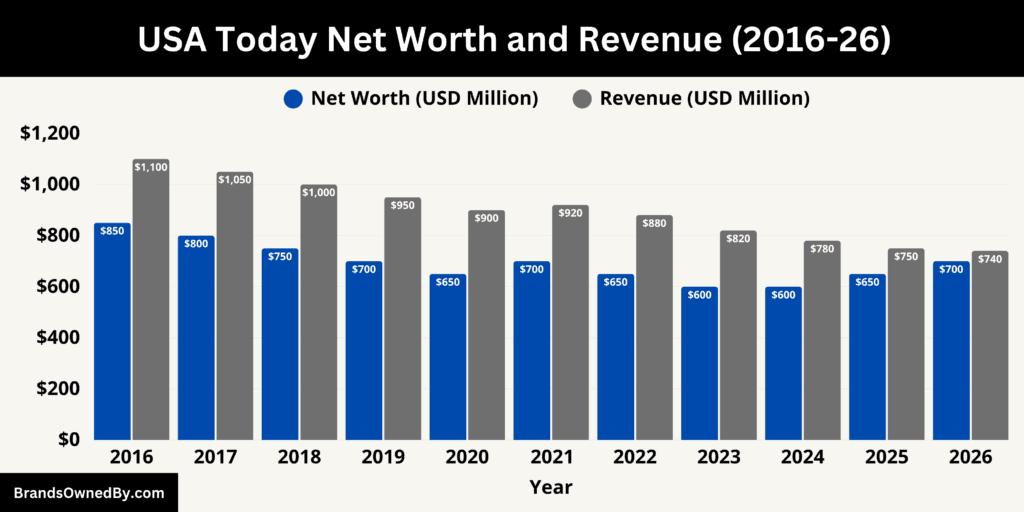
As of April 2026, USA Today generates an estimated $740 million in annual revenue and holds an approximate brand value (net worth) of $700 million. These figures reflect its position as a leading national media brand within Gannett Company.
While it is not a standalone financial entity, USA Today remains one of the most commercially significant assets in Gannett’s portfolio. Its revenue mix has shifted heavily toward digital channels, and its valuation reflects both brand strength and audience reach.
USA Today Revenue Breakdown (2026)
USA Today’s estimated $740 million revenue in 2026 is derived from multiple streams. The business has transitioned from print-heavy income to a diversified digital-first model.
Digital advertising contributes the largest share. It accounts for approximately $300 million, driven by high website traffic and programmatic ad sales. The platform attracts millions of monthly users, making it a strong advertising channel for national brands.
Subscription revenue is the second major contributor. Digital subscriptions and premium content generate around $180 million. Growth in this segment has been steady, supported by paywalls and bundled offerings within the USA Today Network.
Print revenue, including circulation and print advertising, now contributes roughly $160 million. This segment has declined significantly over the past decade but still remains a meaningful income source.
Other revenue streams, including content syndication, partnerships, and branded content, contribute an estimated $100 million. These areas are growing as media companies explore alternative monetization strategies.
Net Worth of USA Today in 2026
The estimated $700 million brand value of USA Today, as of April 2026, reflects its intangible strength rather than physical assets.
This valuation is driven by several factors. First is its national recognition. USA Today is one of the most widely recognized newspaper brands in the United States.
Second is its digital reach. Its online platform generates substantial traffic, which translates into advertising value and subscription potential.
Third is its strategic importance within Gannett. USA Today acts as the central content engine for the USA Today Network. This amplifies its influence across hundreds of local publications.
However, its valuation is lower than historical levels. This is due to industry-wide challenges, including declining print demand and increased competition from digital-native media platforms.
Revenue Evolution and Financial Position
Between 2016 and 2026, USA Today’s revenue declined from over $1.1 billion to approximately $740 million. This drop reflects the collapse of print advertising across the industry.
At the same time, digital revenue has grown significantly. It now accounts for the majority of total income. This shift has helped stabilize the business despite overall revenue decline.
The brand’s net worth followed a similar trajectory. It declined during peak industry disruption but has stabilized in recent years. As of 2026, USA Today is no longer in rapid decline. Instead, it is in a phase of gradual stabilization and digital optimization.
Future Revenue Forecast (2027–2030)
USA Today’s revenue outlook beyond 2026 reflects a transition from decline to gradual, efficiency-driven growth. The sharp drops seen in earlier years are expected to stabilize as the business becomes more digitally optimized. Growth will not be aggressive, but it will be more sustainable and margin-focused.
The primary driver of this recovery is digital monetization. As print continues to shrink, USA Today is expected to rely more heavily on subscriptions, targeted advertising, and data-driven content distribution. Improvements in user engagement, retention, and personalization will play a central role in revenue expansion.
- 2027: $760 million
- 2028: $790 million
- 2029: $820 million
- 2030: $850 million.
This projected growth is supported by several structural shifts. First, digital subscription penetration is expected to increase steadily. As more users convert from free readers to paid subscribers, recurring revenue will become more predictable.
Second, advertising models are evolving. Programmatic advertising, first-party data targeting, and premium brand partnerships are expected to increase ad yield per user. This will allow USA Today to generate more revenue even without massive traffic growth.
Third, operational efficiency will improve. Gannett’s centralized infrastructure allows USA Today to scale content distribution across its network without proportional cost increases. This improves margins over time.
Another key factor is the integration of AI and automation in content creation and distribution. These technologies can reduce costs, optimize publishing timing, and enhance audience targeting. This leads to better monetization of existing traffic rather than relying solely on audience expansion.
However, growth will remain moderate. The digital media space is highly competitive. Platforms like social media and independent digital publishers continue to capture advertising budgets. As a result, USA Today’s strategy focuses more on deepening monetization per user rather than rapid audience growth.
By 2030, USA Today is expected to operate as a leaner, more digitally efficient media brand. Revenue growth will be steady, driven by subscriptions and high-value advertising rather than traditional print scale.
Brands Owned by USA Today
As of April 2026, USA Today directly operates and manages several internal brands, editorial verticals, digital products, and content entities under its own identity. These are distinct from Gannett’s broader portfolio and are specifically tied to USA Today’s newsroom, audience strategy, and monetization model.
Below is a breakdown of the key brands and entities owned by USA Today:
| Entity / Brand | Type | Core Focus | Role Within USA Today | Strategic Importance (2026) |
|---|---|---|---|---|
| USA Today Network | Content network | National + local news distribution | Central content hub that syndicates stories across hundreds of local outlets | Backbone of scale, expands reach and reduces content duplication |
| USA Today Sports | Editorial vertical | Sports news, analysis, live coverage | Covers major leagues and events with high-frequency updates | High traffic driver and strong advertising revenue generator |
| USA Today Money | Editorial vertical | Business, markets, personal finance | Provides simplified financial news and consumer-focused insights | Supports affiliate revenue and attracts finance-related advertisers |
| USA Today Life | Editorial vertical | Entertainment, culture, lifestyle | Covers movies, celebrities, wellness, and trending topics | Broad audience appeal, increases engagement and session time |
| USA Today Opinion | Editorial division | Opinion, commentary, editorials | Publishes perspectives from journalists and external contributors | Enhances brand voice and public discourse influence |
| USA Today Tech | Editorial vertical | Technology, gadgets, innovation | Covers tech news, reviews, and digital trends | Drives affiliate sales and attracts tech advertisers |
| USA Today Travel | Editorial vertical | Travel guides, tourism, tips | Produces destination content and travel insights | Supports seasonal traffic and sponsored partnerships |
| USA Today Investigations | Journalism unit | Investigative reporting | Produces in-depth, long-form journalism | Strengthens credibility and brand authority |
| USA Today Digital Platform | Digital infrastructure | Content distribution | Main platform for publishing, subscriptions, and ads | Core revenue engine and audience engagement hub |
| USA Today Branded Content Studio | Commercial unit | Native ads, sponsored content | Creates marketing content for advertisers | High-margin revenue stream in digital advertising ecosystem |
USA Today Network
The USA Today Network is the most important entity associated with USA Today.
It is a nationwide content-sharing and publishing system. USA Today serves as the central hub of this network. While the local newspapers are owned by Gannett, the national content, editorial direction, and distribution framework are driven by USA Today.
Through this network, USA Today produces national stories that are syndicated across hundreds of local publications. This significantly expands its reach and influence.
As of 2026, the network model is a core part of USA Today’s strategy. It allows efficient content scaling, reduces duplication, and strengthens national-local integration.
USA Today Sports
USA Today Sports is a dedicated sports media division under the USA Today brand.
It covers major leagues such as the NFL, NBA, MLB, and international sports events. The platform provides news, analysis, rankings, and multimedia content.
It has also expanded into digital-first formats. These include video coverage, live updates, and interactive statistics.
USA Today Sports plays a major role in audience engagement. Sports content attracts high traffic and advertising demand. This makes it one of the most commercially valuable verticals within USA Today.
USA Today Money
USA Today Money focuses on financial news, personal finance, and business coverage.
It includes reporting on markets, companies, consumer trends, and economic developments. The section is designed to appeal to everyday readers rather than institutional investors.
As of 2026, it has expanded into digital guides and explainers. These cover topics like savings, investing basics, and consumer financial decisions.
This vertical supports both advertising and affiliate revenue opportunities, especially in financial products and services.
USA Today Life
USA Today Life is the publication’s lifestyle and entertainment division.
It covers topics such as movies, television, celebrities, travel, wellness, and culture. This section is highly traffic-driven and appeals to a broad audience.
The content is optimized for digital consumption. It includes listicles, features, interviews, and trending stories.
USA Today Life plays a key role in attracting casual readers and increasing time spent on the platform.
USA Today Opinion
USA Today Opinion is the editorial and commentary division.
It publishes opinion pieces, editorials, and guest columns. These cover political, social, and cultural issues.
The section is designed to provide diverse perspectives. It often features voices from outside the newsroom.
As of 2026, USA Today Opinion continues to maintain a distinct identity within the publication. It balances editorial viewpoints with reader engagement.
USA Today Tech
USA Today Tech focuses on technology news and digital trends.
It covers major tech companies, consumer electronics, apps, cybersecurity, and innovation.
The section has grown in importance as technology becomes central to everyday life. It also supports product-related content, including reviews and buying guides.
This vertical contributes to affiliate revenue and attracts advertisers from the tech sector.
USA Today Travel
USA Today Travel is dedicated to travel content and recommendations.
It includes destination guides, travel tips, airline news, and hotel reviews. The section is closely tied to seasonal trends and consumer behavior.
It also supports sponsored content and partnerships within the travel industry.
As travel demand has rebounded post-pandemic, this section has regained importance in driving both traffic and revenue.
USA Today Investigations
USA Today Investigations is the publication’s investigative journalism unit.
It focuses on in-depth reporting and long-form stories. These often cover issues such as government accountability, corporate practices, and social challenges.
This unit strengthens the publication’s credibility and journalistic impact. While not always the highest in revenue generation, it plays a critical role in brand value.
USA Today Digital Platform (Website & App)
The USA Today digital platform includes its official website and mobile applications.
This is one of the most important operational entities. It is the primary distribution channel for content.
As of 2026, the platform supports:
- Real-time news updates
- Multimedia content (video, graphics, interactive features)
- Subscription services
- Personalized content feeds.
The digital platform is the backbone of USA Today’s business model. It drives both advertising and subscription revenue.
USA Today Branded Content Studio
USA Today operates a branded content and advertising division.
This unit creates sponsored articles, native advertising, and marketing campaigns for brands.
It works with advertisers to produce content that aligns with USA Today’s editorial style while promoting products or services.
As digital advertising evolves, this division has become increasingly important. It generates high-margin revenue compared to traditional display ads.
Conclusion
USA Today is owned by Gannett. It operates as part of a large media network. Ownership is distributed among institutional investors. No single entity controls it outright.
Control lies with corporate leadership and editorial teams. The structure reflects modern media consolidation. USA Today remains one of the most influential news brands in the U.S.
FAQs
Who owns USA Today?
USA Today is owned by Gannett Company. It is not an independent company. Instead, it operates as a flagship national newspaper within Gannett’s media network.
Who is the USA Today funded by?
USA Today is funded through Gannett’s business model. This includes digital advertising, print advertising, and subscription revenue. Indirectly, it is supported by shareholders of Gannett, including major institutional investors like BlackRock and Vanguard Group.
Who is the CEO of USA Today?
USA Today does not have its own CEO. It is managed under its parent company. The CEO of Gannett Company is Michael Reed, who oversees the company’s overall operations, including USA Today.
Is the USA Today owned by CNN?
No, USA Today is not owned by CNN. CNN is part of Warner Bros. Discovery, while USA Today is owned by Gannett Company. These are completely separate media organizations.