- United States Steel Corporation is owned by Nippon Steel Corporation, which acquired the company in a $14.9 billion deal, making U.S. Steel a wholly owned subsidiary of the Japanese steel giant.
- Nippon Steel holds 100% of U.S. Steel’s shares, giving it full corporate ownership and strategic control, while U.S. Steel continues operating under its historic brand with headquarters in Pittsburgh.
- Operational management remains with U.S. Steel’s leadership, led by CEO David B. Burritt, while the parent company provides global strategy, technology integration, and capital investment.
- The U.S. government holds a special “golden share” oversight mechanism, allowing limited influence over certain strategic decisions to protect national security and domestic steel production.
United States Steel Corporation, commonly called US Steel, is one of the most historically significant industrial companies in the United States. It is a major producer of flat-rolled and tubular steel products used in construction, automotive manufacturing, energy, infrastructure, and heavy equipment industries.
The company is headquartered in Pittsburgh, Pennsylvania, a city long associated with the American steel industry. US Steel operates large integrated steel mills, electric arc furnace mini-mills, iron ore mining facilities, and steel processing plants. Its operations span several states in the United States as well as parts of Europe.
US Steel manufactures a wide range of steel products designed for industrial applications. These include hot-rolled steel, cold-rolled steel, coated steel, electrical steel, and tubular steel products used in pipelines and drilling operations. Its steel products are widely used by automobile manufacturers, construction companies, appliance manufacturers, and energy companies.
A major focus of the company today is advanced steelmaking technology. US Steel has invested in modern mini-mill operations that use electric arc furnaces. These facilities recycle scrap steel and require less energy than traditional blast furnaces. This shift helps the company improve efficiency and reduce environmental impact.
Another key area for US Steel is high-strength and lightweight steel used in modern vehicles. Automakers increasingly rely on advanced steel grades that improve vehicle safety while reducing weight. US Steel produces specialized automotive steels that meet these demands.
The company also controls important parts of its supply chain. It owns iron ore mining operations in the United States that supply raw materials for steel production. This vertical integration allows the company to maintain a consistent supply and manage production costs more effectively.
US Steel operates through several major business segments. These include North American flat-rolled steel operations, mini-mill production facilities, tubular steel manufacturing, and European steel operations. Each segment serves different markets and industries.
Over the decades, US Steel has played a crucial role in building American infrastructure. Steel produced by the company has been used in bridges, skyscrapers, railways, pipelines, ships, and automobiles. Its materials have supported the growth of cities, transportation networks, and industrial manufacturing.
Despite changes in the global steel industry, US Steel remains one of the most recognizable steel producers in North America. The company continues to modernize its production technology while maintaining its long legacy in American manufacturing.
Founders of US Steel
US Steel was formed in 1901 through one of the most significant industrial mergers in history. The company was created by combining several major steel companies under the leadership of powerful financiers and industrialists. The most influential founders were J. P. Morgan, Andrew Carnegie, Charles M. Schwab, and Elbert H. Gary.
J. P. Morgan
J. P. Morgan was the financial architect behind the creation of US Steel. He was one of the most powerful bankers in the United States during the late nineteenth and early twentieth centuries.
Morgan recognized that the American steel industry was fragmented and highly competitive. Multiple steel producers were competing for market share, which created instability in prices and production.
To solve this problem, Morgan orchestrated a massive consolidation of steel companies. His plan was to combine several major producers into a single corporation that could stabilize the industry and dominate global steel production.
Morgan negotiated the purchase of Andrew Carnegie’s steel business and merged it with other large steel companies such as Federal Steel Company, National Steel Company, and American Steel & Wire.
Through this merger, Morgan created United States Steel Corporation. At the time of its formation, it became the first corporation in the world valued at more than $1 billion.
Morgan’s financial leadership made the creation of US Steel possible. He served as the primary organizer and strategic force behind the company’s formation.
Andrew Carnegie
Andrew Carnegie was the most influential industrial figure involved in the creation of US Steel. He built Carnegie Steel Company into the largest steel producer in the United States during the late nineteenth century.
Carnegie immigrated to the United States from Scotland as a young boy. He began his career working in railroads and later invested in iron and steel production.
Through aggressive expansion and technological innovation, Carnegie built a network of steel mills, iron mines, railroads, and coke plants. His company used efficient production methods that lowered the cost of steel manufacturing.
Carnegie Steel became the dominant steel producer in America. The company supplied steel for railroads, bridges, buildings, and infrastructure projects across the country.
In 1901, Carnegie agreed to sell Carnegie Steel Company to J. P. Morgan. This sale became the cornerstone of the US Steel merger. Carnegie received an enormous payout for his company, making him one of the richest individuals in history.
Although Carnegie did not remain actively involved in the management of US Steel, his steel empire formed the foundation of the new corporation.
Charles M. Schwab
Charles M. Schwab played a key role in bringing the merger together. He was a talented steel executive and the president of Carnegie Steel.
Schwab strongly believed that the steel industry would benefit from consolidation. He helped convince J. P. Morgan that combining the largest steel producers into a single company would create a powerful and stable industrial corporation.
After the merger was completed, Schwab became the first president of United States Steel Corporation. He helped organize the company’s operations and manage the integration of many steel businesses.
Schwab was known for his leadership skills and his ability to manage large industrial operations. Under his leadership, US Steel expanded its production capacity and strengthened its position in the global steel market.
Elbert H. Gary
Elbert H. Gary was another important figure in the founding of US Steel. He was a lawyer and industrial executive who became closely involved in the company’s leadership.
Gary served as chairman of the board and helped guide the company’s corporate governance and long-term strategy.
He was known for promoting cooperation among steel companies rather than destructive price competition. Gary believed that stability in the steel market would benefit both producers and customers.
The city of Gary, Indiana was named after him. It became home to one of the largest steel plants in the world and a major center of steel production in the United States.
Gary remained one of the most influential leaders of US Steel during its early decades and played a central role in shaping the company’s corporate structure and industry policies.
Ownership History
The ownership history of United States Steel Corporation reflects more than a century of industrial change, financial restructuring, and shifting shareholder structures. From its origins as a powerful industrial trust controlled by financiers and steel magnates, the company gradually transformed into a publicly traded corporation owned largely by institutional investors.
Formation of the World’s First Billion-Dollar Corporation (1901)
US Steel was created in 1901 through a historic merger orchestrated by financier J. P. Morgan. The merger combined several large steel companies into a single industrial giant.
The most important company in the merger was Carnegie Steel Company, which was owned by Andrew Carnegie. Morgan purchased Carnegie’s company for approximately $480 million, one of the largest corporate transactions in history at the time.
Morgan then combined Carnegie Steel with several other major steel businesses, including Federal Steel Company, National Steel Company, American Steel & Wire, American Tin Plate Company, and American Steel Hoop Company.
After the consolidation, United States Steel Corporation was officially formed. The company became the first corporation in the world valued at more than $1 billion.
At the time of its formation, ownership was concentrated among powerful financiers and industrial leaders. Major early stakeholders included J. P. Morgan and his banking syndicate, Andrew Carnegie, and other investors involved in the steel consolidation.
Early Industrial Ownership and Market Dominance (1901–1920s)
During the early decades of the twentieth century, US Steel was one of the most powerful corporations in the world. The company controlled a large share of global steel production.
Ownership during this period was dominated by wealthy investors, banks, and industrialists who purchased large blocks of shares. Many shares were held by investment groups connected to Morgan’s banking empire.
The company quickly became a cornerstone of American industrial power. Its steel was used to build railroads, bridges, ships, skyscrapers, and factories across the United States.
Although shares were publicly traded, ownership remained concentrated among financial institutions and wealthy investors who had the capital to invest in large industrial corporations.
Expansion of Public Shareholding (1930s–1970s)
Over time, ownership of US Steel gradually spread among a broader group of shareholders. As financial markets expanded, more individuals and institutions began investing in publicly traded companies.
By the mid-twentieth century, US Steel shares were widely held by pension funds, insurance companies, mutual funds, and retail investors. This shift marked the beginning of a modern public company ownership model.
Institutional investors started playing a larger role in corporate ownership. These investors managed money on behalf of pension funds, retirement plans, and large investment portfolios.
At the same time, US Steel faced increasing competition from foreign steel producers. The company invested heavily in new production facilities and modern technologies in an attempt to maintain its industry leadership.
Corporate Restructuring and Industry Challenges (1980s–2000s)
The 1980s brought major changes to the American steel industry. Global competition increased significantly, especially from steel producers in Japan and Europe.
US Steel responded by restructuring its business operations and diversifying into other industries. At one point, the company operated under the name USX Corporation, which included both steel and energy businesses.
During this period, ownership continued to shift toward institutional investors and financial markets. Investment firms, pension funds, and asset managers became the dominant shareholders.
In the early 2000s, the company reorganized again. United States Steel Corporation was re-established as an independent steel producer after separating from other business units.
This restructuring allowed the company to focus entirely on steel production and related operations.
Institutional Investor Dominance (2000s–2020s)
By the early twenty-first century, ownership of US Steel was largely dominated by institutional investors. Large asset management firms accumulated significant stakes through mutual funds, index funds, and exchange-traded funds.
Investment companies such as BlackRock, Vanguard Group, State Street, and other institutional investors became the largest shareholders. These firms did not control the company directly but held shares on behalf of millions of investors worldwide.
This ownership structure was typical for large publicly traded American corporations. Instead of a single controlling owner, the company was owned collectively by institutional investors, retail shareholders, and investment funds.
During this period, the company also attracted acquisition interest from several major steel producers due to its strategic importance in the North American steel market.
Acquisition by Nippon Steel (2023–2025)
The most significant ownership change in the company’s history occurred in the 2020s. In December 2023, Japanese steel producer Nippon Steel announced an agreement to acquire United States Steel Corporation.
The deal was valued at approximately $14.9 billion and represented one of the largest acquisitions in the global steel industry.
The transaction attracted major political attention and regulatory scrutiny in the United States because of the historical importance of US Steel and concerns about foreign ownership of a strategic industrial company.
After regulatory reviews and negotiations, Nippon Steel completed the acquisition, making United States Steel Corporation a wholly owned subsidiary.
Modern Ownership Structure (2026)
As of 2026, United States Steel Corporation is owned by Nippon Steel Corporation.
Under this structure, Nippon Steel serves as the parent company and provides strategic oversight and global industry integration. US Steel continues to operate under its historic brand name and maintains its headquarters in Pittsburgh, Pennsylvania.
The company’s steel plants, mines, and manufacturing operations continue operating across the United States and Europe. However, strategic direction and global expansion are now aligned with the broader corporate strategy of Nippon Steel.
This transformation marks one of the most important changes in the company’s long history. A corporation that once symbolized American industrial power has now become part of a global steel manufacturing group.
Who Owns US Steel in 2026?
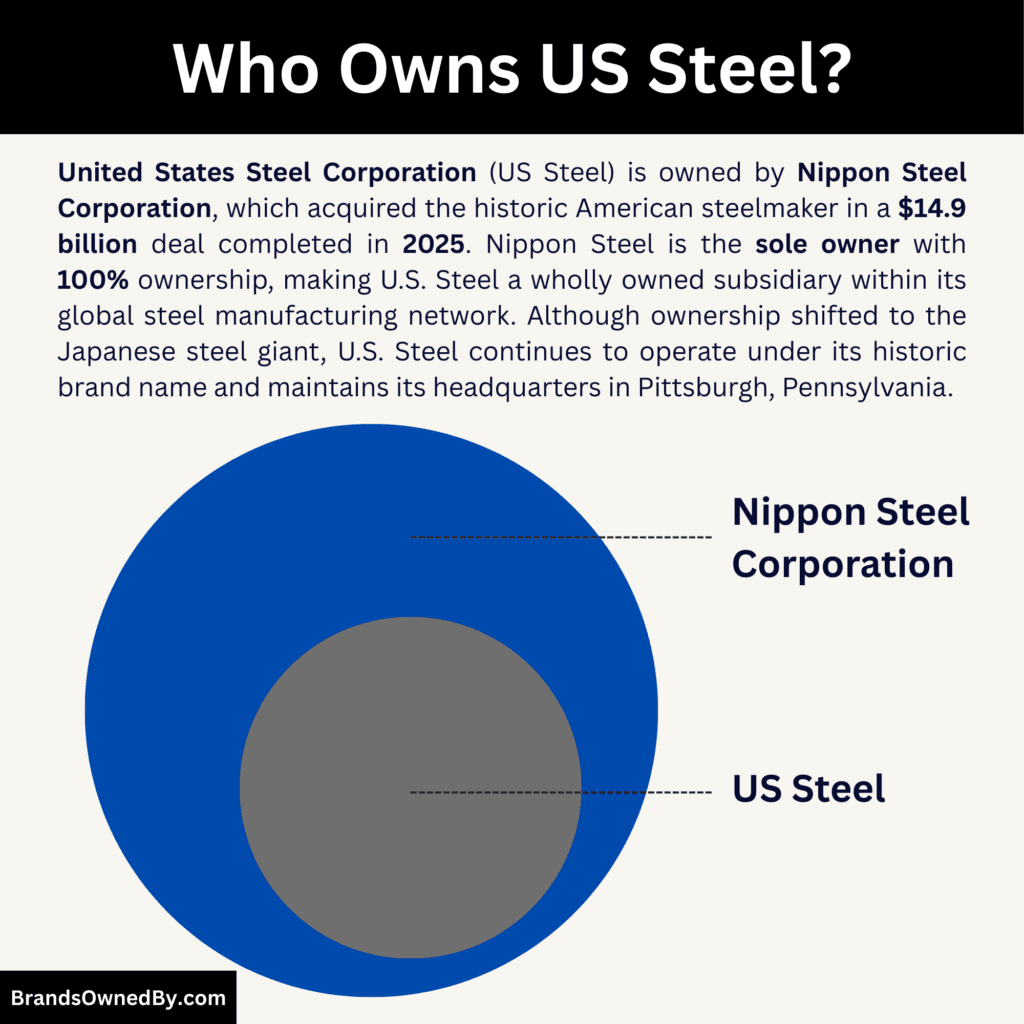
The ownership structure of United States Steel Corporation changed dramatically in the mid-2020s. For most of its history, the company was a publicly traded corporation owned by thousands of investors through stock markets. However, this structure ended after a major global acquisition.
As of 2026, United States Steel Corporation is a wholly owned subsidiary of Nippon Steel Corporation, the largest steel producer in Japan. The acquisition was completed in June 2025 in a deal valued at about $14.9 billion, with Nippon Steel purchasing all outstanding shares of U.S. Steel.
Under the terms of the agreement, U.S. Steel retained its headquarters in Pittsburgh and continues to operate under its historic brand name. However, corporate ownership now belongs entirely to the Japanese steel giant.
The acquisition also introduced a unique governance structure. The United States government received a special “golden share” mechanism that allows federal authorities to influence certain strategic decisions involving the company.
Because of this arrangement, the shareholder structure of U.S. Steel today is very different from the past. Instead of multiple institutional investors owning shares on public markets, the company now has a small number of controlling stakeholders connected to the acquisition structure.
As of 2026, the ownership structure of United States Steel Corporation can be summarized as follows:
- Nippon Steel Corporation – 100% ownership (parent company)
- Nippon Steel North America – operational holding structure in the U.S.
- U.S. government golden share – strategic oversight rights.
This structure represents one of the most significant ownership transformations in the history of the American steel industry. A company that once symbolized American industrial power is now part of a global steel manufacturing group while still maintaining its historic identity and operations in the United States.
Nippon Steel Corporation
Nippon Steel Corporation is the parent company and primary owner of United States Steel Corporation.
After completing the acquisition in June 2025, Nippon Steel purchased 100% of U.S. Steel’s outstanding shares, making it the sole corporate shareholder.
Nippon Steel is headquartered in Tokyo and is one of the largest steel producers in the world. By acquiring U.S. Steel, the company significantly expanded its presence in the North American market and strengthened its global production network.
The acquisition also helped Nippon Steel become one of the largest steel manufacturers worldwide by combining Japanese technology with American steel production capacity.
Although Nippon Steel owns the company, U.S. Steel continues to operate with its own executive leadership team and production facilities across the United States and Europe.
Nippon Steel North America
Nippon Steel North America plays a key role in the ownership structure of U.S. Steel.
The subsidiary acts as the direct U.S. holding entity through which Nippon Steel controls U.S. Steel’s American operations. This structure allows the parent company to manage its U.S. investments while complying with American corporate and regulatory frameworks.
Nippon Steel North America has been operating in the United States for decades and oversees several manufacturing and business units connected to Nippon Steel’s operations in the region.
Through this subsidiary, the parent company integrates U.S. Steel’s manufacturing network with its global steel production strategy.
United States Government (Golden Share Influence)
Although the U.S. government does not own common equity in U.S. Steel, it plays an unusual role in the company’s governance through a golden share mechanism created as part of the acquisition agreement.
This arrangement gives the U.S. government limited authority over certain strategic decisions. These may include major corporate actions such as relocation of headquarters, significant changes in ownership structure, or decisions affecting national security interests.
The golden share was introduced to address national security concerns and political opposition that arose during the acquisition process.
While it does not provide financial ownership in the company, it ensures that the United States government retains oversight over specific strategic decisions involving the historic American steel producer.
Competitor Ownership Comparison
The global steel industry includes companies with different ownership structures and governance models. Some steel producers operate as independent publicly traded corporations with dispersed shareholders, while others are controlled by large industrial groups or founding families. Comparing the ownership of United States Steel Corporation with its major competitors helps illustrate how control and decision-making vary across the steel sector.
| Company | Headquarters | Ownership Type | Major Shareholders / Controllers | Key Ownership Characteristics |
|---|---|---|---|---|
| United States Steel Corporation | Pittsburgh, United States | Subsidiary | Nippon Steel Corporation | Operates as a wholly owned subsidiary after the $14.9 billion acquisition while maintaining its U.S. operations and brand identity. |
| Nucor Corporation | Charlotte, United States | Publicly traded company | Vanguard Group, BlackRock, State Street, institutional investors | Largest U.S. steel producer with widely distributed institutional ownership. |
| Cleveland-Cliffs Inc. | Cleveland, United States | Publicly traded company | Institutional investors and public shareholders | Major American steel and iron ore producer with dispersed shareholder ownership. |
| ArcelorMittal | Luxembourg | Publicly traded with family influence | Mittal family and institutional investors | The Mittal family maintains significant ownership and voting power. |
| POSCO Holdings | Pohang, South Korea | Publicly traded corporation | Institutional investors and financial institutions | Global steel producer with diversified institutional ownership. |
| Tata Steel | Mumbai, India | Public company within conglomerate | Tata Group | Majority controlled by Tata Group as part of a large Indian multinational conglomerate. |
Nucor Corporation
Nucor Corporation is the largest steel producer in the United States and one of the most significant domestic competitors to US Steel. The company is listed on the New York Stock Exchange and follows a widely distributed shareholder model.
Ownership of Nucor is dominated by institutional investors such as Vanguard Group, BlackRock, and State Street. These asset managers hold shares through index funds, exchange-traded funds, and retirement investment portfolios on behalf of millions of investors.
Because Nucor has no controlling shareholder, corporate governance is handled by the company’s board of directors and executive leadership team. Strategic decisions are guided by management, while shareholders influence governance through voting rights and board elections.
This structure represents a typical ownership model for large American public corporations.
Cleveland-Cliffs Inc.
Cleveland-Cliffs is another major steel producer in North America and one of US Steel’s closest competitors in the domestic steel market. The company operates several steel mills and iron ore mining facilities across the United States.
Cleveland-Cliffs is publicly traded and owned primarily by institutional investors and retail shareholders. Large investment firms manage substantial portions of the company’s shares through diversified investment funds.
Although ownership is widely distributed, the company’s leadership team plays a strong role in shaping corporate strategy. Executive leadership works closely with the board of directors to guide expansion, acquisitions, and operational decisions.
Compared with US Steel’s current structure as a subsidiary, Cleveland-Cliffs remains an independent American steel producer.
ArcelorMittal
ArcelorMittal is one of the largest steel producers in the world and operates manufacturing facilities across Europe, North America, Asia, and Latin America.
The company is publicly traded, but its ownership structure includes strong influence from the Mittal family. Lakshmi Mittal and his family maintain a significant shareholding, giving them substantial voting power and influence over corporate strategy.
This ownership structure combines public market investment with family control. Institutional investors also hold shares, but the Mittal family’s stake allows them to play a central role in guiding the company’s leadership and long-term strategy.
This model differs from many American steel companies where ownership is usually more widely distributed among investors.
POSCO Holdings
POSCO Holdings is one of the largest steel producers in Asia and a major global competitor in the steel industry. The company is headquartered in South Korea and operates a wide network of steel production facilities around the world.
POSCO operates as a publicly traded corporation owned primarily by institutional investors and financial institutions. Its shares are held by global investment funds, pension funds, and domestic financial institutions in South Korea.
The company’s governance structure reflects a modern corporate ownership model where strategic decisions are managed by the board of directors and executive leadership rather than a single controlling shareholder.
Tata Steel
Tata Steel is one of the largest steel producers in the world and part of the larger Tata Group conglomerate based in India.
Unlike many publicly traded steel companies, Tata Steel operates within the corporate structure of the Tata Group, one of India’s largest multinational business groups. The Tata Group maintains significant influence over the company’s strategic direction.
Although Tata Steel’s shares are traded on stock exchanges, the parent conglomerate remains the dominant controlling shareholder. This ownership structure allows the company to benefit from the financial resources, global network, and industrial expertise of the broader Tata Group.
Key Differences in Steel Industry Ownership
These companies demonstrate the variety of ownership models used in the global steel industry.
American steel producers such as Nucor and Cleveland-Cliffs operate under dispersed ownership structures dominated by institutional investors. European companies like ArcelorMittal combine public ownership with strong family influence. Asian steel producers such as POSCO and Tata Steel often operate within corporate groups or institutional investment networks.
United States Steel now represents a different model after its acquisition. Instead of operating as a fully independent public company, it functions as part of a larger global steel organization under Nippon Steel. This structure allows the company to access global technology, capital investment, and international production networks while continuing its operations in the United States.
Who Controls US Steel?
Control of the United States Steel Corporation changed significantly after the company was acquired by Nippon Steel. While US Steel continues to operate under its historic name and remains headquartered in Pittsburgh, its governance now follows a layered structure involving the parent company, the executive leadership team, and oversight provisions agreed upon with the United States government. This structure ensures strategic control by the parent company while preserving domestic management and national-security safeguards.
Nippon Steel Corporation (Parent Company)
The ultimate control of US Steel lies with Nippon Steel Corporation, the Japanese steelmaker that completed the $14.9 billion acquisition of United States Steel in June 2025.
By acquiring all outstanding shares, Nippon Steel integrated US Steel into its global steel production network. This acquisition significantly expanded Nippon Steel’s footprint in the North American market and helped create one of the largest steel manufacturing groups in the world.
As the parent company, Nippon Steel provides strategic oversight and determines long-term corporate direction. This includes decisions related to major investments, technology transfer, production strategy, and integration of supply chains across global operations.
The combined organization aims to leverage Nippon Steel’s advanced manufacturing technologies and US Steel’s industrial footprint in North America. Together, the companies plan to invest approximately $11 billion in modernization projects by 2028, including mill upgrades and efficiency improvements across US Steel facilities.
Executive Leadership of US Steel
Despite the acquisition, day-to-day operational control of US Steel remains with its executive leadership team.
David B. Burritt continues to serve as President and Chief Executive Officer of United States Steel. He has held the role since 2017 and was retained by Nippon Steel following the acquisition to maintain continuity in operations and leadership.
The executive leadership team manages production facilities, workforce operations, customer relationships, and business strategy across the company’s steel mills, mining operations, and processing plants.
This leadership structure allows US Steel to operate with significant operational independence while still aligning with the broader strategic goals of its parent company.
Board of Directors and Governance Structure
The board of directors oversees corporate governance, executive performance, and major strategic decisions. After the acquisition, the board was restructured to address national security concerns and maintain American representation.
US Steel’s board now consists of seven directors, with a majority being U.S. citizens.
Several high-profile American leaders were appointed as independent directors, including former defense and national security officials. These appointments were designed to ensure that the company’s governance remains closely aligned with U.S. economic and security interests.
The board serves as the bridge between Nippon Steel’s strategic oversight and the operational management of US Steel.
U.S. Government Oversight and Golden Share
An unusual feature of the acquisition is the involvement of the United States government in the company’s governance.
As part of the national security agreement that allowed the acquisition to proceed, the U.S. government received a special “golden share” in US Steel.
This golden share provides the government with limited but significant oversight powers. These powers include the ability to influence or veto certain strategic decisions that could affect national security or domestic steel production.
The arrangement also allows the U.S. government to appoint a board member and maintain oversight over issues such as plant closures, relocation of headquarters, and reductions in domestic production capacity.
Decision-Making Structure
The governance structure of US Steel now operates through multiple layers of control.
Nippon Steel provides overall corporate ownership and strategic direction. The US Steel executive leadership team manages daily operations and implements corporate strategy. The board of directors ensures governance and accountability, while the U.S. government maintains limited oversight through its golden share.
This multi-layered structure was designed to balance foreign investment with domestic economic and national security interests while allowing US Steel to continue operating as a major American steel producer within a global industrial group.
US Steel Annual Revenue and Net Worth
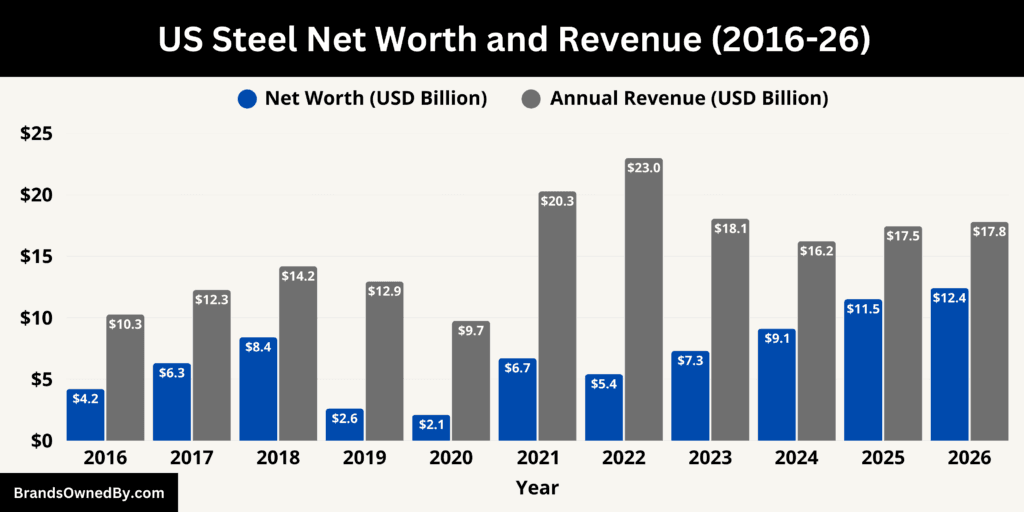
As of March 2026, the company generates approximately $17.45 billion in annual revenue and has an estimated net worth (market capitalization) of about $12.41 billion. The company operates integrated steel mills, electric-arc furnace mini-mills, iron ore mines, and steel processing facilities across the United States and Europe. Its revenue is primarily generated from flat-rolled steel products used in the automotive, construction, and industrial equipment sectors.
2026 Revenue Performance
The most recent financial results show that US Steel generated $17.45 billion in total revenue in 2025, representing a recovery from $16.22 billion in 2024. The increase was driven by higher steel shipment volumes and stronger demand from automotive and infrastructure projects in North America.
Total steel shipments during the year exceeded 15 million net tons, with the majority coming from flat-rolled steel products used in automobile manufacturing and construction materials. The company also benefited from higher output at its mini-mill operations in Arkansas, which produce advanced high-strength steel used in modern vehicle manufacturing.
Although global steel prices moderated after the record highs seen in 2021–2022, steady demand from infrastructure projects and manufacturing industries helped maintain stable revenue levels.
Revenue Breakdown by Business Segments
United States Steel generates revenue through several major operating segments that supply steel products to different industries and geographic markets.
The North American Flat-Rolled segment is the largest contributor to the company’s total revenue. This division generated roughly $9.8 billion in sales, accounting for more than half of the company’s overall revenue. The segment produces hot-rolled, cold-rolled, and coated steel used in automobiles, appliances, construction materials, and industrial equipment.
The Mini-Mill segment, which includes Big River Steel and its expansion facility in Arkansas, generated approximately $3.3 billion in revenue. These operations use electric arc furnace technology to produce advanced steel grades with higher efficiency and lower emissions compared with traditional blast furnace production.
The European segment, centered around the U.S. Steel Košice plant in Slovakia, produced about $3.0 billion in revenue. This facility supplies flat-rolled steel to European automotive manufacturers and industrial companies across Central and Eastern Europe.
The Tubular segment contributed approximately $1.3 billion in revenue. This division produces steel pipes used in oil and gas drilling, pipelines, and other energy infrastructure applications.
Together, these four business segments form the company’s global steel production network and generate its primary sources of revenue.
Net Worth and Market Valuation in 2026
The net worth of US Steel is commonly measured by its market capitalization, which represents the value investors assign to the company.
As of March 2026, US Steel has a market capitalization of approximately $12.41 billion. This valuation reflects investor expectations following the company’s acquisition by Nippon Steel and its planned modernization investments.
In addition to its market value, the company owns substantial industrial assets including steel mills, mining operations, transportation infrastructure, and processing facilities. These assets support a production capacity of roughly 23 million tons of steel annually across its global operations.
The company also maintains iron ore mining operations in Minnesota, which supply raw materials to its steel mills and help reduce dependence on external suppliers.
Future Revenue Forecast (2027–2030)
United States Steel is expected to maintain moderate revenue growth in the coming years as production capacity expands and modernization projects improve operational efficiency.
- 2027: Revenue projected to reach about $18.2 billion as upgraded production facilities increase steel output.
- 2028: Revenue expected to approach $19 billion as new technology investments improve productivity and product mix.
- 2029: Revenue could exceed $20 billion if global infrastructure spending and automotive demand remain strong.
- 2030: Revenue may reach approximately $21–22 billion as advanced steel products and modern mini-mill operations expand production capacity.
Future growth will be supported by investments in electric arc furnace technology, modernization of steel mills, and increased demand for advanced steel used in automobiles, renewable energy infrastructure, and industrial manufacturing.
Companies Owned by US Steel
United States Steel Corporation operates a network of steel manufacturing facilities, mining operations, subsidiaries, and specialized business divisions. These entities manage different parts of the company’s production chain, including iron ore mining, steel manufacturing, steel processing, and advanced mini-mill production.
The company’s subsidiaries and operating entities are designed to support the entire steel supply chain. Some focus on raw material production, while others manufacture finished steel products used in automobiles, infrastructure, energy pipelines, and heavy equipment.
Below are the most important companies, brands, and operating entities owned and operated by United States Steel Corporation as of 2026.
| Company / Entity | Type | Location | Core Function | Key Details |
|---|---|---|---|---|
| Big River Steel | Subsidiary / Mini-mill | Arkansas, United States | Electric arc furnace steel production | Modern steel mini-mill producing advanced flat-rolled steel for automotive, construction, and industrial markets. |
| Big River Steel 2 (BR2) | Expansion facility | Arkansas, United States | Advanced mini-mill steel production | High-capacity electric arc furnace facility designed to increase production and efficiency. |
| U. S. Steel Košice | International subsidiary | Košice, Slovakia | Integrated steel production | One of the largest steel plants in Central Europe producing flat-rolled steel for European markets. |
| Minntac Mine | Mining operation | Minnesota, United States | Iron ore mining | Large iron ore pellet production facility supplying raw materials for US Steel blast furnaces. |
| Keetac Mine | Mining operation | Minnesota, United States | Taconite pellet production | Produces iron ore pellets used in steel manufacturing at US Steel plants. |
| Gary Works | Integrated steel mill | Indiana, United States | Flat-rolled steel manufacturing | One of the largest steel mills in North America producing steel for automotive and construction industries. |
| Mon Valley Works | Steel production complex | Pennsylvania, United States | Integrated steel production | Network of facilities including blast furnaces, finishing mills, and coke production plants. |
| Edgar Thomson Steel Works | Steel mill | Pennsylvania, United States | Steel slab production | Historic steel plant producing raw steel slabs used for flat-rolled steel products. |
| Clairton Coke Works | Coke manufacturing facility | Pennsylvania, United States | Coke production | Largest coke production facility in North America supporting blast furnace steelmaking. |
| Irvin Plant | Finishing facility | Pennsylvania, United States | Steel processing and coating | Produces finished flat-rolled steel products used in automotive and industrial manufacturing. |
| U. S. Steel Tubular Products | Manufacturing division | United States | Steel pipe production | Produces seamless and welded tubular steel used in oil, gas, and energy infrastructure. |
| PRO-TEC Coating Company | Joint venture | Ohio, United States | Automotive steel coating | Produces galvanized steel sheets used in automobile body manufacturing. |
| Transtar LLC | Logistics and transportation | United States | Industrial transportation | Provides rail and logistics services used to transport raw materials and steel products. |
| U. S. Steel Research and Technology Center | Research division | Pennsylvania, United States | Steel technology development | Conducts research on advanced steel alloys, manufacturing processes, and sustainability. |
Big River Steel
Big River Steel is one of the most important subsidiaries of US Steel and represents the company’s shift toward modern steel production technologies.
The facility is located in Osceola, Arkansas, and operates as a mini-mill that uses electric arc furnace technology. Unlike traditional blast furnace steelmaking, electric arc furnaces melt recycled scrap steel to produce high-quality flat-rolled steel.
US Steel initially invested in Big River Steel in 2019 and later acquired the remaining ownership to make it a fully owned subsidiary. The plant produces advanced high-strength steel that is widely used in the automotive industry, construction materials, and appliances.
Big River Steel is also a central part of the company’s sustainability strategy because electric arc furnace production generates lower carbon emissions compared with traditional steelmaking methods.
Big River Steel 2 (BR2)
Big River Steel 2, commonly known as BR2, is an expansion project and advanced steel production facility located adjacent to the original Big River Steel plant in Arkansas.
The facility was developed to significantly increase the company’s mini-mill production capacity. BR2 uses the same electric arc furnace technology but operates with improved automation, higher efficiency, and expanded production capabilities.
The plant produces high-grade steel for demanding applications such as automotive manufacturing, renewable energy infrastructure, and industrial equipment.
The development of BR2 represents one of the largest investments in modern steelmaking technology in the United States and plays a major role in the company’s long-term growth strategy.
U. S. Steel Košice
U. S. Steel Košice is the company’s largest European subsidiary and operates a major integrated steel mill in Slovakia.
The facility produces flat-rolled steel products that serve customers across Central and Eastern Europe. These products are used in automotive manufacturing, construction materials, electrical equipment, and industrial machinery.
Košice is one of the largest employers in Slovakia and a key supplier of steel to European manufacturers. The plant includes blast furnaces, finishing mills, and coating lines capable of producing specialized steel products.
The European operation allows US Steel to maintain a strong presence in international markets outside North America.
Minntac Mine
Minntac Mine is a large iron ore mining operation located in Minnesota’s Mesabi Range.
The mine produces iron ore pellets used in steel production at US Steel’s integrated mills. Iron ore pellets are a critical raw material for blast furnace steelmaking.
Minntac is one of the largest iron ore mines in the United States and plays a key role in securing the company’s supply of raw materials.
By owning its own mining operations, US Steel maintains partial control over the raw material supply chain, reducing reliance on external iron ore suppliers.
Keetac Mine
Keetac, short for Keewatin Taconite, is another iron ore mining operation owned by US Steel in Minnesota.
The mine produces taconite pellets used in the company’s steelmaking operations. Taconite is a form of iron ore that is processed into pellets for use in blast furnaces.
Keetac supports the company’s vertically integrated business model by supplying iron ore directly to its steel plants.
Gary Works
Gary Works is one of the largest integrated steel mills in North America and one of US Steel’s most historically important facilities.
Located in Gary, Indiana, the plant produces flat-rolled steel used in automotive manufacturing, construction materials, appliances, and industrial machinery.
The facility includes blast furnaces, coke plants, finishing mills, and coating lines that produce a wide range of steel products.
Gary Works has been a central part of the American steel industry for more than a century and remains one of the company’s most important production centers.
Mon Valley Works
Mon Valley Works is a group of steelmaking facilities located in Pennsylvania near Pittsburgh.
The complex includes several plants such as the Edgar Thomson Steel Works, Irvin Plant, and Clairton Coke Works. These facilities work together to produce and process steel products.
The Edgar Thomson plant produces steel slabs, which are then processed at finishing facilities to create flat-rolled steel products used in automotive and industrial applications.
Mon Valley Works has historically been one of the core production centers for US Steel.
Edgar Thomson Steel Works
Edgar Thomson Steel Works is a historic steel mill located in Braddock, Pennsylvania.
The plant produces steel slabs that serve as the base material for many finished steel products. These slabs are processed into sheets, coils, and other products used in manufacturing and construction.
The facility is one of the oldest operating steel mills in the United States and continues to play an important role in the company’s production network.
Clairton Coke Works
Clairton Coke Works is the largest coke manufacturing facility in North America.
The plant converts coal into coke, a fuel used in blast furnace steelmaking. Coke is essential for producing steel in traditional integrated mills.
The facility supplies coke to several US Steel plants, including those in the Mon Valley region.
Clairton Coke Works is a key component of the company’s vertically integrated steel production system.
Irvin Plant
The Irvin Plant is a finishing facility located in West Mifflin, Pennsylvania.
The plant processes steel slabs produced at other facilities and converts them into flat-rolled steel sheets and coils.
These products are used in automotive manufacturing, appliances, and construction materials. The plant also includes coating lines that apply protective layers to steel products.
U. S. Steel Tubular Products
US Steel Tubular Products is a division that manufactures steel pipes used in energy infrastructure.
These pipes are widely used in oil and gas drilling operations, pipelines, and industrial applications. Tubular steel products are essential for transporting oil, natural gas, and other energy resources.
The division operates several manufacturing facilities that produce seamless and welded steel pipes designed for high-pressure environments.
PRO-TEC Coating Company
PRO-TEC Coating Company is a joint venture between US Steel and Nippon Steel that produces advanced coated steel for automotive manufacturing.
The facility specializes in galvanizing steel sheets used in automobile body panels. Galvanized steel is coated with zinc to improve corrosion resistance and durability.
Many major automotive manufacturers rely on PRO-TEC coated steel for vehicle production.
The joint venture combines advanced coating technology with the steel production capabilities of US Steel.
Transtar LLC
Transtar LLC is a transportation and logistics company historically associated with US Steel.
The company operates railroads, barges, and other transportation assets used to move raw materials and steel products between mines, mills, and customers.
Although parts of Transtar were sold in recent years, the logistics infrastructure developed through the company continues to support US Steel’s industrial operations.
US Steel Research and Technology Center
The US Steel Research and Technology Center is responsible for developing advanced steel products and manufacturing technologies.
The facility conducts research on steel alloys, manufacturing efficiency, environmental sustainability, and product performance.
Engineers and scientists at the center work on developing new steel grades used in automotive manufacturing, energy infrastructure, and advanced engineering applications.
Research initiatives from this center play a major role in improving the company’s competitiveness and technological capabilities.
Conclusion
Understanding who owns US Steel highlights how the company has evolved from an iconic American industrial giant into part of a global steel network. Today, the company operates under the ownership of Nippon Steel while continuing to run major manufacturing facilities, mines, and research operations across the United States and Europe.
Despite the change in ownership, US Steel remains a major producer of flat-rolled and tubular steel used in automobiles, infrastructure, and energy industries. Its vertically integrated operations, modern mini-mill investments, and global production network ensure that the company continues to play an important role in the global steel market.
FAQs
Who is the biggest shareholder of U.S. Steel?
The biggest shareholder of U.S. Steel is Nippon Steel Corporation. After completing the acquisition in 2025, Nippon Steel purchased 100% of the company’s shares, making it the sole shareholder and parent company of United States Steel Corporation.
Who founded U.S. Steel?
U.S. Steel was founded in 1901 by financier J. P. Morgan through a major industrial merger. The company combined several large steel businesses, including Carnegie Steel Company founded by Andrew Carnegie, creating the first corporation in the world valued at more than $1 billion.
Who owns U.S. Steel companies?
The companies and subsidiaries operating under U.S. Steel are ultimately owned by Nippon Steel Corporation, the Japanese steel manufacturer that acquired the company. These entities include steel mills, mining operations, and processing facilities operated under the U.S. Steel brand.
Who bought United States Steel?
United States Steel was bought by Nippon Steel Corporation, Japan’s largest steel producer. The acquisition was announced in December 2023 and completed in 2025, integrating U.S. Steel into Nippon Steel’s global steel production network.
Is U.S. Steel bought by Nippon?
Yes. U.S. Steel was acquired by Nippon Steel in a deal valued at approximately $14.9 billion, making it a wholly owned subsidiary of the Japanese company.
Is U.S. Steel owned by Japan?
U.S. Steel is now owned by a Japanese company, Nippon Steel Corporation. However, the company continues to operate its headquarters and major manufacturing facilities in the United States.
Is U.S. Steel owned by JP Morgan?
No. U.S. Steel is not owned by J. P. Morgan today. J. P. Morgan helped create the company in 1901, but the company is now owned by Nippon Steel Corporation following the acquisition completed in the 2020s.
Is U.S. Steel still American owned?
U.S. Steel is no longer American owned. The company is currently owned by Japan-based Nippon Steel, although it still operates major facilities and maintains its headquarters in the United States.
Who is the majority owner of U.S. Steel?
The majority owner of U.S. Steel is Nippon Steel Corporation, which holds 100% ownership of the company after acquiring all outstanding shares.
Who owned U.S. Steel before Nippon?
Before the acquisition, U.S. Steel was a publicly traded company listed on the New York Stock Exchange. Its shares were owned by institutional investors such as BlackRock, Vanguard Group, and State Street, along with thousands of individual shareholders.
Why did Nippon buy U.S. Steel?
Nippon Steel acquired U.S. Steel to expand its presence in the North American steel market, increase production capacity, and combine advanced Japanese steel technology with U.S. manufacturing operations.
How much did Nippon pay for U.S. Steel?
Nippon Steel paid approximately $14.9 billion to acquire United States Steel Corporation, making it one of the largest transactions in the global steel industry.
Who started U.S. Steel?
U.S. Steel was started by J. P. Morgan in 1901, who organized the merger of several steel companies, including Andrew Carnegie’s Carnegie Steel Company, to form the United States Steel Corporation.