

- TMZ is owned by Fox Corporation, making it part of a publicly traded media group rather than an independent company.
- Fox Corporation is controlled by the Murdoch family, with Lachlan Murdoch holding significant influence through voting power.
- Major institutional shareholders of Fox include The Vanguard Group and BlackRock, meaning TMZ is indirectly owned by large global investors.
- Editorial control remains with Harvey Levin, ensuring operational independence despite corporate ownership.
TMZ is a celebrity news and entertainment platform known for breaking exclusive stories. It focuses on Hollywood, pop culture, legal issues, and viral moments. The platform operates across multiple formats, including its website, television shows, and social media channels.
The brand stands out for its fast reporting style. It often publishes stories before traditional media outlets. TMZ relies heavily on insider sources, paparazzi footage, and direct tips. This approach allows it to capture real-time developments in celebrity culture.
Its content is direct and often controversial. This has helped TMZ build a strong audience. It is widely recognized for shaping public conversations around celebrities and major entertainment events.
TMZ Founder
TMZ was founded in 2005 by Harvey Levin.
Harvey Levin is a former lawyer turned television producer and journalist. Before launching TMZ, he worked on shows like The People’s Court. His legal background played a key role in shaping TMZ’s coverage, especially in reporting legal cases involving celebrities.
He created TMZ in partnership with Warner Bros. through its division Telepictures Productions. The goal was to build a digital-first celebrity news platform that could move faster than traditional outlets.
Harvey Levin became the public face of TMZ. He led its editorial direction and helped define its tone. His leadership style focused on speed, exclusivity, and strong source networks.
Over time, Levin remained closely involved in TMZ’s operations. His influence continues to shape how the platform reports news and engages with its audience.
Ownership History
TMZ’s ownership history is more complex than most media brands. It has moved across multiple corporate structures. Each transition reflects broader shifts in the media industry, especially consolidation and digital transformation.
Launch as a Joint Venture (2005–2009)
TMZ was launched in 2005 as a strategic partnership between AOL and Warner Bros. through its Telepictures division.
This structure was intentional. AOL brought massive online traffic and distribution power. Warner Bros. contributed production expertise and access to entertainment networks.
At the time, this was a forward-looking model. Traditional media companies were experimenting with digital-first platforms. TMZ became one of the earliest successful examples of this hybrid model.
However, the partnership did not last long in its original form. When Time Warner separated from AOL in 2009, the collaboration weakened.
Full Integration Under Warner Bros. and WarnerMedia (2009–2021)
After AOL’s exit, TMZ became fully controlled by Warner Bros. This marked a major shift. TMZ was no longer a joint experiment. It became a fully owned media asset.
Later, Warner Bros. became part of WarnerMedia after AT&T acquired Time Warner in 2018.
During this period, TMZ operated inside a massive media ecosystem. It sat alongside brands like HBO and CNN. This gave it access to stronger infrastructure, legal backing, and distribution.
WarnerMedia also used TMZ as a high-engagement digital property. It complemented its traditional television and film businesses.
However, AT&T eventually decided to exit large parts of the media business. This decision directly led to TMZ’s next ownership change.
Sale to Fox Corporation (2021)
In September 2021, TMZ was sold to Fox Corporation through its division Fox Entertainment.
This was a major turning point.
Fox acquired all TMZ-branded assets. This included:
- TMZ.com
- TMZ on TV
- TMZ Live
- TMZ Sports
- TooFab.
Fox’s strategy was clear. It wanted to expand its digital and unscripted content portfolio. TMZ already had a strong brand recognition and high traffic. It fit perfectly into Fox’s content ecosystem.
Importantly, Harvey Levin stayed on after the acquisition. He continued to oversee editorial operations. This ensured continuity in TMZ’s voice and reporting style.
Strategic Position Under Fox (2021–2026)
Since the acquisition, TMZ has operated under Fox Entertainment. It is ultimately owned by Fox Corporation, which is controlled by the Murdoch family through its shareholder structure.
Fox integrated TMZ into its broader media network. This includes:
- Fox Television Stations
- Streaming platform Tubi
- Syndicated broadcast distribution.
This integration allowed TMZ to expand its reach. It also strengthened monetization through advertising and syndication.
Unlike its previous phase under WarnerMedia, TMZ now sits inside a company more focused on news, sports, and unscripted content rather than large-scale film production.
Industry Context and 2026 Developments
The media industry is undergoing rapid consolidation as of 2026. While TMZ itself has not changed ownership again, its historical parent companies are part of major deal activity.
For example, Warner Bros. Discovery—a former owner of TMZ—is currently involved in a proposed $110+ billion merger with Paramount Skydance.
This highlights a key point. Media assets like TMZ are often bought and sold as part of larger strategic shifts.
Fox, however, has retained TMZ as a core digital asset. There have been no confirmed reports of a resale or spin-off as of March 2026.
Who Owns TMZ?
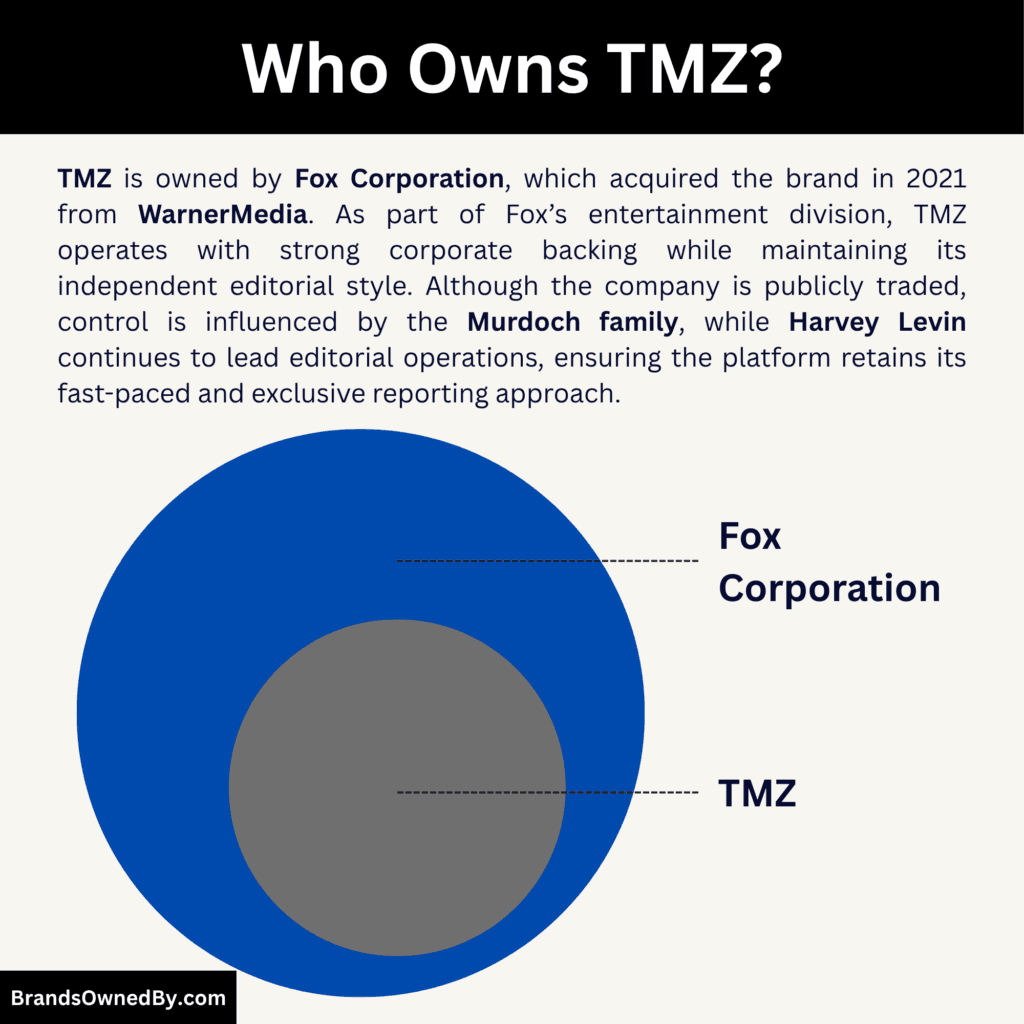
TMZ is owned by Fox Corporation. It operates as a core digital media asset within Fox’s entertainment division. The platform is not independent. Its ownership, strategy, and expansion are directly tied to Fox’s broader media ecosystem as of 2026.
Parent Company: Fox Corporation
Fox Corporation was created in 2019 after The Walt Disney Company acquired most of 21st Century Fox. The remaining assets were reorganized into a new company focused on live and digital media.
Fox Corporation’s business model is very different from traditional Hollywood studios. It prioritizes:
- Live content (news and sports)
- Unscripted and reality programming
- Digital-first media platforms.
Key assets under Fox Corporation include:
- Fox News
- Fox Sports
- Tubi
- Fox Television Stations
- Fox Entertainment.
TMZ fits into this structure as a high-frequency digital content engine. It produces daily viral content that complements Fox’s real-time media strategy.
Fox Corporation is controlled by the Murdoch family. Lachlan Murdoch leads the company. The family maintains significant voting power, which allows long-term strategic control despite public shareholding.
Acquisition of TMZ by Fox
The most important event in TMZ’s ownership history is its acquisition by Fox in 2021.
In September 2021, Fox Corporation acquired TMZ from WarnerMedia. This was not a partial investment. It was a full acquisition of the TMZ brand and all associated assets.
The deal included:
- TMZ.com (core digital platform)
- TMZ on TV (syndicated show)
- TMZ Live (daily talk format)
- TMZ Sports (sports vertical)
- TooFab (celebrity and lifestyle site).
While the financial terms were not officially disclosed, industry estimates suggested a deal value in the range of $50 million to $100 million. The relatively modest valuation reflected TMZ’s niche focus but high engagement.
Why WarnerMedia Sold TMZ
At the time, WarnerMedia was undergoing strategic restructuring under AT&T.
AT&T wanted to reduce debt and refocus its media portfolio. It prioritized large-scale streaming and premium content through HBO Max. TMZ did not align with this premium strategy.
As a result, WarnerMedia divested non-core digital assets. TMZ was one of the most prominent sales.
Why Fox Acquired TMZ
Fox’s strategy was the opposite.
Fox was not competing in big-budget streaming wars. Instead, it focused on:
- Ad-supported content
- High-volume publishing
- Real-time audience engagement.
TMZ fit perfectly into this model. It already had:
- Strong brand recognition
- Consistent traffic
- Viral content capability
- Low production costs compared to scripted content.
The acquisition allowed Fox to instantly strengthen its digital footprint without building a new brand from scratch.
Integration into Fox’s Ecosystem (2022–2026)
After the acquisition, Fox integrated TMZ into its broader content and distribution network.
TMZ content is now leveraged across:
- Fox Television Stations for syndicated programming
- Digital distribution through Fox-owned platforms
- Cross-promotion with Tubi
- Advertising networks managed by Fox.
This integration improved monetization efficiency. TMZ’s constant stream of content supports Fox’s ad-driven revenue model.
As of March 2026, TMZ remains a stable and active part of Fox’s portfolio. There have been no confirmed reports of resale or restructuring.
Role of TMZ Within Fox Corporation
TMZ serves a very specific function inside Fox.
It acts as a real-time content generator. Unlike traditional media brands that rely on scheduled programming, TMZ publishes continuously.
This gives Fox:
- Daily audience engagement
- Strong social media presence
- Viral distribution opportunities.
It also helps Fox reach younger, digital-first audiences. This is critical as traditional TV viewership declines.
Competitor Ownership Comparison
TMZ operates in a crowded celebrity news and entertainment media market. However, what differentiates each competitor is not just content style, but ownership structure.
As of March 2026, most of TMZ’s key competitors are controlled by large media conglomerates or publicly traded digital media companies. These ownership structures directly influence editorial tone, speed of reporting, monetization strategies, and long-term positioning.
TMZ, under Fox Corporation, occupies a hybrid position. It combines the speed of digital tabloids with the infrastructure of a major broadcaster. This becomes clearer when compared to its competitors.
| Platform | Parent Company | Ownership Type | Core Strategy | Content Style | Key Advantage | Key Limitation |
|---|---|---|---|---|---|---|
| TMZ | Fox Corporation | Public company (Murdoch family control via voting power) | Digital-first, ad-supported, high-frequency publishing | Aggressive, fast, exclusive, controversy-driven | Breaks news faster than competitors, strong insider network | Limited access to official studio partnerships compared to legacy media |
| E! News | NBCUniversal (owned by Comcast) | Conglomerate-owned | Premium entertainment coverage, TV + digital integration | Polished, brand-safe, celebrity-friendly | Strong access to Hollywood events and talent | Slower reporting, avoids controversial stories |
| Entertainment Tonight | Paramount Global | Conglomerate-owned | Syndicated TV distribution, mainstream appeal | Conservative, interview-based, promotional | Massive distribution network and long-standing brand | Less focus on breaking news or exclusives |
| Daily Mail Online | Daily Mail and General Trust | Public company | High-volume global digital publishing | Sensational, fast, wide coverage (beyond celebrities) | Global reach, strong SEO and traffic dominance | Less specialized in entertainment-only coverage |
| BuzzFeed Entertainment | BuzzFeed | Public company | Social-first, engagement-driven content | Viral, listicles, trend-based | Strong social media distribution and shareability | Weak in exclusive reporting and insider access |
| Page Six | News Corp | Conglomerate-owned (Murdoch family influence) | Tabloid journalism integrated with news publishing | Gossip-heavy, insider-driven | Strong tabloid heritage and NYC media connections | Slower digital execution compared to TMZ |
E! News (Owned by NBCUniversal under Comcast)
E! News operates under NBCUniversal, which is ultimately owned by Comcast.
As of 2026, NBCUniversal continues to position E! as a premium entertainment news brand tied closely to Hollywood events, award shows, and celebrity partnerships. Its ownership gives it strong access to talent, studios, and exclusive interviews.
However, this structure also imposes limitations. E! News prioritizes brand-safe content. It avoids aggressive or controversial reporting. This is because NBCUniversal maintains deep relationships with film studios and advertisers. As a result, E! is slower in breaking stories compared to TMZ, but stronger in polished production and official access.
Entertainment Tonight (Owned by Paramount Global)
Entertainment Tonight is owned by Paramount Global.
Paramount Global, as of 2026, continues to operate a diversified media portfolio including CBS and its streaming platform Paramount+. Entertainment Tonight benefits from one of the largest syndication networks in the U.S.
Its ownership model emphasizes stability and wide distribution. The show is broadcast across multiple local stations, giving it a consistent reach. However, its editorial tone remains conservative and mainstream. It focuses on celebrity interviews, promotional content, and red carpet coverage rather than investigative or breaking news.
Compared to TMZ, Entertainment Tonight is less reactive. It trades speed for reliability and long-term brand partnerships.
Daily Mail Online (Owned by Daily Mail and General Trust)
Daily Mail Online is owned by Daily Mail and General Trust.
As of 2026, Daily Mail Online remains one of the largest English-language news websites globally. Its ownership structure supports a digital-first, high-volume publishing model.
Unlike traditional broadcasters, Daily Mail operates with fewer constraints related to studio relationships. This allows it to compete directly with TMZ in terms of speed and volume.
However, there are key differences. Daily Mail has a broader editorial scope. It covers politics, lifestyle, and global news alongside celebrity content. TMZ, in contrast, is highly specialized in entertainment and legal celebrity coverage.
Daily Mail’s global ownership base gives it international reach, while TMZ remains more U.S.-focused but culturally influential.
BuzzFeed Entertainment (Owned by BuzzFeed Inc.)
BuzzFeed operates as a publicly traded company with a strong emphasis on digital distribution.
As of 2026, BuzzFeed has restructured its business multiple times to focus on profitability and core verticals, including entertainment content. Its ownership model is driven by advertising, branded content, and platform distribution.
BuzzFeed’s entertainment division competes with TMZ for online attention, but the approach is fundamentally different. BuzzFeed prioritizes shareability and audience engagement. It relies on quizzes, listicles, and social trends.
It does not compete aggressively in breaking celebrity news. It lacks the insider sourcing network that TMZ has built over time.
Page Six (Owned by News Corp)
Page Six is owned by News Corp.
News Corp, also controlled by the Murdoch family, operates a portfolio that includes newspapers, digital media, and publishing assets. Page Six functions as a tabloid-style celebrity gossip platform within the New York Post.
As of 2026, Page Six remains a direct competitor to TMZ in tone and content style. Both focus on exclusives, insider leaks, and controversial stories.
However, Page Six is still tied to a traditional newspaper structure. This affects its speed and digital agility. TMZ, being built as a digital-first platform, moves faster and publishes more frequently.
Strategic Differences Driven by Ownership
Ownership structure directly shapes how each competitor operates.
Companies like NBCUniversal and Paramount Global prioritize long-term brand relationships. This results in controlled, polished, and advertiser-friendly content. Their platforms are less likely to publish risky or controversial stories.
Digital-first publishers like Daily Mail and BuzzFeed operate at scale. They focus on traffic, engagement, and global reach. However, their content strategies are broader and less specialized.
TMZ, under Fox Corporation, sits in a unique position. Fox does not rely heavily on Hollywood studio relationships in the same way as NBCUniversal or Paramount. This gives TMZ more editorial freedom.
At the same time, Fox provides strong distribution infrastructure, advertising networks, and financial backing. This combination allows TMZ to operate aggressively while still benefiting from corporate support.
Who Controls TMZ?
Control of TMZ is layered. It involves corporate oversight from its parent company and strong internal editorial leadership. While Fox Corporation owns TMZ, day-to-day control is exercised through a combination of executive leadership, editorial authority, and corporate governance.
As of 2026, control of TMZ can be summarized in three layers:
- Fox Corporation controls strategy and ownership
- Fox Entertainment manages operations and monetization
- Harvey Levin controls editorial direction and content.
This multi-layered structure is what allows TMZ to operate effectively. It combines corporate stability with editorial independence, which is rare in modern media.
Corporate Control: Fox Corporation Leadership
At the highest level, TMZ is controlled by Fox Corporation. Strategic decisions such as long-term investments, expansion, partnerships, and financial planning are influenced at this level.
Lachlan Murdoch is the key decision-maker. He oversees the entire company and sets its overall direction. Under his leadership, Fox has focused on live content, digital platforms, and ad-supported media. TMZ aligns directly with this strategy.
Fox’s board of directors and executive team also play a role. They approve major decisions that affect all subsidiaries, including TMZ. This includes budget allocation, acquisitions, and structural changes.
Although Fox is publicly traded, control is not evenly distributed. The Murdoch family holds significant voting power. This allows them to maintain long-term control over corporate strategy.
Operational Control: Fox Entertainment Division
Within Fox Corporation, TMZ operates under Fox Entertainment.
This division handles:
- Content production oversight
- Distribution strategy
- Advertising and monetization
- Syndication deals.
Fox Entertainment ensures that TMZ integrates smoothly with other Fox assets. It also aligns TMZ’s output with broader company goals.
However, Fox does not directly control editorial decisions. Its role is more strategic and operational rather than content-focused.
Editorial Control: Harvey Levin’s Role
The most important figure in TMZ’s control structure is Harvey Levin.
He is the founder and remains the central authority over editorial direction. His responsibilities include:
- Deciding which stories are published
- Setting the tone and style of reporting
- Managing newsroom operations
- Maintaining source networks.
Harvey Levin’s influence is critical. TMZ’s identity is closely tied to his approach. He emphasizes speed, exclusivity, and legal accuracy.
Even after the 2021 acquisition by Fox, Levin retained control over editorial operations. This was a deliberate decision. Fox recognized that TMZ’s value lies in its unique voice and fast-moving newsroom.
Decision-Making Structure
TMZ follows a hybrid control model that balances corporate oversight with editorial independence.
At the corporate level, Fox Corporation defines strategic direction. This includes financial planning, partnerships, and distribution.
At the operational level, Fox Entertainment manages production logistics and monetization.
At the editorial level, Harvey Levin and his team control content decisions.
This structure allows TMZ to remain agile. It can break stories quickly without waiting for corporate approval. At the same time, it benefits from the resources of a major media company.
Influence of Corporate Ownership on Control
While Fox does not interfere in daily editorial decisions, its ownership still affects TMZ in important ways.
Fox provides:
- Legal support for sensitive stories
- Financial backing for expansion
- Distribution channels across TV and digital platforms.
This indirectly influences what TMZ can publish and how it scales.
For example, having strong legal backing allows TMZ to take risks that smaller outlets cannot. This is a key part of its competitive advantage.
TMZ Annual Revenue and Net Worth
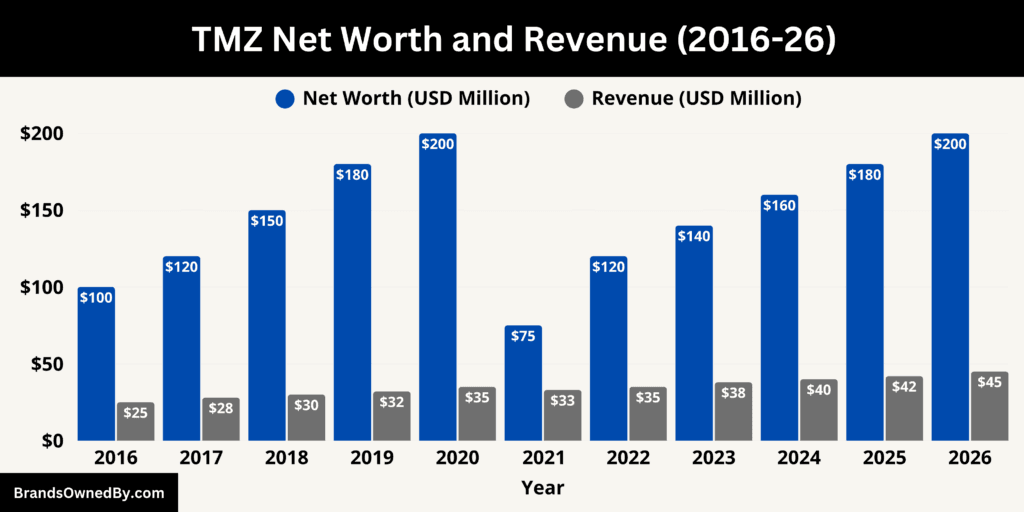
As of March 2026, TMZ generates an estimated $45 million in annual revenue and holds an estimated net worth of around $200 million. These figures reflect a stable, mature digital media business rather than a high-growth startup. Despite its relatively modest size, TMZ remains highly profitable due to its low-cost content model and strong monetization under Fox Corporation, which itself operates a multi-billion-dollar media ecosystem with over $5 billion in quarterly revenue as of early 2026.
2026 Revenue Breakdown
TMZ’s estimated $45 million revenue in 2026 is driven primarily by advertising, with digital ads forming the largest share. Industry benchmarks for similar high-traffic media platforms suggest that 60–70% of total revenue comes from digital advertising, including programmatic ads, video ads, and direct brand campaigns. TMZ’s strength lies in high engagement and repeat traffic, which allows premium ad placements.
Television syndication contributes a significant secondary revenue stream. Programs like TMZ on TV and TMZ Live are distributed across Fox-owned stations and partner networks. These shows generate consistent licensing fees and advertising revenue tied to broadcast slots. This segment typically accounts for 20–25% of total revenue, supported by long-running syndication agreements and stable viewership.
Social media and video monetization represent a growing segment. Platforms such as YouTube and Facebook generate revenue through ad-sharing models. With increasing video consumption, this segment contributes an estimated 10–15% of total revenue in 2026.
Additionally, TMZ earns income through content licensing and partnerships. Exclusive footage, celebrity clips, and breaking news segments are often licensed to other networks and digital platforms. This adds incremental revenue with minimal additional cost.
2026 Net Worth and Valuation Analysis
TMZ’s estimated valuation of $200 million, as of March 2026, reflects a strong recovery and growth after its acquisition. In 2021, Fox acquired TMZ for approximately $50 million, a relatively low price driven by WarnerMedia’s strategic divestment rather than weak performance.
Since then, TMZ’s valuation has increased roughly 4x within five years. This growth is tied to improved monetization efficiency under Fox and better integration into its advertising ecosystem.
Unlike traditional media companies, TMZ operates with minimal capital expenditure. It does not invest heavily in production infrastructure, scripted content, or large teams. This results in high operating margins compared to television networks or film studios.
The valuation is supported by three measurable factors. First, consistent traffic volume and brand recognition in celebrity journalism. Second, strong profitability due to low operating costs. Third, scalability through Fox’s distribution and advertising network.
Revenue and Valuation Growth Drivers (2022–2026)
The period after Fox’s acquisition is critical to understanding TMZ’s financial trajectory.
Fox integrated TMZ into its broader advertising and distribution systems. This includes leveraging its national ad sales network and digital platforms. Fox’s advertising business has shown steady growth, with quarterly revenues exceeding $5 billion and rising ad demand across news, sports, and digital platforms.
This scale directly benefits TMZ. It gains access to premium advertisers and better pricing for ad inventory.
Another key driver is the rise of ad-supported streaming. Fox’s platform Tubi has experienced strong growth, attracting younger audiences and expanding digital ad inventory. TMZ content aligns with this model, contributing to higher monetization efficiency across platforms.
Content efficiency is also a major factor. TMZ produces high volumes of content at low cost. It relies on real-time reporting, user-generated tips, and short-form video rather than expensive productions. This allows revenue growth without proportional cost increases.
Finally, brand positioning plays a role. TMZ remains one of the fastest sources for celebrity news. This ensures consistent traffic and advertiser demand, even in a competitive media environment.
Future Revenue Forecast (2027–2030)
Based on current growth trends, advertising expansion, and Fox’s continued investment in digital media, TMZ’s revenue is expected to grow steadily over the next several years:
- 2027: $48 million
- 2028: $52 million
- 2029: $56 million
- 2030: $60 million.
This projection assumes continued growth in digital advertising, higher video monetization, and stable audience demand for celebrity and entertainment news.
Brands Owned by TMZ
TMZ does not own a large portfolio of independent subsidiaries. Instead, it operates multiple internal brands and media entities under a unified structure. These brands function as extensions of TMZ’s core business model, focusing on different content formats and audience segments.
As of March 2026, TMZ’s ecosystem includes several key properties that it owns and operates directly.
| Brand / Entity | Type | Primary Focus | Platform | Revenue Role | Key Details |
|---|---|---|---|---|---|
| TMZ.com | Digital Platform | Breaking celebrity news, legal updates, viral content | Website | Core revenue driver (digital ads) | Main property of TMZ. Publishes high-volume, real-time stories. Generates majority of traffic and ad revenue |
| TMZ on TV | Television Show | Celebrity news commentary and video breakdowns | Broadcast TV (Syndicated) | Syndication + TV advertising | Distributed across Fox Television Stations and local networks. Expands reach beyond digital audiences |
| TMZ Live | Talk Show | In-depth discussion of celebrity news and legal issues | TV + Digital Streaming | Advertising + content monetization | Hosted by Harvey Levin. Focuses on analysis rather than just headlines |
| TMZ Sports | Digital Vertical | Sports celebrity news, athlete controversies, viral moments | Website + Social Media | Digital ads + social monetization | Covers NFL, NBA, UFC, and athlete-related stories. Strong engagement on social platforms |
| TooFab | Digital Media Brand | Lifestyle, celebrity fashion, interviews, pop culture | Website | Digital advertising | Targets a broader entertainment audience. Less aggressive tone compared to TMZ main site |
| TMZ Investigates | Long-form Content Unit | Documentary-style deep dives into major stories | TV Specials + Streaming | Premium content + licensing | Produces investigative specials. Focuses on high-profile cases and cultural events |
| TMZ Social Channels | Digital Distribution Network | Short-form video, breaking news clips, viral content | YouTube, Instagram, TikTok, Facebook | Ad revenue + platform monetization | Major growth driver. Extends reach to younger audiences and mobile users |
TMZ.com
TMZ.com is the core digital platform of TMZ. It is the primary source of traffic, revenue, and brand identity.
The website focuses on breaking celebrity news, legal updates, paparazzi content, and viral entertainment stories. It operates on a high-frequency publishing model, often releasing dozens of stories daily.
TMZ.com generates the majority of the company’s revenue through digital advertising. It also serves as the central hub for distributing content across other platforms, including television and social media.
The platform is optimized for speed. Stories are often published within minutes of events occurring. This real-time reporting capability is a key competitive advantage.
TMZ on TV
TMZ on TV is a syndicated television program that extends the brand into broadcast media.
The show features newsroom-style discussions, video breakdowns, and commentary on trending celebrity stories. It is distributed across Fox Television Stations and other local networks.
This program plays a critical role in monetization. It generates revenue through syndication deals and advertising slots. It also increases brand visibility among audiences who prefer traditional television over digital platforms.
TMZ on TV has remained a consistent part of the brand since its launch, contributing to long-term audience retention.
TMZ Live
TMZ Live is a daily talk show that focuses on real-time discussion of celebrity news.
The format is more conversational compared to TMZ on TV. It often includes legal analysis, audience interaction, and deeper commentary on ongoing stories.
The show is hosted by Harvey Levin and other contributors. His legal background adds credibility, especially when discussing lawsuits, arrests, and court cases involving celebrities.
TMZ Live strengthens engagement by allowing longer-form discussions. It also helps retain viewers who want more context beyond short news updates.
TMZ Sports
TMZ Sports is a specialized vertical focused on athletes and sports-related celebrity news.
It covers topics such as contracts, controversies, personal lives of athletes, and viral moments in sports culture. This includes coverage of major leagues like the NFL, NBA, and UFC.
TMZ Sports allows the brand to expand beyond Hollywood. It taps into a different audience segment while maintaining the same fast-paced reporting style.
This vertical is particularly effective on social media, where sports content generates high engagement.
TooFab
TooFab is a lifestyle and entertainment website owned and operated by TMZ.
It focuses on lighter content compared to the main TMZ platform. This includes celebrity fashion, beauty, interviews, and trending pop culture topics.
TooFab targets a slightly different demographic. It appeals to audiences interested in entertainment without the aggressive tone of TMZ’s main reporting style.
The platform also contributes to digital advertising revenue and helps diversify TMZ’s content portfolio.
TMZ Investigates
TMZ Investigates is a long-form content initiative that produces documentary-style specials.
These programs focus on high-profile cases, celebrity controversies, and major cultural events. They are typically released as television specials or streaming content.
This segment represents TMZ’s move into deeper storytelling. It allows the brand to go beyond short-form news and explore complex topics in detail.
It also enhances credibility and expands monetization through premium content formats.
TMZ Social and Digital Channels
TMZ operates a large network of social media channels across platforms like YouTube, Instagram, Facebook, and TikTok.
These channels are not separate companies, but they function as critical distribution entities. They generate revenue through video ads, sponsored content, and platform monetization programs.
As of 2026, social media is a major growth driver. TMZ’s short-form video clips and breaking news updates perform strongly on these platforms.
This digital ecosystem ensures that TMZ remains relevant among younger audiences and mobile-first users.
Conclusion
TMZ is owned by Fox Corporation, but its success is driven by a unique balance between corporate backing and editorial independence. If you look at who owns TMZ, the answer goes beyond just ownership. It reflects a structure where a global media company provides scale, while the brand retains its fast, aggressive reporting style.
This combination is what keeps TMZ relevant. It operates with the speed of a digital-first platform but with the stability of a major media group. That positioning continues to define its influence in celebrity news and entertainment media.
FAQs
What does TMZ stand for?
TMZ stands for “Thirty Mile Zone.” It refers to a historical term used in the Los Angeles film industry. The zone marked a 30-mile radius where most film and television production took place.
Does Harvey own TMZ?
No, Harvey Levin does not own TMZ. The company is owned by Fox Corporation. However, he remains the key editorial leader and continues to control content and newsroom decisions.
Who created TMZ?
TMZ was created by Harvey Levin in 2005 in partnership with Warner Bros. through its Telepictures division.
Who owns TMZ entertainment?
TMZ Entertainment is owned by Fox Corporation. It operates under Fox’s entertainment division and is part of its broader digital media portfolio.
Who started TMZ?
TMZ was started by Harvey Levin. He launched it as a digital-first celebrity news platform focused on fast and exclusive reporting.
Who founded TMZ?
The founder of TMZ is Harvey Levin. He built the platform and shaped its editorial style from the beginning.
Did Harvey Levin leave TMZ?
No, Harvey Levin has not left TMZ. As of 2026, he is still actively involved and plays a major role in editorial decisions and content strategy.
Is TMZ owned by Fox?
Yes, TMZ is owned by Fox Corporation. It was acquired from WarnerMedia in 2021.
How much did Harvey sell TMZ for?
TMZ was sold to Fox Corporation in 2021 for an estimated $50 million. The deal included all TMZ-related brands and assets.
What is TMZ known for?
TMZ is known for breaking celebrity news quickly. It focuses on exclusives, legal cases, paparazzi footage, and viral entertainment stories. Its fast reporting style and insider sources make it one of the most influential platforms in celebrity journalism.