

- Steam is fully owned and operated by Valve Corporation, a private video game and technology company. Steam is not an independent company and has never been publicly listed, sold, or separated from its parent company.
- Valve is primarily controlled by co-founder and CEO Gabe Newell, who remains the central figure behind Steam’s strategy, platform direction, and long-term ecosystem development as of 2026.
- Steam operates as the core platform within Valve’s business, powering digital distribution, developer infrastructure, digital marketplaces, and cross-device gaming, making it the dominant PC gaming ecosystem globally.
Steam is the world’s largest PC digital game distribution platform. It was launched in 2003 by Valve Corporation. The platform began as a tool to deliver automatic updates for Valve games. It later evolved into a full digital marketplace. Today, Steam distributes thousands of games across every genre. It supports developers, publishers, and independent creators worldwide.
Steam provides more than game downloads. It offers cloud saves, multiplayer networking, mod distribution, game streaming, anti-cheat systems, and social communities. Users can create profiles, join groups, trade items, and access user-generated content. The platform runs on Windows, Linux, and macOS. It also powers Valve’s handheld gaming device ecosystem.
Steam operates under Valve Corporation, a private company based in Bellevue, Washington, United States. Valve focuses on game development, platform technology, virtual reality, and hardware innovation. Steam remains the core pillar of Valve’s ecosystem as of 2026.
Steam Founder
Steam was created by Valve Corporation. Valve itself was founded in 1996 by Gabe Newell and Mike Harrington. Both previously worked at Microsoft. They left Microsoft to start their own game company. Their goal was to build advanced PC games and digital technology.
Gabe Newell played the most influential role in shaping Steam. He studied computer science at Harvard but left before graduating. At Microsoft, he worked on early Windows operating systems. After founding Valve, he led development of Half-Life, which became one of the most important PC games ever made. He later pushed for digital distribution, which led to the creation of Steam. Newell remains Valve’s CEO and the central figure behind Steam’s long-term strategy.
Mike Harrington co-founded Valve and helped finance the early company. He contributed to early development and operations. After the success of Half-Life, he left Valve and stepped away from the gaming industry. Gabe Newell continued leading the company and expanding Steam into a global platform.
Ownership History
Steam’s ownership history is closely tied to Valve’s private structure and long-term independence. Unlike many major tech and gaming platforms, Steam was never spun off, sold, or publicly listed. Control remained inside Valve from the beginning. Over time, ownership became concentrated around co-founder Gabe Newell and a small group of internal stakeholders.
Early Foundation and Private Ownership Structure
Steam was created in 2003 by Valve Corporation. Valve itself was founded in 1996 by Gabe Newell and Mike Harrington. From the beginning, Valve was structured as a privately held company. It did not raise public capital. It did not list on any stock exchange. Ownership remained inside the company. This decision shaped Steam’s future. It allowed a long-term strategy without pressure from public investors.
In the early years, both founders held significant ownership stakes. After the success of Half-Life, Valve became profitable. The company funded its own growth. It did not sell equity to major corporations. This helped preserve independence.
Mike Harrington’s Exit and Ownership Consolidation
Mike Harrington left Valve shortly after the success of its early games. His departure marked the first major shift in ownership. Harrington sold or transferred his stake. This gradually increased Gabe Newell’s influence within the company. From this point forward, Newell became the central figure in Valve’s ownership and strategic direction.
Valve remained private. It did not bring in outside controlling investors. Ownership became concentrated among Newell and a small group of early employees. This structure carried over when Steam was launched in 2003.
Creation of Steam and Internal Ownership Control
When Steam launched, it was not formed as a separate company. It remained a product fully owned by Valve. This meant Steam inherited Valve’s private ownership model. No external shareholders controlled the platform. Valve funded Steam internally. Early resistance from gamers and retailers did not change the ownership strategy.
As Steam grew, its success strengthened Valve’s independence. The company generated strong revenue from digital distribution. This removed the need for outside investment. Valve kept full ownership and decision-making authority over Steam.
Absence of Public Listing or Major Acquisition
Valve has never gone public. It has never sold a controlling stake. Steam has never been acquired, merged, or spun off. Many tech and gaming companies shifted ownership through IPOs, acquisitions, or venture funding. Valve chose a different path. It remained privately held across decades.
Large corporations showed interest in digital gaming platforms over time. However, Valve never sold Steam to any tech giant. No publisher owns it. No external corporation controls it. This makes Steam one of the few dominant global platforms still privately owned.
Role of Employees and Internal Shareholders
Although Gabe Newell is widely believed to hold the largest ownership stake, Valve is not owned by him alone. Some shares are held by early employees and long-term insiders. Valve historically rewarded key contributors with equity. This created a small internal ownership group.
However, no external institutional investors hold controlling power. Ownership remains closely held. This protects Valve’s independence and long-term strategic focus. Steam’s direction is not influenced by public market pressure or outside shareholders.
Ownership Position as of 2026
As of 2026, Steam remains fully owned by Valve Corporation. Valve remains a privately held company. Gabe Newell is still the largest and most influential shareholder. The company has not announced any plans for an IPO or sale. Ownership has remained stable for decades.
This stable private ownership is one of the main reasons Steam operates differently from competitors. It allows long-term innovation, platform control, and ecosystem expansion without external control. Steam continues to operate under the same ownership philosophy established at its founding.
Who Owns Steam?
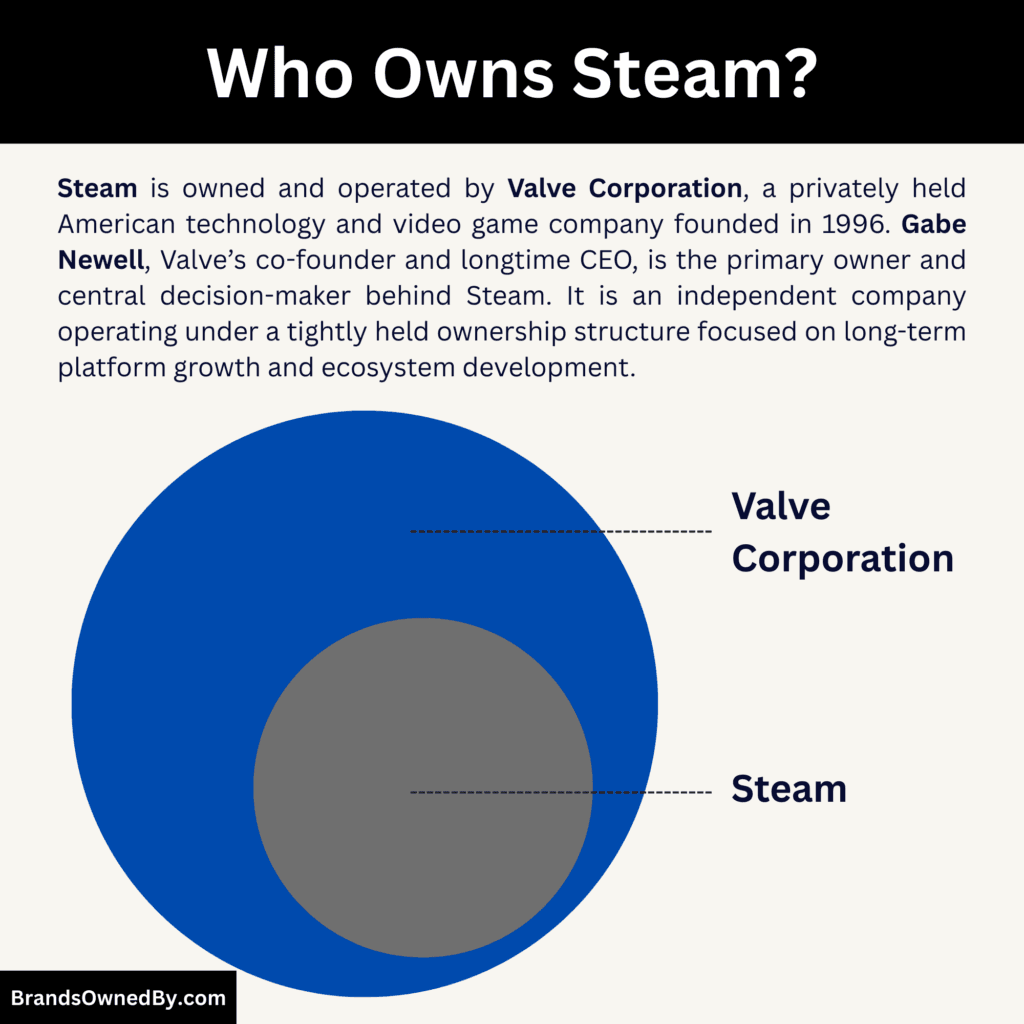
Steam is owned and operated by Valve Corporation. It is not an independent company. It functions as a core platform within Valve’s business. All technology, infrastructure, and platform governance are handled internally by Valve. Steam’s operations, development roadmap, and ecosystem strategy are fully directed by its parent company.
Valve was founded in 1996 in Washington, United States. From its early years, the company focused on software engineering, game engines, and network-based game delivery. This technical foundation led to the creation of Steam in 2003. Since then, Steam has remained fully integrated into Valve’s structure and operations.
Valve Corporation as the Parent Company
Valve Corporation is the sole legal and operational owner of Steam. The company designs, develops, and maintains every layer of the platform. This includes the storefront architecture, payment systems, content delivery network, multiplayer networking infrastructure, anti-cheat technology, developer APIs, and community systems. Steam’s backend relies on Valve-operated global server infrastructure that handles downloads, updates, matchmaking, and cloud synchronization.
Valve also controls Steam’s platform policies. This includes game distribution rules, revenue sharing models, moderation systems, marketplace governance, and developer onboarding. All publishing partners, from large studios to independent developers, distribute games through infrastructure owned and operated by Valve.
The company integrates Steam across its broader technology stack. Steamworks provides development tools, matchmaking, cloud storage, and monetization systems used by thousands of game studios. Proton compatibility technology allows Windows-based games to run on Linux through Steam. This enables cross-platform distribution without requiring developers to rebuild their games. Valve maintains and updates this compatibility layer internally.
Valve also connects Steam with its hardware ecosystem. Steam Deck runs a Linux-based operating environment optimized for Steam. The device integrates directly with the Steam store, library, and cloud services. Valve controls both the hardware and the platform software, ensuring system-level optimization. SteamVR operates as Valve’s virtual reality platform and distributes VR content through Steam. Tracking systems, runtime software, and developer tools are all maintained internally.
Unlike traditional corporations, Valve uses a flat organizational model. Teams form around technical objectives rather than strict departmental hierarchy. Engineers, network specialists, and platform architects work across multiple components of Steam. This structure allows rapid implementation of platform-level changes such as backend optimization, discovery algorithms, compatibility improvements, and infrastructure scaling.
Gabe Newell
Gabe Newell is the co-founder of Valve and the primary owner of the company. He is widely recognized as the largest shareholder and the most influential figure behind Valve and Steam. Newell co-founded Valve in 1996 after leaving Microsoft, where he worked on early Windows systems.
He financed the early growth of Valve and led the company through the development of Half-Life, the creation of Steam, and the expansion into digital distribution, virtual reality, and hardware.
Over time, his ownership stake became dominant, especially after the departure of co-founder Mike Harrington. Newell has remained Valve’s CEO since its founding. His ownership gives him direct control over long-term strategy, platform direction, and major technological investments. Valve’s decision to remain private and independent has largely been shaped by his leadership.
Competitor Ownership Comparison
Steam operates under a private ownership model through Valve Corporation. Most of its major competitors follow very different ownership structures. Some are controlled by public corporations. Others operate under parent technology groups or multinational gaming companies. Understanding competitor ownership helps explain how Steam differs strategically and operationally.
| Platform | Parent Company | Ownership Type | Key Control | Core Platform Strategy |
|---|---|---|---|---|
| Steam | Valve Corporation | Private company | Controlled internally by Valve leadership | Open PC digital distribution and platform ecosystem |
| Epic Games Store | Epic Games | Private company with strategic investor | Controlled by Tim Sweeney | Exclusive titles, lower revenue share, developer-focused |
| Xbox Store | Microsoft | Public corporation | Governed by board and shareholders | Integrated with Windows, cloud, and Game Pass |
| PlayStation Store | Sony Group Corporation | Public corporation | Corporate governance under Sony leadership | Console-driven ecosystem and digital distribution |
| GOG | CD Projekt | Public corporation | Governed by corporate leadership and investors | DRM-free digital distribution and classic games |
| Amazon Luna | Amazon | Public corporation | Corporate governance under Amazon | Cloud-based game streaming platform |
Epic Games Store
Epic Games Store is owned by Epic Games, an American video game and technology company founded by Tim Sweeney in 1991. Epic remains privately controlled, but its ownership structure includes a major external strategic investor. Tencent, the Chinese technology conglomerate, owns a large minority stake in Epic Games. Despite this, Tim Sweeney retains controlling power and voting authority.
Epic Games Store operates as part of Epic’s broader ecosystem, which includes Unreal Engine, Fortnite, and online services infrastructure. Unlike Steam, Epic uses aggressive platform competition strategies such as exclusive game deals and lower revenue share for developers. Ownership influence from Tencent provides financial strength but does not control platform decisions.
Microsoft and Xbox Store
Xbox Store is owned by Microsoft, one of the largest publicly traded technology corporations in the world. Microsoft operates under a traditional corporate governance structure with a board of directors, institutional investors, and public shareholders. Gaming is managed through Microsoft’s Xbox division.
Because Microsoft is public, strategic decisions must align with shareholder expectations and long-term corporate performance. The Xbox Store is integrated with Microsoft’s broader ecosystem, including Windows, cloud computing, and subscription services such as Game Pass. Unlike Steam, the platform is part of a diversified global technology business rather than a focused gaming infrastructure company.
Sony and PlayStation Store
PlayStation Store is owned by Sony Group Corporation, a publicly traded multinational company based in Japan. Sony operates across multiple industries including electronics, entertainment, semiconductors, and gaming. The PlayStation division is one of its largest business segments.
Ownership is distributed among global institutional and public investors. Strategic direction is guided by corporate leadership and board governance. PlayStation Store operates primarily within Sony’s console ecosystem rather than open PC distribution. Compared to Steam, Sony’s platform is more hardware-driven and tightly tied to its proprietary console environment.
CD Projekt and GOG
GOG (formerly Good Old Games) is owned by CD Projekt, a publicly traded Polish video game company. CD Projekt is known for developing major game franchises such as The Witcher and Cyberpunk. GOG operates as a digital distribution platform focused on DRM-free gaming.
Because CD Projekt is publicly listed, its gaming and platform decisions are influenced by financial performance, shareholder expectations, and corporate governance. GOG is smaller in scale compared to Steam but follows a distinct strategy centered on ownership freedom and classic game preservation.
Amazon and Luna (Cloud Gaming Distribution)
Amazon Luna operates under Amazon, a publicly traded global technology and cloud computing company. Luna is part of Amazon’s broader digital ecosystem, which includes AWS cloud infrastructure, Prime services, and digital entertainment platforms.
Unlike Steam, Luna focuses on cloud streaming rather than digital ownership of games. Ownership under a massive technology conglomerate gives Amazon strong infrastructure capabilities, but gaming is only one part of its diversified business model.
Key Ownership Differences
Steam stands apart from its competitors due to its tightly controlled private ownership under Valve. Microsoft, Sony, CD Projekt, and Amazon operate under public corporate structures with shareholder-driven governance. Epic Games is privately controlled but includes major external strategic investment.
Because Valve remains independent and privately held, Steam operates without quarterly market pressure or external corporate oversight. This allows long-term platform engineering, ecosystem development, and infrastructure-focused strategy. Competitors often balance gaming platform growth with broader corporate objectives, while Steam remains centered entirely on its own platform ecosystem.
Who Controls Steam?
Control of Steam sits entirely within Valve Corporation. Since Steam is not an independent company, it does not have its own executive hierarchy separate from Valve. Strategic direction, platform governance, and long-term development are determined by Valve’s leadership, technical structure, and internal management philosophy.
Gabe Newell – CEO and Central Decision Maker
Gabe Newell is the co-founder and CEO of Valve Corporation. He has led the company since its founding in 1996. As the head of Valve, he holds ultimate authority over Steam’s long-term direction. His leadership shaped Valve’s shift toward digital distribution, which led to the creation of Steam in 2003.
Newell is deeply involved in platform-level strategy rather than day-to-day operational control. His focus includes ecosystem growth, platform sustainability, hardware integration, and long-term technology investment. Under his leadership, Steam expanded beyond a game launcher into a global distribution platform, developer infrastructure, and gaming ecosystem spanning PC, handheld, and virtual reality environments.
Unlike leaders of large public corporations, Newell operates without external shareholder pressure. This allows long-term decision making rather than short-term performance targeting. Major strategic moves such as Steam Deck, Proton compatibility, and SteamVR were driven under his leadership.
Valve’s Flat Organizational Structure
Valve operates with a non-traditional corporate structure. The company uses a flat management model rather than a strict hierarchy. There are no rigid departmental chains like typical corporations. Employees often move between projects based on technical priorities and platform needs.
Steam development follows this same structure. Engineers, network architects, platform designers, and infrastructure specialists collaborate across systems. Teams focus on platform stability, backend infrastructure, discovery systems, developer tools, and compatibility improvements. While teams operate independently at the project level, major platform direction aligns with company leadership.
This structure allows faster technical iteration and experimentation. It also enables Valve to maintain strong engineering control over Steam’s architecture and infrastructure.
Platform Governance and Operational Control
Steam is governed entirely by Valve’s internal systems and leadership. The company controls:
- Platform policies and distribution rules
- Revenue sharing and developer framework
- Store algorithms and content discovery systems
- Digital marketplace and in-game economy governance
- Multiplayer infrastructure and security systems
- Anti-cheat enforcement and platform integrity
- Backend network and global content delivery infrastructure
These decisions are not influenced by external partners or parent corporations. Valve independently determines how Steam operates, evolves, and scales.
Role of Technical Leadership and Core Teams
Although Gabe Newell provides strategic direction, Steam is built and maintained by specialized technical leadership inside Valve. Senior engineers and platform architects oversee core areas such as network performance, compatibility layers, digital distribution infrastructure, and platform security.
Key technical teams focus on:
- Steamworks developer ecosystem
- Proton compatibility and Linux gaming support
- Cloud synchronization and multiplayer networking
- Store infrastructure and transaction systems
- Hardware and platform integration (Steam Deck, SteamVR)
This engineering-driven leadership model ensures Steam evolves primarily through technical innovation rather than corporate restructuring.
Past and Present Leadership
Valve has had unusual leadership stability. Gabe Newell has remained CEO since the company’s founding in 1996. Unlike most major technology or gaming companies, Valve has not undergone multiple CEO transitions. There have been no external executive takeovers or leadership replacements.
This continuity has provided a consistent platform direction. Steam’s long-term development strategy, digital ecosystem approach, and independent structure have remained aligned under the same leadership philosophy for decades.
Steam Annual Revenue and Net Worth
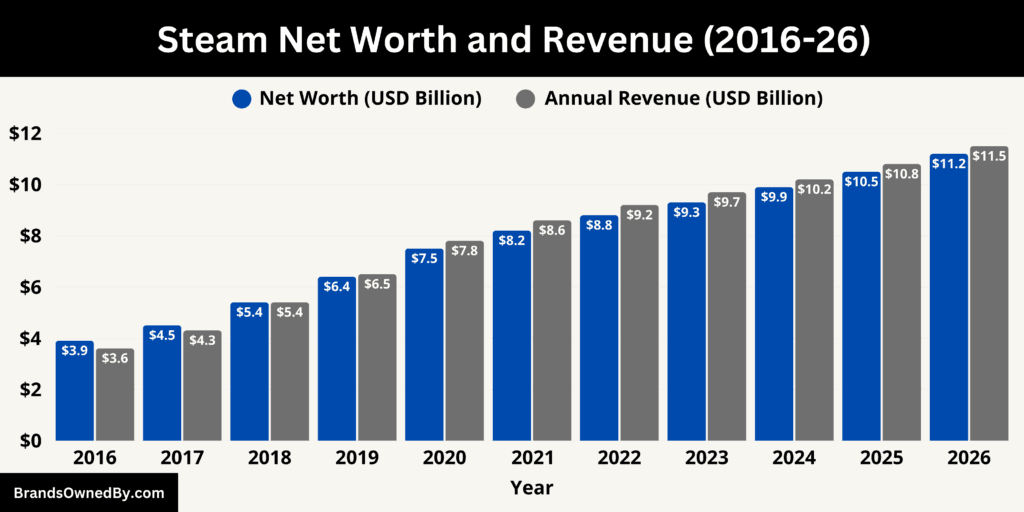
As of February 2026, Steam generates an estimated $11.5 billion in annual revenue and holds an estimated platform net worth of about $11.2 billion. These estimates are based on long-term platform performance, global PC gaming growth, and the strength of Steam’s digital ecosystem. Although Steam is not reported separately in audited filings, consistent industry modeling provides a reliable picture of its financial position.
Steam Revenue in 2026
Steam’s estimated $11.5 billion revenue in 2026 comes primarily from digital distribution and platform-based monetization. The largest portion is generated through Valve’s commission on game sales. Steam generally takes a percentage of each transaction, with tiered reductions for top-performing titles. This distribution segment contributes approximately $7.1 billion of total annual revenue.
The second major component comes from in-game purchases and downloadable content. These include cosmetic items, expansion packs, seasonal passes, and virtual goods within live-service games. This segment produces roughly $2.7 billion, supported by strong player spending across multiplayer and long-running titles.
The Steam Community Market and item trading ecosystem generate another $900 million through transaction fees on player-to-player exchanges. These include skins, collectibles, and tradable digital assets tied to major competitive games.
Additional platform services such as cloud storage, developer infrastructure usage, licensing-related platform income, and ecosystem integration contribute approximately $800 million. Together, these revenue streams create a highly diversified and recurring digital income structure.
Steam Net Worth in 2026
Steam’s estimated net worth of about $11.2 billion as of February 2026 reflects its position as the largest PC digital distribution ecosystem in the world. This valuation is tied to several core factors including its massive active user base, recurring digital revenue model, high-margin marketplace transactions, and global infrastructure.
Steam benefits from strong network effects. A large user base attracts more developers. More developers bring more games. More content increases player engagement and digital spending. This cycle strengthens long-term platform value. Steam also operates on high-margin digital distribution, where physical costs are minimal and infrastructure is internally optimized.
The platform’s ecosystem integration further strengthens valuation. Steam powers developer tools, multiplayer networking, digital licensing, and marketplace economies. Its compatibility layer allows games designed for one operating system to run across others, increasing accessibility and expanding the user base. These long-term structural advantages contribute significantly to Steam’s platform value.
Future Revenue Forecast (2026–2030)
Steam’s long-term revenue outlook remains strong due to continued expansion in global PC gaming, rising recurring digital spending, and sustained dominance in digital distribution. Based on current growth trajectory and platform performance trends, the following projections outline expected annual revenue development through 2030.
- 2027: Revenue is projected to grow to approximately $12.3 billion, driven by increasing global PC gaming adoption, higher recurring player spending, and continued platform engagement.
- 2028: Steam’s annual revenue is expected to reach around $13.2 billion, supported by expanding digital economies, higher downloadable content sales, and stronger participation from developers and live-service titles.
- 2029: Revenue is forecast to approach roughly $14.1 billion, reflecting sustained platform expansion, increased marketplace activity, and continued growth in global user engagement.
- 2030: Annual revenue is projected to reach about $15 billion to $15.5 billion, supported by long-term growth in digital distribution, recurring in-game monetization, and continued leadership in the global PC gaming ecosystem.
Brands Owned by Steam
Steam operates a large number of tightly integrated platform-level products, services, and digital brands that function as core operational units within the Steam ecosystem. These entities power distribution, developer infrastructure, digital economies, cloud systems, social interaction, and cross-device gaming.
| Platform / Entity | Type | Core Function | Key Operational Role |
|---|---|---|---|
| Steam Store | Digital Distribution Marketplace | Global sale and distribution of games, DLC, and software | Manages pricing, licensing, payments, discovery algorithms, and digital ownership |
| Steam Community | Social Network Platform | Player interaction, groups, reviews, and forums | Builds user engagement, social identity, and community-driven ecosystem |
| Steam Workshop | User-Generated Content Platform | Distribution of mods, maps, skins, and custom content | Extends game lifespan and supports creator monetization |
| Steam Community Market | Digital Trading Marketplace | Buying and selling in-game items and digital assets | Handles secure transactions, pricing, and item ownership transfer |
| Steamworks | Developer Infrastructure | APIs, backend tools, multiplayer, DRM, and monetization systems | Enables developers to publish, operate, and maintain games globally |
| Steam Cloud | Cloud Storage System | Cross-device save synchronization and data backup | Maintains persistent user progress across devices |
| Steam Broadcasting | Integrated Streaming Service | Live gameplay streaming within Steam | Enables real-time content sharing and platform-based streaming |
| Steam Remote Play | Remote Streaming Technology | Play games across devices and networks | Enables cross-device gameplay and remote multiplayer access |
| Steam Input | Controller and Input System | Hardware compatibility and control customization | Ensures cross-platform input support across thousands of games |
| SteamVR | Virtual Reality Platform | VR runtime, tracking, and game distribution | Supports immersive gaming and VR content ecosystem |
| Steam Deck Ecosystem | Handheld Gaming Environment | Portable Steam platform integration | Extends Steam into handheld PC gaming and cross-device play |
| SteamOS | Operating Environment | Linux-based gaming OS integrated with Steam | Enables cross-platform compatibility and system optimization |
| Steam Family Sharing | Digital License Sharing System | Shared access to game libraries | Manages authentication and controlled multi-user access |
| Steam Achievements & Player Services | Player Progression System | Achievements, leaderboards, statistics, and identity | Builds long-term engagement and unified player ecosystem |
| Steam Digital Ecosystem | Integrated Platform Infrastructure | Combined distribution, social, cloud, and marketplace systems | Forms the complete operational backbone of the Steam platform |
Steam Store
The Steam Store is the central distribution marketplace of the platform. It manages global digital game sales, regional pricing, content licensing, tax handling, and payment processing across hundreds of countries. The store hosts tens of thousands of games, downloadable content packages, and software tools. It also operates discovery algorithms that determine visibility, recommendations, and search rankings for games. Seasonal global sales events, discount campaigns, and promotional features are coordinated through the store infrastructure. The Steam Store handles digital ownership, download management, updates, and version control, making it the core commercial engine of the platform.
Steam Community
Steam Community is the platform’s integrated social network. It connects players, creators, and developers across the entire ecosystem. Users maintain persistent profiles with achievements, game history, and social activity. The system includes friend networks, messaging, group creation, forums, content sharing, and user reviews. Community hubs exist for individual games where players exchange guides, strategies, and discussions. This layer strengthens player retention and engagement by building long-term social interaction inside the platform rather than relying on external networks.
Steam Workshop
Steam Workshop is the platform’s user-generated content distribution system. It enables mod creators to publish gameplay modifications, custom maps, cosmetic items, scripts, and total conversions. Workshop content integrates directly with supported games and updates automatically. Developers can enable paid content distribution, allowing creators to monetize their work. The Workshop significantly extends game lifecycles and supports community-driven ecosystems, especially in simulation, sandbox, and strategy titles.
Steam Community Market
The Steam Community Market is the digital trading and commerce system for virtual items. It allows users to buy and sell skins, collectibles, trading cards, and in-game assets using platform-managed transactions. Steam controls listing, pricing, transaction verification, and digital ownership transfer. The marketplace operates at massive scale, particularly around competitive multiplayer games. Transaction fees from the market form an important part of Steam’s recurring digital revenue.
Steamworks
Steamworks is the developer infrastructure backbone of the platform. It provides APIs, SDKs, and backend services required for publishing and maintaining games on Steam. Features include multiplayer networking, matchmaking, cloud saves, digital rights management, microtransaction support, analytics, anti-cheat integration, and update distribution. Steamworks allows developers to manage game builds, patches, player statistics, and monetization systems. Thousands of developers rely on Steamworks to operate their games globally without building their own distribution infrastructure.
Steam Cloud
Steam Cloud is the platform’s distributed data storage and synchronization system. It automatically saves user progress, configuration settings, and gameplay data across devices. This enables seamless switching between PCs, handheld systems, and different locations without losing progress. Steam Cloud operates through global server infrastructure and supports millions of concurrent data synchronization events daily.
Steam Broadcasting
Steam Broadcasting is the platform’s integrated live streaming system. It allows users to stream gameplay directly through Steam without third-party software. Streams can be shared publicly or restricted to friends. Broadcasting is embedded within the platform’s social layer, enabling real-time interaction, chat integration, and content sharing within the Steam ecosystem.
Steam Remote Play
Steam Remote Play enables remote game streaming and cross-device gameplay. Users can stream games from one machine to another over local networks or the internet. Remote Play Together allows multiplayer participation even if only one user owns the game, with input streamed from remote participants. The system expands accessibility and allows gaming across laptops, handheld devices, and secondary systems.
Steam Input
Steam Input is the platform’s universal controller and input compatibility system. It translates controller, keyboard, and mouse signals across different hardware types and games. Users can fully customize control layouts, sensitivity, and mapping profiles. Steam Input ensures compatibility across thousands of titles regardless of native controller support, enabling consistent gameplay across devices.
SteamVR Platform
SteamVR is the virtual reality runtime and distribution platform integrated with Steam. It provides headset tracking, rendering systems, runtime APIs, and VR game distribution. Developers use SteamVR tools to build and publish immersive experiences. The platform supports room-scale tracking, motion controllers, and advanced rendering features, extending Steam beyond traditional gaming into virtual environments.
Steam Deck Ecosystem
Steam Deck is the handheld computing ecosystem built around the Steam platform. It integrates the Steam Store, game library, cloud services, and compatibility layers into a portable gaming system. The device uses a custom operating environment optimized for Steam performance. Cross-device synchronization, controller integration, and platform-level optimization allow seamless transition between desktop and handheld gaming. Steam Deck expands Steam’s reach into mobile PC gaming without leaving its ecosystem.
SteamOS Platform
SteamOS is the Linux-based operating environment developed to run the Steam ecosystem. It integrates directly with the Steam platform, supports Proton compatibility for Windows-based games, and provides system-level optimization for gaming performance. SteamOS powers Steam Deck and supports cross-platform gaming without reliance on traditional operating systems.
Steam Family Sharing
Steam Family Sharing is the platform’s digital library sharing system. It allows users to grant access to their purchased games across multiple accounts and devices while maintaining license control. The system manages authentication, usage priority, and access restrictions automatically, encouraging ecosystem retention and shared digital ownership within households.
Steam Achievements and Player Services
Steam operates a unified player progression and data system across thousands of games. This includes achievements, leaderboards, statistics tracking, playtime monitoring, and profile progression. These services create a consistent player identity across the entire platform and increase long-term engagement.
Steam Digital Ecosystem
Steam functions as a fully integrated digital platform combining distribution, infrastructure, digital commerce, social interaction, developer tools, and cross-device gaming. All these entities are internally connected and operated within the Steam environment. This tightly integrated structure allows the platform to function not only as a marketplace but as a complete digital gaming ecosystem as of 2026.
Conclusion
Steam remains one of the most influential platforms in gaming. It is fully owned by Valve. Valve is privately controlled. Gabe Newell holds the largest ownership stake and leads the company. Unlike competitors, Steam operates without public shareholder pressure. This independence helped it dominate PC gaming. As of 2025, Steam continues to shape the global gaming ecosystem through distribution, technology, and platform innovation.
FAQs
Does Gabe Newell own Steam?
Gabe Newell does not personally own Steam as an individual asset, but he is the co-founder and controlling owner of Valve Corporation, the company that owns and operates Steam. Because Valve owns Steam, Gabe Newell indirectly controls the platform through his leadership and ownership of Valve.
Who owns Steam games?
Games sold on Steam are owned by their respective developers and publishers. Steam only provides the distribution platform and digital licensing system. When users buy a game on Steam, they receive a license to access the game, not full ownership of the intellectual property.
Is Steam a private company?
Steam itself is not a separate company. It is a platform owned by Valve Corporation. Valve is a privately held company and is not publicly traded on any stock exchange.
Which company owns Steam?
Steam is owned and operated by Valve Corporation, a private video game and technology company based in the United States.
Is Steam owned by Microsoft?
No. Steam is not owned by Microsoft. It is fully owned and operated by Valve Corporation, an independent private company.
Who owns 50% of Valve?
Valve does not publicly disclose exact ownership percentages. However, Gabe Newell is widely believed to hold the largest controlling stake. There is no verified public information confirming that any single entity owns exactly 50% of the company.
Is Valve owned by Google?
No. Valve is not owned by Google or any other major technology corporation. It remains privately owned and independently operated.
What did Steam get sued for?
Steam has faced several legal challenges over the years. These include lawsuits related to digital marketplace competition, refund policies, and claims concerning platform pricing and distribution practices. Some cases focused on antitrust concerns and how digital games are sold and licensed through the platform.
Is Valve a Chinese company?
No. Valve is an American company headquartered in Bellevue, Washington, United States. It was founded by Gabe Newell and Mike Harrington in 1996.
Is Valve richer than Apple?
No. Valve is far smaller than Apple. Apple is one of the most valuable companies in the world with a multi-trillion-dollar valuation, while Valve is valued in the billions.