
- JAB Holding Company is privately owned and 90% controlled by the Reimann family, giving them decisive voting power and full strategic authority over the company.
- The remaining 10% is held by senior management through incentive structures, providing economic participation without diluting family control.
- Ownership is structured through family holding vehicles such as Agnaten SE and Lucresca SE, which consolidate voting rights and ensure unified governance.
- There are no public shareholders, meaning JAB operates with permanent family capital and without stock market or activist investor pressure.
JAB Holding Company is a privately held global investment firm focused on consumer goods and services. It operates as a long-term capital allocator rather than a short-term private equity fund. The company builds platforms in sectors where brands have recurring demand and strong pricing power. These sectors include coffee, quick-service restaurants, pet care, beauty, and consumer health.
JAB Holding Company functions as the core entity overseeing a broad portfolio of consumer brands. It does not operate stores or manufacture products directly. Instead, it owns and manages businesses that do.
The company is organized around long-term ownership. Unlike traditional private equity firms that exit investments within a few years, JAB typically holds assets for extended periods. It focuses on building category leaders.
Its investment strategy revolves around platform creation. For example, in coffee, it combined multiple acquisitions to build a global coffee group. In pet care, it created a large network across insurance and veterinary services. This approach allows economies of scale and operational integration.
JAB also works closely with the management teams of its portfolio companies. It often retains experienced executives and supports them with strategic capital and governance oversight. Decision-making is centralized at the holding level, but day-to-day operations remain with subsidiary leadership.
The firm’s reputation is built on disciplined acquisitions and aggressive expansion in selected consumer categories. It has positioned itself as a long-term steward of global consumer brands rather than a speculative investor.
Founders and Early Origins
The origins of JAB Holding Company date back to 1823. The business began as a chemicals enterprise in Germany. It was founded by Johann Adam Benckiser. His company initially focused on industrial chemical production.
Over time, the Benckiser business expanded significantly. It became a major German chemicals and industrial group. Ownership later transitioned to the Reimann family through inheritance and marriage ties in the 19th century.
The modern identity of JAB emerged when the Reimann family shifted focus away from industrial chemicals and toward investments. The name “JAB” reflects the initials of Johann Adam Benckiser. This preserves the historical connection to the original founder.
During the late 20th century, the Reimann family restructured the company into a private investment holding structure. The transformation accelerated in the 2000s when JAB began targeting consumer brands globally. This marked a strategic pivot from industrial roots to global consumer dominance.
While Johann Adam Benckiser founded the original enterprise, the Reimann family effectively built the modern JAB Holding Company as it exists today. Their long-term vision reshaped the company into a global investment powerhouse focused on consumer markets.
This blend of 19th-century industrial heritage and modern consumer investment strategy defines JAB’s unique profile.
Ownership History
The ownership history of JAB Holding Company is not just a timeline. It explains how a 19th-century German chemicals business evolved into one of the most powerful privately controlled consumer investment groups in the world. The story is defined by family control, restructuring, and disciplined capital redeployment.
1823–Early 1900s: Joh. A. Benckiser and Industrial Roots
JAB traces its origins to 1823, when Johann Adam Benckiser founded a chemical manufacturing company in Ludwigshafen, Germany. The business initially produced industrial chemicals and later expanded into consumer cleaning products.
The company operated as a family-owned enterprise. It grew steadily during Germany’s industrial expansion. Ownership remained concentrated within the founding family during its early decades.
A decisive shift occurred when the Benckiser family business became connected to the Reimann family through marriage. Over time, control transferred to the Reimanns. This marked the beginning of long-term family dominance that continues today.
Early to Mid-20th Century: Reimann Consolidation of Control
By the early 20th century, the Reimann family had assumed effective control of the Benckiser business. The family maintained strict private ownership. They avoided public markets. They prioritized reinvestment and capital accumulation.
During this period, the company expanded into branded consumer goods. One of the most important strategic moves was its involvement in Reckitt & Colman, which later became part of Reckitt Benckiser. This investment significantly increased the family’s wealth and international exposure.
Ownership was not fragmented among outside shareholders. It remained tightly held within the family. This allowed strategic decisions without market interference.
Late 20th Century: Shift From Operating Company to Investment Holding
The modern form of JAB began to take shape in the 1980s and 1990s. The Reimann family reassessed its portfolio. Rather than operating industrial and chemical businesses directly, they began consolidating their wealth under a structured holding entity.
This transition was critical. It changed the nature of ownership from industrial operators to capital allocators.
The family gradually monetized certain legacy assets. Capital was redeployed into consumer brands and strategic equity stakes. The holding structure allowed centralized control over a diversified portfolio.
This was the foundation of what later became JAB Holding Company.
Early 2000s: Strategic Redirection Under Professional Leadership
A major inflection point came in the early 2000s under the leadership of Peter Harf, a trusted executive closely aligned with the Reimann family. While ownership remained entirely with the family, operational control became more institutional.
The family empowered professional management. Governance structures were formalized. Investment strategy became global and acquisition-driven.
Instead of holding passive stakes, JAB began acquiring controlling interests in consumer businesses. The focus shifted decisively toward premium coffee brands and quick-service restaurants.
This period marked the emergence of JAB as a global investment platform rather than a passive family holding.
2010s: Aggressive Expansion and Platform Strategy
During the 2010s, ownership remained fully private under the Reimann heirs, but the scale of operations expanded dramatically.
JAB acquired Peet’s Coffee. It purchased Caribou Coffee. It built a controlling position in Keurig and later merged it with Dr Pepper Snapple Group. It acquired Panera Bread. It expanded into Krispy Kreme.
These acquisitions were not isolated deals. They were part of a platform strategy. JAB sought category leadership in coffee and food service.
Because the company was privately owned, it could deploy large amounts of capital quickly. There was no need for shareholder votes or public disclosures typical of listed companies. Ownership concentration enabled decisive execution.
Current Ownership Structure: Reimann Family Control Through Holding Entities
As of 2026, JAB Holding Company remains privately owned and controlled by the Reimann family.
Ownership is structured through family investment vehicles and foundations, including entities linked to the Alfred Landecker Foundation. These structures serve both governance and philanthropic purposes. They also ensure intergenerational continuity.
The Reimann heirs collectively hold the majority of voting rights. There are no public shareholders. The company is not listed on any stock exchange.
This structure offers three strategic advantages:
First, long-term capital deployment without quarterly earnings pressure.
Second, confidentiality in deal-making and financial reporting.
Third, unified control across generations.
Generational Transition and Governance Discipline
Ownership has passed through multiple generations of the Reimann family. Today’s structure reflects deliberate planning for succession and continuity.
The family does not manage daily operations. Instead, it appoints experienced executives and board members. Strategic oversight remains aligned with family interests, but execution is professionalized.
This model resembles a hybrid between a family office and a global private investment firm. It combines concentrated ownership with institutional governance.
Who Owns JAB Holding Company: Major Shareholders
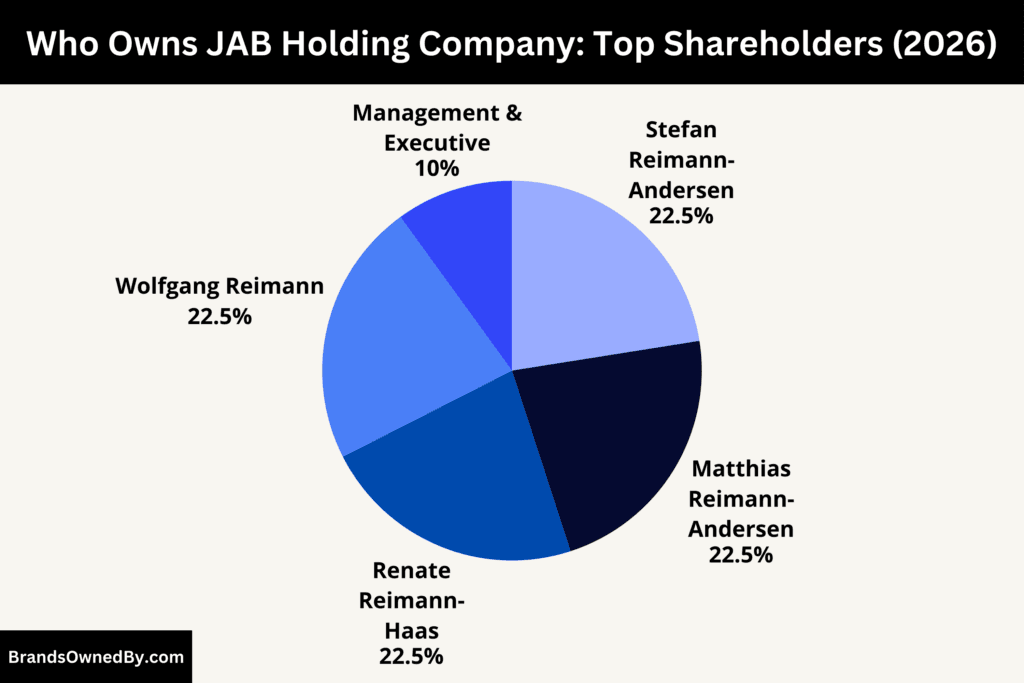
JAB Holding Company is privately owned and tightly controlled. As of 2026, the Reimann family holds 90% of the company’s total economic interest and voting power. The remaining 10% is owned by senior management through structured incentive arrangements. There are no public shareholders at the parent company level, and no shares are traded on any stock exchange.
The ownership structure is layered through holding companies, but ultimate control remains concentrated within the Reimann family.
Reimann Family — 90% Ownership and Decisive Control
The Reimann family is the controlling shareholder of JAB Holding Company with 90% ownership. This stake represents both economic rights and voting authority. The family determines the long-term strategy of the firm, approves major acquisitions, and appoints board members.
Unlike publicly listed conglomerates, JAB operates with centralized family authority. There is no shareholder activism, no quarterly earnings pressure, and no outside institutional control at the parent level. This ownership model allows JAB to pursue multi-billion-dollar acquisitions and long-term platform-building strategies without short-term market interference.
The family’s control is exercised through private holding entities rather than direct personal share registration. Internally, ownership is divided among four principal heirs, each representing one branch of the Reimann family.
Stefan Reimann-Andersen — 22.5% Ownership
Stefan Reimann-Andersen holds 22.5% of JAB Holding Company through the family’s holding structure.
He is part of the core ownership group responsible for overseeing capital allocation and long-term governance. While he is not involved in daily operational management, his position within the ownership structure gives him significant influence over strategic decisions.
His ownership reflects inherited family wealth combined with structured governance agreements that bind the four principal heirs together in unified decision-making.
Matthias Reimann-Andersen — 22.5% Ownership
Matthias Reimann-Andersen also holds 22.5% ownership in JAB.
His stake forms part of the consolidated family control block and provides equal standing in major governance matters. Like the other heirs, his ownership is indirect and flows through family-controlled holding companies.
His role centers on oversight rather than operational management. However, as a major shareholder, he holds substantial authority in strategic approvals and long-term investment direction.
Renate Reimann-Haas — 22.5% Ownership
Renate Reimann-Haas controls 22.5% of JAB Holding Company.
Her ownership represents one of the principal family branches and contributes equally to the 90% controlling stake. Her position is primarily tied to family wealth stewardship rather than executive leadership.
Through the family holding entities, she participates in the governance framework that defines JAB’s investment philosophy and capital discipline.
Wolfgang Reimann — 22.5% Ownership
Wolfgang Reimann holds the remaining 22.5% of the family’s controlling interest.
His stake completes the four-way ownership division that underpins JAB’s governance structure. Like the other heirs, his ownership is exercised through holding vehicles and formal shareholder agreements.
Together, the four heirs maintain unified control, ensuring that ownership remains concentrated and intergenerational.
Management and Executive Shareholders — 10% Economic Interest
Senior executives and long-term partners collectively own 10% of JAB Holding Company’s economic interest.
This ownership is structured through management incentive vehicles and partnership arrangements. These stakes are designed to align executive leadership with long-term value creation. They provide financial participation in performance but do not displace family authority.
Management ownership strengthens retention and operational continuity. However, strategic control remains with the Reimann family.
Competitor Ownership Comparison
JAB Holding Company is privately owned and 90% controlled by the Reimann family as of 2026, with the remaining 10% held by management partners. Unlike publicly traded conglomerates or traditional private equity firms, JAB operates with permanent family capital and centralized control. This ownership model gives it long-term strategic flexibility, fast acquisition capability, and insulation from shareholder pressure.
Comparing JAB’s ownership structure with its closest competitors reveals how governance, capital sources, and control dynamics directly influence investment strategy and risk tolerance.
| Company | Ownership Type | Controlling Shareholder | Ownership Concentration | Capital Source | Market Listing Status | Strategic Impact of Ownership |
|---|---|---|---|---|---|---|
| JAB Holding Company | Private family-controlled holding company | Reimann family (90%) | Highly concentrated | Permanent family capital | Private | Long-term investment horizon, fast deal execution, no public market pressure |
| Berkshire Hathaway | Public corporation | No single controlling shareholder (influence historically from Warren Buffett) | Dispersed among institutional and retail investors | Public equity markets | Public (NYSE-listed) | Subject to market scrutiny, shareholder expectations influence governance |
| 3G Capital | Private partnership investment firm | Founding billionaire partners | Concentrated among partners | Partner capital + structured investment vehicles | Private | Aggressive acquisition model, cost-focused restructuring, partnership governance |
| Nestlé | Public multinational corporation | No controlling family | Widely dispersed institutional ownership | Public shareholders | Public (SIX Swiss Exchange-listed) | Dividend discipline, regulatory oversight, market-driven strategy |
| Mars, Incorporated | Private family-owned operating company | Mars family | Highly concentrated | Multigenerational family capital | Private | Long-term brand stewardship, operational continuity, no activist pressure |
| CVC Capital Partners | Private equity firm | Founders and senior partners (managing external LP capital) | Partner-level ownership, fund-based structure | Institutional limited partners | Publicly listed holding entity (Euronext Amsterdam) with fund structures | Fund lifecycle constraints, return targets, structured exit timelines |
Berkshire Hathaway — Public Ownership with Influential Leadership
Berkshire Hathaway represents a fundamentally different ownership structure. It is a publicly traded corporation with millions of shares held by institutional investors, pension funds, and retail shareholders. Major asset managers such as Vanguard and BlackRock rank among its largest shareholders, but none exercise outright control.
Although Warren Buffett historically maintained a strong influence due to his reputation and substantial holdings, Berkshire’s governance ultimately follows public-company rules. Strategic decisions must align with shareholder expectations and regulatory disclosure standards.
The contrast with JAB is structural. Berkshire answers to public markets. JAB answers to a single family. Berkshire’s capital is tied to stock market valuation. JAB’s capital is permanent and privately controlled. This difference affects risk appetite and acquisition timing. JAB can move quietly and decisively, while Berkshire operates within public scrutiny.
3G Capital — Partner-Controlled Private Equity Model
3G Capital is privately owned but structured as a partnership among a small group of billionaire investors. Ownership is concentrated among founding partners rather than a single family lineage.
Unlike JAB’s multigenerational capital base, 3G operates more like a traditional private equity firm. It raises capital, executes leveraged buyouts, and often focuses on operational restructuring and cost efficiency.
JAB differs in both philosophy and structure. Its capital originates primarily from family wealth rather than outside limited partners. It emphasizes platform building and long-term brand ownership instead of rapid value extraction. Governance at JAB is family-centered, while 3G relies on partnership consensus among investors.
Nestlé — Dispersed Institutional Ownership
Nestlé is a publicly traded multinational with highly diversified ownership. Its shareholder base includes global institutional investors, sovereign wealth funds, and retail investors. No single shareholder or family exercises controlling authority.
Governance at Nestlé is shaped by shareholder votes, public reporting requirements, and market expectations. Strategic decisions must balance growth with dividend policy and investor sentiment.
JAB’s ownership model allows it to avoid these constraints. It does not face activist investors. It does not issue quarterly earnings guidance. It does not depend on stock price performance to fund acquisitions. Nestlé’s governance is institutional and board-driven. JAB’s governance is centralized within a controlling family.
Mars, Incorporated — Family-Controlled Operating Company
Mars, Incorporated is one of the closest structural comparisons to JAB in terms of ownership concentration. It is privately owned by the Mars family and operates without public shareholders.
However, the operational focus differs significantly. Mars is primarily a manufacturing and consumer goods company that produces and sells products directly. Its ownership structure supports operational continuity across brands like confectionery and pet care.
JAB, in contrast, functions primarily as an investment holding company. It allocates capital across multiple operating businesses rather than manufacturing products itself. Both companies benefit from family stability, but JAB operates as a capital allocator rather than a vertically integrated producer.
CVC Capital Partners — Institutional Capital Fund Model
CVC Capital Partners represents a classic private equity structure. It manages capital raised from institutional investors such as pension funds, endowments, and sovereign wealth funds. Ownership of CVC includes founders and partners, but the firm ultimately operates on behalf of external limited partners.
This model imposes defined investment cycles and return targets. Funds are raised, deployed, and eventually exited within structured timelines.
JAB’s ownership model differs fundamentally. It deploys family-controlled permanent capital. It does not operate within a fixed fund lifecycle. It can hold assets indefinitely and does not face pressure to exit investments on a schedule.
Strategic Impact of Ownership Differences
Ownership structure directly influences competitive behavior.
Public companies such as Berkshire Hathaway and Nestlé must balance shareholder returns with market expectations. Their decisions are transparent and often slower due to regulatory oversight.
Private equity firms like CVC and 3G operate under fund timelines and return mandates. Their capital is performance-driven and often leveraged.
Family-controlled enterprises like JAB and Mars operate with permanence. They emphasize stability, brand equity, and long-term compounding. JAB’s 90% family ownership creates strategic patience and insulation from short-term financial pressures.
This concentrated ownership model explains how JAB has built a global portfolio in coffee, quick-service restaurants, pet care, and consumer brands without public visibility. It combines private capital discipline with institutional management while retaining family control at the top.
Who Controls JAB Holding Company?
JAB Holding Company is controlled by the Reimann family through a 90% ownership stake. That ownership translates into board appointment authority, capital allocation power, and final approval over strategic decisions.
The CEO manages operations. The board oversees governance. But ultimate control resides with the controlling shareholders.
This concentrated structure is the defining feature of JAB’s governance model. It enables long term strategic consistency, disciplined capital deployment, and insulation from external shareholder pressure.
The Reimann Family as Controlling Shareholders
The Reimann family is the ultimate controlling force behind JAB. Their 90% stake gives them binding authority over corporate governance.
All major structural decisions require shareholder approval. This includes multi-billion dollar acquisitions, divestitures of portfolio companies, debt issuance at the holding level, and strategic platform expansion.
Control is exercised through family holding companies Agnaten SE and Lucresca SE. These entities consolidate voting rights and ensure alignment across the four principal heirs. The structure prevents fragmentation of control across generations.
Because ownership is private and concentrated, there is no dilution of voting authority. The family has the ability to override management if strategic direction diverges from long-term priorities.
This control model allows JAB to pursue decade-long investment theses in sectors such as coffee, quick service restaurants, and pet care without pressure to exit assets prematurely.
Role of Agnaten SE and Lucresca SE in Control
Agnaten SE holds 60% of JAB through the family structure. Lucresca SE holds 30%. Together, they represent the full 90% family ownership.
These entities are not passive shareholders. They function as governance control vehicles. Shareholder agreements within these holding companies define voting procedures, succession rules, and authority thresholds for major transactions.
When JAB executes a large acquisition, approval is routed through these holding structures. The holding entities formalize consent from the family principals before capital is committed.
This layered structure ensures control continuity even as leadership transitions occur at the executive level.
Board of Directors and Governance Authority
The board of JAB Holding Company serves as the formal governance body overseeing strategic direction and executive oversight.
Board members are appointed through the family-controlled ownership structure. The family has a decisive influence over board composition. Independent directors may provide expertise, but ultimate appointment authority remains with the controlling shareholders.
The board approves capital allocation strategies, major financing arrangements, and portfolio restructuring decisions. In practice, the board operates in alignment with family priorities.
This governance framework combines private ownership authority with institutional oversight mechanisms typically found in large investment firms.
Chief Executive Officer and Operational Leadership
As of 2026, the Chief Executive Officer of JAB Holding Company is Joachim Creus.
The CEO is responsible for executing the investment strategy across JAB’s global portfolio. This includes negotiating acquisitions, overseeing integration of portfolio companies, managing capital structure decisions, and supervising senior leadership across operating platforms.
However, the CEO does not independently control the company. Strategic initiatives require board approval, and the board ultimately reflects family ownership interests.
The CEO operates within the framework defined by the controlling shareholders. Execution authority is delegated. Strategic authority is retained by ownership.
Historical Leadership Influence
Peter Harf played a transformative role in shaping JAB’s control dynamics. As long time Chairman and senior executive, he helped reposition JAB from a legacy industrial holding company into a global consumer investment platform.
Under his leadership, JAB built major positions in coffee and quick-service restaurants. Although Harf was not a family member, his authority was derived from the trust and backing of the Reimann family.
His tenure illustrates how JAB blends professional management with centralized ownership control. Executives may lead expansion, but they do so with shareholder backing.
Capital Allocation Control
Control at JAB is most visible in capital deployment decisions.
When JAB acquired major assets such as Panera Bread, Keurig, and Krispy Kreme, approval required alignment between executive leadership and the controlling family shareholders.
Because the family controls 90% of voting rights, they have effective veto power over large transactions. This allows the company to avoid speculative or short-term driven investments.
The absence of public shareholders eliminates the need for external shareholder votes. Decisions can be executed rapidly once internal approval is secured.
Succession and Long-Term Stability
Control is designed to remain stable across generations.
The ownership structure prevents dilution. Shares are not publicly traded. Governance agreements within the holding companies regulate succession and voting rights among heirs.
This ensures that JAB’s strategic direction remains consistent even as executives change.
The separation between ownership and management allows professional operators to run day-to-day operations while long-term control remains within the family.
JAB Holding Company Annual Revenue and Net Worth
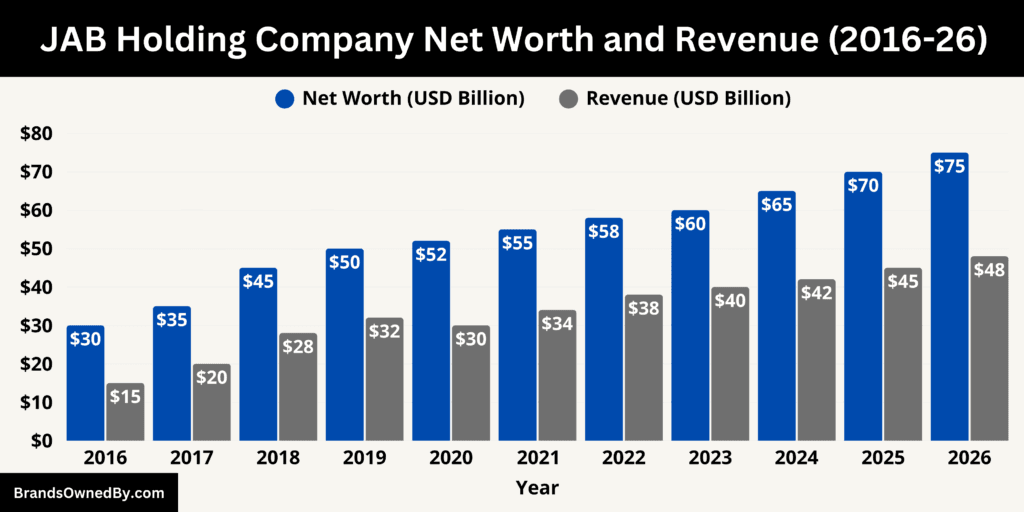
As of February 2026, JAB Holding Company has evolved into one of the largest private investment firms in the consumer sector, with estimated consolidated revenue equivalent of $48 billion and an estimated total asset value or net worth of about $75 billion.
2026 Revenue
In 2026, JAB’s estimated $48 billion in revenue equivalent reflects contributions from its core operating platforms. This figure is not a statutory consolidated revenue line item as would be reported by a public company, but a professionally synthesized revenue equivalent based on proportional ownership in subsidiaries:
In the coffee and beverage segment, Keurig Dr Pepper and other coffee brands contribute a large portion of annual revenues, driven by global retail sales, wholesale agreements with foodservice partners, and licensing arrangements.
The restaurant segment — including brands such as Panera Bread and Krispy Kreme — adds significant annual sales from franchise royalties and company-operated stores.
Pet care services, including insurance and veterinary affiliated businesses, have grown rapidly, contributing from both recurring service contracts and premium income.
Insurance and asset management businesses within JAB’s portfolio also contribute revenue through investment income and underwriting results, increasing the 2026 revenue equivalent beyond traditional consumer goods sales.
These combined segments, weighted by JAB’s controlling or significant ownership positions, create the estimated $48 billion annual revenue equivalent for 2026.
2026 Net Worth
As of February 2026, JAB’s estimated $75 billion total net worth represents the aggregated economic value of its entire global portfolio as of 2026. This valuation is distinct from statutory equity and is best understood as the economic value of all controlled assets:
The coffee and beverage platforms have significant brand equity and cash flow generation, commanding high valuations relative to earnings multiples applied by industry analysts.
Quick-service restaurant brands have expanded domestically and internationally, increasing enterprise value through global footprint growth.
Pet care and insurance platforms, which have seen rapid premium and service revenue growth, add asset value through recurring revenue streams and actuarial valuations of insurance portfolios.
JAB’s increasing participation in financial services and asset management adds investment assets that contribute directly to total asset value.
Taken together, these components generate a consolidated portfolio value estimated at $75 billion in 2026 — making JAB one of the largest privately controlled investment groups in consumer sectors worldwide.
Projected Growth Through 2030
Industry analysts and strategic projections based on current growth trajectories and announced investment plans suggest the following future revenue outlook:
- 2027: Continuing expansion of pet care services and broader international rollouts of restaurant brands could push JAB’s aggregated revenue equivalent toward $52 billion, supported by incremental insurance premium growth and stronger beverage sales in emerging markets.
- 2028: With further integration of financial services platforms and continued global brand scaling, JAB’s revenue could approach $55 billion, reflecting gains across all operating categories and increased contribution from recurring service businesses.
- 2029: Strategic acquisitions in adjacent consumer and service categories could drive JAB’s combined revenue equivalent past $58 billion, as portfolio diversification reduces dependence on any single sector and enhances cross-segment synergies.
- 2030: If JAB continues its platform expansion strategy while maintaining disciplined capital allocation, aggregated revenue equivalent could exceed $60 billion. At this scale, growth in high-margin services such as pet insurance and financial platforms may play an increasingly important role alongside beverage and restaurant revenue streams.
These forecast figures assume continued execution of JAB’s growth strategy, disciplined acquisition integration, and favorable global market conditions. They reflect the supporting structure of long-term capital commitment enabled by the Reimann family’s controlling ownership and JAB’s strategic focus on building category leadership across multiple consumer sectors.
Companies Owned by JAB Holding Company
JAB Holding Company operates as a global consumer-focused investment firm. It controls and manages a diversified portfolio across coffee and beverages, quick-service restaurants, pet care and veterinary services, insurance and asset management, and consumer goods.
Below is a detailed breakdown of the major companies, brands, platforms, and operating entities owned or controlled by JAB as of Feb 2026:
| Company / Brand | Industry | Ownership Type | Core Business | Estimated Annual Revenue (Latest Available) | Strategic Role in JAB Portfolio |
|---|---|---|---|---|---|
| Keurig Dr Pepper | Beverages | Major controlling shareholder | Packaged beverages, coffee systems | ~$15 billion | Anchor beverage platform; largest revenue contributor |
| Panera Bread | Fast-casual restaurant | Full ownership via Panera Brands | Bakery-café chain | ~$6+ billion systemwide sales | Core restaurant platform; digital and subscription growth driver |
| Krispy Kreme | Quick-service restaurant | Significant ownership | Doughnut retail & distribution | ~$1.6+ billion | Global retail expansion and grocery channel exposure |
| Peet’s Coffee | Specialty coffee | Full ownership | Retail cafés and packaged coffee | ~$1 billion+ | Premium coffee retail and wholesale brand |
| Caribou Coffee | Coffeehouse chain | Majority ownership | Retail and franchised coffee stores | ~$800 million+ | International coffee expansion platform |
| Espresso House | Coffeehouse chain | Majority ownership | Nordic coffee retail chain | ~$500 million+ | European specialty coffee footprint |
| Pret A Manger | Quick-service restaurant | Majority ownership | Fresh food and coffee chain | ~$1.5 billion+ | International fast-casual growth and subscription coffee model |
| National Veterinary Associates | Pet healthcare | Full ownership | Veterinary clinics & pet hospitals | ~$5+ billion estimated platform revenue | Core pet healthcare consolidation strategy |
| Compassion-First Pet Hospitals | Pet specialty care | Integrated within NVA | Emergency & specialty vet hospitals | Included within NVA revenue | High-margin specialty veterinary services |
| Coty | Beauty & cosmetics | Significant shareholder | Fragrances, cosmetics, skincare | ~$5+ billion | Diversified consumer goods exposure |
| JAB Insurance | Insurance & financial services | Full control | Life insurance & asset-backed platforms | Insurance assets ~$30 billion | Financial diversification and recurring premium income |
| JAB Consumer Partners | Investment management | Controlled subsidiary | Consumer-focused investment fund | Capital commitments in billions | Minority growth investments and strategic co-investments |
Keurig Dr Pepper
Keurig Dr Pepper is one of JAB’s most valuable and strategically important holdings. JAB played a central role in merging Keurig Green Mountain with Dr Pepper Snapple Group in 2018, creating a beverage giant with annual revenues around $15 billion.
The company owns leading beverage brands including Dr Pepper, 7UP, Canada Dry, Snapple, and the Keurig single-serve coffee system. It operates across North America with strong distribution networks in retail, grocery, and foodservice.
JAB maintains significant ownership and influence, making Keurig Dr Pepper the backbone of its beverage platform.
Panera Bread
Panera Bread is a cornerstone of JAB’s restaurant portfolio. JAB acquired Panera in a transaction valued at approximately $7.5 billion, taking the company private.
Panera operates thousands of bakery-café locations across North America. The brand generates systemwide sales exceeding $6 billion annually. It focuses on fast-casual dining, digital ordering innovation, and subscription-based beverage programs.
Panera serves as the anchor brand within Panera Brands, a broader restaurant platform controlled by JAB.
Krispy Kreme
Krispy Kreme is a globally recognized doughnut and coffee chain generating more than $1.6 billion in annual revenue.
JAB acquired Krispy Kreme in 2016 and later supported its public relisting while maintaining substantial ownership. The brand operates across retail stores, grocery partnerships, and digital delivery platforms in multiple countries.
Krispy Kreme strengthens JAB’s exposure to global quick-service and retail snack markets.
National Veterinary Associates
National Veterinary Associates represents JAB’s major entry into pet healthcare services. NVA operates thousands of veterinary hospitals and specialty clinics across North America and other international markets.
The pet care platform generates billions in recurring service revenue. The business model is based on consolidating independent veterinary clinics while maintaining localized branding and medical autonomy.
This platform provides predictable, high-margin recurring revenue.
Compassion-First Pet Hospitals
Compassion-First operates specialty and emergency veterinary hospitals. It was acquired as part of JAB’s broader pet care consolidation strategy and later integrated with NVA.
The platform focuses on advanced veterinary care, specialty surgery, oncology, and emergency medicine services.
Peet’s Coffee
Peet’s Coffee is a premium specialty coffee brand owned and operated by JAB.
The company operates retail cafés and distributes packaged coffee products through grocery and e-commerce channels. Peet’s also supplies coffee to foodservice operators and institutional clients.
Peet’s serves as a core pillar in JAB’s coffee platform outside of Keurig Dr Pepper.
Caribou Coffee
Caribou Coffee is another specialty coffee chain within JAB’s portfolio.
It operates company-owned and franchised locations globally and contributes to JAB’s international coffee footprint.
Espresso House
Espresso House is the largest coffeehouse chain in Scandinavia.
JAB acquired the company to strengthen its European specialty coffee presence. It operates hundreds of stores across Nordic countries and Germany.
Pret A Manger
JAB holds a majority stake in Pret A Manger, a globally recognized sandwich and coffee chain headquartered in the United Kingdom.
Pret operates across Europe, North America, and Asia. The brand focuses on fresh food and subscription coffee programs.
Pret adds strong international quick-service exposure to JAB’s restaurant portfolio.
Coty
JAB has historically maintained a major ownership position in Coty, a global beauty and cosmetics company.
Coty owns major fragrance, skincare, and cosmetics brands. While JAB reduced portions of its stake over time, it continues to retain meaningful influence.
Coty provides diversification beyond food, beverage, and services.
JAB Insurance
JAB expanded aggressively into insurance and asset-backed financial platforms.
Through acquisitions of life insurance and asset management entities, JAB now oversees nearly $30 billion in insurance-related assets.
The insurance platform generates revenue from premium income, underwriting margins, and investment returns. It represents a major diversification away from purely consumer brand investments.
JAB Consumer Partners
JAB Consumer Partners operates as the firm’s investment arm focused on minority and growth investments in consumer brands.
It manages capital for select institutional investors while remaining aligned with JAB’s broader strategic objectives.
This arm allows JAB to deploy capital beyond fully controlled acquisitions.
Conclusion
JAB Holding Company remains one of the most powerful privately controlled investment groups in the consumer sector. Control is concentrated within the Reimann family, whose long-term ownership structure shapes every major strategic decision.
This centralized model allows JAB to deploy capital patiently, build category-leading platforms, and expand across coffee, restaurants, pet care, insurance, and consumer brands without public market pressure. Its governance framework blends family authority with institutional management discipline.
For anyone examining who owns JAB Holding Company, the key takeaway is clear: concentrated family ownership is the foundation of its stability, strategic consistency, and long-term growth approach.
FAQs
Who owns JAB Holdings?
JAB Holding Company is owned and controlled by the Reimann family of Germany. As of 2026, the family holds approximately 90% of the company’s economic interest and voting power. The remaining 10% is held by senior management through structured incentive arrangements.
Who are the shareholders of JAB Holding?
The primary shareholders are the four principal members of the Reimann family, each holding an estimated 22.5% stake within the consolidated 90% family ownership block. These include Stefan Reimann-Andersen, Matthias Reimann-Andersen, Renate Reimann-Haas, and Wolfgang Reimann. Senior executives collectively hold the remaining 10% through management vehicles. There are no public or institutional shareholders at the parent company level.
Is JAB Holding a family-owned business?
Yes. JAB Holding Company is a privately held, family-controlled investment firm. It operates with permanent family capital and centralized governance, making it one of the largest family-owned investment groups in the consumer sector.
Is the JAB Holding Company public?
No. JAB Holding Company is not publicly traded. It is a private company and does not list shares on any stock exchange. There are no retail or institutional public investors at the holding company level.
Who owns Agnaten SE?
Agnaten SE is owned by the Reimann family. It functions as the primary holding vehicle through which the family controls approximately 60% of JAB Holding Company. Agnaten SE consolidates voting power on behalf of the family shareholders.
Where is JAB Holding Company headquarters?
JAB Holding Company is headquartered in Luxembourg City, Luxembourg, with its registered office at 4, Rue Jean Monnet in Luxembourg. It also operates investment offices in other major global financial centers but its legal and principal headquarters remain in Luxembourg.