- Frigidaire is owned by AB Electrolux, a Swedish multinational appliance manufacturer; the brand does not operate as an independent public company.
- The largest and most influential shareholder of Electrolux is Investor AB, the Wallenberg family’s investment company, which holds high-voting shares and significant board influence.
- Frigidaire itself has no separate shareholders, stock listing, or independent governance; all strategic and operational control flows through Electrolux’s board and executive leadership.
- Ownership has remained stable since 1986, when Electrolux acquired Frigidaire through the purchase of White Consolidated Industries, making it one of the longest-held brands in Electrolux’s portfolio.
Frigidaire is a historic American home appliance brand founded in 1918. It became one of the first companies to commercialize electric refrigerators for household use. Over time, the brand name “Frigidaire” became widely associated with refrigerators across the United States.
Today, Frigidaire operates as a mainstream appliance brand offering refrigerators, freezers, cooking ranges, ovens, dishwashers, microwaves, washers, dryers, and air conditioners. It focuses on reliability, practical design, and accessible pricing. The brand mainly targets middle-income households in North America.
Frigidaire also includes premium lines such as Frigidaire Gallery and Frigidaire Professional. These sub-brands offer upgraded features, modern finishes, and enhanced cooking and cooling technologies. Manufacturing, distribution, and product development are managed by its parent company, Electrolux.
Frigidaire Founder
Frigidaire was originally established as the Guardian Frigerator Company in Fort Wayne, Indiana. The early refrigeration technology was developed by Alfred Mellowes, who designed one of the first practical self-contained electric refrigerators. Nathaniel B. Wales helped commercialize the product.
William C. Durant, the founder of General Motors, played a key role in scaling the business. In 1919, General Motors acquired the company and later renamed it Frigidaire. Under GM’s ownership, the brand expanded rapidly and became a household name.
Alfred Mellowes is credited as the technical innovator behind the early refrigerator design, while William C. Durant was instrumental in transforming the company into a nationally recognized appliance brand.
Ownership History
Frigidaire’s ownership history reflects more than a century of industrial evolution. The brand moved from entrepreneurial innovation to corporate expansion under General Motors, and later into global consolidation under Electrolux. Each ownership phase reshaped its strategy, manufacturing footprint, and market positioning.
Founding as Guardian Frigerator Company (1918–1919)
Frigidaire began in 1918 as the Guardian Frigerator Company in Fort Wayne, Indiana. The business was built around Alfred Mellowes’ breakthrough design for a self-contained electric refrigerator. At the time, home refrigeration was still rare and expensive. Most households relied on iceboxes.
Nathaniel B. Wales partnered with Mellowes to commercialize the product. Early production was limited, but the technology showed strong market potential. The company focused entirely on refrigerator manufacturing during this stage. Its success quickly attracted larger industrial players looking to enter the emerging appliance market.
Acquisition by General Motors (1919–1979)
In 1919, General Motors acquired a majority stake in the company. It later renamed the brand Frigidaire. Under GM’s ownership, the company entered a period of rapid expansion.
General Motors provided capital, distribution strength, and manufacturing scale. Frigidaire became GM’s dedicated appliance division. It expanded nationwide and invested in research and development. The brand introduced improvements in refrigeration systems, automatic defrosting, and temperature control. Over time, it diversified into electric ranges, air conditioners, and laundry appliances.
By the mid-20th century, Frigidaire was one of the most recognized appliance brands in the United States. The name became so common that many consumers used “Frigidaire” as a generic term for refrigerator. GM’s long ownership period established the brand’s reputation for durability and engineering strength.
Sale to White Consolidated Industries (1979–1986)
In 1979, General Motors decided to exit the appliance business to focus on automotive operations. Frigidaire was sold to White Consolidated Industries (WCI), a U.S.-based appliance manufacturer.
Under WCI, Frigidaire operated in a more competitive and cost-sensitive environment. The late 1970s and early 1980s saw growing competition from global brands. WCI worked to maintain Frigidaire’s market share while modernizing production processes. The brand continued offering refrigerators, cooking appliances, and laundry products, but with greater emphasis on operational efficiency.
Although this ownership phase was shorter, it preserved the brand’s national presence and kept it competitive during industry consolidation.
Acquisition by Electrolux (1986–Present)
In 1986, Swedish multinational AB Electrolux acquired White Consolidated Industries. This acquisition brought Frigidaire under global ownership. It marked a strategic shift from domestic manufacturing focus to international integration.
Electrolux incorporated Frigidaire into its North American operations. The brand became a key pillar of Electrolux’s portfolio in the United States and Canada. Electrolux strengthened supply chains, improved product design, and aligned Frigidaire with global technology platforms.
Since 1986, ownership has remained stable. Electrolux manages Frigidaire’s product development, manufacturing strategy, and market positioning. The brand continues to compete in the mainstream and upper mid-range appliance segments, supported by the global resources of its Swedish parent company.
This long-term ownership under Electrolux has provided stability and global scale, while preserving Frigidaire’s American brand identity.
Who Owns Frigidaire in 2026?
![Who Owns Frigidaire [its parent company]](https://brandsownedby.com/wp-content/uploads/2026/02/Who-Owns-Frigidaire-its-parent-company-1024x1024.png)
Frigidaire is owned by AB Electrolux, one of the world’s largest home appliance manufacturers. The brand is not a separate company. It operates as a major business unit within Electrolux, especially in North America. Understanding who owns Frigidaire requires looking at Electrolux, its shareholders, and the strategic acquisition that brought Frigidaire into its portfolio.
Parent Company: AB Electrolux
AB Electrolux is a Swedish multinational appliance company founded in 1919. It produces refrigerators, cooking appliances, laundry equipment, and home solutions across more than 100 countries. Electrolux manages several global and regional brands, each positioned for different consumer segments.
Within this structure, Frigidaire plays a critical role in the North American market. It is positioned as a dependable and accessible brand for everyday households. Electrolux handles everything behind the scenes. This includes product engineering, manufacturing strategy, global sourcing, and brand direction. Frigidaire benefits from Electrolux’s global technology, research capabilities, and large-scale supply chain, which helps maintain product consistency and competitive pricing.
Who Ultimately Owns Electrolux?
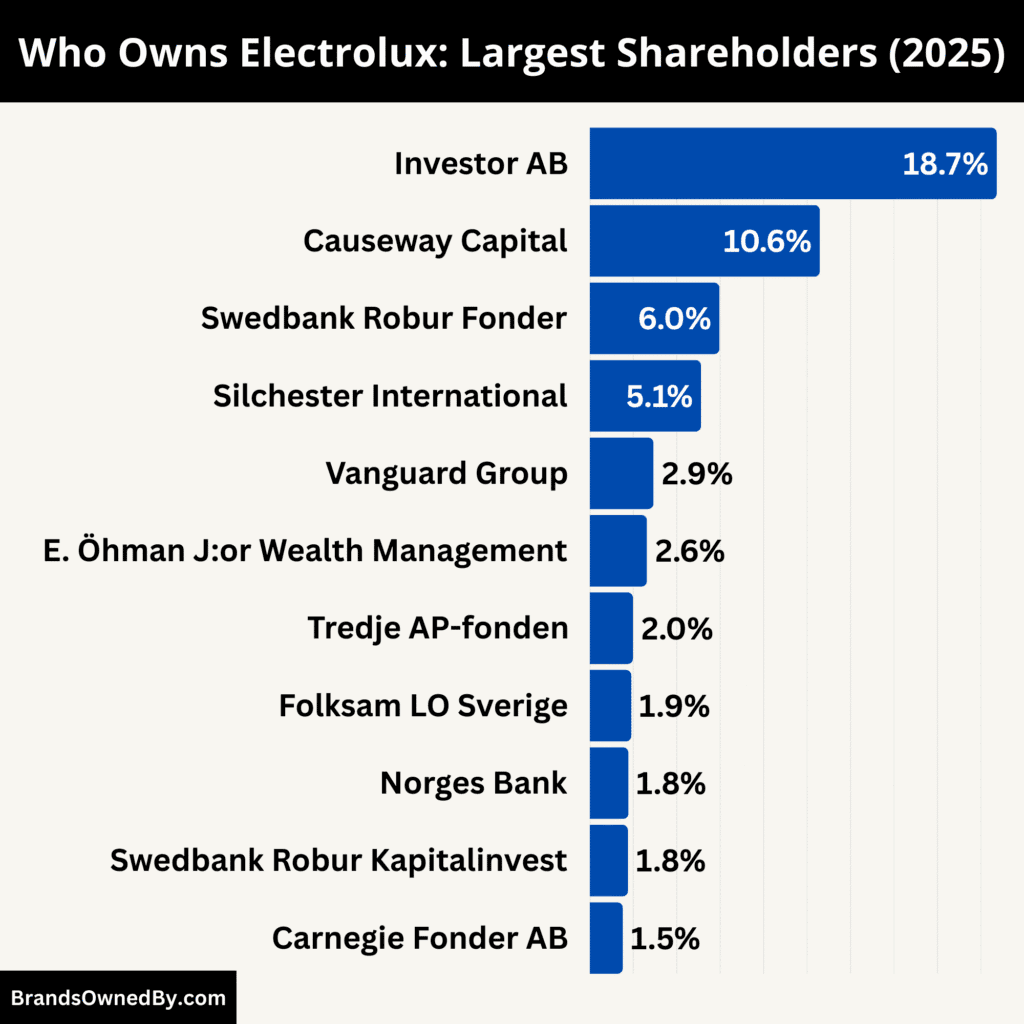
Electrolux is a publicly traded company listed on the Nasdaq Stockholm exchange. Its ownership is spread across institutional investors, asset managers, and long-term strategic shareholders. The most influential shareholder is Investor AB, the investment company controlled by Sweden’s Wallenberg family.
Investor AB holds high-voting Class A shares. These shares provide stronger voting rights than ordinary shares. Because of this structure, Investor AB has significant influence over Electrolux’s board and long-term corporate strategy. Through Electrolux, Investor AB indirectly holds ownership influence over Frigidaire. Other shareholders include global investment firms and pension funds, but none individually have comparable control.
How Electrolux Acquired Frigidaire
Frigidaire became part of Electrolux in 1986 through the acquisition of White Consolidated Industries (WCI). At that time, WCI owned several appliance brands, with Frigidaire being the most valuable. This acquisition was a turning point for Electrolux.
Before the deal, Electrolux had limited presence in the United States. By acquiring WCI, Electrolux gained instant access to the North American appliance market. It also obtained established manufacturing plants, distribution channels, and long-standing retailer relationships. Most importantly, it acquired the Frigidaire brand, which already had strong consumer recognition and trust.
The acquisition allowed Electrolux to compete directly with major appliance giants in the United States. Frigidaire became the company’s primary brand for mainstream consumers, while the Electrolux brand itself targeted the premium segment. This dual-brand strategy strengthened Electrolux’s market coverage and competitive position.
Why Frigidaire Matters to Electrolux
Frigidaire is one of Electrolux’s most important brands in North America. It generates substantial appliance sales across refrigerators, cooking ranges, and home kitchen products. The brand has deep retail penetration and long-standing consumer loyalty in the United States.
Electrolux uses Frigidaire to maintain strong relationships with large retailers, home improvement chains, and appliance distributors. The brand’s wide product range allows Electrolux to compete across multiple price points. It also helps balance the company’s portfolio between premium and mass-market segments.
Frigidaire’s strong legacy and brand recognition make it a strategic asset. It gives Electrolux stability in North America, which is one of the most competitive appliance markets in the world.
Legal and Operational Structure
Frigidaire is not an independent corporation. It does not have its own stock, separate financial reporting, or independent leadership at the corporate level. All major decisions are made by Electrolux executives and its board of directors.
However, Frigidaire operates with its own brand identity, product lines, and marketing strategy. It functions as a specialized brand division within Electrolux. This structure allows centralized control while preserving Frigidaire’s historic brand value and consumer recognition.
Competitor Ownership Comparison
Frigidaire operates under Electrolux, a focused global appliance manufacturer. Its competitors, however, are controlled by very different ownership models. Some are widely held public corporations. Others are family-influenced conglomerates or privately controlled industrial groups. These ownership differences directly shape strategy, investment priorities, innovation speed, and global expansion.
| Brand / Competitor | Parent Company | Ownership Type | Controlling Shareholder / Influence | Strategic Impact of Ownership |
|---|---|---|---|---|
| Frigidaire | AB Electrolux (Sweden) | Public company (brand within parent) | Investor AB (Wallenberg family influence through high-vote shares) | Focused appliance strategy. Strong North American presence. Balanced mass-market positioning supported by global manufacturing and R&D. |
| Whirlpool | Whirlpool Corporation (USA) | Public company | Widely held by institutional investors such as Vanguard, BlackRock, State Street | Pure-play appliance company. Multi-brand portfolio across price segments. Strong focus on efficiency, margins, and shareholder returns. |
| GE Appliances | Haier Smart Home / Haier Group (China) | Public company with centralized group control | Haier Group maintains strong strategic control | Global platform strategy. Integration of regional brands. Strong manufacturing scale and global supply chain coordination. |
| Samsung Appliances | Samsung Electronics / Samsung Group (South Korea) | Public company with family influence | Lee family influence through cross-shareholding | Technology-driven strategy. Strong smart appliance ecosystem. Heavy investment in AI, chips, and connected home products. |
| LG Appliances | LG Electronics / LG Group (South Korea) | Public company with family influence | Koo family historical controlling influence | Vertically integrated innovation. Focus on premium appliances, efficiency, and smart home ecosystem expansion. |
| Bosch Appliances | BSH Hausgeräte / Bosch Group (Germany) | Privately controlled industrial group | Bosch Group (private ownership) | Long-term engineering focus. Premium positioning. Strong emphasis on product quality, durability, and European design. |
Whirlpool Corporation
Whirlpool is one of Frigidaire’s closest rivals in North America. It is owned by Whirlpool Corporation, an independent publicly traded U.S. company. Unlike Frigidaire, which is a brand within Electrolux, Whirlpool itself is the central operating company.
Ownership of Whirlpool is widely distributed among institutional investors such as Vanguard, BlackRock, and State Street. There is no controlling family or dominant shareholder. Governance is driven by a corporate board and executive leadership. This structure pushes Whirlpool to focus strongly on shareholder returns, operational efficiency, and brand portfolio management.
Whirlpool owns multiple major appliance brands including Whirlpool, Maytag, KitchenAid, and Amana. Its multi-brand structure allows it to cover entry-level, mid-range, and premium segments simultaneously. In contrast, Frigidaire serves mainly as Electrolux’s core mainstream brand, with fewer independent brand layers under its name.
GE Appliances under Haier Group
GE Appliances is another major competitor in refrigerators, cooking appliances, and laundry products. However, GE Appliances is no longer owned by General Electric. It is owned by Haier Smart Home, part of China’s Haier Group.
Haier acquired GE Appliances in 2016 to gain a strong foothold in the U.S. market. The acquisition provided Haier with advanced manufacturing facilities, established retail relationships, and a trusted American brand. Haier operates with a hybrid ownership structure. It is publicly listed but maintains strong centralized control and long-term industrial planning.
Compared with Electrolux, Haier follows a platform-based global strategy. It integrates regional brands like GE Appliances into a broader international ecosystem. Frigidaire, by contrast, operates more as a traditional brand within a focused appliance company rather than a globally networked smart manufacturing platform.
Samsung Electronics
Samsung is a powerful competitor in modern home appliances, especially in smart refrigerators and connected kitchen systems. Samsung appliances are owned by Samsung Electronics, a flagship company within the Samsung Group.
Samsung Electronics is publicly traded, but the Lee family maintains long-term strategic control through cross-shareholding across the group. Appliances are only one part of Samsung’s massive business, which also includes semiconductors, smartphones, displays, and consumer electronics.
This diversified structure gives Samsung strong advantages in technology integration. Its appliance division benefits from internal chip development, AI software, and smart home ecosystems. Compared to Frigidaire, Samsung invests more aggressively in connectivity, automation, and premium design, while Frigidaire focuses more on reliability, usability, and broad consumer affordability under Electrolux.
LG Electronics
LG is another major global appliance competitor. LG Electronics is publicly traded and operates under LG Corporation, the holding company of the LG Group. Historically, the Koo family has maintained strong influence over the group’s direction.
LG’s ownership structure allows long-term planning and heavy investment in innovation. The company is vertically integrated, meaning it develops many of its own components and technologies internally. Like Samsung, LG appliances are part of a broader technology ecosystem including displays, batteries, and smart home platforms.
Compared to Frigidaire, LG competes more strongly in the premium and technology-driven segments. Frigidaire remains more focused on mainstream households, consistent performance, and practical appliance design backed by Electrolux’s manufacturing and engineering base.
Bosch and BSH Hausgeräte
Bosch appliances compete with Frigidaire mainly in kitchen appliances, especially dishwashers and cooking products. Bosch home appliances are produced by BSH Hausgeräte, which is majority-owned by the Bosch Group.
Bosch Group is privately controlled, which gives it long-term strategic stability without pressure from public shareholders. This ownership model allows consistent investment in engineering, manufacturing quality, and product durability. BSH manages multiple brands including Bosch, Siemens, and other regional appliance labels.
Compared with Frigidaire, Bosch is positioned more toward premium engineering and European design. Frigidaire, under Electrolux, focuses more on value-driven innovation and strong retail penetration in North America.
How Ownership Shapes Competition
Ownership structure strongly influences how appliance companies compete. Frigidaire benefits from Electrolux’s focused appliance expertise and global manufacturing scale. Whirlpool operates as a pure-play appliance corporation driven by institutional shareholders. Haier uses acquisitions and global integration to expand market reach. Samsung and LG leverage technology ecosystems and family-influenced conglomerate control. Bosch operates with private industrial ownership and engineering-driven strategy.
These structural differences shape product positioning, innovation priorities, and market strategy. Frigidaire’s strength lies in stability, brand heritage, and balanced positioning within Electrolux’s global appliance portfolio.
Who Controls Frigidaire?
Frigidaire is controlled by its parent company, AB Electrolux. The brand does not operate as an independent corporation. All strategic, operational, and financial decisions are directed through Electrolux’s corporate structure. Control flows from shareholders to the board of directors, then to executive leadership, and finally to regional management that runs the brand in daily operations.
Corporate Control by AB Electrolux
Frigidaire functions as a brand division within Electrolux. It does not have separate ownership, stock, or independent governance. Electrolux determines long-term strategy, product roadmap, manufacturing footprint, and global positioning for the brand.
Key decisions such as product platform development, factory allocation, technology investment, and supply chain integration are made centrally by Electrolux. Frigidaire is primarily managed under Electrolux’s North American business unit. This division oversees refrigerators, cooking appliances, dishwashers, and laundry products sold across the United States and Canada.
CEO and Executive Leadership
As of 2025, Electrolux is led by CEO Yannick Fierling. He holds ultimate executive authority over all Electrolux brands, including Frigidaire. The CEO directs global strategy, operational priorities, and market expansion.
Supporting the CEO is a senior executive team responsible for product development, manufacturing, innovation, supply chain, and regional performance. These executives shape how Frigidaire products are engineered, produced, priced, and distributed. Although Frigidaire has brand management teams, they operate within the strategic framework set by Electrolux leadership.
Role of the Board and Shareholder Influence
Electrolux’s board of directors governs the company on behalf of shareholders. The board approves major investments, sets long-term strategy, and appoints executive leadership. Through this structure, the board indirectly controls Frigidaire.
Investor AB, the largest shareholder of Electrolux, holds high-voting shares that provide strong influence over board composition and corporate direction. This gives the Wallenberg investment group indirect control over Electrolux and its brands. However, operational control remains with professional management rather than shareholders.
North America Operational Leadership
Frigidaire’s day-to-day control sits with Electrolux North America leadership. This regional team manages product launches, pricing strategy, retailer relationships, and market competitiveness. They coordinate closely with global engineering and manufacturing teams to ensure consistent product quality and supply.
Brand managers oversee Frigidaire’s market positioning, advertising, and product lineup. They ensure the brand remains competitive in core categories such as refrigeration, cooking, and kitchen appliances. While regional leaders manage execution, all major strategic decisions still originate from Electrolux headquarters.
How Control Functions in Practice
Control over Frigidaire operates through a structured chain. Shareholders influence Electrolux through voting rights. The board sets direction and governance. The CEO and executive leadership translate strategy into action. Regional management executes operations in North America, where the brand is most active.
This centralized structure allows Electrolux to maintain consistent product standards, global efficiency, and unified brand strategy. Frigidaire keeps its distinct identity in the marketplace, but ultimate control remains firmly with Electrolux.
Frigidaire Annual Revenue and Net Worth
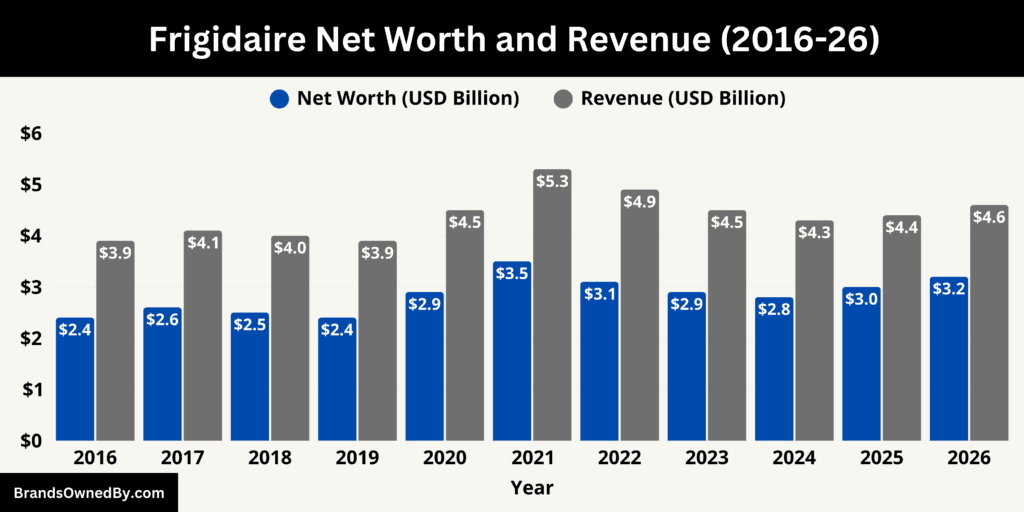
As of February 2026, Frigidaire generates an estimated $4.6 billion in annual revenue and holds an approximate brand net worth of $3.2 billion. Although Frigidaire does not release independent financial statements, its scale can be modeled using market share, shipment volume, product mix, and North American appliance demand.
2026 Revenue Breakdown
Frigidaire’s total estimated revenue in 2026 is $4.6 billion. The majority of sales come from North America, which remains the brand’s core market.
By region, the United States contributes approximately $3.82 billion, accounting for about 83% of total revenue. Canada generates roughly $552 million, representing 12%. Latin America and other smaller markets contribute about $228 million, or 5%.
By product category, refrigeration is the largest contributor. Refrigerators and freezers generate about $2.12 billion, representing 46% of total revenue. Cooking appliances, including ranges, ovens, and cooktops, contribute approximately $1.29 billion, or 28%. Laundry appliances, including washers and dryers, generate about $506 million, accounting for 11%. Dishwashers produce roughly $414 million, or 9%. Room air conditioners and other small appliances contribute around $276 million, representing 6%.
In unit terms, Frigidaire sells an estimated 4.9 to 5.2 million major appliances annually. The average selling price across all categories is approximately $885 per unit. Refrigerators have the highest revenue impact due to both higher unit price and strong replacement demand.
2026 Net Worth and Brand Value
Frigidaire’s estimated brand net worth as of February 2026 is $3.2 billion. This valuation is based on revenue strength, brand longevity, replacement demand stability, and market share in the North American appliance industry.
Using a standard appliance brand valuation multiple of approximately 0.7x revenue, applied to $4.6 billion, results in an estimated brand value near $3.2 billion. This multiple reflects Frigidaire’s stable but not premium positioning. The brand operates in the mid-market segment, which typically receives lower valuation multiples than high-end luxury appliance brands but higher than low-cost manufacturers.
Frigidaire’s brand value is supported by several measurable factors. The brand holds an estimated 14% to 16% share in the U.S. mid-range refrigerator market. It maintains distribution across more than 10,000 retail locations in North America. Replacement demand cycles average 9 to 12 years for major appliances, ensuring recurring revenue stability. The brand also benefits from over a century of consumer recognition, which strengthens long-term brand equity.
From a historical perspective, Frigidaire’s valuation peaked around $3.5 billion in 2021 when revenue reached approximately $5.3 billion during elevated appliance demand. As market conditions normalized, brand value adjusted before stabilizing again at $3.2 billion in 2026.
Overall, Frigidaire’s financial profile in 2026 reflects strong category leadership in refrigeration, balanced product diversification, and consistent multi-billion-dollar revenue generation, supporting stable long-term brand value.
Future Revenue Forecast
Frigidaire is expected to continue steady and moderate growth through the end of the decade. The brand benefits from stable appliance replacement cycles, strong presence in mid-range refrigerators and cooking appliances, and consistent demand across North America. Growth is projected to remain gradual rather than aggressive, supported by product refresh cycles, energy-efficient models, and stable housing demand.
- 2027: Revenue is projected to reach approximately $4.75 billion, with estimated brand net worth around $3.3 billion. Growth is expected to be supported by steady refrigerator replacement demand and improved manufacturing efficiency.
- 2028: Revenue is forecast to rise to about $4.9 billion, while brand net worth may increase to roughly $3.45 billion. Product refresh cycles and continued strength in cooking appliances are expected to drive expansion.
- 2029: Revenue is expected to approach nearly $5.05 billion, with brand net worth estimated around $3.6 billion. Gradual adoption of smart and energy-efficient appliances is likely to support sustained growth.
- 2030: Revenue is projected to reach approximately $5.2 billion, with brand net worth potentially rising to about $3.8 billion. Long-term appliance replacement cycles, stable market share, and continued consumer demand are expected to support this growth.
Overall, Frigidaire’s outlook remains stable and predictable. The brand’s consistent mid-market positioning, strong retail distribution, and reliable product demand provide a solid foundation for gradual revenue and brand value expansion through 2030.
Brands Owned by Frigidaire
As of 2026, Frigidaire operates multiple product lines, sub-brands, and internal operating entities that function as distinct business segments within the Frigidaire ecosystem. These divisions focus on specific appliance categories, market tiers, and consumer needs.
| Brand / Division | Type | Core Focus | Key Products | Market Position | Revenue Contribution (Est.) |
|---|---|---|---|---|---|
| Frigidaire (Core Brand) | Main Consumer Brand | Mainstream household appliances | Refrigerators, ranges, ovens, dishwashers, washers, dryers, freezers | Mid-market mass consumer segment | ~60% of total brand revenue |
| Frigidaire Gallery | Premium Sub-Brand | Enhanced design and upgraded features | Convection ovens, induction ranges, advanced refrigerators, high-efficiency dishwashers | Upper mid-range segment | ~18% of total brand revenue |
| Frigidaire Professional | High-Performance Sub-Brand | Near-commercial kitchen performance | Professional ranges, built-in ovens, column refrigerators, cooktops | Upper mid-range / premium home segment | ~8% of total brand revenue |
| Frigidaire Commercial | Commercial Division | Light commercial refrigeration | Upright freezers, beverage coolers, commercial refrigeration units | Small business and institutional segment | ~4% of total brand revenue |
| Frigidaire Smart Home | Technology Division | Connected and Wi-Fi-enabled appliances | Smart refrigerators, connected ovens, app-enabled dishwashers | Tech-enabled mid to upper segment | Integrated across Gallery & Professional lines (~5%) |
| Frigidaire HVAC & Air Solutions | Climate & Air Division | Residential air conditioning and air quality | Window AC units, portable ACs, dehumidifiers | Mass-market residential segment | ~5% of total brand revenue |
| Frigidaire Parts & Service | After-Sales Division | Replacement parts and service support | OEM spare parts, warranty services, technician support | Post-sale support & recurring service revenue | Recurring service revenue stream |
Frigidaire (Core Brand)
Frigidaire is the primary operating brand and the foundation of all business activity. It focuses on mainstream household appliances including refrigerators, freezers, cooking ranges, ovens, dishwashers, washing machines, dryers, and air conditioners. The core brand targets the mid-market segment and generates the majority of Frigidaire’s annual revenue. It is positioned for reliability, practical functionality, and affordability. Most products are sold through major appliance retailers, home improvement chains, and online distribution platforms across North America.
Frigidaire Gallery
Frigidaire Gallery is a premium-tier sub-brand positioned above the core Frigidaire line. It focuses on upgraded features, enhanced design, and improved performance. Products include advanced refrigerators with better cooling control, convection ovens, induction cooking ranges, and high-efficiency dishwashers. Gallery appliances are targeted at consumers seeking higher-end features without moving into luxury appliance pricing. This sub-brand contributes significantly to Frigidaire’s cooking appliance and kitchen package sales.
Frigidaire Professional
Frigidaire Professional represents the highest-performance segment within the Frigidaire brand structure. It focuses on near-commercial appliance capability for serious home cooks. The product line includes professional-grade cooking ranges, built-in ovens, cooktops, column refrigerators, and advanced ventilation systems. These appliances emphasize precision temperature control, heavy-duty construction, and high cooking output. Frigidaire Professional strengthens the brand’s presence in the upper mid-range kitchen appliance segment.
Frigidaire Commercial (Foodservice and Refrigeration Solutions)
Frigidaire Commercial operates as a specialized division focused on commercial-grade refrigeration and food storage solutions. It provides upright freezers, beverage coolers, and heavy-duty refrigeration units designed for small businesses, restaurants, and institutional environments. While smaller in scale compared to consumer appliances, this segment expands Frigidaire’s reach beyond residential markets and contributes steady niche revenue.
Frigidaire Smart Home and Connected Appliances
Frigidaire operates a connected appliance ecosystem within its product lineup. This division focuses on smart refrigerators, Wi-Fi-enabled ovens, connected dishwashers, and remote appliance monitoring systems. These products allow users to control temperature, cooking settings, and maintenance alerts through mobile applications. The smart appliance segment represents a growing share of Frigidaire’s premium product sales and supports long-term modernization of the brand.
Frigidaire HVAC and Air Solutions
Frigidaire HVAC and Air Solutions focuses on room air conditioners, portable AC units, dehumidifiers, and air quality products. This segment operates seasonally but contributes consistent revenue through strong demand in residential cooling and indoor air management. Frigidaire’s air conditioning products are widely distributed across North America and serve both residential and small commercial environments.
Frigidaire Appliance Parts and Service Division
Frigidaire operates an internal parts and service entity responsible for replacement components, repair services, and product maintenance support. This division manages spare parts distribution, warranty services, and certified technician networks. It plays a critical role in maintaining long-term customer relationships and recurring revenue through post-sale support and appliance servicing.
Acquisitions and Mergers Under Frigidaire
As of 2026, Frigidaire has not independently acquired or merged with other standalone companies because it operates as a brand rather than a corporate holding entity. All major acquisitions historically associated with Frigidaire, including its integration into Electrolux, were executed at the parent company level rather than by the brand itself.
Instead of corporate acquisitions, Frigidaire has expanded primarily through internal product line development, category expansion, and technological integration. The creation of Frigidaire Gallery, Frigidaire Professional, and smart appliance divisions represents organic brand expansion rather than external acquisitions.
Overall, Frigidaire’s structure is centered around product-line diversification rather than ownership of independent companies. Its operational ecosystem includes multiple appliance segments, premium sub-brands, service entities, and connected technology platforms, all functioning under the unified Frigidaire brand identity as of 2026.
Final Thoughts
Frigidaire remains one of the most recognized appliance brands in North America. For those asking who owns Frigidaire, the answer is clear: the brand operates under Electrolux and functions as a core part of its global appliance portfolio. Over the decades, Frigidaire has maintained its reputation for dependable, practical, and accessible home appliances.
Its strength comes from consistent product demand, strong retail presence, and long-standing consumer trust. While the brand continues to evolve with modern technology and efficiency improvements, its core focus remains reliability and everyday performance. This balance of legacy and stability keeps Frigidaire firmly positioned as a leading household appliance brand.
FAQs
Where are Frigidaire appliances made?
Frigidaire appliances are manufactured in multiple countries. Major production takes place in the United States and Mexico, with additional manufacturing in other global facilities depending on the product category and supply chain requirements.
Who makes Frigidaire freezers?
Frigidaire freezers are made by Electrolux. The parent company designs, manufactures, and distributes all Frigidaire refrigeration products, including upright and chest freezers.
What is Frigidaire parent company?
Frigidaire’s parent company is AB Electrolux, a Swedish multinational home appliance manufacturer that owns and operates the brand globally.
Does Electrolux own Frigidaire?
Yes. Electrolux has owned Frigidaire since 1986 after acquiring White Consolidated Industries, the former owner of the brand.
Who makes Frigidaire washing machines?
Frigidaire washing machines are manufactured by Electrolux. Production is primarily handled in Electrolux-operated facilities in North America and other global manufacturing locations.
Does China own Frigidaire?
No. Frigidaire is not owned by China. It is owned by Electrolux, a Swedish company. However, some components or appliances may be produced in global factories, including Asia, as part of international manufacturing.
Are Frigidaire and LG the same?
No. Frigidaire and LG are completely different brands. Frigidaire is owned by Electrolux, while LG appliances are made by LG Electronics, a South Korean company.
Are GE and Frigidaire the same?
No. GE Appliances and Frigidaire are separate brands. GE Appliances is owned by Haier, while Frigidaire is owned by Electrolux.
Does Haier own Frigidaire?
No. Haier does not own Frigidaire. Haier owns GE Appliances, while Frigidaire belongs to Electrolux.
Is Frigidaire owned by Bosch?
No. Frigidaire is not owned by Bosch. Bosch appliances are part of the Bosch Group, while Frigidaire is owned by Electrolux.
Is Frigidaire part of Samsung?
No. Frigidaire is not part of Samsung. Samsung appliances are produced by Samsung Electronics, which is separate from Electrolux.
Is Frigidaire made in USA?
Some Frigidaire appliances are made in the United States, especially certain refrigerators and cooking appliances. However, production also occurs in Mexico and other countries depending on the model.
Is Frigidaire made by Whirlpool?
No. Frigidaire is not made by Whirlpool. Frigidaire is manufactured by Electrolux, while Whirlpool produces appliances under its own separate brand portfolio.